ARTIGO TÉCNICO M. Oliveira, V. Santos, Memberr, IEEE Department of Mechanical Engineering University of Aveiro, Portugal {mriem,vsantos}@mec.ua.pt.
COMBINING VIEW-BASED OBJECT RECOGNITION WITH TEMPLATE MATCHING FOR THE IDENTIFICATION AND TRACKING OF FULLY DYNAMIC TARGETS ABSTRACT This paper describes a system intended to identify and track dynamic targets that may change appearance while moving. The full system includes a pan and tilt unit to ease tracking and keep the interesting target in the center of the image. View-based Haar-like features are used for object recognition while template matching continues to track the object even when its view is not recognized by the object recognition system. Some of the techniques used to improve the template matching performance are also presented. Preliminary results are given and the system performs well up to to 15 frames per second on a 320 x 240 image on an ordinary laptop computer.
I. INTRODUCTION Object recognition using computer vision is a complex problem. Viewbased strategies are receiving an increasing attention because it has been recognized that 3D reconstruction is difficult in practice and also because of some psychophysical evidence for such strategies [1]. Therefore, to have a detector that can recognize an object and track it from every possible view is still a very demanding challenge. Furthermore, the dimension of a database to contain all of the objects possible points of view should be immense just for each single object, unleashing some other problems concerned with real time processing.
For visual tracking, a servo controlled pan & tilt unit is used. It supports a velocity of up to 300º/sec in both axes. Two IEEE1394 cameras are installed on the unit unit, though, though for now, now only one camera is used. used
This paper proposes a method for tracking fully dynamic objects (that may rotate over any axis and, to some extent, modify shape), based on Haar features [2] [3] that are used as a single view identifier and complemented by template matching to track a previously classified object. Templates are self-updated when Haar features fail and redefined when they succeed, allowing the object to freely move and rotate overcoming temporary failures of the identification module. First, the paper describes some of the ways that were used to capture the systems attention so that a particular image region may be processed by the identifier. Secondly, the tracker’s implementation in a pan and tilt unit is briefly described and finally some of the several identifying and tracking techniques studied so far are discussed. This work’s final objective is to identify and track objects moving and rotating through dynamic environments in real time (15Hz). Dynamic environments are difficult to handle because of the difficulties in achieving an accurate background subtraction without depth measurements that could be taken from stereo vision or laser. Moreover, light conditions may change considerably. Although it is still an ongoing work, there are some results mainly with using Haar-like features for identification and tracking with template matching and the implementation is following a modular perspective that may allow particular sectors of the task to be independently developed.
[ ]
robótica
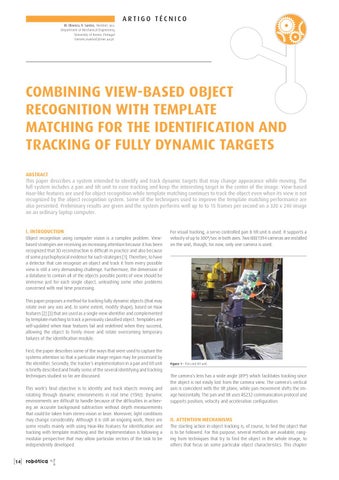
Figure 1 . Pan and tilt unit.
The camera’s lens has a wide angle (89º) which facilitates tracking since the object is not easily lost from the camera view. The camera’s vertical axis is coincident with the tilt plane, while pan movement shifts the image horizontally. The pan and tilt uses RS232 communication protocol and supports position, velocity and acceleration configuration.
II. ATTENTION MECHANISMS The starting action in object tracking is, of course, to find the object that is to be followed. For this purpose, several methods are available, ranging from techniques that try to find the object in the whole image, to others that focus on some particular object characteristics. This chapter
ARTIGO TÉCNICO
Figure 11 . Haar detection (green window in A and I frames) fails at frame B, but tracking continues despite the objects movement and rotation.
VI. RESULTS AND CONCLUSIONS This paper proposes a method for combining view-based identification algorithms with template matching trackers. Up to now, we are able to follow the test object even when it rotates and moves along the laboratory. Figure 12 shows a sequence of frames and the tracking results. In frame A, Haar detection succeeds and a new template is generated. In the following frames, the car’s rear view disappears due to depth rotation. Object identification is no longer possible. At this point, tracking with template matching begins and the object continues to be followed even though, by frame D, it has rotated approximately 90 degrees. In frame I a new template was generated due to a Haar detection event. Therefore the template at frame I has a different size of the one in frame H.
VII. REFERENCES
Figure 12 . Selecting a sub-window of the EGM.
All of Figure 4’s modules are processed at a rate of 15Hz. Further work will scatter trough all of the modules. New object recognition methods will be implemented, namely Gabor filters [1]. Template tracking can be improved by doing sparse feature tracking. Conditioning matrices similar to the Gaussian ones may be utilized to further improve the tracker’s performance. We are also planning to use more objects and to attempt to train a generalized cascade for the detection of cars.
[1] A. Ude, C. Gaskett, G. Cheng, 2004, Support Vector Machines and Gabor Kernels for Object Recognition on a Humanoid with Active Foveated Vision, Proceedings of 2004 IEEEIRSI International Conference on Intelligent Robots and Systems, Sendai Japan. [2] P. Viola, M. Jones 2001. Rapid Object Detection using a Boosted Cascade of Simple Features, Conference on Computer Vision and Pattern Recognition 2001. [3] R. Lienhart and J. Maydt. An Extended Set of Haar-like Features for Rapid Object Detection. IEEE ICIP 2002, Vol. 1, pp. 900-903, Sep. 2002. [4] OpenCV version 0.9.7 FAQ, Included into OpenCV distribution. [5] OpenCV version 0.9.7 cxcore and cvaux documentation, Included into OpenCV distribution. [6] J. Bouget. Pyramidal Implementation of the Lucas Kanade Feature Tracker Description of the Algorithm. Included into OpenCV distribution. [7] D. Stavens, Introduction to OpenCV, Stanford Artificial Intelligence Lab. Found at http://robots.stanford.edu/cs223b05/schedule.html. [8] G. Monteiro, P. Peixoto, U. Nunes, 2006. Vision-based Pedestrian Detection using Haar-like Features. Encontro Científico, Festival Nacional de Robótica 2006. [9] T. Kaneko, O. Hori. Template Update Criterion for Template Matching of Image Sequences, 16th International Conference on Pattern Recognition (ICPR’02) - Volume 2, 2002.
robótica
[ ]