All rights reserved. No part of this book may be reproduced in whole or in part, scanned, photocopied, recorded, distributed in any printed or electronic form, or reproduced in any manner whatsoever, or by any information storage and retrieval system now known or hereafter invented, without express written permission of the publisher, except in the case of brief quotations embodied in critical articles and reviews.
Published by Applesauce Press, an imprint of HarperCollins Focus LLC, 501 Nelson Place, Nashville, TN 37214 USA.
The scanning, uploading, and distribution of this book via the internet or via any other means without permission of the publisher is illegal and punishable by law. Please support authors’ rights, and do not participate in or encourage piracy of copyrighted materials.
13-Digit ISBN: 978-1-40035-475-7
10-Digit ISBN: 1-40035-475-7
Books published by Applesauce Press Book Publishers are available at special discounts for bulk purchases in the United States by corporations, institutions, and other organizations. For more information, please contact the publisher.
cidermillpress.com
Any internet addresses, phone numbers, or company or product information printed in this book are offered as a resource and are not intended in any way to be or to imply an endorsement by Applesauce Press, nor does Applesauce Press vouch for the existence, content, or services of these sites, phone numbers, companies, or products beyond the life of this book.
Without limiting the exclusive rights of any author, contributor or the publisher of this publication, any unauthorized use of this publication to train generative artificial intelligence (AI) technologies is expressly prohibited. HarperCollins also exercise their rights under Article 4(3) of the Digital Single Market Directive 2019/790 and expressly reserve this publication from the text and data mining exception.
HarperCollins Publishers, Macken House, 39/40 Mayor Street Upper, Dublin 1, D01 C9W8, Ireland (https://www.harpercollins.com)
ASL alphabet illustrations used under official license from Shutterstock.com.
Printed in Malaysia
26 27 28 29 30 SEA 5 4 3 2 1
First Edition
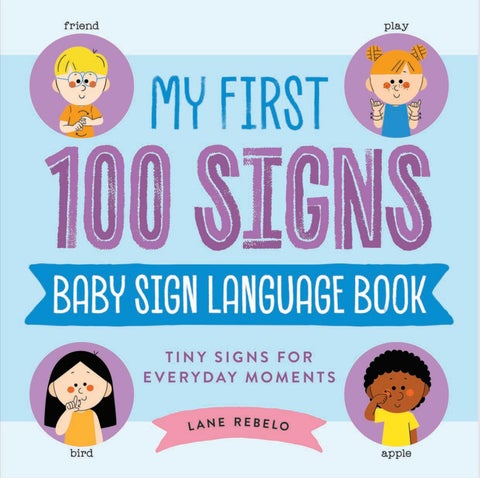
TINY SIGNS FOR EVERYDAY MOMENTS
LANE REBELO
ILLUSTRATED BY ELSA SABATER
Welcome to My First 100 Signs !
Inside these pages, you’ll find a fun and practical collection of signs designed to help you and your little one connect, communicate, and learn together. This book invites you to explore familiar objects, daily routines, and meaningful moments—all while discovering the magic of sign language as a shared experience.
Using signs is a powerful way for babies and toddlers to express themselves long before they can speak. With a little practice and play, you’ll be amazed at just how much your child has to say. Signing not only supports early communication but also strengthens the bond between you and your baby. So dive in, have fun, and enjoy the journey together!
How to Use This Book
Reading with your baby is a wonderful way to nurture language development. When you add a few basic American Sign Language (ASL) signs, you introduce a new dimension of learning—one that’s interactive, hands-on, and filled with connection. Signing turns everyday moments into meaningful opportunities for growth.
You can begin introducing signs at any age—it’s never too early or too late.
Most babies start signing back between 8 and 12 months, but just like with walking or talking, every child reaches milestones at their own pace. Some may begin earlier, others later—and that’s perfectly okay. Remember that signing enhances your child’s natural development and communication— continue to celebrate all of their milestones and maintain regular check-ins with your pediatrician.
Teaching signs can be as simple as waving “bye-bye.” Just pair the spoken word with the sign consistently. Over time, your baby will begin to mimic your actions. With regular modeling and gentle encouragement, signing becomes a natural part of your everyday communication. Before long, your baby will be using signs to tell you what they want, need, or notice— often before they can say a single word.
This book features 100 familiar, engaging words to support your child’s growing interests and vocabulary. Let them explore the pages and see what captures their attention. Use the illustrations and instructions to learn each sign and weave it into your routines. For example, if your baby points to “water,” you might say, “Yes, that’s water!” and then use the sign at bath time: “Let’s take a warm bath in the water!”
Start with a few signs that feel relevant or fun, and build from there. You don’t need to learn them all at once—choose what fits naturally into your day. Over time, you’ll create a shared vocabulary that reduces frustration, deepens connection, and brings joy to everyday life.
Tips for Signing Success
1. Follow Your Baby’s Interests
While practical signs like “milk” or “sleep” are useful, signs that match your baby’s interests—like “light,” “ball,” or even a sign for the family pet—can be more motivating. Watch what excites your child, and start there.
2. Begin with a Few Key Signs
To keep things simple, introduce just a few signs at first and use them consistently. If your baby is already signing, add new signs gradually—a few per week—and enjoy watching their skills grow.
3. Always Sign and Say the Word Together
Every time you use a sign, say the word aloud. This reinforces both the sign and the spoken word, supporting your child’s speech development alongside their signing.
4. Sign in the Moment
Use signs when the object or action is present—sign “milk” during feeding, or “dog” when your dog walks by. This real-time connection helps your baby link signs to meaning more quickly.
5. Keep It Fun!
Signing should be enjoyable for both of you. If your baby isn’t interested in the moment, that’s okay—try again later. Make signing part of playtime, story time, and songs to keep it playful and engaging.
Remember: Every Baby Is Different
Your baby might not sign back immediately—and that’s completely normal!
Many babies are “watchers” who absorb everything before attempting their first sign. Look for other signs of progress: increased pointing, more eye contact during signing, excited reactions to familiar signs, or any deliberate hand movements during relevant moments. These all show that your baby is connecting and communicating, even before formal signs appear. Consistency and patience matter more than perfection, so celebrate every small step along the way!
airplane
Fly your “airplane” (thumb, index finger, and pinkie finger extended) up in the air with two quick jabs.
all done
Twist your open hands away from your body twice.
apple
Twist the knuckle of your index finger on your cheek.
baby
Cradle your arms and rock them from side to side.
ball
Bring your curved hands together twice to show the shape of a ball.
About the Author
Lane Rebelo, LCSW, is the founder of Tiny Signs® and the author of numerous popular baby sign language books. As a licensed clinical social worker, Lane worked for many years with families and young children in the Boston area. Lane began studying American Sign Language in 2006 after her first baby was born and was amazed by all she had to say. She lives with her husband and two teenagers in Massachusetts. You can find Lane online at tinysigns.com .
Access a free video dictionary with all of the signs in the book at tinysigns.com/100signs .
About Applesauce Press Book Publishers
Applesauce Press creates thoughtfully designed children’s books that spark curiosity, creativity, and learning. With a focus on engaging formats and vibrant illustrations, our titles cover a wide range of subjects to educate and delight young readers. As an imprint of HarperCollins Focus, we are dedicated to bringing fresh, beautifully crafted books to families year-round. Learn more at cidermillpress.com.