Keeping Watchful Eyes
Opening weekend with a Kentucky conservation officer
Story and photos by Ciara Knisely
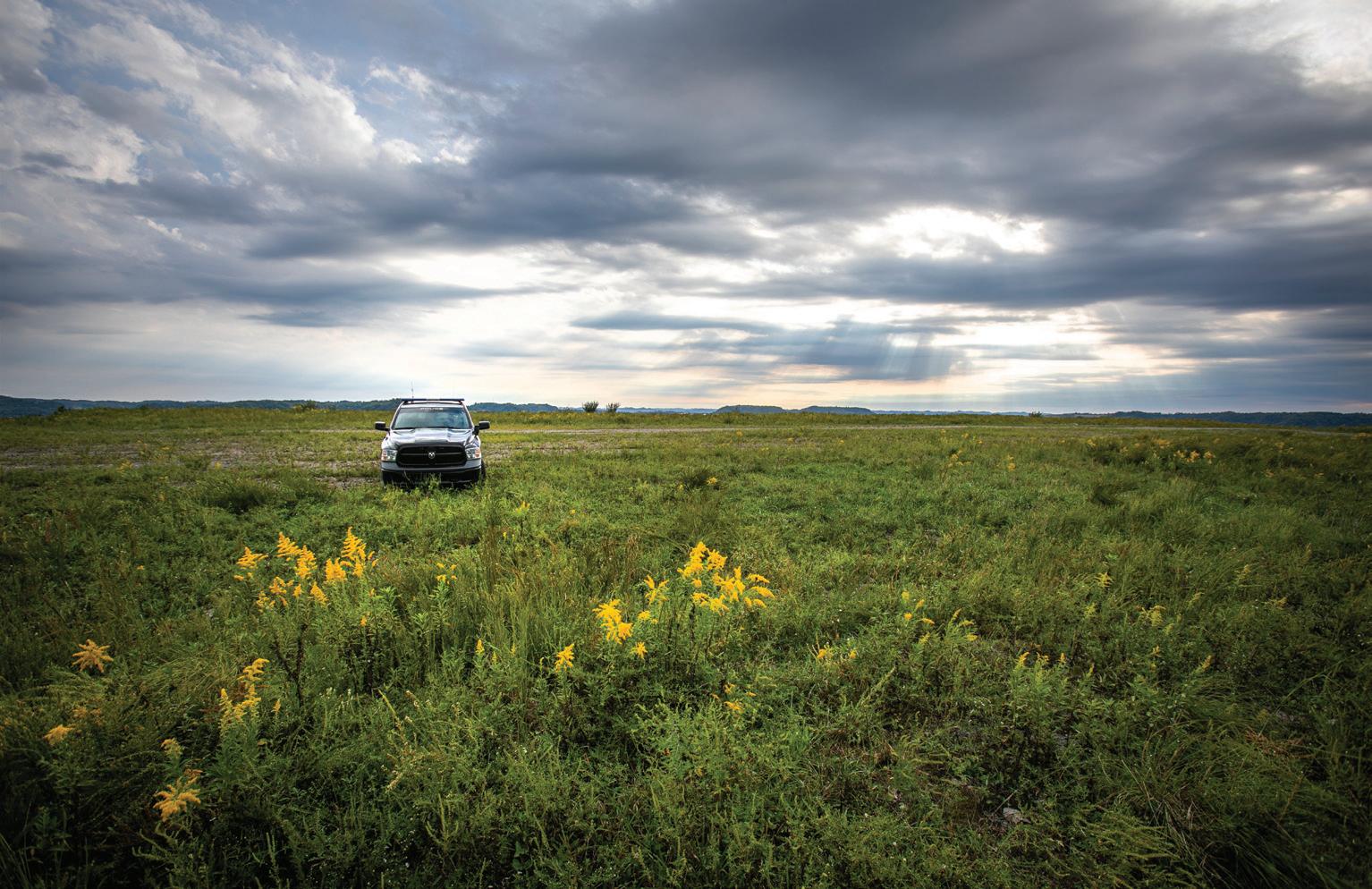
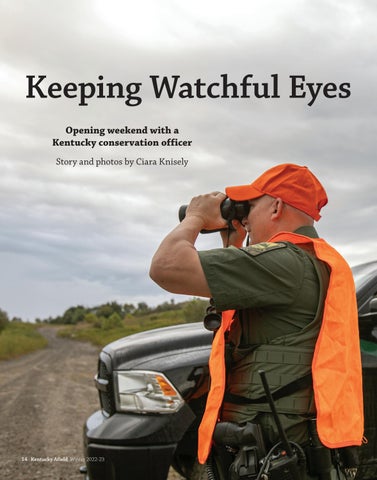
A September dawn has just risen over the original release site of Kentucky’s elk herd in Perry County. Like a bottle-rocket, a bobwhite quail flushes out of the tall brush next to the boot of Conservation Officer Lt. Jason Slone as he steps forward. The open prairie of native grasses and waisthigh goldenrod in front of him appears straight from a painting, but Slone is actually standing on what was once a coal mine.
From this altitude, focusing his binoculars on the ridge across the valley, he stands higher than the fog lingering over the rest of the landscape. Kentucky’s opening day of bull elk firearm hunting season has gotten Slone out of the office, tuned in for radio calls – and bugling bulls.
Kentucky Afield magazine joined Slone and Conservation Officer Glenn Griffie in the fall of 2022 for a law enforcement perspective on elk hunting in Kentucky, on the 25th anniversary of the state’s elk restoration project.
THE OPEN GRASSLANDS of
Appalachia’s reclaimed coal mine sites have supported the growth of Kentucky’s elk herd, going from seven elk transported and released in 1997 into the country’s largest herd east of the Rocky Mountains. Kentucky’s Elk Zone, cornered near the Tennessee and Virginia state lines, includes 16 counties in the southeastern part of the state.
Slone describes harvesting an elk as a once in a lifetime opportunity. As a conservation officer in Kentucky’s Elk Zone, he’s witnessed hunters experience that harvest many times since the state’s first elk hunt drawing in 2001.
ELK RESTORATION ANNIVERSARY
Slone’s patrol area for the opening weekend of Kentucky’s 2022 bull elk firearm season included Knott, Perry, Letcher and Pike counties. On Sunday, he met Kentucky youth hunter Zavian Smith, of Somerset who had harvested a 6 x 7 bull.
Smith filled his elk permit on a reclaimed coal mine site in Pike County. Before his hunting party had worked their way down
the mountainside to recover his bull, Smith said he had watched it tumble down the ridge. “I was afraid it wasn’t going to stop,” he said. “Or that his antlers would be broken.”
By sheer luck, the leveled area of a bench halfway down the mountain had stopped his bull from disappearing into the thickly-forested ravine below.
A silver lining to the mountaintop removal on eastern Kentucky’s landscape has been the creation of elk habitat on reclaimed mine sites. The reestablished vegetation has created a region with western-mimicking open prairie habitat that species such as elk, bobwhite quail, migratory birds and native pollinators need to thrive.
Kentucky Fish and Wildlife employees actively work to open new opportunities for hunters in the region. The department commonly leases or collaborates with landowners, operators of active or reclaimed coal mines, and agencies such as the U.S. Army Corps of Engineers to create elk hunting areas for permit holders. Many of these areas become Hunting Access Areas (HAAs).
“Many hunting areas are broken into multiple tracts across different counties,
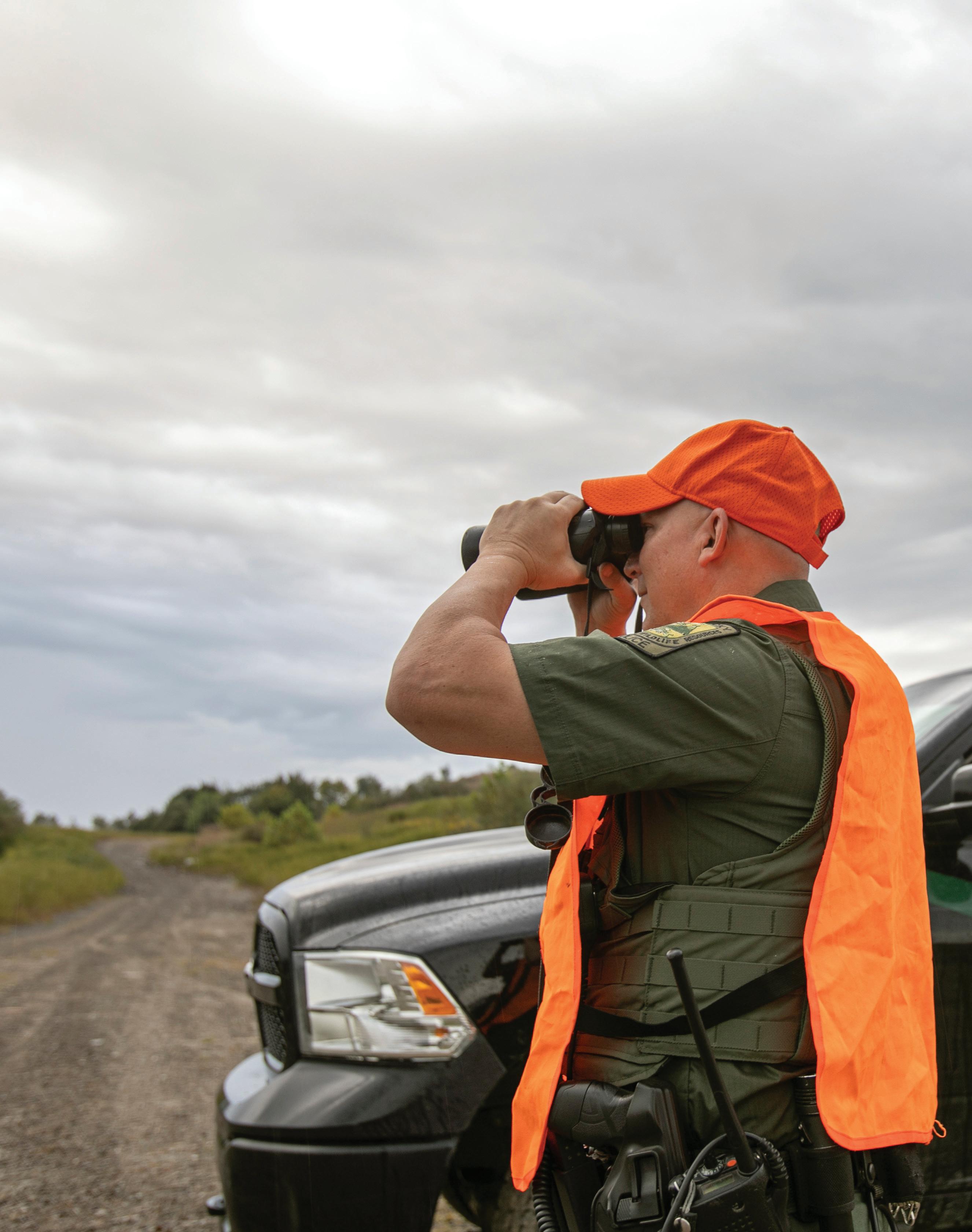
Conservation Officer Lt. Jason Slone scans the mountainsides.
and it’s common for property boundaries to change year to year for whatever reason,” Slone said. “It could be a transfer in ownership, the start of active mining or maybe a new hunting lease statement.”
For pinpointing confusing property lines, Slone encourages hunters to take advantage of mapping and tracking resources through apps such as ArcGIS or the OnX Hunt App.
“Hunting outside of a designated area is the most common violation people are cited for on these hunting areas,” Slone noted, pointing to a rusty fence pole serving as a boundary marker – nearly unnoticeable in the tall grass. “It’s hard for hunters coming here for the first time to find out where and how to access the right area.”
Griffie, a conservation officer based in Perry County, added that hunters sometimes discover they’re using outdated maps.
“When you’re figuring out how to use those trail apps, it really helps to have your phone out and open in the field so you can compare it to whatever you’re looking at,” said Griffie.
The need for good maps is more important now than during elk hunts of the past. “Hunters didn’t have to search as hard because the elk were less wary of human activity. They would find dozens of elk all in one field,” Slone said.
That is no longer the case in hunted areas. “The elk we have in Kentucky now are part of a different generation and behave differently than elk that were captured and released,” Griffie said. “If you come up on one now, especially a more mature bull, by the time you see the elk, it should already be running.”
“There was also less brushy cover to hide behind before the open prairies really grew up,” Slone added.
Looking for any signs of movement on the Hunting Access Areas where he regularly sees elk, Slone pointed out the many thickets of autumn olive in the distance that could obscure resting elk from sight.
Slone has been involved in three state record elk harvests during his 22 years serving in Kentucky Fish and Wildlife’s Law Enforcement Division. “For elk hunting, it’s not as simple as just showing up,” said Slone. His best advice for elk hunters unfamiliar with the area is to spend ample time scouting or to reach out to local landowners for tips. “It is possible see elk without a guide. The hunters who are getting out and going
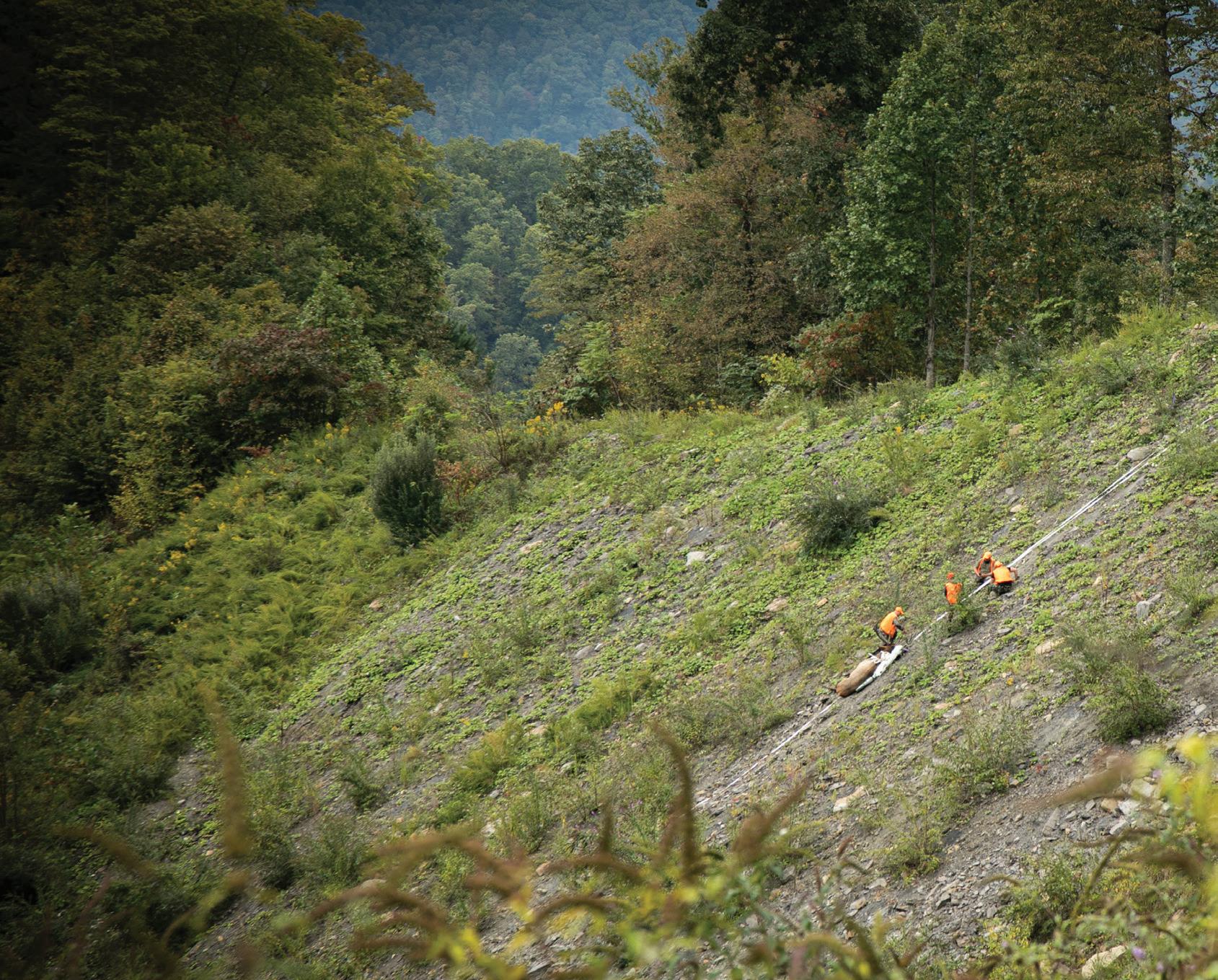
Across the ridge, Smith's helpers slowly eased his harvested bull up the mountain on Pike Elkhorn HAA in Pike County.
deep into the woods are finding them.”
John Hast, elk and bear program coordinator for Kentucky Fish and Wildlife, explained how Kentucky’s elk are changing to better match their environment.
“We have scientific evidence that the large herds once observed are splitting into small groups and spending more time in the timber,” said Hast. “If you think about it, from an evolutionary standpoint, large herds really only work in very open areas like out west. The Kentucky Elk Zone is over 90 percent forested, so these elk do not get any predator protection or other value from a large herd.”
A LIFTED WEIGHT
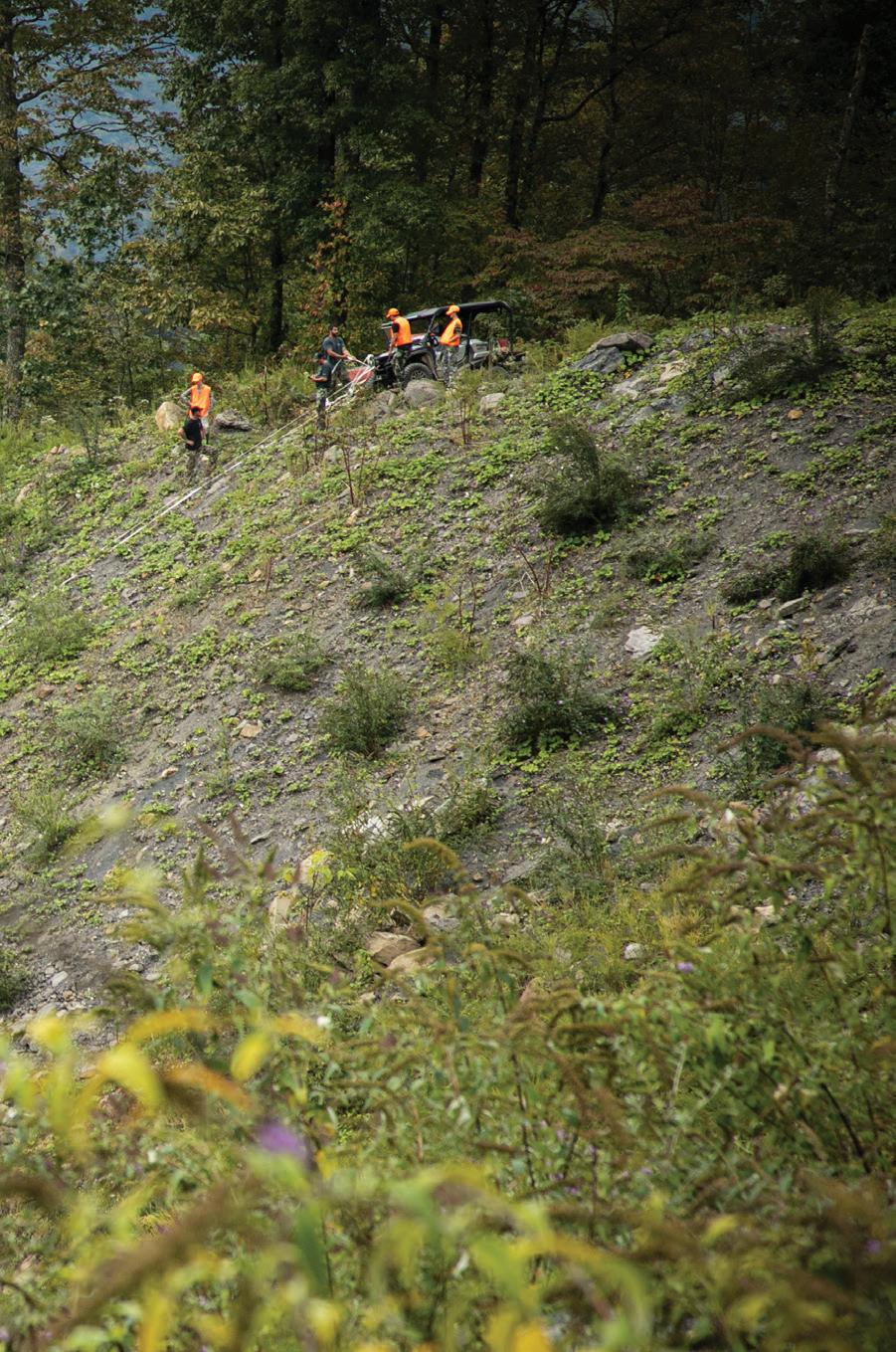
A UTV-mounted winch inches Smith’s elk upward, out from the hollow. Shouts of excitement fill the valley on the Pike Elkhorn Hunting Access Area as the metal sled loaded with Smith’s bull finally crests the ridge. Several men hovering near the sled can now relax; they no longer need to be prepared to jump out of the way if the straps break or come undone. Even field dressed, Slone estimates Smith’s bull weighs around 1,000 pounds.
Hunting on a youth permit, the 15-yearold Smith harvested one of the largest bulls taken that weekend.
Smith is part of the new generation of hunters. Knowing Kentucky’s elk only as the more elusive creatures, he had worried about
filling his elk permit. Just the day before, he’d passed on a shot at a less mature bull.
Standing over his elk and grinning as he looked across the valley, Smith described the decisions running through his head. “I was worried I lost my chance yesterday because I knew today would be my last day to hunt,” he said. “Then I missed my first shot, and he almost ran over the ridge where I wouldn’t have been able to get another shot in,” he said.
The weather also plays a role in hunter success. It had lightly rained the morning Smith harvested his bull.
“Our elk hunting this time of year is very dependent on the weather,” Hast said. “This just shows how important it is to have a bit of cool, rainy weather early in the season to kick off the rut. This fall we had hot and dry conditions and the rut did not really kick in until the second week of bull season, so success rates were down accordingly.”
In contrast to laborious hunting, nuisance complaints against elk were common during the initial years of the department’s restoration effort.
“The elk used to act just like this,” said Slone, nodding toward several unbothered livestock blocking his truck from continuing on the muddy trail toward Knott County Sportsplex, temporarily functioning as a FEMA Disaster Recovery Center.
Griffie also described the elk’s past
behavior like cattle. “We used to get calls about elk blocking the roads all the time, but we only get a few nuisance reports a year now,” he said.
Hast noted that the local community has changed, too, since the reintroduction of elk.
“Nuisance reports were higher early in restoration, but elk were new at that point and many folks did not know what to do when they got in their garden. We still have problems each summer and winter with gardens and hay fields. People have learned to live with the elk and take measures to handle issues on their own,” Hast said.
Kentucky’s first herd became a bonafide part of the community in 1997. “The people here still think of them as their elk,” Slone said.
Having grown up in the eastern Kentucky town of Hindman, Slone’s career with the department’s Law Enforcement Division has brought him more in touch with his home range, living amongst elk country.
ALWAYS ON DUTY
As officers for Kentucky Fish and Wildlife, Slone and Griffie are familiar with the rugged terrain that elk hunters encoun-
ter. Hast described Kentucky’s conservation officers as critical to elk management.
Before coming to Kentucky Fish and Wildlife, Griffie served as a city police officer. “In my current job, there’s a lot less blacktop and a lot more open areas to patrol. We get a lot of calls for assistance with wildlife,” he said.
Griffie already received training as a police officer at his previous job. Kentucky Fish and Wildlife required an additional 12 weeks of training in conservation enforcement.
Depending on the nature of some cases, conservation officers might work with federal officials and other state agencies. Slone helped state police in a poaching and drug trafficking case that ended with a $10,000 settlement when the evidence included wildlife recovered in his district.
Conservation officers aren’t limited to just field work. Slone helped draft new state hunting regulations concerning aerial drones and verifies translations in the Spanish version of Kentucky Fish and Wildlife’s annual Fishing Guide.
Slone and other conservation officers will back up other agencies, including city police, state park rangers and local law enforcement, when necessary. The two doses of Narcan on his dashboard – used for the emergency treatment of opioid overdoses – are reminders of the day he saved two lives with it.
Driving on KY 80 into Hazard, visitors
will see the remnants of destruction from the summer flooding. Troublesome Creek and the North Fork of the Kentucky River have been completely blown out.
Slone, who had also spent time in western Kentucky helping after the tornadoes of December 2021, said he and his officers pulled 16-hour shifts when the floods hit the area.
“Cell phones were immediately gone. Then the radios quit when the station was destroyed,” he recalled. “There was nothing else we could do besides start patrolling and helping wherever we could. Knott and Perry counties were completely destroyed. There were some people who we rescued after we got calls from elk guides who had found survivors.”
However, there are also signs of recovery. Temporary bridges are being replaced with new; the fresh asphalt of KY 80 is a smooth ride.
While cleaning Smith’s elk, Lost Mountain Outfitters guide Hurley Combs held the bull’s heart up in his hand. It dwarfed his palm like a volleyball.
“Some animals will be feasting tonight,” Combs said. The first vulture had already begun circling overhead.
As he watched from across the ridge, Slone recalled the vital organ. “It’s easy to see how they can just keep going,” he said. Like their homeland, Kentucky’s elk are resilient. n
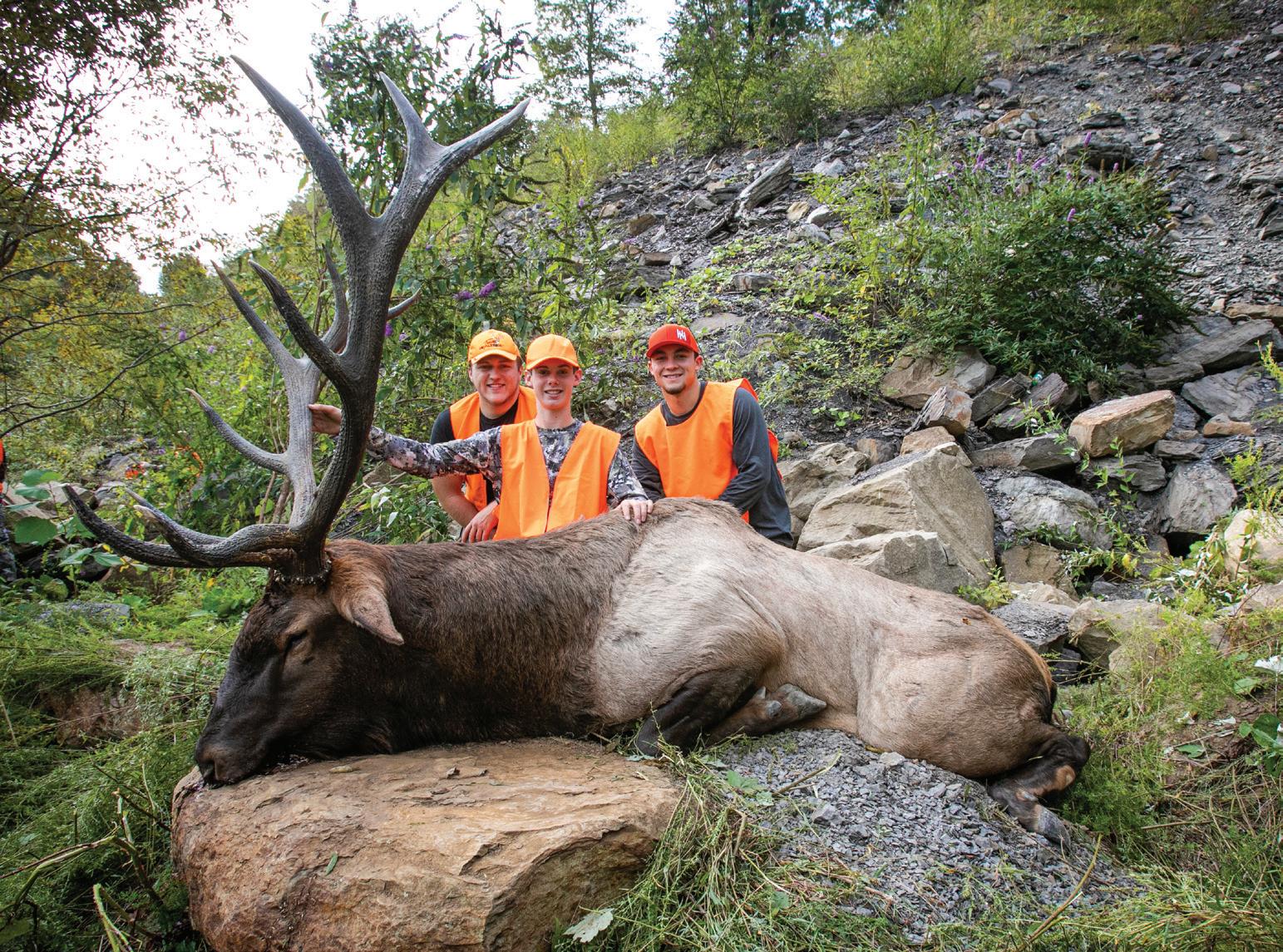
Smith (middle) and his hunting party had to trek up and down steep terrain to recover his bull.