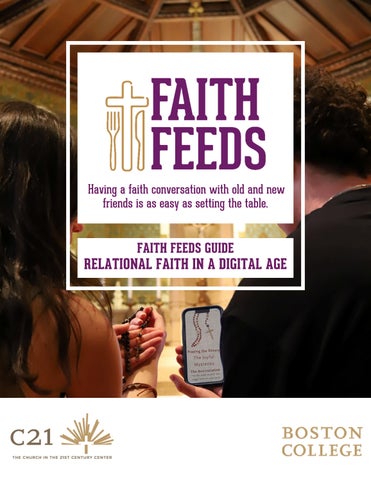
Having a faith conversation with old and new friends is as easy as setting the table.
FAITH FEEDS GUIDE
RELATIONAL FAITH IN A DIGITAL AGE
BOSTON COLLEGE | THE CHURCH IN THE 21ST CENTURY CENTER
The FAITH FEEDS program is designed for individuals who are hungry for opportunities to talk about their faith with others who share it. Participants gather online or in person over coffee or a potluck lunch or dinner and share a conversation using the C21 Center’s downloadable guides. The FAITH FEEDS GUIDE offers easy, step-by-step materials, including articles and questions, to guide the conversation. It’s as simple as: deciding to host the gathering wherever your community is found, selecting a themed guide, and spreading the word. All selected articles for this guide have been taken from the C21 Center’s Fall 2026 issue of C21 Resources, “Deepening Faith & Relationships in a Digital Age.”
CONTENTS Introduction to FAITH FEEDS 2 Conversation Starters/Articles Authentic Faith in an Age of Digital Humanity by Michael Serazio 3 Questions for Conversation 6 A Theology of Communication for a Wounded World by Janet Forbes 7 Questions for Conversation 9 A Conversation with James Martin, S.J. by Michael Serazio and James Martin, S.J. 10 Questions for Conversation 12 Resources for FAITH FEEDS Frequently Asked Questions 14 Checklist to Get Started 15 Facilitator Resources 16 Gathering and Closing Prayers FAITH FEEDS | RELATIONAL FAITH | 2
BOSTON COLLEGE | THE CHURCH IN THE 21ST CENTURY CENTER
ARTICLE 1
AUTHENTIC FAITH IN AN AGE OF DIGITAL HUMANITY By Michael Serazio On May 24, 1844, an inventor named Samuel Morse tapped out the inaugural message to travel by electromagnetic telegraph. The dogs and dashes raced through copper wires connecting Washington to Baltimore. His choice of words was striking, as revealing as it is enduring: “What hath God wrought?” Some 179 years later, when a colleague demoed ChatGPT for the first time at a department meeting, I think I muttered much the same. For religious believers, jaw-dropping breakthroughs in technology—the wheel, the printing press, the steam engine—naturally invite divine attribution.
They signal a world transforming dramatically and possibly irrevocably. They can leave us confused and, by turns, anxious and hopeful. Ours is just such an era. From the dawn of the internet in the 1990s to social media’s emergence a decade later to the AI upheavals of today, digital change feels like the only societal We shape those tools of technology and they, in turn, shape us. And we’ll believe differently because of them: a revolution of both mind and spirit.
FAITH FEEDS | RELATIONAL FAITH | 3
BOSTON COLLEGE | THE CHURCH IN THE 21ST CENTURY CENTER
ARTICLE 1 For just as early Christianity was defined by the affordances of oral communication and, later, the development of writing, so, too, will the texture of faith be molded by digital conditions and values. Our relations with others—that social fabric animating the theological—can still thrive in those spaces if we’re thoughtful and deliberate about them. Woven throughout the articles of this issue are varying names for the same central challenge of online lives: navigating the physical-versus-virtual; the profoundversus-superficial; the real-versus-fake. AI is the apex of that. Such systems seek to read, think, speak, feel, and relate on our behalf. The Catholic Church will have to be a voice that articulates meaning and dignity on behalf of humanity against an AI intrusion that is, by definition, soulless. This digital world therefore confronts us with a new context for an otherwise timeless question: If God hath wrought this, what does it now mean to be human? And how might we find God therein? One could be forgiven for feeling less than hopeful about the prospect of “digital humanity.” For many, that’s a contradiction in terms. Scratch the surface of any number of societal scourges—fragmentation, polarization, alienation—and technology feels like a contributing culprit. Smartphones were addictively designed; algorithms programmed to incentivize emotional extremes. Mix in a generation of vulnerable young people beta-tested by powerful, wealthy corporations eager to “move fast and break things”—and break things they did. Social media overflows with likes—human affection superficially tallied as influencer currency—but Christian love, agape? Less so. In public opinion surveys, AI remains consistently unpopular. That’s because it doesn’t just threaten to automate out of existence countless forms of labor.
Machines have been doing that for hundreds of years. AI threatens to overtake habits of the heart that have long formed the basis of friendship, feeling, and faith. When the pandemic hit, and “social distancing” further atomized humanity, lives once lived in three dimensions suddenly felt depthless in Zoom rooms. And, yet, if Matthew 18:20 has it right, when “two or three are gathered in [Jesus’s] name, I am there among them.” Thank God for dependable Wi-Fi! This is why the tech pessimists are only half right. “Digital humanity” can be a sneer, sure—for all the evidence piled above that technology hollows out our capacity to be full, present, empathetic people of God. Yet, as many of the articles in this issue equally demonstrate, technology can also hallow out our potential as humans as well. It feels like Pope Leo XIV is especially attuned to the promise and peril of this fast-arriving future. He’s no digital native, but then-Robert Prevost reportedly designed the first website for his Augustinian order in the early 2000s. More consequential, still, was his name choice: a nod to Leo XIII, whose papacy grappled with the turbulent aftermath of the Industrial Revolution and thus incubated central tenets of Catholic social teaching. Much as heavy machinery transformed and reordered the world of the 1800s, digital technologies seem poised to unsettle our century (as they already have, abundantly). And much like those Dickensian factories of old, the dignity and humanity of workers ought to be at the forefront of Christian concern. We don’t tend to see that labor—mining rare earths, say, or moderating disturbing content—behind the clean sheen of smartphone glass. But our digital world cannot run without it. Or them. Pope Leo, I believe, will bear that in mind—and in heart. His Magnifica humanitas encyclical, released this summer, is a testament to that. FAITH FEEDS | RELATIONAL FAITH | 4
BOSTON COLLEGE | THE CHURCH IN THE 21ST CENTURY CENTER
ARTICLE 1 It has a pastoral protectiveness woven throughout: a call for safeguards against the threat that AI poses to workers, children, and people who seek peace in the world. And at a time when widespread unemployment is frighteningly forecast, it foregrounds that labor is not just a means to a paycheck but a means to meaning and self-worth. And it’s not just workers who are unsettled. As AI is increasingly normalized, we’re on the cusp of radical cultural change too. Social relations that seem inauthentic now may well cease to be stigmatized as such in the near future—if Silicon Valley has its way. Indeed, part of what tech companies seek to simulate are relationships built upon faith: the most durable of foundations. With more people turning to chatbots for friendship, therapy, romance, and even deepfake reanimations of deceased loved ones, calls will grow to affirm the “personhood” of what is, ultimately, just complex math. Catholicism affirms the fundamental dignity of all human beings. If we reach an age of AGI (i.e., artificial general intelligence), large language models (LLM) will seduce many to be included in that category of consciousness. But an LLM is intrinsically derivative— and humans are created (and creative) in God’s likeness. “We are born as originals, but many of us die as photocopies,” the first millennial saint, Carlo Acutis, cleverly lamented of social media conformity. That yearning that drives people online is, not coincidentally, the same yearning that drives people to faith: a desire for authenticity. We seek from authentic spirituality that which the modern, mediated world often does not provide: a wholeness of true self. And yet, following the Jesuit ideal of “meeting people where they are,” the Christian message must go into that world and adapt to those imperfect conditions. From Archbishop Fulton Sheen charming audiences on broadcast TV to Pope Francis shattering Instagram records to the C21 Center durably “praying it forward” on Zoom—week in and week out— there is ample legacy of this.
For without communication, there can be no community. And for many who can’t always find that community in “real” life—say, the LGBT Catholics that Father James Martin, S.J., welcomes—that online space is vital, soulful, and, frankly, real. The internet is a place of miracle databases and cathedral-tour TikToks and biblical podcasts and prayer apps galore. Finding God in all things means finding God there too. In the end, for me, finding God is but an exercise in focus. That’s important to keep in mind because those same digital industries have designs on our attention more than anything else. Our eyeballs—and, in turn, our minds—form the basis of their billion-dollar industries. Mindfulness is, therefore, a countercultural act against them. And being mindful of others in our lives—in that practice of a relational faith—is equally countercultural. In some ways, one of my favorite parts of the Mass is the silence that precedes it. It’s a prayerful unplug—a minidigital detox, if you will—from the many distractions that came before and the many that await us afterwards on our phones. Perhaps what we need most from our dazzling new technologies is a time and space for reflection—away from them. As I often tell my students, the greatest gift you can ever give someone you love is your attention. God hath wrought that for us too Michael Serazio is a professor and chair of the Department of Communication at Boston College who studies media production. In addition to earlier books on advertising and sports culture, he is the author, most recently, of The Authenticity Industries: Keeping It “Real” in Media, Culture, and Politics from Stanford University Press (2023). A former journalist, he has written essays for The New York Times, The Washington Post, The Atlantic, and other publications.
FAITH FEEDS | RELATIONAL FAITH | 5
BOSTON COLLEGE | THE CHURCH IN THE 21ST CENTURY CENTER
AUTHENTIC FAITH IN AN AGE OF DIGITAL HUMANITY “True progress always stems from a heart open to others, an intelligence willing to listen and a will that seeks what unites rather than what separates.” (Magnifica humanitas 15] -Pope Leo XIV Summary
Author Michael Serazio traces a line from Samuel Morse's telegraph message, "What hath God wrought?" to the arrival of ChatGPT, showing how new technology has always stirred both anxiety and hope. He argues that smartphones, social media, and AI have fueled fragmentation and addiction, yet technology can also "hallow out" our potential when used mindfully. Referencing Pope Leo XIV's new encyclical, which calls for protecting workers, children, and human dignity in the age of AI, he calls Christians to hold firm to the belief that people are made in God's image. He ultimately frames faith in the digital age as a discipline of focus and attention.
Questions for Conversation
1. Serazio compares Morse's "What hath God wrought?" to modern reactions to AI. Do you feel that same mix of anxiety and hope when encountering AI? 2. What do you think Serazio means when he writes, “...humans are created (and creative) in God’s likeness”? 3. Serazio says that the silence preceding Mass is one of his favorite parts of the Mass. How often do you experience moments of silence? Do you intentionally make time for silence?
FAITH FEEDS | RELATIONAL FAITH | 6
BOSTON COLLEGE | THE CHURCH IN THE 21ST CENTURY CENTER
A THEOLOGY OF COMMUNICATION FOR A WOUNDED WORLD
ARTICLE 2
By Janet Forbes The Church Does Not Exist Without Communication From the earliest days of Christianity, faith has been handed on through word, story, gesture, and symbol. The Gospel itself spreads through relationships, through people who encounter Christ and then share that encounter with others. Christianity is not first a philosophy or a system of ideas but a living, breathing relationship with God. My belief is that relationships live or die through communication, and therefore, in this sense, communication is the essential glue that holds the Church together. When that glue weakens, communities fracture, trust erodes, silence replaces dialogue, and the polarization that we see written large across the world today deepens. Conversely, when communication is authentic, truthful, attentive, and rooted in love, the Church becomes what she is meant to be: a communion of people bound together in Christ. Seeing communication through this lens today means that communication can no longer be viewed merely as a practical tool and must be reflected on as a theological reality that mirrors something about the very life and essence of God. Communication and the Life of God At its deepest level, communication reflects the mystery of the Trinity. The Father, Son, and Holy Spirit exist in eternal relationship. Creation itself begins with communication: “Let there be light.” Revelation continues that communication through prophets, Scripture, and ultimately through Christ, the Word made flesh. In Jesus, God’s communication becomes embodied, relational, and visible to humankind. The sacraments continue this pattern. They are forms of divine communication, that is, visible signs that communicate invisible grace. In Baptism, God communicates new life to us. In the Eucharist, Christ communicates his very presence; and in Reconciliation, God communicates forgiveness and mercy. Communication, it would seem, lies at the very heart of our Catholic tradition.
Seen in this way, communication cannot ever be viewed as neutral or benign because it participates in the divine work of building communion amongst God’s people and in the Church. It can divide or reconcile. In essence, communication can either strengthen the covenant that binds the People of God together or weaken it. A Prophetic Council Text In 1963, the Second Vatican Council promulgated Inter mirifica, the Decree on the Means of Social Communication. Compared with documents like Lumen gentium or Gaudium et spes, Inter mirifica rarely receives sustained attention. Yet, when read carefully today, it appears remarkably prophetic. When reading Inter mirifica, it is important to understand that the council fathers were writing before the dawn of the modern media age. Their world was shaped by newspapers, radio, cinema, and the rapidly expanding influence of television. Computers and technology, as we know them, did not exist. In my teaching, I invite students to read Inter mirifica with a contemporary lens substituting original terms such as press, motion pictures, radio, and television with language such as podcasts, social media, digital platforms, and streaming services. Read in such a fashion, the document suddenly feels strikingly current, and with this revelation, we realize that the bishops gathered for the Second Vatican Council understood that communication technologies shape culture itself. So the Council’s concern was not merely functional and technological but moral and visionary. Communication as Covenant In the biblical tradition, a covenant is not a contract but a relationship grounded in fidelity and trust. Covenant in the biblical tradition requires listening, response, and recognition of the other as a person rather than an opponent. Authentic Christian communication is therefore covenantal communication that says: I see you, I hear you, and I will not reduce you to an argument or an ideological label.
FAITH FEEDS | RELATIONAL FAITH | 7
BOSTON COLLEGE | THE CHURCH IN THE 21ST CENTURY CENTER
ARTICLE 2 FRIENDSHIP In an era of rapid digital reaction, this kind of communication is increasingly difficult. Many of the platforms that shape contemporary discourse were developed within corporate environments that prioritize attention, engagement, and market capture. Their algorithms often amplify conflict because conflict generates clicks. Yet we must understand that the Catholic imagination is broader than any one cultural model. The Church is not simply Western. She is global. She speaks in African rhythms, Asian contemplative traditions, Latin American communal spirituality, Indigenous reverence for land and memory, and through centuries of European theological reflection. Catholic unity has never meant uniformity and across the ages this has always meant communion across difference. The challenge we face today is one where we endeavour to honor difference online and in turn learn how to inhabit digital spaces without allowing those spaces to define who we are as Christians. If communication in the Church is covenantal, it must always be grounded in deep listening, remain attentive to cultural diversity and spiritual depth, and always allow room for different voices and experiences within the Body of Christ. Communication and the Heart Pedro Arrupe, S.J., the former superior general of the Jesuits, once observed that the most important question in life is what we fall in love with. For Arrupe, Christian mission was not about winning arguments but about helping people encounter Christ in a way that awakens love. Following Arrupe’s line of thought means that authentic communication flows from that encounter, encounter with God, and encounter with others. Communication grounded in the movement of the heart must always be understood as witness and not propaganda, branding, manipulation, or consumerism, always speaking in a language that invites encounter rather than domination. It listens carefully before responding. It respects cultural contexts while remaining faithful to the Gospel. Communication that ignores diversity fractures the Body of Christ. Communication that honors it strengthens communion. If communication is to be seen as the glue that holds the Church together, then this glue only retains its adhesion when it is rooted in love of God and love of neighbor.
Disarming Language In the early days of his pontificate, Pope Leo XIV spoke of the need for a “peace that is unarmed and disarming,” inviting Christians to resist aggressive rhetoric and to cultivate language that fosters dialogue and encounter. In a world where words, communication, and even the technologies that carry them can easily become instruments of division, they can also become instruments of peace. Disarming language does not mean weak language. It means speech that refuses contempt, truth that is spoken without humiliation, and living the convictions of our beliefs without dehumanization. In a digital environment that rewards outrage and rapid reaction, this approach may appear countercultural, yet it does reflect the deepest logic and rationality of the Gospel. If Catholic communication is understood as sacramental and covenantal, then it must resist mirroring the worst instincts of digital culture. The Church cannot simply use media platforms, but must endeavor to humanize them. The Ongoing Task Throughout history, the Church has tackled the thorny issue of technology and has repeatedly navigated numerous thresholds of new media. She has navigated the shift from scroll to codex, from manuscript to printing press, from pulpit to radio, from television to livestream. Today, in an age shaped by algorithms and digital networks, the question is not whether the Church will communicate online, but how she will communicate within this new landscape. Will our words build trust or erode it? Will our platforms reflect unity in diversity? Will our language disarm hostility or intensify it? The Church has always been called to communicate the Gospel in every age. That task remains unchanged, but the form of communication must always reflect the message itself: the Word who became flesh, who speaks mercy from the Cross, and who continues to call humanity into communion. In a world weary from noise, a Church that communicates with patience, humility, and love may offer one of the most powerful witnesses of all. Janet Forbes is northern youth coordinator and co-director of synod and digital evangelization for the Archdiocese of Armagh. She is also an adjunct lecturer at St. Patrick’s Pontifical College Maynooth, where she teaches on social media and engagement, and is a member of Ireland’s National Synodal Team.
FAITH FEEDS | RELATIONAL FAITH | 8
BOSTON COLLEGE | THE CHURCH IN THE 21ST CENTURY CENTER
A THEOLOGY OF COMMUNICATION FOR A WOUNDED WORLD “...dialogue with the world is not a tactical choice for the Church, but a concrete expression of her mission because the Gospel, like leaven, is capable of transforming the structures of society from within and forging paths toward a greater humanity.” [Magnifica humanitas 34] -Pope Leo XIV Summary
Author Janet Forbes contends that communication is not just a practical tool for the Church but a theological reality rooted in the Trinity, Creation, and the sacraments, where God communicates grace and forgiveness to humanity. She revisits Vatican II's oftenoverlooked Inter mirifica, revealing its relevance when its language about press and television is applied to podcasts and social media today. She concludes by insisting that the Church's task remains unchanged despite shifts in media: to communicate the Gospel with patience, humility, and love.
Questions for Conversation
1. Forbes claims that communication is the "glue" that holds the Church together. Where have you seen authentic communication strengthen or weaken a community you're part of? 2. The article describes "covenantal communication" as saying, "I see you, I hear you, and I will not reduce you to an argument." How might you practice this kind of communication, particularly in online spaces? 3. The piece closes with three questions: Will our words build trust or erode it? Will our platforms reflect unity in diversity? Will our language disarm hostility or intensify it? Which of these three feels most challenging to you right now?
FAITH FEEDS | RELATIONAL FAITH | 9
BOSTON COLLEGE | THE CHURCH IN THE 21ST CENTURY CENTER
ARTICLE 3
A CONVERSATION WITH JAMES MARTIN, S.J. By Michael Serazio and James Martin, S.J. Q: You’ve long been prolific and influential online, but how did that begin for you? A: It started in a small way, with Loyola Press asking me to start a public Facebook page after they published my book My Life with the Saints. I thought: “Why would I want to do that? I’ve already got a personal page and I’m pretty busy already!” But it proved to be a great way of connecting with people and that led to Twitter, Instagram, and all the rest. And I think about that as ministry of the Word (and image) and continuing what Jesus did, which was to meet people where they were, and once there, speak to them in their own language. Q: You’ve described Jesus as engaged in the “ministry of communications” and you were appointed to the Vatican’s Dicastery for Communication. How can and should the Church go about using contemporary media tools to spread the Gospel?
A: Honestly, I think the Catholic Church is doing a great job. I might not have said that 25 years ago (then again, there was hardly any social media then) but it seems that, for example, both the Vatican and Pope Leo XIV (and before him Pope Francis) are using every conceivable type of platform to proclaim the Gospel and share news about the Church. As for Pope Francis, even though he was quite elderly when he was elected, he seemed to embrace new technologies—you remember how big a deal it was for people to start taking selfies with him? So even if he wasn’t personally familiar with all those platforms, he was not averse to using them. Pope Leo, I think, while a more reserved man, is, on the other hand, younger and more familiar with social media. So we’ll see what the combination holds in store. But so far, he’s been on almost every social media platform, and of course speaks regularly to the mainstream media.
FAITH FEEDS FAITH| FEEDS RELATIONAL | TRANSITIONS FAITH | 10| 8
BOSTON COLLEGE | THE CHURCH IN THE 21ST CENTURY CENTER
ARTICLE 3 FRIENDSHIP Q: Needless to say, the online world is not always—or even mostly—habituated to Jesuit ideals like attentiveness and reflectiveness. What practices and orientations can help us rise above the superficiality of discourse that often circulates there? A: The most important one would be what we Jesuits call the “Presupposition,” which leads off St. Ignatius of Loyola’s Spiritual Exercises. In short, he says that we should always be more ready to put a positive interpretation on what someone says than a negative one. Basically, as one elderly Jesuit used to say, always give people the “plus sign.” That’s essential for simple dialogue. And then, perhaps more broadly, remember to adopt a contemplative attitude toward the world so you’re not simply “reacting,” but, more importantly, “reflecting” on what is going on. Q: Along similar lines, platforms tend to incentivize fragmentation, polarization, and anger. How can people maintain Jesuit ideals when engaging with each other on social media? A: As I said above, by trying to put a positive spin on what someone is saying, which also means understanding them, as far as you can, as a beloved child of God. I think this is essential. You may not agree with what a person believes or says, but you can always treat them with dignity. When I was a delegate at the Synod of Bishops, during the two sessions in 2023 and 2024, I met many delegates with whom I disagreed on a number of topics. With the encouragement of a cardinal friend, I made an effort to seek these people out and try to understand them. And of course it helps to establish a friendship first. Cardinal Timothy Radcliffe, OP, who led the retreats for the Synod delegates, quoted St. John Paul II: “Affective collegiality precedes effective collegiality.” In other words, before you have the tough conversations, it helps to be friends. Q: On the positive side, the internet is also a space where marginalized populations can find spaces of care and inclusivity that aren’t afforded to them offline. Where do you see hope and find God like that online? A: Well, the ministry for LGBTQ Catholics that I work with, Outreach, for example, has a wonderful website (Outreach.faith) where we try to “celebrate and elevate” LGBTQ Catholics around the world. We’ve had cardinals, archbishops, bishops, Catholic lay leaders, and many others write for us (and once interviewed Pope Francis). And I always imagine young LGBTQ Catholics who wonder if there is a place in the Church for them stumbling across our website and finding hope.
Q: We all spend too much time on our screens, but young people are especially prone to those habits. What advice would you offer them as they search for more authentic meaning, purpose, and community—both on and off those screens? A: Take a break from your screens and you’ll feel better. It’s hard to do (even for me at times) but you have to remind yourself that you’ll feel better if you take a break and focus on friends and family right in front of you. But the deeper question is, as you say, one of meaning, purpose, and community. For that (whether or not you’re an inveterate phone user) it’s about looking for signs of God’s presence all around you and seeing moments of consolation and connection as ways that God has of communicating with you. Q: Your latest book is about your journey through all sorts of jobs and experiences before finding your calling and the lessons learned along the way. As you reflect on a few decades of ministering in and through new technologies and platforms, what lessons do you feel like you’ve learned? A: Work in Progress is a memoir of how some crazy summer jobs (busboy, dishwasher, caddy, movie theater usher, and many more) helped to shape me as a young man, teach me some important life lessons, and even prepare me for my eventual life as a Jesuit priest. The lessons I learned from those jobs, as I detail in the book, were simple but important ones: work hard, be on time, ask if you don’t know how to do something, apologize when you need to, treat people who don’t have as much power as you do with gentleness, listen, and, above all, be kind. Those are important whether you’re a busboy, a caddy, a dishwasher, a mother, an attorney, a teacher, or even a Jesuit priest. I hope that book gives people a smile but also reminds them of these small but important avenues to living a life of compassion. James Martin, S.J., is the editor at large of America Magazine, host of The Spiritual Life Podcast at America Media, founder of Outreach, consultor to the Vatican’s Dicastery for Communication, and a best-selling author. His most recent book, Work in Progress: Confessions of a busboy, dishwasher, caddy, usher, factory worker, bank teller, corporate tool, and priest, published in February 2026.
FAITH FEEDS | RELATIONAL FAITH | 11
BOSTON COLLEGE | THE CHURCH IN THE 21ST CENTURY CENTER
A CONVERSATION WITH JAMES MARTIN, S.J. “With the same faith as Mary, let us become “weavers of hope” in our world, sharing who we are and what we have, so that the presence of Jesus may grow among us and his Kingdom take shape.” [Magnifica humanitas 239] — Pope Leo XIV Summary
Fr. James Martin, S.J. discusses how his social media presence grew from a simple Facebook page into a "ministry of the Word," rooted in Jesus's own approach of meeting people where they are. He credits Ignatius's "Presupposition," a practice of assuming the best in others, as key to rising above online polarization. Martin also explains how his work with Outreach, a ministry for LGBTQ Catholics, serves as a place where marginalized people find hope online. He concludes by urging young people to notice God’s presence in real relationships by taking breaks from screens.
Questions for Conversation
1. At the Synod of Bishops, Martin made a deliberate effort to seek out delegates he disagreed with in order to understand them. What would it take for you to do the same with someone in your life whose views differ from yours? 2. Martin's advice to young people is simple: take a break from screens and focus on the people right in front of you. How often do you consciously take a break from screens? 3. Martin describes moments of "consolation and connection" as ways God communicates with us. Can you recall a recent moment when you noticed God reaching out to you in that way?
FAITH FEEDS | RELATIONAL FAITH | 12
BOSTON COLLEGE | THE CHURCH IN THE 21ST CENTURY CENTER
NOTES:
FAITH FEEDS | RELATIONAL FAITH | 13
BOSTON COLLEGE | THE CHURCH IN THE 21ST CENTURY CENTER
FREQUENTLY ASKED QUESTIONS Who should participate in FAITH FEEDS? Anyone who is hungry for opportunities to talk about their faith with others who share it! The program is designed for parishes, schools, other organizations, and/or friend groups. Who should host FAITH FEEDS? Any member of the group who has a heart for bringing people together and facilitating conversations about faith is perfect to host FAITH FEEDS. (The host could choose to ask another group member to facilitate.) Where do I host FAITH FEEDS? You can host a FAITH FEEDS in-person at a location that makes sense for the participants (e.g., private home, parish center, local coffee shop, etc.) or virtually through video conference software (e.g., Zoom, Google Meet, etc.). Both versions are effective for conversations and building community. If more than 10-12 are participating, we recommend splitting into smaller groups. When do we host FAITH FEEDS? You should offer a FAITH FEEDS discussion on a day and time that is mutually convenient for your group. The host can help poll the group to figure out what is best. We recommend setting aside one hour for each session.
What is the host’s commitment? The host is responsible for coordinating meeting times, location, and refreshments; sending out an invitation with materials and meeting details (including a video conference link, if online); collecting RSVPs; and determining how many conversation groups to create based on the number of participants (small groups are suggested). What is the facilitator’s commitment? The facilitator guides the conversation, asking participants to introduce themselves, sharing the FAITH FEEDS “Recipe for Success,” suggesting which articles and questions to discuss, and encouraging individuals to participate in the conversation as they feel comfortable. What is the guest’s commitment? Participants are asked to read the articles that will be discussed and to be open to faith-filled conversation. What themes are available for FAITH FEEDS conversations? The C21 Center’s website offers a large collection of themed guides (and new guides are always being added). Visit bc.edu/FAITHFEEDS for a complete list of available guides. Still have more questions? No problem! Email The C21 Center at church21@bc.edu for more information and guidance. We are here to help you get set up and support you on your journey!
FAITH FEEDS | RELATIONAL FAITH | 14
BOSTON COLLEGE | THE CHURCH IN THE 21ST CENTURY CENTER
CHECKLIST TO GET STARTED STEP ONE Coordinate a date, time, location, and guest list. An hour is enough time to allocate for the virtual or in-person gathering. Select a theme/guide to use for the session. The collection of guides can be found on bc.edu/FAITHFEEDS.
STEP TWO Invite potential guests via email/text and ask them to RSVP directly to the host. Share a link to or downloaded copy of the FAITH FEEDS guide selected and ask guests to bring a potluck dish or drink to the gathering. For virtual FAITH FEEDS, send out your video conference link.
STEP THREE Decide if the host will also facilitate the conversation—if not, ask another member of the group to lead the conversation. The facilitator should review the articles in the FAITH FEEDS Guide and decide which article and question(s) will serve as a starter for your discussion. More resources for facilitators are provided on the C21 Center websites at bc.edu/FAITHFEEDS.
STEP FOUR The host should send out a reminder email/text a week or so before the FAITH FEEDS gathering. On the meeting day, the host and facilitator should plan to arrive early for in-person or virtual set up.
STEP FIVE Let the session begin! Welcome participants, make introductions, share a Gathering Prayer (suggestion offered in this guide), review the “Recipe for Success” (conversation guidelines), and open the discussion using the suggested questions. The conversation should grow organically from there. Enjoy this gathering of new friends, knowing the Lord is with YOU!
STEP SIX Before closing the session, make plans for another FAITH FEEDS and share prayer intentions and/or a closing prayer. And we would love to hear about your FAITH FEEDS experience! Contact the C21 Center at church21@bc.edu.
FAITH FEEDS | RELATIONAL FAITH | 15
BOSTON COLLEGE | THE CHURCH IN THE 21ST CENTURY CENTER
FACILITATOR RESOURCES SUGGESTED TIMELINE for FAITH FEEDS Sessions are usually one hour. We recommend the following timeline and activities for facilitators: Welcome & Introductions (10 minutes) Welcome the group and offer an opening prayer Ask participants to briefly introduce themselves Share the “Recipe for Success” (ground rules) for the session Select an article and question from the FAITH FEEDS Guide to start the conversation Share conversation (40 minutes): Continue to move through questions and other articles as time allows. Closing & Sending Forth (1o minutes): Leave time at the end for planning the next session, sharing prayer intentions in the group, and offering a closing prayer.
RECIPE FOR SUCCESS Conversation Guidelines 1. Privacy: Keep all shared personal stories and opinions private. 2. Speak from the Heart: Use "I" statements and speak from personal experience. 3. Respect: Consider each other's viewpoints without interruption. 4. Listen to Understand: Focus on listening without needing to respond. 5. Be curious: Engage with an open mind and seek greater understanding. 6. Share the Space: Be mindful of speaking time to allow everyone to contribute. 7. Respond: Share when you are comfortable, but feel free to just listen if you prefer. 8. Express Gratitude: Express appreciation for the opportunity to learn from each other. 9. Trust: Lift up the conversation for the greater glory of God. The Holy Spirit will be there to guide. 10. Reflect: Spend a few minutes after the conversation thinking about its impact on your faith journey.
FAITH FEEDS | RELATIONAL FAITH | 16
GATHERING PRAYER Be With Us Today St. Thomas More (1478–1535)
Father in heaven, you have given us a mind to know you, and a heart to love you. Be with us today in all that we do, so that your light may shine out in our lives. Through Christ our Lord. Amen.
SENDING FORTH PRAYER Fall in Love Pedro Arrupe, S.J. (1907-1991) Joseph P. Whelan, S.J.
Nothing is more practical than finding God, than falling in Love in a quite absolute, final way. What you are in love with, what seizes your imagination, will affect everything. It will decide what will get you out of bed in the morning, what you do with your evenings, how you spend your weekends, what you read, whom you know, what breaks your heart, and what amazes you with joy and gratitude. Fall in Love, stay in love, and it will decide everything. Amen.
For more information about Faith Feeds, visit bc.edu/FAITHFEEDS This program is sponsored by Boston College’s Church in the 21st Century Center, a catalyst and a resource for the renewal of the Catholic Church. (617) 552-0470 • church21@bc.edu • bc.edu/c21