Basel Dialogues
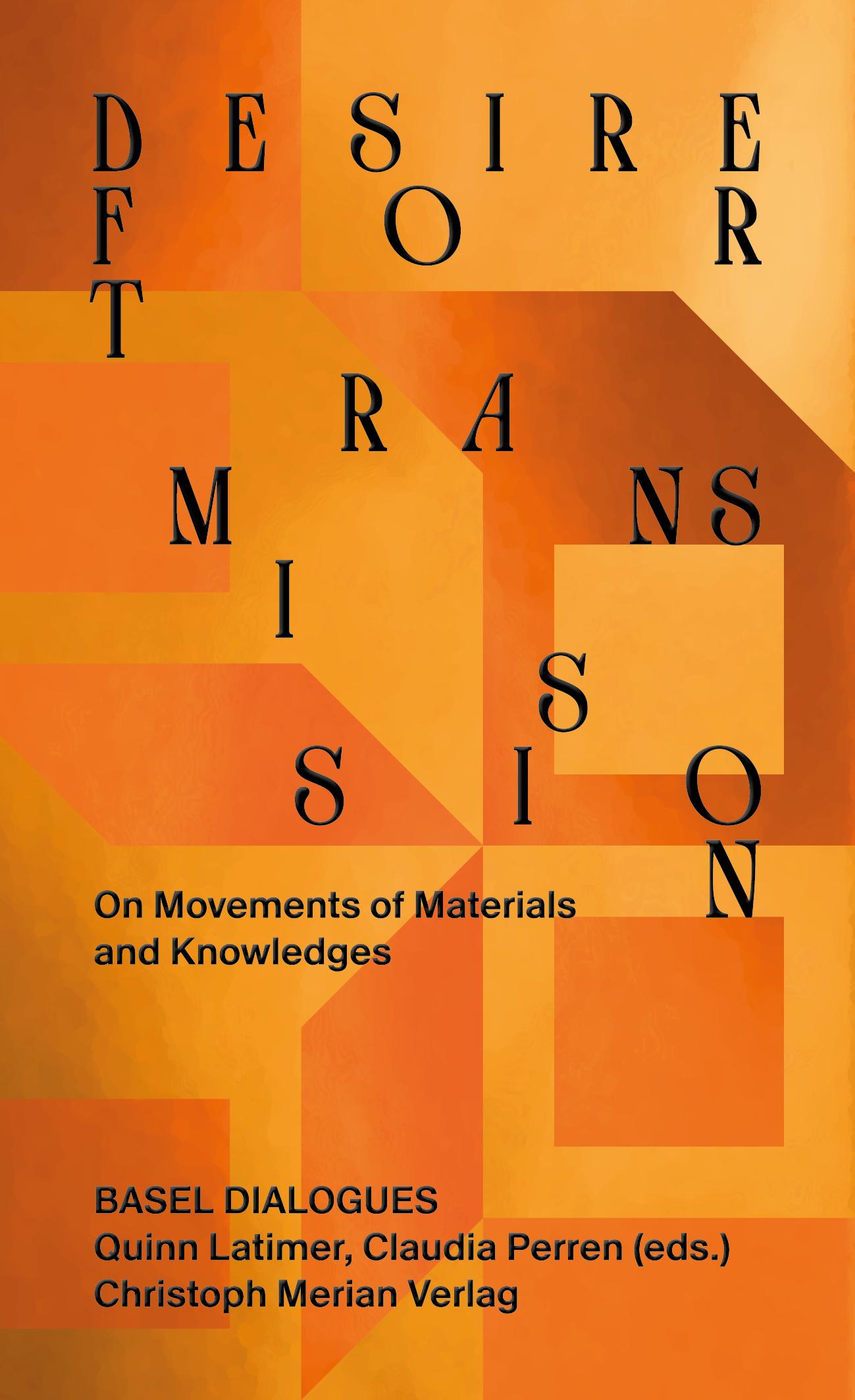
Desire for Transmission: On Movements of Materials and Knowledges
Basel Dialogues
Desire for Transmission: On Movements of Materials and Knowledges
Quinn Latimer, Claudia Perren (eds.) Christoph Merian Verlag
ÌFẸOLÚWA ỌṢÚNKỌYÀ (SKODO) AND AYLIN YILDIRIM TSCHOEPE IN DIALOGUE
UTE HOLL IN CONVERSATION WITH QUINN LATIMER (AND ASIA BAZDYRIEVA)
SHURUQ HARB IN DIALOGUE WITH NADIM CHOUFI
MATTHIEU VITSE IN DIALOGUE WITH BÉRÉNICE SERRA TO
ALEENA CHIA AND VANESSA AMOAH OPOKU IN DIALOGUE
BAKRI BAKHIT AND JACQUELINE LOEKITO IN DIALOGUE
A CONVERSATION WITH ZACH LIEBERMAN AND MICHAEL RENNER DRAWING AS
DOROTHÉE KING, DIANE DEVER, AND ABHAY ADHIKARI IN CONVERSATION MAKING
Quinn Latimer and Claudia Perren
During a recent roundtable devoted to Hannah Arendt’s thought and legacy, and the reverberations her work on speech and action have now, in our newly censorious age of creeping authoritarianism, artist and curator Shuddhabrata Sengupta suggested that we might reconsider the Indian literary and oral tradition called “twilight language.” A polysemic communication system, twilight language is associated with the ancient tantras, those manuals, written in the form of questions and answers, produced by teachers for their students. Many tantras survive only in fragmentary form, and they are often written in “twilight language,” or sāndhyābhāṣā, which literally means “speech in the gap.” The etymology of the word is straightforward: sāndhi being a gap, boundary, or juncture; ābhāṣā being some speech. Notably, the latter word is almost identical to another, that is, abhāsā, or “an appearing.” Twilight language appears as a kind of speech from the gaps, then—in language, in teaching, in the record, in appearances, in the tantras. But it is also speech that slips around the censors. It is an educational language that emerges from the process of asking and answering questions: about knowledges and the social world, and all the disciplines that contribute to and constitute it. This language, in all its meanings and metaphors, resonates with the book in your hands here. This volume is likewise offered in the format of questions and answers, of dialogues that move from oral speech to the written text. It is likewise a kind of teaching manual, one made by teachers for their students, as well as the larger reading public. It too attempts to speak across the gap, across boundaries of discipline and field and borders of all kinds. And it does all this in the hope that the transmission of some language, real and true—one come from relation and plurality, from conversation and epistemology— will emerge, flashing, like an appearance, into being.
This is a desire in the fields of art and design, and beyond, that we know well. The desire to transmit some real word and to have that communication received. Thus comes the title of this book, Desire for Transmission: On Movements of Materials and Knowledges. The second volume of the Basel Dialogues critical book series from the Basel Academy of Art and Design FHNW (HGK Basel), Desire for Transmission is explicit in its, well, desires. To send, to receive, to speak, to teach, to warn, to relay, to embody, to transform, to reach across the space between states or subjectivities with our ideas and energy and, often, desire itself.
To that end, transmission suggests relation. That is, multiple poles between which something flows across. That something—information, knowledge, material, energy, images, violence, excitement, alarm, love, some virus—is transmitted: body to body, system to system, signal to signal, speaker to receiver, writer to reader, state to subject, teacher to student, student to student, artist to spectator, filmmaker to viewer, plant to animal, root to root, one to the other. It is said that the epistemological employment of the word transmission is connected to its use in quotidian contexts via everyday examples, its daily transmissions.
But transmission is not just the content of the communication, it is the technology and means by which that message is broadcast. Here that technology is language—recorded, transcribed, and edited— and publishing. Thus does transmission suggest communication but also control, and the technologies by which these various impulses might be achieved. When that transmission fails, we feel it. But desire often operates by verge of the very possibility of its failure; transmission does, too. Not everything gets across; not everything is received. And yet still we try. This book is a record of such attempts.
In the conversations that follow, all held within the context or campus of the HGK Basel, the layers of transmission, and the desires that propel them, run deep. The conversations, held between professors and lecturers of the five institutes that constitute the HGK Basel and their guests, are often oriented toward epistemologies and their reverberations and transformations, and how they have been received and might be retransmitted. Yet if transmission is often understood as related to theories of knowledge, it is not only. It can be cultural, biological, technical, philosophical, religious, political, artistic, social, viral, electrical. It is often many of these at the very same time. Such is the case here, where the fervent transdisciplinarity of the thinking and teaching on offer at the academy reveals itself in the stunning range of artistic practices, histories, and desires invoked. Taken together, the diversity of voices and practices speak to issues of art and science, poetics and politics, theory and practice, denying their opposition, while revealing the deep desire for social and artistic transformation that so often propels pedagogy forward.
The dialogues are gleaned from recent public symposia, intimate research meetings, international festivals, and academic seminars at HGK Basel. They feature lecturers and professors in conversation with their celebrated guests—guests who come variously from the fields of visual art, design, filmmaking, media theory, science, coding, and poetics— each of whom is grappling with transdisciplinary practices pursued amidst a multivalent world. Their conversations cover technologies of transmission amid conditions of surveillance and resistance; trance techniques and cybernetics of the moving image; the theory and the practice that infuses both fashion and publishing, and their languages of realism and fantasy; the immaterial histories of material knowledges;
quantum computing practices coupled with Indigenous African cosmologies; and contemporary image production’s role in justice and law.
The production of images—as art, as evidence, as a form of storytelling—is considered throughout the volume. Filmmakers like Pauline Julier, Shuruq Harb, and Tai Shani; theorists and curators of film and media studies including Aleena Chia, Ute Holl, and Filipa Ramos; and designers and artists of the digital like Vanessa Amoah Opoku, Zach Lieberman, Ìfẹolúwa Ọṣúnkọyà, and Matthieu Vitse: all examine image production as a potentially transformative practice, even as they acknowledge that the image—its platforms and algorithms and disinformations—also drives operations of violence and profit, surveillance and death.
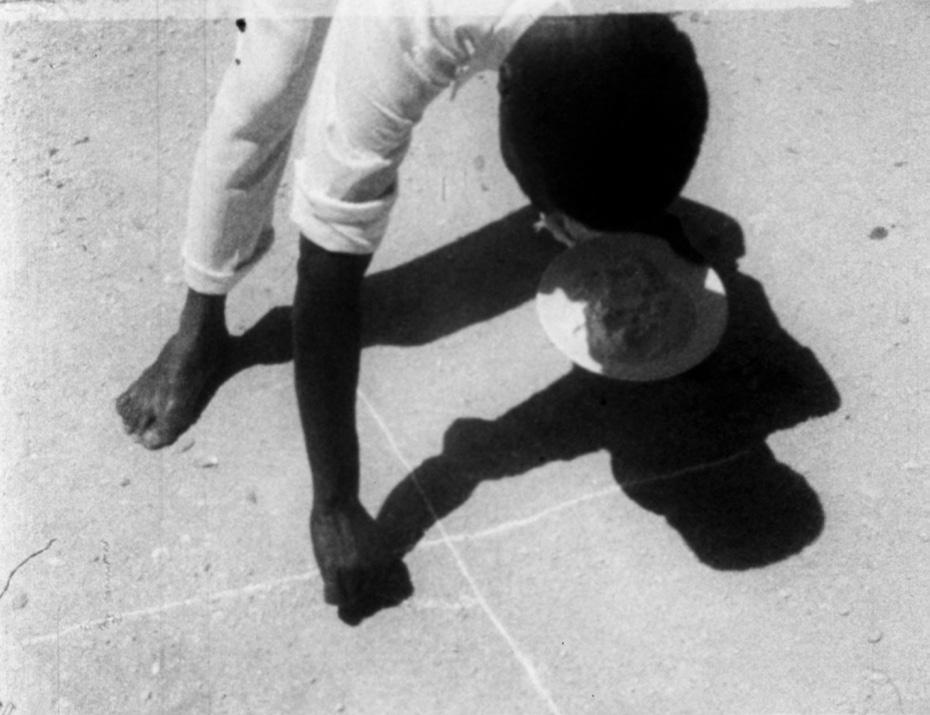
Likewise, cinema understood as an “anthropological machine,” per Giorgio Agamben, is considered throughout. That is, a filmmaking not just capable of recording reality but creating and transforming it, optically and sonically acting on the nerves and impulses of its viewers. In Holl’s conversation, for example, she discusses her landmark book, Cinema, Trance and Cybernetics, in which she examines cinema as a cultural technique of trance and transformation, that is, of effects and of possession. Her conversation takes the spectral, pioneering work of Maya Deren as its focus, both Deren’s famously avant-garde surrealist films like Meshes of the Afternoon, and her experimental ethnographic work in Haiti, which resulted in the seismic book and film Divine Horsemen: The Living Gods of Haiti.
The term “transmission” is not unique to media studies or philosophical discourse: religious and cultural traditions are often transmitted from one generation to the next; diseases from one person to another; information of various kinds from one
computer to another. Electrochemical signals move across synapses to other nerve cells; a car’s transmission gets its name from its intended purpose, namely to transmit the energy from the engine to its wheels. But the use of “transmission” in epistemological contexts is magnified in the quotidian. It is held that one can clarify the concept by considering everyday instances of it—routine and virtuosic both—like those recorded here, for example.
The word “desire,” meanwhile, also suggests some lack, and the hope that it might be transformed into something more consequential for the social. Desire is not just personal, not just interpersonal, not simply romantic and autonomous. It can also be driven by collective hopes and dreams. That is, desires for the collective, for the replenishment of the social. And what is an Academy of Art and Design, what is a university, if not a microcosm of society, and often indicative of its most intrinsic impulses for collectively shared ambitions, and a polis and politics in which each person’s ideas and desires are given space to develop, are allowed to be articulated, to find room for their transmission and reception. All of which remains constitutive of being an Academy of Art and Design in Basel, one supported by the Swiss Federal Constitution, most notably its articles on freedom of opinion and information (Article 16), academic freedom (Article 20), and freedom of artistic expression (Article 21).
That said, what is freedom of expression, artistic or otherwise, without the hope that might guide it? At two separate points in this volume, artists quote lines that give them hope about how to proceed— politically, artistically, spiritually, socially. In “Living the Afterlife While You’re Still Alive,” a conversation with Tai Shani about her artistic work and political activism, held during the symposium The Monster Is Us:
Violence, Nonviolence, and the Authoritarian Turn, Shani quotes a number of political thinkers who inspire her. One of them is Mariame Kaba, an American abolitionist, educator, organizer, curator, and archivist who works on transformative justice and to dismantle the prison industrial complex. Shani notes:
Being political is beyond just a way we organize ourselves here. Mariame Kaba says that having hope is a discipline, but it’s also living in the afterlife while you’re still alive. And, to me, that feels like a very spiritual way of thinking about our time here. A lot of the practices that you have as a person who is committed to equality are not that there’s a lack of heroism there, but that you have to come to terms with the idea that you’re not actually going to benefit from your efforts. You’re contributing toward something that is on the horizon, and you might not ever even witness it, but you still contribute in that way.
And in “There Is No Other Subject: Telling Stories with Images,” Pauline Julier’s conversation on imagemaking possibilities amid ecological and social ollapse, Julier quotes Raymond Williams, the Welsh Marxist writer, educator, and thinker. Julier ends her conversation by noting:
There’s a quote on my desk right now, and maybe it’s something about storytelling that leads me on as well. It’s this quote from Raymond Williams that says, “To be truly radical is to make hope possible rather than despair convincing.” I don’t really care about being radical, but definitely for art and for storytelling, to “make hope possible rather than despair convincing” is something that is really important to me.
As the editors of this volume, and the larger critical book series in which it makes the second constitutive part, it is likewise important for us to, as Williams famously writes, “make hope possible rather than despair convincing.” And to underline that, as Kaba says, “having hope is a discipline,” one as real and demanding as any academic or artistic discipline. Desire for Transmission is the collective communication of this hope. Its contributors, from the fields of visual art, visual communication, filmmaking, fashion, process design, game studies, media theory, physics, performance, poetics, coding, and activism, each speak in a language—twilight or sunrise— that is clear in its aims and desires for a world where art and the social are centered, where speech is understood as a political act, and where the transmission of knowledges (plural) is prioritized for the political betterment and the plurality of society, per Arendt.
As Arendt wrote: “Human plurality, the basic condition of both action and speech, has the twofold character of equality and distinction.” In Arendt’s definition of plurality, each of us are equal, which suggests that, if we try, we might understand each other. Being distinct, however, means that this attempt to make ourselves understood is a constant negotiation. The very “desire for transmission,” indeed. Through our distinct speaking and acting, we attempt understanding, we engage with our freedom, we practice equality. For Arendt, acting and speaking together in a public space is what allows a new world— one defined by rigorous hope, not numb despair— to come into being. It is to this idea that we dedicate this book.
Speaking to that plurality, and its educational policy, the Basel Academy of Art and Design (HGK Basel) is one of nine schools within the University of Applied Sciences and Arts Northwestern Switzerland (FHNW).
Located in Basel, the campus sits on the border between the cantons of Basel-Landschaft and Basel-Stadt, though it is financially supported by two other cantons: Solothurn and Aargau. The HGK Basel is also located in the so-called Dreiländereck, an area surrounded by three countries—France, Germany, and Switzerland— and in the immediate vicinity of the House of Electronic Arts (HEK), the Kunsthaus Baselland, iart, Radio X, and the Library of the Basel School of Design, Kabinett Herzog & de Meuron, Atelier Mondial, Couture Ateliers, Studio Gleisbogen, and Offcut, as well as many more creative initiatives. The HGK Basel has diverse regional and international networks. Internally, it is organized into five institutes whose mission is to offer bachelor, master, and PhD degree programs as well as continuing education and research. These include the Institute Art Gender Nature (IAGN), Institute Arts and Design Education (IADE), Institute Digital Communication Environments (IDCE), Institute Contemporary Design Practices (ICDP), and Institute Experimental Design and Media Cultures (IXDM). Each of these five Institutes contributed to this book—it is their voices that you will read and hear here.
To that end, every year, these Institutes present the graduation projects of their students in various ways. In 2025, in Institute Art Gender Nature’s graduate exhibition titled Revolt Against the Sun!, at Kunsthaus Baselland, a longtime collaborative partner and neighbor on our campus, MA student Ilja Zaharov presented a four-hour-long video work composed of conversations—by turns serious and playful—that the artist held with other artists, mostly. The video offers a long exposure shot of the exterior of Kunsthaus Baselland in early evening, gradually transitioning into night until the image goes black, and then slowly revealing itself again as the sun rises. Against this image—static but not unchanging, evoking the
aesthetics of surveillance but not only—are subtitles of the conversations. This is another kind of twilight language: one doesn’t see the interlocutors or hear them, we only read them. We read—that is, receive—transmissions of their most fervent hopes, doubts, complaints, and ideas about their work and the world. We read their exchanges on the concepts and conditions, forms and materials, for artistic practice now and historically. It’s a reflexively conceptual work—it’s also a very touching and moving one. As such, the video is a conversation piece par excellence. The form of the transmission and its content have almost no break. Zaharov’s conceptually minded artistic practice manifests itself as a final work in which the conversations about what that work might be, how it might evolve and come into being, is the work itself. The artwork, as Zaharov so perfectly demonstrates, does not come into being alone. Nor does it reveal itself in silence—but in speaking and thinking, reflecting and listening, together, despite the complications of the collective. It’s a physical, relational act, made possible by corporeal bodies and the air that moves between them. As Zaharov notes in the video:
Conversation is more gut than mouth. Stomachs in sequence, like a ruminant’s gut, conversation moves in turn. Speech, or writing, must pass from one interlocutor to another, through chambers and pauses. The silent gap allows for hearing. It is in these pauses that friction and resistance arise—where one (gut) passage ends and another begins, where a distinct voice is swallowed and reworked, where singularity softens. Conversation doesn’t advance despite incoherence, distance, or delay. It moves because of them. These interruptions, these stretches of non-alignment, let language breathe. And language, after all, is nothing but flowing air.
As always, we would like to thank our contributors— for their desires and for their transmissions, for their languages and for their listening—from our Institutes as well as their brilliant and generous guests. We would also like to thank those whose work and thinking made this second volume of our book series possible, in particular: Iris Becher, Oliver Bolanz, Marietta Eugster, Orit Gat, Simone Marie, Kurt Rehkopf, and Kirsten Thietz. With them, we wish you good reading. We hope the transmission arrives.