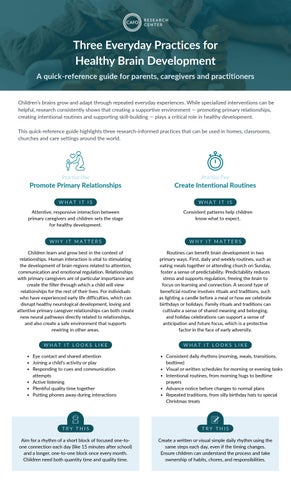
Three Everyday Practices for Healthy Brain Development A quick-reference guide for parents, caregivers and practitioners Children’s brains grow and adapt through repeated everyday experiences. While specialized interventions can be helpful, research consistently shows that creating a supportive environment — promoting primary relationships, creating intentional routines and supporting skill-building — plays a critical role in healthy development. This quick-reference guide highlights three research-informed practices that can be used in homes, classrooms, churches and care settings around the world.
Practice One Promote Primary Relationships
Practice Two Create Intentional Routines
WHAT IT IS
WHAT IT IS
Attentive, responsive interaction between primary caregivers and children sets the stage for healthy development.
Consistent patterns help children know what to expect.
WHY IT MATTERS
WHY IT MATTERS
Children learn and grow best in the context of relationships. Human interaction is vital to stimulating the development of brain regions related to attention, communication and emotional regulation. Relationships with primary caregivers are of particular importance and create the filter through which a child will view relationships for the rest of their lives. For individuals who have experienced early life difficulties, which can disrupt healthy neurological development, loving and attentive primary caregiver relationships can both create new neural pathways directly related to relationships, and also create a safe environment that supports rewiring in other areas.
Routines can benefit brain development in two primary ways. First, daily and weekly routines, such as eating meals together or attending church on Sunday, foster a sense of predictability. Predictability reduces stress and supports regulation, freeing the brain to focus on learning and connection. A second type of beneficial routine involves rituals and traditions, such as lighting a candle before a meal or how we celebrate birthdays or holidays. Family rituals and traditions can cultivate a sense of shared meaning and belonging, and holiday celebrations can support a sense of anticipation and future focus, which is a protective factor in the face of early adversity.
WHAT IT LOOKS LIKE
WHAT IT LOOKS LIKE
Eye contact and shared attention Joining a child’s activity or play Responding to cues and communication attempts Active listening Plentiful quality time together Putting phones away during interactions
Consistent daily rhythms (morning, meals, transitions, bedtime) Visual or written schedules for morning or evening tasks Intentional routines, from morning hugs to bedtime prayers Advance notice before changes to normal plans Repeated traditions, from silly birthday hats to special Christmas treats
TRY THIS
TRY THIS
Aim for a rhythm of a short block of focused one-toone connection each day (like 15 minutes after school) and a longer, one-to-one block once every month. Children need both quantity time and quality time.
Create a written or visual simple daily rhythm using the same steps each day, even if the timing changes. Ensure children can understand the process and take ownership of habits, chores, and responsibilities.