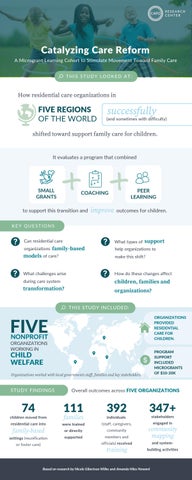
Catalyzing Care Reform A Microgrant Learning Cohort to Stimulate Movement Toward Family Care THIS STUDY LOOKED AT:
How residential care organizations in
FIVE REGIONS OF THE WORLD
successfully
(and sometimes with difficulty)
shifted toward support family care for children.
It evaluates a program that combined
SMALL GRANTS
PEER LEARNING
COACHING
to support this transition and
improve outcomes for children.
KEY QUESTIONS Can residential care
What types of support
organizations family-based
help organizations to
models of care?
make this shift?
What challenges arise
How do these changes affect
during care system
children, families and
transformation?
organizations? THIS STUDY INCLUDED: ORGANIZATIONS PROVIDED RESIDENTIAL CARE FOR CHILDREN.
FIVE NONPROFIT
ORGANIZATIONS WORKING IN
PROGRAM SUPPORT INCLUDED MICROGRANTS OF $10-20K
CHILD WELFARE
Organizations worked with local governments staff, families and key stakeholders. STUDY FINDINGS
74
111
children moved from residential care into
family-based
settings (reunification or foster care)
Overall outcomes across FIVE ORGANIZATIONS
families
392
347+
individuals
stakeholders
were trained
(staff, caregivers,
engaged in
or directly
community
supported
members and
community mapping
officials) received
and system-
training
building activities
Based on research by Nicole Gibertson Wilke and Amanda Hiles Howard
Catalyzing Care Reform A Microgrant Learning Cohort to Stimulate Movement Toward Family Care
continued...
Organizations created or strengthened:
What made the difference?
Foster care systems in previously non-existent regions
MICROGRANTS Enabled pilot programs and staff training
Case management and child protection systems
COACHING Provided ongoing guidance for complex
Family tracing and
decision-making
reunification processes
PEER LEARNING COHORTS
Government partnerships for child welfare reform
Allowed organizations to share solutions across countries
KEY CHALLENGES
Political instability and conflict in some regions
Limited staffing and financial resources
Resistance to changing long-standing residential care systems
Complex family situations requiring long-term casewor
KEY TAKEAWAYS
Transitioning to family care is possible, but complex and resource-intensive A combined model of funding + coaching + peer learning supported measurable progress Strong outcomes require government engagement, leadership commitment and community involvement. Context matters: local political and cultural conditions strongly shaped results Small investments can produce system-level changes when well coordinated
Based on research by Nicole Gibertson Wilke and Amanda Hiles Howard