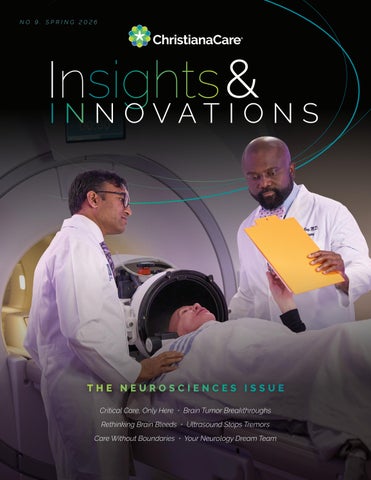
NO 9. SPRING 2026
&
THE NEUROSCIENCES ISSUE Critical Care, Only Here • Brain Tumor Breakthroughs Rethinking Brain Bleeds • Ultrasound Stops Tremors Care Without Boundaries • Your Neurology Dream Team
presents
At ChristianaCare, we strive to provide groundbreaking neurologic care using the latest technologies and approaches, and many of these initiatives are covered in this issue of Insights & Innovations. For example, for patients with brain tumors, our surgeons are using a next-generation connectomics platform called Quicktome to visualize the brain’s intricate speech, motor, visual, and cognitive pathways and create a personalized “map” for each patient that guides tumor resection and improves safety and outcomes. Neurointerventional surgeons at ChristianaCare personalize care using a novel surgical approach called meningeal artery embolization to treat patients with chronic subdural hematoma (SDH). The minimally invasive procedure is often performed as an outpatient surgery, meaning patients are discharged the same day, and they typically experience faster recovery times and are at reduced risk for postoperative complications compared with those who undergo more traditional surgeries used to treat chronic SDH. In addition to these clinical advancements, ChristianaCare is the only health system
in Delaware with a dedicated Neurocritical Care Unit offering patients around-the-clock, cutting-edge care delivered by a highly trained, multidisciplinary team. The unit is staffed 24/7 by clinicians, nurses, and therapists ensuring seamless coverage and continuity of care. Finally, for patients living with chronic neurologic conditions such as epilepsy and headache who are unable to travel to our locations due to mobility challenges or driving restrictions, among other barriers, our neurologists are embracing virtual care platforms to deliver high-quality treatment and vital follow-up care to patients remotely. Through these and other innovations, ChristianaCare continues to transform neurologic care. We look forward to continuing to work with you to provide Neurosciences excellence to our community. Sincerely, Kim Gannon, M.D., Ph.D. Medical Director of Comprehensive Stroke Program, Physician Executive of Neurosciences Service Line
READY TO REFER? Do you have a patient who might benefit from some of the treatment options available at ChristianaCare? Simply scan the QR code or visit ChristianaCare.org/insights-innovations to quickly refer.
I N S I G H T S & I N N O VAT I O N S
THE NEUROSCIENCES ISSUE
Delaware’s Only Neurocritical Care Unit: Advanced Care for the Most Complex Patients
W
hen a patient suffers a devastating brain injury or neurologic crisis, specialized expertise can mean the difference between recovery and lasting disability. At ChristianaCare’s Neurocritical Care Unit (NCCU), the only dedicated neuro-intensive care unit in Delaware, patients receive around-the-clock, cutting-edge care delivered by a highly trained, multidisciplinary team.
care grew. Dr. Creed, who stepped into leadership in 2025, now oversees the program and its expansion. Her colleagues include a team of young dynamic neurointensivists trained at premier institutions such as Thomas Jefferson, Yale and Boston University. Together with experienced APCs and an exceptional nursing team, they’ve created a culture of teamwork and support.
The NCCU features an 18-bed ICU supported by a six-bed transitional neurology step-down unit. Together, these facilities provide continuous care for patients with the most complex neurologic and neurosurgical conditions. The unit is staffed 24/7 by attending physicians, advanced practice clinicians (APCs), nurses and therapists, ensuring seamless coverage and continuity of care.
“They bring fresh energy, innovative ideas, and research interests that continue to push our program forward,” Dr. Creed noted.
On any given day, the team cares for patients recovering from acute ischemic stroke treatments such as thrombolysis and mechanical thrombectomy, as well as those with malignant cerebral edema, subarachnoid and intracerebral hemorrhages, and traumatic brain and spinal cord injuries. They also manage patients with neuromuscular crises related to conditions such as Guillain-Barré syndrome or myasthenia gravis who require ventilatory support. “We are busy all the time—routinely at full capacity and sometimes overflowing into other units,” said Jennifer Creed, M.D., Ph.D., the medical director of the NCCU. “These are the sickest neurological patients in the state, and we provide them with focused, specialized care that can’t be delivered anywhere else in Delaware.” ChristianaCare first developed the NCCU more than a decade ago, transitioning from a mixed critical care environment to a fully dedicated, closed unit as demand for specialized neurologic
ChristianaCare is nationally recognized as a high-volume center for mechanical thrombectomy, ranking among the busiest programs in the country. Every patient who undergoes this lifesaving procedure comes through the NCCU for intensive monitoring and recovery. The NCCU’s stroke program also stands out because of its aggressive approach to patients with large vessel occlusion. “Our interventionalists are willing to take on patients that many other centers would turn away,” Dr. Creed explained. “That philosophy has given many patients opportunities for recovery that wouldn’t have been possible, even a few years ago.” Newer therapies are changing the standard of care for individuals with subarachnoid hemorrhage, a life-threatening condition often caused by ruptured aneurysms. “We’re using intrathecal medications and intravenous agents to prevent vasospasm in ways that weren’t available just a few years ago,” Dr. Creed said. “We’re practicing at the cutting edge of what’s possible for these patients.” CONTIN UED ON PAGE 7
“These are the sickest neurological patients in the state, and we provide them with focused, specialized care that can’t be delivered anywhere else in Delaware.” Jennifer Creed, M.D., Ph.D. 1
I N S I G H T S & I N N O VAT I O N S
W
Cutting-Edge Brain Tumor Surgery at ChristianaCare
hen patients in Delaware and the surrounding region face the daunting diagnosis of a brain tumor, they don’t have to travel to Philadelphia or Baltimore for world-class surgical care. ChristianaCare’s Helen F. Graham Cancer Center & Research Institute offers the same advanced surgical technologies and expertise found at the nation’s top academic medical centers, delivering world-class care to the vast majority of brain tumor patients right here in Delaware. One of the most exciting advances now available at ChristianaCare is Quicktome, a next-generation connectomics platform that brings precision and safety to brain surgery. This powerful technology enables surgeons to visualize the brain’s intricate speech, motor, visual and cognitive pathways in relation to a tumor, creating a personalized “map” for each patient. By identifying and preserving these critical fiber tracts, neurosurgeon Pulak Ray, M.D., and his team can chart safer surgical approaches, minimize the risk of functional loss, and successfully treat tumors in regions once considered inoperable. With Quicktome, patients gain access to surgical options and outcomes that match the nation’s most advanced neurosurgical centers—without leaving Delaware. “In the past, there were areas of the brain where we would hesitate to remove tumors because of the risk of causing major deficits,” Dr. Ray explained. “Now, with connectomics, we can plan more precise surgeries and preserve essential functions.”
“This has transformed what we’re able to offer patients,” Dr. Ray said. “We can now safely resect tumors that previously would have been considered untouchable.” Pulak Ray, M.D.
2
For patients with tumors near speech or motor areas, ChristianaCare offers awake craniotomy. After sedation and surgical exposure of the brain, patients are gently awakened and interact with a speech therapist during the procedure to perform simple tasks such as speaking, moving a hand, or naming objects. This real-time interaction gives surgeons a live “map” of language and motor function in the brain, allowing them to precisely navigate around critical regions while still pursuing aggressive tumor removal. The result is greater safety, preservation of quality of life, and the possibility of successful surgery in cases that might otherwise be considered too risky. Another innovation now offered at ChristianaCare is 5-ALA (Gleolan) fluorescenceguided surgery. Patients receive a compound that causes high-grade gliomas to fluoresce under a special light, helping surgeons to distinguish tumor from healthy brain tissue in real time. During surgery, when illuminated with a particular wavelength of light, these tumor cells glow bright pink, allowing surgeons to see the boundary between tumor and healthy brain tissue in real time. This enhanced visibility helps the surgical team remove as much of the tumor as safely possible while preserving normal brain function, improving outcomes and giving patients a better chance at long-term recovery. CON TINUED ON PAGE 7
THE NEUROSCIENCES ISSUE
Novel Procedure Boosts Outcomes in Chronic Subdural Hematoma
N
eurointerventional surgeons at ChristianaCare are using a state-of-the-art approach for the management of chronic subdural hematoma (SDH). SDH is a condition caused by the formation of fragile, leaky blood vessels (neovascularization) in the membranes surrounding the hematoma over a period of weeks or even months. Called middle meningeal artery (MMA) embolization, the novel, minimally invasive procedure is being used to correct dysregulation of the MMA, a key artery that supplies blood to the inner surface of the skull and is prone to injury following head trauma. In many cases, the procedure is performed as an outpatient surgery, meaning patients are discharged the day of the procedure, an indication of the faster recovery times—and reduced risk for complications—associated with it. The procedure is now considered standard of care based on recent consecutive randomized clinical trials.1-4 “Historically, patients with chronic subdural hematoma have had the blood removed surgically, via craniotomy, in which a portion of the skull is removed,” said Sudhakar R. Satti, M.D., the associate director of Neurointerventional Surgery at ChristianaCare. “This is a highly invasive procedure, obviously, and the risk for complications, including recurrence of the SDH, is significant.” Although SDH is relatively uncommon in the general population, it can have serious, even lifethreatening consequences if left untreated, including seizures, stroke, coma, and death. Effective treatment strategies are therefore critically important.
Chronic SDH is most often seen in people aged 70 and older, who face a higher risk due to falls and the frequent use of blood-thinning medications to manage conditions like hypertension or atrial fibrillation. This combination of factors makes timely diagnosis and innovative treatment approaches especially vital for protecting the health and quality of life of older adults. Developed in the early 2000s, MMA embolization is “truly a paradigm shift in how we approach chronic SDH,” Dr. Satti said. In chronic SDH, inflammation leads to the formation of fragile, leaky blood vessels in the membranes surrounding the hematoma, and these leaky blood vessels are effectively fed by branches of the MMA, resulting in “a vicious cycle of bleeding and inflammation,” according to Dr. Satti. The MMA embolization procedure aims to disrupt this cycle by blocking the blood supply to these abnormal membranes using a catheter that is inserted into an artery (typically via the wrist or groin) and guided to the MMA using x-ray imaging. Once the catheter is in place, an embolic agent is injected to permanently block the artery. CONTIN UED ON PAGE 7
“Research suggests MMA embolization reduces the likelihood of SDH recurrence and reduces the need for additional surgery by over 50%.” Sudhakar R. Satti, M.D.
3
I N S I G H T S & I N N O VAT I O N S
P
ChristianaCare Incorporates MRI Guided Focused Ultrasound, a State-of-the-Art Treatment for Tremor Disorders
atients with essential tremor or tremordominant Parkinson’s disease whose symptoms do not improve with standard pharmacotherapy have access to a state-of-theart treatment at ChristianaCare called magnetic resonance–guided focused ultrasound (MRg-FUS). This outpatient procedure delivers high-intensity ultrasound beams through the skull to a specific target in the thalamus, without the need for anesthesia or cranial implants. Patients are awake and responsive throughout the procedure, which enables real-time assessment for efficacy as well as any potential adverse events and/or complications. ChristianaCare is the only health system in Delaware offering this treatment. “Our health system has performed nearly 100 treatments with outstanding efficacy,” said Pulak Ray, M.D., a neurosurgeon who acts as the Director of the Focused Ultrasound Program. He continued: “Essential tremor and tremordominant Parkinson’s disease are conditions neurology has treated for many years with medications but, unfortunately, medications are only about 60% to 70% effective at reducing tremor in the best studies. Focused ultrasound provides an excellent option for patients who are refractive to medical intervention, one that is safe, effective, and accurate.”
Essential tremor is one of the most common movement disorders in older adults, affecting up to 9% of those aged 60 years and older.1 Parkinson’s disease is less common, affecting more than 1 million adults in the United States—most of them aged 60 years and older. However, tremor is a dominant symptom in up to 75% of those with the disease.2 These figures are significant, given the aging population in Delaware. “We know there are a lot of retirees living in Delaware and, if they are experiencing tremor, it can have a significant impact on their quality of life and their ability to maintain independence,” Dr. Ray said. “For those who are refractory to medication therapy, tremor can become debilitating, affecting their ability to perform daily activities.” Deep brain stimulation (DBS) has previously been considered the standard of care for the neurosurgical treatment of essential tremor and tremor-dominant Parkinson’s in patients who do not respond to medication. Although it is considered reversible and adjustable, the procedure is invasive, as it involves craniotomy and the permanent implantation of electrodes into the brain. These electrodes stimulate the target area, inhibiting neural activity and alleviating the tremor; however, they are battery operated and the batteries require periodic replacement, according to Dr. Ray. CON TINUE D O N PAGE 8
“Focused ultrasound gives us the accuracy needed to stun the cells in the areas of the brain that cause the tremor. As a result, the efficacy is remarkable, with up to 73% of patients still seeing a reduction in tremor at five years.” Pulak Ray, M.D.
4
THE NEUROSCIENCES ISSUE
F
Virtual Care Expands Access for Patients With Epilepsy and Headache
or patients living with chronic neurologic conditions such as epilepsy and chronic headache, regular follow-up visits are an essential part of care. Yet mobility challenges, driving restrictions and the unpredictability of symptoms often make it difficult to attend in-person appointments. At ChristianaCare, neurologists are embracing virtual care to improve access, reduce barriers and deliver high-quality treatment to patients wherever they are located. ChristianaCare’s headache team began offering video visits at the onset of the COVID-19 pandemic. What started as a necessity quickly revealed lasting benefits. “Patients love the convenience,” explained neurologist and headache specialist Jessica Bradley, M.D. “Some of them may live up to two hours away; and for those with neurologic conditions that make driving difficult, a virtual visit saves the challenge of arranging transportation. Others can more easily fit an appointment into their workday or between college classes. It just makes care more accessible.” For migraine patients, telehealth has been especially valuable. “If you’re in the middle of a migraine, driving and sitting in a bright office can be unbearable,” Dr. Bradley noted. “With video visits, patients can stay home, turn the lights down and still get the care they need.” Virtual visits also have reduced missed appointments because patients can log in even when they’re not feeling well enough to travel.
Dr. Bradley emphasized that new or concerning symptoms, such as new visual disturbances or vertigo, still require an in-person evaluation, but she encouraged patients to take advantage of video visits for routine follow-up and medication adjustments when appropriate. “For headache care, even new patients can benefit from a virtual first visit, since diagnosis is so heavily based on history,” she said. For people with epilepsy, virtual care can be even more transformative. Jonathan Pollard, M.D., the director of the ChristianaCare Epilepsy Center, listed the multiple daily obstacles many of his patients face: inability to drive due to seizures, financial strain from job loss and reliance on family members for transportation. “In-person visits can be almost impossible for some patients,” Dr. Pollard said. “Virtual visits have been a godsend. They remove the transportation barrier and give patients a reliable way to stay connected with care.” The American Epilepsy Society now recommends that virtual care be made available to epilepsy patients whenever possible, and more than half of ChristianaCare’s epilepsy patients take advantage of telehealth at least part of the time. Although certain assessments still require in-person visits, Dr. Pollard noted that “95% of the information we need can be obtained virtually. And given that many of these patients might have otherwise missed their visit entirely, virtual care is clearly an essential option.” CONTIN UED ON PAGE 9
5
I N S I G H T S & I N N O VAT I O N S
A
APCs Bolstering Care for Patients With Neurologic Disorders
dvanced practice clinicians (APCs) play an integral role in the evaluation and management of ChristianaCare patients with neurologic disorders, with the ultimate goal of expanding access to treatment services for those with acute and chronic neurologic illness. The Neurosciences service line’s APC program has expanded significantly over the past 15 years, growing from two APCs to 48 in that period. These specially trained clinicians assist in the provision of a wide range of services across the patient care continuum, working in four services: inpatient, outpatient, neurocritical care and neurointerventional surgery. Although neurologists collaborate in the diagnosis and treatment for all patients, APCs serve as frontline providers, ensuring patients and their caregivers have access to all needed services and resources. “In general, the Neurosciences service line here at ChristianaCare has a very high level of respect for APCs, which is why we’re working at the top of our license,” said Erin Mitchell, DNP, APRN, AGACNPBC, FNP-BC, CNRN, SCRN, who is the chief APC of neurosciences at the health system. “We are truly an integral part of the award-winning care offered here.” Neurology APCs are licensed healthcare professionals—such as nurse practitioners, like Mitchell, and physician assistants—with training in the diagnosis, treatment and management of neurologic disorders. At ChristianaCare, these professionals work collaboratively with neurologists to provide comprehensive care to patients from initial evaluation (i.e., collecting medical histories, performing physical and neurologic exams, and ordering and interpreting diagnostic tests) to disease treatment and management. In conjunction with the health system’s awardwinning neurologists, APCs develop and implement treatment plans, prescribe medications, and manage neurologic conditions, such as stroke,
epilepsy, Parkinson’s disease and multiple sclerosis, according to Mitchell, who has been at ChristianaCare since 2009. They are also actively engaged in patient and caregiver education, helping to boost understanding of complex neurologic conditions, treatment options and self-management approaches. Because of its extensive onboarding and orientation process, ChristianaCare’s neurology APCs deliver important care, performing procedures such as lumbar punctures, nerve blocks, invasive line placement, skin biopsy for evaluation of certain neurologic conditions, and OnabotulinumtoxinA (Botox, Allergan) injections for those with migraine.. In addition, they serve as key clinicians within the health system’s stroke centers (assisting with evaluations and post-stroke care) and its epilepsy monitoring unit, where they assist in evaluating seizures and adjusting medications. Many of the 48 APCs at ChristianaCare have subspecialties such as critical care, movement disorders, stroke, and headache, among others, according to Mitchell. “ChristianaCare offers APCs robust training; it’s almost like a fellowship,” she said. “Our onboarding and orientation ranges from 12 weeks for our inpatient neurology APCs to up to 20 weeks for APCs working in neurocritical care. It’s very demanding, and it ultimately enhances the care we offer patients. The majority of our APCs come to us right out of school and stay, which speaks to the strength of our process.” Fully integrated APCs offer more than just improved patient care. They improve efficiency in the delivery of patient care by freeing up neurologists to focus on more complex cases, as APCs manage routine services. APCs also enable 24/7 care by handling overnight and weekend hours in the neurocritical care unit. CONTIN UED ON PAGE 9
“Patients at other health systems may start a new medication, get discharged, and never receive the follow-up they need. Our APCs help close those gaps, ensuring patients have the ongoing support and management that makes their care safer.” Erin Mitchell, DNP, APRN 6
THE NEUROSCIENCES ISSUE
Delaware’s Only Neurocritical Care Unit: Advanced Care for the Most Complex Patients Continued from page 1
The unit is also contributing to the future of neurocritical care through clinical research. ChristianaCare recently began enrolling patients in the CO-MIND trial, which is developing a noninvasive device for measuring intracranial pressure (ICP). Currently, ICP requires invasive devices such as external ventricular drains or bolts.
while preserving normal brain function, improving outcomes and giving patients a better chance at longterm recovery. “On MRI, tumor and normal brain can look very similar,” Dr. Ray noted. “Fluorescence gives us cellular-level clarity, helping us achieve more complete resections.” ChristianaCare’s neurosurgical teams also use advanced intraoperative ultrasound to differentiate tumor from swelling during surgery.
“This device uses two scalp electrodes to simultaneously get information through mobile interactive real-time streaming technology and try to correlate that with ICP readings from the extraventricular drain and blood pressure readings from the arterial line,” Dr. Creed explained. “If this technology proves effective, there may be a role for using this noninvasive method of measuring ICP.”
In addition, all brain tumor samples undergo nextgeneration sequencing, which can reveal genetic markers that open the door to targeted therapies or immunotherapies that traditionally have not been used for brain tumors.
In addition to enhancing neurocritical care with research, ChristianaCare leaders are exploring ways to broaden the NCCU’s reach. Plans include increasing transitional neurology capacity and extending services beyond the main campus through tele-neuro ICU consults at companion institutions such as Wilmington Hospital and Union Hospital.
ChristianaCare’s neuro-oncology program brings together neurosurgeons, neuro-oncologists, radiation oncologists, pathologists, speech and physical therapists, and oncology nurses in a tightly coordinated, multidisciplinary model. After all procedures, neurosurgical patients are cared for in the neurocritical care unit.
“We’re always trying to think about how we can expand our services beyond the walls of the hospital to deliver neurocritical care expertise across the region,” Dr. Creed explained. “Telemedicine and consultative outreach can ensure that patients in Delaware and nearby communities get timely, expert guidance wherever they present. Patients and families can be confident that they’re in the hands of a team fully committed to delivering the highest level of neurologic care.”
“The most important part of oncologic care is collaboration,” Dr. Ray noted. “From diagnosis through surgery, radiation and chemotherapy, our teams know each other well and work seamlessly to provide comprehensive, timely treatment. At ChristianaCare, we deliver the most advanced brain tumor surgery available anywhere—and we do it right here at home.”
Cutting-Edge Brain Tumor Surgery at ChristianaCare
Continued from page 3
•
Continued from page 2
Another innovation now offered at ChristianaCare is 5-ALA (Gleolan) fluorescence-guided surgery. Patients receive a compound that causes high-grade gliomas to fluoresce under a special light, helping surgeons to distinguish tumor from healthy brain tissue in real time. During surgery, when illuminated with a particular wavelength of light, these tumor cells glow bright pink, allowing surgeons to see the boundary between tumor and healthy brain tissue in real time. This enhanced visibility helps the surgical team remove as much of the tumor as safely possible
“We are able to personalize treatment in ways that weren’t possible even a few years ago,” Dr. Ray said.
•
Novel Procedure Boosts Outcomes in Chronic Subdural Hematoma By targeting the abnormal vessels, MMA embolization addresses the underlying mechanism of SDH formation and growth by preventing the reaccumulation of blood and promoting the absorption of the existing hematoma by the body. Careful anatomic assessment during the procedure, again via x-ray imaging, is vital to avoid embolization of vessels that supply cranial nerves or the ophthalmic artery and causing related complications. “Because of the high risk for recurrence associated with drainage of the SDH via craniotomy, many patients ultimately had to have multiple surgeries 7
I N S I G H T S & I N N O VAT I O N S
to resolve the issue,” Dr. Satti explained. “Research suggests MMA embolization reduces the likelihood of SDH recurrence and reduces the need for additional surgery by over 50%.” Currently, MMA embolization is used in patients with chronic SDH and mild to moderate symptoms, either as a stand-alone treatment or as an adjunct to craniotomy (the latter being recommended for those at high risk for recurrence). However, its success in those with chronic SDH has led researchers to explore using the approach for acute and subacute—or more fastdeveloping—SDHs, although that is likely still a few years away, according to Dr. Satti. “For patients with suspected chronic SDH, it’s vital that they be referred to us for treatment as soon as possible because the outcomes with MMA embolization are better earlier in the development of the bleed,” he said. “We’re seeing dozens of cases a year, many in patients who were asymptomatic or who experienced what they thought was an innocuous head trauma, and we are achieving excellent results.” References 1.
J Neurointerv Surg. 2024;16(4):329-330.
2.
N Engl J Med. 2025;392(9):918-920.
3.
N Engl J Med. 2025;392(9):855-864.
4.
J Neurointerv Surg. 2024;17(e1):e172-e177.
•
ChristianaCare Incorporates MRI Guided Focused Ultrasound, a State-of-the-Art Treatment for Tremor Disorders Continued from page 4
Historically, neurosurgeons have also treated these tremor disorders with thalamotomy. Because of the invasive nature of the procedure, however, surgical thalamotomy may be inappropriate for many older adults, many of whom are frail and have underlying cardiovascular disease and other health problems, according to Dr. Ray. Both DBS and surgical thalamotomy carry significant risks, typically adverse effects related to inaccurate target localization, including ataxia, paresthesias, dysarthria, hemorrhage, and/or seizures. MRg-FUS is essentially a noninvasive form of thalamotomy. MRI provides detailed images of the brain in real time during the procedure, enabling precision in identifying the target area treatment,
8
which differs from patient to patient, and minimizing risk to the surrounding tissue. High-intensity FUS is delivered to a focal point through the intact skull using a framing device that is placed on the patient’s head. Patients remain fully conscious during the procedure—no general anesthesia is required—and its functional effects are assessed throughout, allowing the multidisciplinary clinical team to refine and confirm the correct target and appropriate number of sonications. Typically, tremor improvement is immediate, and the noninvasive nature of the procedure yields faster recovery and lower risk for complications such as hemorrhage and infection, Dr. Ray said. “Focused ultrasound gives us the accuracy needed to stun the cells in the areas of the brain that cause the tremor,” he noted. “As a result, the efficacy is remarkable, with up to 73% of patients still seeing a reduction in tremor at five years.” The entire procedure takes less than two hours— from patient arrival to discharge, according to Dr. Ray. It is performed in the MRI suite, as opposed to a traditional operating room. All patients are cared for by a multidisciplinary team that ensures safety and comfort before, during, and after the procedure. Although medication is still first-line therapy for both essential tremor and tremor-dominant Parkinson’s disease, MRg-FUS has become a viable option for patients whose symptoms do not respond to treatment, even those who have other underlying health conditions. Patients with bilateral tremor can have both sides treated via the approach, in procedures scheduled nine months apart. “Many of the patients who have these tremor disorders are quite frail because they’re elderly, so the ability to provide noninvasive neurological procedure is significant, and we have achieved excellent results,” Dr. Ray said. “At ChristianaCare, our ability to provide this less invasive, innovative treatment for this debilitating condition is really a unique benefit that will serve patients in our community and throughout the region.” References
•
1.
Zappia M, Albanese A, Bruno E, et al. J Neurol. 2012;260:714-740.
2.
Pasquini J, Ceravolo R, Qamhawi Z, et al. Brain. 2018;141(3):811-821.
THE NEUROSCIENCES ISSUE
Virtual Care Expands Access for Patients With Epilepsy and Headache Continued from page 5
ChristianaCare is also advancing virtual care in epilepsy through the use of patient-reported outcome measures (a similar model is being used with headache patients), an approach inspired by a successful model in Denmark. Epilepsy affects about 3% of the general population, yet accounts for up to one-fourth of all neurology outpatient visits. To make the best use of limited clinic resources, ChristianaCare Neurology set out to identify its healthiest epilepsy patients and safely reduce the frequency of their routine visits, freeing up time for those who need it most. Here’s how it works: At the end of an in-person or a virtual visit, relatively healthy patients are offered the option of returning in six months as usual or completing a patient-reported outcome measures survey at the six-month mark. The survey, delivered securely by text message, asks about seizure severity, medication side effects, disability and other relevant issues. If responses raise concern, the patient is scheduled for an immediate appointment. If results are reassuring, the next follow-up is extended safely to 12 months. Early results have been encouraging. Among the first 76 patients enrolled, more than 60% responded to the survey—double the typical response rate seen in epilepsy populations nationally. Based on this success, ChristianaCare is now designing a similar survey for migraine patients, using the same paradigm. “Virtual care allows us to see patients sooner, keep them engaged and prevent lapses in treatment,” Dr. Bradley said. “It’s not a substitute; it’s an enhancement.”
•
APCs Bolstering Care for Patients With Neurologic Disorders Continued from page 6
questions. And we can be a second set of eyes for neurologists evaluating very complex diagnoses and plans of care. Indeed, that team approach only strengthens the care patients receive across the neurology service line and adds to the support families and patients receive, she added. NeuroInterventional Surgery APCs work with the physicians to facilitate elective and urgent procedures, improve transitions of care, and assess patients post-procedures. They are integral to ensuring that patients and families have all of the questions answered before and after the procedure. “As APCs, we understand their diagnosis, we understand their medications, and we are able to provide an education component that patients and their families are able to understand,” Mitchell noted. “A real advantage of having an APC partner in your care is that we’re all very detail-oriented, knowledgeable, and hold ourselves to a high standard of care. We assume responsibility for things like care transitions, which can be high risk for many of our patients, whether it’s from inpatient to discharge or from service to service. We truly own those workflows no matter where patients are in the hospital system.” In our outpatient services, APCs are an integral part of hospital follow-ups and longitudinal care for patients with chronic neurologic conditions. In addition to diagnosis and management, they provide access to procedures necessary for ongoing care. They are a key part of ensuring patients continue to receive the care they need outside the hospital and preventing readmissions. “Patients at other health systems may start a new medication, get discharged, and never receive the follow-up they need,” Mitchell said. “If they experience side effects or need changes to their treatment, they can fall through the cracks. Our APCs help close those gaps, ensuring patients have the ongoing support and management that makes their care safer.”
•
“APCs help make sure that all of the T’s are crossed and the I’s are dotted,” Mitchell explained. “In general, all of the inpatient neurology patients at ChristianaCare see the attending neurologist for their initial consultation, our APCs have the training needed to essentially take over from there. Because of the expertise of our APCs, we now have providers available overnight to answer patient and family
9
NON PROFIT ORG US POSTAGE PAID WILMINGTON DE PERMIT NO 357
PO Box 1668 Wilmington, DE 19899-1668
& READY TO REFER? Do you have a patient who might benefit from some of the treatment options available at ChristianaCare? Simply scan the QR code or visit ChristianaCare.org/insights-innovations to quickly refer.