

PUBLISHER
Sandy Jones • 208-703-7860 christianlivingmag@gmail.com
EDITOR
Gaye Bunderson editorgaye@gmail.com
Submit story ideas, article submissions & press releases
GENERAL INFO christianlivingmag@gmail.com 208-703-7860
ADVERTISING & SALES
Kimberly McMullen • 208-703-7509 kim.bcliving@gmail.com
GRAPHIC DESIGN
Denice King • 208-918-5190 www.greentreedkdesign.com
Paul, GFA
CONTRIBUTORS
Larry Banta, Steve Bertel, Daniel Bobinski, Nathan Carroll, Rick Chromey, Tom Claycomb III, Roxanne Drury, Joan Endicott, Leo Hellyer, Vincent Kituku, Rosie Main, Gary Moore, Mark Naito, and Bethany Riehl


By Sandy Jones
Life is hard.
Please don’t stop reading there – I think you’ll find hope in this column.
Yes, life is hard.
We moved a lot when I was a kid, so I went to four different grade schools.
That was hard.
I was a complete and total nerd in high school. The teasing and bullying were hard. I was a single mom at 19. Yep. Hard.
I had a failed marriage by 29, and was once again a single mom, this time to two wonderful boys. Still hard.
Lost my parents 19 days apart in 2007, and helped our youngest son and his kids bury their wife and mother in 2015.
Really hard.
Lost my own sweet Steve the first of this year.
Difficult 26-month journey with a heartbreaking end.

Yet through all of these “hard” times two things remained steadfastly the same: God’s still on the Throne and fully in control; AND I had the choice of how to walk through each of these seasons.
I completely understand that we all process hard times, and grief, differently; but I still believe we also have the freedom of choice in our response to much of it.
For example, on a cold, rainy Monday morning in April, a friend of mine shared on social media how she’d been struggling that morning. Nothing seemed to help her shake her funk, until she decided to choose gratitude and spent time going through many of the things she has to be grateful for. Funk gone. With a new perspective, and renewed energy, she’d won her day back! Despite some recent medical issues, and honestly probably feeling weak and rundown, she shifted her mindset through gratitude.
I had one of those Southern Baptist praying Grandmas who lived in Iowa. She introduced every one of her grandchildren to Jesus. Made sure they knew Who He is. We may not have grown up going to church, but between our Grandma and Vacation Bible School, I learned at an early age how to pray.
So when we’d move and I changed schools again, I’d pray and ask God to help me not be so nervous, and to help me find new friends.
Part of me being a total nerd was that I loved to learn, and I must have been somewhat intelligent based on my GPA, but I struggled with fitting in, and again, finding friends. It was through prayer that I found my strength to keep going back to school each day. I also learned the value of a small group of loyal friends who loved and accepted me just as I was.
I prayed over my marriage, and my sons.
After my divorce I met my sweet Steve, and we rededicated our lives, choosing to live them for The Lord. We knew His Word, and knew that this didn’t mean our lives would get easier, or perfect – but we had the comfort of knowing that whatever life threw at us, God would carry us through.
“I have told you these things, so that in me you may have peace. In this world you will have trouble. But take heart! I have overcome the world” (John 16:33 NIV).
So, I prayed when my Dad got sick.
And I prayed for my Mom when my Dad passed – and for the strength to carry on when she passed suddenly just 19 days later.
I bargained with God to take me instead of our daughter-in-law, knowing full well that’s not how it works, but understanding that He knows me and my fully human heart. I knew He heard every single prayer, and not just mine, but legions of others who were praying with us.
I learned in so many ways that sometimes when it appears His answer is “no,” it’s often “not yet” or “I have a plan, trust Me.”
At the time of writing this, it’s been just a few months since Steve’s passing.
We prayed. Our family prayed. Our church prayed. So many of you prayed.
And God heard each and every one of those prayers. He had a plan.
God showed up, answered those prayers, carried us through that time, and at the end of it all Steve received a Heavenly Healing.
Frequently people ask me how I’m doing. My standard reply is usually “overall, I’m doing well.” If pressed, I will admit that late night, overnight and early mornings are my hardest times – I do miss Steve, but I also rejoice in knowing that he is with our Lord and Savior in a new, cancer-free, pain-free body, singing “Hallelujah” with the Heavenly Choir. How could I be sad knowing that?
I know that Scripture tells us that into each life there will be trouble.
But I also know that God is bigger than the troubles of this world – that even when things end differently than we would have personally chosen, He is faithful and true to carry us through and will greet us with open arms to live truly happily ever after in the paradise we know as Heaven.
My Mom used to tell us, “It’s a great life, if we don’t weaken.”
She was right, and the only way I’ve found to not weaken is to lean into and onto our Heavenly Father. So if you’re struggling with things right now, I encourage you to lean on Him, and allow Him to carry you through whatever it is you’re dealing with. He loves you more than you might ever guess. He loves you so much that He sent His one and only Son to take your place on that cross on Calvary.
For God so loved the world that he gave his one and only Son, that whoever believes in him shall not perish but have eternal life. For God did not send his Son into the world to condemn the world, but to save the world through him (John 3:16-17 NIV).
Until next time…
God Bless! n
As I often ask, please frequent our advertisers, and thank them for their support – without them we couldn’t bring the hope and promise of God’s love found in the pages of each and every issue of Christian Living Magazine.




By Daniel Bobinski
In my last column, I introduced a startling finding from Barna research: Over 81% of evangelical church attenders claim to have a biblical worldview, but when tested, only 21% actually hold biblical positions. That’s a 60-point gap! This means many believers are blending biblical truth with other worldviews, resulting in an inconsistent framework for living. It also creates a faith that can buckle easily under pressure.
In my last column I covered the first two of ten worldview categories, which were Theology (Who is your God?) and Psychology (Who are you?). In this issue we’ll tackle Biology and Philosophy. These topics might sound academic, but as we examine them, we’ll see they are essential to the gospel.
Just like the Theology question, how one answers the Biology question shapes everything downstream. What does that mean? Well, if one believes that humans arrived here through billions of years of random mutation and natural selection, then at our core we aren’t much more than sophisticated animals.
Besides, if humans evolved, then the concepts of sin, redemption, and salvation begin to unravel.
The first chapter of Genesis tells us that God created all things, and that each organism was made according to its kind. Variation within a kind, what scientists call microevolution, is entirely compatible with Scripture. But the claim that one kind could transform into
a completely different kind? That’s called macroevolution and the Bible does not support it.
As for humans, the first chapter of Genesis also tells us that God created mankind out of the earth, breathed into him the breath of life, and then man became a living soul. Scripture doesn’t say we gradually emerged; we were specifically formed. That’s not a minor theological matter!
Another strike against evolution
Many believers learned about evolution in school, and it was often taught as fact. But think about it. Evolution requires death to occur. It’s part of the concept of “survival of the fittest.” Yet Scripture is clear that death entered the world after Adam’s sin, not before it. So if death predated the Fall, then death was already occurring and it therefore could not be the penalty for sin.
Also, if death is not the penalty for sin, then why did Christ need to die?
Without diving deep into the technical weeds, one must also consider that each person’s DNA contains 3.2 billion base pairs. This is an enormous library of precisely sequenced biological information. For evolution to work, countless specific positive mutations would need to occur in a precise sequence, each one highly improbable just on its own. To any reasonable mathematician, the odds against this happening by chance are far past the line of absurdity.
Believing in evolution isn’t just a minor difference in one’s worldview. It dismantles the gospel from the inside out.
Continued on page 7


By Gary Moore
As unique as it felt when my wife and I fell in love, men and women had been experiencing the same emotions for centuries before us. When we said, “I do,” we entered an institution created long before we were born.
Each marriage is unique. Thus, each husband and wife must find their unique way of expressing the marriage covenant. According to Kevin Thompson, author of “Friends, Partners, and Lovers”, the first step to a healthy marriage is discovering the original design of the relationship.
In Genesis 2, God created marriage. And marriage is no different than other things God created. When God creates something, he also establishes the rules for making that creation work.
The Garden of Eden was perfect. Sin had not yet entered the world and humanity had yet to experience shame. It was into that environment that God created humans and designed them to need one another. Carefully reading the Genesis 2 story, it is clear that man and woman are to play three distinct roles within their relationship.
All the animals and Adam were created from the dust of the ground. I call it “the dirt design”.
Everything was working well. Adam was assigned the job of working the garden and taking care of it. Along with that task, he was also assigned the job of naming all the animals. As God watched Adam work, he concluded that Adam needed a “suitable helper”. You would think that God would use the proven “dirt design” to make Adam a helper – but he did not.
Instead, God caused Adam to fall into a deep sleep. He then removed one of his ribs and created a “suitable helper” for him. Why didn’t God use the “dirt design”? I think it was so that Adam and Eve could enjoy a relationship that no other part of creation could enjoy. They were the only part of creation that could say, “This is now bone of my bone and flesh of my flesh”. Eve was a suitable fit for Adam. She could be something for Adam that nothing else could. By sharing his humanity, Eve could be a friend. She could give him a sense of companionship that no other creature could.
Eve brought a unique equality to the relationship. Adam and Eve were different, yet the same. They had compatible strengths while sharing a common humanity. Theirs could be a friendship like no other.
Adam and Eve’s companionship was meaningful in and of itself, but it also served another purpose. They were given a task. They were not just placed in the garden to exist; they were called to be caretakers of the garden. They were to function as partners. They would work together using their God-given talents to steward what God had created. Their partnership was unique,
and their success was dependent on their ability to work together.
Genesis 2 ends with: “The man and his wife were both naked and were not ashamed” (v.25). This physical condition served as a window into their emotional and spiritual connection. There was no division between the two, no sense of shame, no break in their intimacy. There was never a time that Adam thought, “I wonder what she really meant”. They had perfect communication. Their differences were not hidden but were fully exposed and celebrated. This shows the third role that Adam and Eve were to play for one another – lovers.
When God created Eve, he gave Adam a friend, partner, and lover all wrapped up in one person. Each role was not played in isolation but instead complemented the others. Friendship brought trust and understanding. Partnership brought meaning and fulfillment. Being a lover brought intimacy and connection.
This was God’s design in creation. It was how things were before sin entered the world. This was marriage before the leaves. Yet when sin came, so did shame. Trust was lost. Working together became more difficult. Intimacy was shattered. As Adam and Eve adorned leaves to cover their shame, what had been created to be easy became difficult.
After the leaves, shame, blame, and insecurity were natural aspects of marriage. What was meant to come naturally now must be discovered, learned, and fought for. Before sin, the first marriage needed no intention because Adam and Eve would function within their appropriate roles without thought. But after the leaves, everything changed.
Sin radically changed marriage, but it did not transform its basic design. It made marriage more difficult. It eliminated the guarantee of success. It ensured that even the best marriage would have moments of disappointment and seasons of struggle. What changed was not the design but the effort it would take to live out the design.
We live after the leaves. n
Gary Moore served as associate pastor at Cloverdale Church of God for 15 years. He does couples’ coaching and leads couples’ workshops and retreats called MUM’s the Word. He has a weekly radio program – Life Point Plus – on KSPD 94.5FM at 8:45 a.m. on Fridays. His website at www.mutualunderstanding. net has video teachings and other resources for couples. He may be contacted at glmoore113@gmail.com.





Philosophy asks the questions, “What actually exists? Is reality limited to the physical world we can see and measure, or is there something beyond it?”
The secular worldview — what philosophers call naturalism — insists that nature is all there is. Carl Sagan once captured this view in a single sentence, saying, “The cosmos is all there is, all there ever was, and all there ever will be.” In this view, there is no God, no soul, no afterlife, and no miracles. Everything — including your capacity for love, conscience, and rational thought — is ultimately just electrochemical activity in the brain.
The biblical worldview is very different. The Bible says reality consists of both the natural and the supernatural. God is the Creator of all things, and not only does He exist eternally and independently, He can and does intervene in the physical world through providence, miracles, and revelation.

This impacts the body, soul, and spirit of man. As Acts 17:28 puts it, “In Him we live and move and have our being.”
The biblical worldview also contrasts with pantheism, which blurs God into creation itself. It also differs from postmodernism, which denies objective reality altogether. Both of those positions leave us without a stable foundation for truth or meaning.
The Bible’s view on philosophy isn’t wishful thinking — it’s actually the most coherent explanation for what we observe. Consider human consciousness. If we are purely physical organisms, then rational thought, moral reasoning, and self-awareness should be fully explainable by brain chemistry. But that bridge has never been

crossed. The mind consistently behaves as something more than the brain, and multiple prominent neuroscientists back that up.
Some Christians want to let science handle origins and let the Bible handle spiritual things. But that compartmentalization guarantees an inconsistent worldview. And as we’ve already noted, an inconsistent worldview produces an inconsistent life.
If death came before sin, the gospel is undermined. If reality is only material, human dignity evaporates and morality becomes a matter of preference. These aren’t peripheral issues — they’re loadbearing walls in the structure of biblical faith.
The biblical views of biology and philosophy aren’t anti-intellectual positions. They are coherent, defensible, and consistent with what we actually observe about the world — and about ourselves. Christians can hold their heads high in this regard.
If you missed the first installment in this series (Theology and Psychology), you can find it under the “columns” tab at the Christian Living Magazine website, https://www.christianlivingmag.com/ columns. Just do a search for “worldview.”
Stay tuned — in the next issue we’ll examine the biblical view of ethics and sociology. n
Daniel Bobinski, Th.D., serves as Education Director at the Biblical Studies Center in Boise, Idaho. Reach him at Daniel.Bobinski@BoiseBSC.org.


By Rosie Main
The Bible teaches us that God’s creation is intentional and purposeful. Nothing in the body was designed without meaning – including cholesterol.
“I praise You because I am fearfully and wonderfully made” (Psalm 139:14). When it comes to heart health, understanding cholesterol through truth, wisdom, and research brings freedom from fear and confusion.
For decades, cholesterol has been portrayed as the primary cause of heart disease. Yet large population studies – especially in older adults – have shown that very low cholesterol levels are often associated with higher mortality, including increased risk of infections, cancer, hemorrhagic stroke, cognitive decline, and overall frailty.
Research has repeatedly shown that:

• Low total cholesterol is linked to higher all-cause mortality, particularly in adults over 50.
• People with moderately elevated cholesterol often live longer than those with very low levels.
• Cholesterol itself is not the problem – chronic inflammation, oxidation, and insulin resistance are.
Cholesterol is essential for:
• Hormone production (estrogen, progesterone, testosterone, cortisol)
• Brain health (the brain is nearly 60% fat and cholesterol-rich)
• Cell membrane integrity
• Vitamin D synthesis
• Bile production for digestion
Lowering cholesterol too aggressively – without addressing root causes – can work against the body’s God-given design.
God placed cholesterol-rich foods in nature for a reason. Eggs, fish, meat, and dairy have been consumed for thousands of years and were never associated with modern heart disease until processed foods, refined sugars, and industrial oils entered the diet.
Dietary cholesterol:
• Does not automatically raise blood cholesterol in most people
• Supports brain, hormone, and immune health
• Is essential for healing and repair
The body makes cholesterol because it needs it. When inflammation or stress rises, cholesterol often increases as a protective response, not a disease state.
The new food pyramid reflects God’s wisdom by prioritizing:
• Vegetables and leafy greens
• Healthy fats (olive oil, avocados, nuts, seeds)
• Clean proteins (eggs, fish, legumes, pasture-raised meats)
• Minimal refined sugars and processed foods
This way of eating reduces inflammation and stabilizes blood sugar – two of the true drivers of cardiovascular disease.
“Get wisdom, get understanding” (Proverbs 4:7). Functional medicine looks beyond total cholesterol to markers that reveal actual heart risk:
• HS-CRP: Inflammation
• MPO / Lp(a): Oxidative stress and genetic risk
• APO: Number of damaging particles
• LDL particle size: Small particles are more harmful
• Hemoglobin A1c:
These markers help guide wise, personalized decisions rather than one-size-fits-all treatment.
Key nutrients –
• Omega-3 fatty acids: 1,000–3,000 mg daily combined EPA/DHA
• Magnesium glycine: 200–400 mg daily
• CoQ10: 100–200 mg daily 300mg if on statins
• Vitamin D: 2,000–5,000 IU daily
• Vitamin K2 (directs calcium away from arteries): 90–200 mg daily
Herbs used for generations –
• Garlic: 600–1,200 mg daily
• Resveratrol: 100–300 mg daily
• Hawthorn berry: 300–600 mg daily
• Turmeric: 500–1,000 mg daily
• Green tea: 250–500 mg daily

Movement that heals –
• Daily walking
• Strength training 2–3x/week
• Gentle intervals
• Restorative movement and breath
Cholesterol is not the villain – it is a servant of healing when the body is supported properly. True heart health is not about suppressing numbers but restoring balance. God has provided nourishment, movement, wisdom, and hope.
“Beloved, I pray that you may prosper in all things and be in health, just as your soul prospers” (3 John 1:2). n
For further support with your health goals or more information, go to MainHealthSolutions.com.

By Tom Claycomb III
Editor’s note: The following is Part 1 of the author’s trip to a broadcasters convention. Part 2 will appear in the July/August issue of Christian Living Magazine.
I just flew home from the National Religious Broadcasters Convention. The event was held February 17-20 at the Gaylord Opryland Resort and Convention Center in Nashville, Tenn. All of the big name Christian authors, movie producers and speakers were there. I interviewed all of the aforementioned, previewed movies, attended seminars, and gathered a lot of amazing information.
This year was hectic because the Safari Club International Convention was also being held the same week, also in Nashville. My first day at NRBC I had interviews from 8:30 a.m. to 9 p.m. Following are some of the highlights from the top interviews. With all that is going on in Iran, let’s start there. (I’m typing this on February 23 so by the time you read it, who knows what state things will be in?) Between interviewing Dr. Hormoz Shariat and Lana Silk, I may mix things up and credit one for the other so forgive me if I do. Let’s get started.
Dr. Hormoz Shariat: He runs Iran Alive and satellites Bible studies into Iran to something like 1,500,000 people daily. Due to space restrictions, I’m going to just throw out snippets. After 45 years of harsh Islamic rule, the citizens have concluded that Islam is not the answer but the problem. Without Christ, there is no hope. Many are turning to drugs and suicide. Dr. Shariat has pictures of city sewers backed up because hundreds had thrown their Korans into the sewer.
Home groups are spreading. Dr. Shariat had a group of young people training outside of Iran to go back in and evangelize. The last night they were praising and dancing. He thought, “Uh-oh, I’ve misled them, they think being a Christian is a plush life.” So he went in and stopped them and explained the seriousness of their commitment. When he finished, a young man said, “Can I talk? We know and have counted the cost. Can we now go back to worshipping and praising God on our last night before we return?” Wow! No Laodicean Christians in that group!
Lana Silk: I love this girl’s heart. I wanted to know her perspective of what is really going on in Iran. Five years ago, 30% of Iranians were practicing Islamists. Today, only 10%.
Used to be, Iranians thought Islam was the way to go – it’s just the government that’s bad. Now they see that, “No, Islam and the government are one and the same evil.” People are starving. Instead of fixing the infrastructure, the government is spending all its money on funding terrorist groups. Iranian money is worthless so the bazaars have shut down. Their bazaars are where the people buy their goods.
Yes, people are protesting but not compared to, let’s say Minnesota/Portland protests. In Iran all they do is march and hold a sign. The government has shot 40,000 citizens. Again, they’re not rioting and burning and occupying buildings. A huge amount are being shot in the back as they run away.
Getting arrested in Iran is not just getting a slap on the wrist. People are taken in, tortured, and executed. Then Lana started telling me what they do to the women. She then stopped and said, “I’m not even going to discuss it. It’s bad.”
Lana then said, “Pray for us.” Guys, we’re commanded to do this in Hebrews 13:3. Let’s be hitting our knees. During this window of opportunity, we need to help get the Word into Iran.
Glenda Durano: Her daughter wanted to be a nurse since grade school. In college she had a headache; a buddy gave her some medicine, and for some reason her body reacted to it. Reactions included blindness. In the hospital for 40 days, a doctor fixed her blindness, but after six months it reverted back and she can
only see 10% out of one eye. God told Glenda to quit praying for her daughter’s sight and pray that she can reach the most underreached people in the Church: people with disabilities. Glenda and her daughter now go into churches and help tailor-make a plan to minister to people with disabilities. In the meantime, Glenda’s daughter is patiently waiting to regain her eyesight, because the first thing that she’ll see is Jesus!
Dirk Smith Eastern European Mission: The passion of the mission is to get Bibles into the hands of non-believers in their language. They smuggle Bibles into Russia and other countries. Last year they distributed 2,300,000 Bibles. They had Bibles in 75% of the school libraries in Ukraine and had elective Bible classes. Now Ukrainian refugees need Bibles as they flee Ukraine. Smith said, “Make no mistake. The Russia/Ukraine war is a spiritual war.”
Mike Henry: His passion is to help people have a faith experience with God and to learn to hear His voice. Mike has been a pastor and missionary. His project now is to write fiction adventure books. In them, he includes stories that occurred in his life. Mike, his wife, and I went to dinner and had a good interview. I like that he pushes people to have a one-on-one, close relationship with God. Check out his books, starting with The Two Rivers Trilogy.
Hannah Sailesbury: I met Hannah and her publicist, Dr. Tiara Cloud, while walking down a hall hunting for a meeting. She’s a gung-ho, delightful, spirited young lady. She’s an elementary school teacher and one day was walking around her school praying. She re-entered the school and spotted a second grader reading a King James Bible.
Immediately she discerned that kids want to read the Bible, so she asked her librarian buddy if she could put a kids’ Action Bible in the school library. Then her buddies and family put them in three public school libraries. Her efforts have now expanded to 700 schools in 27 states. All because she prayed, saw a need, reacted to that need, and was obedient to the Holy Spirit’s promptings.
Camey Joy: Born with a cleft lip is tough duty for a girl, much less in a Third World country like Nicaragua, in which the citizens look down on you, thinking you are being punished for your sins.
Camey wrote a book titled, “Beautifully Scarred.” She wants her scars to point people to Jesus’ scars. She told me that you have to be healed on the inside before you can be healed on the outside. Forty operations later, she is beautiful on the inside and outside.
I’ve noticed that people who have been through the fire and handled it well earn a platform that no one can deny, and they deserve to be heard.
Dr. Alex McFarland: He’s an apologetic and refutes socialism. Socialism, he said, has been tried 80 times and failed every time; it is godless and incompatible with America. Dr. McFarland also said every argument against Christianity is flawed. Check out his book, “Socialism: The Big Lie.”
Chad Roberts: People don’t have to be dynamic speakers, though Chad is. Their life, what they’re going through, and how they handle it speaks volumes and gives them a deserved platform. Such is Chad. I’m sure that you’ve heard him on the radio. While training pastors in Central America he had an accident, and after two failed operations he went blind. He has pressed in hard to see/ learn God and learned how to suffer well.
Lori Wildenberg: Upon seeing the title of Lori’s book, “Grandparents Make Grand Partners,” I had to read it. Her goal is to help families have relationships that last a lifetime and into eternity. Connection/relationships are how we have influence. Start your relationships in humility, she said, explaining that asking forgiveness will prompt others to overlook your faults. Be respectful of the parents’ rules, as they may see a grandparent’s advice as criticism. Today’s kids are growing up with confusion. According to Wildenberg, a key bulwark in shifting the values of our age are grandparents who provide stability and continuity. “The culture wars have moved into families,” she said. From media infiltration
to peer pressure, parents feel overwhelmed and underprepared. She said grandparents reinforce moral and spiritual values, offer emotional stability, and foster the development of self-esteem and academic success.
Dr. Eric Wallace: His goal is to get the church and particularly the black church to put a biblical world view into practice. Pulpits have traded the message of repentance for a focus on racial grievance. I found him to be a scholarly man, and best described as a shepherd concerned for the soul of the church. I could write this whole article covering his insights. Check out his book, “The Heart of Apostasy.”
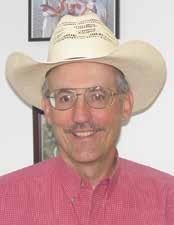
Dr. David Hataj: Until the last five years I’ve preached that kids ought to go to college, but I’ve changed that stance. Dave started out as a seasoned machinist and has written a book titled, “The Craftsman’s Code,” which extols the honor and benefits of learning a good trade and attending a vocational school instead of college. Ironically, they twisted his arm and he has since obtained a Ph.D.; but deep down, he’s a bluecollar tradesman. Someday I’ll expound more on this topic.
Michelle Bader Ebersole: Everyone that I interviewed is laser focused on the mission that God has pushed them into. I’ll use Michelle as an example. (I think most of us if given the choice would coast through life fat, dumb and happy. We’re not mean, just self-centered. Someone sitting 10 feet from us can be in a hot mess and we’re oblivious until God chooses to throw us into change things.) Suddenly after 17 years of marriage and raising three teenagers, Michelle’s husband died. Even in a faith-filled environment, widows are mostly isolated and struggling. Michelle knows the trials and tribulations firsthand. I love it when Christians seek God in their trials and turn them into glorifying Him. Michelle wrote a book titled, “Widow Goals: Steps to Finding Peace When You Lose Your Spouse,” to help widows, but she also teaches us sideliners how to be supportive.
Todd Hampson: I was dying to meet Todd. I’ve never understood Revelation, so finally I told myself, “I’m going to memorize it and work on understanding it.” I got into it a few chapters and
still didn’t have a clue. Then my wife, Katy, found two of Todd’s books: “The Non-Prophet’s Guide to the Book of Revelation” and “The Non-Prophet’s Guide to the End Times.” Both books are super easy reads, written on about the tenth grade level and crystal clear.
Seth Gruber: Seth is a dynamic speaker, and his passion is for the church to reclaim her legacy. America has reduced the church to missions and a little evangelism. We have excused ourselves from politics. (Look where politics has ended up without a Christian influence.) That is foreign and strange to the early 1900’s church. The church has become progressive. It is no longer fighting evil. Seth founded the White Rose Resistance and is well known for the film and book, “1916 Project.”
David Rives: Where were all the Christian scientists when I was a kid? I couldn’t argue on that level with the atheist professors on evolution in college. I love how Christian scientists and archaeologists are coming out of the woodwork the last 30 years. They’re blowing the socks off the so-called atheist “scientists.” I cannot do David justice. I beg you to go to his website, Genesis Science Network, and check all of the resources he offers – books, magazines, weekdays 11-12 educational content to supplement homeschoolers – or visit the Wonders Center in Tennessee. I love it when Christian scientists get into the fight!
Dr. Neil Shenvi: Dr. Shenvi has written a book titled, “Post Woke: Asserting a Biblical Vision of Race, Gender, and Sexuality.” Even from the first page, he comes out swinging. He tackles such topics as critical theory and transgenderism and believes that no matter which direction you look, there’s confusion, anxiety, anger, and irrationality. Definitions have changed. Values have been upended. People can no longer answer basic questions like, “What is truth? What is a woman?” He encourages people to think clearly, biblically, and push back on bad ideas. n
For more information about anything in this column, contact Tom at tomclaycomb3rd@gmail.com.

By Dr. Rick Chromey
It did not begin with a gymnasium. There were no basketballs, no locker rooms, no swimming pools echoing with whistles and laughter. Long before the letters Y–M–C–A became synonymous with fitness and recreation, they stood for something far more urgent—something born not out of leisure, but out of crisis.
The story begins with a young man who, by his own admission, was headed in the wrong direction.
George Williams was born in 1821 on a quiet farm in Somerset, England. Baptized Anglican, he later described his early life with disarming honesty as “a careless, thoughtless, godless, swearing young fellow.” Concerned for his future, his family sent him away to apprentice in a draper’s shop in Bridgwater. It was meant to correct him.
Instead, it transformed him.
In 1837, Williams experienced a genuine spiritual awakening, leaving behind the nominal faith of his youth to pursue a committed Christian life within the Congregational Church.
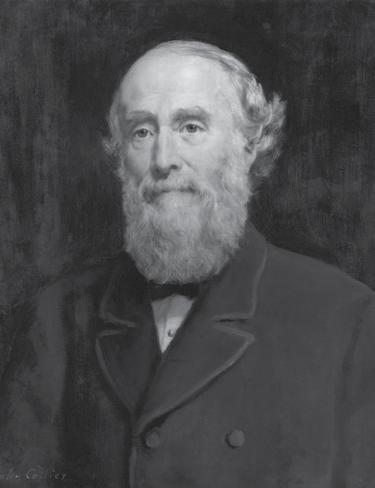
When he moved to London at nineteen to work for Hitchcock & Rogers, a large drapery business, his faith was no longer theoretical—it was active, growing, and searching for purpose.
London gave the young Williams something to do with it.
The city was bursting at the seams, reshaped by the Industrial Revolution into a magnet for young laborers pouring in from rural farms. These were not established men with families and support systems. They were young, alone, and vulnerable, working ten to twelve hours a day, six days a week, sleeping in cramped quarters above shops or in crowded tenements.
Outside their doors was a world that could devour them. The streets were filled with open sewers, drunkenness, gangs, and vice. Taverns promised escape but delivered ruin. The scenes described in “Oliver Twist” were not exaggerations—they were everyday life. Williams watched as young men, far from home and unanchored, were slowly pulled under.
He later wrote that these men were treated as though they existed only “to labor and sleep,” with no space for spiritual life.
That reality unsettled him deeply. It raised a question he could not ignore: what if someone intervened? What if there were a place—a refuge—where young men could find strength, guidance, and faith before the city consumed them?
Around this time, Williams encountered the writings of Charles G. Finney, who argued that revival was not accidental but intentional. Christianity was not passive. It was active, urgent, and missional. Williams realized faith demanded action.
On June 6, 1844, in a modest room above his workplace near St. Paul’s Churchyard, Williams gathered twelve young men. There was nothing remarkable about the setting—no banners, no ceremony, no sense that history was about to be made. They simply met to pray, to study Scripture, and to encourage one another to live differently. Williams described it as a refuge, a place of Bible study and prayer for young men seeking escape from the hazards of the streets.
It was simple. It was practical. And it was exactly what was needed.
That small gathering became the Young Men’s Christian Association, and what followed was not merely growth—it was momentum. Within seven years, the YMCA had spread across Britain, establishing twenty-four chapters and reaching over 2,700 members. Its appeal crossed denominational and social boundaries, speaking to a universal need among young men navigating a rapidly changing world.
In 1851, the movement crossed the Atlantic when Thomas Valentine Sullivan brought it to Boston, creating a haven for sailors and laborers far from home. Within a year, chapters appeared in Montreal, Baltimore, Paris, and Geneva.
The idea was now portable.
Two years later, in Washington, D.C., Anthony Bowen—a former slave—founded a YMCA for Black young men. At a time of limited opportunity and rigid segregation, it became one of the first non-church institutions in America devoted to their development and well-being. By 1855, just eleven years after that first meeting in London, there were 329 YMCA chapters in nine countries with more than 30,000 members. That same year, delegates met in Paris to form an international organization united around a shared commitment to Jesus Christ.
The story is best seen in lives changed. Dwight Moody arrived in Chicago as a poor shoe salesman with little education and less direction. He began attending YMCA meetings, where volunteers urged him—not toward success, but toward Christ. One Sunday school teacher refused to give up on him and personally led him to faith.
That moment changed everything.
Moody would go on to become one of the most influential evangelists of the nineteenth century, preaching to millions, but he never forgot where it began. The YMCA was not just a place he attended—it was the environment that shaped him, challenged him, and pointed him toward a life he could not yet see.
By the late 1800s, the YMCA expanded its vision through what became known as “Muscular Christianity”—the belief that faith should shape the whole person: spirit, mind, and body.
Gymnasiums became tools, not ends.
In 1891, YMCA instructor James Naismith invented basketball to channel the restless energy of young men, and a few years later, William Morgan developed volleyball. These were not merely games— they were instruments for discipline, teamwork, and character.
The YMCA also pioneered swimming instruction, built some of the first indoor gyms, and provided safe housing for young men navigating city life. Educational programs followed, including English classes for immigrants and evening institutes that grew into universities. The model expanded to women through the YWCA.
The influence of the YMCA reached every corner of society.
Booker T. Washington promoted YMCA work among Black communities. George Washington Carver encouraged its spiritual mission. Robert Baden-Powell drew from the model to develop the Boy Scouts. Even movements like Toastmasters and the teaching career of Dale Carnegie began within YMCA walls.
Its impact extended into humanitarian work as well.
Henri Dunant, influenced by YMCA ideals, helped found the International Red Cross. During the Civil War, YMCA volunteers served as chaplains and medics. In World War II, the organization distributed New Testaments to soldiers.
By the early twentieth century, the YMCA had become one of the largest youth movements in the world, spanning continents, cultures, and languages. Today, it still reaches tens of millions across more than a hundred countries.
But the mission that once defined it has largely been forgotten.
In the past seventy-five years, the YMCA drifted from a movement of prayer to a network of programs, from a call to Christ to a calendar of activities. It is known for its gyms, not its gospel. Recognized for what it offers, but not for what it once stood for.
Many who pass through its doors no longer know what the “C” even means.
In 1978, the Village People released “Y.M.C.A.”—a global anthem about belonging, direction, and a second chance. Decades later, that same song would echo through political rallies, recast as a symbol of
SOURCES CONSULTED:
1. Sir John Ernest Hodder-Williams, Life of Sir George Williams (1918)
2. Charles G. Finney, Lectures on Revival of Religion (1835)
3. Lyle W. Dorsett, A Passion for Souls: The Life of D.L. Moody (1997)
energy, nostalgia, and culture. And somewhere in between, the mission was lost.
Would George Williams recognize it?
He didn’t set out to build a brand, a building, or a business. He built a refuge—not for recreation, but for redemption. If you want to understand the YMCA, don’t start in the gym. Go back to that small room above a shop in London, where a handful of young men chose Scripture over the streets, prayer over pleasure, and Christ over everything.
That decision sparked a movement that circled the globe. It also offers a warning. Movements don’t lose their mission all at once. They drift— quietly, gradually, almost imperceptibly—until the mission is reduced to initials.
And when that happens, what remains is not what was built…but what was forgotten. n
Dr. Rick Chromey is a historian and theologian who speaks and writes on matters of religion, culture, and history. He’s also a Lewis and Clark historian for American Cruise Lines (Columbia and Snake Rivers). Rick and his wife Linda live in Star, ID. www.rickchromey.com.
4. YMCA historical archives (ymca.int)
5. Springfield College Archives (Naismith, Morgan)
6. Gideons International historical records
7. Martin Gumpert, Dunant: The Story of the Red Cross (1938)

By Nathan Carroll
“Remember your mercy, O LORD, and your steadfast love, for they have been from of old. Remember not the sins of my youth or my transgressions; according to your steadfast love remember me, for the sake of your goodness, O LORD!” — Psalm 25:6–7 (ESV)
Paying off debt is rarely just a math problem. Often, it’s a battle of the mind.
For many, the most difficult part of the process isn’t the sacrifice it takes to pay down debt. Budgeting, cutting out unnecessary expenses, and diligence are easy for plenty of people. For many that I’ve talked to it’s the continuous discouragement they have knowing they put themselves in this position. Past decisions have a way of resurfacing when progress feels slow. Regret can quietly turn into discouragement, and discouragement can tempt us to quit altogether.

Psalm 25 offers an important reminder: God does not define us by our past mistakes. He relates to us through His mercy and steadfast love.
It’s easy to let debt shape how you see yourself. You may begin to think of yourself as “behind,” “irresponsible,” or “bad with money.” But Scripture never assigns identity based on failure. Instead, it points us toward repentance, obedience, and growth.
Your debt reflects where you were, not where you are. If you’re living on a budget, sacrificing comforts, and intentionally paying down balances, you are practicing faithful stewardship today. That matters far more than the decisions that led you here.
I love how David’s prayer is honest: “Remember not the sins of my youth.” Yes, it’s a prayer to the Lord, but it’s almost as if he’s reminding himself of that as well. A command

to his mind. He understands that dwelling on past failure does not produce righteousness; it produces paralysis. If God chooses to deal with you according to His steadfast love, you should do the same. Shame has no productive role in the debt payoff process. Encouragement, however, is essential – consistent encouragement that you’re making the correct strides to address the issue at hand.
Debt payoff is slow by design. It cultivates patience, humility, and discipline. Virtues that rarely develop quickly. Each payment is an act of obedience. Each month you stay consistent is progress. Each financial “no” strengthens long-term freedom. It takes time, and that’s a good thing. God is more concerned with who you are becoming than how fast the numbers change. The numbers changing is a fleshly outcome – our heart posture changing is a spiritual one.
Paying off debt is not about punishing past mistakes. It’s about preparing for a future with greater margin, peace, and generosity. Stay encouraged. Stay consistent. And remember that your past decisions do not get to control your present mindset when you are walking faithfully today. n
Nathan Carroll is a Registered Assistant with Christian Wealth Management in Boise, Idaho, providing biblically responsible investment advice to Christians. For more information, visit investforthegloryofgod.com.
Investment advisory services provided by Creative Financial Designs, Inc., a Registered Investment Advisor. Securities are offered through CFD Investments, Inc., Member FINRA & SIPC. 2704 South Goyer Road, Kokomo, IN 46902, (795) 453-9600. Christian Wealth Management, LLC is not affiliated with CFD Investments, Inc. or Creative Financial Designs, Inc.

The following information is provided by Wednesday’s Child, an organization that helps Idaho foster children find permanent homes. Note that the photos of its young people have been “cartoonified” in a fun way, while still keeping a wonderful likeness to his or her actual picture.
Bethany, 13, is a kind and caring young girl who loves reading the Bible, listening to Christian music and practicing her faith. Bethany has so many interests and hobbies! She considers herself a “foodie” and loves to think up new recipes on her own. She hopes to someday become an incredibly talented chef.

Bethany is always inquisitive and loves to learn new things, particularly about her favorite school subjects of science, social studies and history. Being creative is another outlet for this outgoing girl and she expresses that through playing the piano, singing and making art out of things she finds in nature. Bethany loves horseback riding and all animals, and she says they help her stay calm and centered.
Spending time participating in activities like gymnastics, swimming, basketball, soccer and tennis help her to thrive as well. Bethany is hoping that her Forever Family loves to play cards and board games together and to chase adventure by exploring new things and traveling. Her bucket list includes one day traveling to Paris; but until that can happen, she’d be happy with a trip to Florida to go to Sea World and play in the sand on a beach.
Bethany’s Permanency Team describes a great fit for her as either a single mom or a two-parent family where she might be the only child in the home; however, the team is also open to hearing from families with other children. Life is sure to be an amazing adventure with this resilient girl as a part of your family.
Learn how your family could be considered as a potential adoptive family for Bethany by visiting www.idahowednesdayschild.org. n
For more information on the Idaho Wednesday’s Child Program, visit www.idahowednesdayschild.org, or contact Specialized Recruitment Services Administrator Shawn White at swhite52@ewu.edu or cell (208) 488-8989.



Launch Pad is a program offering students at high schools across the valley Christian Release Time classes during their public school day.
“It’s a place to grow in faith and connection,” Kristin Brown, in charge of Program Development and Administration for Launch Ministries, said. “Your school counselor can connect you to Launch Pad.”
See launchministries.org for more information.

After high school, take a gap year, with an eight-month discipleship experience that offers college credit through a program called Launch Gap Year. Visit launchgap.org for more information. n Scan code to learn more about Launch Gap




By Gaye Bunderson
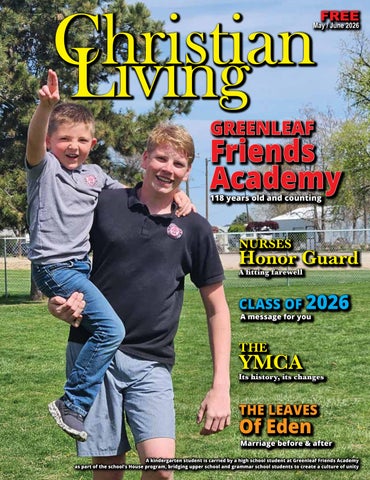
Greenleaf Friends Academy boasts a rich and long history: 118 years to be exact. What makes that especially unique is that GFA is, according to its website, the oldest private Christian school still in operation “west of the Mississippi River.”
The community of Greenleaf, located roughly five miles from Caldwell in Canyon County, is an agricultural hamlet made up of 812 people, according to the 2020 census. Greenleaf Friends Academy has 252 students, only about 10 percent of whom are from the little town. Its student body of junior kindergarteners through seniors comes from surrounding area towns like New Plymouth, Middleton, Caldwell, Nampa, Marsing, Wilder, and others.
A brief history of Greenleaf includes a migration in the 1900s by Quaker folks (aka the Religious Society of Friends), who flocked to Idaho from America’s Midwest. They found an aesthetic agricultural area they deemed worthy of planting farms and homes on. They named the town for a Quaker poet and abolitionist, John Greenleaf Whittier. They built a church in 1906 and named it Greenleaf Friends Church; and, in 1908, they built a school to educate their children in the way they thought most agreeable to their faith. Their young people would receive exceptional training in literature and ethics, among other things.
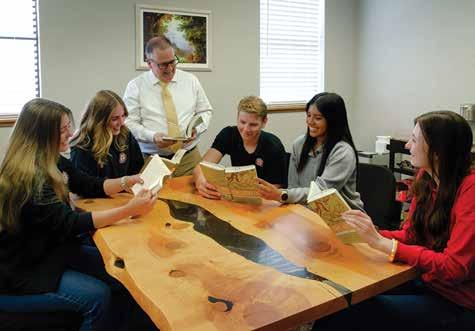
The school maintained that high level of learning – called a classical Christian education – for many years, and has returned to it after a lapse. Current Head of School Chris Browne explained, “Classical education built civilization. But in the 1930s, the country underwent industrialization. We went from teaching morals to teaching young people how to get a job working in a factory. Everything became more skill-oriented.”
The value of virtue was forfeited to the dominant trends of the day.
“We lost our North Star,” Browne said.
But he maintained that, “If you create a virtuous person who loves his neighbor and serves others, you’re creating a good citizen as well as a good accountant, or other occupation.”
Creating that person is an everyday goal for the school. With the return to a classical Christian education, students are trained, according to Browne, “in the Bible, the gospel, and the Christian faith, both formally and informally.”
The school offers courses in Latin, Ancient History, Modern and Medieval History, American History, and the Humanities, among many others. “After a number of years now, we’ve returned to our founding,” Browne said.
That includes studying such works as Plato’s “Republic,” Homer’s “The Iliad,” and Aristotle’s “Nicomachean Ethics,” a look at virtue and happiness.
“We look at it all through a biblical lens,” Browne said, “and we talk about it. We seek understanding and truth – truth is very important.”
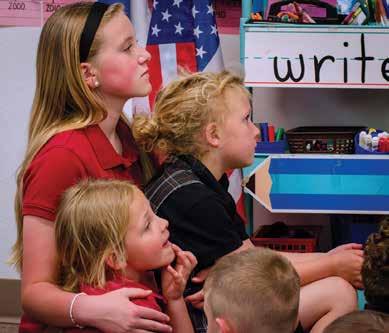
A 6-year-old in the first grade at CFA was well acquainted with the Latin phrase coram deo, which translates into “in the presence of God,” according to Browne. All lessons start early, including Bible studies for 4-year-olds – which isn’t about picking up a Bible and reading it from beginning to end but, for the very young, is about learning Scripture verses relevant to their age and stage of life. All students have a devotional time and a prayer class.
A walk through the halls of Greenleaf Friends Academy highlights both the school’s long history – some walls were built in the 1950s – as well as its love of art and beauty. Representations of famed artworks are displayed, and not merely for art education but for the love of beauty as well.
Browne said the children are, of course, also taught all the essentials of a traditional education, such as how to write a grammatically correct sentence or tackle a math problem and solve it. It’s just that the academy also wants them to be familiar with the classics, works of beauty, and the value of kindness.
Said Director of Spiritual Life at GFA, Caleb Daniels, “I think the greatest benefit to our student culture and climate has been having a clear vision of who we want to be as a school and centering everything we do around that vision. When I first arrived, there was a desire to switch to a classical Christian model from a leadership level, but a hesitancy at jumping in with both feet. … Finding ways to live out our calling to be a community that is ‘Christ-centered, joyfully classical, academically excellent’ has been a helpful guiding star for me as a teacher and director of spiritual life and for our community overall.”
Parents with children in the GFA system attest to the importance of the academy’s emphases.
GFA Director of Development Jennifer Airheart has a 13-year-old daughter enrolled in the school and said, “As a parent myself, I take a lot of comfort that my daughter is not ‘lost’ in a large class with too many students. Teachers are interested in her development; she’s safe; she’s got a good grip on what is right.”
The teacher-to-student ratio is comfortable for both the instructors and the young people, at 11 to 1.
Airheart continued, “The kids here are different – they’re polite and respectful. Teaching that at school is gold.”
Along with the history of the founding of Greenleaf, Greenleaf Friends Church, and the academy, there is an engaging chronicle of the generations who’ve attended the school.
Enter Ken and Devonne Hibbs.
Ken’s great-grandfather came to the area in 1906 to homestead; his parents were missionaries, and there have been five generations [on his maternal grandmother’s side] to attend Greenleaf Friends Academy. Ken himself attended in his youth. Years back, Devonne came to Idaho from Nebraska with her parents and also attended GFA. As a grownup, she married Ken, and the couple had three children attend and graduate from the school. They now have three grandchildren attending.
“One hundred and nineteen of our relatives have come here,” Devonne said, explaining she undertook an informal count that included cousins and other kin.
She enjoyed telling stories about a grandson who is a fifth generation student, now in the fifth grade. Asked recently what his favorite song was, he replied, “It Is Well with My Soul,” a hymn written in 1873 by a man named Horatio Spafford following the deaths of his four daughters in a shipwreck.
She also recounted a story about her teenage granddaughter who, at a beauty shop getting her hair done one day, was asked what classes she was taking in school. To say the least, the other people in the room were amazed by her answers as she told them about studying Latin and “The Iliad.”
serving churches in the Treasure Valley were also educated there.
The school was originally a ministry of the Friends Church but is now interde nominational.
As Head of School, Browne defined his job as “more like a superintendent than a principal – it’s like an old-style headmaster.” In his role, he is in charge of “teacher training, marketing, admissions, and fundraising, including the auction.”
The auction is an annual event that has been going on at GFA since 1951. “That’s how we got our gym,” Airheart said. “The auction supports and generates the funds – it’s the juggernaut – and we auction a little bit of everything, from Quaker quilts; to farm and garden supplies; to furniture; to teddy bears and smaller things; to a rifle for a hunter. We want to make sure there’s something in the auction to interest pretty much anyone.”
This year, the auction was held March 13-14, 2026 – its 75th year.
“It is one of southern Idaho’s longest-running fundraising events,” Airheart said. Another popular fundraiser is a fall gala.
Parents pay an average tuition of $6,100 for a child. “It’s affordable and still brings in revenue. While other Christian schools in the valley cost around $10,000,” Browne said, “we do more with less.”
Similarities to other schools include an “actions have consequences” policy for discipline. That may include time out or what Browne called “serving the school.” That’s when kids have to miss recess to scrub baseboards.
The school also offers intramural sports, and Airheart explained, “We have an intramural basketball team for the students to compete among themselves. However, our varsity boys basketball team is a member of IHSAA Division 1A, and secured a spot in the Idaho state championship playoffs for the first time in almost 20 years. They went on to win the consolation finals.”
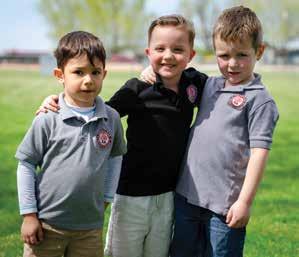
Airheart humorously explained that while her daughter was reading “The Aeneid,” an epic poem about the origins of Rome written by Virgil, she was so impressed by it that she excitedly told her parents, “You have four months to read this!” Wanting to share her daughter’s enthusiasm, Airheart started reading it – “Yes, I am tackling it. All 496 pages,” she said.
Some locally well-known faces around town in Greenleaf and other area hubs have attended GFA. Brad Holton, the former mayor of Greenleaf and current county commissioner, is an alumnus of GFA’s class of ‘75. Also, the current mayor, Ryan Schnuerle, has children who attended; and some pastors presently and previously
GFA’s mock trial team also advanced to the state competition. Once again, Airheart spoke for the school: “In just one year, our team went from the bottom of the rankings to placing in the top five in the entire state, competing against some very big high schools, and they came home with the Ethics Award. We are so proud of these kids!”
Devonne Hibbs told one last, poignant story about a grandchild. Her daughter was looking around at public schools, but when Mrs. Hibbs’ GFA-schooled granddaughter saw what the public schools were teaching, she didn’t want to go. Why? “I already know all that stuff,” she said. A stellar recommendation for the GFA curriculum and its Christ-based policies. n
For more information, go to gfaschools.org.
This special series is for all of you young at heart to enjoy and share with the young ones in your life. ~ Joan

By Joan Endicott
The sky was dark and the wind felt chilly. Joy sat on the ground pulling at the grass with her head hanging low. She thought the cold, grey day looked exactly like she felt on the inside.
“They said I couldn’t play,” Joy whispered. “They said the game was full, and then they turned their backs and made a circle with no room for me. They whispered to each other and acted like I was invisible…I wished I were invisible.”
GiGi wrapped her arms around Joy, pulling her into a warm, tight hug. Joy loved GiGi’s long, strong hugs. Feeling GiGi’s heart beating against her cheek somehow made the world feel quiet and safe again, melting away the hurts of the day.
“I’m so sorry. It’s hard to be the one on the outside of the circle,” GiGi whispered. “It can make a heart feel a very heavy kind of lonely.”
Joy let out a long, shaky sigh. “I don’t think I want to try to be kind to them anymore,” she said quietly. “It didn’t work.”
GiGi held her a little tighter. “I understand—I’ve felt that way many times before, too. When our hearts are hurt, it is very tempting to just close them up.” GiGi rested her chin gently on top of Joy’s head.
“But kindness is a very brave and beautiful thing. I’d love to tell you about three very special people who, when they were right around your age, learned what it means to have a brave, kind heart.”
“Rachel had a big sunny smile and a happy heart. She was kind to others and never wanted anyone to feel left out. So, for her birthday, she invited every girl in her class. She wanted her party to be a big circle where everyone belonged.
“But three of her friends came to her and said, ‘We won’t come to your party if Emma comes. We don’t like her.’ Rachel looked over and saw that Emma was standing nearby and had heard them. She looked very sad and very alone.
“Rachel felt her heart beat faster. Even though she was worried that the three friends might not come, she chose to be courageous. She told the girls, ‘Emma is my friend, too. I want you to come, and I want Emma to come.’
“Then Rachel walked over and put her arm around Emma. She chose to be a brave friend instead of listening to those who weren’t choosing kindness and tried to keep their circle small.”
Joy was silent for a long moment, gently brushing her hand across the green grass. “I don’t know if I could have been that brave...” she whispered.
GiGi squeezed her a little tighter. “Yes, I understand. Being brave usually feels a bit scary while we’re doing it,” GiGi said softly. “I’m learning that it’s simply choosing to do the right thing even with a shaky heart.
“It wasn’t that Rachel wasn’t afraid,” GiGi continued. “It’s that she chose to listen to what God was telling her heart instead of the loud whispers of the others. We get to practice listening to His voice on the
inside, instead of the mean whispers on the outside.”
“Caleb had a huge heart. He was creative and full of fun! He and his friends loved to make up games at recess, like pretending to rescue each other from dragons or acting out scenes from a Star Wars movie—light sabers and all!” GiGi winked at Joy.
“Oh, that sounds fun!” Joy laughed, the sound of her own giggle making her feel a little lighter.
“Ohhh, yes, they had endless adventures, always laughing no matter what they were doing…or if they were doing nothing at all!” GiGi’s laugh met Joy’s in the middle, like a warm secret.
“One winter day, they were excited about playing in the snow at recess and talked about all the different things they could do: throw snowballs, make snow angels, start building a fort…but then someone suggested a snow slide and everyone cheered with excitement! A snow slide it was!”
GiGi continued, “They all worked together quickly, and before long they successfully built a very slippery snow slide.” GiGi overemphasized all the S sounds for fun—the silliness tickling them both until they were breathless.
“When it was finished, the friends all took turns, one after another. Then, as Caleb was getting ready to go down, he invited his friend Henry to go after him.
“Henry wasn’t like Caleb’s other friends; he was quiet and shy. Some classmates didn’t talk to him, and others were even mean to Henry and made fun of him. They said he was ‘different.’ Even though others didn’t choose to be kind to Henry, Caleb did!
“Henry was so excited to go down the snow slide, and his face lit up as he did…until…” GiGi’s voice dropped.
“Until what, GiGi?” Joy asked, her smile fading as she leaned in close.
“Until some of the boys started yelling, ‘Henry, you ruined our slide! Your cowboy boots dented it. You can’t go down it again—no cowboy boots allowed!’ ”
“That’s so mean! Why would they do that?” Joy asked.
“Well, I’m sure those boys would take back what they said if they could, but at the time, they just reacted without thinking about how it could hurt Henry. It’s a good lesson for all of us to stop and think before we say something and ask ourselves, ‘Is it kind?’ ”
Joy paused, then spoke thoughtfully, “Golly, I want to start asking myself that so my words don’t hurt someone else.”
“Me, too, my love. ‘I Get To!’® continue to learn that lesson right along with you!” GiGi gave Joy an assuring wink.
“When Caleb saw how embarrassed and sad Henry was, he patted him on the back and said, ‘It doesn’t matter, Henry, let’s go do something else.’ So they did! In fact, with a few other friends, they decided to make another slide—and it was even nicer!
“So as the builders all got in line, one by one, they slid down the slippery slope, laughing the whole time. Caleb looked over and saw Henry was only watching and not in line to slide. He went over and said, ‘Hey, Henry, come on—come down the slide!’ ”
“Henry looked up at Caleb sadly and said, “But I have cowboy boots on. Does this slide allow cowboy boots?”
“Caleb smiled and patted Henry on the back, bringing him back to the slide and said, “Henry, it allows...EVERYONE!”
GiGi and Joy sat in silence for a long while, letting it all settle in their hearts. Joy thought about how brave one’s heart must be to walk away from a small circle.
The grey clouds were gone and the sky was a beautiful blue. GiGi stood up and offered Joy her hand. As they walked over to water the tomato plants, GiGi handed Joy a small watering can. “You know, my love,” she said. “Another favorite example of a kind, loyal and brave heart is a boy named Nathanael. Besides being kind to others, he made it a priority to show kindness to his brother and sister.”
Joy stopped pouring water. “Hmmm, I wonder,” she said quietly, “why sometimes when it’s family we accidentally forget to use our kindest words.”
GiGi smiled and tucked a stray curl behind Joy’s ear. “It is a very easy thing to forget—but being kind to family is one of the most important to remember.
“Nathanael had a horse named Skeeter and he loved to ride her as often as he could. He was always kind about giving other children rides, but he especially made sure his brother and sister got all the rides they wanted.
“He also enjoyed riding Skeeter in parades. Part of being in a parade is waving to all of the people watching, who are often waving back at you, but because Nathanael had such a tender, observant heart, he had a beautiful way of looking right past the noisy, busy crowds to find the quiet people. After one parade, he said, ‘I like to wave at the people who look lonely.’ ”
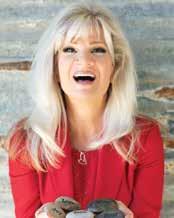
GiGi took a deep, emotional breath. “That is a very sweet and important lesson for us all.”
Joy let the stories settle in her heart for a moment. She looked up, her eyes bright with a new thought. “GiGi, I guess I don’t want to be in somebody’s circle unless it’s a circle of kindness that includes everyone!”
GiGi’s eyes filled with happy tears. She set down her watering can, sat on the wood stump, and pulled Joy into a warm, tight hug. “Oh, my beautiful girl, that is exactly right! And remember, kindness isn’t something we ever wait for others to offer us first.”
“We don’t?” Joy asked, looking puzzled.
“Oh, not at all,” GiGi smiled, her eyes twinkling. “We get to go first! With God’s help, we get to be strong and courageous enough to be kind, even when no one else is. We get to be the example and show others exactly what love looks like.”

GiGi playfully tugged on Joy’s sweatshirt. “There is a beautiful verse in the Bible that tells us to ‘clothe yourselves with kindness.’ Just like you chose to put on this sweatshirt today to keep yourself warm, you get to wake up every single morning and choose to put on kindness—something we get to wear everywhere we go.”
GiGi held Joy’s face and looked into her eyes. “And never worry about sharing kindness with too many people—God gives us an unending supply of His love! Lovingkindness is just like a candle, sweetheart.”
“A candle?” Joy asked.
“Yes,” GiGi smiled. “A candle loses nothing by lighting another candle. It simply makes the whole world brighter.” n
Clothe yourselves with kindness. – Col. 3:12 (excerpt)
Joan Endicott is a keynote speaker, coach, and author. Her faith-centered message, “I Get To!”®, has encouraged people in over 30 countries to make a simple shift in perspective and discover the miraculous life they already have. To receive a FREE copy of her book and ongoing encouragement, visit JoanEndicott.com and follow @JoanEndicott.












By Gaye Bunderson
When nurse Kelli Reed traveled to Montana for a friend’s funeral, she was impressed by an honor guard. Not a military honor guard, but one comprised of nurses who were giving their fellow health care worker a fitting goodbye with a nurses honor guard. Reed was so touched by the ceremony that she wanted to return to the Gem State and participate in a nurses honor guard herself.
But there wasn’t one. So four women – most of them participants in the Faith Community Nursing program – got motivated to launch the Treasure Valley Nurses Honor Guard. They succeeded, and their first ceremony was for a longtime St. Luke’s nurse practitioner in May of 2024. During the intervening years, they performed honor guard duties for many more funerals.
Others they’ve honored included:
• A nurse volunteer who worked with Haitians
• A nurse leader from St. Luke’s who helped develop new leaders
• A nurse who performed at a comedy club – “She so enjoyed humor,” Reed said.
The other members of the original four are Cari Moodie, FCN coordinator; Denise Sullivan, FCN; and Tammie Sherner, a professor of nursing at Boise State University. They got together, planned and organized the group, and now have approximately 50 members. They drew heavily from military and law enforcement honor guards, Reed said, when planning how to organize and present their own ceremonies. The ceremonies are brief but very personal and include information about the nurse’s career, highlighting the areas she cared about most; the information is read out loud from a scroll. “We tell their story and honor them for what they’ve done,” Reed said.
Generally, about five fellow nurses are involved in the ceremony. Stated Reed: “We wear our white nurse’s uniform, blue velvet capes, and a white nurse’s cap. We have eight teams and we perform the ceremonies on a rotation basis.”
One of the nurses holds a lamp, known as the Nightingale lamp after famed nurse and social reformer Florence Nightingale. Another
holds a token of the nursing profession, such as a “nursing service pin,” while yet another carries a flower or flowers.
Similar to other honor guard ceremonies, a “final call to service” is offered, closing out the nurse’s career. “We call their name three times,” Reed said. “Then we extinguish the lamp and give the family the tokens of the nursing profession.”
Families receive the scroll, pin, lamp and flowers as mementos of their loved ones.
Families are notified of the availability of an honor guard through funeral homes, and if they are interested, they contact a member of the Treasure Valley Nurses Honor Guard. The Guard is non-denominational, and nursing designations include an IPN (Intervention Project for Nurses), PN (Licensed Practical Nurse or Licensed Vocational Nurse), NP (Nurse Practitioner), or anyone with a nursing degree. “Time served in the profession is not a requirement,” Reed said.
One honor guard member is a male nurse who was a longstanding nurse in the military. In instances where someone has both served in the military and as a nurse, military honor guards go first during a funeral service followed by, if requested, the nurses honor guard.
The Treasure Valley Nurses Honor Guard has performed both virtual ceremonies as well as a living ceremony for those on hospice. They seek to help other nursing communities throughout the state form their own honor guard programs. Reed stated that Idaho was the last state in the nation to have a nurses honor guard.
Why is the honor guard important to people in the profession?
“We give back this way,” Reed said, continuing, “I’ve worked a variety of roles as a nurse for 28 years. I say it’s the profession that keeps on giving. There are so many opportunities to keep giving, learning, and growing. I’ve never spoken to a nurse who said, ‘I’m sorry I got into this’, and nurses are the backbone of health care.” n
For more information, contact Kelli Reed at tvnurseshonorguard@gmail.com or (208) 571-4851.
By Larry Banta
I had been thinking lately about the concept of joy. I know I experience it, but how does one define it? Prior to coming to Christ, I really did not know I was missing it and since then I wonder how I could live without it.
One passage in James is particularly troubling, or interesting. James 1:2-3 says: Consider it pure joy, my brothers and sisters, whenever you face trials of many kinds, because you know that the testing of your faith produces perseverance.
Some time ago in India we met secretly in a house church with a group of pastors to provide some encouragement and training. In the group were some who had scars from having been tortured and imprisoned. When we worshiped with them, the joy was overflowing. Though suffering more than most of us will ever know, there was such rejoicing in their hearts.
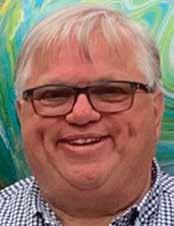
James says to count it not just joy but pure joy! That is not humanly possible. However, with the Holy Spirit residing in us can we have that joy? I cannot create that joy myself. I might be happy in some circumstances and very sad in others, but underlying all of this is that joy. This is a gift from God, a part of the fruit of the Spirit.
Galatians 5:22 starts out: The fruit of the Spirit is love, joy, peace... Joy is right there near the top of the list right after love. Without joy life is very hard to live. I am not happy in all circumstances, but underlying our sorrow and pain and in our happy moments there can be that joy.
Steve Bertel
Fill in each answer, one letter per square. Then ar range t he letters in t he highlighted squares to reveal t he name of …
1. In the NLT, he said, “O sovereign Lord. I can’t speak for you! I’m too young!” 2. It had a deser t to t he south and a sea to t he west
What is joy anyway? The Greek word in the original is χαρά (chara). It is defined as cheerfulness or calm delight.
Joy comes from rejoicing. Rejoicing comes from focusing on what produces joy. In our busyness we can easily forget to slow down and stop for a moment to really meditate on the goodness of God, to rejoice in Him. Philippians 4:4-8 shows us how to have joy. We are commanded to rejoice. What does it mean to rejoice? The word χαίρω chairō means to be glad, to have joy. Later in the passage, Paul tells us what to focus on that will sustain that joy we are commanded to have. Are we taking His blessings for granted by not expressing gratitude? Are we still in awe of His grace and mercy and power? Are we living in expectation of His coming?
Philippians 4:4-8 – Always be full of joy in the Lord. I say it again – rejoice! Let everyone see that you are considerate in all you do. Remember, the Lord is coming soon.
Don’t worry about anything; instead, pray about everything. Tell God what you need, and thank him for all he has done. Then you will experience God’s peace, which exceeds anything we can understand. His peace will guard your hearts and minds as you live in Christ Jesus. And now, dear brothers and sisters, one final thing. Fix your thoughts on what is true, and honorable, and right, and pure, and lovely, and admirable. Think about things that are excellent and worthy of praise.
Continued on page 23




By Mark Naito
Referencing the article from Fox News by Madison Colombo that was published on March 27, 2026.
The headline on the article was “Meta vows to ‘aggressively’ fight after landmark verdicts find tech giant liable for addicting kids.”
“Los Angeles jury found both Meta and Google liable for designing their products to make young people addicted. The plaintiff, known as KGM, testified that she became addicted to social media as a child and that it worsened her mental health struggles.”
I think it’s safe to say our culture has done a great job finding someone or something to blame for the addictiveness or bad habits created by technology (screens). But what ownership do we have?

Yes, Meta and Google are not helping our choices in life, but is it up to us to make better choices? Yes. Instead of relying on platforms that mainly have rumors instead of truth or facts –whether it’s a conservative platform or a liberal one – why don’t we go to in-person professionals in different industries, physically published journals, books, etc.?
Stop and consider where most of your information comes from these days. Whether it’s at work, school, home or wherever, is it online or physically published somewhere?
Think about this... I am writing a book, and there are many layers of editing that take place before it will be published and printed through a major publisher like HarperCollins. But something published on the internet does not necessarily have the layers of people to edit the content.
Why?
Because we all know that things on a screen or virtual document can be pulled, removed or edited at any time versus a paper copy that is printed, and once in the hands of the owner will no longer be removed from distribution.
What can you do then with your kids and things like social media or Google? Some ideas:
Teach them by example how much more meaningful in-person interactions are over virtual ones. And provide them safe options like church activities, having their friends over to your house to do screenfree things like going for a walk together, maybe helping a neighbor with some much-needed care, playing games like Ungame, going to Hobby Lobby and finding something to do together, etc.
Rhea Zakich, the founder of the Ungame – which has sold more than four million copies and helped many people communicate key emotions in a healthier way – reviewed our Reset Tech Kit and said this, “I share your concern about the younger generation being so dependent on their phones and the kind of connection it gives them with friends – and often with people who aren’t their friends. Of course, many parents [are guilty of this] too. It seems we’ve forgotten how to
communicate face-to-face. Many children and adults have what I call ‘plastic relationships’, with texting, email, social media, etc. There’s no heart-to-heart or spirit-to-spirit connection.”
Zakich recognizes, as a pioneer in communicating emotions through a game, that we’ve lost one of God’s key creation designs: in-person relationships without screens. Also, don’t bring a phone, tablet, computer or screen to a conversation – just bring you. The thing you will find most appealing is that the whole family will start building new, healthier relationships. Instead of texting, instant messaging, commenting on posts, etc., you will find yourself making new friends. You might receive extra benefits based on your in-person relationships, and you might find grace with the person at the DMV by befriending him or her.
Recently, I spoke at a Las Vegas homeschool conference, and the message of choosing relationships over screens was so popular that two organizations wanted us to lead additional workshops around this theme. People are hungry to get back to the basics but just don’t know how, because technology is pushed on us every day.
I’m going to repeat what I’ve said before in other columns... At the end of life, no single person transitioning from this world says anything other than they want to spend more time with certain people or reconcile with them. The loved ones in your life don’t ultimately care about anything else but your undivided attention in person.
One other example I came across was from a therapist I work with in the Treasure Valley. She said a young client took a toy that resembled him or her and put it face down to a smartphone. Why? Because the child wanted to be that smartphone in order to have more time with parents.
Wow!
Someday soon technology will be integrated into our bodies. Businesses and government departments are already working on this. So now is the time to find ways to be less dependent on tech so you truly have a choice when that time comes. The bonus is you will have a stronger relationship with God, your family, and others you love, with fewer distractions.
I can promise you that spending less time on screens versus more time on relationships will never be a bad investment. We were created to live that way. God bless and don’t miss the life God has given you by getting caught up with endless content – even good content. n
Mark Naito is passionate about helping people by seeking ‘root cause’, providing result-oriented solutions and good outcomes. His passion has always been to empower others to be educated to make their own informed decisions on what makes sense for themselves or their families. He started Navigating Tech Family toward that goal. He is a family man with a beautiful wife and kids and loves doing life with his family in the outdoors. He may be reached at mark@navtechfam.com.


Continued from page 21
Paul tells us that we need to refocus our thoughts. In this evil world our thoughts easily are focused on the negative, on the turmoil and problems. He starts out with focusing on truth: there is plenty of gossip, lies from the enemy, confusion in the world. We must seek truth. This will protect us from the delusions that the world tends to live under. We must be considering what is honorable and worthy of praise, such as remembering people who have done great things for God. Think about what is just, conformed to the will of God, considering what is right, correct, pure, not lowly, vain, venal, earthly, sinful. We put our minds on that which is excellent and strive for that in our own lives, to be excellent in all we do. We stand in awe of those things worthy of praise, such as God’s amazing creation, His provision, mercy and grace. Lastly those things that are lovely, defined as acceptable, pleasing. Meditating on this list has already increased my joy!
1 Peter 1:8-9 – Though you have not seen him, you love him; and even though you do not see him now, you believe in him and are filled with an inexpressible and glorious joy, for you are receiving the end result of your faith, the salvation of your souls.
If you are missing this sense of joy in your life, what happened? The first step is to know Christ, to accept Him as your Lord and Savior, follow Him in baptism and fellowship in a Bible-believing church. You then have the Holy Spirit living in you.
If you have known that joy of salvation but now it does not seem to be there, we need to take a look at how we might be suppressing the joy. If you are experiencing persistent or intermittent sadness, along with a lack of energy, a sense of hopelessness, change in sleep and appetite, your joy might be suppressed by suffering from depression. Depression is a medical illness for which there are effective treatments that can truly help. Along with drawing close to God, you may need to seek help from a medical professional to completely restore joy in your life.
Since joy comes from the Holy Spirit living within us, what might we be doing to the Holy Spirit to suppress that joy? There are two things we can do to the Holy Spirit, according to the Word. We can quench the Holy Spirit.

1 Thessalonians 5:19 says, Do not quench the Spirit. We quench Him by ignoring His urgings and direction in our lives. We take over the throne. As water quenches a fire, ignoring and turning away from God quenches the Spirit and there goes our joy!
Secondly, we can grieve the Holy Spirit. We are advised in Ephesians 4:30-32, And do not grieve the Holy Spirit of God, by whom you were sealed for the day of redemption. Let all bitterness, wrath, anger, clamor, and evil speaking be put away from you, with all malice. And be kind to one another, tenderhearted, forgiving one another, even as God in Christ forgave you.
We can grieve Him, cause sorrow, by turning to sin. When we are apart from our loved ones, we miss them and we long to be with them. Sin separates us from God and He longs for our presence with Him, as we should long to be with Him and share in that joy that He gives.
So, to get our joy back or to maintain our joy here are some steps:
• Repent: turn away from the joy-destroying effect of sin, unforgiveness
• Refocus: turn your eyes on Jesus
• Rebuild on the foundation, get back into the Word
• Respond to God with thanksgiving for all He has done for you, which then will...
• Restore your contentment
• Refuel your awe in God and His creation
• Reveal in your mind and heart how great is God!
• Rejoice and be glad!
May the God of hope fill you with all joy and peace as you trust in him, so that you may overflow with hope by the power of the Holy Spirit. – Romans 15:13 n
Dr. Larry Banta is an author of several books, a retired psychiatrist, and a former missionary. He served in India, Mexico and Kenya. He and his wife, Evelyn, a counselor, travel together to provide consultation and training in various international locations.

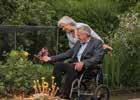







By Bethany Riehl
To the class of 2026,
Please indulge me for one issue while I try to get a grip on myself process the graduation of my oldest from high school. They warned me it would go fast and they were right. Eighteen years of life and thirteen years of school flew by.
I’m sure you are feeling the same way, Graduate. It went fast, didn’t it? And life will continue on that way—agonizingly slow sometimes, and yet time will simultaneously sweep you along as if you’re caught in a rip current. It’s simply how it is—wonderful and terrifying.
As you might have learned by now, or simply heard, the cliché is true: hindsight is 20/20.
As such, I’ve been thinking, if I could go back and tell myself a few things about what was important at graduation, knowing what I know now, what would I say? And would I listen?
I can’t go back and talk to myself, but I can talk to you. Whether you listen or not is up to you.
1. Get into the Word and get the Word in you. Read the Bible daily, immerse yourself in it, study it, memorize it. Make this your habit now, no matter what it takes. Use that fresh, young, brilliant spongy brain of yours to memorize big chunks of Scripture. Trust me. Pick a psalm of praise (like Psalm 103 or 145) to have ready when you want to (or need to) praise the Lord. Have a reminder in your heart that He is good, no matter what (Psalm 43). Memorize a Gospel and marvel at how much more clearly you see Jesus.
2. Along with that, find a good church that preaches the Word. Go, even when you don’t feel like it. Go, even when you feel lonely (go and look for other lonely people). Of course, you don’t have to go every Sunday for the rest of your life, but make it your habit that unless you have a good reason, you’ll be found at church on Sundays. And don’t be a consumer, as if the church is there to serve you—be an active participant. Go to church to learn about and worship God and to serve and love His people. This one practice will make such a difference in your life, I promise.
3. Develop a habit of prayer. Seek the Lord in all things, even before you talk to others about it. Go to Him when you wake, throughout the day, and when you sleep. Carve out a focused portion of time each day to pray in addition to all of the on-the-fly prayers. Schedule it if you have to. It will change your life.
4. Think about where you want to be in five years. Ten. Fifteen. What kind of habits stacked up day after day, year after year will you need to develop to get there? Start them now, one at a time. I guarantee you won’t become a kind and patient person when XYZ happens unless you’re disciplining yourself to be kind and patient now. If you want to be steadfast in the future, you need to learn to be steadfast now.
5. God is God and you are not. Learn contentment and humble yourself before the Lord. “Our God is in the heavens; He does all that He pleases” (Psalm 115:3). The Lord is sovereign over all things, and He has plans for you that you can’t even imagine. Some of those plans might confuse you over the years. I don’t understand why I’ve faced some of the hardship that I have, but I can tell you that God has always been faithful. “But godliness with contentment is great gain…” (1 Timothy 6:6).
Contentment holds much more power than you can imagine. Trust in the Lord holds more peace than you can measure. Cling tightly to this truth.
6. Ask questions, ask lots of them. Ask the big ones, ones that you might think you can’t say out loud for fear of appearing some such way to others. But don’t ask questions just for the sake of looking intelligent for having such a question. Look for and accept the answers. “Ask, and it will be given to you; seek, and you will find; knock, and it will be opened to you” (Matthew 7:7). The Lord did not send His Son to seek and save the lost only to be impossible to find. Seek Him and He will be found. (The website gotquestions.com is an excellent starting place for hard questions.)
7. A.W. Tozer said, “What comes to our minds when we think about God is the most important thing about us.” So how should we think of God? He describes Himself in Exodus 34:6,7 so we don’t have to think too hard on this one. Over and over the Scriptures describe God as merciful and gracious and abounding in steadfast love and faithfulness. Train yourself to think of Him often and to be sure you think of Him rightly.

8. In relationship to others, memorize Romans 12 and ask the Lord to help you live this way.
9. Exercise is really not that bad. Find something you like to do and move your body.
10. Being a perfectionist can look like a person obsessing over every detail and striving for excellence beyond what is reasonable, and it can also look like a person that won’t try anything because they’re
afraid to fail. Either way, strive to excel in a way that pleases the Lord, but don’t be a perfectionist.
11. Have fun! God designed this world for the Christian. We get to enjoy things the MOST because we know the Creator. Enjoy His creation. Laughter is so important. Seek to be joyful. It’s so much more enjoyable than lamenting every slight you perceive has been done against you.
12. Listen to advice but be choosy about who you listen to. Do you want your life to look like theirs? Then listen. Are they a miserable cow? Take a pass on their advice. Do they align themselves with Scripture? Listen. Do they align with the culture? Pass.

13. It’s okay if you don’t know what you want to do yet. Most people aren’t doing what they went to college for. This isn’t meant to discourage you, just know that life takes turns you don’t expect. We are not the ones in control. Don’t be lazy; work hard. But don’t obsess over having to have the exact right plan right now. God will likely change it on you, anyway. His will is for you to obey Him and love Him; He does an amazing job of guiding you through the details of what that will look like. “Your ears shall hear a word behind you, saying ‘This is the way, walk in it,’ when you turn to the right or when you turn to the left” (Isaiah 30:21). My dad repeatedly said this to me my senior year when I was in agony over my future. At the time it frustrated me, but he was absolutely right. The Lord has worked out my life; He will do the same for you.

14. Of course, there is so much more I would say, some more detailed to my own life but I’m sure you’ve had enough for one article. So, I will end this with hearty congratulations! n





To my own daughter, my sweet baby Rae—being your mom, teaching you at home for these years, has been a su- preme joy. I’m so proud of the young woman you have grown into, so proud that most of this advice is already your practice. You are much more mature than I’ll ever be. It’s been a wonder to see your talents and gifts develop; a joy to see you fall and learn to get up again. You are a loving, compassionate, and fun young woman. I can’t wait to see what God has planned for your life. Hold fast to Him in all seasons and en- joy your life as you seek and serve Him. And call your Mama once in a while when you’re out in this great big world. Love you so much, Mama
Bethany Riehl lives in the Treasure Valley with three amazing teenagers and her incredible husband. She aims to write books and articles that show God’s grace in all circumstances and to point readers to His great love through story. You can subscribe to her newsletter—and for a free short story!—and learn more about her works at authorbethanyriehl.com.

By Michael W. Henr y








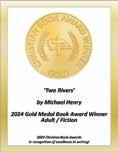






By Roxanne Drury
This morning, beyond my kitchen window, I witnessed the most phenomenal thing I have ever seen. I have been around for over 73 years, so that tells you just how amazing it must have been. Or perhaps my life has been rather boring. Either way, I hope your interest is piqued.
Glancing out the kitchen window, I saw what looked like snow in the harvested field across the street. Snow? There was no snow anywhere else! Suddenly, the ‘snow’ moved. And just as suddenly, I heard rather than saw an extremely large flock of loud, honking white birds overhead heading for the ‘snow’.
Grabbing my phone despite the cold, I promptly dashed out of the house and across the street to see what I could see, as they say. I could not believe my eyes. Hundreds, if not thousands, of snow-white birds graced the field, no doubt looking for scraps for breakfast. The sight left me astonished, not only by the beauty of the scene but also by the Creator. Wow!
Zooming in on the sight with my phone, I discovered via AI that they are Ross’s geese. They were once considered rare, but no longer. Their pinkish beaks and black-tipped wings mark them. They have larger heads and shorter necks than their sister species, the snow goose. They typically call Canada home, migrating as the cold weather sets in. They feed on grasses, sedges, and small grains. All this, along with the fact that our home is a hop, skip, and jump from the Snake River, makes it clear why they would take a pit stop in Wilder, Idaho. Lucky me!

After observing them for a bit and snapping a few pictures, I returned to the house to reflect on what I had just seen. How did they know where to land for breakfast? How did so many birds stay together? Was there a leader of the flock? Who were they following? How long had they been traveling before finding a landing spot? How did they know when to move? I had so many questions. I peered out the kitchen window again to see if they were still there. They were, but it looked like someone had given the signal to move. A few took flight. I quickly grabbed my phone again and headed across the street to capture on video what thousands of birds in flight might look like. It took only 57 seconds for the entire flock to take wing and move to the other end of the field. It was a magnificent sight, and very, very loud with honking and the flutter of wings. It was mesmerizing. How did they do that? I had trouble getting 15 preschoolers to line up or sit in a circle.
There could be only one explanation: God created them that way. In my reading about Ross’s geese, I found this to be exactly correct. They are naturally attuned to the weather, their environment, predators, and each other.
What I found most interesting was the social dynamics of the flock of geese. In an article by James Murray dated November 19, 2025, he lists three social factors that dictate how and when a flock takes off: Leader Behavior, Flock Cohesion, and Communication. Regarding the leader, Murray said, “The lead goose, usually an experienced adult, often initiates the takeoff sequence. Others follow, creating a ripple effect.”
If you have found this or another ar ticle valuable, please consider helping us bring stories like this to our community by suppor ting Christian Living Magazine, a 501(c)3 ministr y, at
We offer free confiden al pregnancy tes ng,
Website: lifelinepcc.org limited ultrasounds, abor on recovery and pregnancy housing support. (The Nes ng Place)
Schedule an appointment today! Call: 208-466-4000
Text: 208-944-1004




The geese follow their leader. Who do we follow? We are all following someone or something. Following Jesus, the King and leader, is the only right answer. That may be a controversial statement, but it is true. When we follow Jesus with all our heart and soul, it shows we trust Him enough to follow. Like the geese, we can trust our leader, Jesus, to know when it is time to move or when danger lies ahead, and to follow Him on the path that is right, safe, and joy-filled.
I am reminded of how God Himself led the Israelites in a cloud and a pillar of fire in Exodus.
When we wholeheartedly follow our leader, Jesus, it creates a ripple effect. Matthew 5:16 calls it shining our light for all to see. It says, “In the same way, let your light shine before others, so that they may see your good works and give glory to your Father who is in heaven.” We show who we follow in the way we live. How we act, what we say, and the choices we make show others what it means to follow Jesus. We must ask ourselves: “When people look at how I live, what would they say I care about, and who or what do I follow?”
Murray explains that “a strong unified flock is more likely to take off together than a fragmented one.” We are one in Christ as Christ followers. Jesus said, “Abide in me and I in you” (Matthew 15:4). David Jeremiah shares, “When Jesus said these words, He invited us into a living, breathing relationship with Him – a bond rooted in trust, obedience, and love.” Like the geese, we are created for a similar kind of relationship with our leader, Jesus. I have since this day seen several flocks of these geese; some form perfect V flight patterns, others not so much…just sayin’.
Murray admits that the ‘communication’ piece of the flock flight readiness “is not fully understood; it is known that the geese use vocalization and body language to signal readiness and coordinate their takeoff.” Keeping ourselves deeply rooted in the Word of God fosters obedience, love, and an unfragmented relationship with Him. It gives us the guidance, support, and encouragement to take off on the paths God has for us.

Honestly, who knew we could learn so much about spiritual growth from migrating geese? What if we applied it to our marriages? Or our work places? And what do we do with this information?
This article uses the natural behavior of Ross’s geese as a metaphor for spiritual growth and community. If you want to apply these “flock dynamics” to your own life, here are several practical next steps you can take:
1. Identify Your “Lead Goose.” Who or what is currently influencing you or your life decisions? Take inventory of the voice you listen to most. (Social media, news, etc.)
2. Strengthen Your “Flock Cohesion.” If you are “flying solo,” seek out a small group or a church where you can build deep roots, or find ways to “foster unity” in your current circles.
3. Practice “Communication.” Study the Bible and get “rooted in the Word.” Setting a daily routine for reading or meditation can help with this. Or create your own positive ripple effect for others by taking action to help someone this week.
4. Observe and Reflect. Look for “life lessons” in the environment around you or answer my closing question: “What do we do with this information?” by identifying one area of your life you feel stuck in and ask how a “flock mentality” (relying on others and a leader, namely Jesus or the Bible) might help you take flight.
Sometimes looking beyond the kitchen window is an eye-opening, amazing experience; other times, you just see the trash cans. Either way, there is a lesson to be seen if you look hard enough. The lesson is in the eye of the beholder. n
Roxanne Drury is a wife, mother, grandmother, and retired Christian preschool teacher who served the Lord in children’s ministry for over 45 years. She has written a group study guide on Psalm 23, as well as other books. She may be reached at glorylandbooks@gmail.com.

By Leo Hellyer
Most people who know me are probably quite surprised to see me writing an article on peace. Those who know me best usually place me in the category of a hawk. I do tend to be protective and aggressive. I have spent a large part of my life seeking peace. Another way to phrase it that may be more correct is that I believe in peace... through strength.
When I served on active duty in the United States Air Force, I served in the Strategic Air Command on a combat crew on B-52s, ready on a moment’s notice to execute our assigned mission. Our motto was Peace Is Our Profession. Our then-commander in chief, Ronald Reagan, believed in peace through strength.
Now that I am retired from the military, I still support peace through strength daily, but from a different perspective. I don’t want to get into politics, so let’s look at this from a Christian perspective. As Christian men we are to be more Christ-like every day of our lives. As Christ walked the Earth, His actions reflected peace through strength. In this instance, and in our living out life as Christian men, our strength is spiritual, our strength comes from God.
There is a wonderful book that addresses this type of peace. Author Ken Sande wrote, “The Peace Maker” to guide us through the process of providing peace through strength from a Christian perspective. This is a biblical guide to resolving personal conflict. In his preface to the book, Sande presents four basic principles of peacemaking. The “Four G’s” are: Glorify God, Get the log out of your eye, Gently restore, and Go and be reconciled. He goes on to say that, “God has provided a way for us to overcome our innate weakness as peacemakers and learn to respond to conflict constructively.”
Most of us as men are wired to take the attack position if we are cornered or challenged. Most of the time, however, this is not the most productive response. Once again, as a Christian man, our strength needs to come from Christ and not from ourselves. How we present ourselves, how we communicate with others, what words we choose to communicate with, all impact the outcome of personal interactions.
We can use our tongues as a soothing salve or as a weapon. The outcome of the exchange of views is very different depending on how we use our tongues. The more we focus on Scripture in choosing our words and actions in difficult situations, the more likely we are to choose constructive, positive ways to communicate. This will give us strength in our communications with others.
Sande shares several Scripture references in his book; I am listing just a few below:
“If it is possible, as far as it depends on you, live at peace with everyone.” – Romans 12:18
“Finally, brothers and sisters, whatever is true, whatever is noble, whatever is right, whatever is pure, whatever is lovely, whatever is admirable – if anything is excellent or praiseworthy – think about such things.” – Philippians 4:8 If your mind is anything like mine, it is essential to keep it functioning in the correct direction. All my life, and especially when dealing with difficult conversations, it goes much better if my mind is focusing on the Word of God. In Philippians 4:8 it says, “think about such things,” and lists some godly traits. If we will concentrate on those things, engage our mental filter, and respond in the strength of God, the results of our interactions
will be much more productive and constructive instead of being fruitless and destructive.
Our walk with Christ needs to be such that the loving, inspired words of truth for our lives, that are spoken into us by Christ, are heard clearer and more forcefully than all the distracting guidance we receive from the world we live in, and from the father of lies. To make the proper choices throughout our lives, we need to have a close, loving, obedient, committed relationship with Jesus Christ, the Holy Spirit, and God the Father. If we have that, we will live in peace and with strength from God Almighty.
Each of us is currently in a daily battle for survival. There is spiritual warfare all around us. We are in the middle of it. There is a battle going on for each soul. If you attempt to go into this very real spiritual battle in your own strength, you will either end up as a prisoner of war or your life will be taken for eternity. The only way to be victorious in this battle of spirituality, truth and lies, good and evil, is to live your life daily with the full armor of God. This is the way to peace through strength. There is a unique way to determine if you are operating in peace through strength (God’s strength). Consider this. If you were brought up on charges in court of being a Christian in all aspects of your life, including how you deal with conflicts, would there be enough evidence to convict you? Are you living life in every way in a godly, constructive, supportive manner? Are you a light in a world of darkness? Are you a man of God in all that you do? Is God Almighty the compass for your life? Let us pray so. n
Leo Hellyer is a non-staff pastor with a local church. He has been married to his wife, Norma, for 53 years and has served with Boise Rescue Mission for over 25 years. He is co-founder and training counselor with Taktikor Defense Group. If you have questions about Real Man’s Toolbox, or need other assistance, he may be reached at silverplate426@msn.com or (208) 340-5544.

By Vincent Kituku
Did you know that what we perceive as extraordinary results are actually achieved by people who did a little bit more than what is ordinary?
The Bible has numerous examples of people going the extra mile. In Luke 5:18-19, we read, “Some men came carrying a paralyzed man on a mat and tried to take him into the house to lay him before Jesus. When they could not find a way to do this because of the crowd, they went up on the roof and lowered him on his mat through the tiles into the middle of the crowd, right in front of Jesus.”
Taking a sick person to where he or she can get help is an ordinary humanitarian act. It is commendable. But the men who took the sick man to Jesus did more than what many of us would do in similar circumstance. When it became obvious that they were not able to present their patient to Jesus, they climbed to the top of the roof, opened some portion of the roof up and lowered the man to where Jesus was able to see him. That’s what going the extra mile is all about!
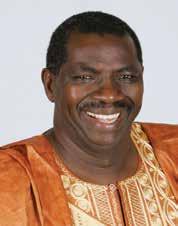
There is resolve not to give up even when there are obstacles. There is need for courage and determination, especially where there are real and/or perceived reasons for throwing in the towel and going home. You do what must be done to take care of a desperate situation.
We read another example of going the extra mile in Luke 19: the story of Zacchaeus. The Bible says that he was “a chief tax collector, and he was rich.” He wanted to “see who Jesus was, but could not because of the crowd, for he was of short stature.” Many of us would consider that as a limitation and reason for not trying.
But here is what he did. “So he ran ahead and climbed up into a sycamore

tree to see Him, for He was going to pass that way.” A government official running to climb a tree like a small boy – that is what is extra ordinary.
Here are some insights to ponder:
1. Nature compensates those who go the extra mile.
2. Those who go the extra mile are perceived as indispensable.
3. Going the extra mile leads to spiritual, personal and professional growth.
4. When you do more than expected, you are likely to become self-reliant.
5. You build self-confidence when you achieve more than what you or others expect.
6. Going the extra mile permits you to negotiate for better terms in many aspects of life.
7. People who go the extra mile are likely to make a huge difference in their own lives and in the lives of others.
8. When you go the extra mile, it becomes easy for others to join in and work with you.
9. Going the extra mile helps you develop definiteness of purpose in life, a crucial aspect that separates achievers from the rest.
Always remember, you are the only one who can permit yourself to go the extra mile. n
Dr. Vincent Muli Wa Kituku, motivational speaker and author of “Overcoming Buffaloes at Work & in Life,” is the founder and executive director of Caring Hearts and Hands of Hope, a non-profit organization that raises tuition and fees for poor orphans and other children from poverty-stricken families in Kenya. Contact him atvincent@kituku.com or (208) 376-8724.

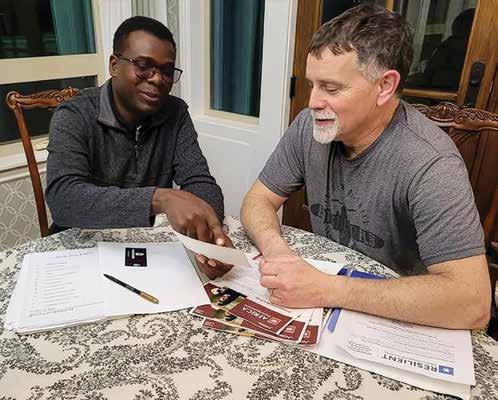
By Steve Bertel
When people hear about Africa, it usually brings to mind images of leopards chasing their dinner – an antelope, an impala, or some such – across a veldt. Or dense jungles. Or the busy streets of Johannesburg. Or the legacy of Nelson Mandela.
Rarely does it bring to mind children sitting in an AWANA Club classroom learning about the Lord. But Christianity has long been the dominant religion in the southern half of the continent. In fact, recent studies show more than 85 percent of Southern Africa’s population professes to be Christian. And, of course, with that prevalence of faith comes the prevalence of AWANA, a global Bible-based children and youth ministry targeting 2- to 18-year-olds through discipleship and evangelism. Founded in Chicago in 1950, AWANA is an acronym for Approved Workmen Are Not Ashamed, taken from 2 Timothy 2:15 which states, in part, “ … Be a good worker, one who does not need to be ashamed and who correctly explains the word of truth.”
Today, according to the latest AWANA figures, the organization operates 101,184 clubs in some 140 countries worldwide, engaging some 10.6 million children every week.
AWANA’s ten-member Global Leadership team will sometimes individually visit various regional chapters and their directors around the world to exchange ideas, to help better mobilize missional resources, and to assist the chapters in effectively reaching out to their communities.
Such was the case last February when Global Leadership team member and Global Vice President for Africa Joseph Mbange (pronounced “bang-ey”; the “M” is silent) visited Idaho – for the first time – from his home base in Zambia, Southern Africa. Joseph, his wife Alice, and Colorado-based Colin Robinson, Vice President of Global Advancement for AWANA, visited southwest and southcentral Idaho clubs that are under the guidance of Nampa-based Jerry Berheim, the Idaho/Oregon Regional AWANA Missionary and member of the U.S. Field Leadership Team. “My friendship with Jerry goes back to 2015 when he first visited our team in Zambia,” Joseph said.
“Joseph’s visit here has really assisted our local AWANA efforts by helping us to listen to the journey that he has had in Africa that started nearly two decades ago. The ministry in Africa made a pivotal shift in their traditional thinking on how they had always done the AWANA ministry,” explained Jerry. “They trusted the Lord to lean into a new idea that would grow the ministry in Africa, not as they had been, by addition – but by multiplication! We here in our ministry, both local and across the U.S., need to look at an addition-versus-multiplication-minded ministry view.”
Growing up in the Southern African country as the oldest of six siblings, Joseph’s parents were both Christians who saw to it their children began attending Sunday School and AWANA at very early ages. And it paid off. As Joseph recalled: “I accepted the Lord as my savior at the age of sixteen and, a few years later, decided I wanted to devote my life to serving others.”
In 1998, he was invited to serve with AWANA in Zambia – “I was the youngest among all the people they were considering,” he pointed out – and became a missionary with the organization in 2002. Last year, he became one of AWANA’s Global Leaders.
Today, his territory includes 48 countries. “I cover Southern Africa, West Africa, Central Africa, and East Africa,” he said.
And, although the cultures and economies of the United States and African countries may differ in many respects, preteens and teenagers in Africa face pretty much the same challenges as their American counterparts. “[Harmful] influences from their peers, drug addiction, teen pregnancy, domestic abuse, sexual purity, the difficulties of being raised in a singleparent home … these are all things children in Africa struggle with every day,” said Joseph.
Although Joseph and his team have received many invitations to establish AWANA programs and bring the gospel into churches and public schools in his 48-country territory, “Some government and education leaders – perhaps influenced by most of North and West Africa that are heavily Islamic – will ask us, ‘What are you bringing into our schools?’ or ‘What are you going to do to supplement our government
efforts?’ to even ‘Are you trying to indoctrinate our kids?’” he pointed out. Fortunately, in some regions, AWANA missionaries have been allowed to work alongside various humanitarian agencies, such as Feed the Children or World Vision, to help get its Bible-based message to young people. “They bring the food. We bring the spirituality – the gospel,” he smiled.
Joseph said Paul’s writing in Colossians best epitomizes the work he and countless others are doing in AWANA. Specifically, he referenced “Colossians 1:27-29 which reads, ‘… this is the secret: Christ lives in you. This gives you assurance of sharing his glory. So we tell others about Christ, warning everyone and teaching everyone with all the wisdom God has given us. We want to present them to God, perfect in their relationship to Christ. That’s why I work and struggle so hard, depending on Christ’s mighty power that works within me.’”
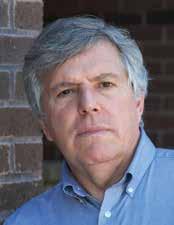
“Those of us in AWANA are going into the churches, the schools, and the countries because we want to be agents of change,” Joseph stated. “It is a privilege to serve in AWANA. And it is a privilege to serve God.” n
If you’d like to learn more about AWANAs in Zambia, listen to Steve Bertel’s episode of Christian Living Spotlight’s podcast, “Jerry Berheim and Joseph Mbange talk AWANA” from Feb. 14, 2026 on your favorite podcast platform.