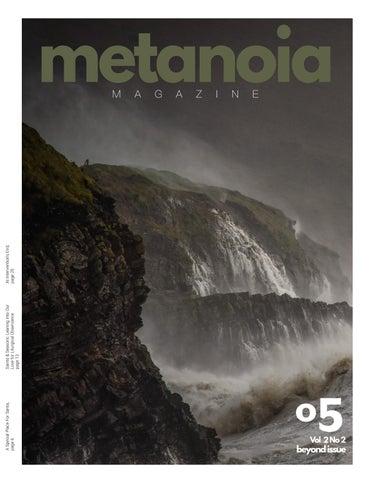
A Special Place For Santa, page 6
Saints & Seasons: Leaning Into Our Love for Liturgical Observance page 13
At Intervention's End, page 20
metanoia M
A
G
A
Z
I
N
E
05
beyond issue
Vol 2 No 2
CONTRIBUTORS EDITOR-IN-CHIEF Isabel Cumbelich CONTENT DIRECTOR Zoë Grimm CREATIVE DIRECTOR Maghee Fleischer
@JulieWellsPhotography
ASSISTANT CONTENT DIRECTOR Alex Dean ASSISTANT ADMIN DIRECTOR Mark Taylor DESIGNERS Amelie Garnand Anna Enyeart Isabel Cumbelich ADVISORY BOARD Kathleen Sullivan, PhD Niall O’Donnell Joseph Brutto, PhD Daniel McInerny, PhD Hugh O’Donnell, PhD
MISSION STATEMENT: Metanoia is a student magazine that showcases the height of Christendom College excellence in the areas of journalism, art, and design. It is meant to inspire thoughtful conversation among the student body and the broader Christendom community. Metanoia articles address issues concerning society, our immediate surroundings, and ourselves. Metanoia allows promising students the opportunity to develop their talents so that they can use contemporary media to “Restore All Things in Christ.”
LETTER FROM THE EDITOR Dear Reader, Welcome to Metanoia Magazine, volume two, issue two: The Beyond Issue. Strung throughout these articles is the theme of a hidden reality, a reminder that there is much more to what is in front of us than what we can see with our eyes. There are many things we come in contact with every day that are shot through with rich information and meaning, but that deeper sense is not what is perceived at first glance. In today’s world, to avoid living a shallow and uninspiring life, one must be able to see the true beauty of the everyday world. It’s so easy to become accustomed to various ideas and conventions that you grow up with and forget to think about what they really mean. Being human, we are not just material, but spiritual as well. Words, ideas, and stories have two parts to them, as we do. There is the obvious, and the invisible. How vapid would life be if you saw people without seeing the good in them? I hope this issue’s articles will be for you a reminder that reality will always be much more exciting and fulfilling than we realize at first glance. In Christ, Alex Dean Assistant Content Director
—2—
IN S IDE
ISSUE
THIS
SELF 4 6
the power of a name a special place for santa
SURROUNDINGS 9 13
the importance of fantasy in shaping the person saints & seasons: leaning into our love for liturgical observance
SOCIETY 18
rhetoric in political discussion
20
at intervention's end
—3—
Self
the power of a NA M E
by Kaylee O'Neill '25
I
remember the day Dr. Whitmore told me that names have power. It was some sunny afternoon, in a 102 Theology class, and what I recall is the wonder of the idea. It seems a little absurd. After all, doesn’t everyone have a name, even God? What significance is there in a name. Does it matter? Names are important for many reasons. First and foremost, they are an identity. Names are a way to single you out from those around you, and these names can have cultural, familial, and many other types of backgrounds, all coming together to shape you. For example, *SPOILER AHEAD*, the main character of one of the most amazing movies I have ever watched, I am David, has a lot of significance around his name. This teenage boy spends months wandering around Europe, hunting for his family, after he escapes from a concentration camp. He knows almost nothing about himself, save that his name is David. He yearns to know who he was, to know that he was loved. At the end of the movie, his mother sees him for the first time in years, and he says to her, “I am David.” And she replies, “I know." With names comes an identity, one that can only come from the one who gave you the name. With David, it was when someone knew his name, the one who had named him, that he finally had the identity he sought. Then, too, there is the simple joy of knowing and being known. Everybody desires relationship; everyone wants to be known for who they are. And this begins with getting to know someone’s name. As Dr. Whitmore pointed out, when you give someone your name, you are giving them a power over you, in that you are giving them a part of yourself. Since, again, a name is an identity, it represents who you are, your being. And this is not to be taken lightly. When God appeared to Moses in Genesis, He named Himself, making Himself most vulnerable to Mankind. Before that point, Man did not have a specific name for God, knowing Him by what He was for Man: Father, Creator, Guide… But once God re-
—4—
Metanoia Magazine
vealed His name, He revealed that He desires a deeper relationship with Mankind. He wanted to know us and be known on a far greater level. The Bible sums it up beautifully when God says, in Isaiah 43, “Fear not, o Israel, for I have redeemed you; I have called you by name; you are Mine.” Knowing your name leads into a relationship. It implies at least some of amount of vulnerability, but only in that comes the beauty of a deeper interaction with others. Only in that knowledge of the other can two begin to get to know the other in a way that potentially can last a lifetime. And the same goes for a relationship with God. When He says he knows our name- he shows that He loves us enough to want to deepen His interactions with us. He has known us from the very moment we lived, and we were named and had an identity, from that moment. Most importantly, He gave us that identity, so that we were ready to begin the deeper relationship He offers us—with Him.
—5—
Self
a special place F O R S A N TA by Aiden Moorehouse '24
M
y parents told me about Santa Claus, but whenever my siblings or I directly asked whether Santa was real they would always redirect to St. Nicholas. There was no observable or intentional pedagogy about how Santa was presented to us: we read A Special Place for Santa and watched the old CCC St. Nicholas cartoon (which is still worth a watch today), but also read or watched the more secular Santa stories, including the Rankin-Bass origin story, Santa Claus Is Coming to Town. We left out the milk and cookies, as well as some carrots on the porch for the reindeer. My discovery of Santa’s nonexistence occurred in the following manner. Around my ninth or tenth year, I had deduced– child prodigy that I was– the improbability, if not the impossibility, of the Easter Bunny’s existence. I summoned my father from his work desk with a tone clearly showing that the matter we were about to discuss was one of grave import. Standing around the pool table in the basement, out of earshot of the rest of the children, I presented the evidence. However, my father must have overestimated my deductive skills, because he not only agreed but added that Santa Claus wasn’t real either. —6—
I was shocked. I left the room in a mood of somber melancholy, my triumph of intellect sullied by this wholly unexpected revelation. Even years later my father was embarrassed by the episode. This begs the question: what made Santa different from the Easter Bunnies, Tooth Fairies, and assorted imaginary friends, playmates, and beasties that occupy a child’s imagination? I believe it had something to do with the unique sense of wonder and gift that Santa represents in the child’s world. Allow me to explain: little children expect a great deal of things from their parents. So much of a child’s life is dictated by his parents. What to wear, when and what to eat, where to go, and when to sleep provide the structure of the child’s first interaction with the world. Anyone who has been near a small child, or even those who only know of the little fiends from blood-curdling stories of “the terrible twos,” know that children take for granted many of the sacrifices that their parents make for them. This applies to nearly every person or interaction in the child’s life. But Santa Claus is different. At least for my family, there would be some gifts wrapped under the tree,
and the gifts from Santa would come in the stocking. Those gifts were usually the things my parents knew we wanted most or had specifically asked for. And those gifts were usually the most exciting, not only because they were often the things we wanted most, but because they came from someone beyond the small circle of benefactors whom we took for granted. If done properly, this can inculcate a sense of wonder, and enhances the child’s incipient receptiveness to the world which one discovers in greater detail as one grows older. And when the child finds out it's his parents, if revealed at the right time, the initial disappointment transitions into a deeper appreciation of what your parents had already done for you and what you had taken for granted when younger, which can further your sense of gratitude. Which brings me to my argument: when done properly, Santa Claus does not detract from the mystery of the Incarnation, but rather enhances it and can bear good fruit in a child’s soul that long outlasts a literal belief in the jolly old elf. The love of God is something that ought never be taken for granted, but, like the love of one’s parents, it often can be. The pious awe that can move an older soul to tears in adoration, a soul that has seen and experienced the drama of salvation play out within its very self, is not fully developed in
Metanoia Magazine
most adults, let alone most children. But a child can easily understand a present. Grace builds on and perfects nature, and a soul inculcated to approach the world as a gift will be fertile ground to receive the Gospel. Of course, Santa should never distract from the true “reason for the season,” but he can be incorporated to shed light on that reason in a way particularly suited to the dispositions and developmental stage of a child. If the family is meant to be a reflection of the Trinity, then surely a family’s practices can, in some small way, mimic a parable.
—7—
Surroundings
—8—
Metanoia Magazine
the importance of fantasy in SHAPING THE PERSON by Helen Davis '25
S
tories have power. Something about them captivates our mind and helps us to understand what might otherwise be beyond our grasp. Skillful teachers utilize the power of stories and examples to fully engage their students and make connections between the listener’s concrete experience and transcending principles. Our Lord Himself, the greatest teacher of all, used stories to communicate Truth to simple and educated audiences alike. As a genre, fantasy uniquely engages our imagination and strongly influences what our intellect abstracts from reality. It is crucial for us as readers to take advantage of the power of fantasy and be discerning in what we allow to form our thinking. Fantasy harnesses this power of story and engages the imagination, sweeping it to new worlds and enfolding the reality of human experience in an exotic and innovative sensory landscape. Because fantasy is so captivating to our imagination, it uniquely affects our intellect. Both Augustine (De (De Spiritu et Anima) Anima) and Thomas Aquinas (Summa (Summa Theologica I:84.7) observe that the intellect must always return to the phantasms,
or sense images, contained within the imagination. The intellect is not a corporeal object and it abstracts incorporeal principles from what we see and observe. But those principles are always rooted in our tangible experience. Thus, what we sense and observe directly influences what we abstract. Through the imagination, fiction, and in a particular way, fantasy, offers tales of boldness and beauty from which we distill deeper, fundamental concepts. However, this power is morally neutral and can be harnessed for good or evil as we will
—9—
Surroundings
discuss later. All stories do this on some level, but how is fantasy set apart from a host of other genres? The most obvious difference is setting. Because it takes place in a world different, even parallel, to our own, fantasy especially stretches our imagination. By describing an unfamiliar geographic, fantasy serves as a catalyst to our imaginations and thus opens our eyes anew to beauty. In the words of G.K. Chesterton: “Fairy tales say that apples were golden only to refresh the forgotten moment when we found that they were green. They make rivers run with wine only to make us remember, for one wild moment, that they run with water.” Stories of fantasy stir our imaginations with strange and beautiful descriptions, rousing our memory to the extraordinary beauty we have seen in our own life. As Tolkien observes in his essay, On Fairy Stories, fantastical stories help us to regain a clear view of the world around us. Our vision is often distorted by the bombardment of images and agendas that vie for our attention each and every day. Endless headlines and news of tragedies, chaos, and confusion leave us wondering if there is any order to the messiness of our world. We can often lose sight of Beauty, threatened constantly by sensory overload from the screens, machines, and sound bites around us. Fantasy builds an alternative structure to communicate
more profoundly, finding the threads of meaning in situations of conflict while painting Truth and Beauty in a single stroke. But setting isn’t all that makes fantasy distinctive. Any thoughtful reader knows that the setting of a story affects the other elements, drawing out and enhancing aspects of tone, plot, and character. Because fantasy is so often set in a world filled with fearful wonders and terrible beauty, it naturally lends itself to formidable odds and heroic deeds. The grandness of scale in the plot shapes the characters as well. The significance of each action flows into subsequent actions, demonstrating the impact of even minor decisions. Characters must choose between subtle options; if they are not careful the consequences may be dire. The role of fantasy is to draw the battle lines and inspire us to confront our own demons. The tangible– and often, terrifying– conflicts of fantasy present again to our senses the real dangers of our own world. “For we contend not against flesh and blood, but against
“There is a dragon to
be confronted and beaten daily, in our own lives."
— 10 —
Metanoia Magazine
principalities, against powers, against the rulers of the darkness of this world, and against spiritual wickedness in high places.” (Eph 6:12) The valor of warriors and soldiers can stir our hearts to face the evils of our own age. The conflict of good and evil transcends the genre and relates to our own experience. There is a dragon to be confronted and beaten daily, in our own lives, and heroes confronting their dragons serve as an inspiration and a guide to our personal struggles. You might be skeptical of fantasy. It’s all very well and good in theory, but perhaps you would say that there are many damaging and false fantastical stories. Stories that seek to distort and bend reality to serve some agenda. And I would agree. There are many stories like that. Which is why it grows ever more important to fill our minds with Truth and Beauty. The power of a story to strike at the heart of Truth is unparalleled. And to do so in a beautiful way is a profound gift. It is a gift worth searching for and a gift worth sharing. Fantasy is a tool by which we can enter more deeply into reality. We can learn powerful lessons from archetypal characters, drawing inspiration from their virtue and learning from their mistakes. Take the time and care to fill your imagination and stretch it, so that you may search for Truth, wherever it may be. Use caution, for the snares of the Enemy are many and cunning. He jealously wishes us to misuse this unique treasure.
For further reading – some fantasy authors to get you started: o J.R.R. Tolkien (The Lord of the Rings and other tales from Middle Earth) o C.S. Lewis (The Chronicles of Narnia, The Space Trilogy, Till We Have Faces) o Andrew Peterson (The Wingfeather Saga) o Helena Sorensen (The Shiloh Trilogy) o Heather Dixon (Entwined)
— 11 —
Surroundings
— 12 —
Metanoia Magazine
S a i nt s & S e a s o n s
L E A N I N G I N TO O U R LOVE FOR LITURGICAL O B S E RVA N C E by MADELINE DAVIS '24
A
nd what are you doing this holiday weekend?” the grocery clerk asked me.
It took a moment for me to remember that this first week of September did in fact bring Labor Day around again. I laughed and said something about not being able to think past this busy week yet; I didn’t have any particular plans for observing this secular holiday. But it sparked a reflection in me. What are we celebrating? Why have such a day? Not that the need for rest is very hard to see. But is that all that lies behind this holiday? And what about all the other seasonal celebrations that follow in its wake with the coming of fall? Even if nowadays we don’t pick apples or carve pumpkins out of any nutritive necessity, these activities strike a chord in us worth pondering. A cynical friend of mine proposed that businesses just seize on whatever they can to get people to spend more money and so they “make a
big deal” about holidays in the interest of profit. But that provoked the question: doesn’t there have to be something already in us for them to appeal to, even if it is exploited? Could there be something deeper to “pumpkin spice season” than another bid for commercial gain? What is our fascination with seasonal activities? Because fascinated we most certainly are— and even with a globalized market where we can have things like pumpkin and apples all year round, it seems we take special delight in enjoying such things within a certain time of year. This points to a profound truth of our human nature—we are creatures not merely situated in time, but deeply rooted in it, and we tend toward a way of existing that reflects that. We want to celebrate, in ways big and small, different times of the year. Changing the details of what we eat and wear and do at different times is part of our nature as human beings, as temporal creatures.
— 13 —
Surroundings
"
We can observe this throughout our calendar year and its holidays. It is not wrong to commemorate our presidents in February, our national independence in July, and the survival of our forebears in November. These are good just as we do well to study our national history and cultivate the virtue of patriotism. But we also belong to a heavenly city, and all the more should we familiarize ourselves with the inspiring examples of our “big brothers and sisters in Christ," the saints. Celebrating their feast days ("heavenly birthdays") is a very helpful way to anchor us throughout the year in looking towards heaven too. We can’t just do that at Christmas and Easter, especially considering we are preparing for eternity.
We are creatures not merely situated in time, but Our wise mother the Church gives us in particu- deeply rootlar the special feast of All Saints to commemorate all ed in it, and the heroes and heroines of our faith. But it is hardly we tend tothe only time we can give our attention to the saints. In fact, we should take advantage of the fact that the ward a way saints’ feast days are liberally sprinkled all throughout of existing the year. The twelve apostles, just as they were sent out that reflects to different parts of the world on mission in the first days of the Church, sanctify the different months of that." the year. The feasts of Our Lady are also generously distributed—we have both the month of May and October to focus our devotion on our sweet mother and her Rosary, and many other feasts besides, recalling the graces of her life and her channeling graces to her children at apparitions like Lourdes and Guadalupe. While there are many ways to implement celebrating the
— 14 —
Metanoia Magazine
saints creatively—color-coordinating with the saints’ liturgical classification (or even their religious habits—brown, black, and white cover a lot), making food from their culture, singing hymns and reading poems about and by them, etc.—all observances can only flourish insofar as they stem from true devotion to the saints, which is fed first by knowledge. Praying the Office of Readings from the Liturgy of the Hours gives a fair bit of insight in the second reading, usually taken from an account of the saint’s life, or a significant writing of their spiritual legacy. But reading good biographies of the saints, seeking out their writings for ourselves, and praying their novenas and litanies are also all excellent ways to foster true knowledge and love and fulfill the longing for liturgical observance in our lives. Thus seeing the diverse ways they have lived out conformity to Christ we can be inspired in our own paths of sanctity. In short, there are many ways that our natural tendencies can be elevated into the life of grace. We are the kind of creatures who want our time to be filled with observing special things and celebrating birthdays, anniversaries, national this day and that, seasonal trends, etc. And the liturgical year with its sprinkling of the saints' days is the way to do that for the highest purpose, directing our whole beings to the one thing necessary.
— 15 —
Surroundings
W
— 16 —
E
AR
G N I E PREPAR
G
Metanoia Magazine
E T R E N I R T O Y F
— 17 —
Society
rhetoric
IN POLITICAL DISCUSSION by RACHEL PIAZZA '24
"
Y
ou’re against Black Lives Matter? So you think black lives don’t matter? You don’t like women’s equality? What’s wrong with women having equality? You’re against gay rights? What, are you anti-rights?”
I've fallen into this trap countless times when vocalizing my political opinions. In fact, I’ve come across this problem so many times that I can foresee exactly where the conversation is going to go afterwards, and it’s never in a productive direction. Usually, we just end up talking in circles around each other, never able to get past the initial title of a movement, much less discuss its core values. — 18 —
Black Lives Matter, women’s equality, gay rights, etc… I’m using these movements as examples but there are so many that employ the same rhetorical tool that gives them the same “special power.” All of these movements are named after concepts, so it is difficult for anyone on either side of the spectrum to disagree with them, even if the titles don’t encompass the mission of the movement.
Metanoia Magazine
For a long time I’ve despised this tool used by the to publicly side with them. left. If you can’t get past what the movement is called, Not all the attempts of the right to use rhetoric have how can you actually talk about its mission? It’s a wall been in vain, however. Take the pro-life movement. The built deliberately to prohibit any meaningful discussion. use of rhetoric in the pro-life movement has been an exHowever, over fall break, I had the chance to discuss the treme success that illustrates what good use of rhetoric topic in a way that I had not previously approached it. can do for the right. Although the opposing pro-choice What if, instead of being reactive toward the left, view is not a completely failed attempt, as being against we were proactive? What if, instead of simply pushing choice can easily be turned around to mean being anback against any new rising leftist agenda or movement, ti-rights, life is a universally sacred thing worthy of legal as the right has been doing for decades, we proposed protection that can be recognized no matter which end a counter-movement using their same tactics of rhet- of the political spectrum you’re on. With these examoric? For every new politically correct movement the ples, it is easy to see how this becomes a debate: in order left comes up with, we could present an equally or more to gain political momentum, is it more effective to tear compelling argument in opposition. down our opponents' arguments or build up our own? Initially, I hated this idea because what makes us During the 2020 presidential election, many Repubany different from them if we licans believed Trump would lower ourselves to their level? have won more votes had he let What if, instead of simWhen they are using savvy Biden’s mental state speak for ply pushing back against rhetoric to support immoral itself instead of highlighting his any new rising leftist agenideas and dishonest politics, own achievements so insistentda or movement, as the how can the right adopt that ly. That is a case in which rhetosame method shamelessly? right has been doing for de- ric might have been most effecHowever, the use of rhet- cades, we proposed a count- tive on the back burner instead er movement using their of front and center. oric has never been an exclusively leftist strategy. All same tactics of rhetoric?" Rhetoric is not always the throughout history, rhetoric most effective approach to take has been employed to present arguments from a new when it comes to political momentum, but in its proper angle, which is in itself not an evil or twisted approach place and when used well, it can be a powerful tool. I am to persuading an audience. not advocating for constant rhetorical usage from the In fact, the right has been using slogans such as right, but instead, I’m asking the right to not be afraid of "pro-marriage" and "pro-cops" for a while, but without it. In the right context, rhetoric can be a powerful shift the desired results we often see from the left’s tactics. in the political right, which could grant it more attenWhy is that? It is the same strategy, the same use of rhet- tion and consideration than it has had for a long time. oric, so why is it not working for us? When it comes to having civilized debate, there is One reason could be that, because of our progres- an art to the language and rhetoric we use to either ensive and twisted culture, the definition of the word hance or discredit different arguments. The art of civil “marriage” and the mission of law enforcement have discourse should not be lost due to the left’s rhetorical been distorted. It is much easier to be against marriage tactics, but by offering opposite ideas instead of atin modern times because the idea of marriage being be- tempting only to shut them down, we can help lead our tween one man and one woman has been discarded by society toward a mindset of life and truth. the popular culture. The numerous controversies surrounding police officers have also made it more difficult
“
— 19 —
Society
at i nt e r v e nt i o n s END by KEVIN FARLEY ‘24
W
hen Russia invaded Ukraine in February of 2022, the possibility of potential American involvement in the conflict became a frequent topic of discussion. After all, in the largest European combat since both World Wars, many wondered if they should expect the United States to finish out the third act. At the time, the fear of Russian aggression, downplayed since Crimea in 2014, resurfaced with a terrifying advance across eastern and southern Ukraine, with the rest of Eastern Europe on the horizon. Leaving aside the NATO obligations that now appeared more tangible than ever, could the United States allow Russia to dominate Europe by force? Was the long-avoided showdown between the US and former USSR inevitable? As we examine this scenario, questions arise concerning America’s role in this post-Cold War world. It is time we as Americans rethink not just how and why we intervene, but understand and accept our responsibility as the sole superpower on the planet. Fortunately for every party except Russia, such questions no longer hold the weight they did in February. Ukraine not only held off the Russian advance
— 20 —
with Western aid but even began a major counteroffensive with considerable success at the time of writing. With instability increasing in Russia, Ukraine stands poised to, at the very least, hold Russian aggression in check for the near future. Furthermore, as Vladimir Putin continues his threats of employing the nuclear option, truthful or otherwise, the prospect of American military involvement at the current stage of the conflict appears entirely unnecessary and even dangerous. But the question remains. Had events not transpired as well for Ukraine as they did, should the United States have intervened? And, perhaps more pressingly, if current circumstances change for the worse, should we as a nation consider intervening in the future? Before attempting to answer either question, another must be asked: Why America? These are not the days of the Cold War. Russia’s military capabilities, while (on paper at least) nothing to scoff at, hardly match proportionally the might of the Soviet Union. Russia no longer stands as a superpower. The United States does. Should not the primary provider of military support then come from somewhere closer to the conflict? Should not Europe be the first to intervene, and not America? Simply put, yes. In the event Ukraine needed or will someday need the aid of allied militaries, it should look to Poland and
Germany, the wider European Union, and the United Kingdom for support first. And from the statements of the powers that be in Europe at present, that is what will happen if the conflict escalates. But what if that is not enough? Moreover, what of other nations desperate for help who lack such a friendly network of potential allies? Of course, the objections to intervention in Ukraine mentioned earlier hold far more reason than arguments in favor. But that does not mean we as Americans should not consider our position in this and in similar circumstances. The most important reason the US should not join the war is that Ukraine has not asked for that kind of help. Without that request, America lacks any justification for war, full stop. We do not have the right to protect the idea of democracy. Until Ukraine requests allied militaries to intervene, we have no cause to even seriously consider doing so. No matter how desperate things become in this or any region, America has no justification for intervening without proper cause. It is important that we recognize our past failings in this department. Many Americans will dismiss American interventionism in its entirety, citing our controversial track record. One need only look at the past two decades of American foreign policy blunders to comprehend how badly we have squandered our task as self-appointed policeman of the world. Indeed, the US should not have invaded Iraq and Afghanistan, especially not for the reasons provided by the government. We as a country have no right to send in the troops or topple regimes because they are hostile to us, even if they abuse their own people. Iraq barely managed to maintain its statehood and Afghanistan’s new government completely collapsed in the face of the resurgent Taliban. Before that,
Metanoia Magazine
“The most important reason the US should not join the war is that Ukraine is not asking for that kind of help. Without that request, America has no justification for war, fullstop.”
look at Vietnam or Cuba. Even South Korea, America’s greatest postwar success story, struggled through decades of political instability to become the nation it is today. Surely our country has demonstrated its capacity to fail in its missions and also support those nations it has successfully liberated. Many in our country and in others point to this history as evidence America should not intervene under any circumstances, and it is difficult not to sympathize with this view. But then again, should we so readily isolate ourselves from the rest of the world on account of our past failings? The point is not that the United States is obligated to place American boots on Ukrainian soil. We are the sole superpower. That status comes with benefits. It also comes with responsibilities. We are the most prosperous nation on the planet. We are wealthy, well fed, and well armed. When faced with crisis, other countries have and will continue to look to the United States for aid. Past misuse of our power does not disqualify us
— 21 —
Society
from helping other nations in the present and future. Nor do we have license to do whatever we want. The United States does not have the right to arbitrarily pick and choose the type of regime that other nations use to govern themselves. Such an attempt seems unnecessary for Ukraine, a country that willingly undertook a transition to liberal democracy. Even so, we may only intervene in a defensive capacity. That means preserving the countries we are defending, faults and all. Far too often we have abused our status as the world superpower, even if well intentioned. As we watch a situation that will hopefully never involve us, we must, as a nation, rethink our role in the world and reaf“Far too often firm our responsibilities. When we have abused we intervene, militarily or otherwise, it should not only be on our status as the behalf of our economic interworld superpow- ests, or the military industrial complex, or even friendly or er, for good and not so friendly leaders, but on bad motivations...We need behalf of the suffering country’s people. Our end should always to, as a nation, rethink our be to alleviate the suffering of role in the world and reaf- others, not forcing change, but leading by example.
firm our responsibilities."
— 22 —
Metanoia Magazine
FEATURING STUDENTS' CREATIVE WRITING AND ART
— 23 —
Vol 2 No 2
SUBSCRIBE
WRITE FOR METANOIA ISSUE 3 SUBMISSIONS DUE JANUARY 5, 2023 CONTACT ALEXANDER.DEAN@CHRISTENDOM.EDU FOR MORE INFORMATION