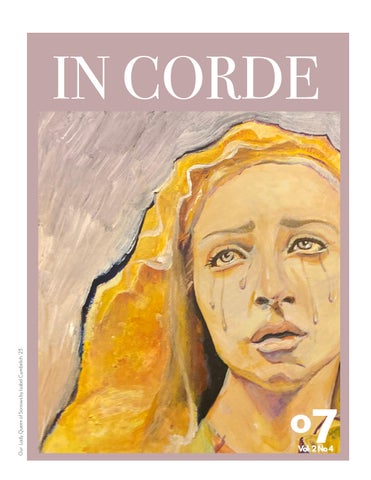
Our Lady Queen of Sorrows by Isabel Cumbelich ’23
IN CORDE
07
Vol 2 No 4
—1—
CONTRIBUTORS EDITOR-IN-CHIEF Samuel Schirra
@AguilarPhotography2020
EDITORS Abigail Greca Helen Davis Madeline Davis Natalie Briggs Anna Enyeart DESIGNERS Karla Martinez Anna Enyeart ADVISORY BOARD Richard Hanley Niall O’Donnell Daniel Spiotta Eric Jenislawski
Samuel Schirra and Anna Enyeart
MISSION STATEMENT:
LETTER FROM THE EDITOR
In Corde aims to be God’s “little pencil,” so that through its contributors’ art, poetry, and stories, He may redeem and elevate the human experience.
Dear Reader, “Truth exists. The Incarnation happened.” These words of Dr. Warren Carroll, the founder of Christendom College, are the foundation of our school’s mission to “restore all things in Christ”—to reclaim the world for our Incarnate God, Truth Himself. At Christendom, we can encounter Our Lord daily—in the flesh, through the Sacrament of the Holy Eucharist. After this Sacrifice, called by Him whom we have just received to be His “witnesses…to the ends of the earth,” we must emulate His charity toward all those we encounter. Without first being rooted in Him, however, how can we ever be the “salt of the earth”? Likewise, without continually remaining in Him, how can we continue to reflect Him—He who is the “light of the world,” our “portion and [our] cup,” our “super-substantial Bread” who alone can sustain us through this Valley of Tears?
In Corde, the new creative branch of Metanoia Magazine, is the holy product of numerous Christendom students who have agreed to share our artistic talents for the greater glory of God. In so doing, we strive to emulate Our Lady, who kept her Son constantly in corde suo—united to her Immaculate Heart. As you contemplate the content of this journal, we hope that you may also be inspired to open up your heart to Our Crucified Lord, to allow it to be pierced for His sake. May we each allow our King and Our Lord to transform our hearts, so that He may transform the world through us. For, by resting in His Most Sacred Heart—always burning with the flames of His Mercy—we shall become who we were made to be and we will “set the world on fire”! Sincerely, Samuel Schirra 2
+Agamus Te duce, Domine!+
ININ CORDE CORDE
IN S IDE ISSUE
THIS Visual Art 4 9 10 13 14 16 19 20 23 24 25 26 28 30 33 34 37
The Holy Family Kiarah of Aradomar Our Lady of Perpetual Help Archangel Michael Immaculate Heart Priest and Thurifer St. Padre Pio Zeus Sun with Stars Kingbird The Barnyard Abandon Ship Study of a Woman Study of a Bust By the Light of the Moon
Literar y Pieces 5 11 15 17 21 23 25 27 29 29 31 32 35 36 38
Veronica Unveiled Doubt and Deliverance Into the Breach Censer in the Street Dance of Four O! What Is the Moon to Me? Haikus: Stories and Old Age The Widow Grief Remember Love (Flip Poem) The Tree California Haze An Exercise of Praise Interview with Joseph Pearce
Wonderlust Sunset on the Shenandoah 3
The Holy Family
by Juliana Jamieson ’23
4
IN CORDE
Veronica Unveiled by Kaylee O'Neill ’25
I
lived my life beneath that veil, heavy and no longer quite white. I never dared remove it—that would show the world that scar, the scar almost as deep as the one I carried within me. It was an old scar, faded a little by time, but the memories of it weren’t—I relived them nearly every night, screaming soundlessly as I saw my young self make the same mistakes all over again. It is still so clear to me even now, many decades later: the fire, my mother’s cries, the disappointment in my father’s eyes… even my cat yowling as she leapt out the window at the last moment. The foolish child I had been....
Veronica! Yes, Mother? I’m leaving now, your little brother is sleeping on the bed. See that you play where you can hear him if he cries! Yes, Mother! Remember, our family lies in the hands of the eldest son. Take care of him! Yes, Mother! It’s funny… the little things you recall so clearly afterwards… the sunlight was bright, and I remember it sparkling off a bucket of water. Only ten years old, I was entranced with the
sight. It was so bright, turning the clear liquid into a mirror, reflecting my face so well. I stared for a long time, touching the surface with my finger, laughing at how it turned my little round face into the oddest of shapes. When it stilled, however, I marveled at the sight of myself… and was glad I was a girl, despite the ancient prayer I had heard my father pray so often: “And I thank you, Lord God, for not having made me a Gentile, or a woman…” I liked my face. I liked who I was. Then I chased my cat, wanting to show her her own reflection, but she didn’t want to go near that water! And so, we ran and played, off into the desert, over the next hill, lost in our innocent little world. Until the shouts called me back. My heart turned to ice when I came running back, to see our little home wrapped in flames. Without stopping to think, I darted between the hands of a neighbor and into the inferno after my little brother. I don’t recall much of what came next… lost in the smoke, I stumbled. My head hit a water jug and it broke. A sharp thread of pain tore its way across my face, dividing my features in two. Somehow, I scrambled back to my feet, already dizzy with the smoke and the pain, and groped my way to the bed. Frantically I fumbled at the blankets, throwing them to the ground in my panic. He was gone. My little, innocent baby brother was gone. 5
I kept hunting, straining to see in the smoky interior, my sight blurred with tears. How I must’ve looked with the tears, sweat, and blood on my dirty little face, I can only imagine… I heard my mother calling me; but, in that moment, I knew I could not face her, could not face my father, not without my baby brother. They depended on him too much: to carry my father’s name, to care for them in their old age, even to support me should I be unlucky enough not to catch a worthy husband. Only ten years old, and at that moment death seemed the better option for me. I could not disappoint them! Even more… how could I live knowing my foolish games had cost my precious brother his little life? How could my parents love me after that? How could I love myself? Numbed with smoke and grief, I slowly sank to the ground. My eyes opened one last time. I saw the blue sky from the one high window. And then my playmate and pet, who’d followed me into the inferno, cried once to me, and jumped to safety. When I awoke, I was covered in bandages. I did not know where I was, nor how I got there. My mother anxiously leaned over me, relief and joy in her eyes. A cool cup of water touched my parched lips, but oh how it hurt to open my mouth! After I drank, she sat back beside me, and before my unbelieving eyes, she lifted my baby brother onto her lap, and he began to suckle. Tiny hands, clutching and unclutching the air! A soft dark head, half hidden by my mother’s shawl, anxiously turning, as precious pink lips pouted, searching for sustenance… my precious brother, alive. She saw my eyes seeking answers, and her own clouded over. “I trusted you with him,” she whispered. “Where were you? What happened?”
6
I could not answer. “He could have died. Our only son. Your father found him just in time.”
Who came for me? “And you… you could have died! Had he not carried you out… the carpenter’s son! You owe him greatly; the fire was almost too much!”
My father came in for my brother… but left me to the care of a stranger? “This is not how a good daughter acts!” And I have reminded myself of that fact ever since. My child heart needed love, comfort… and most of all, forgiveness. She loved me as only a mother could, but my parents wronged me that day, leaving a scar deeper than the one on my face. The first day I was allowed out of bed, I ran out to play, only to return soon after. They had mocked me, the children I had once played with, calling me “scarred one”—that’s who I had become. Innocent children, not knowing the pain they caused me, never realizing they were partly why I retreated beneath my veil that day! When I returned to the house, I covered my face like a widow; my suffering had ended my childhood. No man ever sought me… and who indeed would? What man would want a veiled wraith, silent under her wrappings? A joyful bride is praised, not a woman who wears only suffering in her eyes… A pair of eyes, hidden and shy, scared of the light—that is what I became. Until He happened. It was Passover. I was in Jerusalem, living with my brother and his family. In her nervous preparation for the Feast, my sister-in-law, a young, flighty little piece of girlhood, had
forgotten one of the bitter herbs the meal required. I had always loved her, but how I hated her the moment she asked me to fetch them from the market! The streets were quiet—odd, as the great city was crowded for the Feast. As I drew nearer to the market, though, I heard shouts. Shouts of anger. Cries of pain. And somewhere, an almost silent thread of weeping. I staggered, remembering that day. But something, maybe only my curiosity, maybe more, drew me on. In the background I stayed, hiding behind a crowd, a seething mass of emotional humanity filling the narrow street. Women silent, their faces surging with varying emotions. Men shouting, with twisted and angry expressions, and hard-clenched fists rocking to the erratic rhythm of the mob. Children, darting in and out, their little games somehow still peaceful and innocent amongst the sheer anger of that stormy sea of people. What carefree fantasies were their little minds weaving around the painfilled drama surrounding them? Then I saw them… An older woman, standing like a rock in that storm, her face anguished, yet… could it be?... peaceful... beside her, a girl I had known long ago, and in another life... who mocked me after that day, later a prostitute. Now her glorious beauty was gently hidden as she wept. Who was she now, to publicly weep, where once she had not dared to show her face? And then a man, unashamed of the tears in his eyes, protectively holding the older woman… and I suddenly wondered if he were the one who needed protection. A little girl scampered past, suddenly stopping in her tracks to look at me. Her eyes grew larger and then she ran off again, glancing one frightened look over her shoulder back at me. It had happened again; I had frightened someone. I turned to leave, letting the shadow settle back over me again.
IN CORDE
But then, down the street ahead of me, someone came. Each step emphasized by the growing cries of the crowd, a man came stumbling. A trail of blood followed Him, each step a tragic mockery of a King’s procession. An entourage of iron-faced soldiers accompanied Him, making frequent use of the lengthy whips they held. But He had already been whipped! A heart so long hidden within me, never vulnerable to another’s pain, began to quiver with pity. I stared in silence, my very soul longing to comfort, to help, shaking in agony as I watched lacerated feet ooze blood with every step. Lurching from side to side, an exhausted Body staggered, one step at a time, down the street. Did no one in the crowd weep to see Him? Was there no one to see His pain? As I saw His Face, blood, tears, and sweat mingling, I saw Him frantically blinking, trying to see.
A girl, a girl I had tried to forget, blinking, trying to see… As He came closer, He seemed to hesitate, to struggle mightily, and then to collapse. He lay there, a bloody, pitiable man, so helpless, tangled in his own sweaty, filthy garment, too weak to move. As I watched Him fall, my heart gave a leap; throbbing, it pulsed full of new life in the sight of this living death. As if in a dream, I stepped between jostling, writhing bodies, so near that woman that she could have touched me… did she? … Afterwards, I remembered that she had, and I knew that she felt my pain… and His. I stood there so near Him for a long moment, looking down at Him. I was in front of such a large, such an angry audience, and yet... I felt insignificant, almost invisible, in His Presence. He lay there, so broken and so… vulnerable. In the best of health, He could crush me with His hands... and yet I felt as though they had... carried me? Yes, carried me, although
7
I did not know who He was. I leaned down, and in that moment, I forgot who I was. Where I was. Who could see me. I removed my veil. I wiped His Face gently, carefully, my own hands turning red where they brushed His bloody skin. Time stood still. There was just Him and me. A whip flashed down, striking the Face between my hands, slitting the cloth still touching Him. I saw it: the wound across His Face, dividing His features. Violent hands dragged me away, leaving me in a heap by a nearby well. His eyes followed me, love and thanksgiving within them. Unable to watch as they forced Him back on His feet, and onwards, I buried my face in the cloth I carried.
Smooth. As the water stilled, I bent my head, forcing my trembling, fearful self to gaze at my reflection, so long hidden. And I saw its beauty with new eyes. Eyes that no longer saw a scar. And then?
A gentle hand stroked my long hair, uncovered for the first time in years. A quiet voice whispered, “My daughter…”
Well, when I went home finally, laughing and singing with joy, I still felt a question within me—where had that scar gone? It wasn’t until several hours later, hours spent in giddy exultation and thanksgiving, that I found it. Found it on my veil, in a tear from a whip, that split His Image in two, an Image marked in blood, sweat, and tears upon my veil.
I looked up into her eyes… His eyes… in a mother’s face. The older woman I had seen. She touched my cheek gently, as she murmured—her voice both pained and peaceful—“Thank you for what you have done for Him.”
I no longer veil my face, choosing instead to approach others, to tell them my story. The beauty of my image allows me to show them His, and to tell them of how He took the ugly and left only beauty behind.
I watched as she turned away, her little group following Him to a lingering and anguished death. The crowd drifted along that way too, a stream of hate and anger, carrying the one spot of beauty and love. Only I was left, hunched in the street, next to a bucket of water. Finally I rose to go, and noticed it. I bent to wash my hands, red with blood spilled, spilled for a reason I would maybe never know...
And who knows? Perhaps every wound on His body was someone else’s scar—a scar that He chose to carry that day, in the hope that, someday, we would take it to Him. Because He makes all things new.
A beam of light shone from the quickly gathering clouds: sunlight, reflected off the water. I recoiled, terrified. Sunlight on the water held only terrible pain for me, its beauty a mockery. Slowly, half-averting my eyes, I dipped
8
my hands, the blood and water mingling. Slowly, I raised my dripping hands to my face, seeing how the water droplets sparkled in the sunlight. I rubbed my face, then stopped. Something was different. My sensitive fingers searched my face, feeling only the smooth cheek and forehead.
e
IN CORDE
Kiarah of Aradomar
by Margaret Catalano ’26 9
Our Lady of Perpetual Help
by Anna Stachyra ’24 10
IN CORDE
Doubt and Deliverance by Monica Laframboise ’25
I am tired, so tired—yes, tired again—in body, in mind, and in soul. I’ve been told Christ will come to restore and to love me, to enter and make me whole. Yet, sighing, I dwell on my failures and debts, my losses and times of distrust. Too often they come to discourage and tempt…but they must flee away, they must! Yet Satan inquires, “Is it possible? See your weakness, your sins and such. Yes, Christ forgives, time after time, but there is such a thing as ‘too much.’ You vowed you would change, but you lied. Your actions did not fit your speech. Words are one thing; deed is another. Not to you can forgiveness reach.” ‘Tis true that none of my faults improve. Instead, they remain and increase. They bring me discomfort, and inner turmoil. I cannot attain any peace. But so often when I am powerless, and no courage or strength remains, It is then that Christ comes to call me again, and resistance to Him swiftly wanes. I picture how He comes close to me. His life and His love I feel. A tear in His eye, a compassionate look: before Him I humbly kneel. Overcome with sorrow, overcome with remorse, I feel guilty, sinful, and weak. I tremble to think what He thinks of me, but then He begins to speak. “I shall not deny I am sorrowful, that you’ve fallen once more into sin. But I shall persist for all ages to come, your heart and your soul to win. Deserving of pain and of punishment, you fear what might come to you. Yet gladly I’ll give Myself, now and forever, to take what to you is due. I have done this so oft, for so many. My Heart with much love for all burns, In past times, now present, for future—but never receiving returns. Yet I shall blame you for nothing. I come to restore, not to chide. I only desire you realize this, lest you think that your sins can hide. I do not require great passion, your heart and your soul to fill. Though they be pleasant, they be not true love. Love is an act of the will. I shall not deny it was hard, to love you on Calvary. Though I am God, still I am man, and still ‘twas painful for Me.
11
But though it was hard to accept, your debt I willingly bore. Though feeling did not support sacrifice, My will made Me love you more.” He stands and He opens His arms, a look of hope on His face. My guilt says, “draw back,” my heart declares, “forward”—I run to receive His grace. He embraces me, saying, “I love you. I forgive you but hope you will strive, To re-learn the lesson of effort; only then can your soul truly thrive.” My tears are flowing, my heart is heaving, my face is burning with shame. But I know self-debasement is not what He wants. He wants us to call on His name. So I hide my face and I whisper: “I am sorry, my dearest king. From now on will I try once more to reform, and your praise for all time shall I sing. There are so many words that I’m thinking —so much more that I want to say, But there is only one thing I can do. I beg you: help me to pray!” Then I pause for a while and remain in His arms. He kisses me, holding me fast. Salvation and love am I looking towards. My sin and my fear are past. Christ the Way, Christ the Truth, Christ the Life: Christ must I keep in sight. The path is narrow but His “yoke is sweet,” and I know that His “burden is light.” O Jesus Christ, my Redeemer! My spouse, my one true love! I thank Thee for all Thou hast given me—for all blessings and grace from above. Please help me to never abandon You, and my selfish desires to deny. Then lead me onwards, forevermore, to the eternal glory on high!
e 12
IN CORDE
Archangel Michael
by Bridget Crnkovich ’23 13
Immaculate Heart
by Margaret Catalano ’26 14
IN CORDE
Into the Breach by Samuel Schirra ’24
“Now follow my Son to wherever He goes, Through scourgings and famines and death by His foes. For He gave His all to give share in His Life, So honor the promise you made as His Wife.” So spoke the fair Maiden who, glancing at me, Shed silently tear after teardrop freely. Her face was so moonlike; reflecting her Son, Her heart had been pierced by the sword of our sin. “Oh, Mary, I pray that His Body on earth Be as one as He prayed ere this Church had her birth. May we know our sinfulness, pride, and despair, So we may, then humbled, ask God for His care. Madonna of Heaven, first Communicant, Restore to God’s bosom all those who’ve been sent. Bring us through uncertainties, Star of the Sea, So we may be one with our God, Trinity!”
15
Priest and Thurifer
by Maura Piroch '25 16
IN CORDE
Censer in the Street by Madeline Davis ’24
A
long bead of sweat rolled down the brow of 14-year-old Nick Gallagher as he tried to quell the urge to scratch his back. No, he mustn’t, he couldn’t—that wasn’t proper behavior for an altar server, especially not on this grand day serving in the Mass and procession for the high feast of Corpus Christi. But that grand fact wasn’t conquering the itch that persisted to torture the space between his shoulder blades, smothered by his white surplice, cassock, dress-shirt, and undershirt. So, instead he focused on the rhythmic swing of the censer with which he’d been entrusted. It was a responsibility Nick had handled several times before, but now approached with greater attention. He supposed everyone was a bit more careful about who was holding the container of smoking coals since Tommy Jones had spilled them in a glowing heap on the cathedral’s heirloom rug last week. No, he mustn’t think about that either, not if he wanted to keep himself from snickering and smiling like a loon. To straighten his face out, Nick recalled his father’s words to him that morning. “It’s serious business serving on the altar, son. Don’t you go making a fool of a Gallagher while His Excellency the archbishop is celebrating the most Holy Sacrifice of the Mass.” Well, of course. The Mass wasn’t something to lollygag through if everything Fr. Jacobs said was true. If God was really doing everything the old priest said… The incensing of the gifts was supposed to be now—he had to be in just the right place at just the right moment for the exchange of the censer with the archbishop and the subsequent censing of the people. No mistakes. The rest of the Mass seemed to move quite quickly after that. Despite his efforts to focus,
Nick found himself roused three times by Mikey Stephens ringing the bells for the Sanctus, then the Hanc Igitur, and then the consecration far sooner than he’d have thought possible. Lifting his eyes as he raised the censer toward the archbishop holding up the consecrated host, Nick stared through the smoke at the Mystery of mysteries. There was absolutely no sign of the miracle, no sign of what happened except the signs they gave with their bells and smoke, he thought wonderingly, swinging the thurible up and down to distribute the perfume of the incense smoke. But that was the point, wasn’t it? At least, Fr. Jacobs had said something like that... While another server slipped the golden paten beneath his chin, Nick shoved away the doubts as he knelt to receive his Lord and God, so thoroughly hidden. This was no time for that. But after he had prayed his usual prayers of adoration, contrition, and thanksgiving, the question arose again, and this time he didn’t push it away. “Why so many veils?” he whispered in his heart. “Why are You so hidden, Lord?” Now the Corpus Christi procession was about to start, and he would be leading, right in the front. Through the streets of New York City, they would process, as calmly as if they were merely walking down the familiar aisle of the cathedral. Only there would be bicycle bells and car horns and the shouts of street hawkers clamoring against the bells of the server behind him. There would be the usual stream of hurrying humanity that pulsed through the city’s streets, everyone so intent on getting somewhere; while there wouldn’t likely be any one person in particular fighting their reminder that the King of kings was approaching in veiled splendor, the indifference of the whole crowd would amount to the same thing, Fr. Jacobs had warned him and the other servers. “But that can’t make any
17
difference to us,” he’d said to them beforehand. “Except that maybe we should be all the more careful to be most reverent.” With those instructions echoing in his head, Nick braced himself for the battle of the street. And it was well that he did; the noise slammed into him as soon as they entered the busy avenue. At least there was a way for them already marked out by the police and they wouldn’t have to literally jostle their way down the street. But the noise was enough. All around, everyone else moved frenetically, endlessly— going where so fast? Nick wondered. But he couldn’t let that distract him; he kept his gaze fixed straight ahead, just as he’d been told, and tried to focus his mind as if he had, in the back of his head, eyes only for the monstrance processing behind him, and ears only for the chants of the cantors further back. But he couldn’t help worrying someone he knew would see him, like Jimmy Cole—what if he made faces or called out to him? The voice that did rise above the general din halfway through the procession wasn’t a familiar voice. Still, the moment the man began shouting, the server knew the shouts were aimed at him. The words didn’t register at first, but as soon as they did, Nick turned almost as red as the rubies in the monstrance, though he managed to keep his eyes rigidly staring ahead. If he’d ever used even one of those words, he was sure his mother wouldn’t let him get rid of the taste of soap for a week.
But it’s not really me he’s so mad at, Nick finally realized, still keeping his gaze fixed firmly forward, but aware of the man moving alongside the slow procession; Nick was just the man’s most visible target, the representative for the real object of his hate. The King who had worn a crown of thorns still had His mockers. Nick sobered at that thought. How could a man say such things? And to the Creator of Heaven and Earth, Who was humbling Himself to be present in such an unassuming, helpless way? And yet, no lightning struck the man 18
dead; his shouting persisted, even as policemen closed in on him and dragged him away, Nick judged by his diminishing volume. Still, the man maintained—no, increased—the intensity of his shouts. So, even though Nick was trying his utmost to still ignore the man’s words, one of the last things he said rang clearly through to him: “And you can keep your bloody sacrifice, I damn well didn’t need it!” The whisper in Nick’s heart that followed that shout wouldn’t have stood a chance against the blaring car horns for volume. It wouldn’t have stood a chance against the man’s shouting for forcefulness, insisting on being heard even by the unwilling. But Nick heard that still, small voice, and he knew it.
“That is My Son.” Then I must fight for Him, Nick heard himself whisper back, and suddenly his way was clear. Not in all its details, of course, and certainly not cleared of difficulties, but clear, all the same, to the altar. He would keep sending up incense, the incense of prayer, before the throne of the hidden God. Yes, prayer and sacrifice, for the lost, wandering soul of that man, for his own wandering soul, for all the wanderers, hurrying in aimless directions through the world. Of course he couldn’t do it alone, no more than he could stay focused for ten minutes. But that was to be the sign, the miracle: the grace supporting his own wandering soul, for the sake of others. Thank you, Lord, Nick prayed; and like incense smoke right in the street there drifted up his prayer of gratitude for this man who’d served as the burning coal of his calling, setting alight his path to burn as witness for the King of kings.
e
IN CORDE
St. Padre Pio
by Amelia Coleman ’24
19
Zeus
by Lucy Stanford ’23
20
IN CORDE
Dance of Four by Mary Kathryn Sheba ’26
Spring is a giver of growth, of all things which flourish and stir, Fashioning life out of death, her creations none can deter. Her hands deck the hills with flowers and decorate trees with buds, Pumping sturdy stems and writhing roots with her own life blood. She speaks softly to the waters, her breath melting their faces of ice. Delicate leaves clap and wave, their careful veins precise. She nurtures young wildflowers, fragile as glass, Blessing every flower with fragrance, kissing each blade of grass. Like an artist admiring her masterpiece, she smiles and sighs. Soon the creative maiden will tire, and a new force will rise, For she has given herself so the world could bloom; Summer comes ready to admire Spring’s beauty, And he must fortify the earth, for that is his duty. Greeting Spring, he clasps the maiden’s fingers in his own powerful hand. They twirl and dance for the solstice, his new claim on the land. When the sun has disappeared, they embrace in the field. The longest day has ended, the maiden’s turn to yield, He puts her to rest, kissing each blossom atop her crown. The grasses stretch and grow, her body they gently drown. Spring births, Summer strengthens Prouder leaves and hotter winds Life multiplies and undergrowth swells Sweeter juice and sanctuary. When the sun has gotten too bright, the bugs too bold; When moss has gone brittle and flowers begin to fold; When Summer has overextended his power, Autumn arrives to begin a deathly hour. Solemn and sure, he leads Summer away, Buries him deep so his glories will decay.
21
He lifts his hand to disassemble warmth’s work, Chilled breezes to humble whatever green lurks. He softly touches the trees and coaxes them to die; Bleeding color and bowing with an accepting sigh, Flying red flags in beautiful defeat, With the sober touch of Autumn, even death is sweet. Withering and wilting, straight stems now droop Down to the dying ground their heads to stoop. Barren branches rustle, soundless, with empty cries, Mourning the warmth and brightness of the skies. Autumn knows, that when everything is dead The death-bringer must bring his own self to bed. When the earth smells like the must of an overturned grave, Autumn crawls wearily to the tomb of his cave. Winter storms into sight, flying aloft on piercing breezes; Everything she hardens, sharpens, freezes. She washes bare branches in pure white Billowing snow, blinding in the light. Hissing with brutal cold, she rages against the world’s evil, No amount of prickling ice can wring out retrieval. Though she languishes, and laments for the good and the right, She can only destroy in her despair and harrowing plight. After the earth glistens with frozen tears and she longs for her suffering to end, Spring is born—dreams of goodness to fulfill and faults to amend. The daughter of Winter’s long labor heals a scarred earth; Her mother melts, icy fervor vanquished, rejoicing in rebirth. And so the seasons pass but never truly end, Living the same lives again and again: Gentle Spring Proud Summer Solemn Autumn and Raging Winter In an eternal dance of four.
22
IN CORDE
O! What Is the Moon to Me? by Brody A. Moore ’26
O! What is the Moon to me But the remembrance of Thy holy beams When the world is so benighted? For even when I cannot see The boldness of Thy golden gleams A token stands that argent ring; And cries: “Keep on fighting!”
Sun with Stars
by Niall Maguire ’26 23
Kingbird
by Brendan Summers ’25 24
IN CORDE
Haikus by Chloe Costello ’26
Stories
Old Age
Spiral galaxies The thoughts and dreams of many Spun in dazzling webs
Memories hang ripe Before they fall from the tree And are forgotten
The Barnyard
by Brendan Summers ’25 25
Abandon Ship
by Rachel Cermak ’26 26
IN CORDE
The Widow by Chloe Costello ’26
Behold, the glistening waters Where the moon doth cast its glow, A path upon the darkening deeps Where not a man may go. The waves of the sea crash on the shore With the ebb and flow of the tide And the widow watches from her walk For her husband who has died. She stands high on the balcony And gazes alone at the waves, The waters that swallowed many a ship And became the sailors’ graves. She is waiting, watching for the ship That sailed away on the deeps Bearing her very own true love Who now eternally sleeps, The ship that sank beneath the waves Upon that stormy night, The ship that bore forevermore Her loved one out of sight. She watches by night and morning When the mists are pale and gray, Hoping that she might catch a glimpse Of a ship mast far away. But never again will she see him. Not heeding what they say, She’ll wait and watch for his return Until her dying day.
27
Study of a Woman
by Juliana Jamieson ’23 28
IN CORDE
Grief
by Laurel Eckenrode ’24 Grief is a funny thing. It leaves you with unshed tears, Sleepless nights that never came And the same appetite you had before. There’s no wailing or cries of anguish, no Reluctant sighs; you can’t quite grasp How the world has changed. But your heart, your mind, your soul Have been touched by a glacial hand, Pricked by a pin: your spirit slowly Drips through the wound. You know that it will end. You’ll stitch up the hole and it will heal; But no matter how much joy you apply, a tiny scar Will always remain.
Remember by Helen Davis ’25
From the white gown at the Holy Font To the scholar’s cap and robe, One life nurtures another, before birth forming. A pair of hands, gentle, firm, calloused, caressing, Lifting a child: body, mind, and soul. Flesh of flesh, nurtured by blood turned white. Wisdom imparted: example worded, wordless exampled. Spirit’s eyes raised, to Heaven chin lifted. So much is sacrificed, selflessly gifted. Fly the nest, shine the light, be God’s hands. But remember, Remember the mother.
29
Study of a Bust
by Juliana Jamieson ’23 30
IN CORDE
Love (Flip Poem) by Kiele Harrison ’24
Love is not real So do not tell me Your heart never lies Should you stumble across the one We need to expose love for what it really is A heartbreaker A soul taker that never truly cares Love is a sly pretender Do not think Love can be welcomed send it away or make it disappear you can’t possibly Trust its emotions Trust its words Trust its actions Instead, Block Love out Do not think that you can Let love into your heart When the time comes Love exists only to break your heart Do not think that Love is beautiful (now read from bottom to top)
31
The Tree by Penelope Hepler ’26
Sometimes she climbed so that she could escape From brothers or cleaning, any troublesome thing. Sometimes she climbed up for fun and for pleasure With a book or a cat’s cradle tangle of string. And sometimes she climbed for no reason at all But the feel of the bark, the potential to fall, The thrill of the height, the smell of the air, The branch that broke trying to comb through her hair— Whatever the reason, the tree didn’t care. Sometimes he climbed up to have an adventure In a rocket ship made out of limbs brown and black. Sometimes he climbed to hide from attackers, Hurling down nuts toward their retreating backs. And sometimes he climbed for the challenge it gave. The height often dizzied. He had to be brave. With sticky green sap keeping fingers slip-free, He found handholds and footholds where none seemed to be— Whatever the cause, no complaints from the tree. Sometimes they walk through the forest together In the afternoon, evening, or any old time. Sometimes they talk and sometimes they don’t, Enjoying the quiet and hearing birds chime. And sometimes they walk to this one special spot, Memories unearthing that they had forgot. It’s been many years but the tree is still there. The bark is much weathered, some branches are bare— On the trunk are two names carved with painstaking care.
32
IN CORDE
By the Light of the Moon
by Matthias Raes ’25 33
Wonderlust
by Philomena Swope ’23
34
IN CORDE
California Haze by Sarah Slaga ’25
I hear some speak of summer as a gentle leafy thing Under a green forest, drunk on stormy rain. How foreign it must seem to them where I stand Barefoot on the dusty hills, The air choked with the earthy scent of sage and rustling shrubs, A hawk wheeling overhead in the piercing blue. It is a wild beauty, marked by craggy rocks and sand sloping down To the roar of the sea; Washed up kelp squelching underfoot, I stuff my pockets with mussel shells and sea-pebbles, hair tangling with the salt and the spray. The ocean swells under an azure sky, the horizon a blurry haze. Where does sky end and sea begin? And above on the hills in the rippling heat of summer July has leeched the green to golden brown. Twisted oaks stretch against the skies, orange groves span the valley, Yucca and sycamore and the promise of poppies– There is life to be found if one looks for it. I wade through brittle brush till the rays of the sunset turn the world gold. They spoke of gold in these hills; could it be they meant this? Slowly the sun sinks into the sea. Now I walk the shore again, the hills a looming mass Where coyotes and bobcats will emerge on the prowl. But here on the sand with the monotonous wave-crash All is waiting, Waiting for the break of day, Waiting for the dizzying blue haze of a stretching summer sky.
35
An Exercise of Praise by Lauren Pelletier ’25
The incense still is lingering, sighing through the room, And I breathe in the traces of this fragrant perfume. Nothing stirs the quiet, it presses all around. I solemnly bless myself, both knees on the ground. Looking there I see You, my heart is caught in Yours, A gentle, loving caring where there was rush before. My eyes feel so clear, Your Eucharistic face I see, And all the while I kneel and stare You’re looking back at me. Joyful songs we give, the trembles of the heart, Glory, praise, and honor to You till end from start. You are Awe Striker. I behold Thy wondrous hand That swirls up the galaxies and carefully molds the land. You alone are Wonder Maker. Every hint and hue Of every sunset ever was painted there by You. You are defender. Whatever comes to pass, You protect Your Church; she alone shall last. You are Peace Bringer and You soothe the soul: Anxiety calmed to quiet, the haste to a lull. You are Rabbi, teacher, and You instruct me, The questions not yet ventured explained quietly. And You are Abba, Father, in whose care I rest, Pillar of Strength and Wisdom; it’s You knows me best. I prayed for You to move and You did not fail. You set wind behind my ship to billow out the sail. And how I prayed in anger of the trouble that befell, But You did not turn away from me, my sole help. All creation sings of You and sounds of Your presence, The mountains reach and touch the sky to speak Your eminence. Your mighty hand is in the waves, Your holy fist in the clouds, And I praise You, my Lord and King who never lets me down. Amen. 36
IN CORDE
Sunset on the Shenandoah
by Joseph Cole ’23 37
INTERVIEW WITH JOSEPH PEARCE About Joseph Pearce A native of England and longtime friend of Christendom College, Joseph Pearce is a renowned Catholic literary scholar and the author of numerous bestsellers, including Tolkien: Man and Myth, C. S. Lewis and The Catholic Church, and Wisdom and Innocence: A Life of G.K. Chesterton. Mr. Pearce has also collaborated with EWTN on multiple projects, hosting several television series about Shakespeare and presenting his own documentaries on the Catholicism of The Hobbit and The Lord of the Rings. Furthermore, Mr. Pearce is the editor of the St. Austin Review, series editor of the Ignatius Critical Editions, senior instructor with Homeschool Connections, and senior contributor at the Imaginative Conservative and Crisis Magazine. When neither writing nor teaching, Mr. Pearce participates in and lectures at various literary events at major colleges and universities around the world. Mr. Pearce has also received international acclaim for his work, most recently in 2022 when he was awarded the St. John Henry Newman Visiting Chair of Catholic Studies at Thomas More College in New Hampshire. To learn more about Mr. Pearce, please visit his website at www.jpearce.co.
The following is taken from two related interviews between Samuel Schirra (editor-in-chief of In Corde) and Mr. Pearce, concerning Mr. Pearce’s philosophy of reading, writing, and analyzing literature. Due to limited space, the questions included are only a portion of the interview, which will be published online in full.
38
IN CORDE
PART I: PHILOSOPHICAL QUESTIONS Mr. Pearce, what is the purpose of reading literature? In short and in sum, the purpose of reading literature is to read reality as it is. The humanities show us our humanity. Literature shows us who we are in our relations with our neighbours, including our closest neighbour, God Himself. Literature reflects the three facets of the essence of humanity: we are homo viator, the pilgrim on the quest for heaven; we are homo superbus, the proud man who refuses the quest; and we are anthropos, the man who looks up in wonder at the beauty of the cosmos. We are on a journey, or we refuse the journey, which makes our lives a story of a journey taken or a journey forsaken. We are also called to see the goodness, truth and beauty of Creation, looking in wonder at God’s Presence there. The journey is reflected in narrative literature; the wonder in lyrical literature, generally speaking.
Since good stories mirror reality, are stories thus justified in having unreliable narrators, unresolved plot lines, or moral ambiguity? According to Tolkien in his essay “On FairyStories,” fairy stories judge the earth. They hold up a magical mirror; they show us who we are, who we should be, and who we shouldn’t be. We can use these criteria to judge fiction in general, not just fairy stories. Like in life, we have to make judgments about characters based upon what we see them do and what we hear them say. Generally speaking, a storyteller projects, in some sense, his own take on reality. A work should be judged on its correspondence to reality and on its literary merit. By merit, I mean “What is the work as art, as literature?” There can
be books that reflect reality and are good art, but there can also be books that do not reflect reality despite being good art. As discerning readers, we need to know this difference.
In Flannery O’Connor’s novel The Violent Bear It Away, the protagonist commits arson and murder. Though O’Connor’s characterization is effective for representing the moral degradation possible in a person, do you believe writers should ever draw a line when dealing with evil and its manifestations? For example, are some topics, like intercourse or gratuitous violence, intrinsically off-limits for Catholics to portray in writing? If so, how should Catholic writers instead deal with these issues? Since some of the protagonists of reality are also guilty of arson, murder, and gratuitous violence, and since most people have sexual intercourse, sooner or later, whether licitly in marriage or illicitly outside of marriage, literature cannot hold up a mirror to reality unless it includes these things. The question is not whether they should be included but how they are depicted. If a work of literature depicts evil as being good or at least permissible it is ipso facto evil in itself, however good it might be literarily. As for sexual intercourse, it is a private act which should not be observed, mainly because such voyeurism is harmful to the viewer. It can be depicted well without being observed. An example would be the beginning of the adulterous relationship between Charles and Julia in Evelyn Waugh’s wonderful novel, Brideshead Revisited. When Julia invites Charles into her cabin on the ocean liner, we are left outside. We are not invited in. We know what’s happening without being the proverbial fly on the wall. 39
In The Philosophy of Tolkien, Peter Kreeft describes the Catholic metaphysical backdrop of J. R. R. Tolkien’s Lord of the Rings. Can we analyze a work well without recognizing the influence of the author’s historical conditions, worldview, and intentions? Can we ever understand a work simply “on its merits,” as C. S. Lewis argues in his Preface to Paradise Lost? Kreeft is right and Lewis is wrong! Although Lewis is usually right, and although Kreeft is a disciple of Lewis, it needs to be understood that some of Lewis’ literary criticism is reactionary in the sense that he is reacting, or over-reacting, to the sort of criticism that stressed context to the detriment of text, such as Marxist criticism and the criticism of E. M. W. Tillyard, with whom he crossed rhetorical swords. Although it is true, as Lewis maintained, that an author might achieve an authentic detachment from his work or project an alter-ego on to it, distancing it from himself, it is nonetheless true that text is always informed by context. It is especially true that the most potent and important “context” is the author’s own beliefs, which almost always inform his works, to one degree or another. Tolkien could not and would not have written The Lord of the Flies any more than William Golding could have or would have written The Lord of the Rings. Tolkien wrote that “The Lord of the Rings is a fundamentally religious and Catholic work” because he had made it so “unconsciously at first, consciously in the revision.” If we read the work from a perspective of ignorance of Tolkien’s perspective and intention, we might not see the “fundamentally religious and Catholic” dimension and, insofar as this is the case, we will be misreading the work.
40
Along a similar vein, can a work of literature ever be understood in its objective fullness? Only God can understand anything in its objective fullness. As finite creatures lacking omniscience, we must approach reality with the bifocal perspective of faith and reason. We need to perceive a work of literature in the same way that we perceive the rest of reality. We need to see it truthfully, i.e., objectively, as far as this is possible with our finite perception. This requires, first and foremost, seeing it through the eyes of those who, objectively speaking, understand it better than we do. Reading a literary work objectively requires the humility to see it through the eyes of the most authoritative non-divine other, the author of the work. Once we are able to perceive the work through the author’s eyes, we have the right to voice a relatively authoritative critical opinion based upon our objective reading, via the eyes of the author; until then we are only offering subjective opinions.
Still, can a work’s merits ever surpass its author’s intentions? If a work is an authentic literary work, that is, if it partakes in creativity, it will always transcend the author’s intentions, but it will not blatantly contradict them. All art is the relationship between the giver of the gift (the Muse, or rather, God’s grace) and the user of the gift. As per Christ’s parable of the talents, the gifted artist has five talents given him at birth. Then, inspiration is poured into him by God. The work is the child of that fruitful relationship between the giver of the gift and its gifted recipient. The purity of the gift is filtered through the personhood of the author and is often poisoned by the author’s pride.
PART II: PERSONAL QUESTIONS: Mr. Pearce, who are some of the literary figures who have shaped the philosophy behind your literary criticism? There’s a journey there. When I first became Catholic, I read Chesterton. Chesterton led me to Belloc; then I came to know Lewis, then Tolkien. Specifically, my thought has been shaped by Chesterton’s “philosophy of myth” (in the fourth chapter of Orthodoxy); Tolkien’s “Mythopoeia,” “Leaf by Niggle,” and opening chapter of The Silmarillion; St. Augustine’s De Doctrina Christiana, which taught me that we have to think and see literarily in order to think and see at all; St. Thomas Aquinas, who taught me about the five senses necessary to see all reality (humility, gratitude, wonder, contemplation, and dilation); and the Gospel, for Christ reveals Himself to us through the story that is His Life—by entering history (which is His Story)…a story that continues through the centuries in the life of Christ’s Mystical Body, the Church.
How did you first get into writing, publishing, and editing? I’ve been a writer the whole of my life. When I was nine years old, a poem I wrote, “The Hedgehog,” was nominated for a national poetry award. When I was 20 years old, I was the editor of two separate magazines (though this was when I was not Catholic—you can read about my conversion story in my book Race with the Devil). When I became Catholic, I first published my book on G. K. Chesterton. Then, to support myself financially, I wrote two books per year on average. When I met my future wife, I realized I could not support a family as a writer alone, so I began teaching at Ave Maria University and giving lectures to the public, as well as doing editing work for Ignatius Press.
IN CORDE
Are you currently working on any new works? I am not working on any new books right now, as I have been travelling incessantly. However, I did just finish a new work, Fifty Great Books in a Nutshell, and I have three recent books: Twelve Great Books: Going Deeper into Classic Literature, released this past November; Poems Every Child Should Know, released in March by Tan Books; and A History of Christendom, to be released this fall by Ignatius Press.
Mr. Pearce, thank you so much for the time and wisdom you have given us during these interviews! As we finish, do you have any closing advice for how we aspiring writers at Christendom College can best glorify God through our own literary works? Chesterton quipped paradoxically that a thing worth doing is worth doing badly. Writing stories and poetry are things worth doing. We should write even if we don’t do it well. If, however, we’ve been given the five talents of which the Gospel speaks, we have a calling and therefore a duty to write well. We must use our talents to bring ourselves and others closer to the goodness, truth, and beauty who is God Himself. I pray every morning that my labours might bring my soul and the souls of others closer to Him, and I pray that my words are His words. All creativity, like all of life itself, should be giving back to the giver of the gift the fruits of the gifts given.
e 41
Check out these other literary works by Christendom students! Inkspots and Inkwells Anthology Volume 1 The aspiring authors of the Inkspots and Inkwells Creative Writing Club at Christendom College proudly present for the first time a collection of their own creative short fiction! Read six thrilling new short stories set in a unique fantasy world (created collaboratively by the writers themselves), complete with a detailed map and a preface on the importance of creative writing written by our own professor, Michael Strickland. Explore complex moral and philosophical themes as you journey across the width and breadth of the continent of Atira, from the great merchant city of Palfeirama to the Island of Arasir, where all magic is forbidden; meet dragons, wizards, monster hunters, and elves in the distant lands of the fallen empire of Meridia or the flourishing courts of the kingdom of Revennia. Inkspots and Inkwells Anthology Volume 1 is available for purchase on Amazon.
A Meaningful Life Series by Patricia Carlo ’24 Book 1: One More Chance Aveline has never trusted men. Not after what happened to her in high school. So when she meets Dustin on the first day of college and he shows interest, she avoids him as much as possible. She can’t risk having her heart broken. But as she gets to know Dustin, she can’t help but wonder if she was wrong about men, or if Dustin is not who he says he is. Dustin is intrigued by Aveline. There’s something about her that makes him want to get to know her. As he gets to know her, he realizes that she doesn’t trust men, and she won’t open up to him no matter how hard he tries. When he finally is able to get through to her, he realizes that she has wounds that run deep. He also realizes that he wants to pursue her no matter what, even if she pushes him away. He will do everything in his power to get through to her and show her that he can be trusted. Even if he has secrets of his own. One More Chance and other books by Patricia Carlo are available for purchase on Amazon.
Quick by Kathleen Thomas ’24
Rathka is a grief-hardened orphan leading a band of runaways-turned-thieves in an ancient desert oasis in Kathleen Thomas’s fantasy novel, Quick. For years, Rathka suppressed nightmares of her mother’s murder while she cared for her adopted siblings, but the invasion of a mage and his army threatens her. The Band is the only family that Dar knows, and as Rathka’s Second, he tasks himself with tempering her fiery nature. However, war on their small corner of the world becomes unavoidable, and he fears that none of them will make it out unbroken, let alone alive. Quick is available for purchase at tellingroom.org.
42
IN CORDE
Write for Metanoia! Submissions for Volume 3 Issue 1 due August 15, 2023 CONTACT SAMUEL.SCHIRRA@CHRISTENDOM.EDU FOR MORE INFORMATION
43
Vol 2 No 4
But Mary kept all these things, pondering them in her heart. LUKE 2:19
metanoia M
A
G
A
Z
I
N
E
SUBMIT TO IN CORDE CONTACT SAMUEL.SCHIRRA@CHRISTENDOM.EDU FOR MORE INFORMATION