CL Oct 2026_Laurel Ridge Ad_IFC.indd 15
9/14/26 9:12 PM
CONTENTS
CL ONLINE / SOCIAL MEDIA 2
CELEBRATING 80 YEARS! CO-OPLIVING.COM
DEPARTMENTS
4
8
Farm Life
10 Cooperative Focus 12 Dining with Peggy 24 Cooperative Kitchen 28 Explore More
26
LIKE US ON FACEBOOK
30 Happenings
32
34 Marketplace
FACEBOOK.COM/COOPERATIVELIVING
36 Say Cheese
FOLLOW US ON INSTAGRAM
INSTAGRAM.COM/COOPERATIVELIVINGMAGAZINE
FEATURES 2 OUR COMMUNITIES
4 80TH ANNIVERSARY
26 ENERGY INSIGHT
32 RURAL LIVING
ODEC gives and receives game-changing donations.
What the Regional Greenhouse Gas Initiative means.
A final review of Cooperative Living’s eight decades of milestones.
Hard times for a lobster dinner in the Virginia mountains.
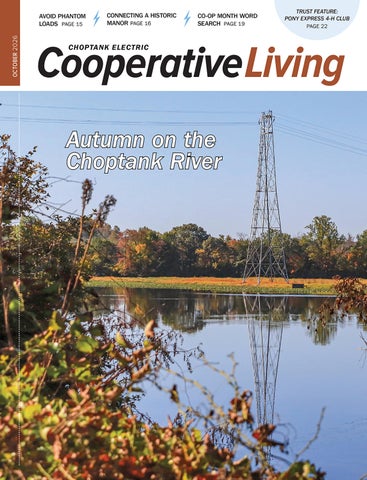
Cover: Background image, Neville Morrison; composite image, John Grott.
VIEWPOINT
Some Things Change; Some Never Will
T
his is the 900th issue of Cooperative Living, a milestone that comes as we celebrate our 80th anniversary. Throughout 2026, we’ve looked back on eight decades of telling the stories of the people and communities we serve — and chronicling the evolution of rural America. What an extraordinary journey it has been. This month, we welcome back Richard Johnstone, who served as editor of this magazine and as president and CEO of the Virginia, Maryland & Delaware Association of Electric Cooperatives during a 36-year career. His guest column, along with Deputy Editor Laura Emery’s memories of her 26 years with the magazine, offers firsthand accounts of the people, events and changes captured in these pages. As we look ahead, we know much will change. Technology will advance. Communities and lifestyles will evolve. The ways we generate, deliver and use electricity will continue to transform.
co-opliving.com
CL Oct 2026_TOC-Viewpoint.indd 15
But some things will remain the same. The people and communities we serve will continue to depend on their electric cooperatives to power their homes, businesses and local economies. Dedicated cooperative employees — from lineworkers and customer service representatives to engineers, office staff and communicators — will continue doing the often unseen work required to keep the lights on for their neighbors. And we will continue working together to meet growing energy demand, navigate data center expansion and affordability pressures, and manage an increasingly complex electric grid — while protecting the communities we are proud to call home. Through it all, Cooperative Living will continue doing what it has done for 900 issues: telling the stories of the people and places we serve. Eight decades have taught us that many things change. But our purpose does not. At your electric cooperative, it has always been — and always will be — about the people we serve.
•
Brian S. Mosier, President & CEO Virginia, Maryland & Delaware Association of Electric Cooperatives October 2026 • Cooperative Living • 1
9/16/26 1:23 PM
OUR COMMUNITIES
Cooperative Living OUR MISSION
To inform you about your cooperative and its efforts to serve your energy needs; how to use electricity safely and efficiently; and the people who define and enhance the quality of life in communities served by electric co-ops. JEFF CALDWELL • Vice President of Communications JACK COOKSEY • Managing Editor LAURA EMERY • Deputy Editor JOHN GROTT • Director of Creative Services JASON KENNEY • Director of Strategic Communications SONJA KINNEY • Business and Advertising Coordinator TOMMY CAMPBELL • Digital Producer
Published by the Virginia, Maryland & Delaware Association of Electric Cooperatives TODD VAN HORN • Chair SCOTT WHITE • Vice Chair CHRIS BOTT • Secretary/Treasurer BRIAN S. MOSIER • President & CEO Board of Directors: Christopher D. Bott, Tobias Moss, A&N; C. Michael Sandridge, Bill Buchanan, BARC; George N. Goin, Gary E. Wood, Central Virginia; Robert B. Thompson, Micheal E. Malandro, Choptank; Jeannette S. Everett, Steven A. Harmon, Community; James E. Huffman, Jeff M. Ahearn, Craig-Botetourt; Patricia S. Dorey, Rob A. Book, Delaware; Fletcher B. Jones, Casey J. Logan, Mecklenburg; Richard E. McLendon, Holly Wargo, Northern Neck; Wade C. House, Kristen R. Senechal, Northern Virginia; Ricky West, M. Brad Coppock, Powell Valley; Herbert R. Patrick, Sarat K. Yellepeddi, Prince George; Sanford Reaves Jr., John D. Hewa, Rappahannock; G. Todd Van Horn, Greg S. Rogers, Shenandoah Valley; Frank W. Bacon, Jason C. Loehr, Southside; Sonja Cox, Scott White, SMECO.
To advertise in Cooperative Living, contact: advertising@co-opliving.com or 804-297-3429. National Advertising Representative: AMP, 611 South Congress Ave., Suite 504, Austin, Texas 78704 • 800-626-1181 Member of AMP network of publications, reaching more than 9 million homes and businesses. To change your subscription, contact your electric cooperative. For editorial inquiries, contact editor@co-opliving.com. COOPERATIVE LIVING MAGAZINE (USPS 473-300) is published 10 times a year, monthly except for combined January-February and November-December issues, by the Virginia, Maryland & Delaware Association of Electric Cooperatives. POSTMASTER, address changes should be sent to: Cooperative Living, 4201 Dominion Blvd., Ste. 101, Glen Allen, VA 23060, 804-346-3344. Periodicals postage is paid at Glen Allen, VA, and additional mailing offices. Subscription: $6.49 per year for members of subscribing co-ops; $10 per year for all others. ADVERTISING PUBLISHED is accepted on the premise that the merchandise and services offered are accurately described and willingly sold to customers at the advertised price. Neither this magazine nor the electric cooperatives in Virginia, Maryland or Delaware endorse any products or services advertised herein. If any readers encounter noncompliance with these standards, they are asked to inform the Association. Cooperative Living is a registered trademark of the Virginia, Maryland & Delaware Association of Electric Cooperatives.
Please recycle.
2 • Cooperative Living • October 2026
CL Oct 2026_Our Communities.indd 15
SVCC POWER LINE WORKER TRAINING SCHOOL PHOTO
ODEC announced $300,000 in grants and donations going to power line workforce training and energy-efficiency programs.
VOL. 81, NO. 10 ● ISSN 1529-4579
Supporting Success
ODEC and partners pave the way for jobs, energy reliability by Jack Cooksey, Staff Writer
T
he future of Virginia’s energy security grew a bit brighter in August when Old Dominion Electric Cooperative announced a combined $300,000 in grants and donations to support power line workforce training and energy-efficiency programs in the state. Partnering with Gas South, an Atlanta, Ga.-based natural gas provider, ODEC announced Aug. 13 a combined donation of $200,000 to Southside Virginia Community College’s Power Line Worker Training School in Blackstone, Va. “As a founding supporter of the Power Line Worker Training School, ODEC’s renewed commitment helps ensure the communities we serve have the skilled labor to maintain the grid,” says Chris Cosby, ODEC’S president and CEO. The electric utility industry faces a significant workforce challenge as experienced employees retire and demand for skilled labor continues to increase at a faster-than-average pace. Employment is projected to grow 10% from 2025 to 2035, according to the U.S. Bureau of Labor Statistics. “By investing in workforce development today, we support the long-term reliability and resilience of the energy systems we will depend on tomorrow,” says Carley Stephens, the company’s director of community affairs. Since launching 20 years ago, the pre-apprenticeship training program has graduated more than 750 students. “Support from industry partners like ODEC and Gas South allows us to continue growing this program and connecting students with rewarding careers,” says Keith Harkins, SVCC’s vice president of academic and workforce programs. Later in August, ODEC joined with Dillwyn, Va.-based FLIPP Inc. to announce news of a $100,000 grant from Microsoft Corporation that will be used to provide free energy-saving upgrades to southern Virginia residents in manufactured and mobile homes through ODEC’s Manufactured Homes Program. FLIPP Inc., a nonprofit organization, develops workforce programs focused on helping communities with housing quality and energy efficiency. “This grant helps expand access to energy-efficient home improvements that make a lasting difference for families while strengthening the workforce needed to support our region’s energy future,” says Raye Elliott, executive director of FLIPP.
•
co-opliving.com
9/15/26 1:36 PM
CL Oct 2026_Lane Hearing Ad.indd 15
9/14/26 8:19 PM
80TH ANNIVERSARY
1946-2026
EIGHTY YEARS at a Glance FOR THE LOVE OF FIRSTS
THROUGH THE STORMS
NOTEWORTHY NAMES
October 1946: First issue of Rural Virginia with a circulation of about 20,000
1955-1975 Vietnam War
August 1950: Reports on Virginia’s first family to receive telephone service through the REA rural telephone program
1969 Hurricane Camille Luci Johnson, youngest daughter of President Lyndon B. Johnson and first lady Claudia “Lady Bird” Johnson
1955: First appearance of Willie Wiredhand, mascot of rural electrification, in Rural Virginia
JUNE 1966
1956: Rural Virginia uses color for the first time
First lady Pat Nixon NOVEMBER 1973
Gary Clark
JANUARY 1988
1997: Down Home column debuts (Victoria, Va., first stop)
John Cephas
Rick Mast
MAY 1989
January 2000: Cooperative Living website launches
AUGUST 1989
2001 Sept. 11 terrorist attacks
2003-2011 Iraq War 2003 Hurricane Isabel 2011 Hurricane Irene
January 2009: Reports on first African American president
2012 Hurricane Sandy
January 2018: “Into the Light” is the first cover story on mental health
Tim Reid
JANUARY 1992
2018 Hurricane Florence 2020-2023 COVID-19 pandemic 2021 Hurricane Ida
March 2025: Sonja Cox, first female CEO (Southern Maryland Electric Cooperative) in the VMDAEC system, featured
Changing
Charlton Heston
JANUARY 1992
January 2020: Genevie Boarman, first female electric cooperative lineworker in Virginia, featured
CES
1999-2000 Y2K
2001-2021 War in Afghanistan
January 1981: First reader-photo contest (Say Cheese)
ON ATI
1986 Chernobyl disaster 1989 Hurricane Hugo
August 1969: Reports on Neil Armstrong becoming the first person to walk on the moon September 1970: Rural Virginia becomes Rural Living, the magazine’s first title change
1972 Hurricane Agnes
President Bill Clinton Wayne Henderson FEBRUARY 1993
JUNE 2013
2024 Hurricane Helene
TIMES S
E ON
S CES
ET
ES
ICL
VEH
IAN
H LEP
4 • Cooperative Living • October 2026
CL Oct. 2026_80th Anniversary.indd 16
E
NC
S IGE S S D GY AC RN ER CTRIC TELL AN NOLO VEN UTER HICLE NET E WEB INTE ER S B L E T S R I O A E T P A I N T E R F E I ES M CH VE ID VE ON MP TE AP EL ED ND ND N/ NE ON AL LEC GW -LI ROWA E CO TRIC AL IN LD W ADBA PHON RTPH AL M RT HO RT TE DBA NSIO ERN ICI L E CTRIC NNIN EVISI Y F T A A I I A R D C A L M R A R A C T C O O P PAR RU HO RU MI WO SM AR MO RU TEL SO ELE BR SM SM BR EX ELE CEL C IFI
co-opliving.com
9/15/26 1:45 PM
80TH ANNIVERSARY
BY THE
NUMBERS
DID YOU
80
KNOW ?
YEARS OF TELLING THE STORIES OF ELECTRIC COOPERATIVE COMMUNITIES
Rural Virginia’s debut issue reached 22,000 homes and businesses. Today, Cooperative Living has a circulation of more than 600,000 and reaches up to 1.8 million readers.
900
ISSUES PUBLISHED SINCE 1946
1.8 MILLION
The publication has had three names: Rural Virginia, Rural Living and Cooperative Living. A fourth name also has a place in its history: In 1993, the Northern Virginia Electric Cooperative edition of Rural Living became Current Living, reflecting changes in the cooperative’s service territory.
ESTIMATED READERS PER ISSUE
13
CUSTOMIZED EDITIONS PRODUCED FOR VIRGINIA AND MARYLAND ELECTRIC COOPERATIVES
10 3
October 2026 marks the magazine’s 900th issue.
Look
ISSUES DELIVERED A YEAR
OF THE BOOK
6: er 194 Octob d letter -fe Sheet press
1953: t forma Tabloid co-opliving.com
CL Oct. 2026_80th Anniversary.indd 17
NAME CHANGES
1960: ia Virgin Rural o t d e switch e zin maga t forma
1970: mber Septe e to chang Name ing Liv Rural
1970: June olor First c graph o phot ver on co
0: ry 200 Janua e g n cha Name e iv t a r pe to Coo Living
October 2026 • Cooperative Living • 5
9/16/26 1:26 PM
80TH ANNIVERSARY
The Long Road Home
Reflections from a co-op childhood to a storied career serving cooperative communities by Richard G. Johnstone Jr., Guest Columnist
M
y birthplace is a rural county in west-central Georgia, its red clay fields peppered with pecan groves and peach orchards, its farms powered by an electric cooperative where my great-uncle served as general manager during its early days. My homeplace is a rambling Dutch Colonial on the outskirts of the county seat. My mother’s happy childhood was spent in this home, and when my father was assigned to an Army base in postwar Japan, she returned there to give birth to me. It was a home filled with love, and with lots of family members. Three generations lived under that roof during my mother’s childhood, and my arrival made me the fourth generation to share the space, with a great-grandmother, grandparents, two great-aunts and my mother. My father’s military service ended near my first birthday, and upon his return home, he began civilian life in a variety of sales jobs with large companies that moved us all over the Southeast, from Atlanta to Charleston, Tampa to Jacksonville, Charlotte to Birmingham, and finally to Richmond, where I’ve lived since age 15. Throughout my childhood, my happiest days were spent not in the various suburbs where we lived for short stretches, but in that small Georgia town, during summers and holidays with those family members, whom we, fondly, called “the folks.” All the folks are gone now, as is my mother, and that Georgia home was sold long ago. Other voices now fill those rooms, other feet now trod on those floorboards, other residents now make memories in those spaces. But my memories of living there are forever fixed. Memories of Christmases in a house overflowing with friends and extended family, enjoying a sideboard filled with turkey and ham and dressing, and once-a-year treats of divinity candy, ambrosia salad and jam cake. Of summers spent working at the soda fountain of my grandfather’s pharmacy, making lemonades and scooping ice cream, a dime a scoop.
6 • Cooperative Living • October 2026
CL Oct. 2026_80th Anniversary.indd 18
Memories of August church revivals, my grandmother elbowing my grandfather when he drifted off during too-long sermons. Of hot nights without air conditioning, with relief from a cool breeze through the windows arriving only once it was time to get up. Of the tiny den crammed with seven or eight of us, watching “Gunsmoke” or “Lawrence Welk.” Of stories from my great-grandmother, of her childhood in the 1880s. Given my roots in rural Georgia, I was excited in 1985 to be hired as editor of Cooperative Living (then called Rural Living). During my 36-year tenure, I traveled from the Cumberland Gap to the Delaware shore and countless points in between, interviewing hundreds of cooperative consumers. Their values — community, fair dealing, neighbors helping neighbors — were the values I was taught growing up. As I reflect on my time as steward of this iconic 80-year-old publication, I am pleased that we shifted the focus from syndicated pieces on national co-op issues to original stories on people and places within our local co-ops’ service areas. We also encouraged more interaction with readers, asking them to submit recipes, photos, letters and answers to various quizzes. Home is a place, and home is also where you belong. There are many decades and many miles between that homeplace in a rural Georgia county served by an electric cooperative, and a long career working for electric co-ops in the mid-Atlantic. But that long road ended up bringing me back where I belong, back home.
•
Richard G. Johnstone Jr. served multiple roles for the Virginia, Maryland & Delaware Association of Electric Cooperatives from 1985 to 2021 — as editor of Cooperative Living, executive vice president, and president and CEO. To watch a 20-minute video reflecting on 80 years of Cooperative Living, narrated by Richard Johnstone, visit vmda.ec/cl80th.
co-opliving.com
9/15/26 4:34 PM
80TH ANNIVERSARY
‘A Front-Row Seat’
Deputy Editor Laura Emery recounts her 26 years of giving voice to co-op stories by Laura Emery, Staff Writer
A
s Cooperative Living celebrates 80 years, I find myself reflecting on the 26 years I have been privileged to be part of this magazine’s remarkable legacy. My introduction to electric cooperatives came in 1995, when I attended the Virginia Cooperative Council’s Virginia Institute on Cooperative Education and then the National Institute on Cooperative Education. An essay contest I never expected to win, invitations to speak at several cooperative events and, eventually, a blind response to a classified ad seeking a writer for a “trade publication” led me rather unexpectedly to Cooperative Living. What followed was a career more fulfilling than I could ever have imagined, one that gave me a front-row seat to the people and places that make cooperative communities special. I’ve traveled winding roads through nearly every corner of Virginia, discovering places I might otherwise never have encountered. I’ve spent early mornings on the Chesapeake Bay alongside hardworking watermen, toured Tangier Island by golf cart with its mayor and followed lineworkers across rugged terrain as they restored power after storms. I’ve ridden in combines during harvest season with farmers whose livelihoods are inextricably tied to the land. I’ve toured power plants, standing amid massive equipment and complex systems that help keep the lights on across co-op communities. The stories have taken me from soup kitchens to NASA rocket launches. I’ve watched the weathered hands of skilled artisans coax something beautiful from wood, metal, yarn, paper and other raw materials, and I’ve sat with political leaders in Washington, D.C. Yet for all the places this career has taken me, it is the people and the smallest details about them that I remember most. The past 26 years of memories come rushing back, like a montage of faces, voices, places and moments.
co-opliving.com
CL Oct. 2026_80th Anniversary.indd 19
I remember meeting U.S. Sen. John Warner and being mesmerized by his charisma and magnetic, larger-than-life presence. And there was the time I spent the afternoon with actor Tim Reid, whom I knew from watching “Sister, Sister.” I remember marveling at how surreal it felt to be sitting with him. Just as vividly, I can recall 105-year-old Eley Demiel of Suffolk, Va., sitting in her wheelchair, afternoon sunlight falling across her face and neatly braided silver hair as she reflected on a life that touched three centuries. I’ll also never forget Matilda “Tillie” Marshall of Onley, Va., a spry 97-year-old with bright blue eyes, freshly painted pink fingernails and a tiny bow tucked into her gray curls. Barely 4 feet tall, she possessed a wit, faith and exuberance for life that seemed to defy the passage of time. I remember Frank Harris of Ford, Va., who spent 33 years serving Southside Electric Cooperative. His positive energy was palpable, but behind his buoyant spirit was a man who had endured tremendous personal loss and, through his faith in God, chose joy. They are just a few of the remarkable people who transformed my career into something far richer. Countless others have welcomed me into their lives and trusted me to share their stories — both extraordinary and ordinary — in the pages of Cooperative Living. In doing so, they left pieces of themselves with me, too. It’s hard to imagine what I thought my career would look like when I first began writing for the magazine, but all these years later, I am proud to continue to call Cooperative Living — and the cooperative community it represents — my life’s passion.
•
Laura Emery joined Cooperative Living as field editor in 2000, later becoming associate editor and then deputy editor. For 26 years, she has helped tell the stories of people, places and communities served by electric cooperatives.
October 2026 • Cooperative Living • 7
9/15/26 4:34 PM
FARM LIFE
A Safe Start to Woodstove Season Prepare now for a warm, worry-free winter by Alice Kemp, Virginia Farm Bureau Federation
A
fter long, chilly days on their Christmas tree farm, Ronald and Roberta Clouse enjoy warming up by a woodstove. “When I’m plowing snow or if we’re working outside all day in the cold, it’s nice to come in and get near the woodstove,” Ronald says. “It puts out a good heat.” With their rustic charm, crackling woodstoves offer cozy retreats during frigid winters. But that comfort comes with responsibility — without proper care, woodstoves can pose serious fire risks. MAINTENANCE ROUTINES The couple heats their home with two woodstoves, and they begin preparations well before the first frost. Their chimneys are inspected and thoroughly cleaned each fall, and Ronald checks the woodstoves — replacing cracked or deteriorating firebricks to keep them functioning safely and efficiently. “I also check the chimneys about midway through the heating season to ensure everything’s still in good shape,” he notes. Each stove sits on a 4-by-4foot stone hearth without furniture or anything that could catch fire nearby. CLEAN CHIMNEYS “The main issue we run into with woodstoves is chimney fires,” says Nathan Fox, chief of Tazewell County’s Clearfork Volunteer Fire Department. “Mostly they’re due to poor chimney maintenance or burning wood that hasn’t been properly seasoned.” According to the National Fire Protection Association, heating equipment is the second-leading cause of home fires and the third-leading cause of home fire deaths. Dirty chimneys,
8 • Cooperative Living • October 2026
CL October 2026_Farm Life.indd 15
usually caused by creosote buildup — highly combustible residue that accumulates inside chimneys — is a leading cause of chimney fires. While small amounts of creosote are normal when operating woodstoves, burning wet or unseasoned wood causes creosote to accumulate faster and can restrict airflow. Left untreated, creosote buildup significantly increases fire risk. A 20-year veteran of the fire service, Fox has responded to attic fires caused by neglected, cracked chimneys. He advises having working smoke and carbon monoxide detectors around the house and keeping a fire extinguisher nearby. Call 911 as soon as you think there may be a problem, he says. “Time is never on your side when fighting fire,” Fox says. “It takes time for dispatch to page the fire department and for firefighters to arrive. That one phone call will get the ball rolling.”
•
WOODSTOVE CHECKLIST
• Burn dry, well-seasoned hardwood. Don’t burn wet or green wood, paper,
plastic or other materials. Don’t overload woodstoves with too much wood.
• Have chimneys inspected and cleaned annually by a professional. • Keep a 3-foot clearance around stoves — free of rugs, furniture, drying clothes or anything flammable.
• Inspect and maintain woodstoves. Check firebricks for damage, inspect door
seals and stovepipes, remove ash, and replace gaskets and parts as needed.
• Use dampers and air controls properly to control air intake and regulate the burn, minimizing creosote and ensuring unrestricted airflow.
• Extinguish the fire before you go to sleep or leave home. • Use a metal container with a lid for ashes, and place it outside at least 10 feet from your home.
• Test smoke and carbon monoxide detectors monthly and replace batteries as needed.
• Keep a fire extinguisher within reach and make sure everyone in the home knows how to use it.
co-opliving.com
9/15/26 1:52 PM
CL Oct 2026_VA Farm Bureau Ad_pg9.indd 15
9/14/26 8:25 PM
COOPERATIVE FOCUS
Dog-Show Days Middle Peninsula residents find success and connections in kennel club competitions
T
he excitement surrounding the now-iconic annual Westminster Kennel Club Dog Show held in New York City each February is visceral for two rural Virginia residents who played important roles in the 2026 show. Polly Smith of St. Stephens Church in King and Queen County, Va., judged the terrier group, and Michael Faulkner of Center Cross in Essex County, Va., judged the WKC’s Junior Showmanship finals where the best junior handler was selected. Faulkner juggles his “dog career” with his job as executive director of the Ledwick-Lewis Free Clinic in Tappahannock. Smith is a retired widow with one adult son. The two have traveled intertwining routes in the kennel club community. CHILDHOOD CONNECTION The WKC “has been part of my total existence from early childhood until now,” Faulkner says. He vividly
10 • Cooperative Living • October 2026
CL October 2026_Coop Focus.indd 16
From left, Polly Smith and Michael Faulkner
remembers the first time he was asked to judge the sporting group, one of seven categories featured in the annual dog show. “The evening before the competition, I went over to [New York City’s] Madison Square Garden with a colleague to do a preproduction run-through because the show [airs live on television],” he says. “We were way up in the nosebleed section in a totally empty arena looking down as I reflected on the importance of the moment. Never in my wildest dreams did I think I would be there. … And it all started with the love of dogs.” Smith also traces her love of animals to childhood. She was introduced to dog shows by her grandparents’ neighbor, who raised and showed chow chows. She recalls dressing up one chow chow named Chinese Jade, putting a leash around his neck and walking him around
PHOTOS COURTESY MICHAEL FAULKNER
by Audrey Hingley, Contributing Writer
pretending to compete in a dog show. In the 1960s, Smith and her late husband Dr. Robert Smith started breeding and showing American foxhounds. Their kennel produced numerous champions and best-in-show winners over several decades. They also bred Welsh terrier and beagle champions, but the American foxhound remains Smith’s favorite dog breed. American foxhounds are low-maintenance, goodnatured hounds who get along well with children, other dogs and even cats. They are sleek hunters known for their speed, endurance and work ethic. Their large eyes have a gentle and pleading expression. Smith is a founding member of several kennel clubs, including the Middle Peninsula Kennel Club, based in Doswell, Va. She has competed and judged at the WKC many times as an American Kennel Club-licensed all-breed judge. “Years ago, when we got started, you were invited to be a judge,” she recalls. “[My husband and I] were both exhibitors and handlers. Now you have be a licensed judge through the AKC. You apply, do tests and are interviewed by AKC representatives [to be a] provisional judge. co-opliving.com
9/15/26 2:12 PM
COOPERATIVE FOCUS
You must have 12 years as an exhibitor to apply, and you must have bred three champions.” Faulkner, a third-generation dog aficionado, says, “My grandparents had great danes, my mom had field spaniels and my aunt had collies.” His passion for dogs has carried him through junior showmanship, a lesserknown competition in the WKC for participants ages 9 to 18 who compete for postsecondary scholarships, and he continues today through his roles as breeder, owner, handler, judge and mentor. In addition to these roles, Faulkner has been involved in extensive breeding programs, breeding and handling golden retrievers and several other breeds, and handling multiple best-in-show winners. “The golden is my lifelong favorite,” he says. “They are highly intelligent, kind, gentle and willing to please. The bond between human and dog is intense, and they are beautiful.” Smith says many people get started in the dog show world through obedience training. Faulkner says many young people begin through involvement in 4-H clubs. DOG SHOW CULTURE To a casual observer, competing at the WKC dog show may seem uncomplicated, but the process is anything but simple. Regarding both dog show participation and breeding, Faulkner admits, “It’s expensive. Anything you do well in will cost you money. I show my own dogs, and we also have handlers, and that is not cheap.” WKC competitors have to consider costs such as training, grooming, transportation, travel and lodging, entry fees and marketing expenses. Established in 1877, the Westminster Kennel Club Dog Show is the oldest organization in America dedicated to co-opliving.com
CL October 2026_Coop Focus.indd 17
the sport of purebred dogs, as well as the second-longest continuously held sporting event in the country, behind the Kentucky Derby, which debuted in 1875. WKC predates the formation of the AKC by seven years and was the first club admitted to the AKC after its founding in 1884. It’s also the longest nationally televised dog show, broadcast since 1948. Television has allowed the public to see both the level of competition and the quality of different
breeds. It has contributed to making Westminster a serious sporting event. In addition to airing on FOX Sports, the WKC recently announced its Feb. 2, 2027, show will stream live on Netflix. Originating as a show for “gun dogs” (primarily setters and pointers), the WKC was founded by a group of sporting enthusiasts who gathered at New York City’s long-gone Westminster Hotel bar to drink and talk about their dogs. Today, the WKC show includes more than 200 breeds and varieties recognized by the AKC. Dog entrants are divided into seven categories: sporting, hound, terrier, toy, working, herding and non-sporting. WKC has broadened its reach over the years, and mixed breed dogs compete in some performance events, such as barn hunt, agility and obedience. Since 1987, WKC’s Westminster Foundation has awarded $4.8 million in scholarships to veterinary students at six universities. WKC’s mission
celebrates the companionship of dogs, promotes responsible dog ownership and breed preservation. Dogs are judged by how closely they conform to breed standards, which describe the characteristics of the ideal specimen for that breed that relate to form and function. These written conformation standards are created, maintained and owned by the national breed club for each respective breed and approved by the AKC. Most standards describe general appearance, movement and specific physical traits, such as height, weight, coat type and coat color. Competition judges conduct hands-on examinations of dogs and watch them in motion. Dogs compete against others of their breed, with each breed’s winner moving to a semifinal judging round. Group winners advance to best in show during the televised event. The designation best in show has been awarded since 1907. Like the canine crowned best in show, considered the highest distinction in American dog competition, Faulkner is not paid for his WKC work. Winners are awarded trophies, such as a polished pewter trophy and The Westminster Legend Trophy, a handengraved Steuben crystal bowl. Winning best in show does provide opportunities. The winning dog receives sponsorships, can earn money for appearances and may see its value in breeding greatly increase. Faulkner, who says the dog world is “extremely welcoming,” was surprised recently when he was invited to become a Westminster Club Member — the only WKC member in Virginia. He calls winning at the WKC show “the [pinnacle] of your career. … It validates your career by winning a show.”
•
The Middle Peninsula Kennel Club of Virginia Dog Show, headed by Polly Smith, will be held Oct. 24 at Meadow Event Park in Doswell, Va. Spectator admission is free; parking is $5. October 2026 • Cooperative Living • 11
9/15/26 2:12 PM
DINING WITH PEGGY
Got a restaurant for Peggy to review? Let us know at editor@co-opliving.com.
Timeless and Tempting
Atmosphere and menu pair together well in Winchester, Va. Orange Crush
by Peggy Hyland, Contributing Columnist
Cajun fried okra
12 • Cooperative Living • October 2026
CL October 2026_Dining with Peggy.indd 15
PHOTO COURTESY WATERSTKITCHEN.COM
O
n Winchester’s charming downtown pedestrian mall, Water Street Kitchen is serving up classic comfort food in a relaxed atmosphere. It is located in one of the fixtures of the Old Town historic district, where Boyd’s Drug Store stood for about a century. There are traces of the old drug store and soda fountain still present, from the tin ceiling to the ornate shelving that lines the walls. Even the name is a nod to the past, when South Loudon Street was known as Water Street. We soaked in the feeling of familiar warmth and nostalgia from the moment we stepped inside. The vintage atmosphere felt timeless, not dated. Service was friendly and helpful, especially when perusing the side dishes. The selection of side dishes was extensive, but there was no need to pick just one. The Side Plate meal option features three sides and a piece of corn bread, perfect for sharing with friends during an afternoon of shopping and strolling. I could eat the Cajun fried okra all day long. We also tried the mac and cheese, a delectable dish with cavatappi noodles bathed in rich, creamy cheese. Crab dip always catches my eye, and this dish was fabulous. It was a creamy indulgence, with generous chunks of
crab meat. The pimento cheese gave it a homey, southern feel, and the crumbled bacon topping added some crunch to the texture. My companion chose the meatloaf, made with Black Angus beef and prepared in the classic style. The housemade gravy will bring back memories of visiting a favorite grandmother for a Sunday meal. He chose the freshly cooked kettle chips, a crunchy delight, and the crispy brussels sprouts, cooked just right. I could not resist the shrimp and grits, which was truly outstanding. The stone-ground grits had the perfect texture, and the mild cheddar added rich velvetiness. The sauce of fire-roasted tomatoes, peppers and onions was terrific on its own, but paired with the blackened shrimp and luscious grits, Meatloaf
the combination was a dream team. The grits are also available as a side dish. With breakfast served all day, Water Street Kitchen is a great place to start — or end — your day of exploring all the shops and historic sites on the Loudon Street Pedestrian Mall. It’s right around the corner from Taylor Pavilion, where a variety of free events are held throughout the year, and a half a mile from the home of Winchester’s famous star, Patsy Cline.
•
Water Street Kitchen 2 S. Loudon St., Winchester, VA 22601 Monday through Friday, 11 a.m.-8 p.m.; Saturday, 10 a.m.-8 p.m.; Sunday, 10 a.m.-3 p.m. 540-313-4680 Waterstkitchen.com Crab dip
co-opliving.com
9/16/26 1:29 PM
co-opliving.com
CL Oct 2026_Ad Page 13.indd 15
October 2026 • Cooperative Living • 13
9/14/26 8:29 PM
CL Oct 2026_ODEC Ad_pg14.indd 15
9/14/26 8:33 PM
A MESSAGE FROM THE CEO HALLOWEEN TIP: PHANTOM LOADS
O
ctober brings cooler temperatures, changing leaves and, of course, Halloween. While you may be preparing for trick-or-treaters and decorating your home for the season, there may be another kind of “ghost” lurking in your house: phantom loads. Phantom loads, also known as standby power, refer to the electricity used by electronic devices even when they are turned off or are not actively being used. Many common household electronics, including televisions, gaming systems, computers, printers and kitchen appliances, continue to draw small amounts of electricity as long as they remain plugged in.
This Halloween, don’t let phantom loads haunt your home. Take a walk through your house and look for electronics that may be drawing electricity even when they are turned off. A few simple changes can help reduce unnecessary energy use and keep these energy “ghosts” from lingering year-round. At Choptank Electric, we are committed to helping our members make informed decisions about their energy use. Small changes in how you use electricity can make a difference over time. For more energy-saving tips and information about programs available to members, visit choptankelectric.coop/energy-efficiency.
One device may not use enough electricity to make a noticeable difference in your monthly bill. However, when you consider how many electronics are plugged in throughout your home and how long they remain connected, those small amounts can add up over time.
From all of us at the co-op, have a safe and happy Halloween!
There are several simple ways to reduce phantom loads. Unplug electronics that are rarely used, such as seasonal decorations or guest-room appliances. You can also connect multiple devices to a power strip and turn it off when those electronics are not needed. Smart power strips can make this even easier by automatically cutting power to certain devices when they are not in use.
Mike Malandro, President & CEO Choptank Electric Co-op
Write to us: P.O. Box 430 | Denton, MD | 21629 Member Service Center: 1-877-892-0001 Automated Member Service: 844-975-2746 Outage Reporting: 1-800-410-4790
CHOPTANKELECTRIC.COOP
• Cooperative Living • October 2026
CL Choptank_October 2026.indd 15
15
9/16/26 12:23 PM
Historic Property, Now Connected By McKayla Kiernan, Communications Specialist
F
or more than 300 years, Worsell Manor has stood as a landmark in Warwick, Maryland, preserving a piece of the Eastern Shore’s rich history. The historic property has also served as a wedding venue for the past decade, welcoming couples and their guests to celebrate special moments. Now, Choptank Fiber is helping bring modern connectivity to the historic property, providing highspeed fiber internet throughout the venue. Worsell Manor can offer guests the internet connectivity they expect while preserving the charm and character that make this Eastern Shore landmark so special. Worsell Manor’s history dates back to 1683, when the property 16 • Cooperative Living • October 2026
CL Choptank_October 2026.indd 16
was part of a 1,000-acre land grant from Lord Baltimore to Peter Sayer. Today, the property retains its rural character and historic setting, with the manor house recognized as a fine example of mid-Georgian architecture and one of the few remaining structures from its period in Cecil County. Scott Millar and his wife, Barbara, purchased the property in 2012
Scott Millar in front of Worsell Manor.
after it had sat abandoned for 15 years, taking on the task of restoring and preserving a piece of the Eastern Shore’s history. The property has since become a wedding and event venue while maintaining many of its historic features. The all-original brick manor sleeps up to 16 guests and features five bathrooms, providing a unique setting for couples and their guests. Preserving the property’s historic character came with its own modern-day challenges, including reliable internet access. Before Choptank Fiber, Millar says the Choptank Electric Cooperative
9/16/26 12:23 PM
It's not very often that you get to go through structures that are older than our country.. – Evan Roe, Supervisor of Fiber Services property relied on 5G cellular service and mobile hotspots, which were “sketchy and unreliable.” Choptank Fiber’s installation provided coverage across the entire property while keeping the technology as unobtrusive as possible. The project included an optical network terminal (ONT), gateway and six extenders, strategically placed throughout the property to provide reliable indoor and outdoor coverage.
modern technology without taking away from a place that has stood for centuries. “Working with such an old and historic venue was a true honor for our team,” Roe says. “It’s not very often that you get to go through structures that are older than our country. It was very important to us to give the best coverage and service that we could, without being seen.” For more information about Worsell Manor, visit: worsellmanor.com.
Choptank Fiber's Wi-Fi extender is placed on the bottom shelf of the table to hide its modern look.
“Working on Pleasant Farms at Worsell Manor was a unique situation,” says Evan Roe, Supervisor of Fiber Services. “The owner wanted to bring the most modern Wi-Fi technology to the complex while not making it obvious against its 1680s facade.” The Choptank Fiber team worked closely with the owners to provide coverage throughout the manor, barns and outdoor areas without compromising the property’s historic appearance. Inside the manor, access points were hardwired and placed in inconspicuous locations across all three floors. In the barns, Ethernet lines were carefully routed along existing rafters. For outdoor coverage, two power-overEthernet access points were mounted near the top of an existing windmill behind the barn and positioned below the roofline so they would remain out of sight in photographs of the manor. For Roe and the installation team, the project was about more than connecting a property to the internet. It was about finding a way to introduce choptankelectric.coop
CL Choptank_October 2026.indd 17
October 2026 • Cooperative Living • 17
9/16/26 12:23 PM
INCREASE YOUR SAFETY YIELD DURING HARVEST
E
specially during the busy harvest season, help decrease the chances of an electrical incident: •
Always use a spotter when operating large machinery near power lines.
•
Use care when raising augers or the bed of grain trucks around power lines.
•
Keep equipment at least 10 feet from lines — at all times, in all directions.
•
Inspect the height of the farm equipment to determine clearance.
•
Always lower extensions to the lowest setting when moving loads.
•
Never try to move or raise a power line for clearance; instead, call us.
If your equipment comes in contact with a power line, do not leave the cab. Immediately call 911, warn others to stay away, and wait for the utility crew to cut the power.
18 • Cooperative Living • October 2026
CL Choptank_October 2026.indd 18
Choptank Electric Cooperative
9/16/26 12:23 PM
Check out our Facebook page for the answers next week! choptankelectric.coop
CL Choptank_October 2026.indd 19
October 2026 • Cooperative Living • 19
9/16/26 12:23 PM
2027 Notice of Election of the Board of Directors I
n conjunction with the 2027 Annual Meeting of Choptank Electric Cooperative, Inc., an election of directors will be held for Dorchester, Kent and Queen Anne’s Counties. If you are interested in being a candidate for one of these positions, please complete, sign and deliver a 2027 Petition for Nomination of Candidate for Director by 4 p.m. on Friday, December 18, 2026. The completed petition must be delivered to the attention of the Credentials & Election Committee, c/o Dawn Bowie, Choptank Electric Cooperative either: (a) by hand delivery or courier to the headquarters office, 10384 River Road, Denton, MD 21629; (b) by mail to P.O. Box 430, Denton, MD 21629; or (c) by email to Dawn Bowie at dawnb@choptankelectric.coop.
Any applications received after Friday, December 18, 2026, will not be reviewed by the committee. Members can obtain a copy of the 2027 Petition for Nomination of Candidate for Director, beginning November 2, 2026, on our website at choptankelectric. coop under Member Services, Annual Meeting or by calling our Member Service Center at 1.877.892.0001 to request a mailed copy. Please review the Bylaws (under Governance on the website) for additional requirements regarding Board of Director positions. The election results will be announced at the 2027 annual member meeting, which will be held on Thursday, April 22, 2027, at the Fountains Wedding & Conference Center located at 1800 Sweetbay Dr., Salisbury, MD 21804.
Register for Girl Power® Eastern Shore T
he 2026 Girl Power Eastern Shore event will take place Nov. 5 at Choptank Electric Cooperative's Training Center in Salisbury, Md. Throughout the day, participants will rotate through interactive demonstrations, outdoor activities, classroom sessions and presentations led by utility professionals. Safety is a key focus of the program, with students learning about topics such as utility pole climbing techniques, bucket truck operations and safe work practices.
20 • Cooperative Living • October 2026
CL Choptank_October 2026.indd 20
To learn more or register for Girl Power, visit vmdaec.com/girlpower-camp or scan the QR code. Registration for the Salisbury event closes Oct. 29, 2026.
Choptank Electric Cooperative
9/16/26 12:23 PM
Choptank congratulates the following employees on their promotions:
Linnie Vann
Jimmy Creighton
Journeyman Lineman
Apprentice Lineman 4th Class
Hunter Rodgers Apprentice Lineman 2nd Class
Welcoming New Employees Experience: Queen Anne's County Government and Talon Security Hobbies: Spending time with friends and family, cooking, lifting weights, playing sports and video games, and learning new things Looking forward to: Learning, sharpening my skills and being part of an amazing organization
Byron Allison
Electronics Technician I
We enjoyed talking with members at the Queen Anne's and Caroline-Dorchester county fairs this summer!
choptankelectric.coop
CL Choptank_October 2026.indd 21
October 2026 • Cooperative Living • 21
9/16/26 12:23 PM
THANK YOU FOR ROUNDING UP!
F
or 50 years, the Pony Express 4-H Club has helped local youth develop confidence, responsibility and lifelong skills through their love of horses. Founded in 1976, the club now has more than 45 members who participate in a variety of activities throughout the year. Members have opportunities to strengthen their horsemanship skills through trail rides, speed shows and other activities, while the annual fair gives them a chance to showcase the hard work they've put into their project horses. Through 4-H, members also learn important skills such as public speaking, record-keeping, organization and responsibility.
The horse barn serves as an important gathering place for club members. In July, the Choptank Electric Cooperative Trust donated $3,499 to support improvements at the horse barn, including a new PA system for the arena. The new system will help improve communication during events and provide a better experience for members, families and spectators. Club leaders Shannon Dill and Jana Hutchison, along with numerous volunteers, play an important role in providing members with opportunities to learn, compete and grow. As the Pony Express 4-H Club celebrates its 50th anniversary, its legacy continues through the generations of young people who have learned valuable lessons through their experiences with horses and 4-H. The club looks forward to continuing that tradition and creating new memories for its members for years to come.
Choptank Electric and Choptank Fiber exist to provide reliable and cost-effective services that improve the quality of life for our communities. President & CEO Micheal E. Malandro Board of Directors John J. Burke Jr. Chairman, Cecil Co. Robert B. Thompson Vice Chairman, Ocean Pines District Donna Richardson West Secretary, Worcester Co. Amy Ireland Brandt Treasurer, Caroline Co. Douglas D. Scott Dorchester Co.
The Choptank Electric Trust is a 501(c)(3) charitable foundation funded by Operation Round Up donations from members of Choptank Electric. Funds from the Trust are distributed throughout Maryland's nine Eastern Shore counties. To apply or to find out more about this program: > choptankelectric.coop/operation-round-trust-fund
Kristen E. Nickerson Kent Co.
August 2026 Trust Awards
Craig N. Mathies Sr. Somerset Co.
Col. Tench Tilghman Sons of the American Revolution . . $1,000 • Eastern Wellness Solutions . . . . . . . . . . . . . . . . . $2,802 • EldoradoShore Brookview Volunteer Fire Dept. . . . . . . . . . . . . $3,000 • Greater Ocean City Chamber of Commerce . . . . . . . . . . . $500 • NCHS Band Association of Parent . . . . . . . . $4,811 • Saddlin' Up for Breast Cancer Ride.& .Students . $700 • Women & Girls Fund of the Mid-Shore.. .. .. .. .. .. .. .. .. .. .. .. .. .. $2,500 •
Robert E. Arnold Queen Anne’s Co.
Jeffery D. Rathell Sr. Talbot Co. Matthew R. Holloway Wicomico Co.
The total of approved applications for August was $23,484, which included $8,170 for individual home and medical expenses. 22 • Cooperative Living • October 2026
CL Choptank_October 2026.indd 22
Choptank Electric Cooperative
9/16/26 12:23 PM
CL Oct 2026_Dinwiddie Co Fair Ad.indd 15
9/14/26 8:36 PM
COOPERATIVE KITCHEN
GOT A FAVORITE RECIPE?
A Taste of Fall
Email your favorite recipes to cooperativekitchen@co-opliving.com, or mail to Cooperative Kitchen, c/o Cooperative Living, 4201 Dominion Blvd., Suite 101, Glen Allen, VA 23060. Include your email address. You can also submit recipes online at co-opliving.com/cooperativekitchen. Due to volume, we cannot guarantee publication of all recipes. Reader recipes are submitted in good faith. Cooperative Living cannot warrant results.
A few seasonal favorites from the archives
Turkey Dandy
Baked Apples
appeared in December 1954 issue of Rural Virginia
Ingredients:
1 (4-oz.) box elbow macaroni ¼ cup butter or margarine ¼ cup enriched flour 1 teaspoon salt
2 cups milk or turkey stock 1 cup turkey, cooked 1 cup peas, cooked 1 cup carrots, sliced and cooked
Directions: Cook macaroni in boiling salted water until tender, about 10 minutes. Drain and rinse. Meanwhile, melt butter or margarine in a saucepan. Stir in flour and salt. Gradually add milk or turkey stock and cook, stirring constantly, until thickened. Place macaroni in an 8-inch-square baking dish. Arrange turkey over the macaroni and top with carrots and peas. Pour the sauce over the mixture. Bake at 350 degrees for about 30 minutes. Makes 4 servings.
24 • Cooperative Living • October 2026
CL October 2026_Coop Kitchen.indd 15
appeared in October 1988 issue of Rural Living, recipe courtesy of Francis and Ann Wilmer of Maryland’s Eastern Shore
Ingredients:
6 medium tart apples ½ cup brown sugar 1 teaspoon cinnamon ½ teaspoon lemon zest
2 teaspoons butter 1 tablespoon lemon juice, water or apple juice
Directions: Peel the top half of each apple and remove cores. Place apples in a flat baking dish. Combine brown sugar, cinnamon and lemon zest. Divide the mixture evenly among the apples, filling the hollow centers. Top each apple with a small pat of butter. Pour about ½ inch of water or apple juice into the baking dish, then add the lemon juice. Sprinkle any remaining sugar mixture over the liquid. Bake at 375 degrees for 45 minutes or until the apples are tender, basting occasionally. Serve warm with cream.
co-opliving.com
9/15/26 2:43 PM
co-opliving.com
CL Oct 2026_Ad Page 25.indd 15
October 2026 • Cooperative Living • 25
9/15/26 2:44 PM
ENERGY INSIGHT
Understanding RGGI
An overview of the regional carbon program by Jack McCarthy, Contributing Writer
W
ith Virginia’s return to the Regional Greenhouse Gas Initiative, as of July 1, 2026, ratepayers in Virginia, Maryland and Delaware now all participate in the regional carbon program. State energy policy shapes how electricity is produced, priced and delivered across the region. One such policy, the Regional Greenhouse Gas Initiative, commonly known as RGGI (pronounced “Reggie”), is a program that has significant effects on energy and affordability. While Maryland and Delaware have participated in RGGI since the program’s early years, Virginia rejoined the program July 1, 2026, after participating from 2021 through 2023. Here’s a look at what RGGI is, how it works and where things stand today. WHAT IS RGGI? The Regional Greenhouse Gas Initiative is a multistate program designed to reduce carbon dioxide emissions from power plants across
26 • Cooperative Living • October 2026
CL Oct 2026_Energy Insight.indd 16
participating Northeast and midAtlantic states. Often described as a cap-and-trade program, RGGI places a limit on carbon emissions from power plants in participating states. Each year, the number of allowances available is gradually reduced, limiting the supply over time. Under the program, power plants subject to RGGI must buy carbon allowances based on the amount of carbon dioxide they emit. Allowances from participating states are primarily sold through quarterly RGGI auctions, although they can also be bought and sold on a secondary market. The auction price can change based on the number of allowances available and demand, including from power plants that need allowances to meet RGGI requirements. RGGI is designed to encourage greater use of low- and zerocarbon generation sources that require fewer or no allowances. Revenue generated from the sale of allowances is distributed to participating states, which decide how the funds
Wildcat Point, an ODEC-operated power generation facility in Cecil, Md.
will be used. For utilities with power plants subject to RGGI, the required purchase of allowances is an additional compliance cost that increases the cost of generating electricity that is passed on to the ratepayer. How the revenue is used varies by state and may include energy efficiency, weatherization, flood mitigation, consumer assistance or other efforts to help offset some of the costs for customers, including bill credits. Today, RGGI states include Virginia, Maryland and Delaware — the three states served by Old Dominion Electric Coperative’s member co-ops — as well as Connecticut, Maine, Massachusetts, New Hampshire, New Jersey, New York, Rhode Island and Vermont. Maryland and Delaware have participated in the program for many years. Delaware was one of the original states to sign the RGGI agreement in 2005, Maryland joined the agreement in 2007 and the program’s first compliance period began in 2009. co-opliving.com
9/14/26 5:32 PM
ENERGY INSIGHT
RGGI is one example of how energy and environmental programs can influence the cost of producing and delivering electricity. VIRGINIA’S HISTORY WITH RGGI Virginia’s involvement with RGGI has changed several times over the past six years. In 2020, the Virginia General Assembly passed legislation directing Virginia to participate in RGGI, and the commonwealth began participating in the program in 2021 under Gov. Ralph Northam. Under Gov. Glenn Youngkin, Virginia pursued a regulatory withdrawal from RGGI and ended its participation after 2023. That action was challenged in court, and in 2024, a circuit court ruled that the regulatory repeal was unlawful. The state appealed the ruling, and Virginia
co-opliving.com
CL Oct 2026_Energy Insight.indd 17
remained outside RGGI while the appeal was pending, which was officially withdrawn in March 2026. Following action by the Virginia General Assembly and Gov. Abigail Spanberger earlier this year, Virginia rejoined RGGI, with compliance obligations resuming July 1, 2026. WHERE THINGS STAND TODAY As of July 1, 2026, Virginia is once again participating in RGGI, making compliance with the program a requirement under state law. The resulting compliance costs become part of the overall cost of providing electricity.
The price of RGGI allowances can change from one auction to the next based on the number of allowances available and demand. In the June 2026 auction, allowances sold for $35 each. That compares with $14.88 per allowance in December 2023, the final auction held during Virginia’s previous participation in the program. The allowance cost will continue to increase based on RGGI’s further allowance reduction goals. RGGI is one example of how energy and environmental programs can influence the cost of producing and delivering electricity. As the energy landscape continues to evolve, electric cooperatives remain focused on keeping members informed, managing costs wherever possible and ensuring the reliable, affordable electricity our communities depend on.
•
October 2026 • Cooperative Living • 27
9/14/26 5:32 PM
EXPLORE MORE
Restoring the American Chestnut Uniting generations, preserving Appalachian history and culture by Amanda S. Creasey, Outdoors Writer
A SCIENCE OF PATIENCE From Stark, I learn TACF is breeding Asiatic disease-resistant chestnut trees 28 • Cooperative Living • October 2026
CL October 2026_Explore More.indd 16
RADIANT SNAPSHOTS PHOTO
W
hen I arrive at the chestnut orchard in Lesesne State Forest, one tree immediately arrests my attention. With lush blooms, healthy foliage and symmetrical branches, she stands tall and proud amid the pastoral scene. Later, I will learn this stunning beauty has a name: Gladys. Referring to her as female, though, isn’t exactly accurate. John Scrivani, chair of restoration science for The American Chestnut Foundation, explains that chestnuts are monoecious, producing both male and female flowers. He gently pulls a low branch lower, allowing me to inspect its flowers. The male blossoms, catkins, look like furry fireworks, the female flowers like tiny, upside-down pineapples. Scrivani leads me toward a utility truck, its bucket extended so the woman perched inside can reach the canopy of another impressive chestnut. Central Virginia Electric Cooperative has donated bucket truck services in the past, when the Virginia Department of Forestry trucks are unavailable, he tells me. Cassie Stark, director of science implementation for TACF, is poised in the bucket, hand-pollinating the tree. After a few minutes, Scrivani calls up to her, the bucket is lowered and Stark hops out. I notice some linework on her forearm — a delicate chestnut leaf is tattooed there.
Cassie Stark, director of science implementation for The American Chestnut Foundation, hand pollinates a chestnut tree.
with American chestnut trees. The resulting offspring will be hybrid chestnuts with varying levels of disease resistance inherited from Chinese and Japanese chestnut, an important trait for competing in a forested setting. The hand pollination happening in the orchard today is not a long-term solution to the American chestnut’s struggle to survive, but a bridge to hopeful restoration. The process currently in use is an industry standard known as recurrent genomic selection. Stark explains that researchers breed high-performing trees and then breed their offspring in subsequent generations, gradually strengthening selected traits. It’s a slow process. Scrivani laughs as he says, “We’re always reminding ourselves that we work on tree time, generation by generation. Our progress can take
A bucket truck gives pollination workers necessary access to the higher reaches of the American chestnut trees.
10 to 15 years to evaluate. The department of forestry has been working on restoration for 40 years.” Hand pollination is a key part of the process, allowing the team of staff and volunteers here today to make the correct crosses. To control pollination, volunteers and TACF staff cover female flowers with paper bags in early June before they become receptive, preventing unwanted pollen from reaching them. Once the flowers are ready, pollen from the selected tree is applied and the bags are replaced to prevent contamination. They return in the fall to remove the bags and harvest the seeds, only then learning how successful the crosses were. Stark and Scrivani introduce me to a squad of volunteers in the orchard today to help. Among them are David Crouch, Neal Grandy and Laura Podyma, all co-opliving.com
9/15/26 2:50 PM
EXPLORE MORE
An empty chestnut burr
retirees, as well as Carter Newsome, a recent college graduate. The team spans several generations. Gathered in this orchard are people ranging from a 20-something college graduate to those in the prime of their careers and those who have been retired for decades — all brought together by a common interest: one remarkable tree. MORE THAN A TREE What’s so special about the American chestnut? A lot, it turns out. Before the blight, the American chestnut was an important source of food and income throughout Appalachia, explains Zoe Bergman, Virginia Department of Forestry research program manager. Long before European settlers arrived, Native Americans relied on the tree for nuts, wood, tanning bark, shelter and wildlife habitat. Though less mainstream than it once was, the chestnut remains a food source today. Bergman says its texture differs from walnuts and pecans, while Stark describes its flavor as sweet and earthy. Raw chestnuts are mildly flavored and somewhat starchy, Scrivani says, but roasting brings out their sweetness and nuttiness. The chestnut was also ecologically important. As a foundational species in oak-chestnut forests, it helped shape forest structure and nutrient cycling while providing a reliable food source for wildlife. “[They were] a fast-growing, high-yield tree that produced nuts for bear, turkey, deer and songbirds alike,” Bergman says. Their rapidly decomposing leaves contributed to soil fertility, while their rot-resistant wood co-opliving.com
CL October 2026_Explore More.indd 17
Bags cover the female flowers of a chestnut tree to control pollination.
stored significant amounts of carbon. Their greater combustibility also encouraged lighter understory fires, helping prevent more devastating canopy fires. A FRIENDSHIP TAKES ROOT Bergman values the trees on a personal level, too. They provided the foundation for her friendship with Stark. Bergman refers to the American chestnut as the friends’ “gateway tree.” Bergman and Stark first worked together as young researchers studying hybrid American chestnut restoration at James Madison University under Dr. Heather Griscom. They spent hundreds of hours in the West Virginia mountains measuring chestnut seedlings and became lifelong friends. Today, they have matching American chestnut tattoos, and Bergman was a bridesmaid in Stark’s wedding. “I love her dearly and truly have the American chestnut to thank for introducing us,” Bergman says. The orchards in Lesesne offer some of the oldest and largest trees TACF uses in collaboration with DOF as a
part of its breeding program. The state forest boasts a 58-year-old, 10-acre, closed-canopy stand of hybrid American chestnuts, possibly the only one in the U.S., according to Scrivani. “Lesesne is more than a stand of beautiful trees. It is a living bridge between decades of breeding, public forestry, volunteer commitment and modern genomic science, and it shows us what the future of the American chestnut could be,” says Michael Goergen, president and CEO of TACF. Visitors are asked to be respectful, refrain from removing any flagging and avoid marking any trees. Podyma, drawn to volunteer in the chestnut orchards by a childhood fascination with the trees, says the plentiful chestnut carcasses in the woods were always “a point of curiosity” for her. Prior to the blight, an estimated 4 billion American chestnut trees thrived in the U.S., though that figure is not well documented, and perhaps 25% of timber came from American chestnuts. Today, an estimated 300 to 400 million wild American chestnuts remain in the U.S. By comparison, a similar tree, the tulip poplar, numbers around 1.5 billion. If restoration efforts succeed, a generation or two from now, more than chestnut carcasses will populate the woods. Majestic, healthy trees like Gladys may once again lift their branches high into the forest canopy.
•
The June pollination project team, from left: Carter Newsome, David Crouch, Jack Kauffman, Cassie Stark, John Scrivani, Neal Grandy and Laura Podyma
October 2026 • Cooperative Living • 29
9/15/26 2:50 PM
HAPPENINGS
Events Around the Area
Editor’s note: All information is believed to be accurate as of press time. Before attending, please use the contact information to verify the status of an event. Listing an event does not constitute an endorsement.
BLUE RIDGE WEST OCTOBER 17 MIDDLETOWN. Lighting of the Luminaries. South End of Historic Main Street. Begins at dusk. 540-869-2226. Middletownva.gov 17-18 MIDDLETOWN. 162nd Battle of Cedar Creek Reenactment. Bell Grove Plantation. Bellegrove.org 24 WARM SPRINGS. Warm Springs Village Ghost Walk. 6-9 p.m. Courthouse Hill Road. Preservationbath.org NOVEMBER 11 MIDDLETOWN. Veterans Day Ceremony. Middletown Veterans Memorial. 1 p.m. 540-869-2226. 14-15 FISHERSVILLE. 2026 Fall Arts & Craft Show. Times vary. Augusta Expo. Expocraftshow@gmail.com.
PIEDMONT OCTOBER 10 FARMVILLE. Antique Fire Apparatus Muster. 10 a.m.-3 p.m. Wilck’s Lake Park. Odhfs.org 17 MONTPELIER. Annual Fall Bazaar. Church of Our Saviour. 8 a.m.-2 p.m. Patwdougan@gmail.com. 16-18 DINWIDDIE. Dinwiddie County Fair. Virginia Motorsports Park. Discoverdinwiddie.com 17 PRINCE GEORGE. Virginia Czech & Slovak Folklife Festival. Prince George Co. Regional Heritage Center. 11 a.m.- 4 p.m. Bestpartva.ocg 17 CHARLOTTESVILLE. Farm Day. 11 a.m.-3 p.m. 1780 Earlysville Road. Kathy@ivycreekfoundation.org. 17-18 GOOCHLAND. Rassawek Pro Rodeo Autumn Festival. Rassawek Vineyards. Times vary. Rassawek.com 23 POWHATAN. Wellness & Aging Expo. 10 a.m. Pocahontas Landmark Center. Powhatanva.myrec.com 23-25 MANASSAS. Holiday Bazaar. Sudley United Methodist Church. Times vary. Sudley-methodist.org
31 BOYDTON. 50th Annual Boydton Day. 9 a.m.-3 p.m. Downtown Boydton. 434-738-6344. NOVEMBER 6 FARMVILLE. Christmas Market. 9 a.m.-1 p.m. 212 High St. 6-7 LYNCHBURG. Heart of Virginia Charity Quilt Show and Sale. 10 a.m.-4 p.m. 219 Breezewood Drive. Jpandjon@aol.com.
TIDEWATER OCTOBER 10 CHINCOTEAGUE ISLAND. 53rd Annual Oyster Festival. 10 a.m.-4 p.m. Tom’s Cove Park Campground. Chincoteaguechamber.com 17 EXMORE. 10th Annual Exmore Town Park Auto Show. Registration: 8:30-10 a.m. Show: 10 a.m.-3 p.m. 3398 Main St. 757-414-3025. 17 DELTAVILLE. Festival honoring Virginia’s 250th. 10 a.m.-4 p.m. Deltaville Maritime Museum. Deltavillemuseum.com
31 DELTAVILLE. Scary Halloween in the Park. 6:30-8 p.m. Deltaville Maritime Museum. Deltavillemuseum.com 31 FRANKTOWN. Franktown Art and Food Festival. 10 a.m.-2 p.m. Franktown Church. 757-442-3481.
MARYLAND OCTOBER 16-17 OCEAN PINES. Star Spangled Quilt Show. Times vary. Ocean Pines Community Center. 24 EASTON. Col. Tench Tilghman Week. 9 a.m.-12:30 p.m. Talbot County Free Library. Facebook.com/coltenchtilghman PRINT Nov. 1 for Jan. 15-March 15 DEADLINES: Jan. 1 for March 15-April 15 happenings@co-opliving.com Email: Send to: Happenings, 4201 Dominion Blvd.,
Online:
Suite 101, Glen Allen, VA 23060 co-opliving.com/happenings
24 BLACKSTONE. 11th Annual Wine and Beer Festival. 201 N. High St. 11 a.m.-6 p.m. Blackstonewineandbeerfestival.com
30 • Cooperative Living • October 2026
CL Oct 2026_Happenings.indd 15
co-opliving.com
9/16/26 1:30 PM
CL Oct 2026_Waterfurnace Ad.indd 15
9/14/26 8:49 PM
VECTEEZY PHOTO
RURAL LIVING
Rural Lobster
I was one of just three Memories of adventure and a delicious surprise in rural Virginia women; the rest were by Margo Oxendine, Contributing Columnist
D
o you like lobster? I am in the “love” zone. I’ve loved lobster since my very first buttery, unforgettable bite, maybe 50 years ago. It’s not as if I’ve been able to have as much lobster as I might like. Shoot — I’d like to have some every day! For a while in Key West — when I first arrived — I was a “lobsterette” at the A&B Lobster House at the foot of Front Street. I’d sneak lobster whenever I could manage it. All us lobsterettes did. It wasn’t easy, but it sure was delicious! After the A&B, I went to work for Treasure Salvors. We spent our time at sea, looking for remains from the 1622 Spanish almiranta (chief treasure galleon), the Nuestra Senora de Atocha. It was the adventure of my life. What we salvors did in our spare time was spend more time out on the water.
very manly men. We were all buddies. About nine of us lived a stone’s throw from each other. Several of us had boats — little Boston Whaler runabouts. These were great little boats. On good “sea days,” we’d all gang into the Whalers and head out to sea. There was a spot in the Gulf of Mexico that we called “The Supermarket.” We hardly made any money at this job (before we hit the motherlode sometime later), but we knew our way around anything maritime. One Thanksgiving Day, we had no money, of course, but we sure would have welcomed a great meal. So, we piled in and headed to The Supermarket with masks, fins and snorkels. On that record day, the gang of us snagged 88 “bugs,” Florida lobsters some called crawfish. That may have been unlawful, but we were hungry! For our big dinner, we each brought anything we might find in our kitchens or pantries. I remember, I brought lots of butter, and oddly, some turnips.
(With no potatoes to mash, we all decided we liked turnips after all!) It was quite the feast, and I’ll never forget it. Around here in the rural mountains of Virginia, lobster is pretty hard to come by. And when I do see it, I can’t really afford it. So, I was shocked one day last week when I drove through the little burg of Mitchelltown, near Hot Springs, to see a big crowd of people milling about in front of a large, black food truck emblazoned with Cousins Maine Lobster. I made an illegal U-turn and zipped back. Lobster! In Bath County! I bought as much as I could afford. It was delicious! I went online to find out when, if ever, the truck would be near me. Sadly, I couldn’t find another stop nearby in the future. So, I signed up for their email list. Maybe I’ll get lucky someday. Someday soon … Then, I can order Maine lobster, Connecticut lobster, garlic butter lobster, lobster mac and cheese, lobster grilled cheese, lobster tacos, lobster tots, lobster bisque — really, just about any type of lobster I might have a craving for (which is all of it!). You can even order it from the site, although it is probably frozen. Why have frozen when you might stumble onto fresh some happy day? We’re all in the same (lobster) boat around these parts. So, get online. Believe me, a two-hour drive is worth it! I guess there’s always a Red Lobster somewhere, but why not go for the real thing?
•
CL WHEREZ IT? Look for a tiny version of the CL logo above in the pages of this issue of Cooperative Living. Submit the page number where you found it, along with your name, email and phone number to WherezIt, c/o Cooperative Living, 4201 Dominion Blvd., Suite 101, Glen Allen, VA 23060 or go online at co-opliving.com under “Contests.” Deadline is October 20. The winner will receive a $25 Amazon email gift card. 32 • Cooperative Living • October 2026
CL October 2026_Rural LIving.indd 15
co-opliving.com
9/16/26 1:49 PM
CL Oct 2026_Supreme Coin Ad.indd 15
9/14/26 8:52 PM
MARKETPLACE
AUCTIONS
ESTATE OF ERIK GILLEY. Charlotte Courthouse, Va. Vehicles, farm and outdoor equipment, tools and more! Bidding begins Friday, Sept. 18, 6 p.m. Auction Closing Date, Friday, Oct. 2, 6 p.m. HOME & SHOP ON 52.41 ACRES. Appomattox, Va. 3 Bedrooms, 2,006-square-foot home. 1,200-squarefoot shop building. Bidding begins Friday Oct. 2, 5 p.m. Auction Closing Date, Friday, Oct. 16, 5 p.m. ESTATE OF HARLEY SHAFFER. Appomattox, Va. Bidding begins Friday, Oct. 2, 6 p.m. Auction Closing Date, Friday, Oct. 16, 6 p.m. CARWILE AUCTIONS INC. Facebook & Auction Zip. VAAR392. 434-547-9100. Carwileauctions.com
BUSINESS
FIREARM-RIGHTS RESTORATION. Call for free consultation. Attorney John Janson at 434-953-8794 (Virginia Bar #91236).
FOR SALE
BOSE WAVE MUSIC SYSTEMS. We sell and repair all Bose bookshelf/table top radios & CD players. Free estimates. www.stereoadvice.com. Pennington Gap, Va. 321-279-8849.
REAL ESTATE
ARE YOU PART OWNER OF A FARM OR INVESTMENT PROPERTY? With family members, partners or unknown parties? Do you want to separate or cash out your interest? Call today for a free consultation. (VSB #91236) Attorney John Janson at 434-953-8794. Johnmjanson@gmail.com.
WANTED
ACTIVE PASTURELAND. Fenced, cross fenced. NO GOVERNMENT WELLS or DEED RESTRICTIONS. Cash and close. Call John at 434-953-8794. VINTAGE SPORTS CARDS. Pre-1980. Baseball, football, basketball, hockey and non-sports. Sports memorabilia/ autographs. Vintage toys, G.I. Joe and diecast cars (Hot Wheels, Matchbox, Corgi, etc.). The older, the better. Fair cash offers. Call or text Loni at 434-760-5060.
SUBMIT: We accept classifieds by email (classifieds @co-opliving.com), telephone (804-297-3429) or mail to: Classifieds, 4201 Dominion Blvd., Suite 101, Glen Allen, VA 23060. Please type or print your ad as you would like it to appear and how many months it should run. Include your name, street, email address and pre-payment. Checks should be made to Cooperative Living. Ads with incomplete information will be returned to the sender. RATES: Non-business: $80 per 25-word block plus $5 per word over 25; OR “Mini” ad – $5 per word (max. 10 words). Business, agent and broker ads: $150 per 25-word block, plus $5 per word over 25. Display Real Estate: $299 per block. DEADLINE: Oct. 5 for November-December issue; Publisher reserves the right to designate classification or reject any ad. No personals, please.
CL ADVERTISING INDEX A. Curtis Andrew Auction Appomattox Railroad Festival Bethel Builders City of Hopewell County Line Materials Czech & Slavic Folklife Festival Dinwiddie County Fair F&M Bank Lane Hearing Laurel Ridge Community College Mitchell Homes ODEC ODEC Parker, Pollard, Wilton & Peaden RAAC Fall Art Tour Red Hill Supreme Coin and Bullion Virginia Farm Bureau WaterFurnace Whitetail Properties 34 • Cooperative Living • October 2026
CL Oct 2026_MarketPlace.indd 15
25 32 30 24 13 Inside Back Cover 23 25 3 Inside Front Cover Back Cover 14 35 27 13 34 33 9 31 34
co-opliving.com
9/16/26 1:47 PM
CL Oct 2026_ODEC Ad_pg35.indd 15
9/16/26 1:53 PM
SAY CHEESE
Y’all!
IT’S FALL, by Laura Emery, Staff Writer
FELINE FESTIVE ⊲ Blair adds a little purr-sonality to the fall decor.
WE WANT TO SEE YOUR PHOTOS! If your photo is published in this column, we will send you a $20 Amazon gift card credit via email. Send your high-resolution images to saycheese@ co-opliving.com. Please include your first and last name, along with a description of the photo. You may also mail your photo(s) to: Say Cheese, 4201 Dominion Blvd., Suite 101, Glen Allen, VA 23060. Do not send originals; photos cannot be returned.
APPLE-SOLUTELY ADORABLE ▼
Montgomery can hardly contain his excitement over his fruitful find.
PHOTO SUBMITTED BY MELISSA RICE
PHOTO SUBMITTED BY TAYLORE LIFE
▲ LEAF ME HERE
CL
Baxter has officially fallen for fall. PHOTO SUBMITTED BY ANGIE HOWARD
FALL CRAWL ▼
No wings? No problem. PHOTO SUBMITTED BY CATHRYN HART
RACK STAR ▲
This buck is clearly the headliner of the fall season.
AUTUMN 101 ▲
This school’s sunset earns straight A’s.
PHOTO SUBMITTED BY LYNN PETERS
PHOTO SUBMITTED BY LAUREN HAMILTON
36 • Cooperative Living • October 2026
CL October 2026_Say Cheese.indd 15
co-opliving.com
9/15/26 4:48 PM
CL Oct 2026_Czech-Slavic Fest Ad_IBC.indd 15
9/14/26 9:07 PM
CL Oct 2026_Mitchell Homes Ad_BC.indd 15
9/14/26 9:00 PM