HOC-Research book (7)

Page 1


TIMELINE OF PRE-HISPANIC MENSWEAR

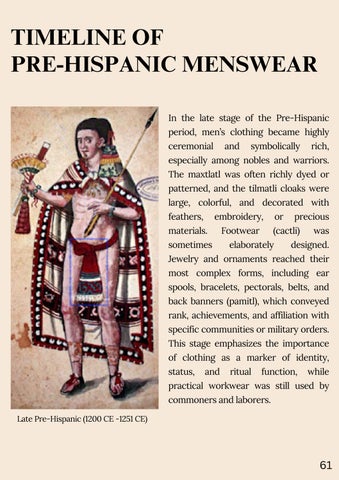
Late Pre-Hispanic (1200 CE -1251 CE)

In the late stage of the Pre-Hispanic period, men’s clothing became highly ceremonial and symbolically rich, especially among nobles and warriors. The maxtlatl was often richly dyed or patterned, and the tilmatli cloaks were large, colorful, and decorated with feathers, embroidery, or precious materials. Footwear (cactli) was sometimes elaborately designed. Jewelry and ornaments reached their most complex forms, including ear spools, bracelets, pectorals, belts, and back banners (pamitl), which conveyed rank, achievements, and affiliation with specific communities or military orders. This stage emphasizes the importance of clothing as a marker of identity, status, and ritual function, while practical workwear was still used by commoners and laborers.

Maxtlatl (loincloth)

The máxtlatl is a traditional pre‐Hispanic Mesoamerican loincloth worn by men. It’s a strip of cloth, often made of cotton or agave fiber, wrapped between the legs and tied at the waist. Designs and materials varied by social status — commoners wore simpler, coarser versions, while elites had more decorative ones.

Tilmatli (cloak)

The tilmàtli was a rectangular cloak or cape worn by men in pre-Hispanic Mexico, draped over one shoulder and fastened with a knot. Made from cotton for nobles or coarse maguey fiber for commoners, it signified social status and could also serve practical purposes, like carrying items. The tilmàtli was often worn over the máxtlatl (loincloth) and sometimes decorated with patterns or colors to indicate rank, achievements, or ceremonial importance.

Ichcahuipilli

Tlahuiztli

The tlahuiztli was a full-body battle suit worn by elite Aztec warriors. Made of colorful cloth and decorated with animal motifs such as eagles or jaguars, it symbolized the warrior’s rank and achievements. Only distinguished fighters could wear these highly stylized garments.

The ichcahuipilli was a padded cotton armor worn mainly by Aztec warriors. Made from densely packed cotton layers, it provided strong protection against arrows and obsidian blades while remaining lightweight and breathable. Its practicality made it one of the most effective forms of armor in Mesoamerica.

PRE-HISPANIC MEN ACCESSORIES

Feather Headdress

Feather headdresses were among the most prestigious accessories worn by nobles, priests, and high-ranking warriors. Quetzal feathers were especially valued for their vibrant green color and association with sacred power.

Chest Pectorals

Chest pectorals were decorative pendants worn over the torso, often made from jade, gold, or carved shell. They served both aesthetic and symbolic roles, representing authority and religious significance.

Ear Spools / Ear Ornaments

Ear spools made from jade, shell, or stone were worn by elite men as markers of status. Their size and material reflected wealth and lineage, and they appear frequently in Maya and Aztec imagery.

Nose Ornaments

Nose ornaments were used mainly in ritual contexts, made from jade or metal and worn by priests or nobles. They signified spiritual authority and connection to deities.

Bracelets & Armbands

Belts / Sashes

Belts or woven sashes were used to secure garments and sometimes included specific patterns that identified the wearer’s social group or profession.

Men of higher status wore bracelets and armbands crafted from copper, jade, or shell. These accessories emphasized elegance and rank, often accompanying ceremonial or noble attire.

Back Banner — Pamitl

The pamitl was a large decorative banner attached to a warrior’s back, used to display military rank and identity. Its bold shapes and colors made it one of the most recognizable elements of Aztec warrior attire.

PRE-HISPANIC MEN

GROOMING AND STYLING

WARRIOR TOPKNOT

LOOSE LONG HAIR STYLE

TIMELINE OF PRE-HISPANIC WOMENSWEAR

In the early stage, women’s clothing in Mesoamerica was primarily functional and practical, reflecting the needs of daily life in early civilizations such as the Olmec and early Teotihuacán societies. The most common garment was the huipil, a simple rectangular woven tunic that covered the upper body and was tied at the sides. Women paired it with a cueitl, a skirt made from cotton or agave fibers, which allowed ease of movement. Footwear was minimal, typically cactli sandals made from leather or plant fibers. Jewelry and accessories were simple, such as basic bracelets, necklaces, and ear spools, mostly worn for personal adornment rather than social or ceremonial purposes. Overall, clothing prioritized comfort and mobility, but still reflected local weaving techniques, materials, and the cultural identity of the community.

TIMELINE OF PRE-HISPANIC WOMENSWEAR

During the mid stage women’s clothing became more elaborate and started to reflect social status, regional identity, and ceremonial importance. Huipils were often decorated with colorful patterns or embroidery, showing symbolic designs or geometric motifs specific to a community. Cueitl skirts became larger, with more intricate weaving and ornamentation, while the tilmatli cloak appeared for ceremonial or special occasions, draped over the shoulders or around the body. Footwear (cactli) included decorative elements, and jewelry such as bracelets, ear spools, necklaces, and simple chest pectorals became more elaborate. Clothing began to serve as a visual indicator of a woman’s role in society, her wealth, or her participation in ritual activities, while maintaining practicality for daily work.

Mid Pre-Hispanic (700 CE-1200 CE)

TIMELINE OF PRE-HISPANIC WOMENSWEAR

In the late stage, women’s clothing became highly ceremonial and symbolic, particularly for nobles, warriors’ families, and those participating in ritual events in the Aztec Empire. Huipils and cueitl skirts were richly dyed, often embroidered with elaborate patterns, or adorned with feathers, beads, and precious materials. The tilmatli cloak became larger, more colorful, and intricately decorated, clearly indicating noble or ceremonial status. Jewelry and accessories were highly elaborate, including ear spools, bracelets, necklaces, chest pectorals, belts, and even back banners (pamitl). These garments were not only functional or decorative but also communicated social rank, achievements, and cultural identity. The late stage illustrates the evolution of clothing from simple daily wear to complex ceremonial attire that integrated artistry, symbolism, and social hierarchy.

Late Pre-Hispanic (1200 CE -1251 CE)

Turn static files into dynamic content formats.

Create a flipbook