
TIMELINE OF PRE-HISPANIC WOMENSWEAR
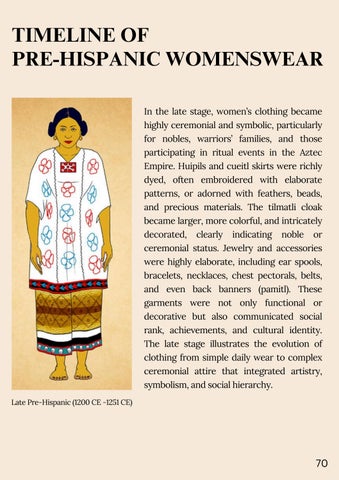
In the late stage, women’s clothing became highly ceremonial and symbolic, particularly for nobles, warriors’ families, and those participating in ritual events in the Aztec Empire. Huipils and cueitl skirts were richly dyed, often embroidered with elaborate patterns, or adorned with feathers, beads, and precious materials. The tilmatli cloak became larger, more colorful, and intricately decorated, clearly indicating noble or ceremonial status. Jewelry and accessories were highly elaborate, including ear spools, bracelets, necklaces, chest pectorals, belts, and even back banners (pamitl). These garments were not only functional or decorative but also communicated social rank, achievements, and cultural identity. The late stage illustrates the evolution of clothing from simple daily wear to complex ceremonial attire that integrated artistry, symbolism, and social hierarchy.
Late Pre-Hispanic (1200 CE -1251 CE)

Quechquémitl
Quechquémitl is a traditional preHispanic women’s garment made from two woven triangular cloth pieces sewn together to form a poncho-like shoulder covering. Common among Totonac, Otomí, Huastec, and Nahua women, it was often richly decorated with embroidery and held ceremonial or status-related significance.
Huipil
Huipil was a traditional loose tunic worn by Indigenous women in pre-Hispanic Mexico, made from rectangular woven cloth and decorated with patterns that showed identity and status.


Faja
Enredo/Cueitl
Enredo/Cueitl was a wrap-around skirt made from a rectangular woven cloth, secured at the waist with a belt. Worn by many pre-Hispanic Mexican women, it varied in length, material, and decoration according to region and social status.
The faja was a woven belt used to secure wrap-around skirts in preHispanic Mexico. Often decorated with patterns, it provided both practical support and a way to show cultural or social identity.

PRE-HISPANIC WOMEN ACCESSORIES

Huaraches
Sombrero
Sombrero is a popular and iconic hat, symbol of Mexican culture. It features, nowadays, an extra-wide brim used to shield the face and eyes from the sun, that is slightly upturned at the edge; a usually high, conical, pointed crown; and a chin strap to hold it in place. Traditionally made of wool felt, hare fur, or wheat straw, it can be adorned with embroidery, decorative trim, or ribbons, with varying regional styles. The crown often has a reinforced band ("pedradas") for added strength in case of impact.
Huaraches are a traditional style of Mexican sandals with woven leather straps, originating from pre-Columbian times as practical and durable footwear. The term "huarache" is also used for a modern athletic shoe by Nike and an oval-shaped Mexican dish.

Pectoral
A pectoral is a large, elaborate chest ornament that functioned as a potent indicator of high social status, wealth, and religious authority in various pre-Hispanic cultures of Mesoamerica. These significant pieces of jewelry were crafted from precious materials such as gold, jade, turquoise, and the sacred Spondylus shell, often depicting deities or abstract symbols that reflected the wearer's position and spiritual beliefs. Due to their size, quality, and symbolic imagery, pectorals were worn exclusively by elite individuals like rulers and high priests during ceremonies and important occasions, and were frequently interred with them in burials to signify their status in both life and the afterlife.

Earspools

Pre-Hispanic earspools also known as earflares were significant, often large, aments inserted through stretched obes to denote social status and lth. Crafted from prized materials h as jade, gold, shell, and bone, these ms were typically reserved for the elite, lity, and high-ranking warriors among ures like the Maya and Aztecs. The erial and size of the earspool directly esponded to an individual's importance, serving as a powerful visual symbol of their social hierarchy and honor within the community.
PRE-HISPANIC WOMEN GROOMING AND STYLING
TRENZAS
Trenzas, or braided hairstyles, were the most widespread form of women’s grooming in pre-Hispanic Mexico. Women typically kept their hair long and arranged it into one or two braids, a practical style that kept the hair neat during daily work such as weaving or cooking. These braids could be simple for everyday life or elaborately decorated with colored ribbons, woven bands, feathers, or flowers for ceremonies, indicating social status, regional identity, or special occasions.
MAYA HIGH BUN STYLE
Maya high bun was a distinctive women’s hairstyle in which long hair was gathered high on the head, wrapped with cloth bands, and sometimes shaped into an elegant knot. Noblewomen often decorated the bun with jade beads, shells, or feathers, turning it into a marker of status and beauty. This style kept the hair secure for daily tasks while also serving as a recognizable symbol of Maya identity.
ICONS FROM PRE-HISPANIC PERIOD
QUETZALCOATL
CUĀUHTLI
REFERENCES JAPAN
Yoshimura, A. (n.d.) A Glimpse of Meiji Kimono Fashion. Meiji at 150 Digital Teaching Resource. https://meijiat150dtr.arts.ubc.ca/essays/yoshimura/ Ezen Foundation (2024) ‘Meiji Fashion’, Ezen Foundation Blog. https://ezenfoundation.org/blogs/kimono-exhibition/meiji-fashion
Goldstein, D. M. and Gidoni, M. (2021) Kimono and the Construction of Gendered and Cultural Identities Teaching About Asia / JSTOR
https://www.teachingaboutasia.com/wp-content/uploads/2021/05/GoldsteinGidoni kimono
Lady Librarian (2014) ‘East meets West: Meijipunk fashions in period sources’, Shisho desu yo! blog, 27 February. https://ladylibrarian123.blogspot.com/2014/02/east-meets-westmeijipunk-fashions-in.html
Tokyo Art Beat (2025) ‘Unraveling the Evolution of Kimono Styles from Early Photographic Materials: Women's Traditional Japanese Clothing in the Late Edo and Meiji Periods’, Marubeni Gallery, 2 December. https://www.tokyoartbeat.com/en/events/-/Unravelingthe-Evolution-of-Kimono-Styles-from-Early-Photographic-Materials-WomensTraditional-Japanese-Clothing-in-the-Late-Edo-and-Meiji-Periods/1-ABA-3-CAF/ Justapedia (n.d.) ‘Japanese clothing during the Meiji period’, Justapedia. https://justapedia.org/wiki/Japanese clothing during the Meiji period
Keukelaar, M. (2021) Japonism and Fashion: How Western Women's Popular Dress was Influenced by the Japanese Craze of the 19th Century, ResearchGate. https://www.researchgate.net/publication/355718496 Japonism and Fashion How W estern Women%27s Popular Dress was Influenced by the Japanese Craze of the 19th Century
Between the Warp and Weft (n.d.) ‘The Collaboration of Culture and Textiles in Edo and Meiji Japan’, Between the Warp and Weft blog. https://betweenthewarpandweft.wordpress.com/japanese-textiles-research-project/ Wikipedia (n.d.) ‘Haori’, Wikipedia. https://en.wikipedia.org/wiki/Haori Wikipedia (n.d.) ‘Khalili Collection of Kimono’, Wikipedia. https://en.wikipedia.org/wiki/Khalili Collection of Kimono
REFERENCES
THAILAND
Wikiwand. “Traditional Thai Clothing.” Wikiwand, https://www.wikiwand.com/en/articles/Traditional Thai clothing Wikipedia. “History of Thai clothing.” Wikipedia, https://en.wikipedia.org/wiki/History of Thai clothing#Ayutthaya Wikipedia. “Ayutthaya Kingdom.” Wikipedia, https://en.wikipedia.org/wiki/Ayutthaya Kingdom#Clothing Thai Style Studio 1984. “Ayutthaya’s Era Apparel.” Thaistylestudio1984.com, https://thaistylestudio1984.com/b/ayutthayas-era-apparel/ Facebook. “Photo - The NationThailand.” Facebook, https://www.facebook.com/photo/? fbid=122104204784851853&set=gm.4244304485895251&idorvanity=26724 10113084704
The Nation Thailand. “Thailand’s rich cultural heritage is beautifully reflected in its traditional attire…” NationThailand.com, https://www.nationthailand.com/life/art-culture/40039110 Poetic Oriental. “Thailand Traditional Dress: Discover the Culture and Styles of Traditional Thai Clothing.” PoeticOriental.com, https://www.poeticoriental.com/blogs/bangkokattractions/thailand-traditional-dress-discover-the-culture-andstyles-of-traditional-thai-clothing Wikipedia. “Sbai.” Wikipedia, https://en.wikipedia.org/wiki/Sbai
REFERENCES MEXICO
Aguilera, C. (2017). Of Royal Mantles and Blue Turquoise: The Meaning of the Mexica Emperor’s Mantle. Latin American Antiquity. Cambridge University Press. https://doi.org/10.1017/S1045663500005654
Anawalt, P.R. (1996). Aztec Knotted and Netted Capes: Colonial Interpretations vs. Indigenous Primary Data. Ancient Mesoamerica, 7(2), 187–206. https://doi.org/10.1017/S0956536100001401
Saadia, Z. (2013). Female Clothing – Pre-Columbian Americas. Zoe Saadia. https://zoesaadia.com/historia-en-el-calmecac/female-clothing/ Saadia, Z. (2013). Prehispanic Male Dress – Pre-Columbian Americas. Zoe Saadia. https://zoesaadia.com/historia-en-el-calmecac/prehispanic-maledress/ Beltrán‐Rubio, L. (2021). Pre-Columbian Mesoamerican Dress. Fashion & Race Database. https://fashionandrace.org/database/reading-list-precolumbian-mesoamerican-dress/ Bjerregaard, L. (2016). “T” for Traditional Mexican Woman Dress called: Huipil. In Dressing the New World. University of Copenhagen / Centre for Textile Research. https://dressworld.hypotheses.org/198 Sienra, E. (n.d.). The ‘Cultural Appropriation’ of Traditional Textiles from Mexico. (Master’s thesis). Brandenburg University of Technology. Retrieved from https://opus4.kobv.de/opus4-btu/files/6612/estibaliz sienra Chase, A.F., Chase, D., Zorn, E., & Teeter, W. (2008). Textiles and the Maya Archaeological Record: Gender, Power, and Status in Classic Period Caracol, Belize. Ancient Mesoamerica, 19(1), 127–142. https://doi.org/10.1017/S0956536108000072
“Textiles, Embroideries and Costumes of Mexico.” Textile Value Chain. Retrieved from https://textilevaluechain.in/in-depthanalysis/articles/traditional-textiles/global-textiles-andcostumes/textiles-embroideries-and-costumes-of-mexico Clacso / Ludden, D. (n.d.). Aztec Garments. Biblioteca Virtual CLACSO. Retrieved from https://bibliotecavirtual.clacso.org.ar/ar/libros/lasa97/ludden