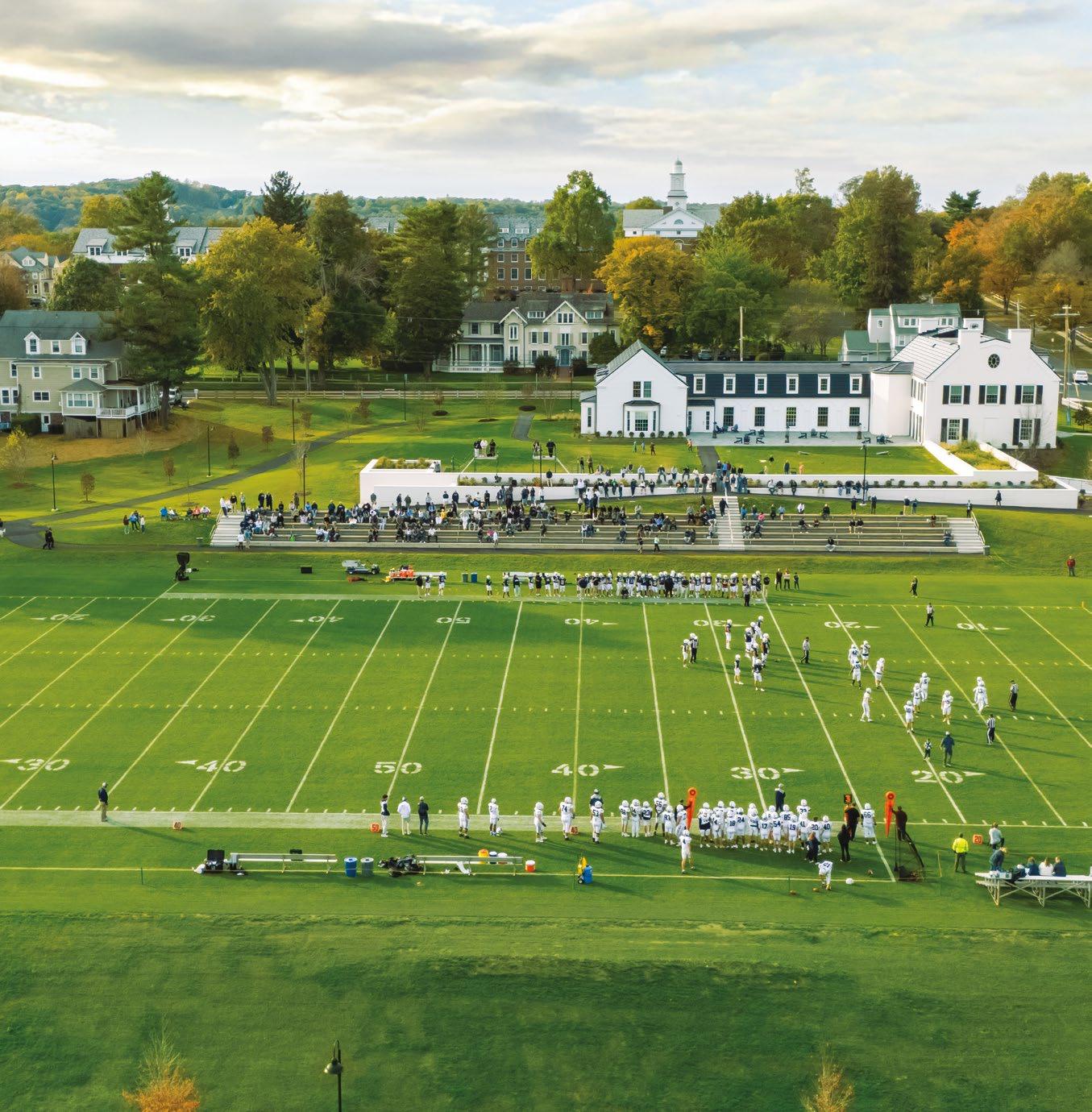
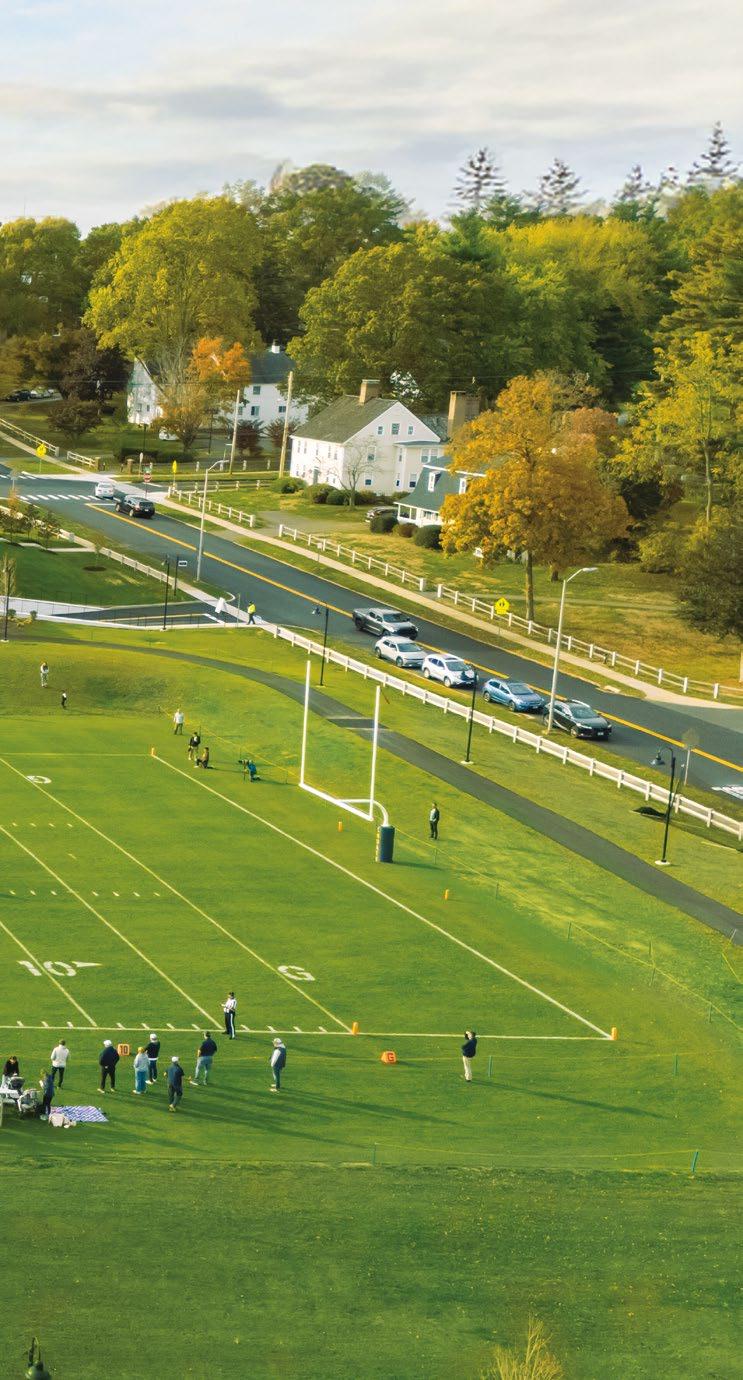
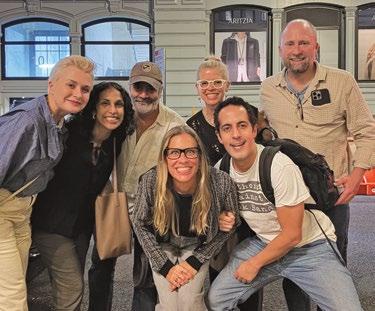
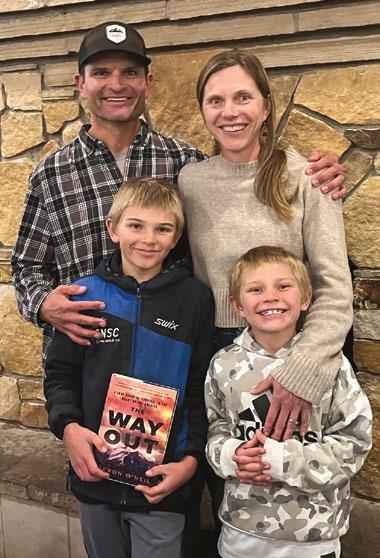
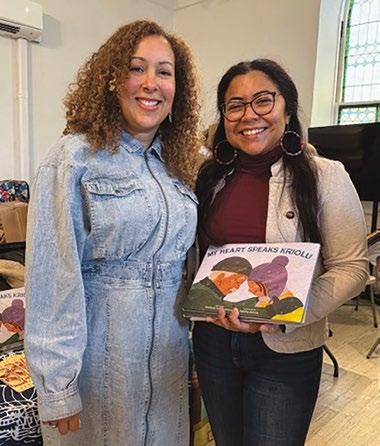
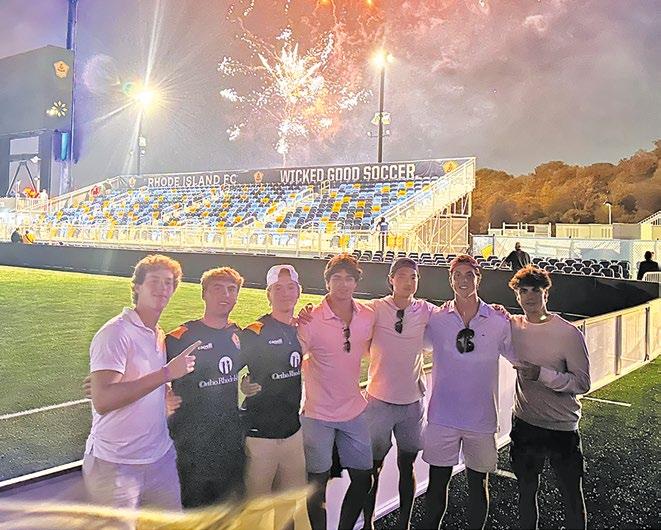
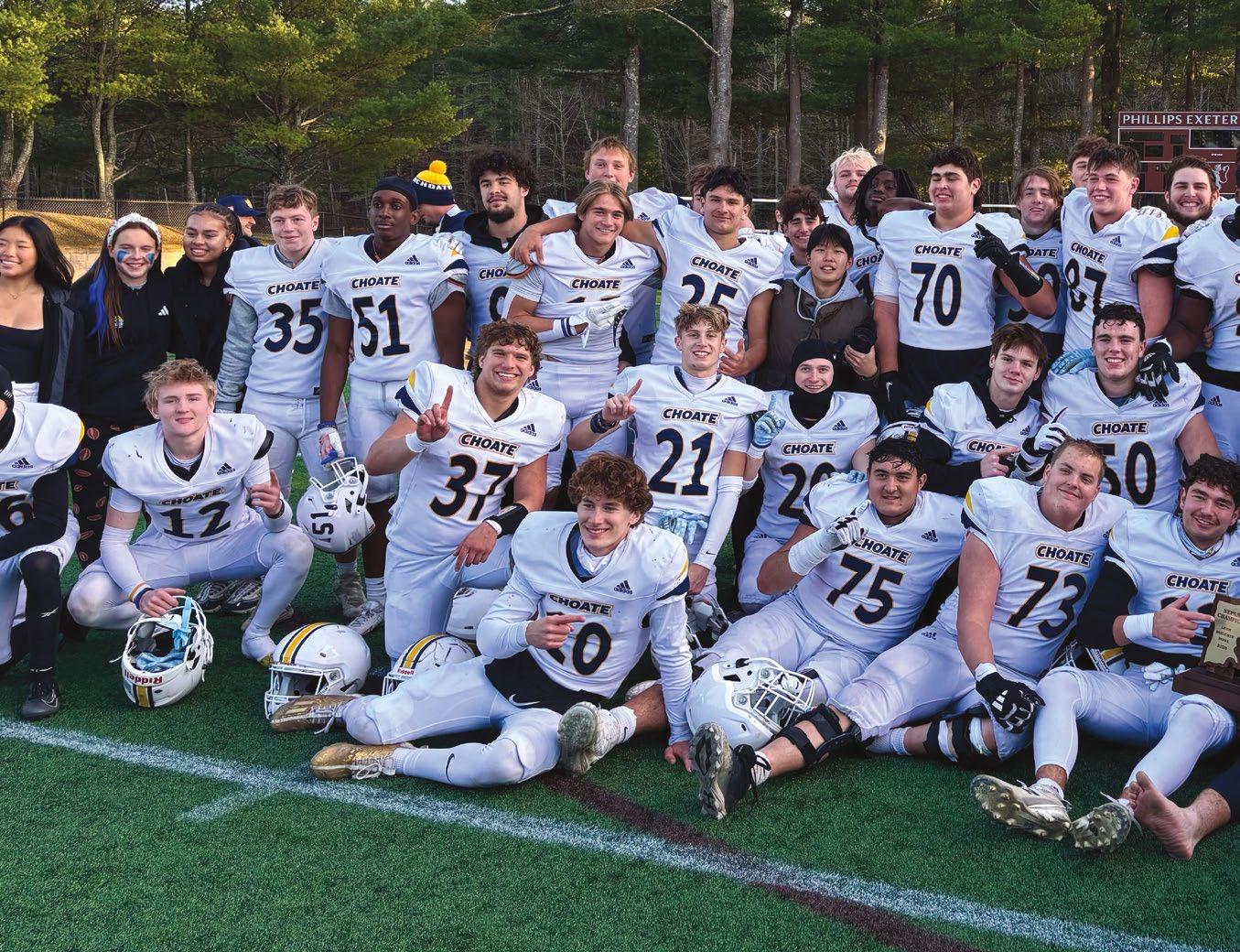
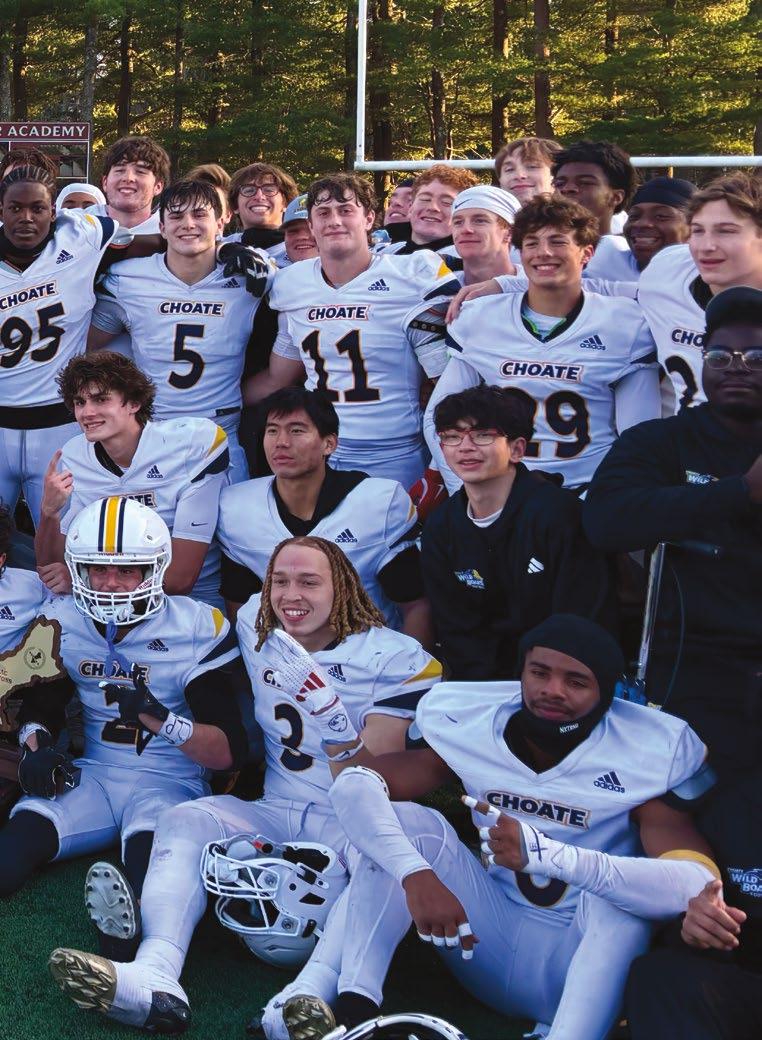
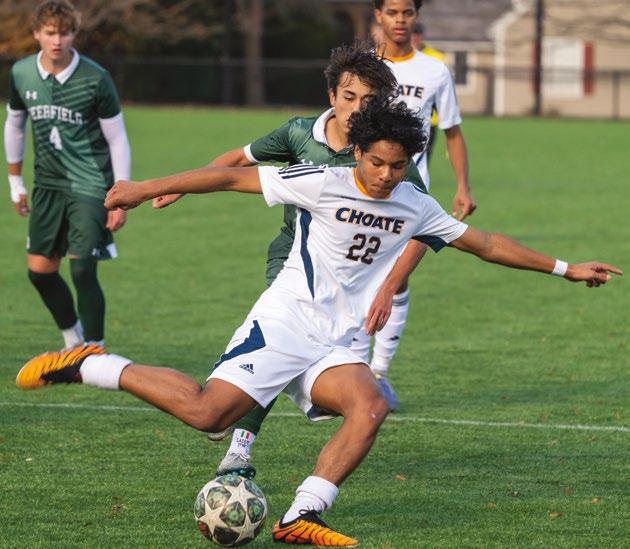
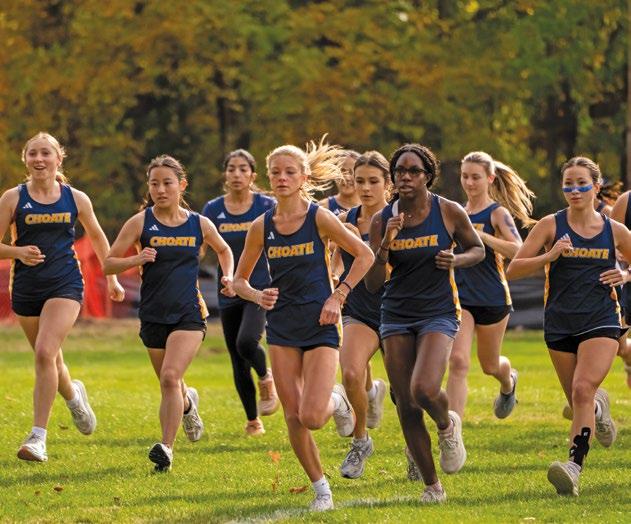
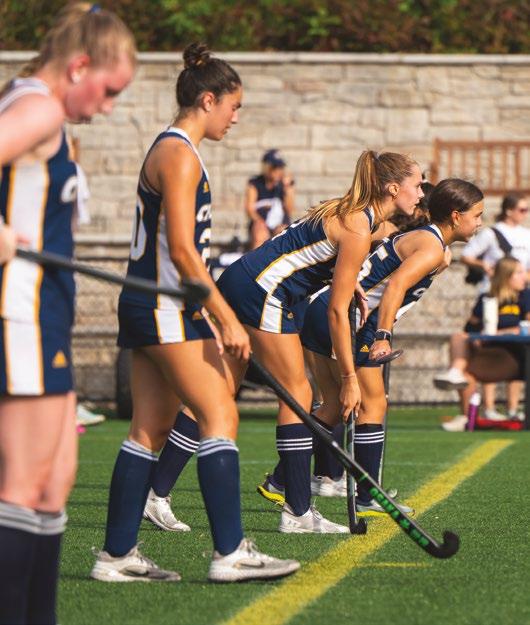
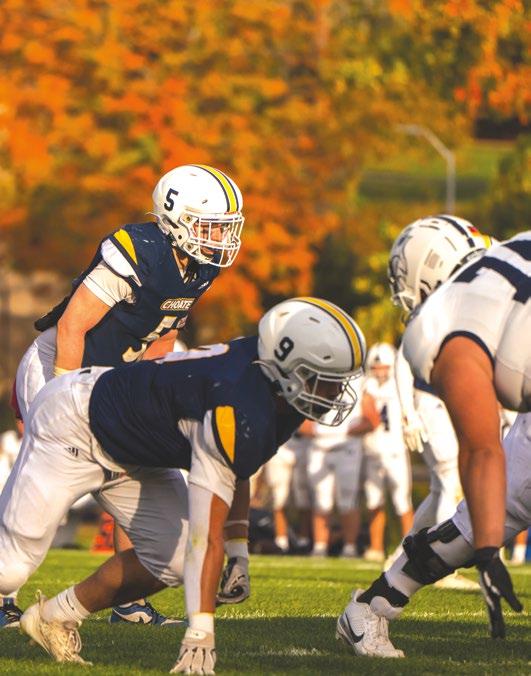
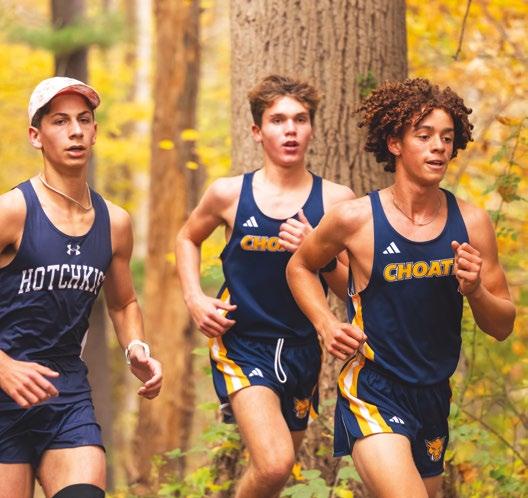
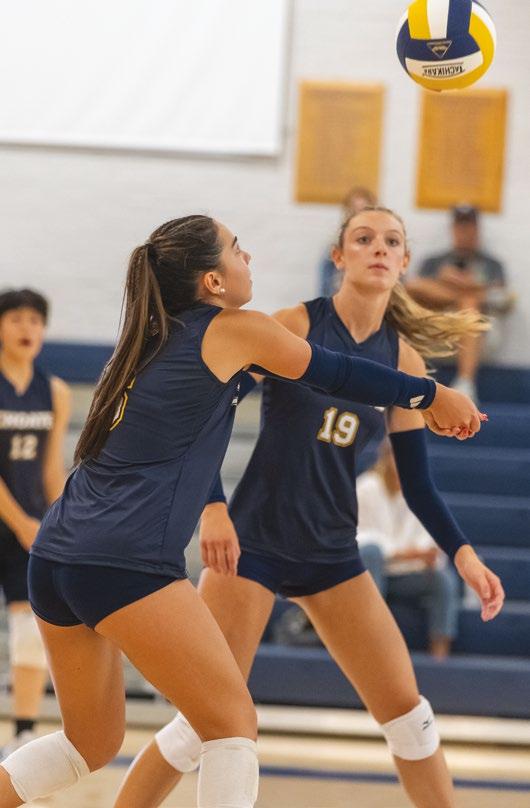
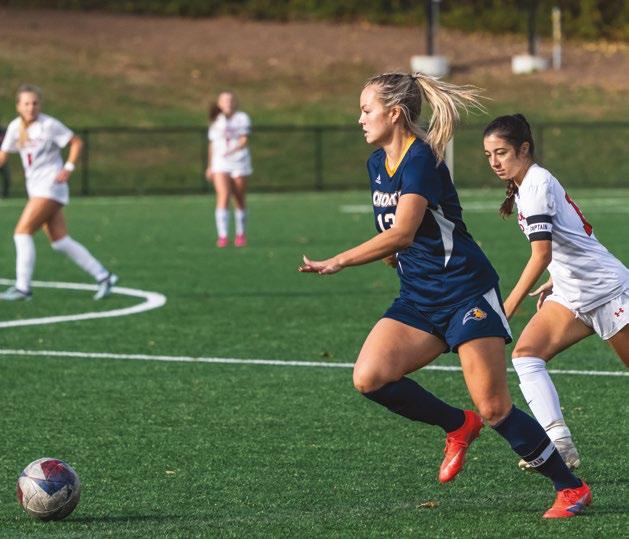
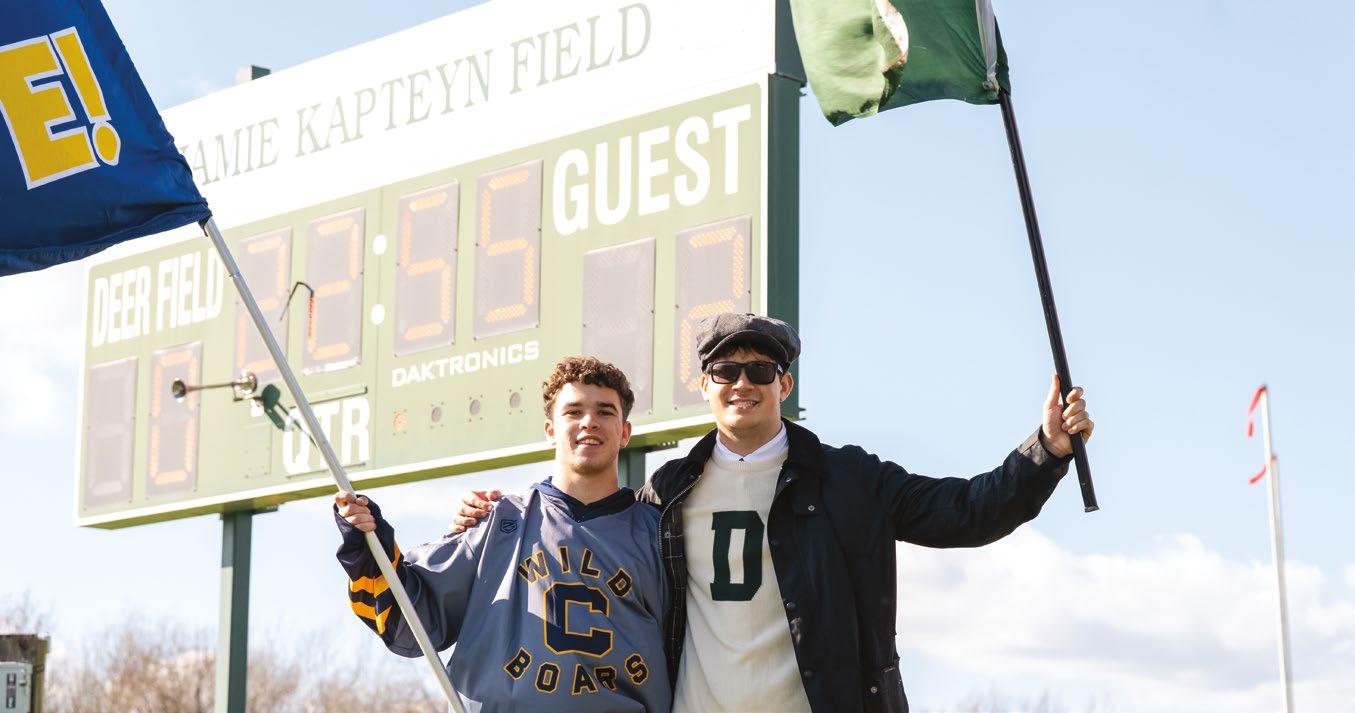
As part of the Carr Hall project, Choate Rosemary Hall’s Maher Field received a welcome upgrade. In addition to being leveled and reseeded, the field incorporates SIS Grass Hybrid field technology. SIS field turf is a sustainable blend of natural grass reinforced with synthetic fibers designed for durability and safety. Installed using 100% electric, laser-guided machinery, the field combines top-tier playability with environmental responsibility. Engineered for longevity, it withstands heavy use while reducing maintenance and injury risk. As the first high school in the U.S. to install a SIS Grass Hybrid field, the renovation once again reflects Choate’s commitment to student-athlete performance, innovation, and sustainability, setting a new standard for high school athletics.
Remarks From the Head of School Letter From Alex Curtis
On Christian & Elm News From Campus
Alumni Association News Alumni Awards, Alumni Events & Gatherings
Classnotes
Profiles of Hans Kaiser ’76, Partner, Peak Insights; and Gary Crotty ’82, Special Counsel, NASCAR
In Memoriam
Remembering Those We Have Lost
Scoreboard
Recap of Fall ’25 Athletics
Bookshelf
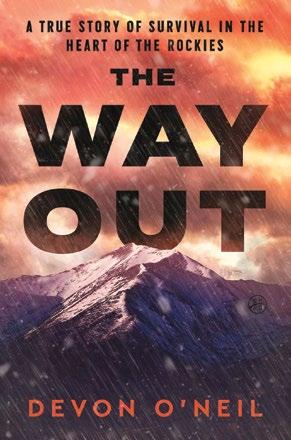
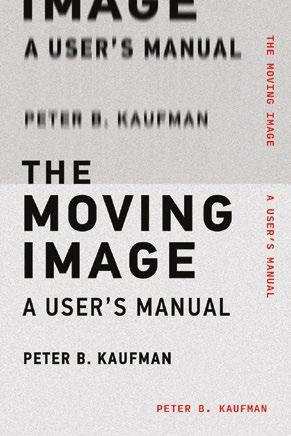
Reviews of Works by Peter Kaufman ’80, Devon O’Neil ’94, and Alyson Richman ’90
End Note Live Poets Society
FEATURES
Carr Hall Dedication Celebrating Vision
Welcome to Carr Hall Admission in A New Home
A Conscious Community Shift Adopting a New Cell Phone Policy
100 Years
Choate Rosemary Hall Bulletin is published fall, winter, and spring for alumni, students and their parents, and friends of the School. Please send change of address to Alumni Records and all other correspondence to the Communications Office, 333 Christian Street, Wallingford, CT 06492-3800.
Choate Rosemary Hall does not discriminate in the administration of its educational policies, athletics, other school-administered programs, or in the administration of its hiring and employment practices on the basis of age, gender, race, color, religion, disability, sexual orientation, gender identity or expression, national origin, genetic predisposition, ancestry, or other categories protected by Connecticut and federal law. Printed in U.S.A. CRH201201/17.75M
Chief Communications Officer
Alison Cady P ’23, ’26
T: (203) 697-2526
Email: acady@choate.edu
Lead Design and Production
Beth Ann Strong
Design
Todd Meagher
Ann Marie Nolan
Classnotes Editor
Henry McNulty ’65
Contributors
Jonas Akins
Kimberly Ashton
Christine Bennett
Nicole Brothers
Jana F. Brown
Alison Cady P ’23, ’26
Jenny Karlen Elliott
Stephanie Gold
Kim Hastings P ’15, ’18, ’18
Katie Levesque P ’23, ’25
David Mills ’84
Steven Scarpa
Nolan Silbernagel
Andrea Solomon
KeriAnne Tisdale
Photography
Choate Rosemary Hall Archives
Joey Avena
Laura Barisonzi
John Giammatteo ’77, P ’26
Tom Kates
Kelsey Paff
Laura Scaviola
Choate Rosemary Hall
Board of Trustees 2025-2026
Danya Alsaady P ’17, ’19, ’23, ’28
Marc E. Brown ’82
Seth J. Brufsky ’84
Yahonnes S. Cleary ’96
Alex Curtis P ’17, ’20
Elizabeth M. Ferreira ’92, P ’28
Katherine B. Forrest ’82
David A. Fraze ’84
Kristen Mautner Garlinghouse ’85
Gunther S. Hamm ’98
Jungwook ”Ryan” Hong ’89, P ’19, ’22, ’25
David A. Javdan ’86
Kelly Green Kahn ’86
Daniel G. Kelly Jr. ’69, P ’03
Patience P. “Duby” McDowell ’78
Christian B. McGrath ’84, P ’18, ’21
Michael Moh ’88, P ’18, ’28
Takashi Murata ’93, P ’25, ’29
George F. Pyne IV ’84
Julian C. Salisbury P ’26
Life Trustees
Edwin A. Goodman ’58
Cary L. Neiman ’64
Stephen J. Schulte ’56, P ’86
William G. Spears ’56, P ’81, ’90
Corrections
In the Spring 2025 issue Shira Knishkowy’s ’06 name was misspelled in Classnotes. Our apologies.
Apologies to retired faculty member Neil Shimmield; his name was misspelled in the announcement about Year-End milestones noted in the Fall 2025 issue.
Rosemarians, Were you gifted the honor of the scarf, whistle, or banner at Garden Party? If so, the Archives would love to hear from you to help fill in our record of details about this tradition and its honorees. Do you remember who passed the item on to you? What did the honor mean to you? Email the Archivist & Special Collections Librarian at archives@choate.edu to tell us more about what you remember from the honor and the tradition. Thank you!
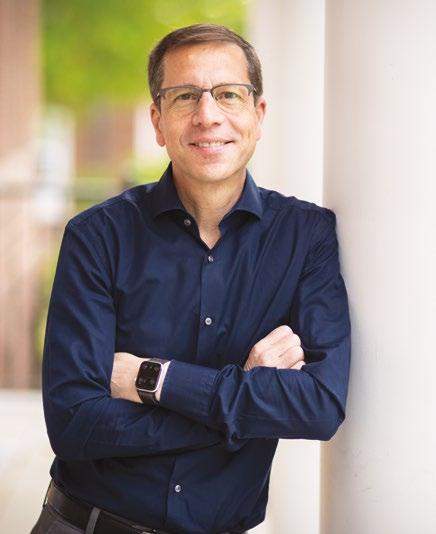
Dear Choate Alumni, Parents, and Friends,
One of the enduring strengths of Choate Rosemary Hall is our ability to hold two ideas in balance at the same time: a deep respect for our history and a constant willingness to innovate in service of future generations. This dynamic balance between tradition and innovation is woven throughout this issue of The Bulletin, and it is especially reflected in two featured stories that anchor these pages.
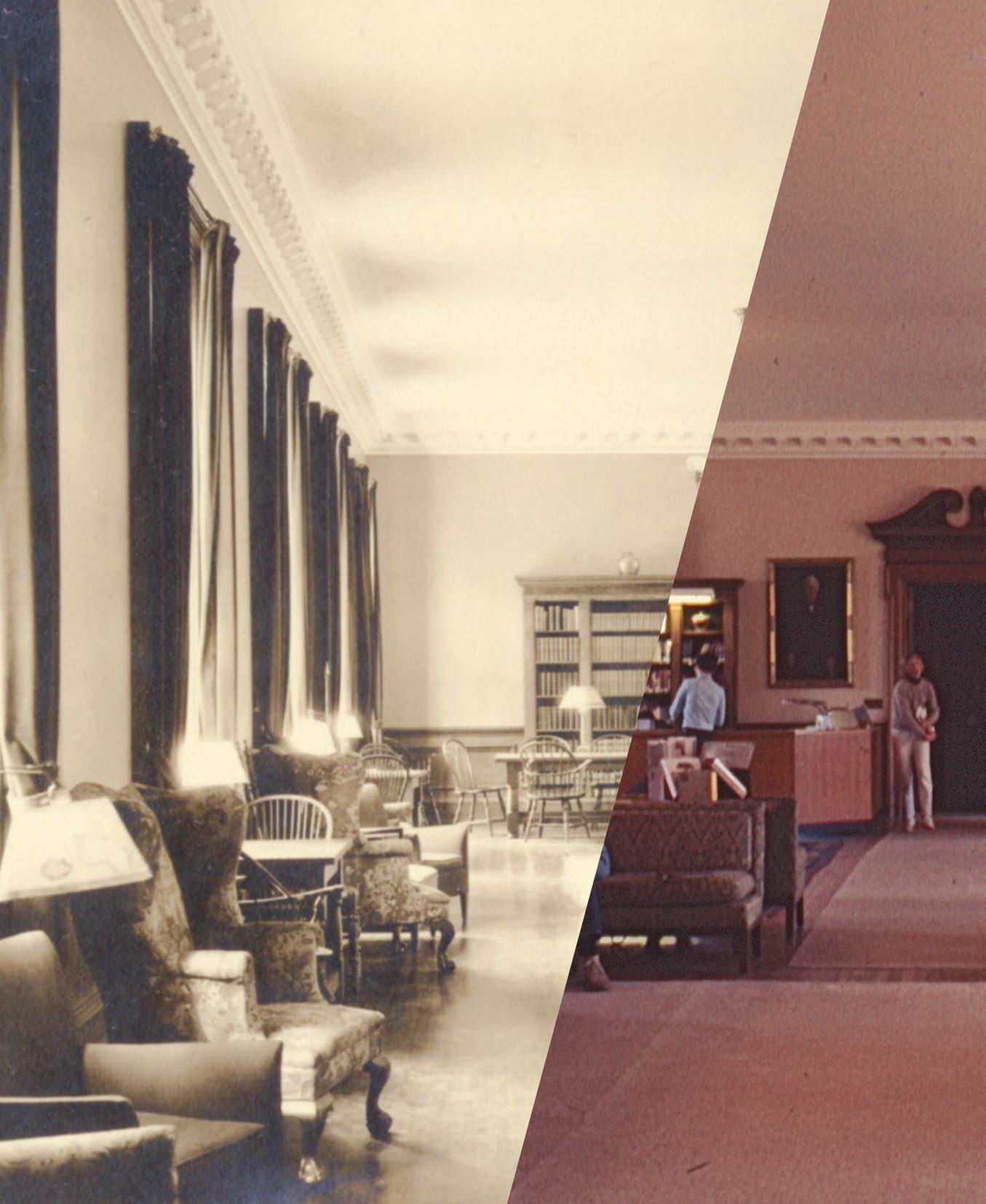
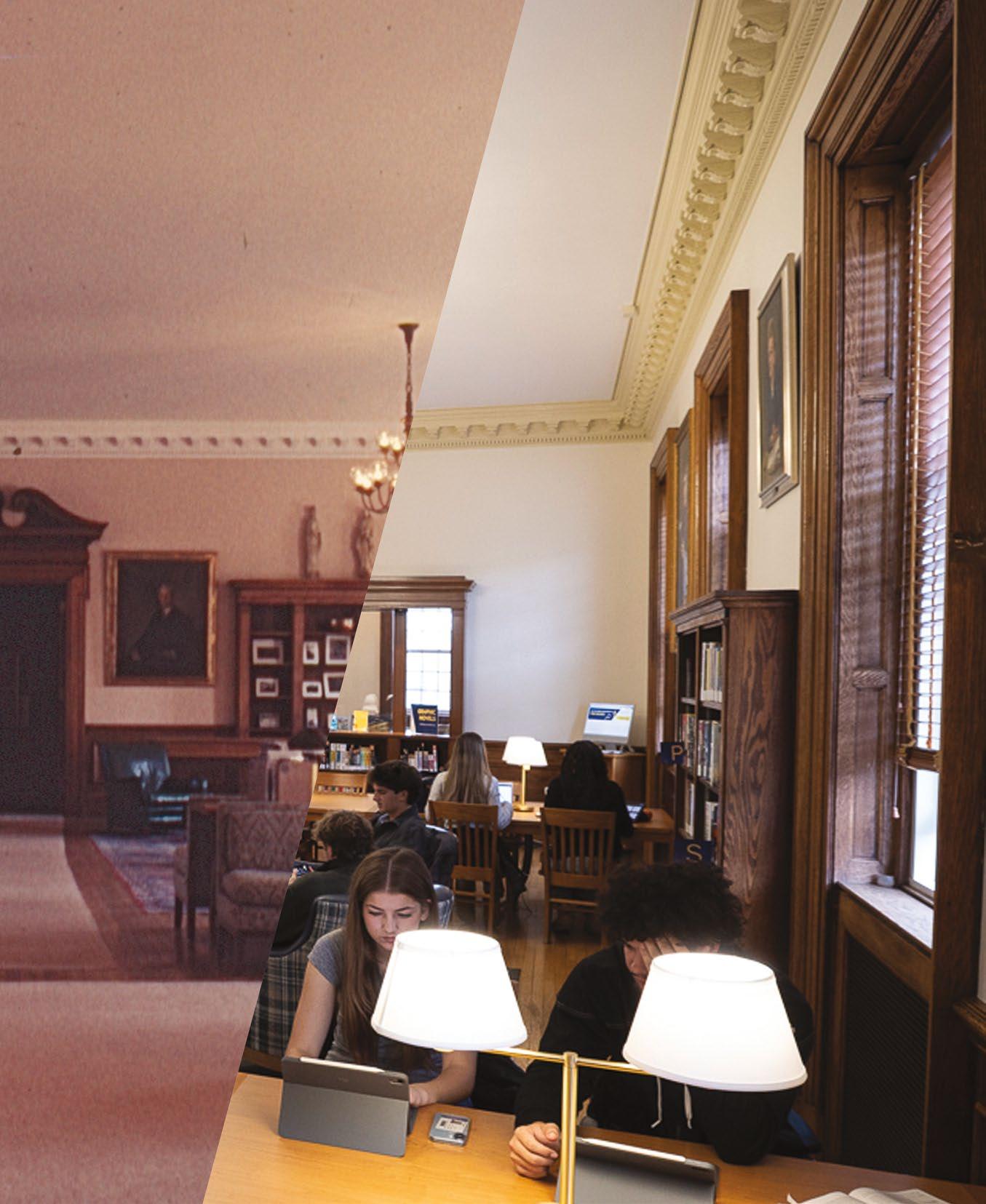
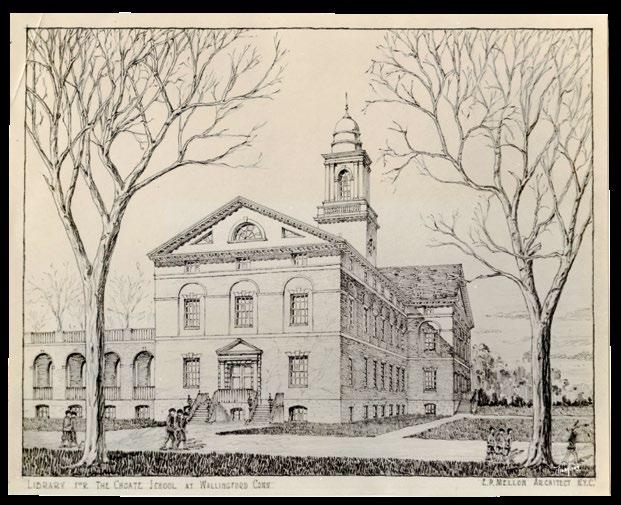
This year marks the 100 th anniversary of Andrew Mellon Library, a building that has long stood at the intellectual and symbolic heart of our campus. Set within a traditional architectural frame that remains true to its origins, the library has evolved continuously over the past century to meet the changing needs of students and scholars. From card catalogs to digital databases, from quiet reading rooms to collaborative research spaces, Andrew Mellon Library has never stood still. Its story is not simply one of preservation, but of thoughtful adaptation, honoring the past while embracing the tools, technologies, and pedagogies of the present.
That same intentional balance is evident in Carr Hall, Choate’s new Admission and Welcome Center. Designed to feel immediately familiar within the context of our historic campus, Carr Hall reflects traditional forms and materials that speak to Choate’s architectural legacy. Yet beneath that classic exterior is a building that represents the very forefront of sustainable design. Achieving LEED Platinum certification, it embodies innovation at its highest level. Carr Hall is environmentally responsible, forward-looking, and purpose-built for the future.
Carr Hall also stands as a tribute to Michael Carr’s extraordinary leadership and vision. From its earliest conception, this building was imagined as a place of welcome, a first threshold for prospective students and families arriving from around the world, and a space that would reflect Choate’s values for generations to come. It is fitting that such a forward-thinking building would honor a leader whose impact on this institution has been both profound and enduring.
Together, these stories and the many others within this issue — tell a larger Choate story. They remind us that our traditions are not static artifacts, but living foundations that support innovation, progress, and possibility. As we look ahead, we do so grounded in our history and inspired by the future we are continually building together.
Thank you for being part of this remarkable community.
Warmly,
Alex Curtis Head of School
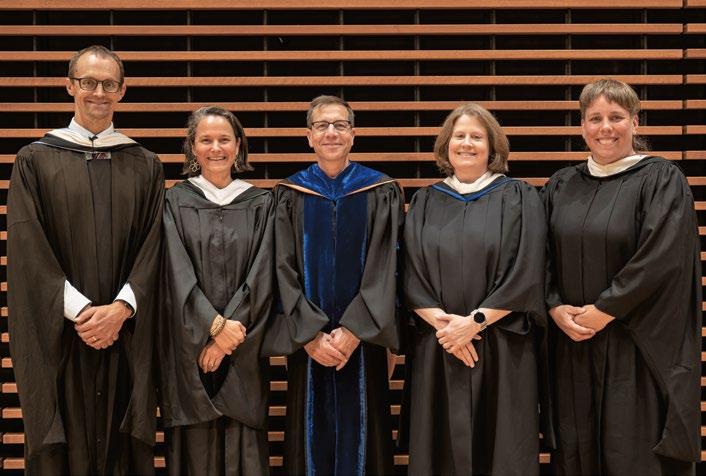
Faculty Recognized at Convocation
At the 136th Convocation, marking the opening of the 2025–2026 academic year, Courtney DeStefano was awarded the Lawrence M. Gelb Chair in American History and William G. Morris was honored with the G. Edmondson and Susan R. Maddox Teaching Chair. Left to right: Will Morris, Head of Student and Academic Life Jenny Karlen Elliott, Head of School Alex Curtis, Dean of Faculty Katie Levesque, and Courtney DeStefano.
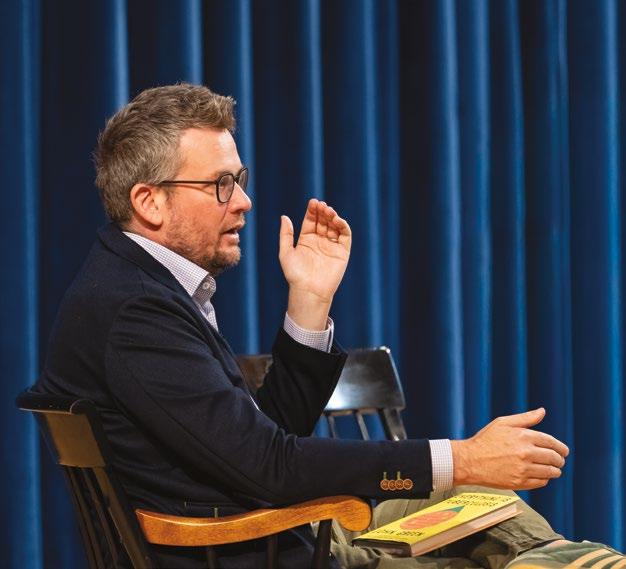
Bestselling Author John Green Visits Campus
Acclaimed author John Green visited campus on September 30 to discuss the All-School Summer Read, his latest work, Everything Is Tuberculosis. The book tells the compelling story of Henry, a young patient he met in Sierra Leone, while also exploring the social and scientific history of the disease.
Green addressed a wide range of topics during his Q&A at School Meeting, including how he balanced his own voice with Henry’s when authoring the book, his commitment to amplifying stories that often go unheard, and the importance of building systems that reflect empathy and affirm equal value in all lives. He also touched on the challenges of chronic illness and medication, as well as how young people navigate information in the digital age through platforms like YouTube.
Green later joined a creative writing class, which allowed students to continue the conversation. Throughout his visit, he spoke about how his writing often begins by following his curiosity and how meaningful it is for him to connect with young adult readers. “I like having a seat at the table in your life,” said Green. That sentiment carried into classroom conversations, where his openness and curiosity invited students to share their own perspectives.
Chen-Lin Honored
Dr. Carol Chen-Lin was recognized with the Klett Award for Sustainable Development Education in the World Language Classroom (K-12) at this year’s American Council on the Teaching of Foreign Languages (ACTFL) Convention held in New Orleans in November. Chen-Lin was lauded for her innovative Chinese language curriculum that connects language learning with the United Nations Sustainable Development Goals (SDGs). Her courses empower students to explore global issues such as climate action and equity, while building linguistic proficiency.
In her acceptance remarks, Dr. Chen-Lin shared the heart behind her work saying, “Language learning isn’t about grammar or even proficiency. It’s about realizing that we share one planet and one future.”
She also credited her students as the driving force behind her success. “Their curiosity and creativity inspire me every single day.”
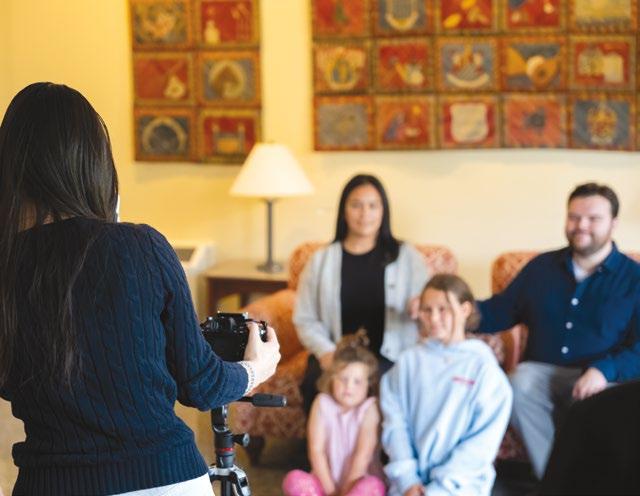
This October, the Paul Mellon Art Center welcomed visiting artist Jamie Diamond. Diamond, a multidisciplinary artist, explores the intersection of intimacy, identity, technology, and performance. For over 20 years, she has investigated the evolving nature of human connection through photography, sculpture, video, performance, and film. Diamond frequently inserts herself into her work or collaborates with strangers, professional actors, and other artists to inhabit a wide range of characters and constructed identities. Her work blurs the boundaries between the authentic and the artificial, challenging conventional narratives around truth, persona, and intimacy.
During her visit, Diamond collaborated with Arts Concentration, film, and photo teachers to offer an immersive creative experience. Students explored new ideas and witnessed the artistic process firsthand, gaining insight from a professional in the field. The visit launched her exhibition, Constructed Families, a staged photography series where strangers posed as families thus challenging notions of intimacy, photographic truth, and identity.
Why Mattering Matters: A Conversation with Author Jennifer B. Wallace In the PMAC: Jamie Diamond Exhibition Constructed Families
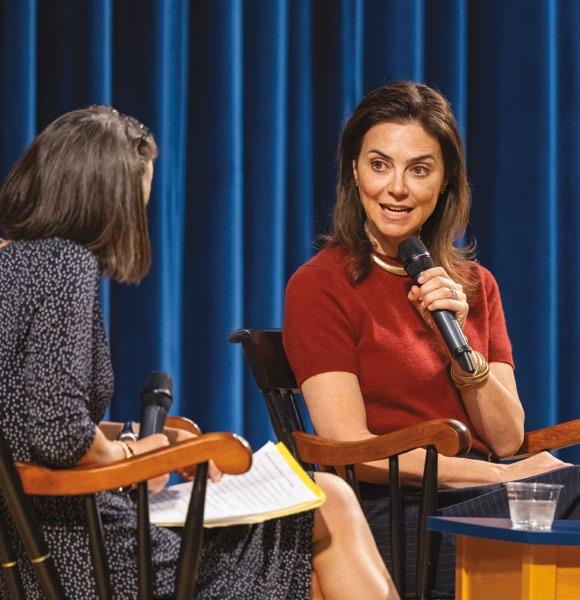
On October 17, Choate welcomed award-winning journalist and author Jennifer B. Wallace. Wallace, known for her acclaimed book Never Enough: When Achievement Culture Becomes Toxic — and What We Can Do About It, joined Jenny Karlen Elliott, Head of Student and Academic Life, for a conversation with parents and guardians during Family Weekend.
During the discussion, Wallace shared insights from her research into high-achieving schools and the concept of “mattering.” Students who matter feel that they add value and are valued regardless of their external achievements. Her work shows that mattering is a powerful antidote to the pressures of achievement culture, which can lead to anxiety and burnout among students.
Through her research Wallace found that instead of serving as a life vest, many high-achieving schools function as a lead vest, weighing students down. She emphasized that being known is better than being praised and that students she describes as “healthy strivers,” those who know they matter and are depended on to add value to their communities, are best equipped to overcome setbacks.
Parents and guardians were left with actionable advice, including to minimize criticism and prioritize affection, to separate the action from the person, and to greet their kids once a day as your dog greets you!
These strategies, drawn from Wallace’s latest book Mattering: The Secret to a Life of Deep Connection and Purpose, aim to foster resilience, balance, and meaningful connections within families and schools.
A Harvard graduate and former CBS “60 Minutes” producer, Wallace is the co-founder of The Mattering Movement, a nonprofit dedicated to creating cultures of mattering in schools, workplaces, and communities. Her work has appeared in The Wall Street Journal, The Washington Post, and on national television.
“ Michael and Shelley have left an indelible mark on Choate, and now through Carr Hall that impact will be felt by everyone who steps on our campus.”
– Alex Curtis, Head of School
CARR HALL DEDICATION
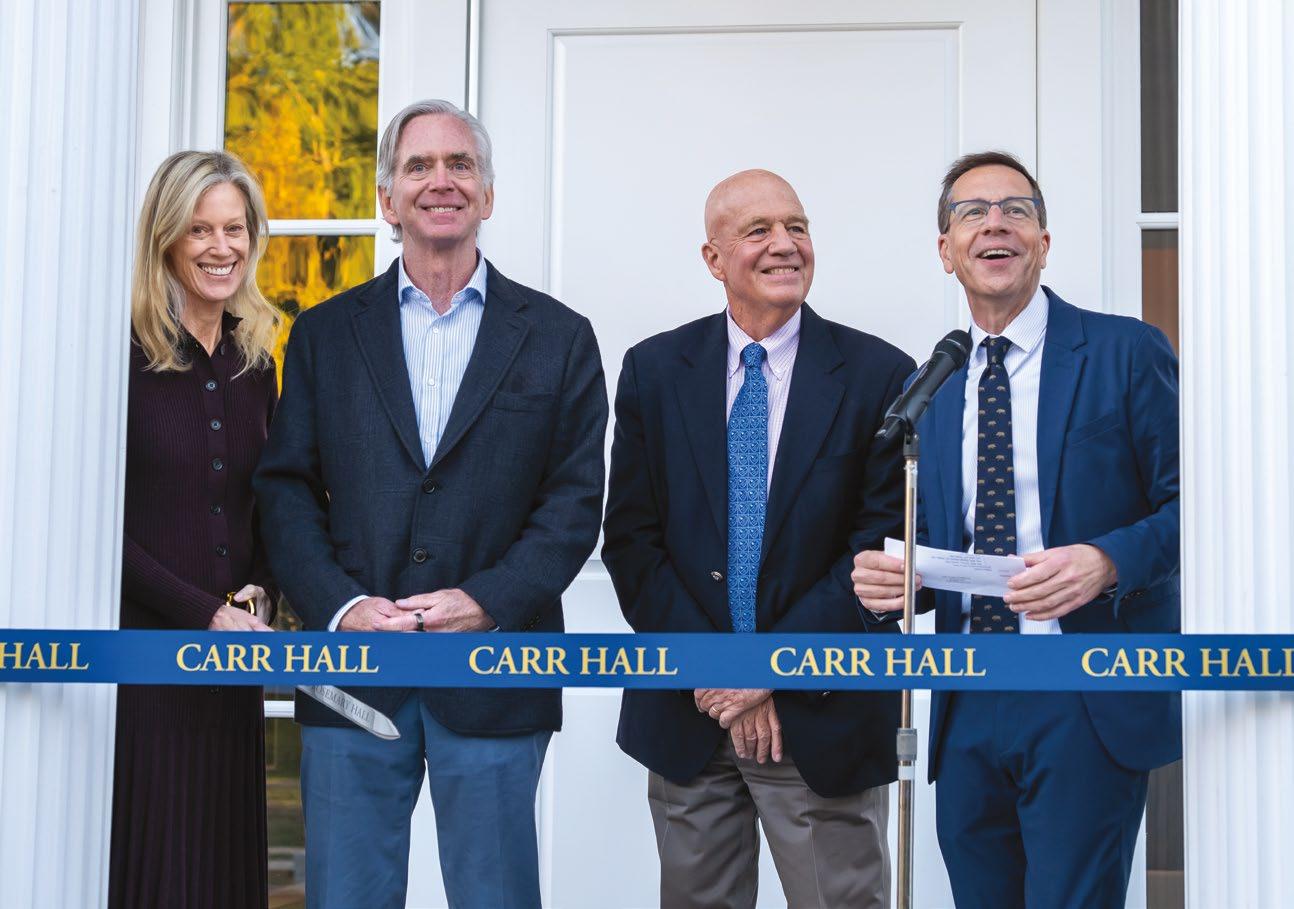
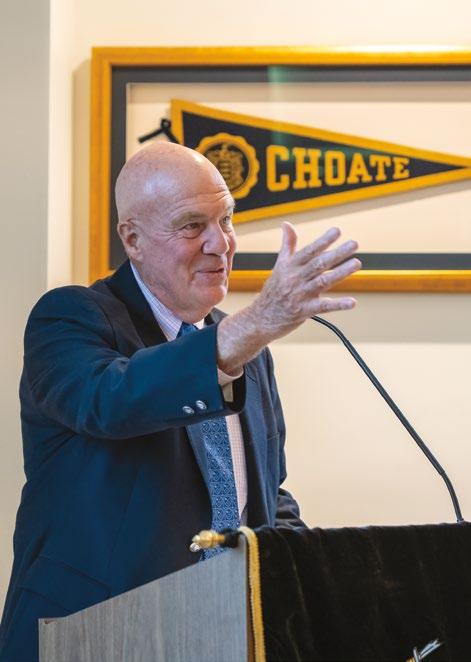
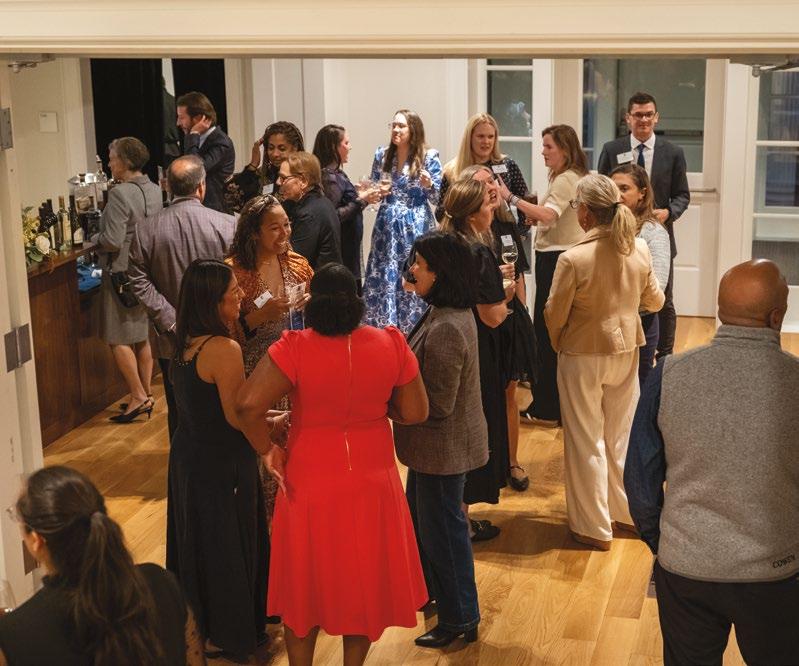
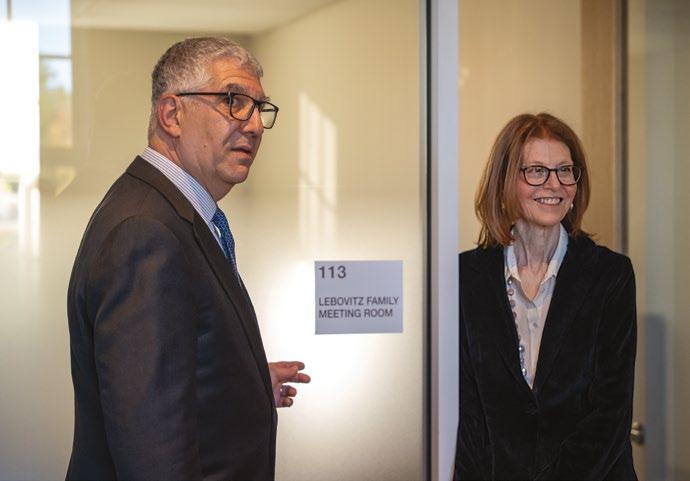
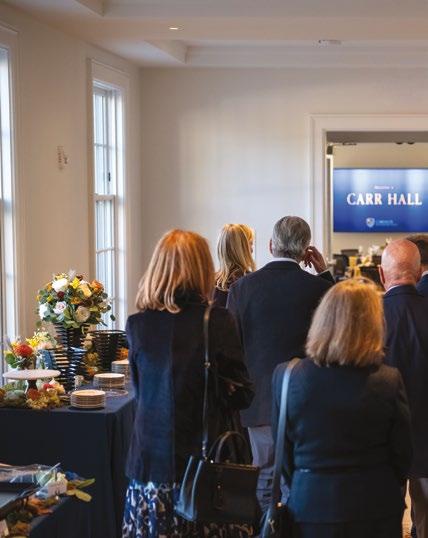
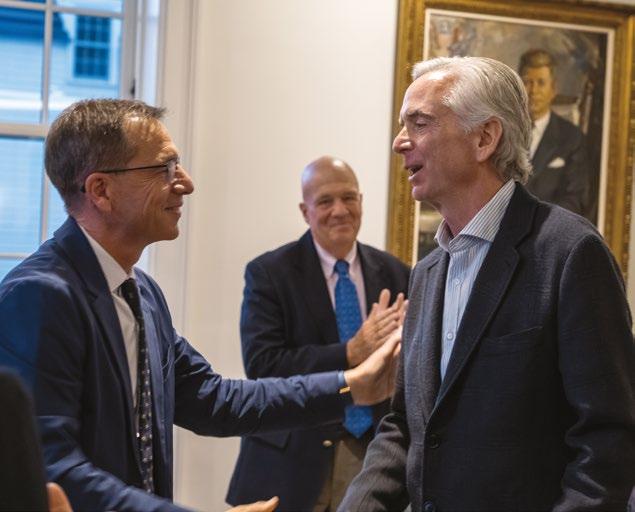
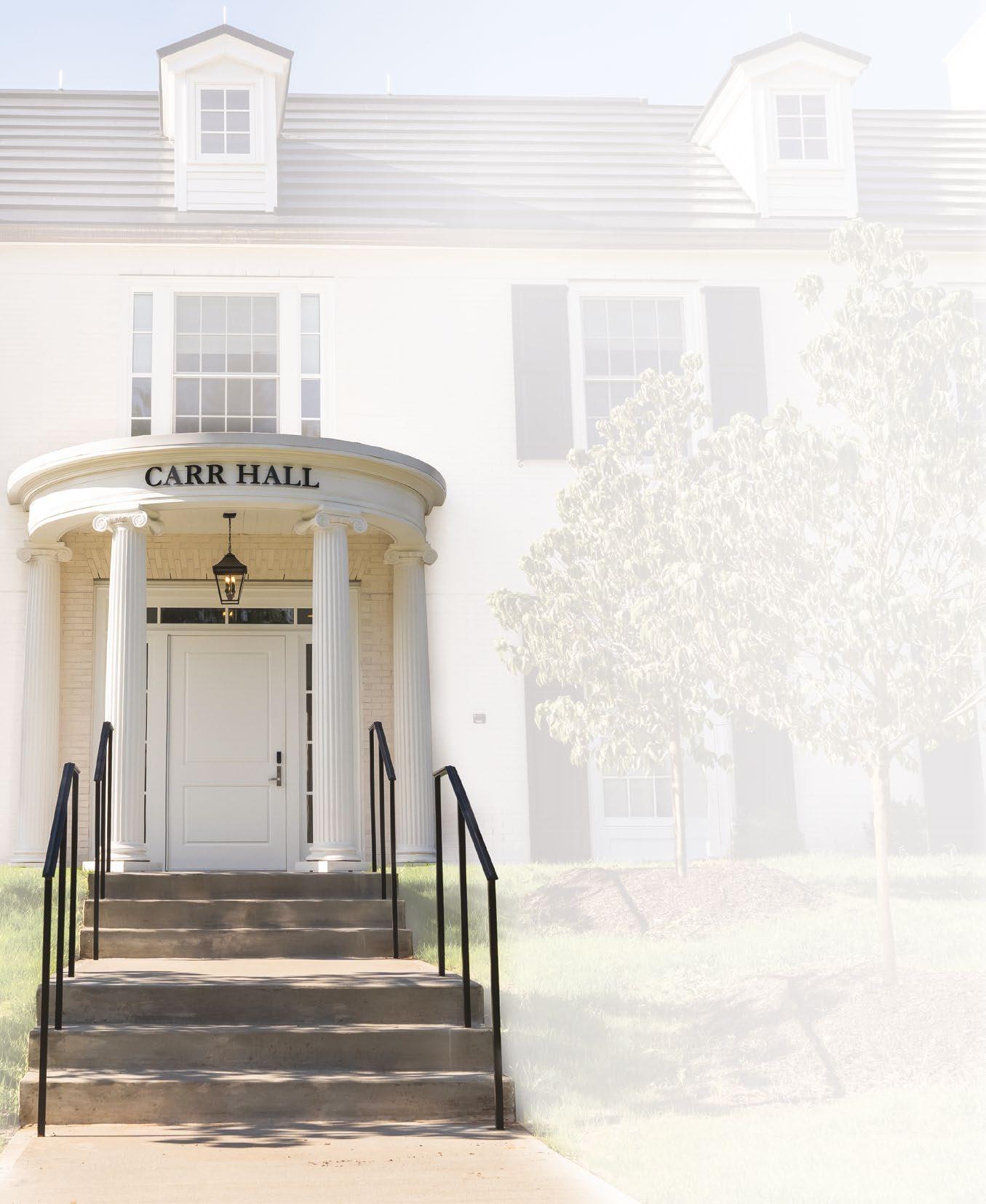
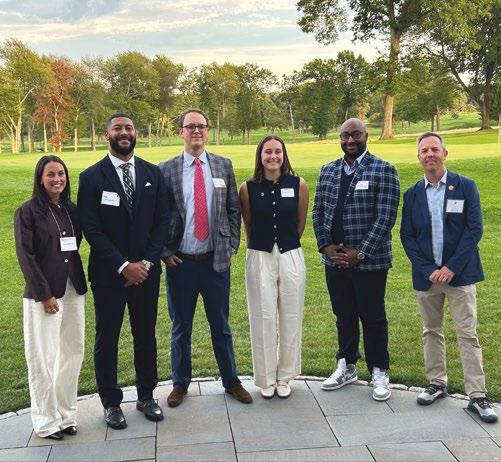
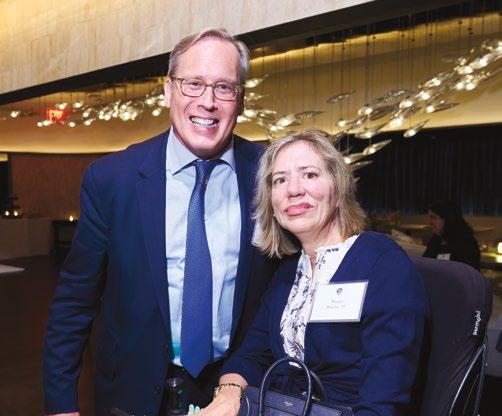
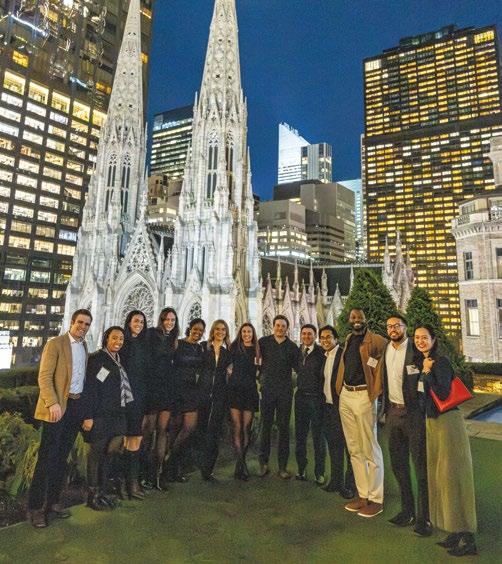
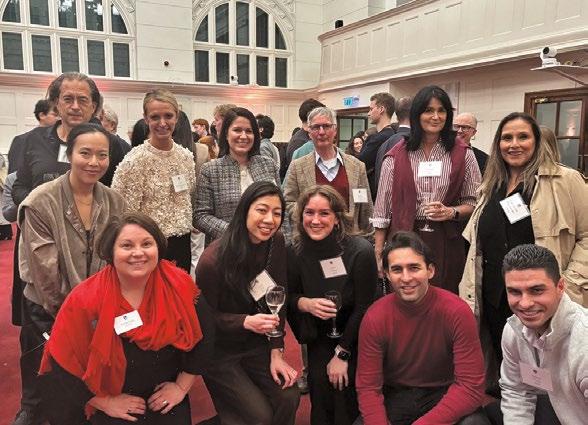
On October 9, 2025, Choate Rosemary Hall dedicated Carr Hall, a new welcome center designed to greet prospective families and campus visitors. The event honored donors Michael ’76 and Shelley Carr, whose leadership and generosity made this transformative project possible. Guests enjoyed a ribbon-cutting ceremony, campus tours, and a celebratory dinner with the Board of Trustees, school leaders, and the admission team.
For Michael Carr, the project reflects a deeply personal vision. He described Carr Hall as “a warm, accessible home base — the first step in a student’s Choate journey.” Carr credits the School with shaping his life, noting that it instilled values of leadership, integrity, and purpose. “With Carr Hall, my intention is simple,” he said. “That every prospective student and family who walks through its doors feels the spirit of Choate: its legacy, its impact, and the lifelong difference it can make.”
Current Board Chair Dan Kelly ’69, P ’03 highlighted Carr’s influence beyond philanthropy, calling his leadership during a pivotal period “inspirational” and essential to the School’s progress over the past decade. Head of School
Alex Curtis echoed that sentiment, emphasizing that “Michael and Shelley have left an indelible mark on Choate, and now through Carr Hall that impact will be felt by everyone who steps on our campus.”
The opening of Carr Hall represents more than a new building — it fulfills a key element of Choate’s strategic vision. Designed to welcome families from around the world, Carr Hall provides a central, accessible gateway to campus and reflects Choate’s commitment to offering an authentic experience from the very first visit. With its thoughtful design and sustainability features, the center underscores the School’s dedication to progress while honoring its enduring traditions.
WELCOME TO CARR HALL
By Alison CAdy P ’23, ’26, Chief CommuniCAtions offiCer
The opening of Carr Hall has immediately enhanced the way we welcome visitors and prospective families to campus. It’s more than just a new building — it’s an extension of who we are as a community. Every detail was thoughtfully designed to reflect warmth, a sense of belonging, and our commitment to creating an experience that feels genuine from the moment visitors arrive at Choate Rosemary Hall.
A CENTRAL, SEAMLESS ARRIVAL
Positioned at the center of campus, at Christian and Elm streets, Carr Hall eliminates the uncertainty that often accompanies a first visit. Visitors and prospective families know exactly where to park — the new, spacious underground garage — and where to begin their day, reinforcing an ease and sense of belonging from the moment they arrive.
“Starting the experience with clarity and comfort sets the right tone. We know the visit can feel nerve-racking for some, so this matters.”
– Jeffrey Beaton, Chief Enrollment Officer
DESIGN THAT REFLECTS OUR PHILOSOPHY
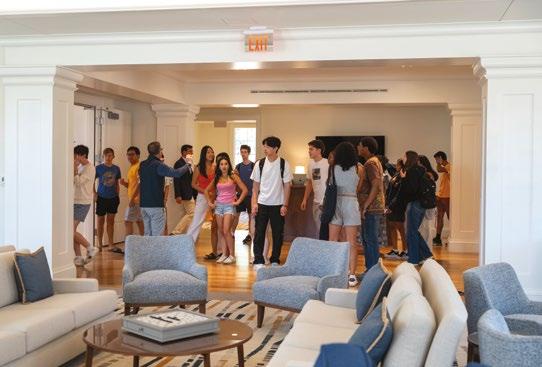
Carr Hall embodies the values that define Choate’s admission process: warmth, transparency, and equity. The reception area — our “living room” — welcomes guests with an open, inviting atmosphere. Guests can enjoy refreshments and the warmth of the fireplace after traveling to campus.
All interviews are now conducted virtually, ensuring consistency, accessibility, and fairness for all applicants. This approach allows families to focus entirely on experiencing Choate while they spend time with the Admission team. “We find prospective students, in particular, are more comfortable when they aren’t worrying about the interview during their visit,” says Beaton. “Rather, it is time for them to absorb information, culture, and the Choate vibe. Then we can dive into a more substantive conversation during the interview later.”
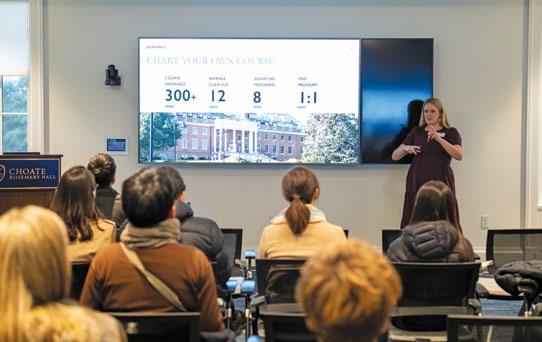
Throughout each day, information sessions are hosted in the presentation room, which accommodates up to 80 guests. This space provides an opportunity for admission officers to share the School’s story and highlight what makes Choate distinctive before families explore campus. From there, student guides lead visitors onto the back terrace, where sweeping views of the campus green and athletic fields create a breathtaking first impression — a moment that captures the sense of possibility Choate offers.
SPACES THAT SPARK CONNECTION
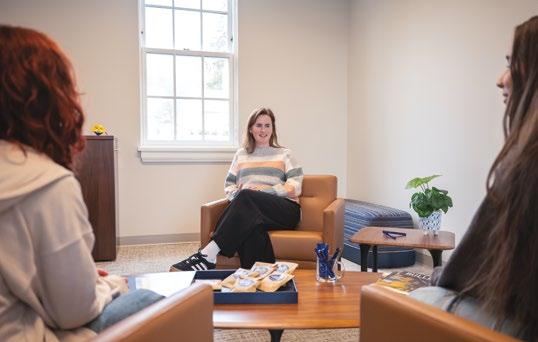
The first floor is a hub for meaningful conversations. Faculty, coaches, and program directors can meet families in comfortable, dedicated spaces — something that was nearly impossible before. This allows prospective students to dive deeper and for faculty and staff to learn more about individual applicants. Upstairs, the entire Admission team finally shares one collaborative home, fostering synergy and innovation in ways that elevate its work. “For the first time, the entire Admission team is on one floor, and that’s been a real game-changer,” says Beaton. “Our team has never been stronger and more aligned on our goals and strategies.”
CELEBRATING STUDENT VOICES
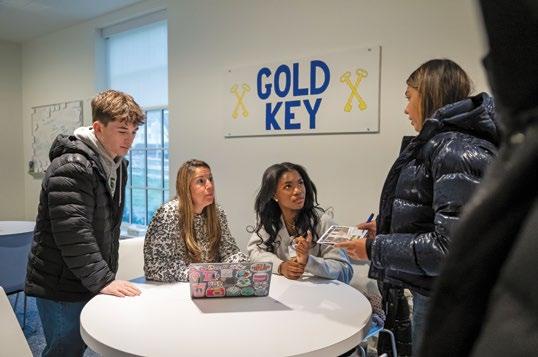
Gold Key tour guides, the School’s student ambassadors and the most qualified storytellers of Choate, now have a space that honors their role. They rotate through the Gold Key Room at the beginning and end of each class block. Before and after tours to share stories, prepare for families, and celebrate the authentic narratives they share every day.
A “SWEET” TRADITION REIMAGINED
And yes — no visit is complete without a sweet ending. A small nod to an old Tuck Shop tradition, Dusty Miller flavored cookies are given to each visiting family as they complete their tour and visit. It is a wonderful way to show our hospitality and send guests away with a smile.
Each year, the Admission team travels the globe to encourage students to visit Wallingford and take a closer look at what Choate has to offer. When prospective families arrive on campus, at Carr Hall, they visit more than just a building — rather, they experience the cornerstone of our commitment to access, equity, and community, shaping the future of Choate one visit at a time.
A CONSCIOUS COMMUNITY SHIFT
By Jenny KArlen
elliott, heAd of student And ACAdemiC life
When you next visit campus, you might notice something that looks strangely familiar: students talking to one another while walking the paths, lively conversations carrying across the Dining Hall, and School Meetings where more eyes are on the speaker than on a screen.
This is not nostalgia playing tricks. It’s the early result of a deliberate, community-wide effort to rethink how we live with our phones.
Over the past year and a half, Choate Rosemary Hall has conducted a comprehensive review of student cell phone and social media use, drawing on national research, community surveys, and extensive input from students. That work culminated in a new phone policy launched this academic year — one that is less about banning technology and more about reclaiming attention, connection, and sleep.
As we shared with families last summer, our goal was never to frame cell phone use as “good” or “bad,” nor to “cure” students through abstinence. Instead, we view our role as teaching young people how to engage with these powerful tools and platforms in ways that support their growth, learning, and identity formation. The policy is one part of that broader educational mission to promote intentional habits that will serve our students long after their time on campus.
Now, we are all engaging in a series of behavioral shifts, and we know that these types of changes require practice, take time, and necessitate steady reminders. We have room to grow, and we appreciate the feedback we continue to receive from students, staff, faculty, and families.
WHY WE NEEDED TO ACT
Like many schools, Choate has been watching with concern as research mounts about the impact of smartphones and social media on adolescents’ mental health, sleep, and relationships. Psychologist Jonathan Haidt outlined how smartphones pose a threat to the mental well-being of young people in The Anxious Generation: How the Great Rewiring of Childhood Is Causing an Epidemic of Mental Illness. Haidt asserted that the rise of smartphones and social media is responsible for the spike in teenage depression and anxiety, highlighting how smartphones have fractured the attention of young people, minimized their physical activity and unsupervised play, drawn them into isolated and disconnected social habits, lowered self-esteem, and negatively impacted their sleep quality and duration. In outlining the potential harms of social media in his 2023 advisory “Social Media and Youth Mental Health,” U.S. Surgeon General Vivek Murthy warned that “adolescents who spent more than 3 hours per day on social media faced double the risk of experiencing poor mental health outcomes, including symptoms of depression and anxiety” and linked excessive use to “sleep problems, attention problems, and feelings of exclusion.”
To understand how those national trends were playing out on our own campus we gathered data. In December 2024, 739 students completed Authentic Connections’ “High Achieving Student Survey.” Their responses were eye-opening:
78%
reported spending more than two hours a day on social media; 18% spent more than four hours a day.
24%
agreed or strongly agreed that it harms their relationships with others.
50% agreed or strongly agreed that their screen time negatively impacts their academic work.
34% reported that their phones interrupt their sleep on a typical night.
78%
reported getting less than eight hours of sleep per night, despite the American Academy of Sleep Medicine’s recommendation that adolescents get between eight and ten.
At the same time, the survey revealed that many students sought support in changing their habits:
42%
expressed a desire for strategies to use their phones more healthfully.
Those findings reinforced what many members of the community were already feeling: something needed to shift.
64%
aimed to reduce their overall screen time.
A YEAR OF LISTENING AND DESIGNING
Rather than simply announce new rules, we approached the challenge as a community change process. During the 2024–2025 academic year, we formed a task force of students, faculty, and administrators and partnered with Challenge Success, a national organization that helps schools promote student well-being, belonging, and engagement.
The committee met regularly with a Challenge Success coach, attended conferences, and gathered both qualitative and quantitative data from students, parents, and faculty. Student voices were intentionally centered. As The Choate News later reported, the team “used surveys, focus groups, and even conferences with peer schools to refine their policies before presenting final recommendations to Choate’s senior team.”
We know that culture change works only when students are part of the solution. One current student described the spirit behind the work:
“I really appreciate how Choate’s approach to the phone policy focuses on habit-building rather than being disciplinary.”
That philosophy — supporting students in building healthier habits rather than catching them breaking rules — became the through-line of the new policy.
By spring 2025, the task force had piloted several approaches across campus and refined its recommendations, focusing on three areas of school life: classrooms, community spaces, and residential life. Those recommendations were approved in May and implemented at the start of this academic year.
WHAT THE NEW POLICY LOOKS LIKE
The resulting policy is intentionally nuanced. As The Choate News observed, peer schools are experimenting with “away for the day” models and full phone bans, but “Choate’s approach is intentionally moderate: classroom expectations and no-screen dining spaces are meant to encourage lasting change, not completely shut down technology use.”
Students still have access to their phones during free periods and after classes. The emphasis is on creating phone-free zones and lights-out policies (that require phone charging outside of student dorm rooms) that protect attention, conversation, and rest.
In classrooms, students turn in their cell phones at the start of every class. Laptops and iPads remain important academic tools, but faculty are working directly with students to minimize distraction. Where appropriate, teachers use Apple Classroom, a classroom management tool, to keep focus on learning.
In community spaces, several areas are now device-free:
• Colony Hall auditorium during School Meeting and other programming
• Hill House Dining Hall, except for a designated device-friendly south seating area
• Seymour St. John Chapel during gatherings
• Theaters and performance spaces
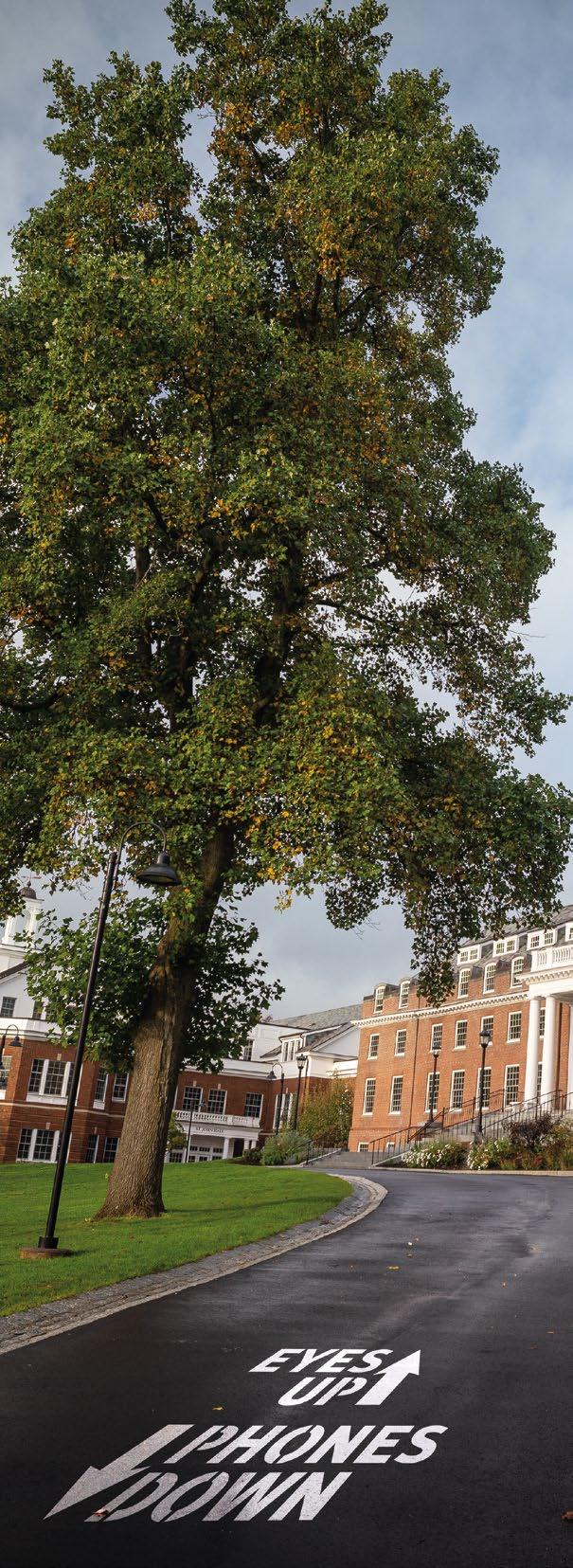
• Street crossings and campus pathways, where “Eyes up, phones down” signage reminds community members to prioritize safety and connection
Phone use is also restricted during athletic practices and contests, advising meetings, and other formal gatherings unless explicitly permitted.
In residential houses, the policy uses a “gradual release” model that acknowledges developmental differences:
• Third form students turn their phones in during study hours and place in common room charging stations overnight.
• Fourth form students also turn in phones during study hours.
• Fifth and sixth form students are offered “opt-in” phone-free spaces and times during study hours and overnight, encouraging older students to model healthier habits.
• Phones stay in students’ rooms during dorm events and meetings to encourage face-to-face engagement.
We reinforce these expectations with visual and physical supports: phone caddies in classrooms, charging stations in common rooms, and refreshed “Eyes up, phones down” messaging on walkways.
EARLY IMPACT: VOICES FROM CAMPUS
The clearest sign of change comes not from policy documents, but from the people living with the new norms.
A faculty member in a third form dormitory describes the shift this way: “In the dorms and classrooms, we are seeing success in reducing the distraction caused by phones. Students have quickly made it a habit of putting phones into the receptacles and have not pushed back at all. Apple Classroom has also added a layer of accountability, making the classroom a place of connection and community. In [our dorm], the mug nights have been much louder as students are not distracted by screens and are more focused on one another … There have been no issues or pushback with the phones in the cabinets at night, and it feels like Lights Out runs smoothly in this freshman dorm.”
The same faculty member notes that the change is affecting adults, too: “Regarding my own habits, as I feel the need to live by these principles, especially if I am to enforce them, I have observed how my screen time has decreased in class, the Dining Hall, and other settings, allowing me to be more present.”
Students echo the sense that the policy is about presence, not punishment. One student reflected on the difference they feel at meals: “One thing I’ve noticed this year is how much easier it has become to connect with my peers during meals. Since the School set up screen-free zones, people no longer look at their phones while eating. Lunch and dinner have become some of the easiest times to socialize and truly engage with friends.”
On the paths, the change feels small but meaningful:
“Personally, since we’re asked not to use our phones on the paths, I’ve found myself more likely to greet people I pass, even if I don’t know them. It’s a small change, but it’s made the campus feel more connected.”
In true Choate fashion, students are also thinking critically about improvements — suggesting, for instance, adding a visible clock in the Dining Hall so fewer people reach for phones just to check the time, and ensuring that younger students, who experience the biggest overnight changes, have a strong voice in ongoing feedback.
Our Student Council president, Zaki Shamsi ’26, places the policy in a generational context:
“I think our generation gets a bad rap for being glued to phones, but a lot of late Gen Z’ers like myself feel a quiet pushback. We’ve never known a world without social media, and we also see the costs … When we talk about phone policy on campus, I’ve noticed people aren’t against the reasoning behind it. That doesn’t mean every rule is perfect, but there’s openness to the idea that protecting time for each other matters.”
He also highlighted the importance of tone and trust: “I’ve also seen that when adults assume students can’t self-regulate, it becomes a self-fulfilling prophecy. When the expectation is framed more like, ‘We think you’re capable of being present,’ people rise to it … I think the shift happens when phone boundaries aren’t treated as anti-technology and are instead framed as pro-connection. Nobody wants to feel like they’re being punished out of modern life, but most of us actually want excuses to disconnect without feeling strange for it.”
The Choate News captured this same balance in its coverage, writing that the policy is “designed to foster deeper connections within the community rather than outright ban devices” and that it “balances connection and independence. It acknowledges how essential phones were during the pandemic and how important they are for students far from home, but it also reflects a desire to restore presence and attention on campus, to make space for more conversation, eye contact, and community.”
LOOKING AHEAD
This year is, by design, a year of learning. We will continue to gather data, solicit feedback, and adjust in pursuit of our core goals: better sleep, deeper engagement in learning, and stronger relationships across campus.
We are realistic. No policy can, by itself, undo the broader forces shaping adolescent life in a digital age. But the early signs are encouraging — louder mug nights, improved attention in class, and a growing sense that students and adults alike are reclaiming moments of quiet, rest, and face-to-face connection.
In the summer letter that introduced these changes, I invited students to focus less on what they “cannot do” with their phones and more on “what we get to do during our time at Choate.” That remains the spirit of this work. Phones are not going away. But within our 458 acres, we can model a way of living with technology that leaves room for boredom and creativity, for serendipitous conversations and sustained focus, for the kind of community life those of us associated with this school value so deeply.
100 Years
of Andrew Mellon Library
By Steven Scarpa
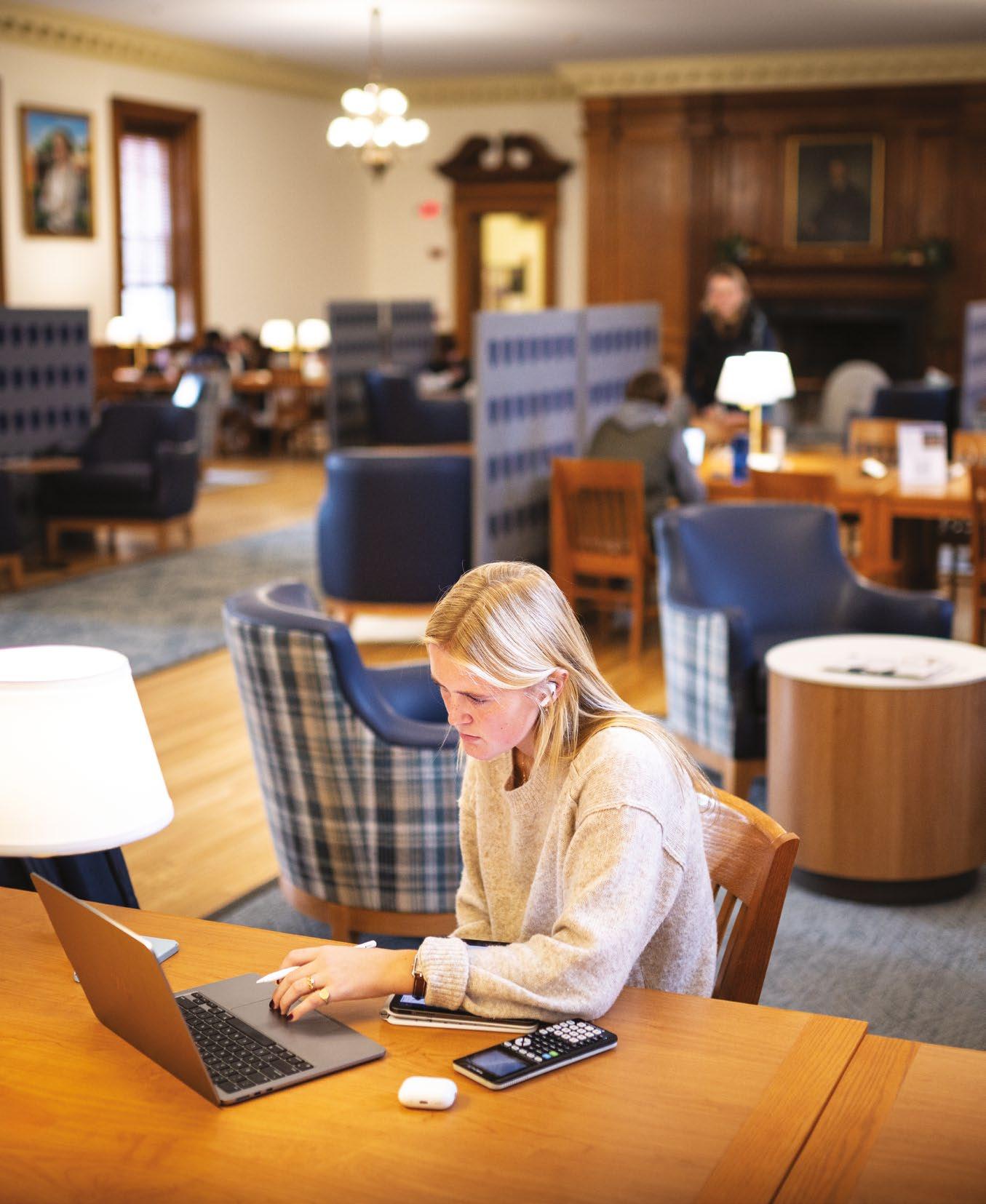
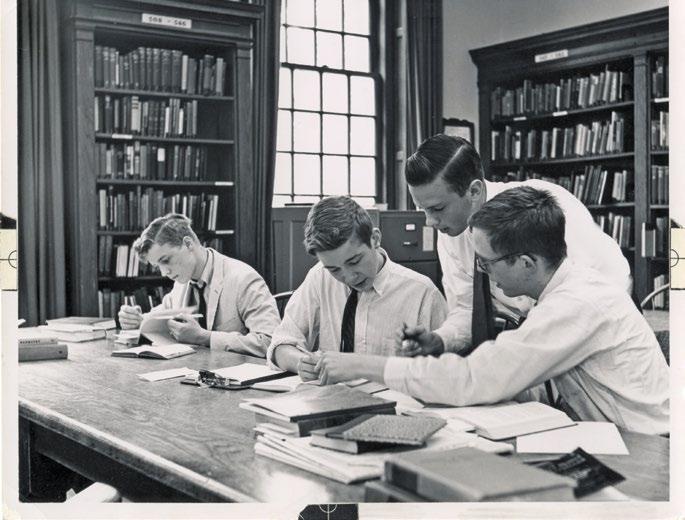
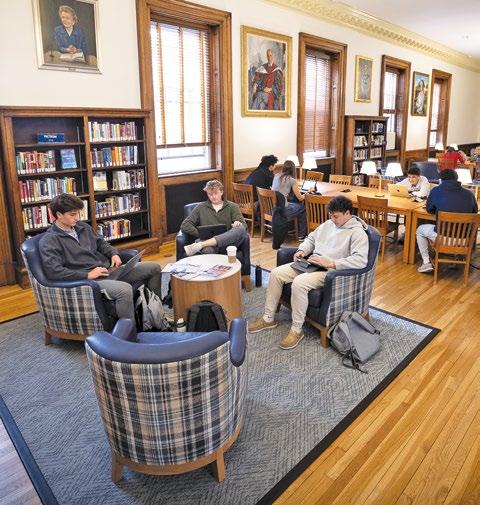
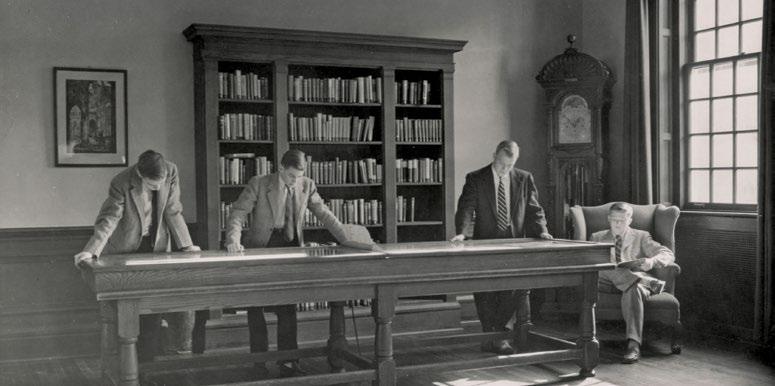
A student is sitting at a long table in the Reading Room of Choate Rosemary Hall’s Andrew Mellon Library during Study Hours, staring intently at the glow of his laptop. He types in a burst and then reads what he wrote, then another burst. Change out the computer for a pen and paper, and you have a moment that could’ve taken place in 1926, when the library first opened.
Under the watchful eye of the paintings on the wall depicting Choate leaders and scholars from years past, the students do their schoolwork. As the evening progresses, the room starts to gradually fill. Stephanie Gold, Choate’s Archivist and Special Collections Librarian, is working this night, overseeing the students as they study. She circulates around the room answering questions, offering words of encouragement, and steering students to resources they might need.
At another table across the room, a group of students is studying intermittently. Something is funny for a moment, and then they get right back to it. Others sit in silence studying in the quiet area of the library, laboring to finish their assignments for the day.
But according to Ethan Sun ’27, the young man intently staring at his laptop, the library is a place where students can connect with
each other and with librarians committed to helping them succeed. “There are all these people who are all trying to do their best work. We can ask each other questions … it’s just a place where a lot of learning and work happens,” Sun says.
The library setting can offer different vibes depending on the time of day or what kind of experience someone might be seeking.
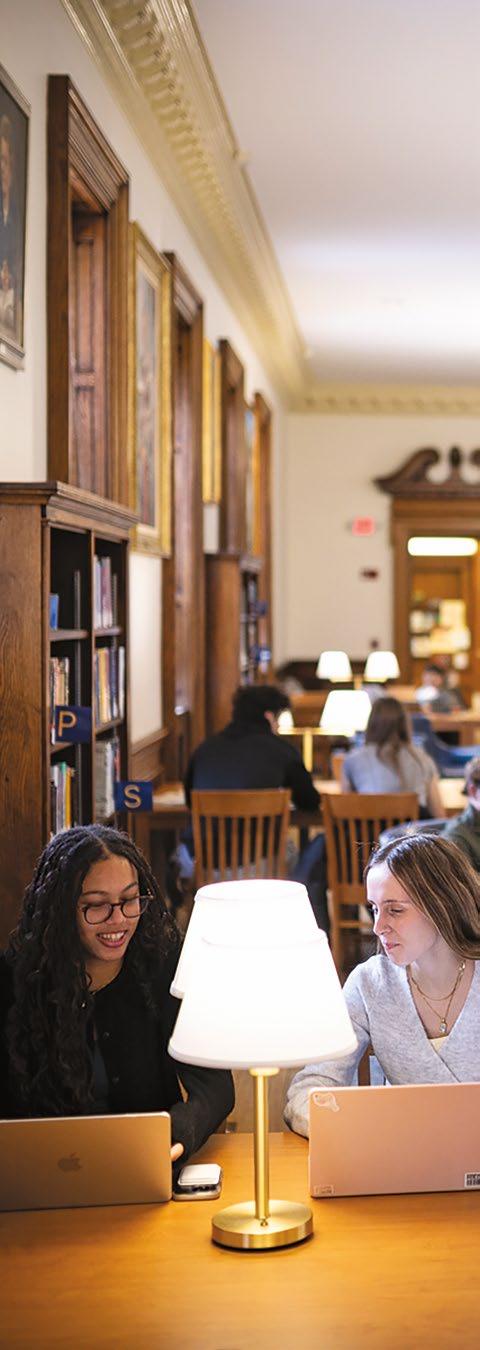
Says Juliet Eller ’27, “If I want to work on a group project, I can do that in the Reading Room. If I really need to study and lock in, I can go to the silent study. Downstairs has more of a relaxed vibe. Lower lighting. I like it for reading. It has different environments for different moods. It caters to every student.”
And, the fact that the goal of the library is to cater to every student and faculty member is central to understanding the modern Andrew Mellon Library.
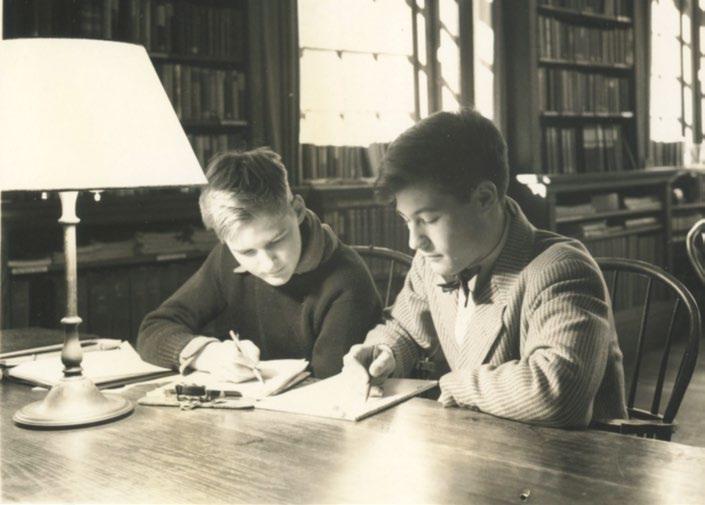
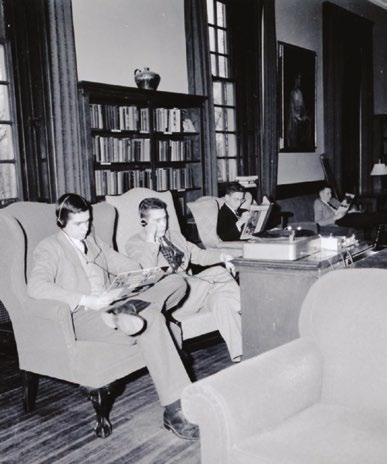
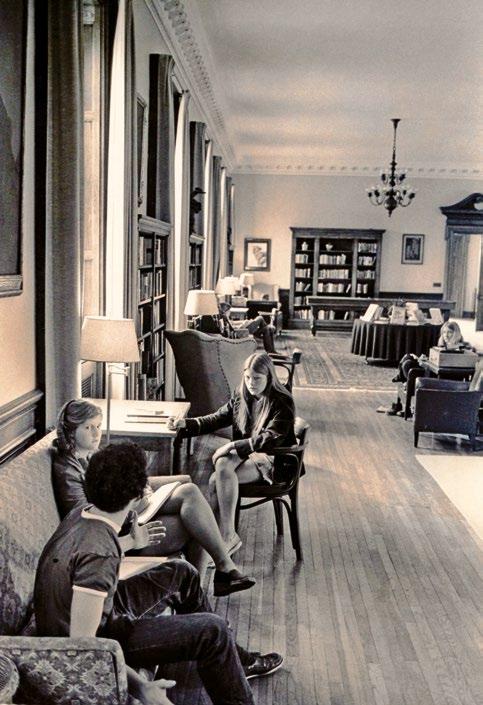
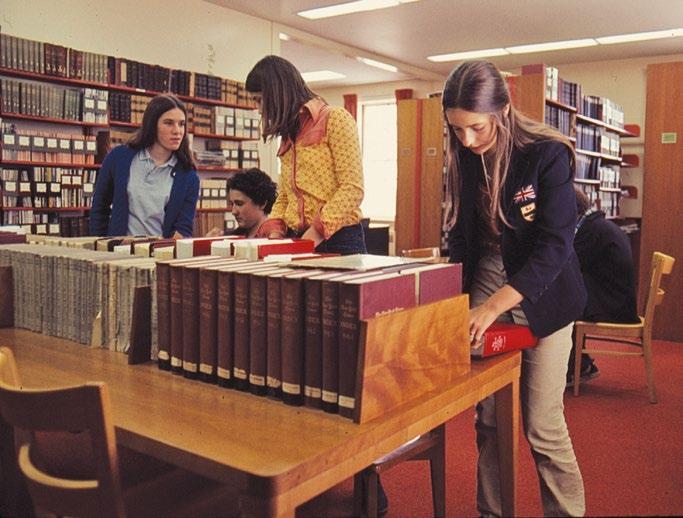
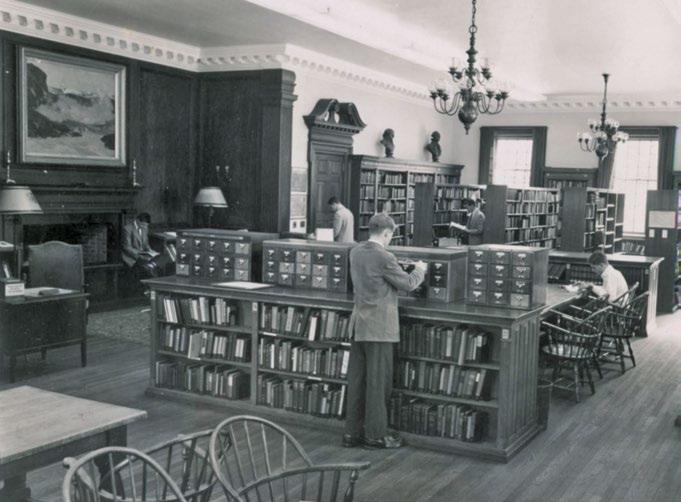
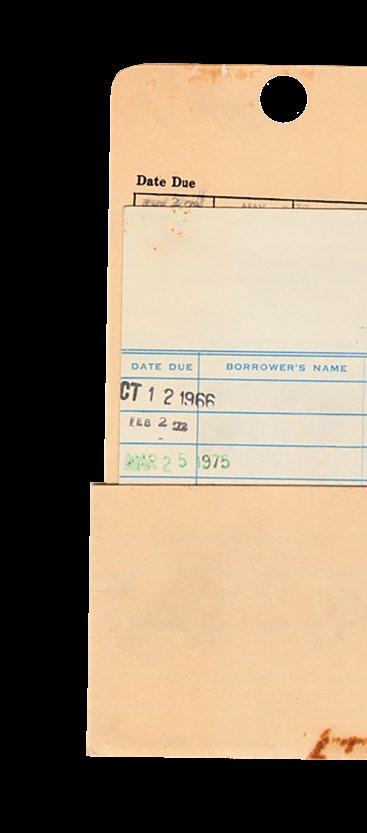
For the past century, a common experience for generations of Choate students has been study sessions in the Andrew Mellon Library. Years ago, that work would’ve taken place in a hush, books scattered on tables. The books are still here, but add the latest digital technology, librarians who circulate among the students, offering guidance and a convivial buzz to the mix. As the Library celebrates its 100th anniversary this year, it continues to foster the academic enterprise, and the future is looking bright.
A library as a place for reading and exploration was important from the School’s inception. In 1890, Rosemary Hall established its first library using books from the headmistress’s personal collection. In 1915, the Choate School set up a small facility, called the Lee Wade Library, which was in Atwater House.
Choate Headmaster George St. John had a vision for what he wanted the school to be, and a large, formal library was on his wish list. “At this point, St. John was building and growing the campus,” Gold says.
Andrew Mellon, a former United States Treasury secretary, banker, and industrialist, was so impressed with the education of his son Paul C 1925 that he approached the headmaster and asked what he could do to help the School. Thanks to Mellon’s gift of $200,000, St. John had his library.
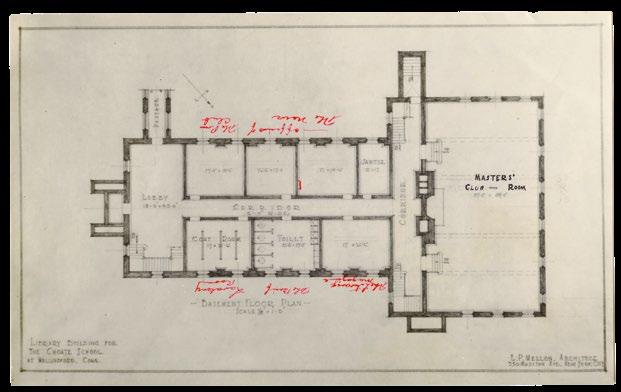
The January 24, 1925, edition of The Choate News announced the gift, breathlessly describing the utility of the space and praising Mellon for his generosity. Mellon’s gift went beyond a donation of money. By working closely with Mellon and architect Edward P. Mellon, Andrew’s nephew, St. John was able to create a library “which would be used, in a building which would make the broadest contribution to the school’s need,” according to The Choate News
Construction began in April 1925. St. John used the School’s own facilities team on the project as a way of controlling costs and maintaining oversight. Through hundreds of pieces of daily correspondence between St. John and Edward Mellon, the scope of the work becomes apparent. Buildings were moved and the land graded to make way for the new structure.
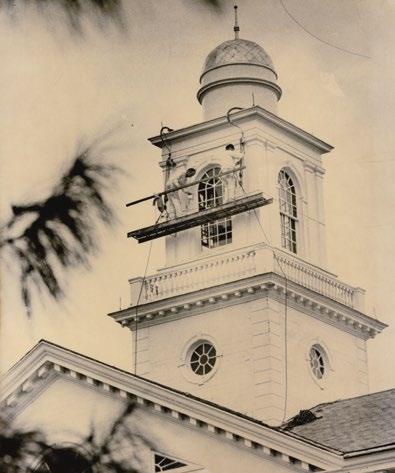
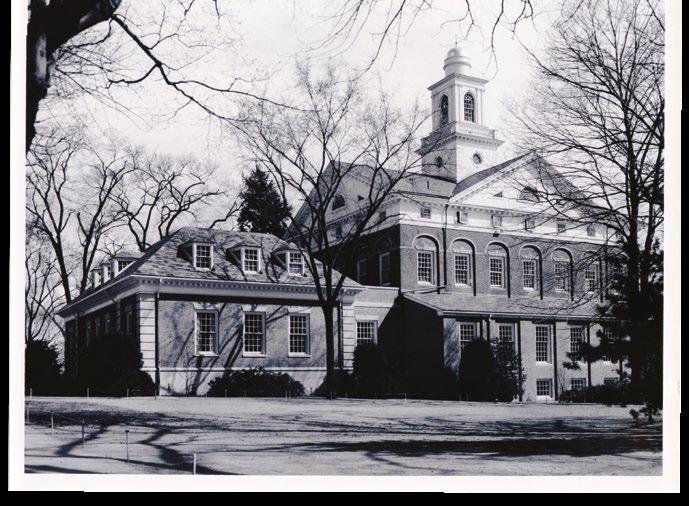
The building was finished on May 1, 1926, and was intended to serve as a central gathering
space for the Choate community. Contemporary accounts likened the library in design to Faneuil Hall in Boston, Harvard Hall in Cambridge, and Connecticut Hall at Yale, a point of pride for the Choate community.
“The most that we can do is to put the right books within reach at the right time; and that is what we hope this library will do,” said Andrew Mellon in his dedication address.
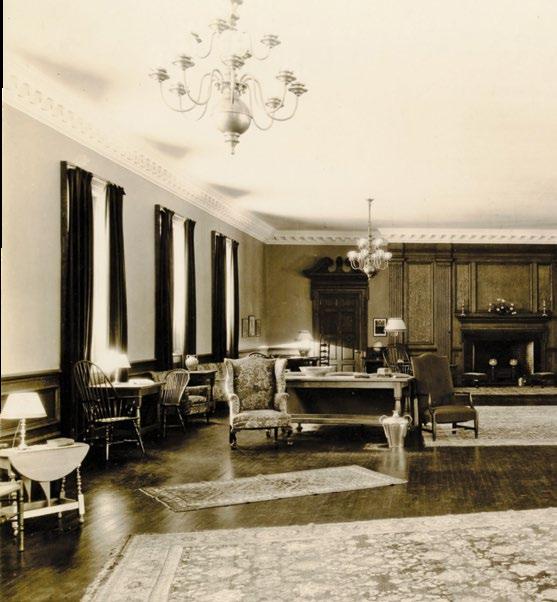
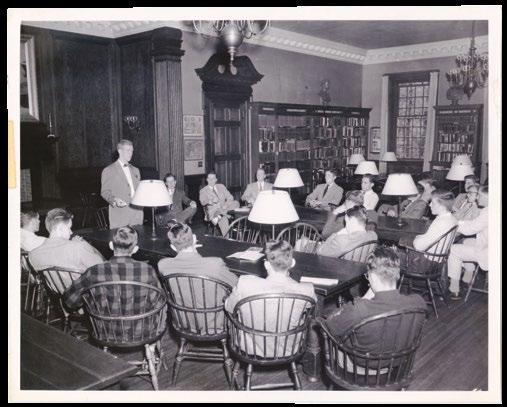
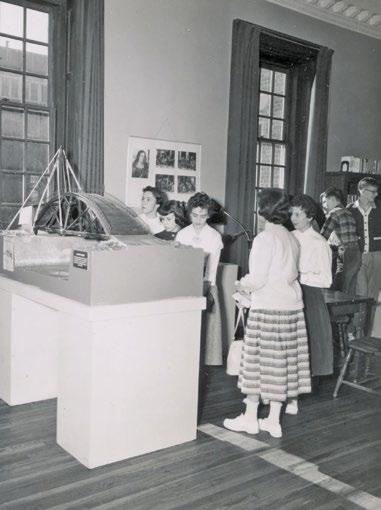
If the Chapel was the campus’s beating heart, the library became its mind. Right from the beginning, students availed themselves of its woodpaneled silence to study. Over time, it became the home of certain events, Gold says. Faculty meetings and student social occasions were held there, but perhaps most important, it became the place where students could meet some of the leading thinkers of the day.
“They would host poets, political leaders, and other notable people in the Reading Room. They sat in wingback chairs in front of the fireplace with students circled around them. It was an intimate setting,” Gold says. Some of the speakers included journalist Walter Cronkite, poet Robert Frost, and First Lady Eleanor Roosevelt, among many others. Over time, the library underwent a couple of physical transformations to keep up with the needs of the community. A new wing was added in 1962. Frost spoke at its dedication. In 2002, the facility received a $1.85 million refurbishment thanks to the generosity of Christopher Hutchins ’56.
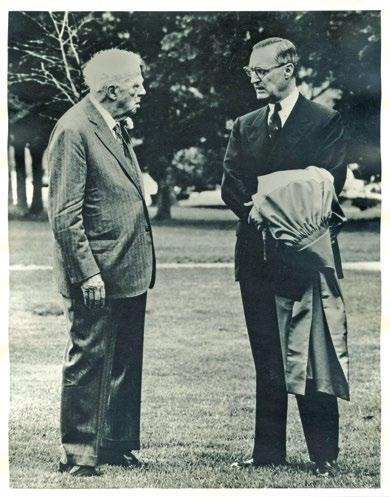
Robert Frost and Paul Mellon C 1925 at the dedication of the Library Wing on May 5, 1962.
While the library never relinquished its importance, over time, it became underused. Fewer students used the collection. As society changed, it became clear that the library needed to adjust along with it to help provide what students needed today. Choate faculty and staff began to explore larger questions: what the future of education in a boarding school could be, and how the library can help achieve that end.
“It has always been a great place,” says Kevin Rogers, Director of Studies from 2012–2022. “The Reading Room has always been a place where our students feel free to gather and study. But it was coming to a place of transition.”
When Director of Andrew Mellon Library Sherry Marrotte Newman arrived at Choate in 2018, she wrestled with how to adjust in real time while still providing great service.
“When I started,” she says. “I wanted to make sure that the library became the hub of the school campus — the resource hub, the community space to collaborate, the space where students can work together, find a quiet place to study, can access resources they might not have, and are able to come and work with a friend.”
Newman believes that an important step is getting out there and pitching what you are doing. Librarians had always attended faculty meetings, but they also started going to department meetings to understand individual needs. They promoted their programs and offerings around campus, a new idea for Choate. By doing this, Newman hoped to insert the library into all aspects of campus life.
“I looked to build purposeful spaces, collaborative spaces where students can work
together in groups, and classroom spaces where teachers can come in and get support,” Newman says.
New furnishings and designs became an important part of enlivening the space and improving the overall layout. The old sofas and wingback chairs were retired. Stacks were removed to make room for classroom space. Collections were curated to assure that students had the latest material.
The austere nature of the building remained — what changed was how its resources were deployed. “I think that students like the warmth, feel, and traditions of the surroundings there, even as we try to serve the modern student,” Rogers says.
Says MaryLiz Williamson ’94, a Latin teacher, Director of Day Students, and a library devotee,
“Thinking about the lives of adolescents as social creatures; it’s core to the adolescent experience, whether it’s to talk to each other about intellectual pursuits or to have a conversation about a particular assignment. We need commiseration. We need sounding boards. So, I think one of the goals of the library is to provide that space.”
Newman also introduced a more proactive mode of librarianship to the School. Librarians are no longer ensconced behind the circulation desk — they actively offer students help, resources, and perhaps most important, encouragement.
Thanks to Newman and her team of professionals, the library’s services today are expansive.
Academics are still at the heart of everything the library does. “We have a long-standing tradition of academic collaboration,” Newman says. “The writing and math centers, both housed within the library, reflect decades of cross-disciplinary support service.”
Librarians now also tailor digital resources to specific classes across the curriculum. They help teach research skills, including how to incorporate artificial intelligence in a way that aligns with academic integrity. The School archives, stewarded by Gold, offer a unique way to explore history by connecting the past to the present day on campus.
Most school textbooks are available on reserve for student use within the library. A small collection of children’s books for faculty members’ kids is being built. There’s a healthy collection of alumni works, including monthly rotating displays.
“By showcasing books by alumni, we create a meaningful connection between the past and the present while celebrating the contributions of our graduates,” Newman says.
And, of course, there is an abundance of technology — cameras, podcast recording equipment, computers, all available to help students complete their work in creative ways.
“It can’t just be about books,” Newman says. “For example, our creative resources and website serve not just as digital tools, but as intentional touchpoints for student success and academic integrity.”
But Newman and her team have also identified other areas, beyond academics, in which the library can take a central role. For example, library team members collaborate with the health center to provide students with wellness resources and with college counseling to offer resume-building workshops.
Partnerships between staff and student clubs yield monthly displays on a wide array of topics, including current events and important campus moments like the summer reading program and International Education Week.
This version of the Andrew Mellon Library is a living and breathing organism, responding to the world around it and assuring that the priorities of the School are always reflected in its offerings. Thanks to the thoughtful evolution of the library, innovations and tradition rest easily alongside one another.
“I am proud of the way it has adapted. I think it’s important that we have a thruline that both capitalizes on our best traditions, but also says that we are not afraid to reimagine,” says Rogers.
“We want people to come in and feel ownership,” Williamson adds.
The library provides a rich collection of resources, in addition to its other offerings. It holds 284,463 items in the collection, including 38,015 physical resources.
“There’s something so visceral about going to the library and pulling a book from the shelf. I always wonder who’s read the book before me and who will read the book after. There is texture and a tactile experience that I never want to go away for people,” says Williamson.
The library hosted 519 classes during the 2022-23 academic year. That number increased to over 700 in the following year. Just this past year, the library hosted more than 60 programs and displays, including performances and talks. Newman’s intention is to keep these numbers steadily and sustainably moving up.
“I hope to get every student here at least once every year. That’s my goal,” she says.
While the work is trending in the right direction, there’s always more that can be done to ensure the next century of the Andrew Mellon Library’s relevance. Accessibility is one of Newman’s key goals. She’s also thinking about ways to increase classroom and study spaces.
Newman places tremendous stock in data, but numbers can’t completely quantify the feeling she hopes the library inculcates in the community. “What would be most gratifying to me is to know that a student understands and really treasures libraries, their values and their services,” Newman says.
One such student is Ana Isabella Bury-Negrón ’25. She first visited the library during a summer session. Embracing some of the pleasure reading it can be hard to do during the academic year. Bury-Negrón, currently attending the College of William and Mary, said she “ended up discovering something magical” in the Andrew Mellon Library. It was the interactions she had with librarians and the memories she created with her friends that continued to resonate after graduation.
“I learned a lot from the librarians,” she says, “that it’s about remaining curious, virtuous, and appreciating your surroundings and the life around you. There are thousands of years of history, literature, and art collected in that library. It really is such a gift.”
For students like Bury-Negrón, Eller, Sun, and others, the Andrew Mellon Library is a crossroads. Sure, they study there. But for others on campus, it’s a special “second place,” a place where they can make friends, connect with faculty, and have a kind of home.
After a century of service and change, that part remains a constant.
Alumni Authors Collection
The Andrew Mellon Library and School Archives maintain an Alumni Authors Collection, which recognizes the literary accomplishments of graduates from Rosemary Hall, The Choate School, and Choate Rosemary Hall. This collection unites the creative works of alumni across various generations, reflecting the institution’s enduring tradition of excellence in writing, research, and creativity. To celebrate and promote the contributions of alumni authors, the library features monthly displays that spotlight selected works from the collection and showcase alumni authors from the class years being celebrated during Reunion Weekend.
The Alumni Authors Collection is housed in the library to ensure accessibility for students and faculty. Oversight of the collection is maintained by the Archivist and Special Collections Librarian, Stephanie Gold, who, with the support of the Alumni Office, manages new acquisitions. Currently, our holdings consist of 236 titles from Rosemary Hall, 1,041 titles from The Choate School, and 348 titles from Choate Rosemary Hall. These volumes encompass a wide range of genres, including fiction, poetry, memoir, and history, among others. Collectively, these volumes celebrate the vibrant intellectual and creative legacy shared by our alumni community.
Interested in exploring the collection? scan ➡
Don’t see your book represented? Reach out to alumnirelations@choate.edu. We would be delighted to include your work in the collection.
ALUMNI AWARD
DR. ELAD LEVY ’89
Choate Rosemary Hall is proud to announce Dr. Elad I. Levy ’89 as the recipient of the 2026 Alumni Award, the School’s highest honor. The award celebrates alumni whose achievements bring distinction to our School through professional excellence and service.
A pioneering and widely respected neurosurgeon, Dr. Levy serves as Professor of Neurosurgery and Radiology and holds the L. Nelson Hopkins Chair of the Department of Neurological Surgery at the University at Buffalo Jacobs School of Medicine and Biomedical Sciences, where he became a SUNY Distinguished Professor in 2020.
In 2024, Dr. Levy was appointed physician leader and medical director of Kaleida Health’s neurosciences service line, building on his longstanding role as director of neuroendovascular services at its Gates Vascular Institute.
Dr. Levy’s research has helped redefine treatment for stroke and aneurysm patients worldwide. He served as the U.S. interventional principal investigator for the landmark SWIFT PRIME trial, which established a now-standard procedure for removing blood clots during acute stroke — saving countless lives.
Building on this work, his team at the Atlas Ambulatory Neurosurgery Center recently demonstrated that advanced treatments for aneurysms and blocked carotid arteries can be performed safely without requiring a hospital stay, improving patient comfort and reducing costs.
Dr. Levy is also exploring the future of neuroscience. As co-principal investigator of the COMMAND study, he is helping develop a braincomputer interface that allows people with severe paralysis to operate digital devices — a breakthrough that earned him the Duke Samson Award at the 2024 Congress of Neurological Surgeons.
With more than 800 peer-reviewed publications and book chapters, Dr. Levy’s work continues to shape contemporary practice in neurovascular care.
Dr. Levy has held numerous leadership roles within the profession, including serving as president of the Congress of Neurological Surgeons in 2023. He also founded PUCCS, a nonprofit organization dedicated to educating children about concussion and stroke prevention.
At Choate, Dr. Levy was a prefect and competed in crew, wrestling, and swimming. He earned a B.S. from Dartmouth, an M.D. from George Washington University, and completed neurosurgery training in Pittsburgh, a fellowship in Buffalo.
Dr. Levy’s career reflects the highest ideals of a Choate education: curiosity that drives discovery, leadership grounded in compassion, and a commitment to using one’s talents to improve the lives of others. We look forward to welcoming him to the School Meeting on April 7 as the 2026 Alumni Award recipient.
SAM BARTLETT ’91
Choate Rosemary Hall is honored to recognize Sam Bartlett ’91 as the recipient of the 2026 Distinguished Service Award, celebrating his unwavering commitment and leadership for more than three decades. This award is presented to alumni whose dedication and service have made an enduring impact on the School.
Sam’s engagement with Choate has been marked by consistency, thoughtfulness, and a deep sense of responsibility to the community. His leadership was most visible during his decade of service on the Board of Trustees from 2010 to 2020, where he played a pivotal role in guiding the School through a period of strategic and financial growth. As a member of the Executive Committee from 2013 to 2020, Sam helped shape key decisions that strengthened Choate’s future. He chaired the Finance Committee, served as Vice Chair of the Compensation Committee, and contributed his expertise on the Audit Committee and the Development, Parent, and Alumni Relations Committee. His stewardship reflected both fiscal acumen and a commitment to sustaining the School’s mission.
Sam’s service began well before his time on the Board. He was a charter member of the Alumni Advisory Committee, president of the Alumni Association, and chair of the Nominating and Prize
Committee — roles that underscored his dedication to fostering alumni engagement and leadership. Beyond governance, Sam has generously hosted events for alumni and prospective families, volunteered on Class of 1991 Reunion Committees, and welcomed new students as the 2009 Matriculation Speaker.
His contributions continue a proud family legacy of service. His grandfather, Richard Higgins C 1918, served as chairman of the Board of Trustees of The Choate School from 1947 to 1958 and is credited with forming the School’s first Alumni Association. As a student, Sam earned some of Choate’s highest honors, including the School Seal Prize, the Aurelian Honor Society Award, and the Mark Pitman Award. He served on the Judicial Committee, delivered the Matriculation Address for his form, and excelled athletically as a member of the varsity football and squash teams, while captaining varsity baseball. Through his enduring commitment, thoughtful leadership, and deep care for the Choate community, Sam embodies the spirit and values recognized by the Distinguished Service Award. We look forward to recognizing his contributions at the Leadership Reception on Reunion Weekend.
ATH L E T ICS
HA L L O F FAME
Each year, the Choate Rosemary Hall Alumni Association honors athletes whose talent, dedication, and sportsmanship have strengthened and elevated the School’s athletic tradition. This Reunion Weekend, on Saturday, May 16, the Athletics Hall of Fame will welcome three remarkable individual athletes and one legendary team — recognizing their achievements and the enduring spirit of Choate athletics.
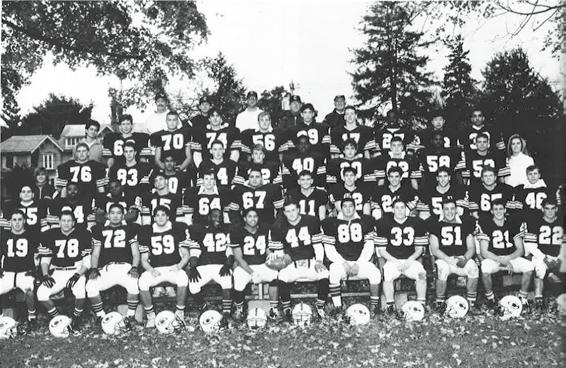
The 1990–91 VARSITY FOOTBALL TEAM delivered one of the most memorable seasons in Choate history, completing a perfect 9-0 campaign and capturing the NEPSAC Class A Championship. Under Head Coach Jim Irzyk, with assistants John Connelly and Joe Orsini, the team combined discipline, depth, and resilience, emerging as the top program in New England.
Throughout the regular season, the team outscored its opponents by an average of 22 points per game, posting shutouts against Andover, Hotchkiss, Lawrenceville, and rival Deerfield. The season culminated in a thrilling come-from-behind championship victory over New Hampton, a 28-27 triumph sealed by a last-minute touchdown and two-point conversion that has since become part of Choate football lore.
Led by captains Raymond Fraser and Bryan Lonsinger, the team showcased strong individual play. Fraser earned the Thomas Wyckoff Award as the most valuable backfield player, while James Waller and Richard Johnson were co-recipients of the Jim Fowler “Hustle” Award, embodying the team’s relentless spirit.
With numerous team members continuing to play varsity collegiate sports, the 1990–91 squad helped establish a legacy that would resonate for years to come. Their undefeated season and championship title defined an era of Choate football, earning their place among the great teams in the School’s athletic history.
CHOATE ROSEMARY HALL 2026
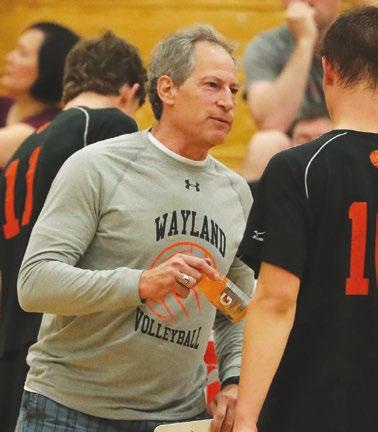
ROD FLETCHER ’76 is among the most accomplished volleyball players ever to represent Choate. A threeyear varsity player and sixth form co-captain, he helped propel the program to national prominence.
With Choate volleyball, he helped his teams capture the Connecticut State YMCA and the New England Prep School titles in 1973–74, and the Deer Lakes Invitational championship in 1975. The team also brought their talents internationally, competing in Czechoslovakia and the Netherlands, and became the first U.S. high school team to play in Poland, beating collegiate teams such as Harvard, Yale, and Princeton.
In addition to volleyball, he played varsity football and received the Harvard Trophy for scholarship and sportsmanship.
Rod continued his career at Stanford, joining the top-10 program as a walk-on and becoming a four-year starter and three-year captain. He won two PAC-10 championships, earned Stanford’s first full volleyball scholarship, and was named to the All-Tournament American Team at the 1977 U.S. Junior Olympics.
After college, Rod earned six gold and four silver medals at the USAV/USVBA National Championships, alongside three individual All-Tournament/All-American honors. He later coached at Wayland High School, where he was named Massachusetts Coach of the Year in 2017, a recognition that reflects the excellence he brought to every stage of his volleyball career.
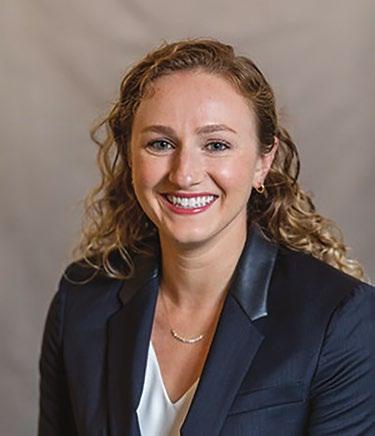
A standout athlete in the pool, JAMIE HILLAS ’11 was a four-year varsity swimmer and a three-year varsity water polo player whose impact extended across two of Choate’s most competitive programs.
In swimming, Jamie helped Choate secure a 2007–08 New England championship and, individually, won back-to-back New England titles in the 100 backstroke in her fourth and fifth form years. As a sixth former, she served as co-captain and received the Dolphin Award for Excellence in Swimming.
In water polo, Jamie played a pivotal role in three consecutive New England championship seasons from 2009 to 2011 and was selected to the alltournament team during a dominant stretch for the program.
At Middlebury, Jamie became one of the program’s most accomplished swimmers. She earned AllAmerican honors twice and has held school records in the 50 breaststroke and 100 individual medley since 2015. She won four consecutive NESCAC titles in the 50 breaststroke and added championships in the 100 breaststroke and 200 medley relay, garnering multiple All-NESCAC selections. Her college career culminated at the 2015 NCAA Division III Championships, where she placed sixth nationally in the 100 breaststroke, solidifying her status among the nation’s elite swimmers.
For more than four decades, FRAN O’DONOGHUE was a cornerstone of Choate athletics, shaping generations of student-athletes through her leadership, mentorship, and unwavering commitment to the School’s athletic tradition. Beginning her career in 1984 as the JV Field Hockey Coach and Girls Varsity Lacrosse Coach, Fran quickly established herself as a respected and influential figure on the sidelines.
In 1991, Fran became Head Varsity Field Hockey Coach, leading the program for 27 seasons and guiding the team to a Founders League co-championship in 1994. She also led Girls Varsity Lacrosse until 2006, capturing a Founders League title in 1999. Beyond these programs, she supported a wide range of interscholastic and intramural offerings, consistently emphasizing teamwork and sportsmanship.
Most recently, Fran brought her passion for running to the cross country team, coaching for five seasons before retiring in June 2025. In total, she coached more than 70 combined seasons and mentored countless athletes, including five future Athletics Hall of Fame inductees. In May 2025, she was honored with the Founders League’s prestigious M.D. Nadal Sportsmanship Award.
Fran’s impact transcends wins and championships, leaving a lasting imprint on the character and confidence of all those she coached. Her work exemplifies the true mission of Choate athletics — developing strength, resilience, and integrity in both on and off the field.
ALUMNI ASSOCIATION
The Choate Rosemary Hall Alumni Association’s mission is to create, perpetuate, and enhance relationships among Choate Rosemary Hall alumni, current and prospective students, faculty, staff, and friends in order to foster loyalty, interest, and support for the School and for one another, and to build pride, spirit, and community.
OFFICERS
President
David Javdan ’86
Vice Presidents
Justin Graham ’98
Ashley Holt ’11
Lena Sullesta Jessen ’92
Dewey Kang ’03
Members
Sam Chao ’04
Rebecca Zubaty Cohen ’99
Marisa Ferraro ’92, P ’27
Ray Happy ’79
Chris Herzog ’99
Arvind Kadaba ’03
David Kestnbaum ’00
Lambert Lau ’97
Brad Mak ’96
George Ramirez ’11
Austin Rees ’09
Becky Vitas Shamis ’91, P ’21, ’26
Will Gilyard ’98, P ’29
Faculty Representative
Additional Executive Committee Members
Chief Advancement Officer
Anne Bergen
Director of Alumni Relations
Andrea Solomon
Alumni Association
Past Presidents
Susan Barclay ’85
David Hang ’94, P ’25
Chris Hodgson ’78, P ’12, ’14, ’17
Elizabeth Alford Hogan ’82
Parisa Jaffer ’89
Woody Laikind ’53†
Patrick McCurdy ’98
REGIONAL NETWORK
LEADERSHIP
Boston
Gabby Rundle Robinette ’06
Chicago
Maria Del Favero ’83
Jacqueline Salamack Lanphier ’06
Connecticut
David Aversa ’91
Katie Vitali Childs ’95, P ’24, ’26
Los Angeles
Wesley Hansen ’98
Alexa Platt ’95, P ’29
New York
Conrad Gomez ’98
Leah Lettieri ’07
Rosemary Hall
Anne Marshall Henry ’62
San Francisco
Albert Lee ’02
Washington, DC
Dan Carucci ’76
Tillie Fowler ’92
Olivia Bee Moore ’10
Beijing
Matthew Cheng ’10
Gunther Hamm ’98
Hong Kong
Jennifer Yu Cheng ’99
Lambert Lau ’97
Sandy Wan ’90
London
Tatiana Donaldson ’13
Elitsa Nacheva ’08
Seoul
Rae-Eun Sung ’97
Shanghai
T.C. Chau ’97
Thailand
Uracha Chaiyapinunt ’13
Isa Chirathivat ’96
Natapitt Sethpornpong ’14
Tokyo
Kirk Shimizuishi ’96
Miki Ito Yoshida ’07
The Celebration of the Decade!
MAY 15-17
Classes ending in 1s and 6s: it’s been 10 years since we’ve all been together. Much has changed both on campus and in your lives, but the important things remain the same. Meaningful connections. Transformative education. Lifelong friendships.
It’s time to reconnect with your school, your classmates, and your friends! Mark your calendars and start making plans to attend. You don’t want to miss this epic weekend!
See you there!
For more information, visit the Reunion Webpage: choate.edu/reunion
Minds ALWAYS Open
LEARNING DOESN’T STOP WHEN SUMMER BEGINS Choate Rosemary Hall’s unique summer programs offer engaging and innovative opportunities for learners to widen their worlds as they pursue their creativity, curiosity, and passion for discovery. Students of all ages explore new concepts and advance their skills through programs at the elementary, middle, and high school levels.
JOIN
CLASSNOTES | News From Our Alumni
1950s
’52 C Peter Hearst writes, “I am long since retired and am currently happy to report that I am still active and well.”
Miguel Suarez writes, “This past August, I attended a Cienfuegos Yacht Club celebration in Miami dedicated to its rowers. I was an oarsman for Choate (1948-52 – Tappens) and the Habana Yacht Club in 1953-55. I won eight gold medals in Cuba. I enjoyed the gathering and meeting old friends. Rowing was a favored club sport in free Cuba.”
’54 RH Hannah Milde Marks writes, “For two weeks in April, I traveled through Africa on three safaris with the World Affairs Council of Charlotte. It’s been a long-time dream to see the animals and not in a zoo. I visited South Africa, where we witnessed the meeting point of the Atlantic Ocean and the Indian Ocean at the Cape of Good Hope. I also traveled to Botswana and Zimbabwe and, in addition to observing the spectacular animals, cruised the Zambezi River and saw Victoria Falls. The trip was breathtaking and exceeded expectations!”
’55 RH Pamela Bisbee Simonds writes, “Nine of our classmates did a Zoom together this year, talking about what keeps us busy at age 87. We shared many thoughts: We all are busy and active, in mind and body, we play bridge or games and keep our minds and memories sharp, we are all retired and now we volunteer and have served on many boards, have founded several organizations, such as friends of a library, a regional multi-use bike path, and a museum, and one has written four award-winning novels for teens. Several of us worry about the digital and AI worlds overtaking personal interactions, we still travel, we are creative, enjoy painting and art, reading, and we knit, we love music, we exercise, we enjoy nature, gardening, we cope with our health issues, we share loving memories of our husbands and our classmates who have died, we love keeping up with our kids and grandkids, and four of us have great-grandkids, and finally, we admitted we all don’t like looking old!”
’56 C William Spears writes, “Maria and I are so pleased that our grandson Greyson is a third former at Choate and thriving despite a severely sprained ankle incurred in soccer. We hope to visit soon.”
’57 C Peter Sipple writes, “Recently, Margaret and I attended a memorial service for Choate classmate Art Trotman. It took place at Yale’s Battell Chapel with many in attendance. Art’s life was beautifully recalled by family members and friends — his strengths of character and achievements fully valued. Family members had asked me to offer prayers in
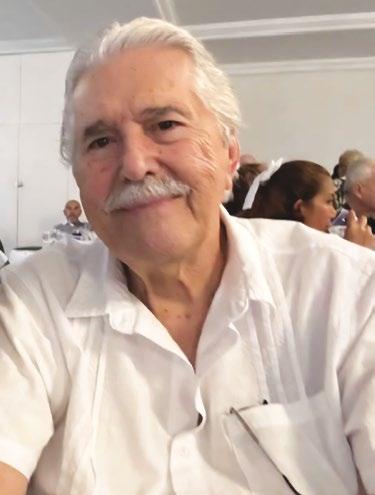
TOP LEFT Miguel Suarez ’52 at a Cienfuegos Yacht Club (CYC) celebration in Miami, Fla.
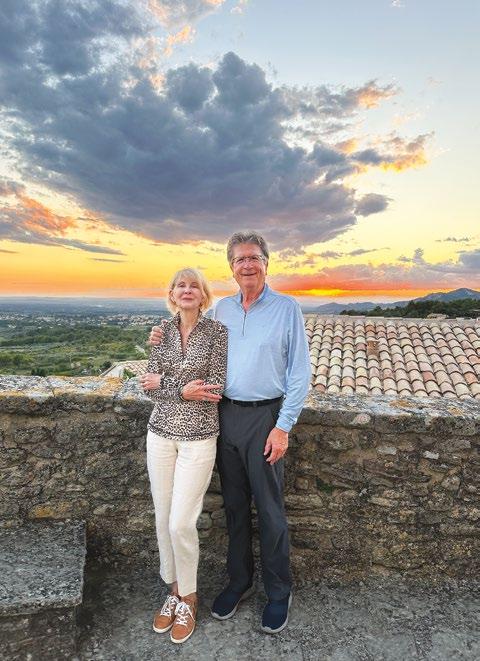
TOP RIGHT Lachlan Reed ’64 on a recent trip to Crillon le Brave in Provence.
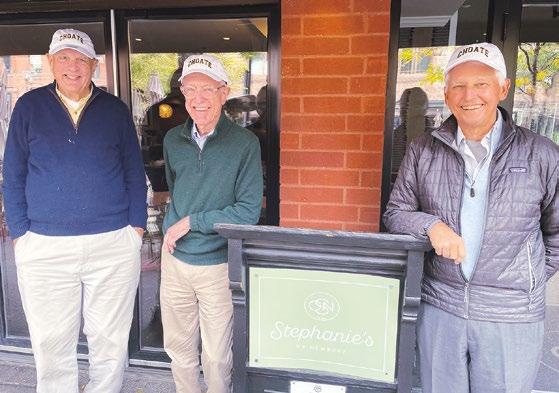
MIDDLE Boston Lunch - From left to right, Jim Whitters ’58, Bob Ackerman ’56, P ’89, and Parker Llewellyn ’62.
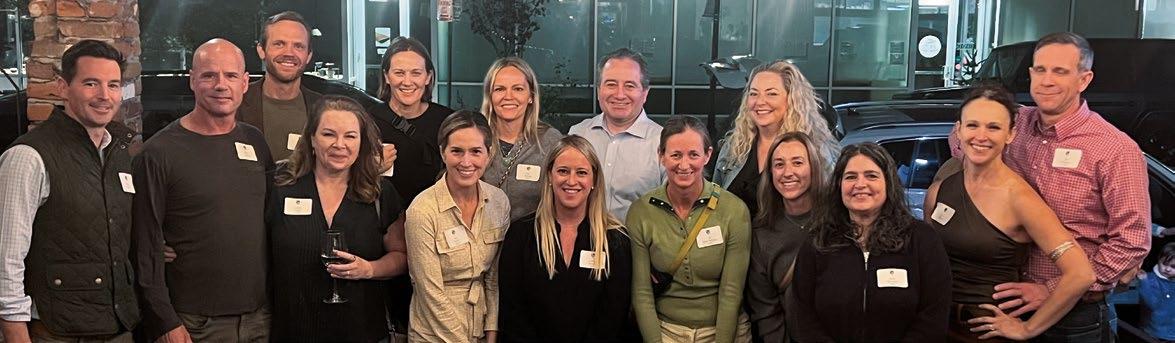
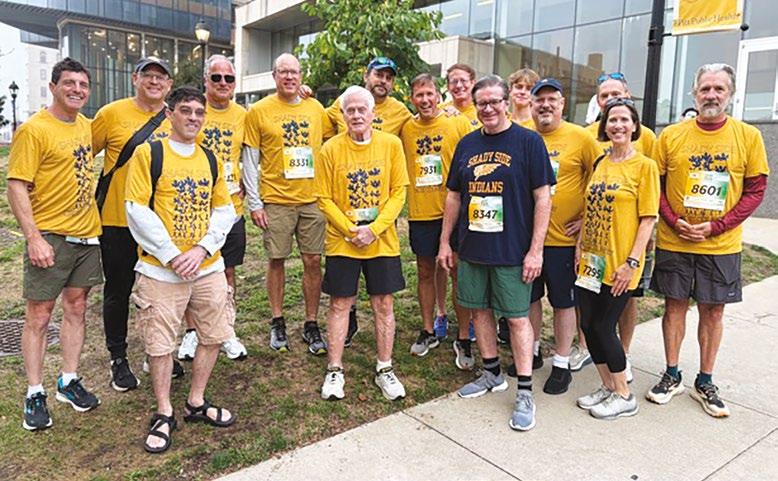
BOTTOM Bill McConnel ’55 with his ’80s Shady Side Academy Cross Country Alums, plus daughter Kambra, all in vintage uniform. “They insisted that I join them in the 5k Pittsburgh Great Race Walk on September 28. I agreed to do so provided that they finish behind. It was a great occasion to get together before the alumni weekend at SSA.”
thanksgiving for Art’s life, and I was honored to do so. Art’s and my three years at Choate helped initiate a close friendship. His athletic prowess prevailed, making it easy to forget his musical aptitude; we both played saxophone in Choate’s band, orchestra, and dance band. It was primarily through music that we came to know Malcolm Manson, our sixth form class’s English-Speaking Union exchange student, and the following year, Art and I attended English public schools following Malcolm’s example in reverse. The years Art and I roomed together at Yale deepened our friendship, as have frequent visits more recently. We have Choate to thank for laying the groundwork for one of my life’s richest associations.”
’59 C Mike Heath writes, “Mary Lou, my wife of 60 years, died about a year and a half ago of cancer. The end was relatively swift, and there was little pain. But it was the loss of a partner I had had for threequarters of my life. I took the first few weeks after her death to try to figure out what I am going to do with the rest of my life. My kids were all grown and at least halfway through their careers, and the grandkids were largely out of college, with one remaining with several years of boarding school left. The move to Indiana from Austin made sense 10 years ago when all four grandchildren were here. But what now? Everyone is gone. I decided after considering a number of alternatives, I knew exactly what I was going to do: I want to fall in love again, just as I did 60 years ago. So I went to see a nearby neighbor, Vida, who was Mary Lou’s best friend and I said: ‘Vida, I’ve been thinking about what I’m going to do with my life now that Mary Lou is gone and, I have decided that I want to fall in love with you. I’m choosing you. My purpose in telling you this is that if you don’t like it, you should tell me at any time, because otherwise I’m going to be relentless.’ It’s now months later and I’m still waiting for her to say ‘no.’ I might mention that I feel like a teenager in the rush of a first love. Vida, I was surprised to learn, is going through much the same thing. In fact, she had resigned herself to dying alone. So maybe two people have been saved. We have found the idea of not signing anything and having no knowledge of the other’s financial situation really resonates with our children. They don’t have to worry about what they’ll inherit; they don’t have to entertain us with meals and visits. They see us as happy as we have ever been. I was amazed at how important these two items were, quickly gaining their support and putting our minds at ease.”
1960s
’61 C Ken Phillips writes, “I spent the entire summer camping off-grid at my mountaintop property in upstate New York, where I have stayed a bit more than ‘active’ restoring views, mowing fields, fixing equipment, and renewing my fascination with photography; got to love digital! Spending full days outside has been a truly restorative experience following my wife Pauleitta’s passing. I feel a bit like Teddy Roosevelt, who retreated to his Elkhorn ranch after losing his wife and mother. Nature has a way of filling each day and night with beauty, solitude, and purpose … I am grateful. I have continued to gather photos and stories for my history of the Lake Minnewaska resort, and I encourage each of you to photograph and note the GPS location of places that have been important in your lives (family gravesites, places you called home, views that you love) so others may discover them in the future. As an example, I have been reviewing the Minnewaska resort brochures from the 1800s and 1900s and noting the location of each photograph and the direction that the photographer was looking — a fascinating way to document change! See y’all in May for our 65th.”
’62 RH Georgia Brady Barnhill The Legacy Press has just published Charles Hart’s Lithography: Its Theory and Practice, edited by Georgia (Gigi) Barnhill from a manuscript at the New York Public Library. Hart’s career spanned the years 1840 to about 1900, and he described the activities in an important commercial lithography workshop.
’63 C John Calfee writes, “As most of our class who are looking at the grass from the right side will turn 80 this year, congratulations on achieving a historic event. To put this in perspective, when we graduated, the class comparable to us now would have been the Class of 1901. My wife, Andrea, and I celebrated our 57th wedding anniversary. Our two children and their spouses, who each have two children, are all well. Andrea is active in the DAR here, along with several historical societies, and serves on the Absentee Counting Board during elections. I continue working with several clients as well as being the treasurer of the local Rotary Chapter Foundation and the Rutherford County Historical Society. We still travel to our summer cottage on an island in Lake Erie, as well as making several trips around the eastern half of the country. We just returned from D.C., celebrating the 200th anniversary of Lafayette’s return visit to the U.S. I was honored to be asked to join three other military veterans in placing a wreath at the Tomb of the Unknowns in Arlington National Cemetery. I was remiss in missing our 60th Reunion, but I hope to be in Wallingford for the 65th. As I have mentioned before, if any of you are going to be near Nashville, Andrea and I would love to see you and show you around.”
Lane Morrison writes, “I am finishing up a two-year term as President of the Carolina Plantation Society, after having been Treasurer and Secretary for a number of years.”
Stephen Wade celebrated his 80th birthday, July 4, 2025, with a gathering in Madison, Conn., of friends and family, including Tom Wilcox ’63. Steve is retired from parish ministry in the Episcopal Diocese of Virginia. He is working with the Jesuit Community in Georgetown, and Tom is with the Board of Trustees at the Connecticut River Museum in Essex, Conn.
RIGHT Steve Wade ’63 (sitting) and Tom Wilcox ’63 (far right) with Tom’s wife, Annie, Steve’s wife, Molly, daughters, Jessica Wade (with her friend, Craig Oaks), Wendy Wade, and Susannah Wade Lewis ’95 (with husband, Will Lewis, and daughter, Annabelle). Sophie the dog roams about at Steve’s feet.
’63 RH Rozzie Chubb Davis writes: “I rejoice in still riding horses, shooting, playing golf, traveling, and being with family and friends as much as I can. God has been good to me, even if I would have preferred he had left Eddie here longer to share in it all. Went up the Mississippi with friends in May, then to the mountains of N.C. for July. I am still involved with the Tall Timbers Research and Conservation Organization, serve on our church Vestry, and am on an advisory development committee for a state-ofthe-art museum for the preservation of our Black history, which includes one of the last standing segregated hotels found in the movie and book The Green Book. When completed, it will greatly enhance why Thomasville is such a well-known destination city for all people. Best birthday wishes to all my classmates, and raise a glass to many more to come for everyone.”
Doreen McClennan Gardner reports that after months of coastal fog, they had beautiful fall weather on the Central Coast of California. With the sunshine comes the possibility of making lifealtering decisions. Almost two years have gone by since her dear husband Michael passed away, and she’s thinking that, as daunting as it is, a move to Independent Living in the area might be a good idea and a way to celebrate her 80th birthday.
Jean McBee Knox writes: “Two highlights this summer, first, acting and singing in a reprise of Elderville, an original musical comedy (with apologies to Gilbert & Sullivan), first performed here in 2019. Six sold-out performances at our little town hall. Second, my 80th birthday party, at which a neuroscientist friend (also 80) gave a comical PowerPoint presentation on our aging brains. No travel this year.
Poetry, hiking, library, and conservation work keep me busy, and occasional babysitting for our two grandchildren, who are two hours away.”
Betsy O’Hara writes: “At the end of a very, very hot summer here in Vila Real de Santo António, I started thinking about how to celebrate my 80th We rented a beautiful, big villa in the country with a swimming pool, plenty of bedrooms and bathrooms for everybody, a huge modern kitchen, and plenty of spaces for communing inside and out. All three children and all five grandchildren flew to the Algarve to be together. It was a beautiful occasion, and watching the cousins, aged 24 down to 11, playing together reminded me of past family get-togethers in my childhood. My granddaughter Vivienne put together an unbelievably beautiful slide show of my life. She managed to get video clips from many of my friends and put together a little show, which was completely unexpected and just simply wonderful. We were blessed by perfect weather and sunshine expeditions to the beautiful beaches, an outdoor celebration at a very long table under the trees. It was our first family reunion, and as the kids were leaving, they were already discussing when we could do the next one! That in itself was the best birthday present a mother could have.”
’64 C Lachlan Reed writes, “I am enjoying retirement in Napa, Calif., and still hiking and skiing in the Sierra, and in Big Sky, Mont., with my brother, Bill ’63. Golf in Florida with other brother, Hal ’75. I’m in touch with housemate and classmate Mike Flynn, but I don’t see many of my other Choate friends these days.”
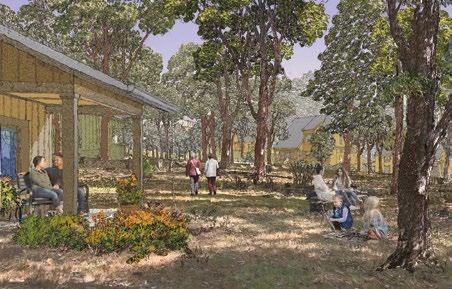
’65 C Doug Cooper writes, “As a longtime member of the Pittsburgh Cohousing Group, I’m excited to share that the construction of Rachel Carson EcoVillage will be complete this coming spring. We’re all about connections — with our neighbors and with nature. Our 35-unit development is 11 miles north of downtown in the highest-ranked school district in the region. We’re a multi-generational community with families in their 30s to their 70s. Our wooded site is part of an 80-acre campus with LaRoche University, where we’ll be members of their Center for Lifelong Learning. While stewarding our own woodland, we’ll also be living within walking distance of a grocery store and other neighborhood destinations, as well as the region’s largest park. My wife, Stefani, and I are looking forward to friendly neighbors and the kind of sustainable living we’ve been searching for.”
’65 RH Joan Andrews writes, “Hello classmates! I have been enjoying eight years as a grandmother of my five grandchildren. My two sons live in California and Connecticut. My oldest son heads up an oncology practice in California, while his wife is a trauma surgeon. My youngest son heads up marketing for technology companies; he began his career at Lyft, whose founder was a high school classmate. Thanks to the suggestion of Suni Stanton, I became a licensed tour guide seven years ago, hosting custom tours in the Hudson Valley, New York, Vermont, and New Hampshire. I enjoy meeting many wonderful people in this business! I spend much time with my twin sister, Jane, visiting our respective families and traveling with many of them.”
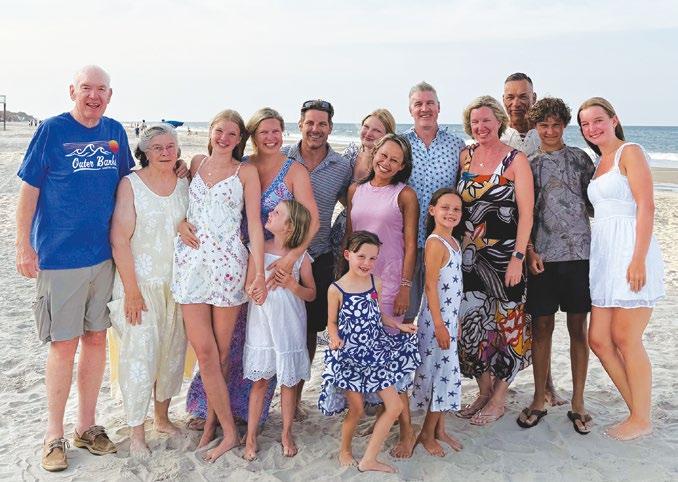
Dick Knight ’63 had a summer “Family Fest” for a week in the Outer Banks, N.C., including the whole family of three children with spouses and all seven grandchildren, ages 6-18.
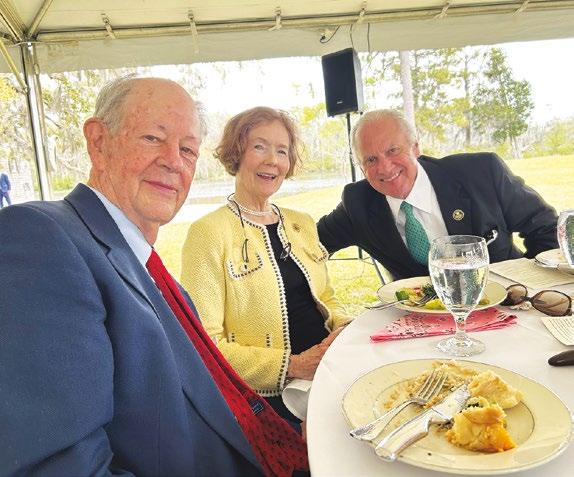
Lane Morrison ’63 with wife, Cille, and the Governor of South Carolina, Henry McMaster, at the Carolina Plantation Society’s spring luncheon.
’66 C Jamie Kirkpatrick writes, “My third novel — the culmination of the Declan Shaw trilogy — is scheduled for release on Feb. 24, 2026. It’s The People Game.”
David Tracy writes, “Cathy and I recently enjoyed a combination land and sea tour of Croatia. It is a beautiful, safe, and friendly country where almost everyone speaks English.”
’67 C Jonathan Farkas writes, “I am moving to Malta as my wife, Somers, is the new U.S. Ambassador there.”
’67 RH Mary Lou Lange writes, “I have been spending much time, as usual, dealing with my house and the property, reading, exercising, skiing, kayaking, time with friends, and romping with my four-legged soulmate, Dovydas, a German Shepherd and Great Pyrenees mix. We went up to the Cape several times camping. Still working on setting up a larger trip ahead to some exotic place.”
’69 C Greg Hooker writes, “My radio show, The Green Mountain Getaway, is now a podcast of vintage and new Americana, bluegrass, country, folk, and roots music.”
’69 RH Jessie Gaston writes, “I retired after 35 years at California State University, Sacramento. I taught the History of Africa and World History. Now, I am Professor Emeritus. I am beyond happy and grateful that my daughter, Sanyu Mulira, was hired in a tenure-track position at Georgia Tech in Atlanta.”
2 Vernon Glenn ’68 with his family, “Team Glenn,” in Berkeley, California, for the UNC – Cal game.
3 Leigh Yarbrough ’66 had a fun weekend celebrating with family in Raleigh! Her youngest grandson was excited to finally become a teenager, and his older brother was home from school for a well-deserved fall break!
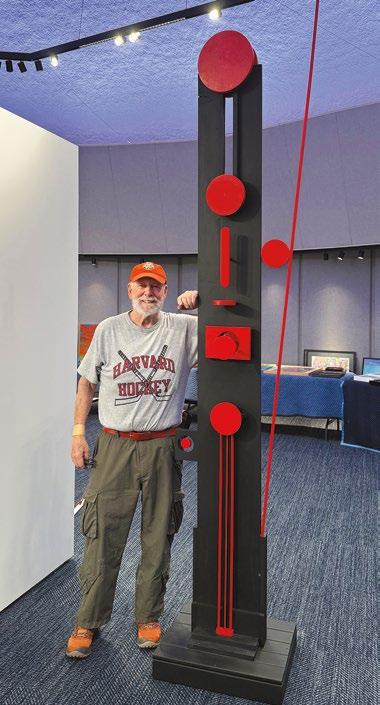
4 Rick Rosenthal ’67 is excited to share that a recent sculpture was accepted into “EXPECTATIONS” — a show at the San Bernardino County Museum — an 8' tall painted wood totem titled THE GUARDIAN.
5 Doug Cooper ’65 is excited to share a rendering of the upcoming Rachel Carson EcoVillage set to be completed in spring 2026.
6 Mary Lou Lange ’67 at Stowe, Vt.
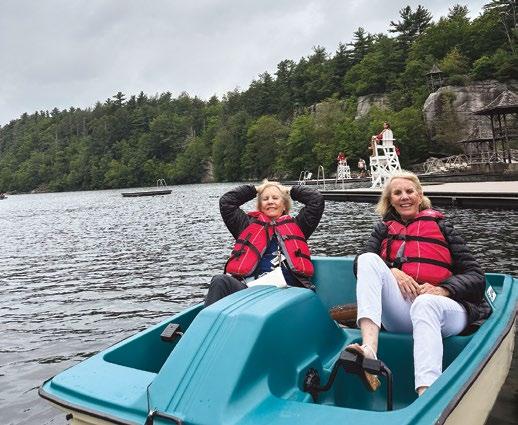
1 Joan Andrews and twin sister, Jane Andrews Goff, both Class of 1965, enjoying a paddle boat ride on the lake at Mohonk Mountain House, New Paltz, N.Y. It was a wonderful weekend with many cousins, children, and grandchildren.
1970s
’70 C Byron McCann writes, “I’m retired from my venture and finance career. My wife, Colleen, said, ‘Come work with me full-time,’ and I agreed. We are having a ball doing residential real estate together in Seattle with Windermere. I do some venture advisory work with a couple of clients, too. We had our first grandchild, a beautiful girl named Sloane. Our two sons are also in Seattle, doing well, and our daughter is in Los Angeles and just completed her second LA Marathon and is working at On Running. We are blessed with an active life with family, travel, and work. I often think of my classmates and the profound impact Choate had on me.”
Jay Moorhead and his classmates Charlie Miner, Jim Berrien, Bruce MacDougall, Chris McMurray, Chip Clowney, Chip Ryan, Win Simone, and Peter Robinson had a fun “mini” Reunion together playing golf and having dinner before spending the day at Choate. Several classmates paid their respects at the Choate Memorial of a classmate, Worthy Johnson’s daughter, Jen ’98, and also contributed to the foundation set up in her name.
Strat Sherman writes, “I’m living in Oakland, Calif., grateful to count several classmates among my dearest friends.”
’71 C Frank Gerold writes, “I am still representing Indian and Balkan claimants who suffered injuries in the wars in Iraq and Afghanistan. Very interesting legal work — The Defense Base Act. Otherwise, I am happy to pass on my ‘Grandfather’ name — used by my seven grandchildren: Poppy. Being a grandfather is a joyous experience … brings clarity to one’s view of life.”
Harton Smith writes, “After nearly 40 years of practice as an interventional cardiologist, first in Boston and then in Olympia, Wash., I retired to Tiverton, R.I., where I enjoy life with my wife, Mary Bandura, and Pearl, the wonder dog. Since retiring, I’ve found myself frequently talking with friends and neighbors about heart issues and the health news they see online. Those conversations made me realize how hard it can be to find clear, reliable medical advice. Doctor visits rarely allow sufficient time for detailed discussions, and the internet can be a minefield of misinformation and disinformation. This inspired me to launch a Substack newsletter as a way of providing trustworthy medical information for people without medical training. I try to make every piece current, evidence-based, and easy to understand. Unlike many Substack authors who monetize their content, I plan to keep everything free. The name of my Substack is The Cardiology Corner.”
’71 RH Katherine Tyson McCrea writes, “If you are in Chicagoland, please visit! My husband, three children, and dog live in Evanston. One son goes to college, and another teenage son and daughter live with us. All the children are rapidly developing into amazing people I’m privileged to know. I haven’t retired yet — I’m a Loyola professor actively involved and loving teaching social work and doing research supporting the leadership and voices of youth in high-burden communities and persons with disabilities. I also enjoy my small private practice in clinical social work as well as gardening, walking with friends, and yoga. I treasure many memories from my invaluable time at Rosemary Hall, where women’s intelligence was supported in multiple ways, and we made so many deep friendships.”
’72 C Jason Danielson writes, “I retired in May after 46 years in Silicon Valley. My career included the development of early computer graphics, digital paint, and digital recording systems for film and broadcast. I had a ten-year stint at Silicon Graphics, where I was director of marketing and worked with 80 software companies to develop animation systems for film and television. My last 13 years were with NetApp, marketing digital storage solutions for hospitals, banks, government entities, film studios, and video streaming services.”
’73 C Stephen Davis writes, “I’m thrilled to report that our son Gabriel ’14 got engaged to Emma Satterfield while climbing a mountain in Colorado this past summer. I spent time readying papers from a 1976 trip to China to donate to the Fung Library at Harvard’s Fairbank Center. The collection, including eyewitness accounts of the last great upheaval of the Cultural Revolution, is now available to scholars. Meanwhile, my wife and I sought refuge from politics by acquiring a modest olive grove to work in Provence. Any classmates ready for harvest duty?”
Tom Lord writes, “After spending our first year living in the U.K., traveling across much of all three countries (52 weeks across 15 counties), I have had my work visa extended for another year by Linklaters. I work about six to eight days a month, helping to build a regulatory and consulting practice within the law firm. For our second year, we are settling into a lovely village in southern Powys named Crickhowell. Happy to host anyone traveling through the area. Just give us a little notice.”
Louis Shenk writes, “After 40 years in the practice of pediatric anesthesiology, I retired in July. In some respects, I owe my career to my time at Choate, where my experiences and experiments in altered consciousness helped prompt my interest in and choice of anesthesia as a medical specialty. I am in the process of downsizing my collection of books, comics, magazines, and records acquired over the past 65 years. Does anyone want some old copies
of The Choate News? My wife Cyndi and I continue to raise our grandson Keagan, now in 5th grade. We keep busy with homework assistance and enforcement, attending playground football and baseball games, monitoring his Roblox and Fortnite use, trying to keep up on the bicycle with his e-scooter, and learning Gen Alpha slang. Who knew that I’m sigma and have rizz? No cap!”
Byron McCann ’70 and his wife, Colleen, at home in Seattle.
Brian Jacks ’74 and his wife.
Jason Danielson ’72 at his retirement party in the NetApp corporate suite, watching the San Jose Sharks.
Hans Kaiser ’76 with former faculty Ed Maddox and his wife, Susan, at their home in Cotuit, Mass.
’74 C John de Jong writes, “I’m enjoying the second year of my term as President of the World Veterinary Association, traveling the globe on behalf of my profession. So many wonderful places visited, meeting professional colleagues, but highlighted by speaking at the United Nations about antimicrobial resistance and joining with the World Medical Association on a renewed and updated understanding of working collaboratively in the area of One Health, which believes that animal health, human health, and environmental health are all inextricably intertwined and co-dependent for sustainable life on earth. Got to spend a wonderful time and catch up with Pam Forrester ’74, who was in Boston for a wedding. Love to hear from classmates about how they are doing.”
Brian Jacks writes, “I’m planning to go to Kauai next year, but in the meantime, we spent a few beautiful days in Scottsdale last April and visited my alma mater, the University of Minnesota, last September.”
’75 RH Cameron Fletcher writes, “I enjoyed our 50th Reunion! More than I expected to, actually, since I remember myself as insecure and withdrawn during my time at Choate Rosemary Hall, and I’ve hardly kept in touch with classmates over the years.
I had delightful conversations and connections with everyone. So I was surprised to fall into a funk when I got home. Not sure what happened, but it slowly abated after a couple of months. Which is good because I then had back-to-back freelance editing jobs, including a memoir and a novel — a nice change from my 30-year career of technical and policy editing.”
Caroline Radlow writes, “I am still working full-time as a residential mental health counselor. I made it to Saratoga on Belmont Day and again on Travers Day, had a great time, and am hoping to return next year. Hope everyone is well!”
’76 C Danny Carucci writes, “After taking a few decades off from theater and the arts, which were such an important part of my life at Choate (dabbling in medicine, science, and global health), I’ve found myself in the midst of two new passion projects in music. I opened Oak Street Recording Studios on Long Island, where my family had a summer home, and where we are focused on vintage vibes and bringing local artists together to record and publish their music. The second is the launch of a new startup, Tipify, to reduce inequities in the music business by empowering fans to support the emerging and independent artists they listen to and love. Get in touch and let me know what you think!”
Rod Fletcher writes, “It’s hard to believe that our 50th Reunion is around the corner and that I am making plans to attend. This past October I had a fantastic time getting together with Pat Fallon (Calif.), Guy Rovezzi (Conn.), and Fabe Yeager (Ore.) at Pat’s place in Carmel, Calif. I’m in Massachusetts. We spent our weekend together playing golf, but mostly sharing updates on our lives as well as old Choate stories, of which there are many. Hopefully, we will be able to get together again to continue the fun.”
Hans Kaiser writes, “I caught up with Jim Smith and Nick Lefferts in New York City last spring; both are doing well, Leffy in Denver and Smitty in Seattle. In July, Fritz Mitchell showed up to watch me play lacrosse in the Lake Placid old man’s tournament, and then we spent a night telling old war stories at his fishing cabin on the Ausable River. Great fun. Later last year my wife and I were on Cape Cod for a wedding and stopped off in Cotuit to see Ed and Susan Maddox. Looking forward to catching up with them all at our Reunion in May. I’m also a first-time granddad to Annie Kaiser, born May 17, 2025.”
’79 Philip Beauregard and Lynne Queenan Beauregard moved to Beijing, China, in October 2025. Philip has been appointed Ombudsperson at the Asian Infrastructure Investment Bank.
Michael Southworth ’74 had a rousing 6-day trip down the Middle Fork of the Salmon River, Idaho, this past August with family and friends, including Choate classmates (left to right), Tim Barnard ’75, Mike Southworth, Chip Lalone, Hans Peter Faye, and The Honorable Grant Mudge.
Tom Lord ’73 visiting Loch Lomond, Scotland.
1 1974 Classmates Mike Kazickas, Peter Prentis, John Steinbreder, and Ed Kelly at the Maidstone Club in East Hampton, N.Y.
2 Members of the Class of ’75 have a mini Reunion and celebrate Anne Drake’s birthday. — Left to right: Chelle Coe Gourlay, Muffy King Fox, Annie Lewis Drake, Liz Flavin, Maggie Moffitt Rahe.
3 Left to right: Fabe Yeager, Pat Fallon, Rod Fletcher, and Guy Rovezzi, all Class of 1976, at a recent trip to California in October 2025.
4 Class of ’70 gathering prior to 55th Choate Reunion: Sitting left to right: Charlie Miner and Jim Berrien; standing left to right: Bruce MacDougall, Chris McMurray, Chip Clowney, Jay Moorhead, Chip Ryan.
5 Katherine Tyson McCrea ’71 in her office at Loyola University, Chicago.
6 Danny Carucci ’76 — P.S. I grew a beard.
Hans Kaiser
Numbers Guy
’76
Despite the inauspicious beginning, the project was a seminal experience that helped Hans gain insights into political leadership. His tenure at Choate represented another formative time for Hans, who came to the school as a third former from Annapolis, Md. He received guidance from many teachers and benefited from the structure inherent to a boarding school environment. Hans credits Choate for shaping his character, work ethic, and ability to build relationships, qualities that served him well at Hobart College and as he entered the workforce.
“I loved my experience at Choate,” Hans says. “It was magical for me.”
Before transitioning to life as a pollster, Hans’ career included the Nixon interview project, working for the Republican Senatorial and Congressional Committees, and managing incumbent Senator Slade Gorton’s (R-WA) successful 1994 campaign. At that time, Hans was constantly analyzing poll numbers and collaborating with veteran Bob Moore, whose company was conducting research for Gorton. Moore noticed Hans’ aptitude for data and offered him an opportunity to open a D.C. office the following year, transitioning him from election intelligence client to provider.
Thirty years later, Hans still finds himself drawn to the numbers amid the ever-evolving landscape of how polling is conducted. The rise of social media has created new challenges, including overwhelming sources of information that make carefully collected data subject to the skepticism of those unwilling to alter their perspective.
“Social media has locked in some people’s inner beliefs,” he says. “Whatever you want to believe, you can find somebody online to confirm it.”
Amid the ever-evolving landscape of how polling is conducted, public opinion pollster Hans Kaiser ’76 is still drawn to the data.
Landlines are settling in among the dinosaurs of 21st century technology. According to the CDC, less than 25% of adults live in a household with a phone line plugged into a wall. That reality has changed the way Hans Kaiser ’76 does his job.
“Very few people have hard lines anymore,” explains Hans, a partner at Peak Insights, where he conducts research for political and corporate clients. “The problem is that people who have landlines are much older, but you also need to reach the younger demographic.”
Hans has been at Peak, a public opinion polling company, since 1995. In his three decades there, this technological shift has forced Hans and his team to adapt their methodologies. The traditional strategy of catching people at home after dinner to solicit their thoughts on a particular candidate or topic has turned into a combination of cell phone interviews, online surveys, text-to-online polling, and hybrid approaches that employ multiple methods.
His path to becoming a trusted source of public opinion polling for Republican candidates began at 14, when Hans canvassed for Richard Nixon during the 1972 general election. Years later, while working as an assistant on an extensive interview project, Hans had an embarrassing — but memorable — encounter with the former president. While changing his clothes in what he believed was an empty dressing room, the door opened to reveal Nixon.
“I was mortified,” Hans recalls with a laugh. “But Nixon couldn’t have been nicer.”
The constant fragmentation of information affects how quickly public opinion can shift and how people interpret data. In election years, Hans explains, particularly in the waning days of campaigns, opinions among swing voters — who actually decide elections — can change rapidly as television ads and social media content influence voter perceptions daily. The speed of change has led to more frequent outreach, with some campaigns conducting nightly surveys of at least 150 people that track rolling averages and real-time insights into voter sentiment over a few days.
While Hans has trusted bipartisan peers in the industry, he notes that dueling poll data can be deceiving. “They’ll put out numbers that show somebody ahead or somebody gaining ground,” he explains. “It’s to influence public opinion and say somebody can win here.” When polling numbers show a candidate is behind, Hans notes there’s often a debate about releasing those figures, because news of a trailing candidate can greatly influence public opinion. That happened in Hans’ work with Senator Susan Collins (R-ME) during the 2020 election cycle. Every public poll indicated the senator was trailing Democratic opponent Sara Gideon, but Peak released one that actually showed Collins up by eight points. She ended up winning by 8.59%.
Making those judgment calls is what keeps Hans invested in his work. While he’s uncertain what the future holds, and how artificial intelligence might impact public opinion surveys (“Is AI going to tell you who the winner in the race is, so nobody needs to do any polling?”), he remains committed to making a difference through helping his clients understand what matters most to their constituents.
“It’s more about how you accentuate the positive and deal with the negative,” he says. “Candidates have to tell the people what they’re going to do about the things they’re most concerned about — and they use polling to get at that.”
Despite the numerous options available to reach voters through modern technology, as far as Hans is concerned, “Talking directly to a person is still the gold standard.”
By Jana F. Brown Jana F. Brown is a New Hampshire-based writer and editor.
Sibling Rivalry?
Katie Propper ’78 achieved a hole-in-one on July 11 on the 12th hole at Falmouth Country Club in Falmouth, Mass. Not to be outdone, her brother, Eric Propper ’76, matched the feat with his own hole-in-one just two months later on Sept. 12, 2025, also on the 12th hole — this time at Woodway Country Club in Darien, Conn. Impressively, this was Eric’s second ace in less than two years, his first coming on Dec. 23, 2023, in Vero Beach, Fla. Looks like Katie’s got some catching up to do!
1980s
’80 Brian Harris writes, “My sci-fi comedy Last of the Red Hot Robots premiered at Empire Stage in Fort Lauderdale in September. It received rave reviews, though commercial success was as elusive as ever.”
’82 After four years as Provost at Dartmouth College, David Kotz is spending a year-long sabbatical conducting research at Imperial College London as a Royal Society Wolfson Visiting Fellow. He is enjoying the opportunity to visit universities throughout the U.K. and Europe, and to spend more time hiking and practicing his love of photography.
Bert Ulrich has been a Visiting Scholar at the American Academy in Rome, where he is working on a Taschen book on paparazzi photos in postwar Italian cinematic culture (due to be released in 2026). Bert is also EVP of Production Development for Italian producer Andrea Iervolino, working on entertainment productions about space exploration, which will eventually be filmed in space.
’84 David Mills writes, “Hello from New York. I am currently on a fellowship at the Cullman Center (with 14 other scholars) at the main (and main research) New York Public Library in Manhattan (the library lions’ building, officially the Stephen A. Schwarzman Building). I’m doing archival research and writing a full-length collection of poems about slavery in the Bronx, where I grew up. I also won both a New York Foundation for the Arts and a New York State Council on the Arts grant in poetry.”
’85 Brett Chappell writes, “It was great to fly over from Denmark and meet the gang for our 40th We spent less time reminiscing about the old times and more on catching up and hearing about our lives today! This event was the highlight of my spring.”
Jennifer Coe writes, “I completed my Ph.D. in Reggio Childhood Studies at the University of Modena and Reggio Emilia in May 2025, with a dissertation on food and taste education. I moved to Milan, Italy, in 1990, and since then I have worked as a translator and English teacher and, for the past 15 years, as an atelierista in a Reggio Emilia approach school and at the Centro Internazionale Loris Malaguzzi. I am hoping to continue doing research as a postdoc! I have two sons in their 20s and two cats.”
Bradford Rabin writes, “General hello to any Choate alums living in or visiting the SF Bay Area. I work in Palo Alto as an internal medicine doctor focused on longevity. I’m married with three kids ages 11-20. Still grateful for the rigorous education. Shout out to Eric Soderberg, Jon Gould, and Val Bogdan.”
Lisi Tesher writes, “Seeing everyone at our 40th Reunion was fantastic! I was so happy I made the trip. What an incredible group of people! I can’t wait to see everyone again.”
Christopher Winston is involved with a fast-growing leader in cloud-based revenue lifecycle management solutions with funding from a growth equity investor. He and his wife, Sally, attended this year’s Wimbledon tennis tournament and have long-term plans to attend all four Grand Slams. His daughters had busy summers as Caroline, a 2024 graduate of Wake Forest, ran the junior sailing program at the New York Athletic Club, along with her sister Caitlin, who is a 4th year at UVA. Shannon, a 1st year at UVA, worked as a sailing race instructor at Riverside Yacht Club in Greenwich, Conn. All three grew up sailing competitively at Larchmont Yacht Club.
’86 David Feiner writes, “The Chicago theater company I co-founded, Albany Park Theater Project, opened the 7th season of its long-running immersive performance, Port of Entry. Co-created and performed by an ensemble of youth artists, Port of Entry invites audiences on a journey through an apartment building where immigrants displaced from all parts of the world establish new homes side by side. I’m grateful for the extraordinary arts education I received at the PMAC from Bob Mellon, Paul Tines, Terry Ortwein, Gale Silverberg, and Maggie Kuypers. If you live in Chicago or plan to visit, please be in touch.”
’87 Christina Nelson Cook writes, “I’m delighted to share the recent publication of my second book, Roaming the Labyrinth with Marie-Claire Bancquart. It’s a hybrid genre text that weaves together my translations of French poems, my own poetry, and a speculative nonfiction narrative that tells the story of a myth and a Tarot-laden tour of Paris that spans centuries.”
Joseph Manning writes “Breakfast at Liz’s, and Jeffrey Schneider goes and orders salmon eggs benedict like he’s having his last meal on earth, and Joseph Manning gets a vegetable omelet because he thinks he’s the sensible one. It’s this whole tradition they’ve got now — meeting in Provincetown after Carnival, like the world would collapse if they didn’t. Kim and Duke were there too, sitting like it was the most natural thing in the world, though God knows why anyone would make a habit of watching those two eat breakfast. They call it friendship. You can call it a racket with coffee refills.”
’89 Marita Bolles Bollici writes, “It has been a long time since I checked in with my Choate community! I currently live in Oak Park, Ill., with my lovely son, Calvin (11), and our too-cute Boston Terrier, Boo. My work as an executive coach and ontological mentor has evolved to include high-networth individuals recreating their relationship with,
and impact on, the world. Concurrent to this is my art/music practice (recently completed an MFA from the School of the Art Institute of Chicago as a New Artist Society award recipient). Reading, evolving, creating, generally off social media, often composing arrangements of new wave songs on the piano. Lastly, I changed/restored my last name, Bolles, to the original Italian, Bollici.”
Sarah Ransom McKenna writes, “It’s been an exciting year to say the least, both personally and professionally! My son Shane graduated from Choate, where he did a PG year on the baseball team. He had a terrific experience, made many new friends, absorbed deep learning from Choate’s amazing teachers, and was delighted to be the third generation of my family to graduate from the School. More than anything, his experience at Choate set him up for success on the baseball team at Denison University, where they have the top baseball program in the Division III league. We then took a long-overdue vacation with my family (our first
summer without nonstop baseball in way too long) and enjoyed 10 days sailing in Croatia. As CEO of a Data & AI company for the past eight years, it’s been a mix of awe at the sheer speed of technological advancement and the invigorating challenge of leading at the forefront of data and AI innovation. I’m also active in various global financial and data industry groups working to establish standards for the ethical collection and use of data. It’d be great to connect with any classmates or alumni in this same area to exchange insights and ideas.”
Brian Newberry writes, “Beth and I are enjoying being empty nesters, rediscovering we have time for golf, among other things. We played 11 times together this year after not having played in about 28 years. Daughter Diane (age 28, what a coincidence) is married and living in Savannah, where she models, writes, and does landscaping. Son Liam is the assistant technical director at Providence Performing Arts Center. Our youngest, Aidan, enlisted in the Army out of high school (the best decision
he ever made, skipping the college route) and is currently in year three, stationed in Korea for the foreseeable future, where I suspect he will make a career out of it. Professionally, I am a partner with the Providence office of Lewis Brisbois Bisgaard & Smith, in my 30th year of legal practice, specializing mostly in professional malpractice defense, especially in the construction field. I also do arbitrations for the AAA and was just inducted into ABOTA, the American Board of Trial Advocates, the premier professional organization for trial lawyers. Finally, in 2026 I will enter my 18th year as a member of the Rhode Island House of Representatives, one of the senior members and the longest current active serving elected Republican official in the State, something I never would have predicted in 2008. It has been quite an interesting experience to say the least. Any Choaties or, at this point, their children who want a tour of the beautiful Rhode Island State House, or who are visiting R.I. and want to get together, just drop me a line.”
1
of the
of
had an
2 Class of ’85 looking sharp at their 40th Reunion in May 2025.
3 David Kotz ’82 begins a year at Imperial College London as a Royal Society Wolfson Visiting Fellow.
4 Jennifer Coe ’85 after she finished defending her dissertation.
Members
Class
1981
amazing dinner at the Yale Club in New York City, hosted by Thea Kashgarian Obstler. Left to right: (sitting) Nancy Stout, Thea, Stacey Gillis Weber, (standing) Janet Goodman, Margot Waldman, Marcia Saunders, and Michele Parsons.
Gary Crotty
Turbocharging NASCAR’s Future
’82
A Duke University economics major with a law degree from the University of Florida and an L.L.M. in taxation law from New York University, Gary was working at his father’s firm (which represented NASCAR) when Lesa Kennedy, granddaughter of NASCAR founder Bill France Sr., asked if he knew anyone interested in becoming the company’s general counsel. He said he would be. The timing was fortuitous — NASCAR went public the following year and the sport took off. “I loved it so much better than practicing private law, because it was all about business and growth and opportunity,” he says. One of those opportunities came during his first year there: helping NASCAR build the California Speedway on the site of an old slag plant.
The site was in such bad shape that it was used to film a dystopian scene for a Terminator movie (the final scene in Terminator 2: Judgment Day), Gary says, recounting the challenging process of getting it up to California’s environmental standards and then building the racetrack. “Stuff like that, when you get an opportunity to go and do something that really kind of hasn’t been done before … well, that’s pretty cool,” he says.
While Gary’s work entails the normal legal work of litigation and sanctioning agreements, a large part of his job is marketing NASCAR and building its brand. He’s done so by making strategic deals with television and streaming partners, figuring out how to secure the right mix of sponsorships and viewers. “You don’t want to take all the cash but not have your programming where the most eyeballs see it,” he says. Part of keeping those eyeballs watching meant breaking races into stages to maintain interest.
Driving engagement is all the more important as another motorsport — Formula 1 — vies to get many of those same viewers. “F1 is definitely coming into our market. They have more races in the U.S. than they have in any other country now, which we have noted,” Gary says, adding that he sees F1’s increasing popularity not as a threat but as an opportunity to grow motorsports.
At the same time, Gary’s had the occasion to get more involved with the body that governs F1 and that’s considered the world’s foremost authority on motorsports: the Fédération Internationale de l’Automobile (FIA). For four years, he’s been the American judge on the FIA’s court, and he was recently voted back in for a second four-year term.
As he readies for this term, he’s also winding down his career at NASCAR. Last year, he stepped away from his role as CLO to become special counsel. His goal is to transition to teaching high school and college students so that he can help them in the way that his teachers, and in particular those at Choate, helped him.
Gary Crotty turned legal strategy into a growth engine, taking NASCAR from local roots to global reach.
In his 30 years at NASCAR, Gary Crotty ’82 has helped steer the company from a Southern motorsport into an increasingly international empire worth billions. As a board member and longtime Executive Vice President and Chief Legal Officer, Gary was part of the team that guided the organization through explosive growth: from three racetracks to 15; from a private company to a public one and back again; and from a domestic sport to one that raced at LeMans and is making inroads into Mexico and possibly Canada and the Middle East.
The irony is that Gary, who grew up in NASCAR’s hometown of Daytona Beach, Fla., couldn’t name but five drivers when he started at the company. “I mean, other people, when they get here, they’re smoking the exhaust pipe, and they know everything,” he says. “[But] I wasn’t that way with any sports when I was 32.” Rather, what drove him was the thrill of finding the best strategies to help turbocharge the company’s expansion.
“I remember Mr. Ford’s marine biology class. He was an excellent teacher,” Gary says, describing him as someone who helped draw out the best of him. “In high school, teachers can make or break you to some degree,” he adds, noting that he now wants to pay forward his good fortune in having had supportive and engaged teachers.
He’s taught business law and business ethics classes at Stetson University, and is looking to teach a dual enrollment class at Father Lopez Catholic High School, from which he graduated before his postgraduate year at Choate. While his background lends itself to business and law courses, he’d also be interested in teaching political science or a short story class.
Whatever the subject, he wants to help students develop their critical thinking skills and the ability to effectively present their views. “[The] kinds of classes where kids have to not only learn something, but then apply it, take a position on it and then defend it … because I think that’s kind of the most helpful skill you can learn in life,” he says.
By KimBerly aShton
Kimberly Ashton is a Massachusetts-based writer and editor.
1 Bob Huseby and Courtney O’Connell, both Class of 1986, hiking in Maine’s Acadia National Park this summer.
2 Christina Nelson Cook ’87 at a reading of her new book, Roaming the Labyrinth, with Marie-Claire Bancquart, published by AIM Higher Press.
3 Anne Glass ’91, Head of School, at the first All School Assembly at The Roeper School, Bloomfield Hills, Mich.
4 Head of School Alex Curtis, Raye Osayimwese-Sisson ’23, and Brett Johnson ’88 at Rhode Island Football Club
5 Gretchen Roberts ’93 and daughter Clementine
6 Kate Verity Wilson ’93, Melanie Samarasinghe ’94, Caleb Urry ’94, Amanda Frazer ’94, Lauren Wimmer ’94, Abdi Nazemian ’94, and Odinn Johnson ’94 met up in New York City recently to attend the NYC launch of Abdi Nazemian’s latest book, Exquisite Things.
7 Martia Bolles Bollici ’89 having fun with the puppy and the boy (Boo and Calvin, respectively)
1990s
’90 Penny Bach Evins writes, “Serving in my professional role at Holton-Arms School allows me to reconnect with Choate in numerous ways. David Javdan ’86 is a parent, Amy Allman Dean ’92 is a parent, and Max Firke ’10 is a colleague! Visiting last spring for Reunion was a pleasure. From hearing Alex Curtis’ inspiring words, seeing classmates, taking in the campus, and participating in panels, I learn from Choate and am proud to support the School’s future. If ever in the D.C./Bethesda area, I hope to connect.”
’91 Anne Glass writes, “Last summer, I loved every minute of Ned Gallagher’s film course! So great to see familiar faces like Sam Bartlett, Meredith Savage ’90, Brian Yeh, and Meredith Levin
Hollander, my longtime dear friend through Choate and Wellesley! I moved from New York to Michigan. A gigantic, unexpected, and delightful new chapter in life. I am Head of School at The Roeper School and love every busy, mission-driven minute working with Roeper’s dedicated community. I left an elected position as a member of the Board of Trustees of Centre Island Village in Oyster Bay, a position of service to my community that I truly loved. I currently serve as a member of Wellesley College’s Class of 1995 Board. My kids are great! Jake graduated from the University of Richmond last May and is working as a financial analyst for AEC Advisors LLC in NYC. Owen is a junior at the University of Miami, living the (palm-tree-filled) dream, while also interning with Walker & Dunlap and serving on the UMiami Student Managed Investment Fund. Proud mom! I cannot wait to see everyone at our 35th Reunion. I find that our 50s are the best yet. Go, Judges!”
’92 Courtney Baker writes, “After a series of relocations, I have settled into life in Los Angeles. I first arrived in 2016 to help establish the Black Studies department at Occidental College. After a fellowship year at Emory (interrupted by the COVID outbreak), I returned to California to assume a faculty position in the English department at the University of California, Riverside.”
Caitlin Thompson writes, “After a recent, brutal divorce that upended my life and sense of self, I’ve regrasped the reins and spent the past year making a full reset. I moved to a lovely townhouse in central Virginia, quit my job, and started my own onewoman consulting company, and have continued the incredible adventure of being mom to my brave, compassionate, artistic, and hilarious 12-year-old son, Kippie. Here’s to new beginnings, fabulous adventures, and the great wide open.”
’93 Gretchen Roberts lives in Morrison, Colo., in view of Red Rocks Amphitheater. Her daughter Clementine is just starting to think about applying to independent schools. Gretchen works for Fresh Food Connect, a nonprofit mobile app connecting gardeners with excess produce to hunger relief organizations in 18 states.
’97 Alexis Boateng Pacheco writes, “It’s been a memorable year! I hit 20 years with the federal government as an electrical engineer and patent examiner, and celebrated 26 years living in the D.C. area. My husband and I marked our 10th wedding anniversary with a special summer in Puerto Rico, where our kids had an amazing time at camp at TASIS Dorado. Life back in D.C. is busy, happy, and full of gratitude for all that’s unfolding.”
Devon O’Neil writes, “My latest book is The Way Out: A True Story of Survival in the Heart of the Rockies, and it chronicles a backcountry ski trip gone wrong in January 2017 near Leadville, Colo. In short, a legendary U.S. Forest Service ranger and a 15-year-old boy became lost in a blizzard during a quick jaunt from their cabin at 11,300 feet. A massive search ensued. Nearly 30 hours later, an X Games champion snowmobiler found them separated in a remote, avalanche-prone drainage. Only one survived. He didn’t tell his story for five years. The book is at once an ode to mountain life and a dissection of what that life costs.”
’98 Until recently, Cait Unites was a commissioned Foreign Service Officer in her dream job implementing life-saving programs as the USAID Health Office Director in the Democratic Republic of the Congo (DRC). With the closure of USAID, Cait is now taking time to reflect and determine where she can best be of service. Her unanticipated return to the U.S. has allowed her to spend time with friends, including Amanda Lucier, Bianca Ferro, Christen Eddy Hadfield, Genevieve Croteau, and Amy Subach.
2000s
’00 Stefanie Foster Brown’s debut picture book was released with Denene Millner Books/Simon & Schuster last November. It’s a wintry, heartwarming story inspired by her own family’s immigration journey from Cabo Verde, entitled My Heart Speaks Kriolu. Stefanie, a former school psychologist, is enjoying the challenge of writing stories for young readers and has several other traditionally published picture books releasing in the next five years.
James Collins writes, “My family and I returned to our home in Bend, Ore., last fall after a 20-month overseas assignment with the Coast Guard. I am still in the Coast Guard Reserve and took advantage of a unique opportunity to serve on active duty for two years as the U.S. defense attaché at our embassy in Barbados. But the bigger news is that I left my job at Environmental Defense Fund in April to run for County Commissioner. With about 220,000 residents, Deschutes County is the fastest growing in Oregon and is desperately in need of real leadership as we grapple with a homelessness crisis, a growing wildfire problem, and a lot of other challenges that come with population growth.”
’01 Jessica Fong writes, “I am a newly published author! The book is Seeing Ourselves in Nature: Stories from Educators and Children of Indigenous, Black, and Other People of the Global Majority. It came from my early experience as an educator of color, learning about nature-based education and attending conferences. Again and again, I found myself in rooms, books, and research where no one looked like me. This glaring omission struck a nerve. I knew educators and families of color were connecting children to nature, but their stories were not being told. This book is a beginning. The voices of educators of color are centered here, telling the story of their work in their own words. This book provides a platform for these educators who have long been doing this work, often unseen. I’m honored to have stewarded their stories into the world.”
’02 Sarah Allen McConnell has published a textbook on embryology. High-Yield Approach to Medical Embryology (McGraw Hill) presents core concepts in human embryonic development and related clinical correlations using a streamlined, bulleted outline format.
TOP Alexis Boateng Pacheco ’98’s three children enjoying their summer in Puerto Rico.
MIDDLE Devon O’Neil ’97 and his family at his book launch party for The Way Out: A True Story of Survival In the Heart of the Rockies.
BOTTOM Stefanie Foster Brown ’00 (right) with classmate Jessica Melendez Rodriguez (left) at the Newton Children’s Book Festival. Stefanie was honored to share her debut picture book, My Heart Speaks Kriolu, with Jess and her students.
’03 Matthew DeSantis continues his work as founder of MyBhutan, a boutique travel designer and outfitter that creates private journeys across Bhutan. His most recent project, the luxury tented Sangwa Camp, was featured on Time’s World’s Greatest Places in 2024 and 2025. Now dividing his time between Bhutan and Puerto Rico, Matt remains dedicated to cultural preservation, community-based tourism, and youth development in the Himalayas. His “Baseball in Bhutan” photograph, honored by the Sony World Photography Awards and Travel Photographer of the Year, reached over 25 million people and led to Bhutanese youth being invited to the U.S. by the New York Yankees and Hudson Valley Renegades to celebrate the growing bond between the two nations through sport. Matt recently became a member of YPO and was appointed Fellow at The Explorers Club, where he has been a member since 2016.
’05 David ‘Van’ Bloys married Joseph Justin Whited on June 6, 2025, in a ceremony at the Old Chapel at Central Moravian Church in Bethlehem, Pa., Van’s hometown. Presiding at the ceremony was the Rev. Elizabeth Keeler, Rector of Trinity Episcopal Church in Washington, Va., where Joe is mayor. Choate ’05 was well represented on the dance floor, including Doug Berman, Ben Broderick, Morgan Eifler, Vanessa Le, Max Sinsteden, and Christian Tookes.
Elisabetta Zucchi writes, “My company, BoxPlay.io, has launched a new learning platform and secured a lead investor to support our next stage of growth. Through BoxLabs.AI, we are expanding this work by developing the Attention to Knowledge Engine, an AI system designed to turn attention into real understanding. By combining creative storytelling, pedagogy, and technology, we’re exploring how AI can help people learn, remember, and engage with ideas in more meaningful ways. Choate’s spirit of innovation and its encouragement of different ways of learning, which was especially important to me as a dyslexic student, continues to inspire my work today.”
’07 Seamus Connolly has been appointed Medical Director of the freestanding psychiatric hospital Coachella Valley Behavioral Health. Appointment was made in concert between the Acadia Hospital Group (who owns the hospital) and the Vituity Medical Group (which staffs the physician talent for the hospital). Seamus is a psychiatrist who built a private clinic (which has grown to supply standard and specialized psychiatric care for more than a thousand patients per year) while also forging meaningful connections to multiple large Healthcare systems important to the Coachella Valley.
Peter Gault writes, “The AI for education nonprofit that I founded, Quill.org, has reached 10 million students impacted, including a class of Choate Rosemary Hall students! Quill helps students
build their critical thinking skills through AI-powered writing activities. Quill was featured in the Chronicle of Philanthropy and in a segment for the Today Show We are looking for new nonprofit education and philanthropy partners; you can reach me at peter@quill.org to get in touch.”
’08 Sam Pape writes, “I celebrated my wedding this past May in NYC with four of my best friends from the Class of 2008! Ashley McGeary, Rebecca Sassoon, Andrew Silberstein, and Melody Travers were all in attendance and gave toasts or speeches. I also recently moved to the Hudson Valley with my husband, Will, and would love to reconnect with Choaties in the area.”
’09 David Engstrom writes, “I married my wife, Dana, in June 2024, and we just welcomed our new son, Bennett Michael Engstrom, in April 2025. I was also recently promoted to Major in the United States Army JAG Corps and will be leaving active-duty military service in January 2026 to pursue a career in private litigation.”
Kristen Raddatz has received a two-book deal with Hachette’s romance imprint, Forever. Her debut cozy fantasy romcom, A Tale of Mirth & Magic, was published in August 2025 under her pen name, Kristen Vale, and her second novel will be out in fall 2026. Kristen also continues to work her day job as marketing manager at The University of Chicago Press, where she just celebrated her 12-year anniversary. She lives in Chicago with her partner Jon, a home full of books, and her frenemy black cat, Opal. You can connect with her on social at @kristenvalewrites.
2010s
’10 Julia Discenza writes, “After 10 years living in NYC, where I was a professional modern dancer and cinematographer, my fiancé and I have relocated to Ann Arbor, Mich., where he will pursue a Ph.D. in history. I am continuing to pursue filmmaking as a director and cinematographer of documentary, commercial, and dance-related projects, and would love to connect with any Choate alumni in the area.”
Brandon Sherrod writes, “Since graduating from Choate, life has continued to be full and meaningful. I’m currently in my third year as an assistant basketball coach at Yale, working with an incredible group of student-athletes and hoping to guide the program to our third consecutive Ivy League championship. Coaching at my alma mater has been a rewarding way to stay connected to the game while mentoring young players as they balance academics, athletics, and personal growth. Outside of basketball, I’ve stayed active musically and continue to perform and write when time allows. I also remain involved in several community
and educational initiatives in New Haven that use sport and the arts to inspire local youth. Choate continues to hold a special place in my life, and the lessons from my time there continue to shape how I lead and engage with others today. If you’re ever stopping by New Haven for a slice of pizza, be sure to check out Yale Men’s Basketball.”
On August 23, 2025, Adanma Raymond ’12 and Alastair Clements ’13 were married in the town of Wallkill, N.Y. The wedding was officiated by Alastair’s uncle, Faulkner Hunt, who briefly attended Choate in the 1980s. It was at Choate that he first met his now-wife, Alastair’s aunt, Ann Lightfoot ’84. The Choate-filled affair featured a bridal party with maids of honor Ericka Poltash ’12 and Randoll Akselrad ’12, and best man Matt Floyd ’13. Adanma writes, “Although we overlapped at Choate and later both attended Columbia (Class of 2017), it was actually a dating app many years later that brought us together. What a joy it has been to revisit the ways Choate shaped us through the lens of this relationship. We are deeply grateful to our alma mater for the lifelong friendships we found there.”
Brandon Sherrod ’11, assistant basketball coach at Yale University, with the trophy for the 2025 Men’s Basketball Ivy League Championship.
1 Yankees’ Aaron Judge greets Matthew DeSantis ’03 and Bhutanese youth at Yankee Stadium (photo credit: New York Yankees)
2 Kristen Raddatz ’09 with her newly published book, A Tale of Mirth & Magic.
3 David Engstrom ’09 was promoted to Major in the United States Army JAG Corps.
4 Jessica Fong ’01 with her newly published book, Seeing Ourselves in Nature: Stories from Educators and Children of Indigenous, Black and Other People of the Global Majority.
5 Classmates of 2007 Lily Haydock Sanders, Briana Fasone, and Kiki Kazickas vacation at Briana’s family home in Mougins, France, in August 2025.
2020s
’21 Sabrina Carlier writes, “Along with receiving my BFA in drama with theater honors from New York University Tisch School of the Arts this past May, I was also awarded Outstanding Achievement in Studio — Atlantic Acting School at the Tisch Department of Drama’s 27th Annual Drama Awards Ceremony. To name a few exciting projects since graduating, I wrote and directed a short play margot for the ALab Theater Festival; performed and directed parlor readings at Savage Wonder Art Center in Beacon; and am currently Assistant Director and Dramaturg to Kevin Kuhlke on his MainStage production for the Experimental Theatre Wing at NYU.”
Andrew Carmody writes, “Post graduation from Amherst this spring, I will start my career in NYC as an investment banking analyst at PJT Partners. Looking forward to catching up with Choate people in the professional world!”
’25 Will Schneider and several classmates attended the July 5 soccer match between Rhode Island FC and Birmingham Legion FC at Centreville Bank Stadium in Pawtucket, R.I. RIFC was founded by Choate grad Brett Johnson ’88, whose ownership group includes numerous Choate alumni from the Class of 1988, including Will’s dad, Jack Schneider, Steve Lundin, Samir Desai, and Katie Mautner Grieco. Michael Papaspyros and Will Henderson, both ’25, plan to play together again for the PAL Jr. Islanders in the upcoming hockey season.
TOP This summer, Lauren Finkelstein Gray and Amelia Lane Johnson Jaben, both 2008, had a wonderful reunion out in California with all of their kids. Left to right: Penelope Jaben (3), Mia Gray (2), Eloise Jaben (5), Amelia, Hayes Jaben (1), Lauren, and Zoe Gray (1)
BOTTOM Left to right, 2025 Choate grads: Michael Papaspyros, Will Schneider, Jacob Head, Rowan Aggarwal, Will Henderson, Nolan Kappus, one of Nolan’s friends who didn’t go to Choate. Behind the camera: Kameron Mohammed.
Lisana Quintiliani ’21 and her father, Richard Quintiliani ’77, summited Le Grand Paradis in the Italian Alps in August 2025. The two-day climb brought them to an elevation of 4,061 meters, where they were rewarded with breathtaking views of the French, Swiss, and Italian Alps.
CLASSNOTES | New Beginnings
1 Morgan Ballengee ’11 wed Mark Jungmann in Montecito, Calif., on April 12, 2025. 2011 classmates pictured from left to right: Christina Montesi Pusar, Alex Tenney Katzenstein, Morgan, Mark, Danielle Adler Sherill, and Paula Ho.
2 Wedding of Adanma Raymond ’12 and Alastair Clements ’13 — Choaties in attendance from Class of 2012: Adanma, Randoll Akselrad, Ericka Poltash, Ben Ballard, Gabrielle Zachery, Gabrielle Reisner, Justine Seivright, Alex Poltash, Claire Abbadi, and Alexander Nassief; Class of 2013: Alastair, Matt Floyd, Brian Sarfo, Alyssa Hubbert, Victoria Nassief, Ellison Taylor, Richard Soper, Austin Hubbert, Shane Potts, Jeff Coby, Jack Murren, and Taylor Lemmons; Class of 2026: Rose Lightfoot. Other Choate connections: Faulkner Hunt (officiant), Colin Lord (former faculty). Not pictured: Alexandra Lightfoot ’79, Elizabeth Lightfoot ’81, Ann Lightfoot ’84, John Lightfoot ’86, Bowen Kelley ’09, and Isabel Clements ’11.
3 On Sept. 21, 2024, Tessa Tookes ’13 married Joey Kirchner in Prince Edward County, Ontario, Canada. Joey and Tessa married after finding love on Season 2 of Bachelor in Paradise Canada. Choate Alums in attendance with the bride and groom: Gianna Collier-Pitts, Cameron Congleton, Katherine Fickel, Channing Tookes ’07, Christian Tookes ’05, Isabel Álvarez de Lugo, and Ashley Scheller.
4 Mark Wilcox ’82 married Mary Rentoumis on June 7, 2025, in Fort Lauderdale, Fla. They moved there after more than 25 years in California to be closer to family, including their five children. They would love to catch up with any alumni nearby.
6 Van Bloys ’05 married Joe Whited on June 6, 2025, in Bethlehem, Pa., followed by a dinner dance at Saucon Valley Country Club. Left to right from top row: Ben Broderick, Morgan Eifler, Jordan Rundell, Christian Tookes, Doug Berman, Ross Keller, Max Sinsteden, Allegra Eifler, Joe, Van, and Emili Tookes.
7 This summer, Afia Amoako ’14 had the wonderful opportunity to reconnect with her dearest friends from Choate Class of 2014 at her traditional wedding. From left to right: Sherri Afshani, Emily McAndrew, Afia, and Alex Klein.
5 Wall-to-wall Walls at the wedding of Catherine Wall ’12 to Will Stockton in Bermuda on May 10, 2025. Left to right: Tom Wall ’76, Jon Wall 82, Cinda Wall Ball 83, Sophie Ball 17, Chris Wall 80, Trustee Duby McDowell ’78, Josh Wall ’77, Will, Catherine, Lily Ball 20, Avery Stewart ’12, Coco Chen ’12, Mackenzie Tesei ’12, Charlie Wall 15, and Consuelo Garcia-Garcia ’12.
8 Sam Pape ’08 and husband Will Levitt at their wedding on May 10, 2025, in NYC.
1 JJ Abram ’99 and his wife, Naquita, welcomed their third child, daughter Riva Gabrielle, in April 2025.
2 Jane Mosbacher Morris ’04 and her husband, Nate, welcomed their son, JR Morris, on July 18, 2025.
3 Diane Gremillion Evans ’12 and her husband, Daniel Evans, welcomed Grace Rosemary Evans on April 30, 2025.
4 Luz Solano-Florez ’15 and her husband, Austin Winter, welcomed a baby boy, Austin Miles Winter Solano, on August 19, 2025.
IN MEMORIAM | Remembering Those We Have Lost
Alumni and Alumnae
’48 C George K. Moss, 95, a retired executive of aircraft and electronics companies, died August 5, 2025, in East Hampton, N.Y. Born in New York City, George came to Choate in 1943; while he was at School he obtained his pilot’s license. After graduating from the University of Virginia, he served in the Army, including three years at the Pentagon with the research unit that developed the Huey helicopter. Later he was with Ampex, the audio and video company. George was on the board of the Woods Hole Oceanographic Institution. He leaves his wife, Joyce Moss; two sons; and two grandsons.
Robert S. Walin, 95, an antiques dealer, died August 25, 2025 in Southport, Conn. Born in the Bronx, N.Y., Bob came to Choate in 1945; he lettered in football, hockey, and baseball. His studies at St. Lawrence University in Canton, N.Y., were interrupted by two years in the Marines; he graduated in 1952. He was with Shell Oil on Long Island for 13 years, but then moved to Woodbury, Conn., to pursue his loved of antiques; his specialty was early American furniture and folk art. Bob enjoyed bicycling, fishing, and spending time on Nantucket. He leaves two children and a stepdaughter.
’49 C William H. Plauth Jr., 95, a retired physician, died September 21, 2025. Born in Amityville, N.Y., Bill came to Choate in 1947; he lettered in tennis and was in the Glee and Choral clubs. After earning degrees from Princeton and Cornell Medical College, he completed internships and residencies in pediatric cardiology. After serving at Egleston Hospital for Children in Atlanta, he was one of the founding members of the Children’s Heart Center. In 2003, he was given a Lifetime Achievement Award from the Georgia chapter of the American College of Cardiology. Bill enjoyed sailing, tennis, and bluegrass and classical music. He leaves two children and five grandchildren.
’50 C Charles B. Fay, 93, a retired aeronautical engineer, died September 20, 2025 on Long Beach Island, N.J. Born in Boston, Chuck came to Choate in 1946; he played trumpet in the Band and Orchestra. After earning degrees from Middlebury and MIT, he worked for 30 years for Boeing’s Vertol Helicopter Division in Philadelphia. An avid sailor, Chuck sailed in the British Virgin Islands and the entire U.S. East Coast; he also enjoyed tennis, travel, and scuba diving. He leaves five children, nine grandchildren, and four great-grandchildren.
’50 RH Marian F. Burros, an awardwinning food writer and cookbook author, died September 20, 2025 in Bethesda, Md. She was 92. Born in Waterbury, Conn., Marian Fox came to Rosemary Hall in 1947. She headed the Answer Book committee and won School prizes for punctuality and history. Marian described her time at Rosemary Hall as “one of the best things that happened to me,” although she called the School food “just horrible.” After marrying and graduating from Wellesley, she was a librarian who, with a friend, self-published a cookbook called Elegant But Easy, which was picked up by a major publisher and sold half a million copies. It was the first of many cookbooks she wrote or co-wrote. Marian wrote about food for newspapers: first a local weekly, then a local daily, and then The Washington Star. In 1974, she moved to The Washington Post, and in 1981 to The New York Times. There, her most famous recipe was one for plum torte (see right), which was reprinted year after year and was the most-requested recipe in Times history. In addition to recipes and food news, she did investigative journalism about nutrition, the politics of food, and economic, health, and safety issues involving the food industry, for which she won several awards. There were, in her words, “a lot of fraud, a lot of cover-ups” among food purveyors — for instance, stores describing some salmon as wild-caught when in fact it was farmed. Marian retired in 2008 but continued to write for various publications. She leaves a daughter and two granddaughters.
’51 C Henry Carter Alden, 92, retired President of an engineering firm, died August 25, 2025 in Charlotte, N.C. Born in Warren, Ohio, Carter came to Choate in 1948; he was in the Choral, Glee, and Western clubs. After graduating from the University of Missouri, he served with the Navy. Carter began his career at Piedmont Natural Gas, later was a project manager at Catalytic Inc., and finally was President of Carrington Engineering Sales. He loved sports, especially tennis, which he played until age 90. He leaves his wife, Frances Alden, and three children.
’54 C Merritt Dutton Morehouse Jr., 89, active in the Episcopal Church, died November 6, 2025 in Athens, Ga., Born in Evanston, Ill., Terry, as he was known at Choate, was in the Altar Guild, was Literary Editor of the Literary Magazine
and Senior Editor of The Brief. (Later in life, he was known by his middle name, Dutton.) After graduating from Yale, he worked in public relations in Chicago. An ordained Archdeacon of the Detroit Diocese of the Episcopal Church, he spent many years as a chaplain and edited Diakoneo, the magazine of the Association of Episcopal Deacons. Terry later moved to Georgia, where he was chair of the Morgan County Democratic Party. He enjoyed reading and was a longtime member of a nonfiction book club. He leaves his wife, Joyce Morehouse; five children; seven grandchildren; and a brother.
’55 C Peter H. Seed, 88, a retired attorney, died September 26, 2025. Born in Toledo, Ohio, Peter came to Choate in 1950. He lettered in football, wrestling, and track; was Chair of the
Marian Burros’ Plum Torte
INGREDIENTS
• ½ cup unsalted butter (1 stick) softened
• ¾ cup granulated sugar plus 1 tablespoon divided
• 2 large eggs
• 1 cup all-purpose flour
• 1 teaspoon baking powder
• ¼ teaspoon salt
• 6-12 plums depending size, pitted and halved (frozen OK if thawed and drained)
• Juice from ½ lemon
• 1 teaspoon cinnamon
Preheat the oven to 350°F and butter the inside of a 9-inch springform pan. Cream together the butter and ¾ cup of sugar in a medium bowl until light and fluffy. You can use an electric mixer. Add in the eggs, one at a time, making sure each is fully incorporated. Mix in the flour, baking powder and salt until just combined. Spread the batter into the pan and smooth the top. Arrange the halved plums cut-side-down, then use your fingers to gently press them into the batter. Squeeze the lemon juice over the fruit, then mix together the remaining tablespoon of sugar and cinnamon, and sprinkle over the top. Bake for about 45 minutes to an hour, or until the cake is golden brown and a toothpick inserted into the center comes out clean. Allow the cake to cool on a rack for at least half an hour prior to cutting.
Debate Council and President of the Current History Club; and won School prizes for excellence in public affairs, debate, and public speaking. After a year in England at Harrow School, he graduated from Yale and from Harvard Law School, then was a legal officer in the Army. He and his wife then moved to Minnesota, where he joined a law firm in St. Paul as a public finance attorney. Active in civic affairs, Peter worked to convert an abandoned rail line into a walking and biking train. He enjoyed travel and the outdoors, in retirement spending two months a year hiking and biking in New Zealand. He co-authored books on walking and bicycling here and abroad. He leaves two children and four grandchildren. Two brothers, Alan Seed ’43 and William Seed ’49, also attended Choate, as did a cousin, George Matthews ’55.
Roger E. Vaughan, 88, a writer, died August 25, 2025, in Easton, Md. Born in Manchester, N.H., Roger came to Choate in 1953; he was Literary Editor of the Literary Magazine; President of the Golden Blues (drums); and in St. Andrew’s Cabinet. After graduating from Brown, he had a long career in writing, editing, and photography. The founding editor of Yacht magazine, he wrote 12 books and contributed to many periodicals. Roger loved sailing, crewing on several Bermuda races and participating in many more events internationally. He leaves his wife, Kippy Requardt; a son; a stepdaughter; and three granddaughters.
’56 C Jon M. Dickinson, 87, a retired lawyer, died April 29, 2025. Born in New York City, Jon came to Choate in 1952; he was Vice President of both the Glee Club and the Maiyeros. After earning engineering and law degrees from Cornell, he worked for the intellectual property law firm Kolisch Hartwell in Portland, Ore. He helped clients obtain crucial patents and argued before the U.S. Supreme Court. From 2004 to 2014 he ran a solo law practice. He enjoyed filmmaking, choral singing, making and playing string instruments, and riding Harley Davidsons. He leaves his wife, Marlene Burns, and two children. Robert Livingston Gaines, 87, a retired marketing and advertising executive, died November 3, 2025 in Darien, Conn. Born in New York City, Bob came to Choate in 1952. He was Photography Manager of both The Brief and The Choate News, was in the Camera Club, and won a School prize for excellence in photography. After earning degrees from Sewanee and the University of Virginia, he had a lengthy career in advertising and marketing. A longtime Choate class agent, Bob enjoyed train travel and backgammon. He leaves his wife, Marjorie Gaines; two children; and five grandchildren. Bob was a member of the Choate Society, those alumni who have left a bequest to the School.
’58 C Joel Cassel, 85, a retired lawyer, died May 5, 2025. Born in Waterbury, Conn., Joel came to Choate in 1954; he was on the Board of The Brief and was President of the Press Club. After earning degrees from Brown and New York University, he spent the majority of his career as a partner at Jeffer Mangels Butler & Mitchell in Los Angeles. He enjoyed travel. Joel leaves his wife, Lisa Cassel; four children; and five grandchildren.
Edward S. Evans III, 86, an executive of industrial firms, died August 2, 2025. Born in Detroit, Ned came to Choate in 1953; he lettered in hockey and was in the Glee Club and the Altar Guild. After graduating from the University of Michigan, he had a career that spanned several construction industries, including Evans Products, Emhart Corp., Ralph S. Wilson Co., and General Dynamics Corp. Ned enjoyed music, fishing, and sports. He leaves his wife, Laura Evans; four children; eight grandchildren; and a brother.
’60 C John Franklin Joyce II, 83, a stockbroker, died May 25, 2025 in Rio Rancho, N.M. Born in Carlsbad, N.M., John, known as Frank, came to Choate in 1956 and was in the Model Railroad and French clubs. After graduating from Campbell University in North Carolina, he was a stockbroker for nearly 50 years. He enjoyed music and studying economics. He leaves two sons and four grandchildren.
John W. Bowman Jr. became a naval aviator in the Marines, serving in Vietnam. John flew one of the last helicopters out of South Vietnam when it fell to the North in 1975. Active in the American Legion, he participated for years in the Wounded Warrior mentor program.
’62 C John W. Bowman Jr., 81, a retired Marine Corps officer, died August 21, 2025 in Laguna Nigel, Calif., from complications of Alzheimer’s disease. Born in Cape Girardeau, Mo., John came to Choate in 1959. He lettered in football and wrestling, was on the Student Council, and was in the Current History, Choral, and Glee clubs. After graduating from Princeton, he became a naval aviator in the Marines, serving in Vietnam. John flew one of the last helicopters out of South Vietnam when it fell to the North in 1975. Active in the American Legion, he participated for years in the Wounded Warrior mentor program. He leaves his wife, Grace Bowman; two stepsons; and four grandchildren.
Jeffrey C. Morse, 81, a retired physician, died October 15, 2025. Born in New London, Conn., Jeff came to Choate in 1958; he lettered in football — the team was undefeated in his sixth form year — and was in the Glee Club and St. Andrew’s Cabinet. After earning degrees from Colby College and the University of Vermont College of Medicine, he spent decades as an anesthesiologist at Mercy Hospital and Maine Medical Center in Portland. Jeff enjoyed sailing, golf, and cooking. He leaves three sons (triplets), including Matthew Morse ’94; and seven grandchildren. Jeff’s three brothers also attended Choate: the late Willard Morse ’50, J. A. Morse ’52, and Christopher Morse ’58.
’62
George A. Woolley, 81, a retired insurance executive, died October 6, 2025 in Bethesda, Md. Born in Bar Harbor, Maine, George came to Choate in 1959; he was Editorial Chairman of The Choate News and in the Art and Glee clubs. After graduating from New York University, he spent most of his career working for the Government Employees Insurance Co. (GEICO). He was a founding member of MDI Wheelers, dedicated to increasing accessibility to the carriage roads of Arcadia National Park in Maine. George enjoyed tennis and sailing. He leaves his wife, Linda Woolley; three daughters; five grandchildren; and a sister.
’63 C Thomas Revillon Winans, 80, a psychologist, died September 15, 2025 in Little Rock, Ark. Born in Los Angeles, Rev, as he was known at School), came to Choate in 1958; he was in the Art, Conservative, and Ski clubs. After graduating from the University of Virginia, he completed his Ph.D. in psychology at the University of Mississippi. He was a psychologist for many years, most recently at Living Hope Institute Southeast; he was a former Chair of the Arkansas Board of Examiners in Counseling. Rev liked skiing, dogs, gardening, reading, and music, and was known for dressing well even when others opted for a more casual look. He leaves his wife, Anne Winans; two sons; and three siblings.
Active in the community, Carlotta Wick worked with Womanspace, which counsels and shelters victims of domestic and sexual abuse.
’65 C George R. Hoguet, 77, an investment banker and finance professional, died September 23, 2025. Born in New York City, George came to Choate in 1961; he was in the French Club and the Russian Club (Secretary) and won a School prize in Russian language. After graduating from Harvard and its Business School, George spent decades in economic development, policy, and finance, especially at State Street Global Advisors; in the 1980s he was Principal Deputy Assistant Secretary for International Affairs in the Treasury Department and represented the United States at the World Bank.
George enjoyed travel, history, skiing, hiking, and the arts. He leaves his wife, Marie Hoguet; three sons; and three grandchildren. His cousins who also attended Choate are John Arthur ’66, Richard Arthur ’70, Sean Cosnard des Closets ’80, Marc Cosnard des Closets ’81, and Elisa Colas ’85.
’66 C Frank T. Hamilton III, 78, died August 8, 2025 of complications from Alzheimer’s disease. Born in Cincinnati, Frank came to Choate in 1963; he lettered in football and lacrosse, and was in the Automobile, Press, and Spanish clubs. After graduating from the University of North Carolina at Chapel Hill, he served four years in the Navy, attaining the rank of Lieutenant. He was then President of Short Run Companies. Frank loved tennis, golf, and coaching his children’s sports teams. He leaves his wife, Emily Hamilton; three children; three stepchildren; seven grandchildren; and one step-grandchild. His mother was the late Kathryn Hosford RH 1934.
’71 C Peter S. McArdle, 72, an entrepreneur, died of cancer September 17, 2025 in Raleigh, N.C. Born in Lawrence, Mass., Peter came to Choate in 1967; he was in the Press Club, the Ski Club, and Gold Key. After graduating from Tufts, he ran his own company during the dot-com boom and sold insurance for Nationwide. He loved the ocean, sailing, and fishing. He leaves his wife, Cindy Lee McArdle; three stepdaughters; and two siblings.
’72 RH Carlotta Wick, 70, an attorney, died August 22, 2025 of cancer. Born in Norfolk, Va., Carlotta came to Rosemary Hall in 1969. She lettered in volleyball and lacrosse, wrote for the literary magazine, and was in the Art Club. She was designated a Rassweiler Scholar. After working briefly at House & Garden magazine, she earned a law degree from the University of Chicago. Carlotta worked for several law firms in Chicago and Connecticut, then retired from private practice and was the in-house lawyer for her husband’s company. Active in the community, she worked with Womanspace, which counsels and shelters victims of domestic and sexual abuse. She enjoyed vacations and Virginia Beach. She leaves her husband, Christopher Rice ’72; and two children, including Carlotta ‘Carlie’ Rice 2009.
Staff, Faculty, Trustees
Charles Donadio, who worked in the equipment room for the School’s Athletic Department for 14 years, died October 30, 2025. He was 92. Born in New Haven, Charlie graduated from Notre Dame University, then served in the Korean War. He later owned the R & R Package Store in Wallingford. He came to Choate Rosemary Hall in 1984 and retired in 1998. Recalls water polo coach Todd Currie, “Charlie was always helpful and supportive when I, young and ignorant, needed his assistance. He made me feel good about my role in athletics and was fully committed to helping the athletes in our care.”
Retired teacher John Connelly remembers that Charlie was “always a friendly presence at the equipment room, and he greeted each student with a welcoming grin and some soft affirming words that bespoke both familiarity and empathy.” He enjoyed music, especially jazz, and was a big Notre Dame football fan. He leaves his wife, Frances Donadio; a son; four grandchildren; and several great-grandchildren.
Vicki Killian-Lehr, a groundskeeper at Choate Rosemary Hall since 2011, died November 2, 2025. She was 66. Throughout her years of service, Vicki was known for her unwavering commitment, cheerful presence, and genuine care for the campus and community around her. Head of School Alex Curtis recalled that “her hard work and attention to detail ensured that our grounds were always welcoming and enjoyable for all who visited.” A lover of all plants and animals, she leaves her husband, Blake Killian-Lehr; a son; two grandsons; and two brothers.
’72
Burrett E. McBee Jr., who taught English at Rosemary Hall in Greenwich and in Wallingford, died of cancer October 6, 2025. He was 78. The nephew of former Headmistress Alice McBee, he earned degrees from Utica College of Syracuse University and from the University of Illinois. He taught at the Greenwich campus from 1970 to 1971, then in Wallingford until 1978. When Burrett left, former President and Principal Charles F. Dey wrote, “Through your creativity, your competence, and your unfailingly positive attitude to your work you were instrumental in helping Choate Rosemary Hall to become a better place.” He then taught at the Harvey School in Katonah, N.H., and at independent schools in Chicago, New York, and Philadelphia. His final teaching years were at Plymouth State University in New Hampshire. An avid outdoorsman, he was called by his family “a mountain man disguised as an academic.” He leaves his wife, Deborah “Rhu” McBee; a daughter; a granddaughter; and three siblings, including Hetty Tye ’61 and Jean Knox ’63.
Bruce S. Gelb ’45, a former Ambassador and Choate Rosemary Hall Life Trustee, died November 17, 2025. He was 98. Born in New York City, Bruce came to Choate in 1943 after two years at Andover. At Choate, he was Editor of The Choate News, sang
Constance LeMoyne Dodge
“Lee” Sylvester, Choate Rosemary Hall’s first Archivist, died November 11, 2025
Bruce S. Gelb ’45 REMEMBERED
in the Glee and Choral clubs, and was among those voted “wittiest” by his classmates. Here, he later said, “I learned how to study, to write, and how to speak, but most importantly, how to think critically. I learned from the most frightening, lovable, actor, teacher and man, Stanley Pratt, how to get up and stand before a group of people without turning to jelly. I learned about fear and I learned about respect from a great man by the name of George Steele.” After serving in the Naval Reserve, he earned degrees from Yale and Harvard Business School. He then joined the family personal-care business. Clairol Inc., which had been founded by his parents in 1931, serving as its President from 1965 to 1976; he was later a senior consultant to Bristol-Myers Squibb. A former director of the U.S. Information Agency, Bruce served as America’s Ambassador to Belgium from 1991 to 1993 and was later President of the Council of American Ambassadors. He was on the Boards of the American Academy of Diplomacy,
in Branford, Conn. She was 91. Born in Omaha, Neb., Lee earned a degree from Radcliffe College and in 1961 married Choate history teacher and crew coach Benjamin F. Sylvester Jr. In 1963, then-Librarian Pauline Anderson asked Lee to help organize the School’s archival materials which were, in Lee’s words, stored “in a 6-by-10 windowless room in the Library basement.” For the next nearly 40 years she collected and arranged official documents, institutional correspondence, School and student publications, artifacts, media material, photographs, scrapbooks, oral histories, maps, student clothing, and more. Lee single-handedly created an invaluable historical resource for the administration, faculty, students, and alumni. Running out of space,
the Association for Diplomatic Studies, the Kennedy Center, the Woodrow Wilson International Center, the New York City Economic Development Corp., and Howard University. He had an honorary Ph.D. from the Monterey Institute of International Studies. At Choate, he was a Trustee from 1968 to 1975 and 1977 to 1986, serving as Chairman from 1982 to 1985. In 1986, he was named a Life Trustee. When a 90-foot beech tree was planted in Bruce’s honor in 1990, former President and Principal Charles F. Dey praised his “special brand of leadership, openness for new ideas, and his obvious pride and love of the School.” The Bruce ’45 and Lueza Gelb Track and Field is named in honor of the Alumni Seal Prize winner and his late wife, who was a published author. In his spare time, Bruce enjoyed sailing. He leaves four children, including John Gelb ’72, Jody Gelb ’74, Richard Gelb ’76, and Mary Gelb ’78; and six grandchildren, including Nate Gelb ’04, John Gelb ’05, and Dora Jarkowski ’15.
the Archives eventually moved to a larger dedicated space on the second floor of the Library. She also created and maintained an inventory of the School’s fine art and furnishings. Lee retired in 2001, later moving with Ben to a lakeside home in Guilford, Conn. In 2018, she was given Choate’s Distinguished Service Award “in recognition and appreciation of consistent and substantial service to the School.” She enjoyed gardening, volunteering for Guilford’s A Better Chance, spending time with her grandchildren at the lake, reading, and painting with watercolors. She leaves two children, including Benjamin Sylvester III ’87; six grandchildren; and a brother.
Our sympathy to the friends and family of the following, whose death are reported with sorrow:
John E. Sullivan Jr. ’60 February 3, 2025
Jeffrey M. Hobbs ’63 March 22, 2025
Choate Rosemary Hall reaffirmed its reputation as one of New England’s premier athletic programs this fall, with the Wild Boars achieving an outstanding varsity record of 75-34-7. The Boys Varsity Water Polo team delivered a historic performance, finishing 13-2 and earning New England Runner-Up honors for the first time since 2012. Varsity Football also brought home hardware, edging Phillips Exeter Academy in a thrilling 44-42 victory to capture the Leon Modeste Bowl. Boys Varsity Soccer and Girls Varsity Volleyball both advanced to the NEPSAC Playoff semifinals, while Girls Varsity Soccer secured the #3 seed in the tournament. Among the season’s most memorable moments was Choate’s Deerfield Day triumph — a testament to the players’ sportsmanship and the fans’ spirited support, making it an unforgettable occasion for all.
BOYS VARSITY CROSS COUNTRY
Record: 3-4
Captain: Kino Liu ’26
Highlights: Secured regular-season victories against Hotchkiss, Taft, and Trinity-Pawling. The team placed 5th at the Founders League Championships and finished 12th overall at the New England Championships.
GIRLS VARSITY CROSS COUNTRY
Record: 5-4
Captains: Ella McNeil ’26, Emma Zeng ’26
Highlights: Notched two regular-season victories over Deerfield and added wins against Hotchkiss, Taft, and Northfield Mt. Hermon. The team earned 3rd place at the Founders League Championships and finished 11th at the New England Championships.
VARSITY FIELD HOCKEY
Record: 6-10-1
Captains: Annie Cady ’26, Ellie Silva ’26 Highlights: Played closely contested matches throughout the season, securing victories over Westminster, Hopkins, Northfield Mt. Hermon, Kingswood-Oxford, Ethel Walker, and Canterbury.
VARSITY FOOTBALL
Record: 8-2
Captains: Jack Brooder ’27, Will Tellers ’26 Highlights: Won last five games of the regular season to qualify for the Leon Modeste Bowl, eventually defeating Exeter. Earned big wins over Deerfield, Dexter Southfield, Loomis Chaffee, and Lawrenceville.
BOYS VARSITY SOCCER
Record: 16-5-2
Captains: Juan Delgado ’26, David Villavicencio ’26
Highlights: Defeated Avon Old Farms in the first round of the New England Playoffs to advance to the semifinals round. Earned big wins over Deerfield, Loomis Chaffee, Hotchkiss, Exeter, Andover, and Suffield.
GIRLS VARSITY SOCCER
Record: 11-2-4
Captains: Logan Dubuc ’26, Madi MacDonald ’26, Hayes Wheeler ’26
Highlights: Posted an impressive regular season with just one loss, highlighted by victories over Deerfield, Westminster, Hotchkiss, and Worcester Academy. Advanced to the New England playoffs tournament.
GIRLS VARSITY VOLLEYBALL
Record: 13-5
Captains: Norah Davis-Jeffers ’26, Mimi Stahura ’26, Emma Wang ’26
Highlights: Earned regular season wins against Andover, Exeter, Taft, Hotchkiss, and Sacred Heart Greenwich en route to claiming the #6 seed in the New England playoffs. Defeated Dana Hall in a 3-2 match to advance to the tournament semifinals.
BOYS VARSITY WATER POLO
Record: 13-2
Captains: Dylan Kim ’26, Andrew Stahlman ’26, Ethan Zhang ’26
Highlights: Delivered one of the program’s finest seasons, finishing 12-1 in the regular season with marquee victories over Andover, Deerfield, Suffield, and Williston Northampton. The team defeated Exeter in the New England playoffs to advance to the championship final.
1.
2.
3.
4.
5.
6.
7.
8.
Jason Price ’26 (#22) strikes the ball past Deerfield defenders.
The Wild Boars offense lines up for a corner on Class of ’76 Field
Ella McNeil ’26 leads the team out on race day.
Jack Brooder ’27 (#5) and Paul Evans ’27 (#9) get ready to make a defensive stop.
Choate runners Ari Lopez ’29 and Brayden Bratti ’27 pass Hotchkiss
Hayes Wheeler ’26 (#13) dribbles past a defender to move up field.
Izzy McGhee ’27 (#6) and Mimi Stahura ’26 (#19) defend
Boys Varsity Water Polo celebrates on the pool deck with their New England Runner-Up trophy.
This issue features three reviews that examine how stories shape our understanding of ourselves and the world. Through explorations of community, memory, and media, these works invite us to reflect on the ways we seek meaning, connection, and resilience in times of change.
The Way Out: A True Story of Survival in the Heart of the Rockies
By Devon O’Neil ’97 | Reviewed by Katie Levesque
The families of Salida, Colo., enjoy their small town, their community, and perhaps most of all, their slice of the Rocky Mountains. Yet when outdoor enjoyment grows dangerous, moods and fates shift quickly.
Join several Salida families as they head to a remote backcountry cabin for a weekend of deep powder skiing. Pristine mountain beauty, fresh snow, and friendships old and new — including a young, budding romance — give the trip all the ingredients of memories in the making. But when the group gets separated and the weather grows worse than expected, the trip begins to unravel, testing both the limits of human endurance and the bonds that hold a small mountain community together.
Devon O’Neil’s careful research and eye for detail give his readers a front-row seat for this unnerving true story. Fueled by first-hand interviews, O’Neil pieces together every element of the riveting tale: how its participants made their way to Salida in the first place; how they found each other; their varied motivations for planning a remote mountain ski getaway in the mountains of the Sawatch Range; what happens when they get there; and the lasting shockwaves their trip creates for their families and the entire community.
Reflective and multi-faceted, The Way Out will leave you with as many questions as answers. How do we balance our commitments to ourselves, our families, and our communities? How should we make decisions when those commitments conflict with each other? Why are so many of us attracted to risky outdoor adventures, even when they may endanger our lives? How do we begin to heal from our hardest days? And from the things we’ve done, or chosen not to do?
The Way Out provides searing insights into this unexpected chapter of Salida history, showing how events that unfold in just a couple of days can change individuals, families, and communities forever. Unwilling to leave any angle on the story unexplored, O’Neil shares perspectives from those directly involved in the backcountry crisis, the search and rescue team, and friends and family members of those impacted. He considers the complexity of both what is known and what remains unknown about this ski trip gone awry, and the need for grace, patience, compassion, and reflection as both those directly impacted and those more peripherally involved navigate feelings and relationships, rumors and reactions. He also addresses directly the hard and complex work of moving forward
Steeped in the outdoors, community, and interconnectedness, The Way Out offers a thorough portrait of the raw complexity, terror, and impact of a backcountry adventure gone wrong. For those who love outdoor adventure, tight-knit communities, or both, it provides ample fuel for thoughtful reflection, reminding us of the incredible powers of nature and of the human spirit, and how the intersection of these powers can yield highly unpredictable outcomes.
Author: Devon O’Neil
Publisher: HarperOne
About the Reviewer: Katie Levesque teaches English and is Dean of Faculty at Choate Rosemary Hall.
THE WAY OUT: A TRUE STORY OF SURVIVAL IN THE HEART OF THE ROCKIES
’97
The Moving Image: A User’s Manual
By Peter B. Kaufman ’80 | Reviewed by Jonas Akins
John Green, author of such bestsellers as The Fault in Our Stars, Looking for Alaska, and Turtles All the Way Down, was on campus recently to discuss our summer reading, Everything Is Tuberculosis. In explaining how he had picked the topics, Green described his desire to use his megaphone, developed through his many “CrashCourse” and “Vlogbrothers” YouTube videos, to draw attention to matters of global impact. He also mentioned that none of our current students have ever known a world without (!) YouTube. Peter B. Kaufman ’80, has recently published a seminal work on the evolution and role of video in our lives, The Moving Image: A User’s Manual, that presents vital inquiry into the way in which our world has been shaped by a medium that has just barely reached adolescence.
As both a history and a handbook, the deeply researched volume provides important insight into the way in which video has grown from a novelty to more than two-thirds of all Internet traffic. With a particular expertise in the realm of education, video production, and consumption, Kaufman draws on a diverse array of experiences, having been Associate Director of Columbia University’s Center for Teaching and Learning; co-chair of the JISC Film & Sound Think Tank; co-chair of the Copyright Committee of the Association of Moving Image Archivists; a member of the Scholar Advisory Committee of WGBH’s American Archive of Public Broadcasting; a member of the American Council of Learned Societies Commission on Cyberinfrastructure in the Humanities and Social Sciences; and a long-time consultant to the Library of Congress’s Packard Campus for Audiovisual Conservation. He is currently a Senior Program Officer at MIT Open Learning.
With models for the book including the Chicago Manual of Style, Strunk and White’s immortal classic Elements of Style, and the AP Stylebook, The Moving Image is perhaps closest to Kate Turabian’s Manual for Writers of Research Papers, Theses, and Dissertations in its fluency, accessibility, and range. Comparisons to the transparencies of old school anatomy textbooks, traditional sentence diagrams for grammar and syntax, and Sergei Eisenstein’s storyboards provide multiple entry points to the transition away from print and toward video for the reader, while also introducing new and important methods of “Citation and Discovery” and “Preservation and Power,” to take two chapters as examples. The book is replete with citations and links to outside sources, most of the links to videos themselves, that help to prove the larger points about videos’ pervasiveness, impact, and evolution. The most powerful insights, however, are in the final chapter, “Our New Ways of Knowing,” as Kaufman calls on all of us, whether educator, publisher, or producer, to think broadly and deeply about just how we will use video, instead of letting it use us, as we create, consume, consider, and cite the dominant form of media, in our efforts to advance the human condition.
THE MOVING IMAGE: A USER’S MANUAL
Author: Peter B. Kaufman ’80
Publisher: The MIT Press
About the Reviewer: Jonas Akins is Third Form Dean. He coaches football and teaches in the History, Philosophy, Religion, and Social Sciences Department at Choate Rosemary Hall.
THE MISSING PAGES
Author: Alyson Richman ’90
Publisher: Union Square & Co.
About the Reviewer: Nicole Brothers serves as a Teaching & Resource Librarian at Choate Rosemary Hall’s Andrew Mellon Library.
The Missing Pages
By Alyson Richman ’90 | Reviewed by Nicole Brothers
I adore books and libraries. As far back as I can remember, I have felt most comfortable surrounded by the multicolored spines, and I continue to find reasons, both paid and otherwise, to spend my time in libraries. I sense an almost sacred quality standing amongst wooden desks and plush chairs, with shelf after shelf of literature, poetry, reference, and history collected around me. Unguessed-at truths and tales are waiting to be unearthed by that most intrepid of adventurers, the ardent reader. Alyson Richman captures the reassurance and spirit an inviting library can bring to life in her newest book, The Missing Pages
Unassuming Harvard sophomore Violet Hutchins finds her collegiate world turned upside down after the unexpected death of her boyfriend Hugo, the athletic golden boy. With every space on campus a constant reminder of her missing anchor, the floundering Violet accepts a page position at The Harry Elkins Widener Memorial Library. Harvard’s immense flagship library is the one place where Hugo’s spirit doesn’t suffuse her thoughts.
However, there is another presence in the library that Violet is unable to evade, one far more at home within the library’s walls. The library was a gift from Eleanor Elkins Widener as a memorial to her eldest son, who perished on the Titanic at age 27. The rumors and myths around Harry Widener’s tragic end are famous on Harvard’s campus (a campus tour guide’s yarn was the inspiration for this novel), but Violet cannot ignore the feeling that there is something beyond the one-dimensional stories of Widener that only she is destined to uncover. As we are carried along on Violet’s ghost hunt, the pages are divided between Violet and the phantasm himself, as Harry conveys his own tale, leading up to his untimely demise.
Discuss The Missing Pages by Alyson Richman with the Wild Boar Book Club
Tuesday, February 17, 2026
7:00 - 8:00 p.m. EST on Zoom Register today!
A young man from a family of the greatest wealth and status, not long graduated from Harvard himself, Harry Widener is a bibliophile of the highest degree. Richman evokes the opulence of the Gilded Age with flourish and keen detail highlighting the promise of a young man of privilege starting his life. It was a pleasure to delve into this world, and I found myself frequently seeking out historical information on the Widener family, a glimpse into an American aristocracy long past. Yet the window into Harry’s life is knowably finite — he is a ghost after all. That does not stop the reader from wishing that some magic could intervene to save Harry from boarding the Titanic. This desire to save him is untenable, and devastating. There is a moment the author crafts aboard that doomed vessel that will stay with me for years.
Everyone in this book is living with loss, yet how they navigate their grief makes this an unexpectedly heartening book. There is love on every page. This is a story of young love, the story of a mother’s love, and a tribute to the love of the written word. There is also love in caring for and creating books, for as the author notes, “each one a portal that ha[s] the power to illuminate something new.” When you are confronted with a burden or despair, you may not be able to erect the largest academic library in the world, but you can seek comfort in a library, lost within the covers of a good book like The Missing Pages, and know, ghosts or not, you are never alone.
EXQUISITE THINGS
Author: Abdi Nazeman 94
Publisher: HarperCollins
SEEING OURSELVES IN NATURE: STORIES FROM EDUCATORS AND CHILDREN OF INDIGENOUS, BLACK, AND OTHER PEOPLE OF THE GLOBAL MAJORITY
Author: Jessica Fong ’01
Publisher: Redleaf Press
HIGH-YIELD APPROACH TO MEDICAL EMBRYOLOGY
Author: Sarah Allen McConnell ’02
Publisher: McGraw Hill
CHARACTER CUSTOMIZATION WITH UNITY 6
Author: Joseph Hocking ’97
Publisher: Jettelly, Inc.
Live Poets Society
Wandering Choate’s pristine greens, I had returned to give a poetry reading in spring 2024 — my 40th reunion. I felt as if I had justified my education here with Boneyarn, a book which had garnered a national prize. But I had struggled writing essays my first trimester. So I would meet with my English teacher, Ms. Nesslage, with her Cheshire cat smile and Dorothy Hamill bob, in her Memorial House apartment. She assiduously taught me how to write a critical essay. Then, I went from middling English grades to Honors English with Dr. Memnon, who dared students to stump him with any dictionary word. (Nobody ever did.)
Two of my closest Choate schoolmates (Emile Westergaard and Pete Ausnit) roomed downstairs from me in Hill House, where I’d head after study hours. Somehow these white classmates introduced me to my music. (My dad was from Jamaica. But I grew up in the Bronx where Reggae hadn’t caught on.) So Emile playing Bob Marley’s “Redemption Song” was revelatory during those evenings when the three of us would spin our pubescent mental engines. “If G-d created everything, who created G-d?”
I faced cultural challenges, however. I did not experience sufficient or appropriate representation of African American thought in English and U.S. History courses. (I recall maybe two paragraphs on slavery in the U.S. History book.) And canonical writer though he may be, Mark Twain, or rather his novel Huckleberry Finn, offended me and was a soul-splintering learning experience. During class, I wilted under Twain’s “n-word overkill.” (I believe that the work should be framed with unambiguous cultural sensitivity.)
Pedagogical unease, such as enduring Huckleberry Finn, compelled me, when convening with my BIPOC Choate peers, to propose we give a speech at morning meeting about racism in the curriculum and with some schoolmates. I would speak; and my preppies of color would join me on stage. The day of, however, I stood alone in the Paul Mellon Arts Center. (I understood: most of us were scholarship students and feared losing funding.) To Choate’s credit, they did not withdraw my partial scholarship; and they hired three African American teachers to join Mr. Bradford the following year. And students and the administration held forums about interpersonal and curricular sensitivity.
I graduated from Choate with honors. I excelled similarly at Yale, where I did a 180 senior year and applied to some creative writing programs — me who had hid my poems from my Choate baseball and football teammates, because I was a jock. (But I also edited the Choate literary magazine with “soft science” genius Norman Gholson. Norman was a lithe, tall, White Texan who sported vintage winter coats with fur collars and carried a boombox on his shoulder with James Brown’s Funky Drummer stomping from the speakers. What were these preppy kids doing blasting the G-dfather of Soul on these tony lawns, I wondered.)
During grad school, I choked up in a Bronx multiplex watching the film Dead Poets Society. Robin Williams starred as iconoclastic English teacher Mr. Keating. I got a lump in my throat watching him inspire those mostlyprivileged and all-White males with poetry (what I, at that time, hoped to make a life calling). When Keating’s students stood on their desks exclaiming “O Captain! My Captain!” after he had been fired, I wept for my Choate years. I felt as if I were watching my maverick self (other than Keating being White and a teacher) who had challenged an institution because he loved it.
So Dead Poets Society played like my life on preppy steroids — save the lack of Black characters. Dead Poets’ cave scenes conjured the bull sessions I’d had with Emile and Pete. But that student refuge and their clandestine endeavors also called to mind Mr. Davidson, my Choate Morals and Ethics teacher, who had taught me, David Myerson, and Eric Putzig Zen meditation in his secret, upper-campus temple.
I believe a full life should possess a spiritual, mental, and physical gestalt. And upon reflection, I’ve never consistently experienced the intensity of that trinity as I had during my Choate years. The mental: academic rigor; the physical: the varsity sports; the spiritual: Buddhism — a practice I maintain to this day.
Mr. Yankus, my dean and baseball coach, (I was told I was the first African American to play varsity at Choate), and I had endured a few uneye to eyes. But the day of my reading, Yankus, the Choate institution, showed up. And I welled up. Again. And I found out Ms. Nesslage, who’d turned me from book reporter to critical essayist, was living in Maine. I emailed her and a few weeks later she replied. She had remembered me and had read Boneyarn
By DaviD millS ’84
David Mills is a 2025-2026 Cullman Center fellow at the New York Public Library working on a poetry collection about Bronx slavery. His sixth book of poems, Unhired Hands, was just published. He’s still the same kid from Choate with just a few more nicks, shortcomings, and adventures.
For our students
Our students bring their curiosity. Your gift powers what happens next.
Every year, students arrive with curiosity and find faculty, programs, and spaces ready to help them explore.
Take robotics: from drop-in Sunday lab sessions to national competitions, Choate offers a path for every level of interest.
For our students, for society, for the planet.
Support bold thinking.
Sustain spaces where curiosity meets creation.
Power programs that fuel lifelong passions.
Give now. Go Choate.
333 Christian Street PO BOX 5043
Wallingford, CT 06492-3800
Change Service Requested
Choate Rosemary Hall and Deerfield Academy faced off for another year of athletic contests on November 8. The fierce and friendly rivalry drew fans of all ages to the sidelines in Deerfield, Mass.,