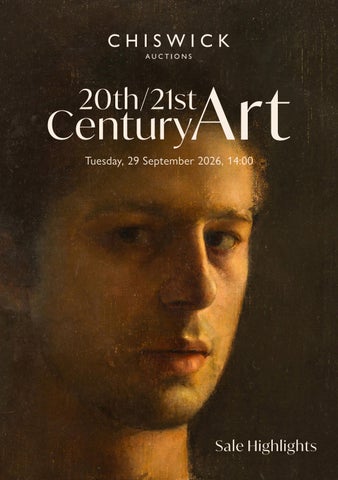
Tuesday, 29 September 2026, 14:00
Sale Highlights
Our upcoming 20th/21st Century Art auction, taking place on Tuesday, 29th September 2026, showcases an incredibly wide range of works spanning from the 20th Century to the present day. This season’s catalogue presents collectors with an opportunity to explore contrasting artistic movements and acquire works that span the international landscape. At the heart of the sale is a strong curation of European modernism and expressionism. Featuring the atmospheric, bohemian Parisian scenes of František Zdeněk Eberl, alongside celebrated names such as Austrian Expressionist Oskar Kokoschka and the dynamic Post-Cubist works of Claude Venard. This selection offers a compelling look at the figures who helped shape modern art. The auction also features notable pieces by other significant international artists. A standout selection of Latin American art features works by Ecuadorian master Oswaldo Guayasamín and Brazilian socio-political artist Siron Franco. These sit in fascinating contrast to the hyper-saturated Pop Art landscapes of Australian artist Ken Done and the introspective, shadowy portraiture of Romanian painter Victor Man. A significant highlight of this season's sale is a dedicated section of Works from the Collection of Frank Cohen (Lots 79-95). This esteemed collection offers a compelling cross-section of mid-century and contemporary art, featuring monumental subversive sculptures by Young British Artists Jake & Dinos Chapman, the visceral expressionist paintings of John Copeland, and a highly sought-after solid bronze sculpture by American Pop Art pioneer Jim Dine. Bringing the collection fully into the present day, the catalogue rounds out with striking contemporary pieces from artists such as Philip Colbert and Bradley Theodore, alongside impressive sculptural works by Lorenzo Quinn, offering a dynamic range of artworks suited for both new and established collectors.
20th/21st Century Art Tuesday 29 September 2026, 14:00 Viewing exclusively at the Barley Mow Centre, W4 4PH Friday 25 September
12:00 - 17:00
Saturday 26 September
11:00 - 15:00
Sunday 27 September
11:00 - 15:00
Monday 28 September
10:00 - 17:00
Tuesday 29 September
10:00 - 12:00 (Sale at 14:00)
Collection of Lots We continue to offer Click and Collect service for all purchased lots. The process is quick and easy and can be done personally or via your chosen courier: Contact collections@chiswickauctions.co.uk for more information. Condition Reports All our sales are fully illustrated online and have been expertly catalogued by our specialists. We recommend you request a condition report via our website prior to the sale. Terms & Conditions For a full list of our Terms & Conditions, please visit www.chiswickauctions.co.uk Buyer’s Premium The buyer shall pay Chiswick Auctions Ltd. a premium on the hammer price of 26%+ VAT on that commission.
Symbol Key: § - Artist Resale Rights/Droit de Suite. Lots marked with ‘ARR/ §’ may be subject to a levy. † - Normal VAT rules apply and the standard rate of VAT will be charged on both hammer price and premium. * - These lots have been imported from outside the UK for sale and placed under the Temporary Admission regime. Import VAT is payable at 5% on the hammer price. VAT at 20% will be added to the buyer’s premium but will not be shown separately on the invoice. If you are re-exporting a * lot outside of the UK, you must use Chiswick Auctions Ltd TA Shipper.
Front cover Lot 72 / Opposite page Lot 65 / Specialists page Lot 97 / Inside back cover Lot 33 / Back cover 57
Meet the Specialists James Flower
Emily Smaje
Head of Pictures Head of Modern British & Irish Art james.flower@chiswickauctions.co.uk +44 (0)20 3089 6874
Specialist - Paintings emily.smaje@chiswickauctions.co.uk +44 (0)20 3089 6888
Megan Peters
Ellie Smith
Department Coordinator - Paintings megan.peters@chiswickauctions.co.uk +44 (0)20 3089 6855
Junior Specialist - Paintings ellie.smith@chiswickauctions.co.uk +44 (0)20 3343 0528
Get in touch Gallery: Barley Mow Centre, Chiswick, W4 4PH Collections: 5 Roslin Square, Roslin Rd, W3 8DH Valuations: 1 Roslin Square, Roslin Rd, W3 8DH chiswickauctions.co.uk
1§
František Zdeněk Eberl (Czech/French, 1887-1962) Woman's Portrait with Ear Hoops signed 'F. Eberl' (lower left) oil on canvas Painted between 1935-40 Unframed: 35.1 x 27.1 cm. (13 3/4 x 10 5/8 in.) Framed: 52.8 x 44.8 cm. (20 3/4 x 17 5/8 in.) £3,000 - 5,000 Provenance Private Collection, France Sale; Artcurial, Deauville, 20 August 2010, lot 164, where purchased by the present owner Literature Gerald Weinpolter & Miriam Forster, François Eberl, Online Catalogue Raisonné, no.G54
2§
František Zdeněk Eberl (Czech/French, 1887-1962) Woman with Cigarette in a Bar I signed 'F. Eberl' (lower left) oil on canvas Painted circa 1940 Unframed: 41 x 33 cm. (16 1/8 x 13 in.) Framed: 51 x 43.5 cm. (20 x 17 1/8 in.) £3,000 -5,000 Provenance Sale; Artcurial, Deauville, 20 August 2010, lot 164 Literature Gerald Weinpolter & Miriam Forster, François Eberl, Online Catalogue Raisonné, no.G592 František Zdeněk Eberl initially studied in his native Prague before relocating to Munich, finding the conservative nature of the Prague's Academy of Fine Art too restrictive for his developing vision. In 1911, he settled in Montmartre at the very heart of Paris’s bohemian artistic community. Immersing himself in the local nightlife, Eberl moved within the same avant-garde circles as Pablo Picasso and Amedeo Modigliani. This vibrant, nocturnal world quickly became the central subject of his oeuvre. Rather than depicting the polished glamour of the French capital, Eberl was drawn to its marginalised characters, observing patrons, drinkers, gamblers, prostitutes, and those living on the fringes of society. This fascination is powerfully articulated in the present work, Bar Scene. The composition is anchored by a formidable central female figure who immediately commands attention. With a cigarette resting on her lips and her arms firmly folded, she gazes outward with a striking blend of confidence and detachment. Eberl employs masterful chiaroscuro to give her form a substantial sense of volume, deliberately contrasting the warm, yellowish tones of her skin against the deep reds of her blouse and the murky browns of the interior. The treatment of the background further enhances the painting's atmospheric resonance. Rather than rendering every architectural detail, Eberl allows the surrounding furnishings and secondary figures to dissolve into the hazy, smoky environment of the bar. These indistinct silhouettes seem to emerge through the gloom, successfully capturing a specific, gritty social reality that existed firmly alongside the city’s glamour, yet decidedly within its shadows. Eberl's works can be found in the New National Museum of Monaco, Musée des Beaux Arts and National Gallery Prague.
3§
František Zdeněk Eberl (Czech/French, 1887-1962) Berthe II signed 'FZ Eberl' (lower right) oil on board Painted circa 1925 Unframed: 27.1 x 21.7 cm. (10 5/8 x 8 1/2 in.) Framed: 43.7 x 38.6 cm. (17 1/4 x 15 1/4 in.) £3,000 - 5,000
Provenance Sale; Artcurial, Deauville, 20 August 2010, lot 148, where purchased by the present owner Literature Gerald Weinpolter & Miriam Forster, François Eberl, Online Catalogue Raisonné, no.G264
4§
František Zdeněk Eberl (Czech/French, 1887-1962) Woman's Portrait in Red Dress signed 'F. Eberl' (lower left) oil on canvas Painted circa 1940
Provenance Private Collection, France Sale; Artcurial, Deauville, 20 August 2010, lot 170, where purchased by the present owner
Unframed: 41 x 33 cm. (16 1/8 x 13 in.) Framed: 51 x 43.5 cm. (20 x 17 1/8 in.)
Literature Gerald Weinpolter & Miriam Forster, François Eberl, Online Catalogue Raisonné, no.G54
£2,000 - 3,000
33 §
František Hudeček (Czech, 1909-1990) The Night Walker signed and dated 'F. Hudeček/46' (lower left) oil on panel Unframed: 29.5 x 21 cm. (11 5/8 x 8 1/4 in.) Framed: 50.2 x 41.4 cm. (19 3/4 x 16 1/4 in.) £4,000 - 6,000 František Hudeček was a pivotal figure in twentieth-century Czech avant-garde art and a central member of the highly influential Group 42. Formed in 1942, the collective rejected traditional romanticism in favour of a rigorous focus on the mechanised rhythm and immediate experience of the modern, industrialised city. Hudeček’s distinctive approach fused this urban reality with structural precision, establishing him as a crucial voice in Central European modernism. Created at the height of his involvement with the movement, The Night Walker encapsulates a period in which Hudeček’s imagery became increasingly geometric. The work exemplifies his ability to push towards abstraction without completely abandoning representation. While the form is radically simplified into sharp, intersecting angles, it remains firmly anchored to human anatomy. This synthesis of the corporeal and the structural reflects a distinctly mechanical approach to the figure, directly echoing Group 42’s enduring fascination with the industrial world. The composition is defined by an innovative use of colour and texture to construct form. Eschewing traditional modelling through light and shadow, Hudeček positions cool blues, greens, and blacks against intensely saturated reds, oranges, and yellows. Each block of pigment establishes a distinct spatial plane, creating the illusion that the figure has been fractured and reconstructed entirely through colour. This structural palette is matched by a heavily worked, highly tactile surface. Visible, directional brushstrokes imbue the painting with a drawn quality, allowing the viewer to trace the process of building the figure.
34 §
Claude Venard (French, 1913-1999) Nature Morte a La Bouteille signed 'C VENARD' (lower right) oil on canvas Unframed: 60 x 60 cm. (23 1/2 x 23 1/2 in.) Framed: 62 x 62 cm. 24 1/4 x 24 1/4 in.) £5,000 - 7,000
Provenance Maitre Martin, Versailles, 1962 Private Collection, Madame F., Cannes Sale; Pillion (S.V.V.), Versailles, 22 October 2006, lot 245, where purchased by the present owner Claude Venard was a vital figure in the mid-century School of Paris, celebrated for his dynamic approach to Post-Cubism. Merging geometric abstraction with a palpable joie de vivre, his work is defined by robust, angular forms and an energetic application of paint. Venard delighted in the sheer materiality of his medium, using a palette knife to build heavily textured, almost sculptural layers of impasto. Nature Morte à la Bouteille centres on traditional still-life motifs, reimagined through an uncompromisingly modern lens. Venard anchors the right side of the composition with a stark, dark bottle, incisively outlined in vivid yellow, which contrasts sharply against the flat, muted grey background. This deliberate chromatic tension is heightened by the painting's highly tactile surface. Showcasing the artist’s masterful manipulation of oil, the work stands as a striking testament to his expressive and distinctly structural aesthetic.
35 §
Claude Venard (French, 1913-1999) Nature Morte au Vases des Fleurs signed 'C.VENARD' (lower right) oil on canvas Painted circa 1965 Unframed: 92 x 73 cm. (36 1/4 x 28 3/4 in.) Framed: 93.5 x 74 cm. (36 3/4 x 29 1/4 in.) £7,000 - 10,000
Provenance Sale; Provins, Feletin, 28 April 2002, lot 81, where purchased by the present owner
Nature Morte au Vases des Fleurs, is a quintessential example of Claude Venard's vigorous approach to Post-Cubist still life. The composition is firmly anchored by a central, structural white vase, from which angular, highly stylised floral forms emerge. Venard deliberately flattens the picture plane, arranging the surrounding domestic objects, a bowl of fruit to the left and distinct foliage to the right, against a rigidly geometric background defined by striking vertical bands. The visual impact of the painting relies heavily on Venard’s uncompromising use of colour and line. A bold, unmixed expanse of crimson red dominates the foreground, sharply contrasting with the vivid oranges, cool blues, and stark whites that punctuate the canvas. These intensely saturated zones are rigorously contained by heavy, black contours, a hallmark of his mature style. The surface itself is heavily worked; Venard builds up a thick, tactile impasto before aggressively scoring the pigment with sgraffito to define the jagged petals and architectural forms. By balancing this chromatic intensity with structural rigour, Venard transforms a traditional floral arrangement into a dynamic, highly modern statement of material presence.
36 §
Bela Levikova (Russian, b.1939) Untitled signed with initials and dated 'B.L. 3-91' (lower right); inscribed extensively in Cyrillic oil on canvas Unframed: 59.7 x 69.8 cm. (23 1/2 x 27 1/2 in.) Framed: 70.8 x 80.7 cm. (27 7/8 x 31 3/4 in.) £3,000 - 5,000 Provenance With XL Gallery, Moscow, 28 January 2000, where purchased by the present owner Bela (or Bella) Levikova is a Russian post-war and contemporary painter closely associated with the Moscow conceptual and Soviet non-conformist art movements. Beginning her artistic career around 1965, she developed a distinct abstract style that stood in direct opposition to the state-mandated aesthetic of Socialist Realism. Levikova is best known for her Abstract Expressionist approach. She works primarily with oil on canvas, as well as ink and gouache on paper, creating dynamic, expressive, and often geometric abstractions. Well-known works include her multi-panel series like Interaction (1980) and later conceptual series like Comics. During the Soviet era, avant-garde and abstract artists were actively suppressed by the government. As an "unofficial" artist, Levikova was part of an underground community that created art purely for creative freedom rather than state approval, often exhibiting in private apartments rather than official galleries. Today, Levikova's work is preserved as an important piece of Russian art history. She is notably featured in the Kolodzei Art Foundation, which holds one of the world's largest and most comprehensive collections of Russian and Eastern European non-conformist art spanning from the Khrushchev Thaw to the modern day. During the 1970s, Levikova was highly visible within the non-conformist art scene. When the Iron Curtain began to lift, she was included in the legendary 1988 Sotheby’s auction in Moscow, a watershed event that introduced Soviet underground art to Western collectors. Her historical importance is cemented by her presence in premier collections dedicated to underground Soviet art, including the State Tretyakov Gallery, the State Russian Museum, and the renowned Dodge Collection at the Zimmerli Museum in New Jersey. Today, Levikova is experiencing a critical rediscovery (including major recent solo exhibitions like the one at Moscow's Sistema Gallery). Critics now recognise her as an artist who refused to conform not only to the Soviet state's rules, but also to the rigid intellectual rules imposed by the non-conformist underground itself.
Lots 56 - 60
Ken Done (Australian, b.1940) Ken Done is one of Australia’s most recognisable contemporary artists, celebrated for his exuberantly colourful depictions of national landmarks, coastal life, and native flora. Born in Sydney in 1940, he left school at fourteen to study at the National Art School before embarking on a highly successful international career in advertising. When he transitioned to painting full-time with his first solo exhibition at Sydney’s Holdsworth Gallery in 1980, Done consciously rejected traditional artworld hierarchies. Drawing on his commercial background and a profound interest in Japanese design principles encountered during his 1960s travels, he cultivated an immediate, optimistic visual language. This highly accessible aesthetic allowed him to successfully bridge the gap between fine art and commercial design, occupying a unique, and often debated, space in the Australian cultural landscape. Today, his legacy transcends traditional boundaries; while his vibrant designs continue to adorn a wildly popular brand of clothing and homewares, his original artworks are held in the permanent collections of prominent institutions, including Sydney’s Powerhouse Museum and the Grafton Regional Gallery.
56 §
Ken Done (Australian, b.1940) Judy resting, Toberua signed and dated 'Ken Done 96' (lower left) gouache and crayon Unframed: 40.5 x 51 cm. (16 x 20 in.) Framed: 53.4 x 63.5 cm. (21 x 25 in.) £2,000 - 3,000 Provenance With Ken Done Gallery, New South Wales, 2000
57 §
Ken Done (Australian, b.1940) Yellow Opera House signed and dated 'Ken DONE 95' (lower right) oil on canvas Unframed: 152.8 x 119.5 cm. (60 1/4 x 47 1/4 in.) £2,000 - 3,000 Yellow Opera House perfectly encapsulates this vibrant visual language. Translating Sydney’s most iconic landmarks into a bold, graphic celebration of colour, Done renders the harbour in an uncompromising, saturated pink. The Opera House itself is simplified into striking yellow sails, anchored by an abstract, jagged blue reflection that fractures the lower register of the canvas. Surrounding elements, such as the Sydney Harbour Bridge and passing ferries, are reduced to essential geometric forms, demonstrating his ability to distil complex urban topography into instantly recognisable Pop Art iconography. While his unprecedented global commercial success occasionally drew the hostility of conservative critics who dismissed him as a mere designer, Done challenged this perception through a prolific, dedicated studio practice. Today, his business acumen is increasingly recognised as a natural extension of his Pop Art sensibility. His artistic merit has been firmly validated by major public commissions for the 1988 Brisbane World Expo and the Sydney 2000 Olympic Games, alongside an Order of Australia in 1992 and a major retrospective at the Powerhouse Museum in 1994. Against this backdrop, Yellow Opera House stands as a joyous, unapologetic testament to the enduring vision of one of Australia’s most notable contemporary artists.
60 §
Ken Done (Australian, b.1940) Sydney Night I titled and dated 'SYNDEY NIGHT I/1994/WYNNE PRIZE ENTRANT 1995' (to the stretcher verso) oil on canvas Unframed: 182.5 x 167 cm. (71 3/4 x 66 1/2 in.) £2,000 - 3,000 While Ken Done is widely celebrated for his hyper-saturated, sundrenched palette, Sydney Night I marks a deliberate departure into nocturnal restraint. An expansive blackness dominates the canvas, shifting the tone from his typical daytime exuberance to quiet contemplation. Rather than rendering the Sydney Harbour Bridge as a solid mass, Done delineates its structure through delicate, etched white lines. This skeletal treatment gives the bridge a blueprint-like quality as it arcs across a dark sky, subtly populated by the faint outlines of an aeroplane and clouds. The lower register of the composition is equally minimalist, punctuated by jewel-like flecks of primary pigment. These sparse, horizontal dashes of red, yellow, and blue capture the distant glimmer of city lights, passing ferries, and their fractured reflections across the black water. Anchored by the stark white sail of the Opera House emerging from the gloom, the work strips away Done's trademark chromatic intensity to reveal a strong structural confidence, capturing the luminosity of the harbour after dark.
65 §
Siron Franco (Brazilian, b.1947) A Cobra Faz o Perfil signed and dated 'SIRON 86' (lower left); further signed and titled 'SIRON/A Cobra/Faz/o Perfil' (verso) oil on canvas Unframed: 135.3 x 153.5 cm. (53 1/4 x 60 3/8 in.) Framed: 143 x 161 cm. (56 1/4 x 63 3/8 in.) £3,000 - 5,000 Provenance The artist, from whom acquired by the family of the present owner Gessiron Alves de Franco, known universally as Siron Franco, is a definitive figure in contemporary Latin American art, recognised for his intense sociopolitical commitment. Raised in Goiânia, his visual language was profoundly shaped by the vibrant yet threatened Brazilian landscape, allowing him to bridge personal memory with sweeping cultural commentary. While Franco is traditionally celebrated for works defined by sombre, earthy palettes and heavy, brooding atmospheres, A Cobra Faz o Perfil marks a striking stylistic departure. Abandoning his usual tonal weight, this atypical composition embraces a flat, boldly saturated visual plane. Set against an unyielding, luminous orange background, the winding form of a snake dominates the canvas, its body articulated through rhythmic bands of red, pink, and white. This central motif is a direct nod to Franco’s enduring environmental advocacy for the Brazilian Cerrado, the native savannah biome of his home state. Serving as a deliberate ecological protest against deforestation and unchecked urbanisation, the painting aligns with his broader, globally recognised activism. This commitment extends beyond the canvas, most notably through his Peace Monument for the 1992 Earth Summit (Rio-92) and his striking installations for the Rio+20 conference that confronted criminal fires in the savannah. By replacing the dense, painterly textures characteristic of his broader oeuvre with urgent, graphic clarity, Franco presents the vibrant serpent not merely as a formal experiment. It stands as a potent emblem of ecological preservation, compelling viewers to confront the fragile vitality of Brazil's natural world.
66 §
Siron Franco (Brazilian, b.1947) Uma Cena Clássica signed, titled and dated 'SIRON 86/"UMA CENA CLÁSSICA"' (verso) oil on canvas Unframed: 168 x 180 cm. (66 x 70 7/8 in.) Framed: 176 x 188.5 cm. (69 1/4 x 74 1/4 in.) £3,000 - 5,000 Provenance The artist, from whom acquired by the family of the present owner
70
Oswaldo Guayasamín (Ecuadorian, 1919-1999) Cabeza signed 'GUAYASAMIN' (lower right) watercolour Unframed: 45 x 32.5 cm. (17 3/8 x 12 3/4 in.) Please note this work is accompanied with a Certificate of Authenticity £3,000 - 5,000 Provenance With Foundation Guayasamín, Quito, 16 January 1990, where purchased by Daysi Josefina Piaz, Ecuador, from whom acquired by Manuel Alberto Escobar Chirino, 6 August 2004, thence by family descent Oswaldo Guayasamín was an Ecuadorian painter and sculptor whose art focused on social and political issues, as well as indigenous and human rights. He is considered one of the most important Latin American artists of the 20th century, and his work has had a significant influence on both the art world and social movements. Guayasamín's art often depicted the suffering and oppression of marginalised communities, such as indigenous peoples, peasants, and the poor. His paintings and sculptures were highly emotional and expressive, using bold colours and strong lines to convey his message. He also drew inspiration from the pre-Columbian art and culture of his native Ecuador, as well as from European modernism.
71
Oswaldo Guayasamín (Ecuadorian, 1919-1999) Cabeza signed 'GUAYASAMIN' (lower right) watercolour Unframed: 32 x 46 cm. (12 5/8 x 18 1/8 in.) Please note this work is accompanied with a Certificate of Authenticity £3,000 - 5,000
Provenance With Foundation Guayasamín, Quito, 29 December 1989, where purchased by Daysi Josefina Piaz, Ecuador, from whom acquired by Manuel Alberto Escobar Chirino, 28 April 2004, thence by family descent
72 §
Victor Man (Romanian, b.1974) Self-portrait signed 'Man' (upper left); further signed 'Man' (verso) oil on linen Painted in 2000 Unframed: 25.3 x 22.7 cm. (10 x 9 in.) £10,000 - 15,000
Provenance The artist, 2001, whom gifted to the present owner
Born in 1974, Victor Man spent his childhood and early adolescence under the repressive communist dictatorship of Nicolae Ceaușescu. During this period, Romania was culturally isolated, heavily censored, and poor. For a young artist, this meant highly restricted access to Western art, literature, and media. The visual landscape was dominated by statesanctioned Socialist Realism, while independent creative expression was closely monitored. The psychological environment of secrecy, surveillance, and shadows that characterised this era strongly echoes in the dark, mysterious, and veiled nature of his later paintings. In 1989, when Man was just fifteen, the Romanian Revolution violently overthrew the communist regime. The subsequent years were marked by a chaotic, disorienting transition to capitalism and democracy. For Man's generation, this meant a sudden, overwhelming flood of previously banned Western culture, art history, and consumerism crashing into their deeply traditional and historically isolated upbringing. His work often reflects this fractured reality, a feeling of being caught between a heavy, unresolved past and an uncertain present. Man, rose to prominence in the 2000s alongside the ‘Cluj School,’ a group of artists celebrated for their introspective, technically accomplished figurative paintings. Built from layered, muted palettes of deep green, blue, and black, their work frequently evoked oldmaster chiaroscuro and aged frescos. Man’s distinctive style transcends a single era, bridging classical techniques with modern themes. By merging the historical influence of painters like Goya, El Greco, and Velázquez with a contemporary exploration of post-Communist life, he forged a visual language that is distinctly modern yet deeply rooted in art history. Man’s work is also often characterised by introspective subjects. He often paints solitary figures, mysterious scenes and shadowy portraits, all of which feel like fragments of lost memories or dreams; an element of mystery is at the crux of the compositions and narratives within his paintings. Man has been recognised globally for his talent and impact on Romanian art, including representing his country at the 2007 Venice Biennale and being awarded Deutsche Bank Artist of the Year in 2014. Despite this, Man has always preferred to keep his personal life private, mirroring the introspection and mystery found in his artworks. In this work, an early self-portrait, Man uses a small, dark canvas to paint a contemplative image of himself. The realistic portrayal, like many of his works, pays homage to Netherlandish Realism and photorealistic depictions. Here, the human condition is rendered as fragile and vulnerable. Man gives the viewer an unwavering gaze and establishes a strong, immediate connection with the viewer. This contrasts sharply with the detached, introspective, and often obscured figures that populate his more mature canvases. His Self-Portrait from 2000 serves as a strong record of his foundational technical skill and traditional training before he transitioned to the slower, layered, and historically fused narratives of his later career.
Lots 79 - 95
Works from the Collection of Frank Cohen Frank Cohen stands as one of the world's most influential and prolific collectors of international contemporary art. A self-made businessman who began his career working market stalls in Manchester before building a highly successful chain of DIY home improvement stores, Cohen’s approach to art has always been driven by an insatiable, grounded passion. This drive eventually translated into the fine art world, where he began acquiring Modern British masters in the 1970s, before pivoting dramatically in the late 1990s and 2000s to embrace cutting-edge, global contemporary art. The catalyst for this unprecedented offering was the recent closure of one of Cohen’s long-standing storage facilities, a transition that unearthed a trove of artwork held privately in his collection for many years. Long shielded from public view, these rediscovered pieces represent a fascinating time capsule of his curatorial journey. Rather than returning these unseen works to the vault, Cohen expressed a profound desire to see them enter a new chapter, passing the baton to fellow art enthusiasts and collectors. In a uniquely generous move, and through an exclusive partnership with Chiswick Auctions, he has chosen to offer these artworks at remarkably accessible estimates, often a fraction of his original acquisition costs, ensuring they find vibrant new homes and continue to be appreciated as intended. Today, Cohen is embarking on a bold evolution of his artistic vision, parting with a curated selection of his collection as he repositions his focus toward monumental, outdoor sculpture. This remarkable consignment reflects the extraordinary breadth and uncompromising edge of his eye. Offered here are provocative, iconic works by Jake and Dinos Chapman, including CFC76372567.2 (2002) and The Clown that Lost his Humour (2003), alongside the elegant spatial interventions of Olafur Eliasson's 360° Compass (2009). The auction further showcases the visceral, heavily worked canvases of John Copeland, Jim Dine's enduring bronze The Heart on the Rock (1983), John Virtue's monumental monochromatic landscapes, and the intricate, evocative works of Charles LeDray, Charming Baker, Emile Chambon, and Rita Duffy. For the discerning collector, this sale represents a rare opportunity to acquire masterworks vetted by one of Britain's most dynamic and enduring art patrons.
Works from the Collection of Frank Cohen
79 §
Émile Chambon (Swiss, 1905-1993) Le Cochon (The Pig) signed and dated 'E.Chambon 53' (lower left); further signed, inscribed and dated again 'E Chambon. 1953/le gros homme et la femme/Rue John grasset' (verso) oil on cardboard Unframed: 55 x 41 cm. (21 5/8 x 16 1/8 in.) Framed: 64.5 x 50.5 cm. (25 3/8 x 19 7/8 in.) £8,000 - 12,000 Provenance With Richard Nagy, London, 2019, where purchased by the present owner Emile Chambon’s The Pig (1953) is a masterful example of mid-century European figurative painting that infuses everyday urban life with surreal psychological tension. Executed in oil on cardboard (41 x 55 cm), this striking composition uses a muted, earthy palette to set a distinct stage for an unexpected narrative. The scene is anchored by stark juxtapositions. A portly, bowler-hatted gentleman leans on his cane, staring into a gloomy storefront window where a pink pig is suspended— an absurdist disruption of the mundane streetscape. Meanwhile, a slender, red-haired woman in a vibrant teal coat strides briskly past. Though physically close, the figures remain profoundly isolated, sharing the pavement but existing in entirely separate worlds. This cinematic suspense pushes the painting toward magical realism, rendering the urban environment as a quiet stage where the ordinary and bizarre intersect. Rich in narrative ambiguity and formal elegance, it stands as a sophisticated acquisition for collectors of mid-century modernism. Born in Geneva in 1905, Chambon bypassed the avant-garde Cubist movements of his peers to meticulously study classical masters like Rembrandt and Rubens in Paris. The Pig dates to his early 1950s period of maturity, when his atmospheric oeuvre gained major critical acclaim across Switzerland. Today, he is celebrated as a leading Swiss painter of his generation. Often compared to Balthus, Chambon’s signature style masterfully balances classical realism with the quiet theatre of the absurd, evoking an enigmatic tension within the ordinary.
Works from the Collection of Frank Cohen 80 §
Jagannath Panda (Indian, b.1970) Democracy in the Neighbourhood signed and dated twice 'Jagannath Panda 06/2006 JANGANNATH PANDA' (verso) acrylic on canvas Painted in 2006 Unframed: 305 x 147.5 cm. (120 x 58 in.) £5,000 - 8,000 Provenance With Gallery Chemould, Mumbai, 2007, where purchased by the present owner Exhibited Wolverhampton, Initial Access: Frank Cohen Collection, Passages to India, 15 Mar-12 Jul 2008 Jagannath Panda’s Democracy in the Neighbourhood (2006) is a monumental tableau capturing the complex cultural landscape of contemporary India. Executed in acrylic on canvas (147.5 x 305 cm), this expansive composition uses a structured architectural backdrop to stage an enchanting narrative where the boundaries between the divine, nature, and modern urbanity dissolve. The composition is defined by the stark, pastel facades of modern apartment blocks. Within this concrete grid, a blue-skinned, four-armed Hindu deity rests upon a ledge, leaning down to interact with expectant stray dogs. High above, on a cantilevered balcony, a panther-like feline stretches gracefully to sniff a blossoming tree. These disparate elements coexist harmoniously, creating a quiet tension between ancient mythology, the natural world, and man-made sprawl. This vivid juxtaposition elevates the painting into magical realism. By inserting religious iconography and displaced wildlife into rigid metropolitan architecture, Panda comments on the intense urbanization and social transformations reshaping modern India. The work suggests that despite rapid modernization, the mythical and the natural continue to endure in the crevices of the expanding city. This distinct approach is deeply rooted in Panda’s background. Born in Odisha in 1970 to a temple priest, he was heavily influenced by religious traditions before studying internationally in Baroda, Japan, and London. His 2005 relocation to Gurgaon exposed him to the constant construction and ecological displacement that naturally permeated his canvases. Today, Panda remains a vital voice in contemporary Indian art, masterfully reconciling the mythical and the technological within a rapidly changing world.
Works from the Collection of Frank Cohen
81 §
Charming Baker (British, b.1964) Knowing Nothing Is Under-rated signed and dated 'BAKER/2011' (verso) oil on linen Unframed: 125 x 165 cm. (49 1/4 x 65 in.) Framed: 128.6 x 172 cm. (50 5/8 x 67 3/4 in.) £7,000 - 10,000 Provenance The artist, 2011, from whom acquired by the present owner Exhibited Shrewsbury, Shrewsbury Museum and Art Gallery, The Frank Cohen Collection, 1 Apr-30 Jun 2014 Charming Baker is a prominent contemporary British artist whose work explores the tension between beauty, vulnerability, and mortality. After graduating from Central Saint Martins, Baker rose to prominence for his distinctive approach to classical oil painting, which he frequently subverts through deliberate acts of destruction, such as drilling, routing, or shooting his canvases. This visceral intervention introduces an element of chance and chaos, challenging the traditional sanctity of the painted surface. He is highly regarded for his darkly humorous and deeply emotive examinations of the human condition, often mediated through evocative animal motifs. In Knowing Nothing Is Under-rated, Baker presents a stark, arresting juxtaposition. A solitary, innocent white lamb stands in the foreground, seemingly oblivious to the massive, looming steam locomotive bearing down heavily behind it. The work’s muted, almost oppressive palette enhances the creeping sense of impending doom. This piece perfectly encapsulates Baker’s broader practice: it acts as a poignant meditation on fragility and the brutal, unstoppable force of fate.
Works from the Collection of Frank Cohen
82
Jim Dine (American, b.1935) The Heart on the Rock signed, numbered and dated 'Jim Dine 1983 6/6' (on the underside) patinated bronze 47.1 x 45.7 x 25.4 cm. (18 1/2 x 18 x 10 in.) £15,000 - 25,000 Provenance With The Pace Gallery, New York, 1984, where purchased by Private Collection, California Their sale; Christie's, New York, 19 September 2012, lot 138, where purchased by the present owner Exhibited New York, The Pace Gallery, Jim Dine: Sculpture and Drawings, Feb-Mar 1984 (another cast) Literature Marco Livingstone, Jim Dine: The Alchemy of Images, New York, 1998, p.21 (another cast) Exhibition Catalogue, The Pace Gallery, New York, Jim Dine: Sculpture and Drawings, FebMar 1984, p.34 (another cast) Jim Dine is an influential American painter, printmaker, and sculptor, widely recognised as a pioneer of Pop Art and Neo-Dada. Emerging in the late 1950s, he gained prominence for his early ‘Happenings’ and his bold integration of everyday objects, such as tools, robes, and hearts, into his creative practice. While his contemporaries often pursued cool, commercial detachment, Dine consistently infused his work with a powerful, expressionistic energy, creating a deeply personal and emotionally charged iconography that set him apart from the wider Pop movement. As a self-described romantic artist, Dine uses the heart as a template to explore relationships between colour, texture, and composition. Through the dynamic repetition of a focused visual vocabulary, he has transformed the once-common heart into a deeply personal symbol.
Works from the Collection of Frank Cohen 83
John Copeland (American, 1976-2024) As I Once Was, You Will Soon Be signed, titled and dated 'John Copeland/2012/AS I ONCE WAS, YOU WILL SOON/BE' (verso) acrylic and oil on canvas Unframed: 122.5 x 107.4 cm. (48 1/4 x 42 1/4 in.) Framed: 127.3 x 111.7 cm. (50 1/8 x 43 1/2 in.) £4,000 - 6,000 Provenance The artist, 2015, from whom purchased by the present owner John Copeland has established himself as a formidable voice in contemporary figurative painting, celebrated for a highly visceral, texturally dense approach that continuously negotiates the boundary between raw abstraction and recognisable form. Utilising thick, aggressive layers of oil and acrylic, Copeland effectively sculpts his subjects as much as he paints them, bringing a gritty, expressionistic urgency to the canvas. His works operate as intense psychological explorations, capturing the chaotic, fleeting, and sometimes grotesque realities of the human condition. This dynamic manipulation of the medium charges his canvases with a kinetic, pulsing energy, transforming classical motifs and everyday social scenes into uncompromising studies of mortality and existence. The first lot of the four, As I Once Was, You Will Soon Be (2012), perfectly encapsulates Copeland’s masterful command of his materials and his profound thematic depth. Taking its title from a traditional memento mori epitaph, the canvas confronts the viewer with two standing figures rendered in fleshy, smeared tones of pink, white, and red. Copeland’s signature drips and heavy slashes of dark paint obscure the figures' features, stripping away individual identity to present them as universal, elemental symbols of the human form in flux. The vigorous application of paint, melting, dripping, and pooling across the canvas, mirrors the inevitable physical decay suggested by the title, creating a haunting visual metaphor for the passage of time and the inherent fragility of the human body. This intense focus on the physical and psychological weight of existence is a defining hallmark of Copeland's practice during this pivotal period. While concurrent works such as A Leadbelly Song (lot 84) and Lucifer’s Wisdom Teeth (lot 86) employ his violently energetic brushstrokes to unmask the chaotic realities of densely populated social gatherings, As I Once Was, You Will Soon Be turns that same psychological intensity inward. It stands as a powerful, contemplative anchor within Copeland's oeuvre, offering a deeply affecting, modern interpretation of a timeless existential theme. For the discerning collector, this lot presents an exceptional opportunity to acquire a painting that is both formally spectacular and intellectually profound.
84
John Copeland (American, 1976-2024) A Leadbelly Song signed, titled and dated 'JOHN COPELAND/ A LEADBELLY SONG 2012' (verso) acrylic and oil on canvas Unframed: 152.4 x 137.2 cm. (60 x 54 in.) Framed: 156 x 145.5 cm. (61 1/2 x 57 1/4 in.) £6,000 - 8,000 Provenance The artist, 2015, from whom acquired by the present owner
Works from the Collection of Frank Cohen
85
John Copeland (American, 1976-2024) Before The Beginning signed, titled and dated 'JOHN COPELAND/2012/BEFORE THE BEGINNING' (verso) oil and acrylic on canvas Unframed: 182 x 228 cm. (71 5/8 x 89 3/4 in.) Framed: 187.5 x 233 cm. (73 3/4 x 91 3/4 in.) £6,000 - 8,000 Provenance With V1 Gallery, Denmark, 2015, where purchased by the present owner
Works from the Collection of Frank Cohen
86
John Copeland (American, 1976-2024) Lucifer’s Wisdom Teeth signed, titled and dated 'JOHN COPELAND/LUCIFER'S WISDOM TEETH 2012' (verso) acrylic and oil on canvas Unframed: 182.9 x 152.4 cm (72 x 60 in.) Framed: 187.5 x 157.3 cm. (73 3/4 x 61 7/8 in.) £7,000 - 10,000 Provenance The artist, 2015, from whom acquired by the present owner
Works from the Collection of Frank Cohen 87 §
Jake & Dinos Chapman (British, b.1966/1962) CFC76372567.2 2002 titled 'CFC76372567.2' (lower centre back of sculpture) edition 2/3 painted bronze, metal screws and nails on a reinforced wooden plinth Executed in 2002 101 x 44 x 28 cm. (39 3/4 x 15 3/4 x 11 in.) £10,000 - 15,000 Provenance With White Cube, London, 2003, where purchased by the present owner Exhibited London, Diary Art Centre, Islands, 11 Oct 2013 Unflinching in their critique of contemporary culture, Jake and Dinos Chapman have cemented their reputations as the chief provocateurs of the Young British Artists (YBA) generation. The brothers share a subversive, darkly comedic artistic vision that targets the hypocrisies of modern consumerism, the horrors of historical violence, and the sanctimonious nature of institutional authority. Instead of adopting a detached stance, the Chapmans revel in psychological disruption, creating meticulously crafted objects and vast dioramas that force viewers into uncomfortable reflection. Their practice relies on the weaponisation of irony, deploying shock value not merely as a gimmick, but as a calculated tool to unmask the deeply ingrained absurdities and moral failings of global capitalism. First unveiled in 2002, The Chapman Family Collection represents one of the artists' most ambitious and conceptually devastating projects. The series comprises a formidable array of sculptures masquerading as rare ethnographic artefacts—the sort of tribal masks, totems, and carved idols one might expect to find meticulously catalogued in a natural history museum or the private collection of a Victorian explorer. However, these seemingly primitive wooden carvings reveal themselves to be cast in solid bronze and deeply infected with the corporate iconography of McDonald’s. By seamlessly blending the visual language of colonial-era looting with the omnipresent branding of fast food, the Chapmans execute a brilliant satirical manoeuvre. They equate the aggressive, homogenising spread of multinational corporations with the predatory imperialism of the past, reducing sacred cultural aesthetics to a vessel for modern commercial deities. CFC76372567.2 stands as a prime, monumentally striking example from this legendary series. The work commands attention through its imposing, elongated neck and a distressed, heavily patinated surface that masterfully mimics the organic grain and wear of carved wood. The illusion of ethnographic antiquity is forcefully broken by the unmistakable 'M' logos embossed onto the figure's garment and the brutalist inclusion of metal screws and nails protruding aggressively from the skull. Measuring over a meter in height, this painted bronze object asserts a profound physical weight that perfectly matches its intellectual density. Offering this work at auction presents an exceptional opportunity to acquire a defining piece of millennial British art, a sculpture that encapsulates the Chapmans' unrivalled ability to fuse rigorous formal craftsmanship with unyielding satirical bite.
Works from the Collection of Frank Cohen 88 §
Jake & Dinos Chapman (British, b.1966/1962) The Clown That Lost His Humour painted bronze Executed in 2003 212 x 81 x 73 cm. (83 1/2 x 31 7/8 x 28 3/4 in.) £20,000 – 30,000 Provenance With White Cube, London, 2003, where purchased by the present owner Exhibited Walsall, The New Art Gallery, Works from the Frank Cohen Collection, 20 Oct-3 Dec 2006 Jake and Dinos Chapman have long operated at the bleeding edge of contemporary British art, using their collaborative practice to mercilessly interrogate the darkest chapters of human history. Associated with the incendiary Young British Artists (YBA) movement of the 1990s, the brothers eschew polite aesthetic conventions in favour of visceral, often shocking confrontations with the nature of evil, morality, and historical memory. Their work frequently appropriates and vandalises established cultural symbols or historical artefacts, deploying a potent blend of dark humour and meticulous craftsmanship to force a reckoning with the uncomfortable realities of human cruelty. By weaponising absurdity against the most monstrous figures and events of the twentieth century, the Chapmans strip these subjects of their terrifying mythos, reducing them to objects of profound, enduring ridicule. The Clown that Lost his Humour (2003) is a towering masterclass in this subversive methodology. The work initially presents itself as a traditional wooden painter’s easel supporting a completed portrait; however, in a brilliant feat of trompe l'oeil, the entire structure, from the paint-splattered easel legs to the canvas itself, is cast in solid bronze and meticulously hand-painted. The subject of the portrait is instantly recognisable as Adolf Hitler, yet the artists have mercilessly defaced his visage with the crude, pathetic makeup of a circus clown. This deliberate act of iconoclasm robs the dictator of his imposing aura of terror, transforming the historical embodiment of fascist evil into a pathetic, mocked caricature trapped forever on a heavy bronze canvas. As a unique edition within the Chapmans' celebrated oeuvre, this lot represents a profound convergence of exceptional material execution and devastating conceptual critique. The weighty permanence of the painted bronze contrasts sharply with the apparent fragility of the wooden easel and the ephemeral, slapdash nature of the clown makeup, further deepening the physical and intellectual complexity of the sculpture. The Clown that Lost his Humour serves not only as a striking example of the artist's technical virtuosity but also as a powerful testament to art's ability to challenge and dismantle the legacies of tyranny. For the serious collector of contemporary art, acquiring this piece offers the rare opportunity to own a historically charged, culturally vital monument of modern British satire.
Works from the Collection of Frank Cohen
89
Will Boone (American, b.1982) Burying Ground wood, concrete, plastic, metal, enamel and acrylic Executed in 2018 35.9 x 33.7 x 33.7 cm. (14 1/8 x 13 1/4 x 13 1/4 in.) £2,000 - 3,000 Provenance With David Kordansky Gallery, New York, 2018, where purchased by the present owner
90 §
Rita Duffy (Irish, b.1959) Crossroads Dancing signed 'Rita Duffy' (lower right); further signed, titled and dated 'Crossroads Dancing 2015/ Rita Duffy' (verso) oil on linen Unframed: 122.2 x 183.2 cm. (48 x 72 1/8 in.) £7,000 - 10,000 Provenance With Arts Council of Ireland, 2016, where purchased by Mary and Alan Hobart Their sale; Christie's, London, The Private Collection of Mary and Alan Hobart - Pioneers of Modern British and Irish Art, 19 November 2024, lot 174, where purchased by the present owner Exhibited Dublin, Arts Council of Ireland, The Souvenir Shop by Rita Duffy, Apr-Jun 2016, p.35 Dublin, Irish Museum of Modern Art, Championing Irish Art: The Mary and Alan Hobart Collection, Apr-Jul 2023, pp.76-77 (illustrated)
Works from the Collection of Frank Cohen
Rita Duffy’s Crossroads Dancing (2015) presents a captivating and satirical exploration of cultural memory and national identity within contemporary Irish art. Executed in oil on linen, this substantial composition offers a politically charged yet deeply personal narrative steeped in the traditions of magical realism. Duffy masterfully employs a vibrant, earthy palette to ground the theatrical scene, utilising the iconic green, white, and orange of the Irish tricolour as a sweeping, dramatic backdrop for the surreal dance unfolding in the foreground. The composition is anchored by the stark, slightly awkward posturing of its central, oversized figures, who represent the artist's own parents dancing a traditional fourhand reel at their wedding in 1954. A barefoot young woman in a crisp white blouse and billowing green skirt commands the centre, flanked by two men in dark suits who step heavily around her. This central tableau is juxtaposed against a surreal, miniature world bustling at their feet; tiny musicians play the fiddle and accordion, while miniature nuns, clergy, and observers populate the lower register. The domestic intimacy of a bed on the far left contrasts sharply with the looming industrial chimneys on the right, further highlighting the disorienting, dreamlike scale of the scene. This masterful manipulation of proportion and symbol elevates the painting beyond mere biographical homage, pushing it firmly into the realm of political and social critique. By situating traditional "crossroads dancing", a historically romanticised symbol of rural Irish purity, against an industrial backdrop and under the watchful eyes of a miniature clergy, Duffy plays with the cinematic suspense of a nation caught between myth and reality. The absurdity of the miniature figures interacting with the giants injects the work with her signature dark humour, dismantling romanticised visions of Irish heritage to expose the complexities of state, church, and gender roles. Crossroads Dancing stands as a compelling work that originally featured in her acclaimed Souvenir Shop project, which examined Irish history through a subversive, feminist lens. This distinctively surreal approach to historical memory can be directly traced to Duffy’s personal artistic trajectory. Born in Belfast in 1959, Duffy grew up experiencing the profound social divisions of Northern Ireland, prompting a lifelong engagement with themes of conflict, identity, and female experience. Rather than adhering strictly to traditional realism, she developed a uniquely atmospheric oeuvre heavily influenced by magical realism, where the ordinary seamlessly intersects with the bizarre. Today, Duffy is recognised as one of Ireland’s most groundbreaking visual artists and an elected member of Aosdána. In Crossroads Dancing, this signature quality is fully realised, reflecting her enduring dedication to a personal vision that masterfully balances autobiographical reflection with the quiet theatre of the absurd.
Works from the Collection of Frank Cohen 91
Charles LeDray (American, b.1960) Chuck fabric, metal, plastic, thread Executed in 1997 73.5 x 28 x 15 cm. (28 7/8 x 11 x 5 7/8 in.) (excluding plinth) 138.5 x 39 x 39 cm. (54 1/2 x 15 1/4 x 15 1/4 in.) (perspex lid and plinth) £3,000 - 5,000 Provenance With Jay Gorney Modern Art, New York Sale; Christie's, New York, 17 May 200, lot 144 With Sperone Westwater, New York, where purchased by the present owner Exhibited Venice, Germano Celant, The Corderie, 1997 Charles LeDray’s meticulous, small-scale sculptures utilise the vernacular of clothing to explore profound questions of identity, labour, and the human condition. Operating entirely by hand without the use of assistants, LeDray crafts intricate garments that serve as poignant surrogates for the absent human body, transforming everyday materials into deeply psychological portraits. His works subvert traditional notions of scale and monumentality, drawing the viewer into an intimate encounter with vulnerability and personal history. Through an exhaustive, obsessive process of sewing, tailoring, and assembling, LeDray imbues his miniature vestments with a monumental emotional weight, positioning him as one of the most compelling voices in contemporary American sculpture. In the seminal 1993 work Cross Dressing, LeDray directly confronts the societal construction of gender and the performative nature of fashion. Suspended from a simple wire hanger, the piece is a meticulously stitched chimaera of male and female garments, a delicate pink lace camisole and a pleated floral skirt fused seamlessly with a men’s striped dress shirt and tailored trousers. By physically dissecting and reconstructing these highly gendered sartorial codes into a single, unified object, LeDray visualises the complex, often fragmented nature of queer identity. The absence of a physical body within the garments amplifies the work's psychological tension, leaving behind an uncanny, composite shell that speaks to the fluidity and artifice of the gendered self. This exploration of personal narrative and social margins continues in Chuck (1997), a deeply evocative piece. Here, LeDray presents a heavily distressed ensemble featuring a patched, yellow racing-style jacket layered over a blue striped shirt and violently torn blue shorts. The profound level of physical degradation engineered into the fabric, frayed edges, shredded hems, and carefully articulated signs of ruin, implies a specific, harrowing narrative of wear and survival. Unlike the structural fragmentation of Cross Dressing, Chuck presents a unified but deeply battered persona, suggesting the physical toll of a life lived on the fringes. Together, these works encapsulate LeDray’s remarkable ability to thread sweeping narratives of trauma, resilience, and identity into the very seams of his art.
Works from the Collection of Frank Cohen
92
Charles LeDray (American, b.1960) Cross Dressing fabric, thread, buttons and wire Executed in 1993 Unframed: 61.3 x 26.7 x 7.9 cm. (24 1/8 x 10 1/2 x 3 1/8 in.) Framed: 77.5 x 52 cm. (30 1/2 x 20 1/2 in.) £7,000 - 10,000 Provenance With Sperone Westwater, New York, where purchased by the present owner
93 §
Joakim Ojanen (Swedish, b.1985) Welcome To The World, We Gonna Have a Blast! signed and dated 'JOAKIM OJANEN 2021' (verso) oil on linen Unframed: 200 x 150 cm. (78 3/4 x 59 in.) £3,000 - 5,000 Provenance With The Hole, New York, 2021, where purchased by the present owner
Works from the Collection of Frank Cohen
94 §
Olafur Eliasson (Icelandic/Danish, b.1967) 360º Compass nylon fibre, bar magnet, wood, colour and steel Executed in 2009 60 cm. diameter (23 5/8 in.) (steel ring) 3.6 x 58 x 6.5 cm. (1 1/2 x 22 3/4 x 2 1/2 in.) (needle) £1,000 - 1,500 Provenance With Neugerreimschneider, Berlin, 2010, where purchased by the present owner
Works from the Collection of Frank Cohen 95 §
John Virtue (British, b.1947) Landscape No.100 signed, titled and dated 'Landscape 100-1990-1991/John Virtue' (verso) black ink, pencil, white gouache on acid free paper laid on board Unframed: 211.5 x 188.5 cm. (83 1/4 x 74 1/4 in.) Framed: 212 x 188 cm. (83 1/4 x 74 in.) £3,000 - 5,000 Provenance With Albion Barn, Oxford, 2018, where purchased by the present owner Exhibited London, Lisson Gallery (untraced) London, Fortnum & Mason, Fortnum's X Frank AW18, 10 Sept-20 Oct 2018 Literature Robert Upston (curator), exhibition catalogue, Fortnum & Mason, Fortnum's X Frank AW18, London, 2018, p.18, cat.no.3. illustrated John Virtue stands as one of the most distinctive and uncompromising figures in contemporary British landscape painting. Foregoing colour entirely, Virtue has spent decades interrogating his surroundings through a rigorously monochromatic palette, utilising black and white to strip away the superficial and expose the raw, elemental structures of nature. His work builds upon the grand tradition of English Romantic landscape painters like J.M.W. Turner and John Constable, yet it is infused with a kinetic, almost violent abstract expressionist energy. By limiting his materials, Virtue translates his visceral, lived experiences of walking both rural and urban environments into monumental, atmospheric topographies that transcend mere representation. Executed on a grand scale, Landscape No.100 (1990-91) is a masterclass in this distinctive approach, as clearly visible in the present lot. This large-scale work commands the viewer's physical space, drawing them into a dense, turbulent matrix of black ink, pencil, and white gouache. The surface is heavily worked and layered, creating a seemingly grid-like composition where explosive bursts of white gouache punctuate deep, cavernous voids of black ink. This dense network of marks captures the fleeting effects of light and weather, blurring the boundaries between the solid earth and the shifting atmosphere. The deliberate choice to lay the acid-free paper on board provides a rigid support for Virtue’s vigorous, highly physical application of medium, resulting in a surface that is as sculptural as it is painterly. Offered here, Landscape No.100 represents a pivotal period in Virtue's career, encapsulating the raw emotional resonance and rigorous formal experimentation that define his most sought-after works. The painting demands prolonged contemplation; what initially appears as a chaotic abstraction slowly reveals an intricate, deeply felt sense of space and structure. For the discerning collector, this lot offers not just a monumental example of contemporary British painting, but a profound meditation on the sublime forces of nature, rendered by an artist who has entirely redefined the boundaries of the landscape genre.
97 §
Colin McCahon (New Zealand, 1919-1987) Uruwera #7 signed and dated 'McCahon Feb-March 69' (upper left); further signed, titled and dated again 'Colin McCahon/Uruwera/Feb 1969/7' (verso) sand and synthetic polymer paint Unframed: 30.3 x 28.8 cm. (11 7/8 x 11 3/8 in.) Framed: 32 x 31 cm. (12 5/8 x 12 1/4 in.) £30,000 - 50,000
Born in 1919, Colin McCahon both endured and utilised New Zealand’s geographical isolation to become the country's most significant twentieth-century artist. Over a 45year career, he fundamentally redefined New Zealand’s artistic landscape, traversing subjects from landscape and figuration to abstraction and an innovative use of painted text. By adapting international modernist principles to a distinctively local context, McCahon grappled with questions of faith, environmentalism, and cultural identity. Ultimately concerned with the human condition, his work profoundly influenced not only subsequent generations of painters but also how New Zealanders perceive their own environment. As an extensive landscape painter, McCahon drew significant inspiration from the writings of New Zealand geologist Sir Charles A. Cotton. Cotton’s 1942 scientific text, The Geomorphology of New Zealand, stripped the environment of built features and irrelevant objects to examine underlying geological processes. McCahon applied this precise structural reduction to his art, using it to uncover the spiritual basis of the land. He deliberately avoided picturesque representations, describing his resulting landscapes as "often stark and empty," an aesthetic choice designed to raise questions about the human histories of these seemingly unpopulated spaces. Uruwera #7 perfectly exemplifies this structural and spiritual inquiry. The work focuses on the Urewera region, a sparsely populated, heavily forested, and rugged hill country in the North Island that holds immense historical, political, and spiritual importance to the Tūhoe people. By mixing sand with synthetic polymer paint, McCahon moves beyond visual representation to literally embed the physical matter of the earth into the artwork. Despite its intimate scale, the
painting commands a quiet, monumental presence. McCahon constructs the terrain through bold, reductive forms, utilising the granular density of the sand and an earthy, light-absorbing palette to reflect the harsh, ancient reality of the landscape. Crucially, Uruwera #7 does not stand alone; it forms part of a broader, politically charged series developed throughout the late 1960s and 1970s in which McCahon explicitly addressed Māori subjects and concerns. The Urewera region is the traditional home of the Tūhoe people, who were not signatories to the Treaty of Waitangi and whose geographically isolated territory was one of the last to be claimed by the Crown during nineteenthcentury colonisation. McCahon’s work actively engages with this contested history. This engagement with the Urewera region occurred during a critical transition in McCahon’s practice. Following periods working at the Auckland City Art Gallery and lecturing at the Elam School of Fine Arts, this 1969 work emerged just before his most productive years. In 1970, McCahon devoted himself to painting full-time, ushering in a prolific decade that firmly established his distinctive voice. Today, his enduring legacy is cemented by the presence of his work in prestigious public institutions and major global exhibitions. Notable milestones include his second retrospective at the Auckland City Art Gallery in 1972 and the major international retrospective A Question of Faith at the Stedelijk Museum in Amsterdam. Furthermore, McCahon's work has been featured at the Solomon R. Guggenheim Museum in New York, the National Gallery of Australia in Canberra, and the iconic 1999 group exhibition Toi Toi Toi: Three Generations of Artists from New Zealand at the Museum Fridericianum in Kassel, Germany.
141 §
"The hand holds so much power - the power to love, to hate, to create, to destroy." - Lorenzo Quinn
Lorenzo Quinn (Italian, b.1966) Gravity Male signed and number 'LQ/39/99' (to the upper figure's thigh) aluminium on marble base 20.5 x 42 x 16 cm. (8 x 16 1/2 x 6 1/4 in.) Please note this work is accompanied with a wooden presentation box and metal plaque. £2,000 - 3,000 Provenance With Halcyon Gallery, London, 26 September 2015, where purchased by the present owner
This profound observation by Lorenzo Quinn perfectly captures the essence of his artistic philosophy. As a celebrated contemporary Italian artist, Quinn is best known for his monumental public sculptures that explore universally understood human themes. Although he initially studied surrealist painting, Quinn soon discovered that sculpture was the true medium for his vision, allowing him to give physical, tactile weight to his ideas. His style seamlessly bridges classical craftsmanship with modern, surrealist concepts. Quinn is heavily influenced by the grand traditions of master sculptors such as Michelangelo, Gian Lorenzo Bernini, and Auguste Rodin, yet his work maintains a distinct, dreamlike quality. This unique blend of realism and surrealism defines his portfolio, scaling from intimate, collectable pieces to massive, city-defining installations. Surrealist forms are often at the forefront of his subjects, but it is his frequent isolation of the human hand that has become his signature motif. Artistically, hands are notoriously difficult to sculpt, yet they are profoundly expressive. For Quinn, the hand acts as a universal language. It is a powerful tool capable of conveying complex emotions, global struggles, and profound human connection without the need for a single spoken word. Quinn’s mastery of this motif is deeply tied to Venice, a city famously built on bridges and connection. His most globally recognised installations leverage the city's intricate waterways to amplify his messages. A prime example is his renowned 2019 work, Building Bridges, created for the Venice Biennale. This towering installation arches over a Venetian waterway, featuring six massive pairs of hands. Each pair clasps differently to represent six universal values: Friendship, Faith, Help, Love, Hope, and Wisdom. In a city defined by its physical bridges, Quinn created a powerful visual metaphor for global unity and collaboration. This thematic focus on the power of hands was also evident in his earlier 2017 installation, Support. In this striking environmental statement, two colossal children’s hands rise directly out of the Grand Canal to prop up the historic Ca’
Sagredo Hotel. The piece directly addresses climate change and the very real threat of rising sea levels to the historic city. It visually captures the duality of his famous quote: humanity holds the power to destroy our world through negligence, but also the power to physically support and save it. Through his focus on anatomy, scale, and universal symbolism, Quinn's art bypasses intellectual pretence to communicate directly with the viewer. By transforming the simple image of a hand into monumental statements on human nature, he continues to create works that are as thought-provoking as they are visually awe-inspiring. Consistent with Quinn’s broader exploration of profound human emotions, Gravity Male physically manifests the concepts of trust, balance, and mutual support. The literal tension of one figure bearing the full weight of another over an empty void serves as a powerful metaphor for the invisible forces, both physical gravity and emotional love, that connect individuals and keep them anchored during precarious times. Quinn constantly returns to those who inspired him; his sculpture features a large, outstretched hand resting horizontally. In the centre of the open palm sits a small, naked male figure, hunched over in a contemplative or vulnerable posture, reminiscent of Rodin’s The Thinker. Continuing Quinn’s signature use of hands as a universal emotional language, Eternal Love captures the quiet, delicate, and profound moment of initial connection between two people. The encompassing semi-circle acts as a visual sanctuary, representing the sense of safety, wholeness, and focus that newly found love provides. Quinn has previously described the concept of this piece as capturing the silent, almost audible feeling of two people falling in love. Together, Gravity Male, Hand of God, Eternal Love and Draw Your Own Time, stand as a testament to Quinn’s core artistic philosophy: that our deepest, most invisible emotional bonds can be powerfully articulated through the simple, universal language of human touch.
“My work is about looking deeper into individuals, which allows you to look deeper into yourself” - Bradley Theodore
172 §
Bradley Theodore (American, b.1978) Entering the garden signed and dated 'B Theodore/2017' (lower right) acrylic on canvas Unframed: 101.5 x 76 cm. (40 x 29 7/8 in.) Framed: 107.5 x 82.1 cm. (42 1/4 x 32 1/4 in.) Please note this work is accompanied with a Certificate of Authenticity £5,000 - 8,000 Provenance With Maddox Gallery, London, October 2017, where purchased by the present owner Blending the worlds of high fashion and street art, Bradley Theodore has carved out a unique space as a contemporary visual artist. The Turks and Caicos-born, NYC-based creator channels his early experience with graffiti and graphic design into dynamic, instantly recognisable pieces. He is now based in New York City and worked in the tech and digital design sector before transitioning to fine art, bringing a unique, graphic sensibility to his paintings and murals. Bradley Theodore’s artistic process is as unconventional as his path to becoming a painter. He decided to pivot to fine art around 2010. He is remarkably self-taught and spent two years studying documentaries on successful artists and practising brushstroke techniques. Today, his works can be found around the world: on the streets of Tokyo, Paris and Milan and in exhibitions in New York and London. Theodore’s process is incredibly unique. While most artists start a painting with a blank white canvas, Theodore begins with a black one. He inverts the artistic tradition of painting on white. His paintings are as much about pop culture as they are about the universality of colour. Instead of the stark white and grey typically associated with bones, Theodore uses thick, saturated brushstrokes of neon, turquoise, pink, and red. These colours are heavily inspired by the vibrant environment of his childhood in the Turks and Caicos Islands. He refers to his process of painting these bright skulls as "an act of living," using colour to express emotion, memory, and energy rather than decay. The role ‘celebrity’ and ‘icon’ are such an important part of his oeuvre, and he often features well-known subjects from Marie Antoinette to Bob Marley. Despite the fact they portrayed in skull-like forms, they are still iconically recognisable, from Anna Wintour’s angular bob to Karl Lagerfeld white ponytail. He weaves fashion, celebrity, colour, and anatomy together to explore what remains of a person once you strip away their physical exterior. Instead of using skulls as morbid symbols of death, he uses them as vibrant celebrations of life and identity.
192 §
Coco Davez (Spanish, b.1989) Keith Haring signed 'Coco Davez' (lower right); further signed, inscribed and dated 'Valeria Palmeiro/Madrid/2019' (verso) acrylic on canvas Unframed: 129 x 94 cm. (50 3/4 x 37 in.) Framed: 143.5 x 110 cm. (56 1/2 x 43 1/4 in.) £2,000 - 3,000 Provenance With Maddox Gallery, London, where purchased by the present owner Coco Davez, was born as Valeria Palmerio and is a self-taught Madrid-based artist known for her vibrant paintings, her photography and art direction. Her pseudonym has a playful origin: "Coco" comes from her favourite Sesame Street character (Super Coco), chosen because it could belong to either a man or a woman, while "Dávez" is an invented, Latin-sounding surname. Today, she often reclaims her real name, treating "Coco Dávez" as the overarching brand and project for her creative output. Her most well-known works are her Faceless Series of 1915. Originally a mistake, it began while Davez was struggling to paint the facial features of Patti Smith. When Davez covered Smith’s face entirely, she realised that Patti Smith was still identifiable as the cultural icon that she was. She the subsequently completed ‘Faceless’ portraits of other icons including, Frida Khalo, David Bowie, Elton John and David Hockney to name a couple. Despite being faceless, her figures are so instantly recognisable, from Basquiat’s hair to Stevie Wonder’s dark glasses. Her work is defined by bold, primary colours, striking silhouettes, and a blend of neorealism and pop art. She is heavily influenced by colour psychology, choosing palettes intuitively to reflect the mood or personality of her subjects. Dávez began gaining traction in 2010 while living in London and posting her work on Instagram. Her digital-friendly aesthetic quickly caught the attention of major brands. She has since collaborated with high-profile companies including Chanel, Prada, Dior, Vogue, Samsung, and Netflix.
195 §
Mr. Brainwash (French, b.1966) Einstein Love is the Answer signed and dated '2021/Mr Brainwash' (centre-left); further signed twice, once with artist insignia and dated '2021/Mr Brainwash' (verso) mixed media on paper Unframed: 50.5 x 40 cm. (19 7/8 x 15 3/4 in.) Framed: 68 x 58 cm. (26 3/4 x 22 3/4 in.) Please note this work is accompanied with a Certificate of Authenticity £3,000 - 5,000 Provenance With DeMontford Fine Art, Lichfield, where purchased by the present owner Thierry Guetta, known as Mr. Brainwash, operates at the intersection of street art and Pop Art. Rising to global prominence in Banksy’s 2010 documentary Exit Through the Gift Shop, he has built a career on subverting recognisable cultural icons. Einstein encapsulates this approach by merging the raw language of graffiti with modern art sensibilities. A crisp, black-and-white stencil of Albert Einstein holding a "LOVE IS THE ANSWER" placard grounds the composition. This monochromatic figure creates a deliberate visual tension against a densely layered, brightly coloured background that mimics a heavily tagged city wall. Guetta executes the piece through mixed media, combining paper collage, screen-printing, and spray paint with heavy acrylic drips. Interspersed with stencilled phrases such as "Never Never Give Up!" and "Follow Your Dreams", the painting reflects Guetta’s core optimism and his belief in the democratisation of creativity.
197 §
Richard Orlinski (French, b.1966) Wild Kong Tag signed 'Orlinski' (to the left foot); further signed 'Richard Orlinski' (to a plaque) resin Executed in 2019 52 cm. (20 1/2 in.) high £4,000 - 6,000 Provenance With HOFA Gallery, London, 11 October 2019, where purchased by the present owner Renowned for his vibrant, geometric animal figures, modern French creator Richard Orlinski has made his stylised version of King Kong his most recognisable piece. Debuting in the early 2010s, the "Wild Kong" collection serves as the defining symbol of his work, merging pop-art styles with thoughtful concepts. The central theme of these sculptures is the transformation of raw, savage instincts into a force for good. Through the gorilla, Orlinski suggests that genuine power should safeguard what is important and loved, rather than cause harm. Alongside these deeper meanings, the statues advance his goal of making modern art accessible to the masses. Constructed on a massive scale using bright, polished materials like chrome, aluminium, and resin, these angular pieces bypass traditional museums. Instead, they are installed in everyday public spaces like urban sidewalks, outdoor shopping centres, and snowy ski resorts. By placing his towering art directly in the public eye, Orlinski breaks down the walls between fine art and ordinary life, allowing everyday people to interact with his philosophical vision.
199 §
Philip Colbert (British, b.1979) Lobster Grater polished steel Executed in 2017 99 cm. (39 in.) high £4,000 - 6,000 Provenance With UNIT, London, 26 July 2018, where purchased by the present owner
Philip Colbert, born in Scotland, has created a global following and is recognisable for his contemporary art practice using his recurring alter ego: a cartoonish lobster. Originally studying at St Andrews and graduating with a Master's in Philosophy, the London-based artist blends surrealism, pop art, and classical art history to create a visual language that explores consumerism and modern absurdity. Rather than sticking to a single format, Colbert translates his hyper-pop universe across diverse mediums, ranging from monumental steel installations to raw works on paper. This is very much exemplified in the two examples. In his Lobster Grater, Colbert merges the heavy, industrial finish of stainless steel with the mundane form of a cheese grater, transforming it into the body of his lobster persona. By elevating a standard kitchen utensil into a gleaming pop artefact, he channels the surrealist tradition of repurposing everyday objects. The sleek, mirror-like medium gives substantial, physical weight to an inherently absurd, cartoonish concept. In contrast is his work, Lion Hunt Study. This drawing departs from his typically saturated colour palettes. In this charcoal drawing on deckled-edge paper, Colbert engages with classical, monochromatic techniques. The piece reimagines a chaotic, Rubens-style historical battle scene, substituting traditional warriors with his lobster alter ego, fried-egg patterns, emojis, and currency symbols. By using a raw, historical medium to depict a hyper-modern clash, Colbert actively bridges the gap between antiquity and digital-age visual overload. Philip Colbert’s artistic practice operates as a vibrant collision between the classical past and the hyper-stimulated present, anchored by his cartoon lobster alter ego. He uses this surrealist avatar to navigate a sprawling, multimedia universe that explores the absurdities of modern life. Drawing on the surrealist tradition, his lobster specifically nods to figures like Salvador Dalí, who used the lobster as the subject matter. For Colbert, rather than merely a surrealist object, Colbert’s lobster in the 21st Century acts as a mirror to the sensory overload of internet culture and mass consumption. By cramming canvases with emojis, branded logos, currency symbols, and pop-culture icons, he captures the frantic energy of doom-scrolling and digital media. Colbert’s practice extends far beyond the traditional gallery wall. By translating his vision into monumental steel sculptures, fashion lines, digital VR spaces (dubbed "Lobsteropolis"), and NFTs, he treats his own persona and brand as a living, sprawling art installation. Through this relentless cross-pollination of eras and mediums, Colbert questions what holds cultural value in a society driven by rapid-fire consumption and internet aesthetics.
Term and Conditions for Buyers at Chiswick Auctions 1. BEFORE THE SALE 1.1 Agent for the seller Unless otherwise agreed, Chiswick Auctions Ltd, hereafter referred to as CA LTD acts as agent for the seller. The contract for sale of the property is therefore made between the Seller and the Buyer. 1.2 Definitions For the purposes of the current Terms and Conditions, the Seller shall be defined as the owner of the Goods. It is implied that the Seller is the legitimate owner and is authorised to sell the Lot. The Bidder is any registered person participating in the auction, and the Buyer is the successful Bidder for a particular Lot. The Lot means the item(s) put up for sale by CA Ltd and to which the present Terms and Conditions apply. 1.3 Catalogue descriptions Any representation in any catalogue or otherwise as to the origin, date, age, attribution, authenticity or estimated selling price of any lot is a statement of opinion only. Such statements do not constitute a representation warranty or assumption of liability by CA Ltd in relation to the Lot. Any prospective Buyer should satisfy themselves prior to the sale as to the reliability of the catalogue description. The absence of mention related to prior restorations in the catalogue descriptions does not imply that the good is exempt thereof. Photographs of any Lot provided by CA Ltd are for indicative purposes only and are not deemed to be a precise representation of the said Lot. The Buyer is advised to seek independent expert advice in order to be assured of the authenticity and true state of the good. 1.4 Inspection Prior to auction, prospective purchasers are strongly advised to personally examine any property in which they are interested to satisfy themselves in relation to matters which may concern them. 1.5 Condition report CA Ltd may issue a Condition Report on request prior to the sale. This Condition Report is for identification purposes only and cannot be considered as giving a precise account of the Lot’s true state. Thus, some imperfections and faults may not be accounted for in the Condition Report. As aforementioned, and in the absence of any contractual value of the Condition report, it is the Buyer’s sole duty to inspect in person the Lot in order to be assured of its true condition and CA Ltd shall not be responsible for assertions within the Condition Report hereto. 1.6 Electricals All electrical items are sold as seen and CA Ltd offers no guarantee as to the working condition of such items or their safety. It is the Buyer’s duty to take necessary steps to be assured that the Lot is safe for normal use. 1.7 Estimates Estimates are based on various factors inherent to the situation of the market at the time of the sale, as well as considerations such as the condition, rarity, or quality of the item etc. Estimates are only indicative and represent the opinion of CA Ltd. Estimates provided by CA Ltd cannot constitute a guarantee as to the value of the good. Subsequently, goods may sell at prices lower or higher than the provided estimates. 1.8 Reserves Many Lots are offered subject to a reserve, which is the confidential minimum sale price. The reserve will never exceed the low estimate printed in the catalogue. CA Ltd may open the bidding on any Lot
below the reserve by placing a bid on behalf of the seller, and may in their discretion continue to bid up to the reserve price. This can be achieved by bidding in response to other bidders or alternatively by placing consecutive bids. 1.9 Registration to the sale New bidders will need to register prior to the sale. It is strongly advised bidders register at least 24 hours before the sale. Registration thereafter shall be at the auctioneer’s entire discretion. International bidders may be required to register 48 hours before the sale and to submit bank details. A deposit may be requested prior to each sale. Failure to register shall result in the impossibility for the bidder to purchase a Lot. 1.10 Proof of identity Bidders not previously known to CA Ltd will be required to provide: • Official proof of identity in the form of a passport or photocard driving licence. No other forms of ID are acceptable. • Proof of address of main residence. Only official documents showing name and address will be accepted. • Both landline and mobile telephone numbers • A bank reference for foreign bidders may be requested • Corporate clients will have to provide a certificate of incorporation prior to the auction, along with the representative’s ID in accordance with the above mentioned requirements for proof of identity. Any Bidder that does not match the provided identity for registration may not purchase during the sale. 2. DURING THE SALE 2.1 Attendance at auction Attending the auction in person is recommended. CA Ltd has the right at their absolute discretion to refuse participation in any auction, to reject any bid, and to refuse admission to the premises. Bidders are not obliged to be present in person at the auction. Absentee bidders shall be required to make necessary arrangements with CA Ltd prior to the sale. 2.2 Personal bidding Bidders attending the auction in person shall be required to collect a unique bidding paddle prior to bidding in the sale. 2.3 Commission bids CA Ltd will use reasonable efforts to carry out Commission bids received by them prior to the sale for the convenience of clients who are not present at the auction in person. Execution of Commission bids is a free service provided to help clients and CA Ltd does not accept liability for any failure to execute a Commission bid or for errors and omissions in connection with it. Commission bids shall be executed at the lowest possible price, subject to competing bids and reserves. Although CA Ltd will endeavour to inform Buyers, it is the Buyer’s responsibility to check if they have been successful in purchasing a Lot. In the event of multiple commission bids set at the same price, the first registered commission bid will take priority. 2.4 Telephone bids If a bidder is not able to attend in person an auction, CA Ltd will use reasonable efforts to contact prospective Buyers who make arrangements prior to commencement of the sale to bid by telephone. CA Ltd cannot be held responsible in the event of issues affecting connectivity, resulting in the loss of a chance of purchasing the Lot for the Bidder.
2.5 Internet bids Some sales may be available to internet bidding, as well as personal attendance. In this event, CA Ltd shall not be held responsible for issues affecting connection. In addition to having our own in-house online bidding platform, some sales are also offered with online live bidding by third party platforms, CA Ltd is not responsible for any issues that may arise during registration or untilising said platforms. CA ltd encourages prospective bidders to bid directly with Chiswick Live or via traditional direct in-house means wherever possible.
but not be limited to any dispute relating to the attribution or provenance of the Lot, ownership and title, fraud or deceit, lack of relevant licences or certificates, any subsequent changes in domestic or international legislations restricting the sale of export of goods etc. In the event of internet-only auctions (where are no offered advanced physical viewing times), the Buyer shall have a 14 day right to retract, after receipt of the Lot, under EU Consumer Law. Public auctions are not covered by this right to retract.
2.6 Bidding on behalf of someone A Buyer may bid by proxy. In this event, proof of identity of both the Buyer and the proxy must be communicated to CA Ltd prior to the sale. A copy of the mandate shall also be required.
4. AFTER THE SALE
2.7 Bidding on an item Bid incrementation is at the auctioneer’s entire discretion. 2.8 Video transmission For the purpose of the sale, Lots may be displayed on video during the auction. In the event of transmission issues, CA Ltd shall not be held responsible for any subsequent outcome. 2.9 Online-only auctions Some auctions may only be available to bidders via an online platform sale. In this event, Buyers have a 14 day period from the receipt of goods to withdraw from the sale, in accordance with EU Consumer Law. This returns policy relates only to lots where physical viewing of lots prior to sale is not offered by CA Ltd. 2.10 Dispute resolution during the auction Any dispute shall be settled at the auctioneer’s absolute discretion. Under no circumstances will a sale be cancelled after the fall of the hammer, except at the auctioneer’s entire discretion. 3. CONTRACT FORMATION AND EFFECTS 3.1 Contract of sale The contract of sale is between the Buyer and the Seller. The Buyer shall be the bidder at the highest price at the fall of the hammer. The sale is deemed complete once the auctioneer announces its completion by the fall of the hammer and the contract shall be binding thereafter between the Buyer and the Seller and CA Ltd. When a Buyer purchases multiple Lots, each Lot is the subject of a separate contract of sale. 3.2 Transfer of property Property of the goods shall pass to the Buyer only once CA Ltd has received full payment for the goods, this includes the price at the fall of the hammer as well as Buyer’s premium, relevant taxes, and costs in relation to shipping. 3.3 Transfer of risks Purchased Lots shall be at the Buyer’s risk in all respects from the fall of the hammer, and neither CA Ltd nor their agents shall be responsible for any loss or damage of any kind, whether caused by negligence or otherwise. 3.4 Cancellation of the sale At the fall of the hammer, the contract is formed between the Buyer and CA Ltd and is binding thereafter. Under no circumstances can the Buyer cancel the sale. CA Ltd may at its entire discretion, during or after the auction, cancel the sale of the Lot or reoffer and resell the Lot if it becomes aware of any error or dispute of any nature, whether or not title has passed to the Buyer, and up to a period of 6 months after the said sale. Grounds for cancellation under the present section shall include
4.1 Payment All purchased lots must be paid for on the day of the auction. Commission bids must be paid for no later than the day after the auction. Payment must be made by cash, debit, credit card or bank transfer. We do not accept cheques. We do not currently accept American Express. CA ltd adheres strictly to current anti-money laundering regulations and reserves the right to refuse payment or cancel the sale of any lot, should suspicion or evidence of regulation infringement arise. The 2020 guidelines reference ‘Art Works’, but are as yet to be fully defined. As such, CA Ltd reserves the right to adapt buying/selling rules at any time, in order to maintain compliance. Cash payments shall not be receivable for amounts over €10,000, regardless of the payment being for one or multiple Lots. As of 2020, new directives also extend to other forms of payment where the amount is in excess of €10,000 and this may require further information sharing covering both buyers and sellers. Should it encounter contravention of said regulations, or is unable to bring buyers/sellers into line with said regulations through advice and support, CA ltd reserves the right to cancel any lot transaction and offer said lots to underbidders and where applicable will notify the relevant authority of the suspected contravention if deemed intentional. . Payments made by someone other than the registered Buyer shall not be accepted. Title will not pass to the Buyer until CA Ltd has received all amounts due to them in cleared funds even if the Lot has been released to the Buyer. 4.2 Buyer’s Premium The Buyer will pay CA Ltd a premium of 26% on the hammer price plus VAT on that premium on the first £500,000 and 12% plus VAT on the balance thereafter. A Buyer’s Premium of 21% plus VAT is charged on Wine & Spirits Lots. The VAT payable varies by symbol as below: No Symbol: The standard rate of VAT is charged on the premium under the Auctioneers Margin Scheme in accordance with Art. 333 of 2006/112/EC. Standard UK VAT will be charged on the buyers’ premium and invoiced on an inclusive basis. †: Normal VAT rules apply and the standard rate of VAT will be charged on both hammer price and premium. *: These lots have been imported from outside the UK for sale and placed under the Temporary Admission regime. Import VAT is payable at 5% on the hammer price. VAT at 20% will be added to the buyer’s premium but will not be shown separately on the invoice. If you are re-exporting a * lot outside of the UK, you must use Chiswick Auctions Ltd TA Shipper. 4.3 Online Bidding Surcharges Customers bidding through Chiswick Live are liable for a 1% surcharge on the hammer price, plus VAT. This is in addition to the Buyer’s Premium. Customers bidding through the third-party auction platform thesaleroom.com are liable for a 4.95% surcharge on the hammer price,plus VAT. This is in addition to the Buyer’s Premium. Customers bidding through the third-party auction platforms
Invaluable.com, Artsy.net or Liveauctioneers.com are liable for a 5% surcharge on the hammer price, plus VAT. This is in addition to the Buyer’s Premium. 4.4 Taxes VAT is payable on the buyer’s premium, and for some lots, VAT is payable on the hammer price. The successful bidder will be responsible to ascertain and pay any applicable taxes including VAT, sales tax or any equivalent tax arising on sale of a particular lot. W.e.f. 1st January 2021 (Post Brexit), Private individual buyers based outside UK will now be charged VAT at the applicable rate and will not be able to claim a VAT refund. Trade clients based outside UK and who arrange for their own shipping can get the VAT refunded if all the below conditions are met: 1. Have registered to bid with an address outside of the UK 2. Provide immediate proof of export out of the UK within 90 days from the date of the auction Please note, we charge an administrative fee of £35 per invoice to check export documents and arranging VAT refunds. VAT refunds will be done to the original method of payment used by the buyer. No VAT will be refunded where the total VAT on an invoice is under £70. Trade clients based outside UK and who arrange shipping with our recommended shipper JGM Shipping can get the VAT taken off the invoice prior to making payment. In order to do this, you must email katy.mcevoy@chiswickauctions.co.uk a confirmation of shipping with JGM Shipping. If you cancel or change the shipping with our recommended shipper, we will issue a revised invoice charging all applicable taxes. 4.5 Artist Resale Rights / Droit de Suite Lots marked with ‘ARR’ may be subject to a levy. Droit de Suite is a royalty payable to a qualifying artist or to the artist’s heir each time a work is resold during the artist’s lifetime and up to a period of 70 years after the artist’s death. Royalties are calculated on a cumulative sliding percentage scale based on the hammer price excluding the buyer’s premium. The royalty does not apply to Lots selling below the sterling equivalent of €1,000 and the maximum royalty payable on any single Lot is the sterling equivalent of €12,500. Royalties for Droit de Suite are as follows: • From 0 to €50,000 4% • From €50,000.01 to €200,000 3% • From €200,000.01 to €350,000 1% • From €350,000.01 to €500,000 0.5% • Exceeding €500,000 0.25% 4.6 Remedies for non-payment If the Buyer fails to make full payment in cleared funds within the time required as aforementioned, CA Ltd shall be entitled to exercise any one or more of the following rights or remedies additional to such other rights or remedies available: • To cancel the sale • To resell the Lot on such terms by auction or otherwise entirely at CA Ltd’s discretion. The Buyer will be liable for all costs including legal fees incurred in the sale and will remain liable for any shortfall arising upon sale. • To offset against any sums which CA Ltd may owe the Buyer the outstanding sums unpaid by the said Buyer • Where the Buyer owes sums to CA Ltd in respect of different transactions, to discretionary apply any sum paid by the Buyer for discharge of any owed sums. • To refuse entry to the Buyer at any future auction and/or reject any future bids by the Buyer and/or seek a deposit from the Buyer entirely in the discretion of CA Ltd. • To exercise a lien over the Buyer’s property in the possession of
CA Ltd as collateral for any outstanding sums owed and to exercise all the rights and remedies of a person holding security over any such property, whether by way of pledge, security interest or in any other way to the extent permitted by Law. • To commence legal proceedings for the recovery of the total amount due together with interest, legal fees and costs. • To take such other action as is permissible by Law and in the discretion of CA Ltd. 4.7 Collection Purchased Lots can be collected from the auction room after the sale has ended or between 10am and 6pm up until close of business on the Friday following the sale. Special arrangements may be made for collection on Saturday at CA Ltd’s discretion. Any delay in collection must be communicated clearly to CA Ltd in advance of the collection deadline and CA Ltd reserves the right to impose charges thereafter at its utter discretion (see 4.7). 4.8 Storage CA Ltd offers a discretionary 14 days free storage on purchased and unsold Lots from the date of the sale. Thereafter Lots not collected shall incur storage charges of £5.00 per lot, per day or part thereof for smalls and pictures (defined as anything that can be handled by one person) and £10.00 per lot, per day for furniture and other larger lots. CA Ltd shall be entitled to retain said Lots until all sums due have been paid to CA Ltd. If any lot remains uncollected 21 days after the sale, storage charges shall thereafter be £10/£20 (smalls/ larger items) per day and CA Ltd shall, in accordance with the Law, have the right to sell the purchased Lot to recover payment of storage charges outstanding. Any balance proceeds of sale received after payment of all sums outstanding and due to CA Ltd shall be held for the account of the Buyer. 4.9 Shipping Any shipping costs that may arise subsequent to the sale shall be at the Buyer’s expense. Such costs may include but not limited to postage, import and export permits where required and any other licence necessary for goods to be shipped outside of the European Union. CA Ltd does not offer insurance for shipping. However, CA Ltd may arrange insurance upon the Buyer’s request and at the Buyer’s expense. CA Ltd cannot be held responsible for any damages that may be incurred to goods prior to the fall of the hammer. 4.10 Loss or Damage CA Ltd does not accept liability for loss or damage occurring to Lots after the sale. CA Ltd will use reasonable efforts when handling Lots, but shall not be responsible for any loss or damages that may occur whilst the said Lot is in any third party’s care. 4.11 Cultural Goods import and export restrictions Cultural goods may be subject to import and export restrictions. Under EU Regulations related to the trade of cultural goods, export licences may be required for export outside of the European Union if the item’s value exceeds the EU threshold. Under UK Law, a licence may also be required for intra-EU trade. Licenses are issued by Arts Council England and it is the Buyer’s duty to obtain them. Some countries restrict the import of specific cultural goods. For example, the United States prohibits the import of pre-Columbian monumental or architectural sculpture or murals, as well as any cultural goods in provenance from some countries subject to armed conflicts. The Buyer must verify local legislation prior to the sale in order to be assured that import or export is possible. 4.12 CITES Import and export restrictions Certain endangered species are listed in the CITES Convention. Listed specimens and any parts or products thereof are subject to
issuance of an export permit when leaving the European Union. Appendix I species, are also subject to issuance of a prior import permit from the country in which the goods are to be imported. Such permits are necessary before applying for export permits and it is the Buyer’s duty to initiate the proceedings with the relevant authority. The Buyer must be aware that certain countries prohibit the import of some species or any parts or products derived thereof. For example, the United States prohibit all import of African elephant ivory, and any item containing parts that may merely resemble African elephant ivory must be accompanied by relevant documentation stating it is not the latter. Worked items that are dated before 1947 are exempt from import restrictions for intra-EU trade and shall not require export licences. Please be aware that all Lots marked with the symbol λ are subject to CITES regulations.
• Irradiation • Coating Estimates provided by CA Ltd are deemed to be based on the fact that the gemstone may have been subject to any type of treatment in the past. CA Ltd shall not be responsible in the absence of mention thereof. A certificate may be issued by a laboratory, providing with detailed information on the condition of the gemstone and any treatment applied thereto. The Buyer must be aware that different laboratories have different approaches as to the degree or type of treatment for a particular gemstone. If a certificate accompanies the Lot, the Buyer must be aware that it is merely a statement of the laboratory’s opinion and in no way can CA Ltd be held responsible for any mentions therein. Such certificates are deemed to be delivered with the Lot for informative purposes only.
4.13 Limitation of liability regarding CITES export licenses Where licences are required for importing or exporting outside of the European Union, it is the Buyer’s duty to obtain them. CA Ltd cannot be held responsible if the Buyer’s application for an export permit is unsuccessful. Subsequently, in the event of failure thereof, CA Ltd shall not permit cancellation or rescission of the sale.
6.2 Estimated weights If a stone’s exact weight appears within the body of the description, the stone has been un-mounted and weighed by CA Ltd. If the weight of a stone is stated to be approximate, the stone has been assessed by CA Ltd within its setting, and the defined weight is a statement of opinion only. This information is given as a guide and bidders should satisfy themselves with regard to this information as to its accuracy.
4.14 Warranties CA Ltd does not provide the Buyer with warranties relating to any Lot, unless required by Law. 4.15 Authenticity warranty In the event of a Lot being sold as authentic under the catalogue description and the Buyer provides evidence in the form of a written report by a recognised expert or test results that the said Lot is not authentic, CA Ltd will refund the purchase price. The Buyer shall give notice to CA Ltd within 28 days from knowledge or any event giving reasons for suspecting that the item is not authentic, and within one year of the said sale. Any claim thereafter shall not be receivable. For the purposes of the present paragraph, authenticity shall be defined as the state of a Lot that is genuine and not a forgery or a copy. 5. ANTIQUITIES AND TRIBAL ART
6.3 Signatures ‘A diamond ring, by X’: When the maker’s name appears in the title, in Chiswick Auctions’ opinion the piece is by that maker. ‘A diamond ring, signed X’: Has a signature that, in Chiswick Auctions’ opinion, is authentic but may contain gemstones that are not original, or the piece may have been altered. ‘A diamond ring, mounted by X’: Has been created by the jeweller, in Chiswick Auctions’ opinion, but using stones or designs supplied by the client. ‘Maker’s mark for X’: Has a maker’s mark which in Chiswick Auctions’ opinion is authentic. Some items may include parts or products derived from endangered species, such as ivory or coral. Such items may be subject to import or export restrictions. See section on CITES regulations for more details.
5.1 Import and export restrictions and regulations Archaeological goods over 100 years of age, unless covered by exemption of limited scientific interest, will require an EU Licence for export to a third country, regardless of their value. It is recommended that the Buyer contact the Export Licensing Unit at Arts Council England in order to be assured the good is or not of limited archaeological or scientific interest. Archaeological goods found on United-Kingdom soil or in UK territorial waters over 50 years of age shall require a UK Licence regardless of their value and regardless of the export destination. Other archaeological objects regardless of their origin will require an Individual Licence or OGEL depending on their value. Both European-Union and UK Licences may be required simultaneously for some items. It is the Buyer’s duty to undertake the necessary steps. CA Ltd cannot be held responsible and the sale cannot be cancelled in the event of failure to obtain the relevant licences. 6. JEWELLERY
7. CLOCKS AND WATCHES
6.1 Gemstone treatment and estimates Many gemstones on the market have been treated so as to augment their appearance, in a reversible or permanent manner. Treatments under the present section may be but not limited to:
Some watches may include leather straps derived from endangered species. Buyers may be required to obtain appropriate permits for import or export purposes in accordance with CITES regulations. CA Ltd acts in compliance with such legislations and shall take necessary steps where required. Subsequently, watches may be deemed sold without their straps.
• Heat treatment to enhance sapphires and rubies’ clarity and colour • Oil and resin treatments for emeralds applied in different ways, to enhance clarity of the stone • Staining
All Lots are sold as seen. Clocks and watches are therefore not deemed to be sold in working condition. Absence of reference thereof in the description does not imply that the Lot is in good condition and without defects, or has been subject to repair or restoration. CA Ltd makes no representation or warranty that any clock or watch is in working order. As clocks and watches often contain fine and complex mechanisms, bidders should be aware that a general service, change of battery or further repair work, for which the Buyer is solely responsible, may be necessary. Most clocks and watches are likely to have been repaired in the past, and as a result may include parts that are not original thereto. The United-States restrict the importation of watches such as Rolex, Frank Muller or Corum. Such models can only be imported personally by the Buyer and CA Ltd cannot assist with shipping thereof.
8. FURNITURE
11. BOOKS AND MANUSCRIPTS
8.1 Upholstered furniture after 1950 According to The Furniture and Furnishings (Fire Safety) Regulations 1988, furniture that was upholstered after the 1st of January 1950 is subject to restrictions in the United-Kingdom. Exempt upholstered furniture that does not meet such requirements is deemed sold for purely aesthetic purposes. CA Ltd shall not be responsible for later alterations to the furniture, making it unfit for sale.
Books and manuscripts sold as incomplete are not subject to returns. Printed books may be returned for a full refund only if they prove to be defective in text or illustration. This shall not apply to the absence of blanks, half titles or advertisements, to un-named books or to books sold under the heading of ‘binding’ or ‘bindings’.
9. GLOSSARY OF PICTURE CATALOGUING TERMS
In accordance with agreed standards in the trade, estimates shall be deemed to have taken into account the fill level. For the purposes of the present Terms and Conditions, the ‘Fill Level’ refers to the space between the base of the cork and the liquid in the bottle. Fill levels may vary with age or depending on the condition of the wine or spirit. Lack of mention thereof in the description is not a representation of an ‘acceptable’ fill level from CA Ltd. CA Ltd offers no guarantee as to suitability for drinking of the wine or spirit. The Buyer must be aware of the risk that the taste of a wine or spirit may be altered due to factors such as age, storage conditions, oxidation, etc.
Any Statement as to authorship, attribution, origin, date, age, provenance and condition is a statement of opinion and is not to be taken as a statement of fact. The Company reserve the right, in forming their opinion, to consult and rely upon any expert or authority considered by them to be reliable. 1 JMW Turner: In our opinion a work by the artist. When the artist’s forename(s) is not known, a series of asterisks, followed by the surname of the artist, whether preceded by an initial or not, indicates that in our opinion the work is by the artist named. 2 Attributed to JMW Turner: In our opinion probably a work by the artist, but less certainly as to the authorship expressed than in the preceding category. 3 Studio of JMW Turner: In our opinion probably a work by an unknown hand in the studio of the artist, which may or may not have been executed under the artist’s direction. 4 Circle of JMW Turner: In our opinion a work by an as yet unidentified but distinct hand, closely associated with the named artist and of the period, but not necessarily his pupil. 5 Style of; Follower of JMW Turner: In our opinion a work by a painter working in the artist’s style, but not necessarily his pupil. 6 Manner of JMW Turner: In our opinion a work in the style of the artist and of a later date. 7 After JMW Turner: In our opinion a copy (of any date) of a known work of the artist. 8 The term ‘signed’ and/or ‘dated’ and/or ‘inscribed’ means that in our opinion the signature and/or date and/or inscription are from the hand of the artist. 9 The term ‘with signature’ and/or ‘with date’ and/or ‘with inscription’ means that in our opinion the signature and/or date and/ or inscription have been added by another hand than that of the artist. 10 Pictures are framed unless otherwise stated. 10. ASIAN ARTS 10.1 Import and export restrictions When dealing with Asian Arts and more specifically with items made of exotic wood (e.g. all species of rosewood) or elephant ivory, the Buyer must be aware of import and export restrictions in accordance with CITES Regulations. As aforementioned in the Section relating to such matters, import and export permits or re-export certificates may be required. Verification letters will be required for re-export of worked Rhinoceros items. 10.2 Fine Chinese Paintings Current scholarship in the field of Chinese Paintings and Calligraphy does not permit unqualified statements as to the authorship or date of execution. The limited right of rescission contained in the present terms and conditions does not apply to Chinese paintings. Notwithstanding, if within 28 days of the sale of any such Lot, the original purchaser gives written notice to CA Ltd that the Lot is a forgery and within fourteen days after giving such notice, the original purchaser returns the lot to us in the same condition as at the time of sale and demonstrates to our satisfaction that the lot is a forgery, CA Ltd will rescind the sale and refund the purchase price received. For this purpose, a ‘forgery’ is defined as a work created with the intent to deceive.
12. WINES AND SPIRITS
13. COPYRIGHT CA Ltd shall own the copyright on all images, illustrations and written material produced by or for CA Ltd relating to a Lot, including catalogue contents. Such copyright shall remain at all times the property of CA Ltd. Neither the Buyer nor anyone else shall use the above-mentioned materials without the prior written consent of CA Ltd. Some Lots may be subject to copyright protection, CA Ltd does not guarantee said Lots are free thereof. 14. DATA PROTECTION The Buyer agrees that personal information transmitted to CA Ltd may be disclosed exclusively for the purposes of business, or as required by Law. CA Ltd shall not use personal information for any other purpose without the Buyer’s prior consent. CA Ltd never sell, lend or trade in personal data provided by any Bidder. 15. SEVERABILITY Whenever and to the extent that any provisions of these terms would or might contravene the provision of any relevant legislation, such provision is to take effect only in so far as it may do so without contravening such legislation and the legality, validity and enforceability of any of the remaining provisions are not in any way to be affected or impaired as a result. 16. AMENDMENTS The current Terms and Conditions may be amended, verbally or in writing, prior to the sale. 17. LAW AND JURISDICTION The rights and obligations of the parties with respect to these Conditions of Sale and the conduct of the auction and any matters related to any of the foregoing shall be governed by and interpreted in accordance with the Law of England and Wales. For the benefit of CA Ltd all bidders and sellers agree that the Courts of England are to have exclusive jurisdiction to settle all disputes arising in connection with all aspects of all matters or transactions to which these Conditions of Sale and Authorship warranty relate or apply. All parties agree that CA Ltd shall retain the right to bring proceedings in any court other than the Courts of England.
chiswickauctions.co.uk