







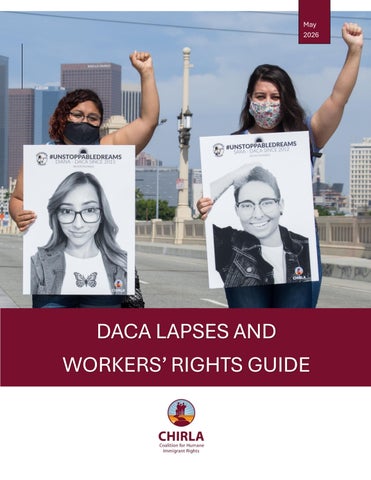
DACA recipients and other workers with temporary statuses are facing unprecedented challenges due to increased wait times for work permit renewals and the elimination of automatic work permit extensions. If you have DACA or another temporary status, it is important to understand your rights at work.
The DACA program was created in 2012 under the Obama administration to provide temporary relief to undocumented immigrant youth while Congress worked to create a pathway to citizenship. Fourteen years later, the program has protected hundreds of thousands of immigrants and allowed them to contribute to the workforce. Some reports estimate that if DACA ended, approximately 22,000 jobs could be lost every two months, with California and Texas likely experiencing the greatest impact.
Under Trump 2.0, we have seen a growing number of new attacks on the program; along with implementation of new policies to purposely delay not only DACA applications, but most applications for immigration relief:
• New Biometric Rules: Under the Trump administration, USCIS has tightened its biometrics and photograph reuse policies, and previously collected biometrics/photos generally may only be reused if they were taken within the past 36 months. As a result, more work permit renewal applicants are being scheduled for biometrics appointments again.
• Fee Increases: USCIS has increased fees for many immigration applications and benefits, making immigration relief more expensive and less accessible.
• Electronic Payment Requirements: USCIS has largely phased out money orders and paper checks, making it harder for individuals without bank accounts to pay filing fees.
• Processing Hurdles: USCIS has increasingly added additional review layers and procedural requirements, contributing to longer processing times.
• Increased Scrutiny: By framing these changes as e orts to combat fraud and increase scrutiny, we have seen an increase in denials, delays, and requests for evidence that sometimes lack a valid legal basis, resulting in longer overall processing times.
• Pausing Applications for Certain Countries: Two Presidential Proclamations (10949 and 10998) have placed pending USCIS applications from individuals from 39 countries on hold.
• For a full list of the countries a ected by the hold, as well as additional information about DACA renewal delays, check out NILC’s blog: https://www.nilc.org/articles/why-some-daca-renewals-are-taking-longer-andwhat-you-can-do/
The primary purpose of this guide is to help individuals with DACA and other temporary statuses preserve their jobs whenever possible, while empowering them to understand, preserve, and assert their rights under employment laws.
Employment law protections apply to all employees, regardless of immigration status.
Under federal law, employers must ensure that employees have valid work authorization. At the same time, they must balance their obligations under immigration law with their responsibilities under employment law, including compliance with applicable employee protections.
• IF FIRED: Under California law, you have the right to be paid all wages owed, including accrued vacation, immediately upon termination.
• IF YOU RESIGN: Under California law, you have the right to be paid all wages owed, including accrued vacation, within 72 hours of resignation.
• OUTSIDE OF CALIFORNIA: Federal law generally requires payment of earned wages, but final paycheck deadlines and whether accrued vacation must be paid depend on state law.
NOTE: The obligation to pay all wages owed does not disappear just because a work permit lapses. Furthermore, the final paycheck should not be conditioned on signing any release of liability. If o ered, additional severance or discretionary payments in exchange for a release, consult with an attorney before signing.
In addition to the above, you have the right to:
• Be paid for all time worked
• Be paid at least the minimum wage or the promised rate
• Be paid on time (no late pay, no bounced checks)
• Receive complete and accurate wage statements
• Be paid overtime at the appropriate rate of pay (e.g., time-and-a-half)
• Receive legally required rest and meal breaks
• Be reimbursed for necessary work-related expenses
• Be free from unlawful deductions from your wages
Employers may o er benefits that are not required by law, such as vacation time, bonuses, or other perks. These perks and benefits are often outlined in the company’s personnel manual or a collective bargaining agreement (CBA) if you work in a unionized workplace.
While these benefits are optional, once promised, they become enforceable obligations.
While their work permit remains valid, employees with serious health conditions, or those caring for eligible family members with serious health conditions, may request federal and state job-protected medical or family leave, such as FMLA, CFRA, or PDL, if they meet the independent eligibility requirements and provide any required medical certification.
Once a work permit has expired, there is little clear legal authority regarding whether employees may still request such leave. If eligible, workers should feel empowered to exercise and preserve their rights, and employers should carefully evaluate valid leave requests consistent with applicable law. Employers should not deny otherwise valid leave requests solely because of an upcoming work permit expiration date.
See the section on “State or Federal Protected Leave”.
All employees are protected against discrimination and retaliation, including immigrationbased retaliation. While some states have stronger protections than others, the following practices are also generally prohibited under federal law.
Employers are prohibited from engaging in the following forms of retaliation or unfair immigration-related practices:
• Refusing to accept valid documents that reasonably appear to be genuine (8 U.S.C. § 1324b(a)(6); Cal. Labor Code § 1019.1)
• Improper reverification of employment authorization without a valid legal basis or in a discriminatory or retaliatory manner (8 U.S.C. § 1324b; U.S. Citizenship and Immigration Services, E-Verify Employer Guidance; Cal. Labor Code § 1019.2)
o The obligation to reverify employment authorization upon expiration falls on the employer. Workers are not required to inform their employer when their work permit is about to expire.
o Employers may track work authorization expiration dates and remind employees of upcoming expirations (often within 90 days). However, they must follow federal I-9 rules and generally should not request updated documents before reverification is required.
o Employers generally should not terminate employment before a work permit expires solely based on a future expiration date, as doing so may raise concerns about discrimination or unfair immigration-related practices.
o For more information about I-9 reverification, see page 5 of the Form I-9 Instructions at https://www.uscis.gov/sites/default/files/document/forms/i9instr.pdf.
o For more information about the list of acceptable documents, see page 2 of Form I-9: https://www.uscis.gov/sites/default/files/document/forms/i-9.pdf
• Misusing E-Verify, including using it in a manner not required or authorized by law, or for improper reverification without a valid legal basis, as discussed above (8 U.S.C. § 1324b; U.S. Citizenship and Immigration Services, E-Verify Employer Guidance; Cal. Labor Code § 1019.2)
• Threatening to report the employee or their family members to immigration authorities (U.S. Department of Justice, Immigrant and Employee Rights Section; Cal. Labor Code § 1019.1)
• Threatening to file false reports with law enforcement or government agencies (including police, state, or federal agencies) (U.S. Department of Justice, Immigrant and Employee Rights Section; Cal. Labor Code § 1019.1)
o Document what happened (dates,
o Save any texts, emails, or evidence
o Do NOT sign anything without understanding it
o Contact legal help immediately
Submit your renewal promptly. We recommend applying at least 5 months (150 days) before your current work permit expires (some practitioners recommend applying as early as 6 months, or 180 days). You may file earlier than 150 days, and USCIS will generally still accept and process the application. However, filing too early may result in losing some of your current DACA validity period if the case is processed quickly. Given current processing delays, some applicants choose to file earlier, understanding this tradeoff.
If your case is taking longer than expected:
• You can check the status of your case using USCIS’ online Case Status tool at https://egov.uscis.gov/. Make sure you have the receipt number USCIS provided when it received your renewal application. The online case status tool may show that your renewal application has been approved before you receive the approval notice or your new Employment Authorization Document (EAD) in the mail. Check your case status regularly for updates.
• You may submit a USCIS case inquiry once your case is outside normal processing times, or earlier if there is an urgent need. You may submit the inquiry at: https://egov.uscis.gov/e-request/ccpt or call USCIS at 1-800-375-5283
• As your expiration date approaches, you may consider contacting your congressional representative to request a congressional inquiry. You can find your member of Congress at https://www.congress.gov/members/find-your-member.
On your Representative’s or Senator’s congressional website, look for a “Member Services” or “Assistance With a Federal Agency” form to request assistance. Be prepared to provide information such as your A-number, receipt numbers and dates, and the type of case involved. If you need additional assistance, you may also contact CHIRLA’s Advocacy and Policy Department at info@chirla.org.
There are no federal or state job-protected leave programs specifically designed to address a DACA lapse.
If a work permit expires and is not renewed, federal law generally prohibits employers from continuing to employ the worker in active employment. However, employers still have discretion to provide paid leave — such as granting vacation or PTO requests — or unpaid leave.1
Workers may also qualify for other forms of leave under state or federal law, employer policies, or collective bargaining agreements (CBAs). These forms of leave are unrelated to the DACA lapse itself, and eligibility depends on independent qualifying factors. Workers should therefore request leave based on the qualifying condition or circumstance — not the DACA lapse. If you independently qualify, you should request leave as soon as possible, as these forms of leave generally may only be requested while you are still able and willing to work — in other words, while your work permit is still valid.
To evaluate your options, follow these four steps:
1. Review your employer’s policies for leave options o ered exclusively by your employer
2. Consider requesting paid vacation or PTO leave.
3. If eligible, promptly apply for federal or state medical or family leave
4. Consider requesting unpaid leave in writing.
Each option is further explained below.
1 USCIS I-9 guidance focuses on the prohibi on against con nued ac ve employment — meaning the con nued performance of labor or services — when work authoriza on lapses, but it does not mandate permanent termina on or require a specific HR mechanism, such as termina on instead of leave. Approved paid or unpaid leave is consistent with overall USCIS guidance (see USCIS Handbook for Employers M-274 and USCIS Con nuing Employment Guidance) and employers retain discre on to grant it.
Some employers o er benefits or leave options—such as sabbaticals or mental health leave—that are not required by law but are provided as additional perks. While not common, it is important to review your employer’s policies for any available temporary leave options and their requirements. Eligibility for these leave options depends on requirements unrelated to the DACA lapse, and you must meet those requirements.
a. Personnel Policies: Review your employee handbook or personnel manual for any leave options (paid or unpaid), such as personal or mental health leave. While employers are not required by law to o er these benefits, if they do—such as through a written policy—you should review whether you meet the eligibility requirements.
b. Union Agreements (if applicable): If your workplace is unionized, review your employer’s collective bargaining agreement (CBA) for provisions on leave or sabbaticals. Some CBAs may provide extended leave or sabbatical opportunities based on years of service or other eligibility requirements.
If you have accrued vacation or PTO time:
• You may request to use it
• Approval is subject to employer policy and is fully at the employer’s discretion.
Employers are not required to approve vacation requests, but they generally will if you have enough vacation or PTO accrued and request it in advance. If your request is not approved, any earned vacation must still be paid out when your employment ends.
Workers with serious health conditions, or those seeking to care for a family member with a serious health condition, may qualify for federal or state medical and family leave programs such as FMLA, CFRA, or PDL, based on independent eligibility requirements. If eligible, you should apply as soon as possible while you are still actively employed.
Important: Eligibility for these leave programs is not based on immigration status. However, in practice, you must generally have valid work authorization to continue working or return to work after leave. Furthermore, you must have a legitimate qualifying
reason to request leave. Applying without meeting the eligibility requirements may result in denial or other consequences.
See the section on State or Federal Protected Leave.
Even if a personnel manual or collective bargaining agreement (CBA) does not provide leave beyond what is required by law, you may still request unpaid leave. Employers have discretion to grant such requests.
It is best to submit your request in writing and obtain a written response (for example, by email or text message). Employers have discretion to grant or deny these requests. When making your request, you may wish to emphasize your positive employment record. When requesting leave, consider explaining:
• That you have already submitted a DACA renewal
• That any delay is outside your control
• The steps you have taken to resolve it
If your employer responds verbally, you can document the conversation by sending a followup email or text thanking them and confirming the details discussed (for example, approval of unpaid leave and the agreed-upon dates).
• You may use the sample letters at the end of this guide (see Addendum A and Addendum B).
• Attach a copy of your DACA renewal receipt and/or documentation of e orts to expedite your case.
• When possible, request unpaid leave amicably using Addendum A to help preserve your job and maintain a positive working relationship with your employer.
• If labor violations are suspected, use Addendum B for a more assertive request.
Workers with serious health conditions, or those caring for family members with serious health conditions, should not be discouraged from applying for job-protected medical or family leave, such as FMLA, CFRA, or PDL, if they meet the independent eligibility requirements and provide any required medical certification. Eligible employees should apply for these types of leave while their work permit is still valid.
Once a work permit has expired, there is little clear legal authority regarding whether employees may still request such leave. If eligible, workers should feel empowered to exercise and preserve their rights, and employers should carefully evaluate valid leave requests consistent with applicable law. Employers should not deny otherwise valid leave requests solely because of an upcoming work permit expiration date.
If your DACA expires while you are on approved leave, you may generally remain on leave. However, your employer typically cannot reinstate you to active work until you have valid work authorization.
Under FMLA and CFRA, eligible employees who return from approved leave generally have the right to be reinstated to the same or a comparable position with equivalent pay, benefits, and working conditions. Employers must generally maintain group health coverage during protected leave under the same terms as if the employee were actively working, although employees typically remain responsible for their normal share of premiums.
We know that many workers in our communities may be living with serious health conditions or may need family leave, but often postpone requesting leave to avoid interruptions at work because of the strong work ethic common in our communities. However, eligible workers should feel empowered to preserve their rights and take care of themselves and their families when needed.
FMLA is a federal law that provides job-protected leave for an employee’s own serious health condition or for that of an eligible family member.
You may qualify if:
• You work for an employer with 50 or more employees;
• You have worked for the employer for at least 12 months; and
• You have worked at least 1,250 hours in the past 12 months.
Covers:
• Your own serious health condition; or
• The serious health condition of an eligible family member, including:
o Spouse
o Child
o Parent
De
fi
Under the Family and Medical Leave Act (FMLA), a “serious health condition” is an illness, injury, impairment, or physical or mental condition that involves either:
• Inpatient care (such as an overnight stay in a hospital or similar facility); or
• Continuing treatment by a healthcare provider.
This includes conditions that:
• Cause incapacity for more than three consecutive days and require ongoing treatment;
• Are chronic (such as asthma, diabetes, or conditions requiring chemotherapy or physical therapy); or
• Include pregnancy, prenatal care, and recovery from childbirth as serious health conditions. This means eligible employees may take leave for their own pregnancyrelated medical needs or to care for a spouse, child, or parent with pregnancy-related medical needs.
Additional FMLA Leave (Separate from “Serious Health Condition”)
• FMLA also allows leave for baby bonding after birth, adoption, or foster placement (within the first 12 months)
• Provides up to 12 weeks of job-protected unpaid leave, or up to 26 weeks for military caregiver leave.
FMLA leave is unpaid but job-protected. Your employer must maintain your health coverage under the same terms (you may still be responsible for your share of the premium). Upon return, you must be restored to the same or an equivalent job with the same benefits.
You may also have wage replacement options. Depending on your state, programs may provide partial income during leave. For example, in California, State Disability Insurance (SDI) may cover your own medical leave, and Paid Family Leave (PFL) may cover bonding or caregiving—typically about 60–70% of wages. You may also be able to use accrued PTO or sick time, depending on your employer’s policies.
For more information about requesting Federal Family and Medical Leave (FMLA), visit: https://www.dol.gov/agencies/whd/fmla/how-to-talk-to-your-employer-about-leave
CFRA is a California state law that provides job-protected leave for an employee’s own serious health condition or that of an eligible family member. Unlike FMLA, CFRA covers a broader range of family members.
You may qualify if:
• You work for an employer with five or more employees;
• You have worked for the employer for at least 12 months; and
• You have worked at least 1,250 hours in the past 12 months.
Covers:
• Your own serious health condition
• The serious health condition of a family member, including:
o Child
o Parent
o Spouse
o Domestic partner
o Sibling
o Grandparent
o Grandchild
o Parent-in-law
De
finition of a Serious Health Condition under CFRA
Under CFRA, a “serious health condition” is an illness, injury, impairment, or physical or mental condition that involves either:
• Inpatient care (such as an overnight stay in a hospital or similar facility); or
• Continuing treatment or supervision by a healthcare provider.
This includes conditions that:
• Cause incapacity for more than three consecutive days and require ongoing treatment;
• Are chronic (such as asthma, diabetes, or conditions requiring chemotherapy or physical therapy); or
• Include pregnancy-related conditions, which may qualify as a serious health condition for purposes of caring for a family member.
:
o Unlike FMLA, CFRA does not cover an employee’s own pregnancy disability. That is covered under Pregnancy Disability Leave (PDL)
Additional CFRA Leave (Separate from “Serious Health Condition”)
• Baby bonding after birth, adoption, or foster placement (within the first 12 months)
• Provides up to 12 weeks of job-protected unpaid leave.
Paid or Unpaid?
CFRA leave is unpaid but job-protected. Your employer must maintain your health coverage under the same terms (you may still be responsible for your share of the premium). Upon return, you must be restored to the same or a comparable job with the same benefits.
Depending on the state you live in, you may also be eligible for wage replacement benefits through state programs. For example, in California, Paid Family Leave (PFL) may provide partial income for baby bonding or caregiving—typically about 60–70% of your wages. For your own medical condition, wage replacement may be available through State Disability Insurance (SDI). You may also be able to use accrued PTO or sick time, depending on your employer’s policies.
For more information about requesting CFRA, PDL, and other forms of California leave, visit: https://calcivilrights.ca.gov/family-medical-pregnancy-leave/
PDL is a California-specific law. Other states may have similar leave programs, but the requirements and protections may di er.
No minimum requirements for:
• Employer size;
• Length of employment; or
• Hours worked.
Covers:
• Only the employee’s own pregnancy-related condition, including pregnancy, childbirth, and related medical conditions.
Up to 4 months of job-protected leave, including continuation of health coverage.
Pregnancy Disability Leave (PDL) is unpaid but job-protected, meaning your employer must maintain your job and continue your health coverage under the same terms as if you were working. However, you may receive partial wage replacement through California’s State Disability Insurance (SDI)—typically about 60–70% of your wages, up to a weekly cap— during pregnancy and recovery. You may also be able to use accrued paid leave, such as PTO or sick time, depending on your employer’s policies.
Baby bonding is not covered by the California Pregnancy Disability Leave (PDL), but it is covered by CFRA. California Paid Family Leave (PFL) may provide partial wage replacement—about 60–70% of your wages, up to a weekly cap—for up to 8 weeks. You must apply for PFL through the SDI system. PFL provides pay but not job protection; job protection for bonding typically comes from CFRA or FMLA if you qualify.
You are not required to use PTO or sick leave. However, an employer may require you to use up to two weeks of accrued vacation/PTO before receiving full PFL benefits.
For more information about requesting CFRA, PDL, and other forms of California leave, visit: https://calcivilrights.ca.gov/family-medical-pregnancy-leave/
This is a legally complex situation. If you are on state or federal job-protected leave:
• You may be able to remain on leave if you qualified for the leave before the expiration of your work authorization.
• However, employers generally cannot return you to active work without valid work authorization.
This creates a tension between employment law protections and federal immigration requirements. In practice, most employers allow workers to complete their leave and return once valid work authorization is obtained.
If an employer fails to reinstate an employee whose work permit has already been renewed, the employee may have valid grounds for legal action, given that many federal and state leave laws generally require employees returning from protected leave to be reinstated to the same or a comparable position with equivalent pay, benefits, and working conditions.
Because unpaid leave is granted at the employer’s discretion, the employer may choose to continue or extend unpaid leave.
• You may be able to remain on leave.
• However, employers generally cannot return you to active work without valid work authorization.
In practice, many employers may allow workers to complete their leave and return once valid work authorization is obtained.
Given that the purpose of this guide as stated is to help employees preserve their job and preserve their employment rights, the following should be considered.
As a strategy to help preserve your job and your employment rights, becoming an independent contractor should generally be considered a last resort and pursued only if other alternatives are unavailable, for the following reasons:
• Potential loss of seniority rights or union protections: Employees with seniority may be eligible for benefits under employer policies, personnel manuals, or collective bargaining agreements (CBAs). If an employer changes an employee’s classification, status, or date of hire, some of those benefits or protections could be lost. In addition, employees who are part of a bargaining unit could be adversely a ected if they are reclassified from bargaining unit members to independent contractors.
• Loss of protections under employment laws: Most employment laws protect employees, not independent contractors. By definition, independent contractors are generally not considered employees under many employment laws. These protections may include, among others, protections against wage theft, retaliation, discrimination, unemployment insurance, workers’ compensation coverage, paid leave protections, and overtime rights. Having said that, misclassified workers may still later assert employee status and seek protections or remedies under applicable employment laws. However, if the worker requested the change in classification, that fact may a ect how arguments are evaluated by labor authorities.
• ABC test (used in some states, including California) and other applicable laws: Federal standards and some state standards for independent contractor classification have become stricter in recent years. In many situations, it may be di icult to lawfully convert an employee into an independent contractor when the work performed remains substantially the same. This requires a case-by-case analysis.
This is not to say that such arrangements are never lawful and appropriate. Parties should evaluate their options, and employers are encouraged to consider this option as appropriate.
Independent contractor status may be a good option for individuals seeking a new arrangement that may provide greater flexibility than traditional employment tied to a single
employer. Individuals may create their own businesses and o er services to multiple clients or, when appropriate, to a single client.
Becoming an independent contractor o ers certain advantages, such as the ability to work with multiple clients, build an independent business, exercise greater control over work schedules and projects, and avoid depending on a single source of income. In some situations, independent contractor work may also provide greater flexibility during periods of uncertainty involving employment authorization. In addition, independent contractors may be eligible for certain business-related tax deductions or advantages depending on their individual circumstances.
For more information about how to become an independent contractor see https://www.thedream.us/current-scholars/career-success/entrepreneurship/
Unpaid leave can be granted at the employer’s discretion. Employers who have invested time and resources in training employees are often willing to grant such requests once they understand they have the discretion to do so.
A denial of unpaid leave may be based on a lawful reason (for example, an employer legitimately seeking to downsize or eliminate a position for non-retaliatory reasons) or an unlawful reason. Some potential red flags that may suggest retaliation, discrimination, or other unlawful conduct include:
• Patterns of prior labor law violations: Employers with a history of wage theft or other labor violations may view a work permit lapse as an opportunity to terminate workers who may later assert employment claims. In some situations, employers may also improperly pressure workers to sign waivers or releases of liability in exchange for receiving final paychecks or other wages already owed.
• Patterns of prior retaliation: If an employee previously complained about wage theft, discrimination or harassment based on protected characteristics, unsafe working conditions, or other labor violations, and the employer later took adverse action (such as termination, reduced hours, threats, or selective reverification), this may raise concerns about unlawful retaliation, especially if it occurred shortly after the assertion of rights.
• Patterns of prior discrimination: If employees of certain national origins, immigrant workers, or workers with temporary statuses are regularly treated di erently from similarly situated employees, this may raise concerns about unlawful discrimination, retaliation, or unfair immigration-related employment practices.
If you believe any of your employment rights have been violated, you may file a labor complaint or consult with an employment law attorney. It is important to know that these claims are subject to strict statutes of limitations, which vary depending on the type of claim and whether it is filed with a federal or state agency.
U.S. Department of Labor (U.S. DOL): Adjudicates claims involving wage theft and certain retaliation claims under federal labor laws. The statute of limitations is often 2 years (3 years for willful violations). See https://www.dol.gov/agencies/whd/contact/complaints
Equal Employment Opportunity Commission (EEOC): Adjudicates claims involving discrimination, harassment, and retaliation based on protected characteristics under federal law, such as religion, race, sexual orientation, gender, and others. The statute of limitations is generally 180 days, but is often extended to 300 days in states with a cooperating state agency. See https://www.eeoc.gov/filing-charge-discrimination
• For more information, contact: EMPLEO Hotline (Outside California): 1-877552-9832 (information and referrals only)
Not all states have agencies that handle employment claims comparable to those available in California. In California, the following agencies are the most relevant:
California Labor Commissioner (DLSE): Adjudicates claims involving wage theft, related retaliation, and other labor violations under California law. The statute of limitations varies by claim; many wage claims are generally 3 years (some may be 4 years). Retaliation claims must be filed within 1 year.
California Civil Rights Department (CRD): Adjudicates claims involving discrimination, harassment, and retaliation based on protected characteristics under California law, such as religion, race, sexual orientation, gender, and others. The statute of limitations is generally 3 years.
• If you’re in California, you may also contact CHIRLA’s Workers’ Rights and Labor Legal Services Department for a legal consultation or for more information.
If your work permit expires and has not been renewed (or your renewal is still pending):
• Employers generally cannot continue employing workers without valid work authorization, and termination based solely on the lack of valid work authorization is generally lawful under federal law.
• However, employers have discretion to provide unpaid leave while a work permit renewal remains pending. The purpose of unpaid leave is to help preserve the employee’s job and rights during that period.
• Employers may also provide other forms of leave or sabbaticals allowed under personnel policies or collective bargaining agreements (CBAs).
• Workers with serious health conditions, or those caring for family members with serious health conditions, may qualify for federal or state job-protected medical and family leave programs such as FMLA, CFRA, or PDL. If a worker qualified for protected leave before their DACA expired, they may, in some situations, remain on leave even after a work permit lapse. However, employers generally cannot return workers to active employment until valid work authorization is obtained. In practice, employers often allow workers to complete their leave and return once work authorization is renewed.
Protected leave laws generally require eligible employees returning from leave to be reinstated to the same or a comparable position with equivalent pay, benefits, and working conditions. Failure to do so may entitle employees to pursue administrative complaints or litigation under applicable employment laws.
• If you are not eligible for other forms of leave, you should consider requesting unpaid leave in writing. Make sure to document the request in writing. Requesting unpaid leave is often the most widely available option for preserving employment.
• Under California Law, if you are terminated, your employer must generally pay all wages owed, including accrued vacation, immediately upon termination. If you resign, wages must be paid within 72 hours.
• Payment of wages generally cannot be conditioned on signing a release of liability.
• Employees remain protected by employment laws regardless of immigration status or a lapse in status, including laws protecting workers from wage theft, retaliation, discrimination, and unfair immigration-related practices and may still file labor complaints or bring private lawsuits regardless of immigration status.
Employers may not:
• Use immigration status as a pretext to avoid paying wages or benefits owed
• Use immigration status as a pretext for discrimination
• Use immigration status as a pretext for retaliation
Examples of possible retaliation:
• You report wage theft, discrimination based on protected characteristics (such as religion, race, or other protected characteristics), or harassment (including sexual harassment)
• Soon after, you experience an adverse employment action (such as termination, reduced hours, or improper reverification of work authorization)
Examples of immigration-based retaliation or unlawful conduct:
• Refusing to accept documents that reasonably appear to be genuine
• Improperly reverifying employment authorization without a valid legal basis, or in a discriminatory or retaliatory manner
• Misusing E-Verify in a way not required or authorized by law
• Threatening to report the employee or their family to immigration authorities
• Threatening to file false reports with police or government agencies
(For use when there is no suspected retaliation or discrimination; collaborative request)
VIA EMAIL
Date: _________________________
Employer Name: ______________________
A n: Human Resources Department
Address: ______________________________
Email: ________________________________
Re: Employment Authoriza on Document (EAD) Expira on and Leave Request – [Employee Name] __________________________________
Dear Sir or Madam,
I have been informed that my Employment Authoriza on Document (EAD) will expire on __________________, and that proof of con nued work authoriza on is being requested.
As I have done in prior years, I mely submi ed my EAD renewal applica on to U.S. Ci zenship and Immigra on Services (USCIS) on __________________. USCIS is currently experiencing significant and unprecedented processing delays affec ng many applica ons, including renewals. These delays were not foreseeable at the me I submi ed my applica on.
Historically, certain EAD renewal applicants—such as those under category C33—benefited from an automa c extension of up to 540 days, which allowed individuals to con nue working while their renewal applica ons were pending. However, effec ve October 30, 2025, an interim final rule eliminated this automa c extension for newly filed applica ons. As a result, my current EAD is not eligible for an automa c extension.
I have made mul ple efforts to follow up with USCIS regarding my applica on, including a empts to expedite processing. Unfortunately, I have not received a defini ve meline for adjudica on. Based on current processing trends, I remain hopeful that my renewal will be approved in the near future.
During my me at __________________________, I have been an employee in good standing and have remained commi ed to my responsibili es. For example: [men on your accomplishments or key contribu ons as an employee]
USCIS I-9 guidance focuses on the prohibi on against con nued ac ve employment — meaning the ac ve performance of labor or services — when work authoriza on lapses, but it does not mandate permanent termina on or require a specific HR mechanism, such as termina on instead of leave. Because approved paid or unpaid leave does not involve the ac ve performance of labor or services, such leave is consistent with overall USCIS guidance (see USCIS Handbook for Employers M-274 and USCIS Con nuing Employment Guidance), and employers retain discre on to grant it.
Given that these delays are outside of my control, I respec ully request considera on of unpaid administra ve leave while I await approval of my renewed EAD.
I will promptly no fy you and provide documenta on as soon as I receive proof of renewed work authoriza on.
Thank you for your me and considera on. Please feel free to contact me at (_____) _____-________ or by email at ___________________________ if you have any ques ons.
Sincerely,
[Employee Signature]
Employee Name
cc: Labor Representa ve (if applicable)
Name: ____________________________
Email Address: ____________________
(For use when retaliation or discrimination may be occurring simultaneously, assertive request)
VIA EMAIL
Date: _________________________________
Employer Name: ______________________
A n: Human Resources Department
Address: ______________________________
Email: _________________________________
Re: Employment Authoriza on Document (EAD) Expira on and Leave Request – [Employee Name] ___________________________________________
Dear Sir or Madam,
I have been informed that my Employment Authoriza on Document (EAD) will expire on __________________, and that proof of con nued work authoriza on is required.
As I have done in prior years, I mely submi ed my EAD renewal applica on to U.S. Ci zenship and Immigra on Services (USCIS) on __________________. USCIS is currently experiencing significant and unprecedented processing delays affec ng many applica ons, including renewals. These delays were not foreseeable at the me I submi ed my applica on.
Historically, certain EAD renewal applicants—such as those under category C33—benefited from an automa c extension of up to 540 days, which allowed individuals to con nue working while their renewal applica ons were pending. However, effec ve October 30, 2025, an interim final rule eliminated this automa c extension for newly filed applica ons. As a result, my current EAD is not eligible for an automa c extension.
I have made mul ple efforts to follow up with USCIS regarding my applica on, including a empts to expedite processing. Unfortunately, I have not received a defini ve meline for adjudica on.
Based on current processing trends, I remain hopeful that my renewal will be approved in the near future.
During my me at __________________________, I have been an employee in good standing and have remained commi ed to my responsibili es. For example: [men on your accomplishments or key contribu ons as an employee]
Given that these delays are outside of my control, I respec ully request considera on of unpaid administra ve leave while I await approval of my renewed EAD.
I also want to note that I am aware that employees are protected from unlawful retalia on and discrimina on under federal and state law. Retalia on includes adverse ac ons—such as termina on, reduc on of hours, or other nega ve treatment—taken because an employee has asserted their rights or raised concerns. Discrimina on includes trea ng an employee differently based on protected characteris cs, including race, na onal origin, or other legally protected categories. While reverifica on of a work permit that is about to expire is lawful and required, immigra on status cannot be used as an excuse to retaliate or discriminate against an employee. These prac ces are unlawful, and I trust that any decisions regarding my employment will be made in compliance with applicable laws.
I will promptly no fy you and provide documenta on as soon as I receive proof of renewed work authoriza on. Thank you for your me and considera on.
Please feel free to contact me at (__) ___-_____ or by email at ___________________________ if you have any ques ons.
Sincerely,
[Employee Signature]__________________
Employee Name
cc: Labor Representa ve (if applicable)
Name: ____________________________
Email Address: ____________________