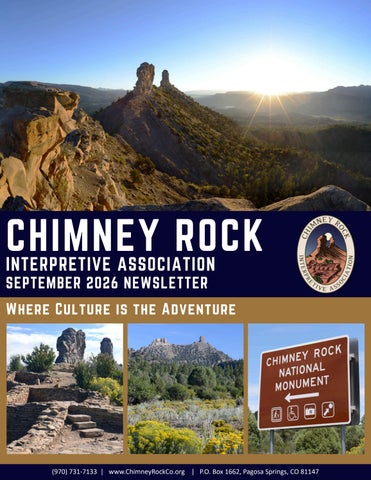
CHIMNEY ROCK INTERPRETIVE ASSOCIATION SEPTEMBER 2026 NEWSLETTER
Where Culture is the Adventure
(970) 731-7133 | www.ChimneyRockCo.org | P.O. Box 1662, Pagosa Springs, CO 81147
Message from the President of the Chimney Rock Interpretive Association Board As a volunteer at Chimney Rock National Monument, my goal is to offer respectful interpretations of the site and the ancient ones who built its structures. Instead of treating these sites as "abandoned ruins," I emphasize the continuous bond linking present-day Puebloans to their ancestors from a thousand years ago. I convey to visitors the importance of this ancestral site and the meaningful insights it provides. This area illustrates the enduring cultural traditions of Puebloan communities, including pottery, weaving and agricultural techniques. If farmers in the Oklahoma and Texas panhandles had implemented ancestral Puebloan farming methods in the 1930s, the Dust Bowl could potentially have been avoided. Protecting and maintaining these spaces depends on engaging individuals through place-based education. To that end, CRIA remains committed to supporting efforts such as the Junior Archaeology Program—which encourages resource stewardship—and gatherings like the Life at Chimney Rock Festival, which highlights Native American craftsmanship. Through place-based education and community events, we honor this rich heritage and foster stewardship to ensure these vital traditions and insights inspire future generations. Jill Sutton, CRIA Board President
(970) 731-7133 | www.ChimneyRockCo.org | P.O. Box 1662, Pagosa Springs, CO 81147
The Dating Game: Archeological Dating Methods Dr. John Kappelman Tuesday, October 27, 2026 6:00-7:30PM Community Methodist Church - Pagosa Springs | 434 Lewis Street The lecture will be offered both in person and via Zoom. Zoom link: https://us02web.zoom.us/j/5210476574?omn=83592279580
Thank you for your Support
This fascinating lecture explores how archaeologists and scientists determine the age of ancient objects, structures, and events—helping us understand what happened, when, and why. John will introduce the geological foundations of dating techniques and examine a range of scientific methods, including radiometric dating, paleomagnetism, archaeomagnetism, dendrochronology, and cultural seriation. With special emphasis on Southwestern Ancestral Puebloan sites such as Chimney Rock National Monument, he will discuss the strengths, limitations, and accuracy of each approach—highlighting key methods like carbon dating and dendrochronology that are essential to understanding the region’s past. This one-hour presentation will conclude with a brief Q&A session, offering attendees a deeper appreciation for the science behind uncovering history. Education & Interpretation in Action A classroom without walls Astronomical alignments and lunar cycles Engineering of the Great House Pueblo Trade routes and regional networks Cultural continuity and ancestral traditions Our Impact Last season over 19,000 visitors experienced guided interpretation. Educational programs were delivered, volunteers contributed thousands of service hours, and preservation initiatives continued through collaborative partnerships.
INSIDE Free Lecture by John Kappelman Did You Know? A Day in the Life of the Ancient Ones Spotlight Dr. Malville Celebration Fundraiser Collaboration Zuni Folklore September Calendar of Events A Rare Celestial Alignment Trail Tip of the Month International Observe the Moon Night
Every ticket purchased, every donation made, and every volunteer hour strengthens our ability to steward this sacred place.
(970) 731-7133 | www.ChimneyRockCo.org | P.O. Box 1662, Pagosa Springs, CO 81147
Did You Know? There used to be a sign beside the Pit house next to the Great Kiva. It had a recipe for blue corn cornbread on it: 1 part juniper ash to 3 parts cornmeal to 2 parts water. Ever wondered why the juniper ash? The inclusion of juniper ash in cornbread goes back to at least 1500 BC in Mesoamerican cultures. This recipe was transmitted to Native Americans along with corn. Inclusion of juniper ash is important for at least two reasons. First, it creates an alkaline (high pH) condition which releases niacin from corn. Niacin, also known as vitamin B3, has a wide range of functions in the body including maintaining digestive, skin and nervous system health. But probably the greatest benefit to prehistoric Native Americans is that juniper ash was a major source of calcium in their diets. One gram of ash has 280-300 milligrams calcium, about the same as a glass of milk. Modern Navajo in particular are going back to including juniper ash in their cornbread in large part because many are lactose intolerant. And it has been claimed that juniper ash improves the flavor, so give it a try.
Rainbows at Chimney Rock
(970) 731-7133 | www.ChimneyRockCo.org | P.O. Box 1662, Pagosa Springs, CO 81147
A Day in the Life of the Ancient Ones Tour Check-in is at the Gift Shop from 9:00 a.m. to 9:15 a.m. The tour begins at 9:30 a.m. The fee is $20.00 for ages 13 and up and $10.00 for ages 5-12, and under 5 are free, and is considered a non-refundable and nontransferable donation. Making a reservation through the Recreation.gov website or the call center (877-444-6777) is the only way to guarantee a spot for this tour. Recreation.gov charges a $1.00 reservation fee that is non-refundable. To ensure this tour is scheduled, reservations are strongly recommended. Reservations will be cut off 12 hours prior to the start of the tour.
A Day in the Life of the Ancient Ones Tour is offered on Tuesday, Wednesday, and Thursday mornings from 9:30 am to 10:30 am. Designed specifically for families with children and those unable to navigate the Great House Trail, this guided tour takes place along the Mesa Village Trail — an easy ¼ mile stroll along a mostly level, paved path. Along the way, visitors will visit a traditional agricultural home – Pit house; a community gathering site – Great Kiva; along with other unexcavated structures in this Ancient Puebloan agrarian village.
Walk-ins will be accommodated if space is available. They will be accepted on a first-come, first-served basis, and must arrive during the specified check-in time frame. Tickets can be purchased at the Gift Shop. Note: if no one has signed up for the tour by online reservation within the allotted time frame, the tour will not run. No refunds will be issued for no-shows. Refunds will be issued only for cancelled – not modified – tours/programs. PROGRAM DATES September 1, 2, 3, 8, 9, 10, 15, 16, 17, 22, 23, 24, 29, 30 More Information: www.ChimneyRockCo.org
Highlights of the tour will be a discussion of the plants and animals the Puebloans gathered and hunted, what crops they farmed, and how they utilized them in their daily lives over 1,000 years ago. You will have the opportunity to hold ancient pottery, touch the seeds they planted, and experience the amazing strength of their yucca fiber ropes. You will also learn how these small villages interacted with Chaco Canyon, the epicenter of the Chacoan culture. This tour is rated Easy and suitable for visitors of all ages and physical abilities. (970) 731-7133 | www.ChimneyRockCo.org | P.O. Box 1662, Pagosa Springs, CO 81147
Chimney Rock Honors Dr. J. McKim Malville and a Discovery Written by the Moon On August 8, Chimney Rock Interpretive Association (CRIA), along with family, friends, volunteers and representatives of the U.S. Forest Service, gathered at Chimney Rock National Monument to recognize a man whose curiosity and research helped reveal one of the site's most fascinating connections to the night sky. The gathering honored Dr. J. McKim Malville, Professor Emeritus of Astrophysical and Planetary Sciences, at the University of Colorado Boulder, and marked the 38th anniversary of his historic observation of the moon rising between Chimney Rock and Companion Rock during a Major Lunar Standstill. CRIA Board President Jill Sutton welcomed those gathered for the special occasion, which included members of Dr. Malville's family, CRIA volunteers, U.S. Forest Service representatives and others who came together to celebrate his contributions to the understanding of Chimney Rock. As part of the recognition, a commemorative bronze plaque honoring Dr. Malville and his work is now displayed in the Chimney Rock Visitor Center. Dr. Malville also donated something especially meaningful to the Visitor Center: a copy of the photograph he took on August 8, 1988, capturing the moon rising between the two iconic pinnacles. The photograph provides a remarkable visual record of the observation that helped deepen our understanding of the relationship between Chimney Rock's architecture and the movements of the moon.
A Discovery 38 Years in the Making Dr. Malville's connection to Chimney Rock began with a question: Why was the Great House Pueblo constructed in such an extraordinary location? The Great House sits high above the Piedra River Valley on a narrow mesa in the shadow of Chimney Rock and Companion Rock. Researchers had long recognized the site's unusual characteristics, but Dr. Malville began exploring whether the placement of the Great House close to the pinnacles might have an astronomical connection. He first considered alignments involving the summer solstice and Venus. Eventually, his attention turned to the moon and the Major Lunar Standstill, an astronomical cycle occurring approximately every 18.6 years, when the moon reaches the northernmost extreme of its rising position along the horizon. Dr. Malville discovered that the Major Lunar Standstill periods in the late 11th century may have corresponded closely with construction activity at the Great House. That possibility led
(970) 731-7133 | www.ChimneyRockCo.org | P.O. Box 1662, Pagosa Springs, CO 81147
Chimney Rock Honors Dr. J. McKim Malville and a Discovery Written by the Moon Preserving a Legacy Saturday's gathering was more than the presentation of a plaque. It brought together people whose connections to Chimney Rock span research, preservation, interpretation, volunteerism and family.
him back to Chimney Rock on August 8, 1988, accompanied by four of his university students. After hours of anticipation, the moon began to rise between the pinnacles. Rising into the space between Chimney and Companion Rock, the moon provided a dramatic confirmation of the astronomical alignment Dr. Malville had been investigating. His photograph of that moment became the first known photograph documenting a Major Lunar Standstill moonrise between the pinnacles.
Remarks by Ron Sutcliffe and Susan Yalom helped reflect on Dr. Malville's work and the importance of his contributions, while the presence of his family added a personal dimension to a story that has become an important part of Chimney Rock's modern history. Now, visitors to the Chimney Rock Visitor Center will be able to see both the plaque recognizing Dr. Malville and the photograph documenting that remarkable August morning in 1988. Together, they tell the story of scientific curiosity, careful observation and a landscape that continues to reveal connections between the earth and sky.
More significantly, Dr. Malville’s research provided compelling evidence that the Ancestral Puebloans who built and used the Great House understood this lunar cycle and intentionally chose this remarkable location to observe the moon’s movements between the pinnacles. For Dr. Malville and his students, the experience was extraordinary. They were witnessing a phenomenon that may have held profound significance for the Ancestral Puebloans more than a thousand years earlier. (970) 731-7133 | www.ChimneyRockCo.org | P.O. Box 1662, Pagosa Springs, CO 81147
Dr. Malville Presentation, Continued For Chimney Rock, the story is particularly fitting. For centuries, the two pinnacles have stood above the Piedra River Valley while the sun, moon and stars moved across the sky. Dr. Malville's work helped modern observers look at that familiar landscape differently—and consider what those same movements may have meant to the people who came before us. Thirty-eight years after he stood on the mesa and watched the moon rise between the pinnacles, Dr. Malville returned to Chimney Rock to see that discovery recognized and preserved for generations of visitors yet to come.
If you “Made it to the Top” at Chimney Rock National Monument, don’t leave without one of our brandnew commemorative stickers! These fun, new stickers are the perfect way to celebrate your accomplishment and share your Chimney Rock adventure with friends and family. Whether you place it on your water bottle, hiking gear, laptop, or vehicle, it’s a great reminder of the incredible journey to the mesa top and the unforgettable views waiting at the summit. After making the climb and experiencing the breathtaking panoramic views from the Great House Pueblo, you’ve definitely earned bragging rights! Be sure to stop by the Gift Shop and grab your sticker after your tour and let everyone know — I Made it to the Top!
2026 Fee Free Days September 17th: Constitution Day September 26th: National Public Lands Day (970) 731-7133 | www.ChimneyRockCo.org | P.O. Box 1662, Pagosa Springs, CO 81147
Making a Difference at Chimney RocK Chimney Rock Program Supporter Levels At Chimney Rock National Monument, the work of Chimney Rock Interpretive Association (CRIA) extends far beyond a single program. Through School week, Life at Chimney Rock, guided tours, lectures, and special events, CRIA creates meaningful connections to history, culture, and the land—many offered free or at low cost to ensure access for all. Each season, these programs reach hundreds of visitors of all ages. From students exploring hands-on activities like rock art and atlatl demonstrations to adults attending lectures and cultural events, these experiences spark curiosity and deepen appreciation for this remarkable place. With the help of dedicated volunteers and generous supporters, these efforts continue to inspire and connect visitors year after year. Your support helps ensure these programs remain accessible and impactful for future generations. Level
Contribution
Supporter of Chimney Rock
$50-$99
Listed in one CRIA Newsletter
$100–$249
Name listed on CRIA website Listed in CRIA Newsletter Listed in group social media post
$250–$499
Name listed on CRIA website Listed in CRIA Newsletter 1 individual shoutout on Social Media Digital “Proud Supporter” badge for your website
$500–$999
Business name + website link listed on CRIA website Listed in CRIA newsletter + logo included with link 2 business shoutouts on Social Media Digital “Proud Supporter” badge for your website
$1,000+
Prominent logo placement + link on CRIA website Listed in CRIA Newsletter for 6 months with link to business website 2 business shoutouts on social media Feature ad in upcoming newsletter (1/2 page) Digital “Proud Supporter” badge for your website
Friend of Chimney Rock
Steward of Chimney Rock
Community Partner
Heritage Sponsor
Recognitions
* Currently 2+K subscribers to CRIA Newsletter / ** Currently 15+K followers on Facebook
Contact us at (970) 731-7133 OfficeMgr@ChimneyRockCo.org Scan the QR Code to show your support! (970) 731-7133 | www.ChimneyRockCo.org | P.O. Box 1662, Pagosa Springs, CO 81147
Rain Couldn't Stop a Wonderful Evening! A little rain certainly didn't dampen the spirit in Pagosa Springs on Saturday evening! Community members gathered at the Tennyson Sculpture Garden for a special fundraiser benefiting two local nonprofit organizations —the Chimney Rock Interpretive Association (CRIA) and the Pagosa Springs Community Band. The evening brought together history, music, and community, beginning with an engaging presentation by Sue Fischer, “Surprises, Mysteries and Oddities at Chimney Rock.” Sue shared fascinating stories and insights about Chimney Rock, giving those in attendance another opportunity to discover what makes this remarkable place so unique. Following the presentation, the Pagosa Springs Community Band's chamber ensembles filled the evening with music. Despite the changing weather, the crowd stayed, listened, visited with friends and neighbors, and enjoyed an evening centered around two organizations that contribute so much to our community. Most importantly, the event was a wonderful reminder of the support that exists throughout Pagosa Springs. We are incredibly grateful to everyone who braved the rain and came out to support CRIA and the Community Band. Your attendance, generosity, smiles, and enthusiasm helped make the evening a success. Thank you, Pagosa Springs, for once again showing how wonderfully our community comes together!
(970) 731-7133 | www.ChimneyRockCo.org | P.O. Box 1662, Pagosa Springs, CO 81147
The Prairie-dogs and their Priest A Zuni Folktale as told to Frank H. Cushing in 1901 Once, long, long, ago, there was a Prairie-dog village south of Zuni, beyond Grease Mountain, and in the middle of that country stands a small mound. All around the base of the mound were the sky-holes and door-mounds of the grandfathers of the Prairie-dogs. In the very top of the mound was the house of an old Burrowing Owl and his wife. One summer it rained, and it rained and it rained so that the fine fields of portulaca were kept constantly fresh. The Prairie-dogs became fat and happy on their favorite food and gloried in the rain storms that produced such an abundant harvest for them. But still it kept raining, until by and by, when they went into their fields of portulaca they found their feet were wet, which they did not like any more than Prairiedogs like it today. And still it rained and rained until only the tops of plants appeared above water. Then the Prairie-dogs began to curse the rain and began to lose weight because they could no longer go to the fields to collect food. At last they grew very hungry and lean for their stores were all gone. The old ones among the Prairie-dogs, the grandfathers, called a great council and everybody trooped to the council. The chief spokes-person asked “How can we stop the rain?” After much futile planning, a wise old graychecked fellow suggested they appeal to their grandfather, the Burrowing-owl. The old grandfather Burrowing-owl stepped out of his house and asked what was the matter. “Ah, indeed” said the old Owl after hearing the problem. “Go down home and I will see what I can do. As you know very well, I am a priest.”
he would not hurt him. In the Owl burrow the Tipbeetle bobbed his head down into the ground before sitting down quite relieved. “Old woman” said the Burrowing-owl, “lay out that dish of beans on the floor.” The wife complied.” My friend” said the Burrowing-owl “fall to and satisfy yourself”. The Tipbeetle ate and swallowed and gulped until he had entirely emptied the first dish, then the second and then the third. Now by this time the Tip-beetle had developed a paunch, with a girth that was larger than safe. The Burrowing-owl then advised the beetle that when he laid a leather pouch on the floor to run his head into it and exhale as much wind as possible. “To facilitate this, I will squeeze you slightly. You see” continued the Owl, “you are relieved of the serious consequences of your gluttony.” The old Owl gently squeezed the beetle again until the bag had swelled so full with wind that it could hardly be tied up. The old Owl then sent the beetle home. Now, you know that if one goes near a Tip-beetle it will rear itself on its hands and head and disgorge breath of so pungent a nature that nobody can stand it. And you know, also, how small stewed beans affect one. Conceive then the power of the medicine contained in the bag. The old Owl, taking up a stick, hit the bag one whack. The clouds, before so thick, now began to thin out and the sunlight sifted through. The Owl hit the bag again and again and the clouds scuttled off. So potent was this all-penetrating odor that even the Rain-gods themselves could not withstand it. The Prairie-dogs shrieked in praise of their great Priest, the Grandfather Burrowing-owl.
The next morning the Burrowing-owl said to his wife “Put on a large quantity of beans, small beans that smell not pleasant.” The old Owl went out hunting at For that reason, prairie-dogs and burrowing owls have the roots of bushes. At last, he found one of those ill- always been great friends. smelling Beetles, with its head stuck down. He grabbed him up and took him home, telling the Tip-beetle that
ZUNIFOLKLORE
(970) 731-7133 | www.ChimneyRockCo.org | P.O. Box 1662, Pagosa Springs, CO 81147
Upcoming Special Event FREE Lecture FREE Lecture with with John John Kappelman Kappelman The Dating The Dating Game: Game: Archeological Archeological Dating Dating Methods Methods Tuesday, October Tuesday, October 27, 27, 2026 2026 from from 6:00-7:30pm 6:00-7:30pm
Join our Join our mailing mailing list list to to receive receive the the link link to to watch watch from from home via home via Zoom! Zoom! Click HERE Click HERE to to join join our our mailing mailing list! list!
Support the Mission The Chimney Rock Interpretive Association is a nonprofit organization dedicated to supporting the preservation, interpretation, and education efforts at Chimney Rock National Monument. Educational programming Volunteer training Site preservation initiatives Community outreach Special events and lectures
(970) 731-7133 | www.ChimneyRockCo.org | P.O. Box 1662, Pagosa Springs, CO 81147
A Rare Celestial Alignment by Ernie O’Toole
Continuing Education Article The CRIA Education Committee has decided to contribute Continuing Education Articles and Tips to the Newsletter monthly to keep our Guides, Volunteers, and Guests up to date on new findings, corrections to the current narratives, etc.
One of the enduring stories that has been circulating around the Chimney Rock world for at least as long as I have been here, and that’s over eleven years, is that the inhabitants of Chimney Rock supplied timbers for the buildings at Chaco Canyon by floating them down the Piedra River then to the San Juan River and on to Chaco. This idea has persisted for a long time, I am sure that we have all heard of it, and some of us have even passed it along to our visitors. I have even had visitors ask about it. This, I think, is just one of a number of “stories” that gets started by someone “thinking out loud”, someone else hearing and thinking, “That’s a good story.” – and it takes on a life of its own. Even as it has persisted, there is no evidence to suggest that this story is true. Thinking about the reality of it, one could reject the premise by looking at the geographical layout of the distances and rivers that would be involved. The Piedra River is narrow and winding, pretty much all the way down to its confluence with the San Juan River. Imagine putting big, cut timbers into this river and letting the river flow take them. They would become snagged at almost every turn by rocks and snags throughout the journey. The same goes for the San Juan River. This would require a number of people situated strategically along the river to get those timbers free from snags, to float again on both sides of the river. They would have had to do this for approximately 86 miles of the Piedra and San Juan Rivers, then pull them out near Farmington, NM for another 50 or so miles overland to Chaco. It just does not seem to be a viable way to supply timbers for buildings at Chaco. There are several sources for timber much closer to Chaco that actually did supply the timbers for Chaco construction.
The Crow Canyon Archeological Center offers an amazing webinar series. “Tracing the Origin of Chacoan Beams from Chaco Canyon to Aztec Great House” by Dr. Chris Guiterman aptly explains where the timbers for building at Chaco and Aztec came from. The link is https://www.youtube.com/watch? v=8CdqcYmrI6o or Tracing the Origin of Chacoan Beams from Chaco Canyon to Aztec Great House with Dr. Chris Guiterman. The bottom line is that 20% of the timbers came from the Zuni Mountains about 15 to 20 miles to the south, and 80% came from the Chuska Mountains about 40 miles to the west. It is estimated that over 200,000 timbers were needed. So next time you hear a “good story” about Chimney Rock, Ancestral Puebloans, Chaco Culture, etc. check out its validity before repeating it to our visitors. Crow Canyon has over 250 webinars in its library, many of which are pertinent to Chimney Rock and the Chaco Culture. The link is https://www.youtube.com/playlist? list=PLiT1D3iEUnpDwPMWOerteiFtfQX5bWply or Crow Canyon Webinar series playlist. If any of you have some interesting “Continuing Education Tid-Bits” like the one above or would like to look into the validity of some “good stories”, please submit them to the Education Committee. We look forward to hearing from you.
(970) 731-7133 | www.ChimneyRockCo.org | P.O. Box 1662, Pagosa Springs, CO 81147
Trail Tip of the Month Don't Let the Season Get Away! September brings cooler mornings, changing colors, and a beautiful time to explore Chimney Rock National Monument—but it also means the 2026 season is beginning to wind down. With just two months remaining in the season, now is the time to make that visit you've been planning, return for another favorite program, or experience something new. Take a guided tour, walk the trails, explore the Great House Pueblo, and spend a little extra time taking in the incredible landscape and history that make Chimney Rock so special. Trail Tip: Don't wait until you're saying, “I wish we'd made it out there one more time!” Check the remaining 2026 program schedule and plan your fall visit now. The trail is waiting—and there are still plenty of adventures ahead before we close out another wonderful season at Chimney Rock!
Book Your Next Visit at www.ChimneyRockCo.org.
Learn more or donate: www.ChimneyRockCo.org or Scan the QR Code to support Chimney Rock Interpretive Association (970) 731-7133 | www.ChimneyRockCo.org | P.O. Box 1662, Pagosa Springs, CO 81147
Ignacio Community Library Invites the Community to Celebrate International Observe the Moon Night
Mark your calendars for an evening of discovery, creativity, and family fun! The Ignacio Community Library will once again host International Observe the Moon Night on Friday, September 18, 2026, beginning at 5:00 p.m. This free community event offers something for all ages, from hands-on activities and exciting rocket launches to telescope viewing under the evening sky. Guests can also enjoy live music, participate in fun activities, and celebrate the wonder of space exploration with friends and neighbors.
Whether you're gazing through a telescope for the first time, cheering on a rocket launch, or enjoying an evening of music and community, International Observe the Moon Night promises to be an unforgettable celebration of science, imagination, and exploration. For additional information, visit www.ignaciolibrary.org.
In conjunction with the event, the library is also hosting two special contests. Creative builders are invited to enter the IdeaLab Rocket Build Contest, designing and constructing an original rocket from materials of their choice. Entries are due by September 16, with winners announced during International Observe the Moon Night. Writers of all ages are encouraged to participate in the Moon Poetry Contest, where poems of any style and length are welcome. Entries are due by September 15 at 5:00 p.m., giving aspiring poets the opportunity to share their creativity and love of the night sky. (970) 731-7133 | www.ChimneyRockCo.org | P.O. Box 1662, Pagosa Springs, CO 81147
CHIMNEY ROCK INTERPRETIVE ASSOCIATION BOARD OF DIRECTORS
Jill Sutton President
Ernie O’Toole Vice President
Bernadette Sikes
Rhonda Julian
Secretary
Treasurer
Tony Aldwell
Ronnie Vera Doctor
Kathleen Thompson
Trustee At Large
Trustee At Large
Trustee At Large
John Kappelman Trustee At Large
Joanne Lucariello Trustee At Large
We look forward to your visit and to sharing in the experience of this truly remarkable place. Chimney Rock is more than a destination—it is a landscape rich with history, culture, and connection. As stewards and advocates, we are honored to help preserve and share the stories of the Ancestral Puebloans and the significance of this sacred site. Our passion for Chimney Rock National Monument is what brings us together, and it is our privilege to help create meaningful experiences for each visitor who walks these trails and takes in these views. We hope your time here inspires curiosity, reflection, and a deeper appreciation for the history and beauty that make Chimney Rock so special. We look forward to welcoming you. (970) 731-7133 | www.ChimneyRockCo.org | P.O. Box 1662, Pagosa Springs, CO 81147
Tribal Partnerships Since Chimney Rock was designated a National Monument by Presidential Proclamation 2012, the San Juan National Forest consults and partners with many Native American Tribes and Pueblos to manage the monument, including restoration. In August 2024, the Ancestral Lands Conservation Corps (a corps program that partners with tribal communities and land managers to accomplish projects based in historical preservation and traditional knowledge) conducted a structural stabilization project at Chimney Rock National Monument. The Chimney Rock area holds deep spiritual significance for modern pueblo and tribal communities. Today, descendants of the Ancestral Puebloans, Navajo, Jicarilla Apache and Ute return to this important place of cultural continuity for ceremonial and traditional purposes. The area is also an important source of traditional cultural materials that are collected by tribal members for food and medicine. Chimney Rock National Monument is managed to protect and preserve access by tribal members for traditional cultural, spiritual, food and medicine gathering purposes, consistent with the purposes of the monument, to the maximum extent permitted by law. The San Juan National Forest ensures that the hunting rights of the Southern Ute Indian Tribe within the exterior boundaries of the Southern Ute Indian Reservation, including lands within the Monument, are upheld. The San Juan National Forest also ensures that the hunting and fishing rights of the 1873 Brunot Agreement are upheld on public lands under its management jurisdiction, including those lands within the Monument. Tribes with ancestral and cultural ties to the Chimney Rock National Monument landscape: Kewa Pueblo Pueblo of Santa Ana Pueblo de Cochiti Pueblo of Santa Clara Pueblo of Acoma Pueblo of Taos Pueblo of Isleta Pueblo of Tesuque Pueblo of Jemez Pueblo of Zia Pueblo of Laguna Zuni Tribe of the Zuni Reservation Pueblo of Nambé Ohkay Owingeh Pueblo of Picuris Hopi Tribe Pueblo of Pojoaque Jicarilla Apache Nation Pueblo of San Felipe Navajo Nation Pueblo of San Ildefonso Pueblo of Sandia Ute Mountain Ute Tribe Southern Ute Indian Tribe Ute Indian Tribe of the Uintah & Ouray Reservation https://www.fs.usda.gov/r02/sanjuan/recreation/chimney-rock-national-monument
SUPPORT THE MISSION www.ChimneyRockCo.org
To book and see a full listing of tour/program times and dates, scan the QR Code.
Designation 2025
/chimneyrockco
chimney_rock_interpretive_association
Chimney Rock Interpretive Association P.O. Box 1662 Pagosa Springs, CO 81147 970-731-7133
@ChimneyRockInterpretiveAssoc
In Partnership with
Chimney Rock National Monument 30841 State Highway 151 Pagosa Springs, CO 81147 970-883-2496