Extract - Alice with a Why

Page 1


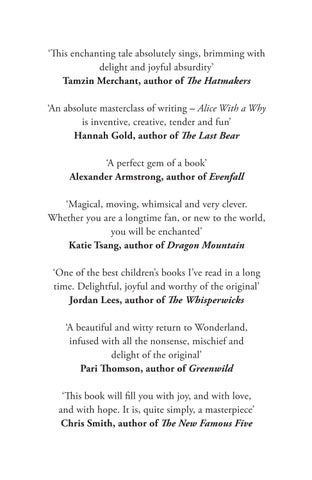
‘This enchanting tale absolutely sings, brimming with delight and joyful absurdity’

Tamzin Merchant, author of The Hatmakers

‘An absolute masterclass of writing – Alice With a Why is inventive, creative, tender and fun’

Hannah Gold, author of The Last Bear

‘A perfect gem of a book’

Alexander Armstrong, author of Evenfall

‘Magical, moving, whimsical and very clever. Whether you are a longtime fan, or new to the world, you will be enchanted’

Katie Tsang, author of Dragon Mountain

‘One of the best children’s books I’ve read in a long time. Delightful, joyful and worthy of the original’

Jordan Lees, author of The Whisperwicks

‘A beautiful and witty return to Wonderland, infused with all the nonsense, mischief and delight of the original’

Pari Thomson, author of Greenwild

‘This book will fill you with joy, and with love, and with hope. It is, quite simply, a masterpiece’

Chris Smith, author of The New Famous Five

Books by

Alice With a Why

Chronicles of Whetherwhy

The Age of Enchantment

The Season of Flames Pages & Co.

Tilly and the Bookwanderers

Tilly and the Lost Fairy Tales

Tilly and the Map of Stories

The Book Smugglers

The Treehouse Library

The Last Bookwanderer

1The Things You Need to Know Before We Begin

Alice and Alyce looked at each other from either

end of the room and had nothing to say that would reach across the empty library. And if you’re confused by their names already, then you may as well stop now before we’ve even got started properly. For Alice is Alyce’s grandmother, and Alyce is Alice’s granddaughter; I’m not sure how much plainer I can make it. Ten minutes ago, Specula House had been full of the noise of Alyce’s mother gathering up her bags, telling Alyce to be good for her grandmother, and the cries of her baby brother (telling her nothing useful). Six months ago, the house had

been full of recovering soldiers and nurses, who were variously frazzled or laughing or sad or annoyed, her grandmother at their helm. The soldiers used to call her Bunny as she scurried between their beds with her white apron and cap and pocket watch. ‘Oh, my ears and whiskers,’ Alice used to say if something went wrong. Alyce did not know if she said it because they called her Bunny, or the other way around – in fact, she could never quite tell which way round things were with her grandmother.

A year ago, before the soldiers and the nurses and the baby, the house had also been full of the sounds of Alyce’s father. These sounds included mainly thinking and tinkering sorts of noises (‘hmmms’ and ‘hmphs’ and ‘eurekas’ and crashes and dabblings and clatterings and so forth), and also a great deal of laughter. But he was gone, and now there was just Alice (her grandmother) and Alyce (her granddaughter), looking at each other across the room where there used to be books, and then soldiers, and now it was only, and very quietly, the two of them.

Alyce’s father (Rufus, but called Rusty for his red

hair) had been an inventor, although the piece of paper he got from Cambridge University said that he was an engineer. While he couldn’t officially be called a sailor, he was very clever at boats in particular, so much so that the navy asked him to come and help when the war broke out, or so Alyce’s mother had explained it. Rusty had seen how nifty fishing boats and their nets were, and used that to come up with a way to help find the exploding mines that the enemy left in the water. The ships were officially called flower-class sloops because they were all named for plants – from Acacia all the way through the alphabet to Zinnia – but when her father was at home he called them Britain’s herbaceous border.

Alyce had liked the idea that they were being protected by flowers, until one of those flowers hit a mine while her father was on board, and he didn’t come home again. The war ended very shortly afterwards, which made sense to Alyce, as she did not understand how anything could keep going without her father.

Alyce’s mother (Sylvie) did not realise she was going to have another baby (Archimedes, if you can

believe it) until afterwards. And now her mother (that’s Sylvie’s mother, Alyce’s other grandmother, name irrelevant, please do try and keep up) was poorly, and so Sylvie was going to care for her instead of the soldiers. The baby was too little to be left, so he had to go with her, but Alyce was to stay at home to help her grandmother and go to school and Sylvie would be back before too long.

What else needs explaining? Ah yes. Their house had been full of soldiers because a few years ago it became clear that there were not enough hospital beds for the men who were injured. Alyce’s grandmother had volunteered Specula House, and then disappeared off to London for a while, and came back knowing how to do useful things with bandages and needles. Books and sitting rooms and toys were cleared, and lines of beds and piles of starched sheets and great pots of boiling water appeared instead, and then the soldiers themselves appeared via train. They were put into long lines of beds in what used to be the library, watched over by a portrait of Rufus. The soldiers called him Captain Rusty, and had perched an honorary naval cap on

the gilt corner of the frame, giving affectionate salutes to him in the evening. Some of the soldiers were jolly and some were sad and some screamed in the night, and some could not remember their names very well. But almost all of them liked to have Alyce sit with them and read to them when she got home from school. And Alyce and her soldiers (they called themselves Alyce’s Private Reserve) had all been looked after by Alice and Sylvie and a team of women in starched caps who chucked Alyce under the chin or ignored her or shouted at her for getting under their feet, or slipped her a penny and a smile.

Rusty, at that time, was usually down in London at important meetings, or up in Scotland at the shipyard, but whether he was going up or down, he always stopped in at Specula House. And he always found time to go down to the pond with Alyce, where they sailed the paper boats that they made together. ‘My pint-sized pilot’ he would call her, as they navigated the lily pads. Before the war, Rusty used to construct wonderful miniature boats out of wood and wire and metal and fabric, but there was only time for paper once the war began (which Alyce

did not mind at all) and she kept her favourite one in her pocket.

But now her father was gone, and the soldiers were gone, and her mother was gone, and it was just Alice and Alyce looking at each other across an empty library in an empty house.

And there, that is what you need to know. Did you take notes? If you want to go back and reread it or jot things down, there’s still time. Or you can come back and check this chapter when you need to. It sounds rather sad because it is rather sad, I’m afraid. But do keep reading, please, as everything may still turn out all right in the end.

Turn static files into dynamic content formats.

Create a flipbook