TM international 2026-01

Page 1


Cereals and oilseeds: global update for the 2025/26 season - Triple wheat productionNew method to accelerate the growth of transgenic plants - Genes controlling plant height and grain size - Spring wheat germplasm resistant to Fusarium - Precision genetic approaches for climate-resilient crops - TaWaxy gene editing to modify starch

in wheat - Rice gene that reduces fertilizer needs

Filter flours collected from different milling streams - Wheat flour dry heat treatmentTemperature and endosperm hardness affect carotenoid content in maize - How milling improves noodles made with purple wheat flour

Pistachio by-products in lamb nutrition - Camelina sativa improves eggs and meat - Alfalfa-based diet for rabbits - Hemp seeds in laying hens’ diet - Hemp seeds, the alternative protein source for chickens

Thermal inactivation of Salmonella, E. coli, and E. faecium - Shelf life of fresh pasta with cricket flour - Hydrolysates from fish by-products and pasta quality - Gluten-free pasta with mango leaf powder - Whey and grape skins on pasta properties - Wheat flour treated with a magnetic field - Potential of rapeseed protein - Effect of spirulina on pasta and meat analogues - Cashew apple pomace as a functional ingredient - Addition of finger millet and lentil flour

How to extend the shelf life of Pane Toscano DOP - Type II sourdough fermentation for the nutritional profile of focaccia - Semolina-legume flour blends and the breads obtainedAvocado waste in sourdough bread - Bran particle size and dough rheology - Quality of pigmented whole grains Machinery 64

The vacuum dough sheeters - Compact grinding unit for efficient food recovery - More than 50 years of excellence - Hygiene, efficiency and safety in the pursuit of qualityQuality technologies for the production of pasta and snack pellets - Feeding system for the first pasta plant in Togo - Efficiency in pasta production from concept to completionSmart bagging for paper bags - A new line marking another milestone - Cameroon: plants that speak for themselves - Hygienic design doesn’t start with the machines

Packaging 84

Bioplastic packaging in the world - Packaging materials innovation at Interpack 2026

Marketing ........................................................................................................................................................................................

Global snack market reaches USD 693 billion in retail sales

Wheat research and international collaboration - New company strengthens engineering and production - Rules and innovation in the global trade of cereals - Cereals and legumes at the heart of the Conference - Cibus Tec returns to Parma - Diary of international events in Italy and worldwide events

Cereals and oilseeds: global update for the 2025/26 season CEREALS

The latest USDA report on projections for the 2025/26 season, provides an updated overview of global production, consumption, trade, and stocks of major crops, highlighting trends in world markets and U.S. season-average farm prices.

Wheat

Global wheat production is forecast slightly lower this month, as reductions in Turkey, Mongolia, and South Africa more than offset larger harvests in Argentina and the United Kingdom. Global consumption is revised upward due to higher food, seed, and industrial use in Bangladesh and Ukraine, outweighing reductions in Afghanistan and Mexico. Feed and residual use is slightly lower, as cuts in Canada and Turkey are partly offset by increases in Indonesia and Vietnam. Ending stocks are expected to decline, mainly due to contractions in Argentina and Canada, which more than offset an increase in the EU.

Global trade is up, driven by higher imports from Bangladesh, the EU, Indonesia, and Vietnam, which outweigh the reduction in

New method to accelerate the growth of transgenic plants

US and Mexican Researchers developed a new method to grow engineered plants in weeks instead of months by enhancing the plant’s natural ability to regenerate after being wounded or clipped. Using this approach, the researchers successfully created transgenic plants by combining genetic engineering with the plant’s own healing process.

The researchers used Agrobacterium, a bacterium known for transferring DNA into plants, to deliver new genes directly to wound sites. When applied to the plants, the modified bacteria triggered the plants’ natural regrowth process, producing shoots and seeds. The technique, tested in tomatoes and soybeans, achieved a success rate of 21% to 35% and reduced soybean growth time from three to four months to just three and a half weeks. The findings, presented in Molecular Plant, show that activating the plant’s wound-induced regeneration pathway can make genetic modification faster and simpler. This innovation could help overcome key challenges in crop biotechnology, such as the long turnaround time and technical barriers of tissue-culture-based methods. Researchers believe the technique could accelerate the development of improved crop varieties and make genetic engineering more accessible for agricultural innovation.

Precision genetic approaches for climate-resilient crops

A review published in Science by experts from California Institute of Technology (Caltech) and Ghent University in Belgium presents a roadmap for using genomics and plant developmental biology to engineer crops that can better withstand the effects of global warming. The study highlights new insights into how plant cell behavior can guide the creation of climate-smart agriculture. The research team proposes the use of precise genetic approaches to make subtle tweaks to a plant’s natural gene expression, rather than relying on broad modifications. The research focuses on brassinosteroids, plant hormones that control growth, showing that optimal development depends on carefully balanced hormone levels. Using advanced tools such as single-cell transcriptomics and live imaging, the researchers tracked how plant cells regulate these growth signals in the model plant Arabidopsis thaliana By combining spatial, genetic, and live-imaging data, the team revealed how plants coordinate growth with remarkable precision at the cellular level. The team aims to apply these insights to major food crops, such as rice, maize, and sorghum, to help them thrive under heat and water stress. The lead author said that understanding these molecular processes could enable “surgical-level precision” in engineering plants for future climates.

MILLING

Filter flours collected from different milling streams

A Chinese study published in Journal of Cereal Science investigated filter flours extracted from different milling streams in a flour mill, including filter flour from the first milling stream (QF), the final milling stream (HF), and the flour blending system (PF), as well as finisher flour (DF), with wheat flour (F) used as the control sample. The quality characteristics of the different flours, including their structural and physicochemical properties were analyzed.

The values of G’ and G for the filter flours were both greater than those of wheat flour. The farinograph and extensograph properties of filter flours vary significantly. None of the filter flours had a whiteness higher than that of wheat flour. The starch content (27.99-75.36%) of the filter flours was lower than that of wheat flour. The gluten index (68.37-91.06%) and relative crystallinity (10.3918.68%) of the filter flours were higher than those of wheat flour, except in the case of QF, with the highest gluten index observed in PF. The peak viscosities ranged from 43.5 cp (DF) to 1077 cp (PF), while the peak temperatures were all higher than that of wheat flour, varying from 57.65°C (QF) to 59.74°C (DF).

A total of 28 volatile flavor compounds were detected in the filter flours, with DF showing a relatively large difference from the others.

FEEDSTUFF

Pistachio by-products in lamb nutrition

In a study published in Animal Feed Science and Technology, Researchers from the University of Catania (Italy) analyzed the effects of dietary pistachio skin, a by-product of the confectionary industry, on the growth performance and meat quality of lambs. Twenty-four male lambs were assigned to 2 dietary treatments and fed for 60 days with a concentrate-based diet or the same diet with 120 g/kg DM of pistachio skin inclusion as a partial replacement of maize and soybean meal. Growth performance, ruminal fermentation, and lipid metabolism were analyzed. The hydrophilic antioxidant capacity, and fat-soluble vitamins were assessed on fresh meat, while colour stability and lipid and protein oxidation were measured over 7-days of refrigerated storage. Dietary treatment did not affect growth performance, carcass traits, and ruminal fermentation (P>0.05). Pistachio skin enriched meat with health promoting fatty acids, including vaccenic and rumenic acids (P=0.037 and 0.031). Feeding lambs with a diet containing pistachio skin increased also meat tocopherols, including gamma-tocopherol (P<0.001), and reduced the lipid oxidation during 7-days of refrigerated storage measured as production of thiobarbituric acid reactive substances (P=0.004). Meat from lambs fed pistachio skin showed lesser values of a*, b*, and C* colour descriptors (P=0.001, 0.009, and 0.003). The development of hydroperoxides, thiols, and carbonyls was not affected by dietary treatment (P>0.05). Feeding lambs pistachio skin as a replacement for conventional feedstuffs may be useful for reducing the environmental impact of the meat supply chain.

The inclusion of pistachio skin can be a profitable strategy for improving the fatty acid profile and lipid oxidative stability of lamb, without adverse effects on growth performance and ruminal fermentation.

PASTA

Thermal inactivation of Salmonella, E. coli, and E.

faecium

Limited data are currently available characterizing the thermal resistance of foodborne pathogens in semolina flour and intermediate pasta matrices representative of commercial conditions during processing. Pasta producers require these data to be compliant with federal regulations since  Salmonella spp. and  Escherichia coli demonstrate survival in flour and dried pasta products. In a US study published in Journal of Food Quality, the heat resistance of pathogenic Salmonella,  E. coli, and  E. faecium NRRL B-2354 was evaluated in semolina flour and partially dried pasta intermediates via thermal death time (TDT) studies. The appropriateness of E. faecium NRRL B-2354 as a surrogate in semolina flour and pasta matrices was determined. Inoculated pasta matrices equilibrated to target water activities of 0.85, 0.88, and 0.91 (at 25°C) underwent isothermal inactivation treatments at 65°, 70°, and 75°C. Serial dilution and direct plating methods allowed for the estimation of bacterial survival at each treatment.

In representative pasta matrices, the  D values for each microorganism increased as water activity decreased from 0.91 to 0.85. Surprisingly,  Salmonella and  E. coli did not exhibit significantly different thermal resistance in pasta. The greatest heat resistance was seen in semolina flour (aw 0.45).  E. faecium was significantly more thermal resistant than both pathogens in all treatments when the temperature was <=70°C.

The results show that  E. faecium strain NRRL B-2354 is not an ideal proxy for Salmonella and E. coli in semolina and pasta matrices. Analysis of the TDT data also found that a long-goods pasta drying process can achieve >=7-log reductions of  Salmonella and  E. coli when following good manufacturing practices.

Hydrolysates from fish by-products and pasta quality

In a study published in International Journal of Food Science, Spanish Researchers explored the innovative development and comprehensive characterisation of fusilli pasta enriched with protein hydrolysates derived from underutilised fish by-products (salmon, sea bass and tuna) materials typically discarded during seafood processing despite their significant nutritional potential. Fish hydrolysates were incorporated into durum wheat semolina at 1% and 3% concentrations to evaluate their impact on pasta quality and nutritional profile. Results demonstrated improvements in protein content and Omega-3 fatty acid profile across all enriched formulations compared to control samples. The incorporation significantly influenced technological properties, including optimal cooking time, weight gain, hydration capacity, cooking loss and colour parameters. Molecular weight fractionation revealed bioactive peptides with potential antioxidant properties, primarily in low molecular weight fractions.

The microbiological assessment confirmed the absence of enterobacteria, moulds and yeasts in the final pasta products, although high viable microbial counts were detected in the raw hydrolysates.

Wheat flour treated with a magnetic field

To optimize the gluten network of the dough and improve the technological quality of noodles, Chinese Researchers applied magnetic field technology to wheat flour, evaluating the effects of different magnetic field intensities (0, 2, 4, 6, 8, 10 mT) on dough water distribution, mixing characteristics, rheological properties, and noodle quality.

Results, published in Food and Fermentation Industries journal, showed that increasing magnetic field strength (0-8 mT) facilitated water binding in starch-protein complexes. This increased gluten resistance and promoted elastic gel network formation. Furthermore, magnetic field-treated wheat flour significantly enhanced textural properties and cooking performance in resultant noodles (P<0.05).

Wheat flour treated at 8 mT observed optimal performance, including bound water content increased by 22.27%, cooking loss decreased by 20.76% and tensile elongation improved by 25.96% compared to untreated controls.

Magnetic field treatment induced structural reorganization of gluten proteins and starch molecules. The resulting ordered molecular alignment improved the continuity and stability of the dough matrix. The analysis confirmed that magnetic field modification produced denser and more stable dough networks, demonstrating its effectiveness for premium noodle production.

Addition of finger millet and lentil flour

In a study published in Food and Humanity, Indian Researchers investigated the effect of incorporating malted finger millet and lentil on the nutritional, cooking and textural properties of pasta formulation. The Mixture Design Quadratic Model with five key variables, such as cooking time, water absorption, firmness, total shearing force, and overall acceptability, were used to optimize the multigrain pasta formulation.

A total of 20 formulations were prepared and optimized using setting restrictions for the independent and dependent variables. The optimized formulation (70% durum wheat semolina, 11% malted finger millet flour, 16% malted lentil flour and 3% gluten) had a shorter cooking time with statistically significant(p<0.05) improvement in the nutritional profile of the multigrain pasta. The optimized formulation had a 41.12% increase in protein, a 213.8% increase in ash content, and 52.36 % in crude fiber content in multigrain pasta as compared to control pasta. Furthermore, the optimized pasta showed comparable in vitro protein digestibility, textural properties and sensory evaluation to the control pasta.

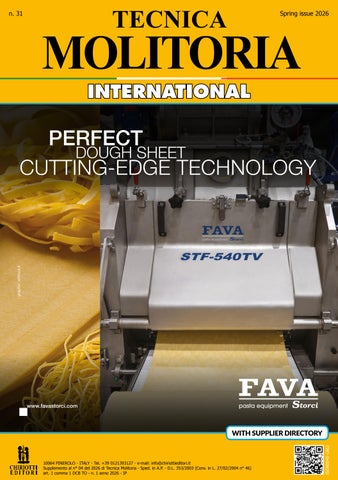
Reliability, excellent results, and ease of cleaning are common elements: the STF TV HD (Heavy Duty) vacuum laminator is now a wellestablished reality, already installed in several important pasta factories in Italy and abroad, top of the range in terms of construction and product quality.

It is a robust, well-constructed machine with a high output capacity. It was designed for intensive use and heavy duty and is ideal for producing long sheeted pasta (tagliatelle), filled pasta, and for working with hard and compact doughs. Designed for largescale industrial use, it allows for automatic production without the constant presence of an operator. Dough sheet width from 540 to 1,200 mm.

For softer sheets intended for filled pasta (sheet width from 250 to 540 mm), the VSF dough sheeter applies vacuum, the dough sheeter VSF applies vacuum to a kneading system and is particularly suitable for the production of tortellini or ravioli. Like the STF TV HD, it allows automatic production of approximately 250-500 kg/h without the constant presence of an operator, offering an excellent cost-performance ratio.

(Fava-Storci - Via Lemignano 6 - 43044 Collecchio - PR - Italy - Tel. +39 0521 543611 - storci@storci.com - favastorci.com)

STF-540 TV dough sheeter (Fava Storci).

Hygiene, efficiency and safety in the pursuit of quality

In grain processing, every stage of the production cycle has a direct impact on the quality of the final product. Plant engineers in the milling sector are constantly seeking technological solutions that ensure reliability, hygiene and operational continuity. Within this context, Wamgroup stands out as a technology partner capable of delivering a comprehensive range of components designed to optimise the handling of raw materials in environments requiring the highest hygiene standards.

With almost sixty years of experience in the handling, mixing and filtration of powders, the company provides a specialised portfolio of machines and components specialized for the food industry. From TXF stainless steel screw conveyors – engineered for hygienic material conveying and easy inspection – to shut-off and feeder valves equipped with food-grade components, every product reflects an engineering approach focused on sector-specific requirements, safety and ease of maintenance.

The new QuickClean WBO mixers represent a benchmark for operators managing frequent recipe changes driven by market de -

QuickClean WBO mixers (Wamgroup).

Cameroon: plants that speak for themselves

In recent years, the Italian industrial Cimas Group industrial company specialized in the design and construction of grain storage systems and feed mill plants, has strengthened its presence in SubSaharan Africa. Among the most dynamic markets is Cameroon, where the company has developed and consolidated major initiatives in the agro-industrial sector, contributing to the growth of the local grain storage and feed production supply chain.

In the port city of Kribi, a grain storage facility with a total capacity of 24,000 t has been built. The infrastructure consists of eight 3,000 t steel silos and is equipped with a handling system featuring a loading capacity of 150 t/h and an unloading capacity of 50 t/h. The installation also includes a grain pre-cleaning system with a capacity of 150 t/h, designed to ensure high quality standards in raw material management. The plant has been operational for more than two years and now represents a strategic asset for logistics management and grain supply security in the area. In addition, in the city of Douala, a new feed mill plant for the industrial production of animal feed is nearing completion. The facil-

Grain storage plant with a capacity of 24,000 t in Cameroon (Cimas Group).

PACKAGING

Bioplastic packaging in the world

New factories for bioplastics open up new prospects for the packaging industry. Larger production capacities for polylactic acid (PLA), thermoplastic starch (TPS), and other biopolymers improve supply capability and predictability, lower prices, and make sustainable alternatives to fossil-based plastics economically attractive.

Ceresana has now analyzed the global market for packaging materials made from bio-based and/or biodegradable plastics for the second time and presents the findings in its bio-based plastic packaging market report. Films, containers, bottles, and cups of all kinds, closures and lids, as well as labels, adhesive tapes, and loosefill packaging chips made from renewable resources: The market research institute expects global sales generated with these products to grow to around USD 32.1 billion by 2034. In the context of the bioeconomy and circular economy, bio-based packaging is also being promoted by government regulation, for example

Wheat research and international collaboration NEWS

The Wheat Initiative (WI), an international science partnership, is calling on governments and the private sector around the world to protect global investments in food security. Representing 14 nations, private sector leaders, and international organisations, the Initiative has serious concerns about new budgetary constraints that are threatening years of research and productive partnerships on wheat, especially at member organisation CIMMYT, an international food security research laboratory headquartered in Mexico. The WI was created in 2011 to help improve global food security through strategic wheat research. And while there has been significant progress over the last 15 years, a growing world population, land degradation, and increasing climate variability are threatening wheat production and global food security. Further challenges are coming from regulatory barriers to collaboration and sharing of genetic resources, and declining support for agricultural research organisations focussed on research for development, through collaborative networks. Scientific research is a basic requirement for improving the yield and sustainability of wheat, this globally significant staple crop.

Wheat was one of the first crops in human history to be domesticated. From its centre of origin in the Middle East, wheat has become the most widely cultivated crop in the world, grown in over 90 countries. Moreover, non-wheat producers are frequently large wheat importers, such that wheat now accounts for over 20% of human carbohydrate and protein intake and is the most traded food source.

The story of wheat’s rise to being a critical food for humanity is a story of collaboration and sharing. Global collaboration has led to dramatic yield gains through the introduction of new germplasm from breeding programs in distant regions and sharing improve-

SUPPLIER DIRECTORY 20 SUPPLIER DIRECTORY

Turn static files into dynamic content formats.

Create a flipbook