IF&PT 111

Page 1


FOOD & PACKAGING TECHNOLOGY

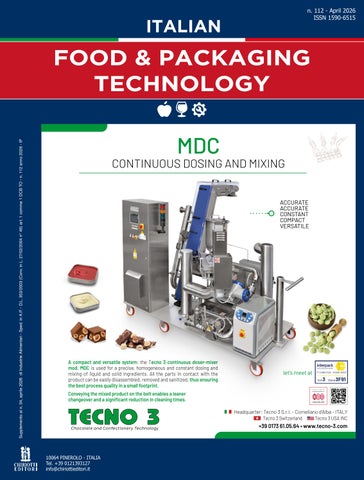
CONTINUOUS DOSING AND MIXING

ACCURATE ACCURATE CONSTANT COMPACT VERSATILE

A compact and versatile system mod. MDC

mixing of liquid and solid ingredients. All the parts in contact with the product can be easily disassembled, removed and sanitized, the best process quality in a small footprint.

Conveying the mixed product on the belt enables a leaner changeover and a significant reduction in cleaning times.

3

PRODUCT TRENDS - Milk Production Continues Growth in 2026 - PlantBased Protein Market Poised for Growth Through 2030 - Global GlutenFree Products Market - An overwiev on the Seafood Market

14

FOOD PROCESSING - Continuity and Control: The Evolution of Thermal Processing Across Pasta and Pouch Applictiions - The Continuous Revolution of Tecno 3 - Hygienic Design Doesn’t Start with the Machines - Novel extrusion-based plant protein separation technology of faba bean protein - Evaluating high pressure processing in dry aged beef - Effects of ohmic treatment in cake production - Evaluation of far infrared technology in coffee roasting

22

30

PACKAGING TRENDS - Pakaging Materials Innovation at interpack 2026Bioplastic Packaging in the world

PACKAGING EQUIPMENT - Sustainable food packaging requires rigorous standards - Tecnopack Group to Showcase Integrated Packaging and End-of-Line Innovation - Excellence on the tables around the world SMI solutions for Latteria Soresina - Outstanding packaging performance in a limited space

44

HYGIENE AND SAFETY - Ultrasound and sodium hypochlorite for the decontamination of chicken leg - Enhanced milk preservation during longdistance transportation - Bacterial efficacy of electrolyzed water on meat conveyor belts

46

NUTRITION - Chitosan-based oleogel as a fat substitute in ice creamDevelopment of low-glycemic white bread - Mozzarella for pizza made from milk with varying casein contents - Moringa oleifera leaf infusion as a functional beverage - Fermented dairy beverages - Fortification of bread with carob extract - Evaluation of gluten transfer from reused frying oil to food - An innovative bread ingredient - Enhancing melatonin content and antioxidant activity of yoghurt - Quality and origin assessment of pistachio nuts - Synergistic effect of ultrasound and pectin addition on yogurt - Probiotic cheese made from milk treated by pulsed electric field - Optimising microwave heating of food - Exploring the potential of lupin flour in high moisture meat analogues - Effect of low-temperature sous vide cooking under high-pressure on pork loins quality - Influence of roasting methods on the aromatic profile of Robusta coffee - Changes in beef eating quality and shelf life during superchilled storage - Development of soy-based meat analogues with yeast powder supplementation - Nitritefree alternatives to enhance red colour of dry-fermented sausages

60

RESEARCH - Probiotic strawberry dairy beverages and ultrasoundHeat treatment of hepatitis E virus in pork meat - Ultrasound-assisted postharvest preservation of strawberries - Efficient decaffeination of green coffee beans - Enhancing brining efficiency and pork quality through electro-heating pretreatments - Reducing cadmium levels in cocoa beans - Automated coffee roast level classification - Microwave treatment for improving gluten-free muffin quality - Exploring coffee wet fermentation with and without Saccharomyces cerevisiae - Pectin extraction from sugar beet pulp waste - Vanilla-flavored milk protein beverages: comparison of heat treatments

68

NEWS - Tuttofood returns to Milan - Cereal and legumes become specialties - Ahead of Cibus Tec 2026 in Parma - International events in Italy

APRIL 2026 - issue 112

Milk Production Continues Growth in 2026

A recent report prepared by the Foreign Agricultural Service of the U.S. USDA forecasts that, in 2026, milk production by the main dairy-exporting countries is expected to grow by 0.4%, driven by increases in the United States, Australia, and Argentina, offsetting the slight declines projected for the European Union and New Zealand. In the United States, milk production is estimated to rise by 1.2%, supported by herd expansion to meet growing processing capacity and cheese demand. Argentina is also expected to record strong growth, with production increasing by 4%, favored by good pasture conditions and contained feed costs; output will thus return to levels seen before the reduction caused by drought and high costs in 2024. Despite this recovery, domestic consumption remains limited, about 31% below 2023 levels, and excess milk will be directed toward whole milk powder exports.

In Australia, milk production is expected to increase by 1.8%, supported by stable farmgate prices and improved pasture conditions, especially in the southern regions of Victoria and South Australia. Northern regions, by contrast, will continue to be constrained by reduced irrigation water availability. Over

the past twenty years, the Australian dairy sector has undergone major restructuring: the number of farms fell by 71% between 2002 and 2024, while milk production declined by only 25%, and this consolidation trend is expected to continue into 2026.

In the European Union, milk production is forecast to decline slightly by 0.5%, marking the second consecutive year of decrease, despite a modest increase in yield per cow. Farm contraction is driven by environmental regulations, such as the carbon tax in Denmark and protection rules in Germany, as well as animal health issues linked to diseases such as Bluetongue and lumpy skin disease. Despite im -

proved margins thanks to high prices and strong domestic cheese demand, the sector remains under pressure and continues to consolidate, with a steadily shrinking new generation of farmers.

New Zealand will see a slight contraction of 0.5% in milk production due to a reduction in cattle numbers, although high farmgate prices and robust export demand will continue to support output.

Cheese

Cheese production will continue to grow in the main producing countries. In Australia, production will reach about 432,000 tons, with exports estimated at 175,000 tons – the highest level since 2008 – thanks to international competitiveness and rising Asian demand. In the EU, production will increase slightly to

10.8 million tons, with exports edging down to 1.4 million tons due to strong domestic demand. New Zealand will post a 4% production increase, with exports forecast at 425,000 tons, while in the United States production will rise by 3%, driven by greater milk availability and new processing capacity, with exports estimated at over 620,000 tons.

Butter

As for butter, EU production will decrease by 1% and exports will drop by 15%, mainly due to limited milk supplies and high domestic prices. New Zealand production will remain stable at 535,000 tons, with exports steady at 515,000 tons, while in China consumption will increase by 3% and imports will grow by just 1%, mainly from New Zealand.

Global Gluten-Free Products Market

Azoth Analytics has published a research report titled  “Global Gluten-Free Products Market (2025 Edition),” which provides an in-depth analysis of the global gluten-free products market. The report examines the sector from multiple perspectives, segmenting the market by product type (bakery products, snacks and ready-to-eat items, dairy and alternatives, pasta and noodles, and others) and by distribution channel (supermarkets/hypermarkets, online retail, specialty stores, and others). The analysis covers historical data from 2021 to 2024, estimates for 2024, and forecasts through 2031.

The report also includes coverage of major geographic regions (Americas, Europe, Asia Pacific, Middle East, and Africa) and features detailed insights on 10 key countries: the United States, Canada, Brazil, Germany, the United Kingdom, France, Italy, China, Japan, and India.

The global gluten-free products market has experienced significant growth, recording a compound annual growth rate (CAGR) of 8.94% between 2021 and 2024. The market was valued at USD 8,107.05 million in 2024 and is projected to reach USD 16,185.18 million by 2031.

This growth is driven by rising consumer awareness of health, evolving dietary preferences, and an increase in gluten-related disorders. An increasing number of people are becoming mindful of their nutritional choices, thereby fueling demand for gluten-free alternatives. This trend extends beyond

those with celiac disease or gluten intolerance, encompassing consumers who pursue healthier lifestyles. The widespread perception that gluten-free products are healthier, aid digestion, and support weight management has further boosted market expansion.

An Overwiev on the Seafood Market

According to the latest analysis by Market Research agency, Seafood Market size was valued at USD 299.65 billion in 2023 and is poised to grow from USD 315.83 billion in 2024 to USD 481.04 billion by 2032, growing at a CAGR of 5.4% during the forecast period (2024-2032).

The seafood market is witnessing significant growth, driven by increasing health awareness and shifting consumer lifestyles. Seafood, which encompasses fish, crustaceans, and mollusks, is increasingly favored as a healthy dietary option. As more individuals embrace pescetarianism, they are opting for seafood over traditional meats like beef, pork, and poultry, which are often associated with harmful substances and hormones used in farming practices. This shift is propelled by concerns about the welfare of farmed animals and a desire for cleaner, more sustainable protein sources. As consumers look for healthier alternatives, the demand for seafood is expected to rise, reflecting a broader trend towards healthier eating habits and a growing preference for responsibly sourced food options.

Top-down and bottom-up approaches were used to estimate and validate the size of the Seafood market and to estimate the size of various other dependent submarkets. The research methodology used to estimate the market size includes the following details: The key players in the market were identified through secondary research, and their market shares in the respective regions were determined through primary and secondary research. This entire proce-

dure includes the study of the annual and financial reports of the top market players and extensive interviews for key insights from industry leaders such as CEOs, VPs, directors, and marketing executives. All percentage shares split, and breakdowns were determined using secondary sources and verified through Primary sources. All possible parameters that affect the markets covered in this research study have been

FOOD PROCESSING

Continuity and Control: The Evolution of Thermal Processing Across Pasta and Pouch Applications

From pasteurization to freezing: how integrated thermal systems ensure uniformity, stability, and performance in both pasta and packaged products processing.

The month of May marks a new step in SARP’s “From One to Forty” journey, a path that celebrates 40 years of activity (1986–2026) while retracing the company’s evolution through the technologies, projects, and decisions that have shaped its identity.

It is not simply a milestone, but an opportunity to reflect on how a company grows: through continuous dialogue with the market, through challenges, and

through the constant refinement of its engineering approach.

Following the direct exchange with industry professionals at the Pastaria Festival, this journey now continues across international stages, where ideas developed over time are tested, shared, and further refined.

Over the years, this evolution has led to a clear direction: thermal treatment is no longer seen as a standalone phase, but as part of a broader, integrated

system. Pasteurization, cooling, and freezing spirals are no longer just machines – they become elements of a wider process architecture, designed to ensure continuity, control, and uniformity.

Applications for pasta and pouch-based products, alongside other packaged formats such as trays, molds, and bags, represent a particularly significant field of application. Among these, pouch processing stands out for its complexity and sensitivity to process

Spiral thermal system for continuous pasteurization, cooling, and freezing: integrated process architecture ensuring uniform treatment and consistent product quality across pasta and packaged products applications (Sarp).

PACKAGING TRENDS

Packaging Materials Innovation at interpack 2026

“Innovative Materials” stands out as one of the key focus themes at interpack 2026, where the packaging materials segment will showcase the industry’s most comprehensive concentration of expertise.

With more than 1,000 exhibitors, the exhibition area will present a globally unmatched spectrum of packaging solutions, packaging materials, and packaging aids designed for virtually every application.

Next-generation material technologies are redefining the future of packaging. Advanced polymers, fibre-based substrates, and intelligent coating systems are driving improvements in product protection, shelf life, and recyclability. From 7 to 13 May, the packaging materials area at interpack 2026 will highlight both proven technologies applied in new contexts and the latest breakthroughs in material innovation. Spread across seven halls and levels, the showcase will feature over 1,000 manufacturers from around the world, including numerous first-time exhibitors presenting new product premieres. Overall, interpack 2026 is expected to host around 2,800 ex-

Bioplastic Packaging in the World

New factories for bioplastics open up new prospects for the packaging industry. Larger production capacities for polylactic acid (PLA), thermoplastic starch (TPS), and other biopolymers improve supply capability and predictability, lower prices, and make sustainable alternatives to fossil-based plastics economically attractive.

Ceresana has now analyzed the global market for packaging materials made from bio-based and/or biodegradable plastics for the second time and presents the findings in its bio-based plastic packaging market report . Films, containers, bottles, and cups of all kinds, closures and lids, as well as labels, adhesive tapes, and loose-fill packaging chips made from renewable resources: The market research institute expects global sales generated with these products to grow to around USD 32.1 billion by 2034. In the context of the bioeconomy and circular economy, bio-based packaging is also being promoted by government regulation, for example through the new EU packaging and packaging waste regulation (PPWR), compostability requirements, or the obligation to reduce CO2 emissions.

Bacteria Produce Films for Food

Not only is the production of bio-based and biodegradable polymers being expanded, their quality is also being constantly improved. Heat-resistant grades, customized barrier properties, and other

Sustainable food packaging requires rigorous standards

As the world’s leading trade fair for the packaging industry, interpack serves as a key hub for professionals working to address the most critical challenges facing the food sector. Today’s food packaging must meet demanding requirements: ensuring maximum product protection while minimizing material use, combining recyclability with strict hygiene standards, complying with evolving regulations, and operating under growing cost pressures. In the food industry especially, effective packaging plays a crucial role in extending shelf life, safeguarding product integrity, and enabling efficient logistics – while significantly contributing to the reduction of food waste across the entire value chain.

Current figures from the UN Environment Programme (UNEP) show that there is still a great need for action here: according

Robotics and automation are gaining in importance

With increasing product diversity and rising hygiene standards, automation is moving further into focus. Stäubli Robotics offers a broad portfolio of HE (Humid Environment) robots that are modified to work reliably even in harsh environments. In meat processing, for example, TX2 robots cut products using a water jet. Vision systems also enable gentle, high-speed handling of delicate foods.

With its acquisition of the Swedish company RobotGrader AB, Ishida recently expanded its product range to include robot-assisted weighing, sorting and packaging systems. This benefits processors of meat, poultry and fish, as well as manufacturers of protein products in particular, who can now utilise smart and automated solutions to precisely package their fresh products in trays.

Developing sustainable solutions together

Paper and fibre solutions are driving the transformation in parallel. Sappi Europe has developed two recyclable high-barrier papers with oxygen, grease and water vapour barriers that are suitable for direct food contact. The heat-sealable Guard Pro OHS is suitable for flow wraps, sachets, pillow bags and doypacks, while Guard Pro OMH has been designed for cold-seal applications.

UPM Specialty Papers and Royal Vaassen replace aluminium laminates with a fibre-based barrier paper for the packaging of coffee, broth or chocolate.

UPM Solide Lucent packaging paper serves as the backing material for Barryrwrap. It is smooth, dense and at the same time stable, meaning that low coating weights are sufficient. UPM is also testing the barrier paper solutions in new applications, which include fibre-based tub formats for crisps, tea or powdered drinks.

Together with Solenis, Heidelberg has developed a process for barrier coatings on flexible paper packaging that are likewise suitable for foodstuffs. With its Boardmaster, the printing press manufacturer has integrated Solenis technology into roll-to-roll flexographic printing processes. During the process, the barriers are transferred to the paper web exclusively at the necessary points and with register accuracy.

Sustainable bonding

Even seemingly downstream components are emerging as a sustainability factor. Jowat uses energy-efficient hot-melt adhesives to reduce energy requirements in carton sealing in the food and frozen food industries. Thanks to its low melting temperature, one new Jowatherm adhesive is suitable for temperature-sensitive products such as chocolate, while another has been developed for use in the frozen food sector, for example for pizza, ready meals or ice cream packaging. And customers who value sustainable raw materials will find a bio-based Jowatherm alternative that is obtained from by-products of paper production and does not compete with food production.

Numerous exhibitors will demonstrate how foods can be safely produced and packaged today and with an eye to the future at interpack in Düsseldorf from 7 to 13 May 2026. www.interpack.com

A new process enables the industrial and partial application of barrier coatings to paper packaging. Image: Heidelberg
Paper packaging for food needs good barrier functions. Image: Sappi
UPM is testing fibre-based barrier papers for new applications. Image: UPM

Excellence on the tables around the world SMI solutions for Latteria Soresina

To respond promptly to market demands while respecting the environment, Latteria Soresina, an important Italian cooperative in the dairy sector, continuously invests in state-of-the-art production systems, such as the SMI EBS 6 KL ERGON stretch-blow moulder.

Keeping up with the times

One hundred and twenty-five years without stopping for even a single day. The history of Latteria Soresina shows how the company has been able to interpret market signals and respond to changing needs through growing efficiency and innovation. Today, all the goodness of milk from cows raised

within a certified supply chain and processed according to tradition using innovative techniques is ready to be enjoyed in practical PET and rPET bottles blown by the EBS 6 KL ERGON stretch-blow moulder, equipped with “ReduxAir” moulds, an efficient system that performs stretch-blow moulding operations at lower pressures than those typically used.

Looking to the future in a sustainable way

The goal of Latteria Soresina is to generate a positive impact for society and the dairy-food sector. The passion for quality and the territory translates into concrete choices in the name of sustainability such as environ-

mental protection, animal welfare, and constant support for members, employees, and collaborators. The sustainable supply chain is realised through periodic investments to renew barns, haylofts, and dairy processing plants to reduce environmental impact and energy consumption.

All the breeding members with their over 200 barns located near the Latteria Soresina plants have signed a supply chain agreement that includes careful monitoring of the entire production cycle, with preventive actions and periodic controls.

SMI solutions for Latteria Soresina

In response to the growing popularity of fresh milk and to produce PET and rPET bottles made with 50% recycled plastic, in sizes of 0.5 L and 2 L, Latteria Soresina has invested in a plant that allows it to increase its operations with a focus on reducing environmental impact. The SMI EBS 6 KL ERGON stretch-blow moulder, installed at the Soresina facility, meets these needs and ensures flexible and sustainable production.

The SMI stretch-blow moulder meets the needs of Latteria Soresina to increasingly use rPET bottles; moreover, the use of preforms with an increasingly lighter weight helps the company optimise distribution and reduce its carbon footprint. To reduce the environmental impact of packaging, the 0.5 L and 1 L containers used for fresh milk have been re-

carried out without the need for time-consuming carrier replacements.

At the heart of the line is the versatile TLM cartoner, which can flexibly handle seven bag formats and carton sizes. At Nutrition’s request, Schubert integrated two compact A3 erectors. These high-precision machines unfold blanks from the magazine and place them precisely onto vacuum conveyors. Exceptional performance is especially evident in the next step: a nimble four-axis robot arm picks up two cartons at a time, places them onto a transfer carriage and moves them to the filling position.

“The double A3 erecting solution gives Nutrition & Santé a significant capacity boost with a compact layout and low format costs,” explains Christiane

Buchstab, Sales Account Manager at Gerhard Schubert GmbH. Parallel operation achieves peak values of 70 to 80 cartons per minute, while single operation achieves around 43 cycles.

The solution really comes into its own when changeovers are required: Nutrition needs customised grouping chain cells for different primary packaging sizes. Schubert developed a pioneering design for this purpose that allows the entire grouping chain hoist to be removed. “The new components are considerably more lightweight, and the magazine plates are more compact and easier to handle,” says Buchstab, describing the gain in flexibility. “The new packaging line delivers exactly what we needed: a powerful boost in production and real material savings,” summarises Nicolau-Guillaumet

About Gerhard Schubert GmbH

Gerhard Schubert GmbH is a globally recognised market leader in top-loading packaging machines (TLM). For its digital, robot-based packaging machines, the family-owned company based in Crailsheim (Baden-Württemberg, Germany) builds on an interplay of simple mechanics, intelligent control technology and high modularity. With this philosophy and a highly developed culture of innovation, the company has been pursuing an entirely independent technological path for almost 60 years.

With its TLM technology, the machine manufacturer provides its customers with future-proof packaging machine solutions that are easy to operate, flexible in terms of format conversion, high-performance and stable in function. The TLM packaging machines pack products of all types and from all sectors – from food, confectionery, beverages, pharmaceuticals and cosmetics to technical products – into trays, cartons, boxes or into flow-wrap bags.

Well-known global companies in the consumer goods and pharmaceutical industries rely on Schubert’s automation solutions, as do numerous small, medium-sized and family-owned companies. Founded in 1966, the second generation of the company now employs over 1,800 people.

(Gerhard Schubert GmbH - Industriegebiet SüdostHofäckerstraße 7 - 74564 Crailsheim - Stuttgart - Phone: +49 7951400-0 - e-mail: info@ gerhard-schubert.de - www. schubert.group)

Only one person is needed to change tool components, saving valuable time.

HYGIENE AND SAFETY

Ultrasound and sodium hypochlorite for the decontamination of chicken leg

A Chinese study aimed to investigate the effect of ultrasound assisted sodium hypochlorite (US-assisted SH) on the physicochemical properties and bacterial communities on the skin surface of chilled chicken leg-quarters.

US-assisted SH treatments were applied for 25 min, either as a single combination treatment (US & SH) or repeated twice, denoted as 2 x (US & SH). Meanwhile, the sodium hypochlorite (SH) and the control (immersion in deionized water) was used to compare their efficacy. After each treatment, all chicken leg-quarters were overwrapped and stored at 0-4°C for 0, 3 and 5 days. The results showed that both US & SH and 2 x (US & SH) treatments reduced the total viable count (TVC), Enterobacteriaceae and Psychrophilic bacteria on the surface at 0 day and maintained better sensory quality, without significant adverse effects on chicken skin color and lipid ox-

idation during 5 days of chilled storage. The 2 x (US & SH) treatment exhibited a superior efficacy in reducing TVC (4.72 log CFU/g), Enterobacteriaceae (2.83 log CFU/g) and psychrophilic bacteria (4.89 log CFU/g) compared to both US & SH and SH treatments, and diminished the growth potential of Acinetobacter, Aeromonas,

Shewanella and Pseudomonas, resulting in an extension of shelf life by more than 2 days.

The study, published in Food Control journal showed that USassisted SH could be a promising method for skin surface decontaminating during poultry slaughtering and fresh chicken preserving.

Enhanced milk preservation during long-distance transportation

Exceeding 10°C during raw milk transportation leads to its degradation, making it unsuitable for consumption. Maintaining a stable low temperature is therefore crucial to preserving milk quality over long distances. Traditional insulation methods have proven inadequate, particularly under extreme climatic conditions. An Algerian study proposes a novel approach incorporating an immersed evaporator within the milk tank to significantly extend the cooling duration and ensure product safety. Using unsteady laminar flow and heat transfer simulations, we evaluated the performance of the immersed

evaporator system under various operating conditions.

Results demonstrate a substantial improvement in cooling efficiency compared to conventional insulation. Key findings include: (1) An immersed evaporator can extend the cooling time by up to 3 h and 19 min (a 69% improvement) compared to insulation alone (1 h and 36 min). (2) Increasing the length of the evaporator by approximately 46% further extends the cooling period by 91%, while maintaining the same temperature of 2°C in both cases. (3) Increasing the evaporator length and decreasing its temperature to 0°C further enhance cool-

NUTRITION

Chitosan-based oleogel as a fat substitute in ice cream

Ice cream quality depends on fat content and type, but these fats often contain high levels of derived trans fatty acids and saturated fatty acids, which have been associated with increased risk of cardiovascular disease, systemic inflammation and metabolic disorders. The replacement with oils rich in unsaturated fatty acids has been explored to pro-

mote better health outcomes. Oleogels have been studied for this purpose in foods and chitosan-based oleogels show promise but remain unexplored in ice cream.

The objective of a Brazilian study was to evaluate the best method of incorporating this oleogel as a fat substitute dur-

Development of low-glycemic white bread

Oxalis tuberosa fiber (OTF) was used to obtain a potentially functional and well accepted sensorially white bread.

OTF showed a dietary fiber content of 88.51 %, which, once added to white bread formulations: 3 (WB3), 6 (WB6), and 10 % (WB10) (w/w), significantly (p <= 0.05) reduced the loaf volume. Breads with OTF showed yellow tones (degreeHue = 76.40) with different chromaticity values and perceptible color change com-

This study published in the International Journal of Dairy Technology, provides valuable information to improve the use of chitosan-based oleogel as a fat substitute in food, especially for the dairy industry. ing the processing of vanilla ice cream, aiming at a better ice cream structure. It was investigated the impact of this structured oil as a milk cream substitute on the physical, mechanical and structural properties of vanilla ice cream at different production stages. The oleogel, composed of chitosan-based soybean oil, vanillin and Tween60, was incorporated at three points before pasteurisation, after pasteurisation and after cooling. The apparent viscosity and microstructure of the aged mix and the fat destabilisation, overrun, melting behaviour, texture profile and microstructure of the ice creams were evaluated. The oleogel incorporation after pasteurisation yielded mixes with apparent viscosity (88.1 mPa.s) and microstructure comparable to the milk cream formulation, and ice creams with similar hardness (19.81 N), melting rate (1.2 g/min) and microstructure as the controls. Thus, the incorporation after pasteurisation method was the optimal strategy for incorporating chitosan-based oleogel in ice cream. This study also revealed that the fat incorporation method had a greater influence on the technological properties of oleogel ice cream than on milk cream ice cream.

An innovative bread ingredient

Since bread is a basic food item in the diet of many people around the world, its nutritional value needs to be increased. In a Turkish study, the potential of Vitex agnus-castus powder to enrich bread was investigated.

For this aim, V. agnus-castus powder was substituted with wheat flour at the levels of 0, 5, 10, 15%. Effects of V. agnus-castus powder on the rheological characteristics of bread dough, color, proximate composition, antioxidant activity, total phenolic content, texture and sensory characteristics of breads

were investigated. V. agnus-castus increased the total phenolic content and antioxidant activity, as well as fat, crude fiber and ash content of bread samples significantly (p < 0.05). Breads containing 15% V. agnus-castus powder had the highest inhibition (21.58 ±1.03%), ABTS+ (215.61 ±0.58 mg/100 g), total phenolic content (986.22 ±1.69 mg GAE/100 g DW), fat (2.22 ±0.09%) crude fiber (11.10 ±0.25%), and ash content.

According to the results of sensory analysis, published in International Journal of Gastronomy and Food Science, bread samples including 5% V. agnus-castus powder had higher scores than control samples. V. agnus-castus could improve sensory and nutritional properties of bread.

Enhancing melatonin content and antioxidant activity of yoghurt

Melatonin and its derivatives positively influence human circadian rhythms. Yoghurt is often suggested as a bedtime food because it contains tryptophan which can be converted to melatonin. However, the impact of yoghurt bacteria (YC) and probiotics on producing melatonin and its derivative content in yoghurt during fermentation has not yet been reported. Therefore, a Thai work investigated the effect of YC and probiotics on enhancing tryptophan, serotonin, and melatonin during yoghurt fermentation.

Cow milk yoghurt was prepared using different combinations of YC (Streptococcus thermophilus and Lactobacillus delbrueckii subsp. bulgaricus, MPYC, control); YC and Lactobacillus

acidophilus and Bifidobacterium animalis subsp. lactis (MP-BY); S. thermophiles, L. acidophilus, and B. animalis subsp. lactis (MP-BT); and YC with L. acidophilus (MPLA). Combining YC and probiotic mixtures had no impact on pH and

total acidity after fermentation for 8 h. Yoghurt containing probiotics and YC had higher melatonin content ranging from 3.54 to 6.67 ng/g dry weight than the control, whereas serotonin was not detected. Tryptophan content significantly improved in all yoghurt samples ranging between 8.52 and 10.17 µg/g. The antioxidant activity of MP-BY and MP-BT was significantly enhanced compared with the control.

The findings, published in the International Food Research Journal suggested a synergistic effect between YC and probiotics, highlighting the potential of probiotic yoghurt as a functional food rich in melatonin, tryptophan, and antioxidants, which could benefit and support human circadian rhythms and overall health.

Changes in beef eating quality and shelf life during superchilled storage

A Chinese study published in Meat Research journal investigated the effect of superchilled storage on the eating quality of beef. The changes in pH, color, shear force, purge loss rate, cooking loss rate, volatile organic compounds (VOCs), protein and lipid oxidation and total viable count were monitored during 12 weeks of superchilled storage (at -1°C). Sensory evaluation was carried out before and after opening the package.

The results showed that the pH value remained in the pH range of fresh meat during storage. The redness value increased significantly in the 5th week and then remained at a high level, and the tenderness was improved with the increase in aging time and reached an acceptable level for consumers in the 5th week. The cooking loss rate decreased significantly in the 8th week and then remained unchanged, while the purge loss rate increased significantly in the 12th week. With the increase in storage time, both the types and contents of VOCs increased, indicating a rick of off-flavor formation. Although the freshness and smell were within an acceptable range at 12 weeks, they were close to the unacceptable threshold, and there was a risk of consumer rejection. Moreover, the degrees of protein and lipid oxidation increased significantly, and the thiobarbituric acid reactive substances (TBARS) value reached up to 0.47 mg/kg. Under superchilled conditions, the growth of microorganisms was inhibited, and both the to-

tal viable count and total volatile basic nitrogen (TVB-N) content were maintained below the limits set for fresh meat.

In conclusion, vacuum packaging combined with superchilled

storage can maintain beef quality and prolong the shelf life, but long-term storage may lead to an increase in VOCs and inevitably cause the oxidation of proteins and lipids.

Development of soy-based meat analogues with yeast powder supplementation

Amid growing global concerns about environmental sustainability and food security, plant-based meat substitutes have emerged as a promising alternative to conventional meat. However, current formulations, especially those based on soy protein isolate (SPI) often fail to replicate the desired texture and structural integrity. To address this limitation, a Chinese study aimed to evaluate the use of whole yeast

powder (WYP) combined with SPI for producing plant-based meat analogues via high-moisture extrusion.

Seven groups were designed: a control group with 0% WYP, five treatment groups with 5%, 10%, 20%, 30%, and 40% WYP, and one reference group containing 20% yeast protein powder (YPP). Although lower in protein content than yeast protein powder (YPP), whole yeast powder exhibits su-

RESEARCH

Probiotic strawberry dairy beverages and ultrasound

Consumer acceptance of milk beverages as probiotic beverages is directly linked to their sensory qualities, such as flavor, consistency, visual appearance, and mouthfeel. Overall, products that exhibit syneresis are often viewed as inferior. Thus, a study published in Foods was conducted by Brazilian researchers to investigate the effects of high-intensity ultrasound on the production of probiotic strawberry beverages, aiming primarily to stabilize the beverage by reducing syneresis and improving sensory properties without compromising the viability of probiotic microorganisms.

The effects of the ultrasound processing time (2.5, 5, 7.5, and 10 min) on the physical, chemical, and sensory properties of the beverages were analyzed. Ultrasound was applied using

a 750-wW ultrasonic processor (Cole-Parmer, 750 W, Vernon Hills, IL, USA) at 40% amplitude, consuming 300 W and resulting in an acoustic power density of 1.2 W/ mL. The results indicate that ultrasound significantly influenced the syneresis of the samples, with intermediate times (5 and

7.5 min) demonstrating lower liquid separation. Notably, the U7.5 treatment exhibited syneresis values of 52.06% ± 2.14, 60.75% ± 2.33, and 61.17% ± 1.90 at days 1, 14, and 28, respectively, corresponding to reductions of approximately 18%, 12%, and 11% compared to the control (63.43% ± 0.93, 68.81% ± 0.56, and 68.59% ± 0.10, respectively).

The fatty acid composition showed changes according to storage time. Notably, palmitic acid (C16:0) concentrations were above 30 g/100 mL, and the omega6/omega3 ratio ranged from 5.92 to 7.47, falling within the recommended dietary values. Ultrasound also reduced the amount of sucrose in the samples, which may benefit the growth of probiotic microorganisms. In terms of sensory analysis, the ultrasound-treated samples (2.5 to 7.5 min) were preferred by the evaluators compared to the control sample. Furthermore, ultrasound treatment did not result in the inactivation of probiotics, supporting its potential for enhancing probiotic beverage quality.

sound treatment caused structural changes in the pectin. Sugar beet pectins obtained by

ultrasound and microwave treatments yielded higher stability, 53.1% and 55.2%, respective-

ly, in o/w emulsion compared to about 40% by conventional method and commercial citrus pectin. All pectin extracts and citrus pectin resulted in about 2-fold increase in the consistency of the milk beverage while serum separation in the beverage was reduced more by citrus pectin.

The results published in Journal of Food Measurement and Characterization demonstrated that sugar beet pectin is a viable food ingredient. Both ultrasound and microwave technologies offer advantages in reduction of time and energy usage in extraction.

Vanilla-flavored milk protein beverages: comparison of heat treatments

Ready-to-drink protein beverages are a growing product category. The objective of an US study published in Journal of Dairy Science was to determine the effects of 3 common thermal processes: UHT pasteurization with direct steam injection (UHTDSI; 142°C for 3 s), retort (123°C, time to achieve sterilization = 5 min), or autoclave (112°C for 6 min) on the chemical, physical, and sensory properties of reconstituted vanilla-flavored milk protein beverages containing approximately 6.5% protein.

Unheated and heated beverages were subjected to composition, minerals, pH, color, apparent viscosity, particle size, trained panel profiling, volatile compound analysis, and furosine analyses. High NPN values in retort and autoclave beverages

indicated possible interaction of lactose with whey proteins that increased their solubility in 12% trichloroacetic acid. Heated beverages had higher b* values than unheated beverages. Sulfureggy flavor was only detected in the UHT-DSI beverages, and these beverages had the highest relative abundance of hydrogen sulfide and methanethiol. Caramelized flavor was only detected in retort and autoclaved protein beverages. These beverages had higher relative abundances of nearly all aldehydes, alcohols, esters, ketones, and furans than unheated and UHT-DSI beverages, indicative of Maillard reaction and Strecker degradation products that contributed to the characteristic caramel flavor. Furosine was not a good heat indicator for reconstituted

milk protein beverages. Furosine values were higher for unheated rehydrated milk protein beverages than for thermally processed beverages.

Turn static files into dynamic content formats.

Create a flipbook