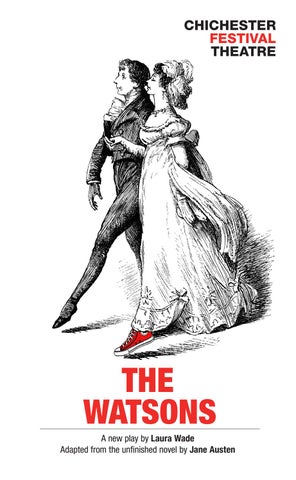
THE WATSONS A new play by Laura Wade Adapted from the unfinished novel by Jane Austen
WELCOME
We’re also glad to welcome back Samuel West, this time in his role as director. His most recent work here was as an actor in Young Chekhov, but this is his third time directing in the Minerva (and, he reminds us, Chichester has been part of his life since his mother, Prunella Scales, worked here when he was a toddler!). It is a truth universally acknowledged that an unfinished novel must be in want of an ending.
DANIEL EVANS AND RACHEL TACKLEY PHOTOGRAPH BY TOBIAS KEY
Welcome to the final production of Festival 2018. It’s particularly thrilling for us to end this year’s Festival with a beginning: Laura Wade’s new adaptation of Jane Austen’s incomplete novel, The Watsons. Laura’s play is itself concerned with finding an ending for the characters left hanging when Austen abandoned her story after only completing five chapters. Perhaps best known for her hit play Posh (which reached the big screen as The Riot Club), Laura enjoyed another major success earlier this year with her new play Home, I’m Darling at Theatr Clwyd and the National Theatre. We couldn’t be more delighted to premiere The Watsons at Chichester.
Sam has assembled a wonderful cast: among them is Grace Molony, returning to play Emma Watson after her performance in The Country Girls (2017), which earned her The Stage Debut Award for Best Actress in a Play. Later in 1805, the year Jane Austen cast aside The Watsons, she spent time staying in Worthing. She moved to Southampton the following year and then spent the last eight years of her life in the village of Chawton, not far from us in Hampshire. We can therefore safely claim her as a local author – another appropriate way to bring Festival 2018 to a close. Our sincere thanks to you, our audience, for your support.
Artistic Director Daniel Evans
cft.org.uk
Executive Director Rachel Tackley
LEAP
LEARNING, EDUCATION AND PARTICIPATION The Learning, Education and Participation Department creates a year-round programme of practical workshops, talks, tours, performances and much more. With opportunities for all ages and abilities we aim to excite and inspire every person that engages with us.
COMMUNITY
CHILDREN & YOUNG PEOPLE
Develop artistic, personal and social skills through our workshops, projects, productions and award-winning Youth Theatre for young people of all abilities. Chichester Festival Youth Theatre | Holiday Activities | Arts Award
EDUCATION
Working with local schools to enrich students’ learning, our training and apprenticeships programme enables us to grow the next generation of arts professionals. Playboxes | Technical Tasters | Creative Careers Day | Work Experience
Learn more about theatre, develop performance skills, discover how productions are made and share experiences with others through our workshops and community projects. Talks and Discussions | Community Theatre Days | Adult Classes
FAMILIES
Take part in Family Friendly talks, tours and workshops designed to complement our Festival programme. Storytelling | Theatre Tours | Toddler Classes
cft.org.uk/leap
COMING SOON
SLEEPING BEAUTY By Rufus Norris From The Sleeping Beauty in the Woods by Charles Perrault Chichester Festival Youth Theatre return to present Rufus Norris’s splendidly entertaining and mischievous version of the original fairy tale which ventures beyond the usual ‘happy ever after’ ending! Ages 7+
15 – 30 December #SleepingBeauty
cft.org.uk
TS T ICK E Y L I FAM AIL ABLE AV
TH E CAFÉ & THE FOYLE TERRACE The Café in the Festival Theatre is open daily from 10am serving freshly made sandwiches, soup, cakes and pastries. Enjoy our barista coffee or choose from a range of hot and cold drinks including wines and beers. The Café is light and airy and offers al fresco seating and free Wi-Fi. The Bar and The Foyle Terrace in the Festival Theatre are open 90 minutes before the show and both serve a selection of locally produced spirits, beers, lagers and wine by the glass or the bottle. The Foyle Terrace also serves pizzas, quiches, jacket potatoes and salads before the show.
The Brasserie in the Minerva Theatre is open for pre-show dining in new stylish and elegant surroundings. The restaurant serves a contemporary British menu using local and seasonal ingredients as well as an excellent choice of wines.
Enjoy either a main meal or one of our lighter food options before or after the show in the Minerva Bar & Grill upstairs, which offers a more relaxed atmosphere. Open 90 minutes before matinee performances, from 5pm for evening performances, during the interval and post-show.
RESERVATIONS
To reserve a table in the Brasserie or Minerva Bar & Grill visit cft.org.uk/dining for online reservations. Alternatively please call 01243 782219 or email dining@cft.org.uk
THE WATSONS A new play by Laura Wade Adapted from the unfinished novel by Jane Austen
AUSTEN UNLIMITED We cannot help wanting to complete what she left us. In the course of just seven years, in the second decade of the nineteenth century, Jane Austen wrote her six finished novels. Then, shortly after embarking on what was to be her seventh, Sanditon, she died in July 1817 at the age of only forty-one. What might she have written if she had lived just a few years more? No lover of her work can fail to ask this question. We have so much of her brilliance – and yet not nearly enough. So, Laura Wade is not the first to return to one of Austen’s fragments – her intriguing, bleakly comical story of a clever young woman without prospects, The Watsons - and to wonder creatively where it might have gone. Attempts to finish Austen’s unfinished work began within her own family. In the last year of her life, Austen dispensed some cautionary advice about writing fiction to her niece Anna, who was working on a not-very-promising novel. After Aunt Jane’s death, Anna laid aside her own work and tried instead to complete Sanditon – but never finished her completion. Another niece, Catherine Hubback (born after the novelist’s death), did finish her completion of The Watsons, which Austen had begun in her late twenties but then abandoned, for unknown reasons. It was published as The Younger Sister in 1850, and, if stylistically plodding, could at least claim to be based on the hints about how the novel was to end that Austen had given her sister Cassandra. In 1928, Hubback’s grand-daughter Edith, Austen’s great-great niece, had another go at finishing this tantalising fragment, in which Austen left us with a promising heroine, the clever Emma Watson, observing the courtship follies of others without a suitable suitor of her own in sight. There have been many other completions of The Watsons since the nineteenth century, but none, until now, LEFT: JANE AUSTEN RIGHT: THE WATSONS NOVEL IMAGES COURTESY OF ALAMY
for the stage. Comparably, Sanditon, which stops short after eleven chapters, has been ‘completed’ over and over again by would-be novelists, and soon will be dramatized on ITV with an Andrew Davies screenplay that will supply the plot developments that Austen prepared but never unfolded. No British writer can rival Jane Austen for spin-offs. If you go online you can find long, long lists of Austen-derived or Austen-adoring novels. If you feel that the original novels cry out for sequels, you could try What Kitty Did Next or The Pursuit of Mary Bennet or Mrs Darcy’s Dilemma (in the last of these, Elizabeth Darcy finds that, despite her own good sense,