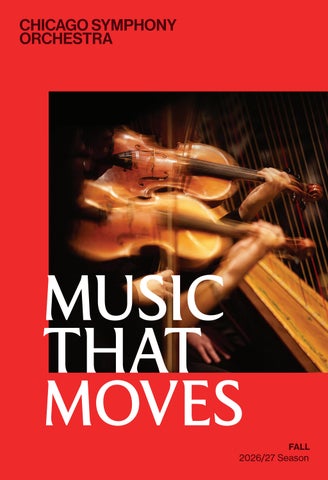
MUSIC THAT MOVES
FALL
2026/27 Season
CHICAGO SYMPHONY ORCHESTRA
ORCHESTRAL VOCAL & CHORAL
Symphony Ball WITH KL AUS M ÄKEL Ä
Celebrate the Chicago Symphony Orchestra’s 2026/27 Season in grand fashion with a red carpet, commemorative toast and timeless music. STRAVINSKY Petrushka WALTON Belshazzar's Feast
OCT 10
Tickets at cso.org/symphonyball Presenting Sponsor
Hosted by Women’s Board
Media Partners
Artists, prices and programs subject to change.
CHICAGO SYMPHONY ORCHESTRA Klaus Mäkelä Zell Music Director Designate
Riccardo Muti Music Director Emeritus for Life
ONE HUNDRED THIRTY-SIXTH SEASON
Thursday, September 17, 2026, at 7:30 Friday, September 18, 2026, at 1:30 Saturday, September 19, 2026, at 7:30
Petr Popelka Conductor Hilary Hahn Violin SCHUMANN
Overture to Manfred, Op. 115
MENDELSSOHN
Violin Concerto in E Minor, Op. 64
Allegro molto appassionato— Andante— Allegretto non troppo—Allegro molto vivace HILARY HAHN
INTERMISSION
DVOŘÁK
Symphony No. 5 in F Major, Op. 76 Allegro ma non troppo Andante con moto Scherzo: Allegro scherzando Finale: Allegro molto
The appearance of Petr Popelka is made possible by the Juli Plant Grainger Fund for Artistic Excellence. The appearance of Hilary Hahn is made possible with support from The Paul Ricker Judy Endowment Fund. cso.org
3
The appearance of Hilary Hahn is made possible with support from
The Paul Ricker Judy Endowment Fund.
4
2026–27 Season
COMMENTS
by Phillip Huscher
ROBERT SCHUMANN
Born June 8, 1810; Zwickau, Saxony, Germany Died July 29, 1856; Endenich, near Bonn, Germany
Overture to Manfred, Op. 115 Robert Schumann’s father August was a respected publisher who made a tidy sum printing pocket editions of works by Goethe, Schiller, and Byron, among others. Like his father, Robert was shy and bookish as a boy; he grew up reading the classics and showed great interest in becoming a writer himself. Although he occasionally worked for his father, Robert wanted to perform and compose music, and he was the only one of four brothers who eventually quit the family business. Long after he had made a name for himself as a pianist, composer, and critic, Robert continued to read voraciously, often by dim, flickering candlelight at bedtime. The powerful effects of literature may even have contributed to his frequent sleepless nights—a diary entry from 1829 reads “Bed-lecture: Manfred by Byron—terrible night.” Schumann
COMPOSED 1848–49, incidental music FIRST PERFORMANCE March 14, 1852; Leipzig, Germany. The composer conducting INSTRUMENTATION 2 flutes, 2 oboes, 2 clarinets, 2 bassoons, 4 horns, 3 trumpets, 3 trombones, timpani, strings APPROXIMATE PERFORMANCE TIME 12 minutes FIRST CSO PERFORMANCES January 1 and 2, 1892, Auditorium Theatre. Theodore Thomas conducting July 12, 1975, Ravinia Festival. James Levine conducting MOST RECENT CSO PERFORMANCES August 1, 1981, Ravinia Festival. Jésus López-Cobos conducting November 2, 3, 4, and 7, 2023, Orchestra Hall. Daniel Harding conducting CSO RECORDINGS 1956. Bruno Walter conducting. CSO (Chicago Symphony Orchestra in the Twentieth Century: Collector’s Choice) 1977. Daniel Barenboim conducting. Deutsche Grammophon
THIS PAGE, FROM TOP: Robert Schumann at the age of forty. Daguerreotype portrait by Johann Anton Völlner (born 1817, death date unknown), Hamburg, Germany, 1850 | August Schumann (1773–1827), father of the composer, in an 1826 engraving by Friedrich Fleischmann (1791–1834) of an 1810 oil portrait by Gotthelf Leberecht Glaeser (1784–1851); and Christiane Schumann (1767–1836), mother of the composer, in an 1810 oil portrait by Glaeser | NEXT PAGE, FROM TOP: Manfred on the Jungfrau, watercolor by John Martin (1789–1854), 1837, inspired by Lord Byron’s poem Manfred. Birmingham Museums Trust Collection, England | À Robert Schumann (To Robert Schumann), 1893. Lithograph by Henri Fantin-Latour (1836–1904) of his painting. An angel crowns a bust of Schumann, while a scroll lists the composer’s dramatic works Das Paradies und die Peri, Genoveva, Manfred, and Scenes from Goethe’s Faust. Cleveland Museum of Art
cso.org
5
COMMENTS
always had a special affection for the British writer and, in 1840, he set one of Byron’s poems to music as part of the song cycle Myrthen. Years later, Joseph von Wasielewski, Schumann’s concertmaster in Düsseldorf, remembered that when the composer read aloud from Byron’s Manfred “his voice suddenly failed him, tears started from his eyes, and he was so overcome that he could read no further.” Two years before Robert and his wife Clara moved to Düsseldorf in 1850, Schumann composed incidental music for a production of Manfred. He was thrilled and inspired by the challenge, commenting at the time that he had never before committed himself “with such love and outlay of force to any composition as to that of Manfred.” Throughout his life, Schumann identified with tragic literary figures, and he may have seen something of himself in Byron’s tormented hero, who wanders the Alps contemplating suicide and seeking oblivion. (Byron began his dramatic poem in 1816, shortly after visiting the Shelleys in the Swiss Alps, where eighteenyear-old Mary was hard at work on Frankenstein.) Schumann wrote an overture and incidental music for fifteen scenes; he began work on August 5, 1848, the day after he finished his only, ill-fated opera Genoveva. Although it is often said that Schumann had no genuine theatrical talent and that he was inept at writing for orchestra, the powerful overture he composed for Manfred proves otherwise. From its quick curtain-raiser beginning (three rushed, offbeat chords), Schumann’s overture is masterfully and economically scored 6
2026–27 Season
and an unerringly paced musical drama. It immediately casts a spell, setting the scene for the action to follow. Schumann has composed a character sketch in dark, unsettled music that grows in passion and urgency, then slowly collapses in the final pages. This is a magnificent and satisfying piece of music on its own, though, like any effective overture, it makes us eager to hear more.
COMMENTS FELIX MENDELSSOHN
Born February 3, 1809; Hamburg, Germany Died November 4, 1847; Leipzig, Germany
Violin Concerto in E Minor, Op. 64 On July 30, 1838, Felix Mendelssohn wrote to his friend, the distinguished German violinist Ferdinand David, “I’d like to write a violin concerto for you next winter; one in E minor sticks in my head, the beginning of which will not leave me in peace.” With those lines, Mendelssohn began his last great work—a masterpiece to refute claims of a career in decline and a concerto that would prove as popular as any ever written. Sketches confirm that Mendelssohn knew very early on how this music would go, and an extensive correspondence with David, spanning six years, shows how much care went into the details. Mendelssohn was the architect; David his technical advisor. David and Mendelssohn were kindred spirits; both were celebrated prodigies, born only a year apart. They became friends in 1825, the year Ferdinand David, fifteen, gave his first concerts in Berlin, and Felix Mendelssohn, sixteen, composed the magnificent Octet for strings that’s one of the greatest miracles in all music. That summer, after Abraham Mendelssohn moved his family to 3 Leipziger Strasse in Berlin, the
two young men became regular chamber music partners as well. (The son of the famous philosopher Moses Mendelssohn, Abraham would later say, “First I was the son of my father. Now I am the father of my son.”) Ten years later, when Mendelssohn was named conductor of the Leipzig Gewandhaus Orchestra, he asked Ferdinand David to be his concertmaster. In 1843 Mendelssohn founded the Leipzig Conservatory; he appointed David to head his violin staff. (He also hired Robert Schumann to teach piano, composition, and score reading and soon added Robert’s wife Clara to the piano faculty.) Although Mendelssohn had written to David some five years earlier of his intention to compose a concerto for him, it wasn’t until 1844 that he found time to work on it in earnest. The concerto was completed on September 16, but as late as December 17 he wrote to David one last time, asking him to look at some changes he had penciled in, even though he had already sent the score off to his publisher, Breitkopf and Härtel. “I very much want to have your views on all this,” he wrote, “before I turn it over to the printer.” David gave the world premiere on March 13, 1845, with the Leipzig Gewandhaus Orchestra conducted by Danish composer Niels Gade. It was a great success.
THIS PAGE, FROM TOP: Felix Mendelssohn, 1847. Oil portrait by Wilhelm Hensel (1794–1861), the composer’s brother-in-law. Düsseldorf City Museum, Germany | Ferdinand David (1810–1873), Mendelssohn’s boyhood friend and soloist in the world premiere of his Violin Concerto in 1845. David was also concertmaster of Leipzig’s Gewandhaus Orchestra and assumed its musical direction after Mendelssohn’s death in 1847. Lithograph by Johann Georg Weinhold (1813–1880), 1846 | NEXT SPREAD: Palais Groeben, the Mendelssohn family residence at 3 Leipziger Strasse, Berlin. Illustration from Famous Israelite Men and Women, vol. 1, by Adolph Kohut (1848–1917). Published by Leipzig-Reudnitz, ca. 1900
cso.org
7
COMMENTS
The concerto turned out to be Mendelssohn’s last orchestral work, a powerhouse finale to a career burdened by the promise of spectacular early accomplishment—even the Italian and Scottish symphonies hadn’t surpassed the masterpieces of his teens—the Octet and the Overture to A Midsummer Night’s Dream. In achievement and popularity, the violin concerto proved to be their equal.
T
his violin concerto has long been too well known for an easy appraisal of its real virtues and innovations. In 1921 the British music critic Donald Tovey wrote, “I rather envy the enjoyment of anyone who should hear the Mendelssohn concerto for the first time and find that, like Hamlet, it was full of quotations.” Perhaps the most famous of the quotations in the concerto is the very opening, a wonderful, singing violin melody launched after just two measures of orchestral “curtain”—a theme so effortlessly right that it comes as a surprise to learn that it gave Mendelssohn considerable trouble. (The essence of both the theme and its accompaniment is all there in the first sketch; as Mendelssohn told David, it was a beginning that wouldn’t leave him in peace.) Although Mendelssohn wasn’t the first composer to introduce his soloist at the start of a concerto, he seized on the happy idea of letting soloist and orchestra explore the exposition together, abandoning the traditional double exposition (one for orchestra alone, a second led by the soloist). The idea was part of Mendelssohn’s design from the beginning, and it was followed by nearly every nineteenthcentury composer, except for Brahms and Dvořák. Equally novel (though less imitated) is Mendelssohn’s decision to move the soloist’s cadenza from the end of the movement to the crucial juncture of the development section and the recapitulation. The soloist now takes the spotlight at the most dramatic moment in the movement—it’s a powerful and satisfying tactic. The cadenza concludes with a series of arpeggios that continues even after the orchestra bursts in with the main theme, a reversal of their traditional roles. Novelty shouldn’t overshadow the music’s less historic moments. The first movement is one of Mendelssohn’s greatest creations—there’s evidence of his fastidious craftsmanship and inspiration in every bar. Notice, in particular, how he handles the important change of key and mode (from minor to major): the solo violin quickly descends three octaves to its lowest G, where it becomes the bass line to a new melody in the clarinets and flutes. In his own Scottish Symphony, Mendelssohn had played with going from one movement to another without a break. He now conceives his entire concerto, in three movements,
8
2026–27 Season
COMPOSED 1844 FIRST PERFORMANCE March 13, 1845; Leipzig, Germany INSTRUMENTATION solo violin, 2 flutes, 2 oboes, 2 clarinets, 2 bassoons, 2 horns, 2 trumpets, timpani, strings APPROXIMATE PERFORMANCE TIME 27 minutes FIRST CSO PERFORMANCES August 4, 1893, Music Hall at the World’s Columbian Exposition. Maud Powell as soloist, Theodore Thomas conducting February 7 and 8, 1896, Auditorium Theatre. Émile Sauret as soloist, Theodore Thomas conducting July 26, 1941, Ravinia Festival. Yehudi Menuhin as soloist, Carlos Chávez conducting MOST RECENT CSO PERFORMANCES March 7, 8, 9, and 12, 2024, Orchestra Hall. Gil Shaham as soloist, Jakub Hrůša conducting July 25, 2024, Ravinia Festival. Augustin Hadelich as soloist, Marin Alsop conducting CSO RECORDINGS 1947. Mischa Elman as soloist, Désiré Defauw conducting. RCA 1962. Nathan Milstein as soloist, Walter Hendl conducting. VAI (video) 1979. Kyung-Wha Chung as soloist, Sir Georg Solti conducting. London (video) 1980. Shlomo Mintz as soloist, Claudio Abbado conducting. Deutsche Grammophon 1993. Itzhak Perlman as soloist, Daniel Barenboim conducting. Erato
COMMENTS
as one continuous flow of music. The first bridge is accomplished by a single note—a low B in the bassoon—that outlasts the final chord of the opening Allegro like a stuck key on a pipe organ. The sustained B finally rises the half step to C, suggesting a new key—C major—and, in turn, a new movement. The Andante is one of Mendelssohn’s loveliest songs without words, a full paragraph of sweet melody and sensitive scoring. (Even in his last letter to David, Mendelssohn was still worrying about the effect of the mixed bowed and plucked accompaniment.) The mood
darkens midway through, with the entrance of trumpets and timpani. The bridge to the finale is accomplished by fourteen measures at a transitional tempo, in the character of a recitative before a showstopper aria. This is truly virtuosic material—roulades, scales, and rapid passagework in virtually every measure—cast in Mendelssohn’s characteristic fleet and dancing style. The scurrying main theme carries the day at the expense of a little march tune that passes for a second subject. There’s a fancy coda, and, in the final bar, the soloist’s high E pierces the stratosphere.
cso.org
9
COMMENTS ANTONÍN DVOŘÁK
Born September 8, 1841; Mühlhausen, Bohemia (now Nelahozeves, Czech Republic) Died May 1, 1904; Prague, Bohemia
Symphony No. 5 in F Major, Op. 76 To the late nineteenth century, Dvořák was the composer of five—not nine— symphonies. His first four, never published during his lifetime, were unknown, and so his last, From the New World, spent its first half century as no. 5. The F major symphony performed at these concerts is really Dvorák’s fifth, although it took some time to get this all straightened out. Like his nineteenth-century colleagues Schubert and Bruckner, Dvořák has been good to musicologists, who sometimes make a living cleaning up after the fact. Only with the publication of Dvořák’s first four symphonies in the 1950s (the long-lost First Symphony was rediscovered after the composer’s death and performed for the first time in 1936) did we begin to use the current numbering. This F major symphony is Dvořák’s most significant product of 1875, a result of the encouragement he felt after winning the Austrian State Stipendium—along with powerful endorsements and four hundred gulden—for the first time, and the most promising sign that the judges had picked extremely well. The prize launched one of the most prolific years of Dvořák’s career, and in addition to this symphony, composed in just six weeks during the summer, he also wrote his five-act grand opera Vanda in three months and turned out several substantial chamber pieces as well. But the symphony is the giant leap—a great advance over anything he had written before. It’s easy now to see it as a score of extraordinary promise, because we know the brilliant Seventh Symphony, for example, or the timeless From the New World that followed, but the Fifth Symphony itself is a very impressive accomplishment. We tend to think of Brahms and Dvořák as contemporary symphonists—their most famous symphonies were all premiered within the span of some fifteen years—who influenced each other in various ways. (When Dvořák began his Seventh, for example, he was still under the spell of Brahms’s new Third, which he had just heard.) But Dvořák composed this F major symphony a year before Brahms finished his first, and so this is his answer to the classics by Beethoven, Schubert, and Schumann that he knew, not a 10
2026–27 Season
COMPOSED 1875 FIRST PERFORMANCE March 25, 1879; Prague, Bohemia INSTRUMENTATION 2 flutes, 2 oboes, 2 clarinets (2nd doubling bass clarinet), 2 bassoons, 4 horns, 2 trumpets, 3 trombones, timpani, triangle, strings APPROXIMATE PERFORMANCE TIME 44 minutes FIRST CSO PERFORMANCES January 24 and 25, 1919, Orchestra Hall. Adolf Weidig conducting MOST RECENT CSO PERFORMANCES January 24 and 25, 1919, Orchestra Hall. Adolf Weidig conducting December 7, 8, 9, and 12, 2017, Orchestra Hall. Neeme Järvi conducting
THIS PAGE: Antonín Dvořák, portrait, ca. 1880. Private collection, anonymous artist. Photo by Fine Art Images/ Heritage Images/Getty Images OPPOSITE PAGE: Hans von Bülow (1830–1894)—to whom Dvořák dedicated his Fifth Symphony— photographed by George Kendall Warren (1834–1884). Albumen print, ca. 1875. Louise St. John Westervelt Collection of Theatrical and Musical Photographs, the Newberry Library, Chicago
COMMENTS
reaction to Brahms. (In fact, if either composer had an influence on the other at this point, it’s the other way around: Brahms got to know at least three of Dvořák’s symphonies while he was still writing his first.) Dvořák’s F major symphony sings with his own unmistakable voice; it’s free of the heavy Wagnerian fog that clouds some of his early works and has a natural warmth and simplicity that often eluded Brahms. Still, Dvořák couldn’t escape the inevitable comparison to Brahms: when he dedicated this symphony to Hans von Bülow, the great conductor said he was thrilled to accept this honor from Dvořák, “next to Brahms, the most gifted composer of today.” This symphony is the first important work of Dvořák’s maturity, and Simrock insisted (against Dvořák’s wishes) on publishing it with a phony, high opus number to give it the stature of an even later composition. (Simrock picked op. 76, which puts it in the company of pieces composed a full decade later, even though Dvořák had appropriately written op. 24 at the top of his manuscript.) For a work saddled with such a convoluted numbering history, the music itself is a marvel of natural, unfussy expression and clarity of form. The entire symphony reveals remarkable assurance and control, suggesting that the speed of its composition was the result of certainty, not haste.
T
he opening Allegro ma non troppo is filled with genial, outdoorsy music— clarinet birdcalls and hunting horns paint an inviting pastoral scene in high summer. The movement is vigorous and muscular until the
very end, when Dvořák opts for quiet contentment over visceral excitement. The melancholy Andante—an intermezzo in a moderate tempo rather than a self-important slow movement—suggests the dumka, the mournful peasant dance that Dvořák loved. The scherzo, which follows immediately after only a moment’s hesitation, takes its time shaking the spell of the Andante before it breaks into a jovial, rustic dance. (The way Dvořák blurs the distinction between the two inner movements is novel and highly effective.) The finale shatters the symphony’s pastoral mood with its powerful opening in A minor—an unexpectedly foreign key in an F major work. Dvořák shrewdly withholds F major for a very long time, which only adds to the suspense and drama. This entire movement, with its driving rhythms, big themes, and heated development, confirms Dvořák’s stature as a natural symphony composer. Both the brief, unannounced return of the opening material of the first movement, pianissimo, and the triumphant recovery of F major, celebrated with pealing trumpets, only add to its continuous sense of excitement and discovery.
Phillip Huscher has been the program annotator for the Chicago Symphony Orchestra since 1987. His history of the Orchestra, Passing the Baton: The Chicago Symphony Orchestra and the Music Directors Who Shaped Its Greatness, will be published on September 28 by The University of Chicago Press.
cso.org
11
THE INDIANAPOLIS 12TH QUADRENNIAL INTERNATIONAL VIOLIN COMPETITION
SEPTEMBER 17 - OCTOBER 4, 2026
Years of Preparation Hours of Practice
It All Comes Down to This The International Violin Competition of Indianapolis is coming. Sept 17
Opening Ceremonies featuring Time for Three Title Sponsor
Sept 19-23
Preliminaries
Sept 25-28
Semi-Finals
Sept 30-Oct 1
Classical Finals with the East Coast Chamber Orchestra
Oct 2-3
Finals with The Indianapolis Symphony Orchestra Title Sponsor
Oct 4
violin.org
Gala Awards Ceremony
PROFILES Petr Popelka Conductor FIRST CSO PERFORMANCES March 1 and 2, 2024, Orchestra Hall. Mendelssohn’s The Hebrides Overture, Schubert’s Symphony no. 6, and Beethoven’s Symphony no. 7 MOST RECENT CSO PERFORMANCES December 4, 5, 6, and 7, 2025, Orchestra Hall. Brahms’s Symphony no. 3 in F major, Aucoin’s Song of the Reappeared with Julia Bullock, and Strauss’s Till Eulenspiegel’s Merry Pranks
Acclaimed for his captivating, authentic, and inclusive approach to conducting, Petr Popelka becomes the general music director designate of the Bavarian State Opera starting the 2029–30 season. He has served as chief conductor of the Vienna Symphony Orchestra since the 2024–25 season. Highlights of the 2026–27 season include, in addition to concerts and tours with the Vienna Symphony Orchestra, his debuts with the Royal Concertgebouw Orchestra Amsterdam, the Los Angeles Philharmonic, and the Orchestra National de France. He also returns to the Cleveland Orchestra, Pittsburgh Symphony Orchestra, Leipzig Gewandhaus Orchestra, Staatskapelle Berlin, Staatskapelle Dresden, Bamberg Symphony Orchestra, Swedish Radio Symphony Orchestra, and Danish National
Photo © Susanne Hassler-Smith
Symphony Orchestra; and to the Zurich Opera House, where he conducts Verdi’s Don Carlo. This past summer, he led music by Mozart at the Salzburg Festival. Previous debuts have taken him to the Berlin and Munich philharmonic orchestras, the Tonhalle-Orchester Zürich, Orchestra dell’Accademia Nazionale di Santa Cecilia in Rome, and the NHK Symphony Orchestra in Tokyo, among others. As a celebrated opera conductor, Popelka made guest appearances at the Bavarian State Opera (Káťa Kabanová and Rusalka), Staatsoper Unter den Linden (Tosca), Deutsche Oper Berlin (Tristan and Isolde), Semperoper Dresden (Die Nase), Theater an der Wien (Schwanda and Die Fledermaus), Zurich Opera House (Don Giovanni), Norwegian Opera in Oslo (Elektra), and the National Theatre in Prague (Rusalka, Carmen, The Marriage of Figaro). Petr Popelka launched his conducting career during the 2019–20 season after serving as deputy principal double bass at the Staatskapelle Dresden from 2010 to 2019. Shortly thereafter, he was appointed as chief conductor of the Norwegian Radio Orchestra in Oslo (2020–23) and subsequently led the Prague Radio Symphony Orchestra (2022–26). He received his musical training in his hometown of Prague and in Freiburg, Germany. He is also active as a composer. Intermusica represents Petr Popelka worldwide.
cso.org
13
at Northwestern University
Learning is more Fun with Friends at OLLI Osher Lifelong Learning Institute (OLLI) at Northwestern University is a non-credit program for adults age 50+ who learn collaboratively through active discussion groups—there are no tests, no grades, just a love of learning! Small groups meet once a week either virtually or in-person at our Evanston and Chicago locations.
Evanston location: 500 Davis Street, Suite 700 847-467-1523 Chicago location: Northwestern Wieboldt Hall 339 E Chicago Avenue, Room 412 312-503-7881 Scan the QR code to learn more!
Questions? email: olli@northwestern.edu
sps.northwestern.edu/olli
olli@northwestern.edu
CLASSIC ENCOUNTER WITH TERRI HEMMERT From The Beatles to Haydn, learn more about the music through stories you won’t forget.
OCT 29
Brahms Requiem FEB 25
Honeck Conducts Bates & Mahler 1
MAR 18
A Little Night Music MAY 13
Mäkelä, Batiashvili & Sibelius 1
Visit cso.org/classicencounter for the perfect pairing with your CSO Classical concerts.
PROFILES
Hilary Hahn Violin FIRST CSO PERFORMANCES March 29, 30, 31, and April 3, 2007, Orchestra Hall. Goldmark’s Violin Concerto, Charles Dutoit conducting MOST RECENT CSO PERFORMANCES December 7, 8, and 9, 2023, Orchestra Hall. Brahms’s Violin Concerto, Mikko Franck conducting
Three-time Grammy Award–winning violinist Hilary Hahn melds expressive musicality and technical expertise with a diverse repertoire guided by artistic curiosity. Hahn is a prolific recording artist and commissioner of new works, and her twenty-three feature recordings have received every critical prize. Hahn currently serves as a member of the Juilliard School’s string faculty, following her earlier tenure as visiting artist in Juilliard’s Music Division in the 2023–24 season; recent seasons have also seen her serve as the Chicago Symphony Orchestra’s first-ever artist-inresidence, artist-in-residence at the New York Philharmonic, and curating artist of the Dortmund Festival. Hahn has personally commissioned and championed works by a diverse array of more than forty living composers, including Steven Banks, Jennifer Higdon, Jessie Montgomery, and Carlos Simon. Her 2021 album, Paris, features the world premiere recording of Rautavaara’s Deux Sérénades, written for Hahn and premiered by her in 2019. Other recent commissions include Michael Abels’s Isolation Variation, Hahn’s recording of which was nominated for a Grammy; Barbara Assiginaak’s Sphynx Moth; Lera Auerbach’s Sonata no. 4: Fractured Dreams; and Six Partitas by Antón García Abril. García Abril, Auerbach, and Rautavaara were among the twenty-seven composers who contributed to In 27 Pieces: the Hilary Hahn Encores, Hahn’s Grammy-winning multi-year commissioning project.
Photo © Chris Lee
Hahn related to her fans naturally from the start of her career. Her Bring Your Own Baby concerts create opportunities for parents of infants to share their enjoyment of live classical music with their children. Her social mediabased initiative, #100daysofpractice, has transformed practice into a community-building celebration of artistic development; since Hahn created the hashtag in 2017, fellow performers and students have contributed more than one million posts. A former Suzuki student, she released new recordings of the first three books of the Suzuki Violin School in 2020. In 2019 she released a book of sheet music for In 27 Pieces that includes her own fingerings and bowings and performance notes for each work. Hahn is a prolific and celebrated recording artist whose feature albums on Decca, Deutsche Grammophon, and Sony have all opened in the top ten of the Billboard charts. Recent releases include Night After Night, a collection of James Newton Howard’s scores for the films of M. Night Shyamalan, for which Hahn reprised her contributions to his score for The Village; and a Gramophone Recording of the Year Award–winning disc of Ysaÿe’s six sonatas for solo violin. Three of her albums have been awarded Grammys. Higdon’s Violin Concerto, which was composed for Hahn and recorded by her in 2008, was awarded the Pulitzer Prize. Hilary Hahn is the recipient of numerous awards and recognitions. In recent seasons, she received the Avery Fisher Prize; was named Musical America’s 2023 Artist of the Year; delivered the keynote speech of the Second Annual Women in Classical Music Symposium; received the 2021 Herbert von Karajan Award; and was awarded the Eleventh Annual Glasshütte Original Music Festival Award, which she donated to the Philadelphia-based music-education nonprofit Project 440. Hahn was the 2022 Chubb Fellow at Yale University’s Timothy Dwight College. She also holds honorary doctorates from Middlebury College in Vermont and Ball State University in Indiana, where there are three scholarships in her name.
cso.org
15
HONOR THE CSO MEMORIES THAT MADE YOU. “
The CSO is a very important part of my life. Supporting this culturally iconic organization is one way to give back and help ensure that future generations can experience and appreciate its impact.” — Marybeth Johnson
Join the Theodore Thomas Society Here are some meaningful ways to give: Remembering the CSO in your will Naming the CSO in your trust Designating the CSO as a beneficiary of your retirement assets Gifts — of any amount — preserve the Orchestra and music programs you love for future generations. Contact us today at 312-294-3100 or visit cso.org/plannedgiving for more information.
CHICAGO SYMPHONY ORCHESTRA Now in its 136th season, the Chicago Symphony Orchestra is a global artistic leader, hailed as one of the most esteemed ensembles in classical music. The ensemble’s history began in 1889, when Theodore Thomas, the leading conductor in America and a recognized music pioneer, was invited by Chicago businessman Charles Norman Fay to establish a symphony orchestra. Thomas’s aim to build a permanent orchestra of the highest quality was realized at the first concerts in October 1891 in the Auditorium Theatre. Thomas served as music director until his death in January 1905, just three weeks after the dedication of Orchestra Hall, the Orchestra’s permanent home designed by Daniel Burnham. Frederick Stock, recruited by Thomas to the viola section in 1895, became assistant conductor in 1899 and succeeded the Orchestra’s founder. His tenure lasted thirty-seven years, from 1905 to 1942. Stock founded the Civic Orchestra of Chicago—the first training orchestra in the U.S. affiliated with a major orchestra—in 1919, established youth auditions, organized the first subscription concerts especially for children, and began a series of popular concerts. Three conductors headed the Orchestra during the following decade: Désiré Defauw was music director from 1943 to 1947, Artur Rodziński in 1947–48, and Rafael Kubelík from 1950 to 1953. The next ten years belonged to Fritz Reiner, whose recordings with the CSO are still considered hallmarks. Reiner invited Margaret Hillis to form the Chicago Symphony Chorus in 1957. For five seasons from 1963 to 1968, Jean Martinon held the position of music director. Sir Georg Solti, the Orchestra’s eighth music director, served from 1969 until 1991. His arrival launched one of the most successful musical partnerships of our time. The CSO made its first overseas tour to Europe in 1971 under his direction and released numerous award-winning recordings. Beginning in 1991, Solti held the title of music director laureate and returned to conduct the Orchestra each season until his death in September 1997.
Daniel Barenboim became ninth music director in 1991, a position he held until 2006. His tenure was distinguished by the opening of Symphony Center in 1997, appearances with the Orchestra in the dual role of pianist and conductor, and twenty-one international tours. Appointed by Barenboim in 1994 as the Chorus’s second director, Duain Wolfe served until his retirement in 2022. In 2010, Riccardo Muti became the Orchestra’s tenth music director. During his tenure, the Orchestra deepened its engagement with the Chicago community, collaborated with visionary musicians and composers, and realized many notable performances of operas in concert. In September 2023, Muti became music director emeritus for life. In April 2024, conductor Klaus Mäkelä was announced as the Orchestra’s eleventh music director and will begin an initial five-year tenure as Zell Music Director in September 2027. In July 2025, Donald Palumbo became the third director of the Chicago Symphony Chorus. Carlo Maria Giulini was named the Orchestra’s first principal guest conductor in 1969, serving until 1972; Claudio Abbado held the position from 1982 to 1985. Pierre Boulez was appointed as principal guest conductor in 1995 and was named Helen Regenstein Conductor Emeritus in 2006, a position he held until his death in January 2016. From 2006 to 2010, Bernard Haitink was the Orchestra’s first principal conductor. Pianist Jean-Yves Thibaudet is the CSO’s artist-in-residence for the 2026–27 Season. The Orchestra first performed at Ravinia Park in 1905, later helped to inaugurate the Ravinia Festival in 1936, and has been in residence nearly every summer since. Listeners enjoy the weekly CSO Radio Broadcast Series as well as releases from the ensemble’s extensive commercial discography. Recordings by the Chicago Symphony Orchestra and Chorus have earned sixty-five Grammy awards from the Recording Academy. The musicians of the Orchestra are deeply involved in the Negaunee Music Institute, which reaches students, families, and earlycareer musicians through free and low-cost programming and world-class training.
cso.org
17
HOST YOUR EVENT AT SYMPHONY CENTER In addition to performances by some of the world’s greatest musicians, Symphony Center provides the perfect atmosphere for celebrating special occasions. Contact our professional event management team and make your next event a success.
Visit cso.org/events Email rentals@cso.org Call 312-294-3260
Chicago Symphony Orchestra Klaus Mäkelä Zell Music Director Designate Jean-Yves Thibaudet Artist-in-Residence VIOLINS Robert Chen Concertmaster The Louis C. Sudler Chair, endowed by an anonymous benefactor Stephanie Jeong Associate Concertmaster The Cathy and Bill Osborn Chair David Taylor* Assistant Concertmaster The Ling Z. and Michael C. Markovitz Chair Yuan-Qing Yu* Assistant Concertmaster So Young Bae Cornelius Chiu Gina DiBello Kozue Funakoshi Russell Hershow Qing Hou Youngji Kim Gabriela Lara Matous Michal Simon Michal Sando Shia Susan Synnestvedt Rong-Yan Tang Baird Dodge Principal Danny Yehun Jin Assistant Principal Lei Hou § Ni Mei Hermine Gagné Rachel Goldstein Mihaela Ionescu Jasmine Mengjia Lin Wendy Koons Meir Florence Schwartz VIOLAS Teng Li Principal The Paul Hindemith Principal Viola Chair Catherine Brubaker § Youming Chen Sunghee Choi Paolo Dara Wei-Ting Kuo Danny Lai Weijing Michal Diane Mues Lawrence Neuman Jikun Qin Max Raimi
Riccardo Muti Music Director Emeritus for Life
CELLOS John Sharp Principal The Eloise W. Martin Chair Kenneth Olsen Assistant Principal The Adele Gidwitz Chair Karen Basrak The Joseph A. and Cecile Renaud Gorno Chair Richard Hirschl Olivia Jakyoung Huh Daniel Katz Katinka Kleijn Brant Taylor The Ann Blickensderfer and Roger Blickensderfer Chair BASSES Alexander Hanna Principal The David and Mary Winton Green Principal Bass Chair Alexander Horton Assistant Principal Dan Carson Ian Hallas Robert Kassinger Mark Kraemer Stephen Lester Bradley Opland Andrew Sommer FLUTES Emma Gerstein Jennifer Gunn PICCOLO Jennifer Gunn The Dora and John Aalbregtse Piccolo Chair OBOES William Welter Principal Lora Schaefer Assistant Principal The Gilchrist Foundation, Jocelyn Gilchrist Chair Scott Hostetler ENGLISH HORN Scott Hostetler
CLARINETS Stephen Williamson Principal John Bruce Yeh Assistant Principal The Governing Members Chair Gregory Smith Pavel Vinnitsky E-FLAT CLARINET John Bruce Yeh BASS CLARINET Pavel Vinnitsky BASSOONS Keith Buncke Principal William Buchman Assistant Principal Miles Maner HORNS Mark Almond Principal James Smelser David Griffin Oto Carrillo Susanna Gaunt TRUMPETS Esteban Batallán Principal The Adolph Herseth Principal Trumpet Chair, endowed by an anonymous benefactor John Hagstrom The Bleck Family Chair Tage Larsen TROMBONES Timothy Higgins Principal The Lisa and Paul Wiggin Principal Trombone Chair Michael Mulcahy Acting Assistant Principal Charles Vernon
TIMPANI David Herbert Principal The Clinton Family Fund Chair Vadim Karpinos Assistant Principal PERCUSSION Cynthia Yeh Principal Chair sponsored by an anonymous benefactor Vadim Karpinos LIBRARIANS Justin Vibbard Principal Carole Keller Mark Swanson § CSO FELLOWS Ariel Seunghyun Lee Violin The Michael and Kathleen Elliott Fellow Alba Schoonmaker Violin Brandon Xu Cello ORCHESTRA PERSONNEL John Deverman Director Anne MacQuarrie Manager, CSO Auditions and Orchestra Personnel STAGE TECHNICIANS Christopher Lewis Stage Manager Blair Carlson Paul Christopher Chris Grannen Ryan Hartge Peter Landry Joshua Mondie
BASS TROMBONE Charles Vernon TUBA Gene Pokorny Principal The Arnold Jacobs Principal Tuba Chair, endowed by Christine Querfeld
* Assistant concertmasters are listed by seniority. ‡ On sabbatical § On leave The CSO’s music director position is endowed in perpetuity by a generous gift from Zell Family Foundation. The Louise H. Benton Wagner and Erika and Dietrich M. Gross Principal Flute chairs are currently unoccupied. The Chicago Symphony Orchestra string sections utilize revolving seating. Players behind the first desk (first two desks in the violins) change seats systematically every two weeks and are listed alphabetically. Section percussionists also are listed alphabetically.
cso.org
19
Learn more about the Chicago Symphony Orchestra Association’s musicians, concerts, and supporters at cso.org. Find articles and program notes, listen to CSOradio, and watch CSOtv at Experience CSO.
Get involved with our many volunteer and affiliate groups.
For complete listings of our generous supporters, please visit the Richard and Helen Thomas Donor Gallery.
cso.org/experience
cso.org/getinvolved
cso.org/donorgallery
Connect with us on social @chicagosymphony
Enhance Your Concert Experience
Symphony Center Venue Policies
Program Notes
Children: Children 8 years of age and older are
Access CSO program books and program notes online at cso.org/program. For many classical performances, notes are offered in written and video formats. Digital CSO program books are made possible with the generous support of The Walter and Karla Goldschmidt Foundation.
The Symphony Store
Commemorate your trip to Orchestra Hall with exclusive CSO souvenirs. The Store is open before all CSO and select Symphony Center Presents concerts. Regular store hours are Tuesday–Saturday, 11:30 a.m. to 5 p.m. Visit symphonystore.com to shop online.
welcome to attend concerts at Symphony Center. Family concerts and select holiday and movie concerts are open to children 3 years of age and older. All children, regardless of age, must have their own tickets for all performances.
Late seating: Late seating is at the discretion of house
management and may not be available for certain programs and seating locations. For most concerts, late seating opportunities are between pieces or at intermission.
Electronic devices: Before the concert begins, mobile
phones and other electronic devices must be turned off or set to silent mode. The use of photography, audio, and video equipment is not permitted during the music.
Please note: As of this season, Box Level seating is now assigned.
CHICAGO SYMPHONY ORCHESTRA ASSOCIATION BOARD OF TRUSTEES OFFICERS Mary Louise Gorno Chair Chester A. Gougis Vice Chair Steven Shebik Vice Chair Helen Zell Vice Chair Renée Metcalf Treasurer Jeff Alexander President Kristine Stassen Secretary of the Board Stacie M. Frank Assistant Treasurer Dale Hedding Vice President for Development TRUSTEES R. John Aalbregtse Peter J. Barack H. Rigel Barber Merrill Blau* Roderick Branch Robert J. Buford Johannes Burlin Leslie Henner Burns Marion A. Cameron-Gray Enrique Carrillo* George P. Colis Keith S. Crow Stephen V. D’Amore Brian W. Duwe James B. Fadim Robert B. Ford Matthew Fry* Jennifer Amler Goldstein Sarah Good* David A. Gordon Mary Louise Gorno Graham C. Grady Aengus Hallinan John Holmes Janice L. Honigberg Andrew M. Jessen Lori Julian Neil T. Kawashima Geraldine Keefe Donna L. Kendall Thomas Kilroy Dr. Randall S. Kroszner Patty C. Lane Jason M. Laurie Ling Z. Markovitz
Paul H. McDonough Renée Metcalf Britt M. Miller Frank B. Modruson Toni-Marie Montgomery Mary Pivirotto Murley Sylvia Neil Gerald T. Nowak Christopher A. O’Herlihy Santa J. Ono Gerald L. Pauling II Andrew Pritzker LTC. Jennifer N. Pritzker, USA (Ret.) Katherine Protextor Drehkoff Dr. Don M. Randel Dr. Mohan Rao Laura G. Rice* Alexander Ripley Melissa M. Root Burton X. Rosenberg E. Scott Santi Steven Shebik Marlon R. Smith Walter S. Snodell Dr. Eugene Stark Daniel E. Sullivan, Jr. Scott C. Swanson Nasrin Thierer Liisa M. Thomas Christopher D. Tower Laura Sumner Truax* Frederick H. Waddell Paul S. Watford Craig R. Williams Robert Wislow Helen Zell Gifford R. Zimmerman LIFE TRUSTEES William Adams IV Mrs. Robert A. Beatty Arnold M. Berlin Randy Lamm Berlin Laurence O. Booth William G. Brown Dean L. Buntrock † Bruce E. Clinton Richard Colburn Anthony T. Dean
John A. Edwardson Thomas J. Eyerman David W. Fox, Sr. † Cyrus F. Freidheim, Jr. Mrs. Robert W. Galvin Paul C. Gignilliat † Joseph B. Glossberg Richard C. Godfrey William A. Goldstein Chester A. Gougis Mary Winton Green David P. Hackett Joan W. Harris John H. Hart Thomas C. Heagy Jay L. Henderson Debora de Hoyos William R. Jentes † Richard B. Kapnick Donald G. Kempf, Jr. Mrs. John C. Kern Robert Kohl Josef Lakonishok Charles Ashby Lewis Eva F. Lichtenberg John F. Manley R. Eden Martin Arthur C. Martinez Judith W. McCue Lester H. McKeever, Jr. David E. McNeel William A. Osborn Mrs. Albert Pawlick Jane DiRenzo Pigott John M. Pratt Dr. Irwin Press John W. Rogers, Jr. Jerry Rose Frank A. Rossi John R. Schmidt Thomas C. Sheffield, Jr. Robert C. Spoerri Carl W. Stern William H. Strong Richard L. Thomas Richard P. Toft Penny Van Horn Paul R. Wiggin
* Ex Officio Trustee † Deceased List as of September 2026
cso.org
21
ADMINISTRATION Jeff Alexander President PRESIDENT’S OFFICE Kristine Stassen Executive Assistant to the President & Secretary of the Board Mónica Lugo Executive Assistant to the Music Director Emeritus for Life Human Resources Lynne Sorkin Director Dijana Cirkic Manager ARTISTIC ADMINISTRATION Cristina Rocca Vice President The Richard and Mary L. Gray Chair James M. Fahey Programming Consultant, Symphony Center Presents Randy Elliot Director, Artistic Administration Lena Breitkreuz Director, Programming and Administration, Films and Special Presentations Caroline Eichler Senior Manager, Artistic Administration Jackson Brown Manager, Artistic Planning Autumn Selover Coordinator, Artistic Administration Phillip Huscher Scholar-in-Residence & Program Annotator Pietro Fiumara Artists Assistant Chorus Melissa Hilker Manager Olive Haugh Assistant Manager & Librarian, Executive Assistant to the VP for Artistic Planning ORCHESTRA AND BUILDING OPERATIONS Vanessa Moss Vice President Jiwon Sun Director, Tour & Media Operations Michael Lavin Director of Production Jeffrey Stang Associate Director of Production, CSO Joseph Sherman Associate Director of Production, SCP & Rental Events Jenise Sheppard House Manager Charlie Post Chief Recording Engineer Logan Goulart Production Coordinator Sara Hedberg Operations Assistant Rosenthal Archives Frank Villella Director Orchestra Personnel John Deverman Director Anne MacQuarrie Manager, CSO Auditions & Orchestra Personnel Facilities John Maas Director Engineers Tim McElligott Chief Engineer Michael McGeehan Kevin Walsh Stephen Excellent Electricians Robert Stokas Chief Electrician Doug Scheuller Stage Technicians Christopher Lewis Stage Manager Blair Carlson Paul Christopher Chris Grannen Ryan Hartge Peter Landry Joshua Mondie
22
2026–27 Season
NEGAUNEE MUSIC INSTITUTE AT THE CSO Jonathan McCormick Managing Director Katy Clusen Associate Director, CSO for Kids Rachael Cohen Associate Director, Musician Training & Community Engagement Anna Perkins Orchestra Manager & Assistant Director of Programming, Civic Orchestra of Chicago Katie Eaton Manager, School Partnerships Carol Kelleher Coordinator, CSO for Kids Matthew Nowlan Operations Coordinator, Civic Orchestra of Chicago Victoria Koretsky Programs Assistant & NMI Board Secretary FINANCE AND ADMINISTRATION Stacie M. Frank Vice President & Chief Financial Officer Renay Johansen Slifka Executive Assistant Accounting Sam Pincich Controller Kerri Gravlin Director, Financial Planning & Analysis Hyon Yu Assistant Controller, Reporting & Systems Janet Kosiba Assistant Controller, Accounting Operations Mehrin Reid Payroll Manager Karen Levin Accounting Manager Milda Reklyte Senior Accountant Christopher Biemer Accountant Cynthia Maday Accounts Payable Manager Elizabeth Tyska Payroll Assistant Information Technology Kirk McMahon Director Douglas Bolino Client Systems Administrator Jackie Spark Lead Technologist Dwayne Laughlin Tessitura Systems Analyst-Technologist SALES AND MARKETING Ryan Lewis Vice President Erika Nelson Director, Institutional Marketing & Revenue Management Alyssa Greenberg Manager, Audience Engagement Digital Marketing Dana Navarro Director Laura Emerick Digital Content Editor Peter Breithaupt Manager, Digital Content Steve Burkholder Web Manager Megan Ireland Manager, Digital Marketing Program Marketing and Operations Amy Brondyke Director Alex Demas Associate Director, Marketing Tommy Crawford Manager, Program Marketing Kate McDuffie Manager, Community & Family Programs Amanda Swanson Marketing Analyst Jesse Bruer Advertising & Promotions Specialist Andrew Hilgendorf Email Marketing Associate Mya Gibson Marketing & Copywriting Associate Creative Jaime Hotz Director Sophie Weber Associate Director, Project & Digital Asset Management Emily Herrington Lead Designer Fattah Mulya Design Associate
Communications Eileen Chambers Director, Institutional Communications Frances Atkins Director, Publications & Institutional Content Gerald Virgil Senior Content Editor Kristin Tobin Associate Director, Publication Design & Production Media Relations Hannah Sundwall Director Clay Baker Manager Zoe Carter Coordinator, Media Relations & Social Content Sales and Patron Experience Joseph Fernicola III Director Pavan Singh Manager, Patron Services Brian Koenig Manager, Preferred Services Joseph Garnett Senior Manager, Box Office Tommy Bravos, Nicholas Bryan Assistant Managers, Patron Services Justin Corp, Carmen Ringhiser Assistant Managers, Preferred Services The Symphony Store Tyler Holstrom Manager Annie Grapentine Assistant Manager DEVELOPMENT Dale Hedding Vice President Jeremiah Strickler Manager, Development Administration Allison Szafranski Director, Leadership Gifts Tori Ramsay Director, Major Gifts & Special Projects John Heffernan Major Gifts Officer Karen Bippus Director, Endowment Gifts & Planned Giving Victoria Barbarji Associate Director, Campaigns & Strategic Giving Nathan Wetter Associate Director of Development, Negaunee Music Institute Joe Bauer Manager, Endowment Gifts & Planned Giving Institutional Advancement Nick Magnone Director, Corporate Development Mary Grace Corrigan Associate Director, Foundation & Government Relations Jenny Choi Coordinator, Grants & Institutional Giving Donor Engagement and Development Operations Liz Heinitz Senior Director, Development Lisa McDaniel Director, Donor Engagement Alyssa Hagen Associate Director, Donor & Development Services Kimberly Duffy Associate Director, Donor Engagement Jocelyn Weberg Senior Manager, Annual Giving Jamie Forssander Senior Donor Engagement Manager Brent Taghap Manager, Donor Engagement Jeremiah Pickett III Manager, Governing Member Gifts Karli Scott Prospect & Donor Research Specialist Mykele Callicutt Coordinator, Donor Engagement Victoria Menendez, Elisabeth Miller Coordinators, Donor Services Casey Bowman Coordinator, Development Communications
MUSIC THAT MOVES Klaus Mäkelä Zell Music Director Designate SEP 24-26
Mäkelä Conducts Sibelius & Shostakovich OCT 1-4
Mäkelä Conducts Mahler 9 OCT 8-9
Mäkelä, Petrushka & Belshazzar’s Feast OCT 10
Symphony Ball with Klaus Mäkelä
Tickets at cso.org Symphony Center | 220 S. Michigan Ave. | 312-294-3000 Concert Juli Plant Grainger Fund Sponsor for Artistic Excellence
Concert Sponsor Media Partners
Symphony Ball Presenting Sponsor
Chorus Sponsor The Grainger Foundation
Artists, prices and programs subject to change.