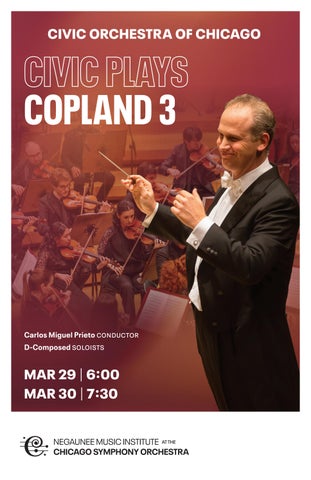
CIVIC PLAYS COPLAND 3
D-Composed soloists

MAR 29 | 6:00
MAR 30 | 7:30
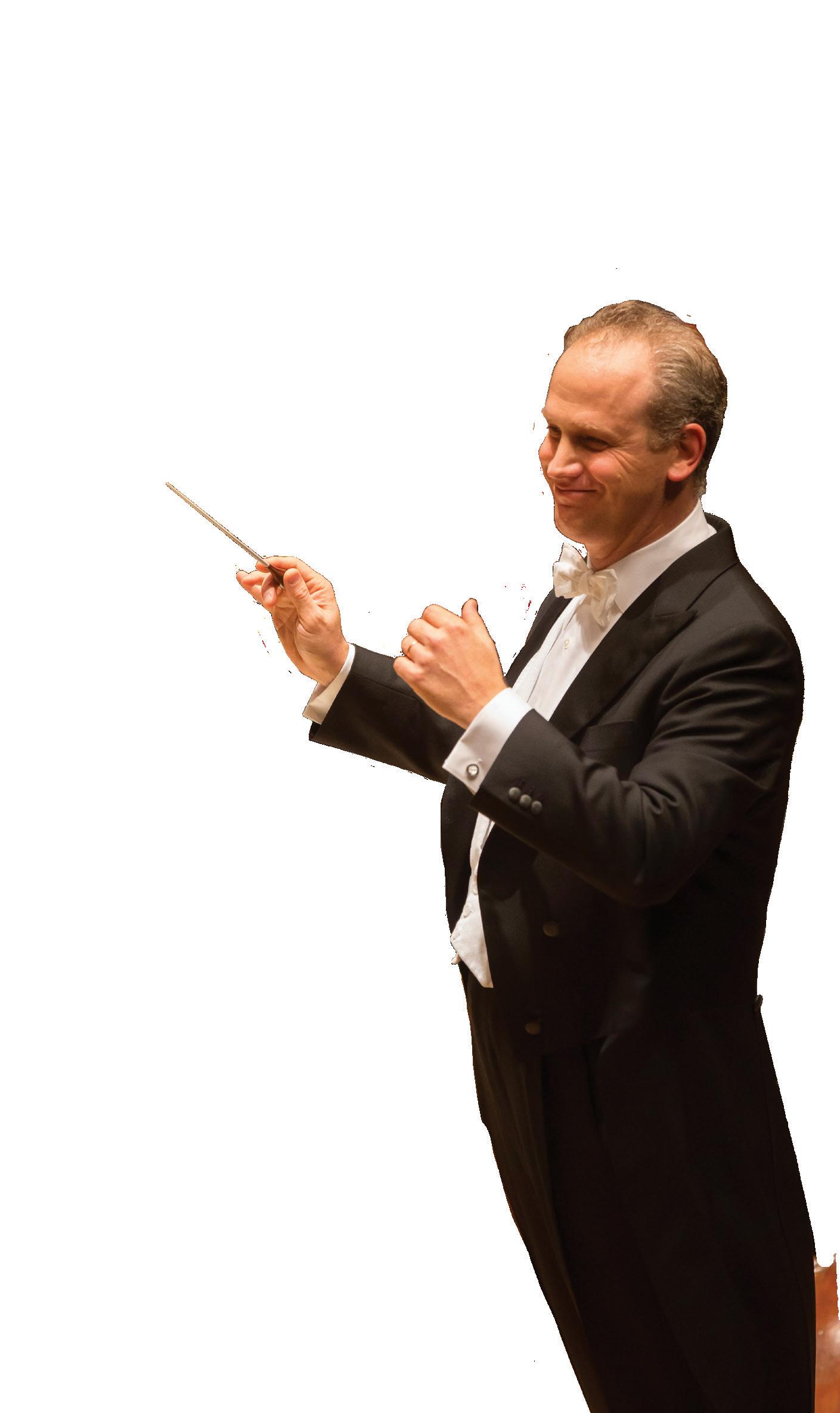

Carlos Miguel Prieto conductor
The 2025–26 Civic Orchestra season is generously sponsored by Lori Julian for the Julian Family Foundation, which also provides major funding for the Civic Fellowship program.
The March 29 concert is generously sponsored by the JCS Arts, Health and Education Fund of DuPage Foundation.

The appearance of D-Composed is sponsored by The Robert and Isabelle Bass Foundation.
CIVIC ORCHESTRA OF CHICAGO
KEN-DAVID MASUR Principal Conductor
The Robert Kohl and Clark Pellett Principal Conductor Chair
Sunday, March 29, 2026, at 6:00
Wentz Concert Hall, N. Central College—Naperville
Monday, March 30, 2026, at 7:30 Orchestra Hall
Carlos Miguel Prieto Conductor
D-Composed
Caitlin Edwards Violin
Khelsey Zarraga Violin
Wilfred Farquharson Viola
Lindsey Sharpe Cello
CHÁVEZ Sinfonía india (Symphony No. 2)
ABELS
Delights and Dances
D-COMPOSED
INTERMISSION
COPLAND Symphony No. 3
Molto moderato, with simple expression
Allegro molto
Andantino quasi allegretto—
Molto deliberato—Allegro risoluto
The 2025–26 Civic Orchestra season is generously sponsored by Lori Julian for the Julian Family Foundation, which also provides major funding for the Civic Fellowship program.
The March 29 concert is generously sponsored by the JCS Arts, Health and Education Fund of DuPage Foundation.
The appearance of D-Composed is sponsored by The Robert and Isabelle Bass Foundation.
The Civic Orchestra of Chicago acknowledges support from the Illinois Arts Council.
COMMENTS by Phillip Huscher and Nicky Swett
CARLOS CHÁVEZ
Born June 13, 1899; near Mexico City, Mexico
Died August 2, 1978; Mexico City, Mexico
Sinfonía india (Symphony No. 2)
COMPOSED 1935–36
FIRST PERFORMANCE
January 23, 1936, New York City. The composer conducting
INSTRUMENTATION
3 flutes and 2 piccolos, 3 oboes, 2 clarinets, E-flat clarinet and bass clarinet, 3 bassoons, 4 horns, 2 trumpets, 2 trombones, percussion (indian drum, maraca, metal rattle, soft rattle, suspended cymbal, tenor drum, snare drum, claves, xylophone, rattling string, güiro, bass drum, rasping stick), timpani, harp, strings
APPROXIMATE PERFORMANCE TIME 11 minutes
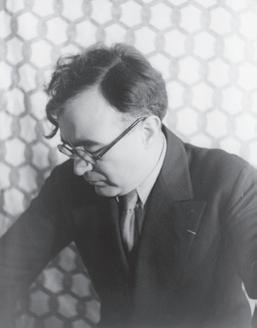
Musicians in the United States first learned of Carlos Chávez through Aaron Copland, whose friendship with the Mexican composer spanned more than half a century and included regularly performing, conducting, and championing his colleague’s music. We don’t know for certain when Copland and Chávez met. (At a party given in their honor in the late seventies, Chávez said, “We met in Paris.” Copland replied, “In Paris? No, in New York—I think!”
“In ’26,” Chávez pronounced. “Really?” said Copland.) In any event, when Copland finally visited Chávez in Mexico in 1932—falling madly in love with the country and its people—he understood at once what made Chávez’s music so distinctive and unassumingly right. “Mexico offers something fresh and pure and wholesome—a quality which is deeply unconventionalized,” he wrote. “The source of it is the Indian background everywhere—even in the landscape.” (It was Chávez who took his New Yorker friend to the dance hall El salón México on this visit, inspiring one of Copland’s most popular scores.)
Chávez was born in a suburb of Mexico City. He was not truly selftaught—he studied first with his brother and later with Manuel Ponce—but he resisted conventional training in music theory, preferring to learn by examining the scores of the great masters. At the age of twenty-one, Chávez encountered international musical modernism firsthand when he traveled to Vienna, Berlin, and Paris (where Paul Dukas urged him to become for Mexico what Falla was to Spain—a composer who creates a unique musical style by thoroughly assimilating his native folk music). Chávez spent the winter of
above: Portrait of Carlos Chávez by Carl Van Vechten (1880–1964), 1937
1922–23 in New York City and returned again in 1926, this time to stay for two years.
Back home in Mexico, Chávez quickly became the central figure in his country’s musical renaissance, and he soon was a national celebrity. He helped establish the first permanent symphony orchestra in Mexico—the Orquesta Sinfónica de México, which he led for twenty years—and, in 1928, he became director of the National Conservatory. Chávez was also highly influential in the growing cultural transaction between the Americas, and with fellow modernists Edgard Varèse and Henry Cowell, he founded the Pan American Association of Composers. Chávez played the role of musical ambassador extremely well, regularly visiting the United States not only to see old friends such as Copland but also to teach and perform his music—and to make new friends for Mexican culture.
Like the Mexican painters Diego Rivera and José Orozco, Chávez tried to create a popular art form inspired by the Indian culture of the pre-Columbian period. “For the first time in the history of art,” Rivera said, “Mexican mural painting made the masses the hero of monumental art.” Chávez’s music tried to achieve the same blend of modern and ancient (and of popularity and timelessness). In his 1958 Norton lectures, Chávez recalled the work of Rivera and his fellow muralists:
In trying to be accessible to the people, as they called it (or, as we
would prefer to say, to the average audience), they did not descend to a level of vulgarity. They maintained a classic dignity, at times truly superb, and whether or not they were accessible to the “people,” it is good that their work was achieved and stands for posterity.
It was with the Sinfonía india that Chávez came closest to achieving the muralists’ accessibility and dignity while reviving his country’s folk heritage.
Chávez had begun to incorporate Aztec elements and native Indian music into his own work as early as 1921 with the ballet The New Fire, commissioned by the same José Vasconcelos who invited Rivera to participate in his program of public art. Although Chávez did not regularly use native material in his compositions, his musical language was forever marked by its influence; in the chamber piece Xochipilli (1940), he even went so far as to attempt “to reconstruct—as far as it is possible—the music of the ancient Mexicans.”
The Sinfonía india of 1936—the second of Chávez’s seven symphonies—is one of the few scores in which Chávez actually quotes Indian music; here, he uses three ancient melodies—one from the Seris of Sonora; one from the Huicholes of Nayarit; and one from the Yaquis, also of Sonora.
Chávez told his friend Herbert Weinstock that he picked these three because they came from the northern Pacific coast of Mexico and shared a certain unity. As he told Weinstock:
COMMENTS
The essential characteristics of this indigenous music have been able to resist four centuries of contact with European musical expressions. That is, while it is certain that contact with European art has produced in Mexico a mestizo (mixed) art in constant evolution, this has not meant the disappearance of pure indigenous art.
With its exotic colors, repetitive phrases, irregular rhythms, and driving energy—Chávez once wrote a work called H.P. (for horsepower)—the Sinfonía is decidedly non-European in sound and structure. One expansive, open-air melody at the heart of the
score, however, suggests that Chávez was deeply influenced by Copland’s brand of lyricism. (Chávez gave the premiere of Copland’s Short Symphony in 1934, not long before he began this work, and wrote to the composer of his great admiration for such natural and unaffected music.) To recreate an ancient sound world, the Sinfonía india calls for a large percussion section, with modern instruments substituting for primitive Indian ones—the tenor drum for a water gourd, a soft rattle for the tenabari (a string of butterfly cocoons), a rattling string of hard, wooden beads for the grijutian (a string of deer hooves).
—Phillip Huscher
MICHAEL ABELS
Born October 8, 1962; Phoenix, Arizona
Delights and Dances
COMPOSED 1986
FIRST PERFORMANCE
September 25, 2007, Carnegie Hall, New York; the Harlem Quartet and Sphinx Chamber Orchestra
INSTRUMENTATION
string quartet and string orchestra
APPROXIMATE PERFORMANCE TIME 13 minutes
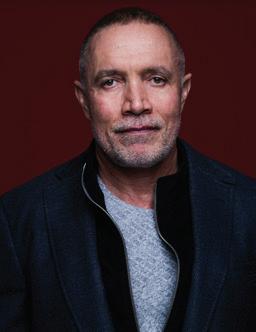
When composer
Michael Abels studied piano and composition at the University of Southern California in the 1980s, he found it difficult to overcome a nagging feeling that everything had already been done before. As he explained in a recent interview, “You listen to so many wonderful pieces of music, and you
above: Michael Abels, photo by Eric Schwabel
keep thinking ‘well, that idea is taken, that idea is taken.’ I started to wonder, ‘what is my voice?’” One way he worked through the issue of originality and artistic identity was by exploring a range of nonclassical genres. He discovered surprising connections among musical traditions from far-apart places like West Africa and Ireland, and in his own works, he experimented with carefully combining threads from different musical styles. He came to recognize that even if a sounding relationship wasn’t traceable to a concrete, historical connection, it could still have artistic value: “It was important that I, as an artist, as a lover of music, hear a relationship. There’s a relationship to me, even if other people don’t hear it. And that’s what I can show in a piece of music.”
Abels has carried this polystylistic impulse through his varied career, which has ranged from large-scale orchestra commissions to scores for major Hollywood films, including Get Out (2017), Us (2019), and Nope (2022). In collaboration with the folk singer Rhiannon Giddens, he wrote the Pulitzer Prize–winning opera Omar (2022), which was inspired by the life of Omar ibn Said, a West-African scholar who was enslaved and brought to the United States in 1807 and wrote an Arabic-language memoir about his life in 1831. Abels composed Delights and Dances in 2007 to celebrate the tenth anniversary of the Sphinx competition and organization, which gives financial support and professional
development opportunities to young Black and Latino classical musicians. The premiere of the piece took place at the laureate’s concert for the Sphinx competition in September of that year, with the Harlem Quartet playing the virtuoso principal parts on that occasion—“with panache,” according to the New York Times reviewer.
Abels went through multiple orchestration possibilities for Delights and Dances before settling on the final version for string quartet and string orchestra. The piece opens with a melancholy, arpeggiated dialogue between the solo cellist and violist that contains a number of beguiling and poignant harmonic twists. The full orchestra soon enters with a lightly swung, plucked rhythmic groove, and an extensive blues section begins in which the members of the quartet exchange increasingly virtuosic solos. Though the notes of these solos are precisely written out, Abels gives each performer a sweep of playful cross-rhythms and biting grace notes that rub against the ensemble’s repeated pattern, lending the passages the feeling that they are being extemporized in the moment. In the composer’s words, the final section is a bluegrass-inspired “raucous hoedown.” Another round of solo turns for the string quartet forms exciting sonic links among the diverse string playing styles featured throughout the piece.
—Nicky Swett
AARON COPLAND
Born November 14, 1900; Brooklyn, New York
Died December 2, 1990; New York City
Symphony No. 3
COMPOSED
Summer 1944–September 1946
FIRST PERFORMANCE
October 18, 1946; Boston, Massachusetts
INSTRUMENTATION
3 flutes and 2 piccolos, 3 oboes and english horn, 2 clarinets, E-flat clarinet and bass clarinet, 2 bassoons and contrabassoon, 4 horns, 4 trumpets, 3 trombones and tuba, timpani, 2 harps, celesta, piano, strings; and a percussion (bass drum, tam-tam, cymbals, xylophone, glockenspiel, tenor drum, wood block, snare drum, triangle, slapstick, ratchet, anvil, claves, and tubular bells)
APPROXIMATE PERFORMANCE TIME
42 minutes
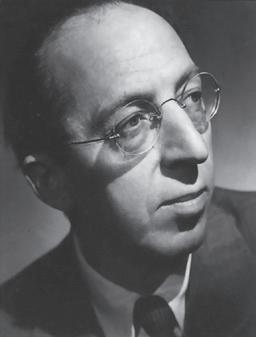
It was left to Aaron Copland, who was born with the new century more than one hundred and twenty-five years ago, to serve as the grand statesman of American music. Of all the gifted composers who came of age in the twentieth century, Copland was the one whose work seemed to capture best the essence of this land and its people.
And so, at the end of World War II, Copland was the obvious choice to write our official musical statement—to express the optimism sweeping this country and to provide a grand public monument of hope and affirmation. Copland didn’t set out with this in mind when he began his third symphony in the summer of 1944, in the isolated town of Tepotzlan, Mexico, far from both his home turf and the front lines of war. At that point, he was thinking more of pleasing Serge Koussevitzky, who had commissioned the work, and who “liked music in the grand manner.” But, from the start, Copland apparently planned to incorporate his recent Fanfare for the Common Man, a brassy, populist soundbite composed in 1942 to boost morale in wartime effort, into this work. By the time the score was completed, in a converted barn near Tanglewood, Massachusetts, in September 1946, the war was over, the fanfare had taken its place in the symphony’s finale, and Copland publicly claimed that the work was “intended to reflect the euphoric spirit of the country at the time.”
—Phillip Huscher
above: Aaron Copland, photo ca. 1940s
Aaron Copland on Symphony No. 3
Regarding my Third Symphony, one aspect ought to be pointed out: it contains no folk or popular material. During the late twenties, it was customary to pigeonhole me as a composer of symphonic jazz, with emphasis on the jazz. I have also been catalogued as a folklorist and purveyor of Americana. Any reference to jazz or folk material in this work was purely unconscious.
For the sake of those who like a purely musical guide through unfamiliar terrain, I add a breakdown by movements of the technical outlines of the work.
1. Molto moderato (very moderate). The opening movement, which is broad and expressive in character, opens and closes in the key of E major. (Formally it bears no relation to the sonata-allegro with which symphonies usually begin.) The themes—three in number—are plainly stated: the first is in the strings, at the very start without introduction; the second, in a related mood, in violas and oboes; the third of a bolder nature, in the trombones and horns. The general form is that of an arch, in which the central portion is more animated and the final section is an extended coda presenting a broadened version of the opening material. Both first and third themes are referred to again in later movements of the symphony.
2. Allegro molto (very fast). The form of this movement stays closer to normal symphonic procedure. It is the usual scherzo, with first part, trio, and return. A brass introduction leads to the main theme, which is stated three times in
part one: at first in horns and violas with continuation in clarinets, then in unison strings, and finally in augmentation in the lower brass. The three statements of the theme are separated by the usual episodes. After the climax is reached, the trio follows without pause. Solo woodwinds sing the new melody in lyrical and canonical style. The strings take it up and add a new section of their own. The recapitulation of part one is not literal. The principal theme of the scherzo returns in somewhat disguised form in the solo piano, leading through previous episodic material to a full restatement in the tutti orchestra. This is climaxed by a return to the lyrical trio theme, this time sung in canon and in fortissimo by the entire orchestra.
3. Andantino quasi allegretto (moving along a little, almost like an allegretto, slightly fast). The third movement is freest of all in formal structure. Although it is built up sectionally, the various sections are intended to emerge one from the other in continuous flow, somewhat in the manner of a closely knit series of variations. The opening section, however, plays no role other than that of introducing the main body of the movement. High up in the unaccompanied first violins is heard a rhythmically transformed version of the third (trombone) theme of the first movement of the symphony. It is briefly developed in contrapuntal style and comes to a full close, once again in the key of E major. A new and more tonal theme is introduced in the solo flute. This is the melody that supplies the thematic substance for the sectional
metamorphoses that follow, at first with quiet singing nostalgia; then faster and heavier—almost dancelike; then more childlike and naive; and finally vigorous and forthright. Imperceptibly, the whole movement drifts off into the higher regions of the strings, out of which floats the single line of the beginning, sung by solo violin and piccolo, accompanied this time by harps and celesta. The third movement calls for no brass, with the exception of a single horn and trumpet.
4. Fanfare: Molto deliberato (very deliberate)—Allegro risoluto (fast and resolute). The final movement follows without pause. It is the longest movement of the symphony, and closest in structure to the customary sonata-allegro form. The opening fanfare is based on Fanfare for the Common Man, which I composed in 1942 at the invitation of Eugene Goossens for a series of wartime fanfares introduced under his direction by the Cincinnati Symphony Orchestra. In the present version, it is first played pianissimo by flutes and clarinets, and then suddenly given out by brass and percussion. The fanfare serves as preparation for the main body of the movement that follows. The components of the usual form are there: a first theme in animated sixteenth-note motion; a second theme—broader and more songlike in character; a full-blown development; and a refashioned return
to the earlier material of the movement, leading to a peroration. One curious feature of the movement consists in the fact that the second theme is to be found embedded in the development section instead of being in its customary place [following the statement of the first theme]. The development, as such, concerns itself with the fanfare and first-theme fragments. A shrill tutti chord, with flutter-tongued brass and piccolos, brings the development to a close. What follows is not a recapitulation in the ordinary sense. Instead, a delicate interweaving of the first theme in the higher solo woodwinds is combined with a quiet version of the fanfare in the two bassoons. Combined with this, the opening theme of the first movement of the symphony is quoted, first in the violins, and later in the solo trombone. Near the end, a full-voiced chanting of the second songlike theme is heard in horns and trombones. The symphony concludes on a massive restatement of the opening phrase with which the work began.
Phillip Huscher is the program annotator for the Chicago Symphony Orchestra.
Cellist, writer, and music researcher Nicky Swett holds a PhD in music from the University of Cambridge, where he was a Gates Scholar. From 2016 to 2018, he was a section member and community engagement fellow in the Civic Orchestra of Chicago.
PROFILES
Carlos Miguel Prieto Conductor
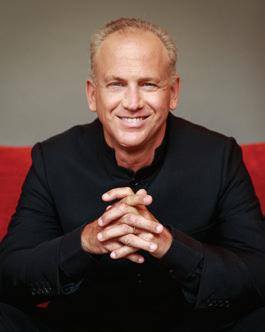
Known for his charisma and expressive interpretations, Grammy award–winning Mexican conductor Carlos Miguel Prieto has established himself not only as a major figure in the orchestral world but also as an influential educator, cultural change-maker, and champion of new music.
Career highlights include engagements with the London Philharmonic Orchestra, NDR Elbphilharmonie, Frankfurt Radio Symphony, the Hallé, Royal Liverpool Philharmonic, Chicago Symphony Orchestra, Cleveland Orchestra, New Jersey, Dallas, Toronto, and San Francisco symphony orchestras, Los Angeles Philharmonic, and a successful BBC Proms debut at the Royal Albert Hall, among many others.
Prieto was named music director of the North Carolina Symphony in 2023 and has been music director of Orquesta Sinfónica de Minería since 2008, with whom he earned a Latin Grammy nomination for Best Classical Music Album. From 2007 to 2022, Prieto served as music director of the Orquesta Sinfónica Nacional de México, the country’s leading ensemble,
significantly raising the caliber of the orchestra. He was also music director of the Louisiana Philharmonic Orchestra from 2006 to 2023, where he helped lead the cultural renewal of New Orleans following Hurricane Katrina.
An advocate for music education, Prieto has conducted the Youth Orchestra of the Americas since its inception. Alongside Gustavo Dudamel, Prieto served as the orchestra’s principal conductor from 2001 until 2011, when he was appointed music director.
In 2018 he conducted the orchestra on a tour of European summer festivals, which included performances at the Rheingau and Edinburgh festivals as well as Hamburg’s Elbphilharmonie. He has also worked regularly with the National Youth Orchestra of Great Britain and the NYO2 in New York.
Carlos Miguel Prieto is renowned for championing new and lesser-known Latin American and African American music. He has conducted over one hundred world premieres of works by Mexican and American composers, many of which he commissioned.
Prieto has recorded on Deutsche Grammophon, Naxos, and Sony labels and was recognized by Musical America as the 2019 Conductor of the Year. A graduate of Princeton and Harvard universities, Prieto studied conducting with Jorge Mester, Enrique Diemecke, Charles Bruck, and Michael Jinbo.
PHOTO BY LORENA ALCARAZ & BERNARDO ARCOS
D-Composed
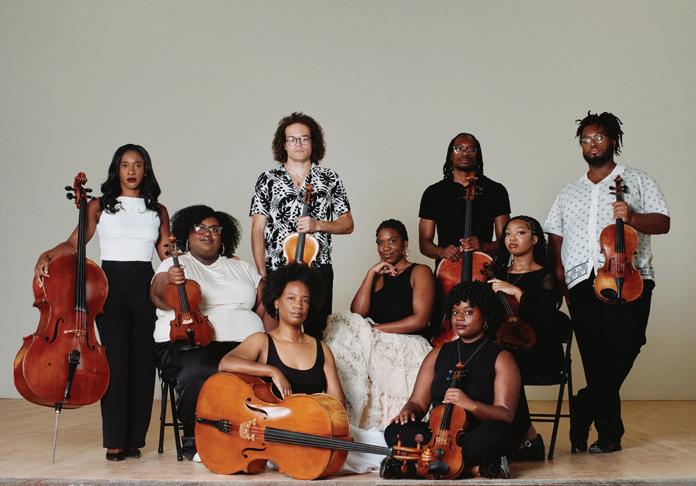
Historians of art and culture may not currently fully account for the fact that Black culture and creativity are part of the foundation of every musical institution we see today. D-Composed, a Black chamber music collective, exists to ensure that we never forget it.
Led by their mission to uplift and empower society through the music of Black composers, this Chicago-based creative incubator serves as a bridge between the past and the present, connecting to the future of representation, music-centered experiences, and the communal power of Black composers and their lasting impact.
Music is not solely entertainment; for this collective, music is a storytelling tool that educates and inspires. Unapologetically Blackness is at the core of their experience; on the other side of that core is the work of protecting, nurturing, and sustaining. At the heart of it lies their impact—the people who make up these experiences, whether as musicians, creatives, or community members.
As a Black ensemble that focuses exclusively on the works of Black composers, D-Composed partners with institutions that have a proven commitment to communities of color. The Chicago-based ensemble with global impact has been presented by Apple, Theaster Gates’s Rebuild Foundation, the Museum of Contemporary Art Chicago, TUCCA in São Paulo, Brazil, the Kaufman Music Center in New York, and TEDx. While merging the worlds of contemporary music and classical, the ensemble has also collaborated with esteemed artists across genres and disciplines, including Jessie Montgomery, Pamela Z, avery r. young, Jamila Woods, Davóne Tines, Sudan Archives, Plínio Fernandes, and the New York Times bestselling author Tricia Hersey.
In fall 2025, D-Composed was named one of the inaugural creative partners at artist Theaster Gates’s latest spacebased project, the Land School.
The meaning of the collective’s name embodies that boldness in action.
D–Composed (dee-kuhm-pohzd)— adverb—our creative process that involves the breaking down of preconceived notions, barriers, and opinions of what people think classical music should be, to rewriting our own narrative to reflect what the classical world could be.
Individual biographies for this evening’s performers are available at cso.org.
PHOTO COURTESY OF THE ENSEMBLE
Civic Orchestra of Chicago
The Civic Orchestra of Chicago is a training program of the Chicago Symphony Orchestra’s Negaunee Music Institute that prepares young professionals for careers in orchestral music. It was founded during the 1919–20 season by Frederick Stock, the CSO’s second music director, as the Civic Music Student Orchestra, and for over a century, its members have gone on to secure positions in orchestras across the world, including over 160 Civic players who have joined the CSO. Each season, Civic members are given numerous performance opportunities and participate in rigorous orchestral training with its principal conductor, Ken-David Masur, distinguished guest conductors, and a faculty of coaches comprised of CSO members. Civic Orchestra musicians develop as exceptional orchestral players and engaged artists, cultivating their ability to succeed in the rapidly evolving music world.
The Civic Orchestra serves the community through its commitment to present free or low-cost concerts of the highest quality at Symphony
Center and in venues across Greater Chicago, including annual concerts at the South Shore Cultural Center and Fourth Presbyterian Church. The Civic Orchestra also performs at the annual Crain-Maling Foundation CSO Young Artists Competition and Chicago Youth in Music Festival. Many Civic concerts can be heard locally on WFMT (98.7 FM), in addition to concert clips and smaller ensemble performances available on CSOtv and YouTube. Civic musicians expand their creative, professional, and artistic boundaries and reach diverse audiences through educational performances at Chicago public schools and a series of chamber concerts at various locations throughout the city.
To further expand its musician training, the Civic Orchestra launched the Civic Fellowship program in the 2013–14 season. Each year, up to twelve Civic members are designated as Civic Fellows and participate in intensive leadership training designed to build and diversify their creative and professional skills. The program’s curriculum has four modules: artistic planning, music education, social justice, and project management.
A gift to the Civic Orchestra of Chicago supports the rigorous training that members receive throughout the season, which includes coaching from musicians of the Chicago Symphony Orchestra and world-class conductors. Your gift today ensures that the Chicago Symphony Orchestra Association will continue to enrich, inspire, and transform lives through music.
Civic Orchestra of Chicago
Ken-David Masur Principal Conductor
The Robert Kohl and Clark Pellett Principal Conductor Chair
VIOLINS
Naomi Powers
Alba Layana Izurieta
Kimberly Bill+ Kaylin Chung
Adam Davis
Rose Haselhorst
John Heo
Ben Koenig
Nelson Mendoza+
Mona Mierxiati
Tricia Park
Mia Smith
Keshav Srinivasan
Justine Jing Xin Teo*
Jingjia Wang
Natalie Boberg
Sage Chen
Maria Paula Bernal
Carlos Chacon
Evan Chen
Ebedit Fonseca
Alyssa Goh
June Lee
Matthew Musachio
Timothy Parham
Sean Qin
Lorena Uquillas
Yulia Watanabe-Price
Lina Yamin
VIOLAS
Darren Carter
Sava Velkoff*
Lucie Boyd
Eugene Chin
Jacob Davis
August DuBeau
Elena Galentas
Roslyn Green+
Judy Huang
Matthew Nowlan**
Yat Chun Justin Pou
Mason Spencer*
CELLOS
David Caplan
Ashley Ryoo
Grant Estes
Ómkara Gil
J Holzen*
Nick Reeves
Daniel Ryu
Somyong Shin
Andrew Shinn
BASSES
Bennett Norris
Jonathon Piccolo
Albert Daschle
Gisel Dominguez
Jared Prokop
Tony Sanfilippo, Jr.
Alexander Wallack
Hanna Wilson-Smith
FLUTES
Xander Day
Joanna Lau
Hanna Oyasu
PICCOLOS
Isabel Evernham
Joanna Lau
OBOES
Hannah Fusco
Guillermo Ulloa
Madison Constantine
ENGLISH HORN
Hannah Fusco
CLARINETS
Elizabeth Kapitaniuk
Henry Lazzaro
E-FLAT CLARINET
Max Reese
BASS CLARINET
Michael Thompson
BASSOONS
Jason Huang
Hannah Dickerson
Finn McCune
CONTRABASSOON
Finn McCune
Civic Orchestra Fellow **NMI Arts Administration Fellow +Civic Orchestra Alum
HORNS
Eden Stargardt*
Emmett Conway
Layan Atieh
Lauren Goff
Erin Harrigan
TRUMPETS
Hamed Barbarji*
Sean-David Whitworth
Sam Atlas
Abner Wong
TROMBONES
Dustin Nguyen
Arlo Hollander
BASS TROMBONE
Timothy Warner
TUBA
Chrisjovan Masso
TIMPANI
Kyle Scully
PERCUSSION
Cameron Marquez*
Alex Chao
Adriana Harrison
Tae McLoughlin
HARPS
Kari Novilla*
Emily Reader
PIANO
Daniel Szefer
CELESTE
Wenlin Cheng
LIBRARIAN
Andrew Wunrow
NEGAUNEE MUSIC INSTITUTE AT THE CSO
The Negaunee Music Institute connects people to the extraordinary musical resources of the Chicago Symphony Orchestra. Institute programs educate audiences, train young musicians, and serve diverse communities across Chicago and around the world.
Current Negaunee Music Institute programs include an extensive series of CSO School and Family Concerts and open rehearsals; more than seventy-five in-depth school partnerships; online learning resources; the Civic Orchestra of Chicago, a prestigious ensemble for earlycareer musicians; intensive training and performance opportunities for youth, including the Percussion Scholarship Program, Chicago Youth in Music Festival, Crain-Maling Foundation CSO Young Artists Competition, and Young Composers Initiative; social impact initiatives, such as collaborations with Chicago Refugee Coalition and Notes for Peace for families who have lost loved ones to gun violence; and music education activities during CSO domestic and international tours.
the board of the negaunee music institute
Leslie Burns Chair
Steve Shebik Vice Chair
John Aalbregtse
David Arch
James Borkman
Jacqui Cheng
Ricardo Cifuentes
Richard Colburn
Charles Emmons
Judith E. Feldman
Toni-Marie Montgomery
Rumi Morales
Mimi Murley
Margo Oberman
Gerald Pauling
Kate Protextor Drehkoff
Harper Reed
Melissa Root
Amanda Sonneborn
Eugene Stark
Dan Sullivan
Paul S. Watford
Ex Officio Members
Jeff Alexander
Jonathan McCormick
Vanessa Moss
NEGAUNEE MUSIC INSTITUTE ADMINISTRATION
Jonathan McCormick Managing Director
Katy Clusen Associate Director, CSO for Kids
Rachael Cohen Program Manager
Katherine Eaton Coordinator, School Partnerships
Charles Jones Program Assistant
Carol Kelleher Assistant, CSO for Kids
Anna Perkins Orchestra Manager, Civic Orchestra of Chicago
Zhiqian Wu Operations Coordinator, Civic Orchestra of Chicago
Kevin Gupana Associate Director, Education & Community Engagement Giving
Frances Atkins Director of Publications & Institutional Content
Kristin Tobin Designer & Print Production Manager
Petya Kaltchev Editor
civic orchestra artistic leadership
Ken-David Masur Principal Conductor
The Robert Kohl and Clark Pellett Principal Conductor Chair
Coaches from the Chicago Symphony Orchestra
Robert Chen Concertmaster
The Louis C. Sudler Chair, endowed by an anonymous benefactor
Baird Dodge Principal Second Violin
Teng Li Principal Viola
The Paul Hindemith Principal Viola Chair
Brant Taylor Cello
The Ann Blickensderfer and Roger Blickensderfer Chair
Alexander Horton Assistant Principal Bass
William Welter Principal Oboe
Stephen Williamson Principal Clarinet
Keith Buncke Principal Bassoon
William Buchman Assistant Principal Bassoon
Mark Almond Principal Horn
Esteban Batallán Principal Trumpet
The Adolph Herseth Principal Trumpet Chair, endowed by an anonymous benefactor
Michael Mulcahy Trombone
Charles Vernon Bass Trombone
Gene Pokorny Principal Tuba
The Arnold Jacobs Principal Tuba Chair, endowed by Christine Querfeld
David Herbert Principal Timpani
The Clinton Family Fund Chair
Cynthia Yeh Principal Percussion
Chair sponsored by an anonymous benefactor
Justin Vibbard Principal Librarian
CIVIC ORCHESTRA OF CHICAGO SCHOLARSHIPS
CIVIC ORCHESTRA OF CHICAGO SCHOLARSHIPS
Members of the Civic Orchestra receive an annual stipend to offset some of their living expenses during their training. The following donors have generously helped to support these stipends for the 2025–26 season.
Ten Civic members participate in the Civic Fellowship program, a rigorous artistic and professional development curriculum that supplements their membership in the full orchestra. Major funding for this program is generously provided by Lori Julian for the Julian Family Foundation
Nancy Abshire
Darren Carter, viola
Dr. & Mrs. Bernard H. Adelson Fund
Elena Galentas, viola
Robert & Isabelle Bass Foundation, Inc.
Timothy Warner, bass trombone
Rosalind Britton^ Ashley Ryoo, cello
Leslie and John Burns**
Matthew Nowlan, viola
Robert and Joanne Crown Fund
Alyssa Goh, violin
John Heo, violin
Pavlo Kyryliuk, violin
Buianto Lkhasaranov, cello
Matthew Musachio, violin
Mr.† & Mrs.† David Donovan
Chrisjovan Masso, tuba
Charles and Carol Emmons^ Will Stevens, oboe
Mr. & Mrs. David S. Fox^ Daniel Fletcher, flute
Paul † and Ellen Gignilliat
Naomi Powers, violin
Joseph and Madeleine Glossberg
Adam Davis, violin
Richard and Alice Godfrey
Ben Koenig, violin
Jennifer Amler Goldstein Fund, in memory of Thomas M. Goldstein
Alex Chao, percussion
Chester Gougis and Shelley Ochab
Tony Sanfilippo, Jr., bass
Mary Green
Walker Dean, bass
Jane Redmond Haliday Chair
Mona Mierxiati, violin
Merle L. Jacob
Keshav Srinivasan, violin
Lori Julian for the Julian Family Foundation
David Caplan, cello
Orlando Salazar,* oboe
Lester B. Knight Trust
Tricia Park, violin
Jonathon Piccolo, bass
Shun-Ming Yang, cello
The League of the Chicago Symphony Orchestra
Kari Novilla,* harp
Leslie Fund, Inc.
Cameron Marquez,* percussion
Phil Lumpkin and William Tedford
Mason Spencer,* viola
Glenn Madeja and Janet Steidl
Erin Harrigan, horn
Maval Foundation
Arlo Hollander, trombone
Dustin Nguyen, trombone
Sean-David Whitworth, trumpet
Judy and Scott McCue and the Fry Foundation
Cierra Hall, flute
Leo and Catherine † Miserendino
Sava Velkoff,* viola
Ms. Susan Norvich
Yulia Watanabe-Price, violin
Margo and Mike Oberman
Hamed Barbarji,* trumpet
Julian Oettinger and Gail Waits, in memory of R. Lee Waits
Kyle Scully, timpani
Bruce Oltman and Bonnie McGrath†^
Alexander Wallack, bass
Earl† and Sandra Rusnak
Ebedit Fonseca, violin
Barbara and Barre Seid Foundation
Emmett Conway, horn
Micah Northam, horn
The George L. Shields Foundation, Inc.
Yat Chun Justin Pou, viola
Guillermo Ulloa, oboe
Abigail Yoon, violin
Dr. & Mrs. R. J. Solaro
Lara Madden Hughes, violin
David W. and Lucille G. Stotter Chair
Mia Smith, violin
Ruth Miner Swislow Charitable Fund
Rose Haselhorst, violin
Ms. Liisa Thomas and Mr. Stephen Pratt
Nick Reeves, cello
Peter and Ksenia Turula Abner Wong, trumpet
Lois and James Vrhel
Endowment Fund
Albert Daschle, double bass
Paul and Lisa Wiggin
Layan Atieh, horn
Eden Stargardt,* horn
Marylou Witz
Justine Jing Xin Teo,* violin
Women’s Board of the Chicago Symphony Orchestra Association
Elizabeth Kapitaniuk, clarinet
Anonymous J Holzen,* cello
Anonymous^
Carlos Chacon, violin
Anonymous
Hojung Christina Lee, violin
Anonymous^
Judy Huang, viola