Giuseppe Verdi, Sinfonia to La battaglia di Legnano
La battaglia di Legnano is the thirteenth of Verdi’s operas. It marks, more or less, the midpoint in his operatic output, but not in his career: he would continue composing for another half century. La battaglia di Legnano was written just seven years after his breakthrough, Nabucco, which marked the turning point in his fortunes And it follows directly on the heels of two of his most impressive and adventuresome early works, Atilla and Macbeth. Within the next four years, Verdi would become even more wildly popular as a result of the three operas premiered within months of each other in the early 1850s: Rigoletto, Il trovatore, and La traviata.
Despite its initial success—the entire last act had to be encored!—La battaglia di Legnano did not find itself a home in the opera repertoire, partly because its revolutionary subject matter rarely made it past the censors. (Although set in the twelfth century, it drew unmistakable parallels with the revolutions sweeping through Italy and much of Europe in 1848.) Legnano, the site of the celebrated battle fought on May 28, 1176, is the only town, aside from Rome, mentioned by name in the Italian national anthem. The overture, because of the opera’s neglect, has often been overlooked as well, even though it is one of Verdi’s greatest and most original. It is designed on the grandest scale, in the traditional three parts, but with the central slow section more expansive and outfitted with delicious solo wind writing.
Giuseppe Verdi, Prelude to I masnadieri
I masnadieri is one of Verdi’s operas that nearly disappeared from the stage. It was a success when it premiered in London in July 1847—it was Verdi’s first international commission and the composer himself conducted the first two performances. But it never caught fire in Italy, despite being presented there in more than a dozen leading theaters, including La Scala, and it fared no better elsewhere in Europe. By the mid-1860s, it disappeared from the repertoire and did not return to the public stage till the middle of the following century. The libretto is often blamed. Based on the play Die Räuber (The Robbers—masnadieri is Italian for bandits) by Friedrich von Schiller, the story centers on Carlo, who has fallen in with a band of thieves and must reconcile his new life with his relationship to his beloved (the “Swedish nightingale,” Jenny Lind, in the London premiere). Despite its fate, I masnadieri contains much music that is on a par with that of other successful Verdi operas from the same period in the composer’s career (the first version of Macbeth was staged just four months before I masnadieri.) The somber prelude is one of Verdi’s most striking and unusual curtain-raisers, which, against all convention, is essentially a grand, flowing, richly lyrical aria for solo cello, written for Carlo Alfredo Piatti, a celebrated Bergamesque cellist who lived at that time in London.
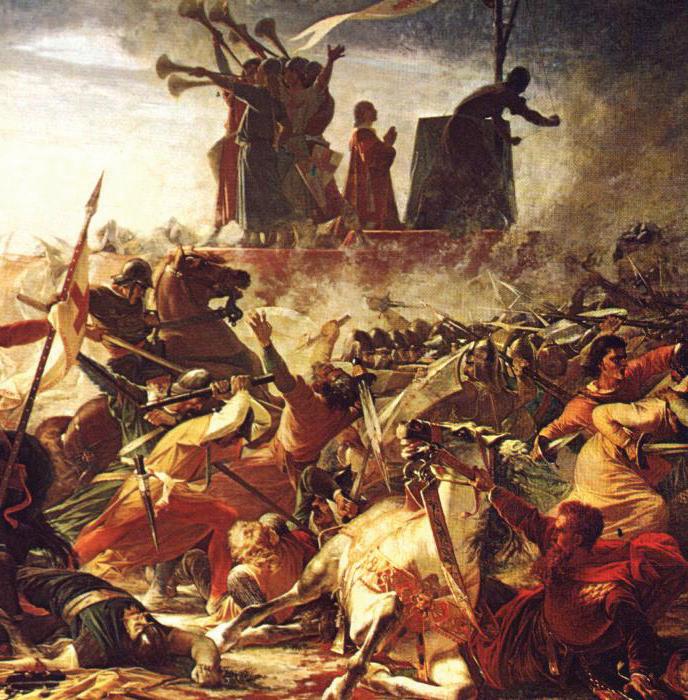
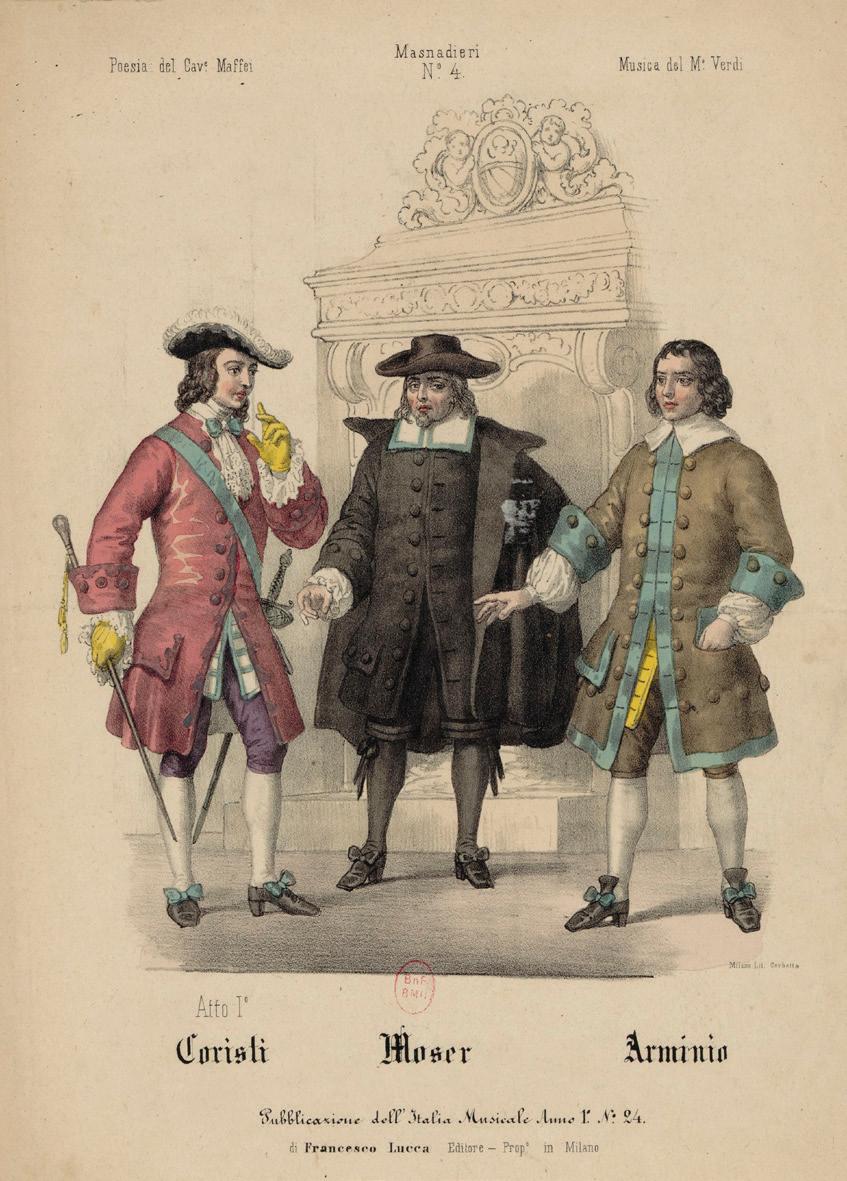
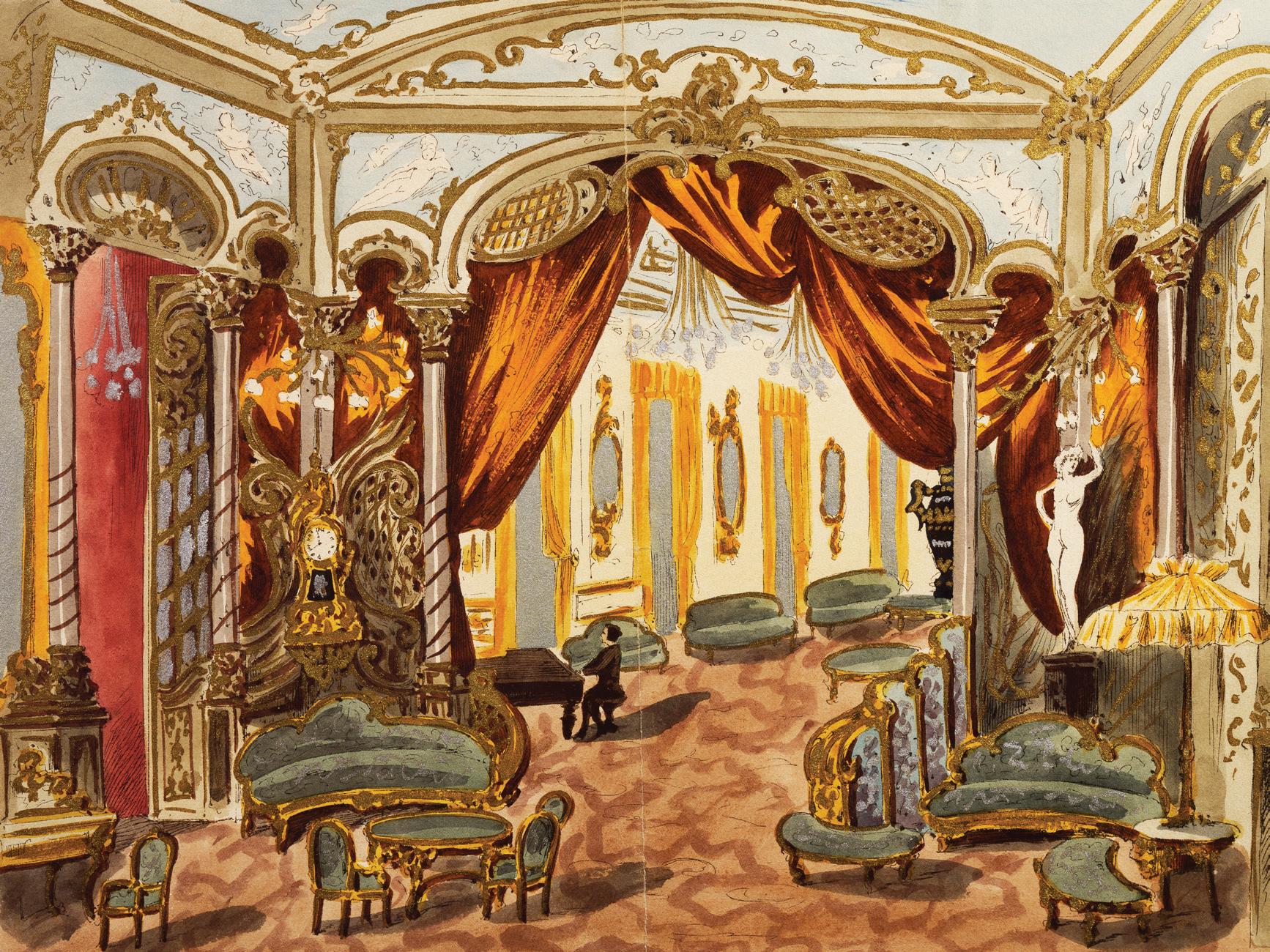
opposite page, clockwise from top left: La battaglia di Legnano, monumental painting in oil by Amos Cassioli (1832–1891), ca. 1870, depicting the 1176 victory of the Lombard League over Holy Roman Emperor Frederick Barbarossa (1122–1190) at the Battle of Legnano. In the background is the Caroccio, or large four-wheeled war chariot, including an altar and the city’s standard. Galleria d’Arte Moderna, Palazzo Pitti, Florence, Italy | Act 1 costumes for I masnadieri, ca. 1847–48, including, left to right, a chorister and characters Moser (clergyman) and Arminio (servant to the Moor family), likely dating from the original production. Lithograph drawing by Francesco Corbetta (ca. 1815), published in Musical Italy: Artistic and Literary Journal | Second-act sketch for the premiere of Fedora by an unknown artist. November 17, 1898, Teatro Lirico, Milan, Italy. Photo by DeAgostini/Getty Images
Umberto Giordano,
Amor ti vieta from Fedora
Near the end of Verdi’s long and astonishingly productive life, when he was arguably the most beloved composer in the world, several new composers began to stand out in the Italian opera world, including Umberto Giordano, who scored a great public success with Andrea Chenier in 1896. For his next work, premiered two years later, Giordano turned to the opera he had wanted to write ever since he saw Victorien Sardou’s play, Fédora, in 1889, with Sarah Bernhardt in the title role. (The play was so popular that it gave its name to a hat.) At the Milan premiere of Giordano’s Fedora, Enrico Caruso, a twenty-three-year-old tenor on the cusp of international fame, sang the role of Count Loris. His aria, “Amor ti vieta,” is one of music’s tiny miracles: two minutes of perfect, unbroken lyricism that is ideally suited to the contours of the tenor voice, in a melody that is at once simplicity itself but at the same time so distinctive as to be instantly unforgettable.
Alfredo Catalani, Ebben? . . . Ne andrò lontana from La Wally
Alfredo Catalani emerged as an opera composer of unusual ambition and promise in the long interval between Verdi’s Aida, which premiered in 1871, and Otello, which marked his return to opera in 1887. Catalani was born in Lucca, just a few hundred feet from where Puccini was born four years later. Their careers, however, took very different directions. It was Catalani’s final opera, La Wally, premiered at La Scala in January 1892, that was immediately viewed as his masterpiece. But Catalani’s moment in the sun was short lived. Late in the summer of 1893, Catalani died suddenly at the age of thirty-nine (he had suffered from tuberculosis for years), before his fame had begun to spread. Over the following years, Arturo Toscanini became La Wally’s greatest champion, conducting the U.S. premiere in 1909 and even naming his second daughter after the title character, Wally. Wally’s act 1 aria, “Ebben? . . . Ne andrò lontana,” is her vow to leave her homeland forever rather
than marry the man her father prefers. The aria became the most famous moment—it was the signature of the 1981 cult film, Diva—in an opera that has rarely been produced, in no small part because of the complexity of realistically staging its finale, when Wally and her lover are killed in an avalanche.
Giuseppe Verdi, O Signore, dal tetto natio from I Lombardi alla prima crociata
I Lombardi alla prima crociata (The Lombards in the First Crusade) is the opera Verdi wrote in the aftermath of the great, career-making triumph of Nabucco. The premiere, at Milan’s La Scala, came less than a year after that of Nabucco in the same theater, which made unfavorable comparisons all but inevitable But the first performance of I Lombardi scored a considerable success, and its popularity was confirmed by the large number of productions staged throughout Italy over the years that immediately followed. Although the opera was seldom heard outside Italy, it was the first of Verdi’s operas to be produced in the United States (in March 1847 in New York
City). By 1847, Verdi thought it was the ideal candidate for a makeover, and he revised it as Jerusalem, with a premiere that November in Paris, to a new French libretto.
In the original Italian version, the act 4 chorus “O Signore, dal tetto natio” is a solemn song of despair from the crusaders and pilgrims that God has abandoned in the desert. (The opera is set during the First Crusade at the end of the eleventh century.) With its grand arching melody over an increasingly involved orchestral accompaniment, it is, surely by design, a companion musically and dramatically to “Va, pensiero,” the chorus of the Hebrew slaves in Nabucco, and like that chorus, it too became overwhelmingly popular with the Italian public.
Giuseppe Verdi, Patria oppressa! from Macbeth
Throughout Verdi’s career, the patriotic chorus was one of his signature numbers. In 1847, before he had written a note of Macbeth, Verdi told his librettist to pay particular attention to the text for a chorus of Scottish exiles at the beginning of act 4, “the one moment of real pathos in the opera.” When Verdi revised Macbeth for Paris in 1865, he decided to replace the original version of “Patria oppressa!” with the magnificent chorus we know today. This is a work of great originality, beginning with the unusual opening brass chorale over timpani rolls. Throughout, the harmony is bold and unorthodox, and the splendor and subtlety of the choral writing looks forward to the Requiem and the Four Sacred Pieces.
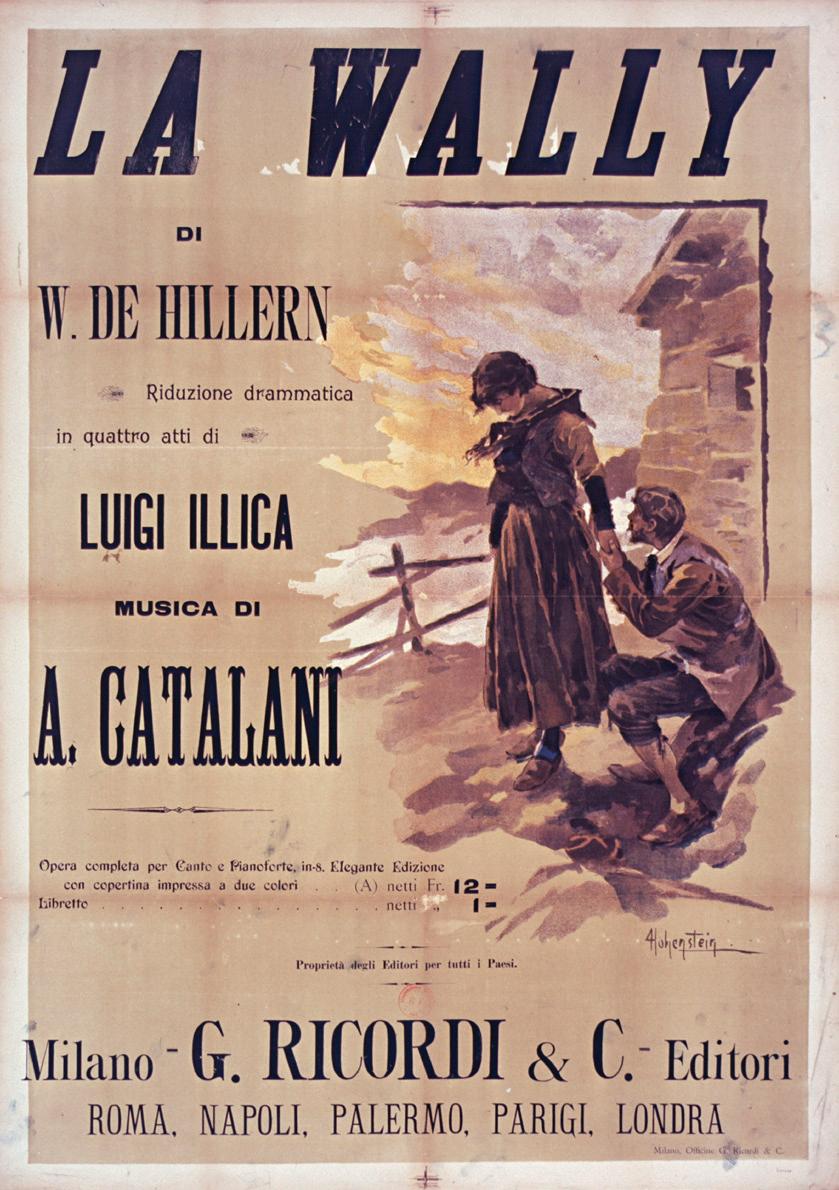
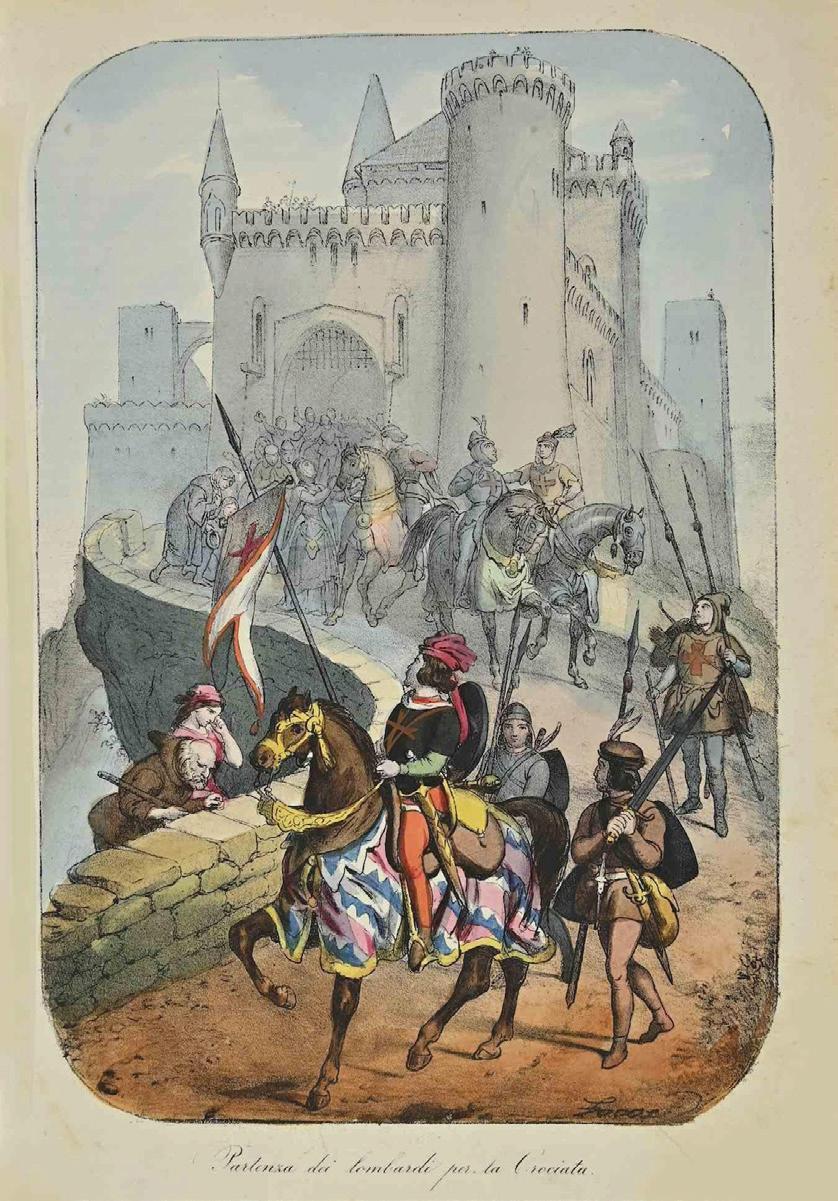
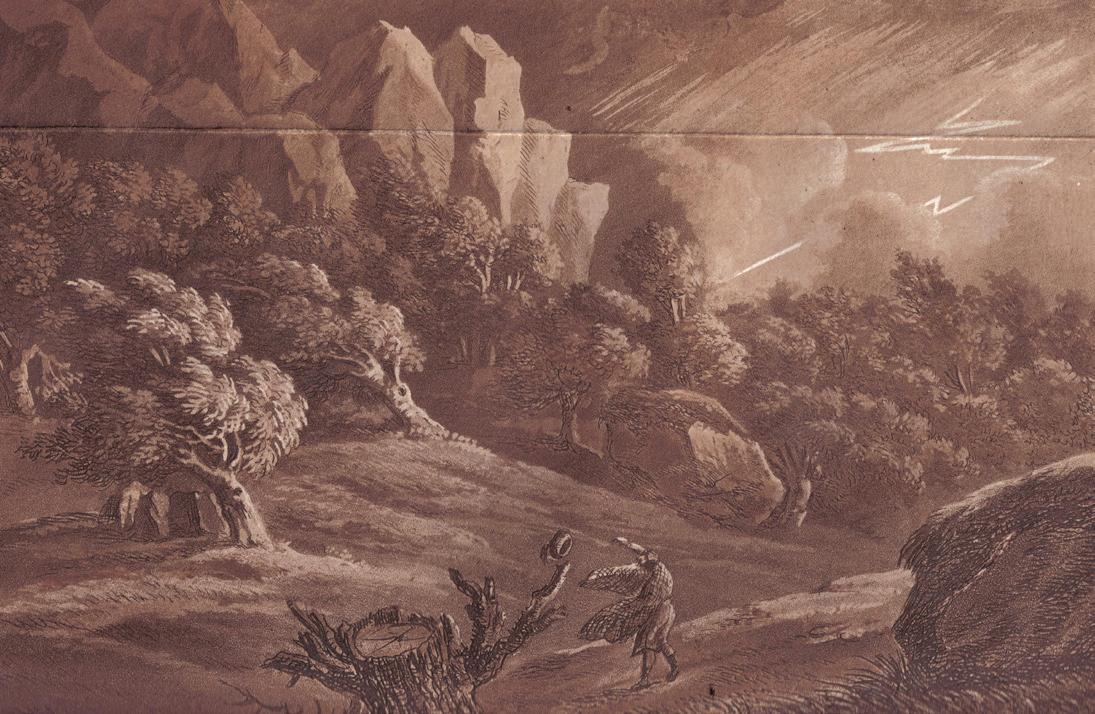
opposite page, from left: Cover of the vocal score to La Wally, ca. 1892. Illustration by Adolfo Hohenstein (1854–1928), published by G. Ricordi & Company, Milan, Italy, ca. 1890–1900. Bibliothèque nationale de France, Paris | Partenza dei Lombardi per la crociata (The Departure of the Lombards for the Crusade), illustration by Roberto Focosi (1806–1862) for I Lombardi alla prima crociata, the epic poem by Tommaso Grossi (1791–1853) | this page: Birnam Wood, MacBeth, Scotland. A landscape view of Birnam Hill, 1800, drawn by John Stoddart (ca. 1773–1856) to evoke the famous “Birnam Wood” scene in Shakespeare’s Macbeth, where the trees move toward Dunsinane. From Stoddart’s Remarks on the Local Scenery and Manners of Scotland, published 1801
Giuseppe Verdi, Overture and Va, pensiero from Nabucco
“With Nabucco,” Verdi wrote, “my career can be said to have begun.” Nabucco was his third opera and his first big success. Coming quickly after the dispiriting failure of Un giorno di regno (King for a Day) when Verdi seriously considered giving up composition for good, before he had even written a single work that would keep his name alive—Nabucco marked the turning point in his fortunes. In Italy, Verdi was quickly recognized as the voice of the future. The Overture to Nabucco was hastily written after the opera was finished, scarcely in time for the premiere. It is based on themes from the opera, including the big melody of the chorus “Va, pensiero,” which is never stated full-out, but is instead previewed and glimpsed, in order not to spoil its ultimate effect in the opera. The overture resounds with the confidence and assurance of a composer who has found his voice.
The prototype and best-known of Verdi’s choruses remains “Va, pensiero.” At the La Scala premiere of the opera on March 9, 1842, this
powerful chorus of the Hebrew slaves struck such a resonant chord—particularly at a time when Italians were struggling for freedom from foreign control—that, despite the conventional police prohibition of the time, it had to be repeated. By the time of Verdi’s death, “Va, pensiero” had become a kind of Italian national anthem, and the original message of hope for the Hebrew exiles soon spoke of salvation for all mankind. A month after Verdi’s death, when a procession carrying his remains to their final resting place slowly passed through Milan, the streets were jammed with thousands of grieving spectators, and the crowd sang “Va, pensiero.” It was a fitting gesture, for at the heart of Verdi’s great achievement throughout his creative life was his uncanny ability to stir mass emotion. Despite its universality, this was clearly deeply personal music, with a melody that seems to come straight from the heart. The hallmarks of this hauntingly simple piece—a long arching melody over throbbing triplets, unison at first and then exploding into choral harmony, to unforgettable effect, only with the third stanza— have often been imitated by other composers but never surpassed.
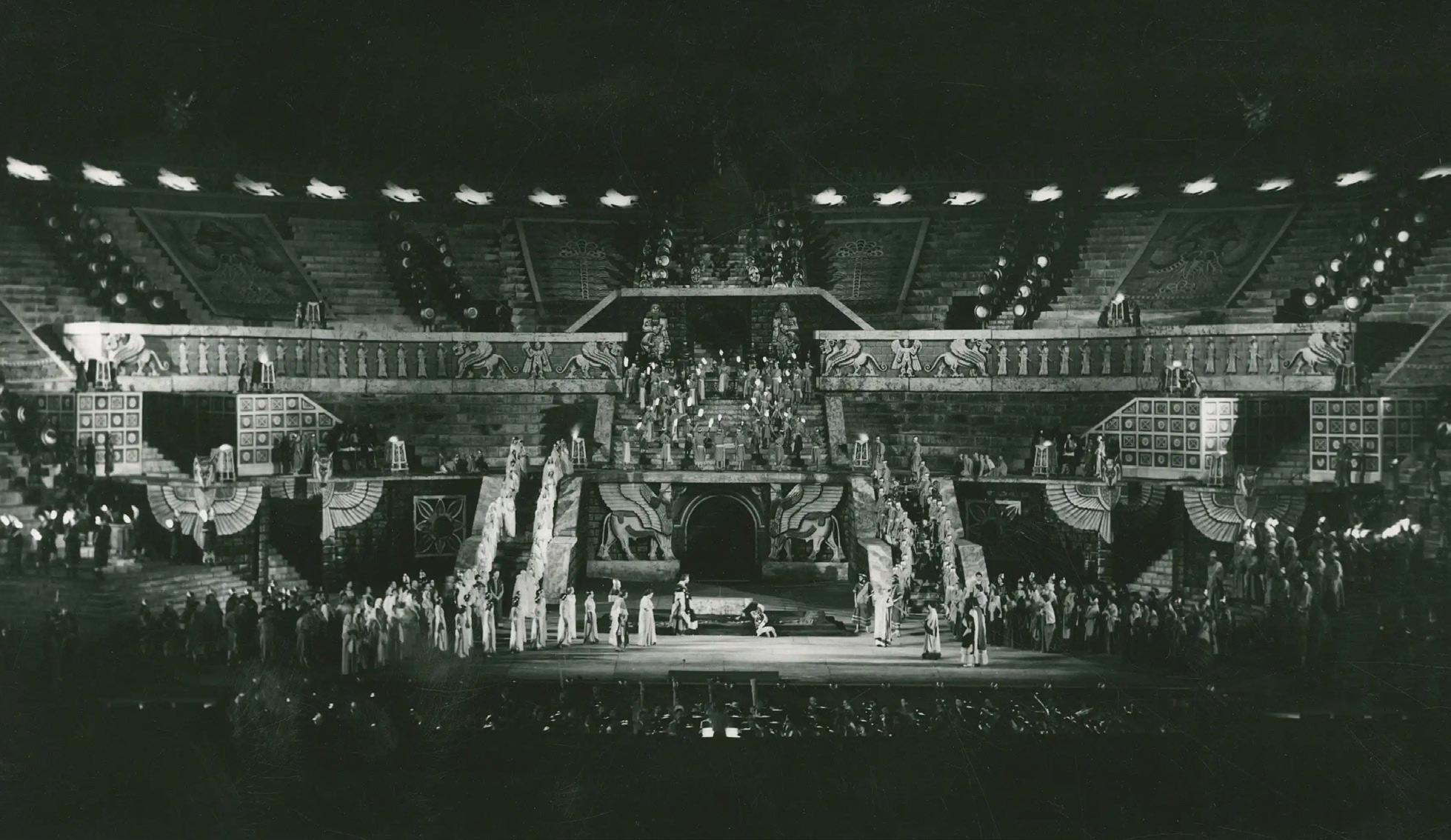
Act 4 of Nabucco, Arena di Verona. Gelatin silver print, 1958. Archivio Storico del Touring Club Italiano Collection
GIUSEPPE VERDI
Born October 10, 1813; Le Roncole, near Busseto, Italy
Died January 27, 1901; Milan, Italy
Sinfonia to La battaglia di Legnano
COMPOSED 1848
FIRST PERFORMANCE
January 27, 1849; Rome, Italy
INSTRUMENTATION
flute and piccolo, 2 oboes, 2 clarinets, 2 bassoons, 4 horns, 2 trumpets, 3 trombones, cimbasso (a low brass instrument with the same range as the tuba), timpani, percussion, strings
FIRST CSO PERFORMANCE
July 7, 1959, Ravinia Festival. Walter Hendl conducting
MOST RECENT
CSO PERFORMANCE
September 21, 2019, Orchestra Hall. Riccardo Muti conducting
These are the first Chicago Symphony Orchestra subscription concert performances.
November 2, 3, and 4, 1989, Orchestra Hall. Chicago
Symphony Chorus (Margaret Hillis, director; Terry Edwards, guest chorus master), Sir Georg Solti (November 2 and 3) and Kenneth Jean (November 4) conducting
June 26, 1981, Ravinia Festival. Chicago Symphony Chorus (Margaret Hillis, director), James Levine conducting (complete opera)
November 2, 3, and 4, 1989, Orchestra Hall. Chicago Symphony Chorus (Margaret Hillis, director; Terry Edwards, guest chorus master), Sir Georg Solti (November 2 and 3) and Kenneth Jean (November 4) conducting
CSO RECORDING
1989. Chicago Symphony Chorus (Margaret Hillis, director; Terry Edwards, guest chorus master), Sir Georg Solti conducting. London
MOST RECENT
CSO PERFORMANCES
June 22, 23, 24, and 25, 2017, Orchestra Hall. Chicago Symphony Chorus (Duain Wolfe, director), Riccardo Muti conducting
CSO RECORDING
1989. Chicago Symphony Chorus (Margaret Hillis, director; Terry Edwards, guest chorus master), Sir Georg Solti conducting. London
November 2, 3, and 4, 1989, Orchestra Hall. Chicago Symphony Chorus (Margaret Hillis, director; Terry Edwards, guest chorus master), Sir Georg Solti (November 2 and 3) and Kenneth Jean (November 4) conducting
August 1, 1993, Ravinia Festival. Chicago Symphony Chorus (Duain Wolfe, guest chorus director), Carlo Rizzi conducting
MOST RECENT
CSO PERFORMANCES
June 22, 23, 24, and 25, 2017, Orchestra Hall. Chicago Symphony Chorus (Duain Wolfe, director), Riccardo Muti conducting
CSO RECORDING
1989. Chicago Symphony Chorus (Margaret Hillis, director; Terry Edwards, guest chorus master), Sir Georg Solti conducting. London
GIACOMO PUCCINI
Born December 22, 1858; Lucca, Italy
Died November 29, 1924; Brussels, Belgium
Intermezzo and Act 4 from Manon Lescaut
Act 4 from Manon Lescaut
In 1893, with the premiere of Manon Lescaut, Giacomo Puccini became opera’s new star composer. Manon Lescaut was not his first opera, but it was his earliest great success—both its predecessors, Le villi and Edgar, had floundered at the box office—and the first in a series of his exceptionally popular stage works. Since La Scala was already fully booked with rehearsals for Verdi’s long-awaited Falstaff by the time Puccini finished his score, the premiere of Manon Lescaut was set for the Teatro Regio Turin. That night, February 1, 1893, immediately established the thirty-four-year-old Puccini as the heir to Verdi, now in his eightieth year. The premiere, eight days later, of Verdi’s last opera, suggested that this was, in effect, the changing of the guard.
Manon Lescaut was not only a hit, but it was also the greatest triumph of Puccini’s career—an unqualified success with both the critics and the public, more so even than the operas that followed over the next decade: La bohème, Tosca, and Madama Butterfly. Ricordi, who was also Verdi’s publisher, cleverly offered Verdi’s Falstaff in a package deal with Manon Lescaut, insisting that opera houses contract to present both. Little more than a year after the premiere, newspapers reported that Puccini’s opera had been performed 338 times in Italy and thirty times in South America. Manon Lescaut and La bohème were both introduced to Chicago in April 1898— the first of Puccini’s operas staged in the city.
Following the failure of Puccini’s second opera, Edgar, in 1889, Puccini wanted to make an opera from Abbé Prévost’s famous novel, Manon Lescaut, which was the most popular novel in French literary history. Puccini was intoxicated with the tale of the Chevalier des Grieux, who
is so obsessed with the beautiful Manon that he cannot give her up, even after he learns that she has taken a rich lover to pay for their life together. But because of the great public success and continuing popularity of Jules Massenet’s opera Manon, premiered in Paris in 1884, Ricordi resisted. But Puccini persisted: “Manon is a heroine I believe in and therefore she cannot fail to win the hearts of the public,” he said in 1889, the year he began writing. “Massenet feels it as a Frenchman with the powder and the minuets. I shall feel it as an Italian, with desperate passion.”
The original title page of Manon Lescaut names no librettist, ignoring the suspiciously long list of men drawn in to work on the text, including the journalist Domenico Oliva, novelist Marco Praga, playwright Giuseppe Giacosa, poet Luigi Illica, composer Ruggero Leoncavallo, and even Puccini’s publisher Giulio Ricordi. But while the libretto remains the opera’s greatest liability, with Manon Lescaut Puccini found his true, full voice as a composer. The melodies are voluptuous and memorable, the orchestration rich and complex (critics at the time remarked on the unexpected influence of Wagner), his understanding of emotional fragility and drama sharp.
At this concert, we hear the intermezzo and final act of Manon Lescaut. The intermezzo—in the opera it falls between acts 2 and 3—reveals Puccini’s gift for imbuing purely orchestral music with a sense of theater. This is music of movement and powerful drama, recalling themes taken from acts 1 and 2. With its dark mood—the brooding opening for solo strings is particularly effective—and urgent melody, it is a masterpiece of implied action.
The first three acts of Manon Lescaut take place in France—in the town of Amiens, in Paris, and on the waterfront of the port city of Le Havre, where Manon is to be deported to America after being imprisoned for theft. In the fourth act, the scene shifts to a desolate location in the New World, an imaginary place described implausibly in the libretto as “a vast desert near the outskirts of New Orleans.”
The opera’s final act reveals for the first time the full extent of Puccini’s extraordinary talent for writing music of distilled emotion and dramatic intensity. Writing for just the two principal singers alone onstage, Puccini provides a microscopic examination of the fatal attraction of the opera’s main characters, Des Grieux and Manon. In early performances, this act often was not received with the same enthusiasm as the preceding ones, because it lacked the scenic grandeur, the overflowing crowd scenes, the spectacle and exoticism we have come
to associate with Puccini. The spotlight here narrows on a single, tightly woven, constantly shifting confrontation between two people facing the end of their lives together. There is no fussy stage business, no complex twists of plot; the vocal lines are as direct as speech and all the more powerful for it. The musical structure flows in one unbroken span. This is not a formal duet, in the traditional sense. The structure is fluid, ever responsive to the shifting emotions of the two characters. Twice the music opens up to allow for aria-like outbursts—Des Grieux’s “Vedi, son io che piango,” and Manon’s devastating final “Sola, perduta, abbandonata.” The entire scene is a distillation of the desperate passion that Puccini promised. From a purely musical point of view, Puccini wrote nothing finer.
Phillip Huscher has been the program annotator for the Chicago Symphony Orchestra since 1987.
Intermezzo and Act 4 from Manon Lescaut
COMPOSED
1892–93
FIRST PERFORMANCE
February 1, 1893; Turin, Italy
INSTRUMENTATION
3 flutes and piccolo, 2 oboes and english horn, 2 clarinets and bass clarinet, 2 bassoons, 4 horns, 3 trumpets, 3 trombones, tuba, timpani, percussion, strings
FIRST CSO PERFORMANCES
November 23, 1957, Orchestra
Hall. Fritz Reiner conducting (Intermezzo)
July 7, 1959, Ravinia Festival. Walter Hendl conducting (Intermezzo)
MOST RECENT
CSO PERFORMANCES
June 29, 1996, Ravinia Festival. Christoph Eschenbach conducting (Intermezzo)
September 23, 2023, Orchestra
Hall. Riccardo Muti conducting (Intermezzo)
January 27, 2024, Teatro alla Scala, Milan, Italy. Riccardo Muti conducting (Intermezzo) (encore)
These are the first Chicago Symphony Orchestra performances.
UMBERTO GIORDANO
Amor ti vieta from Fedora
(Act 2)
An elegant reception at Princess Fedora’s Paris mansion. She has come here, still consumed by grief and a thirst for vengeance, having followed Count Loris Ipanov—the man she believes responsible for her fiancé Count Vladimir’s murder in Saint Petersburg. As the evening unfolds, Fedora and Loris find a moment alone, during which he confesses his love for her.
Amor ti vieta di non amar.
La man tua lieve, che mi respinge, Cerca la stretta della mia man; La tua pupilla esprime; “T’amo!” Se il labbro dice: “Non t’amerò!”
—Arturo Colautti, based on Victorien Sardou’s play Fédora
ALFREDO CATALANI
Love forbids you not to love. Your light hand that pushes me away Seeks the grasp of my hand; Your pupil expresses, “I love you!,” Even if your lips say, “I shall not love you!”
Ebben? . . . Ne andrò lontana from La Wally
(Act 1)
After Wally’s wealthy father, Stromminger, orders her to marry his bailiff, Gellner, within a month, she rebels—her heart belongs to Hagenbach, her father’s rival. Refusing to submit to a loveless marriage, Wally declares she will leave her home and the mountain valley forever, expressing both sorrow and defiance.
Ebben? . . . Ne andrò lontana, Come va l’eco della pia campana, Là, fra la neve bianca! Là, fra le nubi d’ôr! Laddove la speranza è rimpianto, è dolor!
O della madre mia casa gioconda, La Wally ne andrà da te lontana assai, E forse a te non farà mai più ritorno, Nè più la rivedrai! Mai più!
Well then? . . . I will go far away, As goes the echo of the holy bell, There, among the white snow, There, among the golden clouds, Where hope itself is but regret and pain!
Oh, from my mother’s joyful home, Wally will go far away from you; And perhaps to you she will never return, Nor will you see her again, Never again!
Ne andrò sola e lontana
Come l’eco della pia campana, Là, fra la neve bianca;
Ne andrò sola e lontana, E fra le nubi d’ ôr!
GIUSEPPE VERDI
I will go alone and far away,
As goes the echo of the holy bell, There, through the white snow; I will go, alone and far away, And through the golden clouds!
O Signore, dal tetto natio from I Lombardi alla prima crociata
(Act 4, Scene 2)
Encampment of the Lombardians near Rachel’s tomb. The crusaders and pilgrims are despairing that God has abandoned them in the desert.
O Signore, dal tetto natio
Chi chiamasti con santa promessa; Noi siam corsi all’invito d’un pio, Giubilando per l’aspro sentier.
Ma la fronte avvilita e dimessa
Hanno i servi già baldi e valenti!
Deh! non far che ludibrio alle genti
Sieno, Cristo, i tuoi fidi guerrier!
Oh, fresc’aure volanti sui vaghi
Ruscelletti de’ prati lombardi!
Fonti eterne! purissimi laghi!
Oh, vigneti indorati dal sol!
Dono infausto, crudele è la mente
Che vi pinge sì veri agli sguardi, Ed al labbro più dura e cocente Fa la sabbia d’un arido suol! . . .
—Temistocle Solera, adapted from Tommaso Grossi’s eponymous 1826 epic poem
O Lord, from our native hearths
Thou didst call us with holy promise; We hastened at the invitation of a pious man, Rejoicing along the rugged path.
But the heads of Thy bold and valiant servants Are already dejected and humbled!
Ah! Let not your faithful warriors
O Christ, serve but as mockery to the world!
Oh, fresh breezes blowing over the fair Streams of Lombard meadows!
Eternal springs! Pure lakes!
Oh, vineyards gilded by the sun!
Oh, unfortunate gift, cruel is the mind That depicts you so true to our eyes
And makes the sand of an arid soil
Harsher and more burning to the lips! . . .
GIUSEPPE VERDI
Patria oppressa! from Macbeth
(Act 4, Scene 1)
A deserted spot on the borders of England and Scotland, the forest of Birnam in the distance. Scottish refugees, men, women, and children
Patria oppressa! il dolce nome
No, di madre aver non puoi, Or che tutta a’ figli tuoi
Sei conversa in un avel!
D’orfanelli, di piangenti, Chi lo sposo, chi la prole
Al venir del nuovo sole
S’alza un grido e fere il ciel.
A quel grido il ciel risponde
Quasi voglia impietosito
Propagar per l’infinito,
Patria oppressa, il tuo dolor!
Suona a morto ognor la squilla, Ma nessuno audace è tanto
Che pur doni un vano pianto
A chi soffre ed a chi muor!
Patria oppressa!
Patria mia, oh, patria!
—Francesco Maria Piave and Andrea Maffei, after Shakespeare
Oppressed country! The sweet name
Of mother, no, cannot be thine,
Now that for thy children
Thou art converted all to a tomb!
The cry of orphans and bereaved, Lamenting the loss of husbands or children
At the coming of each new morn,
Flies up and wounds the heavens.
To that cry heaven makes response
As if, moved to pity, it would
Propagate in the infinite
Thy sufferings, oppressed country!
The bell eternally tolls to death,
But no man makes so bold
As to shed a useless tear
For those who suffer and those who die!
Oppressed country!
My country, oh, my country!
GIUSEPPE VERDI
Va, pensiero from Nabucco
(Act 3, Scene 2)
The banks of the Euphrates. Hebrews in chains, at forced labor
Hebrews
Va, pensiero, sull’ali dorate; Va, ti posa sui clivi, sui colli, Ove olezzano tepide e molli
L’aure dolci del suolo natal!
Del Giordano le rive saluta, Di Sïonne le torri atterrate . . .
Oh, mia patria sì bella e perduta!
Oh, membranza sì cara e fatal!
Arpa d’ôr dei fatidici vati, Perché muta dal salice pendi?
Le memorie nel petto raccendi, Ci favella del tempo che fu!
O simìle di Solima ai fati
Traggi un suono di crudo lamento, O t’ispiri il Signore un concento
Che ne infonda al patire virtù!
—Temistocle Solera, after the play Nabuchodonosor by Auguste Anicet-Bourgeois and Francis Cornu and the ballet Nabuccodonosor by Antonio Cortesi
Fly thoughts on wings of gold, Go settle upon the slopes and the hills, Where, soft and mild, the sweet airs
Of our native land smell fragrant!
Greet the banks of Jordan
And Zion’s toppled towers . . .
Oh, my country so lovely and lost!
Oh, remembrance so dear and fraught with despair!
Golden harp of the prophetic seers, Why dost thou hang mute upon the willow?
Rekindle our bosom’s memories, And speak of times gone by!
Mindful of Jerusalem’s fate, Either give fourth an air of sad lamentation, Or else allow the Lord to imbue us With fortitude to bear our sufferings!
REFRESHMENTS AT SYMPHONY CENTER
You can order drinks and snacks before the performance or during intermission at various bars located throughout Symphony Center, including the Bass Bar in the Rotunda and most of the lobby spaces in Orchestra Hall.
GIACOMO PUCCINI
Manon Lescaut
ACT FOUR
In America
Una landa interminata sui confini della Nuova Orléans. Terreno brullo ed ondulato; orizzonte vastissimo: cielo annuvolato. Cade la sera.
Manon e Des Grieux si avanzano lentamente dal fondo; sono poveramente vestiti. Hanno l’aspetto di persone affrante. Manon pallida, estenuata, si appoggia sopra Des Grieux, che la sostiene con fatica.
Des Grieux
Tutta su me ti posa, O mia stanca diletta. La strada polverosa, la strada maledetta Al termine s’avanza.
Manon
Innanzi ancor!
L’aria d’intorno or si fa scura.
Des Grieux
Su me ti posa!
Manon
Erra la brezza nella gran pianura E muore il giorno! . . . Innanzi! No . . . (Cade.)
Des Grieux
Manon!
Manon
Son vinta! Mi perdona! Tu sei forte, t’invidio; Donna, debole, cedo!
An endless expanse on the edge of New Orleans. Barren, rolling terrain, vast horizon, cloudy sky. Evening falls.
Manon and Des Grieux slowly advance from the back, ragged and poorly dressed. They look distraught. Manon, pale and exhausted, leans on Des Grieux, who struggles to support her.
Des Grieux
Put all your weight on me, O my weary beloved. The dusty road, the cursed road Will soon end.
Manon
Onward, ever onward!
The air around us is getting darker.
Des Grieux
Lean on me!
Manon
The breeze roams over the great plain And day is dying! Onward! No . . . (She falls.)
Des Grieux
Manon!
Manon
I am finished! Forgive me! You are strong, I envy you; A woman, weak, I give up!
Des Grieux
Tu soffri?
(Des Grieux, ferito da queste parole, dimostra collo sguardo e cogli atti uno spasimo profondo)
Manon
Orribilmente!
(Manon sforzandosi risponde.)
No! Che dissi?
Una vana, una stolta parola. Deh, ti consola!
Chieggo breve riposo . . . un solo istante . . .
Mio dolce amante, a me t’appressa, a me!
Des Grieux
Manon, senti, amor mio!
Non mi rispondi, amore?
Vedi, son io che piango, Io che imploro, io che carezzo e bacio
I tuoi capelli d’oro!
Ah, Manon! Manon, rispondi a me!
Tace!? Maledizion!
(con disperazione, toccandole la fronte)
Crudel febbre l’avvince.
Disperato mi vince
Un senso di sventura,
Un senso di tenèbre e di paura!
(a Manon)
Rispondimi, amor mio!
Tace! Manon! non mi rispondi?
Manon
(Si desta d’un tratto, guarda Des Grieux quasi senza conoscerlo; Des Grieux si china e la solleva da terra.)
Sei tu che piangi?
Sei tu che implori?
I tuoi singulti ascolto
E mi bagnano il volto
Le tue lagrime ardenti.
Ah! sei tu che piangi e implori?
Amor, aita!
Des Grieux
O amore! O Manon!
Ah! Manon, amor mio!
Des Grieux
Are you in pain?
(Des Grieux, wounded by these words, reveals a deep pang with his gaze and actions.)
Manon
Horribly!
(Manon answers with an effort.)
No! What am I saying?
Vain, foolish words.
Oh, take comfort!
I ask but a brief rest . . . only a moment . . .
My sweet love, come closer to me!
Des Grieux
Manon, listen, my love!
You don’t answer, dearest?
Look, it is I who weep, I who implore you, I who caress and kiss Your golden hair!
Oh, Manon! Manon, answer me!
Silence! Curses!
(in desperation, touching her forehead)
A cruel fever grips her. Desperate, I am haunted By a sense of misfortune, A sense of darkness and fear! (to Manon)
Answer me, my love!
Still silent . . . Manon, won’t you answer me?
Manon
(She suddenly awakens, looks at Des Grieux almost without knowing him; Des Grieux bends down and lifts her off the ground.)
Is it you weeping?
Is it you imploring? I hear your sobs, And your burning tears Bathe my face.
Ah, is it you weeping and imploring? My love, help me!
Des Grieux
Oh, beloved! Oh, Manon!
Ah, Manon my love!
Manon
Amor! Amor aita!
Des Grieux
O mia Manon!
Manon
La sete mi divora . . . Amore, aita!
Des Grieux
Tutto il mio sangue per la tua vita!
(Si guarda intorno smarrito, scrutando l’orizzonte lontano.)
E nulla!
(Sfiduciato, ritorna verso Manon.)
Arida landa . . . non un filo d’acqua . . . O immoto cielo!
O Dio, a cui fanciullo anch’io levai
La mia preghiera, un soccorso!
Manon
Sì, un soccorso! Tu puoi salvarmi!
Senti, qui poserò!
E tu scruta il mister dell’orizzonte
E cerca monte o casolar.
Oltre ti spingi e con lieta favella Lieta novella poi vieni a recar!
(Des Grieux adagia Manon sopra un rialzo di terreno. Indi s’allontana a poco a poco. Giunto nel fondo rimane di nuovo perplesso e fissa Manon con occhi disperati, quindi, con improvvisa risoluzione, parte correndo.)
(L’orizzonte si oscursa: l’ambascia vince Manon; è stravolta, impaurita, accasciata.)
Sola, perduta, abbandonata
In landa desolata! Orror!
Intorno a me s’oscura il ciel.
Ahimè, son sola!
E nel profondo deserto io cado, Strazio crudel, ah!
Sola, abbandonata, io la deserta donna!
Ah! non voglio morir!
Tutto dunque è finito.
Terra di pace mi sembrava questa!
Manon
Love! Love, help me!
Des Grieux
Oh, my Manon!
Manon
Thirst is destroying me . . . darling, help me!
Des Grieux
All my blood I would give for your life!
(He looks around in bewilderment, scanning the distant horizon.)
Nothing to be seen!
(Disheartened, he returns to Manon.)
Barren land . . . and not a trace of water . . .
O motionless sky!
O God, to whom as a child I also raised
My prayer, give us your help!
Manon
Yes, help! You can save me!
Listen, I will rest here!
You scan the hazy horizon
And look for hill or cabin.
Push forward and then return
With joyful words and glad tidings!
(Des Grieux places Manon on a rise in the ground. Then he slowly moves away. Once he reaches the bottom, he is again perplexed and stares at Manon with desperate eyes; then, with sudden resolution, he takes off running.)
(The horizon darkens; anguish overcomes Manon; she is distraught, frightened, depressed.)
Alone, lost, abandoned
In this desolate land! Oh, horror!
The sky is darkening around me.
Alas, I am alone!
And in the depths of the desert I meet my end, Cruel torment, ah!
Alone, forsaken, I am a deserted woman!
Oh, I do not want to die!
So all is over.
This seemed a peaceful land to me!
Ah! mia beltà funesta, Ire novelle accende . . .
Strappar da lui mi si volea; Or tutto il mio passato orribile risorge, E vivo innanzi al guardo mio si posa.
Ah! di sangue s’è macchiato!
Ah! tutto è finito!
Asil di pace ora la tomba invoco. No, non voglio morir!
Amore, aita!
(Entra Des Grieux precipitosamente, Manon gli cade fra le braccia.)
Fra le tue braccia, amore! l’ultima volta!
Apporti tu la novella lieta?
(sforzandosi a sorridere e simulando speranza)
Des Grieux
(con immensa tristezza)
Nulla rinvenni, L’orizzonte nulla mi rivelò, Lontano spinsi lo sguardo invano.
Manon
Muoio: scendon le tenebre:
Su me la notte scende.
Des Grieux
(con passione per confortarla)
Un funesto delirio ti percuote, t’offende.
Posa qui dove palpito, In te ritorna ancor!
Manon
Io t’amo tanto . . . e muoio!
Già la parola manca al mio voler, Ma posso dirti che t’amo tanto!
Oh! amore, ultimo incanto, Ineffabile ebbrezza!
O mio estremo desir, Io t’amo, t’amo tanto!
(Cade lentamente, mentre Des Grieux cerca di sostenerla fra le sue braccia.)
Des Grieux
(le tocca il volto, poi fra sè stesso, atterrito)
Gelo di morte!
Dio, l’ultima speme infrangi.
Oh, my fatal beauty
Kindles a new anger . . .
They wanted to tear me from him; Now all my horrible past rises again And comes to life before my eyes.
Ah, it is stained with blood!
Ah, all is ended!
Now I invoke the tomb as a haven of peace. No, I do not want to die!
My love, help me! No!
(Des Grieux enters hastily; Manon falls into his arms.)
In your arms, beloved, for the last time!
Do you bring good news?
(forcing herself to smile and feigning hope)
Des Grieux
(with immense sadness)
I found nothing,
The horizon revealed nothing to me, In vain I gazed into the distance.
Manon
I am dying: the shadows are closing in; Night is descending upon me.
Des Grieux
(passionately trying to comfort her)
A fatal delirium strikes you, offends you.
Rest here on my throbbing heart
And regain your strength!
Manon
I love you so much . . . and I am dying!
Already I can hardly speak,
But I can tell you about how much I love you!
Oh, my love, heavenly delight, Ineffable rapture!
Oh, my supreme desire, I love you, love you so much!
(She falls slowly, while Des Grieux tries to support her in his arms.)
Des Grieux
(touching her face, then, to himself)
The chill of death!
God, my last hope is shattered.
Manon
Mio dolce amor, tu piangi. Non è di lagrime, Ora di baci è questa; Il tempo vola . . . baciami!
Des Grieux
O immensa delizia mia . . . Tu fiamma d’amore eterna.
Manon
La fiamma si spegne . . . Parla, deh! parla . . . ahimè!
Des Grieux
Manon!
Manon
Più non t’ascolto . . . ahimè!
Qui, qui, vicino a me, voglio il tuo volto . . . Così, così, mi baci . . . Vicino a me, ancor ti sento . . . Ahimè!
Des Grieux
Senza di te perduto . . . Ti seguirò!
Manon
Non voglio! Addio . . .
Cupa è la notte . . . ho freddo. Era amorosa la tua Manon? Rammenti? (con ineffabile dolcezza, sorridendo)
Dimmi . . . la luminosa mia giovinezza? Il sol . . . più non. . . vedrò . . .
Des Grieux
Mio Dio!
Manon
Le mie colpe . . . travolgerà l’oblio . . . Ma . . . l’amor mio . . . non muor . . . (Des Grieux, pazzo di dolore, scoppia in un pianto convulse, poi cade svenuto sul corpo di Manon.)
Manon
My sweet love, you weep. This is the hour for kisses, Not for tears; Time is flying . . . kiss me!
Des Grieux
Oh, my greatest joy, Flame of love eternal.
Manon
The flame is dying . . . Speak, oh speak . . . alas!
Des Grieux Manon!
Manon
I can no longer hear you . . . alas! I want your face here, close to me . . . So, so, kiss me . . . Close to me, once more I can feel you . . . Alas!
Des Grieux
Without you I am lost . . . I will follow you.
Manon
I forbid it! Farewell . . . Dark is the night . . . I’m cold. Was your Manon loving? Do you remember? (with ineffable sweetness, smiling) Tell me . . . the splendor of my youth? And I shall never see . . . the sun . . . again!
Des Grieux
My God!
Manon
My faults will be . . . forgotten, But my love . . . will never die . . . (Manon dies and Des Grieux, crazed with grief, falls senseless over her body.)
Libretto by Ruggero Leoncavallo, Marco Praga, Giuseppe Giacosa, Domenico Oliva, Luigi Illica, and Giacomo Puccini, based on Abbé Antoine-François Prevost’s novel, Histoire du Chevalier des Grieux et de Manon Lescaut
PROFILES
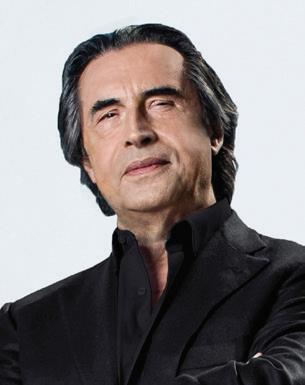
Riccardo Muti
Music Director Emeritus for Life
Born in Naples, Italy, Riccardo Muti is one of the preeminent conductors of our day. The Chicago Symphony Orchestra’s distinguished tenth music director from 2010 until 2023, Muti became the Music Director Emeritus for Life beginning with the 2023–24 season.
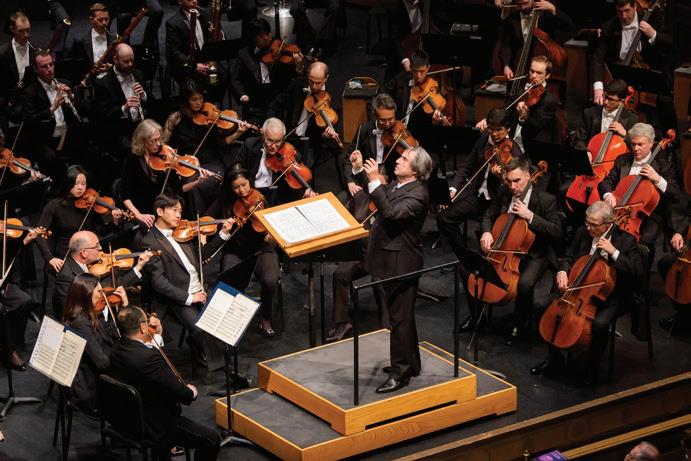
Muti’s leadership has been distinguished by the strength of his artistic partnership with the Orchestra; his dedication to performing great works of the past and present, including eighteen world premieres to date; the enthusiastic reception he and the CSO have received on national and international tours; and twelve recordings on the CSO Resound label, with four Grammy awards among them.
Before becoming the CSO’s music director, Muti had more than forty years of experience at the helm of Maggio Musicale Fiorentino (1968–1980), the Philharmonia Orchestra (1972–1982), the Philadelphia Orchestra (1980–1992), and Teatro alla Scala (1986–2005). Over the course of his career, Muti has conducted the most important orchestras in the world. He is linked by particularly close and important ties to the Vienna Philharmonic, with which he has
appeared at the Salzburg Festival since 1971 and of which he is an honorary member.
Muti has received innumerable international honors. He is a Cavaliere di Gran Croce of the Italian Republic, Knight Commander of the British Empire, Commander of the French Legion of Honor, Knight of the Grand Cross First Class of the Order of Saint Gregory the Great, and the recipient of the German Verdienstkreuz, Japan’s Praemium Imperiale and Order of the Rising Sun Gold and Silver Star, Austria’s Great Golden Decoration of Honor, as well as the “Presidente della Repubblica” award from the Italian government. In December, during a special concert at the Vatican, Pope Leo XIV presented Muti with the Prize of the Ratzinger Foundation for his immense artistic contributions.
Passionate about teaching young musicians, Muti founded the Luigi Cherubini Youth Orchestra in 2004 and the Riccardo Muti Italian Opera Academy in 2015. Through Le vie dell’Amicizia (The Roads of Friendship), a project of the Ravenna Festival in Italy, he has conducted in many of the world’s most troubled areas in order to bring attention to civic and social issues. The label RMMUSIC is responsible for Riccardo Muti’s recordings.
On Friday, March 20, 2026, the CSO Family salutes Riccardo Muti on the occasion of his 600th concert with the Chicago Symphony Orchestra. Since 1973, their relationship has flourished in memorable concerts throughout Chicago, across the country, and around the world.
Riccardo Muti’s Recent Concerts, Honors, and Events
Riccardo Muti has maintained a robust calendar of engagements since his last appearances in Chicago this past November.
From November 19 to 30, he led select young conductors and pianists in lessons and rehearsals of Mozart’s Don Giovanni during the 2025 edition of the Riccardo Muti Italian Opera Academy, culminating in a concert conducted by Muti. This was the third time the program took place at the state-of-the-art Prada Foundation in Milan.
On November 28, Muti was the guest of honor at the opening ceremonies of the academic year at the Catholic University of the Sacred Heart in Rome. He led the Luigi Cherubini Orchestra in the Overture to Don Giovanni in honor of the year’s theme: the alliance between generations.
On December 12, Pope Leo XIV awarded the prestigious 2025 Ratzinger Prize to Riccardo Muti at a ceremony following a Christmas concert led by Muti given in the Pope’s honor in the Paul VI Audience Hall at the Vatican in Rome. The concert and ceremony were attended by a capacity audience of nearly 6,000, including Cardinal Blase Cupich, archbishop of Chicago. Prior to the ceremony, Muti met Pope Leo, who shares ties to Chicago, having grown up in the southwestern suburb of Dolton, Illinois.
“ The ensemble wasted no time stating its case—and demonstrating its prowess—as one of the world’s great orchestras. Maestro Riccardo Muti led the symphonic charges in the lucid and luscious collective sound.” Santa Barbara Independent January 23, 2016. Todd Rosenberg Photography
On December 16, Muti made a private visit to the Accademia della Crusca, a Florence-based society for scholars of Italian linguistics and philology, to receive the international Crusca–Benemeriti della Lingua Italiana Prize for, “performing, rediscovering, and promoting Italian opera and the Italian-language musical repertoire throughout the world for over fifty years,” said the Academy in its official announcement. “He urges all performers to respect the text set to music, embedded in its centuries-old and still vibrant linguistic tradition, and demonstrates genuine attention to the problems of the Italian language.”
On December 19, Muti conducted the Maggio Orchestra and Chorus in a special concert honoring Vittorio Gui, founder of the Stabile Orchestrale Fiorentina and the Maggio Musicale Fiorentino Festival. At Muti’s suggestion, the Maggio Musicale is renaming its theater in Gui’s honor.
On January 10, Muti led a special concert at the Opera prison on Milan’s southern edge with the Cherubini Orchestra. The musicians played string instruments made by the inmates from wood reclaimed from the wreckage of migrant boats that had washed up on Italian coasts and been brought to the prison after being seized. “Hearing these people, who are here serving their sentences, but who seem so serene and so clearly and openly eager to find a sense of harmony in their lives through music . . . has been an enrichment of my experience as a musician and as a man,” said Muti after the performance.
January 15–24, the Chicago Symphony Orchestra and Riccardo Muti embarked on a twelve-day tour across the western United States, featuring repertoire by Brahms, Ravel, Stravinsky, Hindemith, and Johann Strauss, Jr. The tour began in Mesa, Arizona, and ended in Costa Mesa, California, with concerts along the way in Berkeley, Davis, Palm Desert, Northridge, and Santa Barbara, California, where sold-out performances earned rave reviews.
On March 4, Muti was made an honorary citizen of the city of Novara at the Teatro Coccia, where he gave a keynote address as part of the thirtieth anniversary celebrations of the Guido Cantelli Conservatory. The young Riccardo Muti won the 1967 Guido Cantelli Prize in Novara, which brought him international attention.
Between February 24 and March 7, Riccardo Muti conducted six sold-out performances of Verdi’s Macbeth at the Teatro Regio in Turin in a widely-acclaimed new production directed by his daughter Chiara Muti and starring baritone Luca Micheletti and soprano Lidia Fridman, who makes her American and CSO debut in concerts led by Maestro Muti this month.
For more on the presentation of the Ratzinger Prize at the Vatican and the recent West Coast Tour, visit cso.org/experience.
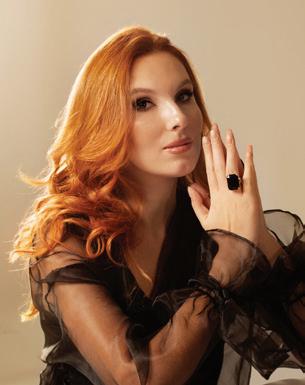
Lidia Fridman Soprano
FIRST CSO PERFORMANCES
These concerts mark Lidia Fridman’s debut with the Chicago Symphony Orchestra.
Lidia Fridman is a dramatic bel canto soprano known for her impressive vocal range and exceptional agility.
Born in Samara, Russia, she studied locally and at the Elena Obraztsova Academy before graduating with honors from the conservatories of Udine and Venice in Italy. A winner of several international competitions, she was nominated Young Artist of the Year at the 2021 International Opera Awards and currently studies with Paoletta Marrocu.
She opened the 2025–26 season as Lady Macbeth (Macbeth) at Teatro Regio Torino in Chiara Muti’s new production under the baton of Riccardo Muti. Other engagements include her Staatsoper Berlin debut as Abigaille in Nabucco, as well as the title roles of Salome in a return to the Wiener Staatsoper with Sebastian Weigle and Norma at the National Centre for the Performing Arts in Beijing under Fabio Luisi, a return to the Verdi Festival in Parma in
Nabucco, and her New York Philharmonic debut in Shostakovich’s Symphony no. 14 under Mirga Gražinytė-Tyla.
In 2024–25, she made debuts in the French version of Macbeth at the Verdi Festival and in the title role of Lucrezia Borgia at Teatro dell’Opera di Roma, both conducted by Roberto Abbado; Norma at the Wiener Staatsoper in Cyril Teste’s new production under Antonino Fogliani; Anna Bolena staged by Pier Luigi Pizzi and led by Renato Balsadonna and Marie in Wozzeck led by Markus Stenz at Teatro la Fenice in Venice; Salome at Maggio Musicale Fiorentino conducted by Alexander Soddy; and Giselda in I Lombardi alla prima crociata at Teatro Real Madrid under Daniel Oren, among other engagements.
Recent highlights include Amelia in Un ballo in maschera and Abigaille with Muti, Donna Elvira in Don Giovanni for Deutsche Oper Berlin, Tatiana in Eugene Onegin, Giselda in Parma, and Donizetti’s Dalinda at Konzerthaus Berlin and Sylvia in L’ange de Nisida at the Donizetti Opera Festival in Bergamo. She also performed in Le villi and Edgar at the Puccini Festival during the hundredth anniversary of the composer’s death and appeared in gala concerts honoring Puccini and Pergolesi with Muti. Her discography includes the world-premiere recordings of L’ange de Nisida (2019) and Dalinda (Naxos, 2024).
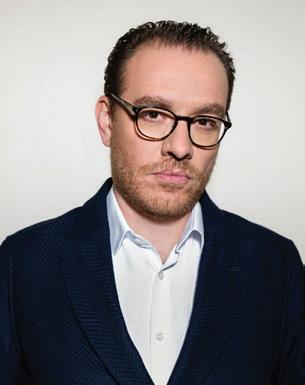
Francesco Meli Tenor
FIRST CSO PERFORMANCES
September 28, October 1, 4, and 6, 2013, Orchestra Hall. Verdi’s Macbeth, Riccardo Muti conducting
MOST RECENT CSO PERFORMANCES
June 23, 25, and 28, 2022, Orchestra Hall. Verdi’s Un ballo in maschera, Riccardo Muti conducting
Francesco Meli, a recipient of the Cross of Saint George, Liguria’s highest honor, for his contributions to opera and culture, is among the world’s most charming and sought-after tenors.
He made his 2002 professional debut in Verdi’s Macbeth, Rossini’s Petite messe solennelle, and Puccini’s Messa di Gloria at the Festival of the Two Worlds in Spoleto, Italy, beginning a career in the bel-canto and Rossini repertoire, including twenty years of collaboration with the Teatro alla Scala in Milan, where he made his debut at the age of twenty-three in Poulenc’s Dialogues des Carmélites conducted by Riccardo Muti and returned in the following years for Verdi’s Otello, Giovanna d’Arco, I due Foscari, Macbeth, Un ballo in maschera, La traviata, Ernani, Il trovatore, Aida, and Don Carlo; Mozart’s Idomeneo and Don Giovanni; Donizetti’s Maria Stuarda and L’elisir d’amore; Strauss’s Der Rosenkavalier; Bizet’s Carmen; and Puccini’s Tosca.
Francesco Meli’s repertoire features more than fifty roles sung in the most important Italian, European, and international theaters, and he works with the world’s leading conductors, including Riccardo Chailly, Myung-Whun Chung, Daniele Gatti, Fabio Luisi, Riccardo
Muti, Christian Thielemann, Gianandrea Noseda, Sir Antonio Pappano, Riccardo Frizza, Daniele Rustioni, and Yuri Temirkanov.
He is featured on numerous DVDs released by Deutsche Grammophon, Unitel, and Opus Arte.
In the 2022–23 season he took part in three productions at the Teatro del Maggio Musicale Fiorentino (Don Carlo, La traviata, and Carmen) before returning to the Royal Opera House (London) as Radamès in Aida and to Tokyo on tour as Alfredo in La traviata, a role he also sings at the Arena di Verona Festival.
After opening the 2023–24 season at La Scala in the title role of Don Carlo, Francesco Meli sang Riccardo in Un ballo in maschera at the Palau de les Arts in Valencia, Corrado in Verdi’s Il corsaro at the Teatro Carlo Felice in Genoa, Nemorino in L’elisir d’amore at the Regio in Parma, Gabriele Adorno in Verdi’s Simon Boccanegra at the Teatro di San Carlo in Naples, and made his debut as Foresto in Verdi’s Attila in Tokyo with Muti.
Among recent and future engagements are his debut in the title role in Otello for the season opening at La Fenice (November 2024), Verdi’s Requiem at Sächsische Staatskapelle Dresden under Gatti (November 2025), Mario in Tosca at Teatro alla Scala and Teatro di San Carlo in Naples (March–April 2025) and at Festival Pucciano in Torre del Lago (August 2026), Ismaele in Verdi’s Nabucco and Oronte in Verdi’s I Lombardi alla prima crociata at Teatro Real de Madrid (July 2025), the Trilogia Verdiana at Teatro Municipale in Piacenza (October–November 2025), his debut as Jason in Cherubini’s Medea in Naples (December 2025), Simon Boccanegra in Venice (January–February 2026), and Nabucco at La Scala (May–June 2026).
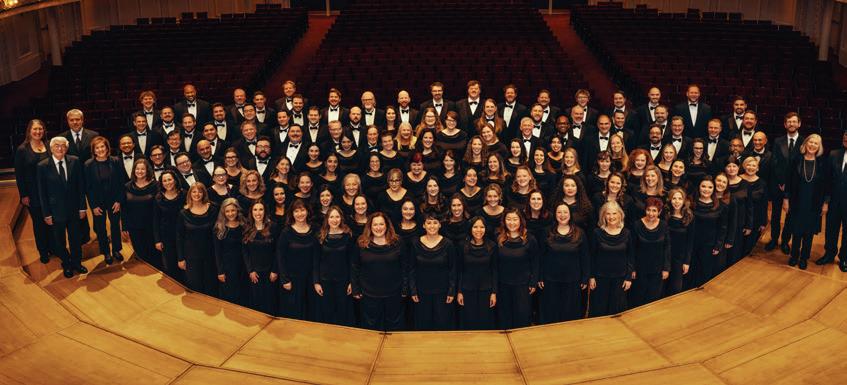
Chicago Symphony Chorus
The Chicago Symphony Chorus regularly performs with the Chicago Symphony Orchestra in Orchestra Hall and at the Ravinia Festival.
The history of the Chorus began in 1957, when sixth music director Fritz Reiner invited Margaret Hillis to establish a chorus to equal the quality of the Orchestra. Hillis accepted the challenge, and the Chicago Symphony Chorus debuted in March and April 1958, in Mozart’s Requiem under Bruno Walter and Verdi’s Requiem under Reiner. Hillis served the Chorus for thirty-seven years. In 1994 ninth music director Daniel Barenboim appointed Duain Wolfe, who served as the Chorus’s director and conductor until his retirement in 2022. Donald Palumbo was appointed as the Chorus’s third director in 2025.
The Chorus first performed in Carnegie Hall in 1967 in Henze’s Muses of Sicily and Ravel’s Daphnis and Chloe under seventh music director Jean Martinon, and most recently in 2015 with Riccardo Muti for Scriabin’s Prometheus and Prokofiev’s Alexander Nevsky. Touring internationally with the Orchestra, the Chorus traveled to London and Salzburg in 1989 with Sir Georg Solti for performances of Berlioz’s The Damnation of Faust and to Berlin in 1999 with Barenboim for Brahms’s A German Requiem and Pierre Boulez for Schoenberg’s Moses und Aron.
World premieres featuring the Chorus have included Ned Rorem’s Goodbye My Fancy, John Harbison’s Four Psalms, and Bernard Rands’s apókryphos. With visiting orchestras, the Chorus has collaborated with the Berlin Philharmonic under Claudio Abbado, the Boston Symphony Orchestra and Seiji Ozawa, the Israel Philharmonic Orchestra with Zubin Mehta, and the Staatskapelle Berlin under Barenboim.
Since first recording commercially in 1959—Prokofiev’s Alexander Nevsky under Reiner—the Chorus has amassed a discography that includes hallmarks of the choral repertoire and several complete operas. The Chorus most recently received a 2010 Grammy Award for Best Choral Performance for Verdi’s Requiem, led by Riccardo Muti on CSO Resound. The Chorus has received an additional nine Grammy awards for Best Choral Performance for Verdi’s Requiem, Beethoven’s Missa solemnis, Brahms’s A German Requiem, Berlioz’s The Damnation of Faust, Haydn’s Creation, and Bach’s Mass in B minor with Solti; Brahms’s Requiem and Orff’s Carmina Burana with James Levine; and Bartók’s Cantata profana with Boulez.
The Chorus also has appeared on two movie soundtracks with the Orchestra: Fantasia 2000 led by Levine, and John Williams’s score for Lincoln conducted by the composer. Recordings on CSO Resound featuring the Chorus include Mahler’s Second and Third symphonies, Poulenc’s Gloria and Ravel’s Daphnis and Chloe under Bernard Haitink; and Berlioz’s Lélio, Verdi’s Otello, Schoenberg’s Kol Nidre, choruses by Verdi and Boito’s Prologue to Mefistofele, Shostakovich’s Symphony no. 13 (Babi Yar), and most recently Mascagni’s Cavalleria rusticana under Riccardo Muti.
Donald Palumbo Chorus Director
Donald Palumbo was born in Rochester, New York, and received a bachelor of arts degree from Boston University. His career was launched in the 1980s at the Dallas Opera, where he served as assistant to Roberto Benaglio, the renowned Italian chorus master of Teatro alla Scala in Milan. Following a sixteen-year tenure as chorus director at the Lyric Opera of Chicago from 1991 to 2007, Palumbo assumed the same position at the Metropolitan Opera. There he was responsible for the Met Chorus’s participation in more than twenty productions each season, and his work was honored with seven Grammy awards for Best Opera Recording. After stepping down from his position at the Met in June 2024, he returned to the theater in the following season to prepare the chorus in a new production of Verdi’s Aida.
Palumbo’s appointment as the third chorus director of the Chicago Symphony Chorus was announced in June 2025, and he began an initial three-year tenure on July 1, 2025. As director, he works with the Chorus each year to prepare multiple programs across the Chicago Symphony Orchestra’s downtown season and the annual summer residency at the Ravinia Festival.
Palumbo was music director of the Chorus pro Musica of Boston and has also served as chorus master of the Canadian Opera Company, Dallas Opera, Banff School for the Arts Summer Opera Program, the Opera Company of Boston, and Opera Theatre of Saint Louis. In Europe, he has
held chorus master positions at Opéra de Lyon, the Aix-en-Provence Festival, the Théâtre du Châtelet, and the Teatro Massimo in Palermo. From 1999 to 2001, Palumbo was chorus director of the Salzburg Festival, the first American to hold that position.
He has worked extensively at the Théâtre du Châtelet in Paris, preparing the chorus for the Berlioz Festival in 1990—Requiem, The Damnation of de Faust, Romeo and Juliet—and performances of Britten’s Peter Grimes and Janáček’s Jenůfa. Palumbo has conducted the Radio France Chorus in several a cappella choral concerts and prepared Britten’s War Requiem.
Palumbo has been a vocal coach for the Apprentices of the Santa Fe Opera since 2014 and a faculty member of the Marcus Institute for Vocal Arts at the Juilliard School in New York since 2016.
In 2022 and 2023, he joined the Chicago Symphony Orchestra as guest chorus master for performances of Verdi’s Un ballo in maschera and Beethoven’s Missa solemnis, both works conducted by Riccardo Muti. Shortly after his appointment in June 2025, he was guest chorus master for performances of Verdi’s Requiem, also led by Muti.
In June 2024 he prepared the choral forces for a concert performance of Puccini’s La bohème for the Philadelphia Orchestra under Yannick NézetSéguin and returned for Wagner’s Tristan and Isolde in June 2025. In March 2025 he prepared the chorus for Verdi’s La traviata staged in Kyoto and Tokyo for the Seiji Ozawa Music Academy.
Donald Palumbo returned to the Lyric Opera of Chicago in May 2025 to prepare and conduct a program of scenes with the artists of the Ryan Opera Center.
Chicago Symphony Chorus
Donald Palumbo Director
Cheryl Frazes Hill Associate Director
Jennifer Kerr Budziak Assistant Director
Benjamin Rivera Assistant Director
SOPRANOS
Michele Agpalo
Alicia Monastero Akers*
Melinda Alberty
Nicole Besa
Eileen Marie Bora
Anna Joy Buegel
Laura Bumgardner
Melanie Burbules
Katherine Buzard
Anastasia Cameron Balmer
Nathalie Colas
Anna Donnelly
Katarzyna Dorula
Megan Fletcher
Mary Lutz Govertsen
Nida Grigalaviciute
Amy Gwinn-Becker
Ashlee Hardgrave
Megan Hendrickson
Betsy Hoats
Marissa Howard
Alexandra Ioan
Alison Kelly
Gabriella Klotz
Lisa Kotara Horwitz
Priya Krishnaswamy
Susan Krout
Alexis Langlois
Katelyn Lee
Rosalind Lee
Amanda Compton LoPresti*
Suzanne Ma-Ebersole
Allison Mann
Taylor Jacobson Manrique
Ingrid Mikolajczyk
Gisella Milla
Lillian Murphy
Máire O’Brien
Cari Plachy
Elvira Ponticelli
Angela Presutti Korbitz
Margaret Quinnette
Alexia Rivera
Elizabeth Shuman
Meaghan Smallwood
Samantha Thielen Pak
Grace Tozer Wipfli
ALTOS
Emily Amesquita
Melissa Arning
Angela Born
Diane Busko Bryks
*Section
Magaly Cordero
Sandra Cross
Leah Dexter
Ashley Marie Eason
Stacy Eckert
Kirsten Fyr-Searcy
Anna Therese George
Liana German
Jennifer Gingrich
Elizabeth Haley Hamilton
Catarine Hancock
Ruth Ginelle Heald
Miya Higashiyama
Thereza Lituma
Kathleen Madden
Clarissa Parrish Short
Laura Polevoy
Sarah Ponder
Emlynn Shoemaker
Bridget Skaggs
Cassidy Smith*
Aidan Spencer
Alannah Spencer
Gabrielle Timofeeva López
Elizabeth Vaughan
Debra Wilder
Megan Wilhelm
TENORS
Michael Brauer
Joseph Cloonan*
Nicholas Falco
Andrew Fisher
Alec Fore
W. Ryan Frenk
Ace T. Gangoso
Klaus Georg*
Tejas Gururaja
Jianghai Ho
Garrett Johannsen
James Judd
Stephen Mollica
Keith A. Murphy
Stephen D. Noon
Nathan S. Oakes
Marcos Ochoa
Wha Shin Park
Steven Michael Patrick
Brett Potts
Nicholas Pulikowski
Cole Seaton
Silfredo Serrano
Andrew Seymour
Aaron Short
Brian Skoog
Michael St. Peter
Alan Taylor
Paul W. Thompson
Ryan Townsend Strand
BASSES
Evan Bravos
Matthew Brennan*
Conor Broaders
Terry L. Bucher
Michael Cavalieri
Timothy Christopoulos
Chris DiMarco
Christopher Filipowicz
Dimitri German
David Govertsen
Kevin Michael Hall
Adam Lance Hendrickson
Jess Koehn
Mathew Lake
Lee Lichamer*
Dorian McCall
Eric Miranda
Ian Morris
Ian Murrell
Douglas Peters
Robert J. Potsic
Leo Radosavljevic
Stephen Richardson
Michael Seybold
Joseph Smith
Avery Sujkowski
Scott Uddenberg
Vince Wallace
Jonathon Weller
Peter Wesoloski
Jonathan Wilson
CHORUS MANAGER
Melissa Hilker
CHORUS LIBRARIAN, ASSISTANT CHORUS MANAGER AND EXECUTIVE ASSISTANT TO THE VP FOR ARTISTIC PLANNING
Olive Haugh
REHEARSAL PIANISTS
John Goodwin
Sharon Peterson
Chuck Foster
The Chorus was prepared for these performances by Donald Palumbo.
leader
The Chicago Symphony Orchestra—consistently hailed as one of the world’s best—marks its 135th season in 2025–26. The ensemble’s history began in 1889, when Theodore Thomas, the leading conductor in America and a recognized music pioneer, was invited by Chicago businessman Charles Norman Fay to establish a symphony orchestra. Thomas’s aim to build a permanent orchestra of the highest quality was realized at the first concerts in October 1891 in the Auditorium Theatre. Thomas served as music director until his death in January 1905, just three weeks after the dedication of Orchestra Hall, the Orchestra’s permanent home designed by Daniel Burnham.
Frederick Stock, recruited by Thomas to the viola section in 1895, became assistant conductor in 1899 and succeeded the Orchestra’s founder. His tenure lasted thirty-seven years, from 1905 to 1942—the longest of the Orchestra’s music directors. Stock founded the Civic Orchestra of Chicago— the first training orchestra in the U.S. affiliated with a major orchestra—in 1919, established youth auditions, organized the first subscription concerts especially for children, and began a series of popular concerts.
Three conductors headed the Orchestra during the following decade: Désiré Defauw was music director from 1943 to 1947, Artur Rodziński in 1947–48, and Rafael Kubelík from 1950 to 1953. The next ten years belonged to Fritz Reiner, whose recordings with the CSO are still considered hallmarks. Reiner invited Margaret Hillis to form the Chicago Symphony Chorus in 1957. For five seasons from 1963 to 1968, Jean Martinon held the position of music director.
Sir Georg Solti, the Orchestra’s eighth music director, served from 1969 until 1991. His arrival launched one of the most successful musical partnerships of our time. The CSO made its first overseas tour to Europe in 1971 under his direction and released numerous award-winning recordings. Beginning in 1991, Solti held the title of music director laureate and returned to conduct the Orchestra each season until his death in September 1997.
Daniel Barenboim became ninth music director in 1991, a position he held until 2006. His tenure was distinguished by the opening of Symphony Center in 1997, appearances with the Orchestra in the dual role of pianist and conductor, and twenty-one international tours. Appointed by Barenboim in 1994 as the Chorus’s second director, Duain Wolfe served until his retirement in 2022.
In 2010, Riccardo Muti became the Orchestra’s tenth music director. During his tenure, the Orchestra deepened its engagement with the Chicago community, nurtured its legacy while supporting a new generation of musicians and composers, and collaborated with visionary artists. In September 2023, Muti became music director emeritus for life.
In April 2024, Finnish conductor Klaus Mäkelä was announced as the Orchestra’s eleventh music director and will begin an initial five-year tenure as Zell Music Director in September 2027. In July 2025, Donald Palumbo became the third director of the Chicago Symphony Chorus.
Carlo Maria Giulini was named the Orchestra’s first principal guest conductor in 1969, serving until 1972; Claudio Abbado held the position from 1982 to 1985. Pierre Boulez was appointed as principal guest conductor in 1995 and was named Helen Regenstein Conductor Emeritus in 2006, a position he held until his death in January 2016. From 2006 to 2010, Bernard Haitink was the Orchestra’s first principal conductor.
Mezzo-soprano Joyce DiDonato is the CSO’s Artist-in-Residence for the 2025–26 season.
The Orchestra first performed at Ravinia Park in 1905 and appeared frequently through August 1931, after which the park was closed for most of the Great Depression. In August 1936, the Orchestra helped to inaugurate the first season of the Ravinia Festival, and it has been in residence nearly every summer since.
Since 1916, recording has been a significant part of the Orchestra’s activities. Recordings by the Chicago Symphony Orchestra and Chorus— including recent releases on CSO Resound, the Orchestra’s recording label launched in 2007— have earned sixty-five Grammy awards from the Recording Academy.
Chicago Symphony Orchestra
Klaus Mäkelä Zell Music Director Designate
Joyce DiDonato Artist-in-Residence
VIOLINS
Robert Chen Concertmaster
The Louis C. Sudler
Chair, endowed by an
anonymous benefactor
Stephanie Jeong
Associate Concertmaster
The Cathy and Bill Osborn Chair
David Taylor*
Assistant Concertmaster
The Ling Z. and Michael C.
Markovitz Chair
Yuan-Qing Yu*
Assistant Concertmaster
So Young Bae
Cornelius Chiu
Gina DiBello
Kozue Funakoshi
Russell Hershow
Qing Hou
Gabriela Lara
Matous Michal
Simon Michal
Sando Shia
Susan Synnestvedt
Rong-Yan Tang
Baird Dodge Principal
Danny Yehun Jin
Assistant Principal
Lei Hou
Ni Mei
Hermine Gagné
Rachel Goldstein
Mihaela Ionescu
Melanie Kupchynsky §
Wendy Koons Meir
Ronald Satkiewicz ‡
Florence Schwartz
VIOLAS
Teng Li Principal
The Paul Hindemith
Principal Viola Chair
Catherine Brubaker
Youming Chen
Sunghee Choi
Paolo Dara
Wei-Ting Kuo
Danny Lai
Weijing Michal
Diane Mues
Lawrence Neuman
Max Raimi
CELLOS
John Sharp Principal
The Eloise W. Martin Chair
Kenneth Olsen
Assistant Principal
The Adele Gidwitz Chair
Karen Basrak
The Joseph A. and Cecile
Renaud Gorno Chair
Richard Hirschl
Olivia Jakyoung Huh
Daniel Katz
Katinka Kleijn
Brant Taylor
The Ann Blickensderfer and Roger Blickensderfer Chair
BASSES
Alexander Hanna Principal
The David and Mary Winton
Green Principal Bass Chair
Alexander Horton
Assistant Principal
Daniel Carson
Ian Hallas
Robert Kassinger
Mark Kraemer
Stephen Lester
Bradley Opland
Andrew Sommer
FLUTES
Stefán Ragnar Höskuldsson § Principal
The Erika and Dietrich M.
Gross Principal Flute Chair
Emma Gerstein
Jennifer Gunn
PICCOLO
Jennifer Gunn
The Dora and John Aalbregtse Piccolo Chair
OBOES
William Welter Principal
Lora Schaefer
Assistant Principal
The Gilchrist Foundation,
Jocelyn Gilchrist Chair
Scott Hostetler
ENGLISH HORN
Scott Hostetler
Riccardo Muti Music Director Emeritus for Life
CLARINETS
Stephen Williamson Principal
John Bruce Yeh
Assistant Principal
The Governing
Members Chair
Gregory Smith
E-FLAT CLARINET
John Bruce Yeh
BASSOONS
Keith Buncke Principal
William Buchman
Assistant Principal
Miles Maner
HORNS
Mark Almond Principal
James Smelser
David Griffin
Oto Carrillo
Susanna Gaunt
Daniel Gingrich ‡
TRUMPETS
Esteban Batallán Principal
The Adolph Herseth Principal Trumpet Chair, endowed by an anonymous benefactor
John Hagstrom
The Bleck Family Chair
Tage Larsen
TROMBONES
Timothy Higgins Principal
The Lisa and Paul Wiggin
Principal Trombone Chair
Michael Mulcahy
Charles Vernon
BASS TROMBONE
Charles Vernon
TUBA
Gene Pokorny Principal
The Arnold Jacobs Principal Tuba Chair, endowed by Christine Querfeld
* Assistant concertmasters are listed by seniority. ‡ On sabbatical § On leave
The CSO’s music director position is endowed in perpetuity by a generous gift from Zell Family Foundation.
The Louise H. Benton Wagner chair is currently unoccupied.
TIMPANI
David Herbert Principal
The Clinton Family Fund Chair
Vadim Karpinos
Assistant Principal
PERCUSSION
Cynthia Yeh Principal Chair sponsored by an anonymous benefactor
Patricia Dash §
Vadim Karpinos
LIBRARIANS
Justin Vibbard Principal
Carole Keller
Mark Swanson
CSO FELLOWS
Ariel Seunghyun Lee Violin
Jesús Linárez Violin
The Michael and Kathleen Elliott Fellow
ORCHESTRA PERSONNEL
John Deverman Director
Anne MacQuarrie Manager, CSO Auditions and Orchestra Personnel
STAGE TECHNICIANS
Christopher Lewis
Stage Manager
Blair Carlson
Paul Christopher
Chris Grannen
Ryan Hartge
Peter Landry
Joshua Mondie
The Chicago Symphony Orchestra string sections utilize revolving seating. Players behind the first desk (first two desks in the violins) change seats systematically every two weeks and are listed alphabetically. Section percussionists also are listed alphabetically.
Discover more about the musicians, concerts, and generous supporters of the Chicago Symphony Orchestra Association online, at cso.org.
Find articles and program notes, listen to CSOradio, and watch CSOtv at Experience CSO.
cso.org/experience
Get involved with our many volunteer and affiliate groups.
cso.org/getinvolved
Connect with us on social @chicagosymphony
Chicago Symphony Orchestra Association Board of Trustees
OFFICERS
Mary Louise Gorno Chair
Chester A. Gougis Vice Chair
Steven Shebik Vice Chair
Helen Zell Vice Chair
Renée Metcalf Treasurer
Jeff Alexander President
Kristine Stassen Secretary of the Board
Stacie M. Frank Assistant Treasurer
Dale Hedding Vice President for Development
Chicago Symphony Orchestra Association Administration
SENIOR LEADERSHIP
Jeff Alexander President
Stacie M. Frank Vice President & Chief Financial Officer, Finance and Administration
Dale Hedding Vice President, Development
Ryan Lewis Vice President, Sales and Marketing
Vanessa Moss Vice President, Orchestra and Building Operations