NEWS: Federal Court Dismisses Graduate Students’ Lawsuit Against GSU
APRIL 15, 2026 FOURTH WEEK VOL. 138, ISSUE 12 PAGE 3
![]()
NEWS: Federal Court Dismisses Graduate Students’ Lawsuit Against GSU
APRIL 15, 2026 FOURTH WEEK VOL. 138, ISSUE 12 PAGE 3

NEWS: Meet the Candidates in the Spring USG Election
PAGE 2
VIEWPOINTS: In the USG Election, Don’t Rank Premium and New Generation
PAGE 6
ARTS and CULTURE: Court Theatre Captivates With a Hypnotizing Rendition of Miss Julie
PAGE 10
SPORTS: UChicago Undergraduate John Moore Reflects on His Journey from the NHL to the Classroom PAGE 14
By BORIS ARCHIPOV | Senior News Reporter and SILAS YATES | News Reporter
This spring’s Undergraduate Student Government (USG) election will take place virtually from 9 a.m. on April 20 through 4 p.m. on April 24. Students can cast their ballots for the executive slate—president and executive vice president—as well as various Executive Cabinet and College Council (CC) class representative positions. The Maroon spoke with the candidates running for president and executive vice president about their platforms.
The CORE Collective slate is led by CC Vice Chair Kevin Guo and Class of 2029 Representative Aaron Horowitz.
The slate also includes Class of 2028 Representatives Destiney Samare and Aidan Keesler, Class of 2029 Representative Audrey Krajewski, and third-year Yero Diamanka.
Guo said the slate aims to make USG more “active” and to push for “ambitious but realistic” change.
“I think Cabinet has not necessarily been an extremely active organization in terms of advocacy, in terms of internal oversight, just on every feasible measure,” he said. “I want to turn the cabinet into an active organization.” He added that the CORE slate is composed of “some of the most active people in Student Government,” which he argued would allow them to help change the culture of USG.
“I am really proud of the track record that all members [of our slate] have,” Horowitz said.
The Collective has emphasized advocacy for an option to use Maroon Dollars to pay for laundry in residence halls. Horowitz, who wrote a resolution passed by CC in January calling for the change, said he has been in regular contact with administrators about potential implementation of the policy.
Guo added that the CORE Collective slate would advocate for an increase in budget from the University to allow USG to distribute more funding to RSOs. USG’s budget has increased by just two percent in the past three years, while the requests Student Government Funding Committee (SGFC) receives from RSOs have more than doubled in the same time frame, Guo said.
“Student Government historically has never advocated for an increase in its budget, and even last year, when it tried a little bit, it never even came up with a specific number,” Guo said. “I want to advocate as hard as we can.”
Guo also emphasized the importance of transparency in USG finances. College Council passed the CLEAR Act—cosponsored by both Guo and Horowitz—earlier this quarter, requiring SGFC to disclose how funds are allocated to individual RSOs. But Guo said the “infrastructure” needed to implement the CLEAR Act has not yet been built.
“We’ve heard other candidates this
and Vaani Kapoor, running for executive vice president. The slate also includes incumbent VP of Advocacy Andrea Pita Mendez and third-years Kate Vercellino, Faris Lovejoy, and Cecilia Merloni.
De Beer told the Maroon the party wants to “transform USG from [a] bylawsand resolutions-based organization to an outcomes-based organization that’s able to get stuff done”—and to “save the Pub.”
Last month, University President Paul Alivisatos announced a $50 million donation from Board of Trustees Chair David Rubenstein to renovate Ida Noyes Hall, which houses the Pub, a private bar serving University affiliates that is owned and operated by the family that runs Medici on 57th. The timeline and extent of the renovations are unclear. A University spokesperson told

election cycle saying they want to publish the budget on day one. The reason that’s not feasible is because that system for actually collecting data, for collecting expenditures across all the different areas of student government, is not set in place,” Guo said. “I will use my position as president to set that system in place and to release the first-ever annual transparency report this year.”
The slate has also promised to push for making course syllabi available before the pre-registration process, allowing RSOs to secure uchicago.edu email addresses, and expanding sexual assault awareness and prevention efforts.
“None of our proposals are particularly outlandish, which is very intentional in that we want to actually do things,” Guo said. “We want to actually deliver on the promises we’re making.”
The Ida Noyes Party slate is led by thirdyears Daniel de Beer, running for president,
Kapoor served on CC last year but did not run again this year. “I felt like I just did a year of just sitting in meetings and debating small nuances in bylaws or little issues rather than trying to actually work towards advocating for student voices, which is something that we want to prioritize,” she said.
The slate also proposed creating a Sidechat community where students can submit concerns for weekly discussion by USG. “If you have an issue, you don’t have to go all the way to a USG meeting or schedule office hours with someone,” de Beer said. “You can just voice your opinion straight from your phone.”
De Beer also said the party would push to open up classrooms for student use outside of scheduled class time.
RSOs and other groups that receive funding from the Student Engagement Fund can reserve designated student spaces. CC introduced a resolution earlier this year that would have allowed non-registered student groups to reserve spaces via USG, but it failed to pass due to liability and implementation concerns.
the Maroon that there were “no plans to move the Pub,” but that “some spaces [in Ida Noyes] will need to be relocated during the renovations.”
“Renovations could start after we even leave,” de Beer said. “What we want to do is ensure that when those renovations start, whenever that is, that there is a temporary Pub.”
Obtaining a liquor license is one barrier to setting up a temporary pub, according to de Beer, who suggested that USG partner with a Hyde Park business that already has one. He also emphasized the challenge of finding an available space on campus and said that his slate had not yet narrowed down a specific location to propose. “I’m confident that in a year’s time we can have the proper plan,” de Beer said.
De Beer, who has not previously served on USG, said his inexperience gives him a valuable outside perspective. “There’s a lot that I don’t have to unlearn about how USG is currently run,” he said.
The slate also aims to increase student input in the University artificial intelligence policy by establishing a new committee of students, faculty, and administration. “Most committees that meet at UChicago to determine how AI policies are written or what the approach on education and AI [should be] mostly consist of professors and academics,” de Beer said. “There’s sort of a lack of student opinion and input there.”
Second-years Grace Beatty and Esther Ma are running for president and executive vice president, respectively, under the Premium Party banner. Both currently serve on CC.
Beatty chairs the Program Coordinating Council (PCC), a USG committee that funds performance groups and other RSOs that provide large-scale programming for students, as well as serving on SGFC. Ma serves on the Health and Wellness Committee. The pair emphasized that their USG experience differentiates them from other candidates.
“We have a lot of experience in USG, which I think is really valuable, especially in an organization like Student Government where there’s many processes [and] many people that you have to understand,” Beatty
By OLIN NAFZIGER | News Reporter
U.S. Northern Illinois District Judge John Kness rejected an anonymous group of UChicago graduate students’ request to block their union, Graduate Students United-United Electrical (GSU-UE), from forcing them to pay dues on the grounds that the students’ First Amendment rights were not violated by the collective bargaining agreement.
The group, Graduate Students for Academic Freedom (GSAF), had asked the court to strike down the clause of GSUUE’s contract that requires non-union member graduate students to pay agency fees and to grant GSAF also asked for its members to be granted relief for fees they had paid in the past.
A provision of GSU-UE’s collective bargaining agreement with the University states that all graduate student employees choosing not to pay dues and
become union members must pay equivalent agency fees to fund union activities. Non-members who pay agency fees do not vote in union elections or run for office.
GSAF alleged in a July 2024 lawsuit that these agency fees forced them to associate with and financially support GSUUE despite their opposition to the union’s pro-Palestine activism.
The National Labor Relations Act allows unions and non-governmental employers to sign “union-security agreements,” which require dues for both members and non-members as a term of employment. However, GSAF argued that GSU-UE stepped beyond traditional employment negotiations in its pro-Palestine advocacy and thus that the sole collective bargaining power held by GSU-UE was unconstitutional, as all graduate workers are required to fund the organization as a
By KALYNA VICKERS | News Editor
The University of Chicago announced Thursday that alumni Joseph (A.B. ’78, M.B.A. ’80) and Rika Mansueto (A.B. ’91) donated $50 million to support artificial intelligence and machine learning research.
The gift is part of a broader effort, the Mansueto Faculty of Mind and Machine Challenge, to raise nearly $200 million to recruit faculty and expand interdisciplinary work in artificial intelligence, University President Paul Alivisatos wrote in an email to students and staff on Thursday.
The challenge, kickstarted by the Mansuetos, is intended to “inspire matching support from additional donors,” Alivisatos wrote.
The University plans to recruit a cohort of 20 faculty members to work in
departments across the University as a part of the initiative, according to Alivisatos, with the challenge’s funding supporting both hiring and investment in “the academic ecosystem for emerging topics in AI-related inquiry.”
A University spokesperson said the initiative will not be housed in a single department or institute. “The faculty supported through the challenge may work in fields ranging from the arts and humanities to the social sciences, science, medicine, economics, business, law, and beyond,” the spokesperson wrote, adding that some faculty may hold joint appointments in computer science, mathematics, and statistics.
The spokesperson added that the $50
condition of employment.
In 2022, GSU affiliated itself with the United Electrical, Radio and Machine Workers of America (UE). In 2024, it signed its first contract with the University, giving the union sole bargaining power for all graduate student workers, including teaching assistants, graders, and lecturers.
In May 2024, during UChicago United for Palestine’s (UCUP) encampment on the main quad protesting the Israel-Hamas War, GSU-UE reaffirmed its commitment to the Boycott, Divestment, Sanctions movement and called for UChicago to “divest from Israel’s occupation and genocide in Palestine.” Following the encampment’s removal from the quad, GSU-UE joined the UCUP coalition.
GSAF objected to the decision, calling the union’s statements antisemitic and saying that students should not be legally compelled to fund it. “Graduate students
must associate with—and indeed fund— an ideological group that they abhor, as the price of continuing with their research and teaching,” the group said in the complaint. “That sort of levy on the ability to pursue a student’s work is anathema to academic freedom.”
According to the complaint, since the union’s ability to collect funds from both members and non-members is the result of federal law, the agreement should be subject to the First Amendment.
In his decision, Kness rejected GSAF’s argument that the bargaining agreement with the University was grounds for state action, ruling that “the agency fee arrangement negotiated between the University of Chicago and the Union does not satisfy the state action requirement and thereby does not raise a First Amendment issue.”
Neither GSU-UE nor GSAF responded to a request for comment.
Celeste Alcalay and Anika Krishnaswamy, editors-in-chief
Gabriel Kraemer and Nathaniel Rodwell-Simon, managing editors
Eliot Aguera y Arcas, chief production officer
Arav Saksena and Adam Zaidi, chief financial officers
The Maroon Editorial Board consists of select editors and staff of the Maroon
NEWS
Oliver Buntin, editor Kalyna Vickers, editor
GREY CITY
Vedika Baradwaj, editor Kaci Sziraki, editor
VIEWPOINTS
Sofia Cavallone, editor Adam Zaidi, editor
ARTS AND CULTURE
Shawn Quek, editor
Nolan Shaffer, editor
SPORTS
Josh Grossman, editor Shrivas Raghavan, editor
DATA
Jinny Kim, editor Nikhil Patel, editor
CROSSWORDS Piyush Garodia, editor Noah Sodickson, editor
PHOTO AND VIDEO Olin Nafziger, editor
DESIGN
Ankki Dong, editor
COPY
Megan Ha, chief Olivia Rae Okun-Dubitsky, chief Leah Tabakh, chief
Mazie Witter, chief
Vanessa Yelder, chief
NEWSLETTER
Nathaniel Rodwell-Simon editor
SOCIAL MEDIA
Katherine Bolte, manager
PODCASTS
Audrey Barb, editor
“Alivisatos described the gift as timely amid... ‘advances’ [which are] enabling researchers to solve ‘what were once thought to be intractable problems.’”
CONTINUED FROM PG. 3
million gift from the Mansuetos is the first contribution toward the University’s broader $200 million goal, and that administrators are developing a faculty hiring plan.
The University did not provide a specific timeline for recruitment.
In recent years, the University
expanded its investment in artificial intelligence with the Data Science Institute, which includes AI-focused programs in climate science and physical science.
In the email, Alivisatos described the gift as timely amid “accelerating advances in computing, statistics, and artificial intelligence,” which he wrote are enabling researchers to solve “what were once thought
to be intractable problems.”
He added that the initiative aims to bring “a wide variety of perspectives and disciplinary lenses” to AI-related developments.
Rika Mansueto, a member of the University’s Board of Trustees, and Joseph Mansueto have previously made donations supporting the Joe and Rika Mansueto
Library and the Mansueto Institute for Urban Innovation.
The donation is one of several major alumni gifts announced by the University this academic year. This gift comes less than two weeks after a $50 million donation from Board of Trustees Chair David Rubenstein (J.D. ’73) to support the modernization of Ida Noyes Hall.
By OLIN NAFZIGER | News Reporter
Metra will discontinue its free day pass program for UChicago students on May 31, the commuter rail service and the University confirmed to the Maroon University Senior Associate Vice President for Operations for the Department of Safety and Security Eric Heath announced the end of the program in a March 26 email to students.
The program offers students five free Metra Day Passes anually for train rides within Metra zones one to three, which include the entire Metra Electric line that passes through Hyde Park. Any students who have not claimed passes this academic year will be able to do so until May 31.
The move comes as Metra plans to expand U-Pass+, a version of the U-Pass pro-
gram that allows participating students to take unlimited rides on both the Metra and Chicago Transit Authority (CTA) trains and buses. U-Pass+ was launched for University of Illinois Chicago (UIC) students in 2024, with over 4,100 students opting to purchase it over the regular U-Pass.
Metra plans to expand the U-Pass+ to all current U-Pass partner universities, replacing previous partnerships that provided Metra tickets to students.
“We are ending [the sale of Day Pass 5-Packs] because we now have the U-Pass+ and we want that fare product to be the standard product offered to all colleges and universities,” a Metra representative wrote in a statement to the Maroon, adding that U-Pass+ has been offered to the University
for the upcoming academic year.
The Metra pass program began in autumn 2022, initially offering all students the opportunity to request a free 10-pack of one-way Metra tickets—which the University purchased directly from Metra— through their my.UChicago accounts. When Metra discontinued the 10-pack pass in February 2024, the University began providing a five-pack of Day Passes instead.
Almost 2,000 students requested a five-pack of free Metra passes this academic year, according to a University spokesperson.
The standard U-Pass program will continue to give all undergraduate and Crown Family School of Social Work, Policy, and Practice students unlimited free rides on CTA buses and trains through spring quar-
ter. Any changes to the U-Pass program for the upcoming academic year will be announced ahead of the start of autumn quarter, the University spokesperson said.
Currently, each College student is charged a $106 U-Pass fee per quarter. It is unclear how fees would change if the U-Pass+ program were adopted, though UIC charges students who opt in to U-Pass+ more than double the cost of standard U-Passes.
Metra and the CTA will be overseen by the Northern Illinois Transit Authority (NITA) starting September 1, following the passage of the Northern Illinois Transit Authority Act last year. Part of the bill requires NITA to consolidate fare collection by merging the previously separate systems used to purchase CTA and Metra tickets.
By KYLE LIN | Senior News Reporter
In 2024, the University announced its decision to name its new Cancer Pavilion after the AbbVie Foundation, following a $75 million gift in support of the pavilion’s construction. The Cancer Pavilion, which is set to open in April 2027, will serve as a hub for cancer care, research, and clinical trials
on Chicago’s South Side.
Though the AbbVie Foundation is a nonprofit, its parent company, AbbVie, is a major pharmaceutical corporation that develops and sells drugs for profit and has often been criticized for its pricing. Relationships between the pharmaceutical industry and
academic medical centers have been commonplace for decades, but they can also raise ethical concerns, including financial conflicts of interest that could threaten a medical center’s independence.
UChicago Medicine (UCMed) Comprehensive Cancer Center Director Kunle Odunsi, the AbbVie Foundation Distinguished Service Professor of Obstetrics and
Gynecology, said that naming decisions follow a formal review process and are tied to the scale of a donor’s contribution.
Both Odunsi and Mitchell Posner, the chief clinical officer of the cancer services, emphasized that the AbbVie Foundation operates separately from the pharmaceutical company. “There’s a firewall between the
CONTINUED ON PG. 5
“Research that used to be a slam dunk has not been funded in the past year.”
CONTINUED FROM PG. 4
two,” Odunsi said. The corporation focuses on drug development and clinical research, while the foundation supports philanthropic initiatives aimed at promoting health equity, he explained.
Posner said the gift would not give AbbVie any influence over clinical or research decisions made by UCMed. “The donations [are] governed by an agreement ensuring that the sole purpose of the [donation] is for the Pavilion’s construction and [that it] nowhere, in no way interferes with our independence or clinical or research integrity,” he said.
The collaboration between UCMed and AbbVie began in 2016 as a five-year agreement to jointly conduct medical research and clinical trials. It has since been extended twice and is currently set to last through 2027. Concurrently, AbbVie has gifted at least $18 million to UCMed to support community outreach and research initiatives. The foundation also donated $15 million to the University of Chicago Education Lab in 2018 to the lab’s work with Chicago Public Schools.
Unlike prior AbbVie Foundation gifts, which supported specific programs, the 2024 gift supports just the construction of the Cancer Pavilion.
Though AbbVie’s work will extend into the Cancer Center—meaning ongoing collaboration efforts will continue—Odunsi emphasized that the University follows industry standards regarding nonprofit partnerships.
UCMed has seen threats to research funding amid the Trump administration’s cuts to federal agencies like the National Institutes of Health and the National Science Foundation, which Posner indicated have pushed UCMed to seek alternative sources of funding. AbbVie’s donation to the Cancer Center came before the start of President Donald Trump’s second term.
“In the current environment, funding of important scientific efforts to diagnose and treat cancer is compromised,” Posner said. “We’re looking at not replacing—because there will always be government funding— but being able to utilize other avenues of
resources… and build upon the science we have now to provide options for patients that they would not have otherwise.”
Researchers have struggled to attain the funding they previously would have secured, according to Odunsi. Out of “400 grant [applications], only four will be funded,” he said. “Research that used to be a slam dunk has not been funded in the past year.”
Posner said that the difficult research funding environment has made seeking partnerships and gifts like those from AbbVie “more important than it’s ever been.”
“My hope is that things will change over time in terms of being able to secure funds through federal funding agencies that have [recently] been much more challenging,” he said.

By BORIS ARCHIPOV | Senior News Reporter
Class of 2029 Representative Gavin Wynn introduced the Equal Access to Election Information Act at an April 6 College Council (CC) meeting, proposing the creation of an email list that the chair of Elections and Rules Committee could use to communicate election information and updates to prospective candidates in the Undergraduate Student Government (USG) election.
“If you are not a College Council member running for student government, you don’t receive any emails until your signatures have been verified,” Wynn said, referring to the petitions candidates must submit in order to appear on the ballot. “I think going forward, it would be good to have an email list that’s accessible to
everyone, that’s easy to join, and that can communicate changes.”
Because resolutions cannot be passed at the same meeting in which they are introduced, the measure could not be passed at that meeting.
CC also discussed an emergency policy introduced by Vice President of Student Organizations (VPSO) Fred Lee that would allow USG committee chairs to temporarily suspend unresponsive committee members. The USG Constitution requires that half of all voting members be present for a committee to take any official actions.
The Committee on Academic Teams (CAT) and the Program Coordinating Council (PCC) have struggled to reach a quorum due to unresponsive members,
according to Lee. Temporarily suspending those members would allow committees to satisfy attendance requirements.
Because the USG Constitution allows the VPSO to take emergency policy action to ensure the continued functioning of student organization committees, the change did not need to be passed through CC.
The change does not apply to the Student Government Finance Committee.
CC also discussed its March 7 ad hoc meeting, during which it passed a resolution to call for the removal of Thomas Pritzker from the University’s Board of Trustees. CC entered executive session, during which only CC members are permitted in the room, for the discussion at that meeting.
Members on Monday voted to delay the release of the minutes from the March
7 meeting until at least week 4 to allow CC to prepare a summary of its discussion of the Pritzker resolution.
“People were concerned about things that they were saying when they were asking questions being taken out of context,” Class of 2029 Representative Aaron Horowitz said. “This ensures that those who have any kind of security concern will still be able to have that protected while ensuring at the same time that we prioritize transparency and accessibility.”
College Council holds weekly public meetings in Stuart Hall 104 on Mondays at 7 p.m.
Editor’s note: Aaron Horowitz is a current staff member of the Maroon. He had no involvement in the reporting of this story.
said.
“[T]he University of Chicago has the best [culture]... and our reputation, sadly, reflects an old generation of Chicago where fun goes to die.”
If elected, Beatty and Ma said they would make the RSO funding process more flexible.
SGFC currently allocates funding to RSOs for specific purposes rather than allowing them to decide how to use their budgets. Beatty and Ma hope to give RSOs more agency over their spending by providing fixed budgets—which other funding committees give to large RSOs already—instead of filling funding requests on a caseby-case basis.
“If we give someone $100 and they want to spend $90 of it on food… that might not be the greatest decision, but if food is really important for you, you make that decision, versus [SGFC] saying, ‘You can only spend $12 on food per person,’ et cetera,” Beatty said.
They also promised to create an online funding calculator to help RSOs estimate the allocations they will receive, adding that they would work with students to design the calculator.
Beatty and Ma also hope to provide free printing services and exam blue books for students across campus as well as stock menstrual products in campus bathrooms using existing USG funding and administrative support. UChicago Student Wellness maintains a list of locations that currently
distribute free menstrual products, including Ida Noyes, the Harper Center, and Regenstein Library. Previous iterations of this program were implemented in 2017 and 2023 with varying degrees of success.
“I think our role is to say, ‘These are things that the University should be doing for its students,’” Beatty said.
Beatty and Ma said they would advocate for extending the Reading Period and requiring lecture recordings be provided to students for all classes. “A lot of classrooms actually come equipped with recording equipment in the classroom… not to use it, I think, is kind of a waste,” Ma said. Beatty and Ma did not provide details on how an extended Reading Period could be implemented.
Third-years Will Moller and Marcus Borden are running for president and executive vice president, respectively, at the head of the New Generation Party. The slate also includes third-years Luca Propper-Bowring, Evan Winik, and Owen Yingling, as well as first-year Allie Shepard.
Moller cited a gap year he took between his second and third years, when he spent time at several other college campuses, as the motivation for his campaign. “It convinced me that the University of Chicago has the best [culture]… and our reputation,
sadly, reflects an old generation of Chicago where fun goes to die,” he said.
Moller said he hopes to change that reputation through new USG policies. “What I see is a new generation of Chicago students who still work hard but want to have community and do really cool things after they graduate,” he said. “And I thought, ‘To usher in that new generation, what do we need?’ We need [a] stronger campus community, and we need access to better opportunities after we graduate. All of our [slate’s] policies do those two things.”
The slate wants to work with Career Advancement to collect more information from alumni and develop search filters in a renovation of the University’s alumni database. “At Stanford, [University of Pennsylvania] Wharton, and even some high schools, you can really find the alumni you need,” Moller said. “[Career Advancement is] open to us putting computer science students and a little bit of the USG budget into revamping the user interface.”
They also plan to utilize the student body to create more networking opportunities for students by establishing a committee to share students’ personal connections with Career Advancement. “In doing so, we [would] basically turn all [7,500] undergraduates into scouts for Career Advancement,” Moller said.
The slate also plans to offer stipends to
RSOs for events or parties, with the condition that the RSO must invite the entire student body. “There’s a barrier to going out. It’s very easy to just spend all your time in the Reg,” Moller said. “The purpose of this stipend will be to reduce friction for those people.” SGFC currently requires that events it funds be open to all students.
Moller and Borden also hope to run shuttles to take students downtown on weekend nights, which Moller said would cost $53,000 per year, “about 10 percent of the budget for the Program Coordinating [Council],” Moller said. “That committee is in charge of programs that usually involve travel, so we think it best fits in there.” The PCC is responsible for allocating funding to RSOs that organize programming and performances for students.
The New Generation Party created a website demo to preview their policies. The website features a live budget, event planning, an event board, a live shuttle map, and an alumni network. All content displayed on the website is “fictional” and “for demonstration purposes only,” according to a disclaimer on the site.
Editor’s note: Grace Beatty and Aaron Horowitz, candidates for USG president and executive vice president, respectively, are staff members of the Maroon. They had no involvement in the reporting or editing of this story.
Marketed as a safeguard for accountability, the proposed Judicial Council instead concentrates power, ignores conflicts of interest, and masks deeper administrative incompetence within Undergraduate Student Government.
By NEVIN HALL
Since my own impeachment last year, I’ve watched Under-
graduate Student Government’s (USG) attempts to strengthen itself from the sidelines. The Maroon recently reported some-
thing that ought to concern every member of the undergraduate student body. USG is, once again, trying to implement the proposed
Judicial Council—long proposed but structurally flawed from its inception. The Judicial Council referendum, as written, is poorly
drafted and reveals goals within USG at odds with those of the student body.
“This is not designed to be a court as such, but a method to make sure that no member of USG will ever need to worry about elections again.”
CONTINUED FROM PG. 6
USG didn’t become USG until 2021, when it finally split from Student Government (SG) and the graduate students. Prior to that point, a UChicago administration–supported court system, the Student-Faculty-Administration Court, existed largely to discipline RSOs when they broke funding rules. The precedent of the Student-Faculty-Administration court, which was a very limited body and lapsed in the 1990s, is now being invoked to justify a broad judicial authority it was never designed to hold.
It’s worth discussing the new form of the Judicial Council proposed, which is largely the same as that proposed two years ago when it was first discussed, a year ago when it was disqualified (I recused myself from and advised against the Judicial Council referendum’s disqualification), and now. The Judicial Council would have five justices: one chief judge elected by the student body and four appointed by agreement of the chief judge, USG President, and Chair of College Council (CC) or election by CC. This council would have the power to review elections, review financial decisions, and really anything else within USG.
This, on its face, seems anomalous from the beginning. It immediately does not make sense to have an elected official, the chief judge, judge election complaints. Yet the elected chief judge would do so as currently designed. Of course, the chief judge would need to recuse on their own complaints. However, the only bodies that can enforce that recusal are the Judicial Council itself, which is appointed by CC and the chief judge. CC would itself have election complaints pending at the Judicial Council, making it unlikely to enforce recusal proce-
dures. Separation of powers is a doctrine emphatically ignored in this referendum. The proposal contains no independent recusal or enforcement mechanism. Conflicts of interest would be adjudicated by the very body implicated in them. Further, the drafting of the referendum leaves plenty of protection for members even if they do commit a conflict of interest—to quote the referendum, “The Judicial Council may remove one of its own members for failure to attend meetings of the Judicial Council and for no other reason” (emphasis added). The Judicial Council interprets its own rules, which simultaneously ban conflicts of interest in a way that only it can police and maintain perfect legal ambiguity in the event they do choose to commit a conflict of interest. This doesn’t require a perfect storm for a conflict—the referendum as written almost guarantees it.
As written, there is also no provision for those parts of USG whose internal operations or confidential application materials are generally kept secret, like the Sexual Assault Awareness and Prevention Committee or the Student Advocate’s Office (SAO). These bodies hold exceptionally sensitive information that USG is obligated, if not legally then certainly morally, to protect. The proposal does not specify how this information would be protected, nor does it define limits on document access. The SAO is nominally a part of USG, but it is de facto and largely de jure independent, with USG exercising no oversight on its day-to-day operations besides quarterly checkins and setting its small annual budget. The SAO’s independence from USG is how it collaborates with UChicago administration to represent students, on whose behalf it retains confidential and
private information. Its independence is ignored by the drafters of this referendum. Election and privacy concerns were brought up at length the last several times this referendum came up and remain unaddressed. This current proposal is at least a minor improvement on past proposals, which were so bold as to appoint their drafter as the provisional chief judge for a full academic year until elections could be held. That history matters because it reveals a persistent centralization impulse embedded in the project. This is not designed to be a court as such, but a method to make sure that no member of USG will ever need to worry about elections again. It allows a de facto bureaucratic elite to directly control RSO finances, worth over $2 million a year, without a member of the student body casting a vote in their name or able to complain about conflicts of interest, unfairness, or anything else. The referendum itself enables prioritization for people already part of USG in unelected office, which outright biasing itself in favor of placing those already in the know within this unchecked bureaucratic leviathan.
Even if we assume USG has the best of intentions, the best case scenario for the Judicial Council is not great. There is a wider mechanical question at hand, which is to say that even if the Judicial Council works despite its problematic drafting, USG itself lacks the competence to actually comply with its own rules. A new court system to enforce them won’t fix that issue, and may merely exacerbate it with more procedure—ignoring, for a moment, the fact that USG struggles to staff the offices that already exist, much less new offices. USG routinely flails at simple administrative tasks. A new judi-

cial system cannot produce rule of law without administrative competence.
USG’s incompetence isn’t a new issue—my predecessor at the Elections & Rules Committee (E&R) wrote in an email to the then-VP of Internal Affairs Tyler Okeke, in 2021, “Personally, I don’t trust SG to change a lightbulb.” When asked to administer votes in CC, he wrote, “E&R can step in and lend whatever gravitas, legitimacy—and let’s face it, competence—that SG feels like they can’t muster.” This is a problem that has only continued, with reports this year that USG managed to nearly run out of RSO funding over four months before the end of the academic year, publicly fumbled with uncertain math, caused delays in hearing RSO requests spanning nearly a month, and seated a new member of CC with three votes in their favor—while still having attendance issues.
Not that attendance issues are easily fixed—exceptionally few people ever run for USG positions and even fewer apply for ad-
ministrative roles, so it remains very vulnerable to institutional capture, something yet another understaffed body wouldn’t fix. Look no further than Moot Court, which has members of its team sitting on CC as members, as vice chair of CC, and chair of E&R, among other positions. The current chair of E&R is simultaneously the new vice president for finance and logistics for Moot Court. Similarly, during annual allocations for spring of last year, the treasurer of Doc Films was appointed to sit on the USG body that determined Doc Films’ funding. These are issues the Judicial Council would be unable to fix, and by its construction, particularly the prioritization built in, would be especially vulnerable to. The lack of administrative competence and continued institutional capture has gotten so dire that USG took several months to provide financial records (that it acknowledged possessing), to Gabriel Kraemer, currently serving as the Maroon’s co-managing editor. This forced
“The Judicial Council, as it stands, is a solution in search of a problem.”
CONTINUED FROM PG. 7
him to look for alternative sources, including myself, which should absolutely never be the case. This is critical because the same reporter is the treasurer of a major RSO and ought to have access anyway. Further, the main campus publication, responsible for holding USG accountable, should have no problem getting these records. The failure to provide such
records appears inconsistent with USG’s own bylaws, though it’s difficult to know. Until spring break of 2026, despite significant recent amendments, the publicly available bylaws had not been updated since March 7, 2025. Even what is public now is inadequate—even though E&R has announced the introduction of ranked choice voting, a substantial modification to election procedures, the cur-
rent public bylaws don’t authorize that form of voting. A court order wouldn’t change the difficulties USG already has in following its own rules.
Even if the Judicial Council were drafted in a way that wasn’t as fatally flawed as it is now, USG doesn’t have the bandwidth to follow its own rules. The Judicial Council, as it stands, is a solution in search of a problem. USG
doesn’t violate its own rules because it likes breaking them, but rather because it isn’t staffed by people who know enough about how USG works to follow them. This is a problem the UChicago student body can fix by using their votes to change who represents us. Regardless, at least for now, the Judicial Council is at best a machine for more paperwork and at worst an exceptional danger.
Nevin Hall is a fourth-year in the College and served as vice president of student organizations and Elections & Rules Committee chair for Undergraduate Student Government until his impeachment last spring.
Editor’s note: Maroon Managing Editor Gabriel Kraemer was not involved in the publication of this op-ed.
USG Executive Vice President Alex Fuentes believes serving in Student Government requires integrity, honesty, and presence. In this op-ed, Fuentes highlights information he thinks is key for voters in the upcoming Student Government elections.
By ALEX FUENTES
I am not seeking reelection this year as Undergraduate Student Government’s (USG) executive vice president. The goal of this op-ed is to present information I feel is relevant in the upcoming election that candidates cannot share because of Elections & Rules Committee (E&R) restrictions on attacks on other candidates.
The most basic duty of an elected official is to show up. As of March 5, the Premium Party’s presidential candidate, Grace Beatty, has an approximately 29 percent absence record this academic year from the Student Government Finance Committee (SGFC), on which she sits.
This isn’t just a matter of a busy schedule; it is a failure of representation. As a member of College Council (CC) who sits on SGFC, Beatty is expected to attend CC meetings to relay SGFC’s reasoning on allocation decisions,
but her consistent absences from SGFC have actively hindered her ability to explain its decisions to CC. For example, during the February 23 CC meeting, members briefly discussed the minutes from the previous week’s SGFC meeting—which Beatty had been absent from—including the fundraising requirement for the Latino Medical Student Association; Beatty remained silent during this discussion.
Most alarmingly, Beatty’s proposal at a March 5 SGFC meeting to bar RSOs from receiving their annual budget allocations if they failed an audit, regardless of the discrepancy, would effectively be a death sentence for dozens of student clubs. This undermines her current platform of improving funding flexibility by providing RSOs with fixed budgets to be allocated at their own discretion.
I believe this kind of unforgiving philosophy is extremely dangerous for the existence of RSOs on this campus.
A candidate’s platform should reflect their vision, and yet many of the Premium Party’s “plans”
and achievements belong to other members of Student Government. While the Premium Party has claimed credit for organizing this year’s Taste of Hyde Park event, a review of the planning documents and communications with University Commercial Real Estate Operations reveals a different story. The project was almost entirely administered by incumbent VP of Advocacy Andrea Pita Mendez, a candidate on the Ida Noyes Party slate. The role of the Premium Party’s executive vice presidential candidate, Esther Ma, was limited to the day of the event, where she led groups of attendees and helped distribute tote bags.
Additionally, the initiative for free menstrual products outlined in their platform was championed by incumbent Vice President of Student Affairs Malaina Culbertson, an independent candidate running for reelection. To present these as original “Premium” works is a disservice to the members who actually did the legislative heavy lifting.
Finally, I must address the Premium Party’s digital strate-
gy. Their campaign’s Instagram has blocked me for voicing criticism. In an environment like the University of Chicago, which champions the principles of free expression and rigorous debate, any party that shuts out the voices of the electorate is unfit to lead it.
The New Generation Party’s proposed Career Advancement Committee, which sets aside “a few hundred thousand dollars,” is both fiscally irresponsible and unrealistic, requiring, at a minimum, a $100,000 cut across the board in funding for RSOs.
Their party stipend proposal—which would offer every RSO several hundred dollars to rent out a bar or other venue and host a party—is also completely impossible; the University is not allowed to fund alcohol purchases without University-trained staff checking IDs and handling the distribution.
Finally, the party’s presidential candidate, William Moller, has written for the Chicago Thinker, a right-leaning publication on
campus, about the importance of Immigration and Customs Enforcement (ICE) and ramping up deportations. Though he notes federal overreach in the piece, he also suggests that “ICE should slowly and steadily hire the best talent and deploy them with local law enforcement to surgically and covertly remove aliens.” A possible leader of the University expressing this kind of sentiment is incredibly dangerous, given that more than 10 people have already been detained by federal agents in the Hyde Park area.
Alex Fuentes is a third-year in the College and currently serves as the executive vice president of USG.
Editor’s note: Grace Beatty and Aaron Horowitz, candidates for USG president and executive vice president, respectively, are staff members of the Maroon. They had no involvement in the reporting or editing of this story.
The Maroon independently verified all claims for which evidence was not publicly available.
In the absence of clarity on Ida Noyes Hall’s future, speculation has flourished.
By ADAM ZAIDI
Every time I walk toward the Maroon office in Ida Noyes Hall on a Wednesday night, I’m greeted by a long line of people waiting to get into the Pub, their Beer Passports ready for a new stamp. A gaggle of grad students, lecturers, and suspiciously young-looking “Northwestern” students wait to be granted access to a place that is undoubtedly an integral part of UChicago’s student life. While I’ve heard complaints from upperclassmen about how these “Northwestern” students (read: UChicago undergrads) are encroaching on the sacred grounds of the Pub, the underground establishment remains a must for anyone wanting to experience nightlife on the campus where “fun comes to die.”
The Pub is one of many iconic parts of Ida Noyes Hall, alongside the Cloister Club, Max Palevsky Cinema (where Doc Films operates), and (weather permitting) the sheltered courtyard. Through visiting the building for RSO events, academic advising, and, of course, the Maroon, I have become quite familiar with it. I recently discovered that there are intricate faces carved into the bottoms of the banisters, their grotesque expressions morphing into the ornate staircase. While the building’s facilities are not the newest, such details give the building an irreplaceable charm.
So when I first heard news of the $50 million gift from Board of Trustees Chair David Rubenstein (J.D. ’73) that will fund a renovation of the building, I was immediately suspicious. Why so much money, why now, and why Ida Noyes Hall?
The announcement from the
school was just vague enough to conjure images of a concrete behemoth engulfing the storied arches of one of the oldest buildings on campus. My first instinct was to put pen to paper (or, more aptly, fingers to keyboard) and write a sharp critique of what seemed like yet another frivolous donation from a trustee who had no idea what the student body actually needs. Amid cuts to humanities funding and RSO budgets, it seems like $50 million could go a long way if allocated across UChicago, rather than to a single building.
if a similar urgency was directed toward area studies, RSOs, or other neglected parts of campus. These are all legitimate questions about the University’s priorities, and our community has the right to ask them openly.
The issue is that, without clear information, the discussion around Ida Noyes has moved from scrutiny to speculation. One rumor circulating campus is that building renovations next year will prompt the Pub’s closure. Every few days, a post pops up on Sidechat bemoaning the injustice of the Rubenstein proj-

In retrospect, I think that instinct was fair. A gift of this size deserves a comparable level of scrutiny. $50 million is an extraordinary amount of money, and students are within their rights to ask whether renovating Ida Noyes is the best use of an investment of this scale. If the University can facilitate this level of philanthropy for a single building, it begs the question of what campus life might look like
ect taking the drinking spot out of commission, with numerous users arguing in the comments about what will actually happen. There is even an “Ida Noyes Party” running for Undergraduate Student Government’s Executive Cabinet with the tagline “Save the Pub.”
Given how central the Pub is to student life and to Ida Noyes Hall’s character, I understand why the fear has quickly taken
hold. When the announcement is littered with words like “revitalize” and “modernization,” it’s easy to picture the sleek but boring contemporary architecture of the Rubenstein Forum across the Midway—the same image immediately popped into my head. But after speaking with Rubenstein’s team and the University News office, I learned that the designs have not yet been finalized, and the University plans to select an architectural firm this spring. No one, not even Rubenstein, has a precise image in their head.
Right now, nobody knows enough to say with confidence what will happen to the Pub. The University does need to clearly communicate its plans, but it’s easy to play off uncertainty. And that uncertainty cuts in both directions, as it weakens the claims behind the rumors, while not settling the larger questions raised by Rubenstein’s donation.
For my part, I’m not one to cozy up to billionaires. The ethics of accumulating a billion dollars in the first place are questionable enough. Don’t expect me to treat Rubenstein like a benevolent god blessing us with his capital just because he decided to part ways with a tiny fraction of his wealth.
Still, his latest gift seems to fit within his broader philanthropic interest in the preservation of historical documents and buildings. Rubenstein’s gifts extend across universities, museums, and preservation projects, many of them tied to history and public memory. In the past decade alone, he donated $61 million to the Law School, providing scholarships to a tenth of its student body. This does not exempt the most recent gift from criticism, but it does mean that objections
to the Rubenstein Commons project should be grounded in how the renovation will actually impact the character of Ida Noyes Hall and the student life it hosts, rather than Rubenstein’s presumed intentions.
This is part of my frustration with the University’s communication on the topic (though we are no strangers to President Paul Alivisatos’s less-than-forthcoming emails). If a donor is going to reshape one of the most recognizable and frequently used student spaces on campus, we deserve something more substantial than an email and an article filled with buzzwords like “creat[ing] a center of gravity for the University community.” We deserve to know how student activities in the buildings will be protected and who has a voice in imagining the future of buildings that already have an active life of their own.
Ida Noyes Hall’s value lies in the fact that it already functions as a space for students to host events, screen films, and wait in an ungodly long line to get their Beer Passports stamped every week. Any renovation should have that understanding as its starting point and should work to preserve that life, not paint over it.
While a $50 million gift is worth welcoming, it is also worth thinking twice about. It is the University’s responsibility to provide public accountability and set clear expectations for what this project means for the students who use Ida Noyes Hall every day. We all pride ourselves on inquiry, and that commitment should include asking serious questions about the gifts that shape our campus without lapsing into automatic gratitude or rumors.
The Joy of Painting seeks to understand what it means to be rational animals.
By JACK RICH | Arts and Culture Reporter
What does it mean to be human? Aristotelians would have you believe that the essence of humanity is that we are rational animals. And yet, too often we set animality and rationality in tension or treat them as entirely contradictory to each other. Fredrik Værslev’s The Joy of Painting, an exhibition of eight paintings at the Neubauer Collegium for Culture and Society, reconciles the two in a visual joyride.
In each painting, there is something trying to break through. Elements reminiscent of the natural world are hidden under human artificiality. The animal is buried in favor of the rational. In Untitled (2016), a white canvas is cut diagonally to reveal black anchors on a light blue background. Evocative of the sea, the silver contrasts with the white reminiscent of scientific artificiality.
In Untitled (2010), bright green-andyellow splotches are set against a bleak gray foreground and black dots. The piece, reminiscent of a terrazzo floor, evokes nature and growth through its verdant hints.
Two paintings are hidden, revealed only when the gallery lights are dimmed and sunlight is allowed to filter through. This isn’t obvious at first. The pieces are listed in the gallery guide, and their location is revealed only when the viewer asks a gallery attendant to switch off the lights.
One of these pieces, Untitled (Japan), (2025) is a recreation of the Japanese flag, hidden behind Untitled (2025), which features strong, crisp lines imposed on a cloudy orange background. The artificiality of Untitled (Japan) breaks through the natural cloudy background of Untitled (2025).
However, Untitled (2025) on its own creates the opposite impression. Its manmade lines are imposed upon a sky-like background, allowing the natural to come out of the artificial. There are three layers
to the two pieces: the imposed lines, the clouds breaking through these lines, and the Japanese flag that underscores everything. And yet, there’s arguably another layer: to see the flag, the viewer must return to nature by turning off the lights and letting the sun peek through.
Of course, reducing the exhibit to nothing more than a natural–artificial dichotomy is too simplistic. It removes much of the nuance from the paintings. After all, the anchors depicted in Untitled (2016) are just as man-made as my computer. There’s another tension within the pieces: that between order and disorder.
Untitled (2022) portrays random chaos versus ordered chaos: that is, the difference between nonsensical chaos and chaos that can be understood and predicted. The painting displays colored dots on a white background with brushstrokes of deep maroon that look as random as the dots. This chaos is ordered: the dots may appear random, but they’re consistent, evenly spaced, similarly sized, and harmoniously colored. The brushstrokes, on the other hand, resist easy comprehension and arrangement. They are spread randomly, lacking a shared shape beyond what their technique implies. Both elements are stochastic. However, one is predictably so, and in some sense ordered, while the other is entirely random.
Untitled (2016), the piece with the anchors on a silver background, exhibits a similar interplay between ordered and unordered chaos. The dots are organized in three lines, while the anchors are randomly placed, overlapping, and cut off by the white edge of the canvas.
However, this piece seems to defy reduction to either of the proposed themes. It can’t be only natural versus artificial, as part of the “natural” would include an anchor and lines of dots. It also can’t be
only ordered versus unordered, as the unordered element, the blue, appears in a straight diagonal line, contradicting the notion of random chaos. The anchors could theoretically represent disorder based on their placement, but anchors are meant to hold ships in place and counteract the random nature of the waves—they don’t scream disordered stochasticity. But the lack of simplification to either theme may point to a broader one of animality versus rationality.
Both the conflict between humans and nature, as well as that between order and chaos, can be linked to the clash between the animalistic and rational parts of humans, as conceived by Aristotle. By showing both natural and random chaos peeking through the unnatural and the ordered chaos respectively, the exhibit portrays the animal in us. However much we might try to hide it beneath rationality and all its artifices, our animality shines through regardless. We are as irrational as we are rational.
Throughout this analysis, I have ignored a crucial aspect of the exhibit: its title, The Joy of Painting. Simply knowing the title, one might walk in expecting to see a representation of the painting process itself. And yet, nothing in the exhibit is clearly related to painting. This raises the question: what is the joy of painting? For Værslev, it seems to be the very rebellion of animality against the imposition of the rational.
Looking at Untitled (2010), the piece akin to a terrazzo floor, the green-andyellow dots, along with the random brushstrokes and darker patches, tell of a floor well-used by a painter. Untitled (Japan), the painting that hides the Japanese flag, is composed of green-and-black straight lines imposed over orange clouds. The clouds look more painted than the lines, and, if you look closely, they go over the
lines, not under. The clouds reclaim the area of the lines. Even Untitled (2016), the anchor piece, where “rebellion” consists of black anchors and dots on a blue background, feels triumphant against the pure white background of the rest of the piece. If the white is conceived as the canvas, it’s easy to see the connection between the triumph of the painted blue onto the white. Each of these pieces rejects artificiality and constraint in unique ways. The paint itself seems imbued with rebellion.
When we consider the act of painting itself, the rebellion against the rational doesn’t seem so far off. What is painting but an expression of human emotions, the least rational parts of ourselves? In a world that’s increasingly mechanistic, returning to what cannot be ordered or controlled is a genuine joy. The joy of painting, the exhibit seems to say, is that of being fully human.

In Court Theatre’s 71st season, the cast and crew put on a provocative rendition of the 1888 one-act Miss Julie.
By VIOLET CONKLIN | Associate Arts and Culture Editor
Court Theatre’s rendition of August Strindberg’s 1888 one-act drama Miss Julie, staged from February 6–March 8, was a provocative performance that explored the power dynamics that illustrate the very worst of human nature. Upon entering the theater, I was struck by a set designed by John Culbert, which blended the natural and the domestic. The exterior was bustling with foliage and featured plastic on the floor that created a beautiful effect resembling water, which drew our focus toward the central room. The room contained a table, three wooden chairs, an old-fashioned stove, and evidence of a lived-in space: worn shoes in the corner and jackets hung on the coatrack. Although our attention was anchored there, a screen separated the audience from the room, creating a visual blur that accentuated the surreal viewing experience.
Set on a wealthy count’s property, Miss Julie centers on the count’s daughter Miss Julie and household servants Jean and Kristine. The small cast of three interacts within a single room, amplifying their tensions as they collectively descend into madness.
The play opened with Kristine, played by Rebecca Spence, who set the stage for the madness to follow. Upon her entrance, she began making bread in front of the audience using real ingredients. Spence’s clear knowledge of the space demonstrated that Kristine had performed this act dozens of times before. This fragile, quiet domesticity was broken by the juxtaposition of loud techno music in the background, heightening the scene’s tension. Spence’s movements were mesmerizing as she folded the dough in tempo with the music. She carried that familiarity into her conversation with Jean, played by Kelvin Roston Jr., when he returned from work. The banter between Roston Jr. and Spence was electric, evoking the feeling of an old married couple’s gossiping. The
audience laughed after Kristine messed with Jean’s hair, and he muttered that he was “touchy about that hair.”
However, we were reminded that they are not married when Mi Kang, as Miss Julie, pranced onto the stage. Her costume, designed by Raquel Adorno, was reminiscent of the costuming in the 2019 film Midsommar: Kang wore a leaf crown paired with a white, flowy dress. Adorno’s costuming effectively reflected the free spirit of Miss Julie. Kang immediately established Miss Julie as an unlikable character. She moved through the space chaotically, climbing on the table with no regard for the environment Kristine and Jean had cultivated. This behavior sharply contrasted Kristine’s care for the space, serving as an emblem of the class tensions central to the play.
In a scene between Miss Julie and Jean, Miss Julie sat on the table and commanded Jean to kiss her foot, waving it provocatively in an attempt to goad him into sex. She forced herself upon him so intensely that he had to shift to avoid being pressed against her. This interplay accentuated the obvious disparity between them. Despite Miss Julie’s unlikability, Jean had immense chemistry with her. I could feel his stress and deterioration as he tried to reason her out of her proposition to run away together. He commanded “no” in a deep, gravelly voice that emphasized the distress caused by the combination of her persistence and his own long-hidden and forbidden desire for her.
The tension finally broke in a wild and desperate sex scene. The scene moved through various stages of intimacy as the lighting shifted to orange and the erratic techno music returned. Miss Julie and Jean gave in to their most animalistic desires, irreversibly shifting the tone of the play. Afterward, Miss Julie paced the stage in silence as Jean attempted to make sense of the crime he had committed in coupling with his boss’s daughter, their

disheveled appearances emphasizing their guilt.
Bottles piled up as Jean and Miss Julie debated their situation. Jean’s frustration was palpable as Miss Julie curled herself into a ball and shut out his pleas, representing the inversion of their hierarchical relationship and leaving him stranded in their crisis. He was left with the mess they created. Rather than doing something productive to reverse its effects, such as cleaning up the room that had been ravaged, Jean paced and monologued about their crisis. The tension became palpable as he found no solution.
While we previously saw a lighthearted relationship between Jean and Kristine, her re-entry signaled the weight of Jean’s betrayal. As she rapidly began cleaning the bottles, she didn’t need to speak as her silence and the way her tongue rubbed the inside of her cheek suggested, “I’m not mad, just disappointed.” Regardless, she assumed her role, demonstrating that in contrast to Jean, she continued to perform her place in her class.
Over the course of the play, it was undeniable that Miss Julie caused the story’s central problems by disturbing their social order, and yet I felt as if I should have had a more nuanced view of her, given her turbulent backstory. She was raised by a
mother who believed in a full rejection of gender roles. This upbringing left Miss Julie in a state of gender confusion, and she was later forced to assume the very gendered role of being a count’s daughter after her mother passed. Kang’s performance in relaying this backstory fell flat, and, in turn, I did not feel nuanced emotions toward Miss Julie.
Kang’s performance was most impactful during Miss Julie’s descent into madness. In the final scene, she circled the table, facing Jean with a clear mania in her eyes. While she had previously been playful while standing on the table, it now appeared like something inside her had snapped; the audience held its breath, unsure of her next move. This unpredictability illustrated Kang’s ability to make us feel as if Miss Julie herself did not know her next move. In the end, the teapot whistled eerily and she stepped down. The conclusion mirrored the beginning, with Miss Julie moving through the stage just as Kristine had, disturbingly mimicking the actions of her servant.
Court Theatre’s Miss Julie included all the hallmarks of a great play. The incredible performances, combined with the dreamlike set design and unsettling music, left a haunting impact on the audience that lingered long after the show ended.
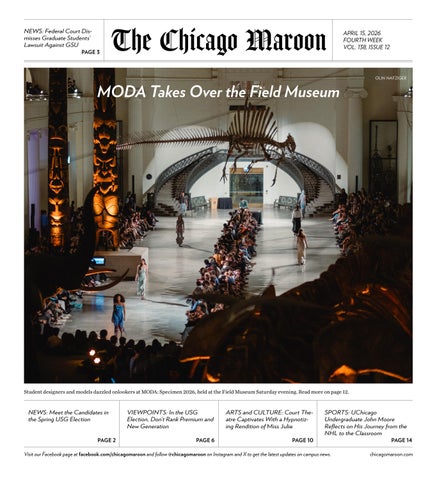
Student designers and models dazzled onlookers at this year’s edition of UChicago’s annual celebration of fashion.
By OLIN NAFZIGER | Head Photo Editor
Audience members, designers, and models filed into the main hall of the Field Museum Saturday night to attend MODA: Specimen 2026, this year’s sold-out edition of UChicago’s annual celebration of fashion.
Every year, MODA, the student fashion magazine, holds a runway show where

amateur designers can showcase their creations. This year’s event was MODA’s largest on record, with attendees crowding together to catch glimpses of models as they strode underneath the tusks of taxidermied elephants and the neck of Máximo the titanosaur.


Rob Osler discusses his newest mystery novel, the second in a series that follows detective Harriet Morrow as she unravels mysteries of corruption and homicide in 19th-century Chicago.
By ISABELLA COLEMAN | Arts and Culture Reporter
The Case of the Murdered Muckraker is the second novel in Rob Osler’s Harriet Morrow Investigates series, following the success of the four-week USA Today bestseller The Case of the Missing Maid. In this sequel, Harriet Morrow continues her journey as the first female operative at the Prescott Detective Agency in nineteenth-century Chicago. In addition to her investigative work, Harriet faces the challenges of being a lesbian in the late 1800s, raising her teenage brother on her own, and navigating the complexities of life during the Progressive Era in Chicago.
In The Case of the Murdered Muckraker, Harriet is determined to further prove herself as a capable female detective. However, this becomes difficult when her newest case involves the suspicious murder of a muckraker—a journalist who exposed corruption and social injustices in the Progressive Era—who possessed details of the city’s underlying corruption, with an innocent mother imprisoned as a suspect. To solve this case, Harriet must camouflage her fiery and nonconforming personality by adopting several different disguises, from a tenement woman to a man named Harry. Through these disguises, she uncovers wrongful convictions and connects a series of violent deaths, all while facing constant danger.
In his interview with the Maroon, Osler detailed numerous factors that led to the choice of Chicago as the novel’s setting, such as the variety of neighborhoods for the protagonist to explore and social issues for her to navigate, including sexism, crime, and class inequality. He also highlighted the late-nineteenth-century setting, noting that “2,000 miles of paved, flat roads were available to Harriet throughout her travels and investigations,” which she explored with her steadfast companion, an Overman Victoria bicycle.
Having lived in Chicago for several years
as an advertising copywriter at Leo Burnett, a Chicago-founded marketing company, Osler described how his time in the city significantly affected how he wrote the Harriet Morrow Investigates series. While Osler and Harriet experienced Chicago in vastly different eras, Osler described both modern and older Chicago as “a very muscular city… it’s big, it’s bustling.” He explained that living in the location allowed him to obtain a “general vibe of the city.”
Specifically, living in Chicago enabled Osler to become familiar with the city’s architecture. Although Chicago has changed in many ways since the start of Harriet’s detective journey 128 years ago, Osler noted that several buildings from that era still exist today. While living in Chicago, he was “able to see those buildings, get a better feel for the architecture and the architecture center downtown on Wacker Drive… [and] take a couple tours.”
The Case of the Murdered Muckraker primarily focuses on the city’s corruption, a topic Osler grounded in research. 1898, the year the book is set, falls in the heart of the Progressive Era, which saw urbanization, industrialization, harsh working conditions, and a growing middle class. Osler explained that two characters from the book, Dan “Irish” Walsh and Michael “Saloon Mickey” Powers, are based on real aldermen—elected council members—in Chicago’s history: Michael “Hinky Dink” Kenna and John “Bathhouse” Coughlin, respectively, both of whom served Chicago’s First Ward, a district then dominated by brothels, saloons, and gambling dens. These details, based on true aspects of the period, become vital elements of the novel’s plot.
Of the many social issues presented throughout the series, Osler particularly emphasized Harriet’s constant defiance of gender norms. “Harriet—right on!” Osler said, encouraging both the protagonist and readers to confront social norms and patri-
archal pressures. He noted that although some readers might disagree with the feminist ideals he presents through Harriet’s perspective, he did not seek to explicitly state his own political beliefs in the story but instead naturally embed representation and diversity within it.
Osler also crafts Harriet as more than just a detective. Though detective characters are often presented as lonesome outsiders, much of the novel focuses on Harriet’s various forms of relationships, including with Aubrey, her brother; Pearl Bartlett, the employer of the maid from the series’ first book, who befriends Harriet; Matthew McCabe, a fellow queer detective; and Barbara Wozniak, Harriet’s love interest.
Another crucial element of the plot is the
absence of Harriet’s parents, who passed away when Harriet was a young adult. Osler introduced this loss because he “wanted her to be more independent and have more pressure on her. And also not have [her parents] tell her what she could and couldn’t do.” As a result, she can “just remember them fondly and believe that they would be supportive.” He particularly stressed the connection with her younger brother across both novels. Their relationship contains “tension, but they love each other.… [Osler] wanted that dynamic to be tough love.”
Although Harriet’s queerness is important to her identity, Osler noted that it was not meant to be the focus of the story, going so far as to say that the mystery would not
CONTINUED ON PG.


“[Q]ueer
CONTINUED FROM PG. 13
have been affected at all if he had made Harriet straight. He said he added this dimension to her character because “queer people exist. I want to read stories about them, and I want straight people to read stories about them, where they just are, and that they happen to gay, lesbian, trans, etc. But their world doesn’t revolve around that.”
To further explain this point, Osler recalled an interaction he had with an “older, white, straight woman who, [he] believed, was probably more on the conservative side” after a panel discussion at a conference. This woman had read two prior books of his from the Hayden & Friends Mystery series, which stars a gay man named Hayden. The woman approached Osler, praising his books and noting that it “didn’t bother her that Hayden had a queer lifestyle.” Osler pointed out that the term “gay lifestyle” is inherently problematic, reducing an important characteristic into something far less fundamental.
But, in this situation, “[he] just decided [he] was going to let that slide.… [He] had brought her to a better place than she was because of these two books.” This further encapsulates Osler’s attitude toward his work, which he hopes will positively impact all readers.
Osler doesn’t claim to be “changing the world” but noted that, “in [his] own little way, [he] achieved something with that one woman,” possibly influencing her to be more accepting and supportive. He clarified that, although he had no way of knowing whether she had had any prejudice against queer people prior to reading his book, he hadn’t wanted to spoil the moment by lecturing her. He just “let it ride.”
Osler went on to compare Harriet’s queerness to his own. When asked why the plot does not purely revolve around Harriet’s LGBTQ+ identity, he simply said, “Because… I play tennis. I do a lot of other stuff. I don’t just sit here thinking, ‘Wow, it’s so great to be a gay man.’” Osler said that he
replaces the nectar in his hummingbird feeders, buys cat food, and simply lives his life. Similarly, Harriet, like any other person, has tasks and responsibilities: grocery shopping, doing her laundry, and raising her brother. She also has a difficult profession, especially for a woman in the 19th century. Osler emphasized that numerous other factors play a role in her life, not just her sexuality.
According to Osler, the Harriet Morrow Investigates series is set to have six books, with the third installment already in progress. Additionally, Osler’s third short story following Perry Winkle, a nonbinary amateur sleuth, will be released in the Ellery Queen Mystery Magazine later this year. Osler is also planning a new series, with the first book, The Butler, coming out in summer 2027. Osler described this as a contemporary series that follows Clive Humphrey, whose “zeal for order and discipline for both his clients and staff has lethal conse-
quences.”
Ultimately, Osler’s primary wish for readers to gain from his novels is enjoyment; he hopes to create a fun, fast read. Second, he aims to further not just representation of queer people but also relatability, which he tries to do by making Harriet a multifaceted protagonist. He wants audiences to read about a queer hero who is not defined solely by their queerness—one who is “as relevant and as zesty and as fun and bold [and] as courageous as Harriet is.” The point was best encapsulated by Osler himself, who remarked that he wanted to write something “unapologetic about the hero, Harriet, being a lesbian. It doesn’t matter that she likes women. It doesn’t matter, because Harriet is awesome. And that’s just not a problem.” Osler masterfully achieves these goals, as The Case of the Murdered Muckraker is not only a queer story but also an exhilarating and engaging mystery that reflects social issues of the past and present.
Former NHL defenseman John Moore discusses triumphs, injuries, and lessons learned from his 12year career in professional hockey and his adjustment to student life at the University of Chicago.
By ALEXA WALSH | Senior Sports Reporter
For most UChicago undergraduate students, the 12 years prior to attending the College are spent in a classroom. For fourth-year business economics major John Moore, however, those 12 years played out under the bright lights of the National Hockey League (NHL) instead. In the 2009 NHL entry draft, Moore was drafted 21st overall by the Columbus Blue Jackets. From there, he traveled across North America and played with some of the most storied franchises in the NHL, making it to the Stanley Cup Finals with the New York Rangers in 2014 and the
Boston Bruins in 2019.
When asked if there was something he was particularly proud of in his career, Moore recalled, “The moment I think about most is in 2019. I had broken my humerus and torn the labrum in my shoulder.… I decided to put off surgery and be ready if the team needed me because we had a great team in Boston, and we ended up going to game seven in the Stanley Cup Finals.”
Moore went on to explain that he played with the injury because of the bonds he had built on that Bruins team—bonds that per-
sist today. For him, playing through injury was a “mentality of being there when you’re needed,” he said, explaining, “I think that applies to everyone, no matter what your situation in life is.… There are people that depend on you, and there are certain times when you have to dig deep and kind of overcome whatever you’re feeling internally and show up for the people that matter most for you.”
During his first few weeks at UChicago, Moore leaned on his experience on that 2019 Bruins team. Despite being unsure if he would be prepared for the initial shock that comes with attending UChicago, he “committed to the process and learned
and got better every day.”
While his NHL experiences have helped guide his undergraduate experience thus far, Moore has still seen contrasts between his NHL and UChicago careers. “The mantra that was often repeated when I was a young player, by coaches and teammates was ‘The NHL is not a development league,’ meaning, with travel schedules, competition schedules, with injuries, there’s very little practice time,” Moore said.
At UChicago however, Moore found himself with ample “practice” time. As an undergraduate, Moore realized that taking time to understand course material by ex-
“[P]ursuing an education.... is a way of investing in yourself.”
CONTINUED FROM PG. 14
tensive studying, going to office hours, and approaching other classmates was necessary to development—a clear juxtaposition to the NHL, where most of his instruction was relegated to team meetings and all his energy was saved for puck drop.
Notably, most professional athletes do not pursue a college degree after a long career in sports. They often turn to broadcasting or player development after retirement instead of completing a degree they may have started as a National Collegiate Athletic Association (NCAA) athlete.

Additionally, unlike the National Football League, for example, where virtually all players are drafted from collegiate institutions, the National Hockey League drafts primarily from organizations outside the NCAA, such as top major junior hockey leagues. Moore was drafted from the United States Hockey League, so the first time he ever stepped foot in a college classroom was at the University of Chicago. So, how did John Moore end up here?
After sustaining serious injuries in the 2018–2019 season, Moore had a lot of downtime while he underwent physical rehabilitation. This time off the ice offered him the opportunity in the summer of 2019 to start taking online classes offered through the NHL’s Players’ Association. A couple of years later, during the COVID-19 pandemic, Moore was in the “bubble” in
Toronto, a strictly controlled environment designed to prevent the spread of the virus throughout the league, and once more found himself with a lot of downtime, permitting him to take more online classes.
Moore had reconstructive hip surgery the next year, which required extensive rehabilitation and added further to time away from the rink. Reflecting on what this time meant for him, Moore explained, “I started to really think about what life after hockey would look like for me. [After] being exposed to the world and a lot of business opportunities through professional sports, I felt that pursuing an undergraduate education was something I really wanted to do. And I was really fortunate that my wife shared that enthusiasm as well. We have three young kids, so it takes a lot of sacrifice from everyone to allow me to do this.”
While Moore’s time off the ice certainly motivated his educational pursuits, his curiosity to learn was not something that suddenly appeared post-retirement. “I was really lucky to kind of realize a childhood dream and have a career in professional sports, but I’ve always been extremely curious,” Moore explained. “For the longest time, [my curiosity] took a backseat to the demands of my sport and my job.”
Having thus settled on a clear post-retirement plan to explore his previously cast-aside curiosity, there were many qualities, similar to those appreciated by most prospective students, that drew Moore to UChicago: the amazing faculty, the core curriculum, and a welcoming campus.
Moore recalled visiting campus in July 2022, “[I]t was a beautiful summer day, and I was put in touch with a bunch of former military people who walked me around.” If Moore felt any reservations about pursuing a college degree, they were similar to those held by most adults who go to these institutions after solid careers. There is always the question of whether students largely in their early twenties will mix well with someone in a different stage of life. However, Moore was thankful to learn from the veterans leading his tour “that no one really cares about your background, or how old you are, or that you might not look like many of your other classmates. They care about how you contribute in a class setting, what you have to say.”
That’s not to say the transition from a career as a professional athlete to an in-
tense university like UChicago was easy for Moore. When asked about retirement itself, Moore reflected, “I think when you’re playing [in the NHL], nobody ever really takes a lot of time envisioning what the end looks like. And then that happens. It’s so sudden, and [it means] adjusting from the NHL, where you’re given a schedule every day of ‘here’s where you have to be, here’s who we’re playing, these are the training protocols, this is what you need to eat, this is what time you need to be on an airplane,’ to nothing. You’re no longer in a locker room with your peers. You don’t get that social interaction on a day-to-day basis. It was disorienting getting out of it.”
From an outside perspective, retirement after a professional sports career where you made millions of dollars may sound like a great opportunity to slow down and enjoy the fruits of your labor. For Moore, it was different. “I didn’t want to just, you know, be done and kick my feet up when I’m 32, 33. I don’t think that’s any way to get through life. I think in and of itself the process here of learning day in and day out, at my age and my stage of life, is… an indulgence, and I try and bring that gratitude to the classroom,” he said.
Moore was also extremely grateful for the mentorship of professor Christopher Simon, who taught his Classical Latin class, at the beginning of this new experience. “[Simon] went out of his way to meet with me, really build me up confidence-wise, and make sure that my habits and everything were appropriate for this new kind of chapter in my life. I think back, and I don’t know where I’d be without someone like that who took time out of a busy schedule of his own,” Moore said.
Moore acknowledged how much he has grown since retiring from professional hockey through the support of his family and his great mentors at UChicago. When asked what a younger John Moore would think of John Moore today, he remarked, “I think he would be incredibly proud of the 35-year-old version of himself. You know, in the NHL, tomorrow was, in my career… never really a guarantee I’d still be there.… [T]here was an intensity to keep your seat at the table.… I think 22-year-old John Moore, knowing that a 35-year-old version is at the University of Chicago… would be incredibly proud and incredibly grateful to the admissions committee for
allowing him to be a student here.”
Besides furthering his own education and knowledge, Moore also highlighted the example he wants to set for his children. Moore described the importance of being a role model for them, saying, “I really love that my kids see me toil over a book, underlining and Post-it-ing things.” Moore continued, “I’m of the opinion that I think it’s great for kids to see their parents or their caretakers working and struggling, especially around education.… I think someday, maybe when [my kids] are older and they have children of their own, if that ever happens, they can kind of appreciate how hard this was, not just for me, but for my wife as well.”
When asked if there was any advice he would give to retiring NHL players, Moore explained that, because of the luck required to become an NHL player, many players have internalized the phrase “always bet on yourself.” For Moore, his “bet” was the decision to go pro right out of high school. Reconciling this NHL adage with his decision to pursue education post-retirement, Moore said, “This ‘betting on yourself’ is something I only saw more of as my career progressed, whether it was deciding to pursue free agency, playing through injuries, deciding to take chances within the team system, or just simply advocating for [myself] in an organization. I would say to my peers that pursuing an education after a professional sports career is an extension of that same philosophy. It is a way of investing in yourself. My time here has given me a toolkit that I can apply to things from Classical Latin to economics, but, more than that, it has deepened my curiosity and appreciation for the world around me. This has been transformative, and I want to promote this experience and remain actively involved in helping attract others from nontraditional backgrounds to the University of Chicago.”
While many of us here at UChicago have not played at Madison Square Garden for the New York Rangers, won a bronze medal at the International Ice Hockey Federation World Championships, or played through severe injuries in the seventh game of the Stanley Cup finals, Moore is no different than your average UChicago student. He reads the same books, enjoys the same courses, and studies at Regenstein Library.
By OLIVIA PHILLIPS | Crossword Constructor
