NEWS: University Affiliate Robbed at Gunpoint on Ellis Avenue Last Week
PAGE 2
![]()
NEWS: University Affiliate Robbed at Gunpoint on Ellis Avenue Last Week
PAGE 2
MARCH 4, 2026
NINTH WEEK VOL. 138, ISSUE 10

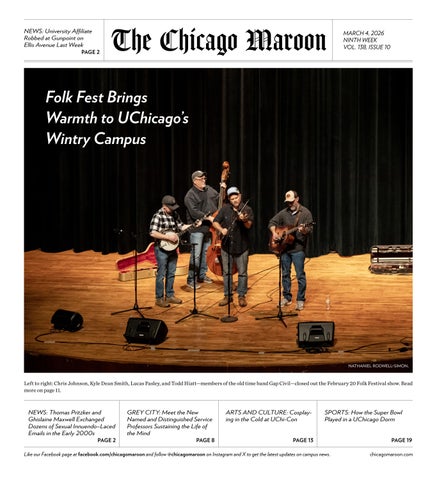
of the old time band Gap Civil—closed out the February 20 Folk Festival show. Read more on page 11.
NEWS: Thomas Pritzker and Ghislaine Maxwell Exchanged Dozens of Sexual Innuendo–Laced Emails in the Early 2000s
PAGE 2
GREY CITY: Meet the New Named and Distinguished Service Professors Sustaining the Life of the Mind
PAGE 8
ARTS AND CULTURE: Cosplaying in the Cold at UChi-Con
PAGE 13
SPORTS: How the Super Bowl Played in a UChicago Dorm
19
By NATHANIEL RODWELL-SIMON | News Editor and BORIS ARCHIPOV | Senior News Reporter
Content warning: This article contains references to sexual abuse.
Emails between University of Chicago Trustee Thomas Pritzker (M.B.A. ’76, J.D. ’76) and Ghislane Maxwell, one of Jeffrey Epstein’s closest associates, indicate that Pritzker and Maxwell shared a previously unknown close personal relationship.
The pair exchanged dozens of innuendo-laced emails in the early 2000s, discussing underwear and Pritzker’s “manhood” among other topics.
The Maroon previously reported on Pritzker’s close relationship with Epstein, which lasted until Epstein’s death. New reporting from the Maroon also shows that Pritzker planned several visits to Little Saint James, Epstein’s private island where prosecutors allege he abused victims.
Maxwell was convicted of participating in and facilitating the sex trafficking of underage girls in 2021. She is currently serving a 20-year sentence.
Virginia Giuffre, one of Epstein’s most prominent accusers, who died by suicide last year, previously named Pritzker in a 2016 deposition as someone who had sex with her on one occasion.
Pritzker has denied any wrongdoing stemming from his relationship with Epstein and has not been charged with any crime related to the Epstein investigations. A spokesperson for Pritzker declined to comment on this story.
Pritzker stepped down as the executive chairman of Hyatt Hotels Corporation on February 16 because of his relationship with Epstein.
“I exercised terrible judgment in maintaining contact with them, and there is no excuse for failing to distance myself sooner. I condemn the actions and the harm caused by Epstein and Maxwell and I feel deep sorrow for the pain they inflicted on their victims,” Pritzker wrote in his resignation letter to the Hyatt Board of Directors.
Pritzker’s spokesperson told the Maroon in a statement that “Tom Pritzker will retire from the [UChicago Board of Trustees] this June having reached the mandatory retirement age. Tom has already concluded his service on the board’s executive committee.”
The newly released emails between Pritzker and Maxwell date back to at least 2001 and suggest that the two had a close relationship; correspondence between them was often filled with sexual innuendos.
In March 2001, Pritzker asked Maxwell, “so, what did I miss? … be truthful. Going out to buy underwear now.” Maxwell responded, “If I allowed you to participate vicariously at all these events I may never get you in person.” It is not clear what events Maxwell refers to in the exchange.
Original spelling, capitalization, and punctuation have been retained unless otherwise noted.
Later that day, she asked Pritzker to “send a copy of the receipt for the underwear + e mail photo. I need proof. The alternative is that you have to show them to me in person.”
In another email from the same year, Maxwell wrote to Pritzker, “Given that I know how that at least your manhood stretches 7 hours …. well how could a girl
By NOLAN SHAFFER | News Reporter
A member of the University of Chicago community was robbed at approximately 11:30 a.m. on February 23 on the sidewalk in front of the William Eckhardt Research

be more impressed (except if I discover that it goes 9 hours).”
The email appears to reference an earlier email exchange where Maxwell asked if Pritzker had “the long range Falcon [private jet] or the shorter one – are you a 7 1/2 hour or a 9 hour plane?” Pritzker asked whether the comment was “like a challenge to my manhood?”
In a 2003 email, Maxwell invited Pritzker to a dinner hosted by Epstein. When asked who would be in attendance, Maxwell responded with several names and “5 models who are the serving girls.” Pritzker asked if Maxwell would be in attendance as well, to which she responded: “Of course –who else could possibly be there to hold the peace or was it hold your piece.”
That phrasing also appears in an email chain from two days earlier. In the email, Pritzker asked Maxwell for names to invite to an upcoming event in Madrid, telling Maxwell to “speak now or forever hold my piece.”
“Hold your piece – now that is very fresh,” Maxwell responded.
Pritzker was not the only man in Epstein’s orbit who exchanged flirtatious messages with Maxwell. Doug Band, a former advisor to Bill Clinton, shared similar emails with Maxwell in the early 2000s. Band denied they ever had a physical relationship, further calling Maxwell a “monster” in a statement to the New York Times Pritzker also wrote to Maxwell about being away from his wife, Margot Pritzker, on at least six occasions, suggesting that they meet in person. He would occasionally refer to himself as a “bachelor” in these emails.
“I (w/o Margot) fly to Miami and will be there all week for a variety of meetings. Are you going to come down with me and play? I may even end up getting a day off for good behavior,” Pritzker wrote in 2002.
“I am a bachelor for another week, but I have to deal with Kaka. Margot is in Kathmandu,” Pritzker wrote in 2001. “Where are you this weekend? Can we create a scene? I may be free.”
Pritzker and Maxwell remained in contact until at least 2013, emails show.
Center at East 56th Street and South Ellis Avenue, according to a security alert emailed to the University community that afternoon.
The victim was approached by two unknown suspects armed with handguns, who demanded and took property before
By AARYAN KUMAR | Senior News Reporter
The Chicago City Council unanimously adopted the International Holocaust Remembrance Alliance (IHRA) definition of antisemitism on January 21, modifying its existing definitions of discrimination. Jake Rymer, a third-year in the College and president of the Maroons for Israel RSO, advocated for the ordinance’s passage.
The IHRA defines antisemitism as “a certain perception of Jews, which may be expressed as hatred toward Jews.” The definition has been criticized for being vague and suppressing discussion of the Israel–Palestine conflict and the Israel–Hamas war; of the 11 examples of antisemitism the IHRA provides, seven mention Israel.
Its examples of antisemitism include “drawing comparisons of contemporary Israeli policy to that of the Nazis” alongside more traditional examples such as “[d]enying the fact, scope, [or] mechanisms” of the Holocaust.
Chicago is the second-largest American city to codify the IHRA definition of antisemitism, after Los Angeles. In January, New York City Mayor Zohran Mamdani revoked a 2025 executive order establishing the IHRA definition, leading the Israeli government to accuse him of antisemitism.
The University did not respond to questions about whether the city’s adoption would affect campus policy or whether the University has considered adopting a definition of antisemitism, as some peer institutions have been pressured to do by the federal government.
In an interview with the Maroon, Rymer said that “the IHRA [definition of antisemitism] doesn’t inhibit free speech; it just categorizes speech.”
15th Ward Alderman Raymond Lopez, the primary sponsor of the ordinance, told the Maroon separately, “This [ordinance] will also allow us to charge people for antisemitic hate crimes, as opposed to just simply referring to them as hate crimes, or... giving people the opportunity not to charge things for hate crimes when they clearly are.”
For a violent crime to qualify as a hate crime, it must be motivated by bias against
the victim’s perceived race, color, religion, national origin, sexual orientation, gender, gender identity, or disability. Even prior to the new ordinance, the Chicago Police Department (CPD) maintained records of reported anti-Jewish hate crimes.
A Chicago Commission on Human Relations report found that in 2024, Chicago experienced a 25.5 percent decline in hate crimes reported to or investigated by CPD, from 282 to 210, compared to 2023. However, reported anti-Jewish hate crimes increased by 58 percent during that same period, from 50 to 79, with a plurality classified as “criminal damage.”
Lopez indicated that under the new ordinance, anti-Zionist beliefs would be sufficient motive for a violent crime to be prosecuted as a hate crime. “If you have a bunch of anti-Zionists who attack Jewish individuals walking down the street, that is a hate crime,” Lopez said. “That is no different than the KKK walking down the street and attacking a group of Black people going to church.”
Rymer defended the IHRA definition over alternatives, saying that the IHRA definition is the accepted definition of Jewish organizations, including the American Jewish Committee and European Union of Jewish Students. “Other communities choose their own definitions of racism,” Rymer added. “Why don’t the Jewish people get to choose their definition?”
Lopez said he did not consider alternative definitions of antisemitism when drafting the ordinance.
The Jerusalem Declaration and Nexus Project, which explicitly position themselves as alternatives to the IHRA definition, seek to protect open debate while properly defining antisemitism.
Na’ama Rokem, an associate professor of comparative literature and Middle Eastern studies, and Tom Ginsburg, a professor of international law and faculty director of the Forum for Free Inquiry and Expression, both expressed concern in interviews with the Maroon about the universal application of a context-specific definition.
The IHRA definition was initially published in 2005 as a guideline for the Euro-
pean Monitoring Centre on Racism and Xenophobia to help the body collect data on incidents of antisemitism. In 2016, the definition was adopted by the IHRA as its working definition.
“In the aftermath of the fall of the Eastern Bloc, there was a sense that there was an uneven landscape of education about the history of the Holocaust,” said Rokem, who is a signatory on the Jerusalem Declaration. In the Soviet Union and Eastern Bloc, Holocaust education deemphasized the Nazis’ persecution of Jewish individuals specifically. “You can think of the IHRA definition as a kind of cultural policy document that was meant to address a very particular historical moment.”
Ginsburg noted that, in addition to Europe having smaller and more fragmented Jewish populations, European countries like Germany do not have robust free speech protections like the United States. “For the original purpose for which it was
adopted, it might have been perfectly appropriate,” Ginsburg said.
Defending the definition’s several references to Israel, Rymer said, “It’s an unfortunate truth that since 2023, the main target of antisemitism has been in things regarding anti-Zionism against the State of Israel.”
Rymer also said that, while the codification will not affect a private institution like the University, he hopes UChicago will adopt a formal definition of antisemitism.
Ginsburg said that the University adopting a definition of antisemitism would be in opposition to the Chicago Principles and free expression.
“Universities have a special duty to be spaces of very broad discourse,” Ginsburg said. “A definition of antisemitism is what we call a contested concept. One person might have a different view of what is antisemitic than others [do].”
CONTINUED ON PG. 5
Tiffany Li, editor-in-chief
Elena Eisenstadt, deputy editor-in-chief
Evgenia Anastasakos, managing editor
Haebin Jung, chief production officer
Adam Zaidi and Arav Saksena, chief financial officers
The Maroon Editorial Board consists of the editors-in-chief and select staff of the Maroon
NEWS
Gabriel Kraemer, co-head editor
Anika Krishnaswamy, co-head editor
Nathaniel Rodwell-Simon, editor
GREY CITY
Celeste Alcalay, editor
Anika Krishnaswamy, editor
Vedika Baradwaj, editor
Kaci Sziraki, editor
VIEWPOINTS
Camille Cypher, co-head editor
Sofia Cavallone, co-head editor
ARTS AND CULTURE
Nolan Shaffer, co-head editor
Shawn Quek, co-head editor
Emily Sun, co-head editor
SPORTS
Shrivas Raghavan, editor
Josh Grossman, editor
DATA AND TECHNOLOGY
Nikhil Patel, editor
Jinny Kim, editor Emily Sun, editor
CROSSWORDS
Eli Lowe, head editor
PHOTO AND VIDEO
Nathaniel Rodwell-Simon, head editor
Olin Nafziger, editor
DESIGN
Eliot Aguera y Arcas, editor
COPY
Mazie Witter, chief
Megan Ha, chief
Feifei Mei, chief
Vanessa Yelder, chief
Olivia Rae Okun-Dubitsky, chief
SOCIAL MEDIA
Katherine Bolte, manager
NEWSLETTER
Evgenia Anastasakos, editor
BUSINESS
Maria Lua, co-director of operations
Patrick Xia, co-director of operations
Executive Slate editor@chicagomaroon.com
For advertising inquiries, please contact ads@chicagomaroon.com
Circulation: 2,500
“This is the first on-campus robbery this academic year... There were three reported robberies during the 2024–25 academic year.”
CONTINUED FROM PG. 2
fleeing the scene in a dark blue Honda Accord southbound on Ellis, Associate Vice President for Safety and Security Eric Heath wrote in the security alert. The vehicle had a temporary Illinois license plate with the number 728AC769.
The victim reported no physical injuries, and the University of Chicago Police Department is investigating the incident,
according to the email.
The incident took place across the street from Max Palevsky Residential Commons West and Joe and Rika Mansueto Library. There was no commotion in the Mansueto Reading Room at the time of the event, according to third-year Alison Lafayette, who was working there at the time. As of 1:30 p.m., there was no security or police presence at the scene.
This is the first on-campus robbery this academic year, according to Clery Act reports emailed to University members. There were three reported robberies during the 2024–25 academic year. As an institution participating in federal financial aid programs, the University is mandated to report certain crimes under the Clery Act if they happen within campus boundaries.
Since the U.S. Department of Education began collecting data in 2001, as per the Clery Act, UChicago has averaged about one on-campus robbery per year. The national average of on-campus robberies among all four-year public and private institutions has declined steadily over the past two decades, falling by 71 percent from 0.7 in 2001 to 0.2 in 2023, the latest year for which data is available.
By AVA NEAL | Senior News Reporter
The University of Chicago Crime Lab appointed Kenneth Corey as executive director of the Policing Leadership Academy (PLA) on January 28. Corey will serve as the PLA’s second executive director, taking over from founding Executive Director and Crime Lab founder Roseanna Ander.
Corey previously worked for the New York City Police Department (NYPD) as a beat officer and as chief of training before becoming the four-star chief of department, NYPD’s highest-ranking uniformed officer. He has been closely involved with the development of the PLA since its launch.
Ander formed the PLA as part of the Harris School of Public Policy’s Crime Lab in May 2023. The PLA aims to “prevent violent crime, support officers, and improve fairness and effectiveness in policing,” according to an overview released in February 2026.
The Crime Lab and the PLA have received donations from Citadel Investments CEO Kenneth Griffin, GCM Grosvenor CEO Michael Sacks, and the Sue Ling Gin Foundation Trust.
“We like to think of it as a Booth Executive M.B.A. for policing middle managers,” such as the Chicago Police Department’s district commanders or parallel titles in other cities’ policing organizational structures, Corey told the Maroon.
According to Corey, PLA’s participants typically oversee between 150 and 300 officers and are responsible for over 100,000 citizens, and departments often give them “no education to prepare them for that particular role.”
“There is very little leadership development that goes on in policing as a profession,” he said.
Corey explained that the PLA’s methodology is to first teach officers in cities with the 100 highest violent crime rates in order to make the largest impact from the start of the program. Reaching 600 “middle managers” in 100 cities would be enough for the PLA to achieve the impact on homicides that it wants, he said.
By training these “middle managers” to better oversee their staff—not over-policing or “flooding an area” when not necessary—police departments can plan for far fewer hostile and violent interactions with officers. Thus far, 135 alumni from 90 U.S. jurisdictions have graduated from the PLA, hailing from departments accounting for the highest proportion of homicides in the U.S.
Corey says the training gap the PLA attempts to bridge comes mostly from budget difficulties. “The budget in the NYPD is $6 billion, and yet 94 percent of that goes just to pay personnel,” Corey said. “Every time they want to tighten the belt… one of the first things that’s going
to get cut is training, because there’s no mandate anywhere to do it.”
According to the NYPD’s preliminary budget for fiscal year 2026, 92 percent of the $5.8 billion adopted FY2025 budget went toward personnel costs. Line-item training expenditures increased by $16.4 million between the adopted and final FY2024 budgets.
In Illinois, basic training for incoming officers is mandatory, but any further training conducted as an officer’s career progresses is far less regulated.
The PLA works with each cohort for five months, giving lectures and assignments covering leadership, strategic thinking, trauma-informed and emotional intelligence, and communication, culminating in the presentations of capstone projects the officers plan to implement in their own departments.
“The capstone is an actual problem; it’s not a theoretical or academic exercise,” Corey said. “They usually kick [the capstone] off in month three or four, so that by the time they present it to us at the end, they’ve already gotten some early results and are starting to make some real-world adjustments.”
For the past two cohorts, the PLA has required participants to complete capstone projects as part of their curriculum. The PLA does occasional check-ins on these projects to gather data for its ongoing five-year efficacy report, but does not work directly with the precincts to imple-
ment the projects, according to Corey.
“Some of them have got really tremendous results; some of them have gone from being small neighborhood initiatives to now being full-blown, citywide initiatives in some major cities,” Corey said.
One capstone project based in Philadelphia studied “community engagement as a crime-fighting technique.” According to Corey, the program was so popular that it expanded across the entire Philadelphia Police Department (PPD).
This capstone project, headed by PPD 12th District Captain Joseph Green, grew to include 14,000 instances of community engagement, where officers check in with citizens on the streets and in local schools and businesses. In the wake of these engagements, his district reported decreased numbers of homicides, shootings, and traffic stops.
Looking ahead, Corey said the PLA will focus under his leadership on data-driven policing, particularly after the five-year report is completed in 2027. “The bar on knowledge, particularly around using data to drive decision-making, was so much lower than I thought it was,” he said. “Things that I would’ve assumed that people at this level of the organization would’ve used for a number of years, they don’t, and they haven’t been exposed to.”
For Corey, the combination of professional policing experts and data scientists at PLA is “the best of both worlds.”
CONTINUED FROM PG. 3
“[O]verly broad implementation of any of the anti-discrimination
Kenneth Stern, the principal author of the IHRA definition of antisemitism, has criticized its applicability in educational environments.
In 2019, the Department of Education adopted the IHRA definition of antisemi-
The legal application of definitions of antisemitism is also contested. According to Rokem, “both the IHRA [definition] and the Jerusalem Declaration were written more as a kind of document that give general guidelines and a sort of point of orientation” than an enforceable set of rules.
tism. “We are subject to investigation from the Department of Education, even prosecution by the Department of Justice under some circumstances,” Ginsburg said. “So when the government changes its view, we have to follow that or contest it.”
“There’s some tension between [the
IHRA] definition and the Chicago Principles,” Ginsburg added. “Actually, there’s a tension between all anti-discrimination law and the Chicago Principles, in the sense that overly broad implementation of any of the anti-discrimination provisions could chill speech.”
By AVA NEAL | Senior News Reporter
At its meeting on Monday, Undergraduate Student Government’s (USG) College Council (CC) discussed proposed revisions to the Student Government Funding Committee (SGFC) appeals procedure that would allow appeals to be heard outside CC’s regular meeting time.
Members also debated instituting ranked-choice voting in future CC elections and discussed bylaw changes concerning election recalls, proposed amendments to CC bylaws, and a proposal by Class of 2029 Representative Aaron Horowitz for CC to call for Thomas Pritzker’s removal from the Board of Trustees.
CC Vice Chair Kevin Guo introduced proposed revisions to Article VI, which governs elections, appointments, vacancies, and removals in CC’s bylaws. Guo called a new clause that would make Election & Rules Committee (E&R) members’ individual votes public a “particularly controversial” part of the resolution.
Fred Lee, the vice president of student organizations, cited a spring 2023 vote as an example of potential difficulties that could result from public votes. Lee referenced his choice to call for deducting votes from current USG President Elijah Jenkins’s ticket as an example of why CC privatizes E&R decisions. He warned that publishing E&R’s nullification votes could dissuade future members from joining E&R for fear of backlash over their votes.
Guo also proposed a resolution to allow ranked-choice voting in next year’s USG elections for cabinet positions. Last year, CC briefly discussed a similar proposition brought by Guo, but it didn’t progress “due to personnel issues,” Guo said.
Class of 2028 Representative Destiney Samare suggested that the choice to switch to ranked-choice voting be left up to a referendum to be voted upon by the student body during the next election cycle. E&R Chair Jay Love said that CC would have to enact Guo’s resolution by next week’s meeting for E&R to implement it for spring elections, as election code changes become difficult during election seasons.
Guo separately noted that there was no process for changing RSOs’ assigned finance committee to better suit their needs. He told members he would reach out to RSOs and ask if they wanted to move to other committees for the coming academic year, but said he hoped to make the process more formalized in the future.
In light of a recent influx of SGFC appeals, Lee proposed the creation of a subcommittee which could hear SGFC funding appeals outside of the regular CC meeting and calculate an appropriate allocation to be reviewed at the next CC meeting. CC has spent significant shares of several meetings this quarter hearing and deliberating on SGFC appeals.
Class of 2029 Representative Gavin
Wynn questioned CC’s ability to find a representative group to staff the subcommittee and asked that members have more time to consider the proposal. The creation of the subcommittee will be discussed further at next week’s meeting, Guo said.
CC also reviewed allocations to RSOs set at the previous week’s SGFC meeting.
Wynn and Guo debated whether funds given to the Latino Medical Students Association by that the Pritzker Medical School qualified as fundraising under SGFC’s guidelines. CC ultimately sent the request back to SGFC for reconsideration.
Horowitz presented a resolution for CC to publicly call for Thomas Pritzker’s removal from UChicago’s Board of Trustees. The Maroon has reported that Pritzker had a close relationship with convicted sex offender Jeffrey Epstein.
Class of 2028 Representative Grace Beatty said she supported the “spirit of the resolution” but wanted to hear more “in terms of practice,” given that Pritzker will turn 75 on June 6 of this year. The University’s Articles of Incorporation mandate that trustees are ineligible to serve following the annual meeting after their 75th birthday. Horowitz said that the “symbolic weight” of a statement by CC would give the student body a voice, even though CC lacks the power to remove Pritzker.
Because a resolution cannot be passed at the same meeting as it is introduced, none of the resolutions introduced on Monday will be approved until at least next week.
Love also proposed several technical changes to the language of the election code, including specifying “campaign staff” as people who worked on electoral activities for more than one hour per week. Wynn questioned Love’s proposed definition, noting that social media management would not qualify as campaign staffers, but CC approved the changes.
E&R also presented changes it had made to the House Rules, many of which revoked provisions written by former E&R Chair Nevin Hall in February 2025, according to an email Guo sent to CC members last week. Hall was impeached last spring for attempting to change USG bylaws to consolidate his own power, among other charges.
The eliminated sections included several provisions that protected the E&R secretary from removal and conditioned the committee’s motions and decisions on the approval of the secretary. Hall appointed himself E&R secretary before his impeachment. CC does not have to approve House Rules changes.
CC ran out of meeting time to address the rest of its agenda items, such as members’ individual projects, and adjourned.
College Council holds weekly public meetings in Stuart Hall 104 on Mondays at 7 p.m.
Editor’s note: CC representatives Aaron Horowitz and Grace Beatty are current staff members of the Maroon. They had no involvement in the reporting of this story.
By ISAIAH GLICK | Deputy News Editor
Three professors took to the stage in Rockefeller Chapel to settle the age-old debate of which Jewish delicacy is superior at UChicago Hillel’s 79th annual Latke–Hamantash Debate on Sunday.
The event has previously featured Milton Friedman, Martha Nussbaum, and Leo Strauss, each relying on their expertise in their respective disciplines to make the case for their favored food.
This year’s debate was organized around the concept of “Snackonomics” and featured Linda Ginzel, a clinical professor of managerial psychology at the Booth School of Business extolling the merits of both foods; Avner Strulov-Shlain, an assistant professor of marketing arguing in favor of the latke, a fried potato pancake; and Joseph Dov Bruch, an assistant professor of public health sciences defending the hamantash, a triangular cookie with a fruit-based filling.

UChicago’s 79th annual Latke-Hamantash Debate centered on the concept of “Snackonomics.” nathaniel rodwell-simon
Rabbi Daniel Kirzane of Hyde Park synagogue KAM Isaiah Israel, who earned his M.A. in religious studies from the University of Chicago Divinity School, delivered opening remarks. Kirzane quipped that he discovered an ancient tablet in the Institute for the Study of Ancient Cultures, proving the debate over latkes and hamantashen dates back thousands of years.
Ginzel, whose research and teaching focuses on leadership and management, made the case for the positive qualities of each food. She compared latkes to leaders,
visionaries who can transform and motivate others (in this case, the classic toppings of applesauce and sour cream). “The latke says: ‘We’ve been through enough, let’s fry something,’” she said. “A latke inspires. A latke says, ‘Follow me into the kitchen.’ A latke says, ‘Sit, eat, everything will be okay without applesauce.’ That is leadership.”

Linda Ginzel, a clinical professor of managerial psychology, argued for the synthesis of both foods. nathaniel rodwell-simon .
By contrast, hamantashen, she said, are “managers” who provide the structure necessary to keep an organization running smoothly. “Leaders burn bright, management burns steadily,” she said. However, both are necessary to success, because “without both, there is only salad.”
Ginzel then used gematria, a system in which letters in the Hebrew alphabet are assigned to numbers, to prove the difference between latkes and hamantashen was the number six, which in Hebrew means “and.” In other words, everybody has been asking the wrong question: “It is not ‘either or,’ it is ‘and.’” Ginzel then pronounced the debate over.
Strulov-Shlain drew on the principles of behavioral economics, his own research focus, to make the case for the latke as the superior food.
He used inattention, choice architecture, and prospect theory to demonstrate that the consumer ultimately preferred the latke through their economic habits, as proven by fictitious data.
He argued, for example, that the struc-
ture of the hamantash meant consumers did not fully understand the product they were eating. Just as someone might register to stay at a hotel at one price only to later find out that they have numerous fees to pay, he said, so too might an unsuspecting snacker find that a hamantash contains poppy seeds rather than chocolate.
However, the latke is “an example of radical transparency, right? It’s a potato! It was always a potato; it will always be a potato. In the struggle against inattention, exploitation, the latke clearly wins.”
He also examined how hamantashen represent an uncertain choice for consumers where they do not know the corner where they should begin eating the cookie and used the Kahneman-Tversky function to show that data demonstrates consumers’ preferences for latkes over hamantashen.
Strulov-Shlain ended his presentation by contrasting the two foods. “The latke is not merely a potato pancake; it is a behavioral economic phenomenon, an object of profound cultural attachment. It activates powerful psychological mechanisms of value and loss, while the hamantash is a dry cookie shaped like a hat.”

Avner Strulov-Shlain, an associate professor of marketing, argued for the superiority of latkes. nathaniel rodwell-simon .
As the last speaker, Dov Bruch, a social epidemiologist studying the political economy of health, sought to contrast the supply chain of hamantash and latke production.
He first noted that just as hospitals have been taken over by private equity firms, resulting in higher costs and mixed
impacts on quality, a rising number of latke mixes have also been bought out by private equity. While he acknowledged that this was not applicable for people who made their latkes at home, a far more insidious process was afoot in the potato economy.

Joseph Dov Bruch, an assistant professor of public health sciences, argued for the hamantash’s virtue as a “decentralized resistance pastry.” nathaniel rodwell-simon
“While your bubby has been making latkes for decades, a big potato industrial complex has grown, taking over the entire latke industry,” he said. “And this latke supply chain, highly concentrated, industrialized, and financialized, includes seed monopolizers, big oil overlords, petit potato bourgeois, and households alienated from their labor, replaced by speculative latke mixes.”
He explained that, when adjusted for inflation, potato prices have increased rapidly since 2000. By contrast, he noted that the price of flour, used to make hamantashen, has remained mostly the same.
In closing, he declared that, compared to the monopolistic practices of the latke political economy, “the hamantashen is a countermovement, certainly counter to what you’ve heard before. It offers a decentralized resistance pastry that represents communal giving, equity, shared blessing, and ultimately, purity. It is the anti-monopolistic baked good.”
After the event, guests were invited to the Hillel Center for a reception where they could sample the two foods for themselves, in the spirit of UChicago academic inquiry.
By CLARA TRIPP | Senior News Reporter
Two years ago, UChicago students Ethan Ostrow (A.B. ’24, A.M. ’24) and Harley Pomper (A.B. ’24, A.M. ’24) sued Cook County Sheriff Tom Dart after he revoked their security clearances at the Cook County Jail (CCJ), where they had participated in the Institute of Politics’s (IOP) Bridge writing workshop program.
The IOP suspended the creative writing workshop cohort that Ostrow and Pomper had participated in in May 2024, citing violations of the CCJ code of conduct by student volunteers.
Last April, the lawsuit ended in a settlement. Pomper told the Maroon that the agreement included equal financial compensation for the plaintiffs, which they both plan to donate to organizations that work with incarcerated individuals.
In the Bridge program, students lead creative writing and civic education programs for people incarcerated at the CCJ and the Illinois Youth Center detention facility. The creative writing workshop at CCJ remains paused, though the voter education and book club cohorts there, as well as writing workshops at the Illinois Youth Center, continue to operate.
According to attorney Tayleece Paul, who represented the plaintiffs, the terms of the settlement did not prevent the writing workshop from resuming.
Matilda Thornton Clark, the IOP’s assistant director of civic and student engagement, wrote in a statement to the Maroon that the “decision [to pause the Bridge writing workshop program] was
not made lightly and gave us an opportunity to consider and update our policies and practices when working with incarcerated individuals. We re-evaluate our partnership with CCJ every year and will continue to do so to make sure we are providing the best programming for this population and our student volunteers.”
Ostrow and Pomper alleged in the lawsuit that the sheriff violated their First Amendment rights, claiming that they were removed in retaliation for an op-ed they published in the Chicago Sun-Times criticizing the CCJ’s restrictions on paper use. The students argued that paper, including legal documents and personal objects, was essentially banned within the jail.
Dart responded with his own oped, arguing that drug-laced paper was a method of smuggling illicit substances and posed a threat to inmates’ safety. He contested the claim that incarcerated individuals could not access legal documents.
Paul said she did not think Dart intended to discontinue the entire cohort by revoking Ostrow and Pomper’s clearance, but that he had a strong emotional response to their op-ed.
“The decision to settle should not be misconstrued as any admission that the Sheriff’s Office was wrong in its handling of the serious safety threat presented by drug-soaked paper,” Matt Walberg, the director of communications at the Cook County Sheriff’s Office, wrote in a state-
ment to the Maroon. “The Sheriff’s Office elected to settle this lawsuit to avoid lengthy and expensive litigation.”
He added that the IOP independently paused the creative writing program after students “committed severe violations of rules and restrictions enacted to protect the safety and security of the students, jail staff, and individuals in custody.”
Dart alleged in a May 7, 2024 court filing that Pomper and other UChicago students broke agreements they had signed before participating in the workshops by sharing personal phone numbers with detainees and contacting them from outside the jail.
“These violations had nothing to do with the Plaintiffs’ public misrepresentation of the Sheriff’s Office’s efforts to prevent the drug-soaked paper from entering the Jail,” Walberg wrote.
“We did not agree that [Pomper] was in violation of the policy,” Paul told the Maroon
The students initially sought injunctive relief and hoped to regain their security clearances, which were revoked without warning. Though immediately refused reauthorization themselves, Pomper said the sheriff entertained the idea of reinstating Ostrow’s clearance. However, according to both Paul and Pomper, the process of reauthorization took too long for Ostrow to return before his graduation in spring 2024.
Paul said that, after failing to obtain injunctive relief, the plaintiffs decided to depose Dart. “He was arguing that we weren’t allowed to take his deposition,”
Paul said. “Once we started to litigate whether we were going to take Tom’s deposition, they started entertaining a settlement.”
Paul said that Dart used the alleged rule violation as pretext for the clearance denial, when the denial was done in retaliation for the op-ed.
“It was clearly backfilling a reason,” Pomper added. “The claims that they made were entirely about me violating policy—I disagree with those, I should be clear—but [Ostrow] was also banned, and they had literally no evidence for him.”
In a January 9, 2024 statement to the Hyde Park Herald, the sheriff’s office wrote that “[t]he jail cannot allow individuals access when they have previously demonstrated a clear intent to use that access to spread disinformation in a way that undermines the safety of staff and individuals in custody.”
Ostrow and Pomper cited the comment in their lawsuit as evidence that the revocations were retaliatory rather than stemming from alleged policy violations.
“Neither of [the plaintiffs] were a threat to safety,” Paul said.
Pomper still works with incarcerated individuals but said the revocation of their clearance has limited their ability to organize at CCJ. “I’m pursuing chaplaincy and hoped at one point that I could continue to facilitate programs inside [CCJ] as a chaplain or through programs beyond Bridge,” Pomper said. “None of that is a possibility anymore… but what the sheriff can’t do is stop outsiders from building relationships and solidarity with people inside.”
By AVA NEAL | Senior News Reporter
Joe Zhang, a fourth-year, and Samuel Levy (A.B. ’24) were selected to represent UChicago in the 2026–27 Scholar program. Zhang and Levy will accompany 148 other students from Harvard, Princeton, and other universities in the Schwarzman Scholars program’s 11th cohort. Established in 2015, the Schwarzman
Scholars program was inspired by the Rhodes Scholarship and promotes itself as a way to “strengthen understanding between China and the rest of the world.”
More than 1,500 students from 107 countries and 490 universities have participated in the program since its inception, and fewer than 3 percent of applicants are accepted.
The host institution, Tsinghua University, is part of C9, China’s designation for its top nine universities. It stands alongside Peking University as the top two colleges in the C9, with Peking best known for the humanities and Tsinghua for STEM.
Zhang, who studies economics, was drawn to the Schwarzman Scholars’ global studies program because of his experience
“competing in a wide range of international competitions, from investment arbitration to insolvency disputes, [which] exposed me to legal reasoning in settings that closely mirror real-world dispute resolution,” he told UChicago News.
During his time at UChicago, Zhang has worked with various legal institutions and the World Peace Forum, an annual
CONTINUED ON PG. 8
“Schwarzman is... the chance to learn alongside a cohort whose experiences range from public service to entrepreneurship.”
non governmental peace conference, and he currently serves as an assistant coach for the College’s moot court team. While at Tsinghua, he plans to research “international security and Chinese foreign policy, focusing on the intersection of law and global governance,” according to his Schwarzman Scholars profile.
“Schwarzman is more than a chance to study Global Affairs; it’s the chance to learn alongside a cohort whose experiences range from public service to tech entrepreneurship,” Zhang wrote in a statement to the Maroon. He hopes to work with China International Economic and Trade
Arbitration Commission, an international arbitration firm.
“Learning alongside peers from diverse sectors, from entrepreneurs to policymakers, offers a perspective I simply cannot get in a traditional classroom. That exchange is vital because effective legal frameworks aren’t built in a vacuum,” wrote Zhang.
Levy graduated in 2024 with bachelor’s degrees in political science and global studies and spent a term at National Taiwan University in 2024 as a Boren Scholar in the International Chinese Language Program. He has also studied at the Kivunim Institute in Jerusalem. Levy could not be reached for comment.
Since February 2025, Levy has worked for the Department of Justice as an internal affairs specialist. In a LinkedIn post about becoming a Schwarzman Scholar, Levy wrote, “After spending years studying China’s history, policymaking, and language, along with U.S. foreign policy toward China, I am incredibly excited for this opportunity to study directly in China.”
Levy thanked his mentors and professors from UChicago in the post, citing UChicago’s Institute of Politics and the Office of National Fellowships as sources of guidance and advice during his undergraduate years.
“UChicago provided me with my initial introductions to Chinese affairs and the Mandarin dialect of the Chinese language,” Levy told UChicago News. Classes are taught primarily in Mandarin at Tsinghua, which will allow Levy to continue his study of the language and pursue “similar insights on China throughout [his] time with the program” to what his study of Chinese affairs at UChicago provided.
“I know that Schwarzman Scholars and Tsinghua University also have an incredible network of faculty and I’m excited to learn from their perspectives while taking advantage of every opportunity possible during my year in Beijing,” he said.

Thirty-two UChicago faculty were appointed to distinguished or named professorships on January 1. The Maroon sat down with eight of them to understand why they came to UChicago, how their work here has changed, and their lives outside of academia.
By EZRA ELLENBOGGEN | Grey City Reporter
Thirty-two UChicago faculty received named or distinguished service professorships, effective January 1. These professorships highlight and support professors who have made extraordinary contributions to the University, academia, and the nourishment of the life of the mind on campus.
The Maroon sat down with eight of the professors—representing disciplines span the physical and biological sciences, the humanities, and law—to understand why they came to UChicago, how their work
here has changed over time, and how they spend their time outside of academia.
Horace
Professor
When Cheng Chin came to the University of Chicago in 2005, he had no colleagues in his field in the physics department. “I was the first one working on experimental atomic physics here,” he told the Maroon Interest has since developed, and Chin now
leads a 22-researcher lab—the Chin Lab— dedicated to the study of ultracold atoms and molecules.
Chin’s work is focused on “exploring novel quantum phenomena” by trying to find experimental evidence for theoretical conjectures and by “trying to link different complex phenomena” observed across different fields. This work is often unpredictable: in 2017, the Chin Lab unexpectedly discovered Bose “fireworks,” the spontaneous emission of star-patterned jets of atoms from a Bose—Einstein condensate.
CONTINUED ON PG. 9

“Grant admires UChicago as a ‘place where people are interested in asking questions, even if those questions don’t have answers.’”
CONTINUED FROM PG. 8
But expected or not, Chin says his projects expand humanity’s fundamental understanding of the world and can help develop practical applications for abstract science.
According to Chin, UChicago is well-positioned to “push for interdisciplinary research.” Recently, he has worked with the Department of Molecular Engineering to advance quantum networking technology that could be crucial to the future of quantum computing.
Chin also works to bring more young people to physics, such as by organizing exchange programs to bring UChicago students to Taiwan and vice versa.
When he’s not working, Chin likes to play the piano to relax, go to the lakefront trail, or explore Chicago’s downtown.
James Conant, Chester D. Tripp Distinguished Service Professor in the Department of Philosophy and the College

steins,” Conant said, speaking of the tendency to view Wittgenstein’s earlier work as incompatible with his later. The New Wittgenstein School works against this approach, building a more developmentalist reading that emphasizes continuity instead.
Conant, however, is most excited about his upcoming work in collaboration with fellow UChicago philosopher Matthias Haase on the logical form of the second person. According to Conant, there is a different “fundamental logical form” in interactions between the self and the other that cannot be merely reduced to reciprocity, as thinkers as varied as Erving Goffman and Georg Wilhelm Friedrich Hegel have argued. Rather, the mutual acts of action, speech, intention, and recognition in these contexts form what Conant calls a “joint act of consciousness.”
In his daily life, Conant is never not philosophizing, whether that involves analyzing music, learning a new language, working his way through a novel, or traveling.
Physics to interdisciplinary study. Through her time here, Gardel said, “the University has been really good about keeping its core values intact,” protecting academic freedom and innovation by supporting junior faculty and the development of new disciplines.

Now, Grant is working on developing new approaches to treatment for obsessive-compulsive disorder. He aims to investigate the efficacy of catechol-O-methyltransferase inhibitors, which interact indirectly with dopamine in the prefrontal cortex to enhance cognitive flexibility, which could potentially mitigate obsessive-compulsive thinking patterns.
Grant also characterizes himself as an “avid exercise person” with a special love for tennis. His other passion is 19th-century British novels. He hypothesizes that “most of life’s questions can be answered by Charles Dickens.”
James Conant has been teaching at the University since 1999, with interests spanning thinkers from Immanuel Kant to Stanley Cavell and topics from epistemology to aesthetics. But Conant’s work cannot be carved at its joints so neatly. For him, philosophy is a unified yet diverse field, and he tries to cover ground throughout.
He is most well-known for his work in the New Wittgenstein School, focused on interpreting the philosopher Ludwig Wittgenstein. “There was a period when I first came into graduate school [when] it was very fashionable to speak of two Wittgen-
Margaret Gardel, Edward L. Ryerson Distinguished Service Professor in the Departments of Physics and Molecular Genetics and Cell Biology, the Pritzker School of Molecular Engineering, and the College Biological cells have no a priori design, and yet they have emerged to form incredibly complex systems, according to Margaret Gardel, whose work attempts to demystify these developments. Gardel takes an interdisciplinary approach, aiming to “take principles of emergent phenomena from physics to understand biological processes,” she said.
She is known for her work on a project that reconstructed two key phases of cell division using proteins outside of a cell. This year, she plans to collaborate with the Data Science Institute to find new ways to utilize AI and machine learning to aid the investigation of cellular-scale phenomena.
Not unlike Chen, Gardel said, “The discipline I came here [for] did not exist 20 years ago.” As a founding member of the field, she chose UChicago for the open-mindedness of its Department of
Outside of her work as an academic, Gardel is raising two children, who are eight and 13-years old, with her wife. She enjoys finding ways to stay connected with nature, whether through gardening, hiking, or going down to the Chicago River.
Jon Grant, Ellen C. Manning Professor in the Department of Psychiatry and Behavioral Neuroscience
Psychiatrist and behavioral neuroscientist Jon Grant has accumulated five degrees over the course of his career, published over 500 articles and 15 books, and his research continues to produce research at the cutting edge of his field.
Grant admires UChicago as a “place where people are interested in asking questions, even if those questions don’t have answers.” His work on understanding and developing treatments for impulsive and compulsive disorders, however, focuses more on the practical. From 2009 to 2016, Grant helped develop and test the first effective treatment for trichotillomania, using a medicine called N-acetylcysteine that reduces compulsive behavior like hair-pulling, skin-picking, and nail-biting.

William H. J. Hubbard, Clifton R.
Musser
Professor of Law and Economics at the Law School
Almost 30 years ago, William H. J. Hubbard wandered into the Law School for the first time. There, he quipped, he saw something he hadn’t seen anywhere else: students with bags under their eyes, focused on their studies, and genuinely excited to learn. After finishing his J.D. at UChicago in 2000, he spent a few years practicing law but came back in 2006 for a Ph.D. in economics and went on to become a professor in 2011.
Hubbard’s research centers on the economic analysis of litigation and civil procedure. His forthcoming research with CONTINUED ON PG. 10

CONTINUED FROM PG. 9
professor Ronen Avraham is based on data from millions of federal court cases from the past few decades and asks, “What changes in the law of civil procedure over the past several decades have had the biggest effect on what’s happening in court?” Hubbard plans to bring in his background in economics to study how incentives have changed with new precedents and how these incentives have motivated lawyers to change their practice.
His work also involves a recurring theme of reconsidering how we frame our understanding of seemingly contradictory systems of economic analysis, such as the Chicago School and behavioral economics. He draws an analogy to Newtonian and quantum mechanics: although the frameworks are technically incompatible, he thinks they are both useful. When one fails or is inapplicable, the other can step in. It is “an ‘and’ rather than an ‘or,’” Hubbard said. If you cannot find Hubbard at the Law School, you might see him playing cards or pickleball. If you go to Jimmy’s at the right time, you can even find him doing amateur improv comedy.
Zhe-Xi
Luo, Mila Pierce-Rhoads Professor in the Department of Organismal Biology and Anatomy and the College
“Our history is our reason [for] being,” Zhe-Xi Luo told the Maroon. To understand ourselves, we need to understand where we come from. Luo’s work is essential to this quest, studying the emergence, survival, and evolution of humanity’s earliest mammalian ancestors.
“Our history is our reason [for] being.”
His office is filled with 3D-printed models of jaws, bones, and ancient critters. His PaleoCT scanner allows him and his team to scale up tiny fossils and examine them at an incredibly detailed level. From there, they use modern knowledge of biological traits to ascertain why and how certain features of early mammals developed. Luo’s work has shown that mammals underwent a massive period of evolution, with new adaptations pushing them to diversify into a multitude of ecological niches. This consequent variability helped mammals persist even through the Cretaceous-Paleogene extinction event that eradicated 75 percent of life on earth, including the dinosaurs.

This year, Luo hopes to study how mammals developed some of their most strategic and defining features, including enlarged brains and strong olfactory capacities. According to Luo, “in the time of dinosaurs, we essentially took advantage of our better sensory capacity,” allowing mammals to “survive the age of dinosaurs and actually come out on the winning end.”
Luo enjoys reading about the history and theories of science, especially from authors like Stephen Jay Gould and Edward Wilson. He also finds time to jog on the lakefront trail and travel with his family.
Christopher Walters, Daniel Gressel Professor of Economics in the Wallman Society of Fellows, the Kenneth C. Griffin Department of Economics and the College
Over the past decade, Christopher Walters found himself always returning to Chicago. This time, he is here to stay. In 2015,
he was a visiting lecturer; in 2017, he was a visiting assistant professor; and in 2025 he became a full professor in the Department of Economics. Walters finds UChicago intellectually exciting and says that people’s commitment to their work here inspires him.

Weezer, and Stone Temple Pilots.
Judith Zeitlin, William R. Kenan Jr. Distinguished Service Professor in the Department of East Asian Languages and Civilizations and the College How often do you think about ghosts? Judith Zeitlin would say not enough. Zeitlin came to the University in 1994, drawn by its support of interdisciplinary research. She specializes in early modern Chinese literature. Her most well-known research centers on literary interpretations of the depictions of ghosts in popular Chinese stories, particularly how these depictions reflect ideas about religion, death, and gender. “I often joke that I’m a ‘ghostologist,’ even though I don’t believe in ghosts in the slightest,” she said.
Walters specializes in labor economics and the economics of education. He is interested in why people choose the schools they attend and how these choices impact outcomes for different groups. He is well known for his research on Knowledge is Power Program schools, a set of charter schools focused on providing opportunities for underserved populations and instilling character development. These schools utilize a “no excuses” model which emphasizes structure, discipline, and high expectations. Although the pedagogical assumptions that support such models have fallen out of favor, Walters’s research suggests these schools still have a place. “For kids who are really far behind, [the model] seems to be quite effective,” he said.
This year, Walters wants to study how school districts respond to declining enrollment, which he says “necessitates hard choices about what to do with the excess capacity.” Districts across the U.S. are closing, consolidating, and merging schools, and Walters wants to understand how they can most effectively maintain local accessibility, consider community opinion, and maximize student outcomes when making these difficult decisions.
Walters has two daughters and spends his spare time dabbling in playing covers of his favorite ’90s bands like Third Eye Blind,
This year, she plans to continue this work: “I’m translating one of the most famous collections of Chinese ghost stories, which is from the 17th century; it’s called Strange Tales from a Chinese Studio.” She hopes to make the work more accessible for modern readers with her new translation, paired with her own scholarly commentary. Zeitlin also serves on the faculty committee for Theater and Performance Studies and teaches arts Core classes for the program. She is currently extending her previous research on music to an investigation of the relationship between gender and voice in the 17th and 18th centuries.
When not studying the paranormal or immersing herself in visual and musical culture, Zeitlin can be found swimming, going for walks, enjoying Chicago’s theater and opera scenes, cooking, reading all kinds of books, or teaching herself new languages (currently, Italian).

At the Folklore Society’s 66th annual concert, musicians from all corners of America performed all manner of Americana.
By NOËL DA | Associate Arts and Culture Editor
Outside Mandel Hall, the cold air surged down the streets along silent gusts of snow. Inside, a warmth had already begun to permeate, glowing from the golden stage to the far corners of the great wooden theater. On the evenings of February 20 and 21, the Folklore Society hosted their annual concert festival, and the campus venue took on the cozy atmosphere of a dance hall: snug and sheltered from the winter night, with the stirrings of fiddle and banjo guiding people to their places.
The bluegrass act of the night, High Fidelity, kicked off Friday’s show. Hailing from Nashville, Tennessee, the band’s first word on Chicago’s stage was a loud and merry “Howdy!” Then they launched into their first song, “The Old Home Place,” a rapid banjo melody.
High Fidelity’s use of two banjos, which rolled and worked off one another, created a signature background for their performance. Only in the verse did the continuous and colorful plucking subside, replaced by rhythmic guitar slaps from Daniel Amick, lively bass notes from Rina Rossi, and the harmonized vocals of Jeremy Stephens and Corinna Rose Logston Stephens. Fiddle followed, dipping high and low with skillful spirit interspersed by banjo licks. Their set continued down a jaunty path of bluegrass classics and Christian hymns with a constant exchange of instrumentals and vocals.
It was only halfway into High Fidelity’s set that I noticed the velvet curtains behind them were moving. They had been slowly rippling for some time, ostensibly from the commotion of setting up the stage, and were now swaying back and
forth to the rhythm of the current song, “Kneel At the Cross.” The whole stage was alive with movement: Logston Stephens leaned toward the microphone with each phrase of her verse, Stephens stepped from side to side as he played the banjo, and the four members reshuffled during each harmonized chorus. Even the grand neck of Rossi’s bass danced as she tilted the instrument back and forth, matching the mood of each ditty.
In between sets, an announcer from the Folklore society told us about Nina Helstein, LAB ’60, A.B. ’64, A.M. ’75, Ph.D. ’95, a woman who had attended every single Folk Festival for the past 66 years. The theater applauded, and the room grew closer with the knowledge of her presence and its testament to the festival’s history.
Next came vocalist and fiddler Lissa Schneckenburger and her accompanist Garrett Cameron, to represent New England folk. Cameron’s vibraphone delivered the first notes into the air, crystal clear and pulsing with a sound not typically associated with folk music. Schneckenburger’s fiddle quickly restored the sweetness of tradition, its melody spiraling upwards in patterns reminiscent of Celtic music and coastal song. Their performance brought Americana to the theater, evoking the grey salt of sea spray and the lushness of stately mountains.
Ethan Leinwand took the stage next, performing barrelhouse blues on one of the largest pianos I’ve ever seen. Introduced by Folklore Society Co-President Evgenia Anastasakos as a largely selftaught pianist, Leinwand commanded the magnificent instrument with great gusto. His first song, a 1929 piece titled

“31 Blues,” roared down the keys with the unstoppable force of a steam engine. Together with the singer Jontavious Willis, Leinwand produced a haunting duet from America’s South, with the gravelly vibrato of Willis’s voice tangling with the low flourishes of the piano. And then ragtime’s delightful tempo twirled over the rest of the set as Leinwand played the “Good Gravy Rag” and the jolly Joplin classic, the “Maple Leaf Rag.”
After a brief intermission of bagpipes by Scott McCawley, the University bagpiper, the Luke Huval band performed their Cajun blues with all the tenderness and companionship of an old friendship. The songs’ French lyrics, several of which were written by Huval himself, moved in harmony with the fiddle of Steve Riley, the guitar and vocals of Amelia Biere, and the accordion of Huval himself. Wistful heartbreak, the subject of many of the songs, stretched languorously along each
whinnying pull of the accordion. Whenever the mood was getting too low, however, the music would pick up again with the strums of the good-natured guitar. At the back of the theater, a few people started to dance.
Each musician that night brought their own warmth to the stage, fueled by their particular brand of humor. High Fidelity, with their country cheer, told an anecdote about one of the band members winning a folk contest with a stolen instrument. Schneckenburger set a softer tone as she told the audience, “I like you guys.” Leinwand joked and quipped, playfully defending his rendition of the “Maple Leaf Rag”: “If it still swings, it’s a good tempo.… We can talk about it later.” Riley, the oldest member of the Luke Huval band, then wisecracked about his age to the delight of the audience. It was Willis, the blues act, who won
CONTINUED ON PG. 12
“Even on its 66th run, the Folk Festival concert stayed true to tradition, allowing the audience’s natural reactions to fill the room.”
over the theater completely. “How y’all feeling?” he asked us, following it up with “I love Chicago.” As soon as his steel-bodied guitar unleashed his soulful voice, the room was enchanted. Willis saturated every note with rich vibrato, crackling in the upper registers to create a raw expression unmatched by any of the other acts that night. Combining a reverence for the blues tradition of his Georgia heritage with his own creative impulse, he performed a diverse set of blues standards,
original tunes, and even a song with only his stomping foot and wailing harmonica as accompaniment. With his eyes mostly closed, Willis seemed always able to draw on a deep well of emotion and bottomless musical intuition.
Gap Civil, the festival’s old-time folk act, closed the show on Friday night. Awash in the nonstop banjo, fiddle, bass, and guitar of Chris Johnson, Lucas Pasley, Kyle Dean Smith, and Todd Hiatt, respectively, their set roused more than one audience member to get up and dance.
With occasional whoops and hollers from Pasley, the blue-jeaned, baseball-capped band heralded the audience through the late hours of the night and nearly into the next day.
Saturday night’s concert delivered many of the same performances as the previous show, with a few key differences. Notably, an international act called Mariachi Flor de Primavera replaced Leinwand’s piano blues, and Willis played the fretboard with his forearm instead of his fingers.
Still, much remained the same. Even on its 66th run, the Folk Festival concert stayed true to tradition, allowing the audience’s natural reactions to fill the room. Across seven acts, each hailing from a different region of the country, our engagement with the performances remained consistent, in thrall of the merriment onstage. In the warm light of Mandel Hall, everything moved to the music: the curtains swayed, the dancers spun, and a woman who had seen every show since its conception leaned in just a little bit closer.
Curator Anju Lukose-Scott explores mutable interpretations of the horizon at the Cochrane-Woods Art Center.
By LARA ORLANDI | Senior Arts and Culture Reporter
What do we refer to, really, when we speak of the horizon? A fixed boundary where the earth meets the sky? Horizon Lines: Reimagining Potentiality challenges a stable definition. Artworks placed throughout the first and second floors of the Cochrane-Woods Art Center distort, multiply, and eliminate the notion of the horizon, provoking the conclusion that the term is wholly abstract, mutable, and emotionally charged.
Curated by Anju Lukose-Scott, a fourth-year in the College, the exhibition destabilizes expectations. This premise is exemplified by Lukose-Scott’s own work, Untitled. A gelatin silver print both acknowledges the horizon as a familiar mental image—an unwavering line where the sea appears to end—and hints that this image is changeable, with a fluid fingerprint standing against the scene.
Moving through the exhibition reveals the horizon as a backdrop to human narratives. Fred Miller’s photographs of Apsáalooke Tribe members ensnare a moment of apparent stability, where the grassland’s certain boundary fails to disclose the epidemics and territorial loss to come. Here,
the horizon cannot be trusted. On the second floor, you will encounter Magicfeifei’s rice is a beautiful thing, but rice and rice are two different things. Over the course of four hours, Magicfeifei and her friend Isaac Duan consume a bowl of rice on the shore of Lake Michigan, grain by grain. The stability of the waves behind the two figures mediates the absurdity of the action and the discomfort of its duration, lending an atmosphere of certain calmness. Immovable and comforting against the flux of human change, the horizon quietly elicits gratitude for its presence.
And yet, selected works demonstrate that the horizon can function as an actively disruptive presence, too. Walking up the staircase, you’ll encounter a richly hued cyanotype titled Seracs in Illecillewaet Glacier, Selkirk Mountains, B.C., produced by the Detroit Publishing Company. Deep blue mountain peaks loom over a solitary traveler, poised to observe his surroundings at the center of the print. Here, the horizon is traced by jagged rock, becoming a material barrier that evokes a sense of hopelessness. Zarouhie Abdalian’s Gaza, Earth illustrates the Earth rising over the

Installation view of rice is a beautiful thing, but rice and rice are two different things by Magicfeifei. courtesy of the university of chicago ’ s visual resources center .
lunar horizon, a swirling sphere eerily breaking into an otherwise empty white expanse. Reworking the Cold War image of Earthrise, the work situates the horizon as a site where cosmic imagery narrates the geopolitical realities of the Middle East as a proxy battleground. Gauze embossing on the paper reference bandages of war, in-
stilling persistent unease, while theories that the word ‘gauze’ originating from the city of Gaza more explicitly anchor the work to the region’s conflict. With this scope, the horizon becomes layered and sinister.
What if the horizon were not distant
“[T]he horizon... no longer feels distant, but rather intimately tied to our lived experience.”
CONTINUED FROM PG. 12
at all, but something tangible? Nazafarin Lotfi’s No Horizon (#4) evokes topography through its crevices and peaks of papier-mâché, squashing the horizon somewhere between intersecting ridges. Lukose-Scott’s …nowhere at all references critic and Black feminist scholar Hortense Spillers’s 1987 essay “Mama’s Baby, Papa’s Maybe.” Spillers writes that, in the context
of the transatlantic slave trade, the ocean is a charged abyss that signifies the removal of human identity. In Lukose-Scott’s piece, viewers are invited to turn on a projector and cycle through fingerprints chemically stained onto negatives of Lake Michigan. Each click offers a different blurred or shaky view of the water, echoing the tumult of Spillers’s essay. Two twisting negatives are also shown, echoing waves
in material form. The tactile rendering of the aquatic horizon intensifies the work’s emotional impact.
Before or after other interpretations of the horizon, you may wander into the building’s first-floor lounge. In it, three viewfinders from Anika Steppe’s A New Horizon series face out toward the window. The illuminated color slides draw on three photographs from the exhibition, ty-
ing the space back to the larger narrative. Glancing through the lens projects these photographs onto the courtyard outside, introducing foreign horizons into a familiar setting. This work alludes to a key takeaway from the exhibition: given the subjective understanding of the horizon through the eyes of each artist, it no longer feels distant, but rather intimately tied to our lived experience.
By DENIZ KURDI | Senior Arts and Culture Reporter
January 24, 2026. Winter quarter. Cruel conditions. The University warns that “[i]n these conditions, frostbite can occur on exposed skin within 5–10 minutes.”
Yet the arctic weather was no deterrent to Rainbow Dash (from My Little Pony), Makima (from Chainsaw Man), and Yuki Tsukumo (from Jujutsu Kaisen), who stood huddled around each other outside of Ida Noyes Hall, taking quick drags of their cigarettes and stamping their feet to keep warm in the subzero winds with the minimal layers with which their cosplays provided them. It was the day of UChi-Con, an anime convention hosted by the University of Chicago Japanese Animation Society.
This was the best initiation I could have had to the inherent humor of an anime convention, where extraordinary figures are brought down to the banality of everyday life. It was the first convention of this type that I’d been to. I had a vague image of cosplayers and booths, but, aside from that, I had no real expectations. After entering the convention, my breath still fogging even after closing the door behind me, my first impression was that it was sparse. In all honesty, there really wasn’t all that much to do. There was a maid café, a game room with about eight consoles that never really filled, an escape
room only noticeable because it was near the coat check, and a cafeteria that saw two musical performances. But nobody came to this con for any of that. It was the community that brought people here, and after milling about for an hour or two I began to understand that this meandering was the whole point.
The most special part of UChi-Con was the cosplayers themselves. There was an astonishing number and variety of cosplayers. These cosplays varied in every way from fandom to quality, from ones that rivaled movie costumes to ones that were lovingly cobbled together from everyday clothes. The passion these cosplayers put into their costumes and the recognition that they showed for others’ was testament to the community, one that they loved enough to brave the Chicago tundra.
The cold wasn’t enough to dissuade cosplayers from trying to get the perfect shot of their costumes in the courtyard of Ida Noyes. While the lighting must have been nicer outside, I can’t imagine the shoot would be any easier with the shivering cosplayers trying to hold that pose, get that shot, then run back to the warm refuge inside. UChi-Con, understanding photography to be one of its main attractions, had also set up official photographers in the lounge and the entry to Max
Palevsky Cinema. There were umbrella lights and white laminate backdrops, and the whole thing reminded me too much of school picture day.

The con was split up between Ida Noyes and the David Rubenstein Forum, which held the artist alley. This choice meant the attendees were forced to cross the Midway, an uncovered stretch which acts as a veritable wind tunnel channeling the gusts in a famously windy city. The brave attendees were not daunted by this challenge. Throughout the day, there was a sparse yet steady trickle of cosplayers sprinting across the Midway.
The journey was well worth it. Walking around, I could hardly believe the number of talented artists who were concentrated here. Artists displayed their posters, keychains, and stickers making use of
their beloved characters and stories. The community gave its love back to the artists by showing up and supporting them in numbers that would make official galleries blush.
Patronage of the arts may yet have a future in the anime convention. It seems entirely possible that the next Michelangelo will start their career drawing fanart before they paint the Sistine Chapel. While that might sound insane, seeing the talent at this event made me think that the only difference between the biblical scenes of the Renaissance and IzuOcha ship art is 500 years.

Voyaging back across the Midway and seeing more frigid cosplayers sprinting with their multicolored wigs flapping in
CONTINUED ON PG. 14
“[H]ow many places are there where one can be stepped on by maids and buy tapestries of their favorite anime characters, all in one day?”
CONTINUED FROM PG. 13
the wind, I knew it was time for one final venture which had piqued my interest when I’d first heard about the con: the maid café. I’d gotten there just in time for the last shift of the day, and the maids were standing out front trying to pack in as many people as possible.
I took my seat at a table with a maid hosting a game of Chinese checkers and got the full hospitality experience while we tried to figure out—and eventually abandoned—the rules of the game. As time went on, though, it became apparent that I was alone in my dedication, especially as a patron standing at the table behind me was getting tied up with rope.
While the maids were passionately peddling their services, the crowd seemed almost reluctant as they shuffled in, like they were trying to delay this overtly Hegelian dialectical relationship between maid and master, one requiring the recognition of the other. In this sense though, just like the con itself, the nominal activities were simply secondary. As our time with the maids began to run out, we were increasingly encouraged to demand “fan service” from the maids.
Originating in anime and manga communities, “fan service” refers to the creators “giving the fans what they want”: often overtly self-indulgent, gratuitous, and often risqué images. For the maids at
this convention, this meant stepping on and tying up patrons. This dynamic made it obvious that the games we had been distracting ourselves with were only there as a diversion. Just like in the rest of the con, the activities served as a pretext for direct human connection—even on terms that would be inexplicable anywhere outside of this subculture.
The maid café proved an apt note for the convention to end on. It celebrated this unique culture, with its own humor and language, that made the con what it was. There must have been countless references and inside jokes that flew over my head. Despite all that, how many places are there where one can be stepped on by
maids and buy tapestries of their favorite anime characters, all in one day?

The maid café prepares to host its last shift of the day. deniz kurdi
Emerald Fennell’s Wuthering Heights sacrifices the emotional depth and poignant commentary of Brontë’s novel, offering a lackluster pornographic rendition of the gothic classic.
By SHAWN QUEK | Head Arts and Culture Editor
Audre Lorde draws a distinction in “Uses of the Erotic” that any adapter of great love stories should keep in mind. The erotic is “the chaos of our strongest feelings.” Real feeling demands something from us. Pornography, for Lorde, is a far cry from that feeling, merely sensation without emotion. The body is engaged while the self stays safely uninvolved. Did Emerald Fennell read Lorde before adapting Emily Brontë’s Wuthering Heights? Based on the film itself, probably not.
Instead of a faithful adaptation, Fennell says that she’s after something else, to evoke “the most physical emotional connection” she felt reading Emily Brontë’s novel at 14. Fennell has her signature move: undercutting every earnest moment with the kind of winking self-awareness that worked in Promising Young Woman and Saltburn. The thing is, Wuthering Heights doesn’t survive Fennell’s signature treatment.
The film opens with plenty of promise: Owen Cooper as young Heathcliff and Char-

lotte Mellington as young Cathy deliver the only performances that land. Cooper and Mellington bring depth and realism to the story, investing the audience in their friend-
ship and adventures. Whatever emotional connection to the characters the audience manages to scrape together rests entirely on these two kids.
The mise-en-scène is obviously beautiful. Shot in Yorkshire Dales National Park, the film’s jaw-dropping imagery sometimes reads less as narrative cinema and more as a tourism ad for Northern England. Cinematographer Linus Sandgren’s location work is one of the few aspects grounding the audience in reality, though “grounding” feels wrong for landscape shots that seem designed for social media.
Then comes Jacqueline Durran’s costume design. Among the best in the business, with two Oscar wins and nine nominations, her work on Little Women, Pride & Prejudice, and Anna Karenina established her ability to craft period dresses that carry the ambitious tasks of emotional period dramas. Here she immerses the audience in corsets, lace, and velvet. She draws from Victorian high fashion, German milkmaids, vintage Chanel, and the Golden Age of Hollywood. The mise-en-scène does at
least half the film’s emotional work, often outperforming the actors.
Fennell described the film as an “imaginative exercise” in recalling her first encounter with Brontë, trying to invoke that initial response for audiences. Wuthering Heights emerges from this desired emotional connection crossed with Fennell’s signature subversive pastiche. What if we could make a period drama that acknowledges its own artifice while still moving us? In theory, this sounds promising.
In practice, the picture is a tonal catastrophe. The melodrama is overshadowed by the irony of Fennell, never quite tugging at the heartstrings like great love stories do. Fennell abandons the promising throughline of childhood friendship, opting instead for a hypersexualized progression of the same connection. Some might be tempted to call it miscasting. However, the problem goes deeper.
Margot Robbie and Jacob Elordi, two beautiful people whose combined star power could light up a small city-state, are the
“A film can be gorgeous and leave us cold. Such beauty without feeling is nothing more than an expensive wallpaper.”
CONTINUED FROM PG. 14
main draw for popular audiences. Everyone wants to watch Robbie and Elordi smolder at each other across windswept moors. Yet, Fennell doesn’t seem to have asked whether this casting serves the material or just the audience’s desire to see attractive people be attractive together. There’s a word for this: pornography. It’s in Lorde’s essay.
Despite the physical beauty of landscape, the exquisite shot composition, and two gorgeous film stars, none of this is the
erotic in Lorde’s sense. Wuthering Heights feels like smutty fanfiction written with the sole narrative goal of engineering scenarios that place Elordi and Robbie alone on screen with the constant thrill of potential discovery. The picture is a hollow replica, a merely pornographic substitute for the original novel. Lorde writes that “the erotic is not a question only of what we do; it is a question of how acutely and fully we can feel in the doing.” A film can be gorgeous and leave us cold. Such beauty without feeling is nothing
more than expensive wallpaper.
What has kept readers returning to Wuthering Heights for nearly two centuries is an emotional connection to characters that are fully alive in their suffering, desire, and rage. The film barely hints at the broader themes of class, gender, and racial commentary in which the original text found its success. Fennell’s film offers no such depth. Her renditions of Catherine and Heathcliff never face such external conflicts or threaten to dissolve into each other, because the
two are barely fleshed out as individuals. The audience finishes Wuthering Heights not moved, not interestingly unsettled, but rather, vaguely embarrassed. Fennell mistakes aesthetic sophistication for emotional complexity. Lorde would recognize this immediately, a pornographic impulse dressed in period costume. The actors are beautiful. The landscape is beautiful. The costumes are beautiful. Everything is beautiful, except the one thing that matters: the feeling itself.
By ISAAC CRANE | Senior Arts and Culture Reporter
The pillion is the passenger seat on a motorcycle. Pillion tells the story of Colin, a shy man played by Harry Melling, who gets plucked from obscurity by biker Ray, played by Alexander Skarsgård, and occupies the role of Ray’s submissive.
The film is not flush with dialogue but rather is decorated with meandering moments of exploration, both physical and emotional. Skarsgård’s magnetism would be enough to maintain one’s interest for a worse film, but Melling steals the show with the way he communicates with his eyes. The film’s sparse dialogue allows for more full characterization in its silences.
Pillion explores the confrontational romance between two characters unalike in masculinity. Colin’s role as Ray’s submissive both inside and outside the bedroom creates circumstances which, to the external world both in the film and to filmgoers, may appear undesirable. While to Colin these structures are initially enticing, they also instill in him the need to test those limitations and rebel.
The search for mutual recognition inherent to Colin’s boundary testing may at first seem to evoke a Hegelian master-slave dialectic, which is characterized by the dominance of one subject over another and the constant zero-sum struggle for

each to force the other to recognize their subjectivity. The film’s undulating developments instead depict power as transient, along the lines of the slightly more nuanced discourse model advocated for by Michel Foucault.
The film demonstrates the inconstant nature of the domination between Colin and Ray. This relationship is emphasized through the interactions of the two main characters and their surroundings, most crucially with Colin’s parents played heart-
breakingly by Douglas Hodge and Lesley Sharp. Pillion’s drama and emotional power stem not from gawking at the lives of people to whom presumably most viewers cannot relate. Instead, ambiguity and instability define the film. Foucault discusses this in The History of Sexuality Volume I, writing, “[Power] is the moving substrate of force relations which, by virtue of their inequality, constantly engender states of power, but the latter are always local and unstable.” Ray’s developing care for Colin creates the possibility for power not defined on all-ornothing domination but rather on a constantly shifting set of force relations.
The film’s tender embrace of its characters despite what, to an outside observer, could be a seemingly harsh and fetishistic relationship, is instead a revelation. Debutant writer-director Harry Lighton’s light touch allows the film to go beyond mere representation of their sexual relations.
Lighton demonstrates a great deal of mastery over the medium. The film opens with a wordless bravura demonstrating the allure of Ray hitting the road on a motorcycle set to the Italian song “Chariot” by Betty Curtis. The song’s lyrics serve as an invitation to a hidden paradise accessible by joining the singer in her chariot flying above the world. From the opening, the viewer and Colin are invited into an unknown world, perhaps at the expense of
their innocence.
The press screening the Maroon was invited to on February 10 was packed with an excited audience. The writer and director Lighton and lead actor Melling were brought to the stage to introduce the film by Gary Wasdin, executive director at the Leather Archives & Museum on the North Side of Chicago, which is dedicated to leather culture and the sexual practices of those that don it. I am not in a position to evaluate the film’s accuracy in its depictions of these practices, but the response from the leather-clad crowd was rapturous both during the film and the audience Q&A that followed. A background in the subcultures explored by the film won’t hurt one’s enjoyment, but if one goes in with an open mind, such knowledge shouldn’t be necessary.
The film climaxes with the largest shift of power relations between Colin and Ray and leaves the viewer questioning the extent to which relationships can find stability in instability. When does a fluctuation in relations shake a relationship past the point of return? If Pillion was merely an opportunity to ogle at Skarsgård and hear some evocative music over beautiful shots of motorcycle rides, that might have been enough for a good movie. That it is also capable of exploring such important questions in such a nuanced manner makes it a great one. I loved going along for the ride.
By ALKIS KARMPALIOTIS | Associate Arts and Culture Editor
In their first concert back home after a West Coast tour with Music Director Emeritus Riccardo Muti, the Chicago Symphony Orchestra (CSO) got right back to business with an intense and demanding program led by guest conductor Esa-Pekka Salonen and pianist Daniil Trifonov.

er, Gustav Mahler. Six of Bruckner’s nine symphonies, including the Fourth, open with soft rumbles in the strings before crescendoing into powerful main themes, creating a mysterious atmosphere—a clear nod to Beethoven’s Ninth.
These two selections depict the composers in the early phases of their careers, still finding themselves and discovering their unique sounds. Despite its title, Beethoven’s second piano concerto was actually the earliest of his many iconic works in the genre to be composed and merely the second to be published. He began composing it as a teenager before struggling with it for several years afterward, an early indicator of his perfectionism. Though the piece is classical in style and form, with a lightness and elegance characteristic of Wolfgang Amadeus Mozart, it offers glimpses of the Beethoven to come: sudden flashes of drama, radical modulations, and abundant dynamic contrast. It is Beethoven as he is becoming Beethoven, eager to distinguish himself from his predecessors but still figuring out how.
nearly doubled in size. Extra strings filled the stage, woodwinds expanded, and the brass section grew threefold. These added forces may seem excessive to the firsttime listener, but they are necessary to the vast sonic landscape of Bruckner’s works, which have led them to be nicknamed ‘cathedrals of sound.’ The CSO is one of only a few orchestras outside of Germany and Austria that can do justice to this music. Thanks to its long history of music directors, including Fritz Reiner, Sir Georg Solti, and Daniel Barenboim, each of whom championed Bruckner’s music and shaped the orchestra’s identity, an affinity for the Austro-Germanic repertoire is built into the CSO’s sound. The heart of that sound, of course, is its unmistakable brass section, which possesses all the depth and weight required to perform Bruckner’s symphonies at a high level.
Like Beethoven, Bruckner was notoriously self-critical. The Fourth Symphony, like nearly all his works, underwent years of revisions before satisfying the composer and, consequently, comes in several different versions.
unresolved tension. It represents the universal feeling of having a nagging thought, a fear or stress that you cannot escape. His symphonies may be long, but if you find the patience and focus necessary to enjoy them, the reward is cathartic, cleansing you of your anxieties and purging you of any existential concerns. While Bruckner offers ample room for interpretation and creative freedom, a good performance of his work must stay true to this spiritual character.
Salonen and the CSO rose to the occasion. The first movement was the best of the four. Salonen’s direction was controlled, opening softly and building up steadily before unleashing Bruckner’s fiery climaxes with full force. The opening horn solo was mystical and atmospheric, with expertly played slurs on the ascending octaves. After an intense crescendo, the main brass theme struck like thunder, and I couldn’t help but jump in my seat every time it returned.
Salonen, in the first of two consecutive weeks performing with the CSO, made a rare foray into the work of Anton Bruckner with his Symphony No. 4, aptly titled “Romantic” by the composer. Trifonov, though famous for his interpretations of weightier repertoire like the concertos of Johannes Brahms and Sergei Rachmaninoff, performed a less flashy but equally rich piece: Ludwig van Beethoven’s Piano Concerto No. 2.
The link between these pieces is both historical and thematic. Like nearly all composers in the Romantic era, Bruckner was very much inspired and influenced by Beethoven. For one, Bruckner composed nine symphonies, leaving his ninth unfinished before his death—making him one of the many victims of the “Curse of the Ninth,” which followed many great symphonists after Beethoven, including Franz Schubert, Antonín Dvořák, and lat-
Across the three movements, Trifonov masterfully balanced the soft touch necessary for a classical concerto with drama and emotional depth. In the first movement, he notably included the lengthy and technically demanding cadenza, which Beethoven added eight years after its premiere in 1801, showcasing the pianist’s skill and virtuosity. In the “Adagio,” his more sensitive side came through, bringing out Beethoven’s subtle lines with beautiful color and expressivity. The final movement burst with excitement and passion. Salonen led the orchestra with poise and control, supporting rather than overpowering Trifonov while injecting energy where necessary.
After a well-deserved ovation, Trifonov encored with Osvaldo Golijov’s rhythmic “Levante,” once again displaying his pristine technique.
Following the intermission, the audience was greeted by an orchestra that had
As men, however, the two composers could not have been more different. Beethoven was passionate, short-tempered, and confrontational; Bruckner was a shy, paranoid, and deeply religious man who spent much of his life obsessed with death. Despite each of their struggles, their music shares the same sense of hope and optimism—the same desire to break free and see beyond.
Though Bruckner was a far later bloomer than Beethoven, not writing any significant symphonic works until he was 40 years old, the Fourth still shows the composer in the process of discovering his voice. Its vast scale and bold climaxes suggest confidence and grandeur, but beneath it all lie reticence and contemplation.
As personal and introspective as Bruckner’s music may be, it might as well speak for all of humanity. Each repetition of a phrase—even those which may seem dull or long-winded on first listen—is like a burning question, insisting upon the same
While brass fortissimos and piercing climaxes may be enough for a satisfying opening, the second movement demands a completely different tone. It requires patience and restraint so that Bruckner’s long and lyrical musical arcs can adequately come through. Although the CSO’s sound was warm and smooth, especially in the strings, Salonen’s tempo was slightly faster than a traditional Bruckner “Andante,” which made it hard for the music to fully sink in.
The third movement, filled with reiterations of the same central theme, is difficult to pace, but Salonen and the CSO sustained a solid momentum throughout. At no point did it seem to drag or wane; rather, it maintained the perfect amount of energy and rhythmic drive necessary to keep the audience on the edges of their seats. Though balancing the forces of such a huge orchestra demands a high degree of precision and management, sometimes a conductor must allow the music to breathe—in other words, to let the musicians play freely without micromanag-
CONTINUED ON PG. 17
“[T]he CSO proved itself to be one of the best orchestras in the world.”
CONTINUED FROM PG. 16
ing every note (a Bruckner performance that misses this often winds up being very boring). In the fourth movement, Salonen and the CSO achieved the perfect balance, resulting in a performance that felt deep rather than mechanical.
The final minutes of the fourth movement make up one of the most famous
finales in classical music. After a short pause that gave the performers (and the audience) a moment to catch their breaths, it began with a familiar soft, shimmering tremor in the strings and a variation of the opening melody of the first movement. Salonen paced the ensuing crescendo carefully, continuously glancing at musicians across the orchestra to indicate dynamics
and phrasing. When the brass entered at full volume, the sound was not merely loud, but also clear and unified—forceful without excess. In this finale, Bruckner does not attempt to resolve every tension or to answer every question; instead, he offers us a path forward, a way to find our place in a world with endless problems and uncertainties. Where lesser compos-
ers might opt for manufactured profundity and feigned triumph, Bruckner suggests that by looking inward, we can find strength and acceptance.
With yet another triumphant performance, the CSO proved itself to be one of the best orchestras in the world, uniquely capable of tackling the most challenging music in the classical canon.
The UChicago Men’s Basketball team is having their best regular season in recent memory. This success builds upon a break-through season last year, when the team achieved a regular season record.Championship if they continue to play at their current level.
By JOE BALDWIN | Sports Reporter
When one thinks of UChicago, sporting excellence rarely comes to mind. However, through humility, hard work, and athletic brilliance, UChicago men’s basketball is actively defying this reductive stereotype.
The team’s record, at the time of publication, is 21–4 (11–3 in UAA conference play), with highlights including a dominant 30-point win against #22 Trinity (Texas), a commanding 23-point victory against conference rivals #8 Wash U (Mo.), and a thrilling 10-point comeback win against current #1 Emory (Ga.) at home. After the Emory win, the team was briefly the top-ranked team in the nation (they are currently #2), marking the second time this feat has been attained in the program’s history—the first time being in 2001.
This success builds upon a breakthrough season last year, when the team achieved a regular season record of 18–8 and reached the NCAA Division III Men’s Basketball Tournament for the first time since 2008. Unfortunately, they lost by one point in the first round against a strong Saint John’s (Minn.) team—a thrilling game with multiple late lead-changes and
a missed UChicago layup at the buzzer.
Head coach Mike McGrath, who is in his 31st year with UChicago men’s basketball (and his 27th year as head coach), described the loss as “devastating,” but acknowledged the motivating role the defeat has had on the team this season. “It was so hard to accept that our season was over. We had such a special group and such a special team,” McGrath said.
However, despite the heartbreak, McGrath was confident that this setback would help in the long run, developing a hunger within the team to avenge this defeat—a hunger that is currently propelling UChicago men’s basketball to greater postseason success in 2026.
This sentiment is shared by fourthyear guard Joe Berry, who recently became the 19th Maroon in program history to score 1,000 career points. For Berry, the first-round exit, despite the disappointment, was evidence of great progress for UChicago men’s basketball.
“I know [the loss] has been a motivating factor for me. I know it’s been a motivating factor for a lot of guys on the team. We got a small taste of it, what we were really chasing. This year, our goal is to go a

lot deeper in the tournament,” Berry said.
The elevation of UChicago men’s basketball from postseason hopefuls to national championship contenders cannot be attributed to a singular factor. However, the impact of new players Shane Regan (guard) and Nick Roper (forward)—both graduate students who transferred to UChicago this year—cannot be understated.
Regan and Roper are incredibly experienced Division III players, having significant individual and team successes during their respective undergraduate basketball careers.
Regan led Wesleyan (Connecticut) to its first Final Four appearance in program history during the 2024–25 season, scoring 559 points—an all-time school record.
“[W]e
CONTINUED FROM PG. 17
Roper was the key player in a successful Illinois Wesleyan team, appearing in the Sweet Sixteen as a senior and Elite Eight as a freshman.
Both, predictably, have been excellent for UChicago so far, with Regan averaging 19.6 points, 4.6 rebounds, and 5.1 assists and Roper averaging 15.7 points, 7.5 rebounds, and 1.5 assists—the team’s two most productive players this season. This exceptional output has not gone unnoticed, with both Regan and Roper being included in the Trevor Hudgins Top 25 Watch List for the 2025–26 season—an honor that recognizes their achievements throughout their entire collegiate basketball careers.
In UChicago’s recent away game at Rochester (N.Y.), Regan became the first player in UChicago men’s basketball history to record a triple-double, finishing with an astounding 12 points, 10 rebounds, and 11 assists. This, combined with a career-high 33-point outing two days later at Emory—a dramatic 94–97 overtime loss—earned Regan a spot on D3hoops. com’s National Team of the Week. He is the second Maroon to receive this honour this season, joining senior guard Eamonn Kenah, whose own selection followed an exceptional opening weekend performance in wins against UC Santa Cruz (Calif.) and Trinity.
When asked about the value that Regan and Roper bring to UChicago’s roster this season, McGrath noted that their recruitment broke from an established precedent within the men’s basketball program.
“We haven’t actively recruited transfers typically over the years,” McGrath said. “We decided to go with these two guys this year in part because we knew what we were getting. We knew where they were coming from. We knew what they had accomplished—it was very clear. A lot of times when people are transferring, it’s because things hadn’t gone well for them somewhere else. This was a case where it had gone really well for them somewhere else.”
Regan gave further insight into his recruitment to the Maroons, making clear that both academic and sporting considerations informed his decision to transfer to UChicago.
“When I entered into the portal, I was
really looking to prioritize my long-term future and get to a great school and then hopefully combine that with awesome basketball. When I visited UChicago, I felt like it really fit the mold. I saw that last year the team was in the [championship] tournament. They were making the right strides and had a really good group coming back. I felt like I could make a really positive impact on the team and add some success. So far, I think I’ve been doing a pretty good job at that. And then when you combine that with being at the Booth School of Business, it’s been a great experience as well, and I’m learning a lot in the classroom.”
The addition of Regan and Roper to UChicago’s roster has instilled a belief within the team that they can beat any opponent—a belief that has been proven at many games throughout the season. When asked about the importance of Regan and Roper’s playoff experience for achieving UChicago’s postseason ambitions, Kenah was ardent in his response:
“Oh, that’s going to be the difference maker. Shane made it to the Final Four last year. Nick, I can’t remember how far he made it last year, but deeper than we did. It’s going to be night and day. What they bring to the table, both basketball-wise but also just IQ-wise, it’s so valuable for us.”
While acknowledging that their current success is predicated on a focused, game-by-game approach, those within UChicago men’s basketball are unafraid of making their lofty ambitions for this season known.
“What I have said, and what I haven’t shied away from, is that we have a dream, a collective dream to compete for a national championship and to win it,” McGrath said. “It’s a dream that we’re striving towards, and it keeps us motivated every day. But we also know that what we do every step along the way is really important.”
After stressing the primary importance of the final conference games of the regular season, Kenah echoed McGrath’s desire.
“Our ultimate goal, like we said from the beginning of the season, is we want to win a national championship…. That’s the plan.”
Beyond the introduction of Regan and Roper, Coach McGrath credits a culture of hard work and friendship, led by the pro-
gram’s stalwarts, Kenah and Berry, as the key ingredient in his team’s comparative success this season:
“What set us apart this year is they’re just completely invested in each other and the success of the basketball team,” said McGrath. “They’re really close. They’re really tight. We want to have great personal relationships in the basketball program first. But the ability to translate that into how you play… this group’s been exceptionally good at that.”
This culture of collective investment, where team success is foregrounded and prioritised above all else, has helped shape the character with which the team plays, fostering a unified resilience against oncourt adversity.
On the rare occasions when the team lost games this season, these disappointments were met with an emphatic response. After falling by three points to #15 Illinois Wesleyan (Ill.) early in the season, the team bounced back immediately, winning their next 12 games. Recently, after a surprise 21-point loss to #20 NYU (N.Y.), the team put together two straight 50-point second-half performances, beating Rochester and #1 Emory at home.
At an academically intense school like UChicago, this level of buy-in requires immense personal sacrifice on the part of the players. During the season, the team plays twice a week, supplemented by four to five team practices, extensive game film analysis, and two scheduled team lifts. Most players extend their commitment even further, getting additional lifts in and organizing separate practices with coaching staff to work on individual skills. If the team is traveling, they will practice at 6 a.m. on Thursday before immediately heading to the airport. Players must stay on top of their academic work while on the road, fitting in problem sets, course readings, and essays between games on Friday and Sunday, team practices on Saturday, and the unpredictability of domestic travel.
With regard to home games, the team has been buoyed by the level of support they have been shown this season by students and the wider University and Hyde Park communities. UChicago men’s basketball has drawn an average home attendance of 535 spectators, with members of the program keen to stress the positive
effect that energetic home support brings to their performance.
“It makes the biggest impact in the world. You just feel so much better when you’re at home and you have a crowd fighting behind you, talking to you—it’s just the greatest thing,” Berry told the Maroon
“I think [the fans] might underestimate the role that they play,” said Kenah. “When people show up and are loud, I think that can really have an effect on the outcome of our games.”
It is no surprise then that two of the team’s best performances at home this season—their win against conference rivals #8 Wash U (1,283 attendees) and win against #1 Emory (734 attendees)—have come when fan support has been at its strongest.
UChicago men’s basketball has a chance to achieve something incredible this season, with the UChicago community able to play a key role in actualizing the team’s national championship ambition. In a game often decided by such tight margins, student support could be the difference, especially during the postseason.
Having attended a few games myself, I highly recommend the experience. Firstly, the standard of basketball is incredibly high, with athletic prowess and tactical aptitude on full display. Secondly, there is much entertainment to be found off the court, with UChicago home games supplemented by cheerleading and band performances, enthused arena announcers, and a dedicated contingent of Greek life ultras.
However, despite the success of this season, the question of longevity remains. To what extent is the success experienced by UChicago men’s basketball sustainable, and can one expect this success to continue in years to come?
The team will look very different next year, with starters Regan, Roper, Berry, and Kenah all playing their final season of collegiate basketball. However, those within the program are confident that the future of UChicago men’s basketball is in safe hands.
Second-year forward Daniel Cochran, the final member of this season’s starting five, will be key to this transition. He has had a fantastic season so far, averaging 10.5 points, 7.4 rebounds, and 1.5 assists— numbers that will surely rise as he steps
“[T]he success of this year potentially secur[es] successes for years to come.”
CONTINUED FROM PG. 18
into an expanded role next season.
Furthermore, the strength of UChicago’s bench has been an invaluable asset this season, with third-years like Noah Pit (forward), Phillip Lawrence (guard), and Luke Smith (forward) well-equipped to play more minutes next year. This, combined with a talented crop of second- and
first-years, whose development has greatly benefitted from the experience and expertise of the current roster, strongly dispels the notion that the success of this season is a one-off.
Additionally, if the program continues actively recruiting players like Regan and Roper, leveraging UChicago’s academic brilliance while selling the prospect of
becoming a student-athlete at the college, future success is inevitable. As highlighted by Regan, the academic draw of UChicago is incredibly enticing during the recruitment process—a comparative advantage UChicago enjoys over many of its Division III rivals. This enduring advantage, now combined with the success of the past two seasons that have garnered signifi-
cant recognition and visibility, will likely increase the attractiveness of UChicago men’s basketball for talented prospects seeking both academic and sporting excellence throughout their time in college.
Ultimately, seasons like these have the power to self-reproduce, with the success of this year potentially securing successes for years to come.
125 million people watched the Super Bowl this year. How did UChicago students watch it?
By ALEXA WALSH | Sports Reporter
Eleven years is a long time to hold a grudge, but at an institution that still argues about the Peloponnesian War, the 2015 “interception at the one-yard line” is practically a current event. Watching the Seahawks secure their 29–13 Super Bowl win on February 8 felt less like a sporting event and more like a collective exorcism performed in a dorm lounge. There was something deeply satisfying about Drake Maye failing to perform Tom Brady–level clutchness in realtime—at least according to the strong Seahawks contingent within Campus North Residential Commons.

While Chicago favorite Caleb Williams was unfortunately missing from the big match, tensions were still running high between the desire for a Seahawks revenge and a Patriots dynasty resurrection. Surprisingly, that tension didn’t turn
into a seminar about the ethics of labor unions in professional sports but instead into something much simpler: a room full of people locked in on an average-sized wall-mounted TV.
By the middle of the first quarter, the wings had been devoured, the couches had been firmly claimed, and the casual Super Bowl observers started to filter in.
In a regular watch party, only three categories comprise a Super Bowl audience: the die-hard fans, the casual fans, and those who have no idea what’s going on. At UChicago, there is a fourth category: the international student.
American football is aggressively American. The Super Bowl is the biggest demonstration of the red, white, and blue in pop culture. So, to an international student, for whom the word “football” usually conjures images of Lionel Messi or Cristiano Ronaldo, the Super Bowl can seem like a fever dream. It was no different at North.
Confident assertions of “That’s the Philadelphia Patriots” and “That’s a penalty kick, right?” circulated in conversations among students while die-hard fans explained the rules as best as they could. Yet it was difficult to explain a touchdown to an international student when both teams refused to score anything but a field goal during the first three quarters.
Unsurprisingly, the common room reached capacity when the first half ended, and the words “halftime” and “Bad Bunny” echoed through the halls. Room
volume reached an all-time low as the first image of Bad Bunny in a field of human sugarcane stalks appeared onscreen. The current political climate and the discourse surrounding the Puerto Rican artist’s halftime show spurred a very UChicago discussion on the symbolism of each shot, though this conversation soon died out when the actual football reappeared onscreen. The dorm’s anti-football ensemble retreated back to their dorms to finish their sosc essays due five hours later.
Prior to the first touchdown scored by Seattle’s tight end AJ Barner, the few Patriots fans in the dorm clung to the same hope that had defined the Patriots’ 2010s dynasty run, and their belief in rising star Maye kept them from the brink of desperation. That is, until Maye made NFL history by becoming the most-sacked quarterback in a single playoff run, with a sixth sack coming in the fourth quarter by Seattle’s iron-wall defensive line.
For non-football fans, which comprised most of the dorm’s population, this Super Bowl wasn’t the best representation of what the Super Bowl can be. 2017’s Super Bowl, with the iconic Brady comeback, and 2009’s Santonio Holmes’ game-winning touchdown come to mind as memorable 21st-century Super Bowls. Statistically, this Super Bowl may be remembered as a more boring one, along the lines of the 53rd Super Bowl’s legacy as the lowest-scoring Super Bowl of all time. Had the Seahawks not scored the game’s first touchdown at the start of the fourth quarter, halting their reliance on kicker Jason Myers’s right leg, this Super Bowl
could have been the first to end without any touchdowns.
For most students watching, the real questions came with the advertisements. Nostalgia kept memories of past Super Bowls with Budweiser’s Clydesdales and a Pepsi campaign in mind. However, viewers instead met an onslaught of advertisements for generative AI and sports betting. In a community like UChicago, this began a lengthy discussion on the ethics of generative AI and advertising for gambling, lasting until an image of a bald eagle extending its wings from behind a Clydesdale entered the screen. Amid this conversation, the awkwardness of an AI-augmented young Ben Affleck alongside other celebrities in Dunkin’s ad was momentarily forgiven by students.
But like any Super Bowl, there were fans gained, fans angered, and fans relieved. For Seattle natives in the dorm, this Super Bowl victory was a breath of fresh air during the trenches of midterm season. For New England fans, this loss was just another item to add to the long list of disappointments and stresses the UChicago quarter system can bring. However, the most disappointed man in the country might have been Maye after that underwhelming performance.
Despite what public perception may imply, a Super Bowl viewing at UChicago is no different than most watch parties across the country. While there may be fewer fans around, the passion is still high, the wings are still delicious, and the “How is a 60-minute game four hours long?” comments still persist.
By ELI LOWE | Head Crossword Editor
