CHICAGO HISTORY










Publication for the exhibition Designing for Change: Chicago Protest Art of the 1960s–70s at the Chicago History Museum
Publication for the exhibition Designing for Change: Chicago Protest Art of the 1960s–70s at the Chicago History Museum
Vice President of Marketing and Communications
Thema McDonald
Editors
Heidi A. Samuelson
Esther D Wang
Designer
Bill Van Nimwegen
Photography
Renee Mudgett
Timothy Paton Jr
Copyright © 2024 by the Chicago Historical Society
Clark Street at North Avenue
Chicago, IL 60614-6038
312 642 4600
chicagohistor y org
ISSN 0272-8540
Articles appearing in this journal are abstracted and indexed in Historical Abstracts and America: Histor y and Life
C H I C A G O H I S T O R I C A L S O C I E T Y
O F F I C E R S
Mar y Louise Gorno Chair
Warren K Chapman
First Vice Chair
Mark D Trembacki
Second Vice Chair
Monica M Weed Treasurer
R andye A. Kogan
Secretar y
Donald L assere
Edgar D and Deborah
R Jannotta President
H O N O R A R Y T R U S T E E
The Honorable
Brandon Johnson
Mayor, City of Chicago
T R U S T E E S
James L Alexander
Michael Barzyk
Paul Carlisle
Walter C Carlson
Warren K Chapman
Dionne Danns
James P Duff
Gar y S Feinerman
L afayette J Ford
T Bondurant French
Sallie L. Gaines
Guillermo Garcia
Alejandra Garza
Timothy J. Gilfoyle
Mar y Louise Gorno
Brad J Henderson
David D. Hiller
Tobin E Hopkins
Janice Jackson
Daniel S. Jaffee
Jennifer “Jill” Kirk
R andye A Kogan
Donald L assere
Robert C Lee
John N Low
Robert Manuel
R alph G Moore
David A Mordini
Maggie M. Morgan
Mark Potter
Elizabeth D Richter
Arnaldo Rivera
Joseph Seliga
Lei Shen

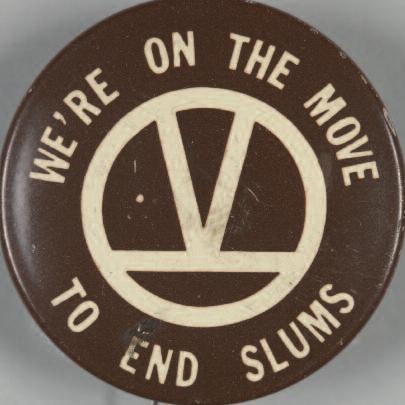
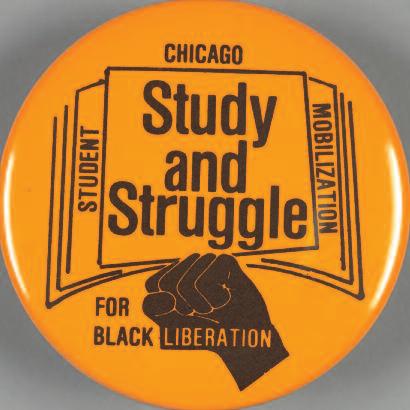
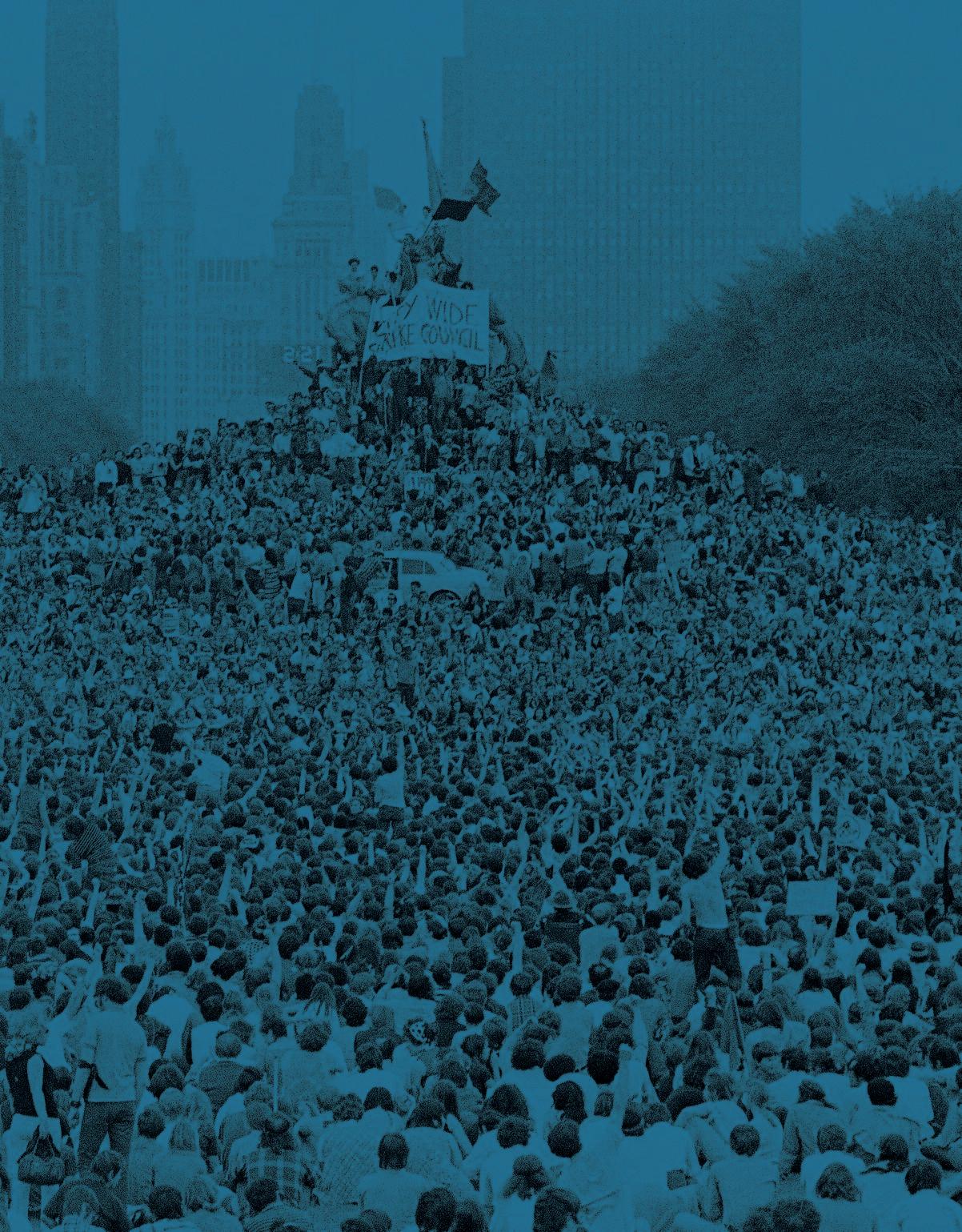
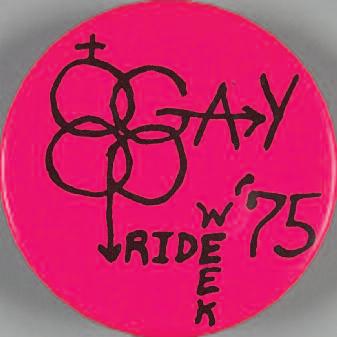
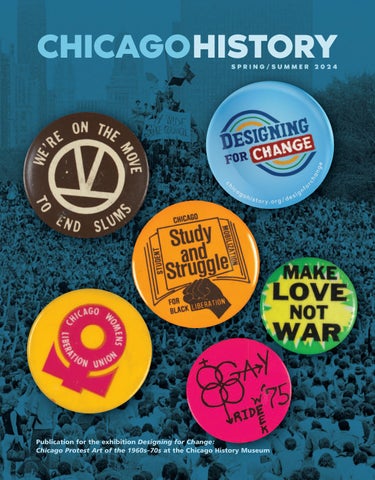
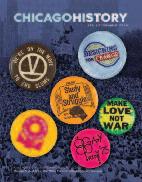
Cover | Background image: rally at Grant Park, May 5, 1970, ST-14002662-0022, Chicago Sun-Times collection, CHM Buttons (clockwise from top left): “ We’re on the Move” button from the Chicago Freedom Movement, courtesy of Busy Beaver Button Museum, Chicago; “Designing for Change” exhibition button, CHM staff; “Make L ove Not War ” button, courtesy of Busy Beaver Button Museum, Chicago; “Gay Pride Week ’75” button, courtesy of Gar y G Chichester; “Chicago Women’s Liberation Union” button, courtesy of Busy Beaver Button Museum, Chicago; “Study and Struggle: Chicago Student Mobilization for Black Liberation” button, CHM, ICHi-179581
Jonathan Skinner
Samuel J Tinaglia
Mark D Trembacki
Ali Velshi
Gail D Ward
Monica M. Weed
J Michael Whitted
Robert R Yohanan
H O N O R A R Y L I F E T R U S T E E
The Honorable
Richard M Daley
The Honorable R ahm Emanuel
The Honorable Lori Lightfoot
L I F E T R U S T E E S
David P Bolger
L aurence O Booth
Stanley J Calderon
John W. Croghan
Patrick F Daly
Patrick W Dolan
Paul H Dykstra
Michael H Ebner
David A. Gupta
Barbara A Hamel
M Hill Hammock
Susan S Higinbotham
Dennis H Holtschneider, CM
Edgar D. Jannotta
Falona Joy
Barbara L Kipper
Judith H Konen
W Paul Krauss
Josephine Louis
R . Eden Martin
Timothy P Moen
Potter Palmer
Jesse H Ruiz
Gordon I Segal
L arr y Selander
Paul L Snyder
T R U S T E E S E M E R
Catherine L Arias
Bradford L Ballast
Gregor y J. Besio
Michelle Bibergal Snow
Matthew Blakely
Paul J Carbone
Jonathan F Fanton
Cynthia Greenleaf
Courtney W Hopkins
Cher yl L. Hyman
Nena Ivon
Gar y T Johnson
Douglas M Levy
Erica C Meyer
Michael A Nemeroff
Ebrahim S Patel
M. Bridget Reidy
James R Reynolds
Nancy K Robinson
April T Schink
Jeff Semenchuk
Kristin Noelle Smith
Margaret Snorf
Sarah D Sprowl
Noren W Ungaretti
L awrie B. Weed
Joan Werhane
*As of March 25, 2024
The Chicago Histor y Museum acknowledges support from the Chicago Park District and the Illinois Arts Council Agency on behalf of the people of Chicago
Following in the footsteps of our Winter 1981–82 (Folk Art of Illinois) and Summer 1985 (Making M u s i c C h i c a g o S t y l e ) i s s u e s , t h i s i s s u
Chicago Histor y Museum’s newest exhibition, Designing for Change: Chicago Protest Art of the 1960s–70s.
The issue follows the course of the exhibition, taking you through the Chicago Freedom Movement, Black Arts/Black Power Movement, anti-Vietnam War movement, women ’ s liberation movement, and gay liberation movement in the 1960s and early 1970s, with a closing section of contemporar y artworks made by Chicago activist artists who continue the city’s tradition of creating visual pieces calling for social change Each article takes a deeper look at a specific topic and is illustrated with items featured in the exhibition Side stories on the Ebony magazine team, Women for Peace, the National Alliance of Black Feminists, and the Lesbian Group of the Chicago Women’s Liberation Union reflect featured subsections within the exhibition.
In the opening essay, exhibition curator Olivia Mahoney takes a closer look at the visual materials of the Chicago Freedom Movement and its use of a distinctive symbol to mark the campaign’s visual identity
Then, Erica Griffin, CHM’s Elizabeth F. Cheney Director of Education, and Skyla S. Hearn, archivist and special collections librarian at DuSable Black Histor y Museum and Education Center, lead us into the
establishing a Black Aesthetic was essential to Black empowerment
The next article is an excerpt by Jonathan Fenderson, assistant professor of African and African American s t u d i e s a t Wa
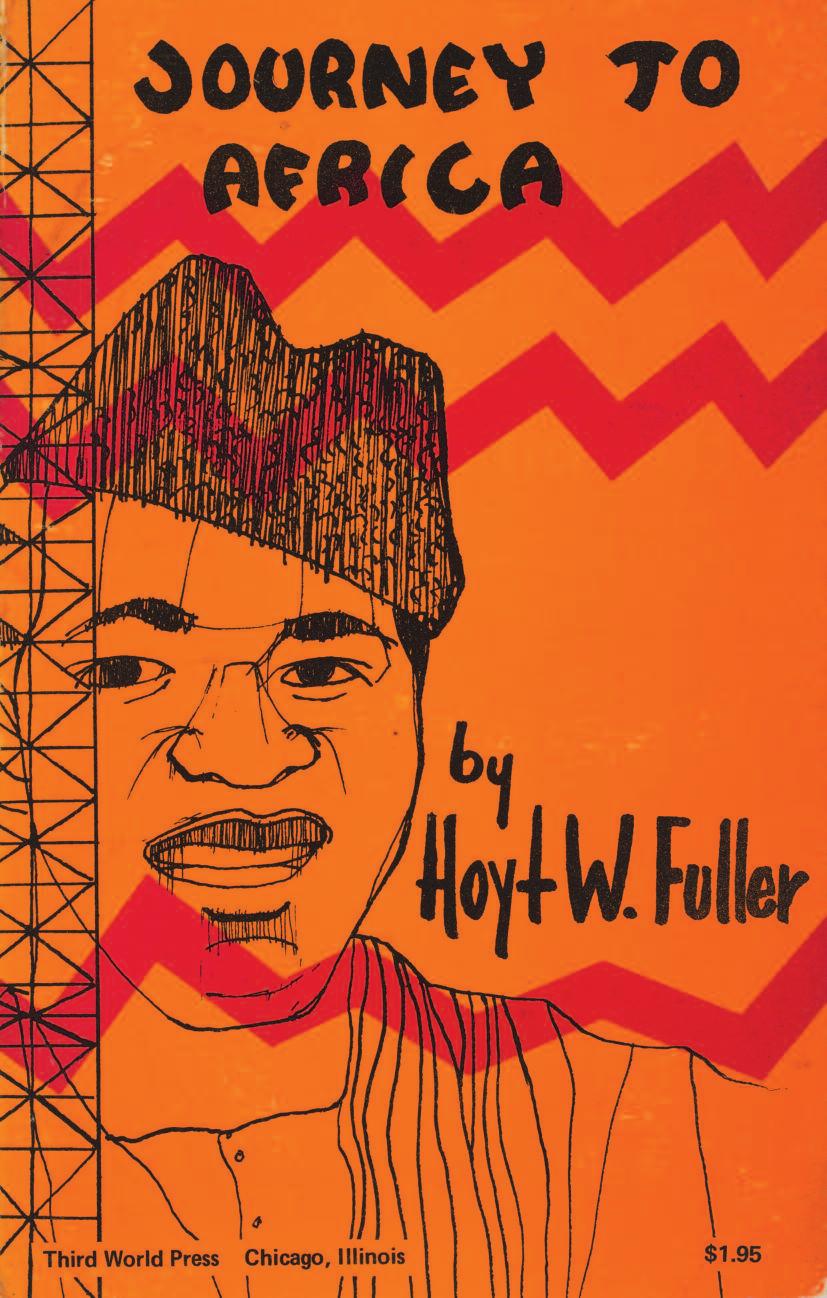
Movement: Hoyt Fuller and the Cultural Politics of the 1960s, which takes an in-depth look at the founding of the Organization of Black American Culture.
“Stop the War,” by Olivia Mahoney walks us through the unprecedented amount of antiwar imager y created in Chicago during the height of the Vietnam War featuring buttons, murals, prints, banners, and radical newspapers that grew more radical as the war progressed.
In the next piece, the words of the Chicago Women’s Liberation Union have been compiled from the C W LU H e r
work in the struggle for women ’ s liberation and their lasting impact
The following essay by Timothy Stewart-Winter, associate professor of histor y at Rutgers University-Newark, features portions of his book Queer Clout: Chicago and the Rise of Gay Politics (2016), with new material written for this publication, on gay and lesbian organizing in Chicago, particularly in the early 1970s
The penultimate piece features the contemporar y artworks that are displayed in the exhibition, leaving you, the reader, to draw connections and divergences between past and present, and the way art can lend a voice in speaking for social change
The final essay in the issue gives you a fascinating behind-the-scenes look with Liz Sorokin, CHM’s conservator for paper and photographs, at how she goes about assessing and conserving printed pieces like the posters and newspapers on display in the exhibition
We hope you are able to visit Designing for Change while it’s open, from May 18, 2024, through May 25, 2025 In the meantime, please enjoy this deeper look at the stories behind the stories
Heidi Samuelson Editor, Chicago Histor
y
Throughout histor y, art has played a critical role in social change This kind of art generally takes the form of mass-produced graphics that have t h e p o w
and foster a sense of identity and solidarity among supporters One of the most famous examples is the coiled r
Chicago, a city with a long histor y of social activism, contributed to the genre with striking images for the abolitionist and labor movements
During the 1960s–70s, when multiple social movements were sweeping the countr y, Chicago became a major center of political and social protest that inspired local artists to create a profusion of works for the Civil Rights, Black Power, anti-Vietnam War, feminist, and gay liberation movements Their works expressed new and often radical ideas about race, war, women, and gender identity that challenged the status quo and met resistance from the mainstream but ultimately transformed American society. They provide a lens or entrée into what these movements accomplished: African Americans achieved greater social equality and a new, more empowering identity; a tragic and costly war ended; women ’ s occupational and political roles greatly expanded; and LGBTQIA+ people achieved greater social acceptance and personal freedom
But not ever y issue was resolved. Indeed, a widespread conservative backlash contributed to the election of President Ronald Reagan in 1980 Since then, the United States has become a deeply divided nation over many of the same issues debated in the 1960s–70s: race, war, gender equality, and LGBTQIA+ rights These and many other issues are prompting a new generation of Chicago artists to create works for change, and they have made the city a leading center of activist art, now called “artivism ” Like their predecessors, they illustrate the critical role that free expression plays in a democratic society where people have the right to protest and make change
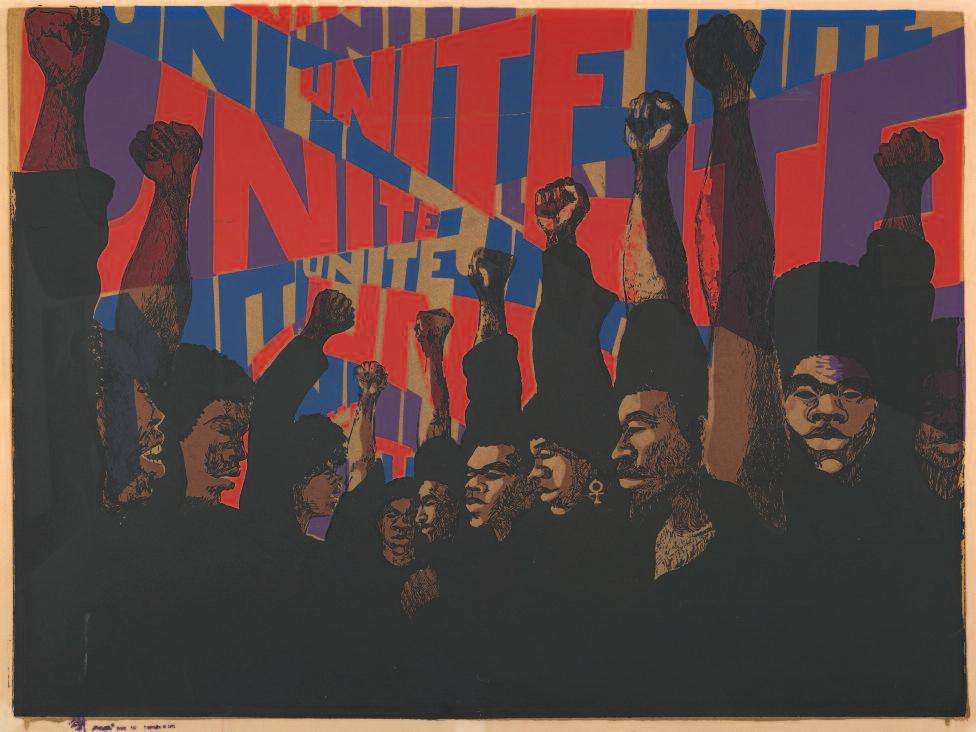
The Chicago Histor y Museum explores this rich but overlooked stor y in a new exhibition, Designing for Change: Chicago Protest Art of the 1960s–70s, on view from May 18, 2024, to May 25, 2025 The exhibition features more than one hundred original artifacts and images, mostly drawn from CHM’s collection, organized in five distinct but related sections: (1) We’re On the Move signs and symbols from the Chicago Freedom Movement; (2) Unite graphic works from the Black Power/Black Arts Movement; (3) Stop the War! art and d e s i g n f r o m t h e a n t i -V i e t n a m Wa r m o v e m e n t ; ( 4 ) Sisterhood is Blooming feminist art from the women ’ s
liberation movement; and (5) Gay Power imager y from the early LGBTQIA+ movement A concluding section, R i s e U p ! , f e a t
Chicago activist artists who address similar issues of social concern and reach a wider audience via the internet and social media
Like all museum exhibitions, Designing for Change is the result of a collaborative process that involved many talented people who improved my efforts beyond measure We were overseen by Donald L assere, the Edgar D and Deborah R Jannotta President and CEO of CHM, and we are grateful for his support. The core team consisted of project director Charles E Bethea, Andrew W Mellon Director of Curatorial Affairs, who supported the exhibition from the beginning and provided invaluable guidance throughout its development; Erica Griffin, Elizabeth F Cheney Director of Education, who expertly led the community engagement effort and developed a series of thoughtful and engaging visitor experiences with her dedicated colleagues Heidi Moisan, senior school programs manager, and Greg Storms, senior public and community engagement manager Paul Durica, director of exhibitions, skillfully managed the complicated process of producing an exhibition; Jamie Topper developed the schematic design plans while Dan Oliver enhanced and perfected them for completion; Mark R amirez, graphic designer, created the outstanding logo and labels; Esau McGhee, production manager, with lead preparator Ethan Gasbarro and museum preparators Taylor Ausley, Elke Claus, Cassidy Cwik, and Joshua Sundermeyer built and installed the exhibition with great care and attention to detail; Judy R adovsky and Michael Hall created mounts to support the objects on display; and volunteer K ate Sheehy took essential meetings notes. Heidi Samuelson, editor and content manager, masterfully edited the exhibition labels, visitor guide, and catalogue essays, while Jojo Galván translated the labels and guide and Bill Van Nimwegen expertly designed the catalog. CHM also enlisted the talents of Ira Murfin and John Szymanski to record and produce audio
Chichester for the exhibition, Mar y J Schrider to fabricate banners for stories about the Chicago Freedom Movement and the National Alliance of Black Feminists, Printlab Professional Studio to create facsimile pieces for display, and Pei Chi Yang to create a series of original murals for the galler y inspired by the works on view.
In addition to the core team, the exhibition involved many other people from departments across the institution. Of special note are staff members of the Abakanowicz
Research Center, the primar y source of materials featured in Designing for Change; they include: Ellen Keith, director of research and access; Lesley Martin, former r e f e
research center associate; Erin Matson, cataloging and metadata librarian; Brigid Crawley, technical services
Elkossei, photocopy/scan assistant; and Annik a Kohrt, research center page. The Collections department, led by Julie Wroblewski, director of collections, also provided essential support with the dedicated efforts of Julie K atz, senior registrar; Jamie Lewis, registrar; Holly Lundberg, senior conservator; Liz Sorokin, conservator for paper and photographs; Maria Paras, conservation technician; Allison Pohl, senior collections manager; and Jessica P
Angela Hoover, rights and reproductions manager, and Natalie Sinclair, rights and reproductions coordinator expertly managed the photography of ever y exhibition piece while Timothy Paton Jr and Renee Mudgett, photographers/imaging specialists, adeptly executed the process and created facsimiles of fragile original paper items to preserve originals for future generations Thema McDonald, vice president of marketing and communications; Arielle Antonio, marketing communications coordinator; Veronica Casados, public communications manager; and Marissa Croft, research and insights analyst, developed creative marketing and publicity campaigns to attract audiences to the exhibition and CHM Michael Anderson, vice president of external engagement and development; Colleen McGaughey, former senior manager of development; Melinda McCrar y, institutional giving officer, Eric Miller, development coordinator, and Eva R achau, director of development, secured critical funding from the Art Design Chicago program of the Terra Foundation for American Art, the Illinois Office of Tourism, and the TAWANI Foundation, as well as funding from the National Endowment for the Arts to support a summer youth art program
To develop the exhibition, we were fortunate to work with a Community Advisor y Council (CAC), supported by the Terra Foundation for American Art, who provided invaluable suggestions and constructive criticism to improve the project. CAC members included: Estelle Carol, cofounder of the Chicago Women’s Graphics Collective; Gar y Chichester, cofounder of the Chicago Gay Alliance; Juarez Hawkins, Chicago artist, educator, and curator; Skyla S. Hearn, archivist and special collections librarian at the DuSable Museum of African American Histor y; and aver y r young, Chicago Poet L aurette In addition, the following individuals provided invaluable
information for the exhibition stor yline: Mar y Lou Finley, James R. R alph Jr., and Don Rose about the Chicago Freedom Movement; Patric McCoy about the Black Arts Movement in Chicago; Maralee Gordon and Patrick Murfin about the Chicago Seed; Estelle Carol, Chris R i d
Graphics Collective; and Gar y Chichester and K athy Munzer about the early LGBTQIA+ movement. Special thanks go to the following people and institutions who generously lent treasured pieces from their collections to the exhibition: Tracy Baim, Charles E Bethea, Busy Beaver Button Museum, Estelle Carol, Mario Castillo, Gar y Chichester, Gerber/Hart Librar y and Archives, David Lusenhop and Stacie Anderson, Patric McCoy, Ty and Lynn McDaniel, and K athy Munzer, while key images came from the Atlanta University Center Robert W. Wo o
R amshaw of Firebelly Design, Getty Institute, Bernard J Kleina, and the McCormick Librar y of Special Collections & U n
Libraries Special thanks go to Arielle Weininger, chief curator of collections and exhibitions at the Illinois Holocaust Museum and Education Center, for connecting me to Gar y Chichester, and to Rebecca Zorach, Mar y Jane Crowe Professor of Art and Art Histor y at Northwestern University, for allowing CHM to use previously taped interviews with artists Barbara Jones-Hogu and Estelle Carol for the Never the Same project
During the project’s research and development stage, also funded by the Terra Foundation for American Art, the following academic scholars reviewed the preliminar y exhibition stor yline and provided critical feedback: Jonathan Fenderson, associate professor, Department of African and African-American Studies, Washington University in Saint Louis; Tuliza Fleming, curator of American art, National Museum of African American Histor y and Culture, Smithsonian Institution; Ann Durkin Keating, Dr C Frederick Toenniges Professor of Histor y, North Central College; T. V. Reed, Buchanan Distinguished Professor Emeritus of American Studies and English at Washington State University; Timothy StewartWinter, associate professor of Histor y, Rutgers University; and Professor Rebecca Zorach. Jonathan Fenderson, Tuliza Fleming, and Timothy Stewart-Winter also reviewed the exhibition labels and offered many helpful suggestions
Finally, I would like to thank my family and friends for their support and encouragement.
Olivia Mahoney, Guest Curator
Designing for Change: Chicago Protest Art of the 1960s–70s
“We’re
O L I V I A M A H O N E Y
Our story about the role of art and design in social movements begins with the Chicago Freedom Movement of 1966, a campaign for open housing in one of the nation’s most segregated cities The movement involved a complex alliance of Civil Rights leaders and activists from both the North and South, principally Albert Raby of the Chicago-based Coordinating Council of Community Organizations (CCCO), Dr Martin Luther King Jr and James Bevel of the Southern Christian Leadership Conference (SCLC), and Kale Williams, executive director of the American Friends Service Committee (AFSC) Their campaign followed in the footsteps of the earlier Civil Rights Movement that achieved passage of the landmark Civil Rights Act of 1964 and Voting Rights Act of 1965 Like its predecessor, the Chicago Freedom Movement adhered to the principles of nonviolence and racial brotherhood but focused on a new and different issue housing.
At the time, tens of thousands of African Americans lived in impoverished areas on the city's South and West Sides, a situation created by Chicago’s deeply rooted racial divisions and high unemployment rates caused by a steady decline of industrial jobs Movement leaders wanted city officials to abolish widespread discriminatory practices in the local real estate and banking industries that prevented African Americans from purchasing homes in white working- and middle-class neighborhoods and surrounding suburbs. Many inner-city residents, however, could not afford to purchase a single-family home, a fundamental flaw in the movement’s planning that created some internal tension and confusion. Nevertheless, racial discrimination in Chicago housing remained a critical issue that needed addressing
The Chicago Freedom Movement began with a festive fundraising event on March 12, 1966, followed by a mass rally on July 10, and in the ensuing weeks, a series of demonstrations, prayer vigils, and mass marches in white neighborhoods where participants encountered a wall of white resistance and hostility.

After several tense weeks, the movement ended in a negotiated settlement with Mayor Richard J. Daley and other city officials, who agreed to reform some aspects of Chicago’s real estate industry but, in reality, changed little Despite its disappointing outcome, the movement brought national attention to conditions of the inner city and influenced Congressional passage (after MLK’s assassination) of the Fair Housing Act of 1968 that prohibits discrimination concerning the sale, rental, and financing of housing based on race, color, national origin, sex, and, as amended in 1988, familial status and disability.
The history of the Chicago Freedom Movement is superbly told in Northern Protest: Martin Luther King, Jr , Chicago and the Civil Rights Movement by James R. Ralph Jr. (Harvard University Press, 1991) and in The Chicago Freedom Movement: Martin Luther King Jr and Civil Rights Activism in the North, edited by Mary Lou Finley, et al (University Press of Kentucky, 2016), but they pay scant attention to the signs or symbols of the movement nor to its distinctive “V” symbol that appeared on buttons, banners, posters, and many other items Studying the symbol expands our knowledge of the movement and the role that art plays in social change
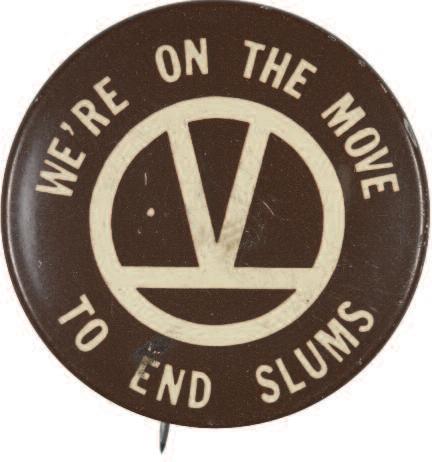
Chicago Freedom Movement button
Early in the campaign, Ann Gillie and Bennie Luchion of SCLC’s public relations committee realized they needed a symbol for the movement After consulting a book on political propaganda at the Chicago Public Library, they created a distinctive symbol that resembled the “V” for victory symbol of World War II and the more contemporary peace symbol of the anti-Vietnam War Movement 1 Their design prompted Don Rose, press spokesperson for the CCCO and MLK, to coin the movement’s official slogan, “We’re on the Move to End Slums ” 2 Together, the symbol and logo created a strong identity for the movement, and they soon appeared on buttons, posters, flyers, and banners used throughout the campaign.
Designed by Ann Gillie and Bennie Luchion, SCLC, 1966 Courtesy of Busy Beaver Button Museum, Chicago
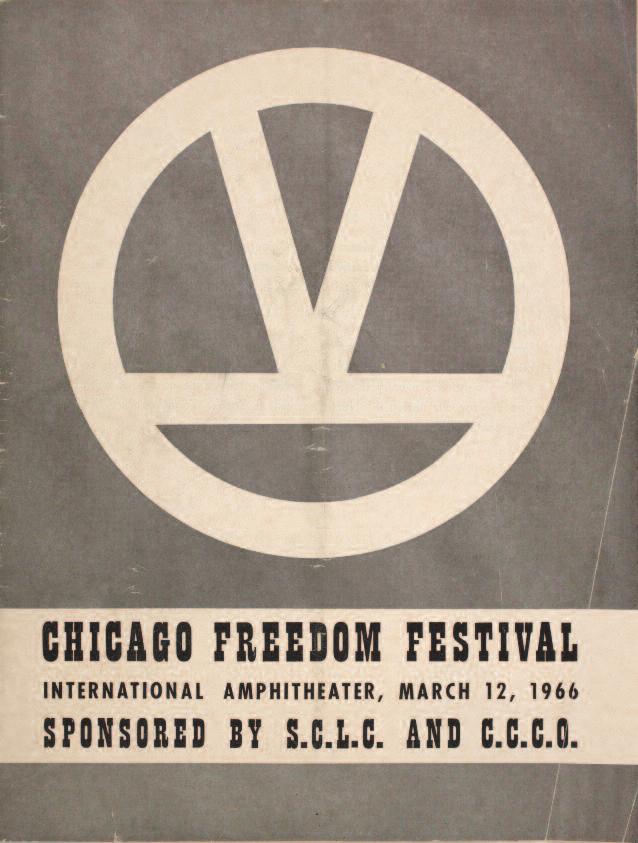
On March 12, 1966, the SCLC and CCCO hosted a special fundraising event for the Chicago Freedom Movement at the International Amphitheatre. About twelve thousand people, including many white supporters, came to watch Mahalia Jackson, Dick Gregory, and Harry Belafonte perform and to hear MLK deliver a keynote address. The program ’ s cover features the movement’s logo, but like most designers at the time, Ann Gillie and Bennie Luchion were not given credit for their creative contribution.
Program for the Chicago Freedom Festival
Cover symbol designed by Ann Gillie and Bennie Luchion, 1966
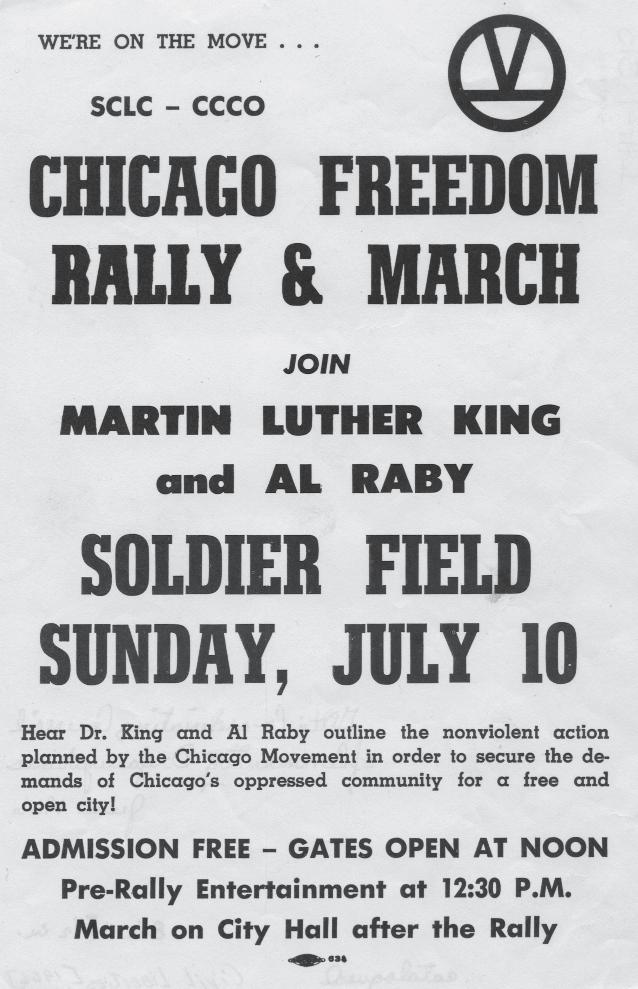
On July 10, 1966, organizers kicked off the Chicago Freedom Movement with a mass rally in Soldier Field About 35,000 people heard King and others speak about their nonviolent plans to achieve “ a free and open city ” After the rally, King led a march of several hundred followers to City Hall where he posted a list of demands for open housing and better jobs on the front door. MLK’s action emulated Martin Luther’s nailing a set of written objections to papal indulgences on a church door in Wittenberg, Germany, in 1517. The flyer's “V” symbol immediately identifies the event with the Chicago Freedom Movement
Flyer for the Chicago Freedom Movement Rally and March Unknown maker, July 1966 Gift of Coordinating Council of Community Organizations (CCCO)
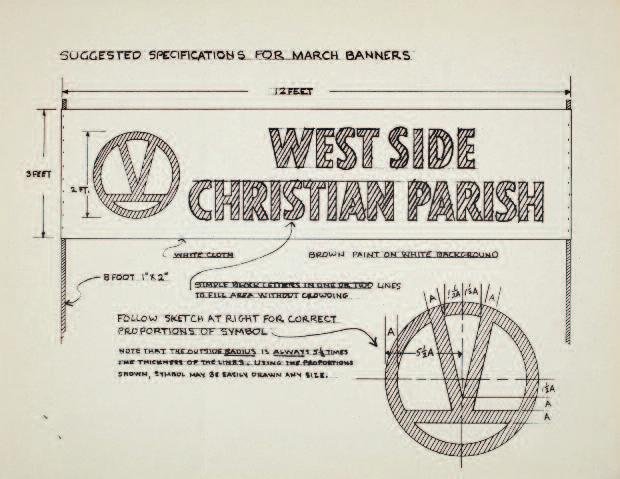
In preparation for the Chicago Freedom Rally and March, coordinator Junius Griffin sent this letter to fellow organizers. The movement’s motto, “We’re on the Move,” is under the movement’s official letterhead that includes his name and those of MLK and Albert Raby Griffin’s letter explains that participants could order a 3’ x 10’ waterproof muslin banner painted with the name of their organization and the movement’s official symbol for $10 from Mr Vernon Guider of Display
Associates Specifications for making a banner were included; they called for using brown paint on a white background and simple block lettering. The instructions note that by “using the proportions shown, the symbol may be easily drawn at any size.”
Photographs taken at the July 10 rally show that signs with the symbol were present, but no banners are visible. However, a color image of the march in Marquette Park on August 5, 1966 (see p. 15) shows two large maroon banners emblazoned with the white “V” symbol leading the procession.
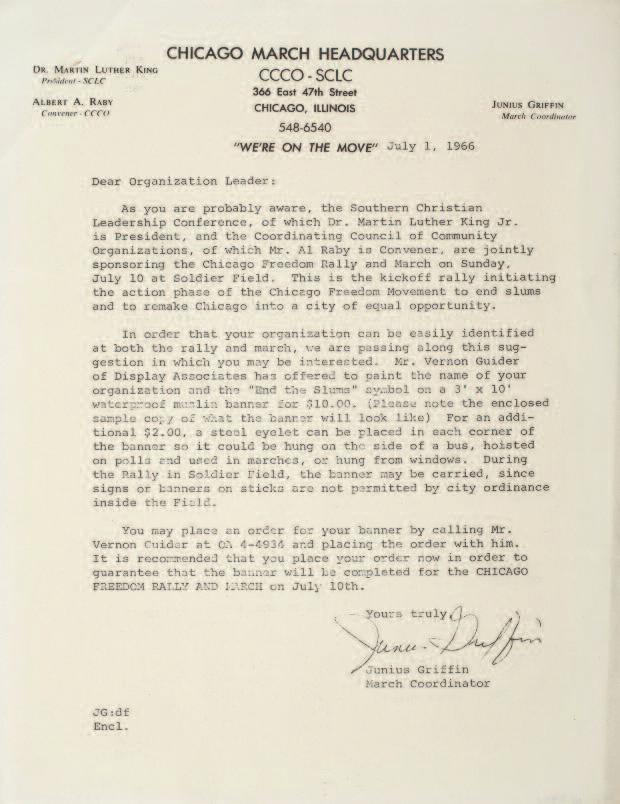
Letter and suggested specifications for Chicago Freedom Movement banners
July 1, 1966
Gift of Coordinating Council of Community Organizations (CCCO)
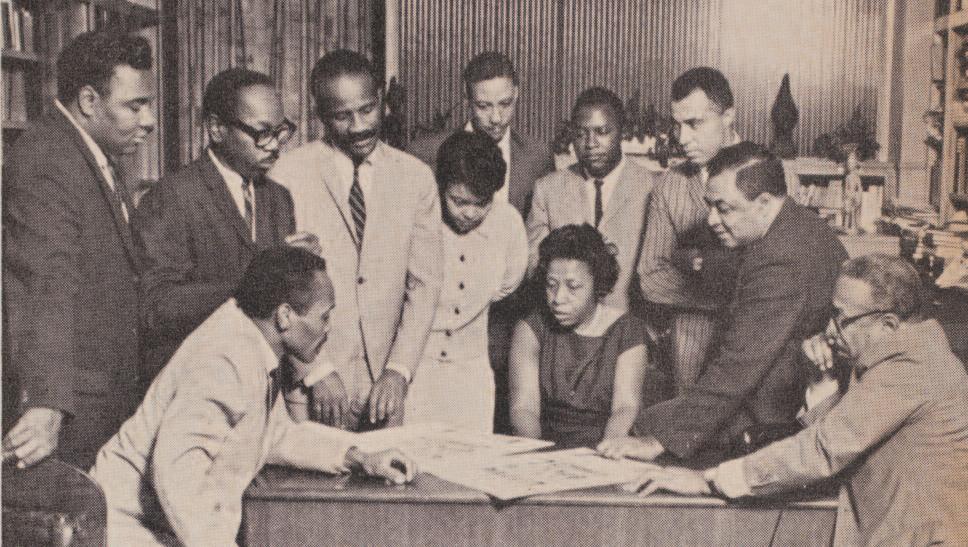
Renowned for their superb photography, Ebony magazine also featured works by a talented team of graphic artists who created a new image of African Americans in popular culture Their portraits of Black people reached millions of readers nationwide and countered racist caricatures like the everpopular “Aunt Jemima” mammy figure Founded in 1945 by John H Johnson, Ebony primarily focused on African American achievement and celebrity, but they paid an increasing amount of attention to issues of race and social justice during the 1960s–70s. Beginning in 1963, Ebony
published a special annual issue devoted to timely themes with dramatic covers that made them bestsellers. They were created by art director Herbert Temple Jr , a graduate of the School of the Art Institute of Chicago (SAIC), and his colleagues Norman L. Hunter, who attended the Institute of Design at the Illinois Institute of Technology, and Cecil Ferguson, a younger graduate of the SAIC. Temple, Hunter, and Ferguson were also responsible for page layouts and the overall look and feel of Ebony Racial barriers meant their career opportunities were restricted, but their work for Ebony reached a
national audience and provided them with long and successful careers. In addition, they illustrated articles about African American history written by senior editor Lerone Bennett Jr., designed the covers of his African American history books, and created exterior and interior artwork for Ebony’ s sister magazines Negro Digest/Black World and Jet.
Two of Ebony’ s most notable magazine covers are featured here The first, published in September 1963, commemorates the 100th anniversary of the Emancipation Proclamation issued by President Abraham Lincoln on January 1, 1863, that declared freedom for millions of enslaved African Americans. But, instead of featuring Lincoln, managing editor Herb Nipson and staff artist Norman L Hunter updated a period photograph of noted African American abolitionist Frederick Douglass, who often criticized Lincoln for moving too slowly on ending slavery during the Civil War. Interior articles included one by Bennett titled “Frederick Douglas: Father of the Modern Protest Movement” and many others about the Civil Rights Movement and African American politics, art, and literature This edition remains one of Ebony’ s bestselling issues of all time.
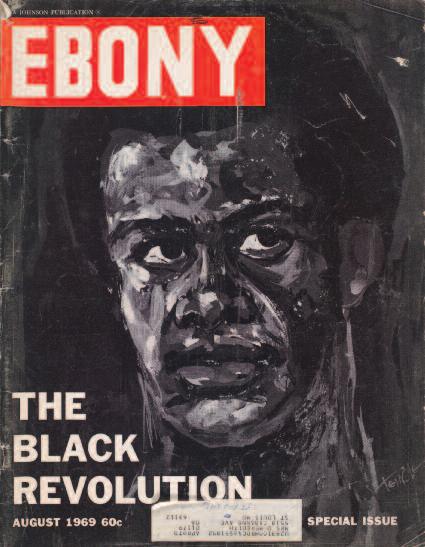
The second cover reflects the transformational shift from Civil Rights to Black Power that occurred during the late 1960s. It features a dramatic portrait of a “Black Revolutionary” originally painted by Herbert Temple Jr and photographed for the cover. Interior articles express diverging views about the movement, from the favorable “How Black is Black?” by sociologist Charles V. Hamilton who co-authored Black Power with Stokely Carmichael, and “The Black Panthers” by their founder Huey P Newton, to the more critical “The Myth of the Revolutionaries” by longtime Civil Rights leader Bayard Rustin Like other Ebony issues from the time period, The Black Revolution helped document and preserve a critical chapter of African American and national history
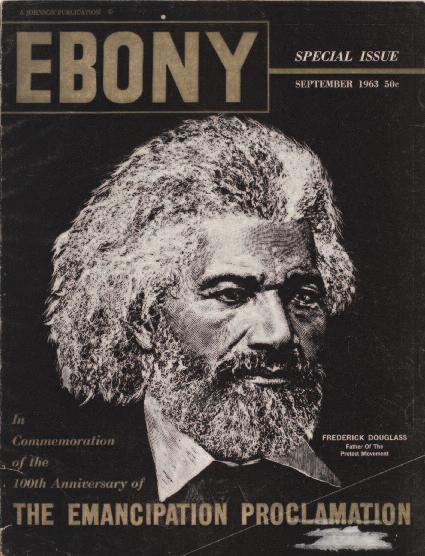
September 1963
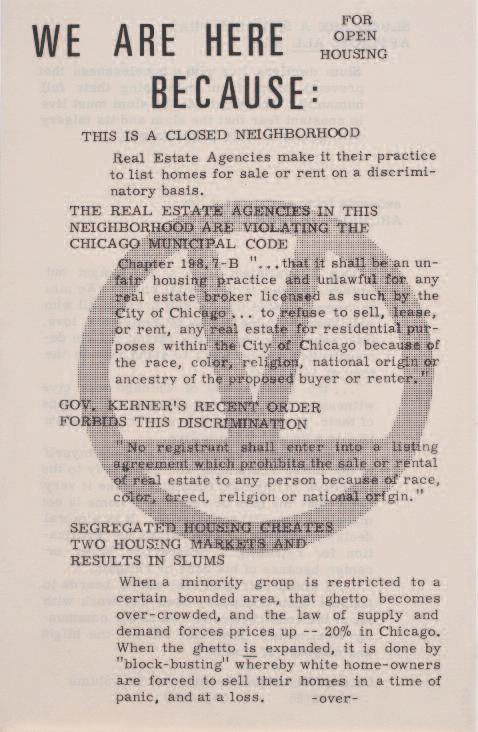
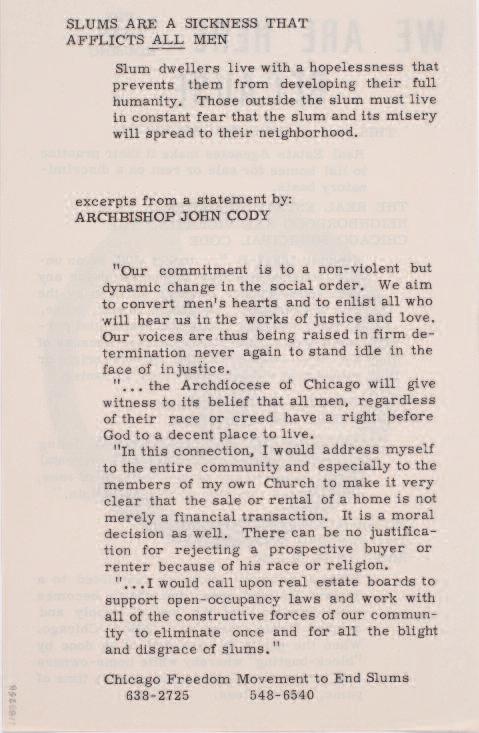
When the Chicago Freedom Movement demonstrated in front of real estate offices in white neighborhoods, they distributed flyers marked with their “V” symbol and statements about the unlawful breaking of city and state antidiscrimination codes already on the books The lower third of the flyer explains how “segregated housing creates two housing markets and results in slums” and points out that the “ghetto is expanded by ‘block busting’ whereby white homeowners are forced to sell their homes in a panic, and at a loss.” The backside carries a statement from Catholic then-Archbishop John Cody, “Our commitment is to a non-violent but dynamic change in the social order I would call upon real estate boards to support open-occupancy laws and work with all of the constructive forces of our community to eliminate once and for all the blight and disgrace of slums ” The donor, Kale Williams, directed the Chicago regional office of the AFSC and helped organize the Chicago Freedom Movement; Williams subsequently cofounded the Leadership Council for Metropolitan Open Communities that he led for more than twenty years.
Real estate flyer for the Chicago Freedom Movement (front and back) Gift of Kale Williams
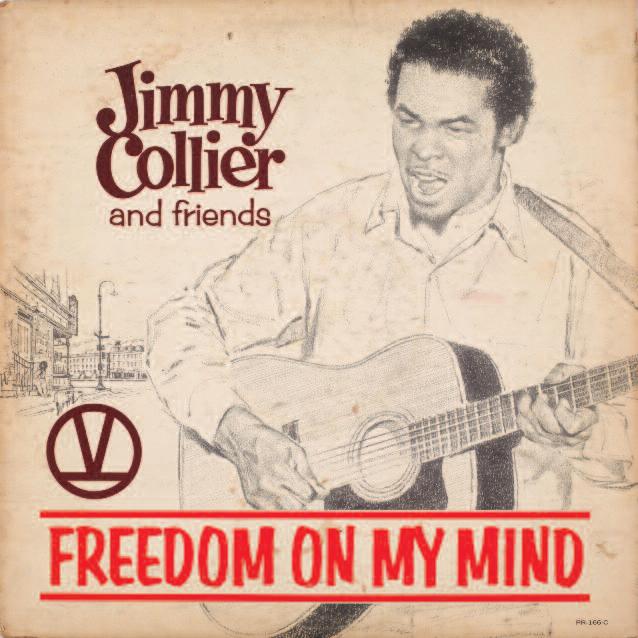
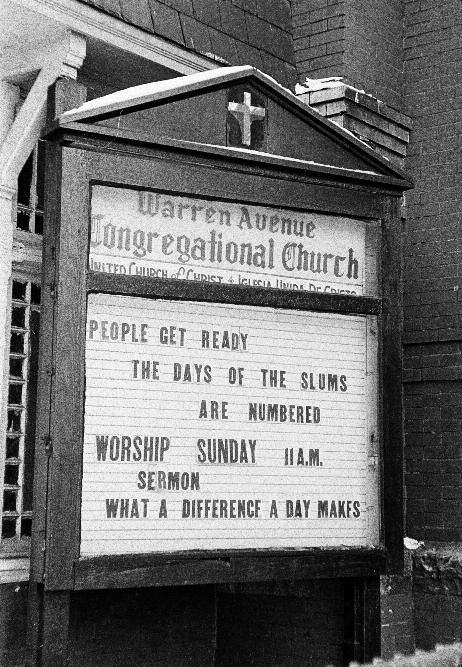
A staple of the early Civil Rights Movement, music also played a key role in the Chicago Freedom Movement Folksinger Jimmy Collier had accompanied MLK in the South where he primarily played folk songs and African American spirituals, but he learned that Chicago audiences preferred a more modern sound As he noted, “The movement music had to be a young music; it had to catch people and engage them right away ”3 His album (above), Freedom On My Mind marked with the Chicago Freedom Movement's “V” symbol featured old standards like “This Little Light of Mine” and some newer compositions like “Rent Strike Blues ” Collier recorded the album at Parish Records, Inc., located at Warren Avenue Congregational Church on the West Side that served as SCLC’s headquarters during the Chicago Freedom Movement. Note that the sign (right) reads, “People Get Ready,” the title of a popular song by the Impressions of Chicago (later known as Curtis Mayfield and the Impressions) that became the unofficial anthem of the Chicago Freedom Movement 4
Freedom On My Mind Record album by Jimmy Collier and Parish Records, Inc., Chicago, 1966
Sign at Warren Avenue Congregational Church, Chicago, January 19, 1966
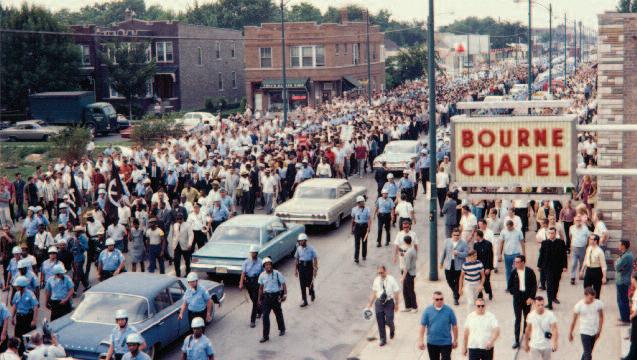
On August 5, 1966, the Chicago Freedom Movement staged one of its largest marches in Marquette Park, a white working-class neighborhood on the city’s Southwest Side. Participants met a wall of resistance and hostility punctuated by sporadic violence at previous marches, but none at the level seen in Marquette Park where this photograph was taken. It shows a large crowd of about 500–700 people marching peacefully down South Kedzie Avenue; visible on the far left side are two large banners with a white “V” symbol set against a dark maroon background.
1. Mary Lou Finley in an email to Olivia Mahoney, January 25, 2023.
2 Email correspondence between Don Rose and Olivia Mahoney, December 7, 2023
3. Mary Lou Finley, et al., The Chicago Freedom Movement: Martin Luther King Jr and Civil Rights Activism in the North (Lexington: University Press of Kentucky, 2016), p 331
4. Ibid., p. 338
Chicago Freedom Movement march in Marquette Park
Photograph by Bernard J Kleina, August 5, 1966
Courtesy of Bernard J. Kleina
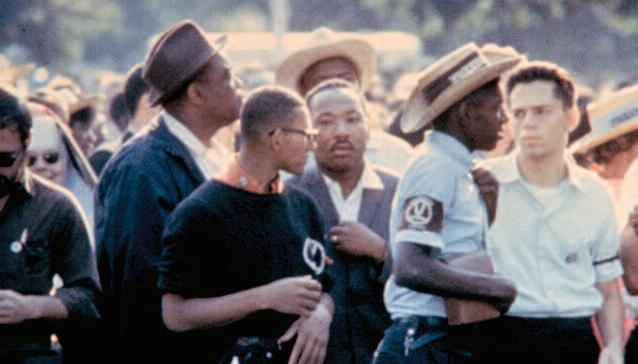
Martin Luther King during the Chicago Freedom Movement march in Marquette Park
Photograph by Bernard J Kleina, August 5, 1966
Courtesy of Bernard J. Kleina
A Word on Art and Conjured Meaning
“Don’t you hear us in the music?” my grandmother said from her lofty position at the piano she had in her front room I loved sitting with her as a little girl as she practiced in preparation for Sunday worship services. I’d nod my head, close my eyes, and just about feel the warmth from those gospel chords washing over the room What I h e a
family and my community, my people. Art is like that it c
society to allow for quick transfers of ideas social, political, or otherwise In Designing for Change, Chicago arts production of the 1960s and ’70s provides proof of this c
immutable societal fact: art and social movements reflect each other, informing each other as societies continue to reconcile with the past as it has imprinted the present, and will inform the future
When the opportunity to contribute to this publication arose, we jumped at the opportunity to collaborate as dear friends and colleagues, as cultural heritage professionals and legacy keepers, and as forward moving solutionaries
We met working tirelessly, with devotion to our culture, leading education, archives, and special collections initiatives at what was formerly known as the DuSable Museum of African American Histor y We bonded over our reverence f o r t h e D u S a b l e ’ s p r
B u r r o u g h s , who served as our catalyst, spearheading countless educational public engagements for the purposes of edifying museum guests and the public on the knowledge of African American histor y and culture through access to the DuSable’s archives and objects collections.
We k n e w o u r a r t i c l e w o u l d c e n t e r o n t h e B l a c k a r t s worlds feat ured i n t h e De sig
on, but deciding how to frame our article was no easy feat
We c o n s i d e
working as community, institutional, and museum advisors, managing and facilitating emerging arts professional l
projects that focused on many of the Black artists in the exhibition Strong considerations were made toward singularly lifting Dr Burroughs, but what continued to reso
and philosophies of the featured artists in the exhibition and mirrored practices across arts practices in the time
t h a t p o s i
progress We are inspired by how relevant and impactful
t
Chicago, the design principles and agreed upon practices that produced visual responses in advocacy for Black liberation and led to the development of a new and distinct Black cultural aesthetic.
In a contemporar y take on a classic folktale inspired by Ae s
Game? The Ant or the Grasshopper?” highlighted the symbiotic nature of relationships, the reality of codependency, and revealed the impact of value imbalances in societal structures In our world, art music, vernacular language, poetr y, theater, paintings, screen printing, and other forms of visual imager y and society exist in a type of codependence, with art serving as a critical means to communicate
messages and build understanding across society. This role is often undervalued, and instead of regarding art as a critical part of societal structure, it is seen as a nonessential byproduct of human life In the Morrisons’ stor y, the argument between the ant and the grasshopper is on the principle of art as work and art as an essential part of society While both characters agree on the need, the want and placement of art are disputable points of contention.1
communicate the legacy of activist art in Chicago and to
the exhibition, providing visitors with an understanding that art has often been in the service of activism and to provide them with a new lens to engage art 2
In socio -political structures centered on art as necessity, art and social movements are intrinsically linked, inform each other, and provide context and a language to build meaning, understanding, and solidarity in societies toward social change. Designing for Change is a strong discussion on “movement culture the art, objects, ephemera, pho-
tographs and visual culture that emerges directly out of movements by the participants themselves ”3
T h e ex h i b i t i o n d i r e c t l y l
artists to efforts to combat injustice, improper represent
works of these artists become crucial tactics to aid in the success of the linked social causes And it is crucial that t h
truths This article endeavors to demonstrate the connection between art and societal impact through an explor
t i o n o f ke y B
amplification of Black Power.
The mutualistic symbiosis between Black social progressivism and Black art has an ancestor in Chicago’s turn of the centur y Black population boom Spurred on by the r a p i d w a
Chicago’s Black population would expand exponentially i
chance at “the American dream” left the severe Jim Crow s
was reinforced by racially discriminator y housing practices and social codes Most of this newly arrived Black population would find themselves relegated to a narrow strip of land between 18th Street and 31st Street called the Black Belt or the Black Ghetto.4 The conditions were cramped but created a sense of safety away from the race hatred smoldering outside of the borders and seeded circ
large population produced a rich cadre of creative, social, a
Black experiences and name the oppressive systems that had a hand in ordering them
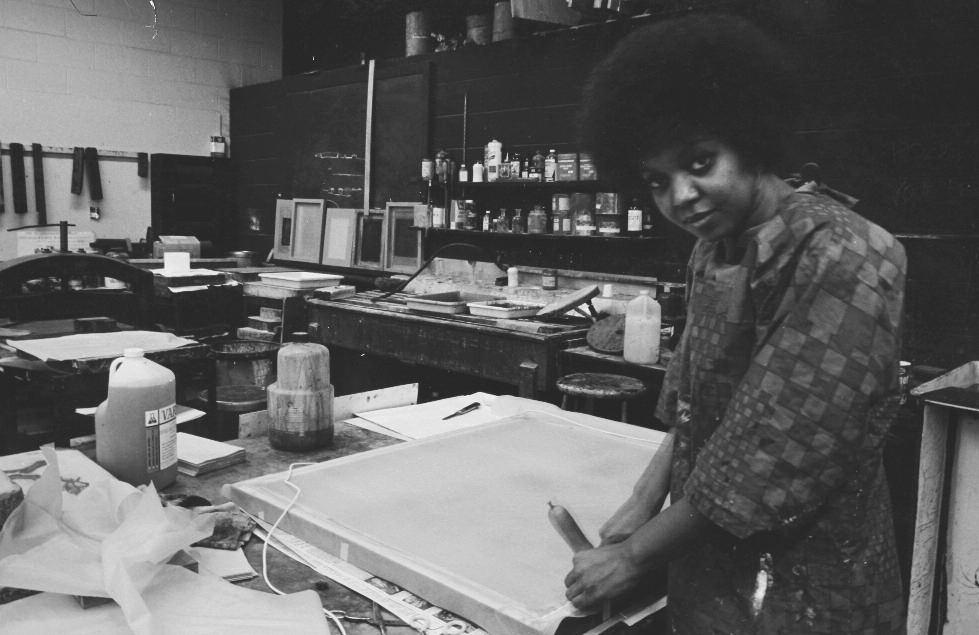
center for Black thought shared through Black art. The canons of work from muralist and painter Charles White a n d p r i n t m a
exemp la rs of soci a l p urp ose- d ri ven
ophy. Both White and Burroughs chronicled Black hist o r y a n d
Chicago Renaissance and the start of the Black Art/Black Power movement, Black arts production in Chicago continued to create work in response to social movements
Movement The movement saw the “ We’re on the Move to End Slums” symbol turn up on newsletters, arm bann e r s , b u t
, building solidarity for the movement through a symbol
To a c c el er a t e t h e p a t h
center self-determination over legislative tactics, factions of the Civil Rights Movement split off from the seemingly moderate movement Black Power became the battle cr y and Black arts and culture served as a vanguard heralding the shift in ideology and culture In Chicago, this sociocult ural sh i ft h ad a deep i mpact on Black art s workers The call to build Black pride as a self-determined pathway to liberation had a profound impact of Black Chicago residents and the countr y and necessitated arts production a s a c a t a l y s t t o s p r e a d t h
a g e T
A r t s Movement, coined by Amiri Baraka (formerly Leroi Jones) was cultivated initially in New York and spread to cities across the countr y In Chicago, performers, intellectuals, p o e t s , w r i t e r s , a n d a r t i s t s s u c h
n B r o o k s , the Black Women’s Committee, Elizabeth Catlett, Lorraine Hansberr y, Barbara Jones-Hogu, Angela Jackson, Carolyn Marie Rodgers, Bob Black, and Ozier Muhammad added to the rich network of activist artists In fact, Chicago produced seminal works that exist today in the canon of the Black Arts Movement 5
The Organization of Black American Culture (OBA- C; pronounced as Oh-Bah-See) stands as an example of the power of positive visual representation and community collaboration OBA- C was realized in 1967 by sociologist A b d u l A l k a l i m a t ( f o r m e r l y G e r a l d M c Wo r t e r ) , e d i t o r Hoyt Fuller, and poet Conrad Kent Rivers on Chicago’s S o u t h S i d e t o s h a r e a v i s i o n o f B l a c k E x p e r i e n t i a l i s m unfettered by White aesthetics or supremacist ideals and informed by key concepts of the Black Power Movement In The Wall of Respect: Public Art and Black Liberation in 1 9 6 0 s C h i c a g o , c o f o u n d e r o f O B A- C A b d u l A l k a
i m a t summarized their focus as “opposite to the racist negation of the Black experience as deviant and inferior ”6
O B A- C w a s d e t e r m i n e d t o g a l v a n i z e t h e i r m e m b e r -
s h i p b a s e o f a r t i s t s , i n t e l l e c t u a l s , a n d c o m m u n i t y workers to work toward the goal of bringing to the Black community indigenous art forms that reflect and clarify the Black experience in and to focus the energy of Black p e o p l e t o w a r d a n a p p
h u m a n p o s s i b i l i t i e s T h e i r c a r e f u l c o n s i d e r a t i o n s a n d
c l o s e c o l l a b o r a t i o n s w i t h B l a c k c o m m u n i t y m e m b e r s
w o u l d l e a d t o t h e p r o d u c t i o n o f a g u i d i n g p h i l o s o p h y
a n d r e l a t e d g o a l s f o r O B A- C a n d f o r t h e i n v o l v e m e n t and impact on Black communities and Black-supporting organizations. The Wall of Respect became their seminal 20 | CHICAGO HISTORY | Spring/ Summer 2024
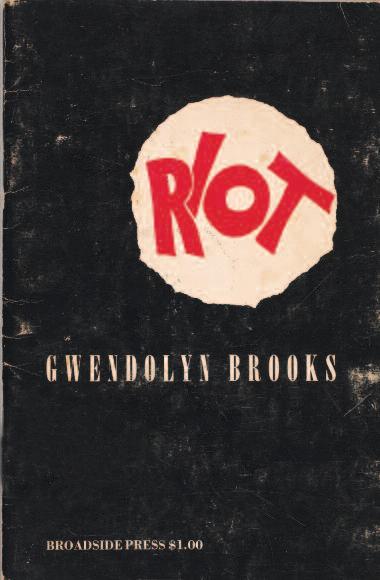
Riot | Written by Gwendolyn Brooks with cover designed by Jeff Donaldson | Broadside Press, Detroit, Michigan, 1969 Courtesy of Charles E Bethea
w o r k b o r n o f t h e i r d e t e r m i n a t i o n t o ex p r e s s B l a c k
Experientialism through the celebrator y presentation of
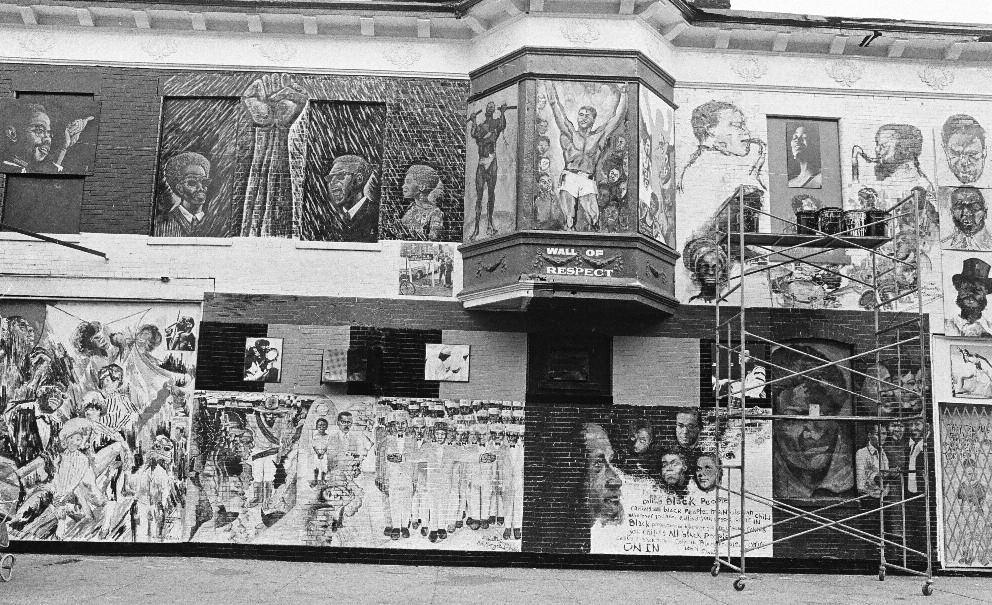
B l a c k h e r o e s a n d h e r o i n e s . Fi r s t p a i n t e d i n 1 9 6 7 , t h e
Wa
l l o f R e s p e c t s t o o d a t t h e c o r n e r o f 4 3 r d S t r e e t a n d
L a n g l e y B o u l e v a r d i n t h e B r o n z e v i l l e n e i g h b o r h o o d
C o v e r i n g t h e s i d e s o f a t w o - s t o r y b u i l d i n g , t h e Wa l l o f
R e s p e c t f e a t u r e d d o z e n s o f B l a c k h e r o e s i d e n t i f i e d i n
c o n v e r s a t i o n b y t h e O B A- C a r t i s t s a n d c o m m u n i t y members The goals of this project resonated with Black Power sentiment:
•To work toward the ultimate goal of bringing the Black C o m m u n i t y i n d i g e n o u s a r t f o r m s w h i c h r e f l e c t a n d clarif y the Black Experience in America
•To r e f l e c t t h e r i c h n e s s a n
B l a c k Histor y and Culture
•To p r o v i d e t h e B l a c k C o m m u n i t y w i t h a p o s
fimage of itself, its histor y, its achievements, and its possibility for creativity7
The heroes selected were Black people who excelled in their respective field, remained closely tethered to and supportive of Black communities, reflected the beauty of Black life, and had connections to Chicago The Wall was developed at a time when Black people were absent from mainstream American life or were portrayed in stereotypes. The
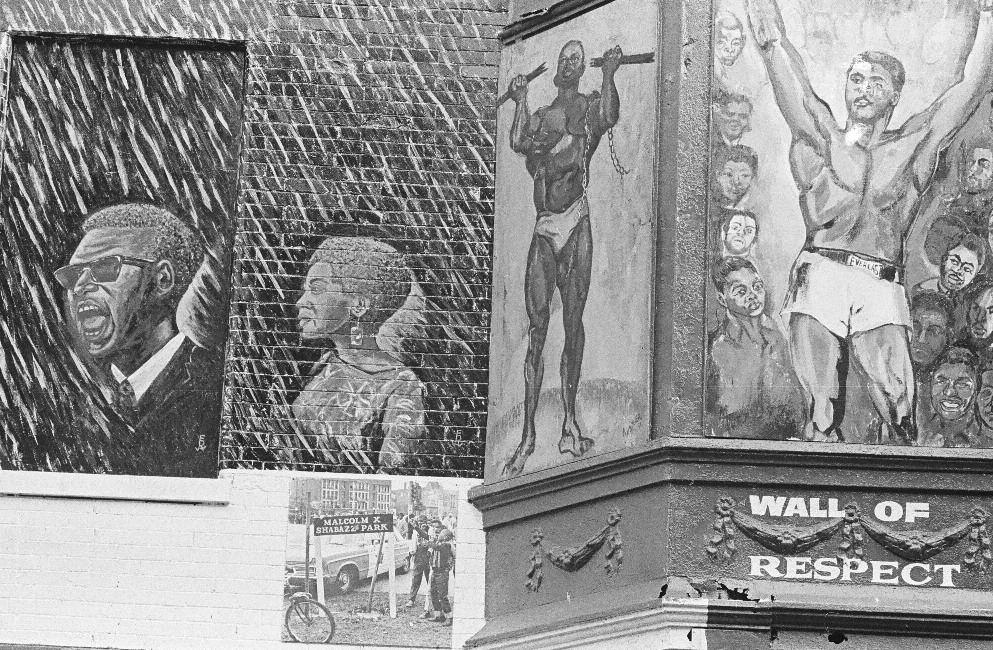
Portions of the Statesmen and Athletes sections of the Wall of Respect | September 29, 1967 | ST 70005221 0002, Chicago Sun-Times collection CHM
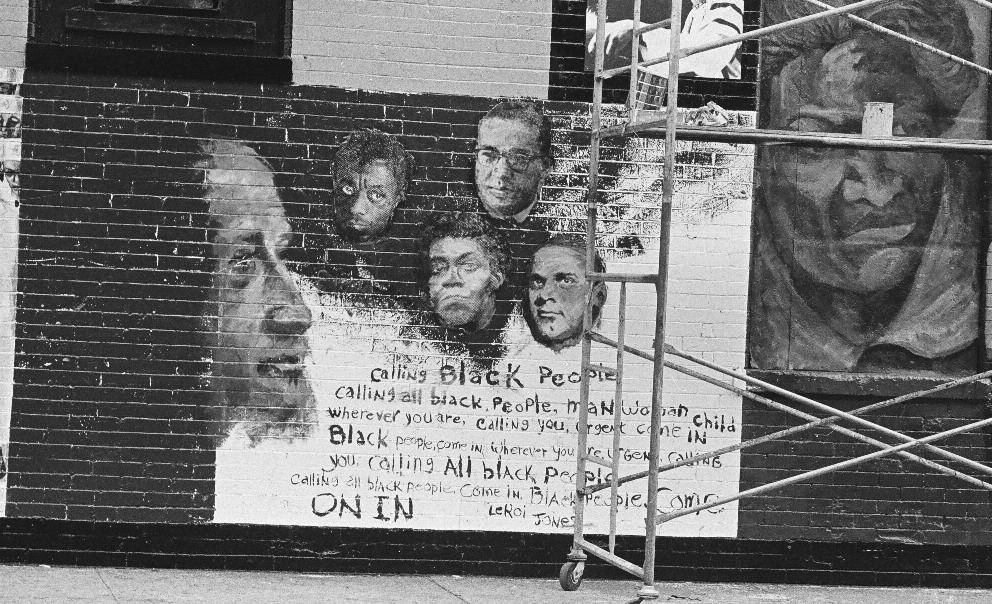
Portions of the Literature and Theater sections of the Wall of Respect | September 29, 1967 | ST-70005221-0003, Chicago Sun-Times collection, CHM
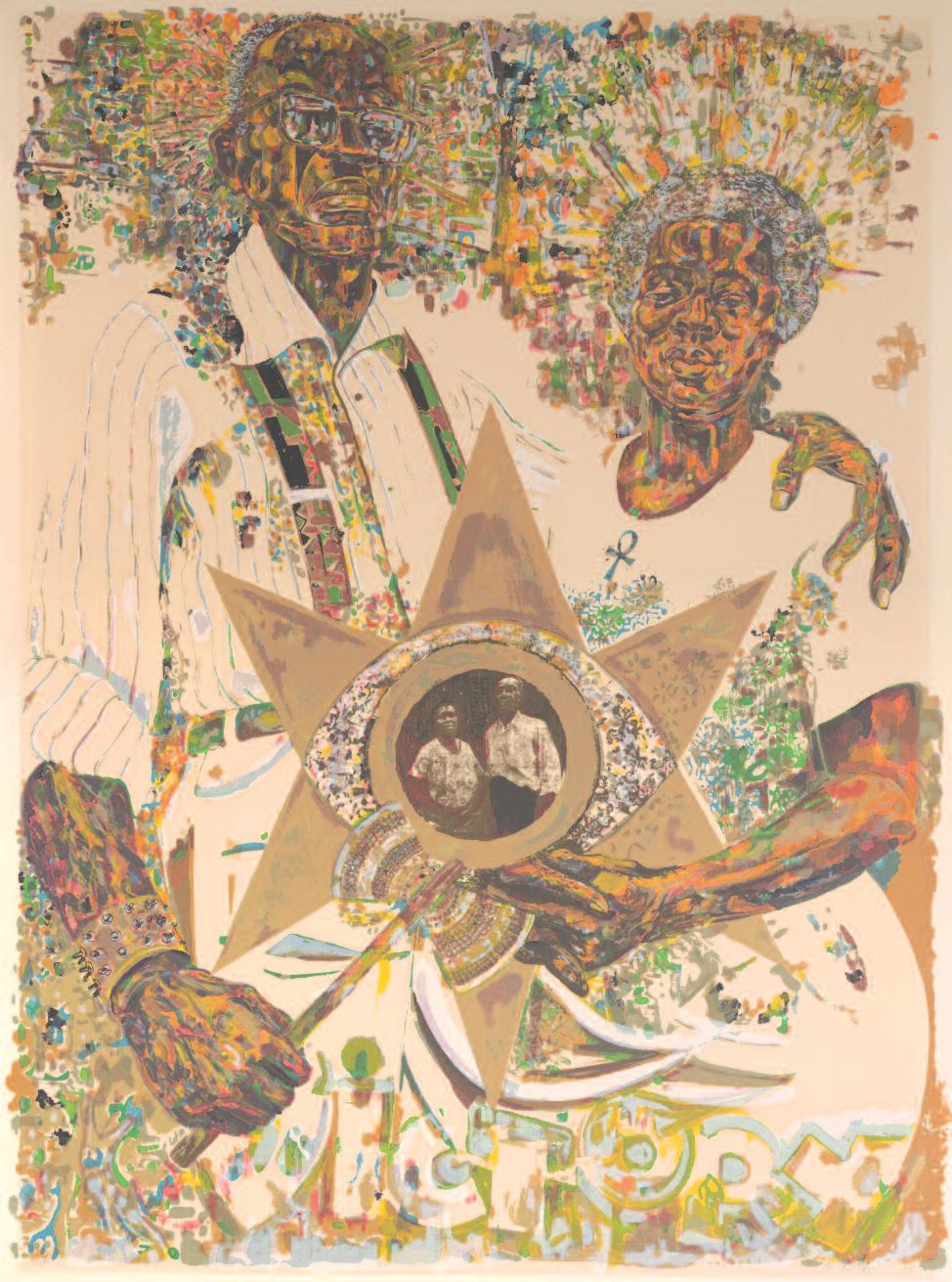
involvement of community was central to the selection of the figures depicted on the wall, and the community kept it safe during the creation phase The Wall served as a public performance and community gathering space after its completion, hosting local community activations and, in 1967, the Student Nonviolent Coordination Committee (SNCC) rally and the Black Festival of Creativity Although the Wall was destroyed in a fire in 1971, the Wall of Respect reso n a t e d a c r
movement Its legacy continues as a testament to the contributions of Black people on American society and the impact of visual art to communicate messages, build solidarity, and inspire action
Fr o m t h e o u t p o u r i n g o f c r e a t i v e ex p r e s s i o n t o a m
the realities of Black life in Chicago and name the racet
ng ed
Against Fear, to OBA- C ’ s self-determined and larger-thanlife commemorative statement on Black heroes by Black p e o p l e , t h
swell in concert in Chicago. Born out of continued coll a b o r a t i o n b e t w
, the African Commune of Bad Relevant Artists (AfriCOBRA) w o u l d d e v e l o p a s e t o
resolve into a singularly Black aesthetic.
AfriCOBRA chose to paint in vivid Kool-Aid colors a k a flavors: grape (purple), lemon-lime (bright green), cherr y (bright red), orange, raspberr y (blue) and strawb e r r y ( p i n k ) 8 t o a m p l i f y t h e
tional Black Power phrases and the “Black is Beautiful” aesthetic and Movement In an interview, Barbara JonesHogu wittingly said, “Ever yone was drinking Kool-Aid. . . ” a n d a l l u d e d t h a t t h e c o l
E N D N O T E S
1. See Toni and Slade Morrison, Who’s Got Game? The Ant or the Grasshopper? (New York: Simon and Schuster, 2003)
2. Nicholas L ampert, A People’s Art Histor y of the United States: 250 Years of Activist Art and Artists Working in Social Justice Movements (New York: The New Press, 2015)
3. See L ampert, A People’s Art Histor y of the United States
4. See Office of Community Affairs and Outreach Programs, “Histor y of Bronzeville,” Illinois Institute of Technology, https://www iit edu/communityaffairs/about/histor y-bronzeville
impossible to look away from. Jones-Hogu stated further that “AfriCOBRA was deliberate with using syncopated, rhythmic repetition that constantly changes in color, texture, shapes, form, pattern, and feature ” 9
N
Af r i C O B R A’ s 1 9 6 9
communities AfriCOBRA and one of OBA- C ’ s founding members, Jeff R . Donaldson, wrote that the goal was “to p r e a c h p o s i t i v i
metric abstraction and realistic imager y This positivity b e c a m
rate into personal adornment, speech, and sensibilities. Where OBA- C painted boldly to proclaim Black Power in B l a c k c o m m u n i t i e s , Af r i C O B R A
Power-informed color and design The Black arts production in Chicago during the 1960s–70s activated the ideology in vivid, larger-than-life detail
We often have ongoing conversations where we muse o v e r t h e i m p o r t a n c e o f r e c o g n
s e n t . We d i s c u s s t h e l o v e w e s h a r e
f
n
l e d b y
ancestors to uplift our cultural heritage, our commitment t o o u r c i v i c r e s p o n s i b i l i t i e s , a n d o u r r e s p o n s i b i l i t y t o b u i l d p a t h w a y s t o f o s t e r u n d e r
m
that summon the shapes of our society. This article repr e s e n t s a n o f f e r i n g o f o u r o n g o i n g c o n t e m p l a t i o n s a n d presents a primer on art as activism evidenced through the work of key members of Chicago’s Black arts world o f t h e 1 9 6 0 s – 7 0 s f e a t u r e d i n t h
exhibition at the Chicago Histor y Museum
E r i c a G r i f f i n i s a s e l f- c o
C h
n
, m e e t i
curiosity into histor y with equitable lear ning pathways
S k y l a S H e a r n i s
cultural heritage sector.
5. Poetr y Foundation editors, “ The Black Arts Movement: An Introduction Showcasing One of the Most Influential Cultural and Aesthetic Movements of the L ast 100 Years,” The Poetr y Foundation, https://www poetr yfoundation org/collections/148936/an-introduction-to -theblack-artsmovement#: :text=The%20 Black%20Arts%20Movement%20was, chants%2C%20slogans%2C%20and%20 rituals%20of
6. See Abdul Alk alimat, Rebecca Zorach, and Romi Crawford, The Wall of Respect: Public Art and Black Liberation in 1960s Chicago (Evanton, IL: Northwestern University Press, 2017)
7. “Culture Conscious in Chicago,” Negro Digest vol 16, no 10 (August 1967): 85–87
8. Teresa Kreutzer-Hudson (contributor), “ What’s Cooler than Kool-Aid?,” Histor y Nebrask a, https://histor y nebrask a gov/publications section/kool-aid/
9. Barbara Jones-Hogu, Resist, Relate, Unite, Exhibition Catalog (Chicago, DePaul Art Museum, 2018)
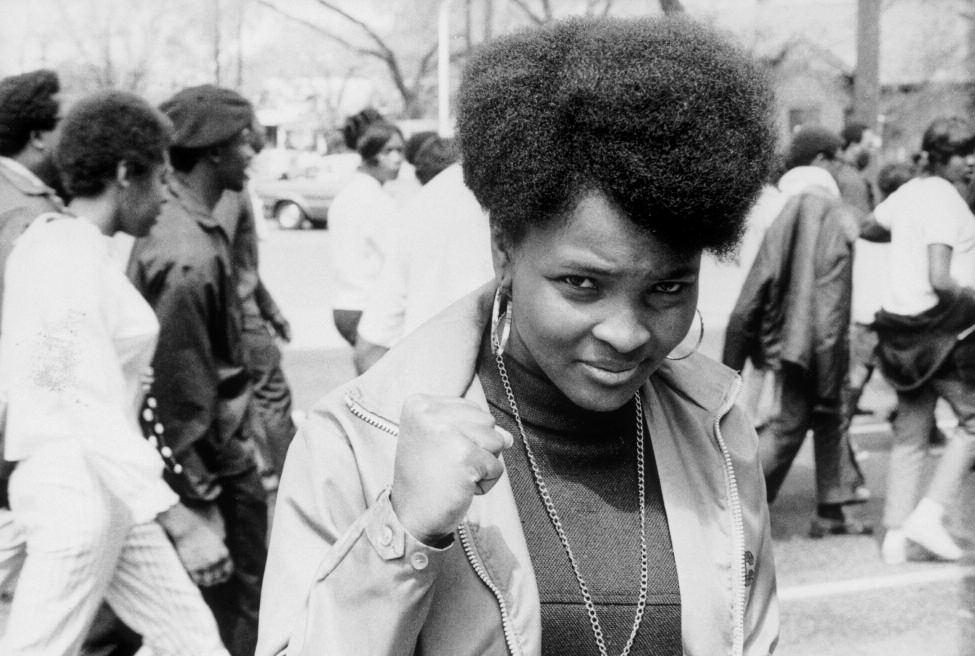
Far from operating in isolation, Hoyt Fuller was among a number of Black artists, intellectuals, a n d o
States who advanced racial politics as a fundamental yet widely understated aspect of cultural production in the United States during the late 1960s and early 1
politics, and Black intellectual life In the process, Fuller and company simultaneously left a lasting mark on the general constitution of American cultural politics and an indelible impact on the countr y ’ s discourses on race, art, and cultural production As a cohort of intellectuals, they insisted that the institutional relationships that made up
America’s world of art and cultural production were not only unequal but also structured in a manner that marginalized Black creative voices and reinscribed the countr y ’ s racist hierarchy Driven by a desire to remake these institutional relationships and to transform the mechanisms that structured racial inequality in the arts, this incredibly energetic cadre of like-minded African Americans developed a network and, ultimately, a social movement This network and social movement could not have taken shape were it not for the critical role played by Fuller. Fu l l e r, A b d u l A l
t h Parkway Avenue on Chicago’s South Side Those meetings led to the formation of the Committee for the Arts
From Building the Black Arts Movement: Hoyt Fuller and the Cultural Politics of the 1960s by Jonathan Fenderson. © 2019 by the Board of Trustees of the University of Illinois Used with permission of the University of Illinois Press
B l a c k A m e r i c a n C u l t u r e ( O B AC ) Ac
“the trio envisioned the arts as the means by which the people might be reached [because] art unlike polit i c
entrenched coalition of the White Establishment and the Self-Satisfied Black Bourgeoisie ”1 They hosted their first e
“O
Black Artist Looks at His Life in the Ghetto,” took place at the South Side Community Arts Center The event was a
a
C
appreciation, intellectual engagement, and career aspirations, fused with a Black nationalist politics that pivoted on a culturally focused public agenda
Alk alimat, and Rivers felt it was time to expand In a few months CFA’s triumvirate grew into a ten-man organizat i o n , w i t h e a c h o f t
m e m b e r s f r o m t h e i r r e s p e c t i v e n e t w
recruits consisted of Black Chicagoans from various walks o f l i f e , i n c l u d i n g a l o c a l r e c o r d s t o r e o w n e r a n d l a w y e r named Ernest Duke McNeil; Joseph Simpson, a doctoral candidate studying psychopharmacology at the University of Chicago; Donald Smith, an African American educational activist and professor at the Center for Inner City S t u d i e s ; G e o r g e R i c k s , w h o t a u g h t Af r i c a n A m e r i c a n music; Bennett Johnson, a social worker and activist who later went on to establish Path Press; and Ronald Dunham, a p r i n t e r. 3 B y f a r t h e m o s t s i g n i f i c a n t a d d i t i o n w a s J e f f Donaldson, a budding visual artist, Chicago native, and f r i e n d o f A l k a l i m a t D o n a l d s o n w o u l d n o t o n l y l e a d OBAC ’ s visual arts workshop through the creation and d e v e l o p m e n t o f t h e Wa l l o f R e s p e c t , b u t h e w o u l d a l s o later serve as a key founder of the spin- off African American v i s u a l a r t i s t s c o l l e c t i v e Af r i - C O B R A 4 I n j o i n i n g C FA , Donaldson forged the beginning of a lasting relationship
w i t h Fu l l e r a n d p r o v i d e d i n s p i r a t i o n f o r t h e g r o u p ’ s name change
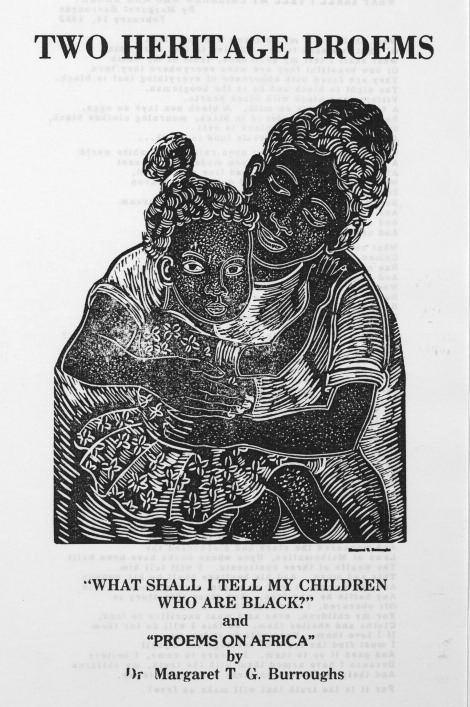
Two Heritage Proems | Written, illustrated, and published by Margaret T G Burroughs, 1963
American culture or, more precisely, “Black American c u l t u r e ” w a s d
, because it was rooted in an African past and conditioned by a set of specific historical experiences in a new world diasporic space. Ever conscious of points of continuity, r u p t u r e , a n d i n n o v a t i o n b e t w e e n Af r i c a a n
h e d i a spora, OBAC ’ s events represented explorations of “Black American culture” in its broadest sense
Ac c o r d i n g t o A n n S m i t h , w h o b e c a m e a n i n s t r umental player in the organization by the fall of 1967, the ten men often met in her apartment, which she shared w i t h D u ke M c N e i l , h e r h u s b a n d a t t h e t i m e S m i t h r e c a l l s t h e “ f o u r p l u s o n e [ a p a r t m e n t ] b u i l d i n g ” a l s o s e r v i n g a s a h o m e f o r A r n a B o n t e m p s a n d C a r o l y n Rodgers, who later emerged as one of OBAC ’ s most celebrated writers 5 During a meeting in Smith’s apartment, Donaldson suggested the group call itself the Organization o f B l a c k A m e r i c a n C u l t u r e , o r O B AC . I n a s u b s e q u e n t essay, Fuller explained that the men agreed to pronounce the acronym as “‘ o -ba-see’ to echo the Yoruba word o b a , d e n o t i n g r o y a l t y a n d l e a d e r s h i p ” 6 T h e ex p l i c i t a t t e m p t t o d r a w f r o m We s t Af r i c a n c u l t u r e e v i n c e d a growing interest in Pan-African histor y, culture, and politics among African Americans during the later 1960s By t h e end of t h e 1970s, t h i s i nt erest w ould blossom i nt o v i s i t s t o m u l t i p l e Af r i c a n c o u n t r i e s b y s e v e r a l O B AC members and collaboration on major international festivals Seeing the Pan-African world as an important source for creative inspiration, politics, and an alternative ident i t y f o r m a t i o n f o r Af r i c a n A m e r i c a n s , O
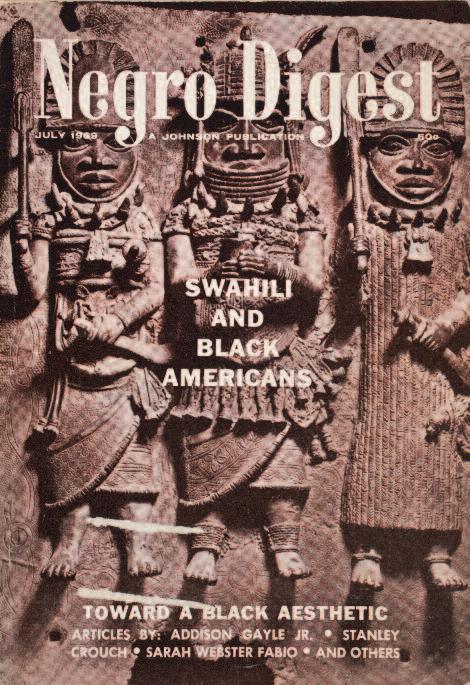
Negro Digest | Edited by Hoyt W Fuller with cover designed by Herbert Temple | Johnson Publishing Company, Chicago, July 1969
OBAC ’ s first event was held in the summer of 1967 at t h e A b r a h a m L i n c o l n C e n t e r o n t h e S o u t h S i d e o f Chicago. It featured dancers, blues, gospel, and rhythm and blues singers; biographical vignettes of important historical figures in African American histor y; short lectures o n v i s u a l a r t a n d m u s i c ; a n d a p o e t r y p e r f o r m a n c e 7
OBAC members led the lectures and recruited an assortment of local artists to conduct the performances Among the performers that night was a poet named David Moore
( A m u s M o r ) I n i t i a l l y i n t r o d u c e d t o t h e m e n o f O B AC
t h r o u g h h i s g o o d f r i e n d A l k a l i m a t , M o r w a s t h e f i r s t
O B AC p o e t t o g a r n e r n a t i o n a l a t t e n t i o n , a f t e
reported on the event in Negro Digest 8 Alk alimat recalls Mor as a “ rogue, proletarian artist” with exceptional creative ability.9 At the same time, he remembers Mor being a n o n c o n f o r m i s t w h o b o u n c
d Black bourgeois conventions 10 Mor was also a voracious
a d
f t . Though lacking formal higher education, Mor spent significant time in the University of Chicago Librar y, gaining access through multiple professors on campus, who also
happened to be his most consistent marijuana customers. There he would study writing from around the world and piece together a global consciousness that matched his deep knowledge of Black Chicago Like Fuller and other OBAC members, Mor dived into the study of Black culture and relished the opportunity to further his intellectual interests in OBAC ’ s informal setting
Abandoning the idea of a committee and now understanding themselves as a full-fledged organization, OBAC initially adopted a guiding philosophy of “black experim
members with flexibility yet sharply focused on the expe-
experimentalism” would be replaced by Fuller ’ s “black aesthetic” concept, which would eventually take on a life of its own Nevertheless, at the outset OBAC would work
u n d e r t h e b r o a d u m b r e l l a o f “ b l a c k ex p
i
e r
a d d i n g a f o u r t h T h e w r i t e r s ’ w o r k s h o p , t h e v i s u a l a r t s
w o r k s h o p , t h e c o m
workshop, which was the last to form, served as the primar y points of entr y for new recruits
The community workshop featured regular speakers and was chaired by Joseph Simpson It provided a space f o r S o u t h S i d e r e s i d e n t s t o i n t e r m i n g l e w i t h l o c a l activists and nationally renowned intellectuals in a casual s e t t i n g T h r o u g h l e c t u r e s a n d f r e e - f l o w i n g d i s c u s s i o n s , t h e w o r k s h o p f o s t e r e d t h e d i s s e m i n a t i o n a n d o p e n exchange of ideas In an effort to flesh out their organizational ideology, the workshop hosted Maulana K arenga in October 1967 and Amiri Barak a in April 1968 11 At the time, both men were considered to be central figures in the development of Black cultural nationalist politics and B l a c k A r t s t h e o r y 1 2 T h e i r v i s i t s , a l o n g w i t h a h o s t o f others, indicate OBAC ’ s position at the cutting edge of t h e c o u n t r y ’ s B l a c k A r t s a c t i v i t y. O B AC c a l l e d t h e s e meet i ngs “R ap p i ng Black Sessi ons, ” because t h ey w ere specifically focused on thinking through the era ’ s emerg e n t n o t i o n s o f B l a c k i d e n t i t y I n f a c t , a l l o f O B AC ’ s w o r k s h o p s i n c o r p o r a t e d t h i s p a r t i c u l a r a i m , b u t s o m e also focused on honing specific artistic crafts
J e f f D o n a l d s o n l e d t h e v i s u a l a r t s w o r k s h o p , w h i c h
l a s t e d a m e t e o r i c f o u r m o n t h s b e t w e e n J u n e a n d
S e p t e m b e r 1 9 6 7 . T h e f i r s t , a n d o n l y, p r o j e c t u n d e rtaken by visual artists in the workshop was “the Wall of R e s p e c t , ” a r e m a r k a b l e t w o - s t o r y m u r a l a t 4 3 r d a n d L angley in the heart of Chicago’s South Side Situated at t h e i n t e r s e c t i o n o f t h e n e i g h b o r h o o d ’ s
and blues thoroughfares, “the Wall” was nestled among some of the most active music joints in Black Chicago 13 T h e p r o d u c t i o n p r o c e s s f
Stone Nation, a powerful African American youth gang in the city, to work together in their efforts to both beautify t
ties.14 The unveiling of the Wall brought out several hund
place for community protests and aspiring Black elected o
Negro Digest and Ebony introduced the site to a national audience and helped to spark similar projects all across t
regarding the monument.18 Although brief, the workshop w o u l d s p
COBRA, an internationally celebrated visual artist collective. Long after the visual arts workshop dissolved, Fuller a n d D
several subsequent Black Arts events
After encouragement from Fuller who believed that Chicago’s theater needed “ a vital shot in the arm ” Ann
S m i t h f o r m e d O B AC ’ s d r a m a w o r k s h o p 19 At t h e t i m e , Smith, who had a graduate degree in speech and theater from the University of Iowa, taught classes at what was
take on a bigger role had a lot to do with the involvement o f h e
interest in performance In fact, she had already served a
A
the early planning meetings 20 Assured that the organization was not meant to be all male, Smith organized several performances, including the Du Sable Festival of the Arts at Dunbar High School in November 1968 and sev-
e
X’s Take Care of Business and Jimmy Garrett’s We Own the Night 21 The workshop also hosted Barbara Ann Teer of the National Black Theatre in Harlem during the spring
1 9 6 9
drama workshop had a short life due to time constraints o n
development of two allied theater companies in Val Gray Wa
Although the drama workshop had disbanded by 1970, Smith’s stewardship is important because she would be the only woman to lead an OBAC workshop during the
ver y close friends, and she continued to lend her support to other OBAC efforts
Although three of the four workshops lasted for only a brief period of time, they proved to be exciting and highly d e n t s , l o c
productive spaces, attracting all sorts of attention. All of the workshops and events were open to the public With
t h
t
events, which required less attention to craftsmanship, would draw anywhere from under twenty people to over a thousand, depending on the evening’s speakers, performance lineup, or nature of the program.25 In fact, during the first two years, each public event was a collaborative e f f o r t b e t w e e n t h e r e s p e c t i v e w o r k s h o p s , w i t h O B AC members encouraging participants and attendees to think across the four specified areas and find productive points of convergence Secretly, th e Red Squad of th e Ch icago Police Department also frequented OBAC events, opening files on members, guests, and even host venues 26 They also scoured the pages of the Chicago Defender, keeping track of the group ’ s activities and the public’s response In less than a year, local police in correspondence with FBI branches identified OBAC as a potential problem
R e g u l a r l y s w a p p i n g i n t e l l i g e n c e r
e d OBAC ’ s foray into the cultural life of the South Side could prove to be a challenge to Chicago’s status quo 27 Quickly accumulating both friends and enemies, OBAC ’ s national notoriety would continue to grow with the success of the writers’ workshop
The OBAC Writers’ Workshop
T h e w r i t e r s l a s t e d l o n g e r t h a n a l l o t h e r O B AC w o r kshops, and they were by far the most active and pivotal i n b u i l d i n g t h e o r g a n i z a t i o
i
n
t i o n T h e workshop produced some of the Black Arts movement’s m o s t r e n o w n e d w r i t e r s a n d i n f l u e n t i a l i d e a s L e d b y
Fu l l e r w h o r e m a i n e d O B AC ’ s c h i e f ex p e r t o n Af r i c a n American literature after Conrad Kent Rivers’s untimely passing in March 1968 the initial assembly of writers w h o m e t f o r t h e f i r s t t i m e o n t h e s e c o n d f l o o r o f t h e S o u t h S i d e C o m m u n i t y A r t s C e n t e r i n M a y 1 9 6 7 w a s primarily made up of college students and recent gradua t e s . 2 8 T h i s i n c l u d e d Wa l t e r B r a d f o r d , a s t u d e n t a t Woodrow Wilson Junior College around the time of the w o r k s h o p ’ s f o r m a t i o n B r a d f o r d ’ s c o l l e g e c l a s s m a t e s
included two more founding members of the workshop: Donald Luther Lee (Haki Madhubuti), who was born in A r k a n s a s a n d r a i s e d i n D e t r o i t b e f o r e a t t e n d i n g h i g h school in Chicago, and Jewel C L atimore (Johari Amini), a n o n t r a d i t i o n a l s t u d e n t f r o m P h i l a d e l p h i a w h o h a d moved to Chicago in 1940. Another founding member, C a r o l y n R o d g e r s , a C h i c a g o n a t i v e b o r n t o a f a c t o r yw o r k i n g m o t h e r a n d a w e l d i n g f a t h e r, h a d j u s t l e f t Roosevelt University.29 Ebon Dooley (born Leo Thomas
Hale), a Tennessee native and graduate of Fisk University, was in New York as a Columbia L aw School student and a v o l u n t e e r f o r H a r l e m Yo u t h O p p o r t u n
e s U n l i m
t e d when he first encountered members of the Chicago delegation at the Black Power Conference in Newark in July 1967 30 The chance meeting motivated Dooley to move to Chicago, where he joined the OBAC writers R andson Boykin was a student at Loyola University when OBAC started Also born in Chicago, Boykin was around nineteen when he joined the workshop as its youngest member Other founding members included Kharlos Tucker (Sigmonde Wimberli), Ronda Davis, and Mike Cook. A s t h e w o r k s h o p ’
mentor and instill a sense of racial pride, seriousness, and c
sense that I could be as confident and comfortable with myself, and as proud, as he was And by proud, I don’t mean externally demonstrative behavior. It was so intu-
i n g , k n o w i n g , and writing within the long African American literar y tradition. He emphasized racial commitment as an integral component of a Black artist’s critical practice and public engagement Convening the first three Wednesdays of the month to discuss their craft, Fuller encouraged the group to reserve the fourth Wednesday as a closed planning session for the following month In each open session, Fuller ke p t t r a c k o f t i m e a s p a r t i c i p a n t s r e a d a
exc h a n g e d writing, offered constructive criticism, and, as their mission stated, “encourage[d] the highest quality of literar y
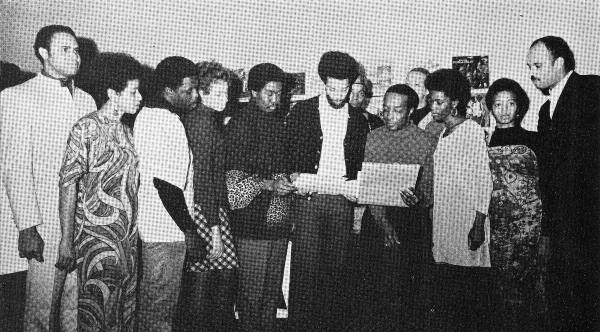
OBAC Writers Workshop members, c 1968, (from left): Mike Cook, Johari Amini, Walter Bradford, Sharon Scott, Ebon, Don L Lee, Sigmonde Kharlos Wimberli, Hoyt W Fuller, R andson Boykin, Carolyn Rogers, Ronda Davis, Jim Taylor | NOMMO, Summer 1972 | Courtesy of McCormick Librar y of Special Collections & University Archives, Northwester n University Libraries
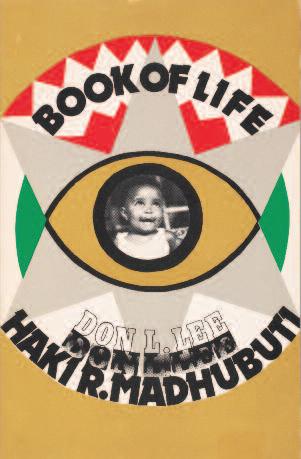
Book of Life | Written by Haki R Madhubuti with cover designed by Jeff Donaldson Broadside Press, Detroit, 1973
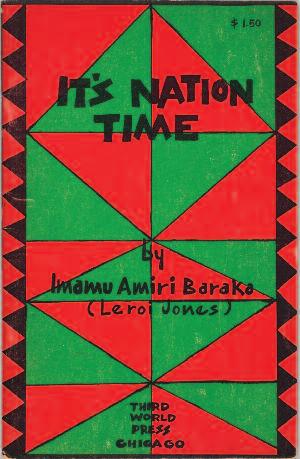
It’s Nation Time | Written by Imam Amiri Bark a (Leroi Jones) with cover designed by Omar L ama | Third World Press, Chicago, 1970
expression reflecting the Black experience ”32 According to s c h o l a r D a v i d L i o n
w o r k s h o p s , d i s c u s s i o n s r e v o l v e d a r o u n d a n u m b e r o f issues, including the craft of writing, the racial and economic politics of publishing, questions of audience, the
c h a l l e n g e s o f b e i n g a B l a c k w r i t e r i n t h e 1 9 6 0 s a n d 1970s, and “managing one ’ s role as a public figure ”33
W i t h i n i t s f i r s t f e w y e a r s , t h e w o r k s h o p c l a i m e d a growing body of literar y works, proving it to be a highly productive space. Released in 1967, just before he joined OBAC, Madhubuti’s Think Black was the first in a rapid
s e r i e s o f p u b l i c a t i o n s t h a t i n c l u d e d t h e w i l d l y p o p u l a r
B l a c k P r i d e a n d D o n ’ t C r y, S c r e a m P u b l i s h i n g i n i t i a l l y w i t h D u d l e y R
M a d h u b u t i w o u l d c
outfit enhanced the workshop’s visibility and productivity by quickly publishing Amini’s Images in Black and Black E s s e n c
including an introduction written by Fuller These works were followed by Sterling Plumpp’s collection of poems titled Portable Soul 35 A Mississippi native and recent graduate of Roosevelt University, Plumpp was working at the Chicago Main Post Office when he joined OBAC in 1969 after receiving verbal invitations from several participants and a formal letter from Fuller 36 The rapid proliferation of OBAC publications was further amplified by Fuller ’ s prom
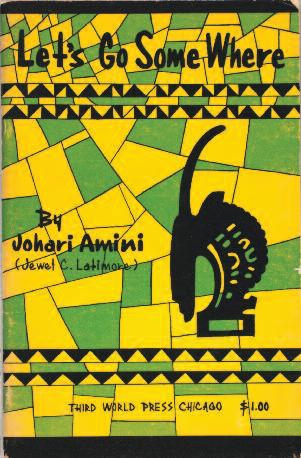
L et’s Go Somewhere | Written by Johari Amini with cover designed by Omar L ama | Third World Press, Chicago, 1970
D i g e s t U s i n g t h e m a g a z i n e a s a n a t i o n a l m e g a p h o n e , Fuller cast the workshop as a cutting-edge, vibrant, crea t i v e e n v i r o n m e n t a n d h o m e t o a n e w g e n e r a t i o n o f important voices He frequently published their writing and included OBAC writers in conversations with established and well-known authors. In addition, his assistant editor at Negro Digest, David Llorens, published a feature stor y titled “Black Don Lee” in Ebony magazine in 1969, e f f e c t i v e l y i n t r o d u c i n g b o t h M a d h u b u t i a n d O B AC t o their largest African American reading audience up to that point 37 In just a few short years, the group could boast of t remend ous accomp li sh ment s, and by 1972 t h e OBAC writers laid claim to more than twenty-five volumes published by members of the workshop.
The OBAC writers also contributed to a number of collective efforts that further raised the visibility of the works
sequent volumes appeared sporadically between 1969 and 1972 The first volume is particularly important because it c a m e a s a r e s u l
C o u n c i l , a n d t h e C o o r d i n a t i n g C o u n c i l o f L i t e r a r y Magazines a group that Fuller had publicly chastised a year earlier for its failure to consider little Black magazines as eligible recipients.39 The group also initiated the shortl i v e d C u m b a y a : A N e w s l e t t e r o f t h e O B AC Wr i t e
Wo
tently.40 In order to produce the periodicals, Fuller leaned
h e a v i l y o n h i s c o n n e c t i o n s a t J
h n s o n P
i s h i n g Company while working closely with Dooley and newer workshop member Barbara Mahone, who was a twenty-
f o u r- y e a r- o
p
e m s p u b
C
Sugarfields OBAC writers also contributed to several of the period’s landmark anthologies, making themselves recognizable names in the field of poetr y However, the written word was not their only means of gaining notoriety
A major part of what led to OBAC ’ s popularity was the writers’ live performances and energetic public presence. The OBAC writers were extremely active Locally they performed at bars, nightclubs, churches, festivals, theaters, and high schools 41 Often they performed as a collective, with Fuller providing introductor y remarks. The band of p o e t s w o u l d a s c e n d o n a g
v e n a u d i e n
, r
d i a t i n g y o u t h f u l e n e r g y a n d e m b o d y i
aura of “Blackness ” Budding Black Arts institutions in the city also helped build the group ’ s reputation as Fuller and the poets hosted parties at Ellis’ Bookstore and were regularly featured in the lineup at the Affro Arts Theatre 42 OBAC writers also traveled the countr y performing at coll
would-be Black revolutionar y poets As with the rest of
Digest However, he omitted the fact that these events created a hierarchy in the workshop that privileged poetr y above ot h er writ ten forms and, more specifically, poet s with a more dynamic reading style, as opposed to those w h o w e r e b e t t e r a t t h e c r a f t o
h e was silent about how his professional connections often led to the writers’ attaining these college invitations. With Fuller serving as the group ’ s gatekeeper, these gigs eventually blossomed into visiting professorships and artist-inresidence positions while also sparking bouts of jealousy and internal competition among workshop participants. Still, the workshop thrived
I n J une 1969 t h e w ri t ers ’ w ork sh op op ened a h eadq u a r t
h Street, just off Michigan Avenue.44 The new location provided the group with a sense of stability They no longer h a d t o s h
S i d e Community Arts Center, the DuSable Museum of African American Histor y, and the George Cleveland Hall Branch of the Chicago Public Librar y The headquarters allowed
tiguous extension in the Douglas neighborhood on the South Side Now operating in plain sight, the workshop
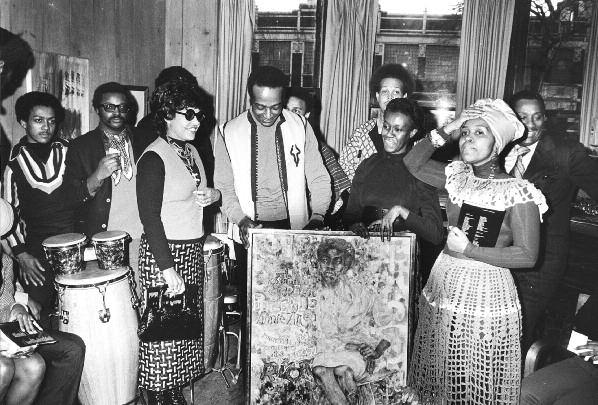
i m m e d i a t e a r e a Fu n c t i o n i n g i n t h e i r o w n s p a c e , t h e
g r o u p h o s t e d b o o k p a r t i e s , f o r u m s , a n d o t h e r e v e n t s without having to totally depend on other neighborhood institutions In order to pay the bills, the writers cosponsored ticketed events, collected donations, and, at times, asked members to contribute. The more consistent workshop attendees shared the responsibilities of keeping the place clean and setting up and breaking down chairs for e v e n t s , t h o u g h Fu l l e r o f t e n b r i s t l e d w h e n i n d i v i d u a l s failed to contribute to these tasks 45 Now firmly situated, t h e g r o u p e s t a b l i s h e d a n i n f o r m a l l i b r a r y t h a t w a s f r e e a n d o p e n t o a l l p a r t i c i p a n t s a n d t o t h e g e n e r a l p u b l i c Workshop members donated and collected books, journ a l s , m a g a z i n e s , a n d a n y w r i t i n g t h e y c o u l d o b t a i n o n
E N D N O T E S
1. Hoyt Fuller, “OBAC A Year L ater,” Negro Digest, July 1968, 92
2. “Arts Committee Schedules Introductor y Program,” Timuel Black Papers (box 24), Vivian Harsh Collection, Chicago Public Librar y, Chicago, Illinois “Arts Committee Schedules Introductor y Program,” Hoyt Fuller Papers (box 33, folder 4), Robert W. Woodruff Librar y, Atlanta University Center, Atlanta (hereafter cited as HFP)
3. Hoyt Fuller, foreword to Nommo: The Jour nal of the OBAC Writers’ Workshop 1, no 3 (1972): 1–2, 24 (hereafter this journal will be cited as Nommo); Fuller,
African Americans, Africa, the African diaspora, and the b r o a d e r
p members hosted a surprise birthday party for the workshop’s director and named the Hoyt Fuller Librar y in his h
established institutional roots on Chicago’s South Side
Important African American writers visited, exchanging ideas and offering samples of their forthcoming works For example, Toni Morrison visited in 1974, shortly after the release of Sula and The Black Book. 47 Alex Haley came to the workshop, too, sharing portions of what would later be his 1976 magnum opus, Roots Academics and aspiring c
University of Chicago professor of African American literature George Kent was a regular attendee Another aspiring critic of African American literature, Addison Gayle, garnered ideas directly from Fuller and the workshop The group ’ s vibrancy also translated into visits from celebrities, s u c h
Brock Peters, with the latter two lending financial support a s w e l l . 48 T h e d y n
h e growing popularity of the workshop as a hotbed for artistic p r o d u c t i o n , a n d t h e r e l a t e d i n s t i t u t i o n s i n t h e c i t y including Negro Digest led Stephen Henderson, one of the major African American literar y theorists of the period, t o w r i t e t o Fu l l e r, “ T h e c e n t e r o f t h e m o v e m e
Harlem, nor San Francisco, but Chicago ”49
Jonathan Fenderson is an assistant professor in African and A f r i c a n A m e r i c a n S t u d i e s a t Wa s h i n g t
histor y, social movements, and transnational links between Africa and the Diaspora.
“OBAC A Year L ater,” 92–94; Doris E Saunders, “Confetti,” Chicago Daily Defender, May 22, 1967, 12; Donald Franklin Joyce, Black Book Publishers in the United States: A Historical Dictionar y of the Presses, 1817–1990 (New York: Greenwood Press, 1991), 181–85; Donald Franklin Joyce, Gatekeepers of Black Culture: Black- Owned Book Publishing in the United States, 1817–1981 (New York: Greenwood Press, 1983), 87–88; Path Press Papers, Vivian Harsh Research Collection, Chicago Public Librar y
4. Jeff Donaldson, ed , “ The Art of Political Struggle and Cultural Revolution,” Inter national Review of African American
Art 15, no 1 (1998); Jeff Donaldson and Geneva Smitherman, “Upside the Wall: An Artist’s Retrospective Look at the Original Wall of Respect,” in The People’s Art: Black Murals, 1967–1978 (Philadelphia: African American Historical and Cultural Museum, 1987), 2–9; Barbara Jones-Hogu, “ The Histor y, Philosophy, and Aesthetics of AFRICOBRA,” in AFRI- COBRA III (Amherst: University Art Galler y at University of Massachusetts, 1973); “Africobra 1 (African Commune of Bad Relevant Artists) 10 in Search of a Nation,” Black World, October 1970, 80–89; Abdul Alk almiat, Rebecca Zorach, and Romi Crawford, eds , The Wall of Respect:
Public Art and Black Liberation in 1960s Chicago (Chicago: Northwestern University Press, 2017)
5. Author interview with Ann Smith, September 28, 2009, Chicago
6. David Lionel Smith, “Chicago Poets, OBAC, and the Black Arts Movement,” in Werner Sollors and Maria Diedrich, eds , The Black Columbiad: Defining Moments in African American Literature and Culture (Cambridge, MA : Harvard University Press, 1994), 255; Fuller, foreword to Nommo 1, no 3 (1972): 1–2, 24
7. Hoyt Fuller, “Happenings: Culture Consciousness in Chicago,” Negro Digest, August 1967, 85–87; Alk alimat, Zorach, and Crawford, Wall of Respect
8. Fuller, “Happenings: Culture Consciousness,” 85–87
9. Author interview with Abdul Alk alimat, March 18, 2010, New Orleans
10 Ibid
11 Fuller, foreword to Nommo 1, no 3 (1972): 1–2, 24; Fuller, “OBAC A Year L ater,” 92–94; surveillance notes, Chicago Police Department, Red Squad Collection (box 304)
12 Scot Ngozi-Brown, Fighting for US: Maulana K arenga, the US Organization, and Black Cultural Nationalism (New York: New York University Press, 2003); Amiri Baraka, The Autobiography of LeRoi Jones (Chicago: L awrence Hill Books, 1997); Komozi Woodard, A Nation within a Nation: Amiri Baraka (LeRoi Jones) and Black Power Politics (Chapel Hill: University of North Carolina Press, 1999)
13 Patrick Hughes, Behind the Wall of Respect: Community Experiments in Heroin A ddiction Control (Chicago: University of Chicago Press, 1977); David Llorens, “Junior Wells Is Boss,” Ebony, June 1968, 133–34, 136, 138, 140
14 Betty Washington, “ The ‘ Wall’ Community Plans for Progress,” Chicago Defender, November 16, 1967, 5; Donaldson, “Art of Political Struggle”; Donaldson and Smitherman, “Upside the Wall,” 2–9
15 Author interview with Robert Sengstacke, September 27, 2009, Chicago; “Big Day at the ‘ Wall’: Black Pride Theme for Dedication Festivities,”
Chicago Defender, September 30, 1967, 3; David Potter, “Crowds Gather as Wall Is Formally Dedicated,” Chicago Defender, October 2, 1967, 3; “Southside Citizens Eulogize Black Beauties,” Chicago Defender, October 3, 1967, 1, 14–15; “Blacks Held R ally to Save Chicago’s Wall of Truth,” Jet, September 4, 1969, 20, 35; “Community Events Calendar,” Chicago Defender, August 16, 1969, 9; photos, Chicago Defender, August 23, 1969, 36; “C C of C Unit Joins Drive to Save Wall,” Chicago Daily Defender, August 29, 1969, 2; “Save the Wall Drive Gains Steam,” Chicago Defender, August 26, 1969, 1; “Orchid for Today,” Chicago Defender, August 27, 1969, 5; “Applaud 43rd St Wall R azing Delay,” Chicago Daily Defender, August 28, 1969, 4; “Soon to Be Destroyed,” Chicago Daily Defender, June 8, 1970, 3; “‘ Wall of Respect’ Tumbles Down,” Chicago Daily Defender, March 29, 1972, 2; “No Respect for Wall of Respect,” Chicago Daily Defender, March 29, 1972, 1
16 Surveillance notes, Chicago Police Department, Red Squad Collection (boxes 297, 304, 306, 219, 230); Potter, “Crowds Gather,” 3; Jeff Huebner, “ The Man behind the Wall,” Reader: Chicago’s Free Weekly, August 29, 1997; Hoyt Fuller, “Black Consciousness and the Political Police,” Black World, May 1970, 49–50, 83; Sengstacke interview; Lerone Bennett Jr , introduction to Tradition and Conflict: Images of a Turbulent Decade, 1963–1973, by Mar y Schmidt Campbell (New York: Studio Museum of Harlem, 1985), 9–10
17 “ The Wall,” Negro Digest, November 1967, 82; “ Wall of Respect,” Jet, September 7, 1967, 36; “ Wall of Respect,” Jet, October 19, 1967, 9
18 Donaldson, “Art of Political Struggle ”
19 Smith interview; Hoyt Fuller to Amiri Barak a, November 17, 1969, Amiri Barak a Papers, Moorland-Spingarn Research Center (box 3, unprocessed)
20 Hoyt Fuller, “Happenings: Culture Consciousness in Chicago,” Negro Digest, August 1967, 85–87
21 “Affro -American Culture Writers Hold Festival of Art at Dunbar,” Chicago Daily Defender, November 6, 1968, 15; Theresa Fambro Hooks, “Social Whirl: Chicago’s
UNCF Femmes L aunch 1969 Program,” Chicago Defender, March 29, 1969, 19
22 Hoyt Fuller, “Perspectives: Some Other Hue and Cr y, ” Negro Digest, October 1969, 49–50, 89–95; Errol G Hill and James Hatch, A Histor y of African American Theatre (Cambridge, UK: Cambridge University Press, 2003), 479; Barbara Lewis, “Ritual Reformulations: Barbara Ann Teer and the National Theater of Harlem,” in A Sourcebook of African-American Performance: Plays, People, Movements, ed Annemarie Bean (New York: Routledge, 1999), 69–82; Smith interview
23 Smith interview; author interview with Abena Joan Brown, September 22, 2009; “ETA Purpose and Program” (organization literature), in author ’ s possession; “Ebony Talent to Tour,” Chicago Defender, Januar y 20, 1973, 21; program for Kuumba’s Black Liberation Awards, HFP (box 36, folder 1); “Nab 5 Whites after Attack on Negro Home,” Chicago Daily Defender, April 29, 1968, 1; Kuumba News 1, no 1 (1972), HFP (box 36, folder 2); “ Val Gray, Dramatist, to Appear at NAACP Luncheon,” Chicago Defender, April 18, 1964, 12; “Reception Honors the Francis Wards,” Chicago Defender, May 7, 1966, 20; “Nab 5 Whites,” 1; Thelma Hunt Shirley, “Confetti,” Chicago Defender, August 2, 1966, 12; program for Kuumba’s Black Liberation Award,” HFP (box 36, folder 1); “Kuumba Workshop Liberation Awards,” Chicago Defender, June 23, 1973, 26; “ To Be Honored,” Chicago Courier, June 17, 1972, 1, sec 2, 2; Charles Watts Jr , “Bennett, Fuller Honored,” Muhammad Speaks, July 7, 1972, 29–30; letter from Fuller to Val Gray Ward and Members of the Kuumba Workshop, HRP (box 36, folder 1); “ The Kuumba Workshop: In a Living Tribute to Living Black Heroes,” HFP (box 36, folder 1); Kuumba Awards program booklet, HFP (box 36, folder 1); letter from Kuumba to Fuller (circa 1972), HFP (box 36, folder 1)
24 Angela Jackson and Sandra Jackson would later play leadership roles in the writers’ workshop
25 Fuller, “Perspectives: Some Other Hue and Cr y, ” 49–50, 89–95; “Imamu Amiri Barak a, ” Chicago Defender, April 1, 1972, 19; Tony Anthony, “Social Circles:
Poet Amiri Barak a Fascinates Guests at OBAC Benefit,” Chicago Defender, April 8, 1972, 13; surveillance notes, Chicago Police Department, Red Squad Collection (box 297)
26 Surveillance notes, Chicago Police Department, Red Squad Collection (boxes 219, 230, 296, 279, 297, 304, 362)
27 Ibid
28 “ Youthful Militant Poet Dies,” 1, 3, 9; Hoyt Fuller, “A Word Must Be Said,” Nommo 1, no 3 (1975): 2
29 Angela Jackson, “ The Blackbird Flies: Remembering Carolyn M Rodgers,” Callaloo 33, no 4 (2010): 919–25
30 “Ebon (Leo Thomas Hale/Ebon Dooley),” in Afro -American Poets since 1955, ed Trudier Harris and Thadious M Davis (Detroit: Gale Research, 1985), 99–103
31 Author interview with James Turner, April 18, 2010, Ithaca, New York
32 Program for OBAC Writers’ Workshop, HFP (box 30, folder 2)
33 David Lionel Smith, “Chicago Poets,” 253–64
34 Carol Easton to Joan Waricha, Februar y 7, 1973, Amiri Barak a Papers MoorlandSpingarn Research Center (box 3, unprocessed); Nommo 1, no 2 (1969)
35 Carolyn Rodgers, Songs of a Black Bird (Chicago: Third World Press, 1968); Johari Amini, Images in Black (Chicago: Third World Press, 1967); Sterling Plumpp, Portable Soul (Chicago: Third World Press, 1969)
36 Jerr y Ward, “Sterling D Plumpp: A Son of the Blues,” in John Zheng, ed , Conversations with Sterling Plumpp (Jackson: University of Mississippi Press, 2016), 11–35
37 David Llorens, “Black Don Lee,” Ebony, March 1969, 72–78, 80
38 Hoyt Fuller, “Books Noted,” Black World, March 1976, 83; Nommo 1, no 3 (1972); Nommo (Winter 1975) In am indebted to Mari Evans for graciously welcoming me into her home and allowing me to peruse her librar y, which held several issues of Nommo, among a multitude of other historical treasures I’m also indebted to Angela Jackson, who gave me a copy of the Winter 1975 issue
39 Hoyt Fuller, “On Pressure and Awards,” Negro Digest, July 1968, 91; Hoyt Fuller,
“’The Black-White War for Control of Image’ Continued,” Black World, May 1972, 90–91
40 Cumbaya: The Newsletter of the OBAC Writers Workshop, 1, no 4 (1976), HFP (box 37, folder 3) Hereafter this newsletter will be cited as Cumbaya Cumbaya 2, no 2 (1981)
41 “Calendar of Events,” Chicago Defender, March 15, 1969, 11; Theresa Fambro Hooks, “Social Whirl: Two California Femmes Guest at Gala Reunion,” Chicago Daily Defender, September 14, 1970, 19; “Calendar of Events,” Chicago Defender, Februar y 20, 1971, 2; “Black Cultural Festival Clicks at Farragut Hi,” Chicago Daily Defender, April 12, 1971, 14; Hoyt Fuller, “A ‘Soul-In’ at Fisk,” Negro Digest, July 1968, 80; Chicago Daily Defender, March 27, 1968, 16; “ TV Listings,” Chicago Defender, Februar y 20, 1971, 43; “At NU Group Sponsor Festival,” Chicago Daily Defender, April 25, 1972, 13
42 Hoyt Fuller, “R andom Notes,” Negro Digest, April 1969, 49–50, 73–74; C N Ellis to Brother LeRoi Jones, March 26, 1968, Amiri Barak a Papers, MoorlandSpingarn Research Center (box 3, unprocessed); “ Val Gray Is Set for Affro Arts Theatre,” Chicago Defender, May 24, 1969, 18; “Affro Arts Theatre Presents Two Revolutionar y Black Plays,” Chicago Defender, March 27, 1969, 18; “Chicago’s Only Continuous Black Experience: Affro Arts Theatre,” Chicago Defender, October 26, 1968, 13; “Black Cinema This Weekend’s Feature: Nothing but a Man,” Chicago Defender, August 3, 1968, 13; “Don’t Miss A-Beta Speaks,” Chicago Defender, Januar y 20, 1968, 6; Theresa Fambro Hooks, “Social Whirl: Big Fun Weekend for Grambling, Prairie View Alumni Folks,” Chicago Defender, October 3, 1970, 19; “ The Affro Arts Theatre Presents Evolution of the Black Man,” Chicago Defender, August 1, 1970, 16; “Group Plans Memorial for Fred Hampton,” Chicago Defender, December 31, 1969, 14; “College Grad Joins Affro Staff,” Chicago Defender, August 31, 1968, 27; Bob Hunter, “Affro Arts Theatre R ally Set,” Chicago Daily Defender, April 4, 1968, 1; John Blanton, “Famed Blind Musician” (photo), Chicago Defender, August 24, 1968, 15; “Affro -Arts Theatre Sets Black
Cinema,” Chicago Defender, August 5, 1968, 11; Gwendolyn Brooks, Report from Part One (Detroit: Broadside Press, 1972), 150; “Affro Arts Stage Brown’s Blacktastic,” Chicago Daily Defender, October 24, 1968, 17; Earl Calloway, “Theatre Wing: Sammy Davis Appearance Is Planned for Affro Arts Theatre Benefit,” Chicago Defender, October 28, 1968, 11; “Sammy Davis, Jr Is Affro Arts Patron,” Chicago Daily Defender, November 14, 1968, 16; “The Impressions Sing Hit Tunes on Affro -Arts Theatre Revue,” Chicago Daily Defender, May 7, 1970, 16; Blanton, “Famed Blind Musician ”
43 Surveillance notes, Chicago Police Department, Red Squad Collection (box 219); Fuller, “’Soul-In’ at Fisk,” 80
44 “Name Librar y for Editor,” Chicago Daily Defender, September 16, 1969, 5
45 Author interview with Haki Madhubuti, September 25, 2009, Chicago; author interview with Angela Jackson, September 26, 2009, Chicago; Fuller to Rodgers, April 23, 1970, HFP (box 23, folder 16); Fuller to Rodgers, July 12, 1971, HFP (box 23, folder 16)
46 “Name Librar y for Editor,” 5; Fuller to Otto, September 12, 1969, HFP (box 2, folder 32)
47 “Author Toni Morrison to be Honored at Book Party,” Chicago Defender, April 13, 1974, 13
48 Alk alimat interview; Madhubuti interview; Jackson interview; Fuller, foreword to Nommo 1, no 3 (1972): 1–2, 24; Fuller, “OBAC A Year L ater,” 92–94; Nommo 1, no 3; Theresa Fambro Hooks, “ Teesee’s Town,” Chicago Daily Defender, October 28, 1975, 12; “AfroAmerican Writers Celebrate with OBAC,” Chicago Daily Defender, November 6, 1975, 12; Hoyt Fuller, “OBAC Celebration: 8 Years Ancient,” Black World, Februar y 1976, 88–91; “Recent Visitors to OBAC R ap Sessions,” Nommo (Winter 1972); “On Jan 15 Mari Evans Will Open OBAC ’ s Lecture Series,” Chicago Daily Defender, Januar y 4, 1973, 10; Hoyt Fuller, “Black Spirits,” Black World, November 1972, 76–79; “OBAC Brings Host of Top Black Writers to Chicago,” Jet, November 27, 1975, 8 49 Henderson to Fuller, October 27, 1969, HFP (box 8, folder 34)
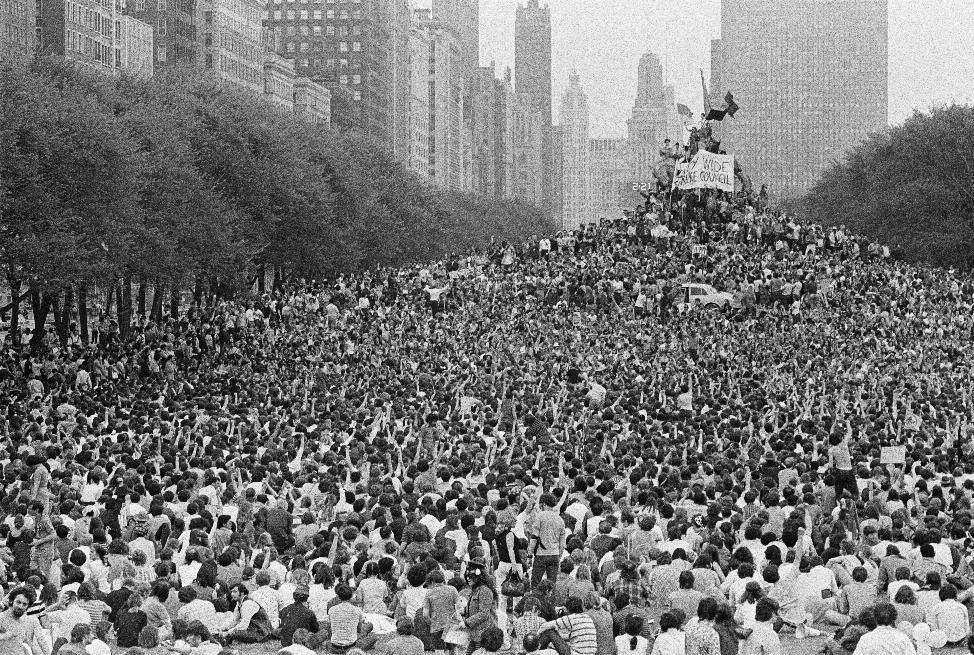
Amajor conflict of the Cold War, the Vietnam War lasted nearly twenty years It was officially fought between North and South Vietnam, but the Soviet Union, China, and other communist states supported the north while the United States and other anticommunist allies supported the south The United States’ involvement began in 1955 with a small number of military advisors but escalated dramatically in the mid-1960s under thenPresident Lyndon B Johnson The conflict inflicted heavy casualties and launched the largest antiwar movement in US history. Most activity took place in the nation’s capital of Washington, DC, and in urban centers, such as New York, San Francisco, and Chicago, which had large numbers of college-age students and others sympathetic to the movement. Indeed, Chicago often took
Rally at Grant Park
May 5, 1970
center stage, most notably with riotous protests at the August 1968 Democratic National Convention, the infamous Days of Rage in August 1969, and a citywide student strike after four student protestors were killed at Kent State University in Ohio in May 1970. Chicago also became a leading center of antiwar art created by a diverse cross-section of local artists. Their works included a singular mural in Pilsen and scores of mass-produced prints, posters, and newspaper illustrations that reached a wide audience. Coupled with mounting casualties, Chicago’s artistic output helped change American views toward the war, a profound shift in public opinion that eventually led to the US withdrawal from Vietnam in 1972. Yet, these works are usually absent from most historical accounts of the time, which is unfortunate, as they illustrate how art serves as a powerful agent of change
The volume of Chicago’s antiwar imagery during the 1960s–70s is without precedent. During the Civil War (1861–65), Chicago produced a plethora of sheet music with patriotic covers supporting the Union cause; the effort continued with colorful lithographs of heroic battle scenes produced by Kurz and Allen in the 1880s. Even during World War I, when antiwar sentiment ran high in the city, antiwar art remained almost nonexistent For example, the Women’s Peace Party (WPP) founded in 1915 by social reformer Jane Addams recruited thousands of members and staged mass demonstrations, but they lacked the artistic touch Their blue and white buttons only featured their name while their brown street banners simply spelled out “Peace” in large white letters with no embellishment of any kind
What, then, caused the upsurge of antiwar art in Chicago during the Vietnam War? In addition to the war itself, which received extensive coverage in print and electronic media that fostered dissent, t are several interrelated reasons: (1) Chicago’s long history of radical social activism that attracted a new generation of social activists; (2) the presence of several art schools, principally the School of the Art Institute of Chicago (SAIC) and the Institute of Design (ID) at th Illinois Institute of Technology (IIT), t fostered a vibrant artistic community in the city; (3) an influx of migrant and immigrant artists bringing talent and energy, and
Mass-produced and worn by millions, anti-Vietnam War buttons expressed personal opposition to the conflict and created a sense of solidarity among strangers Most buttons were created by unknown designers, but their artistry and messaging still resonate
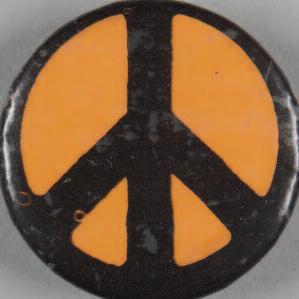

Peace button
Designed by Gerald Holtom, 1958; unknown maker, c. 1965 Gift of Women for Peace (Chicago)
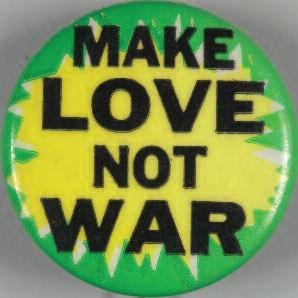
The iconic peace symbol was originally designed for the British Campaign for Nuclear Disarmament. The vertical line in the center represents the flag communication signal for the letter “D,” and the downward lines on either side represent the letter “N ” Together, they stand for nuclear disarmament.
Make Love Not War button
Unknown designer and maker, c. 1968
Courtesy of Busy Beaver Button Museum, Chicago
seeking to make their mark; (4) the city’s position as a major hub of print journalism that supported a small but lively underground press; and (5) a combination of traditional methods and new advancements in print technology that allowed for a more creative expression of dissenting views Working together, these factors fueled Chicago’s ascent as a leading center of protest art during the Vietnam War period.
A closer look at Chicago’s anti-Vietnam War imagery illustrates the complex interplay of these factors We will start with the city’s largest antiwar statement, a 15’ high x 100’ wide mural created by the artist Mario Castillo Born in Mexico in 1945, Castillo moved to the United States with his parents in 1955 He attended Lane Tech High School and later SAIC. Castillo’s mother, Maria Enriquez de Allen, was a folk artist who encouraged her son ’ s talents In late summer 1968, when the antiwar movement reached a crescendo with riots at the Democratic National Convention in Chicago, Castillo, then attending SAIC, led a team of neighborhood youth in Pilsen, a primarily Mexican and Mexican American neighborhood on the city’s Southwest Side, in making a large outdoor mural. Their efforts were part of a citywide Neighborhood Improvement and Beautification Program to create a welcome gathering space for the Halsted Urban Progress Center, a social service agency on South Halsted Street
One of the very few anti-Vietnam War murals in the country, Castillo’s creation was also the first Mexican mural in Pilsen, and it helped launch the nationwide Chicano mural movement Its abstract and heavily symbolic design departed from traditional murals that emulate European art traditions or pay homage to Mexican heroes from the past Instead, Castillo wanted to respond to the living moment of the present with a more abstract creation that drew inspiration from multiple sources both past and present As he explained, the mural had three major intentions: to pay tribute to Mexican and Native American cultures, to serve as a visual protest to the Vietnam War, and to capture the influence of the hippie movement in America In a recent interview, Castillo commented: “As artists, we ’ re supposed to represent our society, our culture, our era. And so that was my way of bringing in the now of the moment into one thing And it’s difficult to deal with so many different things all at once, but I chose to do it through abstraction and symbols, and that kind of brought it together in a nice way, I think ” 1
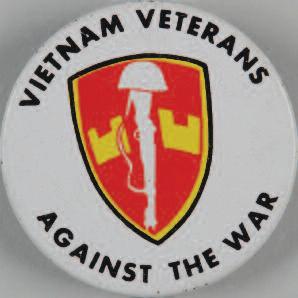
Vietnam Veterans
Against the War button
Unknown designer and maker, c 1968
Courtesy of Olivia Mahoney
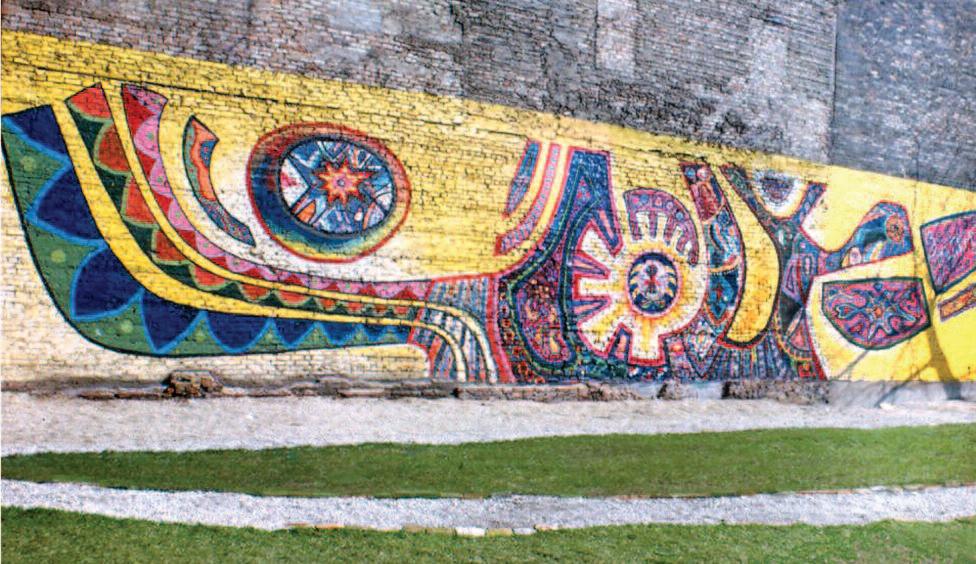
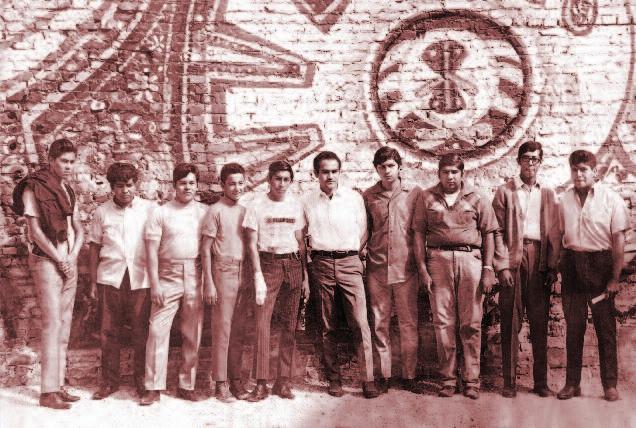
As Castillo notes, the Peace mural had multiple symbols and layers of meaning, but for the sake of brevity, this discussion will focus on three major elements that specifically addressed the Vietnam War. The left side of the mural represents Quetzalcoatl, or Feathered Serpent, a Mesoamerican creator god typically depicted as a combination of the tropical quetzal bird and a serpent. Within the serpent’s head, Castillo and his team created an “exploding eye ” or a graphic representation of a bomb’s explosion
Peace mural
Photograph by Harold Allen, 1968
Courtesy of Mario Castillo
Mario Castillo (fifth from right) with Pilsen mural team
Photograph by Robert Rounsley, 1968
Courtesy of Mario Castillo
A small band of color to the left depicts smoke rising with dust particles and pockets of Agent Orange, a highly toxic herbicide mixture used by the US military in Vietnam to destroy tropical forests that provided opposition forces with protective covering. The central section of the mural contains a dramatic focal point: the peace symbol in red, “making a statement that enough blood has been spilled over this war. ” It is superimposed over the image of a blue hourglass representing the passage of time Both symbols are layered on top of the image of a ladybug landing on a blue Earth for a blessing of good luck. The multilayered symbol is superimposed over the sun, “ so the peace symbol being over both is conveying that peace should reign over our universe ”2
Below and slightly to the right of the central image are two darker shapes that depict dead and truncated tree trunks, representing the burning of Vietnam jungles after being bombed Finally, there are playing card symbols to represent the war as a “poker game ” where both winners and losers suffered greatly The far right side of the mural features a rectangle with the word “Metafisica” inside, surrounded by two rows of “all-seeing” eyes above and below. An ancient symbol that is featured on the back of the US one dollar bill, the all-seeing eye represents an intelligent presence who observes all human activity on Earth, both war and peace.3 This symbol is also found on an antiwar banner that will be discussed later in the article
Like many outdoor murals, Peace suffered from the ravages of time, and the remnants were sandblasted away in 1992. The only known color photograph of the mural was taken in 1968 by Castillo’s stepfather, Harold Allen, who taught photography at SAIC, and it serves as the basis for all our knowledge of this lost masterpiece However, in 2022, the artists Hector Duarte and Gabriel Villa of Pilsen recreated its central peace symbol section in a new mural that expresses opposition to gentrification that threatens to disrupt the ethnic enclave of Pilsen 4
With its rich symbolism and multiple layers of meaning, the Peace mural is a unique and powerful work, but it is atypical of Chicago’s antiwar imagery Indeed, much smaller works of graphic art define the local genre. Among them are two linocut prints by the renowned Mexican American political artist Carlos Cortéz (1923–2005), who created some of Chicago’s earliest and most radical anti-Vietnam War art. Cortéz was born in Milwaukee, Wisconsin, to Alfredo and Augusta Ungerecht Cortéz. Alfredo, a Yaqui or native Mexican, was a construction worker
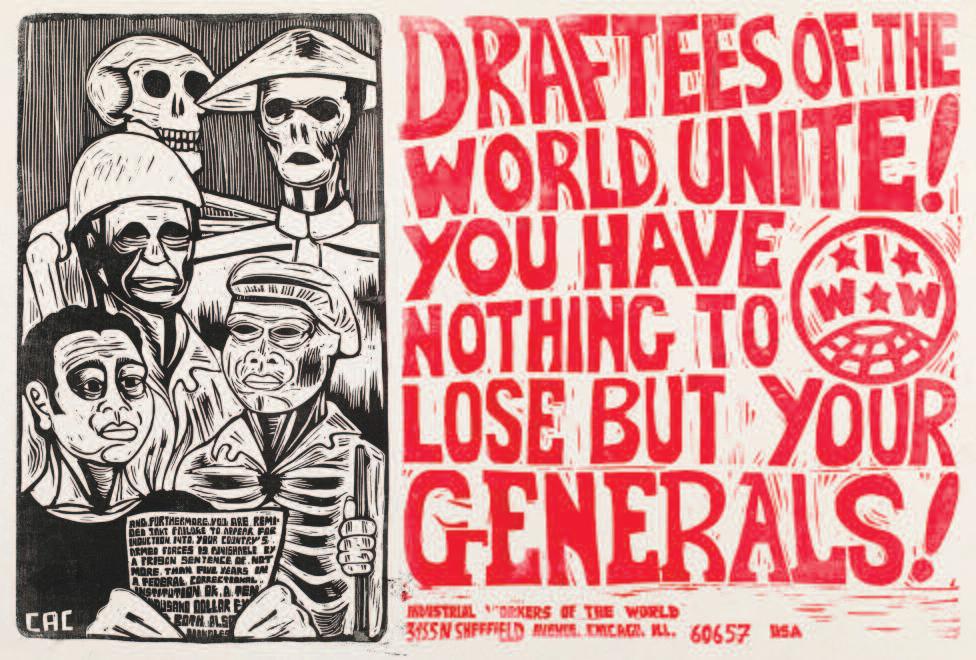
and labor organizer for the Industrial Workers of the World (IWW), a socialist labor organization Augusta was born in Racine, Wisconsin; she was of German descent and held socialist pacifist views. Carlos followed in his parents’ footsteps, joining the Young People’s Socialist League and, later, the IWW for whom he worked as a labor organizer for sixty years. Like his mother, Carlos was a pacifist, and he refused to be drafted during World War II, an act that sent him to prison at the Federal Correctional Institution in Sandstone, Minnesota, for two years.
As a grade school student, Carlos Cortéz taught himself how to make linoleum cut prints Cortéz believed that art should have a purpose, and he favored making prints over other forms of art because they could be mass-produced and distributed to address social issues, particularly those of the working class Cortéz remained in Milwaukee after the war, holding various jobs, before moving to Chicago in 1961, where he continued to work for the IWW, headquartered in Chicago since its founding in 1905, and continue his art practice.5
Most of Cortéz’s works address issues related to the working class, but the war in Vietnam expanded his repertoire, resulting in
Draftees of the World Unite! Linocut by Carlos Cortéz, 1968
two of his most famous works. The first, Welcome Home (Bienvenidos a Casa), is a poignant image of a grieving couple mourning their son returning from the Vietnam War in a flag-draped coffin Cortéz created the print in 1965, when the overseas conflict escalated dramatically with more than 184,000 US troops in action and 1,982 killed Despite the new war theme, Cortéz’s work still addressed the concerns of the working class, who constituted a vast majority of American forces during the Vietnam War. His second work, Draftees of the World Unite! is from 1968, and it is a more controversial work, starting with the prominently displayed title, which is a play on the words “Workers of the world unite!” that conclude Karl Marx and Friedrich Engels’ Communist Manifesto
Cortéz’s central image depicts a young African American man holding a draft notice. Standing behind him are three military officers from the United States and Vietnam with a skeletal figure of death looming in the background Cortéz did not believe any nation was worth fighting for and that only the working class merited such sacrifice He created Draftees of the World Unite! one year after the US military reinstituted military conscription, or “the draft,” to conduct the war. Cortéz’s work struck a chord, and it circulated widely for years, expressing the views of many who opposed the war, including the approximately 570,000 men who were classified as draft offenders with 3,250 jailed for their actions To further identify the work, Cortéz included the red symbol of the IWW near the title and their Chicago headquarters’ address on North Lincoln Avenue along the lower margin Today, Draftees of the World Unite! is considered one of Cortéz’s signature works and an icon of the anti-Vietnam War movement and pacifist movements in general
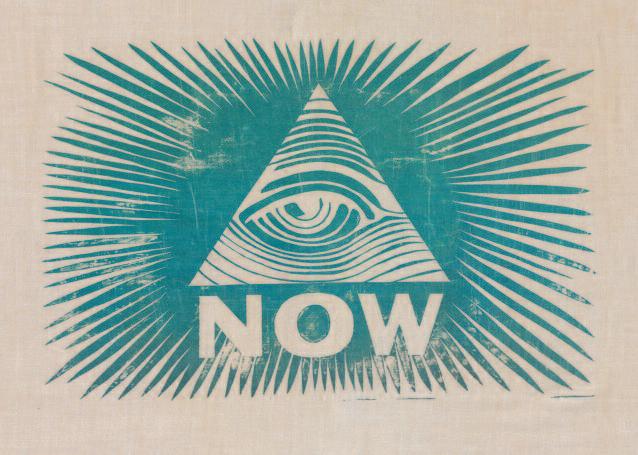
Banner of the Youth International Party
Similar imagery was created by a small group of predominately white male artists working for the Chicago Seed underground newspaper Established as a collective in 1967, the Chicago Seed started as a hippie-style publication with art nouveau covers that resembled rock concert posters and articles
Unknown designer and maker, 1968 Gift of the Chicago Seed
Women for Peace was the Chicago chapter of Women Strike for Peace, a national organization established in 1961 by Bella Azbug, a New Yorkbased lawyer, politician, and social activist, and Dagmar Wilson, an artist, activist, and illustrator of children’s books. Originally founded to oppose the testing of nuclear weapons, the organization primarily consisted of married-with-children, middle-class, white women. The Chicago chapter started in the Hyde Park neighborhood but moved to 343 South Dearborn Street from
where it became involved in the anti-Vietnam War movement.
As seen by its published material, Women for Peace employed art to deliver its message Its main logo featured a properly dressed young mother holding her child and a purse embellished with the organization’s name Unlike more radical antiwar protestors, Women for Peace wanted to appear nonthreatening and “respectable,” an image that helped them attract more mainstream members and financial support
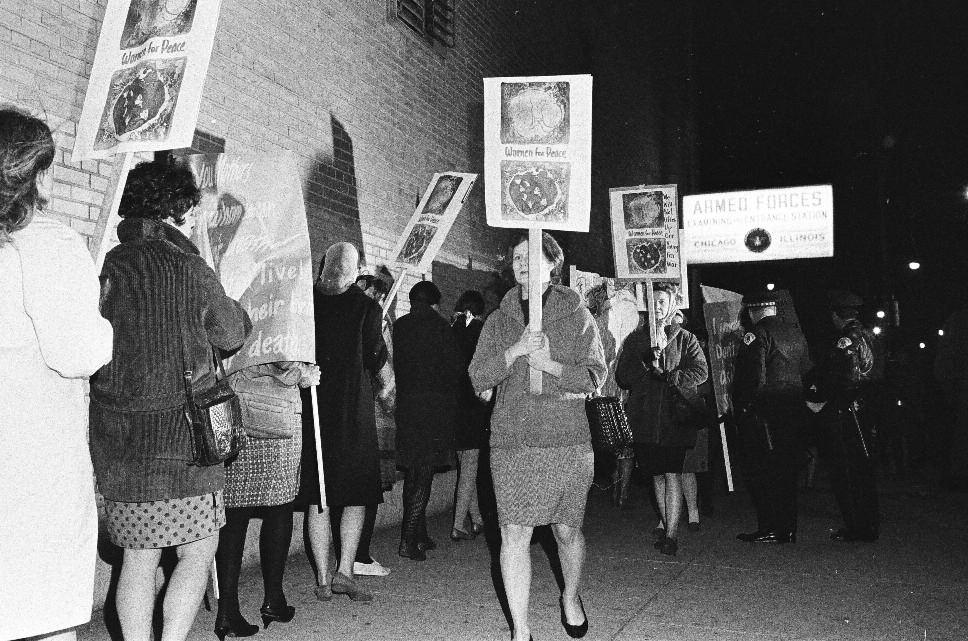
However, their imagery grew more critical as the Vietnam War continued To illustrate, an early flyer from 1965 features a simple sketch of a flower with the message, “Those of us who seek beauty in art forms and in nature also seek beauty and peace for our fellow man. ” A poster from around the same time features a peace dove and flowers below a message to “Save Our Sons / Stop the War Now” with a plea to “Write Your Senator and Congressman for Action Today ” Both pieces are in stark contrast to a flyer from 1967 that features the image of a WFP banner painted in protest of an accidental US bombing of a Vietnamese village that killed at least 100 civilians and wounded 175 others. The image bears a resemblance to Guernica, by Pablo Picasso (1937), considered to be one of the greatest antiwar artworks in history Unfortunately, the banner was not saved, but this flyer illustrates the important role that art played in the antiVietnam War movement in Chicago and across the nation.
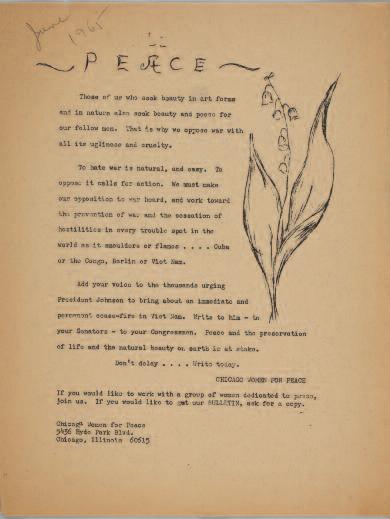
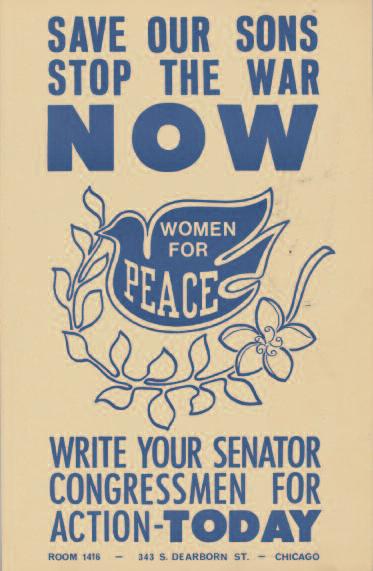
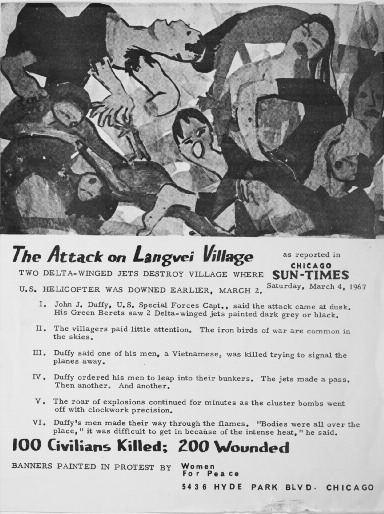
about the local counterculture scene based in the Old Town neighborhood in Lincoln Park on the North Side of Chicago Editor Abe Peck belonged to the Youth International Party (YIP), or Yippies, a radical, youth-oriented group that called for the formation of a “New Nation” with alternative institutions, such as food coops, medical clinics, artist co-ops, and free stores and schools that would eventually take over and replace the current capitalistic system 6
Under Peck’s direction, the Chicago Seed remained a politically independent publication but signaled its support of YIP in September 1969 with a cover by staff artist Lester Dore, who signed his works as “Wanderoo ” Titled “We Are a People,” the cover displays the Yippie flag of a green marijuana leaf an illegal substance at the time overlying a five-pointed red star, historically associated with communist or socialist ideology, on a background of black, a color signifying anarchy The Seed’ s connections to YIP are further illustrated by a silk-screened cotton banner that features the all-seeing eye of Eye of Providence (like those on the Peace mural) above the word “NOW,” as in “end the war now. ” Used at YIP protests during the 1968 Democratic National Convention, the banner was subsequently donated by the Chicago Seed to the Chicago History Museum later that year 7
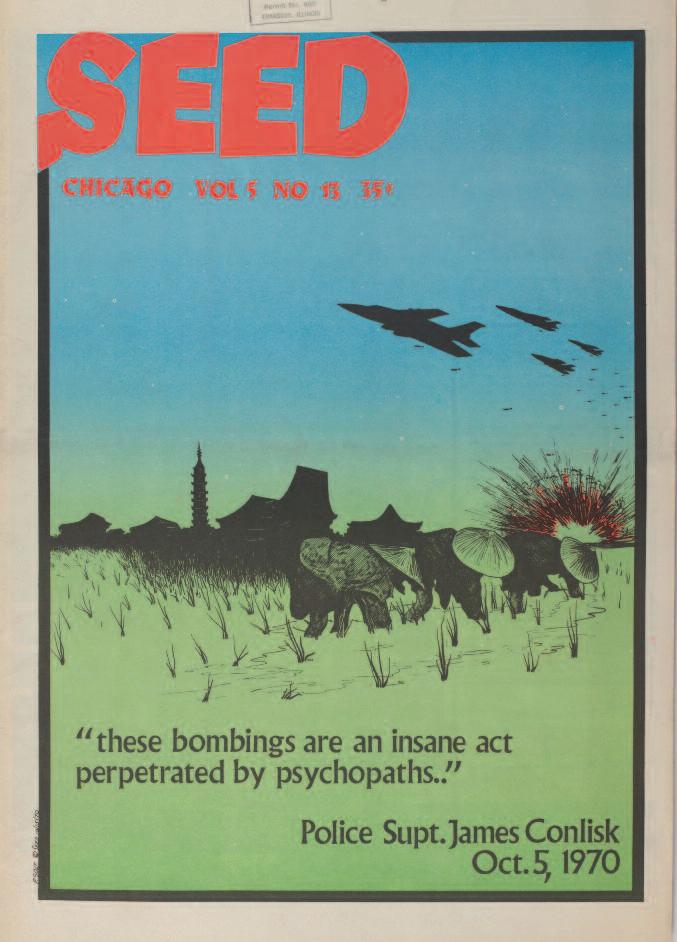
Chicago Seed
Cover art by Peter Solt, October 5, 1970
During its run, the Chicago Seed addressed a multitude of issues from Black Power and gay liberation to Native American rights and police brutality But the Vietnam War remained its main
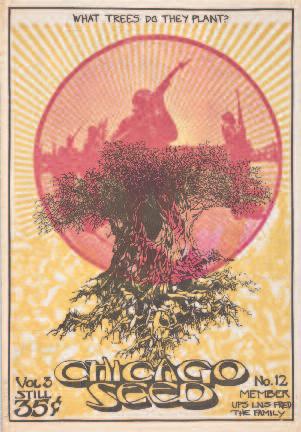
Chicago Seed
Cover art by Lester Dore, May 15, 1969
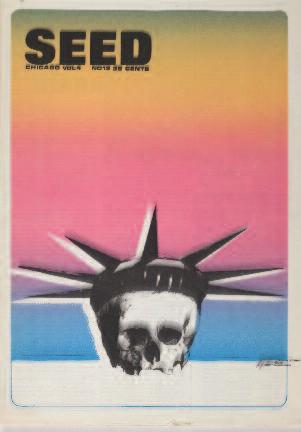
Chicago Seed
Cover art by Karl-Heinz Meschbach, February 1, 1970
focus with a series of covers, articles, and interior illustrations that grew increasingly more radical over time. The Seed’ s first antiwar cover appeared on May 15, 1969, at the start of a major US military offensive Created by Dore (Wanderoo), the cover depicts a US soldier in Vietnam carrying a rifle under the headline “What Trees Do They Plant?” a mocking reference to then-Mayor Richard J Daley’s question about anti-Vietnam War protestors who disrupted the 1968 Democratic National Convention.8
A more extreme image on the February 1, 1970, issue portrays the Statue of Liberty as a figure of death created by the Germanborn artist Karl-Heinz Meschbach, who fled his homeland in the early 1960s during the construction of the Berlin Wall. Upon arriving in Chicago, he found work with the Chicago Seed and with the Students for a Democratic Society (SDS), a radical antiwar organization then headquartered in the city. Meschbach’s startling cover features split-font inking that allows for multiple colors without costly color separation, a printing technique that made the Chicago Seed one of the more most artistic underground newspapers of the era 9
Peter Solt, a graduate of the University of Illinois who became the Seed’ s art director, made the realities of war more apparent in two striking covers The first, from October 1970, is a stark depiction of US planes bombing Vietnamese civilians underscored by a quote from Chicago Police Superintendent James Conlisk after the radical Weathermen faction of the SDS bombed a policeman’s
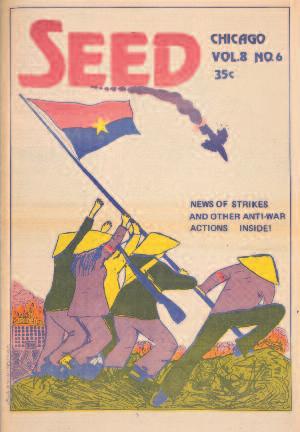
Chicago Seed
Cover art by Maralee Gordon, June 15, 1972
statue in Haymarket Square: “these bombings are an insane act perpetrated by psychopaths ” The second cover, from April 1972, portrays a Vietnamese child with amputated limbs superimposed on an IRS tax form, making a visual connection between personal income taxes and a cruel war that maimed children Refusing to pay taxes for war is a time-honored tradition of showing resistance, and the number of known US tax resisters grew from 275 in 1966 to an estimated twenty thousand in the early 1970s 10 Another memorable cover was created by Maralee Gordon, who did some typesetting and layout work for the newspaper but who was not a trained artist Gordon is the only woman known to have created a cover for the Seed, a reflection of women ’ s status at the newspaper and within the antiwar movement in general. Responding to current events, Gordon’s work, created and published in June 1972, depicts the raising of the Viet Con flag after their victory over US troops. It mimics the iconic black and white photograph of US troops raising the American flag after the Battle of Iwo Jima during World War II.11 Gordon’s image certainly caught the eye and no doubt stirred controversy for portraying the enemy as heroic patriots, although by this time most Americans opposed the war.
While the Chicago Seed took a radical stance, the SDS advanced an even more extreme agenda Founded in 1960 at the University of Michigan in Ann Arbor, the SDS established hundreds of chapters at colleges and univers across the country They helped form the New Left, gener successors to the Old Left of the 1930s–50s that had focu on labor issues. The SDS initially supported the Civil Rights, antiVietnam War, and student movements but they steadily moved further left toward radical Marxist positions. The SDS moved to Chicago in 1965 and participated in protests at the 1968 Democratic National Convention At their own convention, held in Chicago the following July, they broke into competing factions with one group led by, among others, Bill Ayers and Bernadine Dohrn, who adopted the name “Weathermen ” The cover of a rare program from the event features a pen-and-ink drawing by an unknown artist of a manually propelled flying machine hovering over the city of Chicago; inside is the Weathermen’s constitution and their lengthy manifesto titled “You don’t need a weatherman to know which way the wind blows,” a phrase inspired by the popular Bob Dylan protest song of 1965, "Subterranean Homesick Blues "12

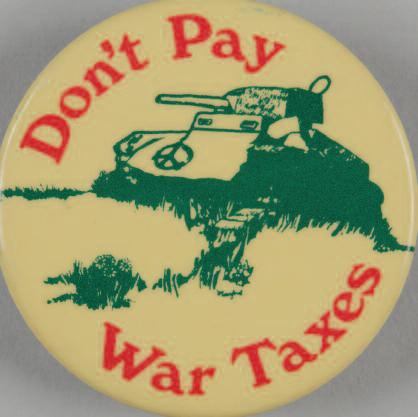
Don’t Pay War Taxes button
Unknown designer and maker, c. 1965
This button is from the War Resisters League, founded in 1923 by people who had opposed World War I They were the first pacifist organization to call for an end to the Vietnam War Note the tank bears a peace symbol.
Believing that real social change required armed insurrection, the Weathermen staged the Days of Rage on October 8–11, 1969, to disrupt the trial of the Chicago Eight (later Seven), a group of protestors arrested during the previous year ’ s Democratic convention. Their newspaper, SDS New Left Notes, from August 8 features the Weathermen’s motto, “Bring the War Home,” above a grainy image of protestors encountering police barricades. A poster bearing the same motto features the image of an armed North Vietnamese soldier standing next to a printed statement about their beliefs that, in addition to ending the war, now included multiple other causes, including Black Liberation, Puerto Rican independence, GI rebellion, and ending a wartime surtax.13
The Weathermen predicted that the event would attract 25,000 participants but given the threat of violence and a heavy police response, only a few hundred people showed up. On the night of October 8, a small group of Weathermen rampaged through the affluent Gold Coast neighborhood in Chicago’s Near North Side, smashing windows of several buildings including the Chicago Historical Society, before being stopped by police, who shot six participants, none fatally, and arrested more than 60 others Subsequent activity included a small gathering of the Women’s Militia in Grant Park on October 9, a mass march on October 10 through the Puerto Rican/Latino neighborhood of Humboldt Park, and a second violent spree
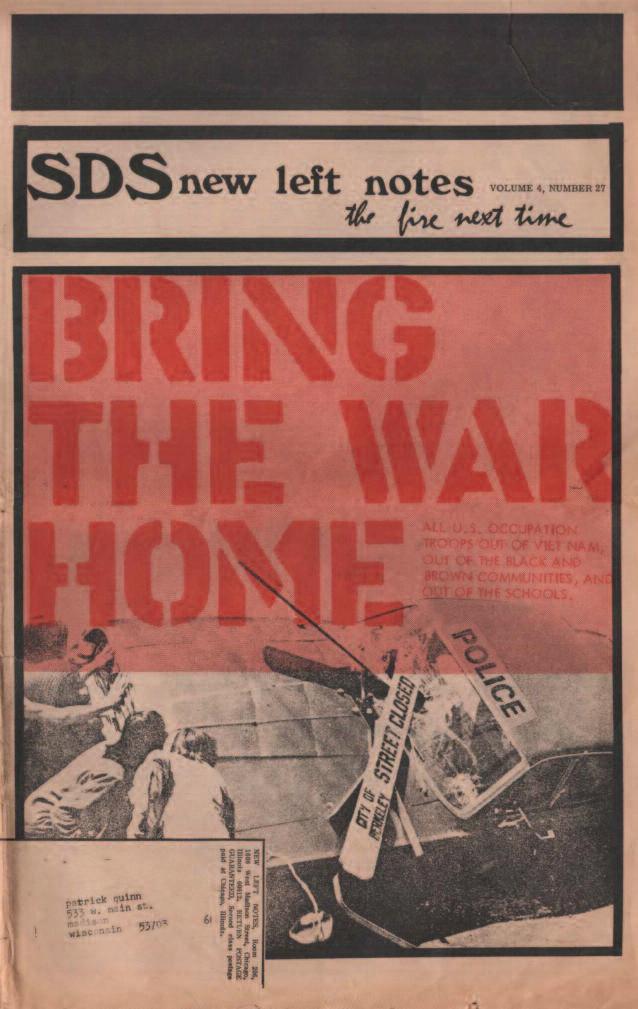
SDS New Left Notes/the fire next time: Bring the War Home
Unknown artist; published by SDS, August 8, 1969
Gift of Patrick Quinn
through the streets of Chicago, this time in the Loop, where Chicago police quickly arrested most of the participants Leaders of the Weathermen failed to show up for their court hearing the following March, instead going into hiding to form the Weather Underground, which carried out a series of bombings in the early 1970s before their arrest by the FBI 14
Like other opponents of the Vietnam War, the SDS and Weathermen used art as a visual weapon They occupied the far left of the political spectrum, and failed to gain widespread support, but their works were integral to Chicago’s artistic expression against the war, which was one of the strongest and most robust of the era Chicago’s antiwar artists secured a place in the rich history of political protest in America and their works serve as important reminders that freedom of expression, as protected by the US Constitution, plays a critical role in a democratic society.
"Bring the War Home!," SDS broadside, unknown designer, August 1969
1 Mario Castillo, “Mario Castillo’s Peace Mural,” unpublished guide, 2023; Ira Murfin and Olivia Mahoney, interview with Mario Castillo for the Chicago History Museum, October 4, 2023.
2. “Mario Castillo’s Peace Mural,” p. 8.
3. Ibid., p. 13.
4 Madison Savedra, “Pilsen’s First Mural Was Destroyed A New Massive Mural Pays Tribute to It And Urges Latino Residents To ‘Fight To Stay,’” Block Club Chicago, May 13, 2022; Retrieved January 18, 2024
5. John Pitman Weber, “Bold Images: Carlos Cortéz,” Elmhurst Art Museum, Elmhurst, Illinois, 1998; https:// icaa mfah org/s/en/item/ 1061374#?c=&m=&s=&cv=1&xywh=2001%2C-49%2C6551%2C3666
Retrieved January 18, 2024; “Carlos Cortéz: 100 ANOS,” National Museum of Mexican Art, https:// nationalmuseumofmexicanart org/
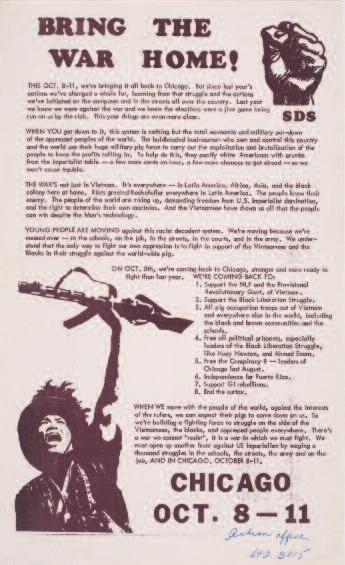
events/carlos-cortez-100-anos Retrieved January 18, 2024
6 Abbie Hoffman, The Yippies! In Chicago, Taken from Revolution for the Hell of It (New York: The Dial Press, 1968) https://www-personal umd umich edu/ ppennock/docYippies1968 htm Retrieved January 18, 2024
7 Chicago Seed with cover by Lester Dore, Chicago, September 1969; Chicago History Museum accession record for YIP banner, gift of the Chicago Seed, 1968.978.
8 Chicago Seed, with cover by Lester Dore, May 15, 1969
9 Robert Newman, Underground Newspapers: The Chicago Seed, Part 1, 1967 69; http://www robertnewman.com/underground-newspapers-the-chicago-seed-part-1-196768/; retrieved October 20, 2022
10 Chicago Seed, with covers by Peter Solt, October 1970 and April 1972
11 Olivia Mahoney, Chicago History Museum, telephone interview with Maralee Gordon, September 20, 2023
12. “Resistance and Revolution: The Anti-Vietnam War Movement at the University of Michigan, 19651972,” https://michiganintheworld. history lsa umich edu/antivietnamwar/exhibits/show/exhibit/ origins-of-students-for-ademo/origins of the new left Retrieved January 10, 2024; SDS New Left Notes/Convention, vol. 4, no 22 (June 1968)
13 SDS New Left Notes/the fire next time/Bring the War Home, vol 4, no 27 (October 1969), Chicago History Museum
14 William W Riggs, “Students for a Democratic Society,” Free Speech Center at Middle Tennessee State University, https://firstamendment mtsu edu/article/studentsfor-a-democratic-society/. Retrieved January 17, 2024
“I am all women, I am ever y woman. Wherever women are suffering, I am there. Wherever women are strug gling, I am there. Wherever women are fighting for their liberation I am there.”
From the CWLU founding conference, 1969
With these words still ringing in their ears,
a s m a l l g r o u p o f w o m e n l e f t Pa l a t i n e , Illinois, to organize a revolution.1 It was
1 9 6 9 a n d t h e f o u n d i n g c o n f e r e n c e o f
t h e C h i c a g o Wo m e n ’ s L i b e r a t i o n U n i o n ( C W LU ) w a s
over The founders of the CWLU had come of age in the 1960s, a t i me of si t - i ns, freedom ri des, peace march es, strikes, riots, and assassinations The Vietnam War was raging, and college campuses across the nation were in turmoil over the issues of war, imperialism, and racism
Women had thrown themselves into the struggles of the 1960s with a ferocious energy From the backroads of M i s s i s s i p p i d u r i n g v o t e r r e g i s t r a t i o n c a m p a i g n s t o t h e s t r e e t s o f Wa s h i n g t o n , D C , t o p r o t e s t t h e V i e t n a m Wa r, w o m e n w e r e t h e r e i n i m p r e s s i v e n u m b e r s . Ye t , i n t h i s struggle for freedom, women were not free Men made the decisions while women made the coffee Women typed the speeches so that men could speak the words. At first, i n d i v i d u a l w o m e n s u f
humiliation But then a few brave women spoke up, and b y 1 9 6 8 , a f l e d g i n g w o m e n ’ s l i b e r a t i o n m o v e m e n t w a s born, and the countr y would never be the same again.
I n t h e l a t e 1 9 6 0 s , i t w a s l e g a l f o r w o m e n t o b e p a i d
l e s s t h a n m e n T h e r e w e r e n o w o m e n c i t y b u s d r i v e r s , firefighters, or Supreme Court justices, and it was rare to see women in decision-making roles in major companies or Congress Women could not get credit cards in their own name,2 and states could bar women from sitting on juries 3 Terms like “domestic violence” or “sexual harassm e n t ” d i d n o t ex i s t , 4 a n d t h e r e w e r e n o d o m e s t i c v i olence shelters 5 Abortion was illegal, and women seeking them risked death and injur y
T h e w o m e n w h o o r g a n i z e d t h e C W LU i n 1 9 6 9 wanted to eliminate the sexism that made these abuses possible They defined sexism as “the systematic oppress i o n o f w o m e n f o r t h e b e n e f i t o f t h e p e o p l e i n p o w e r, which exists ever ywhere in this society for example, on the job, in family roles, and in the laws.”6 And they had
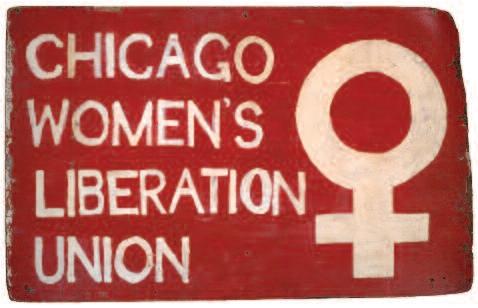
expressed in a CWLU statement of purpose:
We know that changing women ’ s position in society isn’t going to be easy It’s going to require changes in expectations, jobs, childcare, education It’s going to change the distribution of power over the rest of us to all people sharing power and sharing in the decisions that affect our lives These are major, radical changes We consider our struggle revolutionar y because it will r e q u i r
making room for more women within this structure
Guiding Principles of the CWLU
T h e C W LU ( 1 9 6 9 – 7 6 ) w a s t h e
h e socialist feminist women ’ s unions established during the “second wave ” feminist movement, from the early 1960s through the 1980s The CWLU played a leading role in the women ’ s liberation movement in Chicago during the 1970s They considered their primar y purpose to attack s ex i s m T h o u g h t h e y w e r e f i g h
i n d i v i d u a l l i v e s
*Compiled from the CWLU Herstor y Project “Feminism Curriculum and Archives” written by Christine R Riddiough, Margaret Schmid, Estelle Carol, and others, with permission from Estelle Carol
focus on institutions and policies that established sexist patterns, as well as the fact that women ’ s liberation was not possible unless it also fought against racism and capitalism, and for gay and lesbian liberation
Although the CWLU focused on project-based organizing, they also focused on political strategy and theor y
oppression This distinguished them from reform feminists like the National Organization for Women (NOW),
w
ously question the capitalist system. It also distinguished
u
woman organization, but men were usually welcome at
i
s p u b l i c e
attacks on male chauvinism, not on men as a group
In recognizing that women are not the only oppressed group in society, the CWLU asserted that working with
o
a g a i n s t p e o p l e i n p o w e r w a s m o r e b e n e
sidering different forms of oppression as separate issues They aimed to work together against the unequal distribu
making profits, not on human needs Although many of t h e p e o p l e w h o m t h e C W
p
aware that its actual active membership was overwhelmingly white. The social realities of the time made a truly racially mixed feminist organization impractical, so the CWLU made an effort to work with other organizations
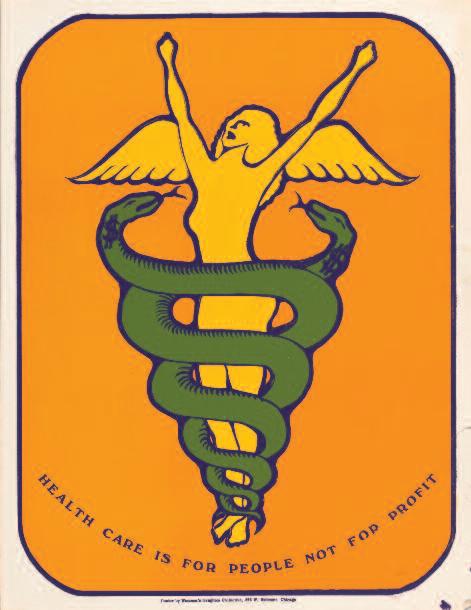
Health Care is for People Not for Profit Estelle Carol and Chicago Women’s Graphics Collective, c 1972
Members of the Chicago Women’s Liberation Union marching to the Civic Center, May 15, 1971
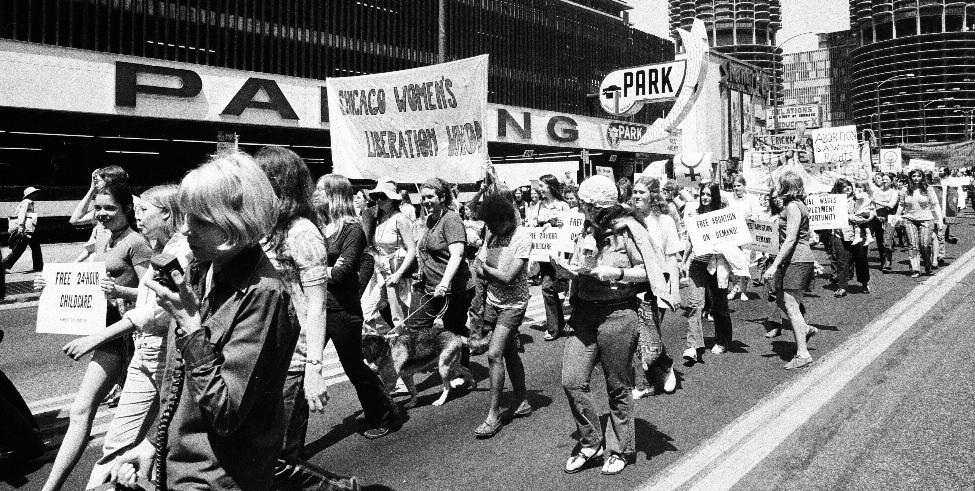
where women of color were active. An example was the C o m m i t t e e t o E n d S t e r i l i z a t i o n A b u s e , w
v e d the CWLU, Mujeres L atinas en Accion, and the Puerto R i c a n S o c i a l i s t Pa r t y T h e C W LU a l s o w o r ke d
Operation PUSH on a campaign to free Jo Anne Little, a y o u n g B l a c k w o m a n w h o w
r she killed a jail guard who had tried to rape her
As proponents of democracy, by which the CWLU did not mean simply voting in elections, but responsible participation of the people affected by a decision, they operated by acting on their ideas in order to test and improve them The CWLU’s work was a delicate balance among its many smaller workgroups, projects, chapters, and the central governing body There was a strong emphasis on democratic process and open discussion, which inevitably led to many long and often frustrating meetings But they considered vigorous debate as part and parcel of democracy as a process, and throughout most of its histor y, the CWLU recognized that diversity of ideas was essential to its unity
T h e i r w o r k i n g p r i n c i p l e s c a n b e s u m m e d
CWLU Membership Conference at the Peoples Church of Chicago located in the Preston Bradley Center in the Uptown neighborhood
The struggle for women ’ s liberation is a revolutionar y struggle.
Women’s liberation is essential to the liberation of all oppressed people.
Women’s liberation will not be achieved until all people are free.
We will struggle for the liberation of women and against sexism in all sections of society. Included in this struggle is the struggle for the right of sexual selfdetermination for all people and for the liberation of all homosexuals, especially lesbians
We will struggle against racism, imperialism, and capitalism, and dedicate ourselves to developing a consciousness of their effect on women
We are dedicated to a democratic organization and understand that a way to ensure democracy is through full exchange of information and ideas, full political debate, and through unity of theor y and practice
We are committed to building a movement that embodies within it the humane values of the society for which we are fighting To win this struggle, we must resist exploitative, manipulative, and intolerant attitudes in ourselves We need to be supportive of each other, to have enthusiasm for change in ourselves and in society, and to have faith that people have unending energy and ability to change.7
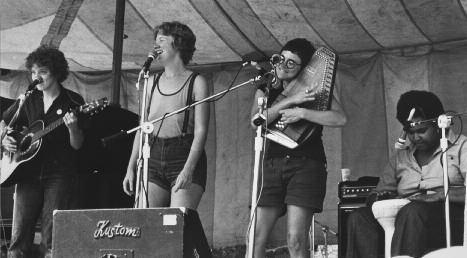
Photograph by Jo Schiffer, 1976 | Gift of Chicago Women’s Liberation Union
“ The Chicago Women’s Liberation Union is a radical women ’ s liberation organization that is over three years old. We have over 300 members, and many different programs aimed at changing the lives of all women and building a new society in which all people will have the opportunity to develop their full potential.”
A CWLU Statement of Purpose, Womankind, December 19728
I n m u c h
emphasis was on personal transformation through consciousness raising groups Small circles of women would meet to help each other overcome the psychological and social effects of sexism The CWLU did not ignore pers
nizing women for revolutionar y change The CWLU was a working organization with a participator y ethos, tr ying to involve more people in change, and tr ying to create a
jects, and chapters
Health care organizing around women ’ s health was, in many respects, the central issue for much CWLU organizing The CWLU reached out to women across class and race lines through education, service, and direct action related to issues of health care, sex, sexuality, and reproduction As CWLU activists applied a feminist analysis to their experiences and to what they had been taught about these topics, it became apparent that health care in general
The National Alliance of Black Feminists (NABF) generated a unique set of symbols for African American women. Brenda Eichelberger (1939–2017), a Chicago public school teacher and guidance counselor, founded the NABF in 1975. With several thousand members from across the nation, the NABF sought a more positive portrayal of Black women in the media, to preserve their cultural heritage, and to combat multiple layers of oppression that Black women face on a daily basis The NABF restricted membership to Black women only but they formed alliances with predominately white organizations, including the National Organization for Women (NOW) and the Chicago Women’s Liberation Union (CWLU).
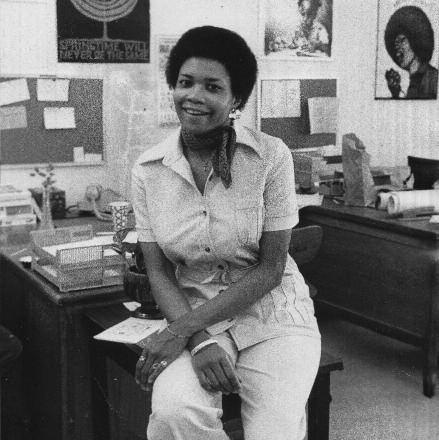
As a distinct organization, the NABF created unique symbols to foster identity and solidarity among members Their official logo depicts a pair of Black female hands breaking the “twin shackles” of racism and sexism, expressing in graphic form what is now called “intersectionality,” or the presence of multiple factors that intersect and overlap to create social identities. Designed by an unknown artist, the logo appeared on organizational literature of all kinds, including the flyer shown on page 52 Note the ankh rings on both index fingers; the ankh is an ancient Egyptian symbol of life that became a popular symbol of African ancestry and cultural heritage during the 1960s–70s Under the logo, the flyer states NABF’s purpose as a “non-profit, non-partisan organization dedicated to achieving full equality for Black women. ” It bears their organizing principle: “where feminism is a dimension of humanism” and provides a full description of their extensive programs and activities that included publications, programs, a speakers’ bureau, credit union membership, peer counseling, and consciousness raising sessions where women can “share, explore, discover, develop and grow. ” NABF also provided workshops and publications on consciousness raising for men
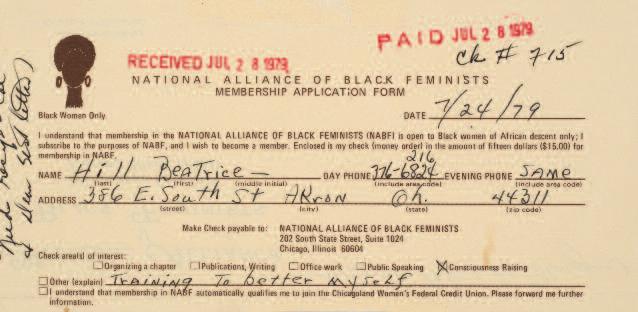
A secondary NABF symbol is that of a silhouetted Black woman ’ s head sporting an Afro hair style and hoop earrings that were period hallmarks of Black identity and beauty Like the twin shackles, this symbol was created by an unknown designer, but it appeared on countless NABF membership forms. The example shown here is from Beatrice Hill of Akron, Ohio, who was interested in “consciousness raising” and “training to better myself ”
The NABF did not seek revolution but rather sought to make American society more equitable Their philosophy is best illustrated by the Black Women’s Bill of Rights, which was modeled after the Bill of Rights, the first ten amendments of the US Constitution adopted in 1791 The NABF’s version, unsigned but probably written by Eichelberger, also consisted of ten articles, but they were expressly written for Black women; they included the right to accurate media portrayal, quality health care, quality education, economic and consumer development, stable homes, civil and criminal justice, quality childcare, and individual freedom.
You can find the Brenda Eichelberger / National Alliance of Black Feminists Papers at the Chicago Public Library, Carter G. Woodson Regional Library, Vivian G. Harsh Research collection of Afro-American History and Literature.
Informational flyer
National Alliance of Black Feminists, c. 1975
Gift of Brenda Eichelberger
Membership application form
National Alliance of Black Feminists, July 1979
Gift of Brenda Eichelberger
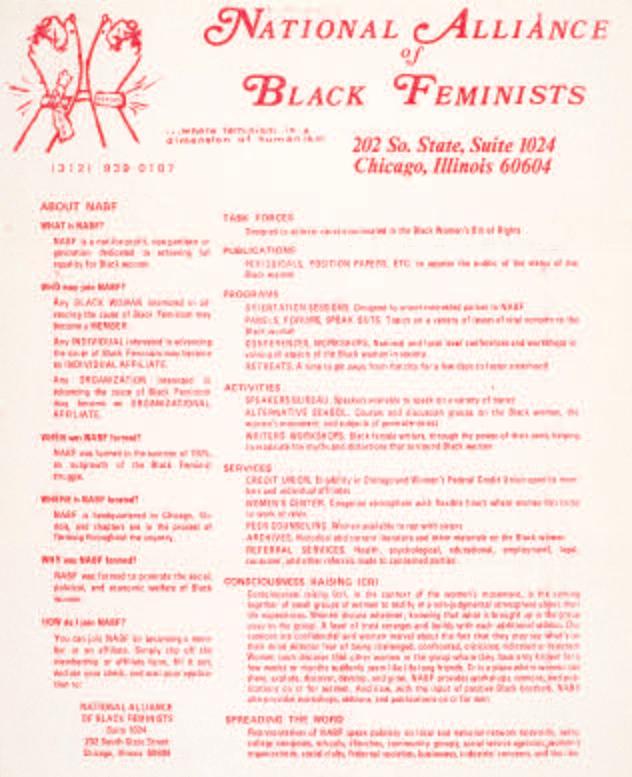
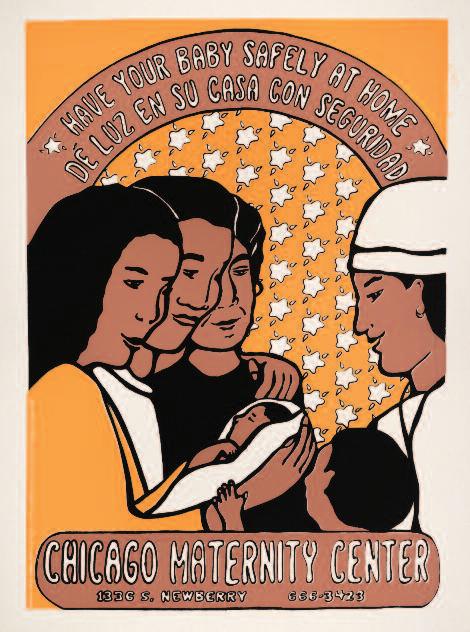
Chicago Mater nity Center
Leslie Nevraumont and Chicago Women’s Graphics Collective, 1972
was largely controlled by a male-dominated medical prof e s s i o n Wo m e n ’ s h e a l t h i n p a r t i c u l a r w a s g e n e r a l l y
i g n o r e d , a n d w o m e n w e r e a d v i s e d t o s i m p l y t r u s t t h e doctor Information about pregnancy, sex, and childbirth was limited and communicated almost exclusively by men. Discussion of lesbianism was taboo
T h u s , t h e H e a l t h E v a l u a t i o n a n d R e f e r r a l S e r v i c e
( H E R S ) w o r k g r o u p s t e m m e d o u t o f t h e n o t i o n t h a t
w o m e n h a d t h e r i g h t t o c o n t r o l t h e i r o w n h e a l t h c a r e . HERS distributed health information that had previously been unavailable to women They also evaluated and recommended health providers so that women could make intelligent health care choices. In addition to HERS, Jane,
t h e A b
g r o u p s
C
CWLU focused on pregnancy testing, sterilization abuse, the Chicago Maternity Center, and overall education on w o m e n ’ s h e
apparent in other work groups and projects 9
The Liberation School for Women was one of the first programs initiated under the umbrella of the CWLU. It
existed nearly a decade before Women’s Studies programs gained traction in colleges and universities, though when t h e s c h o o l c ea s ed o p er a t i o n i n 1 9 7 7 ,
es programs had begun to spring up across the countr y The school’s slogan was “What we don’t know, we must learn. What we do know, we must teach each other,” and its purpose was decidedly political, to counter the role of educat i
words of a Liberation School brochure:
People are not taught to understand how the entire s
For most women, this means that education only fits us for such roles as housewife and mother, follower
v
only the skills and information necessar y for them
t o s e r v e m e n . Wo m e n a r e
i n f o r m a t i o n w h i c h w o u l d h e l p t h e m c
lives, change society, or become independent 10
The Liberation School offered three sessions a year, in Februar y, June, and October. Originally courses were two hours, one night (or Saturday) a week for six weeks; the l e n g t h w a s l a t e r ex
r
Liberation School and the CWLU as an organization As w o m e n b e c a m e c o n s c i
Liberation School for Women sign, 1974 Gift of Chicago Women’s Liberation Union
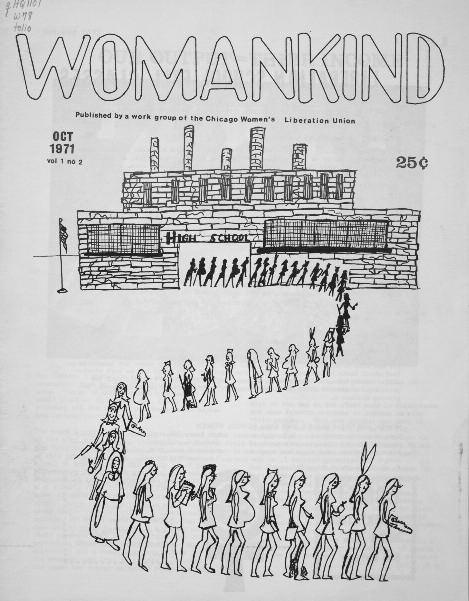
Womankind newsletter, October 1971
Chicago Women’s Liberation Union | Gift of Chicago Women’s Liberation Union
s t r u c t u r e s i n t h e o p p r e s s i o n o f w o m e n , i n c l u d i n g t h e exercise of authority in the classroom, there was a surge of interest in egalitarian, participator y, nonelitist ways of c o n d u c t i n g b u s i n e s s C l a s s e s h a d a w i d e r a n g e , i n c l u d i n g w o m e n ’ s h i s t o r y, h e a l t h p o l i t i c s , c h i l d b i r t h , self-defense, public speaking, and publishing.11
A n o t h e r e a r l y C W LU p r o j e c t w a s Wo m a n k i n d , t h e mass circulation newspaper of the CWLU that started in 1971 Prior to the launching of Womankind, the CWLU had published a monthly CWLU News for its membership, which continued, but it was recognized early on that this
i n t e r n a l n e w s l e t t e r w a s n o t e f f e c t i v e i n i n t r o d u c i n g w o m e n t o t h e w o m e n ’ s m o v e m e n t B e c a u s e C W LU activists were intensely interested in discovering ways to more effectively spread the word about women ’ s liberation and how it could empower and liberate women, this was recognized as a serious problem The first issue came o u t i n S e p t e m b e r 1 9 7 1 , a n d i t w a s p u b l i s h e d m o n t h l y (except in August) through November 1973 In keeping w i t h t h e C W LU ’ s v i s i o n , i t i n c l u d e d a r t i c l e s a b o u t a b r o a d r a n g e o f t o p i c s : s ex , o p p r e s s i o n o n t h e j o b , t h e economy, breast cancer, fixing a car, the Vietnam War, and LGBTQIA+ issues of the time It also included a calendar of woman-related events, comments on the news, information about Chicago’s women ’ s movement, and CWLU
activities such as the CWLU Liberation School. It was distributed to bookstores around Chicago, in junior colleges, and at women ’ s events 12
O t h e r w o r k g r o u p s i n c l u d e d : t h e S p e a ke r s ’ B u r e a u ,
w h i c h p r o v i d e d s p e a ke r s o n w o m e n ’ s l i b e r a t i o n f o r
e v e n t s r a n g i n g f r o m r a l l i e s a t C i t y H a l l t o s p e a ke r s a t
h i g h s c h o o l c l a s s e s o n t o p i c s t h a t r a n t h e g a m u t f r o m
r e p r o d u c t i v e j u s t i c e , t o e m p l o y m e n t r i g h t s , t o l e s b i a n
and gay issues; Direct Action for Rights in Employment (DARE), which plunged into the struggle against gender
d i s c r i m i n a t i o n b o t h o n t h e j o b a n d w i t h i n t h e m a l e -
dominated AFL- CIO ; Blazing Star, a lesbian group within the CWLU, which fought the vicious homophobia prevalent at the time and worked with other gay organizations
i n a c a m p a i g n t h a t e v e n t u a l l y w o n t h e p a s s a g e o f a
H u m a n R i g h t s O r d i n a n c
w h i c h c h a l l e n g e d t h e C h i c a g o Pa r k D i s t r i c
through its sports organizing; and the Chicago Women’s G
for a variety of progressive issues 13
Chicago Women’s Graphics Collective
“ You’ll rarely see a person ’ s name on [the CWGC ’ s posters] because we decided that moder n art had been done all wrong by men. It was based on egotism and the cult of the individual the ‘great men of art’ syndrome. So we decided to throw all that out, and art now had to be a collective experience. So ever y poster that we created had to be done by committee. Ever y one. ”
Estelle Carol, founding member of the Chicago Women’s Graphic Collective14
I n 1 9 7 3 , t h e C h i c a g o Wo m e n ’ s G r a p h i c s C o l l e c t i v e (CWGC) was working in a run-down second floor office o n B e l m o n t Av e n u e t h a t t h e y s h a r e d w i t h t h e m a i n offices of the CWLU. A tattoo parlor was on the first floor. P r i o r t o t h a t l o c a t i o n o n B e l m o n t , t h e s t u d i o h a d b e e n located in Carol’s apartment on Newport Street, where t h e r e w e r e s i l k - s c r e e n t a b l e s i n t h e d i n i n g r o o m , a n d a bathroom doubled as a darkroom. W i t h t h e C W G C ’ s c o l l e c t i v e s y s t e m , a n y m e m b e r
c o u l d t a ke a s u b j e c t a r e a , i d e a , p h r a s e , o r i m a g e a n d d e c i d e t o c r e a t e a p o s t e r. T h e y w o u l d a s k t w o o r t h r e e
Lesbian members of the Chicago Women’s Liberation Union (CWLU) formed their own group within the larger organization. They encouraged the CWLU to adopt a position paper titled “Lesbianism and Socialist Feminism,” which the CWLU did at its annual membership conference in November 1972.
In it, they argued that women ’ s liberation and gay liberation had a commonality grounded in discrimination in jobs, schools, the law, and generally in a culture with strict sex role expectations. Lesbians, they continued, presented a threat to the nuclear family structure by undermining the contract of marriage in which women essentially became the property of a man and by opting out of traditional child-rearing patterns, showing that women are not born to be mothers and can choose their reproductive role Because of this threat to the family structure and domestic labor traditionally done by women, they claimed the very existence of lesbians counters the social structures that relegate women to specific positions in the broader labor force
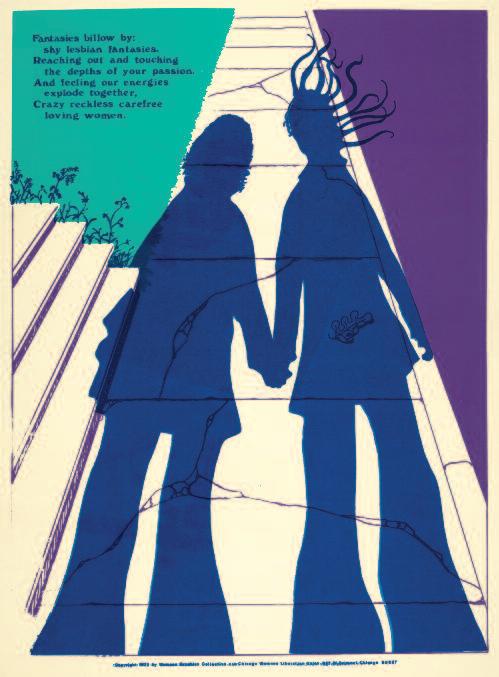
Shy Lesbian Fantasies
Within the CWLU’s three-part structure of service, education, and direction, the Lesbian Group focused largely on education, because direct action around lesbian issues was more difficult at the time. They recognized that a major part of its constituency was people who might attend a private event but wouldn’t become involved in a public demonstration for fear of being exposed or losing their job. For that reason, it was crucial that gay rights struggles be included in organizations not explicitly identified as gay groups, such as women ’ s liberation or civil liberties groups, so that all people could become involved in the struggle without having to declare themselves gay or straight
Chicago Women’s Graphics Collective, 1972
The group did so within the CWLU by including discussion of lesbian issues whenever appropriate in outreach such as in the Liberation School for Women, the Womankind newspaper, the Speakers’ Bureau, as well as a reappraisal of heterosexual assumptions in general situations They encouraged the health project to expand to areas that were of more concern to lesbians, such as gynecological exams and referrals. They also expanded the CWLU’s legal clinic to include gay and lesbian issues, conducted social outreach, and some members joined the Chicago Women’s Graphic Collective (CWGC), creating colorful posters that championed lesbian liberation.
The poster Shy Lesbian Fantasies, pictured on page 55 features a poem about lesbian love in different shades of blue and lavender, the latter a color historically associated with LGBTQIA+ people in a derogatory fashion but reclaimed in a positive manner by the early gay liberation movement The poster Together: A Gay Game for Everyone takes a humorous approach to gay rights with a board game-like take on social interaction.
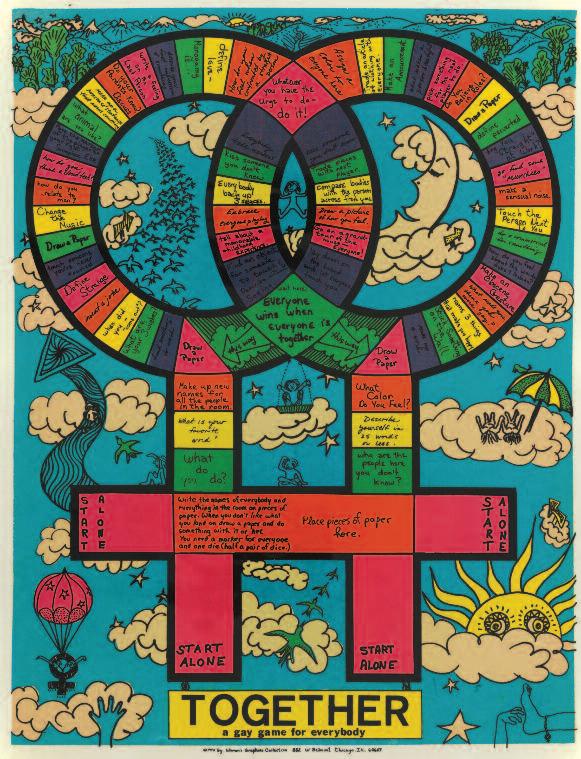
Together: A Gay Game for Everyone Chicago Women’s Graphics Collective and Salsedo Press, 1972
Starting in 1975, the Lesbian Group published their own newspaper titled Blazing Star, which also became the group ' s official name. The newspaper focused on the struggles and discrimination faced by lesbians, including the increasingly homophobic views that many mainstream leftist organizations espoused at the time. After the CWLU disbanded in 1977, a group of lesbian and straight women continued publishing Blazing Star into the mid-1980s, after which it became a section of GayLife, Chicago’s weekly gay and lesbian newspaper.
Blazing Star, vol. 3, no. 1, 1977
Chicago Women’s Liberation Union
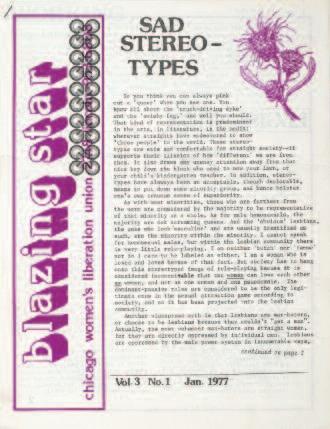
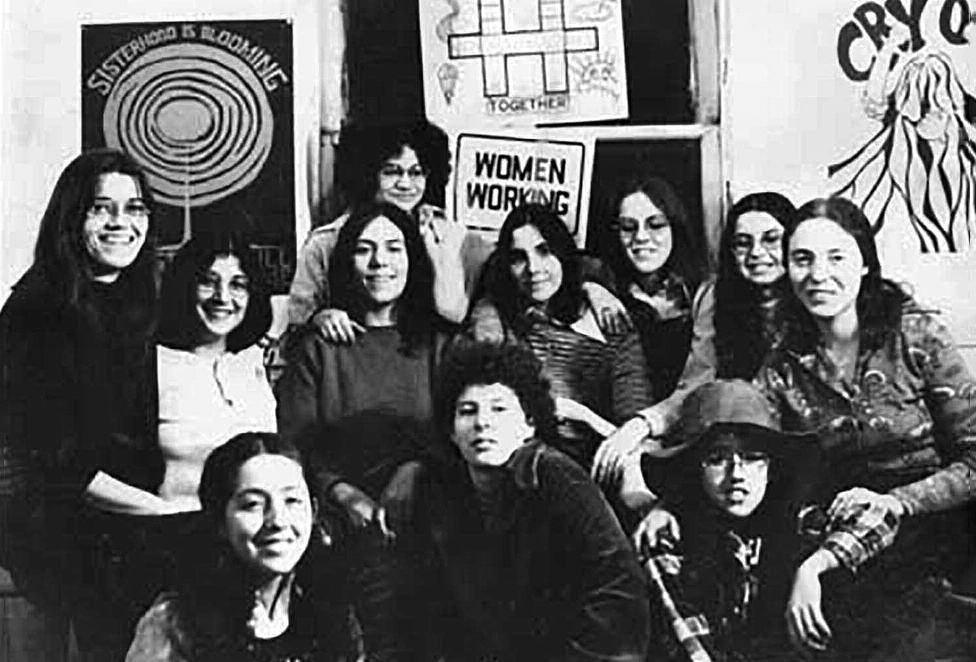
Estelle Carol (center row, far right) with the Chicago Women’s Graphics Collective, 1972 | Unknown photographer, 1972 | Courtesy of Estelle Carol
m
m b
t
help develop the idea Because they were socialist feminists, making women “equal” to men in an exploitative
c a p i t a l i s t s o c i e t y w a s n
clearly feminist posters designed by the group, they did p o s t e r s a b o u t h e a l t h c a r e , t h e T h i r d Wo r l d , l a b o r, a n d other issues
Once the design was ready, in small teams they would physically create the poster in silk screen Carol notes that i t h a d t
s i n g l e w o m a
needed at least three people, and all the silk-screen posters were hand printed If a poster was more than one color, it had to be hand printed for as many kinds of colors as the Collective had, so it was ver y labor intensive They could only print, at a maximum, two hundred at a time because that amount taxed both their physical strength and their space Eventually enough orders came in that they began
t o m a ke m o
a b l e
printshop, to offset printing in larger quantities
The Graphics Collective was an important part of the CWLU. Their creations gave the other CWLU members
were doing The posters also gave the CWLU credibility a
national presence. The CWGC had a fairly extensive distribution network They shipped to organizations, political bookstores, and women ’ s groups all over the world, sometimes as many as 20,000 posters The posters were often large in size, making them hard to miss.
E v e n t u a l l y t h e C W G C
Av e n
i
o n Southport Avenue, with a full kitchen in the back But by 1 9 7 5 , C a r o l h a d g r o w n p h y s i c a l l y ex h a u s t e d f r o m t h e
e f f o r t r e q u i r e d i n s i l k s c r e e n i n g a n d h a d c o n c e r n s t h a t the chemicals they used might be damaging her health
At t h a t p o i n t , m a n y o f t h e p e o p l e w h o s t a r t e d t h e
C W G C h a d m o v e d o n , a n d t h e n e w p e o p l e c o m
h a d d i f f e r e n t g o a l s t h
e s w i t h
i c h t h e Collective began In particular, Carol notes, female separ a t i s m h a d b e c o m e a g r o w i n g f o r c e i n t h e w o m e n ’ s movement, and the CWGC was no exception. This ran c o u n t e r t o C a r o l ’ s s o c i a l i s t f
i n i s t v i
, w h i c h w a s b e c o m i n g t h e m i n o r i t y v i e w, a n d s h e l e f t t h e g r o u p , which continued until 1983.
“ We saw the value of working for a goal much larger than ourselves. We saw that you could really change, change people’s lives, and change the reality by taking action.”
Heather Booth, CWLU founding member
By the mid-1970s, the CWLU could see the changes that
motion Abortion was legal Women were breaking down employment barriers and going into formerly male-dominated fields Women were fighting back against unequal pay and sexual harassment Members of the LGBTQIA+
c o m m u n i t y w e r e c o m
c
being seen as “countercultural” institutions There was a m
p a s s a n E q u
Pe r h a p s m o s t t e l l i n g l y, c o n s e r v a t i v e a c t i v i s t s s u c h a s
Phyllis Schlafly launched a powerful right-wing backlash against “ women ’ s lib,” proving that the movement was being taken seriously by its enemies
I n a r e p o r t t o t h e 1 9 7 5 C W LU a n n u a l c o n f e r e n c e ,
CWLU leaders predicted a bright future for the organizat i on Th e 1 9 7 5 S oc i a li s t Femi ni s t Conf er enc e a t Yellow
S p r i n g s , O h i o , h a d a t t r a c t e d m o r e t h a n o n e t h o u s a n d
w o m e n T h e C W LU w a s r e c o g n i z e d a s a m o d e l f o r
socialist feminist organizing, and the group had strengthe n e d i t s t i e s w i t h o t h e r M i d w e s t w o m e n ’ s u n i o n s
CWLU leaders pointed to the group ’ s growing involvem e n t w i t h w o m e n o f c o l o r, i n c l u d i n g t h e N a t i o n a l
A l l i a n c e o f B l a c k Fe m i n i s t s , w h i c h f o r m e d i n 1 9 7 5 I t
c o m p a r e d t h e C W LU ’ s s i t u a t i o n w i t h t h e d i s a r r a y t h a t
N O W w a s ex p e r i e n c i n g a f t e r i t s d i s a s t r o u s a t t e m p t t o launch a nationwide women ’ s strike
The optimism of the CWLU leadership proved to be unfounded A small number of CWLU members, dissati s f i e d w i t h w h a t t h
middle-class orientation unleashed a scathing attack on t h e o r g a n i z a
g r o u p p a s s e d o u t a l e a f l e t
rejected some of the CWLU’s most basic principles The CWLU went into a deep internal crisis over how to deal with the situation. The organization eventually split apart and in 1977 formally disbanded
Though the end of the CWLU was an agonizing and w r e n c h i n g ex p e r
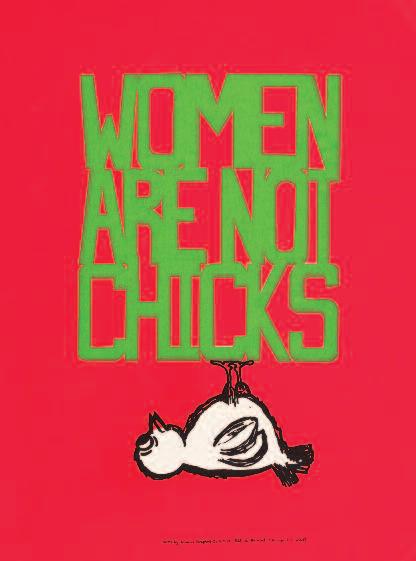
Women Are Not Chicks Barbara Carrillo and Chicago Women’s Graphics Collective, 1972
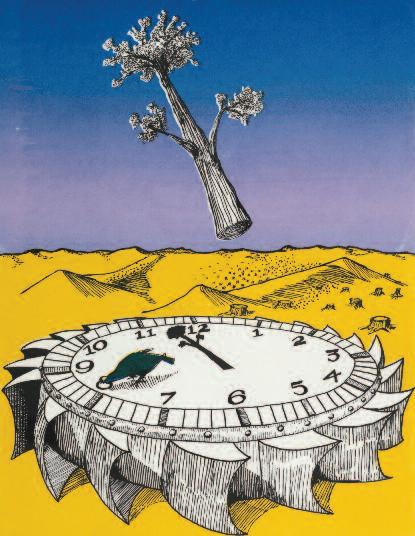
It’s L ater Than You Think Estelle Carol and Chicago Women’s Graphics Collective, c 1972
that ending should not obscure the organization’s positive contributions toward the liberation of women in the United States Thousands of women were touched by its
m a n y o r g a n i z i n g p r o j e c t s Af t e r i t s dissolution, former CWLU members
w e n t o n t o w o
, education, law, publishing, manufac-
t
a
b u s i n e s s o w n e r s , d o c t o r s , o f f i c e workers, political activists and more Many became parents and grandpar-
e n t s a n d n e v e r s t o p p e d w o r k i n g f o r
p o
words of Estelle Carol:
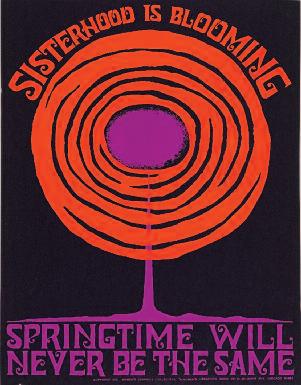
“I want to communicate the excitement of that period so that young women today have a foundation upon which to wage the struggles they need to wage. I am hopeful that a new women ’ s liberation movement will arise to finish the job that we worked so hard on, and if it does, I have ever y intention of becoming a part of it. And if the movement wants some new posters ”
Sisterhood is Blooming Estelle Carol and Chicago Women’s Graphics Collective, 1972 E N D N O T E S
1 Portions of this article were adapted from: “ The Chicago Women’s Liberation Union: An Introduction by the CWLU Herstor y Editorial Committee (2000),” Chicago Women’s Liberation Union: Herstor y Project, https://www cwluherstor y org/supplemental-writings/thechicago -womens-liberation-union-an-intr oduction; additional pages will be cited throughout
2 This changed when the Equal Credit Opportunity Act was passed and signed into law on October 28, 1974 See https://www congress gov/bill/93rd-congress/house-bill/8163
3 This was deemed unconstitutional in 1975 See Taylor v L ouisiana, 419 U S 522 (1975)
4 Addressing the severity of the crimes associated with domestic violence, sexual assault, and stalking was only codified into federal law starting in the 1990s with the Violence Against Women Act of 1994 (Title IV of the Violent Crime Control and L aw Enforcement Act, H R 3355), which was expanded in 2000 and again in 2005
5 Though Haven House opened in California in 1964, the women ’ s safety movement only began to expand nationwide in the 1970s See, L arissa
MacFarquhar, “ The R adical Transformations of a Battered Women’s Shelter,” The New Yorker, August 12, 2019, https://www newyorker com/magazine/2019/08/19/the-radical-transformations- of-a-battered-womens-shelter; A Woman’s Place, “AWP Histor y, ” https://www wadvocates org/2019/10/15 /first-domestic-violence-shelters-in-thenation-speak- out-45-years-later/
6 “ What We Believe,” Chicago Women’s Liberation Union: Herstor y Project, https://www cwluherstor y org/what-webelieve
7 Reprinted at “Political Principles of the CWLU,” Chicago Women’s Liberation Union: Herstor y Project, https://www cwluherstor y org/teachingmodules-theor y-strategy?tag=political%20principles%20of%20cwlu
8 Reprinted at “Our Mission,” Chicago Women’s Liberation Union: Herstor y Project, https://www cwluherstor y org/ our-mission
9 See Christine R Riddiough, “Health Care Organizing in the Chicago Women’s Liberation Union,” Chicago Women’s Liberation Union: HerStor y Project, June 15, 2016, https://www cwluherstor y org/ analysis-articles?tag=health%20care
10 Christine Riddiough and Margaret Schmid, “ The Liberation School for Women: A Case Study from the Second Wave Women’s Liberation Movement,” Chicago Women’s Liberation Union: Herstor y Project, July 18, 2016, https://www cwluherstor y org/teachingmodules-communicating-a-radicalvision/the-liberation-school-for-women
11 Ibid
12 See Christine R Riddiough and Margaret Schmid, “ Womankind: The Outreach Newspaper of the Chicago Women’s Liberation Union,” Chicago Women’s Liberation Union: Herstor y Project, August 29, 2016, https:// www cwluherstor y org/program-descriptions-articles/tag/womankind+outreach+newspaper
13 “Program Descriptions,” Chicago Women’s Liberation Union: Herstor y Project, https://www cwluherstor y org/ program-descriptions
14 Estelle Carol, “‘ The Chicago Women’s Graphics Collective: An Introduction ’ A Memoir by Estelle Carol,” Chicago Women’s Liberation Union: Herstor y Project, August 30, 2016, https:// www cwluherstor y org/chicago -womensgraphics-collective/the-chicago -womensgraphics-collective-an-introduction
On Saturday, June 29, 1970, Chicago became one of four American cities where gay men and lesbians marched to commemorate the first anniversar y of the Stonewall rebellion. The procession began with a rally in Washington Square Pa r k , b e t t
N o r t h S i d e O n c e a s
radicalism, Bughouse Square had been a major cruising a
repression, fear and shame” involved in the stigmatization of their erotic lives, as the countercultural Chicago S
Center (now Daley Center) Plaza, where they listened to speeches and danced around the famous Picasso statue there while chanting, “Gay power to gay people!”1
The invented tradition of the gay pride march gave concrete expression to the notion of coming out of the closet, disclosing one ’ s homosexuality, and becoming visible central tenets of the movement for gay liberation that flourished at the turn of the 1970s. The new movement was shaped by the influences of the Black freedom struggle, the movement against the war in Vietnam, the hippie counterculture, and the rebirth of feminism. The upsurge of queer activism built, as well, on earlier queer activism In 1924, Chicagoan Henr y Gerber had founded the nation’s first known gay rights organization, the Society for Human Rights, though the police quickly shut it down. In the 1950s and 1960s, the C h i c a g o M a t t a c h i n
California-based groups, the Daughters of Bilitis and ONE, had required their members to use pseudonyms for their own protection.
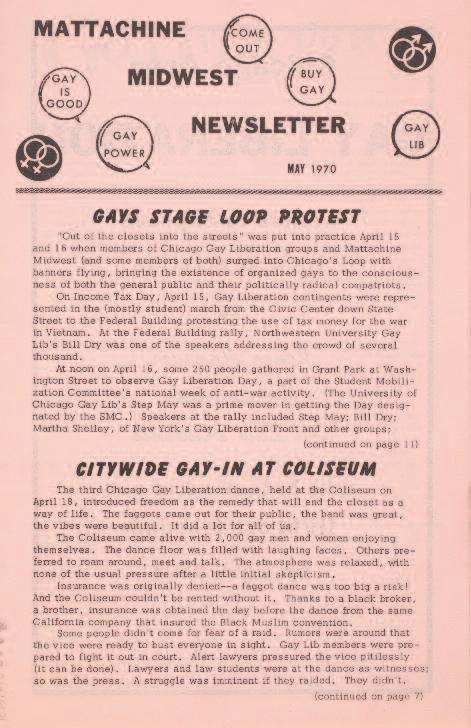
Mattachine Midwest Newsletter, May 1970
Gift of Pearl M. Hart
Mattachine Midwest, founded in 1965 (and unrelated to the earlier group), had increasingly focused on police harassment and included several members who used their real names. Just before the 1968 Democratic National Convention opened at the Chicago Hilton, police raided Sam’s and the Annex, two of the city ’ s largest and busiest gay bars At both locations, in a style familiar to local activists, plainclothes police infiltrated the bars long enough to be “propositioned” by patrons, then brought in uniformed colleagues to shut the place down and cart the patrons off to jail Now, Mattachine Midwest members took an unprecedented step: they held a press conference denouncing the raids and circulated a petition, labeled “Forgotten Citizens Unite,” among the antiwar demonstrators in Lincoln and Grant Parks 2 It was the first time gay Chicagoans had circulated a petition in public, asking strangers to sign in support of their cause.
Portions of this essay from Timothy Stewart-Winter, Queer Clout: Chicago and the Rise of Gay Politics, © 2016 University of Pennsylvania Press, pp 95‒152 Reprinted with permission of the University of Pennsylvania Press
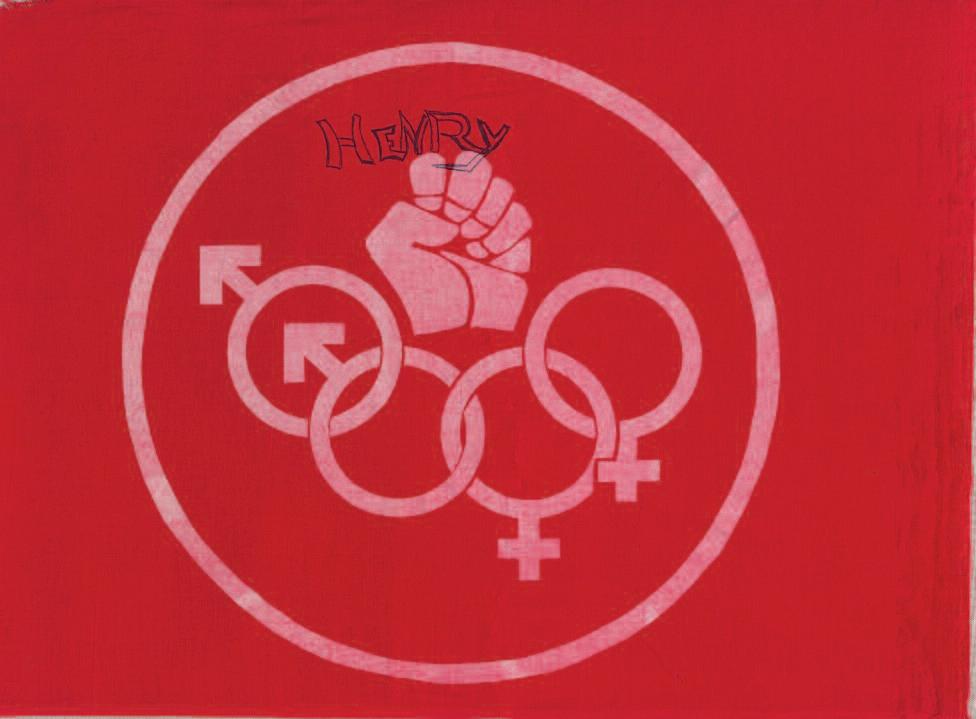
The convention made it easier to challenge the police and helped push queer Chicagoans toward militant activism Chicago’s daily newspapers, which had previously either ignored or celebrated police crackdowns against queer venues, grew more receptive to reporting on antigay harassment In fall 1969, Mattachine Midwest members took it upon themselves to police the police and to do it in plainclothes The group organized a “bar patrol” on weekend nights. The idea, they said, was to “put a significant crimp in police raid plans” by supplying “ responsible observers who would be prepared to testify to the falsity of police allegations of public indecency.”3 Bar owners also began to turn to the courts for relief 4 R aids on gay bars continued, resulting in petition drives in the late 1960s, direct-action protests in the late 1970s, and, in a couple of cases, civil damages awarded by juries to plaintiffs who pursued legal action against the city in the 1980s
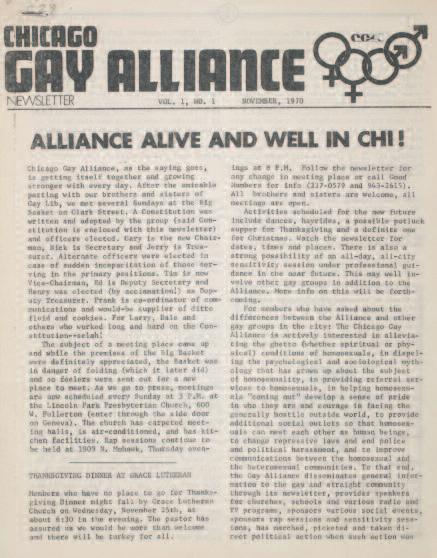
In fall 1969, young activists in Hyde Park held meetings of the Gay Liberation Front. Inspired by the radical Chicago Gay Alliance Newsletter, November 1970
group of the same name founded in New York after Stonewall, this new group met in the apartment of Henr y Wiemhoff and Michael Brody 5
By the time of the June 1970 Pride march, there were campus, neighborhood, and citywide gay liberation groups By spring 1970, gay liberationists held one large, public event after another and were seeking out publicity. Frustrated that the city ’ s gay bars did not allow dancing, members of Chicago Gay Liberation (CGL) tested their ability to sponsor dances where same-sex couples could embrace without facing arrest, holding a citywide gay dance at the Chicago Coliseum on April 18, 1970.6
Two days in advance, on April 16, 1970, a rally for gay rights drew 250 people into Grant Park, then downtown a l o n g t h e l a ke f r o n t , f o l l o w e d b y a m a r c h d o w n Washington Street. The dance on April 18 drew a larger crowd to the Coliseum Despite many fears, precautions, and inconclusive negotiations, the dance was not raided by the police
Following their success in sponsoring the Coliseum dance, gay liberation activists next picketed the owners of a large North Side gay bar, the Normandy Inn, just a few blocks from the Chicago Avenue (18th) Police District headquarters. The protesters called on the bar ’ s owners to use their influence with police to force toleration of
same-sex dancing. When they succeeded the Normandy owners negotiated directly with district police to allow dancing gay Chicagoans celebrated “ Thanks are due to G a y L i b e r a t i o n , ” n o t e d t h e M a t t a c h i n e M i d w e s t Newsletter, “ for getting dancing in gay bars,” reflecting its importance to people of many ages 7
By advancing a political strategy centered on visibility, the June 1970 Pride parade constituted a stunningly effective challenge to the specific experiences of discretion and concealment that characterized gay life in the postwar decades But the existence of gay pride marches and, later, parades did not transform the limitations of the closet overnight Indeed, these groups faced exclusion and ridicule from the city ’ s political elites Like New Left and Black Power organizations, they were subject to surveillance and infiltration by the Chicago Police Department’s undercover antisubversive unit or “Red Squad,” which had grown dramatically in the 1960s
One Red Squad report noted that gay liberation activists attend “ whatever Left Wing Demonstrations or activities there are, ” where, “if given an opportunity to speak” a member would describe “the advantages of Homosexuality, and the discrimination that is shown to Homosexuals ”8
CGL itself was a short-lived citywide organization, rather quickly splintering over whether to adopt a single-
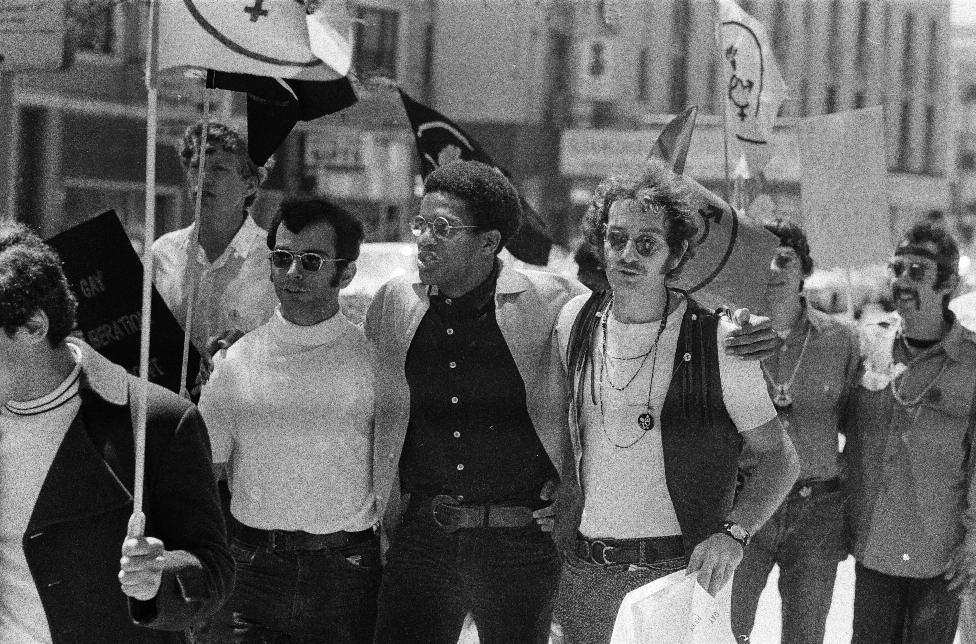
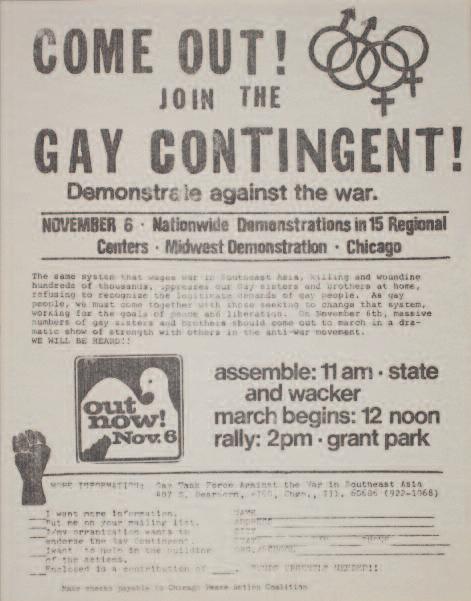
Come Out! Join the Gay Contingent!
Unknown designer, 1972
Courtesy of Gerber/Hart Librar y and Archives
issue or multi-issue political approach. Members of color created a Black Caucus, declaring that “ white racism exists in the homosexual ghettos as it does in our total society ”9 Within a month, the group became Third World Gay Liberation. “ We must align ourselves with our Black heritage in our fight for Black equality,” wrote Elandria V Henderson in an early manifesto “Before we can even begin to do this we have to demand acceptance from our Black people.”10 They joined a wave of rhetoric and activism organized around the concept of remaking society on wholly new principles and committing themselves to intersectional struggle At the same time, predominantly white activists left CGL to found Chicago Gay Alliance in pursuit of militant but “single-issue” political organizing, like the members of New York’s Gay Activists Alliance, which they took as their model 11
Although it did not last long, CGL led to the proliferation of new activist groups, which continued throughout the 1970s to offer a subversive challenge to the city’s heteronormative political culture In the first half of the 1970s, members of Chicago Gay Alliance sent speakers to churches, schools, and community groups, spreading by their presence the then-novel idea that one ’ s homosexuality could be publicly proclaimed. Gay activists solicited
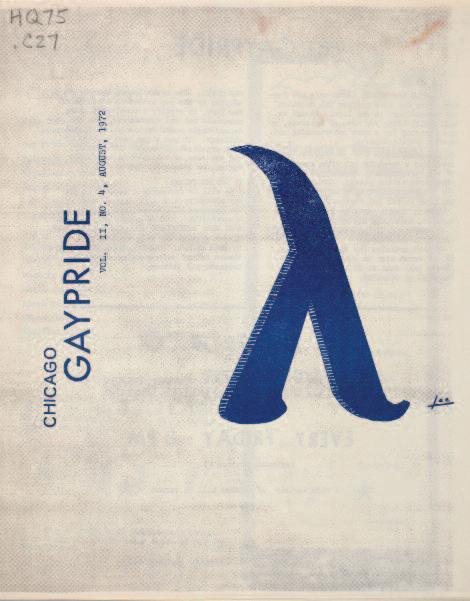
Chicago Gay Pride/Chicago Gay Alliance Newsletter Designed by Les, August 1972
and accommodated requests for speakers on radio and television They lobbied the nation’s professional organizations for lawyers and doctors, both headquartered in Chicago, to change their influential antigay positions 12 From early on, they placed a municipal gay rights ordinance on their agenda Energized by the new universe of possibilities offered by freedom from concealment, gay activists began to challenge prominent Chicagoans, such as newspaper columnist Mike Royko, when he wrote disparagingly about homosexuals 13
Being out of the closet exacted a toll that was emotional as well as economic In 1972, a reporter spoke with 24-year- old Linda Shear, who had worked as a high school teacher in an experimental Chicago school from October 1971 until Januar y 1972: “She found her students and teaching responsibilities ‘gradually phased out’ when her lesbianism became quietly known. Now she is tr ying to start a career as a folk singer who happens to be a lesbian and who will not work straight bars ” Shear was careful to emphasize to the reporter, “But not for a second do I forget what I have left behind ”14 For women, the necessity of concealment exacerbated the toll taken by antiwoman job discrimination and sexual harassment. As one Chicago woman put
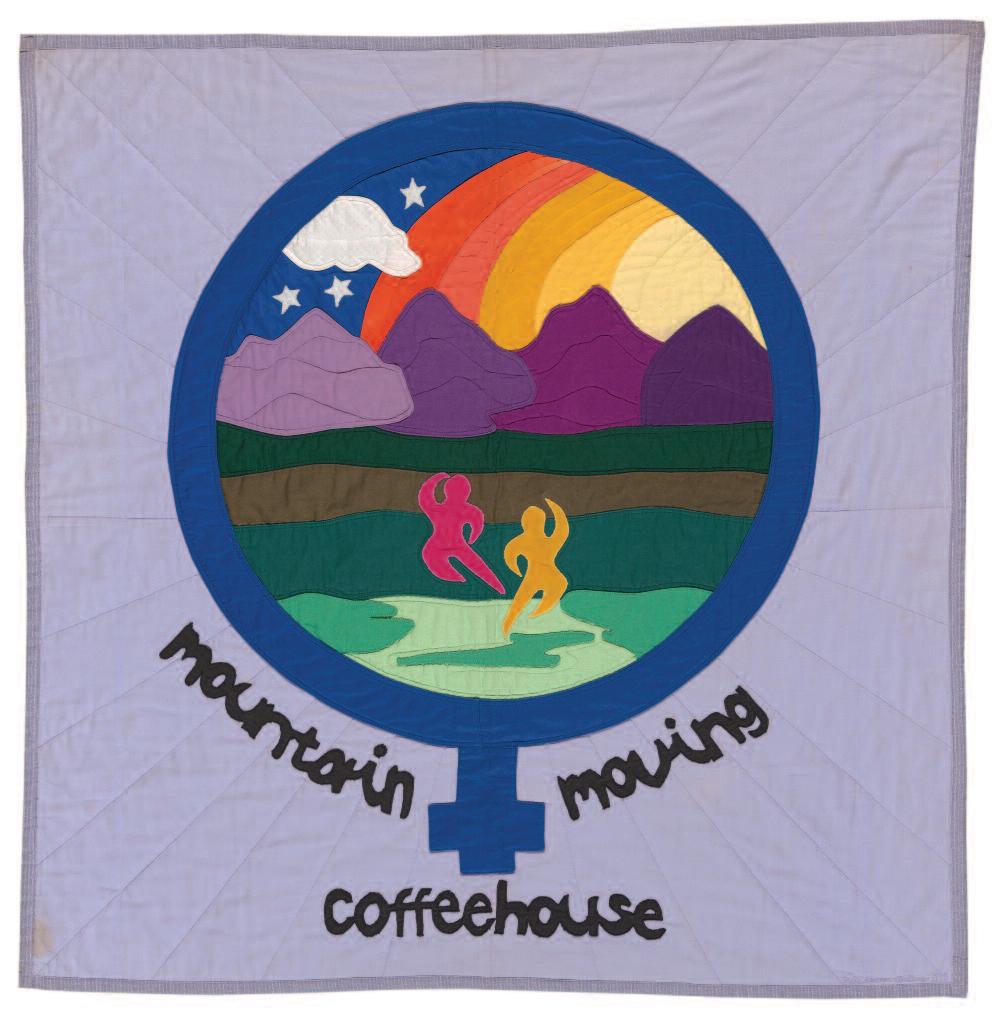
it, “I have to put on this big scene of being heterosexual. And I don’t like putting on fronts But the men who come in like to flirt and expect me to flirt back ”15
By marching publicly and proudly, queer Chicagoans pressed at the boundaries of the closet and staked a claim to city streets Paradoxically, although gay liberation was a radical movement suffused with rhetoric of revolution, it set in motion the greater visibility of gay life on the North Side as well as in participation in urban machine politics As gays and lesbians built and staffed the city ’ s first gay and lesbian community centers, counseling agencies, medical clinics, and religious congregations, they confronted the fact that losing control of knowledge of one ’ s sexuality could entail the ver y real risk of losing one ’ s job After newspapers covered journalist David Stienecker ’ s speech at the April 16, 1970, Grant Park demonstration, for example, he was fired from his job at World Book Encyclopedia 16 Queer activists turned to the civil rights model developed by African Americans to seek legislation to protect them. In 1971, when the city council weighed amendments adding “ sex ” to local antidiscrimination ordinances dealing with “ race ” and “color,” Alliance members attended the hearings and unsuccessfully made the case for including protections for “homosexuals” and “transvestites ”17
Although gay men dominated “ gay ” institutions, lesbians were highly overrepresented in new feminist institutions for women. Indeed, in the 1970s “ women ’ s ” became almost a code word for “lesbian” in certain circles In Chicago, lesbian women in Hyde Park on the South Side and in Lincoln Park on the North Side met in church basements, staffed telephone switchboards, hosted meetings, and joined softball teams Some women joined the Chicago Women’s Liberation Union (CWLU), a large, grassroots socialist-feminist organization that developed out of the West Side Group, one of the nation’s first women ’ s liberation organizations, in 1969 Others volunteered to paint the walls, sand the floors, or make curtains for the fledgling Women’s Center in L akeview. In North Side lakefront neighborhoods, they built women- owned bars, coffeehouses, collective bookstores, restaurants, and drop-in centers Some wrote and published materials that helped connect women in crisis with help and resources, including the collectively run L avender Woman, which was one of the most important and longest running of the lesbian feminist newspapers founded during the 1970s Some women simply showed up when pioneers of the new “ women ’ s music” groups like Family of Woman and the Chicago Women’s Liberation Union Rock Band, which represented one of the key institutional sites for the formation of urban lesbian feminist communities performed at venues around the city
“One of the main reasons for lesbian involvement in Women’s Lib movements,” activist Marie Kuda observed
in a 1970 article in the Mattachine Midwest Newsletter, “is that in the job market women traditionally lose the battle of the sexes ”18 Lesbian activism in the 1970s focused, to a degree little recognized by its latter-day chroniclers, on the economic status of women. Women without husbands in the 1970s frequently faced difficulty obtaining loans, credit cards, and mortgages Because most lesbians could not depend on the income of a husband, the cause of pay equity for women was especially resonant Even before the formulation of lesbian feminism as a fully articulated political ideology, jobs and economic equality were central issues for urban women who wanted to live separately from men
Lesbian organizing in Chicago emerged out of the city ’ s women ’ s liberation and antiwar movements and the counterculture, drawing together women of all races, students and young college-educated women, hippies, and radicals R adical lesbians declared their unwillingness “to sit calmly while men receive the best jobs, the best degrees, the most money, the best part of the world,” as one writer put it She added, seeming to aim her prose at male leftists and skeptical straight women, “As lesbians we are as much or more political than any group on the face of this earth. We stand as the greatest threat to this society, far more than gun-carr ying revolu-
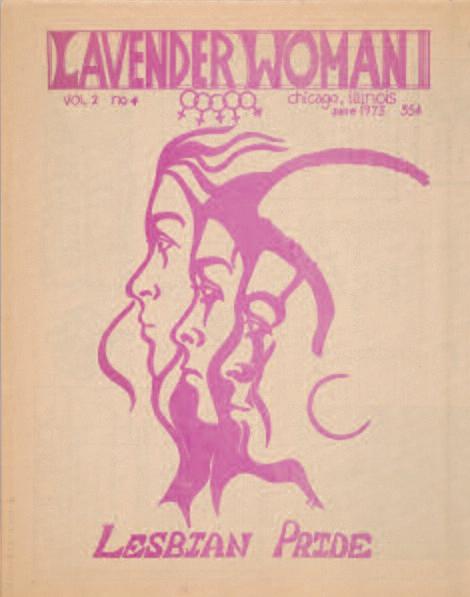
L avender Woman, June 1973 Cover illustration by Sara Thompson
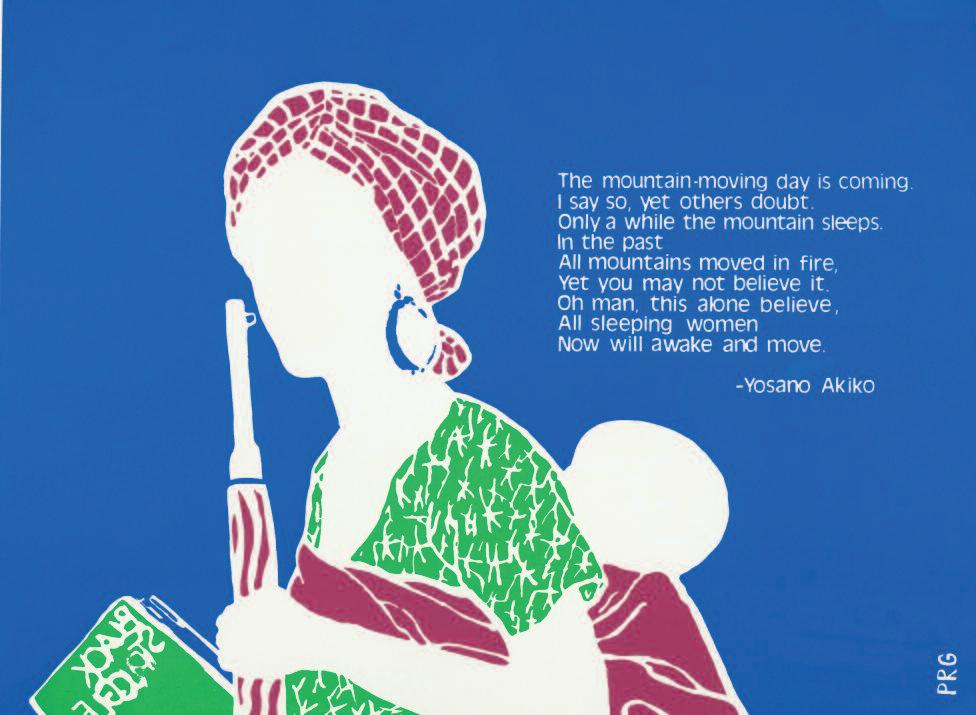
tionaries or bomb-scare groups blowing up the White House or the Chase Manhattan Bank.”19 Since the emergence of gay liberation, lesbian politics has long been far more inflected by radicalism than gay male politics
Many lesbians struggled to make ends meet, partly because they were disadvantaged by metropolitan job markets that assumed women would be supported by a male breadwinner who earned a “ family wage ” Indeed, lesbians experienced more financial insecurity than either straight women or gay men. The conditions of their lives as women and as lesbians led some women to begin to formulate what they called lesbian feminism At once a theor y with ramifications for ever yday life and ways of living with philosophical implications, this new framework was empowering because its vision of sisterhood offered alternatives to the rigid norms of American political economy and culture, which in the postwar decades assumed marriage and childrearing as the appropriate activities for adult women
Lesbian feminism gave women alternatives to the limited options offered by midcentur y American society by
raising their “consciousness.” The nascent lesbian feminist press helped women understand and analyze their experiences in the job market and the hidden forms that sexism often took In Chicago, L avender Woman ran a first-person article by a woman describing her experiences working for an employment agency as a job counselor, under a headline “I Was a Flesh Peddler ” that mocked the sensationalist language of the metropolitan press “ There were some details that didn’t get written down,” noted the stor y ’ s author, “but passed by word of mouth from counselor to counselor: A company wouldn’t see blacks, B wouldn’t see fatties, C wanted women with big tits.”20 Such articles served simultaneously to raise readers ’ consciousness about experiences that many women had faced in the workplace, while also helping to recruit new participants for workplace activism
In late 1973, the collective that ran the Women’s Center on North Halsted Street created a series of courses they called “Lesbian Survival School ” Modeled on the Chicago Women’s Liberation Union’s “Liberation School for Women,” the program included courses that taught concretely usable skills like crafts, auto mechanics, “home mechanics,” and “street fighting,” as well as courses to enrich women ’ s intellectual development and to educate
them about lesbian politics, theor y, and culture. Lesbian Survival School exemplified several features of lesbian feminist mobilization Lesbian survival implied women living independently in a society structured by heterosexual male desires.21 And survival school was a form of cultural education, not electoral or legislative mobilization, or even protest
The woman- oriented communities that flourished between 1968 and the early 1980s reflected a grassroots, do -it-yourself ethos Many lesbians and bisexual women put their political energy in these years not into electoral politics but into grassroots communities that valued
Children, founded in 1974, became an important incubator of women ’ s music. It inspired the name for the 1972 Mountain Moving Day album recorded by the Chicago Women’s Liberation Rock Band and the New Haven Women’s Liberation Rock Band A women- only space from its inception, Mountain Moving functioned as a concert venue held in a space rented from a church once a week 22
Linda Shear, who became a nationally known icon of the women ’ s music scene, described the lesbian feminist communities she was a part of in the 1970s as having adopted “ a range of orthodoxies ” Invoking the landscape of lesbian separatism in Chicago, Shear recalled, “Some women involved in separatism had many other community connections at the same time, and others shunned association with straight men, gay men, and straight women as much as possible.”23 Some women simply preferred the company of other women to that of men Others enjoyed all-female spaces but retained male friends and associates A few women rejected even associating with other lesbians who did not share their views on women ’ s autonomy
Some young lesbians rejected the overt sexuality and physicality of the lesbian bar scene Rejecting the institutions of an older generation of lesbians who mostly did not strongly identify as feminists, these younger women also rejected the “ roles” with which they associated them 24 However, many women continued to patronize women ’ s bars and they maintained ties to the bar-based lesbian subculture “On Monday nights,” noted one woman in describing a weekly lesbian meeting that arose out of Gay Liberation in Hyde Park in 1970 and continued for several years, “all the girls from Chicago Lesbian Lib go to the Bradberr y ”25 Social worlds and new community spaces were thus both social and political, just as they were for gay men
Chicago was the epicenter of the socialist feminist union movement that spread to more than a dozen cities in the 1970s, largely ignored by a national media that tended to seek out prominent individuals, usually living
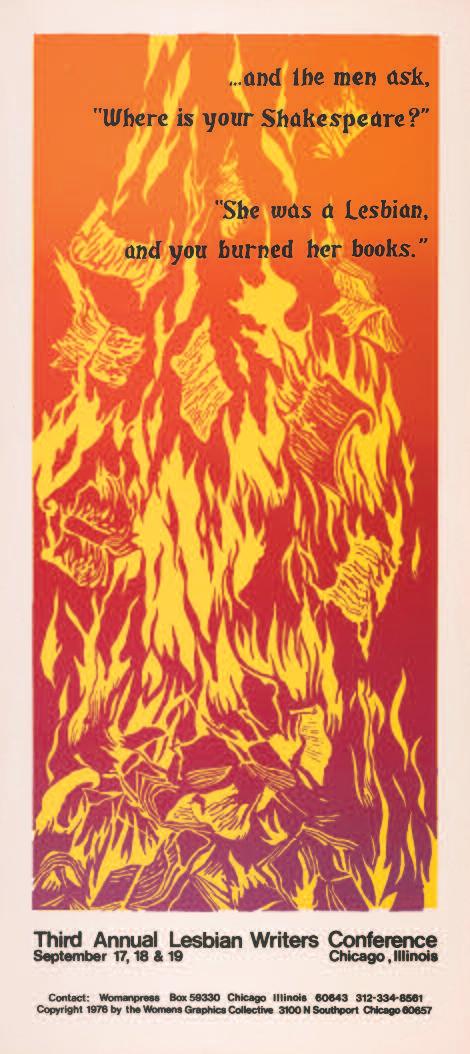
Third Annual L esbian Writers’ Conference, Chicago Chicago Women’s Graphics Collective and Salsedo Press, Chicago, 1976 | Courtesy of Tracy Baim, as gifted to her from Marie J. Kuda, who organized five national Lesbian Writers’ Conferences in Chicago
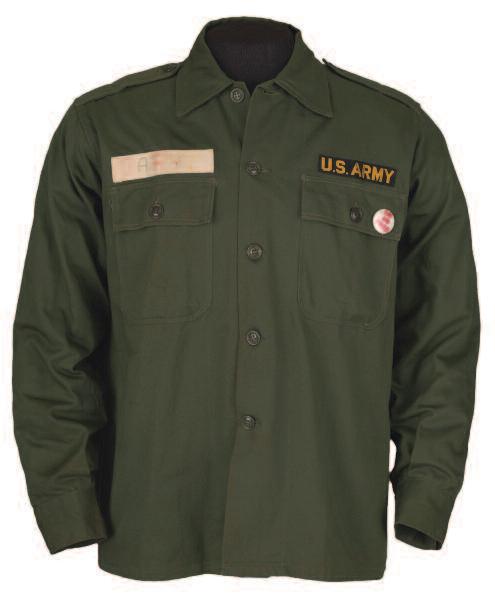
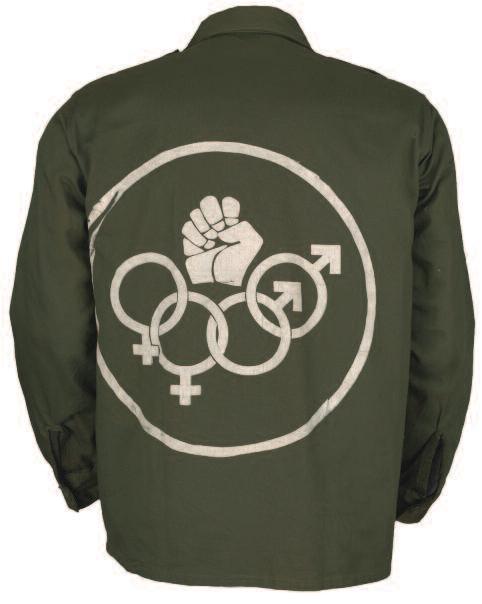
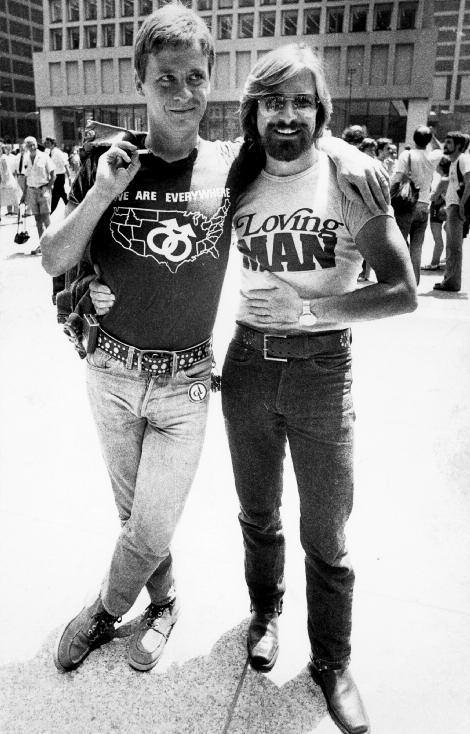
in New York City, as the voice of the women ’ s movement
The CWLU, as noted, founded in fall 1969, was the largest grassroots feminist organization in the United States in the 1970s and drew a considerable lesbian membership 26 The union’s projects ranged from winning the right of women ’ s softball teams to use the diamonds in local parks, to the provision of low-cost, safe abortions through the secret Jane collective. Under the CWLU umbrella, members could pursue a variety of projects, which included a formal “Gay Group” in 1972–73 and a “Lesbian Group” in 1975 Lesbians were also active in Women Employed, which advocated for the city ’ s major corporate employers to hire women 27 A racially diverse collective created L avender Woman, whose pages presented fierce, sometimes brutally raw sentiments, political arguments, poems, and illustrations. By the mid-1970s, this commemoration of the Stonewall anniversar y became an annual ritual; by the second half of the decade, it evolved from a protest march
into a Pride parade and moved north to L akeview. By 1973, there were 1,500 to 2,000 in attendance 28 Gay men and women interacted more often, and in more ways And as radical feminism emerged, it drew many lesbians into its orbit. Many gay women came to identify more with other women than with gay men, and many rejected the brokered, male-dominated world of local electoral politics
In Chicago, as elsewhere, gays and lesbians had marched in the streets in growing numbers over the course of the 1970s Queer activists challenged police harassment in the courts, in an increasingly sympathetic media, and in meetings with police officials. As Black
and white liberals acquired influence in the 1970s, gay activists joined a coalition that resisted police extortion, spying, and surveillance And in the 1970s and 1980s, the emergence of progressive, Black-led local electoral coalitions would for the first time enable gays and lesbians to gain a toehold in city hall 29
Timothy Stewart-Winter specializes in LGBTQ histor y and t h e p o l
Studies and Women’s & Gender Studies programs
Chicago Gay Liberation Memorabilia, Gerber/Hart Librar y and Archives
1 Bob Stanley, “Gay Pride Week, 1970: That Was the Week That Was,” Mattachine Midwest Newsletter, July 1970, 1; “Gay Liberation Stages March to Civic Center,” Chicago Tribune, June 28, 1970; and Richard L arsen, “Gay Pride Week,” Chicago Seed (1970), clipping in box 26, folder 5, Chicago Women’s Liberation Union records, Chicago Histor y Museum The other marches were in New York, Los Angeles, and San Francisco
2 Timothy Stewart-Winter, Queer Clout: Chicago and the Rise of Gay Politics (Philadelphia: University of Pennsylvania Press, 2016), 84
3 Jim Bradford and Bill Kelley, “Cops Hit More Bars,” Mattachine Midwest Newsletter, October 1969
4 Stewart-Winter, Queer Clout, 93–94
5. “Gay Liberation,” in “Closeted/OUT in the Quadrangles: A Histor y of LGBTQ Life at the University of Chicago,” https://www lib uchicago edu/collex/exhi bits/closetedout-quadrangles-histor ylgbtq-life-university-chicago/gay-liberation/
6 John D’Emilio, “Let’s Dance,” in Out and Proud in Chicago: An Overview of the City ’ s Gay Community, ed Tracy Baim (Chicago: Surrey Books, 2008), 98
7 Mattachine Midwest Newsletter, June 1970
8 Background report on Chicago Gay Liberation Front, October 8, 1970, Chicago Police Red Squad files, box 150, file 964-L/Organizations, 1970, Chicago Histor y Museum
9 Victor Varbo, “Statement of Purpose: Black Caucus/Gay Liberation,” in
10 Elandria V Henderson, “Black Gay Liberation,” L avender Woman, May 1972, 5
11 “Schism in Gay Lib!” Chicago Gay Liberation Newsletter, vol 1, no 9 (October 1970), 1
12 In 1973, the Chicago -based American Bar Association called for the repeal of the nation’s remaining sodomy laws. Chicago Gay Crusader, August 1973
13 “Kup Denies Bigotr y, Eyes Gays for TV,” Chicago Gay Crusader, September/October, 1974; and William B Kelley ’ s letter to the editor, “Don’t Knock Gay Liberation,” Chicago Tribune, March 28, 1974
14 Barbara Ettorre, “Lesbians Live in a ‘ Twilight Zone,’” Chicago Today, June 28, 1972
15 William Simon and John H Gagnon, “ The Lesbians: A Preliminar y Overview,” in Sexual Deviance, ed Gagnon and Simon with the assistance of Donald E Cairns (New York: Harper and Row, 1967), 247–82, at 266
16 David Stienecker, interview with Jack Rinella, in Jack Rinella Papers, Gerber/Hart Librar y and Archives, 14–15; “100 Protest Harassing of Homosexuals,” Chicago Tribune, April 17, 1970
17 “Daley Acts to End Sex Bias in City,” Chicago Tribune, October 28, 1971 The Chicago city council passed laws prohibiting employment discrimination based on sexual orientation in 1988 and gender identity in 2002
18 M J Kuda, “Media Montage,” Mattachine Midwest Newsletter, March 1970, 11
19 “Notes on Coming Out, i e , They Mean to Kill Us All,” L avender Woman, May 1972, 3
20 “I Was a Flesh Peddler,” L avender Woman, October 1974, 1
21 “Lesbian Survival School,” L avender Woman, October 1973, 6
22 Jorjet Harper, “Moving Mountains,” in Out and Proud in Chicago, 127
23 Jorjet Harper, “ The Agony and the Ecstasy: Lesbian Separatism,” in Out and Proud in Chicago, 124–25
24 Merle K aminsky, “Lesbians Search for Sisterhood,” Booster, October 10, 1972
25 Sandy Skord, “Uniting Lesbians,” Mattachine Midwest Newsletter, July 1973, 7
26 Anne Enke, Finding the Movement: Sexuality, Contested Space, and Feminist Activism (Durham, NC: Duke University Press, 2007), 12
27 Sheila Wolfe, “Job Equality Plea Made,” Chicago Tribune, April 24, 1973; and “L abor Force Up, but Gals’ Pay a Bad Second,” Chicago Tribune, Januar y 21, 1973
28 “1,500 Gays ‘Come Out of the Closet,’” Chicago Sun-Times, June 25, 1973
29 See Stewart-Winter, Queer Clout
Chicago artists of the 1960s‒70s created vibrant imagery that helped change the world. Today, a new generation of local artists upholds their legacy by practicing what is now called “artivism” art + activism. They use techniques that are both familiar and innovative to amplify the power of art and reach a global audience via the internet and social media This section features a small selection of their works that address a wide range of critical issues and challenge us to work for a better and more just world
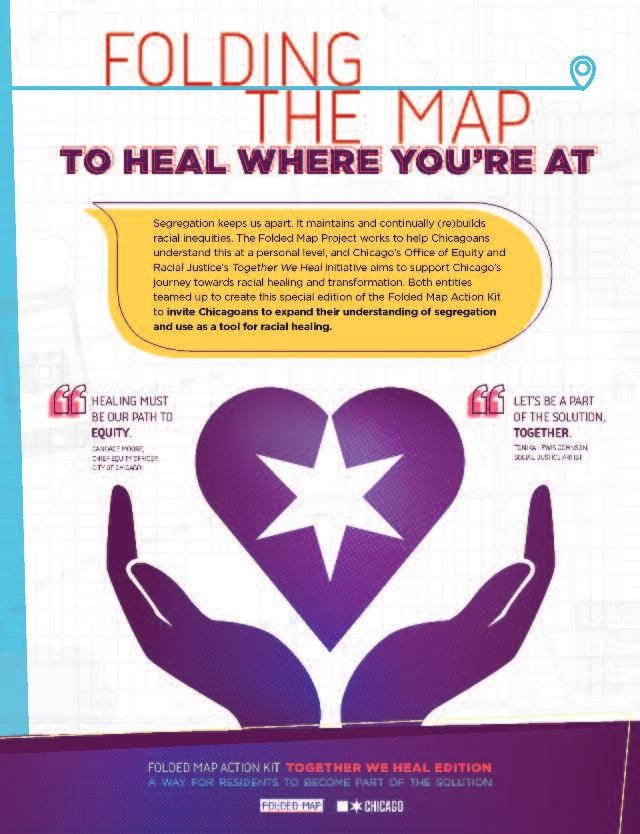
Tonika Lewis Johnson with graphic design by Janell Nelson, 2024 Courtesy of Tonika Lewis Johnson and Janell Nelson
Tonika Lewis Johnson and Janell Nelson are cofounders and codirectors of Englewood Arts Collective, which believes in the “ power of art as a legitimate, viable conduit for positive change in communities.” They partnered with the City of Chicago to produce this action kit to raise awareness about Chicago’s historic patterns of segregation and to encourage dialogue between residents who live in different parts of the city
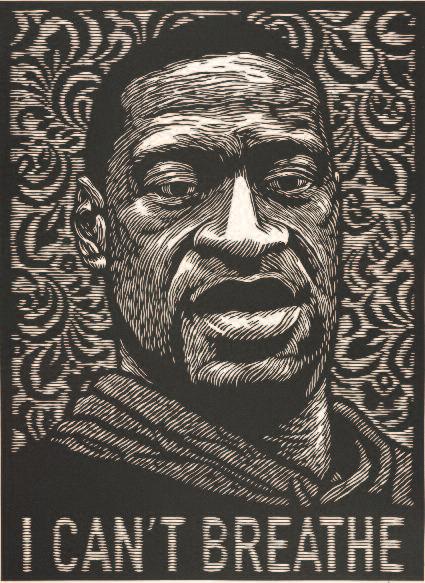
I Can’t Breathe
Carlos Barberena, 2020
“I can’t breathe” were the last words spoken by George Floyd, an African American man who was killed by a white Minneapolis police officer in May 2020. Floyd’s tragic death sparked a national reckoning over race and inspired this poignant linocut portrait by Carlos Barberena, a Chicagobased graphic artist originally from Nicaragua whose works address issues of racial and social justice
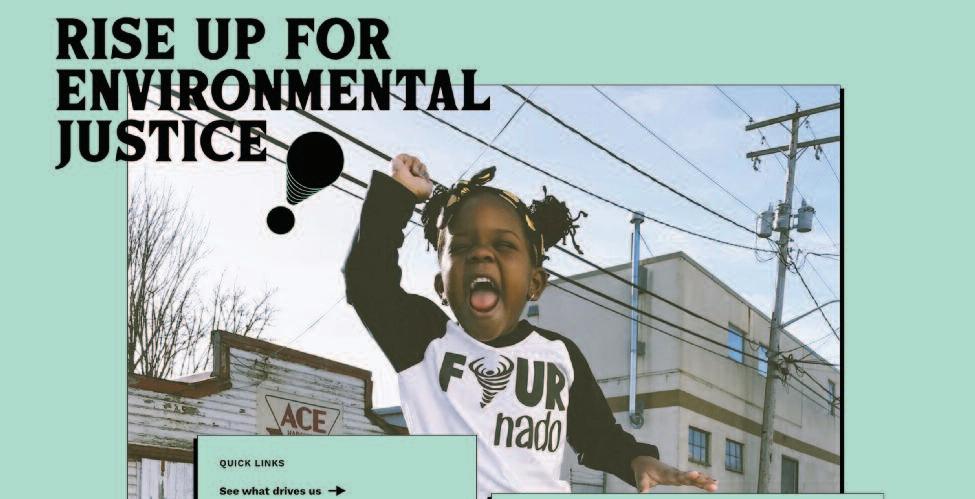
Rise Up for Environmental Justice!
Firebelly Design, 2022
Courtesy of Firebelly Design
Founded by Dawn Hancock, Firebelly Design is a social justicecentered design studio based in Chicago guided by the motto, “Good Design for Good Reason ” In 2022, Firebelly created a new website for PCR People for Community Recovery a Chicago-based environmental organization dedicated to cleaning up toxic waste on the city’s far South Side
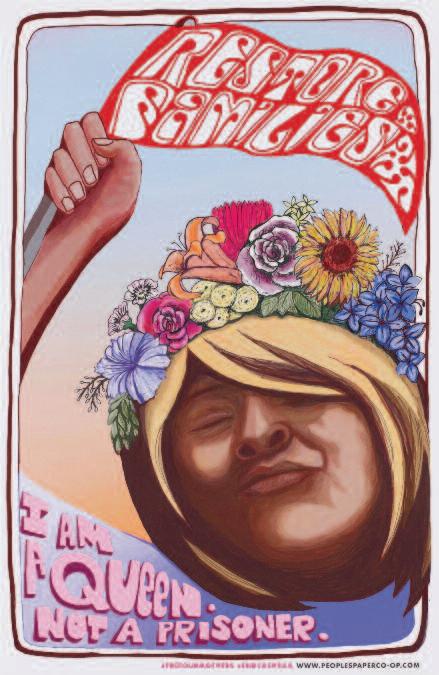
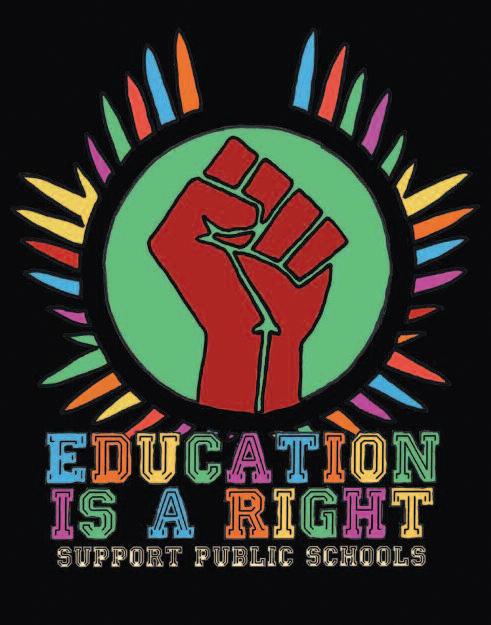
Nicole Marroquin, c. 2020
Nicole Marroquin’s poster helped raise funds for a Philadelphia-based program to release incarcerated women for Mother’s Day. Her print features an African American woman holding a pennant that proclaims, “Restore Families” and “I Am a Queen Not a Prisoner.” Marroquin taught at the School of the Art Institute of Chicago before taking a position at the University of Michigan.
Education is a RightSupport Public Schools
William Estrada, color added by the Chicago History Museum, 2023
Available as a free download, this poster is a visual reminder that education is a basic human right provided for by public schools. Artist William Estrada grew up in California, Mexico, and Chicago He currently develops “community based and culturally relevant projects to collectively imagine just futures.”
Reparations Now, Reparations Won!
Monica Trinidad, 2022
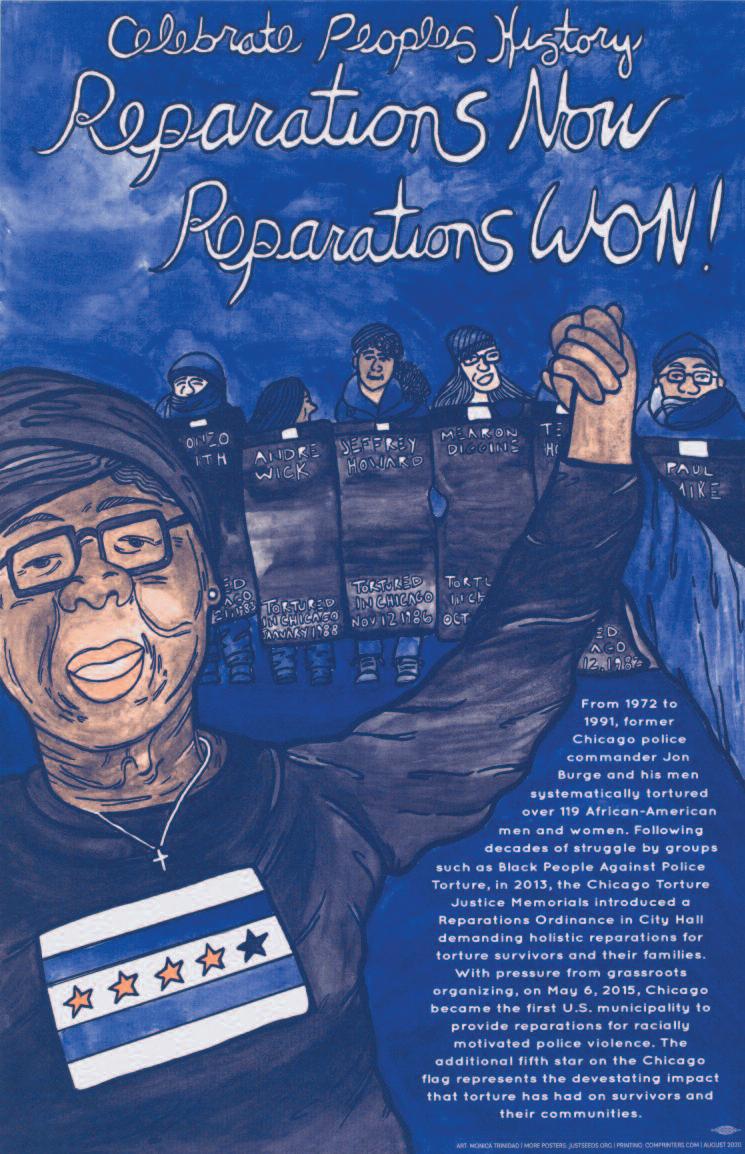
This poster by Monica Trinidad, a queer Latine visual artist and lifelong Chicagoan, honors a long struggle by citizens for reparations from the City of Chicago for the victims of police torture between 1972 and 1991. Trinidad’s poster features images of the movement’s supporters and an additional fifth star on the Chicago flag “to represent the devastating impact torture has had on survivors and their communities.”
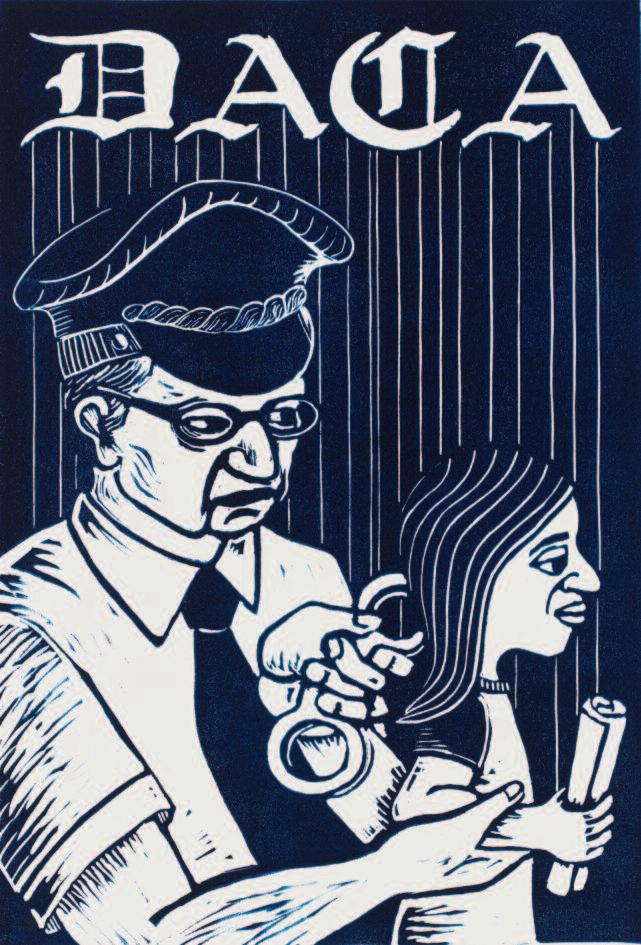
This linocut print is a visual protest against ending DACA, a federal program that protects young undocumented immigrants from deportation Artist and Chicago public school teacher José Luis Gutiérrez describes himself as “ a cultural worker who is . . . addressing issues of social justice through holistic arts education programs ”
DACA (Dreams Arrested for Childhood Arrivals)
José L Gutiérrez (elgtz), 2017; reprinted 2023
Aaron Hughes, 2015
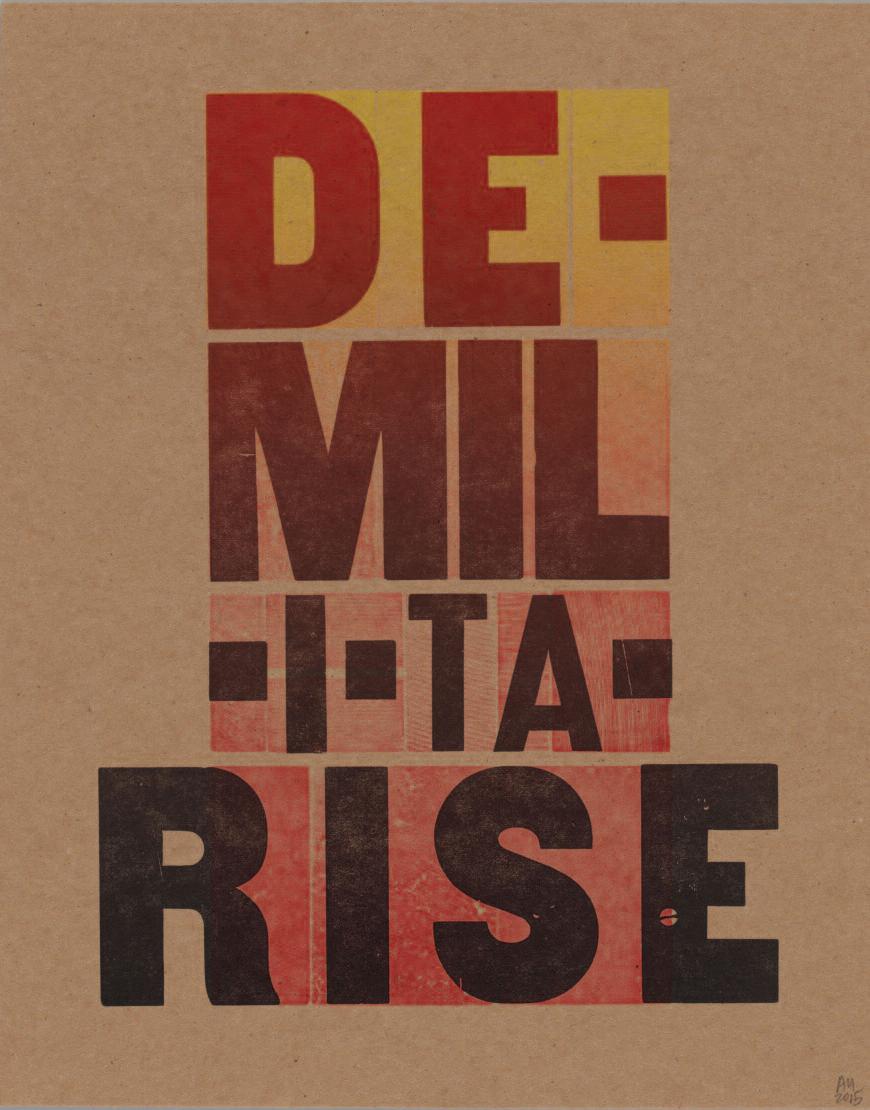
Aaron Hughes of Chicago is an artist, curator, teacher, antiwar activist, and Iraq War veteran He created this poster for the Demilitarize Movement, a global effort to reduce military spending in favor of funding social programs to benefit humanity. Hughes is an active member of many organizations that work for social change.
L I Z S O R O K I N
Printed objects are exhibited extensively in the exhibition Designing for Change, most specific
newspapers printed in the off-set process. The
d u r i n g t h e 1 9 6 0 s a n d 1 9 7 0 s , w
p i d wartime invention and the postwar rise of commerciali z a t i o
c h e
e r a n d m o r e a f f o r d a b l e
Starting with letterpress, the histor y of printing is deeply intertwined with the urge to spread texts to the masses Off-set printing was developed for commercial goods to b e p r i n t e d r a p i d l y a n d a t l o w c o s t a n d w a s q u i c k l y
a p p l i e d t o n e w s p a p e r s S c r e e n p r i n t i n g , o n t h e o t h e r hand, had been used in manufacturing but found a new a p p e a l a s a f i n e a r t f o r m d u e , i n p a r t , t o t e c h n o
a d v a n c e m e n t s B y u n d e r s
d i n g t h e h i s t
r y a n d processes used to create posters and newspapers, as well a s t h e m a
c u r a t o r s , a n d o t h e r M
ensuring their long-term preservation In contextualizing these artifacts, a deeper understanding of these designs becomes apparent They represent a historic moment in both their imager y and their material qualities
Screen printing uses a stencil-like process where a woven screen is partially blocked out Ink is pushed through the unblocked passages of screen and selectively deposited onto the surface below. In late nineteenthcentur y America, screen printing arose as a method for printing pennants Eventually, the simple process was used for creating other types of commercial goods Originally, blocking was done using stencils or cutout paper forms Developments in screen technology, as well as blocking technology, led to more refined techniques of image production.
With the establishment of the Poster Division in the Federal Art Project (a subdivision of the Works Progress Administration [WPA] ) in 1936, led by artist Richard Floethe, artists began to adopt screen printing as artform By 1940, the Silk Screen Division of the Artists Union was established by Anthony Velonis, and Carlo Zigrosser organized the first exhibition devoted to the artform at the Weyhe Galler y in New York.1 Needing only a woven screen stretched on a wooden frame, some ink, and a rubber squeegee, the process allowed for printing to be completed by the artist themselves instead of working with a trained printer or requiring a large press. This allowed for easier reproduction and image manipulation compared to other, more materially intensive printing processes. By the 1960s, artists trained by the WPA began teaching in universities Subsequently many of their students began community-based, collaborative print workshops throughout the United States Artists such as Ben Shahn, Corita Kent, Elizabeth Catlett, and Rupert Garcia began creating prints to engage directly with social movements 2 It is in this moment that the Chicago Women’s Graphic Collective (CWGC) began designing their images and printing their posters.
While the early forms of screen printing utilized much of the same process as that of printers in the 1
Designing for Change reveal that developments in technology made image creation easier, more precise, and more accessible than their historic predecessors
In the physical creation of these prints, process and materials combine in a way that reflects recent advances in ink technology Printing ink requires two primar y ingredients: a pigment to add color and a binding agent to encircle the pigment particle and secure it to the surface.3 Initially, boiled oils like linseed oil were used as the binding agents These oils had slow dr ying times and, depending on the ink, could take many hours to days to dr y. This made multicolor printing time-consuming and
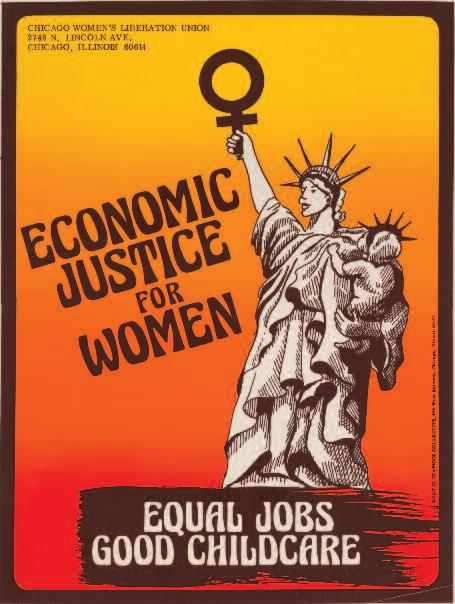
Economic Justice for Women | Estelle Carol and Chicago Women’s Graphics Collective, c 1975 | Bright colors, such as the evocative yellows and reds seen here, are suggestive of newly developed DayGlo pigments
unappealing to artists. The invention of modern resins, such as nitrocellulose, resulted in inks that dried in one to two hours, significantly shortening the process of multicolor printing Additionally, new daylight fluorescent pigments, such as those of the DayGlo Company, become readily available by the 1960s 4 Engaged with these new materials, many prints of the time are suggestive of “DayGlo” colors such as Corona Magenta, Rocket Red, Blaze Orange, Arc Yellow, and Signal Green. Although no analysis was carried out to confirm the presence of the exact pigments, the colors present in prints such as Women Are Not Chicks and Economic Justice for Women are clearly influenced by, if not incorporating, these new pigments
In addition to advancements in ink, developments in screen making also encouraged the rise of screen printing in the mid-twentieth centur y. Originally created with gauze-like cheesecloth or delicate silk fibers (hence the “silk screen ” terminology), the introduction of synthetic fibers like nylon and polyester led to finer and more durable screens. Finer weaves created smaller ink deposits leading to improved detail The process also became more accessible, as the synthetic fibers did not distort as readily upon the introduction of moisture or pressure.
When it came to image transfer, two major advancements in screen blocking technology in the twentieth centur y hugely shifted the screen printing landscape The first, the development of ProFilm in 1928, was a revelation. The product was a shellac film that was easily cut out with a knife and then fused to the screen with heat The film allowed for easier manipulation of the screen and led to a huge growth in the industr y.5 The second shift was the use of photosensitive emulsions While the earliest use of photographic principles in image transfer to the screen were recorded in 1906, it w a s n
polyvinyl alcohol, that the coating’s use became widespread 6 Applied to the surface of the screen, the emulsion would selectively harden under ultraviolet light Passages protected from light exposure would remain soft and could be washed away after exposure, opening up the weave of the screen for ink movement There was now more control in terms of color separation and overall design, including the ability to incorporate photographic images In posters such as Boycott Lettuce & Grapes, details in the faces of the figures are produced that otherwise would be difficult to cut with any stencil
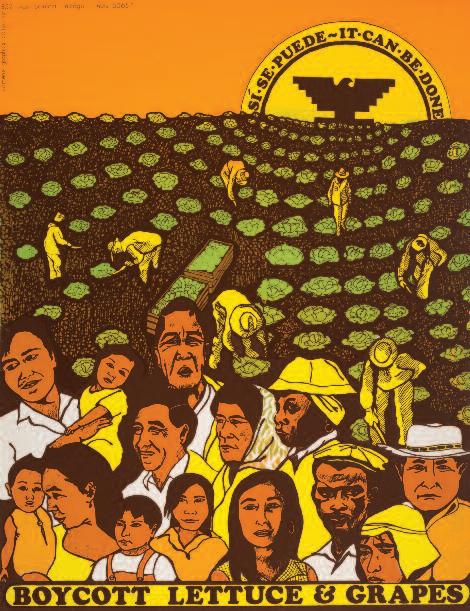
Boycott L ettuce & Grapes| Leslie Nevraumont and Chicago Women’s Graphics Collective, 1972 | Fine details, such as the line work seen in the individual portraits, indicate that this print was likely made from a photographic process of image transfer to the screen
Conservation treatment of screen prints is often limited due to the thick buildup of ink that results from the squeegee process Too much manipulation of the paper can damage the ink layer and cause the ink to crack. The ink layer, by resting atop the paper itself, may also irregularly restrict paper fiber movement If a screen print is exposed to high humidity, the paper fibers will want to expand In places where the paper is printed, the ink will restrict this expansion while unprinted passages of paper will continue to expand Over time this can result in irregular distortions in the paper itself. If the paper gets ver y humid, or entirely wet, the expansion of the paper fibers can put enough stress on the ink to cause a craquelure pattern Sometimes this stress may even result in flaking and loss of the ink layer. While overall water-based treatments may be considered with many paper items, the irregular hold of screen printing ink s e v e r e l y l i m i t s o p t i o n s f o r c o n s e
Furthermore, wide passages of uniform color created by the process are ver y susceptible to damage As is a common difficulty with modern uniform surfaces, any alteration or loss of the surface is immediately notable and difficult to minimize. The process of adding a colored medium to visually reintegrate losses in a design, referred to as inpainting, is almost impossible in areas of color loss for screenprints The conservator needs to not
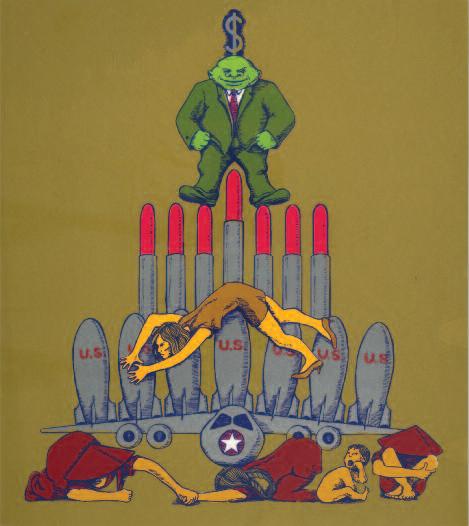
only achieve the exact hue and saturation of a color, but also the gloss of the ink and surface quality and apply that uniformly over the damaged paper surface Subsequently, when it comes to screen prints, minimal treatments are advisable. Even then, risks must be weighed carefully to determine the necessity of the intervention
When preparing for conservation treatment of screen prints from the Chicago Women’s Graphic Collective, these limitations were noted, and the following questions were asked: What form of intervention will improve and stabilize a given item? What intrinsic information do we want to emphasize without risking damage or furthering damage to a given object? What other nonconservation interventions can we undertake to ensure the item’s safe display? Due to the limitations of thick ink layers and the overall good condition of much of the materials, minimal treatment was carried out In prints like Male Chauvinism and Imperialist War Make Profits and Maim People, the thick layers of ink had started to encourage an overall curl to the paper. These distortions, while distracting, could not be safely reduced through flattening processes, as it would risk damage to the ink It was determined that intervention of any form would risk harm Instead, a frame was designed with significant depth to allow for the added dimension of the paper
In some cases, however, conservation was necessar y to ensure an item could be safely exhibited and distracting
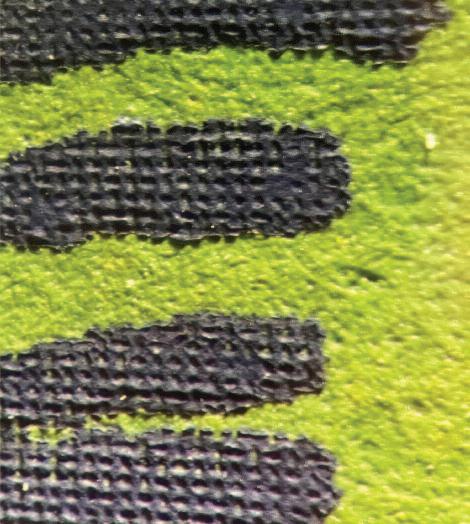
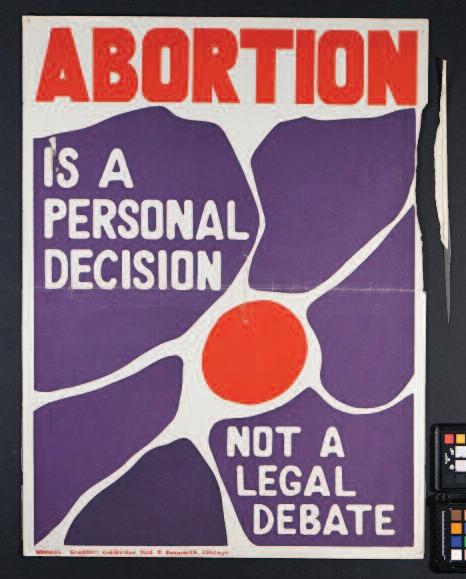
Abortion is a Personal Decision, Not a L egal Debate
Estelle Carol and Chicago Women's Graphcis Collective, 1972 | Before (above) and after (below) images illustrate the effects of overall stabilization as well as minor in-painting; photographs by Liz Sorokin
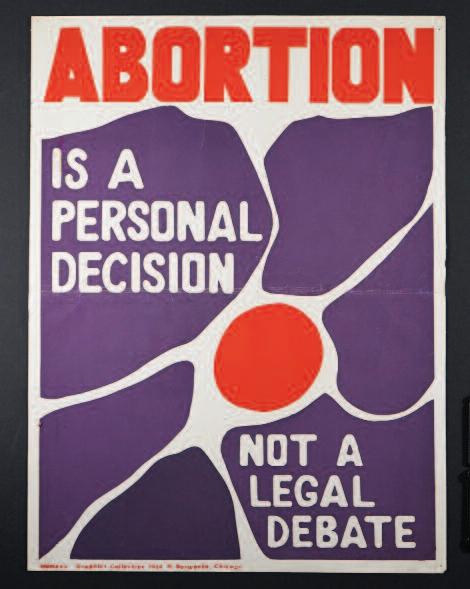
damage could be minimized. The treatment of the Abortion Is A Personal Decision, Not A Legal Debate poster illustrates both the needs and limitations of screen print conservation The print, completed in red and purple ink, exhibited extensive damage, both visual and structural. It appeared the poster had been folded, abraded, and manipulated multiple times The paper was warped overall, with distortions likely caused by historic repairs and poor handling Multiple tapes were adhered to the back of the poster, along with a fragment of the margin that had completely torn off The unstable tapes had caused discoloration of the paper support and much of the remaining adhesive was no longer holding things in place The tapes were removed mechanically, and the associated adhesive was reduced using a gum eraser Mends of Japanese tissue and wheat starch paste were set down to secure the tears and reattach the fragment In addition to structural issues, the richly colored purple and red inks exhibited significant abrasion to the surface, causing the inks to appear mottled and uneven. In some places, there was a physical loss of ink layers, revealing the paper substrate below Gentle surface cleaning was carried out to remove some superficial dirt; however, the overall unevenness remained. The mottled surface was mostly irreversible Minor inpainting was carried out using watercolors and colored pencils to minimize the appearance of ink loss, but given the uniformity of the color and surface created by the printing process, replication of the lost ink is nearly impossible Many waves remained in the paper, as it was not possible to safely humidify and flatten the piece extensively. Intervention was carried out, but ultimately it was limited Given the nature of the medium, the damage remained notable upon close inspection, but was deemed stable for exhibition purposes.
Letterpress printing, developed by Johannes Gutenberg in the mid-fifteenth centur y, utilized moveable type, a block with a raised typographic character cast or etched onto it, to print text Type was placed in rows to form lines of text in a process called typesetting These set types were then inked and run through a press to transfer the text to paper In order to print newspapers, typesetters would methodically set each letter in a newspaper using small type, run the set type through the press and dismantle each set page letter by letter after printing was complete While technological advancements did occur, this time-consuming process remained commonplace until the nineteenth centur y when “hot type” printing presses mechanized the process of typesetting. With hot type printing, hot metal was cast into lines of type through a typewriter-like machine, producing rows of text that could then be aligned on a press and print-
ed. Once printing was complete, the metal was then melted and reused to create new lines of hot type A huge growth in newspapers occurred during this period as production became cheaper and faster
In the early 1950s, a new revolution occurred as photographic means of typesetting entered the print shop This method, also referred to as “cold type,” used light projection of letters onto a photosensitized metal plate to rapidly produce large sheets of text 7 The surface of the plate was altered so hydrophobic (water repelling) areas would hold ink while hydrophilic (water taking) passages would hold water. These thin plates were then secured onto a round roller, wetted overall, and inked using thin, oil-based inks The plate would then roll in contact with a rubber roller that would only pick up the ink, reducing water from the process. The printing occurred when the image then moved from the rubber roller to the final paper This process, called offset printing, allowed for printing on a wider range of papers Text and images were easily combined into a single process, increasing the speed of printing The use of phototype-
setting, and the streamlining of printing ushered in by the offset press, led to the growth of small newspapers With offset printing, multiple newspapers could print in the same facility thus reducing costs overall 8 Based on design and timing, it is likely that all newspapers exhibited in Designing for Change were printed in this manner 9 The seamless combination of images and text in items such as editions of the Chicago Seed suggest photographic typesetting was used to create the newspapers It was only the availability of offset printing that materials like this, including both visual design and text, could be made en masse and at a reasonable price.
As production capabilities for newspaper printing increased, demand for low-cost paper skyrocketed Over the nineteenth and twentieth centuries, materials were modified and adulterated to produce paper in higher quantity, often at the sacrifice of durability Newsprint paper, a thin but opaque wood-pulp containing paper type, was developed specifically for the newspaper press By replacing much of the traditional linen and cotton rag fiber with groundwood pulp, papermakers created a
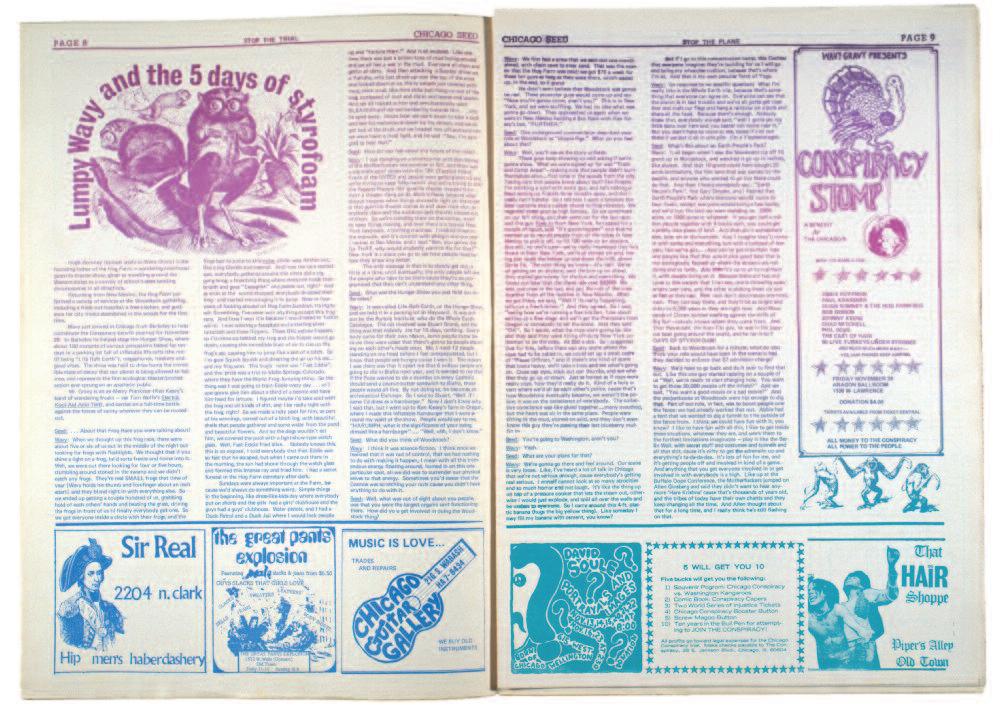
The color process of printing seen here in an issue of the Chicago Seed is called rainbow roll inking Two colors are applied to opposite ends of the same plate and allowed to blend in the middle This type of uniform blending across images and text suggests the ink was applied at the same time, likely using of a single plate that held both elements
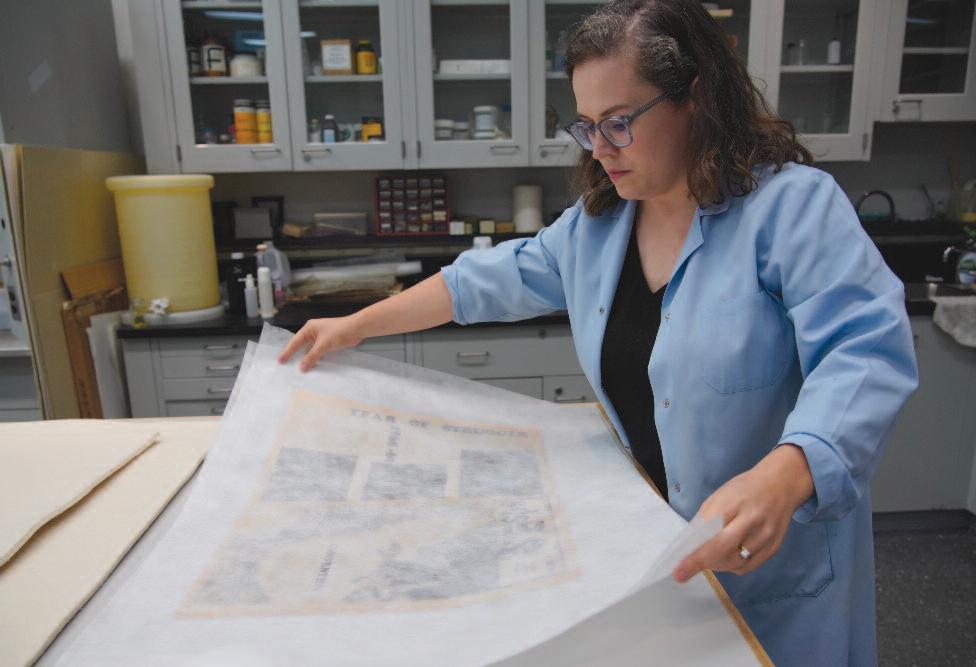
paper slurr y that was revolutionar y in its affordability This new paper had its flaws and structural stability was sacrificed significantly. The long fibers from rags were replaced by short, crudely processed wood fragments, weakening the paper ’ s inherent structure The wood pulp was also naturally high in lignin, a complex organic polymer that occurs naturally in wood. Lignin is acidic and encourages deterioration of the cellulosic structure that makes paper 10
Conservation of historic wood pulp paper is fraught, as the paper itself is structurally weak and has further weakened over time While much of this deterioration is impossible to undo, in some cases, intervention may help prolong the life of newspapers Acidity built up in the paper may sometimes be reduced, slowing the natural deterioration of the paper Understanding the risk of intervention is important, as the process of treatment puts the object at risk of worsening damage Again, the same questions are asked: What form of intervention will improve and stabilize an item? What intrinsic information do we want to emphasize without risking damage or furthering damage to a given object? What other nonconservation interventions can we undertake to ensure the item’s safe display?
After gentle misting, Liz carefully lifts the newsprint while it is sandwiched between two pieces of spun-woven cloth; photograph by Veronica Casados
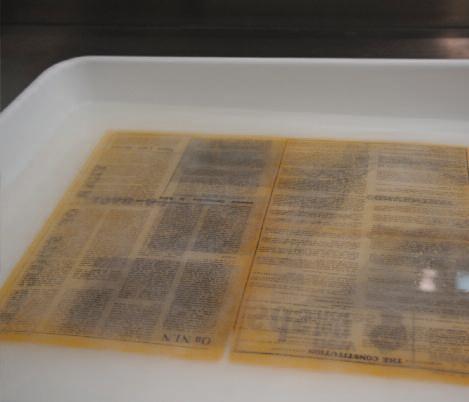
The newsprint is fully immersed in the bath to encourage reduction of acidic deterioration products; photograph by Veronica Casados
Conservation of newspaper is often limited due to its overall fragility In some cases, aqueous treatment through the controlled introduction of water may be used to remove water-soluble deteriorated components of the paper structure This can be done locally, using a suction table, or can be done overall, through immersion in a bath To wash a paper item, the object must be deemed safe to immerse. All inks are tested to ensure stability when exposed to water Initial testing of the stability of inks in water suggested that many of the vibrant colors visible in the Chicago Seed newspapers proved to be unstable. The ink was underbound, meaning the ratio of binder around pigment particles was insufficient in holding the pigment in place when water was introduced It was determined that the risk of pigment moving during treatment was too great, and that while the paper was in dire need of treatment, treatment would put the object at risk of major irreversible alteration Therefore, treatment was not carried out Instead, for much of the exhibition, facsimiles were created with the Museum’s Photography Team to reproduce the appearance of the Seed covers while the original items would be safely preserved in storage
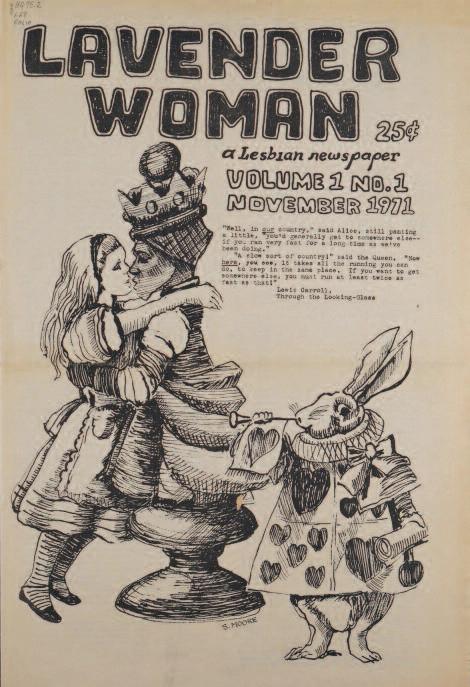
Other newspapers, such as L avender Woman and SDS News, proved to be stable when tested with water Starting with internal pages first, the individual sheets of newsprint were washed separately but identically so the object experienced a consistent intervention overall. Internal pages were treated first to assess the stability of the newspaper By working with internal pages first, the process could be refined so that the treatment of the exterior covers would be the lowest risk Treatment was carried out as follows: an individual sheet of paper was placed between pieces of smooth, spun-woven polyester By sandwiching each page between the fabric, the object was given structural support while wet The page was then gently misted with deionized water and allowed to wet slowly By gently introducing moisture, the paper fibers expanded slowly This was done to reduce risk to the object, and to assess how the paper reacted to the water overall Once the fibers had fully wetted and no notable issues were visible, the paper was gently placed atop a bath of deionized water The water was conditioned to a slightly basic pH. The paper was allowed to slowly saturate and was then gently immersed Discoloration was visible in the wash water, as
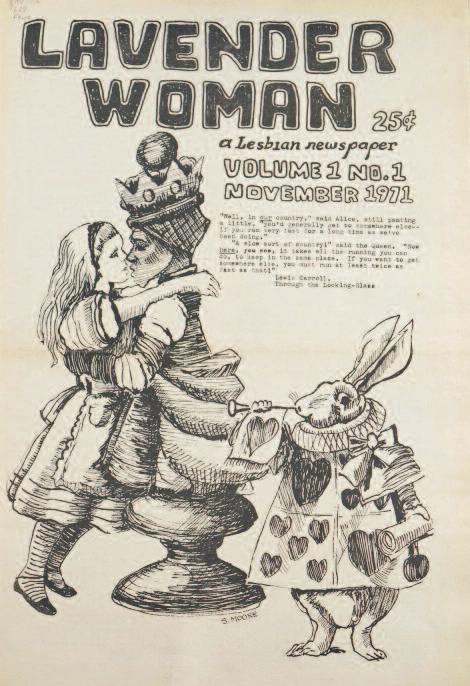
This illustrates the reduction of yellow -toned acidic deterioration products after careful washing Successful treatment results in a visibly brighter paper that is more chemically stable
the colorless water grew increasingly tea-colored. The acidity of the wash water was monitored, and the pH lowered to acidic relatively quickly, suggesting acidity from the paper had transferred into the bath The object was monitored for alteration. No inks were noted moving. The swelling of the paper fibers did not result in any significant change to the paper itself, and no new damage was noted during washing. This process was continued with each individual paper All pages were washed minimally, as extending the time meant increasing the possibility of damage to the paper Once the pages were washed, they were placed between felt for slow dr ying. Open air dr ying would be too fast, putting too much stress on the weak paper fibers and risk causing tears as fibers contracted If tears were noted before or during washing, mends were applied using thin Japanese tissue and dilute wheat starch paste when the object was removed from the bath but still wet The paper was then moved under weights and dried fully between clean blotter paper After about 24 hours of dr ying, the newspapers were carefully refolded to their original orientation The newspapers were then dried fully over the course of 1–2 weeks
Even with intervention, the newspapers remained weak and deteriorated. Limited display of the items was recommended for this reason Respecting the paper ’ s vulnerable nature is important in extending the object’s lifespan Many newspapers will be displayed for a short run during the exhibition and then replaced with facsimiles. In some cases, duplicate copies were acquired expressly for the purpose of the exhibition This was done to ensure visitors can engage with the original materials while the institution protects the materials for future generations
E N D N O T E S
1 Guido Lengwiler, A Histor y of Screen Printing: How an Art Evolved into an Industr y (Cincinnati, OH: ST Media Group International, 2013)
2 Cynthia Burlingham, “A Ver y Democratic Form: Corita Kent as Printmaker,” in Someday Is Now: The Art of Corita Kent (Munich: Prestel Publishing, 2013), 24–33
3 Additional components are frequently added to ink mixtures to ensure proper working consistency, dr ying time, surface properties, etc Additives such as extenders or diluents greatly alter the ink as well; however, two consistent ingredients are a pigment and a binding agent
4 “American Chemical Society National Historic Chemical L andmarks DayGlo® Fluorescent Pigments,” AC S org,
By placing materials in their context historically, as well as materially, conservation decisions were made that considered the nature of the items and prioritized their long-term needs In all cases, decisions were made with Curatorial and Collections Department members to ensure that the items could be safely exhibited and cared for well after exhibition The objects, diverse in their imager y, language, and represented identities, share similar technical and material qualities Much like the content of the artifacts, the physical objects in the exhibition could only exist in the moment during which they were created It was in this moment that technology and capabilities were becoming accessible and widely available, allowing for the amplification of underrepresented voices It is by understanding these materials that we are best able to not only preserve the artifacts and exhibit them safely but appreciate them fully
Liz Sorokin is the conservator for paper and photographs at t
Patricia H. and Richard E. Garman Art Conservation prog
Harvard Art Museums. Prior to joining the Chicago Histor y M
Conservation Center in Minneapolis, Minnesota
http://www acs org/content/acs/en/education/whatischemistr y/landmarks/dayglo html
5 R alph Mayer, The Artist’s Handbook of Materials and Techniques (New York: Vking Press, 1991)
6 See, Lengwiler, A Histor y of Screen Printing
7 Henr y C L atimer, Production Planning and Repro Mechanicals for Offset Printing: The First Updated User ’ s Manual Including Phototypesetting and New Press Production Planning (New York: McGrawHill, 1980), 9–13
8 Otha C Spencer, Staley McBrayer and the Offset Newspaper Revolution (College Station: East Texas Mayo Press, Texas A&M University, 1997)
9 “Until World War II, the only economic way to originate text for printing was in the form from raised metal type the breakthrough for lithography came with the development of photographic methods of typesetting At that point, from the early 1960s, the balance of advantage began to tip toward lithography, particularly in the so -called ‘integrated’ books which both line and halftone illustrations are printed alongside the text,” in Bamber Gascoigne, How to Identif y Prints: A Complete Guide to Manual and Mechanical Processes from Woodcut to Inkjet (London: Thames & Hudson, 2017)
10 Gerhard Banik and Irene Bruckle, Paper and Water: A Guide for Conservators (New York: Routledge, 2012)
All photographs are reproductions. *denotes rotation piece
Note: Numbers starting with ICHi-, DN-, or STcan be used to find more information about the item using the Chicago Histor y Museum's online resources
Liberty Line
Engraving by unknown artist, Wester n Citizen, July 18, 1844
Printed ink on paper; approximately 5” h x 7” w (reproduction) Chicago Histor y Museum, ICHi-061416
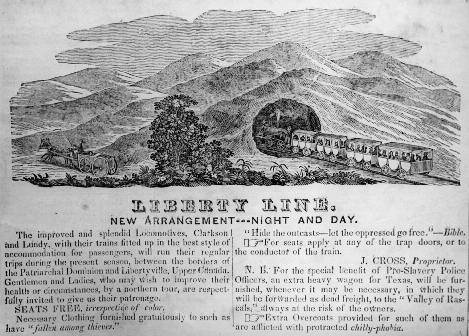
The Hand That Will Rule the World One Big Union
Engraving by R alph Chapin, Industrial Workers of the World (IWW), 1917
Printed ink on paper; approximately 5” h x 5” w (reproduction) Public Domain
Suffragists, Chicago Daily News, March 3, 1913
DN-0060283, Chicago Daily News collection, Chicago Histor y Museum
Marchers of the Chicago Freedom Movement
Photograph by Declan Haun, August 1966
Chicago Histor y Museum, ICHi-077685
Martin Luther King surrounded by Chicago Freedom Movement marchers
Photograph by Bernard J Kleina, August 5, 1966 Courtesy of Bernard J Kleina
Chicago Freedom March down South Kedzie Avenue in Marquette Park
Photograph by Bernard J Kleina, August 5, 1966 Courtesy of Bernard J Kleina
Button from the Chicago Freedom Movement
Designed by Ann Gillie and Bennie Luchion, 1966
Metal; 1” diameter
Chicago Histor y Museum, 2023 32 2
Button from the Chicago Freedom Movement Designed by Ann Gillie and Bennie Luchion, SCLC, 1966
Metal; 1 ½” diameter
Courtesy of Busy Beaver Button Museum, Chicago
“Dr King Takes Fight to Northern Slums”
Unsigned article, Ebony, April 1966
Printed ink on paper; 13 ½” h x 20” w (open) Chicago Histor y Museum, ICHi-183275-001 and ICHi-183275-002
Warren Avenue Congregational Church
Photograph by Chicago Sun-Times, Januar y 19, 1966 ST-19042269-0002, Chicago Sun-Times collection, Chicago Histor y Museum
Freedom On My Mind album cover
Jimmy Collier and Parish Records, Inc , Chicago, 1966
Printed ink on cardboard; 12 3/8” h x 12 3/8” w 2023 32 1; Chicago Histor y Museum, ICHi-183254-001 and ICHi-183254-002
Chicago Freedom Festival program
Unknown maker, 1966
Printed ink on paper; 11” h x 8 ½” w
Chicago Histor y Museum, ICHi-182985
Broadside for the Chicago Freedom Movement R ally and March
Unknown maker, 1966
Printed ink on paper; 8 ½” h x 5 ½” w
Gift of Coordinating Council of Community Organizations; Chicago Histor y Museum, ICHi-018513
Letter and banner diagram regarding the Chicago Freedom R ally
Junius Griffin, July 1, 1966
Printed ink on paper; 11” h x 8 ½” w (both)
Gift of Coordinating Council of Community Organizations; Chicago Histor y Museum, ICHi-182991 and ICHi-182983
Real estate flyer for the Chicago Freedom Movement
Unknown maker, 1966
Printed ink on paper; 8 ½” h x 5 ½” w
Gift of K ale Williams; Chicago Histor y Museum, ICHi183258-001 and ICHi-183258-002
The Ebony Team
Open housing march in Cicero
Photograph by Declan Haun, September 4, 1966
Chicago Histor y Museum, ICHi-036903
Ebony editorial staff
Photograph by L acey Crawford
Ebony, Johnson Publishing Company, Chicago, November 1965
Chicago Histor y Museum, ICHi-183269-002A
Ebony Special Issue: The Emancipation Proclamation
Cover designed by Herbert Nipson and Norman L Hunter Johnson Publishing Company, Chicago, September 1963
Printed ink on paper; 13 ¼” h x 10 ¼” w x 3/8” d
Chicago Histor y Museum, ICHi-183268
Ebony Special Issue: The White Problem in America
Cover designed by Herbert Temple Johnson Publishing Company, Chicago, August 1965
Printed ink on paper; 13 3/8” h x 10 1/8” w x ¼” d
Chicago Histor y Museum, ICHi-183273
Ebony Special Issue: Negro Youth in America
Cover designed by Cecil Ferguson
Johnson Publishing Company, Chicago, August 1967
Ink on paper; 13 3/8” h x 10 1/8” w x ¼” d
Chicago Histor y Museum, ICHi-183272
Ebony Special Issue: The Black Revolution
Cover designed by Herbert Temple
Johnson Publishing Company, August 1969
Ink on paper; 13 ¼” h x 10 1/8” w x ¼” d
Chicago Histor y Museum, ICHi-183271
Ebony Special Issue: Which Way Black America?
Cover designed by Herbert Temple
Johnson Publishing Company, Chicago, August 1970
Printed ink on paper; 13 3/8” h x 10 1/8” w x ¼” d
Chicago Histor y Museum, ICHi-183274
Before the Mayflower: A Histor y of the Negro in America 1692–1962
Lerone Bennett Jr.; cover designed by Norman L. Hunter
Johnson Publishing Company, Chicago, 1962
Printed ink on paper; 9 ½” h x 6 3/8” w x 1 5/8” d
Gift of Lerone Bennett Jr ; Chicago Histor y Museum, E185 84
Black Power U.S.A.
Lerone Bennett Jr ; cover designed by Herbert Temple
Johnson Publishing Company, Chicago, 1967
Printed ink on paper; 9 ¼” h x 6 ½” w x 1” d
Chicago Histor y Museum, ICHi-183606
Woman showing the Black Power fist
Photograph by Declan Haun, August 1966
Chicago Histor y Museum, ICHi-035427
Poster for DuSable Museum of African Histor y (reproduction)
Designed by Bill Bronell, 1971
Printed ink on paper; 44 ½” h x 30” w
Chicago Histor y Museum, ICHi-183628
Curtis Ellis
Photograph by John White, Chicago Sun-Times, July 17, 1969
ST-18991901-0023, Chicago Sun-Times collection, Chicago
Histor y Museum
Ellis’ Book Store, Chicago
Photograph by John White, Chicago Sun-Times, July 17, 1969
ST-18001901-0017, Chicago Sun-Times collection, Chicago
Histor y Museum
Afro hair pick
Unknown designer and maker, c 1970
Plastic and metal; 6 7/8” h x 2 ¾” w x 3/8” d (handle unfolded)
Courtesy of Charles E Bethea
Black Power button
Unknown designer and maker, c. 1970
Plastic and metal; 1 1/4” diameter
Courtesy of Charles E Bethea
Campaign button for Eldridge Cleaver
Unknown designer and maker, 1968
Plastic and metal; 2 ¼” diameter
Courtesy of Charles E Bethea
Black Liberation button
Unknown designer and maker, c 1970
Metal and plastic; 2 ¼” diameter
Chicago Histor y Museum, ICHi-179581
Malcolm
Omar L ama, 1967
Printed ink on paper; 15 ½” h x 12 ½” w (framed)
Courtesy of Patric McCoy
Fred Hampton film benefit poster
Unknown artist, 1972
Screen print on paper; 10 ¾” h x 7 3/8” w
Chicago Histor y Museum, ICHi-182982
Margaret T Burroughs
Charles and Margaret T Burroughs
Unknown photographer, c. 1970
Chicago Histor y Museum, ICHi-061549
James T. R apier: Negro Congressman from Alabama
Eugene Feldman and Margaret T Burroughs
Cover design by Mallor y Pearce
Southern Newsletter, Louisville, Kentucky, 1962
Printed ink on paper; 8 ½” h x 11” w (open)
Gift of Eugene Feldman; Chicago Histor y Museum, ICHi-182725
*Black Power in Old Alabama
Eugene Feldman and Margaret T Burroughs
Museum of African American Histor y, Chicago, 1968
Printed ink on paper; 8 ½” h x 10 7/8” (open)
Chicago Histor y Museum
Two Heritage Proems
Written, illustrated, and published by Margaret T Burroughs, 1963
Printed ink on paper; 8 ½” h x 5 ½” w
Chicago Histor y Museum, ICHi-182996-001
Phyllis Wheatley
Linocut by Margaret T. Burroughs, 1970
Ink on paper; 16 ¾” h x 13” w 2010 94 2; Chicago Histor y Museum, ICHi-183629
The Martyrdom of Crispus Attucks from Figures in Black Histor y Linocut by Margaret T Burroughs; text by Eugene Feldman
DuSable Museum of African American Histor y, 1970
Printed ink on paper; 8 ½” h x 9 ¼” w x 3/8” d (open)
Chicago Histor y Museum, ICHi-182533A and ICHi-182533B
*Portrait of Jean Baptiste Point DuSable from Figures in Black Histor y Linocut by Margaret T Burroughs; text by Eugene Feldman
DuSable Museum of African American Histor y, 1970
Printed ink on paper; 8 ½” h x 9 ¼” w x 3/8” d (open)
Chicago Histor y Museum, ICHi-182533C and ICHi-182533D
Hoyt Fuller
Hoyt Fuller with OBAC Writers Workshop
Unknown photographer, NOMMO, Summer 1972
Courtesy of McCormick Librar y of Special Collections & University Archives, Northwestern University Libraries
Negro Digest
Edited by Hoyt W Fuller with cover designed by Herbert Temple
Johnson Publishing Company, Chicago, July 1969
Printed ink on paper; 7 5/8” h x 5 3/8” w x ¼” d
Chicago Histor y Museum, ICHi-182724
Black World
Edited by Hoyt W Fuller with cover designed by Herbert Temple
Johnson Publishing Company, Chicago, August 1971
Printed ink on paper; 7 5/8” h x 5 ¼” w x ¼” d
Chicago Histor y Museum, ICHi-182539
*Black World
Edited by Hoyt W Fuller with cover designed by Herbert Bruce Johnson Publishing Company, Chicago, August 1970
Printed ink on paper; 7 5/8” h x 5 ¼” w x ¼” d
Chicago Histor y Museum, ICHi-182540
Jour ney to Africa
Hoyt W Fuller with cover designed by Omar L ama (facsimile)
Third World Press, Chicago, 1971
Printed ink on paper; 8 ½” h x 5 ½” w x ¼” d
Chicago Histor y Museum, ICHi-182992
Gwendolyn Brooks
Gwendolyn Brooks and Hoyt Fuller holding her portrait by Jeff Donaldson
Photograph by Norman L Hunter, 1971
Courtesy of Robert W Woodruff Librar y, Atlanta University
Riot
Gwendolyn Brooks
Cover designed by Jeff Donaldson
Printed ink on paper; 8 ½” h x 5 ½” w x 1/8” d
Broadside Press, Detroit, Michigan, 1969
Courtesy of Charles E Bethea
To Gwen With L ove: An Anthology Dedicated to Gwendolyn Brooks
Edited by Patricia L Brown, Don L Lee, and Francis Ward
Johnson Publishing Company, Chicago, 1971
Printed ink on paper; 9 ¼” h x 6 ¼” w x ¾” d
Chicago Histor y Museum
Haki Madhubuti
Notice for Third World Press, 1977 (reproduction)
Angela Jackson Papers
Courtesy of McCormick Librar y of Special Collections & University Archives, Northwestern University Libraries
Black Pride
Don L Lee (Haki R Madhubuti) with cover illustration by John Porter (Omar L ama)
Broadside Press, Detroit, 1968
Printed ink on paper; 8 ½” h x 5” w
Chicago Histor y Museum, 2022 8 3
for black people (and negroes too)
Don L Lee (Haki R Madhubuti) with cover illustration by Omar L ama
Third World Press, Chicago, 1968
Printed ink on paper; 11” h x 8” w
Chicago Histor y Museum, ICHi-182594
Book of Life
Haki R Madhubuti; cover illustration by Jeff Donaldson
Broadside Press, Detroit, 1973
Printed ink on paper; 8 ½” h x 5 3/8” w x ¼” d
Chicago Histor y Museum, ICHi-182605
The Redemption of Africa and Black Religion
St Clair Drake with cover designed by Omar L ama
Third World Press, Chicago, 1970
Printed ink on paper; 9 3/8” h X 5 3/8” w x ¼” d
Chicago Histor y Museum, 2024 8 1
Let’s Go Some Where
Johari Amini with cover designed by Omar L ama
Third World Press, Chicago, 1970
Printed ink on paper; 8 ½” h x 5 ½” w x 1/8” d
Chicago Histor y Museum, ICHi-183607
It’s Nation Time
Imam Amiri Bark a (Leroi Jones) with cover designed by Omar L ama
Third World Press, Chicago, 1970
Printed ink on paper; 8 ½” h x 5 ½” w x 1/8” d
Chicago Histor y Museum, ICHi-183608
Wall of Respect
Wall of Respect
Photograph by Robert A Sengstacke, 1967 Via Getty Images
The Wall
Gwendolyn Brooks
Broadside Press, Detroit, 1967
Printed ink on paper; 11” h x 6 ½” w Chicago Histor y Museum, ICHi-182987
Barbara Jones-Hogu and AfriCOBRA
Unite
Barbara Jones-Hogu, 1968
Screen print on paper; 26” h x 33 ½” w (unframed)
Courtesy of Patric McCoy
*Unite
Screen print by Barbara Jones-Hogu, 1968
Ink on paper; 25 98” h x 33 54” w (unframed)
Collection of David Lusenhop and Stacie Anderson
Barbara Jones-Hogu in her studio
Unknown photographer, c 1968
Estate of Barbara Jones-Hogu; courtesy of Lusenhop Fine Art
Victor y in the Valley of Eshu
Screen print by Jeff Donaldson, 1971
Ink on paper; 41” h x 31” w (framed)
Courtesy of Ty and Lynn McDaniel
*Revolutionar y
Screen print by Wadsworth Jarrell, 1972
Ink on paper; 41” h x 34” w (framed)
Courtesy of Ty and Lynn McDaniel
S E C T I O N 3 : S T O P T H E W A R ! I
R ally at Grant Park
Photograph by Chicago Sun Times, May 5, 1970
ST-14002662-0022, Chicago Sun-Times collection,
Chicago Histor y Museum
Anti-Vietnam War Buttons
Peace Symbol
Designed by Gerald Holtom, 1958; unknown maker, c 1965
Three metal and plastic buttons; sizes from 7/8” to 1” diameter
Gift of Women for Peace (Chicago); Chicago Histor y Museum, ICHi-179687
Make Love Not War
Unknown designer and maker, c 1968
Metal and plastic; 1 ¼” diameter
Courtesy of Busy Beaver Button Museum, Chicago
Peace and Freedom Party
Unknown designer and maker, 1968
Metal and plastic; 1 ¼” diameter
Gift of Charles E. Bethea, 2023.54.9; Chicago Histor y Museum, ICHi-179684
All We Are Saying Is Give Peace A Chance
Unknown designer and maker, 1969
Metal and plastic; 1 ¾” diameter
Gift of Brooks McCormick Jr , 1989 220 8
Stop the Draft
Unknown designer and maker, c. 1968
Metal and plastic; 1 ½” diameter
Chicago Histor y Museum, X 3562 2023
W. E. B. DuBois Clubs of America
Unknown designer and maker, c 1967
Metal and plastic; 1 ¼” diameter
Chicago Histor y Museum, 2023 54 10
WILPF (Women's International League for Peace and Freedom)
Unknown designer and maker, c 1967
Metal and plastic; 1 ½” diameter
Gift of Brooks McCormick Jr , 1989 220 4
Don’t Pay War Taxes
Unknown designer and maker, c 1965
Metal and plastic; 1 ¾” diameter
X 1991 1997; Chicago Histor y Museum, ICHi-179685
Ship the GIs Home Now
Unknown designer and maker, c 1969
Metal and plastic; 1 ¾” diameter
Gift of Brooks McCormick Jr., 1989.220.9
Vietnam Veterans Against the War
Unknown designer and maker, c 1968
Metal and plastic; 1 5/8” diameter
Courtesy of Olivia Mahoney
Chicago Seed
Chicago Seed
Cover art by Lester Dore, May 15, 1969
Printed ink on paper; 16 ½” h x 11 5/8” w
Chicago Histor y Museum, ICHi-183580
The Seed
Cover art by Robert Crumb, October 15, 1969
Printed ink on paper; 16” h x 11 ½” w
Chicago Histor y Museum
Chicago Seed
Cover art by K arl-Heinz Meschbach, Februar y 1, 1970
Printed ink on paper; 16 1/8” h x 11 3/8” w
Chicago Histor y Museum, ICHi-183000
Chicago Seed
Cover art by Peter Solt, October 5, 1970
Printed ink on paper; 16 ¼” h x 11” w
Chicago Histor y Museum, ICHi-182998
Chicago Seed
Cover art by Maralee Gordon, June 15, 1972
Printed ink on paper; 17 1/8” h x 11 5/8” w
Chicago Histor y Museum, ICHi-183582-001
Chicago Seed
Unknown artist, unknown month and day, 1971
Printed ink on paper; 17 ½” h x 11 7/8” w (reproduction)
Chicago Histor y Museum, ICHi-183584
Chicago Seed
Cover art by Skip Williamson, April 15, 1971
Printed ink on paper; 17 ½” h x 11 ¾” w (reproduction)
Chicago Histor y Museum, ICHi-183585
Chicago Seed
Cover art by Peter Solt, April 1, 1972
Printed ink on paper; 16 ¾” h x 12” w (reproduction)
Chicago Histor y Museum, ICHi-183583
General Strike! page from the Chicago Seed
Unknown artist, April 15, 1972
Printed ink on paper; 17 1/8” x 11 5/8” w (reproduction)
Chicago Histor y Museum, ICHi-183582-002
Chicago Seed
Cover art by B Anderson, May 1, 1972
Printed ink on paper; 17 ¾” h x 11 ½” w (reproduction)
Chicago Histor y Museum, ICHi-183586
YIP and SDS
Clash between Chicago police and protestors
Photograph by Declan Haun, August 28, 1968
Chicago Histor y Museum, ICHI-040032
SDS Weathermen fleeing Chicago police officers
Photograph by Chicago Sun-Times, October 8, 1969
ST-80006913-0014, Chicago Sun-Times collection, Chicago Histor y Museum
Banner of the Youth International Party
Unknown designer and maker, 1968
Screen print on cotton; 22” h x 28 ½” w
Gift of the Chicago Seed, 1968 978; Chicago Histor y Museum, ICHi-179802
The Seed: We Are A People
Cover art by Lester Dore, September 11, 1969
Printed ink on paper; 16 ¼” h x 11 5/8” w
Chicago Histor y Museum, ICHi-183581
SDS New Left Notes/the fire next time: Convention
Unknown artist, June 18, 1969
Printed ink on paper; 17” h x 11 ½” w
Gift of Sidney Lens; Chicago Histor y Museum, ICHi-183591
SDS New Left Notes/the fire next time: Bring the War Home
Unknown artist; published by SDS, August 8, 1969
Printed ink on paper; 18” h x 11 ¾” w
Gift of Patrick Quinn; Chicago Histor y Museum, ICHi-183590
Bring The War Home!
Unknown artist; published by SDS, August 1969
Printed ink on paper; 18” h x 11 ¾” w
Chicago Histor y Museum, ICHi-183266
Carlos Cortéz
Welcome Home (Bienvenidos a Casa)
Carlos Cortéz, 1965
Linocut on paper; 20” h x 17” w
Gift of Mar y Janzen, 1980 376; Chicago Histor y Museum, ICHi-183505
Draftees of the World Unite!
Carlos Cortéz, 1968
Linocut on paper; 23” h x 35” w
Gift of Archibald Motley III, 1984 756; Chicago Histor y Museum, ICHi-183502
Mario Castillo
Peace mural
Photograph by Harold Allen, 1968
Courtesy of Mario Castillo
Exploding eye detail of Peace mural
Photography by Harold Allen, 1968
Courtesy of Mario Castillo
Peace symbol detail of Peace mural
Photography by Harold Allen, 1968
Courtesy of Mario Castillo
Mario Castillo with Pilsen mural team
Photograph by Robert Rounsley, 1968
Courtesy of Mario Castillo
Women For Peace (Chicago)
Women for Peace Protesting the Vietnam War
Photograph by Chicago Sun-Times, October 18, 1968
ST-60003442-0024, Chicago Sun-Times collection, Chicago
Histor y Museum
Women for Peace poster
Unknown designer and maker, c 1967
Printed ink on cardboard; 17” h x 11” w
Gift of Women for Peace (Chicago); Chicago Histor y Museum, ICHi-183504
Women for Peace button
Unknown designer and maker, c 1965
Metal and plastic; 1 ¾” diameter
Gift of Women for Peace (Chicago)
Peace flyer
Unknown designer and maker, 1965
Printed ink on paper; 11” h x 8 ½” w
Gift of Women for Peace (Chicago); Chicago Histor y Museum, ICHi-182980
The Attack on L angvei Village flyer
Unknown designer and maker, 1967
Printed ink on paper; 10 ½” h x 8” w
Gift of Women for Peace (Chicago); Chicago Histor y Museum, ICHi-182995
Women for Peace Bulletin
Unknown designer and maker, 1971
Printed ink on paper; 11” h x 8 ½” w
Gift of Women for Peace (Chicago); Chicago Histor y Museum, ICHi-183262
Chicago Women’s Liberation Union
Members of the Chicago Women’s Liberation Union
marching to the Civic Center
Photograph by Chicago Sun-Times, May 15, 1971
ST-20003470-0016, Chicago Sun-Times collection, Chicago Histor y Museum
Headquarters of the Chicago Women’s Liberation Union
Photograph by Elaine Wessel, c 1970
Chicago Histor y Museum, ICHi-062284
Chicago Women’s Liberation Union sign
Unknown designer and maker, c 1970
Paint on wood; 20” h x 31 5/8” w x 1 ¾” d (curved depth)
Gift of Chris Riddiough, 2023 53 2; Chicago Histor y Museum, ICHi-179843
Womankind newsletter, October 1971
Unknown designer and maker,
Printed ink on paper; 11” h x 8 ½” w
Gift of Chicago Women's Liberation Union; Chicago Histor y Museum, ICHi-182530
Liberation School for Women sign,
Unknown designer and maker, c 1970
Paint on cardboard; 13 1/8” h x 10 1/8” w
Gift of Chicago Women's Liberation Union; Chicago Histor y Museum, ICHi-183503
Liberation School for Women brochure
Unknown designer and maker, c 1972
Printed ink on paper; 8 ½” h x 3 5/8” w
Gift of Chicago Women's Liberation Union; Chicago Histor y Museum, ICHi-183256-001, ICHi-183256-002, and ICHi-183256-003
Chicago Women’s Liberation Union button
Based on a design by Carol Hanisch; unknown maker, c 1970
Plastic and metal; 1 ¾” diameter
Courtesy of Busy Beaver Button Museum, Chicago
Chicago Women’s Liberation Union business card
Unknown designer and maker, c 1970
Printed ink on paper; 2 ½” h x 3” w
Gift of Chicago Women's Liberation Union; Chicago Histor y Museum, ICHi-182986-001 and ICHi-182986-002
Chicago Women’s Liberation Union brochure
Unknown designer and maker, c 1970
Printed ink on paper; 6 ¼” h x 8 ½” w
Gift of Chicago Women's Liberation Union; Chicago Histor y Museum, ICHi-183225-001, ICHi-183225-002, and ICHi183225-003
Mountain Moving Day album cover
New Haven and Chicago Women’s Liberation Rock Bands, 1972
Printed ink on paper; 12” h x 12” w
Gift of Estelle Carol; Chicago Histor y Museum, ICHi-183253001 and ICHi-183253-002
Chicago Women’s Liberation Union rock band
Photograph by Jo Schiffer, 1976
Gift of Chicago Women's Liberation Union; Chicago Histor y Museum, ICHi-182990
Chicago Women’s Graphics Collective
Poster sale of the Chicago Women’s Graphics Collective
Unknown photographer, 1972
Courtesy of Estelle Carol
Male Chauvinism and Imperialist War Maim People and Make Profits
Estelle Carol and Chicago Women’s Graphics Collective, c 1973
Screen print on paper; 26” h x 20” w
Gift of Estelle Carol, 2021 30 9; Chicago Histor y Museum, ICHi-176516
Abortion Is A Personal Decision, Not A Legal Debate
Estelle Carol and Chicago Women’s Graphics Collective, 1972
Screen print on paper; 24” h x 18” w
Gift of Estelle Carol, 2021 30 7; Chicago Histor y Museum, ICHi-183630
Economic Justice for Women, c 1978
Estelle Carol and Chicago Women’s Graphics Collective, c 1975
Screen print on paper; 22” h x 17” w
Gift of Estelle Carol, 2021 30 5; Chicago Histor y Museum, ICHi-183507
Take Back the Night
Estelle Carol and Chicago Women’s Graphics Collective, 1978
Screen print on paper; 25” h x 13 ½” w
Gift of Estelle Carol, 2021 30 3; Chicago Histor y Museum, ICHi-183506
Women Are Not Chicks
Barbara Carrillo and Chicago Women’s Graphics Collective, 1972
Screen print on paper; 26” h x 20” w 1986.317.16; Chicago Histor y Museum, ICHi-176512
Health Care Is For People Not For Profit
Estelle Carol and Chicago Women’s Graphics Collective, c 1972
Screen print on paper; 26” h x 20” w
Gift of Estelle Carol, 2021 30 1; Chicago Histor y Museum, ICHi-183508
Chicago Mater nity Center
Leslie Nevraumont and Chicago Women’s Graphics Collective, 1972
Screen print on paper; 26” h x 20” w 1986 371 1; Chicago Histor y Museum, ICHi-176520
Boycott Lettuce & Grapes
Leslie Nevraumont and Chicago Women’s Graphics Collective, 1972
Screen print on paper; 29” h x 22 1/8” w 1986 371 2; Chicago Histor y Museum, ICHi-176522
Estelle Carol
Estelle Carol with the Chicago Women’s Graphics Collective, 1972
Photograph; unknown photographer 1972
Courtesy of Estelle Carol
Sisterhood Is Blooming
Estelle Carol and Chicago Women’s Graphics Collective, 1972
Screen print on paper; 26” h x 20” w 1986.371.12; Chicago Histor y Museum, ICHi-176515
It’s L ater Than You Think
Estelle Carol and Chicago Women’s Graphics Collective, c 1972
Screen print on paper; 19” h x 15 ½” w 1986 371 5; Chicago Histor y Museum, ICHi-176518
Brenda Eichelberger
Photograph by Pete Peters, Chicago Sun-Times, 1976
STR-000000007, Pete Peters/Chicago Sun-Times
Membership application form
National Alliance of Black Feminists, July 1979
Printed and written ink on paper; 4 ½” h x 8 ½” w
Gift of Brenda Eichelberger; Chicago Histor y Museum, ICHi-183257
National Alliance of Black Feminists flyer, c 1975
Printed ink on paper; 11” h x 8 ½” w
Gift of Brenda Eichelberger; Chicago Histor y Museum, ICHi-183260-001
Black Woman’s Bill of Rights
Attributed to Brenda Eichelberger, c 1976
Printed ink on paper; 11” h x 8 ½” w
Gift of Brenda Eichelberger; Chicago Histor y Museum, ICHi-183260-002
Black Feminism: Does It Divide the Black Struggle?
National Alliance of Black Feminists
Unknown designer, c 1973
Printed ink on paper; 11” h x 8 ½” w
Gift of Brenda Eichelberger; Chicago Histor y Museum, ICHi-183259
The Missing Link to Passage of the Equal Rights Amendment
Brenda Daniels-Eichelberger with cover by an unknown designer, 1980
Printed ink on paper; 11” h x 8 ½” w
Gift of Brenda Eichelberger; Chicago Histor y Museum, ICHi-183261
Lavender Sisters
Shy Lesbian Fantasies
Chicago Women’s Graphics Collective, 1972
Screen print on paper; 26” h x 20” w 1986 0371; Chicago Histor y Museum, ICHi-176525
Together: A Gay Game for Ever yone
Chicago Women’s Graphics Collective and Salsedo Press, 1972
Screen print on paper; 26” h x 20” w 1986 0371; Chicago Histor y Museum, ICHi-176526
S E C T I O N 5 : G A Y P O W E R I
Chicago’s first gay liberation march
Photograph by Chicago Sun-Times, June 27, 1970
ST-70001326-0006, Chicago Sun-Times collection, Chicago Histor y Museum
A New Symbol
Chicago’s first gay liberation march
Photograph by Chicago Sun-Times, June 27, 1970
ST-70001326-0004, Chicago Sun-Times collection, Chicago Histor y Museum
Mattachine Midwest Newsletter
Unknown designer, May 1970
Printed ink on paper; 8 ½” h x 5 ½” w Gift of Pearl M Hart; Chicago Histor y Museum, ICHi-183588
Chicago Gay Alliance Newsletter
Unknown designer, November 1970
Printed ink on paper; 11” h x 8 ½” w Chicago Histor y Museum, ICHi-182534
Come Out! Join the Gay Contingent!
Unknown designer, 1972
Printed ink on paper; 11” h x 8 ½” w Courtesy of Gerber/Hart Librar y and Archives
Chicago Gay Pride/Chicago Gay Alliance Newsletter
Designed by Les, August 1972
Printed ink on paper; 8 ¾” h x 7” w Chicago Histor y Museum, ICHi-182538
Gay Is Beautiful
Article by Dan Borroff; unknown graphic designer
Chicago Seed, April 1970 (facsimile)
Printed ink on paper; 16 ¾” h x 11 ½” w
Chicago Histor y Museum, ICHi-182997
Gay liberation flags (2)
Unknown designer and makers, 1970
Screen print on cotton; 17 ½” h x 22” w and 18” h x 24” w Courtesy of Gerber/Hart Librar y and Archives
Gary Chichester
Gay liberation flag
Unknown designer and maker, 1970
Screen print on cotton; 17 ¾” h x 22 ¼” w
Courtesy of Gar y G Chichester
Gar y Chichester and Patrick Jordan attending gay liberation rally at Chicago Civic Center
Photographer unknown, c 1975
Courtesy of Gar y G Chichester
Gay Pride army shirt
Unknown maker, 1970
Screen print on cotton; 30” h x 30” w
Courtesy of Gar y G Chichester
Men’s boots
Unknown maker, c 1968
Leather; 6 ¾” h x 4 ½” w x 12 ½” l
Courtesy of Gar y G. Chichester
Gay pride buttons
Unknown designers and makers, 1970s
Plastic and metal; various sizes from 1 3/8” to 2 ¼” diameter
Courtesy Gar y G Chichester
Mountain Moving Coffeehouse for Womyn and Children
Interior views (2) of Mountain Moving Coffeehouse for Womyn and Children
Photographer unknown, c 1975
Courtesy of K athy Munzer
Programs (4) from Mountain Moving Coffeehouse, 1977–79 (reproductions)
Printed ink on paper; 11” h x 8 ½” w
Courtesy of K athy Munzer
Quilted banner for Mountain Moving Coffeehouse
Made by Ann Arkin in 1990, based on a 1970s design
Cotton; 38 ½” x 38 ½”
Courtesy of K athy Munzer
Mountain Moving
Chicago Women’s Graphics Collective, c. 1975
Screen print on paper; 20” h x 26” w
1986 371 18; Chicago Histor y Museum, ICHi-026933
L avender Woman, November 1971
Cover illustration by Susan Moore
Printed ink on paper; 17 ¾” h x 11 ½” w
Chicago Histor y Museum, ICHi-183587
L avender Woman, June 1973
Cover illustration by Sara Tompson
Printed ink on paper; 17” h x 11 ½” w
Chicago Histor y Museum, ICHi-183592-001A
Blazing Star, Januar y 1977
Cover illustration by unknown artist
Lesbian Group of the Chicago Women’s Liberation Union
Printed ink on paper; 11” h x 8 ½” w Chicago Histor y Museum, ICHi-182993-001
Blazing Star, June 1979
Cover illustration by unknown artist
Lesbian Group of the Chicago Women’s Liberation Union
Printed ink on paper; 17” h x 11 3/8” w Chicago Histor y Museum, ICHi-183589
Third Annual Lesbian Writers’ Conference, Chicago
Chicago Women’s Graphics Collective and Salsedo Press, Chicago, 1976
Printed ink on paper; 22 ¾” h x 10 ¼” w
Courtesy of Tracy Baim, as gifted to her from Marie J Kuda
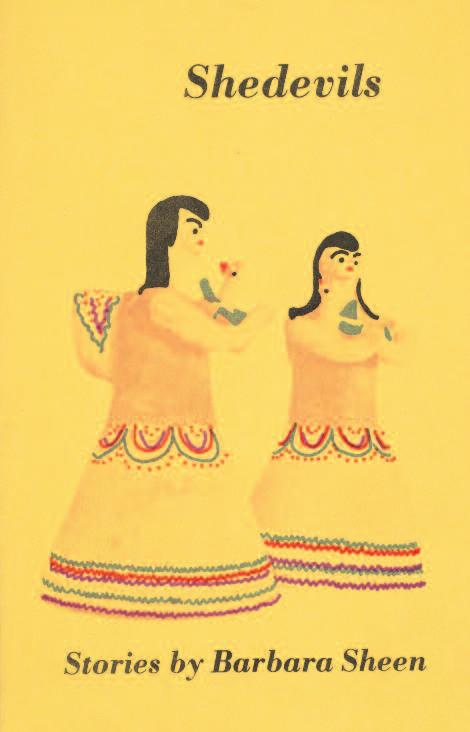
Shedevils
Barbara Sheen; cover by unknown artist
Metis Press, Chicago, 1978
Printed ink on paper; 8” h x 4 ¾” w x ¼” d Chicago Histor y Museum, ICHi-183609
Hurtin’ & Healin’ & Talkin’ It Over
Amy Christine Straayor; cover by unknown artist
Metis Press, Chicago, 1980
Printed ink on paper; 8 ¼” h x 5 ¾” w x ¼” d
Chicago Histor y Museum
Black Maria
Metis Press, Chicago, December 1971
Printed ink on paper; 9” h x 6” w x ¼” d
Chicago Histor y Museum, ICHi-182878
Black Maria
Metis Press, Chicago, Spring 1974
Printed ink on paper; 9” h x 7” w x ¼” d
Chicago Histor y Museum, ICHi-182879
S
Folded Map Action Kit
Tonik a Lewis Johnson with graphic design by Janell Nelson, 2024
Printed ink on paper; 11" h x 8 1/2" w Courtesy of Tonik a Lewis Johnson and Janell Nelson
I Can’t Breathe
Carlos Barberena, 2020
Linocut on paper; 24” h x 18” w 2024 1 1; Chicago Histor y Museum, ICHi-179705
Restore Families
Nicole Marroquin, 2020
Digital print on paper; 17” h x 11” w 2023.54.6; Chicago Histor y Museum, ICHi-183513
DAC A (Dreams Arrested for Childhood Arrivals)
José L Gutiérrez (elgtz), 2017 (reprinted 2023)
Linocut on paper; 15” h x 11 1/4” w 2023 54 8; Chicago Histor y Museum, ICHi-183511
Rise Up!
Digital landing page for PCR website Firebelly Design, 2022 Courtesy of Firebelly Design
Education is a Right / Support Public Schools
Free downloaded poster by William Estrada, 2023
Printed ink on paper, color added by the Chicago Histor y Museum; 24” h x 18” w Chicago Histor y Museum
Reparations Now, Reparations Won!
Monica Trinidad, 2020
Offset printed poster; 17” h x 11” w 2023 54 4; Chicago Histor y Museum, ICHi-183514
DE-MIL-I-TA-RISE & End Grain
Aaron Hughes, 2015
Letterpress print two color on paper; 14” h x 11” w 2023 54 2; Chicago Histor y Museum, ICHi-183512