Week of January 24 | Vol 1 • No 24 • www.cstweekly.com
weekly
ST
SuburbanTimes
Franciscan Health Hosts Upcoming Chicago Heights History Lecture More Inside Community > PAGE 3
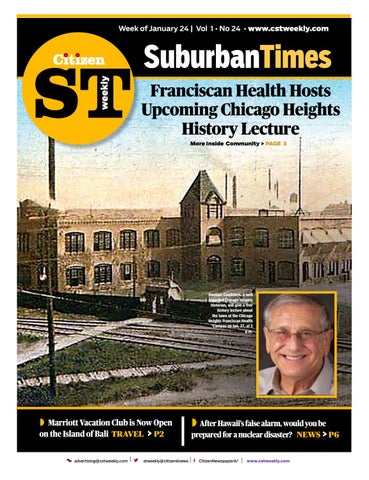
Dominic Candeloro, a well regarded Chicago Heights historian, will give a free history lecture about the town at the Chicago Heights Franciscan Health Campus on Jan. 27, at 2 p.m.
w Marriott Vacation Club is Now Open on the Island of Bali TRAVEL > P2 advertising@cstweekly.com
stweekly@citizen6news
w After Hawaii’s false alarm, would you be
prepared for a nuclear disaster? NEWS > P6 CitizenNewspaper6/
www.cstweekly.com
Marriott Vacation Club is Now Open on the Island of Bali
2
January 24 2018
ST
S
uburbanTimes
ARTSCENE THE SECOND CITY PRESENTS
Second City celebrates Black History Month “Audiences in 2018 will be surprised to see that material created by our alumni is ever more relevant and topical now,” said Donna Griffin-Irons, show producer and The Second City’s Director of Diversity and Inclusion. “This show is a timeless treasure and reason to celebrate our alumni during Black History month.”
ST
Chicago, IL – The Second City proudly celebrates Black History Month with a special engagement of The Second City’s Black History Month Show, featuring iconic scenes written and created by the theater’s lauded African American alumni, which include Keegan-Michael Key, Sam Richardson, Amber Ruffin and more. The show is directed by Second City alum, Resident Director, and Associate Artistic Director of the Training Center, Anthony LeBlanc. The cast features performers Andy Bolduc, Terrence Carey, Asia Martin, Maya Haughton, Seth Thomas, Rob Wilson, and Lilliana Winkworth. The creative team also includes Dionna Griffin-Irons (Producer), Marques Stewart (Music Director), Abby Beggs (Stage Manager), Claudia Michelle Wallace (Casting Director), and Joe Ruffner (Line Producer). Featuring archival scenes dating back to the 1990s with poignant relevancy about race, class and gentrification, The Second City’s Black History Month Show will include classic scenes like “Porches,” written
by Keegan-Michael Key (Key & Peele, Netflix’s Friends from College) and Nyima Funk; “Gourds” written by David Pompeii and Craig Cackowski; “Rasheeda,” written by Angela Shelton (Frangela); “Mother Son,” written by Sam Richardson (Veep, Detroiters) and Edgar Blackmon (Freeform’s Alone Together); and “Outblack,” written by Amber Ruffin (Late Night with Seth Meyers). Other notable African American alumni who started their early careers in comedy with The Second City include Robin Thede (BET’s The Rundown with Robin Thede) and Chris Redd (Saturday Night Live, Netflix’s Disjointed.). “Audiences in 2018 will be surprised to see that material created by our alumni is ever more relevant and topical now,” said Donna Griffin-Irons, show producer and The Second City’s Director of Diversity and Inclusion. “This show is a timeless treasure and reason to celebrate our alumni during Black History month.” In 2002, Griffin-Irons and fellow Second City alum Claudia Wallace
teamed up to curate and direct Words, a showcase of twenty-six poets, comedians, improvisers, musicians and dancers who hailed from Chicago’s North and South side neighborhoods. Words became an annual hit, performing in Donny’s Skybox Theater for five years before branching out to annual festivals until 2010. The platform helped elevate The Second City’s ongoing mission to increase diverse representation on its stages. The 2018 engagement of The Second City’s Black History Month Show was suggested by cast member Seth Thomas (The Defiant Thomas Brothers), who appeared in the original 2002 production of Words. The Second City’s Black History Month Show will be performed on Wednesdays, February 14, 21 and 28 at 8pm at The Second City e.t.c. Theater, located at 230 W North Ave, 2nd Floor of Piper’s Alley, Chicago. Tickets, priced at $20, are available at the Second City Box Office (230 W. North Ave, First Floor, Piper's Alley), by phone at 312-337-3992 or online at www.secondcity.com.
TRAVEL
Marriott Vacation Club is Now Open on the Island of Bali Marriott's Bali Nusa Dua Gardens—Marriott Vacation Club's all-new vacation ownership escape—is now open on the island of Bali. The stunning tropical retreat, where moments of relaxation meet island inspiration, is the company's first resort in Indonesia. The setting couldn't be more extraordinary: Condé Nast ranks Bali as one of the best islands in the world and TripAdvisor has called Bali the world's favorite destination. Marriott Vacation Club continues to add exciting new vacation destinations in Asia and the Pacific. Marriott's Bali Nusa Dua Gardens joins Marriott's Phuket Beach Club and Marriott's Mai Khao Beach in Phuket, Thailand, Marriott Vacation Club at the Empire Place© in Bangkok and Marriott Vacation Club at Surfers Paradise in Gold Coast, Australia. Nestled within the exclusive Nusa Dua community, Marriott's Bali Nusa Dua Gardens features spacious 1-bedroom, 2-bedroom and studio guestrooms each with kitchenettes, their design inspired by the vivid tropical beauty of Indonesia. The resort shares convenient access* to the amenities and activities at the adjacent Courtyard by Marriott Bali Nusa Dua resort, including on-site dining, fitness center, luxury spa and Kids Club, as well as access to a private beach club at Nusa Dua Beach. Close to the new resort are numerous cultural attractions, boutique shops and an eclectic,
Living and dining area for one- and two-bedroom apartments at the all-new Marriott's Bali Nusa Dua Gardens on the island of Bali. Photo courtesy Marriott Vacation Club.
world-class food scene. Known as the "Island of the Gods," Bali is home to world-class surfing and diving and a serene, spiritual attitude framed by turquoise waters, spectacular beaches and gently curving coastlines.
advertising@cstweekly.com
stweekly@citizen6news
CitizenNewspaper6/
Marriott Vacation Club's Owners, Members and nightly guests alike will find Marriott's Bali Nusa Dua Gardens the ideal base for discovering the exotic charm, experience and legendary beauty of Bali.
www.cstweekly.com
January 24 2018
SuburbanTimes
ST
3
COMMUNITY
Franciscan Health Hosts Upcoming Chicago Heights History Lecture
CONTINUED FROM PAGE 1
By: Katherine Newman
“The hospital was established in 1910 and was state of the art and an attractive feature in Chicago Heights,” said Candeloro. “Chicago Heights was an industrial town and the industrial accidents were much more frequent in the past then they are now, one needed to have a hospital to repair the damage done by industrial accidents."
ST
Franciscan Health is hosting a Chicago Heights history lecture on Jan. 27, at 2 p.m., at Cornet Hall on the hospitals Chicago Heights campus. The free lecture, Spotlight on Chicago Heights History; The Early 20th Century to Today, will be given by Dominic Candeloro, a well regarded Chicago Heights historian. “I was born in Chicago Heights in 1940,” said Candeloro “I experienced a lot of Chicago Heights history and the spirit of Chicago Heights. In the mid 90’s, Candeloro was assistant to the Mayor of Chicago Heights. During that time, he was part of a group that developed a historic preservation committee. “The committee consisted of me and a number of others, plus the longtime librarian Barbara Paul, and we were determined to try and develop the image of the city by dwelling on writing its history,” said Candeloro. He and Barbara Paul co-authored Chicago Heights: At the Crossroads of the Nation. The book details the history of Chicago Heights at the way that it mirrors the success and failures of the entire nation over the years. This particular history lecture
will focus not only on Chicago Heights as a whole, but also how the hospital has been an anchor for the community for over 100 years. “The hospital was established in 1910 and was state of the art and an attractive feature in Chicago Heights,” said Candeloro. “Chicago Heights was an industrial town and the industrial accidents were much more frequent in the past then they are now, one needed to have a hospital to repair the damage done by industrial accidents.” In the past, Chicago Heights felt like an island. Before suburbanization took place, the community served as a market town for the surrounding 10 miles of countryside dwellers. The economy was local with business owners, factory owners and managers, teachers, and doctors all living and working in Chicago Heights, according to Candeloro. “All of this made Chicago Heights into an ideal small town with the hospital as the center of all of the community feeling,” said Candeloro. Admission to the Chicago Heights history lecture is free. However, seating is limited. Reservations can be made by calling 1-866-790-2229 or visiting FranciscanHealth.org.
Darrell Garth President / Publisher Janice Garth Sales Manager/ General Manager CST Weekly, published weekly on Wednesdays and distributed in the Township of Bloom, (publishing 52 issues annually). Written permission is required to reproduce contents in whole or part from the General manager or the publisher. CST Weekly does not assume the responsibility for nor are we able to return unsolicited marterials. Deadline for advertising is every Monday at noon. For information on subscriptions or advertising call us at (773) 783-1251. Our office is located at 8741 S. Greenwood Ave., Ste# 107, Chicago, Illinois 60619.
Editorial:
Send press releases, news tips, calendar listing etc. to: editorial@cstweekly.com
Advertising
advertising@cstweekly.com Classifieds call us at (773) 783-1251
POLITISCOPE
Donald Trump doesn’t understand Haiti, immigration or American history Donald Trump’s denigrating comments about Haiti during a recent congressional meeting shocked people around the globe, but given his track record of disrespecting immigrants, they were not Chantalle F. Verna actually that surprising. Despite campaign promises that Trump would be Haiti’s “biggest champion,” his administration had already demonstrated its disregard for people from this Caribbean island. In November 2017, the Department of Homeland Security announced it would end the Temporary Protected Status that had allowed 59,000 Haitians to stay in the U.S. after a calamitous Jan. 12, 2010 earthquake. Their TPS was extended after Hurricane Matthew devastated
Haiti again in 2016. Without protected status, these Haitian migrants have until July 2019 to get a green card, leave voluntarily or be deported. As a scholar and first-generation Haitan-American, I can attest that Trump’s statements and policies reflect not just disrespect for Haiti but also a profound ignorance about how migration occurs.
Why history matters As shown in my recent book, “Haiti and the Uses of America,” history shapes where immigrants choose to build their lives. Outsiders head to the United States in times of crisis not at random but because historic ties point them in this direction. When nativists like President Trump and Attorney General Jeff Sessions refer to immigrants as “criminal aliens” – perpetuating the idea that foreigners are “invading” the country – they ignore
advertising@cstweekly.com
stweekly@citizen6news
CitizenNewspaper6/
this key fact. Movement from Haiti to the U.S. has its roots in colonial times, when British, French and Spanish traders exchanged coffee, cotton and mahogany between the two territories. In the 1790s, thousands of white and mixed-race residents sought refuge from a revolutionary war in colonial Haiti, which was then called Saint Domingue. Fleeing an uprising by enslaved men and women of African descent, French colonists boarded ships following historic trade routes to U.S. port cities like New Orleans, Philadelphia and New York. Some brought with them the people they had enslaved. An estimated 10,000 Saint Dominguan revolution-era refugees ually resettled in Louisiana, contributing to the distinct Creole history and culture that characterizes Gulf cities like New Orleans today. By 1804 the CONTINUED ON PAGE 4
www.cstweekly.com
4
January 24 2018
ST
SuburbanTimes
FOOD
BACONFEST CHICAGO FOUNDERS REVEAL THEIR TEN MOST MEMORABLE BACON DISHES OF ALL TIME (CHICAGO, IL) Baconfest Chicago, one of the pioneers in Chicago's premier food festivals, reveal their ten most memorable bacon dishes of all time. Since launching in in 2009, over 27,000 bacon lovers have consumed more than 46,000 pounds of Nueske's bacon dishes from notable Chicago Chefs including: Stephanie Izard, Kevin Hickey, Takashi Yagihashi, Saigon Sisters and Carlos Gaytan. From Left to Right: Baconfest Chicago highlights featuring Loaded Mash from Honey Butter Fried Chicken, Pancetta from Mercat A La Planxa, and a Bacon Ramen The Baconfest from Slurping Turtle. Chicago team recently published a list of the Here are ten most memorable Baconfest Chicago quail egg, kamaboko, black pepper bacon, scallion, "Golden Rasher" winning chefs from the last nine dishes, in no particular order, noted by Zurer as stand- bacon oil by Takashi Yagihashi. years, giving bacon lovers an opportunity to wander outs from a selection of Chicago's finest Chefs: Girl & The Goat Bacon & Blue Cheese Bread Pudding down bacon Memory Lane, remembering all the winSaigon Sisters Restaurant Bacon Pho with black featuring bacon, Rogue River Smokey Blue cheese and ning dishes of Baconfests gone by. garlic noodles, pickled quail egg and micro Viet herbs. bread pudding by Stephanie Izard. To go along with this list, Seth Zurer, co- founder Honey Butter Fried Chicken Loaded Mash with fried Longman & Eagle Bacon Waffle with brown sugar of fest also shared his own list of personal favorite chicken chunks and bacon buffalo sauce. bacon ice cream garnished with candied dehydrated Baconfest dishes, featuring an idiosyncratic sampling Mercat A La Planxa Arroz De Iberico Pancetta bacon by Jared Wentworth. of the dishes that caught his imagination and stuck in featuring Iberico bacon, smoked Calasparra rice, cageBOKA Black mole-infused pork belly with quince his bacon memory. "Each year, people always ask what free eggs, Iberico bacon aioli by Evan Behmer. sauce, bacon and semolina gnocchi by Giuseppe the favorite dishes of the fest were. It's easy to point to Bottlefork & The Duck Inn The FrankenDuckie Tentori. the winners of the Golden Rasher awards, which carry featuring duck fat dog wrapped in bacon with cheese Mexique Mussels with Bacon Saffron by Carlos with them the legitimacy and glory that can only come sauce, pickled jalapeño and Calabrian chili relish by Gaytan. from the rigorous judging procedures and expert palKevin Hickey. The tenth edition of Baconfest Chicago will be held ates of our celebrity panel of judges. But the dishes that Bad Apple Baconnoli featuring bacon, banana, and on April 6 & 7, 2018 at the UIC Forum at 725 West we can't forget aren't always the ones that take home Bellwether Jersey Cow ricotta filled cannoli, bacon Roosevelt in Chicago. For their ten year anniversary, the Golden Rashers. Our best chefs always surprise us peanut caramel and powdered bacon sugar Baconfest Chicago is offering new tickets levels for as they take bacon to the next level," said Baconfest by Craig Fass. bacon lovers on any budget. Tickets start at $60, plus co-founder Seth Zurer. Slurping Turtle Bacon Ramen featuring Tonkotsu fees, and are on sale now at https://baconfestchicago. based broth, house made ramen noodles, marinated com/ticket/.
Turtle.
Donald Trump doesn’t understand Haiti, immigration or American history CONTINUED FROM PAGE 3
island’s revolutionaries had driven out France to found Haiti. The U.S., however, did not formally recognize Haitian independence until 1862. Born of a slave rebellion, Haiti challenged the legitimacy of an American economy and society dependent on racial hierarchies. In 1806, the U.S. government imposed an economic embargo on the island. But a vibrant illicit trade persisted. In 1821, 45 percent of Haitian imports still came from the U.S. As a result, migration between the two nations continued, too – and not just from Haiti to the U.S. In the 1820s, some 13,000 African-Americans sought refuge in Haiti, seeking freedom from slavery, anti-black violence and lack of economic opportunity in the U.S. From the 1820s to the 1870s, civic and religious leaders, notably Richard Allen of the African Methodist Episcopal Church and the Episcopalian Theodore James Holly, enabled similar
journeys by negotiating directly with Haitian heads of state. President Abraham Lincoln supported such schemes to send African-Americans abroad – not just to Haiti but also to Liberia, Central America and elsewhere. Even many abolitionists of the era believed that blacks and whites could not co-exist as equals in the U.S.. Many of the African-Americans who went to Haiti later returned to the U.S., in part drawn by the promise of new legal rights after the Civil War. American meddling leads to migration By the time the American embargo of Haiti ended in 1862, the U.S. was openly striving for political and economic domination of the Western Hemisphere, including in the Caribbean. Starting with President Ulysses S. Grant, who wanted to annex Haiti, American politicians militarily pursued U.S. interests on the island nation. Between 1862 and 1915, American warships were active in Haitian waters 17 times.
Powerful commercial lobbies with a business stake in Haiti – particularly the financial and sugar industries – also meddled in the island’s affairs. Foreign merchants and bankers in Haiti paid armed groups known as cacos to overthrow standing presidents and empower leaders who would give them preferential terms of trade. The political and economic instability that resulted helped perpetuate the racist perception of Haitians as incapable of self-rule. It also fueled emigration. New research shows that in the first decades of the 20th century, some 200,000 rural Haitians left to work as guest laborers for American sugar companies in Cuba. They were among more than 1 million Caribbeans who traveled across the Americas between 1840 and 1940. Some of them ually landed in the United States. A series of military interventions In 1915, President Woodrow Wilson invaded Haiti’s capital, CONTINUED ON PAGE 6
advertising@cstweekly.com
stweekly@citizen6news
CitizenNewspaper6/
www.cstweekly.com
January 24 2018
SuburbanTimes
H T T E I G DW E K IN
ly week
T S of Week
7 1 • No | Vol 2017
om kly.c twee w.cs
es
• ww
nTim a b r u b Su 27,
mber
Septe
ly week
ST
ly week
ly week
Davis
2017
| Vol
1 • No
he
ing t p l s e e H eless nTim
3•
HomHungry and More
r A. o t c e H evara Gu g
lin Profi
Inside
m
Com
orable
y Famil
A Mem > P2 w Plan on TRAVEL Vacati
adver
om eekly.c @cstw tising
ia ophob Islam ghting OPE > P3 C s are fi erican ts POLITIS m A Muslim vil righ w How ring their ci .com eekly cu cstw and se www. r6/ news izen6 ly@cit stweek
y munit Com How es are sa g Colle Student and g Givin ce to Lead Chan ed . e Succ 3 More
Inside
GE > PA
ary r Milit > P2
as Fo
g Ide
E in w Mov s ARTSCEN
ie Famil
m kly.co twee g@cs
ce as balan in the PE > P3 hang O dgets POLITISC u b w State uncertain .com eekly A cstw of AC www. /
e
futur
er6 spap nNew
ws n6ne citize kly@ stwee
Citize
rtisin
adve
advertising@cstweekly.com
stweekly@citizen6news
bson
nie Ho
Stepha
ity .com ? mun eekly n tick .cstw Com Jong U www
a
Suburb
ST
imes
es Kim 3 t mak w Wha ISCOPE > P LIT g O m P in r kly.co twee ove c 2 w.cs is P ww D > ne: er6/ ene spap nNew ral Sto Art ArtSc Citize tu a N ws f ne w n6 so citize kly@ Form stwee New m kly.co es, twee g@cs roach s how rtisin adve r app e winte discuss people e h t ow As ices to ond N Resp tting serv st . e it’s g eed it mo GE 3 n > PA who unity er 6,
temb
p of Se Week
om kly.c stwee ww.c
6•w
anT Suburb
ST
Inside
1 • No
tem
f Sep
o Week
lores e exp mbers e cours GSU ilitary m s ie m how eir famil and h r and t ience wa r expe a 3 PAGE m u ity > tra mun Com More
| Vol , 2017 ber 20
Dan Credit:
for details
a raum T , r a W the and anities Hum
Photo
Do you have an idea for a great column with the Suburban Times? Join our “Get Inked Campaign Call 773.783.1251
ity
mun
Com
CitizenNewspaper6/
www.cstweekly.com
spape nNew
Citize
5
6
January 24 2018
ST
SuburbanTimes
NEWS
After Hawaii’s false alarm, would you be prepared for a nuclear disaster? By Lisette Gushiniere
On January 13, 2018, a false ballistic missile alert was issued via the Emergency Alert System and Commercial Mobile Alert System over television, radio, and cellphones in Hawaii. According to reports, the alert stated that there was an incoming ballistic missile threat to Hawaii, advised residents to seek shelter, and concluded, "This is not a drill.” The message was sent at 8:07 a.m., local time. A second message, sent 38 minutes later, described the first as a "false alarm.” State officials blamed a “button” pushed in error during an employee shift change at the Hawaii Emergency Management Agency for the first message. Governor David Ige publicly apologized for the erroneous alert, which caused panic and disruptions throughout the state. The Aton Federal Communications Commission Edwards and the Hawaii House of Representatives immediately announced investigations into the incident. But had this been an actual alarm, would you have been prepared? The event in Hawaii should have a sobering effect, especially given the fact that many adults in America are not planning ahead in the event of a disaster. In fact, a 2015 Federal Emergency Management Agency (FEMA) survey found that nearly 60 percent of American adults have not practiced what to do in a disaster by participating in a disaster drill or preparedness exercise at work, school, or home. Further, only 39 percent of respondents said they have developed an emergency plan and discussed it with their household. At the beginning of the year, the Illinois Emergency Management Agency (IEMA) and local emergency management agencies throughout Illinois encouraged people to ‘Resolve to be Ready’ for emergencies in 2018. In a press release, the IEMA said support would be offered throughout the year to help people attain the goal of better preparedness for themselves and their families. According to the release, each month this year, civilians will receive information about preparedness or safety topics, including topics about severe weather, earthquakes, radiation, school and campus safety, cyber security and more. What happened in Hawaii should be a “wake up call,” said Aton Edwards, executive director of the International
Preparedness Network. The possibility of a nuclear exchange between the two nations is a serious threat and must be taken as one, Edwards added. It could result from a deliberate or accidental action, he said. The International Preparedness Network or I.P.N. is a not-for-profit Edwards created along with two other friends in 1989. One of the goals of the organization is to help train civilians to respond to and recover from disasters, he said. People also use the organization as a resource to prepare for disasters like nuclear blasts. The organization specializes in nuclear, bio and chemical weapon response and recovery training. “It’s intense and demanding,” Edwards said, “but given the situation
we find ourselves in today, I believe it’s something the public should know.” Under the Trump administration, Edwards said the president’s rhetoric has made matters worse. “President Trump’s remarks have helped to escalate tensions in the region, increasing the possibilities of skirmishes and confrontations by troops along the 38th parallel,” he stated. “This could result in larger conflicts where full-scale war could erupt. Nuclear weapons could be used by both sides,” he added. On the I.P.N’s Facebook page, Edwards recently went live as a way to help people stay safe during a nuclear event and provided followers with facts on what to do if a nuclear blast occurred. “For the most part, the public knows very little about what do do,” he said, adding, “if you are ever in the unfortunate position where you are in a place where a nuclear device is used, first thing is, if you are still alive after it detonates and are reasonably intact,
you can survive,” he said. “You just need to know what the rules are and be ready to apply them. You can only do that if you learn them before the disaster – not during or after,” he stated. In his last book, Preparedness NOW! An Emergency Survival Guide for Civilians and Their Families, Edwards provides information and techniques that can help mitigate the destructive effects of disasters, whatever the cause. He gives practical advice on the 72-hour emergency kit, water quality control and storage and emergency shelter, power, lighting and heating. In his new book called, Ready-UP NOW!, to be released this fall, Edwards specifically covers how black and other low-income communities can survive a disaster. He added, this segment of the population will be, “impacted the most,” by a disaster such as a nuclear event. According to the IEMA, one of the first steps toward emergency preparedness is having an emergency supply kit stocked with basic survival items including: One gallon of water per person per day (a minimum of a three-day supply) At least a three-day supply of non-perishable food First aid kit Battery-operated radio, flashlight and extra batteries Items for children, seniors, pets, and household members with health or medical needs Disasters often occur with little notice, so it’s also important to have multiple ways to receive critical information 24/7, such as through NOAA all-hazards weather alert radios, Wireless Emergency Alerts enabled on most smartphones, mobile device apps, TV, radio and the Internet. IEMA maintains the Ready Illinois website (www. Ready.Illinois.gov), a one-stop location for preparedness information on a variety of hazards. In addition to information on how to prepare for emergencies, the Ready Illinois website also provides guidance on what to do during and after a disaster. A list of the 2018 monthly preparedness topics is also available on the Ready Illinois website. Preparedness information is also available through the Ready Illinois Facebook (www.facebook.com/ReadyIllinois) and Twitter (twitter.com/ReadyIllinois) pages. For more information about the International Preparedness Network, visit www. readyforanything.org.
Donald Trump doesn’t understand Haiti, immigration or American history CONTINUED FROM PAGE 4
Port-au-Prince. The occupation, which lasted until 1934, was the first in a series of U.S. military actions on the island. The next interventions came in 1994 and 2004, under the auspices of the United Nations. The impetus was the 1991 ouster of Haitian President Jean-Bertrand Aristide, who’d been elected during Haiti’s contested four-year transition from dictatorship to democracy. Through an economic embargo initiated by President George Bush and a military engagement under President Bill Clinton, Aristide was restored to power in 1994. When he was again forced out 10 years later, President George W. Bush ordered the U.S. Marines back into Haiti. The actions preceding and during these interventions have destabilized Haiti. In other words, for over a century, the U.S.
has helped to perpetuate and exacerbate the political fragility and economic struggle that leads Haitians to seek refuge on American shores. Today, an estimated 830,000 people of Haitian descent live in the U.S., primarily in Florida and New York. Approximately 40 percent of them were born in the U.S. Few Haitian-Americans are wealthy – in 2009, census data shows, 1 in 5 households lived in poverty – but they are employed at higher rates than the general American public. The Haitian-American population is also growing, more than tripling between 1990 and 2015. Within this group are the nearly 60,000 people granted Temporary Protected Status
advertising@cstweekly.com
stweekly@citizen6news
CitizenNewspaper6/
after the 2010 earthquake, who have now lived in the U.S. for an average of 13 years. In countless ways, Haiti is woven into the fabric of the United States. Haitian-Americans have made their homes in South Florida, Brooklyn, and Detroit, among many other places. The deep historic ties binding Haiti and the U.S. will persist with or without Donald Trump. What the president’s repugnant language and short-sighted policy changes can do is spur new crises in both Haiti and the United States. Chantalle F. Verna is an Associate Professor of History and International Relations at Florida International University
www.cstweekly.com
January 24 2018
SuburbanTimes
ST
7
NEWS
Harvey Alderman Addresses High Price of Water
By: Katherine Newman
Alderman Chris Clark represents Harvey’s Third Ward and on Jan. 5, he sent a four-page letter to the Cook County Commissioners Human Relations Committee in preparation for an upcoming meeting, scheduled for Jan. 9, to address countywide concerns about the high price of water in Chicago’s suburbs. “As Third Ward Alderman in the City of Harvey, drinking water is an important issue to my constituents as well as the entire Harvey community,” Clark stated in the opening of his letter. Also included in the letter, is a review of water rate increases in Harvey over the last several years, the price paid to the City of Chicago for water, the price surrounding communities are paying to purchase water from Harvey and the current price that residents are paying for water. “If the Cook County Humans Relations Committee was going to investigate the matter, I thought that they should be able to investigate it and make informed decisions about what they were going to do,” said Clark. “Even though my letter was detailed, it was detailed because of research I had done myself and not necessarily because it came from the Mayors Office.” During the meeting on Jan. 9, Eric Kellogg, mayor of Harvey, and Andre Lewis, water supervisor for Harvey, spoke about the current price of water, stating that they have not raised resident rates more than the City of Chicago has raised the rates for Harvey. “For the last 17 years, our rates have been
increased from the City of Chicago by 137 percent,” said Lewis. “We did what is considered a pass-through, we passed the rate from the City of Chicago to the citizens because we had no choice.” Mayor Kellogg also went on to say that it is not the Harvey administration that is initiating the high water rate, it is a consistent theme across African American communities coming from the City of Chicago. “During the course of the Emanuel administration, the City of Harvey and poor African communities witnessed record-breaking water increases by the City of Chicago,” said Kellogg. “These water rates, shall we say gouging, practices by the City of Chicago widens the income gap between the rich and the poor, the black and the white. More importantly, when you look at what
Chicago has tried to do, it has tried to balance the budget on the backs of poor African American communities.” Alderman Clark however, isn’t buying it. He believes there has been a misuse of water funds in Harvey and a Cook County Circuit Court Judge agreed. Judge Kathleen Pantle ruled that Harvey had misused water funds several times and failed to deposit all of the water revenue into the water fund, which is necessary to maintain the water system that provides water to Hervey along with other surrounding communities, according to a Cook County Circuit Court Order filed on July 19. The same court order also appointed a water receiver to take control of the water fund and make sure all water revenue was being deposited into the water fund. Having a water receiver in place will keep Harvey accountable for using the water funds the way there are intended to be used, first to pay Chicago for the water they receive, second to pay water workers, and third to maintain the water system, according to Clark. Moving forward, Clark is calling for greater oversight of water funds across the county, which he addressed in the closing of his letter to the Human Relations Committee. “I would like to see the passing of a measure that controls how cities in Cook County use their water fund, but also to attach penalties to any misappropriation of those funds and give the Cook County attorney the means to enforce those guidelines,” said Clark. For more information and to view Alderman Clark’s letter, visit harveywaterbill.com
Taxpayers learn how GOP Tax Bill will affect their wallet at Town Hall hosted by Congresswoman Kelly More than 100 residents attended a “Teach-in” Town Hall hosted by Congresswoman Robin Kelly to learn how the recently passed GOP tax bill will directly affect their families and communities. Residents posed dozens of questions to local tax experts, community stakeholders and elected officials, including Andrew VanSingel of the IRS’s Tax Payer Advocate Service and Daniel Kay Hertz of the Center for Tax and Budget Accountability. Park Forest Mayor John Ostenburg answered questions regarding how the tax bill would impact communities within the South Suburbs. “The attendance at the Town Hall demonstrated that average working people have many questions and concerns regarding the GOP tax bill, which was pushed through Congress with no open debate and
advertising@cstweekly.com
zero bipartisan support,” Congresswoman Kelly said. “Many are worried they’ll see an increase in their tax expenses next year because of the new cap on core middle-class deductions for mortgage interest and property taxes. I want to fully inform my constituents and make them aware of the direct effects on their pocketbook.” Other guest speakers included Dan Rabbitt, health policy project manager at Heartland Alliance, and Tony Garcia, legislative director for United Auto Workers. The Teach-in took place at Victory Apostolic Church in Matteson. Rep. Kelly said she plans to host more Town Halls on the GOP tax bill throughout the 2nd Congressional District in February. For more information on upcoming Town Halls, visit https://robinkelly.house.gov or call (708) 679-0078.
stweekly@citizen6news
CitizenNewspaper6/
Congresswoman Robin Kelly
www.cstweekly.com
8
January 24 2018
SuburbanTimes
weekly
ST SuburbanTimes GET SOCIAL WITH THE CITIZEN SUBURBAN TIMES WEEKLY
Like Us On Facebook at www.facebook.com/CitizenNewspaper6/
Follow Us On Twitter at: Twitter: cstweekly@citizen6news
Follow Us On Instagram at: www.instagram.com/cstweekly/
Send press releases to editorial@cstweekly.com Send advertising inquiries to advertising@cstweekly.com
Citizen Suburban Times Weekly
w Bloom Township w Chicago Heights w Flossmor w Ford Heights w Greenwood w Home Wood w Lansing w Lynwood w Olympia Fields w Park Forest w Sauk Village w South Chicago w Steger 60411, 60422, 60425 , 60430, 60438
Visit us online at www.cstweekly.com