Citizen Week of Oct. 10, 2018
| Vol. 2 | No. 9 | www.thechicagocitizen.com
SUBURBAN TIMES WEEKLY
TRAVEL
Destination Residences Hawai'i Acquires Classic Resorts PAGE 2
POLITISCOPE
Ruth Bader Ginsburg’s role in shaping women’s rights PAGE 4
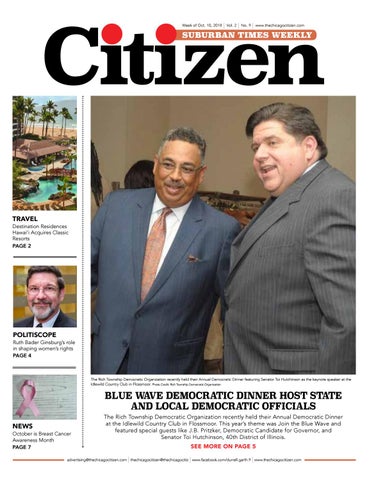
The Rich Township Democratic Organization recently held their Annual Democratic Dinner featuring Senator Toi Hutchinson as the keynote speaker at the Idlewild Country Club in Flossmoor. Photo Credit: Rich Township Democratic Organization
BLUE WAVE DEMOCRATIC DINNER HOST STATE AND LOCAL DEMOCRATIC OFFICIALS
NEWS
October is Breast Cancer Awareness Month PAGE 7
The Rich Township Democratic Organization recently held their Annual Democratic Dinner at the Idlewild Country Club in Flossmoor. This year’s theme was Join the Blue Wave and featured special guests like J.B. Pritzker, Democratic Candidate for Governor, and Senator Toi Hutchinson, 40th District of Illinois. SEE MORE ON PAGE 5
|
|
|
advertising@thechicagocitizen.com thechicagocitizen@thechicagocitiz www.facebook.com/durrell.garth.9 www.thechicagocitizen.com
2 | CITIZEN | Suburban Times Weekly | Week of Oct. 10, 2018
ART SCENE
Educational art exhibit about menopausal hot flashes to travel around North America An educational art exhibit about menopausal hot flashes created by a researcher-entrepreneur at the Indiana University School of Nursing will travel to the West Coast, Canada and around the Midwest in late 2018 and early 2019. Janet S. Carpenter, associate dean for research, created "Hot Flashes? Cool!" to refute myths, provide accurate and culturally appropriate information, prevent use of unproven treatments, and spur dialogue about menopausal hot flashes. The exhibit comprises multiple pieces of two- and three-dimensional art, music and film. "Our goal is a more informed public to help women and their providers make better choices about menopausal health care," Carpenter said. "Nearly three-fourths of women say they seek help from a health care provider for menopause, but most providers do not feel comfortable managing menopausal symptoms. Most women report being confused about treatment options." The exhibit's concept graphics will travel to several locations through 2018 and early 2019:
A private viewing for employee education at a corporate office: Oct. 12-31, Northbrook, Illinois. MOKITA: Empowered for Midlife: Oct. 13, Vancouver, British Columbia. There will be simultaneous live events in London, Seattle and Toronto. Indiana Conference for Women: Nov. 8, Indianapolis. The Art Gallery at IU Northwest: Feb. 11-March 8, 2019, Gary. The final day of the exhibit is International Women's Day. Carpenter has achieved several milestones since she took part of the exhibit to a women's health luncheon in Boston on May 11. "We collected data for our Pfizer-funded project and completed revisions of the exhibit based on public feedback. We created hot flash music using physiological data, and two short films are in production and will be available soon," Carpenter said. Carpenter has worked with the IU Innovation and Commercialization Office to copyright descriptions of exhibit pieces and to trademark the exhibit's logo.
An educational art exhibit about menopausal hot flashes created by a researcher-entrepreneur Janet S. Carpenter, associate dean for research at Indiana University School of Nursing will travel to the West Coast, Canada and around the Midwest in late 2018 and early 2019.
TRAVEL
Destination Residences Hawai'i Acquires Classic Resorts Destination Residences Hawai'i recently announced the acquisition of Classic Resorts Limited of Lahaina, HI, a collection of five luxury condominium resorts and an exquisite portfolio of vacation homes located throughout Maui and the Island of Hawai'i. These properties will expand Destination Residences Hawai'i's impressive footprint throughout the islands, joining Makena Surf, Polo Beach Club, Wailea Beach Villas, Wailea Ekahi Village, Wailea Ekolu Village, Wailea Elua Village, and Wailea Grand Champions on Maui, and The Lodge at Kukui'ula in Poipu, Kaua'i. Classic Resorts, the newly acquired collection with a combined 363 rental residences, delivers the ultimate vacation experience for couples, families and groups, through combining the comforts of a private vacation home with the amenities and services of a resort, in a prime oceanfront or golf course location. Accommodations range from studio to three-bedroom condominiums and feature fully-equipped kitchens, living rooms, private lanais, herb gardens, expansive windows, and daily housekeeping service. Resort amenities include picnic areas, pools, whirlpools, golf courses, tennis courts, beach service,
Experience Hawai’i with even more options than ever before with Destination Residences Hawai'i's portfolio of luxury vacation homes
SUP and surfboard rentals, fitness clubs, yoga studios, and spas. In West Maui, Ka'anapali Ali'i is prime oceanfront on the highly coveted Ka'anapali Beach, while Lahaina Shores Beach Resort and Pu'unoa Beach Estates are positioned on pristine beaches in the historic Lahaina town, just a short stroll to the boutiques and restaurants
of Front Street. The newly acquired operations on the Island of Hawai'i are located on the sunny Kohala Coast within the legendary Mauna Lani Resort. These properties include Mauna Lani Point, The Islands at Mauna Lani and Champion Ridge, in addition to the luxury private home collection at The Cape, The Point www.thechicagocitizen.com
Estates, and Nintendo and Toyota corporate homes. "Destination Residences Hawai'i has over thirty years of demonstrated success in hospitality management in Hawai'i, with an authentic appreciation for Hawaiian culture and values. We are excited to effectively double the size of our portfolio with the addi-
tion of these prime luxury properties and we are proud to welcome the Classic Resorts team members to our ohana," said Michael Cuthbertson, Area Managing Director of Destination Residences Hawai'i. "We look forward to providing these fantastic vacation opportunities to our loyal guests and continuing our mission to be a leader among the best places to work in the state of Hawai'i." Part of the Destination Hotels collection, Destination Residences Hawai'i is a portfolio of distinct, residential style vacation rentals located in beachfront, oceanfront and golf-front resorts. Destination Hotels' residences model is customized for each property, leveraging the brand's expertise in sales and marketing, revenue management and distribution, reservation sales, and asset preservation, through efficient operations management. Destination has extensive experience with multiple ownership structures and with managing fractional, traditional, and multi-use hotels, resorts and vacation rentals. To learn more about Destination Residences Hawai'i, please visit: https://www.destinationhotels.com/ hotels-and-resorts/destination-residences-hawaii
CITIZEN | Suburban Times Weekly | Week of Oct. 10, 2018
|
Darrell Garth President / Publisher Janice Garth Sales Manager/ General Manager
GET SOCIAL STAY CONNECTED WITH THE CITIZEN NEWSPAPER GROUP INC.
CST Weekly, published weekly on Wednesdays and distributed in the Township of Bloom, (publishing 52 issues annually). Written permission is required to reproduce contents in whole or part from the General manager or the publisher. CST Weekly does not assume the responsibility for nor are we able to return unsolicited marterials. Deadline for advertising is every Monday at noon. For information on subscriptions or advertising call us at (773) 783-1251. Our office is located at 8741 S. Greenwood Ave., Ste# 107, Chicago, Illinois 60619.
Editorial:
Send press releases, news tips, calendar listing etc. to: editorial@cstweekly.com
Advertising
advertising@cstweekly.com Classifieds call us at (773) 783-1251
Read Us On ISSUU.com
Send press releases to: Editorial@thechicagocitizen.com Visit us at www.thechicagocitizen.com
3
4 | CITIZEN | Suburban Times Weekly | Week of Oct. 10, 2018
POLITISCOPE
Ruth Bader Ginsburg helped shape the modern era of women’s rights – before she went on the Supreme Court BY JONATHAN ENTIN
As the debate about the treatment of women rages across the United States, one Supreme Court nominee arrived at her confirmation hearing widely acknowledged as a trailblazer in establishing women’s rights. When he nominated Justice Ruth Bader Ginsburg to the Supreme Court, President Bill Clinton compared her legal work on behalf of women to the epochal work of Thurgood Marshall on behalf of African-Americans. The comparison was entirely appropriate: As Marshall oversaw the legal strategy that culminated in Brown v. Board of Education, the 1954 case that outlawed segregated schools, Ginsburg coordinated a similar effort against sex discrimination. Decades before she joined the court, Ginsburg’s work as an attorney in the 1970s fundamentally changed the Supreme Court’s approach to women’s rights, and the modern skepticism about sex-based policies stems in no small way from her lawyering. Ginsburg’s work helped to change the way we all think about women – and men, for that matter. I’m a legal scholar who studies social reform movements and I served as a law clerk to Ginsburg when she was an appeals court judge. In my opinion – as remarkable as Marshall’s work on behalf of African-Americans was – in some ways Ginsburg faced more daunting prospects when she started. STARTING AT ZERO When Marshall began challenging segregation in the 1930s, the Supreme Court had rejected some forms of racial discrimination even though it had upheld segregation. When Ginsburg started her work in the 1960s, the Supreme Court had never invalidated any type of sex-based rule. Worse, it had rejected every challenge to laws that treated women worse than men. For instance, in 1873, the court allowed Illinois authorities to ban Myra Bradwell from becoming a lawyer because she was a woman. Justice Joseph P. Bradley, widely viewed as a pro-
Jonathan Entin
gressive, wrote that women were too fragile to be lawyers: “The paramount destiny and mission of women are to fulfil the noble and benign offices of wife and mother. This is the law of the Creator.” And in 1908, the court upheld an Oregon law that limited the number of hours that women – but not men – could work. The opinion relied heavily on a famous brief submitted by Louis Brandeis to support the notion that women needed protection to avoid harming their reproductive function. As late as 1961, the court upheld a Florida law that for all practical purposes kept women from serving on juries because they were “the center of the home and family life” and therefore need not incur the burden of jury service. CHALLENGING PATERNALISTIC NOTIONS Ginsburg followed Marshall’s approach to promote women’s rights – despite some important differences between segregation and gender discrimination. Segregation rested on the racist notion that blacks were less than fully human and deserved to be treated like animals. Gender discrimination reflected paternalistic notions of female frailty. Those notions placed women on a pedestal – but also denied them opportunities. Either way, though, blacks and women got the short end of the stick. Ginsburg started with a seemingly inconsequential case. Reed v. Reed challenged an Idaho law requiring probate courts to appoint men to administer estates, even if there were a qualified woman who could perform that task.
WHEN GINSBURG STARTED HER WORK IN THE 1960S, THE SUPREME COURT HAD NEVER INVALIDATED ANY TYPE OF SEX-BASED RULE. WORSE, IT HAD REJECTED EVERY CHALLENGE TO LAWS THAT TREATED WOMEN WORSE THAN MEN. Sally and Cecil Reed, the long-divorced parents of a teenage son who committed suicide while in his father’s custody, both applied to administer the boy’s tiny estate. The probate judge appointed the father as required by state law. Sally Reed appealed the case all the way to the Supreme Court. Ginsburg did not argue the case, but wrote the brief that persuaded a unanimous court in 1971 to invalidate the state’s preference for males. As the court’s decision stated, that preference was “the very kind of arbitrary legislative choice forbidden by the Equal Protection Clause of the 14th Amendment.” Two years later, Ginsburg won in her first appearance before the Supreme Court. She appeared on behalf of Air Force Lt. Sharron Frontiero. Frontiero was required by federal law to prove that her husband, Joseph, was dependent on her for at least half his economic support in order to qualify for housing, medical and dental benefits. If Joseph Frontiero had been the soldier, the couple would have automatically qualified for those benefits. Ginsburg argued that sex-based classifications such as the one Sharron Frontiero challenged should be treated the same as the now-discredited race-based policies. By an 8–1 vote, the court in Frontiero v. Richardson agreed that this sex-based rule was unconstitutional. But the justices could not agree on the legal test to use for evaluating the constitutionality of sex-based policies. STRATEGY: REPRESENT MEN In 1974, Ginsburg suffered her www.thechicagocitizen.com
only loss in the Supreme Court, in a case that she entered at the last minute. Mel Kahn, a Florida widower, asked for the property tax exemption that state law allowed only to widows. The Florida courts ruled against him. Ginsburg, working with the national ACLU, stepped in after the local affiliate brought the case to the Supreme Court. But a closely divided court upheld the exemption as compensation for women who had suffered economic discrimination over the years. Despite the unfavorable result, the Kahn case showed an important aspect of Ginsburg’s approach: her willingness to work on behalf of men challenging gender discrimination. She reasoned that rigid attitudes about sex roles could harm everyone and that the all-male Supreme Court might more easily get the point in cases involving male plaintiffs. She turned out to be correct, just not in the Kahn case. Ginsburg represented widower Stephen Wiesenfeld in challenging a Social Security Act provision that provided parental benefits only to widows with minor children. Wiesenfeld’s wife had died in childbirth, so he was denied benefits even though he faced all of the challenges of single parenthood that a mother would have faced. The Supreme Court gave Wiesenfeld and Ginsburg a win in 1975, unanimously ruling that sex-based distinction unconstitutional. And two years later, Ginsburg successfully represented Leon Goldfarb in his challenge to another sex-based provision of
the Social Security Act: Widows automatically received survivor’s benefits on the death of their husbands. But widowers could receive such benefits only if the men could prove that they were financially dependent on their wives’ earnings. Ginsburg also wrote an influential brief in Craig v. Boren, the 1976 case that established the current standard for evaluating the constitutionality of sexbased laws. Like Wiesenfeld and Goldfarb, the challengers in the Craig case were men. Their claim seemed trivial: They objected to an Oklahoma law that allowed women to buy low-alcohol beer at age 18 but required men to be 21 to buy the same product. But this deceptively simple case illustrated the vices of sex stereotypes: Aggressive men (and boys) drink and drive, women (and girls) are demure passengers. And those stereotypes affected everyone’s behavior, including the enforcement decisions of police officers. Under the standard delineated by the justices in the Boren case, such a law can be justified only if it is substantially related to an important governmental interest. Among the few laws that satisfied this test was a California law that punished sex with an underage female but not with an underage male as a way to reduce the risk of teen pregnancy. These are only some of the Supreme Court cases in which Ginsburg played a prominent part as a lawyer. She handled many lower-court cases as well. She had plenty of help along the way, but everyone recognized her as the key strategist. In the century before Ginsburg won the Reed case, the Supreme Court never met a gender classification that it didn’t like. Since then, sex-based policies usually have been struck down. I believe President Clinton was absolutely right in comparing Ruth Bader Ginsburg’s efforts to those of Thurgood Marshall, and in appointing her to the Supreme Court. Jonathan Entin is a Professor Emeritus of Law and Adjunct Professor of Political Science at Case Western Reserve University.
CITIZEN | Suburban Times Weekly | Week of Oct. 10, 2018
|
5
COMMUNITY
Blue Wave Democratic Dinner Host State and Local Democratic Officials Continued from page 1 BY KATHERINE NEWMAN
The Rich Township Democratic Organization recently held their Annual Democratic Dinner at the Idlewild Country Club in Flossmoor. This year’s theme was Join the Blue Wave and featured special guests like J.B. Pritzker, Democratic Candidate for Governor, and Senator Toi Hutchinson, 40th District of Illinois. “Normally if we have an event in the fall it's been small but this time we decided to raise the bar,” said Calvin Jordan, Rich Township Democratic committeeman. The Rich Township Democratic Organization supports the principals of the Democratic Party and the Constitution of the United States while also encouraging Rich Township residents to become more involved in the Democratic process through voting. Rich Township is part of Chicago’s South Suburban community and includes all or part of Country Club Hills, Flossmoor, Hazel Crest, Homewood, Matteson, Olympia Fields,
Park Forest, Richton Park, and Tinley Park. What the Rich Township Democratic organization, and Calvin as committeeman, try to do is connect with local, state, and national Democratic officials and candidates to bring them into the region and help to educate the community on their platforms as well as hear from the community about their concerns. “What I try to do is get ahold of the people who are running to let them know that Rich Township exists so that they can come out and have a chance to give their spiel. I've been working with J.B. Pritzker since the start of his campaign and he's come out several times and talked to various different groups,” said Jordan. Special guest speakers at the Democratic Dinner included J.B. Pritzker, the Democratic candidate for governor, and Illinois State Senator Toi Hutchinson who gave the Keynote speech. Jordan said that it’s not always easy getting democratic representatives to come out and speak to members of the Rich Township community but it is always worth the effort.
“Since I've been committeeman, we've invited several people out to speak about what they do and how it relates to the area,” said Jordan. “We work closely with all the municipalities and try to get people to have a dialogue about what's going on and understanding what each elected official does which is really important.” As a result of the event, several people expressed their interest in getting more involved in democratic efforts in their communities which Jordan said he is elated about. “We had a lot of people come out and express an interest in getting involved and what we're in the process is doing now is just trying to make sure everyone is registered to vote, and then at the same time encourage them to get their neighbors and other people to come out and actually vote. That's the biggest problem that we've got, I run into people all the time that say they don’t know when the election is,” said Jordan. For more information about the Rich Township Democratic Organization visit www. richtownshipdemocratic.org.
South Suburban Job Fair Connects Over 100 Residents With Employment Opportunities
Chamber 57 honors Percy Scott as “Board Member of the Year” The Rich Township Chamber of Commerce, dba “Chamber 57,” recently honored Percy Scott, who is its executive director and the CEO of Global 360 Marketing, as “Board Member of the Year” during its ninth annual anniversary breakfast. Percy(pictured) addresses the audience during the anniversary breakfast. Global 360 Marketing is a full-service media agency offering a variety of services, including digital marketing and optimization, media planning and placement, audio and visual production and cinematography, lead generation, graphic design, public relations and event planning. Scott has served on the Chamber 57 board for eight years.
BY KATHERINE NEWMAN
The Blue Island/Robbins Neighborhood Network recently held their first job fair for the community. There were over 50 employers present from the surrounding area and over 100 potential employees attended the event. The Job Fair was hosted to help local residents access employment opportunities that would be closer to home and improve their quality of life. The Blue Island/Robbins Neighborhood Network is part of the United Way of Metropolitan Chicago and brings together community members and stakeholders, like schools, businesses, churches, and hospitals, to develop a strategic plan that addresses community issues and how to solve them. “The job fair is just one other way that we were able to, as a network of not-for-profits, partner with the business community to help provide resources to the residents of Blue Island and Robbins. That was our big goal, to partner with the business community and this job fair was a great way to do that,” said Kentric Benson, project coordinator for the Blue Island/ Robbins Neighborhood Network. There were about 50 employers present at the Job Fair and over 150 potential employees attended the event, according to Benson. Local
Darrell Garth President / Publisher Janice Garth Sales Manager/ General Manager
The Blue Island/Robbins Neighborhood Network recently hosted their first Job Fair as a way to provide sustainable employment opportunities to members of the community. Photo Credit: Blue Island/Robbins Neighborhood Network
businesses like the Robbins Action Committee and Beggars Pizza were present with available jobs as well as large companies with local opportunities like Allied Universal, Target, and Walmart. “We reached out to some of the employers right here in the community like people who own restaurants, people who own bars, people who have some entry-level jobs, and we had a few of them actually set up interviews. A lot of the other jobs were in the surrounding south suburban areas,” said Benson. It was important for the Blue Island/Robbins Neighborhood Network to create a job fair that show-
cased employment opportunities in the community and the nearby neighborhoods to help residents become employed in a way that would be sustainable for them. “The one thing that we found, especially in these two suburban communities, is that a lot of people go out of the community and into the city of Chicago or into the western suburbs to work. We tried to invite employers who were in the surrounding suburbs like Walmart in Country Club Hills, someplace close where people can actually get to work versus having to take a couple of buses and a train to be able to get to work,” said Benson.
www.thechicagocitizen.com
For people who weren’t able to attend the Job Fair, there are still employment opportunities available. The Blue Island/Robbins Neighborhood Network hosts an online job board that is updated weekly. “We have a job board on our website and every week we post jobs and we try to keep it updated at least every other week. People who missed the job fair can go there and they can still find job opportunities that they can reach out to,” said Benson. “We told all the employers that came out to let us know when they have openings.” The job board can be found at www.servebir.org.
CST Weekly, published weekly on Wednesdays and distributed in the Township of Bloom, (publishing 52 issues annually). Written permission is required to reproduce contents in whole or part from the General manager or the publisher. CST Weekly does not assume the responsibility for nor are we able to return unsolicited marterials. Deadline for advertising is every Monday at noon. For information on subscriptions or advertising call us at (773) 783-1251. Our office is located at 8741 S. Greenwood Ave., Ste# 107, Chicago, Illinois 60619.
Editorial:
Send press releases, news tips, calendar listing etc. to: editorial@cstweekly.com
Advertising
advertising@cstweekly.com Classifieds call us at (773) 783-1251
6 | CITIZEN | Suburban Times Weekly | Week of Oct. 10, 2018
FOOD
A Fitting Snack for Holiday Festivities Family Features - The to-do list for holiday hosts seems to be a never-ending one, starting with planning, guest lists and preparation then ending with goodbyes and cleanup. The hours of work that go into a festive get-together are almost always worth it in the end, and family members surely appreciate the hospitality - especially when it comes to food. When hosting for the holidays, it can be a challenge to accommodate all of your guests' favorite tastes while factoring in dietary preferences and restrictions. Building out a balanced menu, like other parts of hosting, starts with devising a thought-out plan. To help accomplish this task without cooking up personal dishes for everybody in the house, consider these simple tips: * Request that guests RSVP. Assuming you have a basic understanding of which friends and family members adhere to special diets, knowing exactly who is coming can be a major help before heading to the store. * Think back to past festivities. Try to remember which dishes were hits at last year's party, and which
ones were hardly touched. Maybe the appetizers that disappeared in a flash will be good ideas to repeat this year. * Create dishes that fit (almost) everyone. While you can't control guests' flavor preferences, it is possible to whip up snack trays, main courses, desserts and more that fit a multitude of dietary restrictions. For example, these Bacon, Baked Brie and Cranberry Holiday Melts feature Crunchmaster Multi-Grain Crackers for a gluten-free, non-GMO, low-sugar, tasty crunch. Because they're made with wholesome ingredients, these simple snacks are crafted to fit nearly every healthy lifestyle. Plus, if multiple family members adhere to vegetarian lifestyles, you can simply omit the bacon. * Add "warning" labels. Despite your best efforts, it can be nearly impossible to create foods every single person can enjoy. If you make a dish containing a common allergen, such as peanuts, simply place a card next to the bowl, tray, plate or pan that informs guests of the ingredients included. For other recipes, coupons, tips and nutritional information, visit crunchmaster.com. www.thechicagocitizen.com
BACON, BAKED BRIE AND CRANBERRY HOLIDAY MELTS
Prep time: 10 minutes Cook time: 5 minutes Servings: 6 24 Crunchmaster Multi-Grain Crackers, Sea Salt flavor 24 small slices Brie cheese 1/4 cup prepared cranberry sauce 2 slices bacon, cooked and crumbled Heat broiler to high and position rack in center of oven. Arrange crackers in single layer on foil-lined baking sheet. Top each cracker with slice of Brie, 1/2 teaspoon cranberry sauce and sprinkle of bacon. Broil 1-2 minutes, or until cheese is melted. Tip: For vegetarian option, substitute chopped hickory-smoked almonds or pecans for bacon. Nutritional information per serving: 200 calories; 13 g fat; 7 g saturated fat; 45 mg cholesterol; 350 mg sodium; 11 g carbohydrates; 1 g fiber; 4 g sugar; 10 g protein. Source: Crunchmaster
CITIZEN | Suburban Times Weekly | Week of Oct. 10, 2018
|
7
NEWS
October is Breast Cancer Awareness Month WHAT YOU NEED TO KNOW AND HOW YOU CAN HELP
smoking before their first pregnancy. If you or someone you love are concerned about developing breast cancer, has been recently diagnosed, are going through treatment, or are trying to stay well after treatment, the American Cancer Society provides important information on these topics and more.
As National Breast Cancer Awareness Month begins, the American Cancer Society says remarkable progress against the disease should not obscure the significant challenges remaining. THE FACTS: Thanks to largely stable incidence rates, improved treatment, as well as earlier detection through screening and increased awareness, a woman’s risk of dying of breast cancer dropped 39 percent between the late 1980s and 2015, translating into more than 300,000 breast cancer deaths avoided during that time. Despite that progress, there’s much more to be done. Breast cancer is still the second-leading cause of cancer death in women, second only to lung cancer. There is still a large racial gap in mortality, with African-American women having higher death rates compared to whites, even as incidence rates are similar. The American Cancer Society's estimates for breast cancer in the United States for 2018 are: About 266,120 new cases of invasive breast cancer will be diagnosed in women. About 63,960 new cases of carcinoma in situ (CIS) will be diagnosed (CIS is non-invasive and is the earliest form of breast cancer). About 40,920 women will die from breast cancer. While black and white women get breast cancer at roughly the same rate, the mortality rate is 42% higher among black women than white women. At this time, there are more than 3.1 million people with a history of breast cancer in the United States. (This includes women still being treated and those who have completed treatment.) RISK FACTORS: Numerous studies have confirmed that alcohol consumption increases the risk of
breast cancer in women by about 7%-10% for each one drink of alcohol consumed per day on average. Women who have 2-3 alcoholic drinks per day have a 20 percent higher risk of breast cancer compared to non-drinkers. Obesity increases the risk of postmenopausal breast cancer. Risk is about 1.5 times higher in overweight women and about 2 times higher in obese women than in lean women.
Growing evidence suggests that women who get regular physical activity have a 10%25% lower risk of breast cancer compared to women who are inactive, with stronger evidence for postmenopausal than pre-menopausal women Limited but accumulating research indicates that smoking may slightly increase breast cancer risk, particularly long-term, heavy smoking and among women who start
WHAT THE AMERICAN CANCER SOCIETY IS DOING The ACS currently funds 155 multi-year grants focused on breast cancer totaling $60.2 million. ACS has played a key role in many of the advances against breast cancer, including funding early work that eventually led to the development of tamoxifen and Herceptin. Members of the public can join ACS and help save lives from breast cancer by fundraising and participating in one of more than 250 Making Strides events or by participating virtually at makingstrideswalk.org. The American Cancer Society’s nonprofit, nonpartisan advocacy affiliate, the American Cancer Society Cancer Action Network (ACS CAN) is also working to make fighting breast cancer a national priority. ACS CAN is committed to ensuring that all women have the opportunity to receive lifesaving cancer screenings and services. Working in all 50 states and Washington, D.C., ACS CAN advocates for adequate funding for early detection programs that provide access to affordable breast cancer screenings and diagnostic services to low-income, uninsured and under-insured women. To learn more about ACS CAN’s advocacy work and to help make fighting breast cancer a priority in your community, visit acscan.org/ makingstrides.
Illinois K-12 High-Speed Internet Connectivity Rises to 96% Gov. Bruce Rauner recently announced that 96 percent of K-12 school districts in Illinois can access the internet at speeds of 100 kbps per student, a substantial improvement from 71 percent just three years ago. Median bandwidths also have markedly improved, increasing 2.5 times since 2015. High-speed connectivity ensures that students have access to more digital resources, which in turn expands learning opportunities. By making high-speed internet accessible, educators and students gain the benefits of greater interactivity, collaboration, engagement and personal instruction. “Our aim is to give every K-12 student in Illinois access to internet speeds on par with the FCC’s goal of one megabit per second per student,” said Rauner. “When this
Ninety-six percent of K-12 school districts in Illinois can access the internet at speeds of 100 kbps per student, a substantial improvement from 71 percent just three years ago.
kind of technology is fully integrated in our classrooms, students will advance more rapidly and with
much higher odds of success in the 21st century labor market.” Illinois’ digital advances were rewww.thechicagocitizen.com
ported by the EducationSuperHighway which tracks progress toward K-12 connectivity across the United States. The national nonprofit advocates for upgrading internet access in every public school classroom in America. Rauner is one of four governors committed to reaching the FCC broadband speed goal. While Illinois has advanced its school digital resources, work remains. EducationSuperHighway says that 407,093 students in 32 school districts across the state still need adequate bandwidth for digital learning. There also are 136 school campuses that lack scalable fiber-optic broadband connections. The Illinois Classroom Connectivity Initiative, launched by the Rauner administration in 2016, is an effort to ensure that all districts receive the support and funding to close this
school broadband gap. The FY19 education budget includes a $17 million Broadband Expansion fund to help cover costs of fiber upgrades for school districts. There is also provision for free technical assistance. RESOURCES AVAILABLE TO SCHOOL DISTRICTS: Illinois State Board of Education Broadband Information: https:// www.isbe.net/Pages/Broadband-Information.aspx Illinois Learning Technology Centers: http://ltcillinois.org View and compare bandwidth speeds and pricing for school districts across Illinois: http://www. compareandconnectk12.org Contact EducationSuperHighway to get free support with broadband upgrades: brad.weiger@educationsuperhighway.org
8 | CITIZEN | Suburban Times Weekly | Week of Oct. 10, 2018