Citizen Week of Aug. 8, 2018
| Vol. 1 | No. 52 | www.thechicagocitizen.com
SUBURBAN TIMES WEEKLY
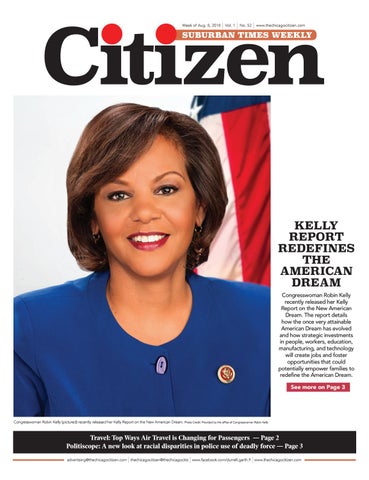
KELLY REPORT REDEFINES THE AMERICAN DREAM Congresswoman Robin Kelly recently released her Kelly Report on the New American Dream. The report details how the once very attainable American Dream has evolved and how strategic investments in people, workers, education, manufacturing, and technology will create jobs and foster opportunities that could potentially empower families to redefine the American Dream. See more on Page 3
Congresswoman Robin Kelly (pictured) recently released her Kelly Report on the New American Dream. Photo Credit: Provided by the office of Congresswoman Robin Kelly
Travel: Top Ways Air Travel is Changing for Passengers — Page 2 Politiscope: A new look at racial disparities in police use of deadly force — Page 3 |
|
|
advertising@thechicagocitizen.com thechicagocitizen@thechicagocitiz www.facebook.com/durrell.garth.9 www.thechicagocitizen.com
2 | CITIZEN | Suburban Times Weekly | Week of Aug. 8, 2018
ART SCENE
Waterfront Café & Summer Stages presents El Grande de Coca-Cola Waterfront Café & Summer Stages presents the multi-lingual cabaret El Grande de Coca-Cola, opening on Thursday, August 23rd and then running through September 29th, 2018. All performances will take place in Berger Park Cultural Center’s Coach House Theater, located at 6215 North Sheridan Road – Chicago, Illinois 60660. Synopsis: In a nightclub somewhere south of the border, local impresario Señor Pepe Hernandez has boasted to the local press that he is bringing a group of famous international cabaret stars to his club. He persuades the local Coca-Cola bottling plant to back the show in exchange for some blatant product placement. But when the night of the show comes, no stars arrive to perform and Pepe is forced to hire his family whose antics wreak havoc upon the stage. This hysterical disaster is full of gag bits, physical comedy mix-ups and a lot of tomfoolery making El Grande de Coca-Cola a deliriously funny and a ridiculously wonderful show! El Grande de Coca-Cola was originally created and produced by Ron House, Diz White, Alan Shearman and John Neville-Andrews with musical arrangements by Alan Shearman and John Neville-Andrews. The show ran off-Broadway for two and a half years. In the 40+ years since, numerous productions have been produced across America and abroad, including Brazil, Mexico, South Africa and Canada. Alan Shearman has recently updated the current version of the script. El Grande de Coca-Cola is presented mainly in Spanish, with some dialogue in French, Italian,
German, as well as English. By using basic vocabulary words that translate easily, coupled with the cast’s fantastic comedic timing and telltale facial expressions, the language barrier all but disappears. Directed & choreographed by Jon Martinez, the cast includes Daviel Bailon, Juan Castaneda, Johnny Garcia, Richard Gomez, Pauleth Jauregui, Sophie Hernando Kofman and Christian Valdivieso. Other members of the creative team are Scenic Designer Harrison Ornelas, Costume Designer Diane Hamm, Lighting Designers Tonika Todorova & Frank Pullen, Production Manager Tonika Todorova and Stage Manager Chris Sylvie. Wednesday nights are “All Access Nights” with performances beginning at 8 pm. General admission seating and cash bar available. Running time 80 minutes. All tickets are $20. Thursday, Friday & Saturday nights the evening begins at 7 pm when guests will enjoy a Taco Bar (Steak & Seitan Chorizo Tacos (v), Margarita Bar and pre-show entertainment in the back of the theater right on Chicago’s lakefront one hour before the 8 pm curtain. All-inclusive event tickets are $60 each and cover food, beverage, entertainment, tax & gratuity. $40 tickets are also available for the 8 pm performance only. (General admission seating with a cash bar available 15 minutes before the 8 pm show – dinner not included). The venue has limited seating of 40 guests per night and the production is recommended for ages 21+. Tickets are available online at www.elgrandedecocacola.com or in person at The Waterfront Cafe.
Waterfront Café & Summer Stages presents the multi-lingual cabaret El Grande de Coca-Cola, opening on Thursday, Aug. 23 and then running through Sept. 29, 2018.
TRAVEL
Top Ways Air Travel is Changing for Passengers At any given time, up to 5,000 aircrafts are in American skies. Ten million passenger flights took place in 2016. The “Golden Age” of air travel may feel like it’s long gone in a time of heightened security and since the advent of mass affordable flight, but experts say that consumers can expect flying to be more comfortable and convenient in the coming years — even when you’re riding coach. “To survive and thrive, airlines are focused on product innovations and comfort upgrades to ensure repeat business from customers,” says Jennifer Coutts Clay, who has over 40 years of experience in the operational management and marketing of airlines, including time with British Airways and Pan Am. She is the author of “Jetliner Cabins: Evolution and Innovation,” a new eBook app featuring a historical record and futuristic look at the commercial flying experience, with over 6,000 images and interviews with airline experts. Are you a frequent flier? Clay says these trends may be headed your way:
Jennifer Coutts Clay, who has over 40 years of experience in the operational management and marketing of airlines, including time with British Airways and Pan Am, is the author of “Jetliner Cabins: Evolution and Innovation,” a new eBook app featuring a historical record and futuristic look at the commercial flying experience.
• Better seating: Ergonomically constructed seat-frames, climate-controlled seat-cover fabrics and lumbar-supporting contoured seat-foam inserts are just a few of the cabin upgrades being made to ensure more
comfortable travel. • Mood lighting: Passengers are given more freedom to control their immediate surroundings through lighting. Thanks to developments in LED technology, many airlines are www.thechicagocitizen.com
phasing out cold-looking lighting installations to feature a rainbow range of colors customized to suit the time of day, the specific area of the aircraft or to simulate the soothing gradual process of sunrise and sunset. • Connectivity: In-flight entertainment, streaming content options and connectivity are expanding as onboard Wi-Fi becomes faster and cheaper. In-seat power supplies will keep mobile devices running during long flights, giving passengers opportunities to work, keep in touch with those on the ground and more. • More accessibility: Airlines are making air travel more accessible to those with special needs. Recent advances include aisle-size wheelchairs, seat-armrests that can be raised, extra grab bars and handrails, in-flight literature in braille, special meals for an increased range of dietary restrictions, privacy curtains for use around lavatory doors and baby-changing facilities. • Improved experience: Flights are getting longer and more crowded. In response, airlines are aiming to tackle
the problems of stressed-out passengers, with more personalization, humanization and options for how time can be used onboard, including opportunities to move around the aircraft. • Luxury amenities: In first-class cabins of the “gold-standard” airlines, the luxury-level accommodations, amenities and in-flight service standards keep getting better. Passengers can rely on concierge-type support to handle personal arrangements before, during and after flights, and there is limo service for ground transfers to and from airports. In the future, passengers might be able to expect onboard salon-style spas and even gyms if they are willing to pay a premium. More about the air travel experience is available by downloading Clay’s app at jetlinercabins.com. “Preparing jetliners to accommodate airline passengers is both an art and a science,” she says. “As passenger expectations evolve and grow, you can expect significant improvements in cabin comfort and hospitality standards.”
CITIZEN | Suburban Times Weekly | Week of Aug. 8, 2018
|
3
POLITISCOPE
A new look at racial disparities in police use of deadly force BY JOSEPH CESARIO One of the most important social issues of the last five years is fatal police shootings of black Americans. The concern that police fatally shoot blacks at higher rates than whites has given rise to a strong push for department-wide interventions for police officers. Such interventions, usually in the form of “implicit bias” training, rely on changing the beliefs that officers have about minorities as a means of reducing this racial disparity. But are the assumptions underlying these interventions reasonable? Is there strong evidence that faulty officer decision-making is responsible for the racial disparity in fatal police shootings? There is clear evidence of racial differences in fatal police shootings in terms of population proportions. Black Americans are only about 13 percent of the population, but make up over 30 percent of people fatally shot by police. It is from this evidence that many news outlets and activists conclude that police officers are racially-biased in their decisions to shoot.
Joseph Cesario
If this is true, then it makes good sense to target officer bias. But is comparing the percentages of blacks and whites shot to the percentages of blacks and whites in the population really the right comparison? Does it tell us what we need to know about how to reduce fatal police shootings? My colleagues and I have expertise in decision-making and police use of force. We tested whether these population-level comparisons provide us with the information we need to reduce police shootings. Our recent work, published in Social Psychological and Personality Science, reveals a different view of police bias.
IMPORTANCE OF BENCHMARKS Using population-level comparisons as a benchmark for evidence of officer racial bias relies on the assumption that people of all races are equally involved in situations where officers are likely to use deadly force. We argue that this assumption has led to a misdiagnosis of the problem, and by extension, solutions that won’t work. Consider the following example: Imagine that you want to know if there is racial disparity in who receives cancer treatment. You find that among those receiving treatment, blacks make up 13 percent. Comparing this to the overall population of 13 percent, you would conclude that no racial disparity existed. Yet suppose you learn that blacks make up 75 percent of people with cancer. Surely you would conclude that there is racial disparity in receiving treatment. That’s because the relevant pool is those who need treatment, not the general population. More likely to be shot, compared to what? As with the cancer example above, it is crucial to choose the cor-
rect benchmark or pool of individuals to compare an outcome with. In the case of police shootings, the evidence is clear that fatal shootings are strongly tied to situations in which violent crime is being committed or suspected of being committed. A typical fatal police shooting occurs when there is the potential for imminent death to an officer or other citizen. Almost 85 percent of police fatal shootings involve armed citizens. Given this, we can ask, “Are blacks shot more than whites given their presence in situations in which police shootings are likely to occur?” To answer the question, my colleagues and I analyzed the largest database of fatal police shootings to date, The Guardian’s database of police shootings, The Counted. It covers all known shootings from 2015 to 2016. We calculated the odds of being shot for blacks and whites given violent crime rates for each group, which we established by using 16 different measures of crime across four databases. We used these different crime rates as a means of estimating presence in deadly force situations.
One might ask, “Isn’t using arrest data to assess crime rates wrong, given that police are more likely to police black communities and arrest black citizens?” If police are more likely to arrest black citizens than white citizens – without any actual racial differences in criminal behavior – this would inflate crime estimates for blacks and would skew our findings. To deal with this, we also looked at a different set of data to measure crime – death by assault records from the Centers for Disease Control. These data are derived from death certificates. Whether police are more likely to arrest one race or another for, say, homicide would have no impact on the CDC’s counts for how often members of each race die from assault. Thus, the data provide a way to estimate rates of violent crime that is not biased from police arrest decisions (although it is possible that this data could be subject to other kinds of errors). When we considered the rates at which people from different groups are likely to be present in these conContinued on page 4
COMMUNITY
Kelly Report Redefines the American Dream Continued from page 1 BY KATHERINE NEWMAN
Congresswoman Robin Kelly recently released her Kelly Report on the New American Dream. The report details how the once very attainable American Dream has evolved and how strategic investments in people, workers, education, manufacturing, and technology will create jobs and foster opportunities that could potentially empower families to redefine the American Dream. This is the third Kelly Report that the Congresswoman has released since she took office as the U.S Representative of Illinois’s second district in 2013. Each of the reports has examined critical issues and proposed solutions. Previous Kelly Reports have examined preventing gun violence and ending health disparities. “This is definitely something that I have been thinking about even when I ran for Congress. Because I’ve worked in local government, and then I was a State Rep, and I also worked for Cook County at one point, I saw the economic needs,” said Kelly. “When I really looked around, I had already done gun violence and I did health so it became clear to look at economic empowerment because when people feel empowered eco-
“KEY PARTS OF THE AMERICAN DREAM HAVE CHANGED OR BEEN SIFTED OUT OF REACH FOR SO MANY FAMILIES AND THIS BILL IS REALLY DESIGNED TO FOSTER CONVERSATION ABOUT MOVING THE BALL FORWARD.” CONGRESSWOMAN ROBIN KELLY nomically it affects so many other portions of their life.” In the first few pages, Kelly welcomes readers to the new Kelly Report by sharing a very personal story about how her grandparents became business owners in New York City about 70 years ago when Kelly’s grandmother bought a grocery store in Harlem on a whim. The family shop, Ross’s Grocery created economic opportunity in the neighborhood and forever changed the trajectory of their family. In the Report, Kelly signifies that “it was in this store where the Kelly family’s American Dream began.” The report also includes researched and thoughtful readings on community, workforce, and family development as well as how to create equity in the workplace and adapt to the quickly evolving job market that we live in. Kelly called on academics, community leaders, business strategists, and government colleagues to provide their insight on The New American Dream and what it means for us as civilians.
“Most people in office think about other things like health and gun violence like me, but everyone thinks about economics. That’s how people have a roof over their heads, put food on the table, can further their education, and travel and have fun,” said Kelly. According to Kelly, it was easy to get people involved in the third Kelly Report and “people were very willing to share their opinions and two cents,” she said. In Sept. 2017, Kelly introduced her Today’s American Dream Act which, if passed, would establish new programs and amend several existing programs related to workforce and community development. “Key parts of the American Dream have changed or been sifted out of reach for so many families and this bill is really designed to foster conversation about moving the ball forward. We know there are solutions but it’s just that we have to prioritize how we appropriate funds and the investments we make on a federal, state, and local level,” said Kelly.
www.thechicagocitizen.com
Darrell Garth President / Publisher Janice Garth Sales Manager/ General Manager CST Weekly, published weekly on Wednesdays and distributed in the Township of Bloom, (publishing 52 issues annually). Written permission is required to reproduce contents in whole or part from the General manager or the publisher. CST Weekly does not assume the responsibility for nor are we able to return unsolicited marterials. Deadline for advertising is every Monday at noon. For information on subscriptions or advertising call us at (773) 783-1251. Our office is located at 8741 S. Greenwood Ave., Ste# 107, Chicago, Illinois 60619.
Editorial:
Send press releases, news tips, calendar listing etc. to: editorial@cstweekly.com
Advertising
advertising@cstweekly.com Classifieds call us at (773) 783-1251
4 | CITIZEN | Suburban Times Weekly | Week of Aug. 8, 2018
FOOD BUNNY OATMEAL
New Study Suggests This Breakfast Staple Could Help Kids Start the Day off Right Family Features - Eating a nutritious breakfast helps kids start their day off right, and new research reminds us why serving real dairy milk is so important for the first meal of the day. As little as 7 grams of milk protein at breakfast could help set kids up with building blocks they need to grow after a good night’s sleep, according to a new study in the Journal of Nutrition. It’s no secret that kids need nutritious foods to fuel their constantly growing bodies, but there’s a period of time when they’re not getting these nutrients - during sleep. Of course kids need sleep - and plenty of it - but as they slumber, they’re using up their body’s energy stores, and if they don’t refuel in the morning it could potentially impact their ability to grow. That’s why a proper breakfast is so important, to ensure kids make up for this overnight fast. In this new study, University of Toronto researchers gave 28 boys and girls ages 7-11 a breakfast of 170 calories that included 0, 7, 14 or 21 grams of milk protein. While more protein at breakfast was more beneficial, researchers found as little as 7 grams was enough to promote positive effects over the next nine hours. Serving an 8-ounce glass of milk, which has 8 grams of high-quality protein, each day at breakfast is an easy way to get kids protein they need to support optimal growth and development. In fact, a previous study in the
(1 serving) Recipe courtesy of MilkPEP Ingredients 1/3 cup instant oats 3/4 cup fat free milk 1/4 teaspoon cinnamon 1/4 teaspoon vanilla 1 teaspoon brown sugar 2/3 of a small banana 2 fresh blueberries 1/2 of a small strawberry Optional- chocolate syrup Pair each serving with: 8-ounce glass of milk
American Journal of Human Biology suggests regularly drinking milk during the growing years (all the way through late teens/early twenties) is associated with greater height in the teen years, while research in Osteoporosis International has linked regularly skipping milk to reduced height.1,2 Milk is also an easy way to get kids B vitamins to convert food to energy, vitamin A to support a healthy immune system, and phosphorus, calcium and vitamin D to help build strong bones. That’s why experts recom-
mend including milk in kids’ diets. And, with a taste they love, it’s a simple, wholesome and affordable addition to any morning meal. To kick start your child’s morning, serve a protein-packed breakfast, like this adorable bunny oatmeal, to give them nutrients they need to grow up strong. Not only will it bring a smile to your child’s face, it also gives them 18 grams of high-quality protein when served with a glass of lowfat milk. For more information and kid-friendly recipe ideas, visit milklife.com.
Directions In a microwave safe bowl stir together oats, milk, cinnamon, vanilla, and brown sugar. Microwave on high for 30 seconds to 1 minute and stir. Cut banana in half crosswise. Cut 1 1/8-inch thick coin slices from the flat end of each banana half. Place those banana slices in the upper third of your oatmeal bowl, side by side, to make the eyes. Top with one blueberry on each banana slice. Place the remaining banana halves at the top of the bowl, hanging out, to create the ears. Place strawberry in the middle of the bowl to make the nose, and then drizzle chocolate if desired to make a mouth and whiskers. Serve with an 8-ounce glass of milk. Nutritional information per serving: 320 calories; 2 g fat; 0 g saturated fat; 10 mg cholesterol; 18 g protein; 59 g carbohydrates; 5 g fiber; 190 mg sodium; 550 mg calcium (60% of daily value). Nutrition figures based on using fat free milk, and include an 8-ounce glass of milk.
POLITISCOPE
A new look at racial disparities in police use of deadly force Continued from page 3 texts, a different picture emerged. The differences in involvement in criminal situations between black and white citizens fully explains the population-level disparity in fatal police shootings. This suggests that officer bias – in terms of officers making different shooting decisions for black and white citizens – is not necessarily the cause of black citizens being shot at higher rates. Even if officers were making the same decisions about whether to use deadly force for black and white citizens, population-level disparities would still emerge given these crime rate differences. What about shootings of unarmed citizens? The results were too uncertain to draw firm conclusions one way or another. This is because the number of fatal shootings in
which a citizen is unarmed and not assaulting an officer is small – about 6 percent of all fatal shootings, or 45 people every year. To be clear, there is a population-level racial disparity in fatal police shootings. But our work suggests this disparity is explained by differences in rates of exposure to the police, rather than racial bias by officers making deadly force decisions. NOW WHAT? These results may help explain why department-wide implicit bias training has not been – and will not be – effective. It is not addressing the root of the problem. The notion that all officers across the profession are biased in this important decision is not supported by the data. Instead, our research suggests two paths for reducing fatal police
shootings and reducing the population-level gap in these shootings. First, the most effective means of reducing police shootings would be to reduce violent crime, particularly crimes involving firearms. While this may seem obvious, the point has been lost in most public discussions. The decision to shoot usually happens in certain contexts – reducing the frequency of those events will directly reduce police shootings. At the same time, it would also reduce police shootings of innocent unarmed citizens who live in neighborhoods with high rates of violent crime. One recent example is the case of Akai Gurley, an unarmed black man who was killed by police patrolling a public housing building in New York City with high rates of violent crime. Reducing violent crime rates would reduce the expectation www.thechicagocitizen.com
that officers have of encountering armed individuals in such locations, likely reducing such mistakes. Second, researchers need to develop tools that accurately identify those few officers who do show robust evidence of racial bias and identify which psychological processes are responsible for such bias. Officers might treat black and white citizens differently due to implicit bias, explicit racism, or even something much more basic such as low skill at visually distinguishing harmless objects from guns. Targeted interventions, based on a scientific understanding of bias, are needed – not blanket, untested interventions based on faulty assumptions. Our lab has recently been awarded a National Science Foundation grant to develop such interventions. All research has limitations, and
ours is no exception. Our analyses look at national data and cannot speak to any individual case or police officer. Moreover, there is robust evidence of racial bias in other useof-force behaviors, such as Taser use – just not the use of deadly force. Anti-bias training might be effective in stemming these racially-biased policing behaviors. Finally, the question of why crime rates are different across racial groups in the U.S. is a complicated question beyond the scope of this research, and thus we do not speak to this issue. Nonetheless, we believe that any research that can suggest new and innovative interventions to address this important problem should be encouraged. Joseph Cesario is an Associate Professor of Psychology at Michigan State University.
CITIZEN | Suburban Times Weekly | Week of Aug. 8, 2018
|
5
NEWS Mississippi Civil Rights Museum Tells Authentic Stories from the Movement BY FREDDIE ALLEN
EDITOR-IN-CHIEF, NNPA
In the early morning hours of January 10, 1966, civil rights leader Vernon Dahmer Sr. was jolted from his sleep, as members of the Ku Klux Klan surrounded his house just north of Hattiesburg, Miss. Dahmer, a Black land-owner, had been actively working to register Blacks to vote and, in some cases, he even paid their “poll” taxes. It was enough to earn a Black man a death sentence in the South. The Klansmen bullets ripped through the darkness splintering wood and shattering glass as they fired on Dahmer’s house; one of them hurled a Molotov cocktail through the window; the Klan wanted to burn Dahmer and his family alive. As smoke and flames engulfed his home, Dahmer grabbed his shotgun and blasted his way out, creating a diversion as the rest of his family fled into the woods. Later that day, Dahmer died from smoke inhalation at an area hospital. A few days later, Dahmer’s voter registration card arrived in the mail. “These are the kinds of stories we talk about in the Mississippi Civil Rights Museum,” said Pamela Junior, the museum’s director. “We tell people all the time: Museums are living and breathing places.” Junior lamented that, oftentimes, the history of the Civil Rights Movement is told through the
narrow lens of a few key figures, like Martin Luther King, Jr. and Rosa Parks. She said that it was important that people know that Mississippi was ground zero for the Movement; the Mississippi Civil Rights Museum helps to tell the stories of the people that were there. “What we want to do is make sure that the stories are told authentically,” Junior said. “We have our own native son, Medgar Wiley Evers. We have Fannie Lou Hamer, June Johnson, Owen Brooks…local people who made up the Movement.” Junior said that it was also important to show that civil rights leaders were ordinary people, yet they still managed to have a significant impact on the course of American history. Junior continued: “So, to see something so powerful that these regular, poor people did to make things happen in the state of Mississippi is awesome.” The Mississippi Civil Rights Museum opened on December 9, 2017. The Clarion Ledger reported that the Dahmer family donated a truck that had been shot during the 1966 attack to the Mississippi Civil Rights Museum. The museum promotes a greater understanding of the Civil Rights Movement in Mississippi and shares the stories of the movement that changed the world. A press release that described the museum said
that visitors can witness the freedom struggle in eight interactive galleries that show the systematic oppression of Black Mississippians and their fight for equality that transformed the state and nation. The press release continued: “Seven of the galleries encircle a central space called ‘This Little Light of Mine.’ There, a dramatic sculpture glows brighter and the music of the Movement swells as visitors gather.” Each museum gallery highlights a specific sub-topic or period. Gallery 1 defines civil and human rights; Gallery 2 focuses on the Civil War and Reconstruction; Gallery 3 highlights civil rights activists and shares the stories of a Mississippi movement that changed the world; Gallery 4 peels back the layers of a segregated society; Gallery 5 showcases the sacrifices and the successes of the 1960s; Gallery 6 takes a deep dive into the Freedom Summer and local movements in Mississippi (1963-1964); and Gallery 7 tells the story of Black Empowerment from 1965 to the early 1970s. Junior said that, through the civil rights museum, the ills of Mississippi are finally on the wall. “We’re taking the bandage off of the sore,” Junior said. “We don’t allow it to fester anymore. We let it breathe, so that healing can continue.” The last gallery, Junior said, was designed to spark conversations about how all races can move forward together.
“Martin is gone. Medgar is gone. All of these people are gone that were at the center of the movement, at the forefront. We believed in them and trusted in them. These people are gone,” Junior said. “So, what we want to do is teach people that they are the movement.” Junior continued: “We are the movement; it’s up to us to do the work.” Gallery 8 is titled “Where do we go from here?” and features mirrors with quotes from Mississippians who made incredible sacrifices to improve the lives of others. One of the last quotes that visitors see as they walk out of the Mississippi Civil Rights Museum is by Oseola McCarty, a Black seamstress and domestic worker who lived in Hattiesburg, Miss. McCarty, who “quit school in the sixth grade to go to work, never married, never had children and never learned to drive,” according to The New York Times, eventually donated nearly her entire life savings—$150,000—to the University of Southern Mississippi to fund scholarships for Black students. “[McCarty] said that, ‘if you want to be proud of yourself, you have got to do things you can be proud of,’” Junior said. “So, I want people to live by that mantra.” For more information about the Mississippi Civil Rights Museum, please visit http://www. mcrm.mdah.ms.gov/.
6 | CITIZEN | Suburban Times Weekly | Week of Aug. 8, 2018
NEWS
August is National Minority Donor Awareness Month and in honor of that, Thornton Township recently took nearly 100 employees and summer program students to the Gift of Hope Organ and Tissue Donor Network’s Wave Away the Wait event at the Thompson Center in downtown Chicago. Photo Credit: Thornton Township
South Suburban Township Wants To Dispel Common Organ Donation Myths BY KATHERINE NEWMAN
August is National Minority Donor Awareness Month and in honor of that, Thornton Township recently took nearly 100 employees and summer program students to the Gift of Hope Organ and Tissue Donor Network’s Wave Away the Wait event at the Thompson Center in downtown Chicago. The Gift of Hope Organ and Tissue Donor Network is a nonprofit organ procurement organization that coordinates organ and tissue donation and provides public education on donation in Illinois and northwest Indiana. Since 1986, Gift of Hope has saved the lives of more than 23,000 people who were in need of an organ transplant and improved hundreds of thousands of lives through tissue transplants, according to the Gift of Hope’s website. Learning the truth about organ and tissue donation is especially important in minority communities where there are known to be a few misleading myths that circulate from generation to generation and that prevent people from becoming
organ donors. “Minority communities are often in need of organ and tissue donations but we can also have the lowest number of donors. We wanted to bring awareness to this because a lot of times the reason we don’t donate to the level that we could is that there are a lot of myths on organ donation,” said Ernst Lamothe Jr., community relations manager for Thornton Township. Some of the most common myths around organ and tissue donation are that registered donors don’t receive the same medical care as non-donors or that organ and tissues donation goes against a certain religion. “I previously was an example of somebody that had heard the myths as well and it wasn’t until I worked at a hospital a few years ago, and saw how many people are actually on the waiting list and how much joy families feel when they hear that they are getting a new organ, that I changed my mindset and became an organ donor,” said Lamothe. The event featured speakers including medical professionwww.thechicagocitizen.com
als, organ donation recipients and their families, and Illinois Secretary of State Jesse White. “This is something that is not talked about enough in the community so the kids don’t necessarily know about the great impact that people can have in this way. Kids anywhere from 9 to 13 years old came to the program and it was just uplifting for them to hear the stories that were told by the adults and even the kids that were there who had a transplant and were much younger than them. That really resonated with them to hear that maybe these kids wouldn’t be alive if someone hadn’t stepped up and been an organ donor,” said Lamothe. The most impactful information for the adults was learning that there is no religion that formally forbids donation or receipt of organs from living or deceased donors, according to Lamothe. He said that there are several people who have heard the myths their whole lives and never changed their minds because they have never heard the truth about organ donation until now.
CITIZEN | Suburban Times Weekly | Week of Aug. 8, 2018
|
7
NEWS Law Passed to Protect Veterans at State Homes from Epidemics
Rep. Rita Announces Legislative Hearings on Illinois Gaming Expansion State Rep. Bob Rita will bring together two House committees for legislative hearings aimed at bringing gaming expansion and broad economic opportunity to Illinois. Rita, D-Blue Island, has been the House Democrats’ point person on gaming issues since spring 2013. He has proposed several bills on gaming expansion, including a large amendment to Senate Bill 7 that combined new casinos, race tracks slot machines and other concepts at the end of the spring legislative session. But the bill did not muster enough support before the session ended May 31. Rita will now lead two House subcommittees – on Gaming and on Sales and Other Taxes – to have hearings on the measure he presented at the end of the session and other gaming expansion issues such as internet gaming, fantasy sports and sports betting, in hopes of using building a consensus proposal that could be considered in Springfield after the November election. The committees will meet on Wednesday, Aug. 22, at the Bilandic Building in Chicago and on Wednesday, Oct. 3, at the Capitol in Springfield. “As I have said from the beginning in working on this issue, gaming expansion presents many tremendous opportunities to create revenue, jobs and economic growth in Illinois,” Rita said. “The gaming landscape has changed significantly since I took on this issue five years ago, and I want to use these hearings to understand how those changes present new opportunities for us to put the right package together as we look to meet budget needs and provide a spark for our economy.”
A new Illinois state law sponsored by State Senator Tom Cullerton (D-Villa Park) will protect veterans at state homes from epidemics like the deadly Legionnaires’ disease outbreak at the Illinois Veterans Home at Quincy. Cullerton’s legislation, which was signed into law recently requires Illinois veterans homes to notify facility residents and their emergency contacts within 24 hours if two or more residents in the home have been diagnosed with an infectious disease in a period of one month or less. “This new law will put the health of our veterans ahead of government bureaucracy,” Cullerton said. “When your loved one is in harm’s way, you have a right to know. Now that right is the law.” House Bill 4278 was supported by the Better Government Association, the Veterans of Foreign Wars and Illinois AMVETS. It goes into effect immediately.
Senator Durbin Endorses Democrat Lauren Underwood for the U.S. House of Representatives in Illinois’s 14th U.S. Senator Dick Durbin (D-IL) offered his formal endorsement of Lauren Underwood, a Democrat running for the U.S. House of Representatives in Illinois’s 14th District, during a July 28 event in Oswego, IL alongside members of the Kendall County Democrats. “Healthcare is the driving issue in this election, and we couldn’t have a better candidate,” Durbin said of Underwood, a registered nurse and health policy expert from Naperville, IL. “The incumbent congressman has voted in lockstep with the Republicans in Congress in favor of a health care system that would deny coverage to people with pre-existing conditions and dramatically increase the cost of health insurance for people over 50.” “As a nurse I know how critical it is for people to have access to medications and procedures when they need them, particularly if they have a chronic illness. I have a pre-existing condition myself, so this is deeply personal to me. I understand the plight of so many northern Illinois families who are struggling to afford their care,” said Underwood whose team marked 100 days to Election Day July 29 with an open house celebration at her new office in St. Charles with more than 100 local supporters.
State Rep. Bob Rita
AmeriCorps NCCC Helps Richton Park Public Works An AmeriCorps NCCC (National Civilian Community Corps) team is serving with the Village of Richton Park Public Works from July 13 to August 30. The team isassisting with disaster mitigation and infrastructure improvement tasks. The AmeriCorps NCCC team of seven from the North Central Region campus of Vinton, Iowa is doing GPS/GIS (Geographic Information System) mapping of storm water infrastructures, manhole covers, street sign inventory, and other public infrastructure throughout the village. Additionally, the team is cleaning up waterways and storm water runoffs to meet National
Pollutant Discharge Elimination System (NPDES) compliance and gathering information to aid in planning and replacement of the current infrastructure. Through their service, AmeriCorps NCCC members are expected to benefit all the residents of Richton Park by reducing localized flooding and providing accurate information for future development of the Village. The information the team helps gather will help the village make decisions and develop data-driven plans for the future. “We are here to get the job done,” says member Douglas Anderson from Houston, Texas. “I am very excited about this project
www.thechicagocitizen.com
because we are helping Richton Park Public Works make the community safer and better.” The Richton Park Public Works Department mission is to provide quality services to enhance the living and working environment of the community. Their vision is to be recognized as an outstanding provider of public works services to the community, which is accomplished through partnerships, quality customer service, teamwork and continuous improvement. AmeriCorps National Civilian Community Corps (NCCC) and its FEMA Corps unit engages up to 2,800 young Americans in a full-time, 10-month commitment
to service each year. AmeriCorps NCCC members address critical needs related to natural and other disasters, infrastructure improvement, environmental stewardship and conservation, and urban and rural development; FEMA Corps members are solely dedicated to disaster preparedness, mitigation, response and recovery work. The programs are administered by the Corporation for National and Community Service (CNCS). CNCS is the federal agency that engages more than five million Americans in service through its AmeriCorps, Senior Corps and Volunteer Generation Fund programs. For more information, visit www.nationalservice.gov.
8 | CITIZEN | Suburban Times Weekly | Week of Aug. 8, 2018
weekly
ST SuburbanTimes GET SOCIAL WITH THE CITIZEN SUBURBAN TIMES WEEKLY
Like Us On Facebook at www.facebook.com/CitizenNewspaper6/
Follow Us On Twitter at: Twitter: cstweekly@citizen6news
Follow Us On Instagram at: www.instagram.com/cstweekly/
Send press releases to editorial@cstweekly.com Send advertising inquiries to advertising@cstweekly.com
Citizen Suburban Times Weekly
w Bloom Township w Chicago Heights w Flossmor w Ford Heights w Greenwood w Home Wood w Lansing w Lynwood w Olympia Fields w Park Forest w Sauk Village w South Chicago w Steger 60411, 60422, 60425 , 60430, 60438
Visit us online at www.cstweekly.com