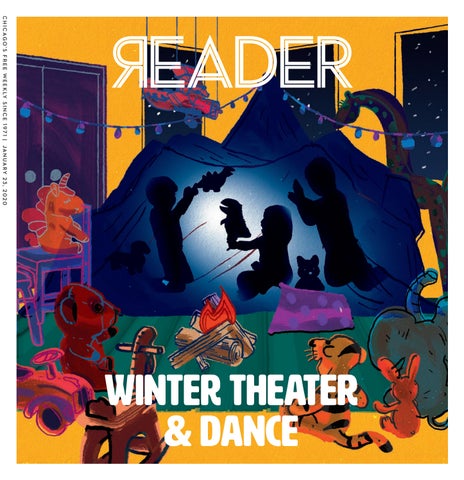
CHICAGO’S FREE WEEKLY SINCE 1971 | JANUARY 23, 2020 Winter Theater & Dance
IN
CITY LIFE
04 Street View An appraisal coordinator matches her fiery red locks with her looks.
FOOD & DRINK
06 Food Feature A night at the theater doesn’t have to make you hangry.
ARTS & CULTURE
12 Visual Arts “Transition” seeks to bring humanity and life to youth experiencing homelessness.
13 Listings A laugh-filled fundraiser for Planned Parenthood, a lunar celebration, a Mies van der Rohe installation, and more arts and culture happenings
bugs her—including Love Actually and bugs.
CHICAGO READER | JANUARY 23, 2020 | VOLUME 49, NUMBER 16
hijacked by Nicolas Cage’s whacky performance.
MUSIC & NIGHTLIFE
51 In Rotation Courtney Mora from In Masks on an album to take you apart and put you back together, and more musical obsessions.
52 Shows of note Blockhead, John Cale, GZA, and more
58
32 Comedy Todd Barry talks about road work, crowd work, and keeping it dry.
34 Preview J. Nicole Brooks examines race and housing in Chicago through the “stunt” of its first woman mayor.
THEATER
14 Oral History Windy City Playhouse’s long-running immersive Southern Gothic gave the company a new creative license.
18 Preview Congo Square’s Day of Absence imagines a town whose Black citizens have vanished.
38 Review Caryl Churchill dissects our binary views of women’s choices.
42 Plays of Note The Gulf traces a relationship stuck in the mud flats; Pure Lies gives us magic with a touch of malarkey; and Sheepdog creates a kaleidoscope of questions around a police killing.
NEWS & POLITICS
08 Joravsky | Politics Chicago is really bad at fairly slicing the economic development pie.
10 Isaacs | Culture The Passion Economy author Adam Davidson on why it might be a good thing that the robots eat your job.
20 Dance Winifred Haun brings motion and music to Unity Temple.
24 Feature Filament Theatre partners with its young audiences in Forts! Build Your Own Adventure
26 Feature LookOut makes space for next-generation theatermakers.
30 Interview Live lit performer-host Gina DeLuca talks about what
FILM
48 Review French and Haitian cultures collide in Zombi Child
50 Movies of note Bad Boys For Life is wildly funny and surprisingly heartfelt; A Fall From Grace doesn’t even have any comedic value to save it; and Color Out of Space is
Early Warnings Sonny Fodera, Monster Magnet, Vetiver, and more just-announced concerts
Gossip Wolf Star Creature Universal Vibrations starts 2020
TO CONTACT ANY READER EMPLOYEE, E-MAIL: (FIRST INITIAL)(LAST NAME) @CHICAGOREADER.COM
PUBLISHER TRACY BAIM
EDITORS IN CHIEF SUJAY KUMAR, KAREN HAWKINS CREATIVE LEAD RACHEL HAWLEY
MUSIC EDITOR PHILIP MONTORO
THEATER AND DANCE EDITOR KERRY REID CULTURE EDITOR BRIANNA WELLEN
ASSOCIATE EDITOR JAMIE LUDWIG
SENIOR WRITERS MAYA DUKMASOVA, LEOR GALIL, DEANNA ISAACS, BEN JORAVSKY, MIKE SULA EDITORIAL ASSOCIATE S. NICOLE LANE LISTINGS COORDINATOR SALEM COLLO-JULIN
CONTRIBUTORS ED BLAIR, NOAH BERLATSKY, LUCA CIMARUSTI, MARISSA DE LA CERDA, MARI COHEN, JOSH FLANDERS, SHERI FLANDERS, JACK HELBIG, IRENE HSAIO, CATALINA MARIA JOHNSON, MONICA KENDRICK, STEVE KRAKOW, NOËLLE D. LILLEY, JAMIE LUDWIG, MAX MALLER, ADAM MULLINS-KHATIB, J.R. NELSON, JEFF NICHOLS, MARISSA OBERLANDER, MATTHEW SIGUR, CATEY SULLIVAN
DIRECTOR OF DIGITAL JOHN DUNLEVY DIRECTOR OF PUBLIC ENGAGEMENT & PROGRAMS KRISTEN KAZA
SOCIAL MEDIA COORDINATOR JANAYA GREENE MEDIA PARTNERSHIPS COORDINATOR YAZMIN DOMINGUEZ
ADMINISTRATIVE ASSISTANT TARYN ALLEN
ADVERTISING
with a bundle of boogie, Elastic Arts debuts a 16-channel overhead sound system, and more.
OPINION
Savage Love Dan Savage offers
to a kinky partner who’s just told what they want to hear.
312-392-2970, DISPLAY-ADS@CHICAGOREADER.COM CLASSIFIEDS: TALLEN@CHICAGOREADER.COM
SALES DIRECTOR PATTI FLYNN VICE PRESIDENT OF SALES AMY MATHENY CLIENT RELATIONSHIP MANAGER TED PIEKARZ SENIOR ACCOUNT REPRESENTATIVES LENI MANAA-HOPPENWORTH, LISA SOLOMON CLASSIFIED SALES MANAGER WILL ROGERS
NATIONAL ADVERTISING VOICE MEDIA GROUP 1-888-278-9866
VMGADVERTISING.COM
JOE LARKIN AND SUE BELAIR
DISTRIBUTION CONCERNS distributionissues@chicagoreader.com 312-392-2970
NOTE FROM AN EDITOR
ON NIGHTS WHEN the temperature falls into single digits and icy sidewalks (clear that stuff, people!) make the public way treacherous, it’s easy to find reasons to stay home.
But the months ahead also o er intriguing theatrical ways to think about what “home” in Chicago means. Sometimes, as with Steppenwolf’s LookOut series, it’s about a larger institution opening its doors to emerging theatermakers and their audiences. It also means returning to your roots. Congo Square Theatre celebrates 20 years of presenting work from the African diaspora with Day of Absence —a salute to the early days of the Negro Ensemble Company, a company that
inspired Congo Square’s founders.
Windy City Playhouse built a home in the middle of their venue for the long-running Southern Gothic, and they’re fully committed to the immersive-theater aesthetic now. Kids and adults alike can create their own worlds with Filament Theatre’s innovative Forts!
Build Your Own Adventure.
Sometimes the “make-believe” home comes with a ton of historic baggage, as when Jane Byrne moved into the Cabrini-Green housing projects for three weeks in 1981—an incident captured by playwright J. Nicole Brooks in Her Honor Jane Byrne.
A cozy pub makes a great place for a tale or two, and live lit performer-host Gina DeLuca
turns the Duke of Perth (and other venues) into stages for vets and newbies to share their stories. Comedian Todd Barry calls Thalia Hall home for a night in February and talks about life on the road. And one of the Chicago area’s most beloved buildings, Frank Lloyd Wright’s Unity Temple, is transformed by music and dance in February’s Light in Winter program.
And if you need more incentive to get off the couch, the League of Chicago Theatres and Choose Chicago team up for the eighth annual Chicago Theatre Week, February 13-23 (yes, that’s more than a week!), with discounted tickets to over 100 performances.
—KERRY REID
CHICAGO READER L3C BOARD PRESIDENT DOROTHY R. LEAVELL TREASURER EILEEN RHODES SECRETARY JESSICA STITES AT-LARGE SLADJANA VUCKOVIC
CONSULTANT CAROL E. BELL
READER (ISSN 1096-6919) IS PUBLISHED WEEKLY BY CHICAGO READER L3C 2930 S. MICHIGAN, SUITE 102 CHICAGO, IL 60616 312-392-2934, CHICAGOREADER.COM
COPYRIGHT © 2020 CHICAGO READER PERIODICAL POSTAGE PAID AT CHICAGO, IL
ALL RIGHTS RESERVED. CHICAGO READER, READER, AND REVERSED R: REGISTERED TRADEMARKS ®
ON THE COVER: ILLUSTRATION BY NGUYEN TRAN. FOR MORE OF NGUYENS WORK, GO TO WWW.LEFTSTUDIO.COM.
2 CHICAGO READER - JANUARY 23, 2020 ll
58
60
advice
CLASSIFIEDS 62 Jobs 62 Marketplace
THIS WEEK
THIS ISSUE
GetYourSwag! www.chicagoreader.com/shop
STREET VIEW
Seeing red
An appraisal coordinator matches her locks with her looks.
By ISA GIALLORENZO
Working a traditional o ce job doesn’t deter Mandy Sears from making a bold fashion statement. Sporting an outfit she described as “punk rock meets business casual,” the 23-year-old appraisal coordinator managed to look both polished and rebellious by pairing classic pieces with edgier ones: a houndstooth duster coat with a black pair of Dr. Martens boots. Another way Sears stands out from the nine-to-five crowd is by not shying away from bright colors, which are amplified by her fiery red strands. “I like to match my hair color with a lot of my clothes,” she says. “I’m also partial to menswear. And I love layering! I’ll put fishnets under plain pants to make them more fun; instead of wearing just a T-shirt, I’ll put on sheer turtlenecks underneath.” Most of Sears’s elaborate wardrobe comes from thrift stores: “Many of my clothes come from the 60s. I’m really into 60s mod, but I mix it with modern pieces,” she says.
She says her fashion philosphy is “to wear whatever it is that you’d like to wear. Layer pieces. Go thrifting, recycle something that was once loved. There are no ‘rules’; take the time to sew the hole in that amazing coat you found at a consignment shop. Reinvent something that someone might’ve thought was garbage. Wear the colors you want to wear, the patterns you like. Anything goes and everything works if you own it.” v
4 CHICAGO READER - JANUARY 23, 2020 ll CITY LIFE
Mandy Sears
ISA GIALLORENZO
Dinner and a show
Theater doesn’t have to make you hangry.
By MIKE SULA
All too often, a night out at the theater means compromising on an acceptable dinner. It doesn’t have to be that way, at least when it comes to the houses hosting the shows in this week’s features. Don’t kid yourself. Nothing in the lobby will make you happy at intermission.
Show: Filament Theater, Portage Park Dinner: Community Tavern 4038 N. Milwaukee
773-283-6080 communitytavern.com
Since it opened in 2015, this Portage Park mainstay has pivoted from nominal steakhouse to a more well-rounded (but no less meaty) neighborhood asset. Chef and
now-owner Joey Beato has fully embraced the pan-Asian influence that marked his food at the late Portage with a variety of noodles and dumplings, papaya salad and bibimbap, but also tweaks on the American standards that most restaurants can’t do business without: double cheeseburgers dressed with Yuzu mayo; NY strip with Thai basil chimmichurri; kimchi fries with Merkts cheddar.
Don’t sleep on : bo ssam with five-spice grilled pork secreto
Backup plan: Bia’s Café Marianao
Show: Congo Square Theater, Lincoln Park Dinner: Somerset 1112 N. State 312-586-2150 somersetchicago.com
No other neighborhood but the Viagra Triangle would make sense as the setting for one of the weirdest concepts in the Boka Restaurant Group Empire. “Country club culture” is the phrase BRG has chosen to describe the vibe of Somerset. Gold Coasters will dig its luminosity: brass fixtures shimmer over blue banquettes and warm woods, bathed in golden light from atrium windows towering above the second-floor dining room, which is outfitted with a restroom foyer devoted to the gentlemanly sport of elephant polo. Because colonialism, bro. They should also feel at home among servers dressed in khaki and pale blue blazers, children of the less fortunate, forced to work for a living.
But all you really need to know is that the great Lee Wolen is the mastermind in the kitchen along with pastry chef Meg Galus, both of whom can be counted on for extraordinary seasonal takes on everything from ricotta dumplings and Wolen’s magnificent roast chicken to pineapple upside-down cake and housemade sorbets. Don’t sleep on : smoked beet tartare with cumin yogurt and goat gouda
Backup plans: Pakiza, Mogadishu
Show: Windy City Playhouse Dinner: D’Candela 3449 W. Irving Park 773-478-0819 dcandelarestaurant.com
For more than a decade the Garcia family has quietly set the standard not just for pollo a la brasa but for the whole canon of Peru’s melting pot cuisine, including lomo saltado , fried rice, the cilantro-and-spinach-spiked green chicken soup aquadito, ceviche, and alfajores. Now in bigger, brighter digs on Irving Park Road, it’s still packed all day and well into the night on weekends with pisco- and wine-sipping Peruvian expats. Don’t sleep on : papas rellenas , and deepfried mashed potato ovoids stuffed with ground beef, onions, olives, raisins, and hardboiled eggs
Backup plan: Astoria Cafe
Show: Unity Temple, Oak Park Dinner: Katy’s Dumplings 1113 Lake, Oak Park 708-383-9888
Search the Reader’s online database of thousands of Chicago-area restaurants at chicagoreader.com/food.
katysdumpling.com
The Oak Park outpost of Westmont’s Northern Chinese pioneer has su ered ups, downs, and possible changes in ownership since it first opened, but it appears to be back on the upswing.
“The name would suggest that dumplings are the draw here, but it’s the fresh homemade noodles that instantly turn unsuspecting diners into fervent members of the cult of Katy’s. . . . Stir-fried noodles with dry chile offers the perfect introduction: meat, seafood, and vegetables are stir-fried with a healthy dose of dried red chiles and served atop a big nest of the fresh noodles. . . . Szechuan cold noodles are just as good, the slow burn of the Szechuan-peppercorn-spiked shredded pork prevailing over the shredded cucumber that attempts to cool the palate. If you must have something other than noodles, the chewy pancake with shredded pork may be the only worthy substitute—even it’s cut to look like a noodle,” wrote Reader reviewer Kristina Meyer of the original location.
Don’t sleep on: Dan dan noodles
Backup plan: MacArthur’s
Show: Lookingglass Theater, Water Tower Dinner: Marisol 205 E. Pearson 312-799-3599 marisolchicago.com
Three years ago, Lula Café’s Jason Hammel debuted his restaurant at the Museum of Contemporary Art Chicago, and it’s since cemented its position as a dependable resource for both jaded locals and tourists with brunch, lunch, dinner, and happy hour in a bright and stunning space under British artist Chris Ofili’s plantlike line drawings and prominent mural of a cave-dwelling green sorceress. Pastas are particularly good and it’s all in line with Hammel’s pioneering seasonal approach, as I wrote back then: “The very best thing about Marisol is that Hammel and company aren’t presenting boring food. They’re challenging themselves, like artists are known to do. You slash the canvases sometimes when you do that. Fortunately, a restaurant isn’t a motionless painting. It’s an ongoing performance.”
Don’t sleep on: sunflower hummus with flaxseed cracker
Backup plan: Ramen Misoya v
@MikeSula
6 CHICAGO READER - JANUARY 23, 2020 ll FOOD & DRINK
Steak at Community Tavern ANDREA BAUER
FOOD FEATURE
JANUARY 23 2020 - CHICAGO READER 7 MOBILIZE A series of political engagement events by the Chicago Reader New Hampshire Primary Watch Party Tuesday, Feb. 11, 6-8 p.m., Free GMan Tavern, 3740 N. Clark Super Tuesday Watch Party Tuesday, March 3, 6-8 p.m., Free Promontory in Hyde Park, 5311 S Lake Park Ave W. Come join the Chicago Reader for ELECTION NIGHT WATCH PARTIES With hosts Ben Joravsky and Maya Dukmasova Live Stream on the Reader’s facebook page JANUARY 14 - 25, 2020 KENNEDY-KING COLLEGE 740 WEST 63 STREET www.collaboraction.org FOR TICKETS & MORE INFORMATION STUDENT, SENIOR & GROUP DISCOUNTS AVAILABLE "This is the most healing form of activism that I have seen in my life." -GQ, The Q Brothers RD
By BEN JORAVSKY
Iwas tempted to give Mayor Lightfoot a standing ovation for her recent “Chuck and Larry” remarks at the City Council, but then she started talking about slicing the pie—and it was downhill from there.
OK, let me explain . . .
Chuck and Larry are the lead characters in I Now Pronounce You Chuck & Larry, a really stupid and insulting Adam Sandler and Kevin James flick about two straight guys who pretend they’re a gay couple to get better health benefits for their children.
The less said about Chuck & Larry the better—though I can’t let this moment pass without quoting a Wall Street Journal
critic who said the film manages to insult “gays, straights, men, women, children, African-Americans, Asians, pastors, mailmen, insurance adjusters, firemen, doctors—and fans of show music.”
Other than that—wonderful movie.
Anyway, at a recent council meeting Alderman Walter Burnett cited Chuck & Larry as a reason the city may want to reconsider a proposal to create set-asides for LGBTQ-owned businesses.
That nonsense prompted Lightfoot to proclaim that “as a Black gay woman proud on all fronts, I have to say I’m disturbed by the nature of the . . . discussion here today. We
Guess who got the majority of this pie . . . DEBBIE HUDSON / UNSPLASH
need not ask anyone’s indulgence, patience, or forgiveness, or acceptance to be who we are and who we love.”
Right on!
And then she made the pie-slicing allusion. “My friends, the pie is big enough to slice it in lots of other ways. . . . We need not victimize, demonize, and discriminate through our words because we are worried about what the size of the pie is going to be for me.”
I get the main point. As a city we’ve got to expand opportunity for everyone, not pit one group against the other. We shouldn’t resort to nastiness and prejudice, and aldermen should set a better example.
Amen to all that. But as a rule, the mayor should refrain from pie-slicing metaphors because— and here’s a sad fact about Chicago— if there’s one thing we’re really bad about, it’s unfairly slicing the pie.
Martin Luther King Jr. himself came to Chicago in 1966 to launch his campaign to end slums and, you know, more equitably divvy up the pie by spending money on areas that need it the most. And some Chicagoans reacted by throwing rocks and bottles at him as he marched through Marquette Park.
“I’ve been in many demonstrations all across the south, but I can say that I have never seen, even in Mississippi and Alabama, mobs as hostile and as hate-filled as I’m seeing in Chicago,” King told reporters.
In the years since King left town, Black residents have had to go to court to force the school system, the park district, the fire department, the Chicago Housing Authority, and the city itself to get them a bigger slice of the pie.
As for economic development dollars, it’s particularly hard to fairly slice the pie when the pie you’re cutting has been baked to favor the people who need it the least.
I’m talking, of course, about the tax increment financing program, the single largest source of economic development pie that the mayor has at her disposal.
Every year the mayor gets to distribute as much as $840 million of your property tax dollars to di erent neighborhoods.
The program is intended to help the poorest of the poor. But somehow or other, when the pie is sliced, it helps the richest of the rich. If you think of TIFs as a giant cherry pie,
the wealthiest neighborhoods get the cherries and the poorer ones get the pits, year after year.
Last year, for instance, Englewood got $3.47 million in TIF funds. And LaSalle Center—in booming downtown—got $100.9 million.
I could go on and on. Roseland got $678,000, Near North got $35.7 million. And so on and so forth.
Mayor Rahm was particularly sensitive to accusations that he gave nothing but crumbs to the Englewoods of the world and came up with something called the Neighborhood Opportunity Fund.
It’s a fund filled with contributions from developers who make a fortune by building highend developments in upscale neighborhoods.
In one of his last acts as mayor, Rahm held a press conference in which he congratulated himself for being such a benevolent overseer to the people of the west and south sides.
At last count, the neighborhood fund had doled out about $47 million to west- and south-siders. That leaves just another $1.3 billion or so to catch up with the handout that Mayor Rahm forked over to just one northside community, Lincoln Yards.
As I said—fairly slicing the pie has never been a Chicago thing.
My many Mayor Lightfoot-loving friends (and I’ve got a ton of them) tell me that I shouldn’t blame her for Lincoln Yards. And that she’s a true progressive. And one day I’ll be singing her praises like she’s the second coming of Harold Washington.
Well, I had a glimmer of hope the other day when I heard Maurice Cox, Lightfoot’s handpicked planning commissioner, on Sun-Times City Hall reporter Fran Spielman’s podcast.
Asked about a couple of mega downtown deals that would probably require TIF financing, Cox said: “You start talking about billion-dollar TIFs. Could you imagine what we could do with a billion dollars in the south side just doing 100 little projects? I’m interested in unleashing hundreds of little development projects that incrementally build these neighborhoods one lot at a time.”
I almost fell out of my chair when he said that. A planning commissioner talking about fairly slicing the TIF pie so that the west and south sides finally get a bigger slice?
I know talking about being fair is a lot harder than actually being fair. But it’s a start. v
8 CHICAGO READER - JANUARY 23, 2020 ll NEWS & POLITICS
@joravben POLITICS Pie crumbs Chicago is really bad at fairly slicing the economic development pie.
JANUARY 23, 2020 - CHICAGO READER 9 W T H E M A T T E R O F A R T FEATURING ARTISTS: XU BING WANG LU MIAO YING MEL CHIN THURSDAY, FEBRUARY 6TH, 2020 10AM-7PM REGISTRATION AT 9:30AM THE REVA AND DAVID LOGAN CENTER FOR THE ARTS THE UNIVERSITY OF CHICAGO KEYNOTE ADDRESS @ 5PM: WU HUNG US-CHINA FORUM 2020 IN CONVERSATION WITH UCHICAGO FACULTY: BILL BROWN ORIANNA CACCHIONE JULIE Y. CHU RACHEL DEWOSKIN JENNIFER IVERSON PATRICK JAGODA HAUN SAUSSY WU HUNG LEARN MORE: GLOBAL.UCHICAGO.EDU/US-CHINA-FORUM-2020 PRESENTED BY UCHICAGO ARTS AND UCHICAGO GLOBAL, IN CONJUNCTION WITH THE OPENING OF THE EXHIBITION THE ALLURE OF MATTER AT THE SMART MUSEUM OF ART AND WRIGHTWOOD 659
CULTURE
Robots will
By DEANNA ISAACS
Author and broadcaster Adam Davidson is a master storyteller—a prize-winning print and broadcast journalist, New Yorker writer, and successful podcaster as the cofounder of NPR’s Planet Money (where he once conducted a notoriously contentious interview with Elizabeth Warren).
So if, as he told me in a phone interview last week, the Reader rejected the only story he ever submitted to it back in the 1990s, I
have to guess that this happened on that one unfortunate day when our faultless editor was struck with a fleeting but terrible, judgment-impairing illness.
Davidson, who graduated from the University of Chicago and spent a decade here working at the Tribune and at WBEZ, says he’s over it now. He’ll be back in town this month for a Chicago Humanities Festival event where he’ll discuss his new book, The Passion Economy: The New Rules for Thriving in the Twen-
10 CHICAGO READER - JANUARY 23, 2020 ll NEWS & POLITICS
eat your job The Passion Economy author Adam Davidson on why that’s a good thing
150+ VENDORS 100+ SPEAKERS THE LARGEST CANNABIS INDUSTRY FOCUSED ON ILLINOIS! necann.com/2020-illinois Contact ads@chicagoreader.com or call 312-392-2970 APRIL 3-4, 2020 THE CHICAGO HILTON, IL I C C LLINOIS ANNABIS ONVENTION THE ADAM DAVIDSON ON THE PASSION ECONOMY Wed 1/29, 7 PM, Venue SIX10, 610 S. Michigan, chicagohumanities.org
NEWS & POLITICS
ty-First Century. An engaging mix of Michael Lewis-style reporting and a Shark Tank -like focus on how to succeed in business, it’s an upbeat spin on what’s ahead for us in the new, gig-and-hustle environment. It goes like this: although robots and AI are going to eat our current jobs, we’ll get an unprecedented opportunity to turn what we love to do into our source of income. Davidson provides a set of eight rules to guide us in this endeavor, and a collection of happy stories about folks who are already doing it.
The backdrop, however, looks grim. As Martin Ford noted in his 2015 book about our “jobless future,” Rise of the Robots , productivity and job growth have disconnected. A Bureau of Labor Statistics study comparing data for 1998 and 2013 showed that while the value of goods and services produced by American businesses grew 42 percent (and the population increased by 40 million) over that time the number of hours worked annually remained exactly the same. A Brookings Institute study published last year estimates that 70 percent of the tasks now performed by 36 million American workers will be taken over by robots, and that it’ll happen rapidly, especially if there’s a downturn in the economy. Another suggests that an average of 45 percent of all job tasks in the Chicago area are susceptible to automation.
And it’s not just the robots that we need to worry about. University of Chicago Booth School of Business professor Michael Gibbs, who researches this stu and whom I called for some context, says the larger impact will come from artificial intelligence. “Automation has been an issue for a long time,” he says. “In 1850 the United States workforce was over 50 percent agriculture; in 2020 it’s one percent or less. So automation has been huge, but it has not so far led to mass unemployment.” In this century, Gibbs says, technological change, coming at an ever-faster pace, is freeing up people in high-skill cognitive jobs, allowing them to be more productive and more valuable, even as it eliminates mid-level positions.
“The interesting question is, will machine learning allow AI to mimic higher order thinking by humans?” Gibbs says. “And will that mean that we’ll have fewer jobs or more?” He’s cautiously optimistic: new technology tends to lead to new products, new services, new markets—things that grow
the economy, which tends to create jobs, he says. But, “We’re going to get further disruption. It will be painful, some people will be displaced.”
So, back to Davidson. His first rule for getting along in this disrupted new world is to identify the thing we love to make or do, find the people who want it, and listen to their feedback. (Among the other rules: keep the business small, tell a good story about it, and never let it be a commodity.) He envisions a future in which we’re all artisans, so to speak, crafting our unique wares or services and mostly striking out on our own to sell them—locally or in the global bazaar of the Internet. “Once you put your passions and abilities together with the right kind of customers, you’ll be amazed by how easy it can be to carve out a profi table niche in this economy,” he writes. He knows “more than a dozen people who started in public radio . . . and are now podcast millionaires,” while many of their former colleagues are stuck, languishing in the old broadcast format.
But, reality check: the universe of podcasts right now is enormous, about 800,000. And that raises a question: Can we all really prosper by turning our avocations into our jobs? Or is it just going to be the same bold souls who were successfully entrepreneurial in the 20th century?
“That’s obviously the central question,” Davidson told me, but here’s the di erence: “The 20th century economy rewarded being the same, suppressing whatever made you weird and interesting. But this economy doesn’t reward that. This economy has shifted far more in the direction of rewarding uniqueness. So broadly speaking, more passion is more possible.”
“I’m certainly not arguing that we’re just going to flip a switch and everyone is going to get to do whatever it is that they happen to want to do,” Davidson added. “But I think of my great grandmother who came to Chicago in 1908 and got a job as a seamstress, and never particularly liked it, and never had an opportunity to even think about, ‘Is this something I want to do?’ I think we’ve already come a long way, and we will come even farther. This economy o ers that opportunity.
“There’s a lot of people who think they’re screwed, who are not at all screwed, who actually could both have more fun and make more money than ever before.” v
JANUARY 23, 2020 - CHICAGO READER 11
Adam Davidson MICHAEL LIONSTAR
@DeannaIsaacs
CULTURE
‘Transition’ showcases perseverance
The art exhibit seeks to bring humanity and life to youth experiencing homelessness.
By ARIEL PARRELLA-AURELI
When Zamari Vivens, 27, experienced homelessness a few years ago, he turned to art as an emotional outlet to cope with the uncertainty of his living situation. Instead of resorting to a harmful activity, Vivens says he produced photos and music to express his feelings. It’s been five years since he’s been homeless, but the art he created is part of a new exhibit aptly called “Transition.”
The exhibit, which opened January 17 at
Gallery 400 at the University of Illinois at Chicago, highlights artwork from youth experiencing and transitioning out of homelessness. It seeks to bring humanity, livelihood, and an understanding of their struggles to the public and examine our culture’s view of youth homelessness.
Cocurated by Vivens and fellow artist Kasey White, the exhibit is in partnership with UIC and nonprofi t One Heart One Soul, whose traveling art program, Called to
Create, brought the curators together more than eight years ago—“Transition” marks the first time an exhibit is curated by former participants.
“This exhibit is entitled ‘Transition’ because I wanted people to understand that being homeless is not the end of the world,” Vivens says. “It’s showcasing perseverance and you can weather that storm. There’s still light at the end of the tunnel.”
Vivens’s art has been in galleries across the city and has sold to large companies like Walgreens. He started his own photography business in 2016, Mcfly Photography, and says he and White wanted to show artists of the same caliber—some of whom have also started their own businesses and worked with high-profile local musicians while transitioning out of homelessness.
White, 29, has experienced homelessness both with her family and then on her own—
she has now lived in supportive housing for seven years. To her, transitioning looks like three pairs of shoes. One of her exhibit pieces, a photo called Walks of Life, features a pair of dirty shoes, a pair of cleaner shoes, and a pair of dress shoes.
“It tells its own story of so many di erent walks of life—you have the rough part and then you have the it’s-not-all-the-way-there part but it’s getting there,” White says. “Then you have the dress shoes, [that say] ‘OK, I’m here’ or ‘This is where I’m going.’”
White’s primary artistic media are spoken word, photography, and writing, which she says has helped her cope with depression, anxiety, and bipolar disorder. She says most of her art comes out of bipolar or depressive episodes, which is when she is most drawn to create.
However, she wants viewers to know that “Transition” isn’t all about trauma or melancholy feelings. “Don’t walk in expecting to see something depressing because that’s not what this exhibit is,” she says. “You will see a lot of color and lively pieces.”
In addition to archived artwork, the exhibit lets viewers tap into audio interviews with youth, music, and spoken word. QR codes available for each piece provide accessibility to those who have visual or literacy challenges.
“We’ve always displayed [artwork] of our youth [and] been the voice for them, but it’s a very empowering time because two individuals are speaking up for themselves,” says Mireya Fouche, founder of One Heart One Soul.
Fouche says it was always her goal for youth to take the lead, and now timing has found a perfect slot for the stories. Scheduled exhibit tours are available and high schools are planning to attend, which she says is an exciting move to close the gap between youth experiencing homelessness and other homeless folks.
“Our hope is that if society can see the arts and creativity, that will highlight stronger than [what] someone sees in their circumstance,” she says. “You can hear their own perspective.” v
12 CHICAGO READER - JANUARY 23, 2020 ll ARTS &
VISUAL ARTS
“Transition” at Gallery 400 COURTESY MIREYA FOUCHE
“TRANSITION” Called to Create Public Art Workshop facilitated by Zamari Vivens and Kasey
White,
Fri 2/28, 6-8 PM. Through 4/2020, Tue-Fri 10 AM- 6 PM, Sat noon- 6 PM, Gallery 400, 400 S. Peoria, 1heart1soul.org. F
@ArielParrella
ARTS
Things to do
COMEDY
ComeDnD
The women of Matt Damon Improv start off the night with their signature improv style then in act two they join the hosts of the podcast Dungeons, Dice, and Everything Nice for a game of Dungeons and Dragons. The BYOB show is a benefit for GirlForward, complete with a raffle. Sat 1/25, 8 PM, Cards Against Humanity, 1917 N. Elston, facebook. com/ddenpodcast, $10.
Friends With Benefits
Nick Mayer and Danii Gallegos host this monthly stand-up show benefitting Planned Parenthood. This time around the lineup features Chelsea Hood, Alex Dragicevich, Sabeen Sadiq, Casey Larwood, and Dwayne Murphy Jr. All beer sales are directly donated to Planned Parenthood. Wed 1/29, 8 PM, Longman & Eagle, 2657 N. Kedzie. F
VHS: Gritty Reboot
The vintage clip-based comedy show makes its debut at its new home, the brand-new Lincoln Lodge space. Featuring stand-ups Olivia Perry, Alan Giles, James Fisher, and Naomi Spungen. Sat 1/25, 10 PM, the Lincoln Lodge, 2040 N. Milwaukee, facebook.com/VHSCOMEDY, $10, $7 in advance.
DANCE Family Reunion
Choreographer Nora Sharp created this piece for Synapse Arts’s New Works program, inspired by a support group for gender-expansive folks at IntraSpectrum Counseling. It combines movement, conversation, soundtrack, and live video documentation, featuring Sharp and eight other performers. Fri 1/24-Sat 1/25, 8 PM, Steppenwolf Theatre, 1700 Theatre, 1700 N. Halsted, steppenwolf.org, $20.
Stories of Chicago
Chicago Danztheatre Ensemble examines sociopolitical oppression for people of color in Chicago through an exploration of the civil rights movement, migration, and heritage while acknowledging the influence of white privilege. The participating companies in this chapter of CDE’s “Art + Activism” series are Dance Loop Chicago, South Chicago Dance Center, and Re:Dance. Fri 1/24-Sat 1/25, 7:30 PM, Ebenezer Lutheran Church, 1650 W. Foster, danztheatre.org, $19 advance ($10 students and seniors), $25 general door ($15 students and seniors).
The Martin is hosting an evening of live storytelling under the theme, “Joy,” with a lineup of amazing ladies. Storytelling sign-up is still available for those interested in presenting. Thu 1/23, 7 PM, the Martin, 2515 W. North, themartinchicago.com, $12.
Reading the Black Library: Jonathan Holloway and avery r. young
The Johnson Library has over 11,000 volumes of texts and the Rebuild Foundation wants the public to be able to read these texts. Renewing the program, “Reading the Black Library” includes weekly public research hours, monthly workshops, discussion groups, readings and other activities focused on African American heritage. Free but RSVP is encouraged. Sun 1/26, 1 PM, Stony Island Arts Bank, 6760 S. Stony Island, rebuild-foundation.org. F
MARKETS
A Babely Bazaar
Slippery Slope hosts a showcase of talented local artists and makers selling their handmade items, including Cariñosa Designs, Pure Candle House, and Totsicle vintage. The night also features tarot and palm readings by Teresa Principe plus a DJ and dancing until the bar closes at 2 AM. Wed 1/29, 8 PM-11 PM, Slippery Slope, 2357 N. Milwaukee, slipperyslopechicago.com. F
Fiesta De La Luna V
Ojo De Fortuna celebrates the first New Moon of the year with this market that also includes a meditation service on Saturday at 8 PM. Sat 1/25-Sun 1/26, 4-9 PM, Ojo De Fortuna, 2024 S. Ashland, facebook.com/OjoDeFortuna. F
VISUAL ARTS
“Could Be Architecture: McCormick AfterParti”
The Chicago-based duo Could Be Architecture are opening their interactive installation at the Elmhurst Art Museum with the original 1952 floor plan of the historic Mies van der Rohe McCormick House. The exhibition promises to be seriously playful. 1/25-4/12, Tue-Sun, 11 AM-5 PM, Elmhurst Art Museum, 150 Cottage Hill, Elmhurst, elmhurstartmuseum.org, $15.
“The Years Now”
An exhibition featuring newly commissioned works of acclaimed artist Harold Mendez as well as a sound installation that was created in collaboration with Chicago’s Experimental Sound Studio. Opening reception and artist tour Fri 1/24, 6 PM. Through 3/8, Tue-Sat, 9 AM–9 PM, Sun 11 AM-9 PM, Logan Center for the Arts, 915 E. 60th, arts. uchicago.edu. F v
JANUARY 23, 2020 - CHICAGO READER 13
& CULTURE
LIT Ladies Aloud
You’re soaking in it
Windy
By MARK LARSON
indy City Playhouse’s 2018-2019 production of Southern Gothic was not the first and not the only immersive theater production in town, but it is among the first to achieve a sustained high profile and perhaps the longest run at some 22 months. It earned Je Awards for its director, David Bell,
scenic designer, Scott Davis, and
Its success helped put the then-five-year-old theater firmly on the map, and drew the attention of a wider audience to this form of theater loosely termed “immersive.”
No Proscenium, a national website that reports exclusively on immersive theater,
defines it “as an experience that physically and (usually) narratively puts the audience in the same place in which the action occurs.”
that definition, Southern Gothic certainly qualifies.
If you were accustomed to hiding in the dark as you watched a drama unfold on a stage behind a fourth wall, your notion of the-
atergoing was challenged and expanded. And that is exactly what managing director Evelyn Jacoby and artistic director Amy Rubenstein had in mind when they and their cofounders, Milan and Joshua Rubenstein, established Windy City Playhouse in 2014.
When you arrived at Windy City Playhouse to see Southern Gothic, you found yourself on
14 CHICAGO READER - JANUARY 23, 2020 ll THEATER W
properties designer, Eleanor Kahn.
ORAL HISTORY
City Playhouse’s long-running immersive Southern Gothic gave the company a new creative license.
THE BOYS IN THE BAND 1/29-4/ 19: Wed-Thu 7:30 PM, Fri 8 PM, Sat 3:30 and 8 PM, Sun 1:30 and 6 PM, Windy City Playhouse, 3014 W. Irving Park, 773 891 8985, windycityplayhouse.com, $75 -$95
By
Southern Gothic MICHAEL BROSILOW
the veranda of a full-scale, 1,800-square-foot 1950s bungalow erected within the Playhouse. Here was a living room, there a dining room, to your right, a bathroom, and to your left a kitchen with a working refrigerator and drawers filled with utensils. Scenes played out, sometimes in all four rooms, most often simultaneously, as would happen at a party.
It took some trial and error for Windy City Playhouse to arrive at their own form of immersive theater.
THE IDEA
AMY RUBENSTEIN (cofounder and artistic director, Windy City Playhouse): I was looking for a way to get more people to see theater, especially people who don’t normally think of themselves as theatergoers. From day one, we wanted to break down any barriers or preconceived notions about what theater is. We knew we didn’t want a proscenium theater because it separates the audience from the actors. We also knew we didn’t want a traditional theater seating. That was very important to us.
DAVID BELL (director, Southern Gothic ):
Amy has a great sense that there is an audience/actor contract that is partly dictated by the space itself.
RUBENSTEIN: We started out with traditional plays, so we were contradicting ourselves.
On the one hand, we were trying to be so different, but on the other hand we were scared to do a piece that didn’t already have some sort of critical success. We also were bringing in designers who were wonderful, but we kept getting in-the-round, thrust, alley, and proscenium designs. Those are the usual models, right? So it makes sense that that’s what we were getting.
Then, by the time we got to our third show, Things You Shouldn’t Say Past Midnight [by Peter Ackerman], we said, “OK, we’re not doing what we set out to do.” This play was about three couples in three different bedrooms, so we said, “Well, this is our chance.”
We stuck a bedroom over there, a bedroom over there, and a bedroom in the middle, and the audience was everywhere in between. They sat in chairs that swivel so they could turn to the scene and were able to get involved
in a di erent way. But the audience’s focus was still on one thing at a time. So at that point, I went to see immersive theater everywhere I could find it. I saw a lot in New York and other cities, too. Some of my favorites were Fuerza Bruta, De La Guarda, Then She Fell, and Sleep No More
Then, I read Leslie Liautuad’s play Southern Gothic, and [an idea] came to me in the middle of the night. I actually jumped out of bed and said, “Oh my God, I’ve got it!” This play is about a party and all this drama that goes on at the party, right? I thought, the audience has to be literally inside of it. Forget these swivel chairs that aren’t allowing us to get inside of it. They’re keeping us in one place.
Then, I realized, “Oh! It all has to happen at the same time [like in a party], and the audience has to be able to move whenever they want so that they can have control [of their experience].
LESLIE LIAUTAUD (playwright, Southern Gothic ): I got a phone call out of the blue. Amy said, “There’s this relatively new form of theater I’m seeing: immersive theater. I
really think we can do that with your script. I probably Googled “immersive theater” to see what this is. I was searching everywhere, thinking, please let there be a formula because I don’t know how to do this. My original script is traditional and happens one scene at a time. So I took a year and worked with Amy and Carl Menninger. The three of us basically ripped the script apart and rewrote it to be staged [in the way Amy imagined].
What I had figured out is that I needed to write a script for each character. I printed all of them out, and we laid them side-by-side. We made a river of scripts that circled around Amy’s entire apartment.
CARL MENNINGER (associate artistic director, Windy City Playhouse): Then we had to figure out how these stories wove into each other, how they overlapped and how they could happen simultaneously. We felt a little out of our league, to be honest, but we knew that if we just kept forging ahead with this concept in mind, we would get there.
RUBENSTEIN: We were midway through our first draft when I went to David Bell. I knew that David would be the right director.
BELL: We sat down in my apartment, and Amy said, “I would like you to direct an immersive play.” And I said yes!
RUBENSTEIN: I said, “But David, you have no idea what I’m talking about yet.” He goes, “No, no. I do understand. It’s great. This is exactly what I want. I’m in.”
BELL: I hadn’t even seen a script yet. She gave me a thumbnail, but I’d already said yes because I believe the nature of theater now is changing. Clearly, when you have a 20-foot gorilla on stage being the lead in a Broadway musical [King Kong], the dialogue that we are having with technical theater is changing. The opposite end of the spectrum is a show where you see someone having a nervous breakdown three feet away from you and without the safety of a proscenium arch or even stage lighting to distance them from you. And that’s the thing that we were exploring in Southern Gothic
THE FIRST REHEARSAL
RUBENSTEIN: When we first got it up on its feet with our eight actors, we did it in David’s apartment.
LIAUTAUD: It was just dumb luck that his apartment is laid out almost exactly the way the set was designed.
EVELYN JACOBY (managing direc- J
JANUARY 23, 2020 - CHICAGO READER 15
Southern Gothic MICHAEL BROSILOW
THEATER
David’s apartment.
LIAUTAUD: It was just dumb luck that his apartment is laid out almost exactly the way the set was designed.
EVELYN JACOBY (managing director): On the first day we read the entire play straight through, every single scene one at a time, rather than at the same time, the way it would eventually be in production. Hearing it in that format . . . Well, I just put my head down. I thought, Oh my god, I don’t know if this is going to work. But then the second day, we started doing all the scenes simultaneously.
BELL: Evelyn was sitting over there. Leslie moved around a lot. Amy was in my dining room. I tried to hog the best spot. Carl, I think, was standing by the front door. So we were the audience.
JACOBY: I found myself doing the very thing that our audiences ended up doing. I started
out one place, and then I found myself, like: Uh, wait a second, something louder and more dramatic is happening in the other room. And I moved over there.
MENNINGER: The actors were so game and so willing to go along with this. They recognized that they were creating something new, that it was going to change as we worked, and they had to be part of that evolutionary process.SARAH GRANT (actor, originated the role of Ellie): I remember having a feeling of anxiety about it. I wanted to know what other scene was happening at the same time. I’m used to being able to watch from the wings before my entrance, so I couldn’t get a sense of the narrative flow at first. I remember having a little trepidation, like, is this really going to work? But I also remember being really swept away by David’s excitement and charisma and feeling like he did know what he was doing and had a good sense of where we
were headed.
LIAUTAUD: I will never forget getting to the end of that first read-through and looking at Amy and Carl and David; all of our jaws were on the floor. We said, “Oh my gosh, this actually works!”
JACOBY: Southern Gothic was our first ever world premiere, too, so it wasn’t just our first time doing this style, it was our first time developing a new script in house, a title nobody’s ever heard of. I knew all the marketing challenges that go along with that. And on top of that, it’s a style of work that few have even heard of. It’s certainly not widely known here in Chicago, yet. As an administrator, I was nervous about the whole thing.
THE AUDIENCE
GRANT: It’s not traditional theater and everyone was coming to the space with di erent expectations for how to behave and what im-
mersive theater might be like.
MENNINGER: When the audience arrives, they gather on the patio and they’re given a few basic instructions: Don’t talk to or touch the actors, stay at the perimeter of the room. We were trying to keep those rules really basic.
RUBENSTEIN: We wanted to make it very clear that you’re not a part of the story. You are an observer, a fl y on the wall, a ghost in the room, an invisible guest.
JACOBY: We do keep that fourth wall. But it moves throughout the space with you.
MENNINGER: Some people stayed in the living room because you could pretty much see every room in the house from there. Other people followed a specific character, or moved when there was some yelling or action in another room.
JACOBY: There is no best seat in the house. The best seat in the house is the one that you think is best, appreciating that there’s a multiplicity of experiences to have at any given
16 CHICAGO READER - JANUARY 23, 2020 ll THEATER
Southern Gothic MICHAEL BROSILOW
continued from 15
THEATER
moment. And you can change it many times during the evening, too.
RUBENSTEIN: Of course, audience members can’t hear everything that’s going on at a given moment, but they have to be able to follow the main storyline, so if some key piece of information comes out in the kitchen, for example, that same information had to come out in another room, too, but it didn’t have to come out in the same way.
MENNINGER: At the end of the play, the lights would go out in each of the rooms, one at a time, which easily moved the audience into the last room with a light on, the living room, and that’s where the last scene played out.
THE RESPONSE
LIAUTAUD: When we first opened [in February of 2018], we hoped we’d sell enough tickets to stay open maybe eight weeks.
RUBENSTEIN: We were very, very pleasantly surprised. We didn’t know that it would get the following that it got. We ran almost two years. [Windy City moved the production to their second venue in the South Loop on January 2, 2019, where it ran until October 27.]
GRANT: For me, it became this opportunity to have what felt like, by Chicago standards, a long-term run. I truly feel like it was a once-in-a-lifetime experience to do this part in Chicago, my home, for 18 months, 500 performances.
JACOBY: Carl is directing The Boys In The Band , now, which opens January 29. We’re
turning our flagship theater at 3014 W. Irving Park Road into Michael’s [the lead character] apartment. The audience will be free to move about the space, so again, you’ll be surrounded by the story in a way that I think will be completely unique and hopefully bring audience members inside the story.
BELL: What Amy’s trying to create now is repeatable, literate, enduring pieces of theater that are also immersive rather than the other way around. So this takes it far beyond just a gimmick. I do think it is the future of American theater. v
Explore some of Chicago theater’s other immersive companies, including Birch House Immersive, Silent Theater Company, and Albany Park Theater Project whose 2016 immersive production, in partnership with the New York-based Third Rail Productions, Learning Curve , became a sensation of its own. It placed audiences within the walls of an actual Chicago public high school and in the shoes of its students as they moved from room to room.
APTP’s current work-in-progress production, Port of Entry (through 1/25) invites audiences to step inside the stories of immigrants from all around the world within the walls of a single apartment building in Chicago’s Albany Park. For more about immersive theater, both locally and nationally, check out the website No Proscenium (noproscenium.com).
@MarkAllenLarson
JANUARY 16, 2020 - CHICAGO READER 17JANUARY 23, 2020 CHICAGO READER 17
Don’t miss … The award-winning documentary HOW TO DIE IN OREGON Sunday February 2, 2020 • 2:00–4:15 pm Sulzer Regional Library 4455 N Lincoln Ave • Chicago, IL Free admission For further information call 224-565-1500 Sponsored by: The Illinois End-of-Life Options Coalition Compassion & Choices Final Options Illinois ACLU Illinois compassionandchoices.org finaloptionsillinois.org www.aclu-il.org IN THE BAND PLAYHOUSE WINDY CITY PRESENTS
Back to their theatrical roots
Congo Square’s Day of Absence imagines a town whose Black citizens have vanished.
By ALBERT WILLIAMS
Derrick Sanders and Reginald Nelson arrived in Chicago in 1999 with a singular goal: to start a theater company that could fuse the ensemble aesthetic of a Steppenwolf with a focus on work that expressed and arose from the African Diaspora experience. The pair had met at Howard University in Washington, D.C., where they received bachelor’s degrees in theater; Nelson then attended the University of Illinois in Urbana for his master’s degree,
while Sanders headed to the University of Pittsburgh. Keeping in touch long-distance, they talked about creating, in Sanders’s words, “a space where artists of color could come and create work that was nationally impactful and important. At that time in the nation there was only one city we thought could support that”: Chicago, which already had five Black-identified professional theaters producing yearround—ETA Creative Arts Association, the Black Ensemble Theater, MPAACT, and two
companies no longer in existence, the Chicago Theatre Company and Onyx Theatre Ensemble.
Sanders’s model for a nationally significant Black theater was the fabled Negro Ensemble Company in New York, which had nurtured the work of Black artists throughout the 1960s, ‘70s, and ‘80s. “They were able to collect a brain trust of artistic people who were uplifting, challenging, and expanding the stories of the African Diaspora,” says Sanders, now an asssociate professor of theatre at the University of Illinois at Chicago. “They were the first to do it on a national scale.”
The company Sanders and Nelson created, Congo Square Theatre, debuted in 2000 with a well-received revival of The Piano Lesson, by Pulitzer Prize-winning playwright August Wilson, whom Sanders had met in South Africa in 1998. Over the years the company’s mountings of Wilson’s Joe Turner’s Come and Gone, King Hedley II, and Jitney were also successful, and its staging of Wilson’s Seven Guitars in 2005—
the same year as Wilson’s death—won Joseph Jefferson Awards for production, ensemble, and Sanders’s direction. Over two decades the troupe has also staged works by Langston Hughes, George C. Wolfe, Pearl Cleage, Cheryl L. West, Athol Fugard, and Ntozake Shange, as well as premieres by Chadwick Boseman (the future star of Black Panther wrote Deep Azure for Congo Square in 2006), company member Javon Johnson, and Lydia Diamond, whose 2006 Congo Square hit Stick Fly later ran on Broadway.
When Sanders looked for a project to mark Congo Square’s milestone 20th anniversary this winter, he reached back to the legacy of the Negro Ensemble Company, selecting Douglas Turner Ward’s 1965 one-act Day of Absence, the play that led to NEC’s creation. “We wanted to do something that spoke to the present day and also reflected who we were and who inspired us,” Sanders says.
Douglas Turner Ward—who turns 90 on May 5, 2020—was an original cast member of A Raisin in the Sun, Lorraine Hansberry’s groundbreaking drama about an African-American family on Chicago’s south side. Following a tryout at Chicago’s Blackstone Theatre (now the Merle Reskin Theatre of DePaul University) in February 1959, Raisin opened on Broadway in March of that year, becoming the first play by a Black woman to run on “the great white way.” Ward played a minor role in the show while also understudying its star, Sidney Poitier. In 1965, Poitier’s then-wife, Juanita Poitier, and actor Robert Hooks produced Ward’s Day of Absence at the Off-Broadway St. Mark’s Playhouse in New York’s East Village.
Described by Ward as a “reverse minstrel show,” performed by an all-Black cast of actors wearing whiteface, Day of Absence is—in the words of Dramatists Play Service, which licenses production rights—”a satire about an imaginary Southern town where all the black people have suddenly disappeared. The only ones left are sick and lying in hospital beds, refusing to get well. Infants are crying because they are being tended to by strange parents. The Mayor pleads for the President, Governor, and the NAACP to send him ‘a jackpot of jigaboos.’ On a nationwide radio network he calls on the blacks, wherever they are, to come back. He shows them the cloths with which they wash cars and the brushes with which they shine shoes as sentimental reminders of the goodies that await them. In the end the blacks
18 CHICAGO READER - JANUARY 23, 2020 ll THEATER PREVIEW
Derrick Sanders and Christopher Audain of Congo Square Theatre
BETH SILVERMAN
DAY OF ABSENCE 2/27-3/22 : Fri 8 PM, Sat 3 and 8 PM, Sun 3 PM; Richard
Christiansen Theatre at Victory Gardens, 2433 N.
Lincoln, 773 -871-3000, congosquaretheatre.org, $ 35, $25
students and seniors.
begin to reappear, as mysteriously as they had vanished, and the white community, sobered by what has transpired, breathes a sigh of relief at the return of the rather uneasy status quo. What will happen next is left unsaid, but the suggestion is strong that things will never quite be the same again.”
Day of Absence ’s original production ran for two years with an ensemble that included Ward, Hooks, Adolph Caesar, Lonne Elder, Frances Foster, Moses Gunn, Esther Rolle, and Billy Dee Williams, all of whom went on to major stage and screen careers. Ward himself played the Mayor and won an Obie Award for his performance as well as a Drama Desk Award for outstanding new playwright.
The play’s success emboldened the New York Times to publish a 1966 commentary by Ward, titled “American Theater: For Whites Only?”, in which Ward called for “an all-embracing, all-encompassing theater of Negro identity overseen by black artists.” With support from the Ford Foundation and Ward as founding artistic director, the Negro Ensemble Company debuted in January 1968 with Song of the Lusitanian Bogey by Peter Weiss, the German author of Marat/Sade . That was followed shortly by Nigerian playwright Wole Soyinka’s Kongi’s Harvest and then Daddy Goodness, by Richard Wright and French playwright Louis Sapin. Over the next 20 years, NEC produced both off and on Broadway, generating such significant plays as Joseph Walker’s The River Niger, Leslie Lee’s The First Breeze of Summer, Samm-Art Williams’ Home, Lonne Elder III’s Ceremonies in Dark Old Men , Steve Carter’s Eden, and Charles Fuller’s Pulitzer Prize winner A Soldier’s Play, a 1981 O -Broadway hit that has just opened in a new production on Broadway. NEC struggled throughout its existence, finally ceasing operations in the early 90s. But it left an indelible legacy, having paved the way for a later generation of Black writers such as Wilson and Suzan-Lori Parks.
Day of Absence has gained new currency in recent years. When a reconstituted Negro Ensemble Company staged the play O -Broadway in 2016, a New York Times reviewer wrote: “Mr. Ward’s wit is scathing, if not exactly nuanced,” adding: “There’s cruel humor in a white cop who goes crazy when he has no black men to assault and a Klan member upset that he wasn’t the one to drive the African-Americans out of town.” And a production by Theater Alliance in Washington, D.C., last October was praised as “hilarious, and hilariously telling” by the online publication DC Metro Theater Arts.
THEATER
For Sanders—who stepped down as Congo Square’s artistic director in 2009 but remains an ensemble member— Day of Absence conveys a serious and even hopeful theme beneath the satiric irony. “I think Ward was trying to uplift his black audience,” he says. “He was saying: look at what would happen without us. Where would they be without us?”
Congo Square’s board chair, Christopher Audain, thinks the play takes on sharp new significance as Chicago experiences what a 2019 Reader story described as “a little-understood reverse Great Migration.” Noting that “Chicago’s black population, the city’s largest demographic in 2000, has dropped by 24 percent through 2017,” the article examines possible factors creating this situation, ranging from “the rust-belt-restructuring theory” to violent crime, school closures, and especially Chicago’s legacy of segregation. “It shows how great art is relevant in di erent eras for di erent reasons,” says Audain, a 33-year-old grants o cer at the Alphawood Foundation. He joined Congo Square’s board in 2015 after seeing Twisted Melodies, actor-writer Kelvin Roston Jr.’s powerful one-man show about 1970s soul singer Donnie Hathaway.
When Congo Square’s then-artistic director Samuel Roberson Jr. died in 2017 at age 34 following a series of health problems, ensemble members began rotating the duties of producing on a show-by-show basis while company member TaRon Patton served as executive director. “TaRon really helped keep the organization running through a lot of challenges,” says Audain, who became board chair in January 2019 with a focus on shepherding Congo Square into its milestone platinum anniversary season. Veteran Chicago theater administrator Luther Goins is serving as interim executive director while a search for a permanent executive director begins, buoyed in part by what Audain calls “our Christmas miracle”: an unexpected $75,000 “Signal Grant” announced in December by the Bayless Family Foundation.
With Sanders producing and company member Anthony Irons directing, Day of Absence features an ensemble of seven actors, each of whom plays multiple roles, as Douglas Turner Ward requested: guest artists Jordan Arredondo, Meagan Dilworth, Bryant Hayes, and Sonya Madrigal and ensemble members Kelvin Roston, Ronald L. Conner, and Ann Douglas, who plays the Mayor—the role that playwright Ward himself played in the original 1965 production. “We’re really excited,” Sanders says. “There’s going to be a female Mayor for the first time.” v
OFFICIAL INFORMATION REGARDING APPRENTICESHIP OPPORTUNITIES
I.B. E. W. Local 134 and the Electrical Contractors’ Association spon sor apprenticeship programs in Cook County, Illinois through the Elec trical Joint Apprenticeship and Training Trust (EJATT). EJATT has per mission from the U.S. Department of Labor to open a registration for new applicants for its Electrical Program. For more information on this program, please go to our website at www.ejatt.com.
REGISTRATION INFORMATION
Registration for the Electrical Program will take place at the IBEW-NECA Technical Institute
6201 W. 115th Street, Alsip, Illinois
EVERY WEDNESDAY
9:00 A.M. until 11:00 A.M.
All applicants must report in person and bring the following documents in order to register:
1.Your valid Driver’s License.
2.Your original Social Security Card.
You must provide copies of the following documents that will be kept by EJATT (No documents will be copied in our o ce or returned to you):
3.A $50.00 non-refundable registration fee (Money Order only made payable to EJATT).
4.To prove employment eligibility you must provide a copy of your .S. Birth Certificate, .S. Passport, Certificate of .S. Citizenship or Naturalization, or Permanent Resident Alien Card. (Minimum age of 17 at registration).
5.To prove High School Graduation (HS), you must provide a copy of your HS transcript (o cial or uno cial with a graduation date posted), or a copy of a HS Diploma, or GED Certificate. College transcripts do not satisfy this requirement. HS seniors in their last semester prior to graduation may register with acceptance contingent upon graduation. 6.To prove one full year of HS level Algebra with a grade of at least “C” or better, or one post HS level Algebra course or higher level course with a grade of at least “C” or better, you must provide a copy of a transcript. Note: The GED Math Certification does not satisfy this re quirement.
pon an offer of apprenticeship, you must be able to demonstrate that you can perform the essential functions of an apprentice electrician with or without a reasonable accommodation. In addition, a drug screen, physical exam, and background check will be required.
EJATT will not discriminate against apprenticeship applicants or ap prentices based on race, color, religion, national origin, sex (including pregnancy and gender identity), sexual orientation, genetic informa tion, or because they are an individual with a disability or a person 40 years old or older. The EJATT will take a rmative action to provide equal opportunity in apprenticeship and will operate the apprentice ship program as required under Title 29 of the Code of Federal Regu lations, Part 30.
JANUARY 23, 2020 - CHICAGO READER 19
20 CHICAGO READER - JANUARY 23, 2020 ll
Winifred Haun & Dancers at Unity Temple MATTHEW GREGORY HOLLIS
Dancing with divinity and humanity
Winifred Haun brings motion and music to Unity Temple.
By IRENE HSIAO
No entrance greets the eye at the intersection of Lake Street and Kenilworth Avenue in Oak Park, where Unity Temple, a fortress of an edifice in poured concrete, stands. A heavy structure in solid gray, the building almost repels with planes and right angles, and the visible windows are too high up to peer inside. To penetrate is, to borrow a phrase from choreographer Martha Graham, an “errand into the maze”—you circle the building, searching in all the usual places, and at last scurry down an unmarked sidewalk and up an unassuming flight of steps to arrive at a platform over which hangs a motto in brass, “For the worship of God and the service of Man.”
Three sets of doors with glass panels lead into a low-ceilinged foyer. To the east, beyond a welcoming table, a bright and open space is visible. However, this is not the sanctuary. To get there, the winding continues—four more turns in dim and narrow corridors before you come to the brief flight of steps that brings you to a spacious green-gray room lit by the clear glass of the clerestory windows and the warm light that filters in from the grid of oat and amber panes of glass above. With Unity Temple, considered by some his greatest public building in the Prairie Style, Frank Lloyd Wright himself said he ceased being an “architect of structure” and became instead an “architect of space.” To enter his church is to understand what this means: the shape of the space creates movement, and visitors are made to attend to their journey within it as much as to the form of the place itself.
Simultaneously intimate and airy, the sanctuary seats 450 on three levels, facing inwards on a pulpit at a distance from which no amplification is needed. Though the colors are muted to match the natural hues of the prairie, the design is bright and lifted, creating
the sense of light and height associated with ecclesiastical architecture for centuries, yet without European structural features such as arches and steeples. To Wright, a steeple was an unnecessary gesture: a church should not refer to a distant God but present a clear space for humans to inquire into divinity with each other. “Why point to heaven?” wrote Wright in An Autobiography
Throughout the church are repetitions of the square that form the footprint and the silhouette of Unity Temple, a unit repeated on so many scales that it seems to shimmer through the space. The square appears as an abstraction of a leaf, a flower, a tree. Any biological form, we see, can be a square—and, perhaps, in the context of the unbroken horizontal expanse of the prairie, it is. Before the pixel, there was Frank Lloyd Wright. And yet, beyond an ode to mathematical structure as considered and inspired as a Bach fugue, Unity Temple was, for Wright, “a modern meeting-house and a good-time place.”
“It’s a functioning church, so there are people in here every day,” says Heidi Ruehle-May, executive director of the Unity Temple Restoration Foundation, which recently completed a $25 million restoration of the building. “It’s not the kind of space where you’re not allowed to touch or sit or breathe on anything. Our mission is to restore and preserve this building. Aside from that, we have an obligation, we feel, to use the space to help educate people on Frank Lloyd Wright and his architecture and to introduce as much arts and culture as we can into this space. One way we do this is to work with accomplished artists in the area to diversify the programming in dance and theater and nontraditional music to pull in as many types of audiences as we can to enjoy the space. A lot of the time the artists are inspired by the space or take something and tweak it based on this space.”
Arabesque to Zapateado
JANUARY 23, 2020 - CHICAGO READER 21 DANCE PREVIEW
THEATER LIGHT IN WINTER: DANCE AND MUSIC AT UNITY TEMPLE Fri 2/21, 7:30 PM and Sat 2/22 , 5:30 PM, J Come move with us this spring! From African Dance to Zumba, we offer hundreds of classes and workshops annually in just about every kind of movement. Find your perfect class at oldtownschool.org From
We offer hundreds of classes and workshops annually in just about every kind of dance. Come move with us this spring!
22 CHICAGO READER - JANUARY 23, 2020 ll Providing arts coverage in Chicago since 1971. www.chicagoreader.com
“I just long to see movement here,” says choreographer Winifred Haun. A Chicago native, longtime resident of Oak Park, and on the cusp of a quarter-century with her dance company, Winifred Haun & Dancers, Haun is working with six dancers and Chicago composer Renée Baker, who leads the Chicago Modern Orchestra Project, to bring motion and music to every nook and corner of Unity Temple for an evening-length program in February, Light in Winter.
“Dance can be almost anywhere if you have the imagination,” Haun says. “People experience the place in another way when they see bodies moving in it. Dance reminds people we’re all human, and even though we’re in this very designed, a little sterile, a little distant structure, my role as a teacher or guide is to tell people it’s still for humans. The shape of the human form, the curves, the wildness, is completely antithetical to the geometry of the space, [but] it’s still about us.”
“There will be no meaning or poem or story or narrative,” she says. “The phrases I’ve made
are geometric, angular, circular, and linear— with lots of flat line arabesques, my favorite.”
Haun’s works are informed by the Graham technique, the austere and forceful impulses and vocabulary created by Martha Graham, which, like Wright’s architecture, has become inextricably associated with American modernism. And Unity Temple has been a home to dance from the beginning, with Oak Park native Doris Humphrey, Graham’s contemporary and another icon of American modern dance, teaching her own movement principles in the community rooms of the church. “A lot of dancers do work in their church. It’s an open space, low cost, and brings people in, so we’re continuing a 100-year tradition,” says Haun.
“I’m looking forward to how the space on the floor is used, and getting into the balcony levels. I’m hoping it will force the audience to look around and not just be fed,” says Ruehle-May. “They have to become part of it.” v
@IreneCHsiao
JANUARY 23, 2020 - CHICAGO READER 23
continued from 21 THEATER Check out the latest giveaways to win tickets to live theater, concerts, and much more. VISIT CHICAGOREADER.COM/WIN for your chance to win! WIN FREE TICKETS
It’s not a spatula, it’s a magic wand
Filament Theatre partners with its young audiences in Forts! Build Your Own Adventure.
By MARISSA OBERLANDER
It could have been Lord of the Flies. Filament Theatre was giving over complete control of its space to a young audience for Forts! Build Your Own Adventure, an hour-long experiment in professionally designed creative play. Arming kids with boxes piled high to the ceiling, pillows, sheets, clothespins and flashlights—what could go wrong? Absolutely nothing. Hundreds of
performances, and perhaps thousands of forts later, Filament has proven the value of trusting its young people with agency and influence in the world of its performances.
As a theater critic and an aunt, I’ve experienced the magic of Filament’s immersive productions. I’ve daydreamed at The Van Gogh Café , moved from place to place with Soledad’s migrant family in Luna and been
held hostage in a washer-dryer box by an enterprising nephew during Forts! The common thread throughout the past 14 years of Filament’s dramatically different, site-specific theater is a healthy respect for and admiration of young people’s ability to engage with complex and often introspective material. Like a Pixar movie, Filament operates on multiple frequencies for everyone from toddlers
enjoying sensory overload to tweens and adults meditating on challenging themes.
“Every audience is a multigenerational audience and every audience is a neurodiverse audience,” says Julie Ritchey, Filament’s artistic director. In The Adventures of Robin Hood , violence was pantomimed to avoid shocking the youngest children. The Uncorker of Ocean Bottles o ered a portrayal of lone-
24 CHICAGO READER - JANUARY 23, 2020 ll FEATURE
THEATER
liness for some; for others, delightful tactile elements like sand between your toes and unexpected sprays of water. Always the final design element, the audience’s job was to become the ocean and make waves.
“acceptable behavior” to those in attendance, Ritchey says.
The most unique way Filament is building bridges and healthy feedback loops with its audience is through its growing Youth Advisory Council (YAC), a large, loosely connected group of kids that advises on and will eventually help select Filament material before it hits the stage. “We are all theater professionals, but I grew up in Kansas in the 80s. I don’t know what it is to be a kid in Chicago in 2020,” Ritchey says.
workshops to help actors anticipate audience responses, as well as the thoughtfully crafted rules and tools that make Forts so successful.
allowed into the “sacred space” of theater to further support arts and arts education advocacy, she says. And Filament needs it. Just adding the label of TYA to their consistent slate of young audiences material has decreased critical acclaim and press coverage.
FORTS! BUILD YOUR OWN ADVENTURE
Through 3/ 15 : Sat-Sun 1 and 3 PM; adult version Sat 7:30 PM through 2/22 , Filament Theatre, 4041 N. Milwaukee, 773 270 1660, filamenttheatre.org, $9.
“I think theater for young audiences can be so much more avant-garde in many ways than theater for adults, because young people crave new stories and new experiences,” Ritchey says. “Theater for young audiences” (TYA) is Ritchey’s preferred term to “children’s theater” and an e ort to legitimize the work as an art form.
“Criticism of theater for young audiences focuses on educational value and attention span—was it good for you, were you bored,” Ritchey says. “I fi nd it upsetting and condescending, and that kind of thing is a huge part of the reason why we didn’t expressly say that we were TYA for so many years.”
But families weren’t coming. It took a three-year infrastructure-building process, supported by the Chicago Community Trust and in partnership with the Arts & Business Council of Chicago, for Filament to lean, loudly, into its mission of creating theater for young people and their communities. Young people, families, schools, period. Engagement took a dip as some supporters who’d hoped Filament would grow up one day and do A Streetcar Named Desire exited, but the following season, their audience grew exponentially.
“A driving motto that we have, that we talk about at every fi rst rehearsal, is there’s no wrong way to be here,” Ritchey says. That means Filament is rethinking what it means for kids to be good audience members. At one sensory-friendly performance of Robin Hood, a two-woman show full of direct audience address, one audience member spoke the whole time and took a closing bow along with the actors. In addition to being a gratifying moment for the actors, this full-hearted engagement modeled a more inclusive definition of
Early surveys spurred the creation of pre-show art activities in the lobby and postshow family play inside the theater. In 2018, young people were brought into the rehearsal process as true collaborators. Last year, Filament summer camps morphed into youth dramaturgy workshops, which influenced productions in the coming season. The kids help the Filament team understand the world in a di erent way, and their acting, direction, and set design evolve accordingly.
In conversation with five of Filament’s youth advisors, Drake and Luke Groszek, ages 11 and 7, recalled their involvement in The Miraculous Journey of Edward Tulane rehearsals last year. In addition to acting out di erent parts, the kids were tasked with bringing specific scenes to life, like the china rabbit Edward Tulane being tossed overboard. “The only material we had was people,” Drake says, which led to figurative representations of the undulating waves and sea creatures. In a camp designed around Luna , Emma Sennett, age 8, built golden benches for their play’s set, a “fancy park,” and journaled daily about new learnings and overcoming past challenges.
Filament’s shorthand for its immersive techniques includes “agency” and “influence,” moments when the audience can move around, respond, build, or transform a scene before their eyes. That could be flexible seating with short legs in mind, like pillows one boy used to build a fort during Pinocchio , or having the audience wave their napkin “seagulls” during Van Gogh Café . “There’s no better teacher of how you can pick up a spatula and say ‘this is a magic wand’ than our target audience,” Ritchey says.
It shouldn’t be a surprise that Filament’s work is grounded in academia. Strongly influenced by Northwestern’s theater department head and TYA expert Rives Collins, Ritchey also follows the Montessori philosophies of “follow the child” and “freedom within limits.” It’s spurred child development
A doctoral student of the learning sciences at the University of Illinois at Chicago, Lisa Siciliano came to a Forts! adult night last year through her friend Andrew Marikis, the show’s experience designer. She immediately saw the opportunity for research and will be running a study this Friday on how adults interact with one another and the tools provided, and how those interactions change over time.
“I think of it as a maker space, I think of it as improvisation, I think of it as play,” Siciliano says. “These are experiences and items that you already know how to use, that tap into something already existing in your memory bank and emotions.”
For Forts’ young audience, it was an opportunity to work their imaginations overtime and build connections. Drake waged war, Emma ran covert ops as a secret agent, and Leah Walsh, age 9, built a palace. Maddie Walsh, age 11, appreciated an invitation from some new friends to army-crawl through their “super cool fort.” All agree the hour run time was too short, though Maddie concedes it was probably because they were having too much fun.
Siciliano’s seen limited research on theater, her disciplinary specialization, and hopes her footage and interviews with both audience members and designers will expand the conversation around informal learning environments. It’s necessary for researchers to be
“It speaks more to the way that our society thinks about children in ways that are troubling, and that we, through the work that we do, are specifically hoping to subvert and address,” Ritchey says. Kids are hungry for theater, and their sensitivity and maturity will impress you.
“What makes a good play is when the audience feels emotions,” Maddie says, recalling the YAC camp last summer. The kids were tasked with creating an original piece on a major global issue in one week. They chose climate change, and their vignettes were thoughtfully designed and instructive. A skit with someone in Chicago unable to enjoy their burrito due to inclement weather and a farmer in India unable to grow crops illustrated a keen understanding of scale and relative su ering. Another, where the “green family” convinces the “meat family” to eat more veggies, was a take-home tip for reducing your carbon footprint.
Leah has choice words for adult underestimators. “I think they know we want to help do whatever we can to save the world, but they just think we’re not responsible enough, which is kind of annoying because they don’t know what they’re doing either.” v
@MJOberlander
JANUARY 23, 2020 - CHICAGO READER 25 THEATER
Filament Theatre’s 2018 production of The Snow Queen CHRISTIAN LIBONATI
LookOut makes space for next-generation theatermakers
By KAYLEN RALPH
Since the early 90s, Steppenwolf Theatre has hosted local performing arts companies in its ever-expanding space on North Halsted.
“It started out as a very ad hoc kind of thing, a little bit of that Chicago goodwill,” says Greta Honold, coproducer of LookOut,
Steppenwolf’s multigenre performance series and the current iteration of the theater’s nearly three-decade tradition of hosting smaller companies.
The inclination to make space for lesser known or attended Chicago-area theaters has manifested into various initiatives and
programs that have “shape-shifted” over the years, Honold says.
Before LookOut launched in 2016, there was Garage Rep, a Steppenwolf residency program that allowed for three different companies to perform on a repertory schedule over a two-month period in the Merle
Reskin Garage Theatre.
While Garage Rep was solely focused on theatrical productions, LookOut covers a broader range of performances.
“Much of the year, we have the space set up in a funky cabaret configuration which allows for stand-up one night, storytelling the next,
26 CHICAGO READER - JANUARY 23, 2020 ll THEATER FEATURE
First Floor and Definition head to Halsted Street for Plano and White
PLANO AND WHITE Plano, 2/ 16 -3/28 ; White, 4/ 17-5/24; Steppenwolf 1700 Theatre, 1700 N. Halsted, 312 335 1650, steppenwolf.org. For complete schedule and prices, see website.
Plano IAN MCLAREN PHOTOGRAPHY
JANUARY 23, 2020 - CHICAGO READER 27 By ensemble member Tracy Letts Directed by David Cromer Featuring ensemble members Randall Arney, Carrie Coon and Namir Smallwood with Jennifer Engstrom and Steve Key In Tracy Letts’s mind-bending cult classic, a lonely waitress unexpectedly falls for a young drifter… and then they see the first bug. THEY’RE EVERYWHERE JANUARY 23 – MARCH 8, 2020 2019/20 GRAND BENEFACTORS 2019/20 BENEFACTORS
THEATER
a band the night after that,” says Honold. “[It allows for] a unique experience that is a little more like a nightclub than a theater.”
Programming is traditionally announced quarterly, and for the fall and early winter 2019-20 lineup, Honold and her coproducer, Patrick Zakem, gave particular focus to dance and movement-based performance art, reconfiguring LookOut’s performance space in the 1700 Theatre into a dance- and movement-friendly proscenium.
That series ends on February 2 with the
fi nal performance of Get Out Alive , an autobiographical “afrogoth” musical, written and performed by Nikki Lynette and presented through the lens of a hip-hop concert.
The late winter and early spring programming is comprised of theatrical productions from two local storefront companies. First Floor Theater will present Will Arbery’s dark comedy Plano from February 16 to March 28, and Definition Theatre’s run of White begins April 17 and continues through May 24.
Both productions also have ties to key
28 CHICAGO READER - JANUARY 23, 2020 ll
Hutch Pimentel COLLIN QUINN RICE
March 8 January 24 Harold Mendez THE YEARS NOWLogan Center Gallery • Reva and David Logan Center for the Arts • 915 E 60th St Chicago IL 60637 arts.uchicago.edu/logan/gallery GetYourSwag! www.chicagoreader.com/shop
THEATER
players in Steppenwolf’s current season— Plano is directed by Audrey Francis, a Steppenwolf ensemble member most recently seen in Dance Nation, and White was written by James Ijames, who also wrote The Most Spectacularly Lamentable Trial of Miz Martha Washington, which will run semi-concurrently with White at Steppenwolf later this spring.
While such connection is not a requirement for LookOut collaborations, it isn’t uncommon.
“That’s the way Chicago theater works,” Honold says. “But we don’t look for that. The connections we’re seeing in the next couple productions are special, we think. With these two particular projects, it felt like the stars aligned.”
This is Francis’s second time directing a First Floor production; she previously codirected (with Will Bishop) the company’s fi rst-ever production, David Mamet’s Sexual Perversity in Chicago, in 2013.
Since that first production, First Floor has continued to develop a reputation for boundary-pushing, intersectional work in the Chicago theater world, and attracted a dedicated cohort of younger theatergoers in the process. Plano follows three sisters in the eponymous Texas town who are su ering from various strange illnesses, all somehow connected to the men in their lives. LookOut is the company’s first large-scale partnership with another presenting body, First Floor’s artistic director Hutch Pimentel says.
“We have a chance to introduce our work to [Steppenwolf’s] audiences, and they have the chance to get younger folks in their building, which is exciting for both of us,” says Pimentel. “We have such a young group of ticket buyers at our company, so we’re looking to fi nd those folks who go see Steppenwolf shows and Goodman [Theatre] shows, and bring them into our theater, and I think [Steppenwolf’s] looking to find the next generation of ticket buyers and audience members, who are the people who come to see our shows. It’s a great mesh of sharing our audiences, but it’s also an exciting artistic opportunity. Steppenwolf’s ensemble is the preeminent acting ensemble in the world. It’s exciting for us to be collaborating with one of their members, in their house, on a show that is a really interesting intersection of our interests.”
Francis says First Floor and Definition are two of her favorite companies to watch right
now.
“For [First Floor] to be in that same slot next to Definition feels really exciting to me, because those two companies have a vision I believe can set the tone for the next 20 to 40 years of theater. They’re making me excited about theater’s relevance again.”
Definition’s production of White is directed by Tasia Jones, who previously directed the play in 2018 while pursuing her MFA in the directing program at Northwestern University. (She graduated in June of 2019.)
Jones says she knew she wanted to direct the play again, and Anna Shapiro, Steppenwolf’s artistic director who also teaches in the directing program at Northwestern, suggested Jones team up with Definition, who already had a working relationship with Ijames.
“It kind of seemed like a natural fit that we would do this as part of the LookOut series,” Jones says. “That was the plan from the beginning.”
Prior to moving to Chicago for graduate school, Jones was directing and performing in Boston. “Boston had a lot of fringe theater companies. . . but there wasn’t a whole lot of interaction between them [and the larger companies]. Coming to Chicago and seeing that happen often was really great to see,” she says.
White grapples with how institutions of art can promote diversity, inclusion, and equity initiatives without objectifying or tokenizing the very people for whom those same institutions are claiming to make space for, says Jones.
“I think Defi nition is really ready to have that conversation and invite audiences to have that conversation, and it’s really encouraging that a large theater company like Steppenwolf is also ready to have that conversation,” Jones says. “I think having this production live in Steppenwolf’s space, and inviting their subscribers and core audience members to have that conversation, is really important. Small companies are thinking about this because they’re grassroots and they are often more diverse in terms of their audience and theatermakers, but these larger institutions—how do they have these conversations with their audience members? This provides an opportunity for these di erent audience bases to come hopefully together and share in that conversation.” v
JANUARY 23, 2020 - CHICAGO READER 29
@kaylenralph AtTheMAC.org 630.942.4000 McAninch Arts Center 425 Fawell Blvd, Glen Ellyn Buffalo Theat e En em le P e ent THE CAKE By Be ah B un Di ected y Ste JAN 30 - MAR 1 Written by one of the former writers and current producer of NBC’s hit show This Is Us.
The first
INTERVIEW
Tartle tales
Live lit performer-host Gina DeLuca talks about what bugs her—including Love Actually and bugs.
By JACK HELBIG
Gina DeLuca is a 32-year-old Chicago-based writer and live lit performer who specializes in wry, personal essays. She has performed readings of her work at CIC Theatre, iO, and Steppenwolf Theatre. She also cocurates and cohosts a monthly open-mike live lit event with writer Sarah Ashley at the Duke of Perth (2913 N. Clark), called Tartle at the Duke, the first Sunday of every month.
I spoke with DeLuca about her life, her career as a struggling writer, and her live lit event.
Your show is called Tartle at the Duke. What is a tartle?
It is a Scottish word for when you think of a comeback much later for an insult.
So what is the Tartle at the Duke?
It is an evening of ten-minute comic pieces, [personal essays], or poetry—not stand-up or regular unscripted [Moth-style] storytelling, not memorized; you have to be reading off [a manuscript on] the stage. And Sarah [Ashley] and I will be doing readings as well. We created the series for the community. But really it is for us, too. [She laughs.] So we would have deadlines. So we would continue writing. This keeps us accountable.
So is that the goal of this event? Just to give yourself a deadline?
The goal is to make this show a community event. No matter if you just started writing, or if you are a seasoned veteran, you can come and practice reading. Or by watching other people reading you walk away with lessons for your own work. I
30 CHICAGO READER - JANUARY 23, 2020 ll THEATER
TARTLE TALES
Sunday of every month, 8 PM, Duke of Perth, 2913 N. Clark. Free
THEATER
don’t want it to be an exclusive type of thing. I think it’s hard for people to find how what they write on the page translates to how it will be heard. What someone thinks is funny might seem to someone else completely tragic.
Has that happened to you? You read something you think is funny, and the audience takes it as tragic?
That’s been my life [laughs] yeah. I have this story about how in my first apartment here it was just riddled with cockroaches. And I suffered from insomnia for like years. And I had this horrible job. I was just like haunted by these bugs. Day and night. So the picture I paint of my apartment sounds like a war zone. To me it’s very funny— now. I trapped them under glass jars. I would put poison under the jars. Yeah, it was a losing battle. I didn’t have any hot water in that apartment. And I didn’t have any furniture, either. It was bad. [Laughs.] It was a lot. I think to some people it reads like, Oh, she’s a little bit loony. But to me it was like, can you believe this was my life for a while?
You didn’t grow up in Chicago, did you?
I grew up outside of Philadelphia; I grew up in Wallingford. I went to school at Smith College. I stayed in Northampton, Massachusetts, after graduation for a year. I was reading Bossypants by Tina Fey. For some reason I thought that was my next step—to move to Chicago, to be an actor. So I just moved here. I didn’t know anybody. I had never been to Chicago.
Did you do improv at Smith?
Smith had an improv group, but I didn’t know what it was. So I never saw them perform. [Tina Fey] mentioned iO and Second City. So I took classes [at iO and Second City]. I did one play. I got an agent. But I never got a call back. I took classes for a long time. It took a long time to get on a[n improv] team. I had a lot of confi dence issues. I felt like everyone was smarter than me. And I have a kind of bad memory.
Did you study theater at Smith?
No, I studied art, printmaking. I didn’t do theater. I didn’t do writing.
How did you get into writing?
A few years ago, I was asked to write a roast for my friend’s 30th birthday. It went well, well enough to continue writing. But I knew I couldn’t
continue writing roasts. So I—at the time I was reading David Sedaris—I started writing about things that were bugging me. And reading what I wrote at public performances.
And you kept writing and performing. Have you ever tried comedy sketches?
I did. I was miserable at sketch writing. It felt very premise-y. Sketch writing is all about the joke. The joke is the center of the piece, and all of the dialogue serves the joke. I didn’t think that was super interesting.
I find when you figure out what the central joke is in a comedy sketch, it’s done; it stops being as funny.
It’s like when you see the monster in a horror movie. It stops being as scary. I feel with essay writing I can write the way I think and talk. I can make a lot of jokes, while also talking about something different.
I have written a book of stories and essays.
I am sending it around [but it hasn’t been published yet]. It is called Atrocious
Who were your influences in writing?
My biggest infl uence is PG Wodehouse. I love him. I think I have read the complete works of Jeeves. He’s timeless. And David Sedaris.
You dare to say things in your writing that a lot of people would not dare to say. I am sure you write a lot of stories that one audience might think are very funny, and another very sad.
The last piece I wrote was for a by-invitation-only variety show called “The Love Actually Show.” In that show, everyone was assigned to write about one of the nine couples in [the 2003 movie] Love Actually. I was given the couple Jamie and Aurelia. That’s the love story of the Portuguese housekeeper and the writer on the rebound, who discovered he got cheated on by his girlfriend. It is portrayed very romantically in the movie. But I did what I thought was this very honest read on the movie. I made it a story about human trafficking. [She laughs.] Yeah. This Portuguese housekeeper arrives at the door in France, so alone. So he gets some really cheap labor from Portugal and then becomes obsessive about her, and then asks her to marry him, while she is working. It is really an insane story, if you think about it. My story was very polarizing. Some people really like it, and it horrifi ed others. (Laughs). But, yeah, I like when that happens. v
JANUARY 23, 2020 - CHICAGO READER 31
Gina DeLuca
EMILY WILLIAMS PHOTOGRAPHY #CTW20 | GET YOUR TICKETS TODAY! $15 and $30 tickets to over 120 shows CHICAGOTHEATREWEEK.COM PRESENTING SPONSORS Chicago Theatre Week is a program of the League of Chicago Theatres. Theatre is essential to the life of a great city and to its citizens. The League of Chicago Theatres is an alliance of theatres which leverages its collective strength to support, promote, and advocate for Chicago’s theatre industry. Through our work, we ensure that theatre continues to thrive in our city. FOLLOW @CHICAGOPLAYS NOW THROUGH MARCH 8 TheHouseTheatre.com (773) 769-3832 Chopin Theatre 1543 W Division St
Todd Barry talks about road work, crowd work, and keeping it dry
By DAN JAKES
The laid-back, unassuming, eminently cool aesthetic of Pilsen’s Thalia Hall is such a harmonious fit for veteran stand-up Todd Barry that it’s wild he hadn’t performed there yet in his many stops through Chicago. The ASMR-voiced comic and author will play the historic venue for the first time February 22 as part of his facetiously-named Stadium Tour
In your book, Thank You for Coming to Hattiesburg, you say you’re not a “road dog,” but I think
it’s fair to say you’ve seen more of the country than most people. A er three decades in standup, what’s your relationship with travel like?
It usually works out to like three or four months [out of the year]. I definitely do the road, but I mean, there are comics who live on the road—40 weeks out of the year they’re on the road. The ups are that I get to go do [venues like] Thalia Hall, which is very nice. Chicago crowds are very nice. But like, right now, before I was calling you, I was in the middle of packing. I hear about these people who can pack in ten minutes. For me, it’s a multi-
day thing with checklists. It causes me incredible stress, even for a short trip, but that’s my problem. I like the gigs, I like the hotels, I like checking out places to eat and other sorts of cultural things. But, you know, when you have five delays in a row . . . it sounds like I’m complaining, but when you fly more than most people, then you’d probably end up complaining.
It sounds like you’re a green room aficionado, too. Well, one of the best green rooms is near you, actually, in Evanston in a place called Space. I think it’s a
famously good green room. There’s multiple rooms and there’s couches, and it’s clean—it seems like it’s meant to be a green room. There’s food and lots of tissues out. O entimes, you’ll play a place where you’re sitting there next to a drum of Diet Coke or something. “This is a storage room, and you’ve got a folding chair.” I don’t need a whole lot. The only thing I get a little prickly about is if I just feel like they didn’t know a show was about to happen. And another thing is it’s great when there’s a bathroom backstage. Oftentimes, I’ve done shows where you’re like, “Well, you can go to this restaurant.” I just don’t want to use the bathroom with people who are about to see me. I like to have some delusions that there’s a mystique involved.
You just got back from performing in Thailand. Yeah, I did a show there in Bangkok. It was quite fun. It was like in an English pub. It’s the first time I’ve done a show in southeast Asia or even been to southeast Asia. It sounds exotic—I mean, it is exotic, but the actual show is expats, so you’re just kind of performing for people who moved there from Denver or something.
32 CHICAGO READER - JANUARY 23, 2020 ll THEATER COMEDY
The laid-back comedian brings his Stadium Tour to Thalia Hall in February.
R Stadium Tour with Todd Barry Sat, 2/22 , 7:30 PM (doors 6:30 PM), Thalia Hall, 1807 S. Allport, 312 526 3851, thaliahallchicago.com, $25 -$ 35, 17+.
Does your teasing style of crowd work translate to other cultures when you’re performing abroad?
I’m fortunate in that, while it’s not a huge following, I have a small following. So I can go to Finland and other places where English isn’t their first language—although they probably speak English better than most people do—and get my crowd.
I’m always interested in hearing what artists think about the adjectives that get ascribed to them in the press. [Playwright] Sarah Ruhl, for example, is on the record as hating the word “whimsical,” which critics called her work during her early career.
I would be on her side on that one.
In your case, the press go-to seems to be “super-dry,” “bone-dry,” “famously dry,” and “dry like a fine wine.” Do you identify with that?
I get it, but it’s not calculated. It’s not like, “I don’t think I was dry enough tonight. Got to be extra-dry.
I’m going to Milkwaukee. I wasn’t dry enough last time.” But I don’t think about a lot of the shit that people ask me about. I remember that band Belle and Sebastian, people would just use that word “twee” to describe them. And I’ve just never heard that world used other than in the context of Belle and Sebastian. The only thing that I remember for a while—and this hasn’t happened in a while—would be, people would lump me in with, like, “one of the kings of the alternative comedy scene,” and I would ask people to remove that.
“Alt-comedy” was a strange term to begin with. I never wrapped my head around the idea of, say, Patton Oswalt being an “alt-comic” versus whatever traditional stand-up is.
Patton Oswalt could go to any club in the country and destroy for any audience.
Did it have to do with the style or the venues?
I actually don’t hear it nearly as much as I used to, but I mean, I’d always played what they referred to as alt-rooms. They were o entimes very good rooms with smart people. No one is eating chicken fingers. And there was a great scene about it, like
just socially. But as far as the actual comedy—during the alt-comedy era, you saw a lot of very ordinary comedy. Even Andy Kaufman was a mainstream star. I mean, he played big places. There are definitely acts where, like, all right, maybe that’s not going to work with the Funny Bone. You know, something might not work at the Funny Bone because it’s bad.
You came up in Florida during the 80s comedy boom. Are we in another boom now, or have podcasts and social media just made club-style comedy feel more accessible?
People have been asking me about multiple booms for 20 years now. I get the 80s boom, because I can see the drop off between the way it used to be and [today]. I started in Florida, and you could literally tour Florida for seven weeks, eight weeks in Florida in the 80s. Someone would go into some bar and go, “What have you guys got going on Thursdays? Are you slow? We’ll do comedy here. I’ll bring in a PA and comics and you can just advertise it, and I’ll rip off the comics and we’ll take it from there.”
There was a time when you could just headline and play to a packed house being basically unknown, because people were just checking out comedy for
comedy’s sake.
There’s a moment in your Crowd Work Tour special that packs in like five different audience energies into a minute or two: the loquacious woman in Portland passionately delivering an unsolicited diatribe about urban chicken farming. She wasn’t a mean person. She was . . . lively. People would o en think that the crowd work shows are rowdy, and they’re generally tame. But I don’t live for chaos—too much chaos. But yeah, I’ll probably do a healthy dose of crowd work at Chicago and on this tour. I mean, I like the crowd work because I don’t get bored with myself, because I don’t know what’s about to happen. So it’s exciting on that level. And I’m generally even more relaxed doing a crowd work show than I am doing one with material. I think it’s because a show where you’re doing jokes, there’s an expectation they’re going to laugh right here, and I know it’s coming up. And they better laugh right there, because that’s my intention, whereas when you don’t even know what’s about to happen, there’s a little less pressure. v
@DanEJakes
by
JANUARY 23, 2020 - CHICAGO READER 33 THEATER
Todd Barry MINDY TUCKER
DANCE NATION By ensemble member Clare Barron Directed and choreographed
Lee Sunday Evans DEC 12 – FEB 2 | steppenwolf.org Tickets start at just $20 | 312-335-1650 FINAL WEEKS: MUST CLOSE
When Jane Byrne moved to Cabrini-Green
By CATEY SULLIVAN
Playwright-actor-director J. Nicole Brooks wasn’t yet in kindergarten when Mayor Jane Byrne did the unthinkable and moved into the Cabrini-Green housing projects. Still, the precocious preschooler was a savvy student of the world around the Washington Park home where she grew up, kitty-corner to the Robert Taylor Homes.
The massive, blocky buildings piqued her preschool curiosity. “I remember asking my mom once, ‘What are those big buildings over there?’’’ she recalls. “She told me ‘Those are projects. A white man wanted to stack a bunch of [N-word plural] on top of each other and see how long before they killed each other.’ I didn’t know a lot about the Cabrini,” Brooks adds. “But I knew there were no white
people there.”
With Her Honor Jane Byrne , Brooks goes headlong into the history of the white woman who famously moved into Cabrini for three weeks in 1981, purportedly to fight crime. The fi rst of four Chicago plays Brooks plans to write, Her Honor follows Byrne’s highly publicized public housing immersion. Her presence, Byrne insisted, could help lower
the crime rate in a community that had long been—at least for those who didn’t live there—shorthand for unchecked violence and abject poverty. It would also help her understand how to fix the problems of a crime-infested slum that had become a national embarrassment for Chicago.
was a hot topic when Byrne took office in 1979, but the neighborhood—
34 CHICAGO READER - JANUARY 23, 2020 ll THEATER PREVIEW
J.Nicole Brooks examines race and housing in Chicago through the “stunt” of its first woman mayor.
HER HONOR JANE BYRNE 2/26 -4/ 12: Wed-Fri 7:30 PM, Sat 2 and 7:30 PM, Sun 2 PM; see website for full schedule; Lookingglass Theatre, 821 N. Michigan, 312 337 0665, lookingglassheatre.org, $ 35 -$ 85
Cabrini
J. Nicole Brooks and Deanna Dunagan in Death Tax, Lookingglass Theatre, 2014 LIZ LAUREN
J
JANUARY 23, 2020 - CHICAGO READER 35 TICKETS $5-$25 bit.ly/operasifu LOGAN CENTER FOR THE ARTS 915 E 60TH ST Free parking Mon–Fri after 4pm loganUChicago Sifu: An Evening of Cantonese Opera Tue, Mar 17 • 7pm Pre-show talk: 6:30pm; reception follows performance The tradition of Cantonese opera, with its vivid costumes, distinctive music, and dramatic presentation, has been fostered and developed for over 500 years. Since its inception, this living practice has been carried on by sifu, experienced performers and masters of the form fluent in the narratives of myth and history. For one performance only, opera sifu will present a collection of these canonical stories through martial arts, acrobatics, acting, and singing, accompanied by traditional Chinese percussion. This event is presented by UChicago Global, the Reva and David Logan Center for the Arts, and the Hong Kong Economic and Trade Office (NY).
continued from 34
bounded by North and Clybourn Avenues to the north, Chicago Avenue on the south, Larrabee on the east, and Halsted on the west— had been branded as the worst-of-the-worst in city living for over a century.
In the 1880s, the neighborhood was known as “Little Hell” because fires from the nearby Goose Island steel mills and gasworks made the skies perpetually flame-colored. Poverty among its earlier residents—mostly Irish and later Italian immigrants—contributed to a crime rate among the worst in the city.
“It was fucked up in 1888. It was fucked up in 1988,” says Brooks. “In 2018, you wouldn’t even know it existed because the buildings are gone and history books sure as shit don’t teach you about it. There’s an erasure of poor people in Chicago history. With the play, I wanted to help stop that erasure.”
Cabrini went up over 20 years, beginning with 586 units in 1942. The final construction in 1962 left the project with 3,607 units. At its peak, between 15,000 and 20,000 people called Cabrini home. Defi nitive numbers are impossible to find because many people lived there without ever signing a lease.
After snipers killed two cops in 1970, the police largely checked out of Cabrini. Crime blatantly fl ourished. Open-air drug markets made procuring anything from weed to heroin as easy as picking up a pair of socks at Maxwell Street Market. Gangs dominated and turf wars raged right up until the highrise buildings were demolished. By 2011, the vast majority of Cabrini was gone, the last residents evicted as well-heeled newcomers snapped up new six- and seven-figure condos built in its footprint.
Brooks watched Byrne’s adventure unfold on television. “I was too young to really understand the politics of it. I do remember all the adults, gathered around the TV, always talking. Saying it was a stunt. Saying she must be crazy.
“Of course it was a stunt. But she also wanted to do something about crime that was out of control. She left in less than a month. Does that make her a hypocrite? Maybe. Yes. I think it defi nitely makes her a Chicagoan,” she says.
Young as she was, Brooks was raised to pay attention to the world around her. Her mother and older brother read three newspapers a day, evening and morning editions. Her
extended family included a cop whose beat covered Cabrini. She grew up a voracious reader who knew how to navigate a racist, segregated, complicated, and often contradictory city.
“My family was intensely interested in Chicago politics. I figured out early that politics impacts the way you live, so you have to pay attention,“ she says. Geography lessons were twined into political lessons.
“For me as a kid, the invisible boundary was Garfield Boulevard. And you couldn’t go north of 55th by yourself,” she recalls. “It wasn’t like, ‘Oh, cross over to Robert Taylor and you’re gonna get killed.’ But people who lived in public housing centers, everybody there knew each other. If they didn’t know you, that’s when you might have a problem.
“Any time one of the kids from the projects came onto our block, that meant you had to be on defense. Sometimes you had to fi ght.
I feel really shitty saying that. We’re all victims of institutionalized, racist housing policies. Yet here we were dividing ourselves again—saying, ‘Oh, those people over there, stay away from them.’
“What I started to notice was ‘those people’ were boxed in too. Those same invisible lines kept them in,” she says.
“Even as a little kid, I realized it was on purpose,” Brooks continues. “We’d go to science fairs or whatever and be like, ‘I barely made it here and these white schools have the resources of fucking NASA.’ I realized early on that equity ain’t equitable.’’
It was a realization that fueled her art.
“Writing keeps me safe and sane, safe so I don’t hurt others, because this shit—racism, segregation—if I didn’t write I’d be out there hurling Molotov Cocktails. I still don’t feel comfortable in Bridgeport. I don’t feel comfortable in Evergreen Park. I don’t feel comfortable going to the theater in Je erson Park because when I was growing up, those were dangerous places for me. If I don’t get behind my computer and try to have compassion and understanding then I think the shit could consume me,” she says.
Brooks was tough enough and smart enough to fend o the shit. She ignored the Carter School elementary teacher who told her she would never get into a performing arts high school. She graduated from the Marie Curie Metropolitan High School’s program in the performing arts and then earned a BFA from Northern Illinois University.
Her triple-hyphenate career (actor-director-playwright) has taken her across the
36 CHICAGO READER - JANUARY 23, 2020 ll THEATER
J. Nicole Brooks LIZ LAUREN
globe and the country. She mined the history of Haiti with Fedra: Queen of Haiti , a 2009 Lookingglass production in which she also starred. She also won acclaim for her 2007 drama Black Diamond: The Years the Locusts Have Eaten , the story of Liberia’s civil war, seen through the eyes of women rebels. Her Honor Jane Byrne marks the fi rst time she’s turned her pen to her hometown.
“I’m very proud of where I come from,” says Brooks. “I’m also not interested in letting people who aren’t from here build stories about Chicago.”
Byrne’s story is prime Chicago. The first female mayor of a major U.S. city, Byrne was swept into o ce by the legendary snowstorm of 1979, voted in by citizens furious that the city ground to a complete standstill when then-mayor Michael Bilandic couldn’t get the streets cleared.
Byrne won the vote but struggled to gain the support of the people surrounding her. Her move to Cabrini enraged then-police superintendent Richard Brzeczek and CHA Chair Charles Swibel (both characters in the play). She was repeatedly the target of vicious sexism. “I mean, she was attacked for her looks for fuck’s sake,” Brooks says.
Byrne was met with well-deserved skepticism from iconic Cabrini activist Marion Stamps (also a character in the play). Stamps had receipts to back her wariness. Byrne’s mentor was none other than Richard J. Daley—architect-in-chief for segregation in 20th-century Chicago. Daley oversaw the construction of the Robert Taylor Homes Brooks’s mother so vividly described. He also built a highway (the Dan Ryan) that e ectively cut them o —along with much of the south side—from the rest of the city.
In June 1968, Daley basically shrugged as the west side burned down in the wake of the Rev. Dr. Martin Luther King’s assassination. (It would be almost 30 years before the burnt ruins were cleaned up—as prep for the 1996 Democratic National Convention.) Roughly two months later, Daley told the cops to “shoot to kill” activists protesting at the 1968 Democratic Convention. Throughout his mayoralty, redlining flourished, making Chicago one of the most racially divided cities in the country.
In Byrne, Daley the Elder found a cagey acolyte. Before she was the fi rst female mayor of Chicago, Byrne was the only female member of Daley’s cabinet.
“You can’t talk about Harold Washington without talking about Byrne and you can’t
THEATER
talk about Byrne without talking about Daley,” Brooks says. “That’s why there’s four plays. This is the fi rst in the saga.” The next three will focus on Washington, Chicago’s first African American mayor and the man who ousted Byrne from o ce. The third will deal with the Daley dynasty, from Richard J. to Richard M. The final piece will take up the end of Rahm Emanuel and the rise of Lori Lightfoot.
“It’s like Marvel movies in that the same characters show up in each piece and they’re all connected,” Brooks says.
Byrne’s stay in Cabrini changed things—at least while she was there. Money for community programs poured in. Cops patrolled there again. Street lights got fi xed, garbage picked up, potholes patched. There was talk of building a community center. Whatever Byrne sincerely hoped to achieve, there’s no denying the entire adventure was rooted in privilege.
“White people get to do that—to say ‘I’m going to move into this place to prove a point.’ You know who couldn’t do that?
Martin Luther King Jr. If Dr. King or Jesse Jackson or Marion Stamps had said ‘I’m going to move to Sauganash or Elmwood Park to help end racism,’ well, they wouldn’t have said that because they’d have known it could never happen. Jane had skin privilege that allowed her to do things people of color couldn’t.”
In the end, Byrne’s effort didn’t make a lasting change.
“I think she probably got in there and realized it was way more complicated than she’d thought,” Brooks says. “There was a well-organized criminal network operating in Cabrini, and I’m not talking about the Gangster Disciples. I’m talking about [Alderman] Fred Roti and the Mob. It got a cut of everything. Byrne wasn’t going to change any of the history or get rid of the outfit.”
Byrne died in 2014. When people mention her now, it’s mostly in exasperation: the Jane Byrne Interchange is bumper-to-bumper standstill more often than not. Her Honor is a glimpse of a woman who is a vivid memory to many and ancient history to others.
“This play is a love letter to Chicago, but it’s also revenge against many years of hurt and frustration,” says Brooks. “I believe artists are the greatest warriors that we have. We can get into spaces in the most beautiful and insidious ways. That’s our superpower.” v
JANUARY 23, 2020 - CHICAGO READER 37
@CateySullivan NOW ON SALE! RUNS FEBRUARY 12 THROUGH APRIL 5 773.281.8463 TIMELINETHEATRE.COM “AN EXPRESSIONISTIC BUZZ SAW THROUGH THE CONTEMPORARY MYTH THAT ‘ALL LIVES MATTER’” by JAMES IJAMES directed by WARDELL JULIUS CLARK CHICAGO PREMIERE NANCY PELOSI IN THE HOUSE IN CHICAGO FOR THREE WEEKS ONLY! WORLD PREMIERE VICTORY GARDENS THEATER JANUARY 22 - FEBRUARY 15
THEATER
REVIEW
Lonely at the top
Caryl Churchill dissects our binary views of women’s choices.
By KERRY REID
The decision by the New York Times editorial board to endorse both Amy Klobuchar and Elizabeth Warren for the Democratic nomination seems puzzling—until one remembers that women are so often framed and bundled according to their (allegedly) opposite number. No woman can be considered in full without reference to a woman somewhere who has made different choices. And those choices must then be assigned moral values as part of the not-so-subtle whip hand employed by patriarchy, the “let’s you and her fight” dynamic inherent in every “mommy war” think piece.
Caryl Churchill’s 1982 Top Girls was written as a rebuke to the Margaret Thatcher era and a response to the notion that taking over the corner office (or Downing Street) was itself inherently liberating. But though Churchill uses the bifurcating (and su ocating) choices faced by women as a skeleton for her story, she’s far too clever and insightful to bleach its bones of nuance, irony, and wit.
Remy Bumppo staged Churchill’s play 18 years ago in a production I much admired.
Now they’ve revived it under Keira Fromm’s direction, and its relevance remains pungent and painful.
The play begins with a dinner party called by Marlene (Linda Gillum), who has just been promoted to managing director at her employment agency (called Top Girls). She’s surrounded by women real but dead (Victorian traveler Isabella Bird, 13th century Japanese noblewoman-turned-Buddhist-nun Lady Nijo), fictional (Patient Griselda, celebrated by Chaucer as the perfect obedient wife, Dull Gret from Pieter Brueghel the Elder’s painting of peasant women attacking demons in Hell), and the in-between (medieval Pope Joan, whose existence continues to be debated in some circles).
Sweeping around in a sequined black gown like Rosalind Russell’s Auntie Mame (great costumes throughout by Raquel Adorno and Meeka Postman), Marlene tosses back white wine while the women tell overlapping tales of their lives. Spoiler alert: they nearly all circle back to betrayal by men and regret for roads not taken.
38 CHICAGO READER - JANUARY 23, 2020 ll
R TOP GIRLS Through 2/22 : Wed-Fri 7:30 PM, Sat 2:30 and 7: 30 PM, Sun 2:30 PM; also Thu 2/ 13 -2/20, 2:30 PM; Sat 2/ 15, 7:30 PM
Top Girls MICHAEL COURIER
J Become part of a community of graduate-level writers in Northwestern’s part-time MA and MFA writing programs. You’ll grow and evolve as you work with published, award-winning faculty in small-group workshop courses. Choose from or combine specializations in fiction, nonfiction, poetry, popular fiction, publishing and professional development. Flexible scheduling, including online classes, gives you the opportunity to balance your professional, personal, and writing lives. Learn more at sps.northwestern.edu/writing. 312-503-2579 • spswriting@northwestern.edu Find your voice. Develop your craft. PART-TIME GRADUATE WRITING PROGRAMS AT NORTHWESTERN
The Chicago Reader is community-centered and community-supported.
CHICAGO FOR CHICAGOANS
You are at the heart of this newspaper. Founded in 1971, we have always been free, and have always centered Chicago. Help us to continue to curate coverage of the diverse and creative communities of this fabulous city.
Your donation keeps the presses rolling.
IN HERE: www.chicagoreader.com/members
JANUARY 23, 2020 - CHICAGO READER 39
CHIP
WANT TO DONATE VIA CHECK? Make checks payable to “Chicago Reader” and mail to Chicago Reader, Suite 102, 2930 S. Michigan Avenue, Chicago, IL 60616. Include your mailing address, phone, and email—and please indicate if you are okay with us thanking you by name in the paper.
The second act begins with two young girls, Angie (Aurora Real de Asua) and Kit (Amber Sallis) playing in Angie’s backyard. Angie is putatively Marlene’s niece, though she suspects—rightly—that she’s actually her daughter and that Joyce (Rebecca Spence), who is raising her, is her aunt. An interlude where she fantasizes about killing Joyce with a brick contains eerie echoes of Peter Jackson’s Heavenly Creatures, based on a real-life matricide in New Zealand.
The scene shifts again to Top Girls on the Monday after the dinner party, where the women we met as legends at Marlene’s roundtable now return as everyday elbow-throwers and supplicants in a cube farm, desperate to find a better position, somewhere. Angie shows up in Marlene’s o ce, as does the wife of the man who was passed over for the promotion, essentially demanding that Marlene step down for the sake of his ego.
The third act takes us back in time a year or so earlier to Angie and Joyce’s dingy home, where Marlene has made a rare return visit on the heels of Thatcher’s election. It explodes in class warfare, but the tensions between Gillum’s Marlene and Spence’s Joyce aren’t just about money. They’re about the internalized doubt and guilt that neither woman can unload unless it’s in the direction of the other. Angie’s absent father (who apparently abandoned the pregnant Marlene) and Joyce’s unfaithful husband (as well as the sisters’ own abusive dad) aren’t blamed so much as taken as par for the course in a woman’s life.
What lifts Churchill’s play and Fromm’s
production above off-the-shelf dialectics about feminism and class are the empathetic details used to make every woman onstage come to life beneath the surface stereotypes. Annabel Armour (who played Joyce in the 2001 Remy Bumppo production) shines as both the eccentric Isabella and as Louise, an older woman interviewing at the agency who has spent her life making men look good in business and seeing them step over her. “I have had to justify my existence every minute, and I have done so,” she says, with an air of both pride and nagging suspicion that nobody will, in fact, miss her when she’s gone.
Gillum’s Marlene is hard-edged, but she’s not entirely wrong to feel pride in her accomplishments—even if they came at the cost of abandoning her daughter. (Powerful men, of course, abandon children all the time without it wreaking havoc on their social standing.)
Spence’s Joyce sticks the knife in by reminding Marlene that the “stupid, lazy, or frightened” people she’s dismissing in praise of Thatcherism include Angie.
And so it’s fitting that de Asua’s Angie gets the last word of the play: “frightened.” She’s right to be scared. What’s unsettling to realize in watching Remy Bumppo’s kaleidoscopic but razor-sharp production is that our fraught times give us more reasons to be fearful now than there were in 1982, or 2001. And patriarchy shows no signs of tossing out the toxic rulebook that continues to split and condense women’s experiences into convenient stereotypes. v
40 CHICAGO READER - JANUARY 23, 2020 ll
@kerryreid THEATER Top Girls MICHAEL COURIER continued from 38
JANUARY 23, 2020 - CHICAGO READER 41
THEATER
OPENING
R Time and tide
The Gulf traces a relationship stuck in the mud flats
Anyone who has weathered a long-term relationship will relate to the passion and struggles in About Face Theatre’s Chicago premiere of Audrey Cefaly’s The Gulf, directed by Megan Carney. Kendra and Betty fish in a tiny boat in the Alabama flats. Six years into their relationship, with their lives taking different directions, they struggle to retain their original desire. The motor dies, tempers flare, and the predictable arc of a relationship drama unfolds. (If you introduce water in act one, someone gets thrown in by act three.)
Sure, the title is a smack-on-the-head metaphor, and the double entendre “are we stuck?” might make eyes roll. Yet Cefaly’s sharp and witty script in Carney’s capable hands provides an intense and o en funny look at a relationship struggling to survive like a simile about a fish. The Gulf is an enjoyable ride, rife with silly anecdotes, hilarious relationship quibbles, and genuine moments of honest indignation, enhanced by the theater-in-the-round seating and a rotating boat set (designed by Joe Schermoly) that draws audiences into the action.
Kelli Simpkins (Kendra) and Deanna Myers (Betty) are both outstanding, their engaging physicality perfectly capturing the nuance of a couple who harbor unexpressed resentments in a relationship buoyed by longing. Kendra loves fishing, sports, and beer; she is
handy, especially at masking her feelings. Betty is emotional and expressive; she has plans and wants to pull Kendra along. But Kendra’s tough, angry exterior masks a sensitive soul looking to connect, hurt by Betty’s past infidelities. Simpkins and Myers land a winning catch.
—JOSH FLANDERS THE GULF Through 2/15: Thu-Sat 7:30 PM, Sun 3 PM; Theater Wit, 1229 W. Belmont, 773-975-8150, aboutfacetheatre.com, $32.
More is less
Theatre Y’s Juliet has too many distractions from its central performance.
As the audience enters The Ready storefront space in Lincoln Square, they’re asked to take off their coats and shoes and don threadbare pink slippers before entering the theater. Inside, the black box theater has been transformed into an oval or lozenge, with two tiers of hard wooden bleachers for seating. All is painted bordello red, with old-fashioned fringed lamps enhancing the atmosphere of a house of ill-repute. A woman in black lies immobile below red gauze, while three women holding infants pace around the middle of the room, muttering, trying to hold onto their shi ing, kicking, wailing cargo.
This is the setting for Theatre Y’s revival of András Visky’s 2002 tribute to his mother’s heroic 22-year survival in a communist Romanian prison camp with her seven children (he was the youngest). The woman in black (Melissa Lorraine) rises and performs a 75-minute monologue. A mix of biblical stories, Shakespeare,
42 CHICAGO READER - JANUARY 23, 2020 ll
R READER RECOMMENDED b ALL AGES F
Sheepdog LOWELL THOMAS
MOBILIZE A series of political engagement events by the Chicago Reader New Hampshire Primary Watch Party Tuesday, Feb. 11, 6-8 p.m., Free GMan Tavern, 3740 N. Clark Super Tuesday Watch Party Tuesday, March 3, 6-8 p.m., Free Promontory in Hyde Park, 5311 S Lake Park Ave W. Come join the Chicago Reader for ELECTION NIGHT WATCH PARTIES With hosts Ben Joravsky and Maya Dukmasova Live Stream on the Reader’s facebook page
THEATER
and plaintive anguish, it is a naked cry of pain in the wilderness and Lorraine’s performance holds little back. This is why the decor and those women with babies puzzle me.
The women reappear at odd times throughout the monologue, o en on a hidden tier behind the audience. The shape of the seating makes it impossible to see all three of them at any one time, but the occasional wails of the infants make them an inescapable distraction. Meant, I suppose, as an evocation alternately of guardian angels and a kind of Greek chorus, they instead take focus away from the main performance. As does the bizarre decor and scene-setting. It is all unnecessary window-dressing for a piece whose words can carry a powerful message without any props needed. —DMITRY SAMAROV JULIET Through 2/16: Thu-Sat 7 PM, Sun 4 PM; the Ready, 4546 N. Western, theatre-y.com, free, but reservations recommended.
R Magical malarkey
Trent James delivers magic with a knowing smile.
The intersection of comedy and magic has ballooned since the art form’s vaudevillian heyday. Case in point: Trent James, a 22-year-old second-generation magician who approaches the art of illusion with a whole lot of self-deprecating humor and a winking acknowledgment that magic is o en little more than “elaborate misdirection.” At one point in his irreverently titled 60-minute show, Pure Lies, James attempts to contact dead twin boys who (he explains) perished in long-ago Louisiana. The patter involves a bit of hocus-pocus involving two small chalkboards. The ghostly writing that appears on the slates is impressive, but the punch line is an admission that it’s all malarkey.
James’s sleight-of-hand also includes chameleonic handkerchiefs, vanishing flutes, and telepathy. It might be all pure lies, aka “bullshit” (his word, charmingly deployed for maximum laughs), but it’s impressive nonetheless. James is the anti-David Copperfield: instead of bombast and disappearing elephants, he works with things like brussel sprouts, electrical tape, and regurgitated pasta. (“And that’s why I’m banned from Olive Garden!”)
The bits aren’t built for spectacle but for amusement. In lieu of assistants in embarrassing outfits (if you want to see a lady sawed in half you’re in the wrong place), there are lyrical bits with James summoning shadows where the properties of light dictate there should be none. There is also a mute ventriloquist’s dummy named William, who is adorable and something of a pet portraitist. James delivers it all with an enigmatic, charismatic smile, one moment exposing the mundane gimcracks of the trade and the next accomplishing something that seems truly magical.
—CATEY SULLIVAN PURE LIES Through 3/25: Wed 7:30 PM, Chicago Magic Lounge, 5050 N. Clark, 312-366-4500, chicagomagiclounge.com, $35 main floor, $45 front row.
R The tangled blue line
Sheepdog creates a kaleidoscope of questions around a police killing.
You know you’ve just seen one helluva play when you spend the next 24 hours doing mental jujitsu with yourself, finding no singular, clear-cut meaning but a
kaleidoscope of brilliant, contradictory hues. It’s not exhausting; it’s true.
Sheepdog is One Helluva Play.
A er 90 minutes with playwright Kevin Artigue’s intricate, difficult show, I found myself in a one-person debate about the story’s creation, themes, and actions, riddled with more questions than answers. Among them: What does it mean for a white playwright to write a Black main character? How does that main character’s second-person performance affect that dynamic? When does firsthand documentation of violence become a snuff film? When does it belong in the theater? I only have 250 words to break this puzzle down, so I can only begin to crack its surface and highly encourage you to hit Shattered Globe for this one.
Directed with care by Wardell Julius Clark, the setup is as poetic and terse as a good headline: Amina (Leslie Ann Sheppard) and Ryan (Drew Schad) are interracial partners on the Cleveland police force who eventually become partners in life. When Ryan pulls over and shoots a Black citizen, however, Amina finds herself pulled in myriad directions while her white, male partner leans into her for support and affirmation.
Dishonesty and reluctance flow between the two, with Amina guiding the audience through the nonlinear framing. I won’t give more of the story away, but the intimacy coordination from Jyreika Guest and set design by Sydney Lynne Thomas round out the production with superfine, successful detail. —KT HAWBAKER SHEEPDOG Through 2/29: Thu-Sat 8 PM, Sun 3 PM; also Sat 2/29, 3 PM; Theater Wit, 1229 W. Belmont, 773-975-8150, sgtheatre.org, $42, $35 seniors, $25 under 30, student rush and industry $15.
Love and hate
Two women struggle to overcome a gay bashing in Stop Kiss.
To be queer and in love in a 90s play is a pitiable fate. At best, characters who express romantic interests outside of heteronormative societal expectations are forced to live their truth in shameful secrecy or as a risky act of public defiance. At worst, by violence or sickness or despair, they’re issued a death sentence. Lest anyone think Diana Son’s ubiquitous 1998 one-act romantic drama is dated, though, it is worth remembering that the recent London bus assault on two women—an attack that eerily mirrors Stop Kiss’s plot two decades on—occurred less than a year ago.
A jaded traffic reporter (Flavia Pallozzi) makes a connection and offers to cat-sit for a friend-of-a-friend (Kylie Anderson), who is excited and naive and new to the big city. Intimate, chemistry-rich, well-acted moments of courtship and stolen glances and humorously clumsy attempts at initiating sex are juxtaposed throughout against the repercussions of a gruesome gay bashing. Kanomé Jones’s Arc Theatre and Pride Film and Plays coproduction features some questionable coding in the casting of ancillary characters and doesn’t quite overcome the less convincing edges of Son’s text—namely an overly quippy, hard-boiled detective straight out of Law & Order: SVU—but Anderson and Pallozzi are deeply affecting as lovers coming to terms with their identities and their desire for true love, consequences be damned. —DAN JAKES STOP KISS Through 2/9: Thu-Sat 7:30 PM, Sun 5 PM: also Mon 1/27 and 2/3, 7:30 PM; The Buena at Pride Arts Center, 4147 N. Broadway, 773-857-0222, pridefilmsandplays.com, $40 premium reserved, $30 general
JANUARY 23, 2020 - CHICAGO READER 43
WILL HAVE YOU DANCING IN CHICAGO NOW YOUR CHAIR AND LAUGHING ” TRIBUNE ” A NEW MUSICAL book, music & lyrics by PAUL GORDON adapted from the novel by Jane Austen directed by BARBARA GAINES Jane Austen’s classic is filled with wit, romance— and now, glorious song! BEGINS JANUARY 28 TICKETS START AT $ 35 THROUGH FEB 14 CHICAGO S H A K E S P E A R E THEATER LEAD PRODUCTION SPONSORS Burton X. and Sheli Z. Rosenberg Ray and Judy
McCaskey
Carl and
Marilynn oma
THEATER
BY LISA LOOMER DIRECTED BY
reserved, $25 students and seniors (not valid Sat).
Bulgarian dysfunction
Rose Valley Theatre Group makes an uneven but interesting debut.
Bulgarian playwright Zachary Karabashliev’s 2008 play, about two entwined dysfunctional families and their messed-up lives, was written originally in English and then translated into Bulgarian by the author before being presented in his home country. (This is why it is only now receiving its English-language world premiere.) Sunday Evening is not perfect. Karabashliev favors a fragmented storytelling style that shatters expectations of a linear plotline—and at times leaves the audience scrambling to put together what is happening.
This fragmentation works, to a point, to portray how the characters’ lives are disintegrating. But the current production, as directed by Zlatomir Moldovanski in the inaugural production of the Rose Valley Theatre Group, can’t seem to keep up with the play. The tempo of the show opening night felt off, with some scenes passing too quickly, and others plodding along at a purgatorial pace. Some of the acting is stiff and pedestrian, with line deliveries that don’t capture the full depth of feeling behind them.
An exception is Chicago newcomer Rachel Sepiashvili, who displays real fire in her portrayal of Rose, a frustrated artist desperate to get out of her suffocating marriage. There is still much that works in a play that dares to make us laugh one minute and gasp the next at how awful life can be. Again and again Karabashliev proves the universality of despair: existential unhappiness feels the same in Los Angeles (where the current play takes place) and Sofia (where the play premiered).
—JACK HELBIG SUNDAY EVENING Through 2/9: Thu-Sat 7:30 PM, Sun 2:30 PM; Greenhouse Theater Center, 2257 N. Lincoln, 773-404-7336, greenhousetheater.org, $35, $30 seniors, $20 students.
R Tasters choice
Revolution meets haute cuisine at Rivendell.
The gulags in Meghan Brown’s world-premiere dystopian fable, The Tasters, resemble plenty of real-world hellholes that confine political prisoners, save for their spectacular dining options. Chained to metal desks, three captives (Daniella Pereira, Paula Ramirez, Shariba Rivers) sample extravagant meals prepared for the upper echelon of a loathed authoritarian regime, who’ve become popular targets for poisonings by famine-ravaged dissidents. When a captured revolutionary figurehead initiates a hunger strike, Brown takes her metaphorically-rich premise to some unexpected heights that speak to the current global political climate, and more provocatively, gender dynamics at large.
Devon de Mayo’s production for Rivendell Theatre features plenty of charged and thought-provoking scene work, particularly between a belligerent commander (Eric Slater) and Ramirez, whose character walks a tightrope that hovers between base, o en humiliating survival tactics and the risks she’s willing to take to secure a less bleak future. Rivers is similarly compelling as a revolutionary whose worldview has tipped over into moral relativism. Broad depictions lambasting the overzealous passion of idealogues, alongside some unusual design choices, lend some
44 CHICAGO READER - JANUARY 23, 2020 ll
The Gulf MICHAEL BROSILOW
312.443.3800 GoodmanTheatre.org Groups of 10+: 312.443.3820 Major Production Sponsors Major Corporate SponsorMedia Sponsor THE ELIZABETH F. CHENEY FOUNDATION “ROUSING ENTERTAINMENT. A BIG PLAY WITH BIG IDEAS” Mail Tribune
VANESSA STALLING NOW THROUGH FEB. 23 Conceived in a pizza parlor and argued in the highest court of the land, 1973’s Roe v. Wade legalized abortion—and is still hotly debated today. Fast-paced, humorous and stunning, Roe illuminates the young women behind the trial, and the heart and passion that each side has for their cause.
JANUARY 23, 2020 - CHICAGO READER 45 WIN UP TO $350,000 IN REAL MONEY PLAY IN STORES TODAY!
THEATER
scrappiness to the production that amplifies the excesses of allegorical theater. At times, those choices make for an odd pairing with Brown’s dialogue and story, but The Tasters is the good kind of messy—creatively outlandish and guaranteed to leave inquisitive audiences with a lot to chew over. —DAN JAKES THE TASTERS Through 2/16: Thu-Fri 8 PM, Sat 4 and 8 PM; also Wed 2/5 and 2/12, 8 PM, and Sun 2/16, 3 PM; Rivendell Theatre Ensemble, 5779 N. Ridge, 773334-7728, rivendelltheatre.org, $38, $28 students, seniors, active military, and veterans.
RThe indomitable Barbara Jordan
Voice of Good Hope comes just in time for an impeachment trial.
Clocking in at 95 minutes, City Lit’s production of Voice of Good Hope (directed by Terry McCabe) isn’t long enough to capture the multitudes of its subject— the indomitable U.S. Representative Barbara Jordan, the first African American Congresswoman from the deep south. Jumping straight from her childhood as a wise dark-skinned Black child (a delightful MiKayla Boyd, alternating in the role with McKenzie Boyd) to her career as a savvy politician, playwright Kristine Thatcher employs only two key moments in Jordan’s
professional life, casting her as a John McCain figure—occasionally willing to cross the aisle for unity, yet ultimately failing to act in a critical moment. Complex themes of tokenism and Black liberation are introduced but not fully explored; however, the handling of the a ermath of the Nixon impeachment is particularly compelling. Ultimately this sampler-sized docudrama can be summed up by the famous Rodney King plea which Jordan quotes: “Can’t we all just get along?”
Andrea Conway-Diaz plays a spirited and headstrong Jordan; moments where she struggles to overcome illness (Jordan had multiple sclerosis for decades) are particularly touching. A rollicking scene with Paul Chakrin as a charming Robert Strauss (a fellow Texan and chair of the Democratic National Committee) illustrates the jockeying leading to one of the most controversial and defining moments of Jordan’s career, exploring the moral muck Black politicians must navigate when attempting to create change from within the depths of the political machine. Jordan’s worldview may leave the audience wistful for a time when more politicians tried to strictly let reason rule above emotion, yet even sage Jordan, le with her regrets, muses: “Where do you put your anger?”
—SHERI FLANDERS VOICE OF GOOD HOPE Through 2/23: Fri-Sat 7:30 PM, Sun 3 PM; also Mon 2/10 and 2/17, 7:30 PM; City Lit Theater, 1020 W. Bryn Mawr, 773-293-3682, citylit. org, $32, $27 seniors, $12 students and military. v
46 CHICAGO READER - JANUARY 23, 2020 ll
JAN 16 – FEB 16 5535 S ELLIS AVE FREE PARKING GARAGE GROUP & STUDENT DISCOUNTS directed by SEAN GRANEY CourtTheatre.org (773) 753-4472 Production sponsored by KIRKLAND & ELLIS Neil Ross and Lynn Hauser
Kate Fry (Mazza).
MOUSETRAP theAgatha Christie’s Pictured: Eric Gerard, Jennifer Latimore, David Alan Anderson, Kayla Raelle Holder, DiMonte Henning and Ayanna Bria Bakari. Photo by Frank Ishman. RICH. SUCCESSFUL. UNDER A MICROSCOPE. SEASON SPONSOR 847-242-6000 I WRITERSTHEATRE.ORG BEGINS FEBRUARY 5TH
FILM
REVIEW
French and Haitian cultures collide in Zombi Child
By KATHLEEN SACHS
French writer-director Bertrand Bonello is one of the best and most underrated filmmakers working today. Each feature since his 2011 film House of Tolerance, about a Parisian brothel in the early 1900s, exemplifies his uncommon ingenuity, from the revisionist biopic Saint Laurent (2014), based on the luxury French fashion designer’s life, to the audacious and evocative Nocturama (2016), in which a group of French twentysomethings execute a series of terrorist attacks around Paris. His eighth feature, Zombi Child , feels smaller in scope compared to the three that precede it, and Bonello seems to recognize this. In an interview with Film Comment , he said he’d wanted to make a big feature, but since it wasn’t easy to finance, he decided to make a small film instead. Still, it’s accomplished and captivating. As in his best e orts, he exhibits a fervor and commitment toward his influences—in this case, a long-time fascination with Haiti and media about zombies and voodoo—that, combined with his singular approach, make for something exceptional.
The film opens in Haiti in 1962. A man (Mackenson Bijou) falls down dead in the street, gets resurrected as a zombie, and is forced to work on a sugar plantation with others of his kind. Bonello then cuts to a prestigious all-girls boarding school in present-day Paris, where a group of young girls, led by Fanny (Louise Labeque), welcomes Mélissa (Wislanda Louimat) into their literary society. Mélissa, who comes from Haiti and whose parents died in the 2010 earthquake, gains entry into their group by reciting Rene Depestre’s poem Cap’tain Zombi. She later tells the girls that her aunt Katy, with whom she lives outside the school, is a voodoo priestess, also known as a mambo . Bonello continues intertwining the
narratives of the zombified man in 1960s Haiti and the girls in contemporary France. In languorous interludes, we see the former liberate himself from the sugar plantation, then visit his own grave and observe his wife from afar.
At the school Fanny, Mélissa, and the rest of their group attend classes, listen to music, and hold secret, candle-lit meetings. In voice-over Fanny composes love letters to her boyfriend, Pablo, who’s seen only in elusive, dreamlike sequences, and Mélissa begins doing odd things, such as making monster-like noises at night and telling Fanny she’s going to eat her. Bonello brings a distinct visual style to each film, and Zombi Child evidences not just one, but two of them. Working with cinematographer Yves Cape (who also shot Leos Carax’s Holy Motors ), Bonello shoots the Haiti sequences, often day-for-night, with an eye for the country’s natural and spiritual wonders; he brings both an appreciation for French classicism and a critical view of its institutions to the boarding school sequences. The separate looks of the film mirror Bonello’s dual focus on past and present, which begins to blur as he merges the narratives in the last third of the film. After Pablo breaks up with her, Fanny goes to see Mélissa’s aunt, wanting first to forget Pablo but then to have his spirit enter her body. Back at the school, Mélissa tells the other girls about her grandfather, Clairvius Narcisse, the man in the other timeline, who also existed in real life. As Katy and Fanny’s sequence descends into the film’s only incident of true horror, the former having summoned the frightful loa (Voodoo god) Baron Samedi, Mélissa reveals that, eventually, Clairvius went back to his wife and had two daughters, her mother and aunt. Occuring at the same time in present-day Haiti is a ceremony honor-
48 CHICAGO READER - JANUARY 23, 2020 ll
Filmmaker Bertrand Bonello blends his singular style with his fascination with voodoo for an exceptional film.
ssss EXCELLENT sss GOOD ss AVERAGE s POOR • WORTHLESS R READER RECOMMENDED b ALL AGES N NEW F TRUEFALSE.ORG March 5–8, 2020 Columbia, MOColumbia, a four-day celebration with nonfiction film, music, and immersive art TRUE/FALSE TRUE/FALSE film festfilm fest Never miss a show again. EARLY WARNINGS Find a concert, buy a ticket, and sign up to get advance notice of Chicago’s essential music shows at chicagoreader.com/early
ZOMBI CHILD s s s
ing Clairvius on the anniversary of his second death.
Bonello’s films often aestheticize politics, and this is no less the case with Zombi Child He acknowledges the inherently appropriative nature of a white European director telling a story (at least in part) about a culture other than his own. In the aforementioned Film Comment interview, he said, “I had to find the right point of view for the story, because, of course, I’m not black—I’m French. So the film could not be set only in Haiti. You can’t come in and say, ‘Okay, I’m going to make a film about voodoo and zombies.’ So I had to find a French point of view for the film.”
Many of the parts set in contemporary France interrogate problematic elements of French identity; in one scene at the boarding school, a professor scrutinizes the exalted reputation of the French Revolution and the concept of a frustrated liberty that was never truly enacted. Bonello’s appropriation of Haitian culture could be described as political in reverse; as opposed to George Romero’s Dawn of the Dead or, more recently, Jim Jarmusch’s The Dead Don’t Die, zombism isn’t a political metaphor here. Rather, Bonello seems intent on exploring zombiism and other aspects of voodoo culture earnestly, with reverence for its origins.
This is likely due to Bonello’s deference to his cultural and artistic influences. The director previously worked with cinematheques to curate a series in conjunction with Nocturama, and now, concurrent with the theatrical release of Zombi Child, Quad Cinema in Manhattan is presenting a series of films, chosen by Bonello, that influenced his most recent work: Jacques Tourneur’s I Walked With a Zombie ; Wes Craven’s The Serpent and the Rainbow (which is loosely based on a book about Clairvius Narcisse); Maya Deren, Cherel Ito, and Teiji Ito’s Divine Horsemen: The Living Gods of Haiti; and Jean Rouch’s The Mad Masters, among others. Bonello’s veneration toward his influences, which also include various books on the subject of Haitian culture, recalls the ardor of Swiss master Jean-Luc Godard, whose passion for art and literature inflects each of his films. Bonello’s reverence toward art and history along with his ability to filter both through his own frame of reference accounts for the filmmaker’s mastery, and Zombi Child continues his ongoing demonstration of it. v
JANUARY 23, 2020 - CHICAGO READER 49
Dir. Bertrand Bonello, 103 min. Now playing at Gene Siskel Film Center
150+ VENDORS 100+ SPEAKERS THE LARGEST CANNABIS INDUSTRY FOCUSED ON ILLINOIS! necann.com/2020-illinois Contact ads@chicagoreader.com or call 312-392-2970 APRIL 3-4, 2020 THE CHICAGO HILTON, IL I C C LLINOIS ANNABIS ONVENTION THE
NOW PLAYING
RBad Boys for Life
“All our lives we’ve been bad boys, now it’s time to be good men.” Franchise revivals can be tricky, but Martin Lawrence and Will Smith prove that the third time really is the charm in the long-awaited third installment of the Bad Boys film franchise. Bad Boys For Life finds Miami Police Officers Mike (Smith) and Marcus (Lawrence) at a crossroads in their partnership and friendship. Marcus, a new grandfather, is ready to retire from the force while Mike swears he’ll be a “bad boy” for life. When Mike’s life is threatened by someone from his past, Marcus decides to join him for one last ride. Wildly funny and surprisingly heartfelt, Bad Boys For Life has enough payoff for both longtime fans and newcomers alike while also grappling with the real-life struggles that come along with growing older. The unexpected— albeit unconvincing—twist in the film’s final act perfectly sets up a sure-to-come Bad Boys spin-off. —NOËLLE D. LILLEY R, 124 min. Now playing in wide release
RCitizen K
Citizen K is Mikhail Khodorkovsky, a Russian oligarch turned lynchpin of the anti-Putin movement a er facing what many view as politically motivated criminal charges and serving over a decade in prison. The documentary details Khodorkovsky’s ascent from impoverished youth into one of Russia’s wealthiest men before his imprisonment and eventual exile to London, as well as his efforts to champion democracy and human rights in his homeland from afar. Though the film is ostensibly about Khodorkovsky, it offers an engrossing window into the climate in Russia following the collapse of the Soviet Union and the circumstances that foregrounded Putin’s rise to power in the late-90s and his current dominance over his country. With its fast pace, compelling storytelling, and deliberate “wild west” vibe, Citizen K is captivating and haunting as it casts parallels between contemporary Russia and any country grappling with autocratic leadership today. —JAMIE LUDWIG 126 min. Gene Siskel Film Center
Clerks
At the time reportedly the cheapest American independent feature ever to be shown at Sundance (it cost less than $28,000), this raunchy 1994 black-and-white come-
dy by Kevin Smith (Chasing Amy) follows a day in the life of a beleaguered New Jersey convenience store clerk whose best friend (Jeff Anderson in a neat debut performance) operates the adjoining video-rental outlet. Most of the film’s prodigious energy is verbal—scuzzy gross-out humor involving the customers and the sex lives of the two heroes and their girlfriends—and if not all the gags work, the overall irreverence and all-American anomie are fairly contagious. —JONATHAN ROSENBAUM 89 min. Fri 1/24-Mon 1/27, 11 PM. Logan Theatre
Color Out of Space
There’s something for everyone in director Richard Stanley’s screen adaptation of the H.P. Lovecra short story “The Color Out of Space.” The film successfully sticks to the source material while simultaneously modernizing it by combining elements of body horror with the cosmic horror of the original text. Set on an isolated farm in Massachusetts, Color Out of Space follows Nathan Gardner (Nicolas Cage) and his family, whose peaceful, rural life is interrupted a er an asteroid hits their garden and a magenta-tinted cloud of sorts permeates their property. Things begin to run amok, the plants mutate, and animals start behaving weirdly. In true Lovecra ian nature, the entity that plagues the land is never exposed—it’s merely hinted at, resulting in the family slowly slipping into madness as they become prisoners of their own devices. The CGI mixed with Colin Stetson’s synth score emphasize the terror. Yet the acting heavily misses the mark, and Cage’s whacky performance distracts from the movie’s strengths.
RE.T. the Extra-Terrestrial
Steven Spielberg’s 1982 film achieves the level of decent, middling Disney—Old Yeller, for example, rather than Snow White or Pinocchio—which is to say that the childhood myths being promulgated here are rather basic and unadorned, without the baroque touches and psychological penetration Disney could muster at his best. The extraterrestrial is a big-eyed, phallic-headed ancient baby, discovered by a suburban boy as implicit emotional compensation for his parents’ divorce. Though marred by Spielberg’s usual carelessness with narrative points, the film alternates sweetness and sarcasm with enough rhetorical sophistication to be fairly irresistible. With Henry Thomas, Dee Wallace, and
Bad Boys for Life
A Fall From Grace
An elderly woman finds herself the victim of a scam in Tyler Perry Studios’s first thriller to be released on Netflix, A Fall From Grace. When Grace Waters (Crystal Fox) is put on trial for the murder of her husband, Grace’s lawyer suspects foul play and works to uncover the truth. Considering that older individuals lose almost $3 billion dollars every year from financial scamming, A Fall From Grace has an interesting and realistic premise as Grace is swept up by a man who seems too good to be true. However, that’s where the compliments stop, as the film quickly spirals into unstructured, nearly laughable chaos. With little to no character development, cringeworthy writing, and nonsensical plot developments, A Fall From Grace completely misses an opportunity to highlight an important issue, and unlike Perry’s Madea films, A Fall From Grace doesn’t even have any comedic value to save it. —NOËLLE D. LILLEY 115 min. Netflix
The Home and the World
Set in East Bengal in 1908, Satyajit Ray’s 1984 film tells of a liberal-minded landowner (Victor Bannerjee, of A Passage to India) who encourages his long-sequestered wife (Swatilekha Chatterjee) to violate purdah and meet one of his friends, a political activist (Soumitra Chatterjee) involved in the protests against the British plans to divide the district into separate Hindu and Muslim zones. Overcome by her first encounter with the outside world, and deeply impressed by the politician’s energy and commitment, she falls in love with him, and even steals money from her husband to give to his cause. The film is slow, studied, and observed with a fanatic attention to the smallest gestures and glances, which helps to fill out the somewhat schematic structure Ray has inherited from his source (a novel by Rabindranath Tagore). Ray so -pedals the ironies (the politician is, of course, a bounder), while bringing out the full emotional sweep of the young woman’s awakening, suggesting that the violent demonstrations that rock the streets are the product of a similar repression.
—DAVE KEHR Sun 1/26, 7 PM. Doc Films
RMarcel DuChamp: The Art of the Possible
Director Matthew Taylor’s Marcel DuChamp: The Art of the Possible enjoyably plots out how the legendary 20th century artist unapologetically eschewed traditional modes of aesthetic representation, eventually bringing those modes into the realm of the conceptual. Taylor calls on artists, historians, and curators to comment on Duchamp’s legacy, interweaving occasional extracts from various interviews with Duchamp himself. Viewers should pay attention to Taylor’s subtitle, “The Art of the Possible,” though—the filmmaker is paying attention here to Duchamp’s body of work and its lasting impact much more than his biography. Among the myriad of episodes the film recounts are the reception of Duchamp’s legendary painting Nude Descending a Staircase, No. 2; his frequent creation of so-called “ready-mades,” found objects which he’d sign, presumably ascribing them with additional aesthetic meaning; and his Large Glass installation, the meticulous documentation of which is as well known
as the original work. “His recognition of the lack of art in art, and the artfulness in everything, I think, is his most important contribution,” says artist Robert Rauschenberg of Duchamp in a vintage interview. Taylor flirts dangerously with hagiography on occasion, given the sometimes- repetitious praise for Duchamp’s legacy, particularly as the film draws to its close. But this is nevertheless a skillful account of both the artist’s inspirations and process, and how his work continues to have an impact even as we progress through the digital age. —MATT SIMONETTE 86 min. Now playing at Gene Siskel Film Center
Portrait of Jennie
This delirious 1948 romance is usually written off as the folly of producer David O. Selznick, though director William Dieterle (known as “Wilhelm” when he was an actor for Murnau) handled a number of similar projects in the late 40s, drawing on his experiences in the German expressionist cinema of the 1920s. The lunatic plot finds Joseph Cotten as an artist who discovers his highest inspiration in the face of a mysterious young woman (Jennifer Jones); his attempts to join her in the misty realm she inhabits end in a spectacularly rendered hurricane sequence. With Ethel Barrymore, Lillian Gish, David Wayne, and Cecil Kellaway. —DAVE KEHR 86 min. Mon 1/27, 7 PM. Music Box Theatre
RThe Secret World of Arrietty
Adapted from the British children’s book The Borrowers, this 2010 animation feature from Hayao Miyazaki’s Studio Ghibli (Spirited Away, My Neighbor Totoro) pulses with feeling for childhood and nature and develops a surprising amount of suspense considering it takes place around a single suburban home. Arietty is a tiny girl who lives in secret behind the walls of the home with her doting parents, “borrowing” food and goods from the residents; when a human boy discovers the family, the parents fear for their safety, but Arrietty senses his kind nature and cautiously accepts his offer of friendship. Emotionally moving in the Ghibli tradition, the movie conjures a utopian world in which everyone acts with compassion and even a crawl space can be a site of awesome mystery. Hiromasa Yonebayahi directed, and Miyazaki is credited for “screenplay and planning”; the English-language dubbing features Carol Burnett and Amy Poehler. —BEN SACHS 95 min. Sat 1/25Sun 1/26, 11:30 AM. Music Box Theatre
ALSO PLAYING
Black Speculative Arts Film Festival
This festival of short films features work from local artists including Ted Crowder, Jonathan Woods, Ytasha Womack, and Stanford Carpenter. A panel discussion with the filmmakers follows the screening. Sat 1/25, 5 PM. The Oriental Institute
A Night with the Shabistan Film Archive
A presentation of rare reels from the Shabistan Film Archive, a nonprofit dedicated to preserving South Asian cinema. The night includes the archive’s executive director David Farris and Northwestern professor and Shabistan operations director David Boyk in conversation. Fri 1/24, 7 PM. Block Museum of Art v
50 CHICAGO READER - JANUARY 23, 2020 ll
—MARISSA DE LA CERDA 111 min. Music Box Theatre
FILM
Peter Coyote. —DAVE KEHR PG, 120 min. Sun 1/26, 2 PM. Beverly Art Center
IN ROTATION
SALEM COLLO-JULIN
Reader listings coordinator
His Name Is Alive, Ft. Lake His Name Is Alive fans who were used to an experimental electronic approach from Warren Defever and company found the much poppier sounds of the 1998 album Ft. Lake a conceptual stretch at the time. I, however, loved it, and still find myself singing “Everything Takes Forever” at bus stops thanks to the album’s pleasantly harmonized synthetic aesthetic and Lovetta Pippen’s gospel-trained voice.
Eugene Thacker’s playlist for his 2018 book Infinite Resignation I just started reading the depressing philosophy of Infinite Resignation , and it’s the direct opposite of my mostly-baking-show TV intake as of late. The prospect of tackling Thacker’s playlist all at once—though he made it under duress, at his publisher’s insistence, it’s well over 24 hours— pushes me into so much gloom that my mind and soul become full of joy: inner goth emerges, scowls at bitches, et cetera.
Historical Academy Award nominees for Best Original Song Looking over the list, you can see what a revelation “Theme From Sha ” must have been for Academy voters. I’m an unashamed Dick Van Dyke stan, so I certainly can get behind “Chitty Chitty Bang Bang,” but it’s refreshing to see some of the other nominees, which were clearly written strictly to complement the movie and not tie in with movie merchandise.
COURTNEY MORA
Half of experimental duo In Masks
FKA Twigs, Magdalene In a recent interview, FKA Twigs said that for her this 2019 album is about “finding my voice without societies’ whispers.” You can hear it in her lyrics, voice, and production on “Thousand Eyes”; see it in her nuanced, studied body movements in the captivating video for “Cellophane”; and feel it in her choreography and direction in the “Home With You” video. Her music shoves, twists, lulls, disrupts, and ignites. It guts me and then puts me back together with a caressing touch.
Sanyo MCD-Z1 Boombox CD Stereo Cassette & Recorder I still have my first boombox, which I bought with my first CDs, Annie Lennox’s Diva and Nirvana’s In Utero, in junior high in 1993. (My musical proclivities were undoubtedly rooted in the Little Bird in the womb.)
The boombox, along with my collection of mixtapes, has survived moves across the country and among countless apartments. Perched in my kitchen between garlic and dried peppers, it serenades diners with weary yet hungry mixes from old crushes, lovers, and friends.
Underground Radio Directory I spent the holiday in Miami Beach with a couple of my favorite people. When not “swimming” in the Atlantic or rambling about town, we dined to the music of the Underground Radio Directory.
URD currently hosts 91 stations in 57 cities in 29 countries. There’s endless music to explore, and when your jazz-loving sister grows tired of the avant-garde, you can press the “I’m feeling lucky” button to bring up a random station.
Our Miami listens included Le Mellotron in Paris and Operator Radio in Rotterdam.
MADDIE REHAYEM
Vocals and synths in the Cell
Dolly Parton’s America Listen to this WNYC podcast and you’ll soon find that Dolly Parton’s America stretches beyond national borders. In episode four, “Tennesee Mountain Trance,” you can hear Ghanaian singer Esther Konkara deliver a chilling rendition of “Tennessee Mountain Home” and host Jad Abumrad tell the story of how his father connected with Dolly because he grew up in the mountains in Lebanon. Dolly is a great unifier—a singular, godlike character, as she illustrates with her lock on political neutrality (and ability to swi ly deflect any prying interview questions with a tit joke), her unique brand of capitalism, and her faith in humanity.
Yaz, You and Me Both This 1983 album by Yaz (or Yazoo) was my favorite record purchase of 2019. It’s a breakup album in the first degree— so bad that I’ve heard Alison Moyet didn’t even want to be in the studio with Vince Clarke during production. She laid down her vocals by night a er he recorded in the daytime. She’s screaming into the void, not at him. The pain and sadness, as well as the shake-itoff joy, are palpable.
Korg Volca Beats It doesn’t look like much, but this little analog rhythm box goes a long way. It’s a toy that’s not a toy—fun to play with but actually practical (though the Volca series does have a toylike, collect-them-all appeal). You can whip it out on a whim and spin up a little beat to workshop over. Look up the specs yourself—with its low price point and small size, it’s a piece of hardware that I plan on hoarding for years to come.
JANUARY 23, 2020 - CHICAGO READER 51
The cover of the His Name Is Alive album Ft. Lake FKA Twigs COURTESY THE ARTIST
Dolly Parton DENNIS CARNEY
v
A Reader staffer shares three musical obsessions, then asks someone (who asks someone else) to take a turn. JUST ADDED • ON SALE THIS FRIDAY! 3/8 Robert Fonseca 3/27 Martin Hayes Quartet 4/15 Vagabon with special guest Angelica Garcia 4/24 & 4/25 Watkins Family Hour 5/30 Mohsen Namjoo FOR TICKETS, VISIT OLDTOWNSCHOOL.ORG 1/25 Global Dance Party: Bossa Tres 1/29 Rini 2/5 Zhou Family Band ACROSS THE STREET IN SZOLD HALL 4545 N LINCOLN AVENUE, CHICAGO IL WORLD MUSIC WEDNESDAY SERIES FREE WEEKLY CONCERTS, LINCOLN SQUARE OLDTOWNSCHOOL.ORG 4544 N LINCOLN AVENUE, CHICAGO IL OLDTOWNSCHOOL.ORG • 773.728.6000 FRIDAY, FEBRUARY 8 8PM iLe FRIDAY, FEBRUARY 14 8PM John Doe, Kristin Hersh, and Grant-Lee Phillips present The Exile Follies FRIDAY, FEBRUARY 14 8PM Seamus Egan (of Solas) In Szold Hall SUNDAY, FEBRUARY 23 7PM Cheryl Wheeler In Szold Hall THURSDAY, FEBRUARY 27 8PM Sierra Hull with special guest Jodee Lewis SUNDAY, MARCH 1 8PM JigJam Irish Bluegrass • In Szold Hall FRIDAY, MARCH 6 8PM Hayes Carll with special guest Allison Moorer SUNDAY, MARCH 8 3 & 6PM Ladysmith Black Mambazo SUNDAY, MARCH 8 7PM Roberto Fonseca In Armitage Hall, 909 W. Armitage Ave
THE ONLY TIME I’ve seen wild jazz pianist Dave Burrell play live was in an odd setting for him—he joined free-jazz bass titan William Parker for a program called “The Inside Songs of Curtis Mayfi eld” at the Chicago Jazz Festival in 2009. The ensemble also included drummer and musical polymath Hamid Drake and writer Amiri Baraka, who provided spoken-word interpretations of the lyrics. It definitely wasn’t your typical set of Mayfi eld covers, and it was likewise peculiar watching Burrell rein in his avant-garde tendencies to accommodate the simple, melodic piano lines on some of Mayfield’s best-loved anthems. But then it happened—Burrell suddenly cut loose. With his arms raised and fl ailing, he came down hard and fast—perhaps with an elbow or two—on those formerly tinkling ivories. This was the Burrell I knew and loved—the musician who committed to record one of the most fearsome and chaotic jazz sessions ever with the monumental 1969 LP Echo . Raised in Ohio, where at an early age he became enamored with jazz pianists (especially Jelly Roll Morton),
Burrell studied his craft at the University of Hawaii and the Berklee College of Music before moving to New York. At age 25 he joined three impressive, heavy-hitting ensembles led respectively by jazz greats Pharoah Sanders, Marion Brown, and Archie Shepp. By 1968 he was leading his own groups, and a decade later he composed the jazz opera Windward Passages in collaboration with his wife, Swedish writer Monica Larsson. Though Burrell will turn 80 this year, he shows few signs of slowing down. In 2019 he played a Swiss festival with Parker plus some solo shows in Philadelphia and released the live recording 1.11.18 on the Otoroku label. For this special gig, Burrell will be joined by two local heroes: bassist Joshua Abrams (of the Natural Information Society) and the aforementioned Hamid Drake (of so many projects it ain’t funny). This is the fi rst set Burrell has led in Chicago since 2015, and the one before that was in 2003—so miss this legend showing o his stu at your own free-jazzin’ peril.
—STEVE KRAKOW
52 CHICAGO READER - JANUARY 23, 2020 ll
Dave Burrell
Burrell will be accompanied by bassist Joshua Abrams and drummer Hamid Drake. Sat 1/25, 8:30 PM, Constellation, 3111 N. Western, $15, 18 +
PICK OF THE WEEK Free-jazz piano great Dave Burrell plays a rare Chicago show Recommended and notable shows and critics’ insights for the week of January 23MUSIC
GEERT VANDEPOELE
b ALL AGES F1800 W. DIVISION (773)486-9862 EVERYTUESDAY (EXCEPT2ND) AT 8PM OPENMICHOSTEDBYJIMIJONAMERICA Comeenjoyoneof Chicago’sfinestbeergardens! JANUARY11..................FLABBYHOFFMANSHOW8PM JANUARY12..................AMERICANDRAFT JANUARY13..................DJSKIDLICIOUS JANUARY14.................. TONYDO ROSARIOGROUP JANUARY17.................. JAMIE WAGNER&FRIENDS JANUARY18..................MIKEFELTON JANUARY19..................SITUATION DAVID MAXLIELLIAMANNA JANUARY20..................FIRST WARDPROBLEMS JANUARY21.................. TONYDO ROSARIOGROUP JANUARY22..................RCBIG BAND7PM JANUARY24..................PETERCASONOVA QUARTET JANUARY25..................THEWICK JANUARY26..................THEHEPKATS SKIPPIN’ ROCK JANUARY27..................THESTRAY BOLTS JANUARY28..................WHOLESOMERADIODJNIGHT Est.1954 Celebratingover toChicago! 61yearsofservice FEBRUARY23.....MIKEFELTEN FEBRUARY24..... DARK ROOMMEN WHITEWOLFSONICPRINCESS MOJO49 FEBRUARY25.....WHOLESOMERADIODJNIGHT FEBRUARY26.....RCBIG BAND7PM FEBRUARY28.....PETERCASANOVA QUARTET8PM MARCH1............SMILIN’ BOBBYANDTHECLEMTONES MARCH2............ICE BOXANDBIGHOUSE MARCH3............CHIDITARODAND TARRINGTON10PM MARCH7............ JAMIE WAGNER&FRIENDS SEPTEMBER20..... DAVIDQUINN SEPTEMBER21.....WAGNER&MORSE SEPTEMBER22.....THE DYNAMOS SEPTEMBER23....WHOLESOMERADIODJNIGHT MURPHYTHOMPSON9:30PM MIKEFELTEN THERONANDRACHELSHOW SEPTEMBER24.....RCBIGBAND7PM BIRDGANGS9:30PM TITTYCITTY DUDESAME SEPTEMBER26.....PETERCASANOVAQUARTET SEPTEMBER27.....DORIAN TAJ SEPTEMBER28..... TOURS BULLYPULPIT SEPTEMBER29.....SOMEBODY’SSINS FEATURINGJOELANASA SEPTEMBER30.....OFFTHEVINE4:30PM NUCLEARJAZZQUARKTET7:30PM Est.1954 Celebratingover 65yearsofservice toChicago! EVERYTUESDAY (EXCEPT2ND) AT 8PM OPENMICHOSTEDBYJIMIJONAMERICA DECEMBER 12 FLABBY HOFFMAN SHOW 8PM DECEMBER 13 STRAY BOLTS JEFF AND MARIO DECEMBER 14 JOE LANASA & SOMEBODY’S SINS SKIPPIN’ ROCKS FOSTER & HIGGINS DECEMBER 15 TONY DO ROSARIO GROUP DECEMBER 16 PROSPECT FOUR 9PM DECEMBER 18 MORSE & WAGNER 6PM THOMAS A MATECKI BAND DECEMBER 19 DANNY DRAHER DECEMBER 20 OBLIQUE STRATEGIES BAD FORUM NO HERO DECEMBER 21 Z28 DECEMBER 22 WHOLESOMERADIO DJ NIGHT DECEMBER 23 RC BIG BAND 7PM RICK SHANDLING DUO 9:30PM DECEMBER 28 RICKYD BLUES POWER JANUARY 1 SMILIN’ BOBBY AND THE CLEMTONES 3PM JANUARY 2 AMERICAN TROUBADOUR NIGHT OPEN MIC ON TUESDAY EVENINGS (EXCEPT 2ND) JANUARY 23 THE RUT LADY STARDUST JANUARY 24 DJ BLOTTSKI JANUARY 25 SCOTTY “BAD BOY” BRADBURY AND JON MCDONALD JANUARY 26 WHOLESOMERADIO DJ NIGHT VIVEK PAUL JANUARY 27 RC BIG BAND 7PM JANUARY 29 LEAGUE OF ERICS PHIL O’REILLY CHRIS QUIGLEY JANUARY 30 DJ SKID LICIOUS JANUARY 31 ALISON GROSS FEBRUARY 1 AMERICAN TROUBADOUR NIGHT MIKE FELTEN’S BIRTHDAY SHOW FEBRUARY 2 WELCOME TO THE BIG GAME PARTY! FEBRUARY 3 PROSPECT FOUR 9PM FEBRUARY 5 MORSE & WAGNER WITH FRIENDS 8PM FEBRUARY 6 SMILIN’ BOBBY AND THE CLEMTONES FEBRUARY 7 MODEST JOHNSON FEBRUARY 8 THE LOCKOUTS FEBRUARY 9 HEISENBERG UNCERTAINTY PLAYERS 7PM (EXCEPT
MUSIC
THURSDAY23
Blockhead Arms and Sleepers and Il:lo open. 8:30 PM, Lincoln Hall, 2424 N. Lincoln, $20, $18 in advance. 18+
New York producer Tony “Blockhead” Simon has invigorated America’s underground hip-hop scene for two decades—he started out as a close collaborator of famously slippery lyricist Aesop Rock, and more recently he’s provided beats for hard-edged rapper Billy Woods. Over the years, Simon has also learned how to transform the gritty, big-footed underground hip-hop sound into lush, cinematic instrumental music. Last year, he dropped two albums for hip-hop heads, one that corrals an allstar team of underground rappers that includes Open Mike Eagle, Tree, and Vic Spencer (January’s Free Sweatpants ) and another that focuses entirely on his nuanced, luxurious production (November’s Bubble Bath ). Simon works hard to sustain an understated feeling of comfort and serenity that belies the vast amount of labor and attention he lavishes on the details of his beats— on the psychedelic “The Magical Intimacy Camel,” he builds patterns of hand drums and hand claps atop dreamy keys, twisting them into complex shapes that grow more hypnotizing as they grow more intricate. Now that “lo-fi ” YouTube stations dedicated to hip-hop wallpaper have attained serious cultural momentum, Simon’s music is especially welcome—he proves that instrumental hip-hop producers have plenty of new territory to explore, and never need to settle for making “homework beats.”
—LEOR GALIL
Chris Farren Retirement Party and Macseal open. 8 PM, Beat Kitchen, 2100 W. Belmont, $13. 17+
Florida punk-scene staple Chris Farren has spent much of the past decade refining one of the most endearing tongue-in-cheek personas since Ste-
phen Colbert’s 11-season-long Colbert Report neocon shtick. On Twitter and Instagram as well as in real life, Farren plays at being an overconfident pretty boy, and he’s stuck with the gimmick long enough to become something like a scene mascot—he’s on the cover of Pets Hounds , the 2015 debut by Chicago emo trio Pet Symmetry, and the band also bundled paper cutout masks of Farren’s face with copies of the LP at their Subterranean record-release show. Farren riffs on that persona with his solo albums—including his third, October’s Born Hot (Polyvinyl), whose clean rock songs he punches up with power-pop hooks and plays with uncanny precision. But the music’s surface perfection stands in sharp contrast to the anxiety, unease, and vulnerability in Farren’s catchy lyrics, which suggest that his social-media performances are part of the same sort of complicated balancing act between performance and reality that we all do when we post a personal update online. The sweet, upbeat ditty “R U Still There?” is about how the death of a parent can drive a wedge between a couple, but Farren’s cheerful delivery makes even his descriptions of new unease in a long-term relationship feel hopeful.
—LEOR GALIL
Kilt Karter Ju Jilla, A.M. Early Morning, and Bandland ZZ open. 9 PM, Subterranean, 2011 W. North, $10. 21+
Chicago rapper-producer Kilt Karter o en unloads his terse verses in a salacious whisper, and many of his songs don’t even last two minutes—both of which should remind you of Valee, the idiosyncratic local MC and GOOD Music signee who’s also Karter’s older brother. In a July interview with Illanoize Radio, Karter said Valee has offered him advice and criticism, though at first he was too stubborn to take it to heart. Karter says that’s since changed: while he continues to share his brother’s charismatic nonchalance and knack for brevity, he’s also putting his own fingerprints on the family sound. He leans into the sinister side of his deep voice on November’s Kart’s Kabinet EP (self released), whose alternately terrifying and
JANUARY 23, 2020 - CHICAGO READER 53
J
Find more music listings at chicagoreader.com/soundboard
Blockhead COURTESY THE ARTIST
MUSIC
titillating tracks he’d originally planned to release on Halloween—producers Gold Haze, Finesse Fest, Glohan Beats, and TyMadeIt help him bundle together blown-out bass, needle-prick hi-hats, and clanging horror- movie synths. He busts through the sluggish percussion and foggy keys of “Hamana” with his speedy, burly bars, seeming to revel in the entropy he creates. His confidence never wavers, and he raps like he could stitch back together everything he destroys all on his own— and in his songs, he does. —LEOR GALIL
Kneebody 8:30 PM, Constellation, 3111 N. Western, $20, $17 in advance. 18+
As far as album titles go, Kneebody’s Chapters is pretty damn on the nose. The record, which came out in October, is the instrumental avant-pop-jazz omnivores’ fi rst full-length since they announced the departure of founding bassist Kaveh Rastegar last February, along with their transformation from a lean five-piece into an even leaner quartet. It’s the group’s only personnel change since they formed in 2001, a er Rastegar, keyboardist Adam Benjamin, trumpeter Shane Endsley, and saxophonist Ben Wendel (who’d come together as students at Rochester’s prestigious Eastman School of Music) headed to Los Angeles and began gigging with drummer Nate Wood. Most of Chapters was recorded before Rastegar parted ways with the band, but if the three tracks where he doesn’t appear (as well as the material on May’s By Fire EP) are any indication, the new incarnation of Kneebody still packs a punch. Their sly, cerebral licks brim over into brash, anthemic, big-band-style unisons, and though these days Wood gamely covers bass as the band’s one-man rhythm section (the other members occasionally pitch in on percussion as needed), the results are as catchy and unpredictable as ever. Chapters mostly convenes collaborators from By Fire, including pianist Gerald Clayton and vocalists Michael Mayo and Becca Ste-
vens, but for this local show the lineup will just be the four Kneebody members in all their freewheeling instrumental glory. In “The Non- Profi t Prince of Lexington,” Endsley plays cosmic arabesques over ghostly syncopated pulses laid down by Benjamin and Wendel while Wood peppers the starscape with atmospheric cymbal hits. The message is clear: though one chapter is closing, a startling, brave new one is just beginning.
—HANNAH EDGAR
Tate Mcrae X Lovers open. 7 PM, Schubas, 3159 N. Southport, sold out. b
You’d think Tate McRae would have a lot to be happy about: at age 16 she’s already a successful ballet dancer who’s appeared on the TV show So You Think You Can Dance: The Next Generation She’s also started a singing career, releasing videos to her own YouTube channel—which has 1.98 million subscribers. Nonetheless, her music is resolutely melancholy pop. Her singing voice has a nasal quality, and she tends to stick to midtempo beats with lots of atmospheric echo and mournful lyrics.
“I stay up wondering / What if I broke my legs / What if I changed my name / Would you still love me the same,” she sings on “All My Friends Are Fake.” It’s a typical sad-famous-kid lament, but the video features a great, exuberantly tortured jerking dance by McRae and her young colleagues. In many ways McRae, who played her first live show in 2018, is still starting out, and the videos she’s released to date show a limited range. Still, she’s got a lot of talent, ambition, and joy pushing at the edges of those downbeat tunes. —NOAH BERLATSKY
54 CHICAGO READER - JANUARY 23, 2020 ll
SATURDAY25 Aperiodic 7:30 PM, Gray Center for Arts & Inquiry Lab at the University of Chicago, 929 E. 60th. Fb
Kneebody DAVE STAPLETON
continued from 53
Find more music listings at chicagoreader.com/soundboard ® ® BUY TICKETS AT SPECIAL GUEST NEAL FRANCIS Friday, January 31 • Park West
Local new-music group Aperiodic recently released its second album, For Aperiodic (Focus). The record’s four pieces, composed respectively by Billie Howard, Michael Pisaro, and ensemble members Kenn Kumpf and Nomi Epstein, showcase Aperiodic’s rigorous execution of scores whose parameters include indeterminacy. In its tenth year, the group will carry on this practice through direct collaboration with three composers: Peter Ablinger, Annea Lockwood, and Renée Baker. The fi rst of the three, the Austrian-born Ablinger, has used a myriad of means to court a particular end— getting people to doubt what their ears tell them. He’s the artist in residence at the nine-day Gray Sound series, an experimental music and sound event sponsored by the University of Chicago’s Gray Center Lab. The residency’s fi nal concert is Aperiodic’s performance of Ablinger’s site-specific 3 Orte / 3 Places Chicago (2001/2020). The composition begins with the selection of three spaces within walking distance of one another. Each space is measured acoustically, resulting in microtonal scales that the ensemble articulates in long tones that reflect the spaces’ dimensions. The musicians will perform the first part of the piece in the Logan Center’s great hall, then walk together with the audience to two other places in the building, where the process of illustrative performance will be repeated—ultimately yielding sonic portraits of all three locations.
—BILL MEYER
Dave Burrell See Pick of the Week, page 52. Burrell will be accompanied by bassist Joshua Abrams and drummer Hamid Drake. 8:30 PM, Constellation, 3111 N. Western, $15. 18+
Canal Irreal Compressions, Spirit Trap, and Future Shock open. 8 PM, Burlington, 3425 W. Fullerton, $8. 21+
Last May, Chicago band Canal Irreal announced
their existence by releasing their first single, “Si Somos,” an explosive mix of postpunk and hardcore that combines jagged riffs and propulsive guitar lines with narrative lyrics about society’s rejection of and refusal to deal with the very issues it creates. Sung in Spanish from a fi rst-person perspective, it’s a thunderbolt of an introduction to a group who need little introduction in their hometown—all the members are mainstays of the Chicago south-side hardcore scene with decades of service under their belts. Keen ears will recognize the trademark tortured vocals of Martin Sorrondeguy, who’s well-known for his time as the vocalist of seminal hardcore bands Limp Wrist and Los Crudos and remains a constant presence in the city’s DIY punk scene (he often documents the experience with his camera). In Canal Irreal, Sorrondeguy is backed by members of underappreciated Chicago hardcore/thrash band Sin Orden. His relationship with Sin Orden goes back to the start of the century; in 2000 he released their first EP on his Lengua Armada label. Canal Irreal haven’t put out any new material since “Si Somos,” but they’ve been gigging around town since they made their live debut last summer—with any luck they’ll follow up their single’s two minutes of taut fury with another record soon. —ED BLAIR
GZA GZA performs with Killah Priest and live band Phunky Nomads; Femdot opens and Altered Tapes DJ. 9 PM, Concord Music Hall, 2047 N. Milwaukee, sold out. 18+
When the Wu-Tang Clan released their landmark 1993 full-length debut, Enter the Wu-Tang (36 Chambers) , they changed the game in popular music. Its raw, stripped-down production and its masterful lyrics, gracefully traded off among nine larger-than-life rappers, represented a fresh take on the booming genre of hip-hop—no slick studio tricks, no cartoony personalities, just lean-andmean rapping over spooky boom-bap beats. The Clan’s standout rapper was without a doubt
JANUARY 23, 2020 - CHICAGO READER 55 J
Tate McRae
NICOLE BUSCH continued from 30 MUSIC SMARTBARCHICAGO.COM 3730 N CLARK ST | 21+ 3730 N. CLARK ST METROCHICAGO.COM METROCHICAGO@ TICKETS AVAILABLE VIA METRO + SMARTBAR WEBSITES + METRO BOX OFFICE. NO SERVICE FEES AT BOX OFFICE! DERRICK CARTER (A Night) FRIDAY JANUARY 31 COCOROSIE SAT APR 11 MONSTER MAGNET POWERTRIP: A CELEBRATION NEBULA / SILVERTOMB SAT MAR 28 PABLLO VITTAR SUN APR 19 GREG DULLI JOSEPH ARTHUR SAT APR 25 THE FRATELLIS SAT JUN 13 RIOT FEST WELCOMES (SANDY) ALEX G EMPATH TUE MAR 31
MUSIC
their elder statesman, GZA. His voice was powerful and commanding, his vocabulary seemed bottomless, and his poise and calm added gravitas and a sense of spirituality to a group of no- nonsense bruisers. Two years later, GZA bested the role he’d had in creating one of the greatest hip-hop records of all time by releasing the absolute greatest hiphop record of all time, Liquid Swords . During the blast of hype that followed 36 Chambers , members of the Clan dropped a barrage of solo and collaborative discs, all of which are fantastic: Method Man’s Tical was unstoppable, Raekwon’s Only Built 4 Cuban Linx . . . blew away genre conventions, and Ol’ Dirty Bastard’s Return to the 36 Chambers was immediately legendary. But among them all, Liquid Swords was untouchable. Blending samurai mysticism with street logic, GZA’s wise, metaphor-laden lyrics make your brain work just as much as RZA’s funky production makes your head bounce; they’re sparse, smart, heavy, and heady, and they can be funny too—in “Living in the World Today” he raps, “Unbalanced like elephants and
ants on seesaws.” As this masterwork celebrates its 25th birthday, it continues to blow minds—and at this show GZA will deliver a front-to-back performance of Liquid Swords , something he’s done frequently since the “full album performance” trend arose in the mid-00s. He’s been at it since his set at the 2007 Pitchfork Music Festival (part of the All Tomorrow’s Parties series Don’t Look Back), and each concert proves the album’s brilliance and timelessness.
SUNDAY26
John Cale 7:30 PM, Art Institute of Chicago, Rubloff Auditorium, 111 S. Michigan, sold out. b
Avant-rock elder statesman John Cale hasn’t played in Chicago in years, so this show is a hell of an occasion. One of two surviving members of the original Velvet Underground, the Welsh-born musician has had a career spanning more than five
56 CHICAGO READER - JANUARY 23, 2020 ll
Find more music listings at chicagoreader.com/soundboard
—LUCA CIMARUSTI
John Cale COURTESY
THE EMPTY BOTTLE
continued from 55 1035 N WESTERN AVE CHICAGO IL WWW.EMPTYBOTTLE.COM773.276.3600 HARD COUNTRY HONKY TONK WITH THE HOYLE BROTHERS5PM-FREE $5 W/ RSVP NEW ON SALE: 3/4: THE MAUSKOVIC DANCE BAND, 3/19: DAMO SUZUKI (OF CAN 1970-1973), 3/21: DOS SANTOS, 3/25: KORINE, 4/17: LITURGY, 4/25: TORRES, 5/8: SHEER MAG DANCE PARTY FEAT. MID-CITY ACES THU 1/23 FRI 1/24 MON 1/27 TUE 1/28 WED 1/29 SUN 1/26 SUN 1/26 THU 1/30 1/31: FLESH PANTHERS, 2/3: MASONIC WAVE (FREE), 2/5: BURR OAK • MIA JOY, 2/7: POOL HOLOGRAPH, 2/8: AIR CREDITS (EP RELEASE), 2/9: 10TH ANNUAL CHILI-SYNTH COOKOFF, 2/10: LOW DOWN BRASS BAND (FREE), 2/13: DONNY BENÉT, 2/14: PLACK BLAGUE, 2/16: 2ND ANNUAL DAVEFEST, 2/18: SCORCHED TUNDRA PRESENTS TRUCKFIGHTERS, 2/19: RADIOACTIVITY, 2/20: BABY ROSE, 2/21: HEMBREE, 2/22 @ OUTSIDE THE EMPTY BOTTLE: MUSIC FROZEN DANCING 2020 FEAT. HOT SNAKES • PISSED JEANS & MORE! (1PM-FREE), 2/26: LITTLE LIZARD, 2/27: HARAMBE’S HEROES, 2/29: THE SEA & CAKE, 3/1: HEART BONES EBP EMPTY BOTTLE PRESENTS SAT 1/25 PINK FROST PINK AVALANCHE • UNDERHAND CLOSE KEPT THE EDWARDS • RUST RING METH. GREET DEATH • LUME DJ MASEO SHAZAM BANGLES ( )DE LA SOUL CHAI BUNNY • SPORTS BOYFRIEND EMPTY BOTTLE BOOK CLUB DISCUSSES ‘THE CHICAGO NEIGHBORHOOD GUIDEBOOK’ FROM BELT PUBLISHING LINA TULLGREN SPIRITS HAVING FUN • MOON TYPE @ THE ART INSTITUTE (111 S. MICHIGAN AVE.) JOHN CALE FREE HAUSU MOUNTAIN SHOWCASE FIRE-TOOLZ RXM REALITY • QUICKSAILS • PEPPER MILL RONDO MATT JENCIK FOREST MANAGEMENT (RECORD RELEASE) BRIAN CASE ( )RECORD RELEASE 3PM FREE
decades, and while he’s slowed down his recorded output since reaching his late 70s, he hasn’t lost any momentum as a musician. In 2009 he launched a series of concerts to commemorate his landmark 1973 solo album, Paris 1919, and in 2011 he returned to his homeland to host a documentary about drug addiction titled Heroin, Wales, and Me . Then in 2016, still reeling from the 2013 loss of his beloved frenemy Lou Reed, he created a song-for-song remake of his stunningly bleak 1982 record, Music for a New Society , transforming its naked, sparse arrangements into a full-blast, surround- soundquality electronic-and- industrial rage against the dying of the light; it’s called M:FANS, and it comes packaged with a re issue of the original. Cale also grudgingly agreed to indulge nostalgia by performing three concerts celebrating the 50th anniversary of 1967’s The Velvet Underground & Nico He may not like looking back—on 1985’s “Dying on the Vine,” he sings, “I’ve been chasing ghosts and I don’t like it”—but he does have a gi for memorializing. Thankfully, he’s equally good at innovating and exploring. In 2012 he made a whimsical album titled Shi y Adventures in Nookie Wood in collaboration with Danger Mouse, and he more recently worked with film director and architect Liam Young to parlay his background in drone music into Loop 60Hz , a playful piece of performance art about modern warfare: Cale provided music, while Young fl ew his handmade Drone Orchestra overhead. This concert is part of the closing of the
Art Institute’s Andy Warhol exhibition, an occasion that invokes the shadow of Cale’s last formal studio collaboration with Reed, the 1990 Warhol tribute Songs for Drella —their producer and mentor had died in 1987. Cale will play with a full band and make use of projections.
—MONICA KENDRICK
WEDNESDAY29
Calexico and Iron & Wine Gia Margaret opens. Calexico and Iron & Wine also play a sold-out show Thu 1/30 at the same time and venue with opener Madison Cunningham. 8 PM, Thalia Hall, 1807 S. Allport, $38. 17+
As a Mexican-Swedish American who grew up with cowboy songs, Lawrence Welk, and mariachi music floating through the house, when I first heard Calexico in the early 2000s I was struck by their startlingly fresh way of straddling the southern border. For nearly a quarter century now, singerguitarist Joey Burns, drummer John Convertino, and their Tucson-based indie-rock band have created sprawing, cinematic compositions that infuse their eclectic desert noir with Mexican borderlands grooves. In 2005 Burns and Convertino collaborated with folk-rock singer-songwriter Sam Beam, aka Iron & Wine, for the EP In the Reins , whose seven songs Beam wrote—and whose dis-
tinctive flavor, belonging neither to one act nor the other, left fans yearning for more. Though Beam has guested on several Calexico records since then, it took 14 years for them to come together for a sequel to In the Reins : 2019’s Years to Burn Beam once again wrote the bulk of the songs, but the sessions departed from those for the previous record by employing mostly touring members of Iron & Wine (pedal steel player Paul Niehaus, accordionist Rob Burger, bassist Sebastian Steinberg) rather than Calexico regulars—with the exception of trumpeter Jacob Valenzuela, whose luminous playing appears on several tunes. On Years to Burn , Burns, Convertino, and Beam explore their common ground without retracing the same path, trading ideas with the comfortable grace of old friends picking up a conversation anew. “The Bitter Suite” is the most experimental iteration of their collaboration, opening with a Spanish-language overture sung by Valenzuela and then transitioning through three distinct movements. Elsewhere Americana takes the fore, setting Beam’s words in impossibly sweet harmonies. These are songs lustrous with the patina of time—as Beam puts it in an interview with Rolling Stone , this collaboration is all about how “Life is hard. Awesome. And scary as shit. But it can li you up if you let it.” This concert will feature songs from Calexico and Iron & Wine individually as well as from their collaborative repertoire—let’s hope it doesn’t take another 14 years for them to add to it again. —CATALINA MARIA JOHNSON v
JANUARY 23, 2020 - CHICAGO READER 57 MUSIC
1200 W RANDOLPH ST, CHICAGO, IL 60607 | 312.733.WINELIVE MUSIC IN URBAN WINE COUNTRY feb febfeb feb 6 19 5 Storm Large of pink martini The Manhattan Transfer Elle Varner with J. Brown DON’T MISS... UPCOMING SHOWS 1.26 Simply the Best TINA TURNER TRIBUTE 1.27 Frieda Lee 80TH BIRTHDAY CELEBRATION 1.28 Sy Smith INDIE SOUL JOURNEYS SCREENING & PERFORMANCE 1.29 Midge Ure 2.2 Mac Powell & the Family Reunion THIRD DAY FRONTMAN 2.4 House of Bodhi WITH LOLA WRIGHT 2.10 Chi-Town Sings: British Invasion 2.11 Miki Howard MIKI SINGS BILLIE 2.12 Patrizio Buanne 2.13-1510,000 Maniacs 2.16 Adam Weiner of Low Cut Connie WITH CHASTITY BROWN 1.23-24 ERIC BENÉT 1.25 PAT MCGEE BAND 1.30-31 PHILLIP PHILLIPS 2.7-8 KINDRED THE FAMILY SOUL 2.16 CHICAGO PHILHARMONIC BRUNCH 2.18 MIKI HOWARD FEAT. DONNA ALLEN 2.19 THE FOUR C NOTES FRANKIE VALLI TRIBUTE 2.20 RYAN MONTBLEAU 2.21 KEITH WASHINGTON 2.22 MYSTICK KREWE OF LAFF MARDI GRAS BASH FEAT. BONERAMA & BIG SHOULDERS BRASS BAND 2.23-24 ANDREA GIBSON 2.25 FATOUMATA DIAWARA 2.26 RAUL MIDÓN AND LIONEL LOUEKE 2.27 FREDDY JONES BAND WITH BRETT WISCONS 2.29 DREW EMMITT & VINCE HERMAN OF LEFTOVER SALMON 3.1 CORKY SIEGEL’S CHAMBER BLUES FEAT. ERNIE WATTS AND GORAN IVANOVIC Robert Randolph & the Family Band
EARLY WARNINGS
Jon McLaughlin, Ryan Ahlwardt 4/11, 8 PM, SPACE, Evanston b Michal Menert 2/1, 9 PM, Chop Shop, 18+
Mentalease, Space Gators, Sally Haze 2/25, 9:15 PM, Empty Bottle Mika 4/27, 7:30 PM, Riviera Theatre, on sale Fri 1/24, 10 AM, 18+
Moneybagg Yo, Fredo Bang, 42 Dugg, Blacc Zacc 3/22, 7:30 PM, The Vic, 18+
Monkey Love Universe, One More Moon, Paula, Kickies! 2/13, 8 PM, Reggies’ Music Joint
Monster Magnet, Nebula, Silvertomb 3/28, 8 PM, Metro, on sale Fri 1/24, 10 AM, 18+
Motels, Bow Wow Wow, When in Rome II 2/3, 8 PM, House of Blues, 17+
Mudmen: A Pink Floyd Experience 2/8, 9 PM, FitzGerald’s, Berwyn
Soup & Bread featuring DJ Jon Langford 2/12, 5:30 PM, Hideout Steepwater Band, Angela Perley 4/25, 9 PM, FitzGerald’s, Berwyn, on sale Fri 1/24, 11 AM Subhumans, All Torn Up! 4/10, 8 PM, Subterranean, 17+ Damo Suzuki’s Network 3/19, 9:30 PM, Empty Bottle, on sale Fri 1/24, 10 AM
NEW
Air Credits 2/8, 9:30 PM, Empty Bottle
Jax Anderson, Better Love, Ariana & the Rose 2/1, 8 PM, Schubas b
Anti-Flag, Bad Cop/Bad Cop, Grumpster 5/7, 6:45 PM, Cobra Lounge b
Barenaked Ladies, Gin Blossoms, Toad the Wet Sprocket 6/29, 7 PM, Chicago Theatre, on sale Fri 1/24, 10 AM b
Bernie & the Wolf, Fauvely, Modern Nun 2/18, 9:30 PM, Sleeping Village
Blind Staggers, Blind Adam & the Federal League, S.S. Web 2/29, 9 PM, Beat Kitchen
Bon Jovi, Bryan Adams 7/21, 7:30 PM, United Center, on sale Fri 1/24, 10 AM b
Anna Burch, Long Beard 5/3, 9 PM, Sleeping Village
Hayes Carll, Allison Moorer 3/6, 8 PM, Maurer Hall, Old Town School of Folk Music b Channel Tres 5/21-5/22, 9 PM, Sleeping Village
Chi-Town Sings: British Invasion featuring Lauren Paris, Robert Deason, and more 2/10, 8 PM, City Winery b
Chicago A Cappella presents Fiesta Coral Mexicana 2/15, 8 PM, National Museum of Mexican Art F b
Chicago Opera Theater 2/8, 7:30 PM; 2/14, 7:30 PM; 2/16, 3 PM, Studebaker Theater, premiere of Freedom Ride, a new opera with music and libretto by Dan Shore b
Cocorosie 4/11, 7:30 PM, Metro, on sale Fri 1/24, 10 AM b
Code Orange, Jesus Piece, Year of the Knife, Machine Girl 4/23, 7 PM, Bottom Lounge, 17+
Louis Cole Big Band 4/30, 8 PM, Chop Shop, 18+
Alice Cooper, Tesla, Lita Ford 6/13, 7 PM, Rosemont Theatre, Rosemont b Cordoba, Tonina 1/31, 9 PM, Hungry Brain
Creedence Clearwater Bluegrass with Wandering Boys, Lawrence Peters 1/31, 9:30 PM, Hideout
Cult of Luna, Emma Ruth Rundle, Intronaut 3/4, 8 PM, House of Blues, 17+ Dabin, Last Heroes 4/11, 9 PM, Concord Music Hall, 18+ Charlie Daniels Band, Marshall Tucker Band 9/11, 7:30 PM, Rialto Square Theatre, Joliet b
Deals Gone Slack, DJ Chuck Wren 3/21, 8 PM, Chop Shop, 18+
Dos Santos, Cordoba, Fantina Banana (DJ sets) 3/21, 9:30 PM, Empty Bottle, on sale Fri 1/24, 10 AM
Greg Dulli, Joseph Arthur 4/25, 9 PM, Metro, on sale Fri 1/24, 10 AM, 18+
Bryan Eubanks, Kathryn Williams 2/2, 8:30 PM, Constellation, 18+
Sandy Ewan (solo), Sandy Ewen/Josh Berman/Jason Stein/Damon Smith 2/6, 9 PM, Elastic b
Sonny Fodera, Dom Dolla 4/2, 8:30 PM, Concord Music Hall, on sale Fri 1/24, 10 AM, 18+
Sue Foley 5/17, 7:30 PM, SPACE, Evanston b Garden, George Clanton 4/8, 7:30 PM, Bottom Lounge b Girls Rock! Chicago 10th Annual Auction 2/5, 6 PM, Parson’s Chicken & Fish Lincoln Park b
Goodnight Texas 3/11, 8 PM, FitzGerald’s, Berwyn, on sale Fri 1/24, 11 AM
JJ Grey 2/25-2/26, 8 PM, SPACE, Evanston, on sale Fri 1/24, 10 AM b
Daryl Hall & John Oates, Squeeze, KT Tunstall 7/18, 7 PM, Hollywood Casino Amphitheatre, Tinley Park, on sale Fri 1/24, 10 AM b Harambe’s Heroes, 11,000 Switches, Todd Novak of HoZac Records (DJ sets) 2/27, 9:30 PM, Empty Bottle Erwin Helfer Trio 2/20, 6 PM; 2/27, 6 PM, Hideout Horse Jumper of Love, Strange Ranger 4/9, 9 PM, Beat Kitchen, 17+ Hot Chelle Rae 4/19, 9 PM, Concord Music Hall, 18+ Iration, Hirie, Ries Brothers 5/16, 6:30 PM, Riviera Theatre Jackie Lynn 4/23, 9:15 PM, Empty Bottle Jacquees, Jacob Latimore, FYB, Bluff City 2/9, 7 PM, House of Blues b Jigjam 3/1, 8 PM, Szold Hall, Old Town School of Folk Music b Kayo Dot, Psalm Zero, Anatomy of Habit, Dust Bath 3/4, 8 PM, Cobra Lounge, 17+ KCL, Chris Siebold/Tim Seisser/Jonathan Marks 2/8, 7 PM, Reggies’ Music Joint Alicia Keys 8/25, 8 PM, Huntington Bank Pavilion, on sale Mon 1/27, 10 AM b
Korine 3/25, 9:15 PM, Empty Bottle
Liturgy, Leya 4/17, 10 PM, Empty Bottle
Los Angeles Azules 4/25, 8 PM, Allstate Arena, Rosemont, on sale Fri 1/24, 10 AM b
Manic Focus, Mersiv, Thriworks, Daily Bread 4/18, 8 PM, Riviera Theatre, 18+ Mardi Gras Party featuring Dibs Brass Band, Mario Abney & the Abney Effect Brass Band 2/25, 7 PM, FitzGerald’s, Berwyn Mauskovic Dance Band 3/4, 9:15 PM, Empty Bottle
Peter Mulvey 3/21, 8 PM, SPACE, Evanston b Mystick Krewe of Laff 28th annual Mardi Gras Bash featuring Bonerama, Big Shoulders Brass Band 2/22, 8 PM, City Winery b Nektar 3/1, 7 PM, Reggies’ Rock Club, 17+
New Orleans Suspects 5/8, 8:30 PM, FitzGerald’s, Berwyn, on sale Fri 1/24, 11 AM
Nickelback, Stone Temple Pilots, Switchfoot 8/29, 6:30 PM, Hollywood Casino Amphitheatre, Tinley Park b Miles Niesen & the Rusted Hearts, Donnie Biggins & the Shortcuts 5/2, 8:30 PM, FitzGerald’s, Berwyn, on sale Fri 1/24, 11 AM
Panache’s Annual Valentine’s Day Village of Love Benefit featuring Discus, Ester, Fauvely, Fran, Girl K, Glyders, Happy Face, Jordanna, Julia Steiner, Stuck, Woongi, and more 2/14, 7:30 PM, Lincoln Hall, 18+
Paul Cebar Tomorrow Sound, Western Elstons 4/17, 8:30 PM, FitzGerald’s, Berwyn Planchette, Susan Voelz 2/5, 9 PM, Hungry Brain Ana Popovic 3/10, 8 PM, City Winery b
Red Elvises 4/18, 8:30 PM, FitzGerald’s, Berwyn, on sale Fri 1/24, 11 AM
Jess Robbins, Excepter 2/1, 8:30 PM, Constellation, 18+ Maggie Rose, Them Vibes 3/27, 8 PM, SPACE, Evanston b Ruki Vverh 5/31, 8 PM, Concord Music Hall b Saint Phnx 4/3, 7 PM, Subterranean b Rina Sawayama 5/2, 7 PM, Bottom Lounge b Sheer Mag, Young Guv 5/8, 10 PM, Empty Bottle Shing02 3/19, 8 PM, Subterranean, 17+
Tara Terra, Ghost Soul Trio, Weekend Run Club 3/2, 9:30 PM, Sleeping Village Telethon, Devon Kay & the Solutions, Big Sky Hunters 2/6, 9 PM, GMan Tavern Tisoki, Minesweepa 3/20, 8:30 PM, Chop Shop, 18+ Torres 4/25, 9:30 PM, Empty Bottle
Robin Trower 9/24, 7:30 PM, Copernicus Center b Molly Tuttle 3/15, 7 PM, Maurer Hall, Old Town School of Folk Music b Varsity (DJ set) 2/22, 10 PM, GMan Tavern F Vetiver 3/27, 9 PM, Sleeping Village
Pabllo Vittar 4/19, 9 PM, Metro, on sale Fri 1/24, 10 AM, 18+ Winter Block Party 2020: We the People featuring Mental Giants, Cash Era, Ang13, Brittney Carter, Blue Groove Freestyle, Add-2, Encyclopedia Brown, Jesse De La Peña, Dirty MF, Matt Muse 2/8, 6 PM, Metro F b Jai Wolf 5/2, 9 PM, Aragon Ballroom, 18+
Yonder Mountain String Band 3/6, 9 PM, Bottom Lounge, on sale Fri 1/24, 11 AM, 17+
Young Xav, Johleee, Kennyflowers 2/8, 8 PM, Reggies’ Rock Club, 18+
UPDATED
A Winged Victory for the Sullen 4/7, 8 PM; 4/8, 7 PM, University Church, 4/7 added; 4/8 sold out, 18+
UPCOMING
Emily Blue, Family of Geniuses 1/31, 8 PM, Beat Kitchen, 17+ Makaya McCraven’s In These Times 1/31, 8 PM, Orchestra Hall, Symphony Center b Smashed Plastic & CHIRP Radio Anniversary Bash featuring Superknova, Dyes, Space Gators 2/1, 9:30 PM, Sleeping Village
GOSSIP
WOLF
LAST WEEK , supreme Chicago boogie label Star Creature Universal Vibrations dropped its first three records of 2020. They bring some serious heat: there’s a seven-inch by NYC talk-box maestro Temu (the tenth release by the label’s Tugboat Editions imprint); the discoinflected debut album by Munir (of Indonesian boogie collective Midnight Runners ), titled Eastern Sun ; and the Paradise’s Love Remix 12-inch EP by American disco combo Bordeaux , a collaboration with London soul-reissue label Fantasy Love that packages a remastered version of the funky, fiery 1982 original with two slick remixes. You can buy all three as a bundle from Star Creature’s Bandcamp— your record collection will thank you!
If you’ve been to Elastic Arts lately, you’ve probably wondered about all the unlighted, alien-looking chandeliers on its ceiling. They’re part of a complex new sound system created by the Chicago Laboratory for Electroacoustic Theatre, and Elastic describes them as “16 individual, hemispheric, omni-directional speakers, each on a discrete channel, configured in a roughly 30-by-30-foot grid.” On Friday, January 24, local sound artist Stephan Moore , who made the CLEAT system, will inaugurate it with a 16-channel performance that exploits its special properties. Also on the bill is electronic musician Jason Soliday , founder of late, lamented local DIY space Enemy.
It’s been five years since local psychpop band Roommate played a set of their patently excellent Cure covers. But they’ll fix that on Friday, January 24, at Sleeping Village . The five-piece have worked up a “balanced blend of hits and deep cuts, with no material released a er 1989.” Their set is part of a night called Cure for Pain, which also features multimedia weirdos the Fruit Stare covering Morphine. Bandleader Kent Lambert adds that Roommate is half done with a follow-up to 2015’s Make Like , which might be out in a year.
—J.R. NELSON AND LEOR GALIL
Got a tip? Tweet @Gossip_Wolf or e-mail gossipwolf@chicagoreader.com.
58 CHICAGO READER - JANUARY 23, 2020 ll
Never miss a show again. Sign up for the newsletter at chicagoreader. com/early
Alice Cooper ROB FENN
A furry ear to the ground of the local music scene
CHICAGO SHOWS YOU SHOULD KNOW ABOUT IN THE WEEKS TO COME b ALL AGES F
WOLF BY KEITH HERZIK
JANUARY 23, 2020 - CHICAGO READER 59
OPINION
SAVAGE LOVE
By DAN SAVAGE
Q: I’m a 30-year-old bi male. I’ve been with my wife for five years, married nine months. A month into our relationship, I let her know that watching partners with other men has always been something I wanted and that sharing this had caused all my previous relationships to collapse. Her reaction was the opposite of what I was used to. She said she respected my kink, and we both agreed we wanted to solidify our relationship before venturing down the cuckold road. Fast-forward a couple of years, and we are in a healthy relationship, living together, regularly visiting sex clubs (though playing only with each other), and beginning to add some cuckold dirty talk to our sex play. Then a er I proposed, we got busy . . . with wedding plans. Sex and experimentation were set aside. Once we got married, we started . . . looking for a house. Sex again took a back seat. Life has settled
down now, and when I bring up my desire to see her with other men, she tells me she’s willing, but the conversation quickly ends. I have suggested making profiles on various websites, but it doesn’t happen. Am I doing something wrong?
I fear that saying, “Let’s make a profile right now,” is pushy, and I absolutely do NOT want to be the whiny and pushy husband. Any advice you might have would be amazing. —WANNABE CUCKOLD GROWING FRUSTRATED
a: So you don’t want to be pushy where the wife is concerned, WCGF, but you’ll send me the same e-mail half a dozen times in less than a week.
Look, WCGF, some people mean it when they say, “We can have threesomes/go to BDSM parties/try cuckolding once our relationship is solid.” But some people don’t mean it. They tell their kinky and/or nonmonogamous
partner what they want to hear in the hopes that a er the wedding and the house and the kids, their husband and the father of their children (or their wife and the mother of their children) isn’t going to leave them over something as “trivial” as a threesome, a public spanking, or cuckolding. Complicating matters further, some people say it and mean it and then change their mind.
To figure out what’s going on you’re going to have to risk being a little pushy—not about putting up a profile, but about having a conversation. You’re ready for this to happen, she tells you she is willing, but nothing ever happens. If she does want it to happen, what steps can you take together to make it happen? If she doesn’t want it to happen—if she never wanted it to happen—you need her to level with you.
Remember, WCGF, she’s the one being asked to take the risks here—it’s her picture you want to put on a pro-
60 CHICAGO READER - JANUARY 23, 2020 ll
She’d rather have a picket fence than a threesome When a kinky partner is just told what they want to hear
MoreLocalNumbers:800-777-8000 www.guyspyvoice.com Ahora enEspañol/18+ 60MINUTESFREETRIAL THEHOTTESTGAYCHATLINE 1-312-924-2082 Meetsexyfriends whoreallygetyourvibe... MoreLocalNumbers:1-800-811-1633 More Local Numbers: 1-800 Try FREE:312-924-2066 vibeline.com18+
OPINION
file, not yours; she’s the one who’s going to potentially be meeting up with strangers for sex, not you; she’s the one who is risking exposure to STIs, not you. (Although you could wind up exposed, too, of course. But just because you’re comfortable with that risk doesn’t mean she is.) She also might worry that you’re going to want her to fuck other guys way more o en than she’s comfortable with. There are a lot of solid reasons why she might have developed cold feet, and by addressing her concerns constructively—no face pics, no strangers, no cream pies, it can be a very occasional thing—you might make some progress.
But if it turns out this isn’t something she wants to do—because she never did or because she changed her mind—then you have to decide whether going without being cuckolded is a price of admission you’re willing to pay to stay in this marriage.
Q: I did one of the things you always say is bad, immature, and hurtful. I was a jerk to my girlfriend for weeks because I wanted her to break up with me. I know it was cowardly. I think she is a great woman, but I just wasn’t into the relationship and I let it go longer than I should have. I felt terrible that she loved me and I didn’t love her back, and I didn’t want to hurt her. My question is this: Why do you think sabotaging a relationship in this way is so bad? I’m glad she hates me now. She can feel anger instead of sadness. I didn’t want to be a “great guy” who did the right thing when the relationship needed to end. I want her to think I’m awful so she can move on with her life. If I said all the right things, that makes me more attractive and a loss. I’ve had women do that to
me—break up with me the “right” way—and I respected them more and felt more in love with them and missed them more. I still think about them because they were so kind and respectful when they dumped me. I prefer the relationships I’ve had that ended with hatred, because at least I knew we weren’t good for each other and the end was no skin off my back. Isn’t it better this way? (I’ve got no sign-off that creates a clever acronym. Make one up if you want to publish my letter.)
—A NNOYING SHITTINESS SHOULD HELP OUTRAGED LOVERS ESCAPE
a: I did what I could with your sign-off.
Being a jerk to someone you’re not interested in seeing anymore in the hopes that they’ll dump you is never okay. It’s certainly not a favor you’re doing them, ASSHOLE, if for no other reason than they’re unlikely to call it quits at the first sign of your assholery. When someone’s actions (jerkishness, assholery) conflict with their words (“I love you, too, sweetheart”), the person on the receiving end of crazy-making mixed messages rarely bolts immediately. They seek reassurance. They ask the person who’s being an asshole to them if they’re still good, if everything’s okay, if they’re still in love.
And those aren’t questions the person being an asshole can answer honestly, because honest answers would end the relationship. The asshole doesn’t want to honestly end things themselves; the asshole wants to dishonestly (and dishonorably) force the other person to end the relationship. So the asshole says we’re good, everything’s okay, I still love you, etc., and then dials the assholery up a little more.
Does the other person bolt then? Nope. The other per-
son asks all those same questions again, the asshole offers up the same lying assurances, and the other person asks again and is fed more lies. This sometimes goes on for years before the person being emotionally abused by a lying asshole decides they can’t take it anymore and ends the relationship—often over the objections of the person who wanted out all along!
Gaslighting isn’t a term I throw around often or loosely, ASSHOLE, but what you describe doing may be the most common form of gaslighting. Nothing about being gaslighted in this manner makes it easier to bounce back after a relationship ends. It makes it harder. Yeah, yeah, your ex “gets” to be mad at you, but she’s going to have a much harder time trusting anyone after dating you because your assholery will likely cause her to doubt her own judgment. (“This new guy says he loves me, but the last guy—that fucking asshole—said he loved me, over and over again, and it was a lie. What if this guy is lying to me, too?”)
These brand-new insecurities, a parting gift from you, may cause her to end or sabotage relationships that could have been great. As for your worry that a person may wind up carrying a torch for an ex who ends things with kindness and respect, well, torches have a way of burning out over time, and it’s even possible to will yourself to set a torch down and walk away from it. But the kind of emotional damage done by actions like yours, ASSHOLE? That shit can last a lifetime. v
Send letters to mail@ savagelove.net. Download the Savage Lovecast Tuesday at savagelovecast. com.
JANUARY 23, 2020 - CHICAGO READER 61
@fakedansavage DUONG CHUNG / UNSPLASH Visit www.squirt.org to hook up today Hookups =
CLASSIFIEDS
MARKETPLACE FOR SALE
New HP Computer–Intel. 22 in. One PC. Brand New, Never Been Used. Bought Winter of 2019. Asking Price $450.00. Cash/Money Order–Only. Call Between 9:00am-12:00pm or 1:00pm-4:00pm. Call Anytime for William–1(773)643-9858.
New Brother Genuine Ink/Toner Copier/Printer. TN-730 Standard Yield Toner Cartridge. TN-760 High Yield Cartridge. MFC-L27100W, Brand New, Summer 2019. New Ink Cartridge, (Value $100.50 in Store). Asking Price $398.00, Cash/Money Order–Only. Call Between 9:00am-12:00pm or 1:00pm-4:00pm. Call Anytime for William–1(773)643-9858.
Used Canon–#104 Cartridge. Image Class–Model #D420. Get 1,000-2,000 Copies when updated. Used Cartridge in Machine. Asking Price $75.00, Cash/Money Order–Only. Call Between 9:00am-12:00pm or 1:00pm-4:00pm. Call Anytime for William–1(773)643-9858.
SERVICES
Psychic Reader Grace. LoveLifePsychic.com. 213-608-7958. In all matters of life, such as love, marriage, business, whatever your problem, big or small. Call now! Tomorrow might be too late.
ADULT SERVICES
Danielle’s Lip Service, Erotic Phone Chat. 24/7. Must be 21+. Credit/Debit Cards Accepted. All Fetishes and Fantasies Are Welcomed. Personal, Private and Discrete. 773-935-4995
PERSONALS
“Christian/Non-Christian Ladies!” To Be My Girlfriend–Must Be Beautiful. Big Bodyparts–Good Character/Relation, Trustworthy, Age 30-60–All Comers Accepted by Calling William today at 1(708)850-6017.
LEGAL NOTICES
Notice is hereby given, pursuant to “An Act in relation to the use of an Assumed Business Name in the conduct or transaction of Business in the State,” as amended, that a certification was registered by the undersigned with the County Clerk of Cook County. Registration Number: Y19002862 on December 26, 2019. Under the Assumed Business Name of FIT COPYWRITING with the business located at 1100 North Dearborn Street Apt 615, Chicago, IL 60610.
STATE OF ILLINOIS, PUBLICATION NOTICE OF COURT DATE FOR REQUEST FOR NAME CHANGE. Location Cook County - County Division - Case Type: Name Change from CHERYL MARIE MALDEN to malden cheryl marie Court Date March 03, 2020, 9:30 AM in Courtroom #1707 Case # 2020CONC000008
Notice is hereby given, pursuant to “An Act in relation to the use of an Assumed Business Name in the conduct or transaction of Business in the State,” as amended, that a certification was registered by the undersigned with the County Clerk of Cook County. Registration Number: Y19001590 on June 18, 2019
Under the Assumed Business Name of MACK FINANCIAL SPECIALISTAL COMPANY with the business located at 7116 S. CORNELL AVE APT 2B, CHICAGO, IL 60649 The true and real full name(s) and residence address of the owner(s)/partner(s) is: WILLIAM E. MCNEAL 7116 S. CORNELL AVE APT 2B CHICAGO, IL 60649, USA
Notice is hereby given, pursuant to “An Act in relation to the use
of an Assumed Business Name in the conduct or transaction of Business in the State,” as amended, that a certification was registered by the undersigned with the County Clerk of Cook County. Registration Number: Y19002831 on December 18, 2019. Under the Assumed Business Name of JAK SPEECH AND LANGUAGE SERVICES with the business located at: 21 E. HURON, #2002, CHICAGO, IL 60611. The true and real full name(s) and residence address of the owner(s)/partner(s) is: JAMIE A. KURZMAN 21 E. HURON, #2002 CHICAGO, IL 60611, USA.
STATE OF ILLINOIS, PUBLICATION NOTICE OF COURT DATE FOR REQUEST FOR NAME CHANGE. Location Cook County - County Division - Case Type: Name Change from JEFFREY RAYNARD SANDERS to sanders jeffrey raynard Court Date March 11, 2020, 9:30 AM in Courtroom #1706 Case # 2020CONC000029
STATE OF ILLINOIS, PUBLICATION NOTICE OF COURT DATE FOR REQUEST FOR NAME CHANGE. Location Cook County - County Division - Case Type: Name Change from Jason Bradley Medalis to Emma Jaye Medalis Court Date February 19, 2020, 1:30 PM in Courtroom #203 Case # 20195009339
Notice is hereby given, pursuant to “An Act in relation to the use of an Assumed Business Name in the conduct or transaction of Business in the State,” as amended, that a certification was registered by the undersigned with the County Clerk of Cook County. Registration Number: Y20002981 on January 15, 2020 Under the Assumed Business Name of P AND M HOME SERVICES with the business located at 328 OAKMONT DR, BARTLETT, IL 60103 The true and real full name(s) and residence address of the owner(s)/partner(s) is: PAUL SOCKI 328 OAKMONT DR, BARTLETT, IL 60103, USA
JOBS GENERAL
Structural Engineer I - WSP USA - Chicago, IL: Prfrmng strctrl analysis, dsgn, plan prep for bridges and/or transport strctrs & prfrm bridge inspctns, assessmnts & prep of reports.
Req.s: Bach deg in civil engg or rel. 1 yr exp as a research asst or rel. Exp must incl: Prfrm linear/ nonlinear finite element analysis on various types of bridges inc bascule, cable stayed, railroad bridges, etc. Modeling of advncd & envrntly-frndly matrl inc UHPC, FRP, RSPC. Damage Detectn & hlth monitoring using finite element analysis w/o visual inspctn. Familiar w Artificial Neural Ntwrks. Prfrm Fatigue life analysis of Sign Trusses. Send resumes to Attn: Kelly Sheil, 33301 Ninth Ave So, Ste 300, Federal Way, WA 98003 - REQ: 2730
Sr. Software Engineer- Search (Foot Locker Corporate Services, Inc.)(Chicago, IL) Work on app architecture &dvlpmt efforts in bldg a robust e-commerce based srch platform. Engage in efforts to enhance the perfrmnce, scalability & reliability of srch infrastructure.
Reqs: Bachelor’s degree or foreign equiv in, Comp Sci, Info Tech, or a closely reltd field plus 5 yrs of progressively responsible exp wrkg to design Scalable Search Infrastructure & implmnt e-Commerce Search capabilities. Exp must incl: Workg w/ Apache Lucene, Apache Solr, Apache Zookeeper, Python, Groovy, Elasticsearch, Search Log Analysis, Apache Tomcat & Java Collections & designing & implemntg restful APIS; Wrkg w/ source control & deployment tools; Participatg in a full dvlpmt cycle wkg w/ Agile/Scrum Test-driven dvlpmt envnmt; Performg advanced diagnostics & trblshootg of issues on Typeahead &srch relevancy affecting both back-end & front-end srvcs of sftwr sys by analyzg logs; executg queries&
utilizg dvlpr tools; Analyzing srch
KPI metrics & addressg areas to improve srch revenue per visit.
Send res to Foot Locker Corporate Services, Inc., Attn: M. Grund, Global Mobility & Compensation Coordinator, Code MOEIICHI, 330 W 34th St, NY, NY 10001.
The Northern Trust Company seeks a Chief Administrative O cer, E-Commerce to provide leadership and guidance to subordinate managers as well as the overall business unit and the development team reporting to Foreign Exchange E-Commerce (“GFX”) Technology in the execution of strategic direction of business function activities. Manage and oversee the financial and operational plans and processes for the GFX E-Com business unit. Participate in developing the division’s strategic plan, set goals and priorities based on the direction set for the unit with technology partners and GFX management, and follow through to ensure that objectives are met.
Maintain risk management and compliance programs, including project risk reviews, operating reviews, and associated risk review activities for the unit.
Oversee acquisition activity, including participating in and coordinating local due diligence and integration activities across functions. Manage business unit budget and tracking, expenses, and salary review process for the division. Direct the development of programs, risk policies, regulatory and compliance practices, and corporate/administration services to enhance partner needs and relationships with GFS relationship managers, corporate bankers, and risk and compliance partners. Lead new product business plans designed to expand the group’s service offering targeted for clients and market segments. Position requires a Bachelor’s degree in Business Management and Leadership, Business Administration, or a related field, and 7 years of continuous trading experience across multiple asset classes, including financial futures and options on interest rate and foreign exchange instruments. Experience must include a minimum of: 7 years of experience with trading via open outcry/voice and electronic platforms; 5 years of experience as a principal, leading an organization as the primary decision maker; 2 years of experience with project management training skills, including managing projects and project managers in an Agile environment, using Jira framework; 1 year of experience leading software development teams to deliver projects from diverse, dispersed teams in the financial technology industry; 1 year of experience as an Agile product manager and Scrum master; and 1 year of experience with understanding of algorithmic execution and regulation around it, such as the FX Global Code, FEAT, and MIFID II requirements. Job location: Chicago, IL. To apply please visit https://careers.northerntrust. com and enter job code 19138 when prompted. Alternatively, please send your resume, cover letter, and a copy of the ad to S. Mohan, Recruiting Manager, 50 S. LaSalle St., Chicago, IL 60603.
The Northern Trust Company seeks a Senior Consultant, ORMB Applications to architect and build the Oracle Revenue Management and Billing solution for replacing legacy solutions alongside corporate systems billing team. Drive technology development teams globally. Coordinate with team workloads, and deliverables to ensure the quality of deliverables. Translate business requirements and conceptual approaches into technical design adhering to the best practices and standards within Oracle Utilities Application Framework (OUAF). Position requires a Bachelor’s degree in Computer Science, Engineering, Information Systems, Mathematics, or a related STEM field, followed by 5 years of progressively responsible experience with Oracle Revenue Management
and Billing. Experience must include a minimum of: 5 years of experience with building and implementing ORMB or Oracle Utilities Application Framework-based products, including CC&B, MDM, and PSRM; 5 years of experience with functional areas of pricing, including TFM, rules engine, billing, general ledger, and payments and collections; 5 years of experience with the ORMB data model and objects and ORMB configuration; 5 years of experience with core Java, shell scripting, and Oracle database; 5 years of experience with applications development, configuration, solutions evaluation, quality assurance, and deployment; and 4 years of experience with understanding and writing complex SQLs and coding extensions using OUAF framework, including Algo, Batches, and Config Tools. Job location: Chicago, IL. To apply please visit https://careers.northerntrust.com and enter job code 19141 when prompted. Alternatively, please send your resume, cover letter, and a copy of the ad to S. Saultz, Recruiting Consultant, 2160 E. Elliot Road, Tempe, AZ 85284.
The Northern Trust Company
seeks a Specialist, Applications to analyze business problems and develop and implement computer systems and information technology solutions for the asset and wealth management business.
Analyze user requirements, procedures, and problems to automate and improve existing computer systems.
Liaise with business users and development teams to provide deliverables across the project lifecycle. Consult with partners from systems and other business units regarding new techniques, practices, or technologies in data processing and the impact of proposed and ongoing projects. Develop and maintain computer programs, including designing, coding, testing, debugging, and installation as needed.
Conduct feasibility studies and define and design system requirements for complex software development projects.
Develop software solutions by studying information needs.
Confer with users by studying systems flow, data usage, and work processes, investigating problem areas and following the software development lifecycle. Translate application storyboards and use cases into functional applications.
Design, build, and maintain e cient, reusable, and reliable applications. Identify bottlenecks and bugs and devise solutions to these problems.
Work with development process to deliver quality solutions on a predictable schedule. Update knowledge and skills to keep up with rapid advancements in industry technological advances and software technology, including languages, operating systems, and development tools.
Position requires a Bachelor’s degree in Computer Science, Engineering, Information Systems, or a related STEM field, followed by 5 years of progressively responsible experience with configuring and implementing front o ce trading and portfolio management applications, including Aladdin and Charles River. Experience must include a minimum of: 5 years of experience with writing complex SQLs in RDBMs such as Oracle and SQL Server; 5 years of experience with investment banking in asset and wealth management business; 5 years of experience with working in various design methodologies and usage of factory design concepts; 3 years of experience with configuring and implementing
back office trading applications, including Eagle STAR, PACE, and Portia; 3 years of experience with ETL and scripting applications, including Batch Kettle, Informatica, Perl, PowerShell, and SSIS; and 3 years of experience with Agile methodologies. Job location: Chicago, IL. To apply please visit https://careers. northerntrust.com and enter job code 19139 when prompted. Alternatively, please send your resume, cover letter, and a copy of the ad to S. Mohan, Recruiting Manager, 50 S. LaSalle St., Chicago, IL 60603.
The Northern Trust Company seeks a Manager, Reconciliations to develop and implement financial technology solutions driven towards process optimization to achieve Year-over-Year (YOY) optimization goals. Apply business process reengineering techniques to identify gaps in the current processes and recommend solutions to streamline business functions. Evaluate capacity planning strategies and insights to span process improvements, organizational changes, and functional strategy efforts. Perform comprehensive research on complex financial
62 CHICAGO READER - JANUARY 23, 2020 ll
JOBS ADMINISTRATIVE SALES & MARKETING FOOD & DRINK SPAS & SALONS BIKE JOBS GENERAL REAL ESTATE RENTALS FOR SALE NON-RESIDENTIAL ROOMATES MARKETPLACE GOODS SERVICES HEALTH & WELLNESS INSTRUCTION MUSIC & ARTS NOTICES MESSAGES LEGAL NOTICES ADULT SERVICES
WANT TO ADD A LISTING TO OUR CLASSIFIEDS? E-mail tallen@chicagoreader.com with details or call (312) 392-2934
quantitative research methods, predictive analytics, and statistical process control techniques to analyze reasons for exceptions and implement complex automation solutions.
solution
algorithms, implementation and project plans, WBS, and
KPIs
all the initiatives undertaken
the Continuous Improvement function. Oversee product developments and the quality, performance, output and delivery to achieve a consistent high standard of solutions to the requirements. Position requires a Master’s degree in Computer Science, Information Systems, Engineering, Business Administration, or a related field, and 2 years of experience with optimizing financial and accounting processes and systems. Experience must include a minimum of: 1 year of experience with architecting hybrid accounting and financial computing solutions and models using programming languages, including C++, Python, Shell scripting, VB.NET, and VBA; 1 year of experience with using SQL for data mining and analysis of large data sets; 1 year of experience with robotics and machine learning; 1 year of
experience with building automated financial and accounting solutions; and 1 year of experience with utilizing machine learning algorithms such as linear regression, logistic regression, neural networks, and random forest on large datasets. Job location: Chicago, IL. To apply please visit https:// careers.northerntrust.com and enter job code 19143 when prompted. Alternatively, please send your resume, cover letter, and a copy of the ad to F. Cooper, Recruiting Consultant, 50 S. LaSalle Street, Chicago, IL 60603
PCG SDM Holdings,LLC dba 4FRONT;Business Development Associate;CHICAGO,IL. Identify corporate sponsors and create fully integrated custom agreements. BBA or related required. Exp as Financial Services Representative, Marketing Assistant or related. Mail resume to PCG SDM Holdings,LLC
dba 4FRONT attn:Stephanie Warren-Ryce,325 W.Huron St, S. 603,Chicago,IL 60654.
The Northern Trust Company seeks a Senior Consultant, Applications to administer and support daily operations of Salesforce CRM system, including managing user setup, roles and security, customization of objects, fields, record types, and page layouts. Develop triggers, custom objects, workflows, Visualforce pages, and other development tools using Apex code. Develop and create customized reports and dashboards within Salesforce CRM. Liaise with technical leads, solution architects, and other development staff in order to ensure Salesforce project deliverables are effectuated. Serve as a Salesforce expert resource to other team members and business partners. Perform unit and system
testing of code, components, and integrations. Responsible for working with technical and functional teams to solicit needs, determine feasibility, and implement configuration changes. Conduct advanced application performance tuning and stress testing. Develop macros for bulk data movement and data manipulation.
Position requires a Bachelor’s degree in Computer Science, Engineering, Information Systems, or a related STEM field, followed by 5 years of progressively responsible experience with Salesforce version control, continuous-integration, build automation, and metadata comparison tools.
Experience must include a minimum of: 5 years of experience with data architecture and data migration; 5 years of experience with implementing advanced formulas and workflow rules to enforce business processes; 5 years of experience with Salesforce
and related CRM technologies; 4 years of experience with developing Apex triggers and classes, web services, and Visualforce pages; 4 years of experience with integrating Salesforce for external applications using service-oriented architecture, and enterprise service bus technologies; and 3 years of experience with web-services experience using Java/ J2EE, XML, SOAP, REST, JSON, and WSDL. Job location: Chicago, IL.
To apply please visit https://careers. northerntrust.com and enter job code 20007 when prompted. Alternatively, please send your resume, cover letter, and a copy of the ad to S. Saultz, 2160 E. Elliot Road, Tempe, AZ 85284.
Senior Valuations Analyst, INTL FCStone Inc. seeks a Senior Valuations Analyst (Job Code 530063) in Chicago, IL to implement and
ensure uniform valuation processes, practices and modeling across a variety of financial instruments and traded asset classes, and to develop complex financial models. Up to 10% domestic travel required. Mail resume referencing Job Code 530063 to Rosemary Carlson, INTL FCStone Inc., 1251 NW Briarcliff Parkway, Suite 800, Kansas City, MO 64116. EOE
JANUARY 23, 2020 - CHICAGO READER 63 FINANCING AVAILABLE Licensed, Bonded & Insured—IL Roofing Lic. #104.013526 For 40 years, 30,000+ satisfied customers have trusted Second City. • ROOFING • BRICKWORK • GARAGES SHINGLE ROOFS NEW GARAGESFLAT ROOFS BIG “O” MOVERS Fall & Winter Sale Call For FREE Estimate (773) 487-9900 Now Hiring!Drivers & Experienced Movers (773) 487-9900 ROOFING, GUTTERS & MORE the platform The Chicago Reader Guide to Business and Professional Services www.herreralandscapeschicago.com DISCOVER YOUR BLISS www.intimate-bliss.com *WARNING: Must be 18 years or older to visit website and/or place order. To advertise, call 312-392-2934 or email ads@chicagoreader.com SAVE BIG ON A NEW HVAC SYSTEM FINANCING AVAILABLE CREDIT CARS ACCEPTED Up to $2,500 savings for a limited time! Call today for a free estimate! 773-895-2797 | www.MironHVAC.com -Energy Efficient -Innovative comfort features -Great maintenance contracts -24-Hr Emergency Service Travel Your Way 708-391-9009 Psychic ReadingsPalm and Tarot If you are worried, troubled, sick or unhappy through love, business, marriage, luck or whatever your problem may be, I have reunited the separated, healed the sick and help many people with money problems. Whereothershavefailed.Ihave succeeded. I will not ask what you came in for. I will tell you. (773)-540-5037 1222 E 47th St She guarantees to help you. No problem is too big for her COLLABO TIVE PREMARITAL FAMILY DIVORCE MEDIATION Brigi e Schmidt Bell, P.C. Lawyers@bsbpc.com | 312-360-1124 BrigitteBell.com Convenient Chicago & Evanston O ces Place your ad here! travel moving home improvementpsychic real estate advertising books romance legal and accounting processes using data mining, value stream mapping, and statistical modeling. Architect and implement robotics solutions across business lines to automate repetitive rule-based processes on accounting and financial systems. Architect automated complex mathematical models utilizing Machine Learning algorithms to analyze financial transaction trends and predict the future behavior of transaction types that enable straight through processing across platforms. Apply
Review process and
designs,
for
by
Opening February 7 | theallureofmatter.org Contemporary art on a monumental scale On view at the Smart Museum of Art on Chicago's South Side and Wrightwood 659 on the North Side.Top to Bottom: Liu Jianhua, Black Flame, 2017 (detail), Photo: © Museum Associates/LACMA. gu wenda, united nations: american code, 2019 (detail), Photo © Museum Associates/LACMA. Ai Weiwei, Tables at Right Angles, 1998 (detail), Stockamp Tsai Collection, New York. Xu Bing, 1st Class, 2011 (detail), Photo © Museum Associates/LACMA. of dark fire of human hair of craftsmanship of 500,000 cigarettes THE ALLURE OF MATTER Material Art from China