Co-funded by the European Union
ABOUT THIS FACTSHEET
CONTACT IN NUMBERS
Child Helpline International is a global network of over 140 members in 130+ countries, working to amplify the voices of children and young people and strengthen child protection systems worldwide.
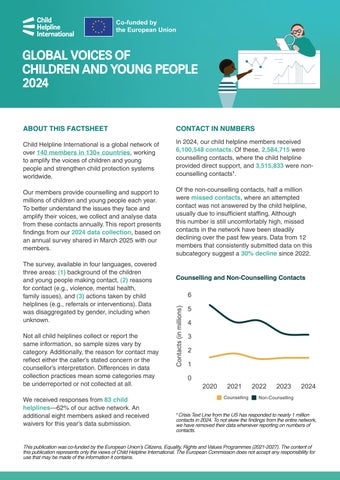
In 2024, our child helpline members received 6,100,548 contacts. Of these, 2,584,715 were counselling contacts, where the child helpline provided direct support, and 3,515,833 were noncounselling contacts1.
Our members provide counselling and support to millions of children and young people each year. To better understand the issues they face and amplify their voices, we collect and analyse data from these contacts annually. This report presents findings from our 2024 data collection, based on an annual survey shared in March 2025 with our members.
Of the non-counselling contacts, half a million were missed contacts, where an attempted contact was not answered by the child helpline, usually due to insufficient staffing. Although this number is still uncomfortably high, missed contacts in the network have been steadily declining over the past few years. Data from 12 members that consistently submitted data on this subcategory suggest a 30% decline since 2022.
Not all child helplines collect or report the same information, so sample sizes vary by category. Additionally, the reason for contact may reflect either the caller’s stated concern or the counsellor’s interpretation. Differences in data collection practices mean some categories may be underreported or not collected at all. We received responses from 83 child helplines—62% of our active network. An additional eight members asked and received waivers for this year’s data submission.
Counselling and Non-Counselling Contacts
6 Contacts (in millions)
The survey, available in four languages, covered three areas: (1) background of the children and young people making contact, (2) reasons for contact (e.g., violence, mental health, family issues), and (3) actions taken by child helplines (e.g., referrals or interventions). Data was disaggregated by gender, including when unknown.
5 4 3 2 1 0
2020
2021 Counselling
2022
2023
2024
Non-Counselling
Crisis Text Line from the US has responded to nearly 1 million contacts in 2024. To not skew the findings from the entire network, we have removed their data whenever reporting on numbers of contacts.
1
This publication was co-funded by the European Union’s Citizens, Equality, Rights and Values Programmes (2021-2027). The content of this publication represents only the views of Child Helpline International. The European Commission does not accept any responsibility for use that may be made of the information it contains.
AGE 13-15-year-olds are the most common age group to contact child helplines, accounting for 1 in 4 counselling contacts worldwide, and this has been consistently the case from 2020 onward. The age group of 10-12-year-olds, however, has been increasingly turning to child helplines, rising by more than 50% in the past five years (using data from consistently-submitting child helplines only)2.
25%
HOW ARE CHILDREN REACHING CHILD HELPLINES? Child helplines are reachable by various methods. Traditionally, phones were used, and indeed phone calls is the most common method of contact to this day, accounting for 2 in 3 counselling contacts. However, this ranges from as high as 92% of counselling contacts in Africa to as little as 58% in the Americas and Caribbean. In fact, not all of our members even operate a phone line – 5% are reachable through written messages online only. Other methods differ in popularity as well. Outreach, for example – when child helpline staff go into the community and offer counselling “on the ground” – is very common in African child helplines (93% of them indicated practicing it), less so in MENA (60%), and far less popular in Europe, Asia, and the Americas, where only 21%37% indicated it as a communication channel they offer to children and young people.
SPOTLIGHT: MENTAL HEALTH
GENDER
Girls generally contact child helplines more often than boys do, at a ratio of 6 to 4. About 1% of contacts are from children and young people who identify as non-binary. 2 Every time we examine longitudinal trends in the data, we only analyse data from those members who have submitted data on that topic every year across the time period. This is true for the trends in Missed contacts, Counselling and Non-counselling contacts, as well as in the changes in reasons for contact.
Most commonly, children and young people reach out to child helplines around issues with their mental health. Our network responded to 854,203 such contacts in 2024. That corresponds to 100 contacts each hour of each day, worldwide. Mental health makes up a third of all contacts made by girls (468,594 contacts), and a quarter of the contacts made by boys (212,102). Mental health is also the topic of half of the contacts logged from children and young people who identify as nonbinary (15,070 such contacts).
Contacts Related to Mental Health* Contacts Related to Mental Health* 650,000
Number of contacts
Globally, 13-15-year-olds represent the most common age group (25%) to contact child helplines.
600,000 550,000 500,000 450,000
2020
2021
2022
2023
2024
* Data presented above is based on 49 child helplines that consistently submitted data from 2020 to 2024.
• Girls and boys are similarly likely to discuss issues with their Mood and Anxiety; • Girls and nonbinary children and young people are far more likely to discuss Self-harm and Eating problems; • Boys are more likely to discuss Addiction, Anger, and Behavioural problems; • Nonbinary children and young people are more likely to contact child helplines with suicidal thoughts and attempts.
Mental Health Contacts in 2020 - 2024 (2.8M)* Neurodevelopmental Trauma Eating behaviour Anger problems Behavioural problems Addiction Concerns about self Self-harm Unspecified Suicide Fear & anxiety Mood problems
Girls and nonbinary children disproportionately contact child helplines around sexual violence, while boys are disproportionately affected by Neglect and Child labour. Nonbinary children often mention Bullying, nearly double the rate that girls mention it in their violence-related contacts. Contacts Related to Violence*
Number of contacts
Consistent with data from the previous five years, we saw that:
600,000 550,000 500,000 450,000
2020
2021
2022
2023
2024
* Data presented above is based on 52 child helplines that consistently submitted data from 2020 to 2024.
Violence Contacts in 2020 - 2024 (2.6M)* Sexual exploitation
0
200,000
400,000
600,000
* Data presented above is a breakdown of 2.8 million contacts from 49 child helplines that consistently submitted data from 2020 to 2024.
TF-CSEA Child marriage Harmful practices Child labour Unspecified Neglect Sexual Bullying Psychological Physical
SPOTLIGHT: VIOLENCE AGAINST CHILDREN Violence was the second most common reason to contact child helplines in 2024, accounting for a quarter of all issues (630,818 contacts). Psychological and Physical abuse were the two most frequent forms of violence mentioned. Sexual violence, Bullying, and Neglect were all similar in frequency, each mentioned in 90-100 thousand contacts.
0
200,000
400,000
600,000
* Based on 2.6 million contacts reported by 52 child helplines consistently submitting data from 2020–2024. TF-CSEA = Technology-Facilitated Child Sexual Exploitation and Abuse.
EXPLORE THE DATA To explore our findings in more detail, visit our interactive data dashboard, which visualises global and regional child helpline data over time.
EXPLORE THE DATA DASHBOARD Citation reference: Child Helpline International (2025). Global Voices of Children and Young People. Amsterdam: Child Helpline International. Available at: www.childhelplineinternational.org