CGS ECONOMICS MAGAZINE
27/01/22 THE CURRENT ACCOUNT JANUARY ISSUE
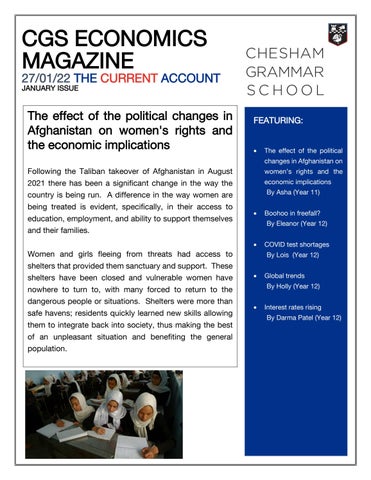
The effect of the political changes in Afghanistan on women's rights and the economic implications
FEATURING: •
The effect of the political changes in Afghanistan on
Following the Taliban takeover of Afghanistan in August 2021 there has been a significant change in the way the country is being run. A difference in the way women are being treated is evident, specifically, in their access to education, employment, and ability to support themselves and their families.
women’s rights and the economic implications By Asha (Year 11) •
By Eleanor (Year 12) •
Women and girls fleeing from threats had access to shelters that provided them sanctuary and support. These shelters have been closed and vulnerable women have nowhere to turn to, with many forced to return to the dangerous people or situations. Shelters were more than safe havens; residents quickly learned new skills allowing them to integrate back into society, thus making the best of an unpleasant situation and benefiting the general population.
Boohoo in freefall?
COVID test shortages By Lois (Year 12)
•
Global trends By Holly (Year 12)
•
Interest rates rising By Darma Patel (Year 12)
This in turn maximised the capacity of the
Universities have been forced to stop
economy as a greater number of people
offering certain courses for women
than
further reducing the opportunity for
previously
possible
were
now
working. Shelters have enabled women to
skills development.
gain independence and freedom from people who may have been abusing or
The change in the cultural and political
controlling them.
climate means that even educated women are choosing to stay at home in
Secondary education in Afghanistan has
fear of their safety. One woman stated
reopened but only for boys and excludes
“I fear for my life. However, I cannot
girls. In 2018 female literacy rates were at
stay quiet and do nothing.” Women
29.8% compared to 5% in 1980. What will the effect be of removing access to
that have protested are met with violence and hostility, a reminder of
education altogether? Most likely women’s literacy and education rates will
when the Taliban had control in the 1990s and women were beaten for
fall even lower, the lack of access to education triggering a multidimensional
dressing “immodestly” and being outside without a male guardian. Many
impact. Girls not receiving education risk being trapped in a cycle of poverty, poor
sectors are becoming increasingly male dominated. In Afghanistan's
health and a lack of fundamental skills
government all positions are occupied
development to earn a living or support
by men. The Taliban have stated that it
their families.
is, “...not necessary for women to be in the cabinet”. This could be the future
The effect of this inevitably will be to reduce the available skills base for much needed development. Added to this is a greater level of dependency on existing income and resources, which will likely hinder economic growth and stability into the future. Afghan universities now have to be segregated by gender. Female students have to be taught by female teachers. For many universities the resources are not available to provide this.
of other professions.
As a result, many educated, skilled women
Prior
are seeking to leave Afghanistan to work and live abroad. This will result in
Afghanistan received $8.5 billion a year of foreign aid - this has now ended. This
Afghanistan losing a large part of its labour force. The women left behind lose role
lack of investment is creating a crisis.
models, educators and mentors, removing representation in decisions that will directly
The United Nations predicts that half the
impact them. This will lead to the further deterioration of women's rights. There are no women in legal positions in Afghanistan. Many lawyers and judges are on the run from criminals they have prosecuted who have now been released from prison by the Taliban. Lawyers have received death threats from men seeking retribution for the time they spent in jail. Some lawyers have managed to flee to other countries, and some are still hiding in Afghanistan. Of these 220 are female judges. The consequence of this is that crimes against women are going
to
the
Taliban
takeover,
population is living in absolute poverty. They also estimate that by mid 2022, 97% will be living on less than $1.90 a day. The deterioration of women’s rights is perhaps not just a political or humanitarian issue. The close connections with educational access and the justice system are directly linked to economic development, which doesn’t leave much reason to wonder why so many women are now protesting for what many of us would consider basic human rights.
unreported and are not prosecuted. The change in Afghanistan's justice system
The long-term impact of the political
appears to be focused on helping members of the Taliban rather than the wider
example of this.
community. The effect of this is diminishing confidence in law and order and the government system. This is leading to the loss of foreign aid and investment.
changes in Afghanistan may become an
BOOHOO IN FREEFALL? Fashion giant Boohoo has hit a 5 year low with declining profits and sales due to customers returning orders in the new year and the new Omicron variant which has caused further demand uncertainties and supply issues.
Boohoo is already trying to recover from a labour supply scandal in 2020 where there were accusations of the company paying workers below the minimum wage, as little as £3 per hour. This has massively tarnished Boohoo’s reputation and is a factor contributing to their fallen share price along with supply chain disruption, surging costs and higher customer returns. The stock has therefore struggled over the course of the year and investors have seen the share price of the online fashion retailer plummet 65%. The online retailer is facing supply chain disruptions. This is due to the new variant and higher freight costs, which is the price incurred to ship goods, an issue many other businesses are facing. This is impacting Boohoo’s international market significantly as supply obstacles have pushed delivery times for US customers to as much as ten days, leading to decreased demand as shoppers switch to retailers with faster fulfilment rates.
The effects of these issues will knock a disastrous £20 million off Boohoo’s earnings and the online retailer is now only anticipated to grow 12-14% compared to a previously forecasted 20-25% growth rate this financial year. Moreover, the US is a key growth area for Boohoo where they are looking to expand, so decreased demand in that market is a huge blow to the company. As shopping patterns begin to return back to normal with the reopening of high street rivals such as River Island and H&M, Boohoo sales growth has slowed significantly especially over the summer quarter.
Online retailers, especially Boohoo, thrived during lockdowns as customers bought more casual clothes for home working and were less likely to send them back. However, Boohoo has recently experienced high return rates; 12.5% greater than in 2020. This may be due to their goods being mostly ‘party-wear’ or ‘occasion’ outfits, which generally have a higher returns rate as consumers like to purchase multiple items at a time, but only end up keeping one and returning the rest. This has negatively impacted Boohoo’s profits as every time a parcel is returned it costs the company £20 due to costs of shipping, repacking and storage, knocking 30% off total company profits. However, Boohoo has seen some benefits to their company; for example, it has expanded its brand portfolio this year in the hopes of enhancing its customer base, snatching up Debenhams' online business in January and obtaining Dorothy Perkins, Wallis and Burton the following month. Furthermore, as of now all of Boohoo's international sales have to go through its UK distribution structure however the company is planning to get its first US-based distribution centre effectively operating in 2023. This would help solve the issue of long delivery times and ease pressure from the UK centre. However, there are concerns the US market could move on to one of the group's many competitors by then. Chief Executive John Lyttle stated, “The current headwinds are short term and we expect them to soften when pandemic related disruption begins to ease.” The company then went on to state it was confident it could maintain its medium-term margin target of 10% and they enjoyed gaining significant market share during the pandemic.
A graph showing the market stocks of Boohoo. As of 25 th January, these stood at 102.50 GBX +1.50 (1.49%)
COVID TEST SHORTAGES Whilst cases surged over the festive period, Boris Johnson has come under scrutiny as millions struggle to access the home COVID testing kits; many of whom include key workers and critical NHS staff, leaving thousands unable to work. These issues were first seen when an error message on the government’s website appeared for many hours when people tried to order lateral flow tests, and for some time, there were also no PCR test kits available for essential workers and the wider public. Johnson advised people to continue to
Apart from the issues surrounding
test regularly in the run up to Christmas
gatherings during the festive period, the
and New Year, but combined with the
national shortage of tests is already
record number of positive results, mostly caused by the new wave of the Omicron
having further consequences; for example, fears of staff shortages are
variant, both lateral flows and PCR tests are almost impossible to come by. This is
massively increasing as NHS staff are required to test twice a week, but the
due to the sudden high demand which suppliers are unable to match. It was
lateral flows are not provided by their place of work, so individuals must seek
reported
Chief
their own. The surge in demand has
of
meant these key workers are unable to
Independent Multiple Pharmacies, that chemists were having people ask for tests
test, and numbers of staff absences were initially being reported as 18,000
every five minutes, frequently having to turn them away empty-handed. This
workers missing from hospitals in England – and is now estimated to be 1
contradicts statements made in the Tory WhatsApp group by Maria Caulfield,
in 10 of NHS staff are not able to work.
Executive
by of
Leila the
Hannbeck, Association
claiming that there are “plenty of tests” and that “constant speculation that we are running out of tests is just fueling the demand.” However, despite the confidence, the country still faced several pockets of complete test gridlock, including Kent, which experienced a mass shortage of delivery slots and stocks.
Helga Pile, deputy head of health at
It
Unison (a main trade union for health
headteachers that despite the stockpile
workers) said, “NHS staff are under
they have gathered for pupils, they fear
enough pressure as it is without the
shortages for teachers and essential staff will cause a larger problem, as staff
additional worry of obtaining tests”, which has started the call for priority testing for NHS staff.
This initiative is also being
has
been
reported
by
several
absences may cause school closure in the future.
backed by the Royal College of Nursing and the British Medical Association, as
Many people had said that Johnson and
well as the Shadow Health Secretary Wes
the Conservative party are to blame for the shortages. Wes Streetling said that
Streetling, who in a tweet claimed he had “written to the health secretary urging him to make sure that NHS staff are at the front of the queue.” Without a change, the consequences of the test shortage could place more unnecessary strain on the already stretched NHS, and the 34% increase in coronavirus hospital admissions could place the NHS on the brink of collapse once again.
the prime minister’s plea for people to test frequently when it was clear that there were dire shortages showed, “spectacular incompetence.” He said that, “people are trying to do the right thing, follow the government’s own advice and test regularly, but are prevented by the conservative government’s incompetence.”
Daisy
Cooper, Lib Dem spokesperson also In addition to the healthcare crisis, the effects of the lack of tests will also be evident as schools re-open and commence in the new year. The department of education announced that
added that “if the government doesn’t get its act together, vaccine centres could soon grind to a halt, and patient safety could be at risk.”
all secondary school pupils in England will need to test twice before returning to
For now, the government is
classrooms, but the start of the new term
remains the same; test regularly, act
may have to be delayed for some due to
sensibly and wear masks in confined
the shortage of supply. However, the main issue won’t fall on the students, as
spaces.
most schools use a different ordering system for lateral flow tests, so most of their orders are due to be delivered in time.
only advice the currently offering
GLOBAL TRENDS Following a talk from Alex Hammond, a trade economist from the Institute of Economic Affairs, the significance of global trends was thrown into the foreground of our conscience. Much of his presentation focused on changing a common mindset of pessimism. According to a YouGov poll from 2019, 68% of British citizens thought that (generally speaking) the world is becoming a worse place to live. A second YouGov poll stated that fewer than one in twenty Britons felt the world was getting better. Alex Hammond agreed that currently, it is difficult to be an optimist, however he managed to modify our perspective. He showed us that numerous aspects of our life are ameliorating, which we subconsciously disregard.
The global infant mortality rate has declined massively, currently at 2.9%. This advancement is also likely to be due
to
better
prevention
and
A notable field which appears to be improving in all branches, is health and
treatment
longevity. Global life expectancy had levelled at about 29-30 years old from the
and better sanitation, as well as
start of the 16th century to around 1820. Since then, global life expectancy has only inclined and it is currently at its highest, at 72 years old, it is also projected to continue rising. predominantly
This improvement is accredited
to
the
improvements of medicines and diets. Similarly, considerably fewer children are dying young globally. Demographers estimated that 30% of babies in premodern societies died before their first birthday.
of
infectious
diseases,
greater knowledge about pregnancy greater access avoid malnutrition.
to
food
to
These factors are likely to be aided by monetary improvements, such as fewer people living in extreme poverty and rising incomes. In 1820, nearly 84% of the world’s total population lived in absolute poverty (living on less than $1.90 per person per day, but by 1981 this percentage had exactly halved.
The most recent figure issued by the World
Overall, there are many arguments for
Bank estimates extreme poverty has fallen
why now is the best time to be alive. This is definitely difficult to
to 8.6%. Another encouraging statistic is that roughly 158,000 people escape from extreme poverty every day, and this has the potential to be completely eradicated by 2050 according to experts. The Industrial Revolution caused average global incomes to accelerate, and between the 19th and 20th century, average global incomes rose from approximately $1,140 to $2,021. Furthermore,
today
average
global
incomes have soared, and are now at approximately $14,600 per year. A domain which is likely to have catalysed these improvements, is the growing universal literacy rate. 200 years ago, over 90% of the world’s population was illiterate, whereas today almost 90% of the world is literate. High literacy rates are regularly correlated with higher life expectancy and decreased mortality rates, as well as reduced poverty rates. Being literate provides one with more job opportunities, which is particularly significant to people in developing/thirdworld countries. It also corresponds with other advancements such as greater gender equality as well as increased political awareness and participation, proving it has beneficial indirect effects.
comprehend, especially over the past few years with the pandemic, but it is crucial to also pay attention to the improvements in today’s society. It is also possible to argue that often benefits give rise to harmful externalities, for example rising incomes can lead to excess demand which can cause inflation. Alternatively, it is more difficult to argue that the costs outweigh the benefits. A final reason to have a more positive outlook is because health, life expectancy, incomes and literacy are all forecast to improve as time goes on.
UK Interest Rate rise as Cost of Living Deepens From December 2021, the Bank of England has announced they have raised interest rates for the first time in 3 years. They have decided to increase it from 0.1% to 0.25% to hold back the inflationary pressures building up in the economy due to Covid-19. Inflation is now at 5.1%, which is the highest in a decade, and the Bank is hoping to deter spending by elevating the interest rates. The Bank of England is hoping to boost the economy by making an attempt to stabilise the price level, following the peak of the pandemic. It was expected to hold off because of
Higher interest rates make borrowing
uncertainty about the Omicron variant.
more expensive. For all homeowners, this means higher mortgages, and a
However, consumers have been spending a high proportion of their income on online shopping, streaming subscriptions, and takeaways, as restrictions provided few options to where they could spend their money. The data that online retail spending surged by almost 88% in March 2021 demonstrates this. This could also be due to some people isolating, and needing to spend money online rather than in person.
limited household budget as bills are rising compared to previous years where there was cheap borrowing and slow rising prices. For savers, there is an advantage, as they receive higher rewards for saving, however, in the long run, returns are still below the rate of inflation.
If you're on a low income or don't have savings to fall back on, high inflation will affect you more severely. If your wages are rising by less than inflation, there will be a fall in the real value of the wages, as you can purchase less now with your income. However, some employees’ wages rise at the same rate of prices, so they will not feel the impact as seriously as those on lower salaries. This has a regressive effect on those individuals that are on lower incomes.
The bank rate, as the diagram shows, fluctuates from 2012 until 2020 where it suddenly rapidly declines, to deter saving, and encourage saving.