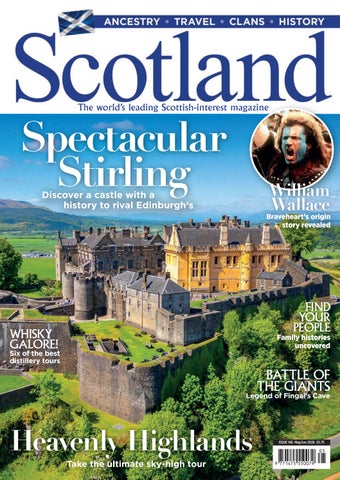
Scotland May/June 2026 sample

Page 1


Spectacular Stirling

Discover a castle with a history to rival Edinburgh’s

Six of the best distillery tours

The world’s leading Scottish-interest magazine

Braveheart’s origin story revealed William Wallace

Family histories uncovered FIND

BATTLE

Legend of Fingal’s Cave

CLAN COURIER

Ancient footprints discovered on an Angus beach and a clan gathering in Georgia

ROYAL ROOMS REVEALED

This summer, the public will be given the unique opportunity to glimpse inside the private rooms of Queen Elizabeth II at the Palace of Holyroodhouse, her official Scottish residence in Edinburgh, in the centenary year of her birth.

Running for 100 days from 21 May to 10 September 2026, visitors will be taken in small groups on behind-the-scenes tours, to see a suite of private ‘lived-in’ rooms on the palace’s east side, where Queen Elizabeth II and Prince Philip would relax between official duties.

Emma Stead, curator at the palace, said: “Queen Elizabeth II’s well-known love for Scotland will be given fresh context through this unique and special access to the private apartments, where visitors will enjoy a new perspective into both the formal and more informal use of Edinburgh’s royal palace.” rct.uk

Stewart STRONGHOLDS

This issue, we follow the trail of the family that rose to found Scotland’s longest-reigning royal dynasty

The Black Isle

We take a tour round this often overlooked peninsula, which our beloved Notes from the Isles columnist calls home

With its proximity to Loch Ness and Speyside distilleries, Inverness applies the northerly full stop to many a Highland journey. Make the spectacular trip across the landmark Kessock Bridge, however, and you’ll find the Black Isle – a vastly underrated region worthy of further exploration.

Extending for 15 miles east to west and just six miles from north to south, the Black Isle is home to handsome towns and villages, is dotted with deciduous woodland and Scots pine survivors, and offers some of the best wildlife-watching opportunities in the country.

The resonant name is a curiosity, for everyone seems to be complicit in agreeing to ignore the fact that the Black Isle – Eilean Dubh in Gaelic – isn’t actually an island. Nor is it black.

The moniker is generally thought to refer to the dark, fertile soil that represents something of a farmer’s bounty, superb for cereals, potatoes and rearing livestock; or it may just be that the soil of this maritime peninsula has a darker pigmentation when set against a backdrop of the neighbouring snow-covered hills.

Before the opening of the Kessock Bridge in 1982, the ferry across the Beauly Firth would have given the Black Isle more of an island feel. Today that bridge, at threequarters of a mile long, with eight steel cables forming a ‘twin harp’ shape and holding the main span 200ft above the firth, is an exhilarating gateway to the region.

I start my journey in the village of Beauly, where the mild bustle of high-street antique and craft shops eases into the quiet repose of the crumbled remains of the 13th-century priory. Today only the roofless abbey church survives amid a sprinkling of tombs and headstones hewn from local Tarradale red stone. Three miles north lies the village of Muir of Ord, an ancientsounding name for a modern community that sprung up around the Glen Ord distillery.

The origins of the settlement stretch back further, for the Great Cattle Tryst was held here in the 19th century, for the sale and auction of black cattle led here along drovers’ roads from across the Highlands. Whisky is of course big business across the Highlands but at Munlochy, a short distance away, I discover the friendly, small organic Black Isle Brewery, which makes beer instead of ‘uisge beatha’, holding its own.

As it heads east, the Black Isle moulds more recognisably into a finger-shaped peninsula. My destination is Cromarty but the journey there allows the Black Isle to reveal its charms.

LEFT:

Gently sloping contours give Munlochy Bay, overlooked by dense woodland, mudflats and salt flats, the grace of any bay on the more celebrated west coast. There’s an ancient ‘Clootie Well’ here, where soaked rags are hung on trees in healing rituals dating to pre-Christian times.

Aerial view of Cromarty – note the car ferry on the slipway that transports drivers and foot passengers across the Cromarty Firth each summer

Just beyond Avoch (in the local dialect the village is pronounced ‘och’ with a silent ‘v’ and ‘ch’ as in ‘loch’), the small town of Fortrose’s ruined sandstone cathedral is a mirror-like reflection of its ecclesiastical cousin in

Original Source

Using traditional, time-honoured methods since its establishment in 1763, the Glenturret in Crieff not only holds an enduring legacy for producing handcrafted, small-batch single malt Scotch whiskies – it’s also world-renowned as Scotland’s oldest working distillery, with a reputation for highly skilled distillers, exceptional quality and an exquisite, distinctive taste. Set amid Perthshire’s verdant hills, it’s a beautiful nature spot to visit, as well as a worthwhile whisky stop, with the welcoming Dram Bar offering a curated menu of malts and flights, while two-Michelin star Lalique Restaurant, helmed by Mark Donald, caters to visitors with gourmand leanings. And for anyone seeking accommodation, the 19th-century Aberturret Estate House provides luxurious overnight quarters. Enhance your time here with the two-hour Fine & Rare Warehouse No.9 Tour & Tasting Experience, where you’ll be welcomed behind the scenes to savour tastes of four exceedingly scarce whiskies – including rare archive bottlings and limited releases – led by one of the distillery’s senior experts, surrounded by the heady scent of ageing casks.

Fine & Rare experience £250 per person; theglenturret.com

CAMILO GÓMEZ PINTO

Beyond the Drams

Passionate about sharing Scotland’s whisky culture through local stories, flavours and people, Once Upon A Whisky Tours’ itineraries are designed to connect guests with the communities they visit.

As well as private distillery tours, the core two- to three-hour routes on offer cover the country’s cities and their most characterful maltsipping spots, while celebrating national craftsmanship, local food traditions and authentic Caledonian hospitality.

On the Edinburgh tour, an expert leads small groups through an array of intimate venues from the medieval Old Town to the Georgian New Town, learning about architecture, the art of whisky tasting and sampling some premium drams along the way.

The Glasgow West End Tour, meanwhile, captures the vibrancy of the city’s favourite local bars and rich distilling heritage. In the Highlands, the Inverness Tour and Tasting Experience takes in three of its old town’s hidden whisky rooms.

Alongside drams, guests can enjoy live traditional music, Scottish tapas and some spirited storytelling.

Prices start from £65 per person; onceuponawhisky.co.uk

All the Senses

To cap off a wonderful stay in Edinburgh take a trip to 145 Princes Street – home to the Johnnie Walker Experience. Billed as a tour with a difference, rather than guests visiting the company’s cask-lined Glenkinchie Distillery near Pencaitland to the east of the city, they’re treated instead to an immersive, theatrical event in this modern, elegant eight-storey West End space.

Over the space of 90 minutes, the Johnnie Walker Signature Experience will take visitors on an epic journey through the 200-year history of one of the world’s most popular and best-selling Scotch whisky brands via light shows and live performances.

Visits start with a flavour quiz to help mixologists tailor the tour to individual taste buds, with three delicious whisky cocktails (or mocktails) made to match your flavour profile. And to finish, what better way to come down from the sensory overload than heading up to the 1820 rooftop bar for a bite and stirring views of Edinburgh Castle. £30 per person; johnniewalker.com

Turn static files into dynamic content formats.

Create a flipbook