![]()
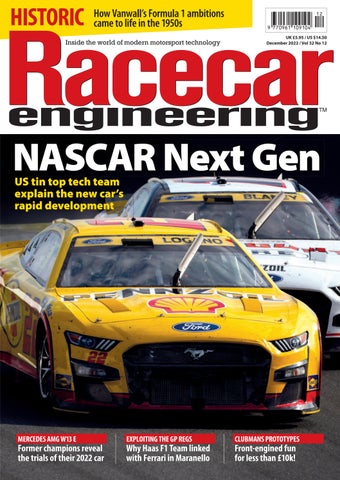
The introduction of NASCARās Next Gen racecar has been hailed a success, but its early development was a hot and bumpy road
By DR ERIC JACUZZI AND CHRIS POPIELANASCARās Next Gen vehicle has been an incredible success on track, with an unprecedented 17 diļ¬erent winners and numerous thrilling races over the 2022 season. While a great year was certainly hoped for, such an outcome was far from certain in mid-to-late 2021 as teams began testing their own cars.
As could be reasonably expected with the debut of a brand new car, issues began to appear that were not seen during NASCARās own prototype testing. This is the story of
the race to ļ¬x some of the most concerning issues before the new car hit the track, with high hopes of delivering one of the best seasons in NASCARās recent memory.
NASCARās on-track testing approach with the Next Gen car extended through much of the early part of 2021, beginning with a two-day test at Richmond in March. The new vehicle, dubbed Prototype 1 (P1), was the initial platform designed to evaluate
all the new systems on the car. But, by the time of the test, most of P1 was already obsolete as the design was rapidly evolving, so it was decided to advance the design and build a new vehicle, Prototype 3 (P3), which skipped over an anticipated evolution of P1. This car was run initially at Texas in May and then for the remainder of the NASCAR testing schedule until team testing began.
Cut to September 2021, where eight teams participated in the inaugural organisation test of the Next Gen at Daytona.
By the time of the [first] test, most of [Prototype] 1 was already obsolete as the design was rapidly evolving, so it was decided to advance the design and build a new vehicle, (P3), which skipped over an anticipated evolution of P1
Mercedes AMG has had a rude awakening in Formula 1 in 2022. Racecar talks to Mike Elliott, the teamās technical director, to nd out how it has approached the problems
By STEWART MITCHELL
āItās easy to say weāre having a tough time when weāve been through the last eight Formula 1 world championships, winning them all, and weāre not in that position this year,ā says Mike Elliott, technical director of Mercedes AMG Formula 1, on the teamās 2022 performance to date.
āWeāre bound to think itās not brilliant. However, looking at a wider context, the 2022 regulations intended to mix up the ļ¬eld and improve the show. In that way, Formula 1 achieved those outcomes.ā
At time of writing, with four races left of the season, Mercedes was sitting third in the Constructorsā Championship, 67 points behind Ferrari and an insurmountable 232 points behind Red Bull Racing.
Unlike the previous generation of dominant Mercedes machinery, the W13 has had a somewhat bumpy coming of age
Mercedesā change of fortune since the introduction of the new era has been well documented. Its car this season, the AMG F1 W13 E Performance (the 13 referring to it being the 13th car produced by the Mercedes-AMG works team since re-entering F1 in 2010), is the product of a top to bottom re-design in line with this yearās Formula 1 regulations. The only carry-over element from its predecessor is the steering wheel.
Operating from a blank slate, with a steep development curve, the teamās Brackley and Brixworth engineering squads have had to push even harder than the previous generation of Formula 1, where they stole a march on the competition and carried it through to the end of the era. Unlike the prior dominance of Mercedes machinery, though, the W13 has had a bumpy coming of age.
For context, the 2022 rules have reduced the carsā wake (turbulence caused by the car passing through the air) as a function of the new aerodynamic regime, allowing competitors to get closer to one another, particularly in the corners. The challenge of overtaking in the previous generation of F1 was primarily down to this wake. However, the lower wake means the corner gains are somewhat outweighed by the tow eļ¬ect (slipstreaming) reduction on the straights.
Net, Elliott feels the carsā resulting closeness and overall competitiveness over an individual lap have not changed much.
āIn terms of closing up the grid, itās probably the same split as weāve had before,ā he notes. āI guess we are the only ones that have seriously changed position this year, and thatās our problem to deal with. Weāve ended up with a poorly behaving car and an uncomfortable ride for the drivers, thanks
to the direction weāve taken with the new aerodynamic establishment.ā
Thanks to the introduction of groundeļ¬ect aerodynamics, the 2022 rules reward running the car as close to the ground as possible. But if platform control isnāt suļ¬cient, this low running can induce instability in underļ¬oor ļ¬ow ļ¬elds and lead to so-called porpoising and bouncing. Mercedes suļ¬ered badly from ļ¬ow ļ¬eld instability in various ways throughout the 2022 season, but has not been alone in this battle.
āI donāt think any teams eļ¬ectively spotted porpoising over the winter period between 2021 and 2022,ā says Elliott. āWe did anticipate having to run the car very low under these full ground-eļ¬ect regulations. However, the challenges of ground-eļ¬ect aerodynamics are stronger on some cars than others. They are unique to the ļ¬ow ļ¬eld structure under the car, its set-up scope and performance window.ā
Cars have three modes in their suspension: roll, pitch and heave, which operate at diļ¬erent frequencies. In a porpoising scenario, the car ends up with a phase shift between its front and rear aerodynamics, which feeds into the pitch mode. With these cars, teams see predominantly heave, and some pitch, which depends on speed and the characteristics of the circuit.
āIt became apparent early, even without signiļ¬cant aerodynamic work, that these cars wanted to run very low to the ground. So we focused on designing the ļ¬oor to survive in those conditions, and at the ride height that would be most performant,ā says Elliott. āWe underestimated one problem and didnāt spot another, which is why we have the behavioural issues. One thing we can put our ļ¬nger on is that it is a consequence of the aerodynamic changes in the regulations.ā
Mercedes claimed to make good progress ironing out its issues regarding underļ¬oor ļ¬ow ļ¬eld instability that led to the porpoising phenomenon seen so dramatically in the seasonās early stages. However, the W13 still suļ¬ers from ābouncingā ā a heave motion response caused by the underļ¬oor aerodynamic instability.
āBouncing issues are complex,ā notes Elliott. āThe aerodynamics put energy in the vertical motion of the car due to a phase shift between the aerodynamic load and the carās ride height position that gives a net energy input more than the dampers can deal with.
āThe fact we have to run these cars so low to the ground, with so much downforce on them to be performant, means they must run really stiļ¬, and thatās a huge contributor to these signiļ¬cant consequences.ā
As well as the changes to the aerodynamic regulations, the new-for-2022 18in wheel and tyre package has changed how teams approach car performance.
āThe challenges of groundeffect aerodynamics are stronger on some cars than others. They are unique to the flow field structure under the car, its set-up scope and performance windowā
Mike Elliott, technical director at Mercedes AMG Formula 1
āAs per every era of Formula 1, there are signiļ¬cant amounts of lap time to be found by improving the carās dynamic behaviour, and engineers can ļ¬nd some of this in setting up the car to get the tyres into their performance window,ā notes Elliott. āThe new tyres want slightly diļ¬erent things to get them into the window that works when
compared to the previous 13in ones. Though this isnāt the way to solve the challenges weāve been facing with car behaviour.
āYou have to put it in perspective. The tyre is not particularly stiļ¬, and then youāve got stiļ¬ suspension springs and, in parallel with the suspension springs, you have the stiļ¬ dampers. In reality, these cars are inļ¬exible, so itās hard to dampen the motions and take a lot of energy out of the carās movement.ā
The chassis regulations also changed for 2022 and now include a more challenging side squeeze test, requiring a higher strength than the previous generation of cars. The aerodynamic regime has also driven teams to stiļ¬en their cars in areas they otherwise wouldnāt have in the last regulation set.
Even with good engineering design, these elements add signiļ¬cant weight to the cars, which have gone up from 752kg to 798kg.
Teams throughout the grid have not pushed to meet the minimum weight, instead choosing to maximise more lap time performant opportunities that were perceived as more rewarding than just having the lightest car possible by regulation.
āWe were overweight at the beginning of the season, though we have done a lot of work to bring it down towards the minimum,ā explains Elliot. āHowever, weight is an interesting equation in this era of Formula 1. Although itās one of the key performance drivers, it is also limited by regulations. Because of that, car development diļ¬ers from what one might think.
āWe are always targeting a lower lap time, and reducing the weight to the minimum amount gains a certain amount of lap time performance, but weāve found that a heavier car with a more sophisticated aerodynamic package actually generates much more performance on the track.
āBecause we have so many tools to develop a more performant car, lowering the weight to the minimum isnāt as dramatic a driver as it once was in Formula 1.
Additionally, weāll take a weight penalty for a more reliable car, as a DNF or grid penalty from replacing components that have failed, or run over the maximum unit allocation for the season, carries a high burden in the championship standings.ā
The position of the homologated side impact structure is deļ¬ned in the regulations, but early in the design phase for the W13, Mercedes spotted an opportunity to design a wing around the upper side impact structure to add downwashing ļ¬ow in that area.
āWe spent a lot of the winter ļ¬guring out how best to work this loophole, and wondering if there was any part of the wording that would see the other teams trying to get it stopped,ā says Elliott of the wings that sit either side of the driverās cell. āWe went for it at a certain point in the development, and it performs well and suits our overall aero regime for the car.ā
Others are yet to follow suit, instead using the space Mercedes carved away for this structure to house components.
The teamsā aerodynamic philosophies dictate the direction they go in terms of the weight of each component that aļ¬ects aerodynamic performance. Once a philosophy is settled on, much of the design concept then comes from that, and forces you down a particular route to eļ¬ectively deploy it. Interestingly, there is a variety of concepts seen across the 2022 grid. Mercedes has gone with a very narrow packaging concept, while much of
āIn reality, these cars are inflexible, so itās hard to dampen the motions and take a lot of energy out of the carās movementā
the rest of the grid has chosen a wider body to suit their philosophies. Elliott doesnāt think thereās a big diļ¬erence in the potential of any one philosophy because the detail is where it counts, much of which is under the ļ¬oor.
āWhen you look at a Formula 1 car as an aerodynamicist, you immediately see that the dominant features are the front wheels. These generate a tremendous amount of wake, and how you deal with that is the key to performance. In the past, we would counter the eļ¬ect of front tyre wake by implementing complex structures behind the wheels in the form of bargeboards and other wake control devices. But in 2022, we canāt do that. So, our philosophy for the W13 was to bring the bodywork in the central chassis of the car as tight as possible to the driver cell and the PU to have a minimal eļ¬ect from front tyre wake.ā
The W13ās aggressive sidepod packaging is partly thanks to the compact design of the M13 power unit, which features volume dense systems such as water-to-air intercooling. On its creation, Elliott says the team have built up a lot of power unit systems modelling capability over the last few years, enabling them to do a superior job at predicting where the heat capacity and ļ¬ow rates need to be in order to be as eļ¬cient as possible.
āWe do a lot of work to optimise airļ¬ow through the car and work out the pressure losses around radiators,ā he says. āCharge air cooling is based on water-to-air heat exchange because we see a massive beneļ¬t in that in terms of the entire design philosophy of the car. Its role cannot be underestimated.ā
The underļ¬oor aerodynamic regime only slightly changes the packaging of the cars. However, Elliott notes that, in every era, Formula 1 teams always try to push the limits when it comes to packaging
āOne signiļ¬cant change for us was the limited wheelbase regulations this season.
āOur philosophy for the W13 was to bring the bodywork in the central chassis of the car as tight as possible to the driver cell and the power unit to have a minimal effect from front tyre wakeāMercedesā charge air cooling is based on water-to-air heat exchange and coincides with the design philosophy of the car. This allows the car to run fewer cooling louvres in the body than many of its competitors The W13 ļ¬oor has an exit ļ¬ow condition positioned midway down. This rejects airļ¬ow under the car that isnāt in the tunnel ļ¬ow. Slots further back on the ļ¬oor edge re-ingest some of the exit ļ¬ow to work the diļ¬user and control rear tyre jets Unlike the rest of the grid, Mercedes has chosen to go with a very narrow packaging concept for this car, wrapping the bodywork extremely tightly around the driver cell and power unit
We had the longest car in the previous regime, giving us some freedom. We certainly had a lot more packaging work to do in 2022.
āThe cost cap also drives this because you donāt want to reinvent every bit of the car every year. So, much of our thinking over the winter was about how we could develop a car where much of the architecture and critical systems could carry over from year to year. That drove more work on packaging than the aerodynamic regime.ā
āWeāve come through the 2022 season so far with a huge amount of humility,ā says Elliott of the learning journey into this new era to date. āWe have looked at all the other car solutions on the grid, investigated how other teams have arrived at their solutions and wondered if any of them are better than ours. Itāll be interesting to see how the cars turn out next year with all the lessons of the ļ¬rst season of this regulation set behind us.
āThe most signiļ¬cant thing we have learnt in 2022 is how to go about adapting to a new rule regime, and ļ¬guring out how best to ļ¬nd a performant compromise in adverse circumstances. Weāve learnt how to ļ¬nd the right operations approach to ļ¬nding performance in a very diļ¬erent type of Formula 1. Without giving too much away about what we did wrong in the ļ¬rst place, weāve learnt and adapted to this new F1.ā
Earlier this year, the World Motor Sport Council conļ¬rmed there would be alterations
to the 2023 technical regulations, citing driver safety as the main reason for the adjustments. These changes include raising the ļ¬oor edges by 15mm and raising the diļ¬user throat height. The diļ¬user edgeās stiļ¬ness will also increase, and there will be a mandated sensor to monitor porpoising more eļ¬ectively.
As to how the rule changes for 2023 will aļ¬ect Mercedesā performance, Elliott says, āthe raised ļ¬oor edges are probably the main thing that will aļ¬ect the car aerodynamically, and this will inļ¬uence performance. I think thatās going to keep the ļ¬oor edges oļ¬ the ground in the high-speed sections, and I think that, generally, it will be helpful for most teams running the car really low.
āOn the ļ¬ip side, to recover the lost performance from that, weāll have to see which way drives us, whether to run the car lower or see a re-design. Running the car lower could end up back in the same order with the same problem, but we will investigate that. 15mm is not a huge move.
āWeāre still going to have ground-eļ¬ect cars, and theyāre still prone to underļ¬oor ļ¬ow ļ¬eld instability. If youāre not careful with how you deal with that aerodynamically, youāll still have the same problems.ā
The 2023 car, Elliott admits, will see a diļ¬erent design to the current W13, succeeding Mercedesā investigations into the aerodynamic concepts of the other teams lined up on the grid.
āNormally, in a set of rule changes, as the rules get ļ¬xed ā and theyāre ļ¬xed for
longer and longer these days ā the teams tend to converge. I think the intention of the new rules and the cost cap was to try and constrain the grid, though the front three teams are as far ahead as they have ever been. Whether that will change in time, we will just have to wait and see.
āIf you look at Ferrari, Red Bull and Mercedes, the three quickest teams, they all look very diļ¬erent. The logical thing is to copy the quickest one, which, unfortunately, is Red Bull. But you canāt just photocopy a car and suddenly jump to the front of the grid. It doesnāt work like that. Itās more about trying to understand what people are thinking and their approach, which will converge a bit and maybe the teams will move together, but I donāt think itāll be next year we see parity. I think it will take a few years.ā
āThe most significant thing we have learnt in 2022 is how to go about adapting to a new rule regime, and figuring out how best to find a performant compromise in adverse circumstancesā