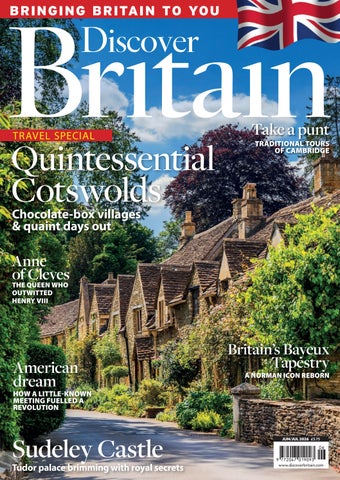
Discover Britain June/July 2026 sample

Page 1


Quintessential Cotswolds

Chocolate-box villages & quaint days out

Anne of Cleves

Secrets of Sudeley

Nancy Alsop on why this Tudor castle can easily rival the allure of Hever

British castles tend to lay claim to a royal connection or two. Sudeley Castle, near the Cotswolds market town of Winchcombe in Gloucestershire, however, boasts an especially rare one: it remains the only private castle in England to have a queen buried within its grounds.

That the aforementioned monarch should be Catherine Parr, the last wife of the much-married Henry VIII, feels especially apt. In the famous rhyme, Parr is the one who ‘survived’ – and Sudeley, too, has proved remarkably enduring, its hefty walls weathering nearly 1,000 years of upheaval, reinvention and intrigue.

Sudeley’s earliest beginnings are somewhat shrouded in the haze of history, although we do know that its Anglo-Saxon name, Sudeleagh, means ‘south clearing in the forest’.

Left to right: The castle’s origins stretch back nearly 1,000 years; Queen Catherine Parr’s tomb in St Mary’s Chapel

In its nascent days, it served as the home of Goda, daughter of King Ethelred the Unready, who held the estate before the Norman Conquest (remarkably surviving William the Conqueror’s widespread redistribution of Saxon lands).

Yet it was not until the late Middle Ages that Sudeley took on the form we see today – a transformation that ushered it into centuries of prominence, during which it passed through the hands of some of England’s most powerful figures.

The much-maligned King Richard III is said to have left his mark in its great banqueting hall (now partially ruined and reimagined as a garden, with roses and ivy climbing its walls), while Henry VIII and Anne Boleyn stayed here in 1535, as England stood on the brink of the Dissolution of the Monasteries.

It is, though, Catherine Parr who remains most synonymous with

Right: Niall Folbigg aboard a Scudamore’s punt in front of King’s College, Cambridge

My Britain

Niall Folbigg, the station manager at Scudamore’s Punting, Cambridge, talks to Jeremy Flint about this fascinating river tradition

I oversee the operations at the Mill Lane punt station in Cambridge. It’s a wide and varied role. I look after, coach and mentor our staff – a young demographic of people, often in their first ever job. I teach them our values, and all parts of the job, from how to punt to selling tickets, and working around water safely. I also look after the commercial side, ensuring the business is financially viable.

Flat-bottomed boats were once pulled by horses along bridleways next to the river.

Punting is likely to have been part of the East Anglian transport network for thousands of years. I believe the oldest example of a flat-bottomed boat was found in the Fens (low lying marshland), dating back some 2,000 years ago. This was the only way to get around Cambridgeshire and the fenlands.

In more recent history, Cambridge became an inland seaport and commercial hub in the Anglo-Saxon period to transport goods from the coast inland.

Punting has always been a big part of the city, and it helped establish Cambridge around AD700, when it grew commercially, before the church, education and universities followed. There is still evidence that some colleges designed their buildings with doors built on the river to open for punts delivering food or coal. Punting changed from transporting cargo to leisurely pursuits during the 18th and 19th centuries, as railways and roads developed.

When Franklin met Hill

Michelle Fleming visits Hillsborough Castle, which in 2026 is marking the 250th anniversary of American Independence with a special exhibition exploring a key meeting that took place here

Hillsborough Castle is about 12 miles southwest of Belfast, in County Down, Northern Ireland; portrait of Benjamin Franklin

“There were days of conversation in this very room that led to centuries of consequences,” reflects David Orr, castle and collections manager at Hillsborough Castle and Gardens.

“You could argue that the seeds of American independence were sown here.”

It’s a bold claim made by Orr in Hillsborough Castle’s opulent State Dining Room, which has been renamed ‘The Franklin Dining Room’ for the duration of its fascinating USA-NI250 Franklin, Hillsborough and the Seeds of Independence exhibition, marking the 250th anniversary of the US Declaration of Independence.

Here, priceless personal items and artworks bring vividly to life the US founding father’s visit and the little-known part that this palatial pile, perched on a hill in a bucolic corner of County Down, played in the story of American freedom.

It was here, in this very room, that Franklin found himself in the autumn of 1771 – as Orr puts it – “detained by a thousand civilities”, by Lord Hillsborough, Wills Hill, the 1st Marquess of Downshire, Britain’s then powerful Secretary of State for the Colonies.

A commanding portrait of Benjamin Franklin, painted by French artist Jean-Baptiste Greuze six years after his visit to Hillsborough, and on loan from the American Philosophical Society, hangs over the fireplace, while by the entrance, Lord Hillsborough gazes down from a painting by Allan Ramsay from the Royal Collection.

A glass showcase contains three of Franklin’s

Despite her short stint as queen, Anne also left a mark on the new country she called home

about her. She was also popular among the people, with Marillac reporting that she was England’s “sweetest, most gracious and kindest queen.”

She was fun too, and loved entertainment and jousting. In 1539, while at Calais waiting for stormy weather to blow over before sailing to England, she enjoyed banquets and tournaments, with more laid on once she arrived in London.

During her short time as queen, she attended pageants, masques and plays, and in January 1541 after Henry had gone to bed, she stayed up late dancing with her replacement, Queen Catherine. No shrinking violet, she also loved to dress lavishly. In the famous painting by Holbein (previous page), she shines in cloth of gold, velvet and pearls, while her will of 1557 mentions a number of diamond and ruby rings in her possession.

Despite her short stint as queen, Anne also left a mark on the new country she called home. On 6 July 1540, as part of the divorce agreement, Henry provided her with a cash allowance along with various lands and properties.

She lived at Richmond Palace on the bank of the Thames in London and Hever Castle in Kent, with other buildings known to have belonged to her, too.

The 15th-century Anne of Cleves House in Lewes, Sussex, is now a museum, while another of Anne’s houses in Melton Mowbray in Leicestershire now operates as a pub, The Anne of Cleves.

She also lived at Bletchingley Palace in Surrey, and in her last years, at Chelsea Manor House in southwest London. Some of these buildings no

Clockwise from left: Hever Castle near Edenbridge in Kent; Anne of Cleves House in Lewes, East Sussex; Catherine Howard became the fifth wife of Henry VIII

Wimbledon (Tennis)

In Britain, the sport of tennis is synonymous with a certain leafy suburb in southwest London. Wimbledon, or more explicitly the All England Lawn Tennis and Croquet Club, was founded in 1868. The inaugural Championships, a Gentlemen’s Singles event, took place in 1877, with a three-wooden-plank stand offering seating for the 30-strong audience.

The winner of this first ever tournament was

Spencer Gore, who later admitted to preferring cricket, remarking that “tennis will never rank amongst our great games”.

How wrong he was. Today, Wimbledon ‘fortnight’ starts at the end of June and runs for two weeks, attracting over 500,000 live spectators, plus over 2 billion TV and digital viewers. A museum in the grounds offers behind-the-scenes tours of the oldest tennis tournament in the world, and the only Grand Slam event still played on grass. wimbledon.com

Queen Elizabeth Olympic Park (Various Sports)

Built for the 2012 Summer Olympics and Paralympics but now a permanent, well-loved part of the London landscape, the Olympic Park is 560 acres in size, straddling no fewer than four East London boroughs. More than just a world-class sports complex – comprising athletics, cycling, hockey, tennis and swimming facilities and a stadium – it offers family entertainment across a range of venues, with public art installations (including Britain’s largest, the ArcelorMittal Orbit), gardens, play zones and a range of places to dine. Its centrepiece, the London Stadium, is the home of West Ham Football Club as well as regularly hosting the Major League Baseball (MLB) London Series. The park is also home to ABBA Voyage, a virtual concert housed in its own custombuilt arena, as well as the V&A’s new Storehouse museum. The latest addition is Sadler’s Wells East, a satellite venue of the famous dance theatre. queenelizabetholympicpark.co.uk

Turn static files into dynamic content formats.

Create a flipbook