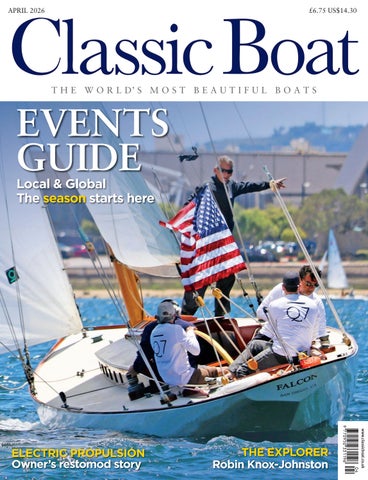
Classic Boat April 2026 sample

Page 1


EVENTS GUIDE

Local & Global

The season starts here

TAKING FLIGHT

Falcon is 100 years old this year and a jewel in the Q Class crown, but her new owner has bigger plans for the Qs. Much bigger

WORDS JAN HEIN

REBUILD PHOTOS

ALISON LANGLEY

ELECTRIC DREAMS

Ihere it was the

driving force

couldn’t find the boat I really wanted. I had looked at a few and in each case the compromises seemed too many. I had noticed a 30ft (9.1m) bare hull for sale and found myself repeatedly returning to the online listing. Eventually, I decided to drive to the Essex coast to inspect it in person, armed with a tape measure and a plastic-ended hammer. The hull proved to be sound, and within a few weeks I had a project on my hands. This was how I discovered Lockheed: no decks, no wheelhouse, no cabin, and no propulsion. For my requirements, at least, she was perfect.

This was my first classic boat and my first restoration, though it was by no means my first project. I had spent the best part of my career designing and deploying complex technical systems on production platforms and drilling rigs for the oil majors. My university degree is in Fine Art Sculpture – a qualification that proved unexpectedly useful when rebuilding a classic wooden boat, as the ability to make things is indispensable.

CELL THEORY

Re-powering forms part of any major restoration;

fabrics, deck hardware, steering gear, and wiring. Decisions had to be made regarding material selection, and what would be painted versus what would be left bright—the traditional boatbuilding term for varnished wood. There were countless lessons to be learned, and I found enjoyment in each of them.

I had no idea of what lay ahead, nor could I have fathomed how profoundly this small boat would change my life. What I did have was a very clear use case in mind for Lockheed. She was to be a sociable weekender on the Thames, with a generous aft deck for entertaining friends, while also being capable of supporting occasional longer voyages of up to 10 days with two people aboard. She would also have electric propulsion.

Propulsion was always going to be electric. In fact, Lockheed was destined to be electric. When she was launched in June 1937, the boating press described her as ā€œa Thames-built cruiser with an unusual power installation.ā€ Fitting her with electric propulsion 86 years later felt entirely in keeping with that tradition.

I began by designing the interior arrangement, using 3D modelling to determine the optimal placement of each element. After several iterations I was satisfied that my requirements had been addressed as effectively as possible. Inevitably, the realities of wooden boat construction necessitated changes as the build commenced and after working alone for six months, it became clear that additional expertise was essential. Expertise and reality management came from Dennis Nissen, a boatbuilder to whom I owe much. Every aspect of the build required consideration. I was responsible for procuring systems for heating, lighting, plumbing, and instrumentation, as well as sourcing components such as

Given my background in electronics and control systems – combined with my complete lack of experience with diesel engines – electric propulsion was also something I could understand and own. I began by designing the propulsion system, using online tools to calculate the power required to move Lockheed through the water. By inputting her length, displacement and other parameters, I was able to generate power-versusspeed curves for various conditions. With these requirements established, I could specify the motor and battery system.

A PAIR OF PODS

Lockheed originally had a single, American six-cylinder Hercules engine. I had concerns about my ability to manoeuvre a single-screw vessel with a full-length keel in confined spaces – reality on the non-tidal Thames. As a wooden boat novice, I sought the advice of John Tough, asking him to inspect the hull and comment on my proposed approach. Among his recommendations was a simple but decisive suggestion: ā€œmake her twin-screw.ā€

I explored several ways of achieving this, including twin propeller shafts, shaft logs, and potentially multiple rudders. However, this approach appeared overly complex, requiring two motors, two controllers, two reduction gearboxes, and duplications of almost everything – consuming valuable internal space.

Drawing on my experience in oil and gas, where many vessels use azimuth thrusters for dynamic positioning, I identified compact, steerable electric pods

CLASSIC EVENTS 2026

Summertime and the living is easy – or so they say. But it’s also regatta season in the northern hemisphere and the quays and pontoons are alive with the sound of tapping halyards and rustling sails as great fleets of yachts emerge from hibernation to shine.

The world of the classic regatta can seem esoteric, but it is a surprisingly broad church and one that is growing in number and popularity. As Jonathan Dyke puts it, ā€œnot that long ago there were, perhaps, three dedicated events; our own Suffolk Yacht Harbour Classic Regatta, the British Classic Week and Falmouth Classics.ā€ Now, as we will see, there are dozens, taking in everything from motorboats and dinghies to rustic working sail regattas such as Looe Luggers, where you might spend the evening sipping on warm ale while discussing the niceties of pilchard fishing and the merits of Stockholm Tar.

The flipside is the wild opulence that is shoreside at Les Voiles de Saint-Tropez. Here, warm ale is replaced by champagne. Great herds of Birkenstock-shod sailors prowl the narrow alleys of the old town at night, their white chinos and monogrammed linen shirts glowing luminous. Meanwhile on the waterfront, a bevvy

of half-naked women draped in jewellery throw shapes on a stage so bedecked in gold that even Donald might blink. There’s nothing funny about the incomparable spectacle on the water though.

For all the diversity and madness, the stars of the show are always the yachts themselves and the vast and varied range of classic events that make up the rich tapestry of the classic boat scene. Summer is the time to fully celebrate this.

Last year was notable for some major UK sailing anniversaries, and this year the Isle of Wight is in the spotlight. Cowes Week will celebrate its 200th year with a special programme of events and a focus on historic and classic racing. Just along the island’s northern coast, the Yarmouth Gaffers Regatta, a more recent addition to the scene, will be celebrating its 30th. In France, the world’s second biggest traditional boat event in terms of participation, the biennial Douarnenez Maritime Festival, turns 40. It’s only beaten only by the quadrennial Brest Festival nearby, next on in 2028. In America, Camden Classics in Maine turns 10; a confident child growing up fast. If there are other anniversaries happening do let us know.

NICO MARTINEZ/PUIG
C/wise from TL: Racing at the Puig Vela; Mariska in the Med; Three Rivers Race on the Broads; Tall ship Morgenster; Fifes and more at the Richard Mille Cup; Classic motorboats in London
RICHARD SIBLEY

TOTALLY RIGGED

Canvas and cordage. Covered

Two things which, when renewed, can do wonders for a boat’s visual appearance and the enjoyment of her owners are her sails and running rigging. As with a fresh coat of antifoul and a topside polish, new sails add a lease of life to a boat and a skip to any owner’s step. New lines do something similar and are, let’s face it, much better to use.

Sails are the most visually conspicuous part of a boat and over time they will, even with the best care, begin to degrade in terms of their appearance and performance, as will ropes.

CORDAGE

Many owners of classic boats are likely to be sensitive about the colours of their ropes and sails, most likely favouring beige or white for their ropes, and white, cream or tan for their sails. A wide variety of beige ropes is now available from most rope manufacturers – including Liros, Kingfisher Yacht Ropes, English Braids, Marlow, Gottifredi Maffioli, Gleistein, FSE Robline, Langman and Cousin - but if all the ropes on your boat are the same colour, you and your crew members (especially the infrequent ones) may have trouble easily distinguishing one from another.

Among the companies addressing that issue are Marlow, Kingfisher and Maffioli, who produce beige ropes with subtle coloured tracers which are

WORDS AND PHOTOS NIGEL SHARP

Clockwise from top left: Century-old, Thames-built rowing skiff Tir Na Nog; Alden schooner in frame before planking began; And partly planked; Deck beams being fitted to Patience; Panacea, built by Ben in 2018; Constance, a more recent new-build; New deck structure around Patience’s cockpit; Ben hard at work on the Alden schooner (and middle) Patience awaiting a new foredeck

Turn static files into dynamic content formats.

CreateĀ aĀ flipbook