FIND YOUR
BRITAIN THE OFFICIAL MAGAZINE
6
TRAVEL CULTURE HERITAGE STYLE
Wonders of Wiltshire
WIN
a five-star stay in a
COUNTRY HOUSE HOTEL
Standing stones & stately homes
TOP CLASS
CHATSWORTH
Palace of the Peaks
The colleges of Cambridge
STAND & DELIVER
Highwaymen through history
NOV/DEC 2021 £4.95
www.britain-magazine.com
Life below stairs
True stories of servants in Britain’s grand houses
The very best of Britain, planned just for you Extraordinary Experiences, Exclusive Access, Expert Guides That’s the Louisa White way to travel. Experience it for yourself. Small Group Tours and Bespoke Journeys by Driver-Guide, Self-Drive, and Rail
LouisaWhite.com
EDITOR'S LETTER
PHOTOS: © IAN DAGNALL/ALAMY/MANCHESTER ART GALLERY/BRIDGEMAN IMAGES/PAUL BARKER/CHATSWORTH HOUSE TRUST
The days may be getting colder, but this issue we bring you warmth, cheer and a dash of festive sparkle to keep the chill of winter at bay. We visit Wiltshire, a county of such celebrated attractions – not least a certain stone circle – that we could have dedicated an entire issue to it (Wonders of Wiltshire, p14); we get into the festive spirit at London’s historic shopping arcades (Beadles & baubles, p57); and we pay a visit to Chatsworth, perhaps Britain’s favourite stately home, which this year celebrates 20 years since its first Christmas opening (The greatest estate, p40). It’s also time to look ahead to future travels; if you’re planning a trip in 2022 be sure to read Capital escapes (p48), our selection of charming and historic towns within easy reach of London. As ever, we also have tales of bygone times to beguile you: from the highwaymen that roamed the roads on dark winter nights (Stand & deliver, p32), to the servants who kept Britain’s grand stately homes running like clockwork (Life below stairs, p24). Enjoy the issue!
48
Lewes, East Sussex
CONTENTS VOLUME 89 ISSUE 6
FEATURES
Natasha Foges, Editor For the best articles straight to your inbox, sign up to our free BRITAIN newsletter at www.britain-magazine.com/newsletter @BRITAINMAGAZINE
14
WONDERS OF WILTSHIRE
24
LIFE BELOW STAIRS
FACEBOOK/BRITAINMAGAZINE @BRITAIN__ MAGAZINE PINTEREST/BRITAINMAGAZINE
BRITAIN
STAND & DELIVER
40
THE GREATEST ESTATE
48
CAPITAL ESCAPES
THE OFFICIAL MAGAZINE
6
TRAVEL CULTURE HERITAGE STYLE
Wonders of Wiltshire
WIN
a five-star stay in a
COUNTRY HOUSE HOTEL
Standing stones & stately homes
TOP CLASS
CHATSWORTH
Palace of the Peaks
The colleges of Cambridge
STAND & DELIVER
Highwaymen through history
JAN 2022 USA&CAN $7.99
www.britain-magazine.com
OFC_BRT_ NovDec21_new.indd 1
Life below stairs
True stories of servants in Britain’s grand houses 28/09/2021 11:35
www.britain-magazine.com
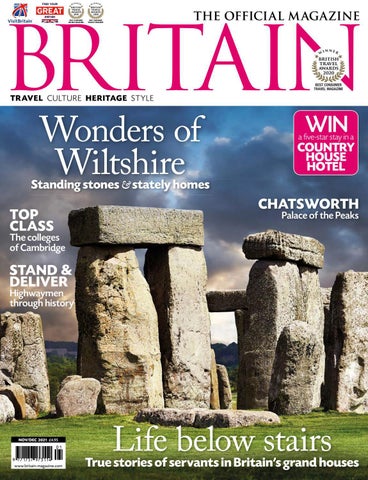
Cover image: Stonehenge, part of a UNESCO World Heritage Site in Wiltshire © funkyfood London - Paul Williams/Alamy
The ‘downstairs’ quarters of historic houses once bustled with the servants that worked there. We discover what a servant’s life was really like
32
FIND YOUR
32
With its timeless landscape of chalk hills and gentle valleys, and an array of chocolate-box villages and stately manors, Wiltshire is brimming with charm
The romantic image of highwaymen endures to this day, but what’s the real story behind these rugged rogues and their infamous exploits? Chatsworth has beguiling good looks, an extraordinary art collection and a remarkable history We pick the best places within easy reach of London for a historic day-trip
40
FEATURES 57 65
REGULARS 6
LETTERS
9
THE BULLETIN
23
COMPETITION
77
CITY GUIDE: CAMBRIDGE
82
LAST WORD
www.britain-magazine.com
BEADLES & BAUBLES London’s elegant and historic arcades are atmospheric places to shop, especially when festooned with festive trimmings at Christmas
WHITBY How did this well-to-do Victorian resort town become the inspiration for one of Gothic fiction’s darkest tales?
VERDANT VALLEY
Advertising Group Sales Director Catherine Chapman Head of Sales Operations Jodie Green Group Advertising Manager Natasha Syed
The Wye Valley was Britain’s original tourist destination, and there’s more to explore than ever
Publishing Chairman Paul Dobson Managing Director James Dobson Publisher Simon Temlett Group Editor Steve Pill Chief Financial Officer Vicki Gavin EA to Chairman Sophie Easton Subs Marketing Executive Bret Weekes For VisitBritain Sarah Wagner Printed in England by William Gibbons Ltd Production All Points Media
68
Share your stories and memories of Britain, and your thoughts on the magazine
SUBSCRIPTION ENQUIRIES USA and Canada: www.britsubs.com/britain Tel: 1-888-321-6378 (toll free) Email: btncustserv@cdsfulfillment.com Post: BRITAIN, PO Box 37518, Boone, IA 50037-0518 (USA only); OR BRITAIN, 1415 Janette Avenue, Windsor, Ontario N8X 1Z1 (Canada only) UK and Rest of World: www.subscription.co.uk/chelsea/help Tel: +44 (0) 1858 438 878 Email: britain@subscription.co.uk Post: BRITAIN, CDS Global, Sovereign Park, Market Harborough, LE16 9EF, UK
Lunar landings, masonry miracles and 18th-century society in the frame Your chance to win a two-night stay at a five-star hotel near Bath Great minds and beautiful architecture meet in the historic university city
Did you know you can manage your subscription online? Oversee your print and digital subscriptions online today simply by signing up at https://www. subscription.co.uk/chelsea/solo/. Stay up to date with the latest issues, update your personal details, and even renew your subscription with just a click.
Daniel Hyde, Director of Music at King’s College, Cambridge, takes us behind the scenes as he prepares his choir for their iconic radio broadcast on Christmas Eve
Annual subscription rates (6 issues) UK – £36; USA and Canada – US $41.70 Australia and New Zealand – AUD $84 Rest of World – £42 www.britain-magazine/subscribe Back issues www.chelseamagazines.com/shop News distribution USA and Canada: NPS Media Group, 2 Corporate Drive, Suite 945, Shelton, CT 06484. UK and Rest of World: Seymour, 2 East Poultry Avenue, London EC1A 9PT, UK Tel: +44 (0)20 7429 4000
IN THIS ISSUE
SCOTLAND
CRAGSIDE p24
WHITBY p65
IRELAND
CHATSWORTH p40
WA L E S
77 4 BRITAIN
BRITAIN is the official magazine of VisitBritain, the national tourism agency. BRITAIN is published by The Chelsea Magazine Company Ltd, Jubilee House, 2 Jubilee Place, London SW3 3TQ Tel: 020 7349 3700 Email: info@britain-magazine.com Editorial Editor Natasha Foges Art Editor Clare White Production Editor Jenny Rowe
CHEPSTOW p68
ENGLAND
CAMBRIDGE p77
BRITAIN (ISSN 2396-9210) (USPS 004-335) is published bi-monthly by The Chelsea Magazine Company, Jubilee House, 2 Jubilee Place, London SW3 3TQ , UK Distributed in the US by NPS Media Group, 2 Enterprise Drive, Suite 420, Shelton, CT 06484. Periodicals postage paid at Shelton, CT and other mailing offices. POSTMASTER: Send address changes to BRITAIN, PO Box 37518, Boone, IA 50037-0518 Publications Mail Agreement Number 41599077, 1415 Janette Ave, Windsor, ON N8X 1Z1. Canadian GST Registered Number 834045627 RT0001 © The Chelsea Magazine Company Ltd., 2021. All rights reserved. Text and pictures are copyright restricted and must not be reproduced without permission of the publishers The information contained in BRITAIN has been published in good faith and every effort has been made to ensure its accuracy. However, where appropriate, you are strongly advised to check prices, opening times, dates, etc, before making final arrangements. All liability for loss, disappointment, negligence or damage caused by reliance on the information contained within this publication is hereby excluded. The opinions expressed by contributors to BRITAIN are not necessarily those of the publisher or VisitBritain.
STONEHENGE p14 RYE p48
www.britain-magazine.com
PHOTOS: © GUY BELL/ALAN COPSON PICTURES/ALAMY/JUSTIN FOULKES/4CORNERS IMAGES
57
68
THE OFFICIAL MAGAZINE
WORLD & ANCIENT COINS World Records Set at Heritage Auctions The Two Most Valuable British Coins Ever Sold at Auction
Edward VIII gold Proof Pattern 5 Pounds 1937 PR67 Ultra Cameo NGC Highest Price Realised for a British Coin in History – March 2021
Realised $2,280,000
Victoria gold Proof “Una and the Lion” 5 Pounds 1839 PR66H Ultra Cameo NGC Second-Highest Price Realised – August 2021
Realised $1,440,000 Accepting consignments year-round to tailored events presented to a global audience of more than 1.5 million bidder-members. Generous cash advances and purchase offers available upon request. Inquiries: Cole Schenewerk | Managing Director, Heritage London +44 (0)207 493 0498 | UK@HA.com DALLAS | NEW YORK | BEVERLY HILLS | SAN FRANCISCO | CHICAGO | PALM BEACH LONDON | PARIS | GENEVA | AMSTERDAM | HONG KONG
BP 20%; see HA.com 62087
Always Accepting Quality Consignments in 40+ Categories Immediate Cash Advances Available 1.5 Million+ Online Bidder-Members
YOUR LETTERS
Write to us with your thoughts on the magazine and memories of Britain
A WARTIME SNAPSHOT
STAR LETTER WHAT’S IN A NAME? Our star letter wins a copy of London Clay, a fascinating new book exploring the secrets beneath the city (Doubleday, £20). www.penguin.co.uk
I have just finished the latest issue [Vol 89 Issue 4] and really appreciated the article on Washington Old Hall, the ancestral home of the Washington family. I am the manager of the Mary Washington House in Fredericksburg, Virginia, the final home of George Washington’s mother. My staff and I love reading about English history and frequently share back issues of
BRITAIN magazine. The tidbit about the family surname originally being Hertburn was fascinating. I have to admit that Washington has a better ring to it than Hertburn. Michelle L. Hamilton, Fredericksburg, Virginia, USA
I am enclosing a photo with a message on the rear that my father Mario DeLibero sent to my mother during his stay in England in 1943. I am not sure where in England this took place and sorry I didn’t get more of his wartime experiences. I only wish I would be able to share this photo with Mrs Webb’s family [the message on the rear is, That’s Mrs Webb and the officer on the right is a British captain]. I do know that he was in England prior to going to France about one month after D-Day. I think this photo exemplifies the close bond between England and the United States during those trying times. John Peter DeLibero, Westport, Connecticut, USA BRITAIN replies: If any readers can provide further information, please let us know!
A GLADIATORIAL STATUE
LEGENDARY SISTERS When I saw the Mitford sisters mentioned on the cover of the September issue [Vol 89 Issue 4], I couldn’t wait to read the accompanying article (Sisters in Scandal). For the last year and a half, I’ve immersed myself in books, articles and YouTube videos about these six fascinating women and their extraordinary lives. Thank you for providing another look at the Mitford legend. Linda Alkire, Washington, Pennsylvania, USA
WRITE TO US! By post: Letters, BRITAIN, The Chelsea Magazine Company, Jubilee House, 2 Jubilee Place, London, SW3 3TQ Via email: editor@britain-magazine.com FOLLOW US! Twitter: @BritainMagazine Instagram: @britain_magazine Facebook: www.facebook.com/BritainMagazine Pinterest: www.pinterest.com/britainmagazine
6
BRITAIN
www.britain-magazine.com
PHOTOS: © NATIONAL TRUST IMAGES/CHRIS LACEY/NORTHSCAPE/ALAMY
My wife and I enjoy our travels to the British Isles and have been there some thirty times over many years. In visiting the numerous places of interest, we noticed that in many locales we have seen the same statue that you have on page 71 of the July issue [Vol 89 Issue 3]. We wondered if you could be kind enough to provide the name of the sculpture and perhaps the sculptor for us? We have been faithful subscribers for many years and derive great enjoyment from your magazine Richard and Elizabeth Welch, Annandale, Virginia, USA BRITAIN replies: This beautiful statue at Grimsthorpe Castle is attributed to John van Nost the Elder and is a copy of the Borghese Gladiator, a Roman marble sculpture.
CHANNEL ISLANDS
Discover your own island adventure. Embrace our islands beauty and breathtaking landscape. Let the crisp sea air refresh you as you explore our stunning coastline and appreciate the simple wonders of nature. Come, see and discover the unique island that's closer than you think!
Go to visitalderney.com or call 01481 822333 For latest COVID-19 travel guidance go to GOV.GG
The
BULLETIN Lunar landings, masonry miracles & 18th-century society in the frame ART
IMAGE: THE NATIONAL GALLERY, LONDON
Compare and contrast Featuring over 60 of William Hogarth’s works, brought together from private and public collections around Europe and North America, Tate Britain’s new exhibition Hogarth and Europe (3 November 2021 to 20 March 2022) will present the famously satirical artist in a new light. His celebrated 'modern moral' paintings, such as Marriage A-la-Mode (1743) and Gin Lane
(1751), will be exhibited alongside works by famed European artists, including Jean-Siméon Chardin in Paris, Pietro Longhi in Venice, and Cornelis Troost in Amsterdam. Together they will reveal how artists in Britain and abroad were responding to the 18th century’s increasingly innovative, opportunistic and indulgent society. www.tate.org.uk
HISTORY / NEWS / REVIEWS / INSPIRATION
H E R I TAG E
Local triumph
EVENT
Circus extravaganza The world-class performers of Circus 1903 are limbering up to return to London’s Southbank Centre for three weeks this season (from 16 December). The extraordinary show evokes the glamour and drama of the golden age of the circus with awe-inspiring performances by strongmen, contortionists, acrobats, musicians, knife-throwers and much more. Plus, sensational puppetry from the awardwinning team behind War Horse puts elephants back in the ring as never seen before. You won’t want to miss this, now a mainstay on the London stage over the festive period. www.circus1903.com
The tallest three-sided obelisk in the world, built to commemorate the Duke of Wellington following his victory at the Battle of Waterloo in 1815, has successfully been restored. The monument, located just outside Wellington in Somerset – after which the Duke took his name – presented a major challenge, having become dilapidated due to its exposed position. The National Trust was able to raise the £3.1million required – thanks in large part to the passionate fundraising efforts of locals – and believes the monument is now possibly in better condition than when it was first completed. www.nationaltrust.org
SHOPPING
S TAT E LY H O M E
Regency romance From 25 November until 2 January you can enter the real-world equivalent of TV sensation Bridgerton at Belvoir Castle in Leicestershire. One of the finest examples of Regency architecture in Britain, Belvoir’s lavish interiors will sweep visitors back in time to the festivities of yesteryear; look out for a grand Regency Christmas tree and a spectacular Kissing Bough. Meanwhile, from 26 November until 1 January guests can follow the new Enlightened Light Trail through the Rose Garden, Japanese Garden and Spiral Walk, passing magical ‘talking trees’, interactive stepping stones and illuminated fountains. www.belvoirchristmas.com
Hip hip hooray
10
BRITAIN
IMAGES: © JAMES BILLINGS/CHARLOTTE GRAHAM
Aspinal is a quintessential British luxury lifestyle brand, whose coveted leather goods exude English style and sensibility. We love its Union Jack-emblazoned Brit 5oz Classic Hip Flask (£65), which can be personalised with engraved initials for an extra fee. Hand-bound in full-grain leather using a traditional leather marquetry technique, it is small enough to slip inside a coat pocket during cold winter walks in the country. Just pour in five ounces of your favourite tipple and take your celebrations into the great outdoors. www.aspinaloflondon.com www.britain-magazine.com
I N S TA L L AT I O N
Out of this world Set between the two buildings of the Old Royal Naval College in Greenwich, London, the Queen’s House was England's first Luke Jerram’s touring artwork, Museum of the Moon, reaches its classical building, built in the 17th-century by architect Inigo southwest phase this season. Throughout autumn (12 October Jones for Anne of Denmark, as a gift from her husband, James I. to 3 November), you can see the giant, awe-inspiring 3D model Four hundred years later, the splendid royal villa is due to of the moon suspended from the nave at Wells Cathedral in reopen on 11 October following extensive renovations, which Somerset, where the first British astronaut, Helen Sharman, will have seen an overhaul to the galleries housing its famous speak on 13 October. Seven metres in diameter and featuring collection of art – including key works by Gainsborough and detailed NASA imagery of the moon’s surface, the installation Hogarth – and original features, such as the Tulip Staircase.
If that’s not reason enough to visit, it is likely to be the home of the historic Armada portrait of Queen Elizabeth I (pictured incorporates surround sound composition created by BAFTA and above), one of the most iconic images of any British monarch. Ivor Novello award-winning composer Dan Jones. During winter The painting has been the subject of intensive fundraising (19 November to 26 December), the Moon will move to Bath to save it for the nation since it was put up for sale. With the Abbey, where visitors can enjoy Christmas carols, storytelling and funding target due to be hit this summer, the Queen’s House moon-gazing with the Bath Astronomers in the Abbey’s newly will be the perfect place to view the portrait: Elizabeth I was restored worship space. born at Greenwich Palace in 1533 and Queen’s House is the last www.wellscathedral.org.uk; www.bathabbey.org; www.my-moon.org remaining part of the palace complex. www.rmg.co.uk
HISTORY / NEWS / REVIEWS / INSPIRATION
READING CORNER Take inspiration for your British adventures from these great reads Women in Medieval England by Lynda Telford (Amberley, £10.99). A fascinating exploration of the status of women both before and after the Norman Conquest.
Seasons at Highclere by the Countess of Carnarvon (Century, £30). A lush tome celebrating gardening and cooking through the year at the iconic stately home.
Claridge’s pour 53,714 cocktails per year, 13,604 of which are martinis
RECIPE
Claridge’s Bar Martini The brand-new Claridge’s – The Cocktail Book (Mitchell Beazley, £25; www.octopusbooks.co.uk) is a veritable tome of cocktail recipes for the discerning bartender and comes just in time to get some practice in before Christmas celebrations begin. Featuring more than 500 cocktail recipes from the esteemed London hotel’s archives, it encompasses classics from every period in its history – which began in 1856 – as well as some heady new inventions.
I n g re d i e n t s : M A K E S 1 D R I N K 3 sprays of Noilly Prat Original Dry Vermouth 125ml (4fl oz) Claridge’s London Dry Gin or Konik’s Tail Vodka (or your preferred gin or vodka), frozen Lemon twist or olive, to garnish
Method: This is a much drier version of the classic Martini and one that guests at Claridge’s enjoy the most. The coupe and the gin or vodka should be kept in the freezer at –19C (–2F) and the garnish prepared first to ensure the drink is served as cold as possible. When you’re ready to serve, collect the glass from the freezer and spray with the vermouth. Pour in the gin or vodka, garnish with a lemon twist or an olive, and drink immediately.
12
BRITAIN
100 Paintings from the Collections of the National Trust by Dr John Chu and David Taylor (National Trust, £10). Curators spotlight 100 gems from over 13,000 works. The Bloodless Boy by Robert J Lloyd (Melville House, £18.99). This gripping literary thriller is set in 17th-century Restoration London, with characters based on real-life figures.
The Tudor Socialite: A Social Calendar of Tudor Life by Jan-Marie Knights (Amberley, £20). A chronicle of Tudor high society – from weddings to funerals – in diary format.
www.britain-magazine.com
CJ_BritMag_Half_PgAd_3.9.21.qxp_Layout 1 3/9/21 6:12 PM Page 1
SCOTLAND
— 2022 ESCORTED TOURS — British Isles
Scotland: Dumfries and Galloway England: Hadrian’s Wall, Lake District Wales: Snowdonia National Park, Welsh Castles Ireland: Dublin, the magnificent Neolithic site at Knowth in Bru Na Boinne, Belfast
May 5-19, 2022 • 14 Nights • $5,995
19th Annual Outlander Tour® Based on the book series by Diana Gabaldon. Time travel back to the 18th-century Highlands, where history and fantasy come face to face. See secret places & magical sites off the beaten path.
June 23-July 4, 2022 • 11 Nights • $4,995 October 2-11, 2022 • 9 Nights • $4,195
Deluxe escorted tours • 16-guest maximum
Western & Northern Isles of Scotland
A combination tour of the popular Lords of the Isles and Viking Treasure. Skye, Lewis, Harris, Orkney, the Northwest and Northeast coasts, and the Highlands. Includes the Royal Edinburgh Military Tattoo.
August 11-27, 2022 • 16 Nights • $5,995
703.941.6455 • www.CelticJourneys.us • Email: Judy@celticjourneys.us
www.britain-magazine.com
BRITAIN 13
WILTSHIRE
W An aerial view of Stonehenge Opposite: Castle Combe in Wiltshire, often voted the prettiest village in England
14
BRITAIN
ONDERS OF WILTSHIRE With its timeless landscape of chalk hills and gentle valleys, and an array of chocolate-box villages and stately manors, Wiltshire is brimming with charm WORDS JANE GIFFORD
www.britain-magazine.com
www.britain-magazine.com
BRITAIN
15
S Top right: Salisbury Cathedral, which boasts the tallest spire in Britain Bottom right: Lacock Abbey in Lacock village on the River Avon
16
BRITAIN
ituated in England’s rural West Country, Wiltshire is made up of rivers, medieval towns and villages, high plains and rolling downs, topped with old drovers’ roads where you can walk for miles under wide-open skies. This verdant county encompasses numerous neolithic monuments, iron age hill forts and tumuli, the ancient burial mounds that dot the skyline all over the county. Picture-perfect Cotswold manor houses, historic churches and rural pubs abound. You can spend hours relaxing on a riverbank, where the water is clear and fast-moving, with just the rustling of the wind in the willows and the occasional birdcall to punctuate the silence. Despite the prevailing peace, some of Britain’s most iconic and best-loved visitor attractions are in Wiltshire, not least the UNESCO World Heritage Site of Stonehenge and Avebury. Built around 5,000 years ago, these prehistoric megaliths and stone circles on Salisbury Plain are shrouded in mystery to this day. One of the most complete stone circles in existence from this time, Stonehenge dominates the landscape. Learn all about the stones in the visitor centre – or at least examine the many theories that attempt to explain their existence
PHOTOS: © JON ARNOLD/GAVIN HELLIER/AWL IMAGES/NATIONAL TRUST IMAGES/JAMES DOBSON/MAURIZIO RELLINI/4CORNERS IMAGES/ILLUSTRATION: © LAURA HALLETT
wiltshire
www.britain-magazine.com
PHOTOS: © NATIONAL TRUST IMAGES/JAMES DOBSON/CHRISTOPHER NICHOLSON/ALAMY/JUTSIN FOULKES/4CORNERS IMAGES
wiltshire
18
BRITAIN
www.britain-magazine.com
Hidden among the gentle wooded hills at the head of the River Stour are the lakeside walks and sweeping lawns of beautiful Stourhead
Clockwise, from left: The Palladian Bridge in the tranquil surroundings of Stourhead; the Blue Parlour within Lacock Abbey; the Westbury White Horse is one of 13 chalk figures in Wiltshire
– then stroll across the Plain to see these world-famous stones close-up. At the summer and winter solstices the sun rises on opposite sides of the monument, framed between the upright stones, making this a popular destination for modern druids. Avebury’s stone circle and avenue are thought to be even older than Stonehenge but the stones here have been much relocated, especially by Alexander Keiller, who bought the site in the late 1930s when it had fallen into disrepair. Many old Wiltshire buildings contain large stones taken from the ancient stone constructions here. Salisbury, Wiltshire’s only city, is an easy drive away. It boasts a fabulous medieval cathedral, built 1220-58, which houses the best-preserved Magna Carta and holds the record for the tallest spire in Britain. There are some fine old houses on Cathedral Close, while the Market Place hosts a Charter Market dating back to medieval times. For a change of pace, seek out Heale House and its eight acres of riverside gardens, hidden away among the Downs above Salisbury. The house is little changed since King Charles II hid from the Roundheads here in 1651. Snowdrop Week is a treat in February, when the gardens are briefly open to winter visitors. Nearby Wilton House has been the family home of the Earl and Countess of Pembroke for over 460 years. The house stands on the site of a 9th-century nunnery founded by Saxon King, Alfred the Great. The neighbouring town of Wilton has a history going back two thousand years and lays claim to the title ‘Ancient Capital of Wessex’. Don’t miss the Italianate Church of St Mary and St Nicholas,
www.britain-magazine.com
with its glittering mosaiced apse. ‘Wilton’ is also synonymous with luxury woollen carpets: in these parts there was always plentiful water for the mills and lots of excellent pasture for sheep. Indeed, you will discover that most Wiltshire towns and villages have a river at their heart: rivers which drove the mills, which made the area rich. Confusingly, there are two rivers with the name Avon in Wiltshire. One rises near Malmesbury and flows west through Bradford-on-Avon. The other rises in the Vale of Pewsey, where two tributaries, also both called the Avon, join forces and flow south towards Salisbury. Given that ‘avon’ is an old Celtic word for river, there are several waterways in Wiltshire with the name ‘River River’. Two of Wiltshire’s most celebrated villages are rendered even prettier thanks to their riverside setting: Lacock on the River Avon (that’s the Malmesbury Avon), where William Henry Fox Talbot famously discovered the negativepositive photographic process at Lacock Abbey; and charming Castle Combe, where the By Brook, a tributary of the Avon, glides under the old bridge. These two villages may be familiar from period costume dramas and films – Dr Dolittle and War Horse featured Castle Combe, while Lacock was used in Cranford, Pride and Prejudice and the Harry Potter films. Another cinematic location, Stourhead, stands further south. It has had starring roles in many dramas, including the recent Bridgerton and The Pursuit of Love. Hidden among the gentle wooded hills at the head of the River Stour are the lakeside walks and sweeping lawns of one BRITAIN
19
wiltshire
THE PLANNER GETTING THERE The Great Western Railway covers most locations, served by buses and coaches from main towns like Swindon, Bradfordon-Avon, Westbury, Salisbury, Marlborough and Chippenham. www.gwr.com WHERE TO STAY In Salisbury, stay at the four-star White Hart Hotel, a 17th-century central coaching inn in the heart of the city; or try a country pub with rooms. The Bell at Ramsbury has comfortable rooms and a celebrated restaurant whose food and drink is sourced from the Ramsbury Estate; while the Red Lion in Pewsey Vale offers Michelin-starred dining and five riverside rooms with private balconies overlooking the water. For a cottage stay with character, rent Grade II-listed Rowley Cottage in the grounds of Iford Manor. www.mercure.accor.com; www.thebellramsbury.com; www.redlionfreehouse.com; www.ifordmanor.co.uk WHERE TO EAT & DRINK There are numerous excellent pubs in Wiltshire. Try The Bell on the Common in the village of Broughton Gifford near Bradford-on-Avon, where a large village green, swaying with long grass and wildflowers and complete with a duckpond, hosts summer cricket matches. On the Kennet & Avon Canal in the village of Avoncliff, the Cross Guns has a fascinating history dating back to the mid-15th century and idyllic views. In the picturesque Woodford Valley a few miles north of Salisbury, the Bridge Inn has a garden overlooking the Avon and a cosy interior warmed by a wood burner. www.bellonthecommon.co.uk; crossgunsavoncliff.com; www. bridgeinn-woodfordvalley.co.uk
i 20
FURTHER INFORMATION www.visitwiltshire.co.uk
BRITAIN
www.britain-magazine.com
PHOTOS: © MARIANNE CARTWRIGHT-HIGNETT/GEOGPHOTOS/ALAMY/WWW.VISITWILTSHIRE.CO.UK
PHOTOS: © ROGER HARRIS/HOUSE OF LORDS
wiltshire
Clockwise, from left: The Waterfront pub at Pewsey Wharf along the Kennet and Avon Canal; the Great Terrace at Iford Manor; the mosaic apse in the Italianate Church of St Mary and St Nicholas in Wilton
of the most beautiful and famous gardens in Britain, now cared for by the National Trust. Somehow the gardens manage to absorb thousands of visitors each year and still retain their serenity. Not far away, it’s worth rising early for a surreal experience on the Longleat Estate as the lions in the Safari Park – safely penned in – join in the morning chorus of birdsong. Longleat House itself is one of the best examples of Elizabethan architecture in the country and has been home to 15 generations of the Thynne family. In winter (this year 5 November to 8 January), a spectacular light show illuminates the grounds after dusk. Wiltshire holds an array of scenic market towns. Best known of these is affluent Marlborough in the northeast of the county, famous for its school and the characterful buildings that line its broad high street. Sleepy Malmesbury further north was once a place of major importance. The first King of England, King Athelston, grandson of Alfred the Great, made the town his capital in 925. The abbey with its impressive Norman porch dates from 1180. Neighbouring Abbey House, part 13thcentury, part Tudor, has beautiful landscaped gardens on the River Avon with some unexpected horticultural twists. Bustling Bradford-on-Avon nestles on the banks of the Avon. Part 13th-century, part 17th-century, the old bridge
www.britain-magazine.com
spanning the river is the centrepiece of the town, featuring an 18th-century ‘lock up’ at one end, where prisoners would be held before they went before a magistrate. In the neighbouring Frome River Valley, medieval Iford Manor is the perfect English country house, surrounded by glorious gardens. Renowned architect and garden designer Harold Peto travelled the world collecting ancient relics, and eventually chose Iford as the perfect location in which to finally settle down and display his archaeological treasures in 1899. The current owners, the Hignett family, organize a host of events, from evening champagne tours to a summer opera festival. Once away from the main tourist sights you stand a good chance of getting lost – something that can be avoided by hiring a narrowboat. Enjoy slowly gliding through the countryside along the Kennet and Avon Canal. The 29 lock-gates at Caen Hill near Devizes might present a challenge but the experience will be memorable. Honeystreet, not a road but the name of a tiny village on the canal, is the perfect place to moor up, with a view of the White Horse on Pewsey Downs and refreshments at the Barge Inn, built in 1810. Look out for the mystical crop circles that dot the Vale of Pewsey in the summer. The Wiltshire countryside invites you to stop a while, spread out a blanket and have a picnic, perhaps with a BRITAIN
21
wiltshire
22
BRITAIN
MOONRAKER COUNTRY Wiltshire natives refer to themselves as ‘moonrakers’: a name originating from the end of the 18th century at a time when smuggling was big business, and French brandy would pass through the county on its way from the south coast to the Midlands. Legend has it that one night the excise men caught the smugglers raking out contraband hidden in a village pond. Aware that ‘towny types’ considered all those with a Wiltshire accent to be stupid, they laid it on thick and pointing to the moon’s reflection in the water, made out that they were attempting to rake out a cheese. Feeling greatly superior, the excise men left the yokels to their madness.
For more on Stonehenge and other mystical sites in Wiltshire, visit www.britain-magazine.com www.britain-magazine.com
PHOTOS: © JASON HAWKES/WWW.JASONHAWKES.COM
Above: Longleat House is set within 900 acres of landscaped grounds
view of one of Wiltshire’s white horses, carved out of the chalky hillsides. From March through to September the lanes are a paradise of wildflowers. Cowslips and orchids, wild roses and honeysuckle mark the ebb and flow of the seasons. Wisteria blooms in cottage gardens in spring, old-fashioned English roses in summer. Hares box in the fields in March and in winter long avenues of trees stand out against the frosty Plain. So if simply pottering about – known locally as ‘going for a bimble’ – appeals, then Wiltshire will not disappoint. Half the fun lies in the accidental detours, where hours of gentle pleasure await.
COMPETITION
WAIN LUXURY STAY AT MAGNIFICENT ocated near the historic city of Bath, Lucknam Park is a stunning Palladian mansion dating from 1720. Set in 500 acres of listed parkland and beautiful gardens, Lucknam Park, a member of the Pride of Britain Hotels collection of 50 luxury hotels, has been lovingly restored to the elegance and style of a bygone era. Arriving at the hotel, you could be forgiven for imagining you’d slipped into the pages of a Jane Austen novel. A mile-long avenue of beech and lime trees leads the way to the columned entrance of the refined honey-stone manor, one of England’s finest hotels. The grand Regencystyle interiors make a stay here a treat, and Lucknam Park also boasts two tempting dining options – Michelin-starred Restaurant Hywel Jones and the more casual Brasserie for all-day dining, while the sunny terrace makes a scenic spot for afternoon tea in fine weather. One lucky winner and their guest will win a two-night stay in one of Lucknam Park’s 43 individually designed rooms, which are sumptuous, stylish and dotted with antiques. The prize also includes a lavish breakfast each morning and dinner one evening. You could while away your time relaxing in the comfort of your room or strolling the www.britain-magazine.com
grounds, but the hotel has further delights in store: book an energising massage at the award-winning spa, hone your tennis or croquet skills, or take a lesson at the equestrian centre, home to 35 glossy horses. There’s plenty to entice you beyond the hotel’s grounds too: explore historic Bath, see Stonehenge, or take a scenic driving tour of the Cotswolds. www.lucknampark.co.uk TERMS AND CONDITIONS
Closing date for entries is 12pm GMT 17 January 2022. The prize is for two people sharing a double or twin en-suite room and is subject to availability. The prize is valid for 6 months, excluding weeks with UK bank holidays, Valentine’s and Easter weekend. Travel, meals, drinks and extras other than those featured in the prize are not included. The prize is not transferable and there is no cash alternative.
HOW TO ENTER For your chance to win this fantastic prize go to www.britain-magzaine. com/competitions/lucknampark to apply online or fill in the coupon below with the answer to the following question: Q: How many horses are there in the hotel’s equestrian centre? a) 5 b) 20 c) 35
ENTRY FORM SEND YOUR COUPON TO: US and Canada readers – Lucknam Park Competition, BRITAIN magazine, PO Box 207, Des Moines, IA 50301, US UK and Rest of World readers – Lucknam Park Competition, BRITAIN magazine, The Chelsea Magazine Company, Jubilee House, 2 Jubilee Place, London SW3 3TQ , UK My answer: Name: Address:
✁
L
LUCKNAM PARK
Postcode: Tel no:
Email:
Please tick if you are a subscriber of BRITAIN magazine ■ Please tick if you are happy to receive relevant information about new products or services from Lucknam Park and Pride of Britain Hotels via email ■ or post ■ , and/or The Chelsea Magazine Company via email ■ , post ■ , or phone ■
stately homes
The New Kitchen at Erddig in Wrexham Right: Livery greatcoats, once belonging to the footman, hang in the Butler's Pantry at Erddig
24
BRITAIN
www.britain-magazine.com
PHOTOS: © NATIONAL TRUST IMAGES/ANDREAS VON EINSIEDEL/ARNHEL DE SERRA
Life Below Stairs
The ‘downstairs’ quarters of historic houses once bustled with the servants that worked there. With a Downton Abbey sequel in the works, we discover what a servant’s life was really like WORDS FELICITY DAY
www.britain-magazine.com
BRITAIN
25
stately homes Medieval pilgrims prayed at a shrine at Winchester Cathedral
PHOTOS: © NATIONAL TRUST IMAGES/NADIA MACKENZIE/ANDREW BUTLER/ANDREAS VON EINSIEDEL
Left: The cosy Housekeeper's Room at Uppark, West Sussex
I
f you visit Erddig House near Wrexham, North Wales, you don’t enter by the front door, into a grand and stately hallway, and your tour won’t begin with a glimpse at the lives of the Yorkes, owners and resident squires for more than two centuries. No, instead you start in the servants’ quarters, winding through the ‘downstairs’ rooms and peeping into the scullery, the servants’ hall and housekeeper’s room – and fittingly, really, since no country house could function, no wealthy family could host their shooting weekends and summer garden parties, without a team of servants working hard behind the scenes. “Dependent on the size of the house, or indeed wealth of the family, some estates employed hundreds of people, working both inside and outside of the house,” explains National Trust curator Helen Antrobus. And as at the fictional Downton Abbey, not only did they employ them, but house them, too – in attic bedrooms and estate cottages. In houses belonging to the landed gentry, like Erddig, however, numbers of indoor servants were usually more modest by the early 20th century – the period in which Downton is set. Mr and Mrs Yorke had between 12 and 15 servants, their cook doubling as housekeeper; while at Uppark House in West Sussex there were just nine indoor servants by 1901, down from 15 twenty years earlier. In other respects, however, life in service in a large country house was not much changed from its Victorian heyday. ‘Downstairs’ there was still a strict hierarchy. “As in
26
BRITAIN
Downton, the housekeeper and butler would have held a considerable amount of authority,” confirms Helen. Along with the lady’s maid, valet and cook, they often ate separately from the lower servants who were under their supervision – either at another table, or as at Uppark, in the steward’s hall. They also had their own spaces in which to work: the butler, a pantry where he could tackle tasks from polishing the silver to organising sleeping arrangements for weekend parties; and the housekeeper, a room where she could manage everything from the cleaning rotas to the checking of the household linen, stored at Uppark inside one of her cupboards. It was the butler and housekeeper, along with ladies’ maids, valets and cooks, who had the most contact (and conversation) with the family ‘upstairs’ – indeed, many junior servants rarely, if ever, saw their employers, or their luxurious living spaces. “The design of many National Trust properties emphasises the lack of interactions,” explains Helen. “They were built to keep the two halves of the house separate. With back staircases, passages and separate entrances, a servant was meant to be a rare sight in the grand halls and drawing rooms.” At Uppark, the staff once moved unseen from the basement rooms to the kitchens and dairy via underground tunnels. Working out of sight required early starts, with housemaids usually rising first, probably between 5am and 6am, to clean and lay fires before the family were up. Many servants spent much of the rest of the working day www.britain-magazine.com
stately homes
Clockwise, from this image: The Scullery at Erddig; the brass servant's bells at Erddig; Uppark House as seen from the dairy; the Housekeeper's Room at Erddig www.britain-magazine.com
BRITAIN
27
stately homes
28
BRITAIN
www.britain-magazine.com
stately homes
PHOTOS: © NATIONAL TRUST IMAGES/ANDREAS VON EINSIDEL/NADIA MACKENZIE
Left: The Butler's Pantry at Cragside, Northumberland Above: The Back Staircase and the South Landing 'upstairs' at Erddig
www.britain-magazine.com
below stairs, their employers relying on sprung bells – operated by a network of wires and pulleys around the house and placed in a prominent position in the servants’ quarters – to summon them as and when they were needed, which could be at any time. To be in service was to be almost constantly on call, though in larger houses servants might enjoy a couple of hours of free time in the afternoon, in addition to the usual scheduled half-day off. They generally fared far better than lone maids, or teams of three or so servants working in small households, who made up the majority of the more than 1.4 million Britons in domestic service in the Downton era. Despite moving around in the shadows, country house servants were in a position of considerable trust: not only privy to all the goings-on in their employer’s house, but in charge of precious family heirlooms. Something as simple as a spring-clean could have disastrous consequences, as at Erddig in 1903, when the butler – admittedly ‘not too sober’ at the time – mishandled a chandelier, which crashed to earth and ‘broke to atoms’. It’s not known whether he kept his job, but quite possibly – the Yorkes were known to be benevolent employers, if not high-paying ones. Housemaid Ena Davies, who worked for them in the 1920s, remembered them giving the servants half a crown each to attend the fair, and purchasing them tickets for local dances. Another former maid recalled being nursed through scarlet fever by her mistress. At Erddig, too, the servants were less separate from the family than in other houses. Female staff used BRITAIN
29
stately homes
PHOTOS: © ENGLISH HERITAGE TRUST/CHRISTOPHER ISON/GEOGPHOTOS/ALAMY/ VISIT ENGLAND/THOMAS HEATON/NATIONAL TRUST IMAGES/NADIA MACKENZIE
Clockwise, from left: An actor plays Mrs Crocombe, one-time cook at Audley End House in Essex; the Victorian laundry room at Audley End; the Fire Attic at Erddig, featuring a sloping four-poster bed designed to fit under the eaves; Harewood House in West Yorkshire
the same landings and staircases in 1943 – his career echoing that of as their employers to access their Downton stalwart Carson and his BOOK AHEAD modestly furnished attic bedrooms, eventual successor, Thomas Barrow. which make a fascinating addition Of course, it’s not only For up-to-date information about visiting Erddig, Uppark and Cragside, and to to the modern visitor tour. the Trust that has opened up rooms find out about the many other National In fact, the Yorkes had long enjoyed ‘downstairs’ to reveal the stories of Trust properties with servants’ quarters an unusual bond with their staff. A their former servants’ lives. Thanks to explore, visit www.nationaltrust.org.uk. series of portraits of loyal servants, to English Heritage’s restored service To find opening times at Audley End, commissioned over more than 100 wing and stable at Audley End in and for details of their ‘meet the staff’ years by successive generations of the Essex, for example, we’re able to weekends and stable yard talks, family – each one accompanied by a visualize the working day of some visit www.english-heritage.org.uk. personalised verse – still hang below of the servants we haven’t ever seen For information on Harewood House, stairs today, allowing visitors to come on screen in Downton Abbey: the including its below-stairs events, face-to-face with the real men and laundry maids, who washed by go to www.harewood.org. women who once strode back and hand, dried, starched and ironed forth across the flagstone floors. somewhere between 300 and 600 At Cragside House in pieces of laundry a week in their Northumberland, Lord and Lady Armstrong’s servants quest to keep owners Lord and Lady Braybrooke supplied were also treated considerately. They could borrow with clean linen; and the grooms, who at one time cared for as many as 20 horses. novels from a staff library, and their bedrooms were Meanwhile, the below-stairs areas at West Yorkshire’s comparatively luxurious: many had a room to themselves, Harewood House might have been modernised in the with heating pipes and windows for natural light. Their 1930s, but they still bear witness to hundreds of years work was made easier, too, by the time-saving gadgets that the forward-thinking Armstrongs had installed, of service, from the hefty kitchen table which carries including a hydraulic luggage lift, which saved servants the scars of two centuries of daily use, to the hooks in the lugging heavy coal up and down stairs, winch-operated servants’ hall, probably used to hang up footmen’s liveries. So while we wait for the Crawley family and their windows for improved ventilation in the bright, faithful servants to hit our cinema screens again next year, double-height kitchen, and even an early dishwasher. rest assured that Britain has plenty of real-life upstairsLike the Yorkes, they were rewarded with loyal staff. downstairs history to explore in the meantime. The National Trust’s archives show that Andrew Crozier quite literally worked at Cragside man and boy, starting as a footman aged 10 in 1881 and retiring as butler in his 70s For more on stately homes, visit www.britain-magazine.com
30
BRITAIN
www.britain-magazine.com
stately homes
BRITAIN
31
history
&
STAND DELIVER Dandy outlaws and gentlemen of the road: the romantic image of the highwayman endures to this day. But what’s the real story behind these rugged rogues and their infamous exploits? WORDS NEIL JONES
32
BRITAIN
T
“
he road was a ribbon of moonlight over the purple moor, And the highwayman came riding – Riding – riding – The highwayman came riding, up to the old inn-door.” Many a schoolchild has thrilled to Alfred Noyes’ popular ballad ‘The Highwayman’ (1906) and its tale of a devil-may-care robber, his betrayal and ghostly reunion with his lover on moonlit winter nights. It also seems that every other pub in the country claims romantic connections with outlaws and highwaymen. But what is the truth behind these ‘gentlemen of the road’? Ambushing www.britain-magazine.com
IMAGES: © IALBUM/ALAMY/MANCHESTER ART GALLERY/BRIDGEMAN
history
mail- and stagecoaches with cries of “Stand and deliver!” and robbing them of their valuables, even murdering those who failed to heed the demand “Your money or your life!” – highwaymen could be violent thugs. Yet no few have gained ‘heroic villain’ status. The “proude outlawe” Robin Hood is sometimes cited as the first English highwayman, mentioned in literature as early as the 14th century, and his adventures with his “merry men” in South Yorkshire and Nottinghamshire’s Sherwood Forest have been embellished ever since. ‘Robin’ was probably a composite character inspired by various medieval rebels rather than one single individual, and it’s easy to appreciate how tales of a maverick robbing the rich www.britain-magazine.com
Left: Stories of highwayman Dick Turpin and his horse Black Bess were heavily romanticised in fictional accounts Above: A painting of 'gallant highwayman' Claude Duval by William Powell Frith
and giving to the poor would appeal to downtrodden common people. Meanwhile the cateran, or Highland brigand, Rob Roy (Robert MacGregor), born 350 years ago in 1671, is often called the Robin Hood of Scotland, thanks to stories of hairbreadth escapes and generosity to the poor, his life much romanticised by Walter Scott in the novel Rob Roy (1817). The peak era for England’s infamous highwaymen was the mid-17th to mid-18th centuries. The disgraceful state of roads made ambushes easy, post-boys were vulnerable targets, mail-coaches journeyed with blunderbuss-wielding guards, and the writer Horace Walpole noted being “forced to travel even at noon as if one was going into BRITAIN
33
IMAGES: © SIMON PRICE/CHRONICLE/PARKERPHOTOGRAPHY/CATHERINE PAFFEY/ALAMY
history
Left: Notorious robber Mary Frith aka Moll Cutpurse Above: The graveyard at Balquhidder in Scotland where Rob Roy is buried
34
BRITAIN
battle”. Highwaymen lurked particularly along roads to and from London, on heaths and commons, and around hills where horses and carriages slowed. Some highwaymen were driven to crime through poverty or gambling, others were servants who aspired to the lifestyles of their masters; there were even sons of nobles after quick cash to support their extravagances. Some highwaymen ran protection rackets, extracting money from drovers and carriers in return for safe passage. Richard ‘Dick’ Turpin, the highwayman most renowned today, was born in Hempstead in Essex around 1705 and was variously a butcher, livestock thief and member of the sadistic Gregory Gang of poachers and house raiders before becoming a highway robber. He “did … barbarously murder” a pursuer, had a £200 price tag on his head and was described as “about 5 Feet 9 inches high, brown Complexion, very much mark’d with the Small Pox”. Tracked down in York masquerading as a horse dealer, ‘John Palmer’, he was hanged in 1739 then buried in St George’s churchyard. It was really by chance that Turpin became a latter-day folk hero, after he appeared in William Harrison Ainsworth’s novel Rookwood (1834) as full of “chivalrous spirit which animated successively the bosoms of so many knights of the road.” Victorian readers thus romanced wept over the episode where Turpin rides (an unlikely) 200 miles overnight from London to York on his horse Black Bess only for the trusty mare to expire of exhaustion. www.britain-magazine.com
history The sentimental scene was fictional, although possibly inspired by the alleged feat of another highwayman: the former soldier William Nevison – ‘Swift Nicks’ – who robbed a traveller at Gad’s Hill in Kent in 1676 and rode the same day to York, chatting to the Lord Mayor on the bowling green there to establish an alibi. True or not, Nevison’s luck ran out eight years later when he was hanged for murder. The Civil War and Commonwealth saw an increase in ex-soldiers who turned to highway robbery for a living. Royalist sympathisers delighted in targeting Parliamentarians including Cromwell himself, while John Cottington (c.1614–59) and accomplices outrageously robbed the army pay-wagon of £4,000 at Shotover Hill near Oxford. The Restoration then gave us the epitome of the ‘gallant highwayman’ when French-born Claude Duval (1643–70) came to England as a nobleman’s footman and, desperate to fund his own high life, resorted to nefarious means. Regularly topping contemporary lists of most-wanted highwaymen in the London Gazette, Duval was celebrated for his charm towards women, the most romantic scene ascribed to him later captured in a painting by William
Right: The White Hart pub on Drury Lane, where convicted criminals were permitted a final drink before attending their public hanging Below: Many British pubs claim connections to outlaws such as Sixteen String Jack
Holding up a coach on Hounslow Heath, Claude Duval danced with the lady occupant and extracted £100 from her husband for the ‘entertainment’ Powell Frith: holding up a coach on London’s Hounslow Heath Duval had danced with the lady occupant and extracted £100 from her husband for the ‘entertainment’. Duval was later hanged for many crimes, despite numerous women pleading for his reprieve. Most robbers disguised themselves with basic face coverings and hat pulled down but James Maclaine (1724–50) somewhat more imaginatively wore a Venetian mask – it was he and an accomplice who robbed Horace Walpole of trinkets in Hyde Park on a moonlit November night in 1749, although ‘Gentleman Highwayman’ Maclaine subsequently wrote a polite letter of apology to Walpole for accidentally discharging his gun. Other highwaymen dressed as women, while highwaywomen sometimes dressed as men, notably Mary Frith, a shoemaker’s daughter who became the most notorious female of 17th-century England’s underworld and the heroine of Thomas Middleton and Thomas Dekker’s 1611 play The Roaring Girl. Pipe-smoking, sword-wielding Moll Cutpurse (as she was known) had a long career as a robber and ‘fence’ of stolen goods in London, even using her ill-gotten gains to bribe herself out of trouble after shooting General Fairfax in the arm during a botched hold-up on Hounslow Heath. She died of natural causes in her seventies in 1659. The lives of highway robbers were more usually short, with no few sent to London’s squalid Newgate Prison (where today’s Old Bailey stands) and then to hang on www.britain-magazine.com
BRITAIN
35
history Clockwise, from left: A portrait of criminal Jack Sheppard by Sir James Thornhill; The Spaniards Inn near London's Hampstead Heath was thought to have been frequented by highwaymen; Tyburn Gallows was situated near today's Marble Arch in central London
IMAGES: © ALEX SEGRE/ROBERT HARDING/ALAMY/ROYAL ACADEMY OF ARTS, LONDON
The surprisingly delicate-looking Jack Sheppard swung at Tyburn, “much pitied by the mob”
Tyburn Gallows (near today’s Marble Arch). Criminal all-rounder Jack Sheppard (1702–24) gained national note for serial breakouts from Newgate, picking the lock of his manacles with a crooked nail, squeezing through tight gaps and escaping across rooftops. Sir James Thornhill painted a portrait of Sheppard in his cell shortly before the surprisingly delicate-looking youth swung at Tyburn, “much pitied by the mob”. Hangings were public holidays, the spectacle intended to be a deterrent to potential criminals, but astonishingly the occasions were treated more like entertainment, with sensationalised ‘last confessions’ often published about highwaymen’s lives. The condemned, en route from Newgate to Tyburn, were permitted final drinks at pubs like The White Hart on Drury Lane and The Swan, Hyde Park, fortifying them to meet their grisly fate at the gallows. The crowds applauded bravado, and coachman-turnedhighwayman Jack Rann, for one, didn’t disappoint. Known as Sixteen String Jack for the dandyish coloured strings he sported on the knees of his silk breeches, he appeared in a specially made pea-green outfit, and bantered with the hangman and onlookers before expiring in 1774. Of course the reality of most highwaymen was that they were total rogues and we can be thankful that better roads, the arrival of railways and the development of an organised police force from the 19th century helped to consign their exploits to history. Yet books and films keep alive the idea of highwaymen as heroic villains, and some winter nights in a cosy pub you might just fancy you hear the clatter of hooves as a ghostly ‘gentleman of the road’ comes riding, riding, riding.
36
BRITAIN
www.britain-magazine.com
history
www.britain-magazine.com
BRITAIN
37
2 EASY WAYS TO ORDER
$17.95/ £10
www.thebritainshop.com/BRIP1WW or complete & post the form
✁
per calendar with FREE delivery*
BEAUTIFUL BRITAIN Calendar 2022 order form The easiest way to order is online: www.thebritainshop.com/BRIP1WW Want to order more than 2 gift calendars? Simply photocopy this form and attach it to the order.
January
STEP 1 YOUR DETAILS (Please complete in BLOCK CAPITALS) Mr / Mrs / Miss / Ms Address City State/Prov/Country
ZIP/Postal code
Tel
GIFT RECIPIENT 1 Mr / Mrs / Miss / Ms
February
Address City State/Prov/Country
ZIP/Postal code
GIFT RECIPIENT 2 Mr / Mrs / Miss / Ms Address City State/Prov/Country
ZIP/Postal code
March
STEP 2 YOUR ORDER PERSONAL ORDER Please send
(write quantity) calendar(s) to me, at my address
GIFT ORDER Please send
STEP 3 ORDER SUMMARY AND PAYMENT PAY BY CHEQUE I enclose a cheque made payable to Britain Calendar ORDER SUMMARY
TOTAL COST OF ORDER
Total number of BRITAIN calendars ordered Total cost of calendars ordered Total of additional postage costs
$/£ $/£
. .
FREE delivery to the US & UK; add $5 per calendar for delivery to Canada; add £2.50 per calendar for delivery to ROW countries
$/£
.
BEAUTIFUL BRITAIN Calendar PO Box 3932 Danbury, CT 06813-3932 Order code: BRIP1WW I would like to receive discounts and other opportunities from The Chelsea Magazine Company by email by post by phone by SMS. *Prices include P&P to the US and UK. Please add $5 for delivery to Canada; add £2.50 for delivery to ROW countries. For any order queries please email info@chelseamagazines.com. Calendars will be shipped from mid-November 2021. If ordering as a Christmas gift, we recommend that you order by the 10th December 2021. Last order date 31st December 2021.
PHOTOGRAPHS: ALAN COPSON/KAV DADFAR/J.BANKS/JEREMY FLINT/ALAN COPSON/TOM MACKIE/AWL IMAGES
(write quantity) calendar(s) direct to my friends/relatives
May
October
Journey through Britain with the
BEAUTIFUL BRITAIN
Calendar 2022 Featuring stunning images that will remind you of your favourite places in Britain, every day of the year
A Special Offer from BRITAIN Enjoy picturesque views of Britain’s landscapes and landmarks for the next 12 months with this luxury 2022 wall calendar, brought to you by the award-winning BRITAIN magazine. The perfect gift for family and friends – or even yourself.
The more you order, the more you save! BRITAIN Calendar 2022
Price per calendar
1 calendar
US$17.95 / £10
2 calendars
$16.95 / £9
3 calendars
$14.95 / £8
Ample space for notes and reminders
2 pages to view per month
US & UK public holidays 2022 & 2023 2 forward planners Great gift idea – delivered direct to you or your recipient
stately homes Canterbury has attracted pilgrims since the 1100s Right: Thomas Becket in a stained-glass window at Canterbury Cathedral
THE GREATEST ESTATE The stateliest of stately homes, Chatsworth has beguiling good looks, an extraordinary art collection and a remarkable history WORDS ED AVES
40
BRITAIN
www.britain-magazine.com
This image: Chatsworth House, as seen from the Salisbury Lawns www.britain-magazine.com
BRITAIN
41
stately homes
PHOTOS: © DPC PHOTOGRAPHY/WWW.SHOOT360.CO.UK/CHATSWORTH HOUSE TRUST
Medieval pilgrims prayed at a shrine at Winchester Cathedral
T
he first glimpse of Chatsworth is unforgettable. Approaching the house, a harmonious ensemble of warm stone set against a backdrop of densely wooded hills in exquisite landscaped parkland, feels like stepping into a historical painting. It’s an illusion that seems for a moment to suspend time. Nestling in the heart of the Peak District, Chatsworth is one of England’s architectural masterpieces – both imperiously grand and arrestingly beautiful. The ancestral seat of the illustrious Cavendish family, Chatsworth was built to be seen. Over the centuries, successive generations – the earls (and later dukes) of Devonshire – remodelled and embellished the house and filled it with treasures, creating a showcase of art and design intended to be enjoyed by all who came. And come they did. Chatsworth has been welcoming the public for more than 300 years – on open days as long ago as the 18th century a table was laid for anyone who wished to stay for dinner. And while many stately homes shed their aristocratic owners during the tumultuous 20th century, Chatsworth remains in family hands today, the tastes of its current custodian – Peregrine Cavendish, the 12th Duke, an avid collector of modern ceramics – much in evidence in the 25 or so rooms open to the public. Displays are ever-changing and constantly surprising, with the historic collection – from paintings to sculpture, silverware to textiles – enlivened by contemporary pieces. The result feels like a living family home (albeit one with a staff of 800) rather than a stuffy museum: an enticing mix
42
BRITAIN
that keeps visitors returning year after year. The story of Chatsworth begins more than 450 years ago with the formidable Bess of Hardwick (1527–1608), four times widowed, who via a string of shrewd marriages rose to become the most powerful woman in England after Queen Elizabeth I. A canny businesswoman, Bess persuaded her second husband, Sir William Cavendish – a favourite of Henry VIII – to sink the fortune he’d made from the Dissolution of the Monasteries on an estate in her native Derbyshire, and the couple set about building a turreted Elizabethan mansion, complete with a great hall. By the end of the 17th century, fashions were changing and Bess’s great-great-grandson, the 4th Earl of Devonshire (1640–1707), decided to rebuild the house in the new Baroque style, inspired by a visit to the Palace of Versailles. Originally intending only to alter the South Front, he developed such a thirst for building that each facade was reworked in turn, creating the perfectly balanced symphony of stone – sensitively updated by later generations – we see today. A highlight of any visit is the Painted Hall, occupying Bess’s original Elizabethan Great Hall. Fed up with Catholic rule, the earl was one of a handful of nobles who invited the Protestant William of Orange to invade England in 1688. After the revolution’s success, he engaged the Versailles court painter Louis Laguerre to flatter the new monarch with a set of murals depicting scenes from the life of Julius Caesar. The trick worked, and in 1694 William III and his wife Mary granted the earl the title 1st Duke of Devonshire. www.britain-magazine.com
stately homes
Clockwise, from this image: The State Music Room; the Sculpture Gallery; the Painted Hall created by Versailles court painter Louis Laguerre
This image: The Dining Room at Inveraray Castle in Argyll Left: Lady Carnarvon, chatelaine of Highclere Castle in Berkshire
www.britain-magazine.com
BRITAIN
43
stately homes
Clockwise, from this image: Chatsworth, as seen from across the River Derwent; the Mortlake tapestries in the State Drawing Room; the current Duke and Duchess of Cavendish; the State Bedchamber
44
BRITAIN
www.britain-magazine.com
PHOTOS: © GEORGE ROBERTON/ALAMY/JO BROADHEAD/WWW.SHOOT-LIFESTYLE.CO.UK/SIMON BROADHEAD/WWW.SHOOT360.CO.UK/PAUL BARKER/CHATSWORTH HOUSE TRUST
stately homes
Even more striking is the richly wood-panelled Chapel, barely altered since the 1st Duke’s time, with an ornate altarpiece carved from local alabaster and black marble. The contrast of Laguerre’s florid wall and ceiling paintings with a gold-plated sculpture by contemporary artist Damien Hirst – a gruesome figure of St Bartholomew complete with flayed skin – is one of Chatsworth’s most dramatic juxtapositions of ancient and modern. From the Painted Hall a grand staircase leads up to the State Apartment, a suite of four rooms lavishly decorated in anticipation of William and Mary’s visit. In the end the royal couple never came, but many a subsequent monarch did – the last, George V, in 1913, slept in the enormous canopy bed occupying the State Bedchamber. The king’s night’s sleep may not have been entirely restful – the bed had previously witnessed the dying moments of George II at Kensington Palace in 1760. Gorgeous English textiles abound at Chatsworth, none more lovely than the Mortlake tapestries of the Acts of the Apostles in the State Drawing Room – nearly 400 years old, their vibrant colours are astonishing. Next door, in the State Music Room, don’t miss the house’s most famous artwork: a trompe l’oeil of a violin, painted in the 1720s, hanging from a peg on a connecting door. It’s so uncannily effective that no matter how long you stare at it, it’s impossible to work out which parts are real and which an illusion. The State Apartment rooms give glorious views across the gardens to the parkland beyond – the work of the 4th Duke (1720–1764), who engaged landscape architect Capability Brown to give the grounds a more naturalistic look. Finding the view insufficiently Arcadian for his tastes, the Duke had the River Derwent straightened and shifted the entire village of Edensor out of sight across the hill.
Moving on, two slender rooms recall two of the most famous women to have married into the Cavendish family. It was the 5th Duke who wed the charismatic Lady Georgiana Spencer (1757–1806), a distant ancestor of Princess Diana. One of the leading socialites of her day, poor Georgiana was cruelly treated by the philandering duke and – as depicted in the 2008 film The Duchess, starring Keira Knightley – manoeuvred into a ménage à trois with her friend Lady Elizabeth Foster. The lobby before the North Sketch Gallery contains works by the painter Lucien Freud, including a pensive portrait of the 11th Duchess, Deborah (1920–2014). The youngest and perhaps most level-headed of the notorious Mitford sisters, “Debo” became the public face of Chatsworth. Her energy and vision was instrumental in transforming the estate out of postwar gloom – when, as she recalled, the only provision for visitors was a cold water tap in an outside wall – into the thriving attraction it is today. Such financial acuity was not shared by all of Chatsworth’s previous incumbents. Perhaps most extravagant was the 6th Duke (1790–1858), nicknamed the “Bachelor Duke”, who ran up such immense debts that assets including the entire town of Wetherby in Yorkshire had to be sold to bail him out. Like his mother, Georgiana, the Duke loved books, and the Library he created to house his collection is now the cosiest room in the house. Laid with plush Axminster carpets and scattered with comfy sofas, it’s the only room open to visitors still regularly used by the family. Try to resist the urge to grab one of the 17,000 tomes lining the shelves and curl up for the afternoon. A consummate host, the Duke had the house’s north wing constructed to entertain his many guests. It was in the BRITAIN
45
stately homes
sumptuous Great Dining Room, its red-silk walls hung with portraits by Frans Hals and van Dyck, that the 13-year-old Princess (later Queen) Victoria attended her first formal dinner in 1832. Laid with ornamental silver, the dining table seems ready to host a royal party at any moment. Crammed with elegant marble figures, the 6th Duke’s Sculpture Gallery – our final room – will be familiar to fans of the 2005 film Pride & Prejudice (Keira Knightley again), in which Chatsworth played a starring role. Jane Austen completed much of her novel in nearby Bakewell and in all probability found inspiration for the fictional Pemberley while rambling in the nearby hills. No visit to Chatsworth is complete without a leisurely stroll around its glorious gardens, with surprises at every turn and plenty of secluded nooks for a romantic tryst. Bursting with colourful camellias and exotic fruits, Chatsworth’s glasshouses are of global importance – the ‘Dwarf Cavendish’ banana, first grown here in the 1830s, is the cultivar of 80 percent of the bananas grown worldwide. The glasshouses are a result of the happy collaboration between the 6th Duke (1790–1858) and his innovative
46
BRITAIN
head gardener, Joseph Paxton. When the Duke announced in 1843 that the arrival of Tsar Nicholas I of Russia was to be welcomed with the tallest fountain in the world, Paxton set to work. The resulting Emperor Fountain, which douses many an unsuspecting tourist, once reached a height of almost 300 feet. Chatsworth is a joy to visit whatever the season but is at its most enchanting at Christmas, when for two months the house and gardens are given a festive facelift. This year will celebrate twenty years since Chatsworth first flung open its doors for the festive season. Initially a homespun affair, the Yuletide displays have grown in scale and ambition though retain a personal touch. A Nutcracker theme will bring the Chapel alive, complete with a music box; there’ll be a nod to the classic Christmas pantomime in the Painted Hall, a giant beanstalk apparently bursting through the roof; and – most magical of all – the Inner Court is set to be transformed into a snowy Narnia winterscape. All in all, it’s the ideal way to experience a Chatsworth welcome before the house shutters its doors for winter hibernation.
PHOTOS: © PAUL BARKER/CHATSWORTH HOUSE TRUST
For more on the country's stately homes visit www.britainmagazine.com
www.britain-magazine.com
stately homes
BOOK AHEAD GETTING THERE East Midlands Railway trains run twice hourly from London St Pancras to Sheffield (around 2hr), from where the no. 218 bus runs direct to Chatsworth’s main entrance (hourly; 45 min). www.eastmidlandsrailway.co.uk CHATSWORTH HOUSE Chatsworth is open daily from late March until early January. Christmas at Chatsworth runs from 6 November 2021 to 9 January 2022. Check opening times and book tickets at www.chatsworth.org. WHERE TO STAY AND EAT Sample superb meat and produce reared and grown on the estate in the restaurants and cafés of the old stable block next to the main house. Accommodation on the estate ranges from a smart country house hotel, through a brace of cosy village inns to self-catering and summer camping. www.devonshirehotels.co.uk
This image: The Great Dining Room, where a young Queen Victoria attended her first formal dinner Top left: The Library www.britain-magazine.com
BRITAIN
47
PHOTOS: © BBA TRAVEL/ALAMY
day-trips from london
48
BRITAIN
www.britain-magazine.com
culture
CAPITAL ESCAPES Within a short radius of the capital lie bustling market towns and grand cathedral cities, home to a treasure trove of royal palaces, Roman ruins, cobbled backstreets and peaceful water meadows WORDS KEITH DREW
PHOTOS: © GARETH GARDNER /ROYAL COLLECTION TRUST/HER MAJEST Y QUEEN ELIZABETH II 2019
RYE The East Sussex honeypot of Rye, a little over an hour on the train from London St Pancras, is impossibly picturesque. Start your wanderings around town with an amble down Mermaid Street, whose wonky timber-framed homes are clad in ivy and wisteria and sport names such as “The House with Two Front Doors” and “The House with the Seat”, before browsing the town’s wealth of contemporary art galleries. You can brush up on Rye’s former role as a Cinque Port, the confederation of English Channel harbours that protected England against invasion from France, at the 14th-century Ypres Tower, which formed part of the town’s defences. Rye now lies two miles from the sea – end your day among the saltmarsh and shingle ridges of hauntingly beautiful Rye Harbour Nature Reserve or on the rolling dunes of Camber Sands, one of the best beaches in East Sussex.
www.britain-magazine.com
BRITAIN
49
day-trips from london
ST ALBANS Just 20 minutes on the train from London St Pancras, the cathedral city of St Albans was one of the largest Roman towns in Britain, when it was known as Verulamium, “the settlement above the marsh”. The shrine of St Alban, Britain’s first saint, lies in the monumental St Albans Cathedral, although the main draw here are the superb medieval wall paintings that line its vast nave. The cathedral’s grounds lead onto Verulamium Park, site of the city’s ancient walls and a lovely ornamental lake; the Sandridge Hoard, in the park’s Verulamium Museum, is one of the largest hoards of Roman gold coins ever found in Britain. Stop for a cup of tea at the restored court room in the city’s modern Museum + Gallery or pick up a bite to eat at St Albans Charter Market, a fixture since the 9th century, but make sure you don’t leave without trying a hot cross bun, said to have been first baked here for the city’s poor by a monk in 1361.
PHOTOS: © NATURAL HISTORY COLLECTION/NATIONAL TRUST IMAGES/JAMES DOBSON
WINCHESTER You’re swapping one capital for another with a visit to Winchester, Hampshire’s county town that lies at the western end of the South Downs, less than an hour by train from London Waterloo. When Alfred the Great was crowned King of Wessex in 871, he made Winchester his capital, and the city remained the most influential in England for the next 300 years. Its centrepiece, both figuratively and geographically, is magnificent Winchester Cathedral, whose medieval nave, the longest in Europe, houses the tomb of Jane Austen. On the city’s fringes, you can follow in the footsteps of John Keats, who wrote Ode to Autumn after wandering through Winchester’s idyllic water meadows; the walk passes by the Hospital of St Cross, England’s oldest almshouse, which continues to offer a Wayfarer’s Dole of “a horn of beer and a morsel of bread” to passers-by. If you can time your trip for the middle or last Sunday of the month, drop by the Broadway, where the stalls of Winchester Farmers’ Market overflow with local Hampshire produce.
50
BRITAIN
www.britain-magazine.com
day-trips from london
HERTFORD
www.britain-magazine.com
BRITAIN
51
PHOTOS: © NICOLA PULHAM/SHUTTERSTOCK/COLIN KEMP/IVAN VDOVIN/ALAMY
Set at the confluence of four rivers, prosperous Hertford is the county town of Hertfordshire, a sedate escape of creeper-clad townhouses and waterside cottages just a 50-minute train ride from the capital. The town was founded by Edward The Elder in the early 10th century and its Norman castle was a royal palace for 300 years – James I of Scotland was imprisoned here and Elizabeth I spent much of her childhood within its walls, although only those walls and the gatehouse remain. Pick up a map from the Tourist and Information Centre and follow the Hertford Heritage Trail around town, which links together the oldest Quaker meeting house in the country, buildings designed by the British architect Reginald Blomfield, and the former home of Samuel Stone, founder of the town’s American offspring – Hartford, Connecticut. Outside of town, take the six-mile round stroll along the River Lea to Ware and back, or putter through the floodplains that connect the two on the Ware & Hertford Waterbus.
day-trips from london
LEWES The county town of Lewes is best known for its spectacular Bonfire Night, the biggest event of its kind in the world, when its historic bonfire societies march through town wielding burning crosses. But for the rest of the year, this is a tranquil place of medieval streets and winding twittens (alleyways), a warren of independent bookshops and bijou boutiques. Lewes lies on the sides of the Ouse Valley – the town’s name stems from “Hlaews”, the Old English for “hills” – and you’ll enjoy a good workout taking in Lewes Castle, Anne of Cleaves House and its other sights. The castle was built soon after 1066 by William de Warenne, the 1st Earl of Surrey, and has fabulous views from its keep; furnished in Tudor style, the striking 15th-century Anne of Cleves House (temporarily closed) was given to the former queen by Henry VIII as part of her divorce settlement, although she never actually visited.
52
BRITAIN
www.britain-magazine.com
culture
CANTERBURY
PHOTOS: © IAN DAGNALL/LEONID ANDRONOV/ALAMY
For a city so weighty with history, Canterbury is surprisingly compact, with a web of cobbled side-streets encircling its fabled cathedral. Founded in 597 and now the headquarters of the Church of England, immense Canterbury Cathedral runs the gamut from Norman to Romanesque and Gothic architecture and is the obvious starting point for a visit. But it’s just one of a trio of important religious buildings that make up the city’s UNESCO World Heritage Site – St Martin’s Church, originally the private chapel of the 6th-century Queen Bertha of Kent, is the oldest church in the English-speaking world, while St Augustine’s Abbey, now in ruins, dates back to when the eponymous saint arrived from Rome to re-establish Christianity in southern England. Balance your visit with some shopping among the timber-framed Tudor houses sprinkled throughout the medieval old town and a stroll along the languid Great Stour river that runs through its centre.
BRITAIN
53
KENT’S CASTLES
PHOTOS: © NATURAL HISTORY COLLECTION/NATIONAL TRUST IMAGES/JAMES DOBSON
You could fill a fortnight of day-trips visiting the castles of Kent, but start with Hever [pictured] and Leeds, around 35 and 40 miles southeast of central London respectively. Leeds Castle dates back to 1119, when it was built around two rocky islands in the River Len. Within 20 years, the castle was being besieged by King Stephen and it became a Norman stronghold, a Tudor palace, a Jacobean country house and a Georgian mansion before opening to the public in 1976. Where a visit to Leeds is about exploring the castle’s state rooms, a trip to Hever is as much about its glorious grounds, 125 acres of award-winning gardens plus Hever Lake, a beautiful spot for boating in the summer months. Hever Castle was the childhood home of Anne Boleyn, Henry VIII’s second wife; you can see two of her prayer books, both bearing her signature, on display in the Book of Hours Room.
54
BRITAIN
www.britain-magazine.com
PHOTOS: © OLEG ABLINSKY/ISTOCK/GETTY/PETER SMITH/THE ROYAL COLLECTION/HER MAJESTY QUEEN ELIZABETH II/HEVER CASTLE & GARDENS
day-trips from london
www.britain-magazine.com
WINDSOR It’s no wonder the Queen spends most of her weekends at Windsor Castle. Family home of the British monarchy for over 1,000 years, this rambling building is the largest and oldest occupied castle in the world. You could easily while away a whole morning exploring the lavish State Apartments but spare some time for St George’s Chapel, where Prince Harry married Meghan Markle in 2018. Cross over the River Thames to visit Eton College, Harry’s prestigious old school, which has been educating England’s brightest minds since 1440. Windsor is a very leafy city, around the Thames within the city itself and even more so at sweeping Windsor Great Park to the south, used as a hunting ground by William the Conqueror and now home to hundreds of red deer. BRITAIN
55
GIVE A SUBSCRIPTION THIS CHRISTMAS
THE PERFECT GIFT FOR FAMILY & FRIENDS
THE GIFT THAT LASTS ALL YEAR
to ift
for yourself or g p e ive ke
plus a
to
FREE
a
d en fri
Fr ee g
Save up to 22%
2022 Beautiful Britain Calendar worth £10*
UK
EUROPE
AUSTRALIA
REST OF WORLD
USA
CANADA
£22.95
€38.95
AUD $57.95
£33.95
USD $24.95
USD $34.95
UK / Rest of World phone: +44 (0)1858 438878 (quote code CBRTXM21) UK / Rest of World order online: www.chelseamagazines.com/CBRTXM21 USA / Canada phone: 888-321-6378 (quote code X156S1) USA / Canada order online: www.britsubs.com/britain *Free gift available for subscriptions delivered to the UK mainland only. Your free gift will be delivered within 28 days to the bill payer’s address. All gift subscriptions will start with the first available issue published after 25th December. Free gift is subject to availability, we reserve the right to exchange for an alternative item. Prices displayed are for a 1 year (6 issues) subscription, discount calculated from UK cover price.
PHOTOS: © JON ARNOLD/AWL
traditions
Beadles & baubles London’s elegant and historic arcades are atmospheric places to shop, especially when festooned with festive trimmings at Christmas WORDS ROSE SHEPHERD
www.britain-magazine.com
BRITAIN
57
PHOTOS: © JLIMAGES/FRANCISCO MARTINEZ/ALAMY/MARY EVANS PICTURE LIBRARY 2015/NATIONAL CIVIL WAR CENTRE
traditions Left: A bronze statue of dandy Beau Brummell stands outside the Piccadilly Arcade
Previous page: The Burlington Arcade, one of Britain's oldest covered arcades
PHOTO: © PRISMA BY DUKAS PRESSEAGENTUR GMBH/ALAMY
I
n September 1817, The Gentleman’s Magazine announced plans for a covered double row of shops between Piccadilly and Burlington Gardens, in the swanky Mayfair district of London, ‘for the sale of jewellery and other fancy articles… for the gratification of the publick and to give employment to industrious females’. Plans had been afoot for two years for ‘a Piazza for all Hardware, Wearing Apparel and Articles not Offensive in appearance nor smell’, and Lord George Cavendish had commissioned Samuel Ware to design a splendid galleria along the west side of his Palladian mansion, Burlington House (today home to the Royal Academy of Arts). This would provide his lordship’s wife and her friends with a safe place to shop, and prevent hoi polloi from throwing discarded oyster shells and other litter over his garden wall. By late 1819, every shop in the splendid new Burlington Arcade had been let – to hosier and hatter, goldsmith and engraver, jeweller, watchmaker, wine merchant and pastry cook. It was the place to go for bonnet or umbrella, shawl or a shooting stick, with so many fashionable boutiques under one roof, while the precinct was patrolled by beadles recruited from Lord Cavendish’s regiment, the Royal Hussars, to watch for pickpockets and to enforce decorum. Today, the Burlington beadles, Britain’s oldest, smallest police force, still parade in their frock coats and top hats, to prevent such infractions as humming or hurrying, behaving boisterously or bicycling, and, BRITAIN
59
Regency dandy George ‘Beau’ Brummell graces the entrance, and tailor, shirtmaker and barber cater to the elegant man about town
Clockwise, from above: Benson & Clegg, in the Piccadilly Arcade, holds a Royal Warrant; a modern-day Burlington beadle patrols the arcade; the Royal Arcade on Old Bond Street is a Victorian-era shopping arcade
60
BRITAIN
more importantly, to contribute a quaint picturesqueness to the longest and one of the most beautiful of London’s shopping arcades. A far cry from sterile, modern shopping malls, it is especially magical at Christmas, after the ceremonial ‘switch on’ of the lights, when the shops are bedecked, ablaze and abuzz. You can browse for beautiful handmade shoes at Church’s and Crockett and Jones, crystalware at Lalique, scents in bottles topped with a Swarovski gold-coated cap at Roja Parfums; or pause for a shoeshine, enjoy a coffee at Noxy Brothers, or hot chocolate, French pastries and macarons from Ladurée. Just across the road, an Edwardian gem, the Piccadilly Arcade, runs through to Jermyn Street, where a bronze statue of Regency dandy George ‘Beau’ Brummell graces the entrance, and tailor, shirtmaker and barber cater to the elegant man about town. Built in 1908, in Portland stone, to designs by architect George Thrale Jell, with ornate iron balconies over bow-windowed shopfronts, this arcade is very much geared to a male clientele. Gentleman’s haberdasher and shirtmaker Budd has been a tenant since the beginning, though its original home at No. 4 was burnt out when a bomb hit the building in April 1941. Here, too, you will find the tailor and Royal Warrant holder Benson & Clegg, www.britain-magazine.com
PHOTOS: © GUY BELL/SOPA IMAGES LIMITED/ALAMY
traditions
luxury leather goods at Swaine Adeney Brigg, and one of the world’s oldest pharmacies, Santa Maria Novella. On Old Bond Street, which runs parallel to Burlington Arcade, the High Victorian Royal Arcade connects to Albemarle Street, and is, to some eyes, the fairest of them all, with its orange and white livery, saddled glass roof, stucco arches, curved windows and Ionic columns. Look up at either entrance to admire relief panels of recumbent female figures, caryatids and iron balcony. You’ll notice that it says simply ‘The Arcade’, and so it was known when it was built in 1879. It acquired its ‘Royal’ status in the early 1880s, when Queen Victoria patronised shirtmakers HW Brettell at No. 12, today occupied by Ormonde Jayne perfumers. The original tenants included court florist Edward Goodyear, bootmaker John Latha, a glass stainer and a heraldic stationer. Today you might come for bespoke jewellery at Calleija and shoes from George Cleverley, handmade spectacles from EB Meyrowitz, and for pink champagne truffles from Charbonnel et Walker, chocolatiers to Her Majesty the Queen. For more chocolate heaven, a little to the east, the Art Deco Princes Arcade is home to Prestat, founded in 1902 by Antoine Dufour, whose chocolate truffles inspired Roald Dahl’s adult novel, My Uncle Oswald. www.britain-magazine.com
BRITAIN
61
PHOTOS: © HISTORIC ROYAL PALACES/NATIONAL TRUST IMAGES
traditions
Built between 1929 and 1933, the arcade was relaunched by the Crown Estate in 2018 with a more modern feel and striking new entrance canopies by artist Andrew Bick. Be sure to check out Sirplus, which was founded in 2010 as a market stall to sell boxer shorts made from surplus shirtmakers’ fabric, before diversifying into recycled cashmere scarves, ties, bags and hats, with the promise of turning ‘would-be waste into lifetime companion pieces’. Here, too, are hatters Christy’s, maker of the Homburg sported by Marlon Brandon in The Godfather, and for two centuries official helmet manufacturer to the UK Police Force. If, now, you hop on the Tube to Monument, you will discover a very different feel at Leadenhall Market. On the edge of the City financial district, at the heart of Roman Londinium, it is ever beautiful, and positively resplendent in the festive season, when the Lord Mayor of London switches on the Christmas lights. There has been a market on this site since the 14th century. In 1411 the lease was acquired by the most
62
BRITAIN
Clockwise, from above: The Art Deco Princes Arcade; Ladurée sells macarons at Burlington Arcade; Leadenhall Market, located in the City of London
famous of all Lord Mayors, Dick Whittington, and gifted to the City. It was for centuries a prime site for the sale of meat, fish, poultry and game, but the building you see, under a roof of wrought iron and glass, was designed in 1881 by Sir Horace Jones, architect of Billingsgate fish market and Smithfield meat market. You can shop here for off-the-peg fashion clothing, cigars, books, flowers, jewellery and watches, but above all it is a foodie destination. Delectable pastries can be had from Aux Merveilleux de Fred (speciality: meringues coated in chocolate whipped cream with dark chocolate shavings). Viandas serves charcuterie and cheeses from their own farm in the Douro valley. Eat Italian at familyrun Rocca or at Osteria del Mercato, go for fish and shellfish fresh from Billingsgate Fish Market at Chamberlain’s, or a pint and a ploughman’s lunch at the atmospheric Lamb Tavern. If cobbled Bull’s Head Passage seems spookily familiar, it may be because it appeared as ‘Diagon Alley’ in Harry Potter and the Philosopher’s Stone; the Leaky Cauldron wizarding pub is an optician’s shop. Magic! www.britain-magazine.com
traditions
PHOTOS: © PRISMA BY DUKAS PRESSEAGENTUR GMBH/GRANT ROONEY PREMIUM/ALAMY/TAKA PRODUCTION
In 1411 the lease was acquired by the most famous of all Lord Mayors, Dick Whittington, and gifted to the City
www.britain-magazine.com
BRITAIN
63
Only Fools and Horses
40th
ANNIVERSARY
★SIR DAVID JASON★ AUTOGRAPH Only Fools and Horses stamps collectable.
£175
★LIMITED EDITION★
(QUOTE BC652S1)
★★★★★★★★★★★★
ONLY FOOLS AND HORSES STAMP COLLECTABLES
Unsigned
£22.50
(QUOTE BC652)
★BOYCIE & MARLENE★ JOHN CHALLIS & SUE HOLDERNESS AUTOGRAPHED EDITION
★RAQUEL★ TESSA PEAKE JONES AUTOGRAPHED EDITION
MORE SIGNED ITEMS ONLINE
£28.50
(QUOTE BC652MS)
★★★★★★★★★★★
£39.95
Unsigned
£18.50
(QUOTE BC652M)
(QUOTE BC652MAS)
BBC and ONLY FOOLS AND HORSES (word marks and logos) are trade marks of the British Broadcasting Corporation and are used under licence. BBC logo © BBC 1996. Only Fools And Horses logo © BBC 1981. Series created and written by John Sullivan. Scripts and characters © Shazam Productions Ltd. Licensed by BBC Studios.
Call to order 01303
278137 international (+44)
MEDIA CODE: OFAH40
Find our covers online at www.buckinghamcovers.com/OFAH40
BRITAIN MAG AD.indd 1
28/09/2021 16:26
Enchanting festive events
at Belvoir Castle
Regency Christmas
Enlightened Belvoir Light Trail
Grottos galore!
Tickets available now at belvoircastle.com KM-RET-2021-342 - Xmas Ad 202x129 landscape bleed 0.0.indd 1
64 BRITAIN
29/09/2021 10:59
www.britain-magazine.com
For more on Yorkshire, go to www.britainmagazine.com
Right: Whitby Abbey, the ruin that inspired Bram Stoker's 'Dracula' Below: The Church of St Mary and Whitby Abbey on East Cliff
A
“
WHITBY
How did this well-to-do Victorian resort town become the inspiration for one of Gothic fiction’s darkest tales? WORDS NATASHA FOGES
the looming, skeletal abbey, he began taking notes for what would become his most famous novel. Little has changed since, and the “beautiful and romantic bits” are still shadowed by a dark Gothic edge. The town’s historic core on the East Cliff is captivating – all cobbled streets, quaint cottages, tearooms and antiques shops, as well as shops selling jet, an industry that took off in the time of Queen Victoria, who popularized the wearing of the black stone in mourning jewellery. On the side streets you might spot some more esoteric offerings – shops selling Goth clothes, and jewellery in the shape of bats and skulls; it’s no surprise that Whitby is beloved of Goths, and hosts a twice-yearly Goth festival, attracting fans from the world over. Stoker honoured his muse by including key Whitby landmarks in his tale. The 199 steps that lead to the abbey, for example, are in the novel ascended by a shape-shifting
PHOTOS: © NIGEL WALLACE-ILES/ENGLISH HERITAGE/RICHARD BURDON
most noble ruin, of immense size, and full of beautiful and romantic bits”; Bram Stoker’s description of Whitby Abbey in Dracula, his masterpiece of Gothic horror, rings just as true today. 2022 will mark the 125th anniversary of the book’s publication, and there’s no better time to plan a visit to this atmospheric Yorkshire town. The idea for Dracula first came to Stoker while on a summer holiday in Whitby, a former fishing village turned genteel Victorian resort. He arrived at the guesthouse of one Mrs Veazey at 6 Royal Crescent at the end of July 1890. He was to be joined a week later by his wife and baby son, and – turfed out of the guesthouse in the mornings so his landlady could clean his room – he used his free time to explore. Stoker wandered the windswept headland, soaking up the atmosphere and hearing salty tales from the local fishermen. Inspired by the town’s narrow alleys, secret staircases, and
www.britain-magazine.com
BRITAIN
65
Dracula in the form of a black dog. At the top of the steps, the ancient church of St Mary provided further inspiration: among the weather-worn gravestones in the churchyard he noted down several names for use in his book, including ‘Swales’, Dracula’s first Whitby victim. Some visitors, unaware that Dracula is a work of fiction, trawl the churchyard in search of the Count’s grave – a misconception so common that this year, a notice appeared in the churchyard politely informing visitors of the character’s fictional status. Above the church, the 13th-century abbey, the ruin of a once-great Benedictine monastery, has towered over Whitby for nearly 700 years. It was first founded in around AD 657 by St Hilda, who, as local legend has it, got rid of all the town’s snakes by throwing them from the cliff here, whereupon they turned to stone in the heat of her anger: a medieval explanation for the coiled form of the ammonites embedded in the rocks below. An interactive trail allows you to unravel the abbey’s history – or you could simply stroll beneath the soaring arches and soak up the views, as Stoker did. Beyond Stoker-style wanderings, there’s plenty to occupy you in Whitby. The town is also famous as the place where Captain James Cook began his seafaring career in 1746. Climb aboard the Bark Endeavour, a full-size replica of the ship in which Cook sailed to Australia and New Zealand. Now a permanent fixture in the harbour, it has interactive displays that help you imagine what life was like for the 95 crew during the ship’s three-year voyage. You can learn more about the explorer’s adventures at the Captain Cook Memorial Museum, in the 17th-century harbourside building where he served his apprenticeship. Paintings, letters and objects collected on Cook’s voyages bring his story to life.
66
BRITAIN
THE PLANNER GETTING THERE It takes around 2hr 50min to reach Whitby from York by train, with a change at Thornaby, or there’s a direct bus, no. 840, from York to Whitby (2hr 20min). www.thetrainline.com; www.transdevbus.co.uk EAT, DRINK, SLEEP The Bagdale Hall Hotel is a Tudor manor near the Thomas Cook Memorial, on the West Cliff where Stoker stayed. It has traditional, beamed rooms, four-posters and plenty of charm. Don’t leave Whitby without trying fish and chips; best in town are to be found at Trenchers, right on the harbour. For an atmospheric pub, try the Duke of York, at the bottom of the 199 steps to the abbey, a favourite haunt of Bram Stoker. www.bagdale.co.uk; www.trenchersrestaurant.co.uk; www.dukeofyork.co.uk
i
FURTHER INFORMATION www.visitwhitby.com
For a taste of the seafaring life, choose from an array of pleasure-boat trips departing from the harbour. The Captain Cook Experience is accompanied by traditional Whitby sea shanties; Whitby Coastal Cruises explore the Yorkshire coastline; while whale-watching trips take place in late summer and autumn. The harbour is also the place for Yorkshire’s best fish and chips, fried in beef dripping – an essential Whitby experience. Back on the Captain Cook trail, the well-curated Whitby Museum above the harbour on the West Cliff has more Cook memorabilia, as well as an array of eclectic displays covering everything from embroidery to ships’ compasses. Nearby, proudly surveying the harbour from his lofty perch is the bronze Captain Cook Memorial Monument. Its inscription, “To strive, to seek, to find and not to yield” might just as well describe the mission of Whitby’s whalers. A thriving industry in the 18th and 19th centuries, the pursuit of whales (specifically, their blubber to be rendered down into oil) saw countless ships navigate a dangerous course from Whitby to the Arctic. Many never came back, but those that returned to port would tie a whale’s jawbone to the ship’s mast – a sign that they had conquered the beast and not the other way around. Next to Cook’s memorial is the 15-foot Whale Bone Arch, a landmark erected in 1853. The current arch is actually the third to stand in this spot; it was donated in 2003 by Anchorage, Alaska, Whitby’s sister town. The breathtaking view framed by the arch – the clifftop abbey ruins above a jumble of russet-roofed houses – is just as Bram Stoker would have seen it, walking out from his guesthouse one long-ago summer’s morning. You might puzzle at the mind that would conjure one of Gothic horror’s most famous villains from this tranquil place – but it’s little wonder that this magical little town inspired a masterpiece. www.britain-magazine.com
PHOTOS: © GREG BALFOUR EVANS/FUNKYFOOD LONDON - PAUL WILLIAMS/ALAMY
weekender
The breathtaking view framed by the Whale Bone Arch is just as Bram Stoker would have seen it
Clockwise, from this image: The Whale Bone Arch frames Whitby Harbour and Whitby Abbey; Church Street; the famous 199 steps leading up to the abbey
rural britain
68
BRITAIN
www.britain-magazine.com
rural britain
VVALLEY ERDANT The Wye Valley was Britain’s original tourist destination, and there’s more to explore than ever WORDS JENNY ROWE
The view north along the River Wye from Symonds Yat Rock www.britain-magazine.com
BRITAIN
69
rural britain
Tintern Abbey, as seen from the Devil's Pulpit, a viewpoint along Offa's Dyke Path Right: Chepstow High Street
70
BRITAIN
www.britain-magazine.com
rural britain
I
“
PHOTOS: © JON ARNOLD IMAGES LTD/ALAN NOVELLI/ANNA STOWE LANDSCAPES UK/ALAMY ILLUSTRATION: © MICHAEL A HILL
f you have never navigated the Wye, you have seen nothing,’ cleric, artist and writer William Gilpin wrote with unwavering confidence in Observations on the River Wye, first published in 1782. Lauded as the birthplace of British tourism, the tranquil landscape of the Wye Valley – a magical borderland straddling England and Wales that covers the southernmost reaches of the Wye’s journey to the Severn Estuary – has entranced visitors ever since. Among them, Romantic poets William Wordsworth and Samuel Taylor Coleridge, who followed in Gilpin’s footsteps on Britain’s first ever package holiday: a pleasure cruise from Ross-on-Wye to Chepstow to take in the ‘picturesque’ valley, a word coined by Gilpin to describe the ostensible theatre-set scenery. Fifty years ago, the verdant region incorporating the Georgians’ ‘Wye tour’ was quite rightly designated an Area of Outstanding Natural Beauty, all rolling pastures, limestone cliffs, steep wooded slopes and peaceful riverside meadows. Yet delve beneath its picture-perfect surface and you will find tales of toil and struggle, rise and decline, and an altogether more pragmatic side to its history. It is less widely known, for example, that the Wye Valley and nearby Forest of Dean were among the first areas in the UK to industrialise, and today agriculture and craftsmanship remain at its heart. This border country is also marked by millennia of skirmishes and hostilities, with more castles per square mile than anywhere else in the UK, not to mention Iron Age hillforts and the incredibly well-preserved earthwork of Offa’s Dyke. The full 177-mile Offa’s Dyke Path crosses the England–Wales border (which, from Redbrook, follows the river) more than 20 times, shadowing the dyke that King Offa ordered to be constructed in the 8th century to separate his Kingdom of Mercia
www.britain-magazine.com
BRITAIN
71
rural britain
PHOTOS: © BILLY STOCK/ROBERT HARDING/ROBERT CONVERY/ALAMY/JUSTIN FOULKES/4CORNERS IMAGES
Clockwise, from below: Chepstow Castle above the River Wye; the remains of the south transept at Tintern Abbey; Monmow Bridge in Monmouth
72
BRITAIN
www.britain-magazine.com
rural britain in what is now England, from his enemies in what is now Wales. The long-distance walking route links Prestatyn in the north with Chepstow in the south, with the official starting point at Sedbury Cliffs. Follow it a short way from sea level for views over to Chepstow Castle, which towers skyward on a precipitous limestone cliff by the river. Commissioned by William the Conqueror, Chepstow Castle was begun in 1067 by Earl William FitzOsbern, making it Britain’s oldest surviving post-Roman stone fortification. Although now a ruin, inside you can admire the original castle doors (replicas hang outside), created according to a revolutionary design of the time. Constructed no later than 1190, they are the earliest known surviving castle doors in Europe. Chepstow’s Old English name, which means marketplace, still holds true, and many of the town’s Georgian and Victorian buildings showcase independent businesses and boutiques, while the High Street and Beaufort Square fill with stalls during the Chepstow Town Market on the second and last Sunday of every month. A few hundred yards east, FitzOsbern also founded a priory in 1071. Now St Mary’s Priory Church, some of its original 12th-century structures have survived, including the semicircular arch at its west doorway.
PHOTOS: © ROBERT HARDING/ALAMY/LUIGI VACCARELLA/4CORNERSIMAGES
By far the most iconic monastic house on the Wye is the romantic ruin of Tintern Abbey
www.britain-magazine.com
By far the most iconic monastic house on the Wye is the romantic ruin of Tintern Abbey, a few meanders north of Chepstow in a small village that is largely made up of cute cafés and country pubs. Founded by Cistercian monks in 1131, it began as a simple wooden structure where Abbot Henry, a former robber, was known to regularly weep over the altar in repentance. Over the following few centuries, the abbey bloomed into a shining example of British Gothic architecture, only to be dissolved by Henry VIII in 1536 and abandoned ever since. If you’re walking Offa’s Dyke, easily joined from Tintern village, a break in the trees at Devil’s Pulpit – a rock so-called, as legend has it, because it was where the devil preached to the monks below – allows you to appreciate the remote location the abbey once had, isolated as it would have been within the steep-sided, thickly forested valley. Another less popular but notable relic of the Wye Valley is set a little way from the river at the unassuming one-pub village of Trelleck. When inquisitive moles began excavating shards of medieval pottery in a local field in 2004, a bold young archaeology graduate and resident used his life savings to buy it, acting on no more than a hunch that there was something far bigger hidden below. He was right. Unearthing a fortified manor house, BRITAIN
73
rural britain round stone tower and heaps of medieval pots and metalwork within 15 years, Trelleck was revealed to have been one of the biggest towns in Wales in the mid-13th century. Its roots as a settlement stretch even further back, evident thanks to the survival of Harold’s Stones, a row of three megalithic stones set in the ground a few fields over and dating back to the Neolithic Period. And finally, as if this tiny, sleepy village couldn’t be more beguiling, the Virtuous Well can be found a short walk down Llandogo Road. There are many curious legends associated with this horseshoe-shaped well, one being that Tintern Abbey tapped into its flow of iron-rich healing waters via a three-mile-long tunnel. Continuing north, head to Monmouth, which, if you can believe it, is a town as big as Trelleck once was. Start your explorations in Agincourt Square, where you can go inside the Georgian Shire Hall, the former county assize courts, and visit the fully restored ‘Courtroom 1’. A statue of Henry V also stands in the square; born in 1386/7 in the now ruined Monmouth Castle, and known as ‘Henry of Monmouth’, he is by far the town’s most famous son. At the convergence point of three rivers – the Wye, Monnow and Trothy – there are several bridges of note in Monmouth, the most impressive being Monnow Bridge, which is the only remaining fortified bridge in Britain. You can get a better sense of how the town has developed around its waterways by climbing the Kymin, an 840-foot hill overlooking the town and the wider valley. With over 20 million trees spread across the Wye Valley and Forest of Dean, autumn-time provides particularly rich, colourful views. Now a National Trust site, the Kymin has been a popular picnic site since the late 18th century when the gleaming white Round House and the unique Naval Temple, celebrating Britain’s maritime victories and most famous admirals, were both built. Another scenic lookout can be found further north at Symonds Yat Rock, where you’ll find arguably the best view of the Wye in the whole of the valley. Formerly the site of an Iron Age hillfort, the limestone cliffs beneath the viewpoint make ideal nesting places for peregrine falcons and other birds of prey, which can be spotted soaring above the river. Finally, the red sandstone Goodrich Castle, also perched on a hill (the aerial theme continues), offers a different perspective of Symonds Yat Rock. The castle’s 12th-century, three-storey keep is coupled with extensive 13th- and 14th-century ruins, and a free audio tour brings to life the devastating Civil War siege that saw Goodrich, a Royalist stronghold, crumble. Now you are nearing Ross-on-Wye and the end of a modern-day ‘Wye tour’. With many natural and man-made landmarks now more accessible than they were in Gilpin’s time, today’s ‘picturesque’ Wye Valley is more enlightening and varied than the Georgians could have dreamed of.
74
BRITAIN
Right: The red sandstone ruin of Goodrich Castle Below: Harold's Stones in the village of Trelleck
www.britain-magazine.com
rural britain For more on the British countryside, visit www.britainmagazine.com
THE PLANNER
PHOTOS: © LOOP IMAGES LTD/FUNKYFOODLONDON - PAUL WILLIAMS/ALAMY
GETTING THERE & AROUND It takes around 2 hours 30 minutes to travel to Chepstow from London via train, with one change at either Gloucester or Newport (South Wales). Though a car might make your visit easier, local bus services reliably run throughout the AONB stopping at all major attractions, towns and villages. www.thetrainline.com; www.traveline.info
www.britain-magazine.com
EAT, DRINK, SLEEP Tintern Old Rectory is a traditional, comfortable B&B with period decor, an open fire and bags of old-world charm. Enjoy a traditional Wye Valley breakfast – featuring Welsh specialties such as the Glamorgan ‘sausage’, which is actually vegetarian – and a warm welcome from knowledgeable local hosts Anika and Ian. The luxury option is The Whitebrook, a stylish restaurant with rooms that boasts a Michelin star. Using locally sourced food, Chris and Kirsty aim to recreate the valley on your plate. To sample local delicacies at less cost, drop in at The Marches Deli in Monmouth, which stocks a range of delights produced locally. www.tintern-oldrectory.co.uk; www.thewhitebrook.co.uk; www.marchesdeli.co.uk
i
FURTHER INFORMATION www.visitdeanwye.co.uk
BRITAIN
75
Family run self-drive hire business since 1969
• Cars • Mercedes • BMW Mini • Hybrids • Multiseaters • 9 & 14 seaters • 9st Auto Mercedes
Choose your size or style of vehicle to rent and either collect direct from any of our 12 sites or, if you are flying into Gatwick or Heathrow – let us meet you at the airport.
www.kendallcars.com T: +44 1483 574434 • E: info@kendallcars.com Head office: 34 Aldershot Road,Guildford GU2 8AF Branches in: Ash, Camberley, Canterbury, Chertsey, Guildford, Leatherhead, New Malden, Raynes Park, Wandsworth, Wimbledon, Woking.
Bossington Hall
Luxury Bed and Breakfast Bossington Hall is set in the Porlock Vale in Exmoor National Park. Breathtaking views of the Moors and the Coastline from the terrace. Elegant luxury in every room, the Grade II listed house has it’s own Cinema, Tennis and Edwardian Squash courts and children’s play area within the 8 acres of informal grounds.
Bed & Breakfast Rooms from £150/pn Porlock, Somerset, TA24 8HJ | T:+44 (0)1643 862800
www.bossingtonhall.co.uk 76 BRITAIN
Step into a hidden world and discover seven centuries of history Two tours daily Free Museum, Chapel & Shop Open Tuesday - Saturday Charterhouse Square, London EC1 www.thecharterhouse.org
www.britain-magazine.com
city guide
TOP 10 CAMBRIDGE
Great minds and beautiful architecture meet in the historic university city WORDS NATASHA FOGES
PHOTO: © IAN DAGNALL/ALAMY/ILLUSTRATION: © LIZ KAY
C
olleges, cobbles and punting on the Cam – as university towns go, Cambridge is a fine specimen. Founded in 1209, Cambridge University is the second oldest in the English-speaking world (after Oxford), and many of the colleges are palatial. Aside from academia, the museums and gardens are world-class, and the quota of bookshops and bicycles imbues the town with the nostalgia of a bygone age. These days Cambridge is inextricably linked with its academic status, but before the first students arrived, this Fenland town, with its easy access by river, was a busy trading centre. Once the university was established it became equally well-known as a place of learning, and soon students were arriving in large enough numbers to set up hostels under masters, forerunners of the colleges. The 31 colleges give the town its unique distinction, from Peterhouse, www.britain-magazine.com
founded in 1284, to the newest, Robinson, opened in 1977; many are so grand that they could pass for stately homes. Almost all can claim eminent graduates, including more Nobel prize winners than any other university: poets John Milton, William Wordsworth, Lord Byron, Samuel Taylor Coleridge and Ted Hughes; numerous politicians, including Oliver Cromwell, leader of parliamentary forces in the English Civil War; and scientists Isaac Newton, Francis Crick and Charles Darwin. Each of the colleges has a distinct feel, and students and alumni are loyal to their own. Book a tour of the architectural highlights with a student or graduate (just don’t step on the lawns – a privilege reserved for fellows); or take the romantic route with a punt tour along the College Backs, enjoying a privileged view of colleges, sweeping lawns, historic bridges and trailing willows en route. BRITAIN
77
PHOTOS: © MARCIN ROGOZINSKI/ROBERT EVANS/ALAN COPSON PICTURES/ALAMY/MICHAEL JONES/ THE FITZWILLIAM MUSEUM, CAMBRIDGE/TRINITY COLLEGE, CAMBRIDGE/CHRIS DORNEY/SHUTTERSTOCK
1
Bridge of Sighs The most famous of Cambridge’s bridges is the covered Bridge of Sighs at St John’s College, based on the one in Venice and built in 1831. It has historically been a target for student pranksters, and has on two occasions had a car suspended from its arches. www.joh.cam.ac.uk
2
Fitzwilliam Museum The grand pillared building of the Fitzwilliam holds displays ranging from Egyptian antiquities to Picasso and Monet. The collection is the endowment of a wealthy aristocrat, Richard, Viscount Fitzwilliam of Merrion, who travelled Europe in the early 19th century acquiring masterpieces and precious artefacts. www.fitzmuseum.cam.ac.uk
3
King’s College Chapel The Gothic splendour of King’s College Chapel, where Oliver Cromwell trained his crew of Parliamentarians during the English Civil War, is not to be missed. Be sure to visit for choral evensong, when the incantatory rise and fall of fine voices is a tranquil way to end a day in Cambridge. www.kings.cam.ac.uk
78
BRITAIN
www.britain-magazine.com
city guide
5
Kettle’s Yard The light-filled former home of Jim Ede, a curator of London’s Tate Gallery, Kettle’s Yard holds an impressive contemporary art collection, with works by Brancusi, Miró and Hepworth. www.kettlesyard.co.uk
4
College tours Each college has its individual history, some of it very royal: Henry VI founded King’s College; while Trinity was established by Henry VIII. Let a student or graduate show you around with Cambridge Alumni Tours, a highlight of which is the chance to enter beautiful Pembroke College. www.cambridgealumnitours.co.uk
6
Wren Library The Christopher Wren-designed library in Trinity College is a treat for bookworms, with treasures including a first edition of Darwin’s The Origin of Species, a Shakespeare First Folio and the original manuscript of Winnie-the-Pooh. www.trin.cam.ac.uk
7
Punting along the Backs The Backs – the expanse of lawns and gardens behind the older, riverside colleges – offer a different perspective on these historic buildings. Take in the view from a chauffeured punt; Scudamore’s have been punting this stretch of the Cam since 1910. www.scudamores.com
www.britain-magazine.com
BRITAIN
79
city guide
THE PLANNER GETTING THERE Trains from London King’s Cross and Liverpool Street take about an hour. Grantchester is a pleasant 45-minute walk from Cambridge, or a short hop on the no.18 bus. www.thetrainline.com; www.stagecoachbus.com
9
Wimpole Estate The largest house in Cambridgeshire, Wimpole Hall sits in a 2,500-acre estate eight miles southwest of Cambridge. Surrounding the 17th-century mansion is a Capability Browndesigned garden and parkland. It was once owned by Elsie Bambridge, the daughter of writer Rudyard Kipling. www.nationaltrust.org.uk
10
Grantchester This pictureperfect village sits on the river just before it enters Cambridge from the southwest. The war poet Rupert Brooke stayed here, and inspiration can still be found in its green meadows and river views, while the question “And is there honey still for tea?”, immortalised in Brooke’s poem ‘The Old Vicarage, Grantchester’, can be answered at the genteel Orchard Tea Garden. www.theorchardteagarden.co.uk
WHERE TO STAY The best place to stay is the University Arms, which has been hosting visitors since 1834. Its rooms, painted in soothing Cambridge Blue, are cosied up with colourful textiles on headboards and ottomans, while elegant drapes frame views of Parker’s Piece (one of Cambridge’s most famous open spaces) or bustling Regent Street. There’s a distinct collegiate air, too, in the leather-padded writing desks, the curated selection of books and art, and the stripy hallway carpets, reminiscent of university ties. You can aspire to a Cambridge intellect in the panelled library, and free bike hire is available, so you can whizz around town like a local. www.universityarms.com WHERE TO EAT AND DRINK The University Arms has an excellent restaurant, Parker’s Tavern, with big windows overlooking Parker’s Piece. It manages to evoke the feel of a wood-panelled Cambridge dining hall – minus the dons and gowns, and with added elegance. The brasserie-style menu concentrates on British dishes with a twist, in dishes such as honey and thyme slow roast Norfolk duck, and crispy coronation chicken salad. For tea and cake, it has to be Fitzbillies, a Cambridge institution founded in 1920. Cambridge isn’t short of historic pubs; try The Eagle, thought to be the city’s oldest pub, where in 1953 scientists Francis Crick and James Watson announced that they had discovered the double helix structure of DNA (a plaque commemorates the event). www.parkerstavern.com; www.fitzbillies.com; www.greeneking-pubs.co.uk
i 80
BRITAIN
FURTHER INFORMATION www.visitcambridge.org
www.britain-magazine.com
PHOTOS: © BLICKWINKEL/SKY HOHMANN/ALAMY/NATIONAL TRUST IMAGES/ANDREAS VON EINSIEDEL
8
Cambridge Botanic Garden Created by John Henslow, botanist and mentor of Charles Darwin, the Botanic Garden is the perfect place to retreat from academia. Wander between glasshouses, woodland and stream gardens, before settling down for a picnic on the lawn. www.botanic.cam.ac.uk
One destination Two extraordinary venues Superb bespoke interiors, bathrooms, Kitchens & Bedrooms
A unique one-stop shopping experience for all your interior & exterior design & decoration requirements.
Miscellanea Crossways, Churt, Surrey GU10 2JA +44 (0)1428 714 014
The most atmospheric sculpture park in Britain.
More than 300 internationally renowned artists exhibiting sculptures for sale within ten acres of arboretum & wildlife inhabited water gardens.
www.miscellanea.co.uk www.thesculpturepark.com Curator: +44 (0)7831 500 506
The Sculpture Park Jumps Road, Churt, Surrey GU10 2LH +44 (0)1428 605 453
LAST WORD
Daniel Hyde
7.50am My day begins with the choristers’ rehearsal in school, before they go to classes. As the new term starts, about a third of the choir are new, and ‘A Festival of Nine Lessons and Carols’ [‘A Festival’] is relatively early in the school year, so we have a lot of work to do. That said, we practice different music every day, learning over 400 different pieces each year, and we don’t begin rehearsing the specific carols for ‘A Festival’ until late November. 9am The first few hours of the morning are consumed by managing ongoing recruitment and administration. All of the adult choristers are from the university and the children are from King’s College School, so we have a specific pool of talent from which to choose. We’re looking for potential, and we don’t expect people to be born with all the right skills! It’s my job to make sure that our sound and performance live up to our prestigious reputation. 11am I attend a meeting to discuss my proposed programme for an upcoming concert. The choir gets a lot of invitations to perform at events throughout the year and part of my role is to decide what we sing, accommodating any special requests, and how we deliver each piece. 1pm I cycle home for a quick lunch break. While there I make the most of the relative peace and quiet to learn some of a new score, pencil in hand. Music scores are often printed in heavy severalhundred-page books that are far from portable – sometimes I use an iPad instead. It helps to have some kind of keyboard nearby to run my fingers over. I need to be completely up-to-speed with new music before I start teaching it, so fitting this in when I can is vital. 2pm Back in the office, I grab a coffee and another few hours are filled with email and other administration, which take up more and more of my time. The choir has its own record label now, so I spend a little while working with a colleague on plans for our next recording in the ‘studio’, aka the chapel. 4pm Every day the full choir – both adults and children – meet back in the chapel to rehearse before the public attend Evensong at 5.30pm. There is a lot of pressure to always deliver. Many people forget that we are first and foremost an educational outfit – the choir members are in-training, and they are not paid professionals. 6.30pm Rehearsals are over for another day and it’s time to head home. Preparing for ‘A Festival’ happens year-round, it’s a gradual learning process and there are many long days and commitments at weekends too. But in that moment when the red recording light switches off at the end of the live radio broadcast on Christmas Eve, it is all worth it. There is a huge sense of satisfaction to know that our voices reach an estimated audience of 120 million people around the world each Christmas. Afterwards, I seem to receive a huge postbag of ‘thank you’ cards, and I personally reply to every single one. A Festival of Nine Lessons and Carols is broadcast on BBC Radio 4 and the BBC World Service on 24 December at 3pm GMT.
82
BRITAIN
PHOTOS: © IAN LITTLEWOOD/ALAMY/LEON HARGRAVES/KING’S COLLEGE, CAMBRIDGE
The Director of Music at King’s College, Cambridge takes us behind the scenes at the world-famous choir’s rehearsals as their iconic live radio broadcast on Christmas Eve, ‘A Festival of Nine Lessons and Carols’, approaches
www.britain-magazine.com
Take a look at theessexcoast.com and plan your Essex adventure Coastal Communities munities Fund
In under an hour you can enjoy quality time with the people you love, in a place that feels safe and welcoming. It’s time to unpause your life. #LiveUnpaused
* Please check our latest travel guidance before booking.
visitguernsey.com