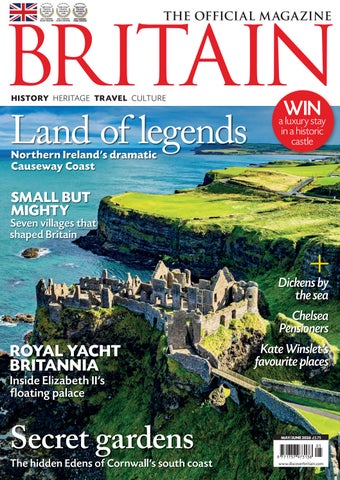
Britain Magazine May/June 2026 sample

Page 1


Land of legends

Northern Ireland's dramatic Causeway Coast SMALL BUT MIGHTY

Seven villages that shaped Britain

Dickens by the sea Chelsea Pensioners

ROYAL YACHT BRITANNIA

Inside Elizabeth II's floating palace

Kate Winslet's favourite places

Secret gardens

The hidden Edens of Cornwall's south coast

Green & glorious

In between the fishing villages and pretty coves that line Cornwall’s south coast are some of Britain’s finest gardens

WORDS NATASHA FOGES

Still STANDING

These seven small villages, in very different ways, helped shape Britain WORDS FELICITY DAY

Britain’s picture-postcard villages are the envy of the world, abundantly endowed with honey-coloured cottages, medieval churches and gently burbling streams. But plenty of our most characterful villages are actually far more than just picturesque – dig deeper and you find that in their winding lanes history was made.

Take Bosham, on the southern coast of England. The West Sussex village (pronounced ‘Bozzum’) is of the kind that begs to be photographed, sometimes described as the ‘Venice of England’ thanks to its beautiful waterfront setting. But along with its old-world charm, Bosham also has a spine-tinglingly tangible connection to the Norman Conquest of 1066, and is both named and represented on the Bayeux Tapestry.

Harold Godwinson – who briefly reigned as England’s last Anglo-Saxon king, before being slain by William the Conqueror’s forces at the Battle of Hastings – is shown feasting in his ancestral manor house in Bosham before travelling to France in 1064 to meet with his future adversary. Harold, who was probably born in the village, is also shown praying at its Holy Trinity Church, still standing nearly a thousand years on, altered and enlarged over the centuries but Anglo-Saxon at its core and still oozing history. Harold may even be buried in its peaceful environs, as is, according to tradition, the Danish King Canute’s young daughter, who drowned in Bosham’s millstream in about the year 1020.

Anglo-Saxon history is also at the heart of a village in England’s northernmost county, Northumberland. Today, Bamburgh is a pretty coastal settlement that buzzes with tourists in the summer owing to its sandy beach and scenic views. But it was a powerful capital for rulers of the kingdom of Northumbria between the 6th and 8th centuries AD, with its castle, poised on a rocky plateau, their chief stronghold and site of their coronations. Captured by the Normans, it eventually became a strategic outpost for England’s medieval kings in their border wars with the Scots. It’s quite a past, but it’s not Bamburgh’s only claim to fame. Britain’s first-known lifeboat was commissioned for the village in 1786 to help sailors in difficulty in the stormy North Sea. Famously, 22-year-old local lass Grace Darling became a Victorian sensation after rowing out from Bamburgh with her father amid a raging storm in 1838 to save survivors of a shipwrecked steamship, becoming the first woman to earn an RNLI Medal for Gallantry. A compelling volunteer-run museum commemorates her bravery.

Inside BRITANNIA

A visit to The Royal Yacht Britannia, now permanently moored in Edinburgh, offers a fascinating insight into life on Queen Elizabeth II’s former floating palace

Where giants walked

The Causeway Coast’s epic geology is matched only by its folklore, from warrior giants and Viking raiders to ghost-filled castles and misty glens

WORDS JOSEPHINE SAUNDERS

Turn static files into dynamic content formats.

Create a flipbook
Britain Magazine May/June 2026 sample by The Chelsea Magazine Company - Issuu