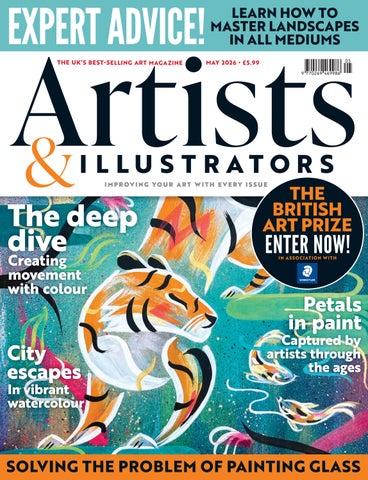
Artists & Illustrators May 2026 sample

Page 1


This month’s spotlight on a British Art Club member

We present...

AIDAN BUTLER

This artist renders Dublin’s changeable weather in textured pastel, turning ordinary streets, bogs and coastlines into luminous landscapes

Aidan Butler paints weather before he paints places. Based in Dublin, his work is less a record of landscape than a sustained meditation on atmosphere: how rain softens a street, how twilight thickens over bogland, how light can transform the most ordinary scene into something arresting. Pastel is his chosen language, but mood is his true subject.

Daily life has shaped that sensibility. Aidan has spent much of his life travelling through Phoenix Park – “one of Europe’s largest urban parklands” – in all seasons, absorbing its shifting skies and unpredictable light. That routine exposure to Dublin’s changeable climate underpins his practice. “Atmosphere is key in my work, and really is the prime subject in whatever I paint,” he says. Living in Ireland, he notes, “the light is always changing,” so the same place can feel entirely different within hours. It is this instability that keeps him returning to familiar sites.

His path to painting was neither linear nor academic. A childhood antilitter poster competition sparked early confidence, and as asthma kept him home from school, copying comic illustrations was a good way to pass the time. A teacher’s blunt encouragement – “whatever you do don’t give up the art” – lingered, even during years when painting slipped into the background. By the mid-1990s, he returned to it seriously, eventually making it his profession.

Technically, Aidan’s method is distinctive. He works on a heavily textured ground – “a third gesso, third fine marble dust and third base acrylic colour” – which allows for dense, layered applications of pastel. He often builds paintings from foreground to sky, letting the land “sit beneath the sky convincingly” while carefully controlling tone and aerial perspective.

Aidan moves fluidly between observation and memory. He sketches on site, makes digital studies in Procreate, yet frequently paints favourite places from recollection. Composition follows instinct: square formats for natural landscapes, rectangular for urban ones.

Over time, his focus has narrowed. After years in different styles –including semi-abstract florals and impasto oils – pastel now allows him to concentrate fully on “capturing a particular mood or ambiance,” which he describes as his current direction.

Looking ahead, he wants to paint more en plein air and turn further toward public interiors – cafés, stations, transport hubs – wherever “interesting light conditions” prevail. For Aidan, the weather will always lead the way.

Wild Garlic Wood, Pastel, 24x33cm

Steen Foege

This artist rethinks landscape painting through atmosphere and unexpected colour. Ramsha Vistro finds out why ▸

I just want to be here, acrylic on canvas, 50x60cm

Let’s twist

Using acrylic paint, SANDRA BUSBY explains how she captures the illusion of light and glass – with compelling results

I’ve lost count of the number of times I’ve been asked, “What colour do you use to paint glass?”

It’s a question that shows just how mysterious this subject can seem, which is precisely why I’ve chosen it. Glass, at rst glance, appears impossibly complex: it’s transparent, re ective, and ever-changing. When I rst began painting, I assumed it must be one of the hardest things to tackle, so I decided to confront it right away.

Painting glass isn’t about nding the right colour at all; it’s about learning to truly see what is in front of you, not what you think should be there. Glass is nothing more than an arrangement of shapes and values. Its magic lies in the subtle shifts between darks and lights, and the dance between lost and found edges.

By choosing glass as my subject, I hope to demystify this often-avoided subject and show that if you don’t overthink it, and instead simply observe what you see, your brush will do the rest. sandrabusbyart.com

SANDRA’S MATERIALS

Oil paint

Gamblin: Sienna, Transparent Orange Oxide, Burnt Umber, Ultramarine Blue, Alizarin Crimson, Vermillon Red, Indian Yellow, Cadmium Yellow Light, Gold Green, Titanium White

Support Jackson’s 24×30cm universal-primed ne-grain

handmade board

Sa ower oil

Gamsol

A mix of brushes

DECIDE WHAT YOU WANT TO ACHIEVE

Painting glass successfully starts long before the rst brushstroke. Before I even touch the canvas, I arrange my glass objects under deliberate lighting, depending on the mood I want to convey. In this case, I’m aiming for something warm and atmospheric, rich in tonal variation. One way to achieve this is by using a shadow box, which allows me to manipulate both the light and the mood before taking my reference image. ▸

Tropical tiger

BEX’S MATERIALS

Paint

Acrylic: Liquitex Soft Body in Cobalt Turquoise, Gold, White, Brilliant Yellow Green and Bright Aqua Green. Liquitex

Basics Acrylic in Mars Black. Winsor & Newton Professional Acrylic in Cadmium Orange and Golden Acrylics in Light Turquoise (Phthalo).

Liquitex Water-Based Spray Paint: Prussian Blue Hue, Cadmium Yellow Light Hue, Fluorescent Pink mtn spray paint

Liquitex paint marker (8-15mm) in Fluorescent Pink

Brushes

A mix of script/rigger/liner brushes for the line work (including Daler Rowney Script Brush in size 1” and Royal & Langnickel BK61 size 1). Flat brushes for some of the shapes, foliage details and background washes (including Daler Rowney 1” Long Flat) and also a larger Daler Rowney Filbert Brush

Support Meraki A3 Sketchbook, Pencil Eraser

Water

Card for testing paint

Chalk

Kitchen roll for dusting off chalk

Soft and atmospheric, I love incorporating the medium of spray paint into my acrylic paintings. When used lightly, it can create beautiful layers that, for me, have a satisfying contrast to the sharper painted elements I create with acrylic.

On a cold and dreary day here in Bristol, I have chosen to bring a touch of tropical colour and vibrancy with a tiger as the subject of my painting, and I share with you a bit about my process, using a fusion of spray-painted texture, organic shapes and flowing lines. The natural world is always my first inspiration, and my paintings explore the delicate connections and interactions within our ever-changing world - depicting a fusion of land and water, where wildlife adapts to a shifting and fluid terrain. My work is very stylised and combines both abstract, expressive elements alongside a more precise use of line and shape, but whatever your own approach may be, don’t be afraid to experiment with layering and colours. I always have a spare piece of card at hand to test out my materials and get the effect I want before committing to the canvas. bexgloverart.co.uk

SKETCH OUT YOUR IDEA

BEX GLOVER shows you how she used a Meraki notebook to create a tiger in action in acrylic and spray paint 1

I have a tiger composition in my mind, and because I like to create my backgrounds first and layer the foreground elements on top, I do a quick sketch that I can refer to once my background is ready. I’ve used the lovely, best-quality Meraki sketchbook for my initial drawing and subsequent painting. ▸

Picture this

Every month, we ask an artist about a piece that is meaningful to them. This month, Canadian artist
ROBBIE CRAIG tells us about his painting

This piece is inspired by the many times I have spent canoeing on Prelude Lake near Yellowknife, Northwest Territories. My friend has a cabin on this beautiful lake. One particular night, under the midnight sun, we went for a paddle. As I approached an island, I took out my camera to capture this moment of complete silence, as I absorbed the untouched wilderness that surrounded me. I knew I had to put this image onto canvas.

The canoe symbolises journey and direction; moving forward in life toward a goal, which in this case is an island as a focal point. The yellow canoe represents my home, Yellowknife. The colours are unique to those who spend time under the midnight sun; a moment

when the sun almost sets, but does not dip below the horizon, creating beautiful hues of purples and blues. In a way, the reflection of the sky in the water blurs boundaries, reminding us that in nature, as in life, everything is connected.

The North of Canada is not just my home; it’s part of my identity. This painting reflects the vastness, quiet strength and raw beauty of the northern landscape. It speaks to solitude, resilience and reverence for nature; qualities that continually shape my life and art. I hope viewers feel a sense of calm, curiosity and adventure; as if they’re stepping into the canoe themselves. I also hope it might spark their own personal memories of being alone in nature, yet completely at peace. ▫

The Wild – Yellow Canoe, acrylic on canvas, 60x76cm

Turn static files into dynamic content formats.

Create a flipbook