GAINES CENTER for the HUMANITIES
FALL 2021
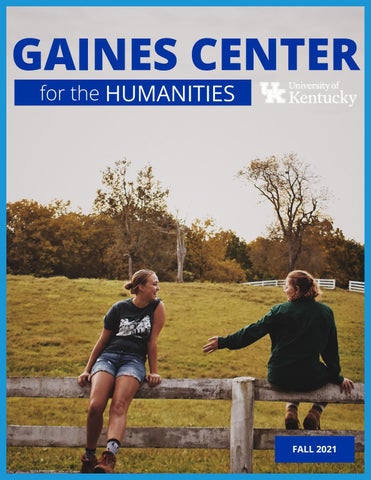
Gaines fellows visit with their friend the goat at our Shaker Village retreat
IN THIS ISSUE 3
4
10
16
18
20
22
26
28
31
Letter from the Gaines Director
Bale Boone Symposium with Rhiannon Giddens
Field Trips with the Fellows
The Archive of Lost Mountains
Meet our Junior Fellows
Celebrate Success!
Staff News: Congratulations Connie!
Gaines Mini Grants
Alumni Spotlight: Catherine Brereton (2011)
Save the Date: 2022 Lafayette Seminar
Letter from the
GAINES DIRECTOR This fall has been about figuring out the new normal even as the pandemic is still very much with us. This has meant continuing to mask and following safety protocols, but the familiar buzz of campus is back. It has been exciting to see the joy of the junior fellows in their courses as they form bonds that, as we have heard from many alums, will be singularly important in their postundergraduate lives. It has also been wonderful to see the connections between the seniors, despite spending their first-year learning remotely. The fellows are the heart of what we do at the Gaines Center and their presence has been missed. I hope you all will join me in welcoming a new member to the Gaines Center staff. Catherine Brereton is our new administrative support staff person. To some of you she is familiar. Catherine is a former Gaines fellow, an accomplished writer and has quickly become an irreplaceable member of our team. You can read more about her and her interesting path to Gaines the first and second times. Catherine is also a daily reminder of the impact the Gaines Fellowship has on students and the wonderful things those students do in the various roles they undertake.
We have been doing a little refreshing at Gaines in both our physical and digital spaces. The brick sidewalks that lead to the Commonwealth House have been re-laid and repointed making them both safer and returned to their original beauty. We are working with the Department of Historic Preservation in the School of Design to make some needed repairs to the shutters on the Commonwealth House.We hope this will lead to a continued partnership between historic preservation and Gaines to ensure we are in keeping with the historic designations of the spaces we occupy. In the digital realm, we have a new and hopefully more easily navigable website. On the website you can also find a link to videos of Gaines events. We hope that you might drop by in person or virtually and let us know how you are doing and how we are doing. More than anything, the return to in-person learning has reminded us of the magic of the classroom. Even after a decade and a half as a faculty member at UK, I still believe we are at our finest when we engage with students in the kind of discovery that takes place in a room where everyone is open to learning. The Gaines Center is fortunate to offer such opportunities both in the classroom and in the spaces where we gather with members of the community. As we continue to learn how to live with Covid, we hope that we are discovering new and better ways to do the important work of the Gaines Center.
3
BALE BOONE
Bale Boone 2021 Featuring
GIDDENS
Photo by Tim Webb Photography
by Shelby McCubbin '22
Gaines Fellow; Neuroscience, GWS major
This November, the Gaines Center for the Humanities hosted our annual Bale Boone Symposium, a public exploration of the humanities and arts which brings together members of the University of Kentucky, the Bluegrass region, and the Commonwealth. For this year’s Bale Boone Symposium, the Gaines Center invited Grammy and MacArthur award winning musician Rhiannon Giddens to participate in a hybrid lecture/performance symposium. The event shed light on the historical roots of different folk instruments, tying into the Gaines Center’s 2021-2022 theme: “Year of Mountains”. A North Carolina native, Rhiannon Giddens graduated from Oberlin College, where she studied opera, although she is most well-known for her contributions to string-band music. Giddens is a founding member of The Carolina Chocolate Drops, an old-time string band (she is noted as musically representing the 5-string banjo, dance, fiddle, kazoo, and voice). In 2013 Giddens began to pursue a solo career, though she has collaborated with many people along the way—including a collaboration with Francesco Turrisi for both her 2019 album There is No Other and her latest 2021 album They’re Calling Me Home. Turrisi joined Giddens on stage for the Bale Boone Symposium. In addition to her musical expertise, Giddens is well known for her activism. She is vocal both within the lyrics and stories she tells, but also through her engagement in the history of the instruments she plays. This is most notably seen in her efforts to teach that the banjo is an African American instrument invented in the Caribbean by people of African descent, thus fighting against the common narrative that the banjo and fiddle “belong” (and are attributed) to white people.
Photo by Tim Webb Photography
5
Photo by Tim Webb Photography
7
Photo by Tim Webb Photography
Giddens stressed the importance of protecting creative energy. When asked how she protects her mental health when navigating spaces that are either not meant for or don’t accommodate Black creative voices, the conversation turned to burnout and cultural strain. Rhiannon Giddens was transparent and open with students, sharing the ways in which she is an instinctual person when it comes to her music and how the transition from being on the road all the time to being at home more has led her to create music that feels comforting and like home. But, she also discussed anger as a catalyst noting how she sometimes writes from anger. However, she explained that it is important to recognize that anger is a secondary emotion and there is always something else underlying it. She encouraged students to not get stuck in anger and instead ask themselves why this particular moment makes them angry. Throughout the conversation, Giddens encouraged students to seek the things they are passionate about and to find different ways to tell their stories. The public event began with Gaines Center Director Dr. Melynda Price welcoming Rhiannon Giddens and her partner Francesco Turrisi to the stage. The event opened with Dr. Price simply asking Giddens, “how are you?”. Rhiannon shared her thoughts on the fragility of the covid experience, but also acknowledged of what it meant to be experiencing the lockdown with privilege, reflecting on the difference between asking what to do with the extra time found in a safe space rather than asking how to find a safe space to begin with. Photo by Tim Webb Photography
Giddens discussed how historical research is used during her creative process and how her different projects initially came together. When Giddens discussed the banjo and its history, she also took a moment to play her banjo, with Francesco performing alongside her on the tambourine. As the evening progressed, Giddens enagaged with a wide variety of topics, such as where division comes from, how we choose to invent ourselves, tradition, diversity, and the value she finds in teaching. But when asked what lessons she will keep from the last two years Giddens reflected that the most valuable thing she learned is that the opportunity will always come back around again—if you need or want to say no in the moment you should, because though the opportunity may not present in the exact same way, it will come back in some form. The evening closed with Giddens and Turrisi performing a short set of songs. Giddens played the banjo, her viola, and sang while Turrisi alternated between the tambourine and two drums. The event ended with a standing ovation and an eruption of excited conversation.
9
FIELD TRIPS
ASBURY This year's orientation took place at the Low Ropes Challenge Course at Asbury University. The fellows collaborated on a variety of skill and team building tasks, followed by a cook out lunch.
"my favorite part of this event was being surrounded by loving and encouraging people"
11
"our first overnight field trip allowed me to bond on a deeper level with the fellows!"
Photo: Teja Sudhaker
Our orientation was followed by an overnight retreat at the historic Shaker Village of Pleasant Hill. Fellows enjoyed a boat ride along the Kentucky River and the opportunity to learn more about the Shakers. An evening of music and s'mores by the fire pit was especially well-received!
SHAKER VILLAGE Photo: Teja Sudhaker
13
WARWICK On a perfect September afternoon, the Fellows took part in our traditional visit to the Clay Lancaster Estate at Warwick--complete with the customary group photo in front of the folly. Our thanks to Dave Elbon for sharing his time and knowledge with us.
"our tour demonstrated how the artistic accomplishments of the past shape the way we live today."
"the Gorge was easily the single best experience I've had in Gaines thus far. I came home from the trip feeling as though I made friendships that will last"
Our junior fellows studied mountain narratives with Dr. Marion Rust during their Fall 2021 seminar and rounded off their experience with a trip to Red River Gorge. They hiked to Creation Falls, where everyone enjoyed the opportunity to "dunk" in a natural waterfall, search for crawfish, and create their own mountain narratives. And, of course, no trip to the Gorge is complete without Miguel's pizza!
"I was reflective about the way "this trip allowed me to shut off my I interact with nature and enjoyed embracing a spirit of phone, press into the people around me, and be engaged with the moment" fun and wonder"
RED RIVER GORGE 15
MINI GRANTS
ARCHIVE of LOST MOUNTAINS by Eva Grossi '22 Gaines Fellow; Arts Administration major; Theatre & Spanish minor
The global pandemic and subsequent quarantine period in the United States resulted in a 60% increase in Netflix streaming, 319 million new TikTok users, and an explosion of interest in hobbies such as bread baking and buying as much toilet paper as your arms can carry. For Professor Brent Sturlaugson of UK’s College of Design, however, this time of isolation led to a much more interesting passion project: the Archive of Lost Mountains. This idea was initially sparked by UK and Somewhere Appalachia’s collaboration The Somewhere Project, a design studio with the intent to “transform coal mining sites into arts spaces.” Reading Professor Erik Reece’s article “Death of a Mountain,” a narrative of the removal of Lost Mountain in Perry County, only fanned the flames. Soon, he found himself collecting more and more data on the beautiful landmarks that have been destroyed by the mining industry.
What began as a project of curiosity has now expanded into a fully-fledged exhibition. The Archive of Lost Mountains, currently displayed in the UK Gaines Center’s Commonwealth House, is a collection of data, drawings, and models that document the destruction of peaks across Appalachia. While this exhibition only features about 40 different mountains, the collection in its entirety covers 700, and it’s continuing to expand as Professor Sturlaugson collects more data. The 40 mountains included in the exhibition are displayed in images that present them as they are now and as they were before the mining industry began carving into them, allowing viewers to see the full extent of destruction. Professor Sturlaugson has also designed 3D models of the peaks in their former glory. A tiny model of the Patterson Office Tower rests beside them for scale. Seeing the restored mountains and comparing them to the decimated landscape, it’s impossible not to be struck by an incredible sense of loss. In addition to the stunning visuals presented in the gallery, each documented mountain is supplemented by a collection of data explaining not just the impact on the physical landscape, but the effects on the community as a whole as a result of the mining process. Total labor hours, issued fines, and worker fatalities, to name a few, are listed. Much more visceral are the cold excerpts from accident reports written by employers. One such report reads “loaded coal truck was leaving pit. For some reason steep haulway road trick rolled back, apparently driver tried to jump out. He was caught by truck and killed.” The takeaway from the exhibition as a whole is not only a sense of loss for the mountains, but the beginnings of an understanding of the cost Appalachian communities paid for the industrialization of the rest of the country. As the exhibition evolves, Professor Sturlaugson hopes to bring it to Appalachia, memorializing their history near the physical sites. He also hopes to humanize this story further by incorporating more personal narratives of those who experienced the destruction of these peaks and the brutality of the coal industry.
17
OUR JUNIOR FELLOWS
Larah Ballard
Riley Droppleman
Horticulture, Appalachian Studies
Biology, MCLLC, English, History
Abby Eplin
Sophie Gershtenson
Secondary English Education, Creative Writing
Interiors & Historic Preservation, Environmental Studies
Brandy Jackson
Mihir Kale
Merchandising, Apparel, & Textiles, Journalism
meet our
Political Science, Peace Studies, Spanish
JUNIOR FELLOWS
Meron Lemma
Felix Lowery
Public Health, Environmental & Sustainability Studies
Landscape Architecture
Chris Lucas
Haley Nelson
Economics & Finance
Career & Technical Education, Agricultural Economics
Lexi Nolletti
Luke Schlake
Neuroscience, Biology, Spanish
Economics, Political Science, Arabic
We welcomed twelve new Gaines Fellows in Fall 2021, representing six colleges and twelve majors. Our fellows were chosen through a rigorous application process and include international and first generation students. We couldn't be more delighted to have all of them as part of our program and are excited to see them develop as scholars over the next two years.
19
CELEBRATE SUCCESS
Our Fellows never fail to impress us with their achievements. Here are just a few of their accomplishments during the last semester: Critical Language Scholarships (Lexi Gauger, Mihir Kale) Global Lex Center volunteer work with immigrants and refugees (Mihir Kale) Markey STRONG Scholar (Meron Lemma) William C Parker Scholarship (Alex Davis, Meron Lemma) College of Public Health Scholarship (Meron Lemma) International Student Scholarship (Meron Lemma) Pelissier Scholar (Chris Lucas) Morgan Stanley Richard B Fisher Scholar (Chris Lucas) Finalist in the Five Minute Fast Track Research Competition (Lexi Nolletti) Wesley Foundation student mentor (Eva Grossi) Oswald Award Winners (Shelby McCubbin, Teja Sudhaker) Kentucky Arts Council banjo apprenticeship (Larah Ballard) Our Fellows also continue to publish and present their work in forums across the country.
SUPPORT GAINES If you would like to support the Gaines Center and humanities programming at UK, you may donate year-round by searching for "Gaines Center" at uky.networkforgood.com
Riley Droppleman '23
Gaines Fellow; Biology major; English & Classics minor
21
STAFF NEWS
Congratulations
CONNIE!
by Ben Jones (Gaines Fellow 2017-2019)
As many of you know, Connie Duncan, our Gaines administrator of the past nine years, retired from the University this spring. During her time at Gaines, Miss Connie established herself as an utterly dedicated and loving steward of the Gaines Center and its houses, its programs, and, most importantly, its people. Although her time with Gaines has officially come to an end, she remains an integral part of our community through her lasting connections with so many alumni and friends of the Center, including her very own successor at Gaines, Ms. Catherine Brereton--who, incidentally, was a Fellow during Connie’s very first year at Gaines! To honor and celebrate Miss Connie’s Gaines legacy, I recently caught up with her for some reflections about her time at the Center. As busy as she is with her new job as full-time grandmother, she graciously took the time to share with us her Gaines Greatest Hits.
Connie and Chelsea at Shaker Village
Ben: Tell us about your time at UK and how you came to the Gaines Center. Connie: I had been working at the University since 1975, beginning in the Admissions Office! In 2012, after fifteen years working in the UK Honors Program, the Gaines position became available and I decided to apply for it. I had always been in love with the Gaines Center since Honors had made use of their buildings and worked alongside their programs for many years. Ben: What things did/do you admire or enjoy most about the Gaines Center? Connie: One of my favorite things about Gaines is the Bale Boone Symposium. I like the fact that it brings the community and the campus together for some of the most interesting seminars that the University provides. Another favorite would be just working with the students, watching the new Fellows come in and watching them blossom in the Gaines program, then leave to go out and do great things in the world. My personal connection with the students is what always kept me there. Getting to know them and being there for them, that’s the one thing that was most important to me. That was absolutely the most fulfilling part of my work with Gaines. Ben: The Gaines Center maintains three unique houses. Which one is your favorite and why? Connie: Commonwealth House has always been my favorite because it was more like an actual home, and it was very welcoming and warm when the students would come in to use it. There was just something about the house that had a magic—I don’t know how to explain it. I saw a lot of things happen there: I’ve seen students get married there, I’ve seen students have their seminars and thesis defenses, their music recitals in there. It was always my special favorite. Ben: You started working at UK in 1975, roughly a decade before the Gaines Center was born. Do you remember anything about the founding of Gaines? Connie: I had no idea about the houses that would come to house the Center. Dr. Raymond Betts had a vision for the houses and for the Gaines Center. I never got the chance to meet our founder, John Gaines, but I did know Raymond Betts because he had worked with Honors. I knew Dr. Betts for many years, and I knew that he had a vision for the Gaines Center, and he helped make it come to life. Many around the University knew him as that kind of “visionary,” as they called him. Ben: You spent (and continue to spend) so much time with Gaines Fellows and saw them pass through their time at the Center over the course of so many years. With this experience, what advice would you give to our current Fellows? Connie: I’ve always told Fellows when they first arrive to the Center to take advantage of all the connections and resources that are available to them there. They have the very best professors, and there are so many connections to be made with them, with each other, and with Gaines alums! It’s a vast pool of knowledge and experience, and they should take advantage of that. That would be my advice: to take advantage of the resources, the people, the knowledge, the connections, and, really, the world!
23
Clockwise: Chinese food in New York; Shaker Village; MOMA, New York; Carnegie Deli, New York
Top Row: Connie with Dr. Lisa Broome Connie earlier in her UK career
Bottom Row: Connie at Shaker Village
25
MINI GRANTS
2021-2022 Gaines
MINI GRANTS Now in its second year, the Gaines minigrant program continues to thrive. Here's a brief look at some of the upcoming events we are supporting through this initiative. Stay tuned on social media for more details and dates as they become available!
January 22, 2022
February 7, 2022
Dr. Takami Delisle
Kia Weatherspoon
Department of Anthropology
Department of Interiors
February 11, 2022
Dr. Julia Hernández Department of Modern and Classical Languages and Literatures
February 25, 2022
April 1-3, 2022
Prof. Travis Martin
Appalasia
Department of History
Appalachian Studies Program
27
ALUMNI SPOTLIGHT
BEST Job on Campus The
On an overcast day in March 2011, Catherine Brereton collected a sealed envelope from Colleen Glenn’s desk in the Gaines Center’s Raymond Bett’s house. “Colleen smiled when she handed me the envelope,” Catherine recalls, “but I wasn’t sure if it was a pity smile or a celebratory smile.” As it happens, it was a celebratory smile; the envelope contained the news that Catherine had been selected as part of the 2011 cohort of Gaines Fellows.
“Being a Gaines fellow was a transformative experience. I met people I never would have otherwise met and made lifelong friends. But, in the midst of being a Gaines fellow, the kindness and efficiency of Colleen—and then Connie (Duncan)—underpinned the entire experience. I remember thinking that they had perhaps the best job on campus.” It seemed natural, then, that when Catherine learned of Connie’s retirement in May 2021 her thoughts turned back to the Gaines Center. “I was thoroughly happy in my position as the Department Manager for Anthropology, and I certainly wasn’t looking to leave it. But, when Connie’s position was advertised I realized very quickly that I’d be so jealous of whoever moved into that position. There was a part of me—and perhaps not such a small part either—that wanted to be back in the Gaines Center.” Ten years after she collected the envelope containing her Gaines acceptance, Catherine walked back into the Gaines Center—this time as the new “Connie”. “At my interview, I joked that it was in keeping with the tradition of having the Gaines Staff Support all have names beginning with the letter “C”—Colleen, Connie, and Catherine. Following in the footsteps of such remarkable women is quite the task, though. I really do stand on the shoulders of giants. Colleen and Connie had such a profound impact upon me as a Gaines fellow— and, I’m quite sure, on all of my cohort, and the cohorts before and after us.”
As Catherine settled into her new position, our current fellows had a few questions for her: Fellows: What first brought you to Gaines? What about the program drew you in? Catherine: My reasons for being drawn to the Gaines fellowship were, I think, a little different to my peers’. I was a non-traditional, first-generation, international student, so my college experience was already very different to most—and I was looking for challenges. I loved my majors (English and Gender and Women’s Studies), but wanted something more. I was looking to be pushed out of my comfort zone intellectually, and the Gaines fellowship offered that. Fellows: How will you use your experience as a fellow to inform your new position? Catherine: One of the things I most appreciated about Colleen and Connie was their profound kindness. Every single interaction I had with them was infused with respect and generosity. Of course, they were efficient administrators, but it was their kindness of spirit that really shone through. When I announced that I’d taken this position in the Gaines Center, the very first person to reach out to me was Luke (Glaser), one of the fellows in my cohort. He was so kind—he said that he couldn’t think of anyone better to support the fellows the way that Colleen and Connie had supported us. I want to keep that support going—to have an office environment that is welcoming and warm, to always have time to talk with our fellows, to learn about them, to listen to them, to provide a safe space for them. Being a college student is challenging—and the expectations we have of our Gaines fellows amplifies those challenges. Sometimes, it’s just knowing that someone understands what you’re dealing with as a student that makes the difference—or that someone is trying to make your day easier or brighter. I hope that I can always make someone’s day easier or brighter. Fellows: What’s your favorite memory with Gaines so far, either as a fellow or as an employee? Catherine: I have so many amazing memories that it’s hard to choose; I know that seems a bit cheesy. New York, of course, was a stand out experience. We visited MOMA PS1 in Queens. One of the installations was a square wooden room with wooden seats built into sloped walls, but it had no roof—it was open to the sky; when you leaned back against the seat, all you could see was the sky moving overhead. There was a moment when the only people in that room were Gaines fellows, and we were all just sitting, quietly, watching the sky. It was such a peaceful, shared experience.
29
But, there were other times as a fellow—the seminar that took place on my birthday and Liz (Schaller), Kelly (King), and Damarias (Moore) baked brownies for me; Doug (Niemann) trying (and failing) to finish an entire sandwich at Carnegie Deli in New York; square dancing on top of a mountain in Eastern Kentucky; singing “Black Socks” with Dr. Ron Pen. I still remember all the words to “Black Socks”! The more I think about my time as a Gaines fellow, the more wonderful things I remember. I’m excited to create memories with Gaines cohorts from a different perspective now. The fellows’ orientation at Asbury and Shaker Village was, honestly, such a special experience. Watching a group of people who had never really met in person truly connect with each other was so amazing; the collaboration, communication, and compassion among the fellows was inspiring, and I’m so excited to spend more time with everyone and watch these relationships deepen. Gaines is such a unique experience—it’s fascinating now to see it from a different position, and perhaps to be a small part of making that experience all that it can be for our fellows. Fellows: Was it more fulfilling to be involved in Gaines as a fellow or to be a member of the Gaines staff? Did/do you prefer one over the other, or are the experiences too different to compare? Catherine: I’ve actually pondered this quite a lot—and, honestly, the experiences are just too different. But, I do think I’m in a very unique and lucky position having been a Gaines fellow and now getting to bring my experiences as a fellow to the administrative side of things. The Gaines Center is in a period of transformation—and that’s so exciting! It’s more important than ever for the us to demonstrate just how crucial the humanities are; where would we all have been during the midst of the pandemic, for example, if it weren’t for the artists and writers and thinkers of the world who created the books, the music, the television shows that we so desperately needed during our isolation? That’s a real over-simplification of the place of the humanities in the world, but it is a demonstration of how much we NEED the humanities. And so, to bring that back to the Gaines Center, it’s important that we communicate this both to our campus and our community. And, it’s important that we stay relevant—that we evolve as the world evolves, that we respond to new methods of communication like social media, that we respond to social movements like Black Lives Matter, that we reflect our community in the best and most ethical ways that we can. But, even as we do that, we have to remember too that the Gaines Center is built, in many ways, on certain traditions—and we have to find ways of honoring those traditions, honoring our past, without only BEING our past. I firmly believe, though, that there is always room for us to create new traditions and new celebrations. I’m truly privileged to be here in the Gaines Center while we make this transformation, while we celebrate the old and the new.
SAVE the DATE March 24, 2022
The 2022 Lafayette Seminar
"MOUNTAIN MOONSHINE" 31
@ukygainescenter | uky.edu/gainescenter