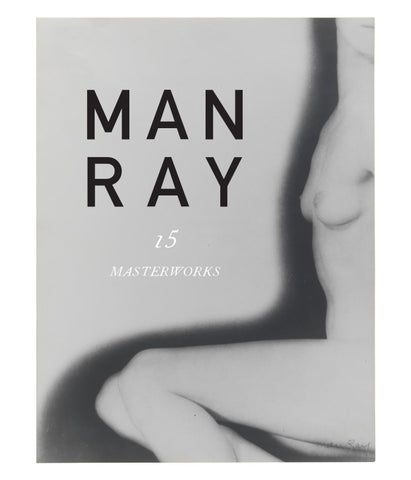
MAN RAY 15
MASTERWORKS
MAN R AY 15
MASTERWORKS
Cheim & Read • Edwynn Houk Gallery Frieze Masters 2013
I
nnovative and provocative, Man Ray moved freely between Dadaism and Surrealism, embracing the irony and wit of one and the enigmatic, dream-like compositions of the other. An important and influential contributor to the artistic ambitions of both movements, he was not exclusively associated with either, a position which allowed a great deal of freedom in his creative process. As exemplified by his consistent experimentation and facility with different stylistic approaches and media (painting, film, photography), Man Ray remained a distinctly autonomous and original artist throughout his career. The influence of his artwork was felt not only in his own time, but continues to reverberate today, especially in photography. Cheim & Read and Edwynn Houk Gallery are pleased to present a group of Man Ray’s photographs at 2013 Frieze Masters. The selection, which focuses on portraits and nudes, dates from the artist’s time in Paris, in the 1920s and 30s, to his war-time stay in Los Angeles, in the 1940s. Man Ray (born Emmanuel Radnitsky) was born in Philadelphia in 1890. His family later moved to New York and settled in Williamsburg, Brooklyn. Profoundly influenced by the 1913 Armory Show, a renowned avant-garde exhibition which introduced modern art to America, Man Ray became a frequent visitor to Alfred Stieglitz’s “291” gallery, where he discovered not only burgeoning movements in contemporary European art, but also the photographic work of Stieglitz and his circle. After exhibiting his abstract paintings and collages in 1915, Man Ray began experimenting with photography, the medium for which he would become best known. In 1920, Man Ray, with his lifelong friend Marcel Duchamp and patron Katherine Dreier, founded the Société Anonyme. In 1921, he and Duchamp produced “New York Dada,” a unique publication which chronicled the movement. The same year, he moved to Paris, where he was quickly accepted into the Montparnasse artistic and bohemian avant-garde; a few years later, in 1925, he was represented in the first Surrealist exhibition in Paris, along with Jean Arp, Giorgio de Chirico, Max Ernst, André Masson, Joan Miró and Pablo Picasso. Two photographs exemplify this early time in Paris. The first, Portrait of André Breton (In Front of Giorgio de Chirico’s Painting, The Enigma of Day), 1921, shows André Breton reclined at the bottom of a de Chirico painting. Breton, author of the Surrealist manifesto and a leading member of the movement, is positioned as if part of the painter’s deeply shadowed composition; the illusion is reinforced by an eerie reflection of studio light on the canvas. The second, Typewriter, c. 1925, is emblematic of Man Ray’s more fractured, fragmented and fetishistic compositions; the typewriter, pictured close-up and at an angle, is abstracted and transformed from a practical tool to a shiny, mechanical, surreal object. Like his contemporaries, Man Ray was initially unable to make a living solely on his art and found commercial photography a viable way to make a living as well as a venue for experimintation. He became a highly successful portraitist and fashion photographer, his work sought-after for spreads in Vanity Fair, Vogue and Harper’s Bazaar, and in many avant-garde journals and publications of the time, including La Révolution surréaliste and Vu, a precursor to Life magazine. Around 1922, while developing some images for the fashion designer Paul Poiret, an unexposed sheet of paper made its way to the developing tray; Man Ray placed several objects on its surface, exposed it to light, and watched as the first “Rayograph” took form. With light as his medium, and the element of chance as his muse, Man Ray’s camera-less experiment resulted in a technique celebrated for its expressiveness and ability to imbue ordinary objects with enigmatic associations. Retaining his dada-inflected wit and use of puns, Man Ray combined elements in often suggestive or poetic compositions, undermining predictable narratives. The Rayograph’s spatial ambiguity, immateriality, and rich contrasts were used to both subversive and unexpected effect, and would profoundly influence his subsequent work.
Man Ray continued to take portraits and work in fashion photography throughout his career. The line between his commercial and private practice was often blurred, and the two often informed each other. The fantasy world of the fashion industry and its fetishisation of the female form were endlessly fascinating for Man Ray; likewise, his fashion spreads were composed, as his art, with dramatic shadows and angles, and staged with artworks and objects. For all of his work, he preferred the relative calm of the studio setting to the bustling outdoors, and his portraits seem to retain this sense of introspection; see the photograph titled Élégante, of 1930, in which a boyish-looking woman gazes off-camera, the beads laced through her fingers radiating palpable tangibility. In the early 1930s, Man Ray “discovered” another photographic process: solarization. Exposure of light on a print or negative during the development process results in its inversion to the negative: dark areas turn to light and vice versa. Controlling the exposure lead to different saturations of this effect; the technique’s characteristic silvery line appearing at the hard edges of an object or figure. Solarization, 1930, captures a woman with her head resting in her arms, haloed by an aura of white; the background space dissolved and ambiguous. It is one of Man Ray’s more well-known uses of the process; the richly-lined profile in Portrait of Meret Oppenheim, 1932, is also a quintessential example. Oppenheim, of the famed fur cup, was photographed several times by Man Ray, three of which—two portraits and one nude—have been brought together for this exhibition. However, the woman most associated with Man Ray during this time was the model and photographer Lee Miller. When Man Ray met Miller in 1929. She quickly became his muse and mistress, and the subject of several photographs, among them Lee Miller, 1930, and Untitled, Paris, circa 1930. Both images, with their focus on the neck and hair, exemplify the increasing disembodiment, fetishism and eroticism of Man Ray’s imagery. His fragmentation of the female form was characteristic of surrealist compositions, but would also echo the coming social and cultural rifts caused by mounting political tension as World War II drew near. Man Ray’s solarization technique, with its ethereal quality and darkening, indistinct shadows, further augmented his images’ dissociative nature. In a nude study of Paul Eluard’s wife, Nusch Eluard, Nue, 1935, the female form is pressed against the right-hand side of the composition, her arms and head cropped, her legs tightly angled at the bottom of the frame. Thickly lined by an ominous, dark gray shadow and weighted by the vast whiteness of the rest of the picture, the image is indicative of Man Ray’s work at this time. More playful, but similarly fixated, his Dora Maar, 1936, frames the well-known mistress of Picasso with two sets of hands, one real and one of miniature porcelain. The hands reference Picasso’s first impression of his future muse: at the café where they were introduced, she had played the “knife game,” a “game” in which a sharply pointed knife is used to quickly stab the table between outstretched fingers. Mesmerized, Picasso requested Maar’s appliquéd gloves, apparently bloodied, and kept them as a souvenir of their meeting. In 1940, Man Ray left Paris for Los Angeles in order to avoid the German occupation. He continued to photograph and work in the United States, and returned to Paris in 1951 where he died in 1976. Man Ray never felt that photography was a separate practice from his other artistic endeavors. His dissolution of hierarchies and rejection of easy or rigid definitions of his art, and his life, are evident in the freedom with which he worked and his embrace of the accidental and experimental. His artistic practice, specifically his attention to material, process, and different mediums, anticipated conceptual art’s and post-modernism’s rebellion against Greenbergian formalism, and predicted the “everything is art” montage of film, photography, painting, and collage, which permeates the art world to this day: “Everything is art…All this anti-art business is nonsense…If we must have a word for it, let’s call it Art.”
Maggie Wright, 2013
2. Lee Miller, 1930
3. Meret Oppenheim, c. 1930
4. Portrait of a Woman, c. 1940
5. Nu de Dos, c. 1944
6. Portrait of Meret Oppenheim, 1932
7. Charlotte, California, 1943
8. Solarization, 1930
9. Meret Oppenheim, 1935
10. Female Nude Study, c. 1930
11. Élégante, c. 1930
12. Dora Maar, 1936
13. Nusch Eluard, Nue, 1935
14. Untitled, Paris, c. 1930
15. Portrait of André Breton (In Front of Giorgio Chirico’s Painting, The Enigma of Day), 1921
LIST OF WORKS:
1. Frontispiece: Typewriter, c. 1925, gelatin silver print on warm-toned ferrotyped paper, 11 7/16 x 9 5/16 inches (29.1 x 23.7 cm). Printed c.1925. Illustrated: Theresa Mulligan & David Wooters, Photography from 1839 to Today, (Rochester, NY: George Eastman House & Cologne: Taschen, 1999), p. 531.
2. Lee Miller, 1930, gelatin silver print on matte surface paper, 9 x 7 inches (22.8 x 17.7 cm). Printed c. 1930, and mounted at the time. Signed and annotated “Man Ray, Paris,” in pencil, on mount recto. Illustrated: Emmanuelle de l’Ecotais & Alain Sayag, Man Ray: La Photographie a l’Envers, (Paris: Centre Georges Pompidou/Seuil, 1998), p. 222; Mason Klein, George Baker, Lauren Schell Dickens, Merry A. Foresta, Alias Man Ray: The Art of Reinvention, (New York: The Jewish Museum, Yale University Press, 2009), p. 89.
3. Meret Oppenheim, c. 1930, gelatin silver print from a solarized negative, 8 3/4 x 11 3/4 inches (22.2 x 29.8 cm). Printed c. 1930. Photographer’s “Man Ray Paris” stamp on verso. Illustrated: Lucien Treillard, Alain Sayag, Bunkamura Za Myūjiamu, Photographies de Man Ray, (Tokyo: The Tokyo Shimbun, The Bunkamura Museum of Art, 2002), p. 98.
4. Portrait of a Woman, c. 1940, gelatin silver print, 7 x 5 inches (17.8 x 12.7 cm). Printed c. 1940. Signed on verso. Photographer’s “Photograph, Man Ray” stamp on verso.
5. Nu de Dos, c. 1944, gelatin silver print from a solarized negative on matte surface paper, 9 1/2 x 7 inches (24.1 x 17.7 cm). Printed c. 1944. Titled, in pencil, on mount verso. Photographer’s “Hollywood, CA Man Ray” stamp on mount verso. Illustrated: Man Ray: Nus, (Paris: Galerie Octant, 1986), unpaginated; Man Ray 1890-1976, (Tokyo: Sezo Museum of Art, 1990), p. 125, no. 247; Man Ray: 18901976, (Antwerp: Ronny Van de Velde NV, 1994), pl. 147.
6. Back Cover: Portrait of Meret Oppenheim, 1932, gelatin silver print from a solarized negative, 9 x 7 inches (22.8 x 17.7 cm). Printed c. 1932. Annotated “Man Ray 1932” and “a renvoyer 2er’s rue Ferou 6e” on verso. Photographer’s “Rue Campagne-Premiere” stamp (with lines drawn through the address) on verso. Illustrated: Janus, Man Ray: The Photographic Image, (Woodbury NY: Barron’s, 1980), pl. 73 [un-solarized variant]; Man Ray: 1890-1976, (Antwerp: Ronny Van de Velde NV, 1994), pl. 123 [variant cropping]; Lucien Treillard, Alain Sayag, Bunkamura Za Myūjiamu, Photographies de Man Ray, (Tokyo: The Tokyo Shimbun, The Bunkamura Museum of Art, 2002), p. 74.
7. Charlotte, California, 1943, gelatin silver print on matte surface paper, 9 3/4 x 7 1/2 inches (24.8 x 19.1 cm). Printed c. 1943 and mounted at the time. Signed, in pencil, on mount recto. Illustrated: Man Ray: 1890-1976, (Antwerp: Ronny Van de Velde NV, 1994), p. 89.
8. Solarization, 1930, gelatin silver print from a solarized negative, 8 1/16 x 10 inches (20.5 x 25.4 cm). Printed 1950s and mounted at the time. Signed and dated, in pencil, on mount recto. Photographer’s “Epreuve Originale, Atelier Man Ray, Paris” stamp with exhibition label on mount verso. Annotated “Collection L. Fritz Gruber” on mount verso. Illustrated: Janus, Man Ray: The Photographic Image, (Woodbury NY: Barron’s, 1980), pl. 113; Photography Until Now (New York: Museum of Modern Art and Little, Brown & Company, 1989), p. 238; Man Ray: 1890-1976, (Antwerp: Ronny Van de Velde NV, 1994), pl. 488; Man Ray 1890-1976: Photographien, (Munich: Hirmer & KunstHaus Wien, 1996), p. 49; Cecilia Casorati, Man Ray: Fotografie / Photographs, 1925-1955, (Milan: Charta, 2001), p. 33; Emmanuelle de l’Ecotais & Katherine Ware, Man Ray: 1890-1976, (London: Taschen, 2004), p. 30; Katherine Ware, Man Ray: 1890-1976, (Cologne: Taschen, 2012), p. 40; Lucien Treillard, Alain Sayag, Bunkamura Za Myūjiamu. Photographies de Man Ray, (Tokyo: The Tokyo Shimbun, The Bunkamura Museum of Art, 2002), p. 104.
9. Meret Oppenheim, 1935, gelatin silver print from solarized negative on matte surface paper, 7 7/8 x 4 5/8 inches (20 x 11.6 cm). Printed c. 1935 and mounted at the time. Signed, in pencil, on mount recto. Photographer’s “81 bis, Rue Campagne” stamp, on mount verso. Illustrated: James Thrall Soby, Photographs by Man Ray 105 Works, 1920-1934, (Hartford, CT: Dover, 1934), p. 46 [variant]; Man Ray, (New York: Abrams), p. 56 [variant].
10. Female Nude Study, c. 1930, gelatin silver print from a solarized negative, 8 x 6 inches (20.3 x 15.2 cm). Printed c. 1930 and mounted at the time. Signed, in pencil, on mount recto. Illustrated: Man Ray: Nus, (Paris: Galerie Octant, 1986), unpaginated.
11. Élégante, c. 1930, gelatin silver print on warm toned paper, 9 x 7 inches (23 x 17.5 cm). Printed c. 1930, mounted at the time. Signed “May Ray, Paris” on mount recto. Photographer’s “MAN RAY 31 bis Rue Campagne Première Paris XIV” stamp on mount verso.
12. Dora Maar, 1936, gelatin silver print on matte surface paper, 2 15/16 x 2 3/16 inches (7.4 x 5.5 cm). Printed c. 1936. Photographer’s “Rue du Val-de-Grace” stamp on verso. Illustrated: Janus, Man Ray: L’Immagine Fotografica, (Venice: Editioni La Biennale di Venezia, 1977), pl. 140 [solarized variant]; Man Ray: Photographs, (London: Thames & Hudson, 1981), p. 159 [solarized variant]; Perpetual Motif: The Art of Man Ray, (Washington, DC: National Museum of American Art, Smithsonian Institution, 1988), p. 43, pl. 32 [solarized variant]; Man Ray, Rétrospective Photographique 1917-75, (Tokyo: Station Gallery, 1996), p. 81, no. 3 [variant]; Man Ray, (Sydney: Art Gallery of New South Wales, 2004), cat. p. 63; Lucien Treillard, Alain Sayag, Bunkamura Za Myūjiamu. Photographies de Man Ray. (Tokyo: The Tokyo Shimbun, The Bunkamura Museum of Art, 2002), p. 93 [variant].
13. Cover: Nusch Eluard, Nue, 1935, gelatin silver print, 11 3/4 x 9 inches (29.8 x 22.8 cm). Printed c. 1950s–1960. Signed, in ink, on recto. Photographer’s “Man Ray, Paris” stamp on verso. Illustrated: Paul Éluard & Man Ray, Facile: Poemes de Paul Éluard, Photographies de Man Ray, (Paris: Éditions G.L.M., 1935), unpaginated; Man Ray: Photographs, (London: Thames & Hudson, 1981), p. 91; Man Ray: 1890-1976, (Antwerp: Ronny Van de Velde NV, 1994), pl. 146.
14. Untitled, Paris, c. 1930, gelatin silver print on matte surface paper, 3 1/4 x 2 1/2 inches (8.2 x 6.3 cm). Photographer’s “Man Ray - 8 Rue du Val-de-Grace Paris 5e - France - Danton 92-25” stamp on verso. Illustrated: James Thrall Soby, Photographs by Man Ray 105 Works, 1920-1934, (Hartford, CT: Dover reprint edition, 1934), pl. 64; Janus, Man Ray: The Photographic Image, (Woodbury NY: Barron’s, 1980), pl. 97 [variant orientation]; Man Ray: 1890-1976, (Antwerp: Ronny Van de Velde NV, 1994), pl. 62 [variant orientation]; Lucien Treillard, Alain Sayag, Bunkamura Za Myūjiamu, Photographies de Man Ray, (Tokyo: The Tokyo Shimbun, The Bunkamura Museum of Art, 2002), p. 97 [variant orientation].
15. Portrait of André Breton (In Front of Giorgio Chirico’s Painting, The Enigma of Day), 1921, gelatin silver print on warm toned, matte surface paper, 8 1/4 x 5 7/8 inches (21 x 14.9 cm). Printed c. 1921. Signed, in pencil, on the image on recto. Signed and dated “Man Ray 1921”, in ink on verso. Titled in French “André Breton devant son Tableau de Chirico, Hotel des Ecoles - rue Decembre Paris 14”, in ink, on verso. Illustrated: Mason Klein, George Baker, Lauren Schell Dickens, Merry A. Foresta, Alias Man Ray: The Art of Reinvention, (New York: The Jewish Museum, Yale University Press, 2009), p. 155 [variant orientation].
Printed in an edition of 1,500 on the occasion of Frieze Master s 2013
MAN R AY 15
MASTERWORKS
Cheim & Read • Edwynn Houk Gallery Frieze Masters 2013
Cheim & Read • Edwynn Houk Gallery