New family health center 2 Ministry Identity Assessment 3 Executive changes 7 PERIODICAL RATE PUBLICATION
SEPTEMBER 2025 VOLUME 41, NUMBER 9
Catholic health care providers brace for impact of budget bill By LISA EISENHAUER
Danielle McPherson remembers the patients undergoing cancer care alongside her years ago who, unlike her, did not have private health insurance. She saw them drop out of treatment because they couldn’t afford the care or they lost access to insurance programs such as Medicaid. “I had a little bit of survivor’s remorse, because the only reason why I was there and they weren’t was because I was insured,” McPherson recalls. “I did not have to have that hanging over my head, that somebody somewhere was going to pull my benefits from up under me, and I was going to have Continued on 5
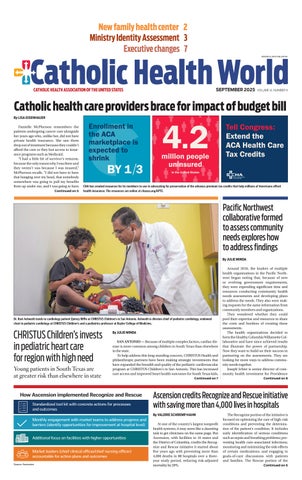
CHA has created resources for its members to use in advocating for preservation of the advance premium tax credits that help millions of Americans afford health insurance. The resources are online at chausa.org/APTC.
Pacific Northwest collaborative formed to assess community needs explores how to address findings By JULIE MINDA
SAN ANTONIO — Because of multiple complex factors, cardiac disease is more common among children in South Texas than elsewhere in the state. To help address this long-standing concern, CHRISTUS Health and philanthropic partners have been making strategic investments that have expanded the breadth and quality of the pediatric cardiovascular program at CHRISTUS Children’s in San Antonio. This has increased care access and improved heart health outcomes for South Texas kids,
Around 2010, the leaders of multiple health organizations in the Pacific Northwest began noting that, because of new or evolving government requirements, they were expending significant time and resources conducting community health needs assessments and developing plans to address the needs. They also were making requests for the same information from community members and organizations. They wondered whether they could pool their expertise and resources to share the costs and burdens of creating these assessments. The health organizations decided to form the Healthy Columbia Willamette Collaborative and have since achieved results that illustrate the power of partnership. Now they want to build on their success in partnering on the assessments. They are looking for more ways to address community needs together. Joseph Ichter is senior director of community health investment for Providence
Continued on 7
Continued on 8
Dr. Ravi Ashwath tends to cardiology patient Quincy Riffle at CHRISTUS Children’s in San Antonio. Ashwath is division chief of pediatric cardiology, endowed chair in pediatric cardiology at CHRISTUS Children’s and a pediatrics professor at Baylor College of Medicine.
CHRISTUS Children’s invests in pediatric heart care for region with high need Young patients in South Texas are at greater risk than elsewhere in state
By JULIE MINDA
How Ascension implemented Recognize and Rescue Standardized tool kit with concrete actions for processes and outcomes
Ascension credits Recognize and Rescue initiative with saving more than 4,000 lives in hospitals By VALERIE SCHREMP HAHN
Monthly engagement with market teams to address progress and barriers (identify opportunities for improvement at hospital level) Additional focus on facilities with higher opportunities Market leaders (chief clinical officer/chief nursing officer) accountable for action plans and outcomes Source: Ascension
At one of the country’s largest nonprofit health systems, it may seem like a daunting task to get clinicians on the same page. But Ascension, with facilities in 16 states and the District of Columbia, credits the Recognize and Rescue initiative it started about five years ago with preventing more than 4,000 deaths in 88 hospitals over a threeyear study period, reducing risk-adjusted mortality by 20%.
The Recognize portion of the initiative is focused on optimizing the care of high-risk conditions and preventing the deterioration of the patient’s condition. It includes early identification of serious conditions such as sepsis and breathing problems; preventing health care-associated infections; monitoring and minimizing the side effects of certain medications; and engaging in goals-of-care discussions with patients and families. The Rescue portion of the Continued on 6