Environmentalism in IT 2 Executive changes 11 Blessings in bags 12 PERIODICAL RATE PUBLICATION
MAY 2026 VOLUME 42, NUMBER 5
Providence subsidiary looks to close biomedical research gap By JULIE MINDA
A Providence St. Joseph Health subsidiary is trying to close a population representation gap in important medical research. Black, Latino and American Indian people are underrepresented in colorectal cancer studies, largely because they are poorly represented in the biorepositories — or repositories of biospecimens — used in that research. These marginalized, ethnically and racially diverse populations also are less likely than white people to be screened for colorectal cancer, and they have worse
outcomes from the condition. There are similar disparities for many other medical conditions. All this is according to researchers with Providence’s Health Research Accelerator. Those researchers are trying to better understand and address these disparities. “If we limit our research to white people, what are we missing?” asks Kristi Roybal Roybal, a clinical research scientist with the accelerator and lead author of a study that ran in the Journal of Community Genetics in January. She notes Continued on 11
“
We are striving to do better. So: How can we be more culturally responsive? We need to understand who our patients are … We are trying to understand how to meet them where they are.” — Kristi Roybal
CommonSpirit hospital clues in staff so patients with dementia get appropriate care
Catholic hospitals join the move to add ERs for expectant moms By VALERIE SCHREMP HAHN
By JULIE MINDA
A couple years ago, members of a caregiver support group at Peace Lutheran Church in Grand Island, Nebraska, got to talking about what it was like taking their loved ones with dementia to the hospital. Many of them had experienced difficulties because clinicians hadn’t known the patients had cognitive impairments and unknowingly responded unhelpfully to behaviors associated with dementia. The support group brought their concerns to Beth Deida, a fellow church member who is a maternal-child nurse educator and patient safety specialist at Grand Island’s CHI Health St. Francis. Deida met with the group Deida repeatedly to understand their concerns, engaged leadership at the CommonSpirit Health hospital to respond and formed a committee at the hospital to create solutions. The result is St. Francis’ REMEMBER initiative, which provides visual cues to hospital staff to alert them when a patient has dementia or other cognitive impairments. Staff have been trained on how to take evidence-based approaches to protect Continued on 9
In a CHA webinar, a hospice nurse says, “We do have a lot of work to do” in honoring the dignity of those with dementia. Page 9
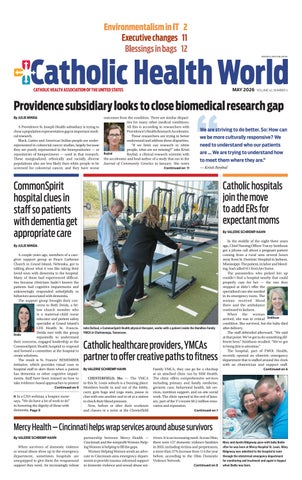
John DuVaul, a CommonSpirit Health physical therapist, works with a patient inside the Hamilton Family YMCA in Chattanooga, Tennessee.
Catholic healthcare providers, YMCAs partner to offer creative paths to fitness By VALERIE SCHREMP HAHN
CHESTERFIELD, Mo. — The YMCA in this St. Louis suburb is a buzzing place: Members bustle in and out of the lobby, carry gym bags and yoga mats, pause to chat with one another and to sit at a station to check their blood pressure. Now, before or after their workouts and classes or a swim at the Chesterfield
Family YMCA, they can go for a checkup at an attached clinic run by SSM Health. The clinic offers comprehensive services including primary and family medicine, geriatric care, behavioral health, lab services, nutrition support, and on-site social work. The clinic opened at the end of January, part of the Y’s recent $9.2 million renovation and expansion.
In the middle of the night three years ago, Chief Nursing Officer Tracey Smithson got a phone call about a pregnant patient coming from a rural area several hours away from St. Dominic Hospital in Jackson, Mississippi. The patient, in labor and bleeding, had called 911 from her home. The paramedics who picked her up couldn’t find a hospital nearby that could properly care for her — the one they stopped at didn’t offer the specialized care she needed in its emergency room. The woman received blood there and the ambulance continued to Jackson. When the woman arrived, she was in critical Smithson condition. She survived, but the baby died after delivery. The staff debriefed afterward. “We said at that point: We’ve got to do something different here,” Smithson recalled. “We’ve got to bring this to attention.” The hospital, part of FMOL Health, recently opened an obstetric emergency department that is staffed around the clock with an obstetrician and support staff. Continued on 6
Continued on 7
Mercy Health — Cincinnati helps wrap services around abuse survivors By VALERIE SCHREMP HAHN
When survivors of domestic violence or sexual abuse show up in the emergency department, sometimes hospitals are unequipped to give them the wraparound support they need. An increasingly robust
partnership between Mercy Health — Cincinnati and the nonprofit Women Helping Women is helping to fill the gaps. Women Helping Women sends an advocate to Cincinnati-area emergency departments to provide trauma-informed support to domestic violence and sexual abuse sur-
vivors. It is an increasing need: Across Ohio, there were 157 domestic violence fatalities in 2025, including victims and perpetrators, a more than 37% increase from 114 the year before, according to the Ohio Domestic Violence Network. Continued on 8
Mary and Austin Ridgeway pose with baby Bodie after he was born at Mercy Hospital St. Louis. Mary Ridgeway was admitted to the hospital in June through the obstetrical emergency department for monitoring and treatment and again in August when Bodie was born.