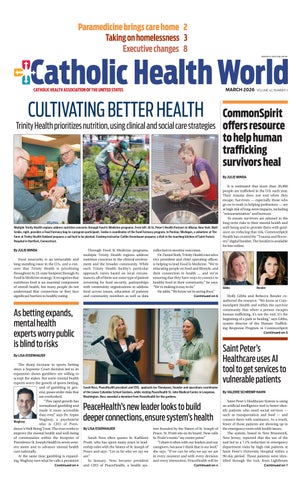
CULTIVATING BETTER HEALTH
Trinity Health prioritizes nutrition, using clinical and social care strategies


![]()


By JULIE MINDA
It is estimated that more than 20,000 people are trafficked in the U.S. each year. Their trauma does not end when they escape. Survivors — especially those who go on to work in helping professions — are at high risk of long-term impacts, including “retraumatization” and burnout.
To ensure survivors are attuned to the long-term risks to their mental health and well-being and to provide them with guidance on reducing that risk, CommonSpirit Health has created the “Trauma and Recovery” digital booklet. The booklet is available for free online.
By JULIE MINDA
Food insecurity is an intractable and long-standing issue in the U.S., and a concern that Trinity Health is prioritizing throughout its 25-state footprint through its Food Is Medicine strategy. It recognizes that nutritious food is an essential component of overall health, but many people do not understand that connection or they face significant barriers to healthy eating.
As betting expands, mental health experts worry public is blind to risks
By LISA EISENHAUER
The sharp increase in sports betting since a Supreme Court decision led to its expansion shows gamblers are willing to accept the stakes. But some mental health experts worry the growth of sports betting, and of gambling in general, poses wider risks that are overlooked.

“This rapid growth has normalized gambling and made it more accessible than ever,” says Dr. Arpan Waghray, a psychiatrist who is CEO of Providence’s Well Being Trust. The trust works to improve the mental health and well-being of communities within the footprint of Providence St. Joseph Health in seven western states and to advance mental health care nationally.
At the same time gambling is expanding, Waghray sees what he calls a persistent
Through Food Is Medicine programs, multiple Trinity Health regions address nutrition concerns in the clinical environment and the broader community. While each Trinity Health facility’s particular approach varies based on local circumstances, all of them use some type of patient screening for food security, partnerships with community organizations to address food access issues, education of patients and community members as well as data
collection to monitor outcomes.
Dr. Daniel Roth, Trinity Health executive vice president and chief operating officer, is helping to lead Food Is Medicine. “We’re educating people on food and lifestyle, and their connection to health … and we’re ensuring that they have ways to connect to healthy food in their community,” he says.
“We’re making it easy to do.”
He adds, “We know we’re saving lives.”

PeaceHealth’s new leader looks to build deeper connections, ensure system’s health
By LISA EISENHAUER
Sarah Ness often quotes Sr. Kathleen Pruitt, who has spent many years in leadership roles with the Sisters of St. Joseph of Peace and says: “Let us be who we say we are.”
In January, Ness became president and CEO of PeaceHealth, a health sys-
tem founded by the Sisters of St. Joseph of Peace. Sr. Pruitt sits on its board. Ness calls Sr. Pruitt’s motto “my center point.”
“I share it often with our leaders and our caregivers, because I think that is our keel,” she says. “If we can be who we say we are in every moment and with every decision and every interaction, PeaceHealth will be


Holly Gibbs and Rebecca Bender coauthored the resource. “We know at CommonSpirit Health and within the survivor community that when a person escapes human trafficking, it’s not the end. It’s the beginning of a path to healing,” says Gibbs, system director of the Human Trafficking Response Program at CommonSpirit
By VALERIE SCHREMP HAHN
Saint Peter’s Healthcare System is using an artificial intelligence tool to better identify patients who need social services — such as transportation and food — and connect them with assistance. As a result, fewer of those patients are showing up in the emergency room with health issues. The system, based in New Brunswick, New Jersey, reported that the use of the tool led to a 7.1% reduction in emergency department visits by high-risk patients at Saint Peter’s University Hospital within a 90-day period. Those patients were identified through the tool, from Lightbeam

ArchCare adds site
The continuing care system of the Archdiocese of New York agrees to operate Wartburg, a Lutheran-sponsored health care and senior living campus.

art gallery
SSM Health Waupun Memorial Hospital in Wisconsin repurposes a lobby wall as a display space for rotating works of art from the community.

Dignity Health — Glendale Memorial Hospital and Health Center in Southern California marks its centennial with community events and acts of kindness.
By JULIE MINDA
Through a program Central Kentucky’s Saint Joseph Health started in the fall, patients who have an increased risk of readmission can get help with their post-hospitalization needs.
The Community Paramedicine Program that Saint Joseph of Lexington, Kentucky, launched in October dispatches a paramedic and social worker to the homes of recently discharged patients who have conditions that make them prone to readmission. The two-member team assesses how well the patients are equipped to heal at home and helps them address medical and socioeconomic barriers to a successful recovery.
Saint Joseph’s program already has achieved a success rate of more than 90% when it comes to preventing seven-day readmissions and a more than 80% success rate for 30-day readmissions.
Saint Joseph’s Austin Roush explains that “community paramedicine is a proactive, hospital-based care model designed to support high-risk patients after they are discharged from the hospital, when they are often most vulnerable to complications, confusion and readmission.” Roush is the system’s director of paramedicine.
The program “provides a wraparound service to vulnerable patients who need a little extra help in the healing process,” Matt Grimshaw says. He is president of Saint Joseph, a CommonSpirit Health subsystem with eight hospitals and a network of about 100 additional sites in 20 Central Kentucky counties.
To implement the model, Saint Joseph developed a pilot program about a year ago with the Lexington Fire Department.
Saint Joseph then received the necessary certification to operate the program itself before bringing the Community Paramedicine Program fully in-house.
The program’s staff includes a licensed community paramedic, a social worker, the director of paramedicine and a medical director.
Saint Joseph’s program already has achieved a success rate of more than 90% when it comes to preventing seven-day readmissions and a more than 80% success rate for 30-day readmissions.
Community paramedics are trained beyond traditional paramedics and learn to provide preventive, longitudinal care.
Saint Joseph offers the paramedic and social worker visits to patients who have complex medical conditions and medication regimens, need early post-discharge support, and/or face socioeconomic barriers. Medical conditions that put patients at high risk for readmission include sepsis, pneumonia, heart failure and chronic obstructive pulmonary disease. The program also is available to new moms at risk for preeclampsia or elevated postpartum hypertension.
Patients can enroll in the program during their admission to the hospital.
They usually receive their first home visit within 96 hours of discharge. During their initial visit, the paramedic-social worker duo assesses patients’ risk level, evalu-
ates their home environment for barriers to recovery, completes a medical evaluation, reinforces education on their condition, reassesses medications, and ensures follow-up care plans are in place and that the patients are able to complete them. The team also assesses patients’ food security, transportation and housing stability. They spot gaps and work to find solutions. They normally complete a follow-up visit with a similar agenda.
Roush says Saint Joseph covers all the costs of the program, including personnel, program infrastructure, training and certification, equipment, clinical oversight and data tracking. “This investment reflects Saint Joseph Health’s commitment to its community and its values,” he says.
A healthy start
Already, the paramedic-social worker team has made over 150 in-home visits in the Lexington area. Roush says that so far, “the program has been well received by patients, clinicians and hospital leadership.”
Roush says the team has found that there is improved patient confidence after discharge, better medication understanding and adherence, strong chronic disease management and appreciation for the inhome, personalized care. Over the long term, Saint Joseph is monitoring how the program impacts readmission rates and health care costs, with a particular focus on high-risk conditions.
Grimshaw says the program is “redefining what it means to care for patients beyond the hospital walls.”
He says by “emphasizing education, trust and compassionate care,” the program “is one more way that Saint Joseph Health lives our mission.”
jminda@chausa.org
By LISA EISENHAUER
The federal spending bill approved in early February contains many reasons for Catholic health care providers to rejoice, even if it doesn’t include all the proposals CHA supported, association leaders say.
Sr. Mary Haddad, RSM, president and CEO of CHA, called the measure an important step toward making sure people can get the care they need when they need it.

“By strengthening Medicaid and Medicare, supporting mothers and children, expanding access to behavioral health care, and investing in rural communities, Congress is helping protect access to health care for patients and families across the country — especially those facing the greatest challenges,” Sr. Mary said.
Congress passed the consolidated appropriations bill and President Donald Trump signed it into law on Feb. 3.

“This is a bipartisan bill,” Lucas Swanepoel, CHA’s vice president of advocacy and public policy, noted. “I think we often see better outcomes and stronger outcomes for communities when our members of Congress are working together, and I think this bill really shows the value of that.”
He and Sr. Mary pointed to several welcome provisions of the bill: Medicare telehealth flexibilities were extended through 2027. These flexibilities allow Medicare patients to access virtual care for many needs, including mental health issues.
Coverage of the Acute Hospital Care at Home initiative was continued through Sept. 30, 2030. This model of care lets patients with acute conditions such as pneumonia get hospital-level care at home.
Scheduled cuts to the Medicaid Disproportionate Share Hospital allotments were eliminated through Sept. 30, 2027. The
payments go to hospitals that serve a high percentage of Medicaid and uninsured patients.
Federal programs got more funding to study preterm births and improve outcomes for premature infants; to expand the scope of state maternal mortality review committees; and to more regularly disseminate best practices for maternal care.
A major provision that CHA had hoped to see in the legislation or passed by Congress as a separate measure was an extension of the enhanced premium subsidies for people who get health care coverage through the Health Insurance Marketplace. The marketplace started under the Affordable Care Act. The premium subsidies were put in place during the pandemic to make insurance more affordable, and they lapsed last year.
The Congressional Budget Office has estimated that 21.8 million people, or 93% of those who accessed insurance through the marketplace in February 2025, got subsidized premiums.
—
Health World (ISSN 87564068) is published monthly and copyrighted © by the Catholic Health Association of the United States. POSTMASTER: Address all subscription orders, inquiries, address changes, etc., to CHA Service Center, 4455 Woodson Road, St. Louis, MO 63134-3797; phone: 800-230-7823; email: servicecenter@ chausa.org. Periodicals postage rate is paid at St. Louis and additional mailing offices. Annual subscription rates: CHA members free, others $29 and foreign $29.
Opinions, quotes and views appearing in Catholic Health World do not necessarily reflect those of CHA and do not represent an endorsement by CHA. Acceptance of advertising for publication does not constitute approval or endorsement by the publication or CHA. All advertising is subject to review before acceptance.
Vice President Communications and Marketing Brian P. Reardon Editor Lisa Eisenhauer leisenhauer@chausa.org 314-253-3437
Associate Editor Julie Minda jminda@chausa.org 314-253-3412
Associate Editor Valerie Schremp Hahn vhahn@chausa.org 314-253-3410
Graphic Design Norma Klingsick
Advertising ads@chausa.org 314-253-3477
By LISA EISENHAUER
Dr. Farrin Manian practiced for 27 years at Mercy Hospital St. Louis, located in one of the city’s wealthier suburbs. Unhoused people were the exception rather than the norm among the hospital’s patient population.

Ensconced in what he calls his own bubble of a suburban infectious disease practice, he says he didn’t appreciate the challenges people with no stable shelter faced in accessing health care and in daily living.
“It was like an out of sight, out of mind kind of thing,” he recalls.
That changed in 2013, when he took a position at Massachusetts General Hospital, a teaching hospital affiliated with Harvard Medical School that serves the diverse urban population of Boston. In his seven years there, he helped care for many people who lacked permanent shelter. Daily, he saw how unstable their lives were as they camped on the streets and in the parks he walked through on his way to work.
“I was really exposed to the conditions of being unhoused in the cold and rain,” Manian says. “And it just made me think about why can’t we do better as a society to help this vulnerable population.”
Even amid the ongoing need in Boston, Manian says he saw inspiring work being done, especially by the Boston Health Care for the Homeless Program. That program describes itself as an “integrated team of over 600 medical and behavioral health staff, social service providers, and support staff committed to providing comprehensive, high-quality health care for individuals and families experiencing homelessness in Boston and beyond.”
Seeing the need back home
When Manian returned to Mercy Hospital St. Louis in 2020, he began to research homelessness in the region.
“I didn’t know the statistics, but the more I looked into it, the more I found out that it’s a big problem for us in the region,” he says. “It is a problem in Missouri. It’s not
just the inner city. It’s suburban as well as rural areas.”
The 2024 homeless assessment from the Department of Housing and Urban Development found that 7,312 people were unsheltered in Missouri. In the St. Louis region, an estimated 1,700 people are unhoused.
Manian’s findings on homelessness in St. Louis and his experience in Boston prompted him to act, with a focus on awareness building. In January, for the second year in a row, he organized a daylong symposium at Mercy St. Louis focused on how to address the needs of people experiencing homelessness. The topic was “Meeting Them Where They Are: Toward Better Health Care for Our Unhoused People.”
The conference brought together national experts on the living conditions of people who are unsheltered and on best practices in providing them medical care; leaders of public health and social service agencies in the St. Louis region; and people who have experienced being unsheltered in the region.
“We were able to somehow, miraculously, bring everybody together and we hope to keep doing it every year,” Manian says.
Awareness, networking
He says the idea for the symposium came to him about two years ago, after he and some of the residents he works with at Mercy began spending Saturday mornings with Street Med STL, a team of volunteers who visit encampments of people who are unhoused in St. Louis to provide medical care.
“We were rounding on the banks of the Mississippi among a bunch of tents and rain and then it just struck me that, within our group, we all know exactly what we need to do, but 99% of people out there are completely oblivious of what life in these encampments really is like,” he recalls. “The lack of awareness at a societal level, to me, in our region, made me think that what we need to do is to have a symposium where we can have a lot of people from all different disciplines come together.”
In addition to encouraging staff from

across its footprint in Missouri, Arkansas, Oklahoma and Kansas to attend the conference in person or virtually, Mercy invites government officials, people affiliated with medical schools and other hospitals in St. Louis, and leaders of health care and social service organizations across the region. This year about 250 people attended in person or virtually.
One of the welcoming addresses at the conference came from St. Louis County Executive Dr. Sam Page, who in addition to being the county’s top elected leader is an anesthesiologist.
Manian says the symposium’s goals are to increase awareness of the unsheltered population and their needs and to provide a networking opportunity for people who have an interest in addressing those needs.
Understanding why
Based on his own experience, Manian says there are many reasons beyond not having a permanent address that people living on the streets don’t or can’t access health care. The reasons include lack of access to phones and transportation.
Another big reason, he says, is that many people who are unsheltered do not trust the health care system. “They don’t really like to necessarily even seek medical care unless it’s absolutely necessary,” Manian says.
Even for those on the streets who are reluctant to seek care for themselves, Manian says society should not give up on improving their lives and health. He points out that compared to others, people who are unsheltered have higher rates of morbidity and mortality.
“That has to do with all the issues that go along with not having a roof over your head, even in the shelter, whether it has to do with trauma, crime, enduring or putting up with the elements, lack of food, frostbite, you name it,” he explains.
As part of his volunteer work with


Street Med STL, Manian visits a church in St. Louis once a month when it serves dinner to unsheltered people staying in the neighborhood. He brings supplies such as antibiotics and bandages and offers his medical services.
Just as important as tending to the health needs of the people at the dinner and at homeless encampments, Manian says, is acknowledging their presence and treating them with dignity. That approach builds trust, fosters hope and can help change the course of their lives, he says.
“This kind of a connection that we establish with our people, that is kind of a shared humanity that we’re privileged to have when we encounter them,” he says. “That, to me, is priceless. And that trust, I think, is going to be really, really important in terms of helping our people get out of the situation they’re in.”
A need for funding and advocacy
Manian says Street Med STL depends largely on the generosity of its volunteers to not only provide their time and talents but to also buy their own supplies. With more funding, the group could help many more, he adds.
“We want to expand our services, not just in downtown St Louis, but also in the county and rural areas,” he says. “We need resources for that.”
Manian recognizes that many people aren’t able to gift their talents or donate money to help those who are unsheltered, yet they still want to help. He encourages them to speak out.
“I know that not everybody’s going to be able to come around with us on Saturdays,” he says. “But if we can really impress upon the community to become better advocates for the unhoused, I think that can gradually change our attitudes toward this population.”
leisenhauer@chausa.org
Baton Rouge, Louisiana-based FMOL Health has improved employee pay and benefits in the past year, with the latest enhancements early this year.
In January, the health system made what it called a major market compensation rate adjustment, and it also increased the minimum wage it pays to $15 an hour, from $14. The federal minimum hourly wage is $7.25. Neither Louisiana nor Mississippi — the two states where FMOL Health operates — has a minimum wage.
About 80% of current FMOL Health employees saw their pay increase as a result of the improvements. Their new pay went into effect with the Jan. 19 pay period.
According to a press release, FMOL Health made the changes after conducting an extensive analysis of thousands of roles across the system, benchmarking each position against competitive rates at comparable organizations. The analysis took
into account both national and regional data sources.
In its release, FMOL Health said it has consistently offered wages well above the federal minimum. The system said this is in line with its commitment to fair and just labor practices, which flow from strongly held beliefs instilled by the system’s foundresses, the Franciscan Missionaries of Our Lady.
The compensation adjustments and establishment of a new minimum wage at FMOL Health follow a 4% pay increase in June as well as a paid parental leave policy that the system began at the start of this year.
In the press release, FMOL Health President and CEO E.J. Kuiper said the system was able to make the investments because it is in a strong financial position and wants to invest in “the team members responsible for our continued success.”
From page 1
“public blind spot” when it comes to gambling addiction and its potential comorbidities such as financial strain, social isolation, depression and substance abuse. “There are no formal surveillance systems tracking prevalence or harm,” he notes.
Court ruling opens door
In 2018, the year the Supreme Court struck down a federal law that had prohibited states from authorizing sports betting, revenue from the practice was $430.2 million, according to the American Gaming Association. By 2024, when 38 states had embraced sports betting, the revenue was 32 times greater, at $13.78 billion nationwide. Sports betting that year accounted for 19% of the $72 billion brought in by commercial gaming, a total that continues a record-setting trend, the association says.
Today, 39 states, the District of Columbia and Puerto Rico have legalized sports betting. One of the reasons states are willing to do so is the tax revenue that gambling generates. The American Gaming Association put the figure at almost $16 billion for state and local governments in 2024, up from $9.7 billion in 2018.
However, a study published in February 2025 in the journal JAMA Internal Medicine noted that very little of the tax revenue from gaming is earmarked to help problem gamblers. Looking at funds set aside in 2023 for gambling addiction programs, the study found “most states allocated less than $1 million and 20 states allocated less than $400,000, despite ample tax revenues.”
20 million report risky habits
Cait Huble is director of public affairs for the National Council on Problem Gambling, a nonprofit dedicated to mitigating gambling-related harm. Huble says that while the council takes no stance on legalizing gambling, it does strongly support education and research on the economic and social costs of problem gambling. It also supports access to treatment.
“Problem gambling as a field receives no
From page 1
the provider and employer of choice in the markets that we serve, and we are determined to make it so.”
Before moving into the top post at PeaceHealth, Ness spent more than 20 years with the system in various positions. Most recently she was executive vice president and chief administrative officer.
She says what drew her to health care was the profound effect caregivers could have on people, especially at their most vulnerable moments.
“Health care is one of the few fields where we have the opportunity to directly touch lives clinically, emotionally, spiritually and across patients and families and communities,” she says. “I believe the work that we do is absolutely sacred and has a lasting impact.”
PeaceHealth, based in Vancouver, Washington, includes 3,200 physicians and other clinicians plus about 16,000 more caregivers. It operates more than 160 clinics and nine medical centers in Washington, Oregon and Alaska.
Ness is focusing on three key priorities as PeaceHealth’s leader. The first is deepening connections between the system and its workforce. To do that, she sees it as essential to spend time on-site with PeaceHealth employees to listen to their concerns and learn what they need to thrive.
As part of that listening and learning process, she is going on “Carry Forward tours” of PeaceHealth sites. “It’s an opportunity for me to share the vision as we think

$72.04 BILLION
$149.9 BILLION $13.78 BILLION 28 OF 38 JURISDICTIONS
federal funding at all, which is our number one advocacy priority,” she says.
In 2018, the council began doing surveys every three years of Americans’ gambling habits. The 2024 survey found 8% of U.S. adults — or 20 million — “reported experiencing at least one indicator of problematic gambling behavior ‘many times’ in the past year.” Those indicators include thinking about gambling constantly and feeling the need to bet more money and more often.
The survey pointed to several predictors of risk for problem gambling, such as gambling weekly or more often, agreeing that gambling is a good way to make money, and being male and/or under 35.
However, the survey found that those who are at the greatest risk of problem gambling also are the most skeptical of treatment. “We have a lot of work to do in terms of education, making sure that people can understand that gambling addiction is a real thing, it’s a real addiction, and the treatment that is available is very effective,” Huble says.
Smartphones, gambling apps
Dr. Thomas Horn is a psychiatrist who leads the behavioral health program at Chesterfield, Missouri-based Mercy. Horn points out that just as the legalization by states of sports betting has led to its expansion, so has the embrace of smartphones
about PeaceHealth’s next chapter,” she says. “But more importantly, it’s hearing directly from our caregivers and our clinicians and our donors around how we serve.”
On the visits, she reinforces to staff the importance of collectively carrying forward PeaceHealth’s mission to meet individual patient needs and to promote the common good across communities.
In her time at PeaceHealth, Ness has advanced workforce development. She championed the system’s Women of Peace movement to empower women caregivers to flourish by giving them encouragement and opportunities. She helped roll out Nurture 360, a program that connects staff with resources to improve their physical, mental, spiritual, financial and emotional well-being.
Modernizing care delivery, service
Ness’ second priority is modernizing PeaceHealth’s care delivery and service model so that the system provides “exceptional and holistic care to every person we serve across every stage of their health and wellness journey.”
She says PeaceHealth already has examples of this in place. In Vancouver, the system opened a community health hub with staff from local social services agencies in the emergency department. The partnership between the hub and those agencies leads to “warm and seamless handoffs” for patients in their time of need, Ness explains. In Eugene, Oregon, PeaceHealth is partnering with a transitional housing organization to provide “recuperation cottages” and a medical clinic for discharged patients with no place else to go to recover.
Another part of PeaceHealth’s modernization effort, Ness says, is to leverage
Source: American Gaming Association
and the development of apps on those phones specifically for betting.

“We’ve got a casino in our pocket now at all times,” Horn says. “And I think that’s why you’re seeing so much interest and intrigue into that intersection of gambling and how it fits in our culture.”
He believes that advertising for sports betting, in particular, seems meant to entice young men by giving them infinite options to test their intuition. For example, major sports betting sites take wagers on not only outcomes of competitions such as Major League Baseball games but also on specific action within the games such as whether the next pitch will be a strike or ball.
“I think they’re marketing to that competitive individual that’s looking to gambling as an outlet,” Horn says.
Though most bettors don’t get in so deep that they put their finances and relationships at risk, Horn says enough do that mental health care professionals should be trained to look for early signs of gambling addiction and to encourage treatment when they see indications of trouble.
While there is no ingested substance involved in betting, Horn says gambling has an effect on the brain like other addictive practices. He says interventions for
technology to better serve patients and caregivers. She points out that some of the most transformative advances she has seen in her two decades in health care involve technology, such as the expansion of access to care through telehealth and the use of robotics to make surgeries more precise and less invasive.
“These new technologies are really having a direct impact in a positive way for our patients but also easing some of the burden of our physicians as well as we ensure that they have the best tools and technology and support to provide the care that our patients and communities deserve,” Ness says.
Ensuring the system’s health
Her third priority as she leads PeaceHealth forward is to safeguard the system’s financial and operational health. She notes that this has been made more challenging by various factors, such as rising costs for services, uncertainty around Medicaid and Medicare reimbursement rates, and the lapse of enhanced premium subsidies for people insured through the Affordable Care Act.
“I think we have got to be able to better manage costs while protecting access and quality,” she says. “And that means working together collectively with policymakers, with payers, with community partners to really find solutions together to better manage costs while always protecting that quality and access.”
Ness points out that like other nonprofit health systems, PeaceHealth is a stabilizing force in the communities it serves and further supports through community benefit programs. In fiscal year 2025, PeaceHealth’s community benefit donations totaled $280 million.
other compulsions, such as 12-step therapy, counseling and medications, also have proven effective in breaking gambling addictions.
If society understood problem gambling to be an addiction, Horn says it might prompt more compulsive bettors to seek help. “I think talking about it that way, hopefully, does decrease the stigma around it, and allow people to, if they’re curious at all, ask ‘Do I have a problem with this or not?’ and to seek out a mental health provider,” he says.
Recommended guardrails
Waghray informally polled mental health care colleagues across the country about compulsive gambling. “What was fascinating to me is that everyone recognized this as a problem, but didn’t really have well-thought-out, sophisticated solutions,” he says.
Even given that finding, he agrees that there are effective treatments for gambling addiction. But he sees a need for more education of care providers and the public about the problem and more research into how best to identify and address it early on.
Waghray stresses that Providence sees advancing compassionate, evidenceinformed solutions to expand access, reduce stigma, and close care gaps for all mental health needs, including compulsive betting, as part of its Catholic mission. He says that mission frames Well Being Trust’s practical recommendations to keep gambling from turning into a societal scourge. Those recommendations include: Establish guardrails like spending limits and requirements for responsible advertising.
Embed routine screening in primary care and emergency settings.
Invest in youth-focused prevention. Build cross-sector partnerships to monitor harms and deliver accessible care.
“Our goal is simple and aligned with Catholic social teaching: protect people, heal families, and strengthen communities — so legalization does not become normalization of harm, but an opportunity to put ethics, public health, and dignity at the center of policy and practice,” Waghray says.
When she’s not working, Ness says she tries to strike a balance between calmness and activity. She’s an early riser who cherishes a quiet start to the day with a walk through her neighborhood with her minigoldendoodle, Madison. She treasures time with her husband, Joe, and enjoys catching up with her two college-age kids, Will and Caroline, whenever they’re home.
She appreciates the outdoor beauty of the Pacific Northwest — whether skiing on Mount Hood, taking weekend hikes, or spending time on the tennis court. She keeps a good book at her bedside, often something by Washington-based author Kristin Hannah, so she can put herself in “a different mental space” as she ends her day.
Sustained commitment
As she settles into her new role, Ness sees a bright future for PeaceHealth.
“I share with our leadership team and our caregivers that I believe this ministry is really just beginning to realize what it is capable of as we become more connected, as we become more purpose driven and as PeaceHealth serves our growing communities with greater access to care, always being faithful to our mission and values,” she says. She also says that PeaceHealth stands firm in its commitment to care for the most vulnerable in the communities within its footprint, just as its foundresses did when they began establishing health care ministries in the late 1800s.
“That need has not wavered,” she says. “It’s as strong now as it ever was, if not more so. And my job as CEO is to ensure that we remain just as committed today to that work as we were 135 years ago.”
leisenhauer@chausa.org
From page 1
Health.
“This book addresses the critical, deep, hidden struggles of survivors,” she explains. Bender, who is founder and head of the Rebecca Bender Initiative and its Elevate Academy virtual learning center, says, “There’s not a lot of trauma support out there to address the long-term needs of survivors. What happens three years after escape, five years after?” She says this book helps address that gap.
Created by survivors, for survivors
In creating the booklet, Gibbs and Bender drew upon their own experiences as human trafficking survivors. They also leaned on the expertise of other survivors as well as psychologists and other experts, including from CommonSpirit.
Funded by the CommonSpirit Health Foundation, the booklet explains what trauma is, how widespread it is and some of the potential causes. It describes different ways people experience and react to trauma. It explains how socioeconomic stressors can have an impact. It explains some of the ramifications of not addressing the problem.
The booklet also runs through ways people can care for themselves to prevent trauma responses from festering or worsen-


ing. For instance, survivors can build a supportive network of friends. They can remain aware of triggers of retraumatization and advocate for themselves to avoid further harm.
The guide provides practical advice on how to move forward and avoid common pitfalls to recovery.
From survivors to advocates
In 1992, at age 14, Gibbs was lured from a stable, middle-class home life in rural New Jersey by a man who promised to res-
cue her from struggles she was facing so she could lead a new life. He instead forced her into prostitution. After two nights, she was arrested, which saved her from her trafficker. Her recovery was long and difficult. She faced retraumatization, including when law enforcement and health care workers treated her poorly.
Gibbs pursued a microbiology career and married. When she was 31, she saw a documentary about human trafficking that changed her life. It put a name to what she’d experienced as a teenager. She began

connecting with others in the survivor community, consulting for anti-trafficking organizations and writing books about her experience. She joined Dignity Health, a predecessor of CommonSpirit, in 2015 to oversee its anti-trafficking programming. She’s since been instrumental in creating educational resources for health care workers and others, so that they better understand how to provide trauma-informed care. She helped develop a clinic system that specializes in providing survivors with that type of care.
She received CHA’s Sister Concilia Moran Award in 2019 in honor of her contributions.
Bender, too, was lured from small-town life, in her case in Oregon, by a predator pretending to be a boyfriend. He forced her into prostitution. She endured six years of brutality at the hands of multiple traffickers in Las Vegas. She escaped during a federal trafficking raid. Putting her faith in Christ saved her, she said in books she wrote after her escape.
She founded the Rebecca Bender Initiative to help people who have been trafficked. The organization trains law enforcement, community leaders, and community members to fight trafficking. She consults and presents on the topic. She founded a virtual school to equip trafficking survivors with skills to rebuild their lives after escape. According to her website, her programming has reached 865 cities, serving 1,818 survivors and training 148,000 professionals.
Seeing a need
Gibbs’ inspiration for “Trauma and Recovery” came when she was developing an educational module for health care providers on trauma-informed care. She realized that she would benefit from applying the information to her own life. She reflected that there were not many resources available for long-term healing for survivors, and particularly those in helping professions.
Gibbs asked Bender, who she’d gotten to know through their activism in the survivor community, to co-author the booklet.
The two embraced the work, discovering a passion for sharing with others what they’d learned about healing after trauma.
Gibbs says she used to rely on alcohol to wind down but quit five years ago and replaced it with other activities that help her de-stress.
Bender recalls a time when, long after her escape, she was a mom of four building up her nonprofit, earning a master’s degree and not tending to her own need for downtime. “I was experiencing pretty bad burnout,” she says. “I was making lunch one day, staring at the fridge, mentally going blank, experiencing fatigue.”
Her therapist said something needed to change. Bender decided to slow down and cut back on what she was trying to do.
Bender says people in helping fields like the one she and Gibbs work in can focus so much on tending to others’ needs that they ignore their own. She says she’s watched people who were doing great work for human trafficking victims burn out and leave the field. “We don’t want to lose good people — they matter, they make a difference,” she says.
She wants to help people in the field to be on the lookout for compassion fatigue and burnout. She wants others to realize the same thing she did when she was fraying — that people need to build a rhythm of rest and renewal. “They need things that bring them joy,” she says.
Gibbs, too, wants to ensure survivors stay healthy — mind, body and spirit. “Human trafficking is a public health issue,” she says. “It’s about us recognizing the longterm health impacts on survivors. I hope we see more progress in supporting people in long-term recovery.”
She says that with the right support, “We can all thrive.” jminda@chausa.org
At Trinity Health’s St. Peter’s Health Partners in Albany, New York, and St. Joseph’s Health in Syracuse, New York, patients and community members have gained access to healthy food and improved their health outcomes through the Food Farmacy program.
Representatives from those hospitals’ community health and well-being departments say Food Farmacy has been a success, in large part because the program has a screening system to identify people who could most benefit from chronic disease management. It also has a behavior change model that provides participants with education and resources to promote lasting results, access to professionals to coach people and help them navigate the system, and access to multiple sources of nutrient-rich food.

Eric Stone, director of community health and wellbeing for St. Joseph’s Health, says, “Our focus has been on the education and social care pieces.”

based organizations to ensure community members generally get access to socioeconomic screening and food aid. Community health workers at these organizations can screen local people for food needs and refer them to help. Local pantries provide groceries, including options that take into account cultural preferences.
The Mother Cabrini Foundation is a top grant source for the Trinity Health New York hospitals’ programming.

Sheilah McCart, manager of community engagement, community health and well-being at St. Peter’s Health Partners, says it is critical for health care providers to address nutritional deficiency, especially as it relates to chronic disease management. Lack of healthy food “leads to so many chronic diseases, including diabetes and hypertension. In pediatric patients, it can cause learning issues. For pregnant women, it can lead to gestational diabetes, which can lead to poor pregnancy outcomes,” she says.
From page 1
About 47.9 million Americans lived in food-insecure households in 2024, with some minority populations especially at risk, according to an analysis of the December 2025 Household Food Security report from the Department of Agriculture’s Economic Research Service.
The report’s findings “highlight a crisis that is set to deepen as the deepest cuts to the Supplemental Nutrition Assistance Program in history take effect,” the nonprofit Food Research & Action Center said in a release. According to the USDA, an average of about 41.7 million people per month participate in the federal nutrition program, with benefits averaging $187.20 per participant per month.
Food insecurity consistently ranks as a top concern in community health needs assessments from nearly half of Trinity Health’s hospitals and their community partners. Trinity Health clinical data shows that food insecurity is a persistent issue for many patients.
Roth says food insecurity has two main facets: Can people afford nutrient-rich food and can they buy that food in their area?
Many areas that Trinity Health facilities serve lack grocery stores, a persistent and widespread problem.

Sheilah McCart, Eric Stone and Carolyn Alessi are Trinity Health colleagues advancing the Food Is Medicine work in local markets. They explain that numerous barriers can exacerbate food insecurity. The rising cost of living can make it too expensive to buy nutritious food, says McCart, manager of community engagement, community health and well-being at St. Peter’s Health
In both the Albany and Syracuse areas, there are neighborhoods with few or no grocery stores selling fresh, healthy foods. McCart says the cost of living has been escalating faster than many people’s paychecks. This has resulted in high levels of food insecurity, she says. Many people eat cheaper, heavily processed convenience food that doesn’t nourish their bodies. There is a high level of nutrition-related chronic disease in these low-income areas, she says.
In Albany, the Food Is Medicine team uses Trinity Health’s patient database to identify people with type 2 diabetes, gestational diabetes, pediatric obesity or malnutrition, or hypertension who also have revealed through Trinity Health’s screening tool that they have socioeconomic barriers to health. Those patients can participate in the 12-week Food Is Medicine program where they receive nutrition education from a registered dietician. They also can work with community health workers from
Partners in Albany, New York. Some people do not have the transportation needed to travel to stores with healthy foods, says Stone, director, community health and well-being at St. Joseph’s Health, Syracuse, New York. Maintaining food access over time can be especially challenging, notes Alessi, regional director of community health and well-being at Trinity Health Of New England.
Whatever the barriers and issues, poor nutrition can have serious — and even lifethreatening — implications, says Roth. Unhealthy diet is linked to some of the top health concerns in the U.S., including heart disease, cancer, diabetes, kidney disease and chronic liver disease. An analysis from the nonprofit National Institute for Health Care Management says these types of chronic conditions are among the nation’s leading causes of death and account for an overwhelming percentage of health care spending. The institute’s analysis says some minority communities are particularly at risk.
Some of the top chronic conditions on Trinity Health regions’ radar screens through Food Is Medicine include diabetes, stroke and cardiovascular concerns, including hypertension.
Roth says Trinity Health enables local markets to tailor programming, based on particular needs and resources in each community.
But the regions’ work has common aspects. All include both clinical initiatives that apply to Trinity Health patients as well as population health approaches that apply to the broader community. On the clinical side, all are taking advantage of Trinity Health’s electronic medical record, which has screening questions on health-related social needs, including food insecurity. All are forging partnerships with community partners, including food pantries and social service agencies. And all are incorporating nutrition education, often from registered dietitians. Multiple regions involve com-
local organizations to get help navigating socioeconomic barriers to health and to learn where they can access food.
In Syracuse, Stone says, the community health and well-being department worked closely with St. Joseph’s primary care clinical network to develop its iteration of Food Is Medicine, which launched in 2021.
The Food Farmacy program includes emergency food aid for patients, staff and community members, with some of this aid provided through partnerships with community organizations.
Through the Emergency Food Bag program in Albany, St. Peter’s keeps a stock of bags of nutritious food for patients to ensure a three-day supply upon discharge. The program started in 2020 in the emergency department and behavioral health units and has since expanded throughout St. Peter’s network.
McCart and Stone mention that both the Albany and Syracuse hospitals have extensive relationships with community-
munity health workers in their programming. These workers help with coaching, navigation and follow-up, for both Trinity Health patients and community members.
Roth adds that all the programming is grounded in whole-person care concepts, addressing people’s needs — body, mind and spirit.
Local iterations
Food Is Medicine programming in some areas Trinity Health serves includes: Trinity Health New York: Trinity Health’s Albany and Syracuse markets offer the Food Farmacy initiative, which includes 12-week group sessions for patients who have specific chronic conditions and who have screened as food insecure. The participants get food and healthy lifestyle education, help addressing socioeconomic concerns, free healthy food if they need it and help connecting with community partners that can meet identified needs. Both the Albany and Syracuse markets also offer patients and staff members access to onsite emergency food supplies. The Albany program involves community health worker support.
Trinity Health Of New England: Saint Francis Hospital in Hartford, Connecticut, has made community health workers a central part of its Food Is Medicine work. Saint Francis Hospital engaged a committee of community partners in developing an intervention for people with food insecurity and unmanaged chronic disease. Piloted at the hospital’s safety net clinics and then broadened to patients of the primary care practices within Trinity Health Of New England’s Medical Group, the program provides intensive support from specially trained community health workers to patients diagnosed with certain chronic illnesses. The community health workers provide education on making healthy choices, coaching on nutrition and help with addressing socioeconomic barriers.
Trinity Health Michigan: Three Trinity Health Michigan sites — Ann Arbor, Mus-
Both the Albany and Syracuse teams have tracked results of Food Farmacy programming. In fiscal year 2025, the Albany and Syracuse programs together served 1,367 people, all of whom were screened for socioeconomic need. This count compares with 1,185 people served the prior fiscal year. In fiscal year 2025, the combined Food Farmacy programs provided access to 70,350 meals as compared with 49,446 the prior fiscal year.
The Food Is Medicine chronic disease management program in Albany has served more than 800 people since its 2020 inception. For a diabetes cohort of that program, participants lost an average of 10.3 pounds and had an average decrease in their A1C score of 3.10%. In the Food Is Medicine program for hypertensive and diabetic people, offered in partnership with community agencies, participants saw an overall 1.9% decrease in their A1C numbers and a decrease in blood pressure from on average 148/84 to 136/78. The Food Is Medicine program in Syracuse has served more than 400 people since its 2021 inception.
“We’ve learned that we need to motivate people” to help them change, says Stone in Syracuse. “We need to give them tools and education.”
— JULIE MINDA
kegon and Oakland — run Food Is Medicine farm programs on their hospital campuses. These farms provide community-centered food programs and seek to improve health equity while investing in the local food system, according to Trinity Health Michigan. The programming includes the Farm Share program that offers produce boxes and cooking education to community members, the Farm Share Assistance program that provides fresh fruit and vegetables to food-insecure people, and the Produce to Patients program that supplies patients with fresh produce. The farms also supply produce to farm stands and food pantries and for nutrition classes. In the Oakland market, retired emergency department physician Dr. Ross Weinstein recently announced a $4 million estate pledge to expand the farm’s work and add a community food hub on the hospital campus.
Trinity Health Florida: As part of a larger body of work, Holy Cross Health of Fort Lauderdale, Florida, hosts an annual Food Is Medicine Symposium. The October 2025 gathering drew more than 100 people — in-person and virtually — to learn how to improve health through nutrition. Sponsored by Holy Cross’s community health and well-being department and local partners, the event featured presentations by experts in food policy, nutrition science and community health. Holy Cross says a highlight of the symposium was the Culinary Medicine Masterclass, three hours of hands-on learning on how to prepare healthy, culturally relevant meals that support chronic disease prevention.
Roth says this and other Food Is Medicine work results in measurable improvements in health outcomes. This includes reductions in readmissions and emergency room visits and improvements in chronic disease management.
“We are joining with partners to change the dynamics in communities that are under-resourced,” Roth says. “We are increasing their food access.” jminda@chausa.org

From page 1
Health Solutions, which describes itself as an “AI-enabled solutions and services leader in population health management.”
The tool helps identify patients with a high risk of having needs related to social determinants of health and lists the top 10 risk factors for the patient, along with the top five recommendations to reduce the patient’s risk. The care team at Saint Peter’s reviews the risk factors and recommendations with the patients to determine the best way to help.
“While still early in the initiative, Saint Peter’s has achieved promising results,” says a case study from Lightbeam.

Clinicians and leaders anticipate that the tool will help reduce noshow rates at appointments and help them identify and
In recent years, Trinity Health Of New England’s community health and well-being department has been implementing strategies to address persistent nutrition-related health issues in and around Hartford, Connecticut.
That community health and well-being department assembled a committee of community partners to study the problem and develop solutions. In conjunction with the primary care practices within Trinity Health Of New England’s Medical Group, they developed Food Is Medicine. Launched in 2023, it is a six-month chronic disease management program centered on healthy eating and behavior change. Community health workers hired by Saint Francis Hospital through grant funding
located, is one of the most racially diverse counties in the nation. The population is 45.4% white, 30.3% Hispanic/Latino, 12.4% Asian, and 10.5% Black, according to a community health needs assessment. The hospital has more than 21,000 inpatient admissions, more than 260,000 outpatient visits and 67,000 emergency department visits each year.
Like many health systems, Saint Peter’s vowed to address disparities in health care after those inequities became more apparent during the COVID-19 pandemic. The challenge was deciding which patients to screen for factors related to those disparities, such as hunger and lack of housing.
“We knew we had to do something,” Ved said. She said the team asked themselves, “How do we risk stratify?”
The system had worked with Lightbeam before on projects, and the company came
“tethered lifelines to participants during their time in the program,” explains Carolyn Alessi, regional director of community health and wellbeing at Trinity Health Of New England. Saint Francis is part of Trinity Health Of New England. Alessi says initial results from the safety net clinic pilot and from the rollout in the medical group show that many participants adopt healthy behaviors, including more healthful eating. She says that participants also have reduced their return visits to the emergency department and improved control of their blood pressure.
your genetic code,” Ved pointed out.
The system wanted to know who, exactly, to question to determine their vulnerability to social determinants of health, which are responsible for up to 80% of health outcomes. The AI tool identifies those patients, by assessing factors such as whether or not a patient is more or less likely to have a car so they can get to an appointment, or whether they are more or less likely to have lead paint in their homes that might affect their health.
“We plotted that data so we know where to focus our effort,” Ved said. “There’s so many different applications of it, and I think the use of AI and population health is going to continue to evolve. But it helps us solve the problem of: Who do we reach out to first? Who do we screen when they’re there?”
The AI tool reviews the week’s upcoming appointments and identifies possible social determinants of health concerns faced by patients. If the tool identifies patients who
Data integration and social determinants of health risk factor identification
AI automatically assessed the week’s upcoming patient appointments from the patient scheduling data and identified likely individual social determinants of health risk factors and recommendations.

the food market will help patients make
AI segmented patients into high, medium, and low risk categories.
Saint Peter’s care team referred patients to available resources, addressing needs and increasing social determinants of health
healthy choices, and social drivers of health coordinators will help people find affordable housing or a job, sometimes within the
The key to Saint Peter’s work in screening and identifying patients who need help is following through, Ved said, and that also includes building and maintaining relationships with outside agencies to update contacts and resources. “We can give you a number all you want, but if you’re never able to get in touch with somebody on the other line, what good is that?” she said.
Ved, who practices Hinduism and Buddhism, says she is fascinated by the Catholic faith and takes one line of the Lord’s Prayer to heart: Give us this day our daily bread. People should have faith that God will provide, and the health system is, sometimes literally, the vehicle to get the daily bread to patients, she said. “That’s the heart of the Gospel. That’s what we’re supposed vhahn@chausa.org
By VALERIE SCHREMP HAHN
Though he grew up during the AIDS crisis that at its peak in the mid-1990s claimed more than 40,000 American lives a year, Dr. Robert Gioia remembers watching an animated program in eighth grade about sexually transmitted diseases that mentioned people dying of AIDS and not knowing about the disease.

In the intervening years, his knowledge about AIDS and HIV, the virus that causes the disease, has vastly grown. Gioia started his career as a dentist, got interested in preventive medicine, changed career paths, and now, at 50, he is a primary care physician and HIV specialist. He recently accepted the role of board chair of the Florida chapter of the American Academy of HIV Medicine.
Though the number of lives lost to AIDS in the United States has dropped significantly in recent decades — the Centers for Disease Control and Prevention put the total at 4,496 in 2022 — Gioia sees much more that can be done, given the advances in medication interventions.
“There’s no reason why anybody needs to get HIV nowadays,” he said. “Before, it used to be a cocktail of pills. Now, one pill can suppress the virus so that it’s undetect-


PRESIDENT/CEO
Cory Darling to president and CEO of Ascension St. Vincent’s Southside, in Jacksonville, Florida. He was president and CEO of Ascension St. Vincent’s St. Johns County in Florida. Sean McAfee, chief nursing officer and chief operating officer at St. Vincent’s St. Johns County, will be interim president of the hospital.
ADMINISTRATIVE CHANGES
Nicole Telhiard to chief nursing officer of FMOL Health in Baton Rouge, Louisiana.
Trinity Health and organizations within that system have made these changes:
Peggy Norton-Rosko to senior vice president and chief nursing officer of Trinity Health.
Carolyn Leja to chief nursing officer of Trinity Health Grand Rapids in Michigan.
Nicholas Strait to chief nursing officer of Trinity Health Michigan’s Muskegon, Shelby and Grand Haven hospitals.
Dr. Gerald Wydro to chief medical officer of St. Mary Medical Center in Langhorne, Pennsylvania, and Nazareth Hospital in Philadelphia, which are part of Trinity Health Mid-Atlantic.
Luis Avila to vice president of operations of Saint Agnes Medical Center in Fresno, California.
Dr. Augusto “Gus” Sepulveda to chief medical officer of CommonSpirit Health’s Houston market and of Baylor St. Luke’s Medical Center.
Joe Malas to executive vice president and chief financial officer of Mercy Medical Center in Cedar Rapids, Iowa, effective March 30.
able. So it’s really come a long way.”
Serving in a hub
Gioia is one of two primary care physicians at Holy Cross Medical Group’s Wilton Manors office in Broward County, Florida. Holy Cross Health is part of Trinity Health. Wilton Manors, a hub for the LGBTQ+ community, is in a county with one of the higher HIV prevalences in Florida at 1,131 per 100,000 people in 2024 compared to 574 per 100,000 people statewide. Gioia and his husband are active in the gay community, and meeting people who were HIV positive pushed him to get more involved in helping to prevent the disease, he said.
HIV, or human immunodeficiency virus, attacks cells that help the body fight infection, which can make a person more vulnerable to other infections and diseases, according to hiv.gov. If left untreated, HIV can lead to AIDS, or acquired immunodeficiency syndrome.
While HIV can affect anyone, in the United States, gay and bisexual men and men who have sex with men are most affected. Black and Hispanic people — who make up about 60% of Broward County’s population — also are disproportionately affected by HIV compared to other racial groups.
The HIV diagnosis rate in Broward County has risen since 2021 and is higher
than the state average and that of counties with similar demographics, according to the most recent Holy Cross community health needs assessment.
The assessment cites HIV and AIDS care as one of the eight most significant health needs, among other concerns like Alzheimer’s disease and maternal and infant health. The assessment projects that the percentage of people above age 60 with HIV in the Holy Cross catchment area will grow “substantially” over the next decade. People said in the assessment HIV is still largely seen as a “gay disease” and that Black men face unique struggles coping with mental health and HIV stigma.
Gioia said he has seen people test positive for HIV, despite the availability of medication interventions such as PrEP, or PreExposure Prophylaxis, which can prevent the spread of HIV. Meanwhile, antiretroviral therapy can help people with the virus live long and healthy lives.
Promoting education
In his role leading the Florida chapter of the American Academy of HIV Medicine, Gioia hopes to promote education about HIV among physicians, especially those in primary care.
“Keeping things within primary care, I think, leads to better outcomes, instead of having a lot of different referrals,” he said.
He said his patients with HIV are highly educated and aware of how to take care of themselves. Many are in relationships where one partner is HIV positive, the other is negative, and both are healthy.
He sees challenges in fighting the virus. One is that there’s a stigma among some populations against using PrEP medication — which can be taken orally or through long-acting injectables — because they don’t want their families to find out they are gay. Another is that it’s sometimes difficult for patients on Medicare to find a pharmacy that will supply PrEP medications through Part B of the insurance program for older Americans.
Anyone taking HIV preventative medicine is required to be tested every three months, Gioia said. People can do rapid HIV tests at home, at the Holy Cross Medical Group’s office, or at other testing locations.
He hopes to see other providers of care to HIV patients follow the mission-driven example of Holy Cross, which recognizes Southeastern Florida’s large LGBTQ+ population and strives to provide affordable care to cover the special needs of that population, as it does with others.
“Our office helps with their mission, because we do provide a safe place where at least people feel safe to come to us and are very honest to us,” he said.
vhahn@chausa.org


