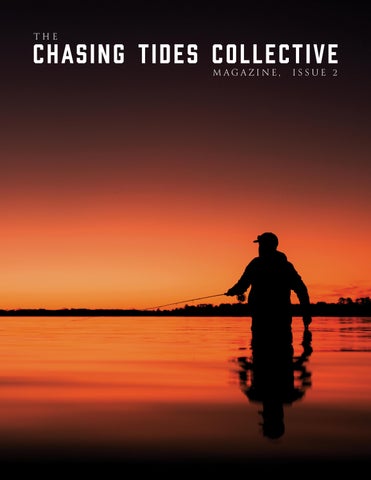
THE
CHASING T I D ES CO LLECT I V E MAGAZINE, ISSUE 2
CHASING TIDES COLLECTIVE LOGO DECONSTRUCTION
330°
5
.5
a.
b.
c. 1 2
a.
CHASING:
TIDES:
• • •
• • •
Always in pursuit Always searching Constantly conceptualizing
b.
Literal Metaphorical The deciding factor
CIRCLE: moon/clock/compass • • •
Clock dictates time Moon dictates tides Compass dictates direction
HANDS: clock hands = compass needles • • •
c.
The two married together Time and direction equally influence our path Yin and Yang; symbols of restriction and freedom
LIVE OFF THE CLOCK phrase of revival
To chase your passions, despite the daily grind.
OUR MISSION The Chasing Tides Collective Magazine is an ill-advised endeavor forged from friendship and a unified neglect of professional and societal responsibilities. Our adoration for fishing, surfing, and the Mid-Atlantic’s coastal culture compelled these collections of pixels and words. It is an artful expression of the phrase, “live off the clock.” Comprising its pages are anecdotes about people, places, products, very random creative musings, and anything that strikes our fancy or grinds our gears. All of which are constructed to inform, entertain, and encourage readers to chase their passions, despite the daily grind.
CHASING TIDES COLLECTIVE ISSUE 2
Sophomore Slump
CO-FOUNDER, EDITOR-IN-CHIEF Nick Northern CO-FOUNDER, MANAGING EDITOR Tim Homa CO-FOUNDER, CREATIVE DIRECTOR Ryan McArthur CONTRIBUTORS James Merrill Mac Elliott Remick Smothers
GENERAL INQUIRIES & ADVERTISING INFORMATION connect@chasingtidesco.com CONNECT WITH US @chasingtidescollective @chasingtidescollective
WWW.CHASINGTIDES CO.COM
CONTENTS BOAT BEERS & BEVERAGES: THE BACKWOODS COCKTAIL Page 9 UGLY PROBLEM. SEXY SOLUTION. Page 25 DELMARVA SERIES: THE ANATOMY OF A TROTLINE Page 37 A YARN FROM THE SPONGE GRASS Page 63 WIZARDS IN THE MARSH Page 96 ONLY GREEN WITH EGGS, DAWG Page 97 RUTHLESS Page 101 SURFING DOESN’T NEED US Page 119 SMOKED FISH DIP Page 121
All words, pho to g r a p h y, a n d d e s ig n , u n le s s o th e r wis e n o te d , d o n e b y Nic k No r th e r n , Tim H o m a , a n d Ry a n M c A r th u r.
A LET TER FROM THE EDITOR Hi, Here it is, unlikely as it may have once seemed, our sophomore album. We’re not positive we avoided the sophomore slump, but we think we did. The construction of our second issue taught us a lot, and accentuated the fact that we’re not that interesting. Luckily, we know some people and places that are. This issue is about those people and places. Without them, it wouldn’t exist. Or it might, but would undeniably be much worse. We don’t do a high level of planning when it comes to the framework of this magazine. Essentially, we scratch down ideas that we hope prove themselves amusing. Many of those ideas never come to fruition. Thematically, for the ones that do, any semblance of holistic synergy is happenstance. Fortuitously enough, such an occurrence happened with this issue. Our sincerest thanks and gratitude go out to everyone involved, featured, and mentioned in the pages to come for the hospitality we’ve been shown. Your kindness, transparency, encouragement, and generosity are inspiring. We hope that you, dear reader, will enjoy learning about these people and places as much as we have, and that you’ll feel a tickle of wanderlust to go experience something new. Keep living off the clock,
Nick Northern Co-Founder | Editor-in-Chief
There is no evidence that alcohol attracts fish. That being said, we rarely embark without it. When blended responsibly, booze and boats create equilibrium. Our position is that fish can sense this harmony. Loose lips, loose grips, agreeable fish. Conversely, should fish prove churlish, we drink to ebb escalating tensions. Booze makes both good and poor days better, it’s the ultimate equalizer. Eager to learn new techniques of and in the drink, we’re asking our friends in the series, Boat Beers & Beverages.
10.
Boat Beers & Beverages:
THE BACKWOODS COCKTAIL with KIRK MARKS A successful day in the backwoods requires resourcefulness and ingenuity. So too does a good cocktail. We asked our friend, Kirk Marks, to come up with a cocktail that represented the backwoods hunt for Northern Snakehead. The story that follows is how it all played out.
12.
I
stood knee deep in mud surrounded by six foot tall marsh grass, sweat dripped down my face. My left hand held my fishing rod, while my right hand peeled off a vine of thorns that punctured my leg and hip. Directly in front of me was a Sony camera held in a hand, attached to an arm that belonged to Ryan. For some reason, I felt the need for confirmation. I shouted up to Kirk, who was completely swallowed by the marsh grass, “is it worth it?” To no one‘s surprise he said “no, turn back.” From that moment on we decided it best to stick with the plan, wait for the tide.
Boat Beers & Beverages | The Backwoods Cocktail
The Northern Snakehead. (Channa argus)
Found in stagnant shallow ponds, swamps, or slow moving streams and rivers with mud substrate and aquatic vegetation.
The target species was the Northern Snakehead. It was my first time targeting these fish, and for all I knew being swallowed by the marsh was part of the process. Northern Snakehead are an invasive species to the United States. They’re draped in dark brown with broken up vertical black markings along their sides, sharp teeth line their jaws, and they’re shaped similar to a native bowfin. Creepy looking creatures for sure. I remember news reports back in 2002 about an invasive species of fish found in a pond in Crofton, MD. The reporter claimed the invader would decimate native populations of fish anywhere it was introduced. Craziest of all, it was reported snakeheads could survive out of the water and travel on land due to sacs above their gills that store oxygen. From the sound of things, snakeheads would be the end of aquatic life as we know it. Unfortunately for the media, snakeheads didn’t pan out to be the “end of days” invasive species they predicted. Fortunately, for anglers and pescatarians in the Mid-Atlantic, these fish are a shit ton of fun to catch in addition to being delicious table fare. We made our way out of the mud and meandered through the woods single file back to the creek bank where we beached our canoes. I felt like a kid again roaming the woods in search of amphibians and crayfish, except my ankles were way less nimble. Kirk Marks, our snakehead sherpa, insisted that we were still a bit early and needed the tide to fill in. Kirk has been chasing these fish deep in the marsh and backwoods for a few years now and I had faith in him. Plus, I will wait on any fish that will crush a topwater lure.
14.
Waiting is simply part of fishing. Whether you are making a thousand casts and covering ground, or anchored up soaking bait, the fish follow their own schedule. Drinking is also part of fishing. Booze can distract you from the waiting process. In our case, we stood in ankle deep water, beers in hand, staring out into the thickest expanse of lily pads I had ever seen.
The three of us sipped on an Eastern Shore of Maryland version of a Special Beer. Kirk used a Pabst Blue Ribbon (PBR), lime juice, fresh jalapeño slice, and a J.O. #2 seasoning rim (yes, the #2 matters). A mix I never could have come up with, but damn if it wasn’t exactly what we needed. As the beers flowed, we discussed every important topic: camera equipment, the golden age of screamo music, Kirk’s talents as a musician, and several fish stories. Throughout the conversations, we heard smacking sounds matriculating ever closer from the distant lily pads. “That’s them,” Kirk said. The water at that point had crept up to our calves and was visibly moving. Armed with hollow body topwater frogs, we made our way off the bank, into the woods, and back to mud.
Following Kirk’s lead, I launched casts into the lily pad trodden battlefield, hopped the frog from lily pad to lily pad and into the gaps of water in between. When the frog landed in the water we’d pop it to create splashes, then pause. Several casts returned with zero reaction. On one of my casts I felt tension, but wasn’t sure if the frog got hung up or had found a taker. Immediately after, 30 feet to my left, I heard the loudest of smacks and saw Kirk patiently wait to feel the weight of the fish before unloading a hookset that would make Bill Dance shed a tear of joy.
The fish thrashed violently and darted back to the thickest of cover. Kirk, seemingly, had been in this position before. In the blink of an eye he somehow sprinted through the mud and grabbed the fish with his hands to prevent it from breaking “This looks better,” Kirk said off. Once secured, he lifted up as we looked into the shallow a 22” alien creature. Pumped Hollow body frog lure. water opening in the back of we caught one, and still the lily pad field. Before I could ask if we were fishing miffed by the display of athleticism just performed, from the bank, Kirk was already five steps into the I let out a hoot of support. Seeing a snakehead in water. Beneath the surface was grass, branches, what person after those reports in 2002 made me think felt like pine trees, and very soft mud. I sank at least about the resiliency of our ecosystems, because knee deep into the mud with each step taken. Kirk, a after looking a snakehead in the eyes I understood bit lankier than I, traversed the terrain like an avatar. the “end of days” claim from 20 years ago.
Boat Beers & Beverages | The Backwoods Cocktail
Boat Beers & Beverages | The Backwoods Cocktail
I assumed we needed to give the area a break after the commotion, but I was wrong. Immediately after Kirk got his fish to the bank we heard blowups in the lily pads. I ripped out casts in the opposite direction and received reactions comparable to red drum in skinny water. Vicious blowups. One fish launched my frog five feet into the air. Snakeheads have incredibly thick jaws and require a hell of a hookset. I came tight on three fish, but each time had the hook pulled or got broken off in the debris underwater. On one retrieve I paused the lure in open water a few feet from the edge of the lily pads. Right as I was about to pop the frog again, I saw a fish come out from under a tree branch four feet away and wake over and annihilate it. Finally, I got a proper hookset on a fish, but it broke me off in the branch. That was ok. That fish provided one of the top five best topwater eats I had ever seen. I will be back for redemption.
18.
Back at the canoes, drenched in sweat, legs caked in mud, snakehead on ice, Kirk opened up his cooler and presented a bottle of 406 Agave blanco tequila with ingredients for a celebratory cocktail. He told us that this cocktail was inspired by the early days of the pandemic. Not like it was a cure or was going to kill us, but it was created with what was available to him in his apartment fridge and pantry during a time where going outside was frowned upon.
Boat Beers & Beverages | The Backwoods Cocktail
20.
The ingredients included tequila, lime, fresh jalapeño, coconut water, and J.O. Seasoning #2. Each of the ingredients seemed fitting for the day we had. Mainly, the coconut water to help restore electrolytes. The instructions are simple. Mix everything up with some ice and add more of what you like to suit your taste. The result is a surprisingly refreshing, spicy, and salty cocktail brilliantly suited to recap a day romping through the woods in search of invasive species.
Boat Beers & Beverages | The Backwoods Cocktail
“
Y’all remember those first few days of mandatory quarantine, right? Many of us learned a new word, some cooked a new recipe, and others realized they can work from home. Hell, some did all three. And as we know, some experienced tremendous pain. But amid the mayhem, personally, I had reason for celebration. My girlfriend and I had lucked out - for the first time, we were the ones that got to call our apartment our office. I was pretty pumped. It was time to imbibe. But there was one problem - the fridge and cabinet were getting sparse and at the time no one really knew if going to the store was a good idea or not. Improvisation is a beautiful thing. Enter: tequila, coconut water, lime, jalapeño, and J.O. Crab Seasoning #2. Let these characters mingle and you’ve got yourself a refreshing libation packed with alcohol & electrolytes. It’s a cocktail fit for a pandemic party or a day on the water with friends. Just eyeball it, you know what you like.
To check out more tasty victuals from Kirk Marks, find him on Instagram @kirkymarks and as a contributor to Flylords Magazine with his “Flavor on the Fly” series.
22.
UGLY PROBLEM.
Photo: James Merrill | Opolis Optics
SEXY SOLUTION. We like to keep things jovial around here, though we recognize there are real issues in the world that can be disconcerting. Some more than others. We’ve made friends along the way that opened our eyes to some sobering issues, one of those friends is James Merrill, who we’ve learned a ton from. We’ve done our best here to articulate some of those learnings. We’re fascinated with this brand, its origins, what it represents, and how it innovates. Ponder, if you will, a new way forward.
26.
Is Seeing Believing? A question so bold it pits Elvis and Jesus at points of opposition. One King across the fence from the other. Ironically, Elvis was talking about Jesus when he sang “Seeing is Believing,” but still, they beef about it. What’s the point? You’ve heard of plastic pollution. Undoubtedly, you’ve heard the phrase, plastic crisis. Have you seen it? Probably. In the media somewhere. More importantly though, are you affected by it? A plastic bottle on your street certainly diminishes the neighborhood curb appeal, but does that bother you enough to pick it up? It’s tough to understand the true impact of something that marginally affects you. Visualize, instead, your street covered in plastic bottles. Knowing none were yours to begin with, and waves of which continually wash over your front yard. Imagine routinely kicking up bottles in bunches as you trudge from your front door to your mailbox. Perhaps you’d be inclined to pick those bottles up, only to realize soon after that effort is futile. Mainly because hoards of tiny plastic invaders relentlessly make a Hoover Town of your fescue foddered front lawn. The same front lawn you’ve dedicated countless laborious hours to in perennial attempts to perfect the ideal combination of color and density. All so Larry and Linda across the street can whither in jealousy behind their curtains in concession of lawn superiority to you, and only you, Lord of Lawns. Cheekiness aside, we’re fortunate. We’re fortunate that the overwhelming majority of citizens in our country will never have to deal with that situation. Most will never see anything like it in person. Which is ultimately the issue, because seeing is believing.
Opolis Optics founder, James Merrill, has seen enough to believe. James spent years working with the United States Agency of International Development (USAID) and other NGOs. He managed diverse projects around the world ranging from agriculture value chains, biodiversity protection practices, and violence extremism. Plastic pollution was the common denominator among the many places he traveled and experienced. If you want scary specifics, there are fire and brimstone statistics out there. For example, by 2050, there is projected to be more plastic, by weight, than fish in the ocean. Likewise, plastic makes up 80% of ocean debris. And here’s a cool one, they’re now finding microplastics in our blood. So we’ve got that going for us. How does it all get there? Well, a bunch of ways, but for starters, commercial fishing, illegal dumping, poor waste management, first world waste exports, broken waste infrastructures, and just good old fashioned littering. We’re talking about a lot of discarded plastic. Reports show approximately 500 billion plastic bottles are made every year, one million are bought every minute, and only nine percent are recycled. That’s a number so large it’s hard for us to truly contextualize, which we believe contributes to the problem. If you can’t comprehend the severity of something, and you don’t see it, it’s hard to believe.
Ugly Problem. Sexy Solution.
James Merrill | Founder & CEO of Opolis Optics
Quick experiment. Let’s say you want to count to 1 billion. How long will that take you? You’ll be able to knock out the small numbers like 25 and 47 quickly, but most of the numbers between one and 1 billion are long. Like this mouthful, 592,167,356. How long does it take you to say five hundred and ninety-two million, one hundred and sixty-seven thousand, three hundred and fifty-six?
breaks at all, it’ll cost you a measly 3 billion seconds to finish counting. That breaks down to 50,000,000 minutes, which equals 833,333 hours, which equals 34,722 days. Divide that amount of days by 365, and it’ll take you 95.1 years to count to 1 billion. your d those numbers aloud in P.S. - Did you actually rea that in, aga If you skipped them, head, or just skip them? blem. might be part of the pro
If you give yourself three seconds to say each number, which is pretty generous, and you take no
28.
That amount of plastic getting pumped out on a yearly basis is stupid, and that’s only water bottles. The next time you go to a store, or literally anywhere, take notice of all the plastic you see. It’s everywhere. There’s more to it than just the plastic. Production at that rate uses roughly 17 million barrels of oil annually; enough oil to fuel 1.3 million cars for a year. Most plastic pollutants end up in a landfill or in the ocean. James experienced these statistics firsthand working with fishing communities all over southeast Asia, and landfill communities in Africa. Singleuse plastic accumulation strains these low-income populations and their natural resources. Ultimately, it negatively affects their health, livelihoods, and education. James recalls seeing beaches in Indonesia, the Philippines, and Papua New Guinea entirely covered in trash. As an avid outdoorsman, those images plagued him. He decided that if he ever chose to pursue another career, he would do something to support the communities most impacted by plastic pollution. Eventually, the day came, and James founded Opolis Optics, a premium eyewear company. From the beginning, Opolis had two objectives in mind; develop products that shift the industry standard in manufacturing, and that reflect a commitment to cleaning up the planet. Bold strategy. How does one accomplish that? Short answer: do more, better, with less. Fancier, less short answer: decouple economic growth from environmental degradation, support environmental justice, increase resource efficiency and promote a sustainable lifestyle. Consumers and manufacturers both have choices to make, and capital is the elephant in the room. Some companies value money above all else, and many consumers are the same. Wu-Tang articulated this principle the best; C.R.E.A.M.
Money matters, we’re not so righteous to pretend it doesn’t, but, Opolis is working to shift the industry paradigm for consumers and manufacturers alike. In building Opolis, James orchestrated a supply chain under the framework of a circular economy. If you’re unfamiliar with the term circular economy, you’re not alone. James introduced us to the concept not that long ago. Our economy is predominantly linear, we take from the Earth to make products that are eventually thrown out. It’s a take > make > waste system. A circular economy differs, and has three primary principles; reduce and eliminate waste, circulate materials and products, and support regeneration of nature. It’s a resilient system that is good for the environment, people, and business. Opolis wants to change the narrative around sustainable supply chains, and build an alternative option for companies using virgin, single-use plastic in production. They’re doing so by offering two up-cycled collections of products that started with sunglasses. The first is their Bio-Collection, which is manufactured from Bio-Acetate. Acetate is the most common hardware ingredient in most high-end eyewear. The problem with Acetate is it requires petroleum-based plasticizers that are harmful for the environment and are produced with high levels of CO2 output. Conversely, Bio-Acetate is derived from plantbased polymers like hemp, red pulp, and cotton seeds. The purest parts of these materials are extracted and turned into powder, before ultimately transforming into hardware. The result is a plasticlike substitute that can biodegrade in 115 days. For comparison, many plastics take upwards of 400 years to completely decompose.
Ugly Problem. Sexy Solution.
Photo: James Merrill | Opolis Optics
*Recycled PET
Opolis’ second collection is the StokedPlastic® line. StokedPlastic® is made entirely from recycled Polyethylene Terephthalate, better known as rPET. Polyethylene Terephthalate is the junk plastic bottles are made from. Opolis sources their rPET from communities most impacted by plastic pollution, communities like the ones James visited.
Altruism is cyclical. The simple version goes like this: Opolis aligns with a network of rPET collectors and manufacturers in Bali, Manila, and Nairobi, and aids in collecting plastic bottles and waste to clean up beaches, oceans, and landfills. From collection, the plastic bottles are cleaned, heated, sorted, and broken down into usable and unusable parts. Unusable parts are disposed of according to local recycling regulations. What’s left is a haul of upcycled PET materials which are shipped via climate neutral shipping to Opolis’ facilities where they’re turned into eyewear.
This excerpt is from Opolis’ website, “Opolis’ supply chain is intentionally designed to uplift and benefit the communities that are directly involved. Each person and place deserves to reap the rewards of their involvement, from the waste collectors picking up plastic bottles out of our oceans, beaches and landfills, to those customers putting a pair of sunglasses on their face. We want people to feel good about being associated with the Opolis brand.”
30.
Ugly Problem. Sexy Solution.
32.
resource is paramount to a sustainable future. Our health and the health of the planet are infinitely tied together. She purged herself of dinosaurs already, and she’ll do the same with us. We are parasitic, we need her. The problem is monumental. It will take systematic change at both the individual and industry levels. Most plastic pollution doesn’t come from you throwing away a bottle instead of recycling it. It comes from industrial mismanagement and oversight. If you really want to go down a dark path, research these prompts; first world waste exports to developing countries, and America’s broken waste infrastructure.
The not so simple version is James had to build that network from scratch, and he had to do it remotely during a global pandemic. Additionally, plastic bottles that have been floating for days, weeks, months, years in the ocean, or hanging out in a landfill, are exposed to a myriad of environmental factors. UV rays alone do considerable damage to the molecular structure and integrity of the bottles, making them difficult to upcycle. Many companies are making an impact using rPET in production, but most are using virgin rPET like a water bottle from a recycling bin. For obvious reasons, upcycling virgin rPET is a simpler, cleaner process. To stay true to its mission, and ensure Opolis is helping clean up the planet, James worked to develop a successful manufacturing process for the compromised rPET, allowing the company to partner with, recognize, and reward its network of collectors. With their offerings, Opolis is positioned to chip away at an enormous industry, which is why we are so interested in James and the story behind the brand. Passion turned to profession, and people over profit. The truth, as we see it, is Opolis is far more than an optics company. Opolis is a catalyst for change. Opolis is betting that as consumers, people want something better, and to be part of a community that accomplished something bigger. Planet Earth is crazy. The ocean controls global systems that make Earth habitable for humankind, and managing this
If you do, you’ll learn some troubling truths. The issue isn’t just a political problem, it’s a people problem. We have benefited from knowing James, it’s given us perspective and context. His mentions of time spent overseas combating terrorist and radical recruitment efforts really opened our eyes. We can’t solve the pollution problem before we solve the people problem. He summarized it for us well, “Without a doubt, without hesitation, providing for and supporting our family is innate in all of us, which is why if our families are protected and fed, we then have space to love and protect the things around us, our home, environment, ocean.” Everyone’s got a role to play, and keep in mind your dollar gets a vote. Opolis’ products are awesome, and their price point is right on par with other premium eyewear. They look great, feel great, and wear great. Outside magazine recently voted their Champlain model, which is part of the StokedPlastic® line, “Best for Casual Adventures” in their review of the “Best Sunglasses of 2023.” Keep your eyes peeled for more from StokedPlastic®. This winter, Opolis released the first ever fully sustainable ski and snowboard goggles. One pair is made from 10 plastic bottles, and they’re already making waves. In January, Opolis’ StokedSnow Goggles were selected as an Innovation Award winner at Outdoor Retailer’s Snow Show. James had this to say, “We are not trying to recreate the wheel as far as designs and styles are concerned in the optics industry. What we are trying to do is introduce materials that support an honest and transparent supply chain that help/save and protect our planet, AND help those communities most impacted by plastic pollution.”
Ugly Problem. Sexy Solution.
Photo: James Merrill | Opolis Optics
The proof is there for consumers and companies alike. You can choose a better alternative. Plastic pollution is a massive problem, and it’s impacting us all whether you see it or not. Choose to see it, choose to believe it. If you don’t know where to start, keep it simple and support companies like Opolis. Doing so is taking direct action to preserve the very resources we as outdoor enthusiasts hold so dear.
34.
is a brand from South Texas built to outfit and fuel anglers obsessed with pursuing trophy Speckled Trout. Pulling design inspiration from the species itself and the habitats it frequents, Truchador & Co. provides functional apparel to help you comfortably stalk trophy Speckled Trout. Additionally, Truchador & Co. offers custom colored, proven gator trout lures, making it a one-stop shop for Speck enthusiasts.
wwW.truchadorandco.com
Performance wear, t-shirts, headwear, baits, and more.
catch trucha or die tryin’
F
ind adventure in your backyard. A simple statement, but in an age of oversaturation it’s an idea that can easily be overlooked. We live minutes from an exceptional strip of geography affectionately known for its abundant hunting and fishing opportunities, and its massive population of chickens. The Delmarva Peninsula, commonly referred to simply as Delmarva, encompasses the majority of the state of Delaware and the Eastern Shore regions of Maryland and Virginia. A wealth of pride and heritage reside in this 170-mile stretch of land. On more than one occasion, factions of Delmarva inhabitants have lobbied for secession to form their own state. The Chesapeake Bay, Delaware Bay, Pocomoke Sound, and the Atlantic Ocean form its most well known borders. It’s an enormous playground for coastal pursuits. Welcome to the first installment of the Delmarva Series.
38.
THE ANATOMY OF A TROTLINE Fall on the Mid-Atlantic means options for people who love the outdoors. On any given day, the fishing, surf, and crabbing can be bonkers. At times it is difficult to decide on which aquatic pursuit to focus on. Depending on your location, all three avocations can receive a respectable crack during a weekend. That was our plan. As summer fades, water temperatures slowly drop and the air changes from humid to crisp. Robust low pressure systems, Nor’Easters, and hurricanes work overtime providing consistent waves throughout the season. The drops in water temperatures trigger migration patterns and frenzied feeding for sea creatures preparing for the winter months ahead. On a quest for rendezvous with a triple threat of piscatorial, crustaceous, and wave sliding pursuits, we linked up with our friend Chris Smith, the founder of Formation Outdoors. Chris hails from an often overlooked slice of coastline in the MidAtlantic known as Delaware. The “lower slower” boasts an abundance of arenas to perform outdoor activities.
Delmarva Series | The Anatomy Of A Trotline
C
hris is a project manager for a landscape, hardscape, and irrigation company. He lives in a rad log cabin and is an incredibly hospitable creature. On top of that, he is an experienced angler, hunter, and waterman. Chris’ path is dictated by the tides, weather, and seasonal patterns of the species that inhabit and pass through the lower slower. We strategically settled on September to visit Chris. September marks the beginning of fall and gives us the best shot at targeting multiple species of fish, large blue crabs, and fun waves. Delaware’s inshore and offshore fisheries harbor several enticing species of fish like striped bass, flounder, seabass, sheepshead, triggerfish, and, on occasion, red or black drum. Its canal and bay systems also offer insane crabbing grounds for blue crabs. Not to mention, sandbars lurk and are waiting to be found. Everything was on the table, until it wasn‘t. Our main goal was to head offshore in Chris’ 17-foot Henry O Hornet (apparently only six hornet models exist) to bottom fish some wrecks for doormat flounder, seabass, and the occasional triggerfish. The night of arrival, we’d fish dock lights for schoolie striped bass. Before heading out of town, soak some chicken necks on a trotline for blue crabs and god-willing, catch a few waves on the way out. Ambitious, but doable. As is tradition, Mother Nature had other plans. The weekend approached and so did a sizable low pressure system. Well offshore, Hurricanes Danielle and Earl churned. The result was lots of swell, but heavy onshore winds. Fishing the offshore wrecks and surfing were off the table. Chris was confident that we could find protection from the wind in the backwaters to hit dock lights for striped bass and run a trotline for blue crabs. The beauty of fall in the Mid-Atlantic is when one door closes, another door slightly opens. It is up to you to make the most of it. Operation Crab People was set in motion. Priority number one for effective trotline crabbing is prepping the line the night before. That gives the succulent chicken necks time to ooze their raw aroma, and maximizes soak time on the day of. Plus, less chicken slime on your hands when making special beers at sunrise. What’s Salmonella anyway?
Ryan and I arrived in Delaware at dusk. We were greeted with fist pounds and ice cold Natural Lights. After we unloaded our stuff into Chris’ house, it was time to head to the HQ to prep the trotline, meet Chris’ cousin Jake, and load up the Claire Anne, an 18’ jon boat that would be our vessel for the weekend. A tall figure emerged from the garage. It was Chris’ cousin, Jake. Jake was armed with a firm handshake and a Philly-like accent. “Nice to meet you boys,” he said. I thanked Jake for having us up. Jake, a younger fella, works for his old man who owns a car dealership. Jake’s specialty is selling tractors. “The Claire Anne is Jake’s baby,” said Chris. “He will be motoring us around tonight and tomorrow.” The four of us setup in a crescent moon formation equipped with chicken necks, trotline, and picnic chairs. Like a well oiled machine, we tightened the chicken necks in snoods that were fastened to the trotline. Jake fed Ryan and I some line, a few snoods at a time. We loaded the necks on and handed them off to Chris who neatly placed the trotline into a bucket for easy deployment the next morning.
Jake tightening a chicken neck in the snood.
After the trotline was assembled, we loaded the Claire Anne to try our luck in the darkness for stripers. Chris and Jake immediately marveled at the height of the water line from the incessant onslaught of Northeast wind. The current was ripping, but the overall appearance of the water looked approachable.
Delmarva Series | The Anatomy Of A Trotline
Jake fired up the motor and we pushed off from the dock. The bow pointed into the current and wind. Seagulls hovered overhead, seemingly in place. We crossed an intersection near the entrance of an inlet and the swell from the ocean was energized. Jake made a turn to the right and the swell dissipated. The current was still ripping, but the wind was at our backs.
A few casts later, I came tight on the target species. The bite would fire up and we’d hook up on every cast. Then it would shut off. Periodically, we’d hear the loud smacks of stripers feeding on the surface. Had it not been for the current, this would’ve been an ideal situation for topwater lures. When the bite shut off on one side of the dock, Jake would move us to the other and the action resumed.
On our approach, Chris pointed out “there’s some fish right there!” Clear as day off the corner of the dock, we saw stripers flashing up into the light destroying bait. Jake pointed the bow of the Claire Anne into the current to give us some shots. With the speed of the current there was no time to jig the paddle tails. Ryan and I launched casts up to the front of the dock and let the lures sweep down, keeping tension. It didn’t take long before Ryan bowed up on a nice schoolie sized striped bass.
Chris joined in on the action and after a while we lost count of how many fish we hooked up. Jake, married to the motor, denied any offer to switch places to get some striper pullage. It was getting late and we had an early morning ahead of us. After a few lazy casts resulted in sacrificed lures, we decided to head back to the ramp. Back at the house, Ryan, Chris, and I prepped our stuff for the next morning and waited for the arrival of Nick. Per usual, Nick arrived with energy. I could, however, see that it wouldn’t last long. This was a relief due to the early start time we had the next day. “Smitty!” Nick yelled as he entered the house. Chris and Nick embraced with a brotherly hug and a Natural Light entered Nick’s hand. We filled Nick in on the plan for the next day, recapped the evening striper fishing, and slowly, one by one, faded to sleep.
42.
S
aturday’s 5:30am wake-up call came quickly, and the Turtlebox speaker was ready for the task. The sweetness of Celine Dion’s My Heart Will Go On lifted us from couch cushions and dissipated the lingering fog from lack of sleep and bedtime beers. Celine’s voice was motivating. The rally was on. Prepping the night before paid off and we made quick work of the loadout. After double checking the gear, we departed as the sun made its appearance. There’s one thing you can’t fault a Delawarean for, and that’s pride. Our trip through the city of Lewes that morning was full of amusing anecdotes and historical tidbits. If you’ve never been to Lewes, DE, we highly recommend it. Did you know it’s pronounced Lew-is? Our first stop was Jake’s family’s house to make our final preparations. Loaded and enthusiastic, we continued to the boat ramp. Jake and Chris launched the Claire Anne while we reminisced about the previous night’s schoolie blitz and admired the pastel sky over the canal, imagining how much busier the boat ramp must be during the summer. We had it virtually to ourselves. There was a chill in the air. It felt like fall. Chris had really hyped up the boat ride that lay between us and the crabbing grounds, again, Delaware pride. But, he wasn’t wrong. To be honest, we were caught off guard at how enjoyable it was. We traversed three towns and five no wake zones through a single canal, lined by lavish homes on both sides, expanses of marsh mixed in, and the occasional run down crab shack. The lack of waterfront porch vinyasas was somewhat surprising. It was a side of Delaware we never would‘ve imagined. Capped by this, a statement of appreciation that could only be made by a person who frequents these waters; we passed an impressive pontoon boat and Smitty noticed our collective fixed gaze, to which he replied, “there‘s some fucking baller ‘toons round here dude.”
Delmarva Series | The Anatomy Of A Trotline
Jake
Chris
44.
As we reached the mouth of the bay, a single loon defiantly held its position in the center of the canal, the final hindrance between us and blue gold. He must have been able to smell our desire, because he eventually gave way and Jake opened up the tiller.
C
rabbing is about mud. Find yourself a good depth and some good mud, and you’re in business. Jake and Chris knew exactly where to go. They immediately jumped into action. The two worked in a routine symmetry that demonstrated years of experience and cohesion. Chris tossed the first anchor and buoy in the water, and slowly fed the line out hand after hand while Jake carefully manned the tiller. For context, a trotline is a long line that rests on the bottom and is anchored at both ends. Baits are attached at intervals of six to ten feet by slipknots or shorter lines called dropper lines, trots, or snoods. There’s a rhythm to setting a trotline. A rhythm that while in harmony looks effortless, but a single snag can be devastating. And a single snag we did encounter, which was made even more difficult to remedy because the line had been in the freezer overnight. Chris and Jake’s synchronicity did not falter. Jake slowed the motor while Chris worked fervently to fix the line. Above our wake, seagulls ascended. The chicken necks already in the water were stalled from sinking as the line was held up, offering free meals too enticing to pass up. We did our best to discourage the flying rats as Chris recovered the line and Jake brought us back to a steady pace. Crisis averted.
Delmarva Series | The Anatomy Of A Trotline
Once set, we gave the line time to sink to the bottom and soak in the mud. We hoped it would set the stage for a blue crab breakfast buffet. As we waited, the sun warmed our faces and our gracious host prepared us some red beers. His michelada-esque mix was a homemade blend, and its occupancy in a mason jar added to its delectability. Its pairing with ice cold National Bohemian was pure perfection.
48.
A
fter our brief calorie intake, Jake prepared the jon boat for our first run. The first step as you approach the buoy is hooking the line and laying it on top of a small L-shaped arm extension attached to the side of the boat. The extension guides the line up from the bottom as you course the run, essentially turning it into a conveyor belt. Armed with a six foot aluminum crab net, we were ready to collect our bounty. The first few snoods retrieved only chicken necks, and then a crab emerged. Witnessing the emergence made us all giddy. The moment of truth happens with the scoop. Just before the crab reaches the arm extension, you’ve got to get the net under and scoop it out of the water. Too early and you might hit it with the net and dislodge it before collecting it in the basket, too late, and the arm extension will knock it off. Timing and precision are key. The technique is easiest with a backhand grip, much like sweeping, with your top hand’s palm facing you and bottom hand’s palm facing away. Once the crab is in the basket, you quickly bring it on board and dump it in a basket before preparing for the next snood on the line. The process is repeated until you’ve run the trotline.
50.
We’d wait about 10 minutes between each run to allow the chicken necks time to sink back to the bottom and soak. Every run was a new opportunity met with anticipation and increasing pressure as the heckling poured on from those not on the collection platform. After a number of successful runs, and a healthy amount of breakfast beers, we decided it was time for a quick break to replenish the cooler. Jake motored us to a nearby dock outside of North Beach restaurant in Dewey Beach. The plan was hatched, grab another case of beer, crab till 2:00, and head back to steam our loot. After replenishing the provisions we set out for more. It was about this time where the day truly hit its stride. The music, a healthy dose of reggae and 90’s alternative, climbed in crescendo. Conversations were loose and encompassing. Topics covered included the large house with the teal chairs owned by wealthy swingers, and how respect must always be paid to Jah.
It was around this time that we learned our tiller captain, Jake, didn’t even like eating crabs. We couldn’t believe it. A true fan of the process, his enjoyment simply falls on camaraderie and being on the water. His selflessness throughout the day was commendable. After persistent beckoning, we were able to get him to leave his post on the motor and dip the net on a run. Crab till 2:00 we repeated. In the early afternoon we took a swim break. The Rehoboth Bay water was cool, and quite salty, which made for a pleasant float. As 1:30 rolled around, the question was asked, “crab till 3:00?” Which soon after became crab till 4:00. Beer on the water is the best beer. The goal was set for three to four dozen crabs. After securing approximately 40 and approaching our 4:00 threshold, we pulled in the trotline and made the trek back up the canal. The ride back was splendid. Jake operated the tiller with precision, as he had the entire day, earning himself the nickname Yotty Tills. The highlight of the return trip was witnessing a 20’+ bay boat almost smash into a breakwater outside a narrow passageway in the canal. The change in tide and depth created what resembled a rapid and the captain clearly didn’t have the control young Yotty Tills possessed.
Delmarva Series | The Anatomy Of A Trotline
56.
Delmarva Series | The Anatomy Of A Trotline
T
he boat ramp traffic had picked up during the day, but we were able to get up and out quickly. We arrived back at Chris’ tired and triumphant. Waiting at the house was a spread worthier than us. Chris’ girlfriend, Lindsay, the most hospitable of hosts, had prepared a smorgasbord of hors d’oeuvres that couldn’t have been more timely. Gratefully we gorged. And then we prepared the pot. A cast of characters began to accumulate at the house as if they were being drawn in by the mere smell of the steam. The sense of friendship and community was evident. For us, the entire day was a new experience, for them, it was just another autumn day in Delaware. We played cornhole and introduced the crew to our favorite game, a silly game by the name of Beer Hunter. It’s the best, worst game in America. As the sun set, the party moved to the screened in porch. In proper crab picking fashion the table was covered with newspaper and laid with knockers, J.O. Seasoning, and apple cider vinegar. We dumped the crabs on the table and marveled at our accomplishment, a beautiful haul. The crabs were full, sweet, and a tinge saltier than their southern Chesapeake brethren. They were delicious. Together, new friends and old, we picked and prattled. Coastal life in Virginia and Delaware was the pit of comparison, and Chris was the common thread connecting the two. It was a little slice of heaven. Our night ended around the coffee table, Chris’ talents don’t stop on the water. He’s a fantastic musician, and the acoustic guitar carried us late into the night. Don’t sleep on Delaware, it’s a piece of paradise. We look back on that trip with incredible fondness. The Delmarva peninsula is truly special. While our initial plan may have been foiled by the weather, the weekend couldn’t have been any better. Outside of the hospitality, and general kindness of everyone we met and hung out with that weekend, the most impactful takeaway was the transfer of knowledge, which is what we, and Chris and Jake with Formation Outdoors are all about. Sharing heritage, sharing knowledge, and sharing stoke to better appreciate and preserve our coastal way of life.
58.
00:00 d bag? Why a boar e 00:06 ds out ther e any bran building so al I didn’t se d an e ard bag ople and th making a bo between pe ally re on g ti in ec us nn a co while also nd ha ea id at e t produc . And th just oducts . . quality pr I actually t n’ do y wh are , me ds ar to came surfbo thing? Our they help e us ca create some be want rtant to us e way you super impo ner you, th the in on e d th an s expres the water in that d r se he es to be expr e bags furt think thes it I do d an ly , wave unique and really c logos connection or specifi ns er tt pa y ey’re an Th t . ou . th wi the sort . of d you ng an hi , or anyt ally good ey feel re em. th e us u simple. Th yo good when it’s you know, feel really rfing is, su of at on wh That’s t expressi really grea is th st ju . simplicity
00:54 How’d you de
cide on th
e name Faro ? 01:07 Faro in Sp anish mean s lighthou quick stor se.The y behind th e lighthou same way li se is the ghthouses protect se they’re sa afarers as iling up an d down the the surfbo coast, ard bags pr otect your you’re trav boards as eling in se ar wanted to ch of wave choose a Sp s . . . I anish word brand, its because th colors, an e d this idea goods were of quality really insp ired by my through Me xico and Sp travels ain. Meetin people from g a lot of Latin Amer ica and Sp noticed th ain, I just at they re ally cared things that about the they had an were going, d the plac es they and there was just th big emphas is on qual is really ity.
Photos: Bolster Mckinley Instagram: @bodolphin www.bomckinley.com
02:09 r the mindful and Faro’s slogan is “fo it about the is t wha ” us, uro advent into that makes ped tap ’ve community you product for le tab your board bag a sui t? dse min t tha e hav t people tha 02:22 adventurous kind of So the mindful and . I wanted to make came really naturally ts from sustainable really quality produc . aged adventure . . our enc materials that the is o, Far to and Sustainability to me, tain ething that can sus idea of creating som ant ort imp t mos time. And that is the e if you have this thing to me. I believ to something, it’s n tio emotional connec ng tainable than anythi bound to be more sus to get rid of t wan ’t don you e else, becaus ’re treat it right. You it. You’re going to t, tha And . ken bro n it’s going to fix it whe e us from sav to ng goi t’s I think, is wha ing things that we overconsumption – hav chase and keep around pur and mindfully use for a long time.
W W W. FAR OB O AR D B AGS .C OM
A Yarn From The Sponge Grass Chapter 1 Hello, Sweet Nothing After driving 25 hours and a 12-hour respite in Houston, we arrived in Port Mansfield, Texas. We pulled into a joint gravel driveway that had our rental house on the right and a local resident’s place to the left. With 45 minutes left of sunlight, we frantically unpacked our things and prepared to step foot in the legendary Laguna Madre for the first time.
64.
Jed Lynch taking his first look at a murky Laguna Madre.
Conditions couldn’t have been worse. Our first view of the Laguna Madre consisted of 30mph southeast winds and churned up coffee colored water. Not quite the pristine fishing grounds I had dreamed of fishing. While we rigged up, we saw mullet jumping, so at least there was life. “Guess I’m not fly fishing,” said Ryan.
Not prepared for the murky wave pool, I tied on a Mirrolure Catch 5 with a black back and orange belly. The large profile and vibration when worked can be detected in murky water. Several casts returned with only my lure attached to the line. My lure bumped the bottom once and I rightfully set the hook as if it was the trophy speckled trout I traveled all this way for. It wasn’t.
A Yarn From The Sponge Grass
For the 30 minutes of daylight we had to fish I battled the bottom, Jed cursed at wind knots, and Ryan managed to catch a 12-inch trout on a Rapala Twitchin Mullet. He held his prized Texas speckled trout to the darkened sky.
I said, “We call Ryan the Newt, so please don’t eat him.” Ryan, Jed, and I laughed nervously. Gila monsters are vicious and neither of us had come across a human with that name before.
“Does that count?” I said. “Skunks out I guess!”
Jed took the bait, “Is that a nickname?” Oddly enough, that question made me even more nervous.
Tails between our legs, we headed back to our place. We were relieved that we didn’t have to pack up and go anywhere for the next few days. Upon our return, our neighbor was outside lighting up his grill.
“Yes, it‘s a nickname,” he said. “Back when Planet Earth came out, I got home and my brother and his friends were drunk and high as shit,” Gila explained. “We didn’t have much to eat in the fridge, so I cooked a bunch of eggs. At the same time there was a scene of the Gila monsters eating bird eggs on the show,” laughed Gila. “When they saw what I was doing, they pointed and yelled ‘Gila monster!’”
Jed, in an effort to let the neighbor know our journey here was piscatorial and that we came in peace, went over to introduce himself. Ryan and I followed suit. “Hey, I’m Gila,” said our neighbor. Gila was short and stocky, had brown hair, possessed a firm handshake, and a Miller Lite in his opposite hand. He grew up outside of Port Mansfield and is a firefighter and charter captain.
Delighted that Gila wasn’t planning on eating us, we went into our place and prepared for the days ahead.
Each of us introduced ourselves and Gila clarified, “Gila for Gila monster.”
That was our introduction to Port Mansfield.
66.
History Port Mansfield is a small town in the deep south of Texas. How small, you ask? According to the United States Census Bureau, the town has a total area of 5.7 square miles and a population of 319 people per the 2020 census data. We did not have time to verify any additional inhabitants during our visit. In 1948, the area was designated a navigation district to create access to the Laguna Madre. It was named Port Mansfield in 1950 to honor Texas Congressman Joseph J. Mansfield, who was Chairman of the House Rivers and Harbors Committee. The town’s lifeblood is the harbor that houses its commercial and charter fishing fleet. It provides direct access to the Laguna Madre and the Gulf of Mexico. Raised houses, pelicans, a couple restaurants, hundreds of boat stalls, and funny looking shallow draft skiffs all surround the harbor. The famed Laguna Madre, according to the National Park Service (NPS), is one of six hypersaline lagoons in the world. Hypersaline meaning that its water is saltier than the nearby ocean. Thanks to over 70 percent of her shorelines being protected via national parks or private land, the Laguna Madre remains pristine and remote. The lagoon is one of the largest suitable habitats for wintering birds. Submerged beneath her surface is over 80 percent of all Texas seagrass beds. It is the shallow water grass flats and oyster reefs that drew us in. The Laguna Madre is home to one of the best fisheries in North America for speckled trout, red drum, and black drum. In the beginning of my speckled trout journey, all of my research led me to the folks who frequent this body of water. I knew it was a place I needed to visit.
A Yarn From The Sponge Grass
68.
A Yarn From The Sponge Grass
Chapter 2 A Rendezvous With Strangers Day two of the trip started with coffee, enthusiasm, and a new location. The golden rule of fishing is “never leave fish to find fish,” but does a single 12inch speckled trout require you to abide? We didn’t think so. We decided to give the south end of town a shot. Unfortunately, the wind was still howling and the water murky. Again we saw signs of life in the form of mullet and birds, so we stepped foot off the bank and into the water working with the wind at our backs.
70.
A Yarn From The Sponge Grass
A few days later, he told me that he would meet us in Port Mansfield and show us around via his boat. He also lined up the guys from Turtlebox Audio, Hook and Bullet, and photographer Mac Elliott to join in on the fun. I was beyond excited to have several days to fish with that crew. A week before the trip, however, I got a call from Mikael saying that he couldn‘t make it anymore. You see, it turned out that the only person I knew in the area happened to be a USFWS Wildland Firefighter. There were severe wildfires growing in West Texas and Mikael had his leave revoked. Talk about luck. Shit happens though, that is all part of traveling.
“Let’s wake their ass up,” I said as I flung a Heddon One Knocker Spook as far as I possibly could.
Mikael, a true gentleman, made sure that we would be in good hands. He connected us with Captain Kaplan Robinson, a young, up-and-coming fishing guide out of the South Padre Island area. Kap, as we called him, was tall and lanky. He had long curly brown hair flowing out the back of his Truchador & Co. hat. At a quick glance, Kap resembled more of a young Randy Johnson than a trophy trout wizard.
Ryan took advantage of the “lightest” winds of that day and threw a clouser minnow with his 8wt fly rod. Jed was ready to get rowdy and started tossing a Mirrolure Top Dog, click clack, click clack. Three hours, several lure changes, and almost a mile later, we collectively caught zero fish. I couldn’t even find an obstruction or a rock to fight.
Do not be fooled, Kap is one fishy son of a gun. He specializes in wade fishing and drift fishing targeting speckled trout, flounder, and red drum, and knows a thing or two about catching big tarpon. That being said, he is truly passionate about catching big speckled trout in skinny water.
Inherently, there is a learning curve whenever you fish somewhere new. I was prepared for that. This was also the first time that I had ever wade-fished. To my surprise, the two areas we had fished had way softer bottoms that forced the focus on not sinking versus effectively fishing. But, several months of anticipation and built up expectations were met with a massive punch to the throat in our first two outings.
We spoke on the phone briefly to set up a time to meet. After our second skunk of the trip and an increasing wind forecast in the afternoon, I didn’t have high hopes. The enthusiasm in his voice felt promising.
Luckily, we had relief on the horizon in the form of new friends who had experience fishing the Laguna Madre. They also had boats. The funniest thing about fishing here is boats are merely a form of transportation. Motor to the area then get off the boat and wade. Prior to the trip, I reached out to founder of Truchador & Co., Mikael Lerma. Truchador & Co. is an apparel and custom lure outfitter for speckled trout enthusiasts. I told him we were planning a trip and wanted to make sure that my thought process of when and where was in the ballpark.
72.
“Bring your topwaters, double d’s, and your corky floaters,” he ordered. “We’ve been catching trout up to 28 inches in a foot or less of water over sponge grass. I’ve seen bigger trout and there are plenty of good redfish mixed in too.” I responded, “Topwater anything would be awesome.” At the marina, we loaded our tackle bags, rods, and cameras onto the boat. On the run out to our first spot it was difficult not to admire the beauty of our surroundings. The water was clear and green. There were palm trees along the shoreline and all sorts of birds flying around that I had never seen before. You could see lush grass flats broken up by sand potholes. Fish spooked off as we ran over their hiding spaces. This was the vision of the Laguna Madre that I imagined. When we reached the spot I grabbed my rod and backpack then hopped off. Our first two wade attempts I struggled with the amount of gear I had in my backpack. I wanted to make sure I had my bases covered, but it was annoying. Kap hopped off the boat with his rod and a single extra lure placed on the top of his hatbill, treble hooks wedged into the bill seam. It was refreshing and insulting to see such a simplistic approach. “You’re making us look like idiots over here,” I said to Kap jokingly. He responded, “I was wondering why y‘all had so much stuff. You only need two lures out here.” Jed immediately tossed his tackle bag back into the boat and took Kap’s lead. Ryan and I downsized as well and got in line with Jed and Kap. Kap said, “Just spread out in a line and literally cast anywhere.” “Easy enough,” I thought. It didn’t take long before our topwater lures were violently abused by upper slot sized red drum. The strikes were vicious. Some launched our lures into the air. There aren‘t many things in fishing as exciting as encountering juiced up red drum in calf deep water. Smiles took over each of our faces.
As fun as it was catching those fish, we were anxious to see some big Texas speckled trout. After Kap gave us a tutorial on erratically fishing a Custom Corky Fat Boy Floater, we loaded up the boat and headed to “the spot.” We approached slowly. In the distance we saw three feeding slicks.
A Yarn From The Sponge Grass
Capt. Kaplan Robinson
“Boy, you think there are some fish around?” Kap said facetiously. “The fish have been holding on top of the sponge grass, so throw the topwaters or the Fat Boy Floaters.” He instructed, “Stand in the sand outside of the grass and cast over, cast on top of, and cast along the edges. If you hook up, walk backwards so they can’t wrap you up in the grass.”
74.
Again, it didn’t take long for one of us to have our topwater lure assaulted. Every cast that I made I thought to myself, “this could be the one.” Kap landed a monster of a red drum that completely choked his Fat Boy Floater. Moments later, my Heddon One Knocker was absolutely smacked and my heart stopped. I felt the fish shake and then it made a blitzing run. I resumed breathing because I could tell it was another drum and not my personal best speckled trout.
Shortly after I released my fish, Jed blurted out “this is a good one!” I looked over and saw a large trout head, mouth open with a chartreuse Mirrolure Top Dog, violently shaking trying to throw the hooks. I walked over to Jed with my net. The fish deployed all of the textbook big trout evasive maneuvers, but its efforts came up short and into the net it went. High fives ensued. Ryan and Kap came over to pay respects to the beautiful 26-inch Texas speckled trout. She was safely released to live another day. We made a few more casts after the sunset, but couldn’t get another trout to bite.
A Yarn From The Sponge Grass
On the run back the orange glow from the setting sun faded. Birds flew over our heads and my face was textured from the wind and salt air. We rode by more feeding slicks and Kap yelled, “Yeeeww, tell me there aren’t some fish around.” At that moment, I felt relieved. I replayed the topwater strikes through my mind and got excited for the days ahead. Back at the ramp, we high fived and made plans to fish with Kap again in a couple days. “That was a warmup, we’ll get y‘all some big ones,” Kap said. “A big blow is coming Wednesday, but we should be able to fish Thursday afternoon.”
76.
Our day wasn’t over yet. After we got back to Port Mansfield, we paid our respects to Gila, cleaned ourselves up, and headed to the south side of town to meet up with new friends. We pulled up to a driveway that had a flats boat and a bay boat on opposite ends. The carport sat underneath a one level house raised by stilts 15 feet in the air. In the middle of the carport was a table loaded with food and the smiling faces of seven new friends. Handshakes, fist bumps, and elbows for those with crab seasoning on their hands were exchanged during introductions. Our new friends were Will, Reagan, Carlos, Rob, Chase, Kristen, and Mac. Will and Reagan are two of the four owners of Turtlebox Audio, an incredibly loud, rugged, and completely waterproof portable speaker. Carlos is a long time friend of Will and Reagan and a true outdoorsman. Rob, Chase, and Kristen of the Phillips clan were the resident chefs, but also are affiliated with the sunglasses company, Hook and Bullet. By affiliated with the company, I mean Rob is one of the owners and Chase and Kristen, his kids, both do their part helping out. Hook and Bullet is a company that is flipping the sunglasses industry on its head. They are reimagining the way that we look at polarization by designing purpose built optics for anglers and sportsmen. Mac Elliott is a professional photographer with a love for capturing the beauty of the wild, especially the Texas coast. Chances are you’ve seen her water shots of a red drum tailing on Instagram or in one of the many publications who have featured her work. “There’s plenty of food, so dig in,” said Rob. The spread was official. A classic shrimp, crawfish, and blue crab boil with potatoes, sausage, and corn. Being raised in Maryland, I couldn’t miss a chance to comment on the blue crabs. “You know you guys cooked the blue crabs wrong, right?” I said.
Rob replied, “We figured you’d say that. Just let us know how they taste.” The conversation ended there because the crabs were delicious. It was refreshing to taste them with a different spice and flavor. The crawfish were a new experience, but treated like the mini lobsters they are, I became a quick study. Shortly after we stuffed our faces, Mikael showed up. His fire crew was able to make a big push against the fires out west and he got back one of his days he had taken off. He quickly unloaded his gear, grabbed a beer, and made his rounds. The crew was assembled. For the rest of the night we drank beers and got to know each other. We traded stories about the lands we hail from, fish we’ve caught, favorite dishes to cook, and learned about each other‘s business pursuits. I couldn’t help but think the internet is a wild place, because that is essentially what brought us all together. Heck, I met my wife on the internet. On an app, not Craigslist or mail order. Shoutout, Hinge. But, with one simple Instagram message to Mikael inquiring about a good time of year to fish Port Mansfield, months later I sat amidst strangers that felt like longtime friends. To tell the truth, that was the first time during the trip I didn‘t even think about the fish. The purpose of the trip had seemingly shifted. Everyone was excited about the light winds and prefrontal conditions for the next day. Will and Reagan drank bourbon and contemplated throwing big soft plastic swimbaits. Carlos and Mikael, who had the most experience fishing Port Mansfield, hatched a plan. The Phillips clan got their boat and gear ready, and Mac made sure her camera equipment was ready to go. The plan was to be on the boats just before sunrise and run south. Like responsible adults the night before an early morning mission, we left ourselves just shy of five hours to sleep.
A Yarn From The Sponge Grass
Chapter 3 A Change in the Wind CLIF Bars and coffee served as the early morning fuel. There was an extra pep in our step thanks to the spicy shrimp and crab boil. We met Mikael at the boat ramp as the first sign of sunlight began to creep over the horizon. It was no surprise that he was the first to have his boat in the water. His passion for fishing and the community of like minded individuals that encompasses it is next level and contagious. The wind was absent for the first time in days.
from ear to ear, “Show us the way,” they said to Mikael. He pushed the throttle down and, in a line, we headed to the first spot. Mikael took us to a spot that had two small islands split by a shallow flat. Perpendicular to the flat was a deep water channel, perfect for larger fish to escape after they ravage the shallow grass nearby. The sun was up, but still low. The wind was still. We saw areas of bait flickering toward the surface. The boats of choice in South Texas are low or no gunnel flat bottom skiffs that can draft in ridiculously skinny water. This allows them to get into the farreach places most traditional boats can’t touch. Compared to the boats we are used to in the MidAtlantic, these skiffs look like alien spacecrafts. Mikael’s vessel was a blacked out Shallow Stalker with the name “El Mayeco” along the hull. “The boat is named after my late grandfather, Ismael Lerma,” he explained. “Mayeco is a nickname for Ismael in Spanish. It‘s a way to honor him, he’s always with us when we are on the water.” Aboard the “El Mayeco,” we idled at the harbor entrance and waited for the other two boats. “I think someone is going to get a big trout at this first spot on topwater,” Mikael said. The boat with the Phillips clan and Mac motored up full of smiles. Everyone decked out in their Truchador & Co. gear and Mac, a true professional, was already snapping photos. Will, Reagan, and Carlos were nowhere to be found. “They were right behind us at the ramp,” said Rob. “I’m not sure what they are doing.” Right before Mikael called Carlos, I could hear some music. “Does anyone else hear that?” I asked. The music kept getting louder. A boat with a dark hull appeared around the corner and we heard, clear as day, “And I will always love you.” As the boat got closer we could tell it was Will, Reagan, and Carlos blasting Whitney Houston on the Turtlebox. They idled next to us grinning
Ryan, pumped about the wind situation, started working his way up the flat toward the channel with his fly rod. Jed, Mikael, and myself spread out in a staggered line focused on separate points of the north island. No shock here, but Jed and I threw topwaters, a Mirrolure Top Dog and a Heddon One Knocker Spook, and Mikael worked a Down South Lures Super Model in white ice on a jig head. Rob, Kristen, and Chase had a similar formation and worked towards the south island. Will, Reagan, and Carlos worked the grass flat running parallel to the south island. Mac loaded up her submarine of a water housing and meandered through the water toward each group of anglers. It didn’t take long for the topwater lures to get investigated, but we weren’t looking for investigations. We were looking for absolute annihilation. The altercations did however prove the presence of fish. In the distance, we heard the unmistakable sound of a hooked speckled trout vigorously shaking its head. I looked back and Kristen had landed the first fish of the morning, “speckled trout,” made its way down the line and from group to group. “Damn, missed it,” muttered Mikael. “They are short-striking it.” Off in the distance again, we heard some commotion. I looked back and saw Carlos with his rod bent and a pissed off speckled trout on the other end. “Trout on topwater,” was the report that navigated through the groups. The communication of any patterns found or lures that received attention was great. It felt similar to an outdoors version of the telephone game we played as kids.
A Yarn From The Sponge Grass
82.
Photo: Mac Elliott
Mac made her way over to us with a blue Truchador and Co. hat and tortoise shell Hook and Bullet glasses on. She was pushing her Aquatech water housing through the water with a big smile on her face, per usual. Some of the first photos I’d ever seen from Mac were half below the surface, half above the surface shots of disgruntled red drum trying to throw the lures that fooled them. The photos captured the marriage of chaos and beauty that unfolds in those situations perfectly. “How long did it take you to become a submarine pilot?” I asked sarcastically. She laughed and said, “I don’t think you can ever master this. I just have to make sure the camera is focused and I’m ready when the moment happens.” Mac snapped a photo as I made another cast. “Do you ever fish or do you just wade around shooting photos?” I asked while I retrieved my lure. “I will if I’m with my Dad or brother or if someone really insists on it,” she replied. “There’s just something about capturing the beauty of nature in the moment that I love.”
A Yarn From The Sponge Grass
Images by the talented Mac Elliott.
84.
Before I could ask another question, we heard “there’s one,” from Mikael. Right on cue, Mac made her way over to him as he fought the fish. At a certain point it looked like the fish was going after Mac by the way she maneuvered around Mikael to take photos. He successfully landed the fish and our section was on the board. Dejected from the lack of commitment to my topwater, I switched to a similar setup as Mikael. Jed did the same. Immediately we started getting strikes and eventually hooked up to a couple medium sized trout. Mikael definitely had the hot hand.
A Yarn From The Sponge Grass
86.
Photo: Mac Elliott
The decision was made to move to another spot. Everyone had caught a fish or two, but the sun was completely up and the bite for all three groups had waned. What do you do in that situation? Go look for some red drum. “Not the fish we were looking for, but we’ve got plenty of time to find some good ones,” said Mikael back aboard the “El Mayeco.” He got the signal that everyone was ready and our caravan was off to the next spot. On the boat it was difficult not to reflect on what transpired. Sure, the bite we were looking for didn’t show itself, but the whole orchestration was different than anything I’d experienced at home. To have that many anglers in the same area, enjoying the moment, was something truly unique. At the second spot it was impossible to avoid the beauty of the lower Laguna Madre. The water was clear, the submerged grass was green, and the sand pot holes were textbook. On our approach we saw a few red drum spook off, so we knew they were in the area. We all spaced out to dissect this flat. I switched to a Texas Customs Double D taking into account the position of the sun. Everyone was lined up and eager to run into a school of red drum. Shockingly, that never happened. Not a bite or bump for anyone. The collective attitude and determination had not waived. We loaded the boats back up and headed to another spot. At this point, the wind slowly started to pick up with the approaching cold front. “We will stay out until the last minute,” said Mikael. Ryan, Jed, and I consented to that plan. The third spot looked unreal. There were birds flying overhead and along the shoreline hunting. Again, the water was crystal clear revealing the famed turtle grass. Bait was present and looked uneasy. The report for this area was trout or drum. We traversed this location without the intended results. While a few people were on the boats taking a break, I wandered off toward a point away from where we had fished.
my casts returned with a small red drum following, but it didn’t eat. I made several more casts and then felt a thump. The excitement vanished when I realized this was not a trout and most likely not a drum. Instead, it was a gut hooked catfish. After the release, I headed back to the boat for a beer and lunch. “I didn’t know there was catfish in here,” I said to the group. “Oh yeah, they’ll disappoint you,” replied Rob. Up against the arrival of the cold front, we headed to another spot close to the harbor. By this point, Will, Reagan, and Carlos ventured off on their own. Mikael said, “Make sure to stay on the sand. If you feel mud, move back over.” The wind progressively picked up and churned up the water. Not long into the wade, Mikael got bit. Then Chase, Rob, and Kristen. All nice looking fish. Kristen’s was definitely the trout of the day. I got some hits and pulled the hook while fighting one fish. Pretty soon after we hit the water, we had waves hitting our backs. The Phillips clan decided to end the day and head back to the house to prepare dinner. Our group was determined to find a bigger class of fish. We pressed on. At this point, the front was clearly visible in the distance. It looked like a scene from Game of Thrones. “We’ve maybe got 45 minutes,” said Mikael. When we got to the spot, we didn’t waste any time and hopped right into the water. Each of us made one or two casts. The front was moving way faster than it looked. We watched the wind rip across the water and hit us right in the mouths. An experience, I’ll never forget. The decision was made for us.
I could see groups of bait balled up and what appeared to be a small school of larger fish moving in. One of
A Yarn From The Sponge Grass
88.
After a siesta, we went over to the house for dinner with the rest of the crew. Chase hit the road because he had work the next day and Mikael was loading up his gear to head out as well. We thanked Mikael for a fun day on the water, introducing us to Kap, and for getting this group together. He made his rounds and went on his way back to fighting fires. Dinner was being prepared by Kristen and Rob. Offers to help, denied. The rest of us sat around and recapped the day. We learned that Carlos, Reagan, and Will got into a few red drum after we had parted ways on the water. We also learned that the resident deer in Port Mansfield are friendly enough to come up to you for food.
Intrigued and with some time to kill, the six of us loaded into Carlos’ truck with corn tortillas. It took no less than two minutes to spot the deer in a field. Carlos pulled to the side of the road in front of the field and automatically the deer moved our way. They were impressively curious and comfortable with our presence. Jed held a piece of tortilla out and a deer took it right from him. We all laughed and then grabbed some more tortillas. Reagan stepped up the game by putting a piece of tortilla in his mouth and having a deer snatch it right out. The first deer Jed fed never left his side. We laughed each time. Watching grown men hesitantly approach then feed these deer, followed by instantaneous laughter was a shockingly fun experience. After the last tortilla, we wished our furry friends well and headed back for fajitas.
Everyone on the trip was involved in building a passion based business, which always sounds better on paper. The reality is building any business is difficult. I shared my story. Rob and Reagan were honest and thought provoking in their responses. Listening to them tell their stories, pain points, and hurdles they continue to experience in their prospective industries was eye opening. Most importantly, it was motivating. Before long, the clock crept past midnight and we realized that the world‘s problems couldn’t be solved in one day. The next morning we got up without the assistance of an alarm clock. For the first time, I was excited to see the palm trees bending and white caps stretched across the Laguna Madre. Our legs welcomed the rest. We were, however, on call for another trophy trout mission with Kap. While we waited for the call, we packed up our things so we could hit the road the following morning. After that we went to the other house to help clean up and say our goodbyes. Will, Carlos, and Reagan braved the north wind and had just returned with some red drum to cook up, then they were hitting the road.
Back at the house, Rob was slicing the steak. The serving table had warmed tortillas, beans, rice, cheese, guacamole, red and green salsa, and sour cream. We said a prayer thanking God for the day we had, the new friends made, and the meal in front of us.
Kristen and Mac’s Uber bailed on them, so Rob was getting ready to take them to the airport. This time hugs were exchanged instead of handshakes. We thanked everyone for the laughs, Texan hospitality, and our introduction to wade fishing. In the car, I got a text from Kap saying, “We’re on.”
I had no sarcastic comment about cooking fajitas, so I kept my mouth shut and assembled my plate. The steak was a perfect medium rare and all the fixings were delicious. My favorite ingredient was a jalapeño salsa in a bag called, “El Gallo Salsa.” It had the perfect mix of flavor and heat.
On our way to meet Kap for our last wade of the trip, I became overwhelmed with gratitude from the experiences of the last 72 hours and the result of a simple message made on social media. The outcome of this last wade trip didn’t matter to me anymore. Managing expectations in this day and age is difficult. It‘s hard enough when you build up a moment in your head on your own. Compound that with consuming content to support those expectations and your focus becomes singular.
After dinner we helped clean up, put a dent in the cooler, and continued conversations from the previous night. We learned about how everyone met, their favorite things about Texas, Mac’s traveling experiences, and much more. Oddly enough, fishing was the least talked about topic.
Things don’t always go according to plan and that is okay. Had I remained stubborn in my pursuits, then I would’ve missed out on the connections made on this trip. While we are all determined anglers, there is much more to be celebrated in the journey than just the fish.
There was a conversation later in the night between Rob, Reagan, and myself that put everything into perspective for me. It was an affirmation that this was more than a fishing trip and I was on the path I was meant to be on.
90.
The Roster True pride in where you live and what you do is tough to come by these days. Each person we met on this trip had a love and admiration for Texas and the outdoors that was undeniable. In an effort to learn more about our new friends, we sat down with each of them to see what it is about Texas and fishing that means so much to them. Identity: Husband, Father, USFWS Wildlands Firefighter, Owner of Truchador & Co., Pursuer of Dreams, Trophy Speckled Trout Enthusiast Thoughts on Texas: “Born and raised in South Texas, it’s got it all. It has its great fisheries, great waterfowl, and it has great hunting from exotics to native bucks. It’s home, man. Home is where the good food and where the family is. I’ve traveled out of state and there is nothing like Texas. It’s family, it‘s fishing, my career is down here and I love bringing people from out of state down here and it‘s all about southern hospitality.” Mikael Lerma
Thoughts on Fishing: “In all honesty, when I fish, it‘s like a therapy session. You don’t worry about anything else, you are just zoned in. The worries of the world are gone. Fishing has given me a lot. I’ve met a lot of good people and a lot of people have welcomed me into their worlds. Fishing is a provider for me. It takes me away and it brings me around a lot of good people. And I get to show people what it’s all about.”
Identity: Helper of Startup Businesses, Promoter of Hook and Bullet, Community Shaper, Pursuer of God’s Plan Thoughts on Texas: “Texas is home. It is a really diverse place. I think that it is a place where a lot of people come to level with each other and experience life together. Texans love to be hospitable and welcome people in.”
Kristen Phillips
Thoughts on Fishing: “For our family, fishing has been a generational hobby. It‘s a fun way for me to connect with my brothers and my dad and spend time on the water with a collective goal. Fishing is a really cool example of God‘s glory and creativity, and our invitation to take part in it all.”
A Yarn From The Sponge Grass | The Roster
Identity: Outdoorsman, Good Food Enthusiast, Field Test Specialist of Hook and Bullet, Construction Superintendent Thoughts on Texas: “Texas is my home and I want it to be my home for the rest of my life. It is a never-ending playground for my family, myself, friends of mine, and people like me. It is so diverse. West Texas couldn’t be any different than East Texas where I was born running around the bayous and piney woods. It has so much to offer. Texas to me is a big part of my life. I’ve traveled a decent amount, but never lived in another state. I might have to live in another country if I couldn’t live in Texas.” Thoughts on Fishing: “One of the first memories that I can even pull of my grandfather was fishing in the bay, off the canal, with my grandpa and my dad. Fishing is a huge part of my family. It is a family camaraderie. When I think of fishing I think of family, beers with friends, and sunlight. When I’m not fishing, I am fishing. With fishing I am able to connect with 90% of the people that I interact with on a regular basis on the water.”
Chase Phillips
Identity: Husband, Father, Businessman, Owner of Hook and Bullet, Feeds Marlin Topwater Lures Thoughts on Texas: “I am biased because I’m from here, but I think most people say we are pretty good people. I define that based on honesty, integrity, and willingness to do what is necessary to help someone out. You don’t meet a stranger, everybody is just another good human and we want to help them. Texas has a lot of culture and a lot of history that is nostalgic because of where we came from, we were once a country. Texas is a good, solid group of folks.” Thoughts on Fishing: “Faith, family, and the great outdoors is really what I’m all about. I was raised and raised my kids off ‘teach em how to hunt and fish, and you don’t have to hunt your kids.’ For me fishing is way more than the pursuit, it is my time with God, it is really my happy place. I am fortunate that it revolves around great friends and family.”
92.
Rob Phillips
Identity: Believer, Husband, Father, Turtlebox Co-Founder, Purveyor of Purpose Thoughts on Texas: “People come to mind. In Texas, people are friendly and good people. That’s a big part of Texas. Texas is “the” outdoors. We’ve got a lot of land, but it’s learned. It’s not like Colorado or Montana where you can just pull over and everything is a state park. We have great bay systems. I live off of Galveston Bay which is the biggest bay in North America. Things aren’t easily accessible, you have to go explore. It’s such a vast state. There is a lot of different topography, a lot of different terrain, and things that are only unique to Texas.” Will Bradley
Thoughts on Fishing: “I grew up fishing with my dad and that was our way to connect. We grew up wade fishing the whole Texas Coast. We’ve fished from Mexico all the way over to Louisiana several times over. It was mostly wade fishing and a little bit of kayak fishing, that was our deal. We didn’t have a fishing boat or anything. It is a great way to connect with people. For me, I feel at home or at peace. It is a good reset.”
Identity: Father, Husband, Caregiver, Turtlebox Co-Founder, Outdoorsman, Used to Golf Thoughts on Texas: “It’s home. I’ve got history here. My middle name is Crockett. I am loosely related to Davey Crockett, he’s an uncle. I am in direct line with his father. My dad made my middle name Crockett, I made my son’s middle name Crockett. Texas is always a place to be proud of and a place with plenty of room to roam. Great people. I’ve got no plans to leave. I’ll die here one day.”
Reagan Fincher
Thoughts on Fishing: “Man, it doesn’t even matter if I get a bite or not. It’s just getting outside and getting away from a screen. Getting outside and fishing is beyond an escape, it is necessary for my soul. If I’m outside at least chasing fish, then I’m checking the box. Having the wind on your face and getting the sun on your back makes life worth it.”
A Yarn From The Sponge Grass | The Roster
Identity: Hunter, Fisherman, Financial Advisor, Friend of the People, Golfer Thoughts on Texas: “Everybody will tell you,‘if you’re from Texas you think that Texas is the greatest state out there, there‘s other great states like Louisiana and Florida,’ in terms of outdoorsmen. Everything‘s bigger in Texas. We care about hunting, we care about our resources and all of that, but Texas is Texas. If you live here, you know what that means. But, you try to be humble. I’m sure people think that we aren’t humble, but Texas is if you come here everyone is going to be friendly. It‘s welcoming, we might brag a little bit, but we’ve got a lot to brag about in this state.” Thoughts on Fishing: “Fishing has evolved. It started as catching as many fish as possible. Now it has evolved to just enjoy being outside and experiencing the creation. I don’t really care about the numbers anymore. I’m targeting certain animals now. It‘s more enjoying and appreciating the natural resources for what they are now. It has turned into more of an artform at this point.”
Carlos Rubio
Identity: Photographer, Submarine Pilot, Wade Fishing Morale Booster, Artist, Refuses to Catch Fish Thoughts on Texas: “Texas is family. I think that Texas is super welcoming. And I also feel like when we have visitors from different states we can bring them into the Texas culture and that feeling. It is really special.” Thoughts on Fishing: “For work, fishing is my opportunity to go somewhere cool and work with awesome brands. In reality, this whole career that I somehow have made for myself started with me going fishing every single weekend growing up with my parents and my twin brother. Just spending time on a boat, not even having to talk, but being there in community is so amazing. It brings together complete strangers and makes you feel like family.”
94.
Macala Elliott
HB PBO, scientifically formulated by pursuit so you can MAXIMIZE EVERY OPPORTUNITY.
wizards in the marsh
Wizards in the Marsh
We need to discuss this. The wizards show up each dawn in small boats. Pitifully small boats. One in a red kayak, the other in a green kayak, and the third in an abomination of a Classic Gheenoe with a dog who shakes in anticipation of the hunt. Silhouetted against a rising sun, their faces are covered with whimsically patterned masks as they seamlessly transition from their world to ours. Infiltrating our home under the cloak of rising darkness, these sick bastards pole and paddle their way into our kitchen, literally- eschewing a knock at the door for an impersonal, “here’s a crab, kid” and a swift abduction into the unknown. But we’re not kids. We’re drum. And we know better than to fall for their bullshit. The Code of the Drum is pretty simple: avoid dolphins, never admit to being captured by the wizards, and never turn left.
Words by Remick Smothers
You do those three things and you’ll get to bull status. Enough of us get to bull status and well - fuck you, wizard and dolphin. We eat YOU. Similar to the wizard, we are often undone by our own devilish disposition. It’s hard to surmise the — POP Did you hear that? POP Shrimp?! POP CRAWBZ?! POP brb.
Redfish has left the chatroom
96.
It started innocently enough. My brother was in town with his family, we were making bacon and the fluffiest of eggs for the rest of the house. If you want them fluffy, they’ve got to stay in constant motion in the pan. Circles and swirls with the spatula until they’re good enough to rest your head on. As we prepared the counter for plating, I opened the refrigerator and asked what kind of hot sauce I should grab. At any given time, five or so different brands share a door shelf in my fridge. He looked at me as if I should have already known, and replied, “only green with eggs, dawg.” He was right, I should have known. Breakfast found me vexed, my mind firing like a stop light. Flashes of green, yellow, and red
illuminated and diffused with varying levels of intensity throughout my brain. I ate, I tasted, I savored, I pondered. “Only green with eggs, dawg.” I haven’t touched an egg with red since. I fancy a good rabbit hole. Complete with twists, turns, and exacerbated depths of curiosity. As new publishers, our editorial pursuits have led us down one or two clandestine ventures. If you want examples of such to distract yourself from work, search The Boring Company, or put on the soundtrack to Interstellar and please let us know where Hans Zimmer’s score takes you; it does weird things.
That ill-fated Sunday breakfast inspired my most recent descent into madness. The muse, Hot Sauce, our favorite condiment. We drink this stuff. And so, I needed to know more about it. Why do people love it so much? Where did it come from? What sauce is the best sauce? What the hell is Xanthan Gum? Rudimentary research about its origins suggest all roads lead to Central America. Rabbit hole schoolings: Archaeologists have uncovered evidence of its use in Aztec civilizations dating back to 7000 BC. Early predecessors of today’s craft hot sauces were likely ground up chilis mixed with water and herbs. Here’s a weird turn, Aztecs documented punishing children by holding them over a fire of burning chili peppers. While we don’t agree with a smoking chili pepper penance, or any practice of human sacrifice, we do appreciate the invention of hot sauce. Among the many things Christopher Columbus was introduced to, eventually stole, and is now credited for, chili peppers made their way from the New World to Europe on his ships. From there, they spread like wildfire to each corner of the Earth, catalyzing an amalgamation of regional adaptations. Neat history. Needed more.
Only Green With Eggs, Dawg
Consuming hot sauce releases endorphins, which are hormones secreted within the brain and nervous system that activate the body’s opiate receptors, resulting in a desirable effect. Other activities that release endorphins are exercise, massage, and sex. Dare I say hot sauce is a drug? Guilty pleasure maybe?
•
Hot sauce on salad works.
•
Add hot sauce to your spaghetti sauce while it‘s cooking.
•
Green hot sauce with chili and pork is a sleeper.
•
Vinegar is sweet nectar.
Further down. Months of research and taste testing.
•
Cholula > Tabasco
One of the main compounds in chili peppers is Capsaicin (awesome word). Capsaicin is associated with a list of health benefits including pain relief, weight loss, decreased inflammation, and cancer prevention. If one wanted to make a health infomercial for hot sauce, or an instructional made-for-school library video, there’s a plethora of material to unpack.
•
The fingertip taste test is publicly acceptable.
•
Trust anyone who carries hot sauce on their person.
•
If you have to sign a waiver, it’s going to hurt. Today, and tomorrow.
Foodie culture and shows like Hot Ones promote a smorgasbord of sauces. Grocery stores have dedicated aisles offering variance in viscosity, color, and flavor. I intentionally avoid the condiment aisle when grocery shopping with my wife and kids, as I know I cannot commit the fair and just amount of time to surveying its pleasantries. Especially in light of my heightened, and admittedly strange, mania with hot sauce.
•
Honey, mango, and peach are friends.
•
Spicy pizza sauce is the best pizza sauce.
•
In the morning, drink water with lemon and cayenne.
•
Be weary of sugar, it’s an unimaginative ingredient.
•
Look for carrots on the ingredient list.
More discovered.
•
If it‘s flavorful, the heat level can be scorched earth.
•
Tacos are inclusive. They accept all colors and flavors.
•
Orange, sweet, and habanero; acceptable on eggs.
•
Smoky sauces always end up being underwhelming.
•
You get what you pay for, except for Crystal, which is an American staple at a blue-collar price.
•
Cumin and Curry have their place, but are best used in moderation.
•
If you dip wings in blue cheese, please sit at a different table.
•
Not all ranch is created equal.
•
A bottle of hot sauce should accompany all burritos.
There are an estimated 50,000 varieties of peppers in the world, and approximately 4,000 of those are considered chili peppers. Imagine the flavor combinations still waiting to be discovered.
For the sake of ink and paper, and to quell any further slip into madness, the following are lessons learned, meditations, and a few favorites from our combined decades of hot sauce experimentation. They are in no order, completely random, and you may wholeheartedly disagree.
100.
• •
Put hot sauce in your beer. We prefer green.
Ruthless
As 9-5ers, we are always thinking about our recreational pursuits while on the clock. We try to ration every last minute of PTO and tweak schedules to maximize our time outdoors. That is the system society has woven for us. Every once in a while you come across a person whose occupation aligns with their hobbies in a display of perfect symmetry. Not in the sense that they get paid to perform such pursuits or aren’t confined by the clock, but rather their occupation directly benefits them in their avocations. Work is still work, but it can help scratch the itch. They exude a certain confidence, but not in an arrogant way. Cory Routh is one of those people. He is a husband, father, outdoorsman, former fishing guide, craftsman, amateur historian, author, filmmaker, lifelong fly fisherman, and professional water quality monitor. He lives in a house that was built in the 1750s, has rubbed elbows with Lefty Kreh and Flip Pallot, and uses the word “benthic” more than you. He knows some shit. If you fish in Hampton Roads, chances are you’ve heard of Cory. He’s not a lifer though. His knowledge of the area is learned.
102.
Born in Randolph County, North Carolina, Cory found himself headed to Virginia Beach, Virginia after college. His love for the outdoors and fishing specifically influenced his field of study. After receiving his Bachelor of Science degree in biology from East Carolina University, Cory landed a gig with the Virginia Department of Wildlife Resources (DWR). Shortly after, he received an offer to become a Fisheries Technician for Virginia Marine Resources Commission (VMRC) and in 2007 took a job with the Virginia Department of Environmental Quality (DEQ). He currently oversees all the Water Quality Monitoring programs from Hampton Roads to the Eastern Shore. Can’t fish for a living? Find a job that gets you on the water. Study fish and their aquatic domiciles. Scratch that itch. “I learned a lot about fishing when I worked at VRMC,” said Cory. Not one for an office job, Cory enjoys spending his time out in the field for work and getting to call the water his office. The needs of the DEQ are constantly changing, so there is always something different for him to do. “Being on the water all the time for work gave me the opportunity to see a lot of fishing spots,” said Cory. “It’s important to take the time to observe what’s going on around you and learn your environment.” Figurative for some, but very literal for Cory. His team at the DEQ are constantly learning about the water and the sediment below it. From an outsider’s perspective, observing the field work looked like a grown up version of playing in streams, except with more expensive equipment and a greater objective. As part of the Seasonal Coastal Program, Cory and his team go to different test sites from July through September and hit each major waterway from the lower peninsula to the Eastern Shore. Their testing stations are designated by the EPA. At each location they test for standard parameters: temperature, pH, conductivity, dissolved oxygen, and chlorophyll. The parameters are logged and any abnormalities are noted.
Ruthless
It’s what’s underneath the surface that is important. His team also collects benthic samples at each test site. In layman’s terms, they scoop up a bunch of sediment from the bottom with a crazy looking, pulley activated, claw called a ponar. The samples are sent to Old Dominion University and other labs to check for organisms and to perform chemical and toxic analysis. Abnormalities with these samples can signify a major problem. With the diversity of locations that his crew gets to test, Cory also makes mental notes about the surroundings. He can make note of how the water flows in certain areas, get an idea of where baitfish are, and pay attention to different types of structure. These notes, of course, don’t go to the labs, they go to the back of his mind for future fishing trips. “Because of all of my field work, there aren’t many shorelines that I haven’t seen. Just being out there exposes you to a lot. You need to take time to appreciate what’s in front of you.”
104.
Off the clock, Cory is not one to sit still. He can be found spending his time in any one of multiple hobbies. If he is not fishing, he is spending time with his wife and kids, doing yard work, documenting hunts and wildlife, sharpening knives, or making sheaths for his emerging side hustle, Ruthless Handmade. With so many interests to occupy his time, Cory knows that a balancing act is key in order to keep his universe at peace. It is often easier said than done, and it’s an ongoing process. “That’s a tough one, I’ll admit that it did not always work out for me,” Cory said. “I’ve had my bumps in the road.” Finding the appropriate balance when juggling work, family, and the pursuit of your passions is different for everyone, but Cory has found that communication, expectations, and timing are essential. “I have learned from past mistakes that communication is key. I think that expectations should be understood and compromises made,” said Cory. “I try to space things out and not hammer down on one thing to the point that others get neglected.” His family enjoys fishing, so getting the gang together for a day on the boat is typically an easy sell. Cory’s fishing prowess proceeds him. I knew of Cory before I met him for fly casting lessons. His knowledge of the sport, techniques, and appreciation of the camaraderie are something to be admired. Every encounter with Cory has resulted in new knowledge gained. An accomplished angler in terms of species caught and locations fished, Cory has always made an effort to give back to the sport. A pioneer of kayak fishing, he wrote Kayak Fishing: The Complete Guide. The highly successful book covers all of the basics of kayak fishing from gear, rigging, reading tides and currents, safety, and fighting and landing fish. In 2004, as a side hustle and way to maximize time on the water, Cory established Ruthless Outdoor Adventures (ROA). ROA provided guided kayak fishing trips and fly fishing instruction for over 10 years in the Virginia Beach area. Through guiding, Cory was able to pass on the knowledge passed down to him and kickstart many into the lifelong pursuits of fly fishing and kayak fishing. Burning the candle at both ends and living a life fully consumed by aquatic pursuits seemed like a dream. But, even for diehards, there needs to be some separation of church and state.
Ruthless
“After a decade or more, guiding lost its sparkle for me. I’m a true example of guide burnout. Over time, after spending long days on the water for work it was getting harder to stay motivated to take on a charter.”
As Cory’s path shifted, so did the path of ROA. With guiding out of the picture, Cory focused ROA on content creation. In 2017, Cory cowrote, filmed, and produced the short film “Back Bay.” The film paid tribute to the once dominant largemouth bass fishery in the Back Bay National Wildlife Refuge. It chronicled the demise and current resurgence of the fishery. The film is chock-full of legendary commentary from Lefty Kreh and Walt Cary. With most projects for 9-5ers, things get put on the back burner. After the success of “Back Bay,” further film production was put on hold due to promotions and a heavier workload for Cory. But, just as the largemouth bass are making a comeback in Back Bay, so is Cory with ROA.
Ruthless Handmade In association with ROA, Cory has established Ruthless Handmade. Like most good things, they sneak up on you, and often we have our better halves to thank. “Ruthless Handmade was kind of an accident,” described Cory. “My wife gave me a knife making kit from Man Crates, and after I went through the first kit I was hooked.” Eager for more, Cory researched making knives and bought more materials. He posted them to social media and before he knew it he was selling, repairing, and making sheaths for knives. Not a fan of waste, Cory started messing around with the scrap leather that he used for knife sheaths and started making plier sheaths. His early designs were scale patterns from fish that he would imprint. Before a trip to the Florida Keys, he made a sheath that was decorated with a Frigate Rum Reserve coin. During the trip, he ran into the legendary Flip Pallot. Knowing Flip is a fan of Frigate Rum Reserve, Cory gave Flip the sheath. Flip posted it on his Instagram account and the requests for sheaths started pouring in for Ruthless Handmade.
Ruthless
Ruthless
The Ruthless Handmade headquarters is located in Cory’s “man cave;” a mix between an actual cave (the house was built in the 1750s), a workshop, and a museum for vintage fishing gear. It epitomizes Cory to a tee. There is always an anecdote or piece of gear paying tribute to the past. All of his pursuits, professional or recreational, exist around his love for fishing. Cory offers sheaths in four sizes and can help you coordinate size based on the pliers that you have. The process starts with determining what type of design you’d like on the face of the sheath and choosing the finish. He recently added color options to make the sheaths pop. He still offers his “OG” patterns like the tarpon or redfish scales, and the blue crab, but he has stepped his game up with custom designs. While a burly outdoorsman, don’t sleep on Cory’s drawing skills. Some of our favorites of his are the “Bad Permit” for Skinny Water Culture, the many renditions of the taboo skunk, and the classic redfish tail. Once settled on a design, he will sketch it out on tracing paper to then outline on the leather. It all begins with nine ounce leather that Cory orders by the side (of a cow). He inspects the hide for imperfections that occurred in the tanning process or the occasional FDA stamp. From there, it’s time to cut out as many sheath blanks as possible from the side. Any scrap leather he has, Cory donates to Goodwill and Boy Scouts who use them for kids crafts. In order for the leather to take the tooling, Cory has to “case” the blanks, which simply means submerge them in water. Casing causes the leather to absorb the moisture, softening the fibers and making it easier to craft. Specific to Ruthless Handmade, the casing process allows Cory to bring the sheath designs to life. The blanks soak for two days and it takes about four to eight hours for the blanks to dry. After drying, he uses a mix of tools that vary in width, texture, and point thickness. He projects the sketches onto the sheath face, then uses a mallet to meticulously drive the tools into the leather, creating the design.
110.
Ruthless
Following the tooling portion, sheaths are dyed, dried, and stitched. The stitching can be standard nylon or recycled fly line in a variety of different colors. Once stitched, sheaths are oiled to help preserve them, and polished. Cory will then break them in based on the type of pliers you use, so they are ready to go upon arrival. They hang for about a day and then receive a final coat of polish before packaging.
114.
Throughout the entire process, Cory sends photos and communicates with customers to ensure each gets what he or she wants. From start to finish, turnover time is about two weeks. Every sheath is made to order and he doesn’t commit to more than 20 sheaths at a time to ensure the highest quality and prevent burnout. Cory has made sheaths for the likes of Flip Pallot, C.A. Richardson, Blane Chocklett, Court Douthit, and Jay Johnson. Ruthless Handmade also offers leather belts, knife repair, and knife sheaths. The grind is real. While we can’t ignore the necessity to provide for ourselves and loved ones, there are many different ways to keep in the game. It is important to scratch that itch. Cory’s dedication to his craft and complete immersion into his passions are something to admire. Whether he is on the clock or off it, he has built a life that is centered around what defines him. “Prioritize the important things, but recognize your happiness is also important,” he advised. Neglecting your happiness makes it difficult to show up for the people that need you.
“Take care of yourself, so you can take care of others.”
Ruthless
To order a sheath from Cory, you can send him a message on Instagram @ruthless_handmade.
116.
WWW
.TURTLEBOXAUDIO. COM
We need surfing. Dolphins, pelicans, and stingrays are all proficient surfers. The act of surfing lives on without us. The daily grind makes it easy to dismiss an opportunity to get in the water. You focus on the slightest of flaws in conditions. We grow reliant upon going “next” time. For some reason the excuses become frequent. But there is always a breaking point. We need surfing. Afternoon strike missions don’t happen often. They come together frantically and commence 30 minutes after the scheduled launch time. These drives are riddled with concerns about traffic, conditions, running out of daylight, growing tensions on a global scale, remembering how to surf, $16 for chicken wings, and how many rest stops Ryan will pass up only to realize he should’ve taken a dump immediately after putting his wetsuit on. We press on, clock’s ticking. There is a place that we love to go that doesn’t care about any of those thoughts or feelings. It has a knack for serving us exactly what we need. In this case, an ill-timed duck dive under a head high wave that finds you pinned to your back on a shallow sandbar. Something special about the feeling of getting sucked back over the falls on a failed duck dive that makes ya feel dangerous. “Welcome back, nerd.” Walking over the dunes to find a plethora of chest to head high a-frames silences a lot of those concerns, except the ones about Ryan potentially having to aquadump with a wetsuit on. Will he drown? But, it’s go- time. Enjoy the moment. It had been months since our last visit and weeks since we had surfed a wave over waist high. The ocean provided. Head dips, check turns, encounters with sandbar, and an exit air competition for the ages ensued (just fly down the line and see how high you can launch on a closeout). Laughter, smiles, and confidence grew. Concerns and tension alleviated. Surfing is what we needed.
120.
his recipe happened by accident. Smoked fish had never been on my radar until our resident hipster, Nick, fed me smoked herring on a cracker in the woods during a fly fishing excursion. To my surprise, it didn’t suck. This fall I came across a massive school of bluefish and decided to keep a few to smoke. The taste was delectable. Inserted into a recipe similar to the one below, magnificent. Soon after, the bluefish had left and I tried smoking red drum and speckled trout. Both fantastic, but speckled trout is my favorite. The recipe below is a result of several attempts and very scientific tweaking to get the flavor just right. Enjoy! *Disclaimer, still not a measurement guy, but here is a legend to assist for a couple key steps. Dollop = ⅓ cup Scoop = ¼ cup Container = at least 3 ounces
Ingredients: • • • • • • • • • •
(2-4) Speckled trout fillets, skin on (red drum and bluefish work great as well) Sour Cream Mayonnaise Sea Salt Pepper Chili Powder Chef Paul Prudhomme Seafood Magic Hot Sauce (I used Frank’s Red Hot Buffalo, trust me) Small container of shredded Parmesan Cheese Worcestershire Sauce
Pellets: •
Traeger Hickory Wood Pellets
122.
Instructions: 1. Brine • Before you throw the fish on the smoker you need to brine the fillets. If you’re like me and don’t have the time or foresight to use a several hour or overnight wet brine, a quick dry brine works great. • Place the fillets on a plate or cutting board and cover them in sea salt. Five or six twists of the grinder should do. The same amount of shakes on a grinder-less container will work. • Let the fillets sit for 30-45 minutes. Rinse them in cold water and dry them off. • Add spices to the fillets. Six taps of Seafood Magic, four shakes of pepper, and three flicks of chili powder. 2. Smoke • Set the smoker to 175 degrees. • Put the fillets, skin side down, on the grill grates. • Open a cold beer and let the fish smoke for 45 minutes to 1 hour. • The fish is done when it has that smoked, almost jerky looking texture on the top with some clear juices oozing. With a fork you’ll easily be able to flake the meat off the skin. The meat should be moist. • Test at least three pieces. Those are the best bites. Savor that moment.
3. Assemble Dip • Use a fork to flake all of the meat into a mixing bowl. With the flakey meat, this should be effortless. The meat should slide off the skin. Terminate any bones. • Throw in a scoop of mayo and two dollops of sour cream. • As many dabs as it takes you to say Worcestershire sauce. For me, it‘s three dabs. • Top it off with a two second drizzle of hot sauce. • Sprinkle in the container of shredded parmesan cheese. • Lastly, four taps of Seafood Magic, a couple shakes of pepper, and three twists or shakes of salt. • Mix that mush up! It will taste better than it sounds. • Add more spices, sour cream, mayo, or hot sauce to suit your taste. Adding more sour cream can mask the saltiness if you’re getting some salt feedback. • Let refrigerate for at least 45 minutes, then serve with your favorite tortilla chips or crackers.
ENJOY! Smoked Fish Dip
Hey! You made it to the end. Thank you for embarking on this journey with us. Now go seek adventure. We hope that you don’t forget to relish the moments of camaraderie associated with your pursuits off the clock. That is where the memories anchor. Thank you to those who housed, fed, and shared their knowledge with us, and those who partnered with us to make this issue possible.
SPECIAL THANKS Badfish Capt. Kaplan Robinson Faro Boardbags Formation Outdoors Hook and Bullet Opolis Optics Ruthless Handmade Truchador & Co. Turtlebox Audio
WWW.CHASINGTIDES CO.COM
LIVE OFF THE CLOCK