Wow, how is it June already???? I’m sitting here in my office with a weekend off, the first in quite a while, brainstorming my President's Message that is late, as usual.
April flew by, May was busy getting ready for the Memorial Weekend show.
We had an excellent, but wet and cold Memorial Weekend show. It certainly did not feel like the beginning of summer. Brrr!
Some statistics about Memorial Weekend:
On Saturday we had 132 entries, 184 rides, and 21.5 hours of judging time. On Sunday we had 123 entries, 137 rides, and 15.75 hours of judging time.
There are so many people to thank for such a wonderful show. Very importantly, I would like to thank our Dressage Chair, Jennifer Koch for taking the reins of the show and making it the fun environment it was. Raymond Denis was a great addition to our team as manager, we can’t thank him enough for stepping up. We would like to thank Kendra Hansis for all of her help with the breed show this year. There is so much to learn about the breed show world and we want to do it right. So having someone willing to guide us and put up with all of our silly questions is truly appreciated.
We brought back perpetual awards. I saw some social media posts about those, I’m glad people liked seeing them again.
There were tacos and margaritas on Saturday night.
There were challenges, the rain definitely factored in. There were some great photos of our horses and members earning great scores while soldiering through the rain. One horse was wondering if it was going to have a second career as a seahorse when its stall flooded in the wee hours of Sunday morning. Thankfully, the horse’s support crew showed up nice and early and were able to get him back to dry land.
Hopefully, this means that next year's Memorial Weekend show will be beautiful to make up for it. Fingers crossed.
I really hope the weather is better for the remainder of the season as I see everyone out and about. Keep up the great work, I love seeing everyone succeed.
President Ellen Brindle-Clark
Board of Trustees
OFFICERS
President Vice President Secretary Treasurer
Ellen Brindle-Clark
Cynthia Vanderley
Ruth McCormick
Holly Cornell
Executive Board
Dressage at Large
Eventing at Large
Dressage Competitions
Eventing Competitions
Marketing
Membership Finance Education Youth Calendar/Omnibus
NJEAB Representative Awards
OFF BOARD COMMITTEE CHAIRS
Grants
Equipment Newsletter Nominating Nominating
Awards Ordering
Show Results
Marley McCourt
Jennifer Duelfer
Jennifer Koch
Janice Pellegrino
Paige Zimmerman
Heidi Lemack
Gary Maholic
Rachael Stillwell
Stephanie Warner
Mia Zimmerman kai glennney
Carolyn Montgomery
Becky Kuc
Ellen Clark
Jessica Clark
Meredith Rogers
Ruth McCormick
Heidi Lemack
Laura Aber
Ashley Mucha
Volunteer Coordinator Jen Koch
president@esdcta.org vicepresident@esdcta.org secretary@esdcta.org treasurer@esdcta
datlargeMAL@esdcta.org eatlargeMAL@esdcta.org dressage@esdcta.org eventing@esdcta.org marketing@esdcta.org membership@esdcta.org fi nance@esdcta.org education@esdcta.org youth@esdcta.org omnibus@esdcta.org
crunner141@comcast.net awards@esdcta.org
grants@esdcta.org horselover8968@gmail com newsletter@esdcta.org nominations@esdcta.org nominations@esdcta.org
Results@esdcta.org youthdressageshows@gmail.com
Young Horse Education: Materiale Classes
By Paige Zimmerman
It’s still early on in the season, but it’s never too early to start thinking about end-of-year goals! This year, ESDCTA has introduced a brand new Materiale Year-End Award for 3-, 4-, and 5-year-old horses, and I’m very excited about it. Materiale classes are such great experiences for young horses, and I think this award is a really fun way to encourage people to get out there with their youngsters and give them some mileage in a low-pressure environment. The award requirements are very approachable, as well. Horses can earn scores at any ESDCTA-recognized show that offers materiale classes. Riders need 3 scores from 3 different judges at 3 different shows, plus 8 volunteer hours per award. The rider must be an ESDCTA member. The same horse-and-rider combination may also compete and win multiple years in a row.
For anyone unfamiliar with materiale classes, horses are shown under saddle in groups while demonstrating the walk, trot, and canter. They are then scored on the quality of their gaits and their suitability to become dressage horses. The youngsters gain a lot of confidence from being in the ring with other horses, since they can follow one another and don’t have to feel alone. There’s also much less pressure than riding a traditional test. You don’t have to perform movements at a specific letter or exact moment, so there’s much more flexibility to present the horse in a way that gives them a positive experience. If the scary corner isn’t the best place to canter that day, you can simply wait a few strides and set the horse up for success.
Another great thing about materiale classes is that they’re much more accessible than many people realize. Pretty much all USDF/USEF-licensed shows offer materiale classes, which is very convenient. Horses can also qualify for the East Coast USDF Breeder’s Championship Materiale classes at Dressage at Devon (Sep. 22–27, 2026) by earning a 72% (note, scores are generally higher in materiale classes than regular tests,
so don’t be put off by that score threshold) in any materiale class at any USDF/USEF show. Dressage at Devon is always such an incredible showcase for young horses during the breed show portion earlier in the week. The materiale classes are especially fun to watch because the quality of horses is so high, and it’s exciting to see so many talented young horses early in their careers.
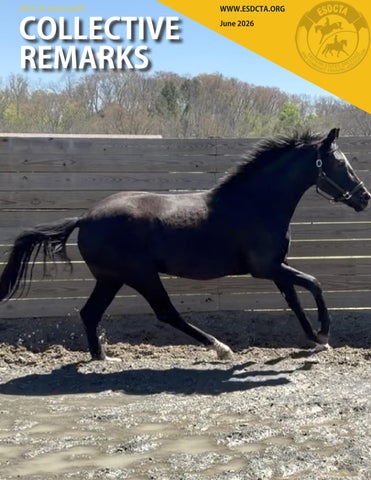
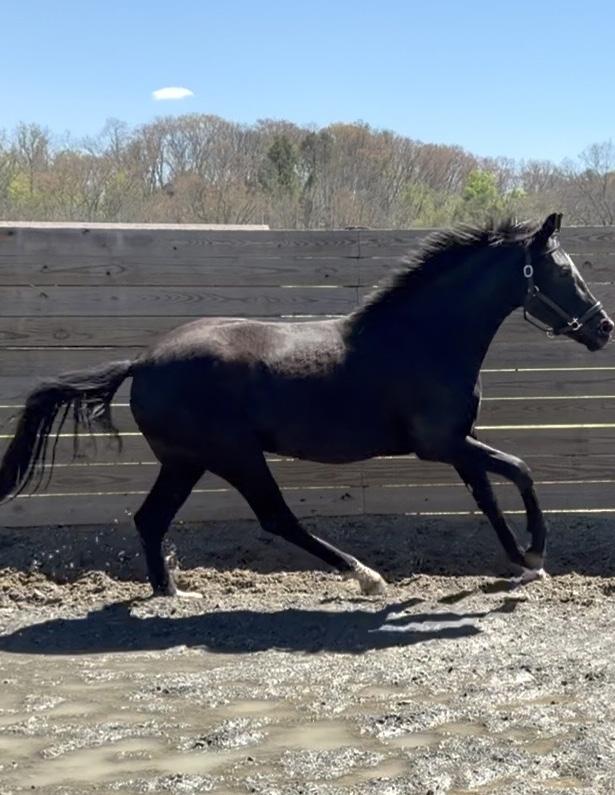
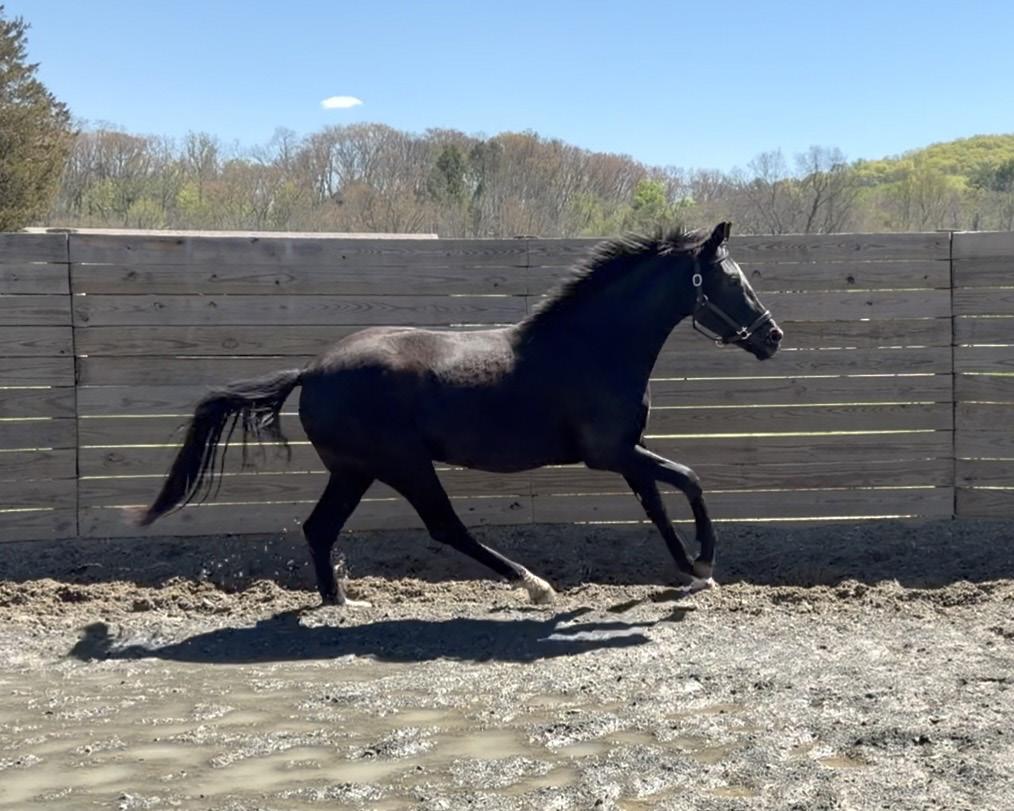
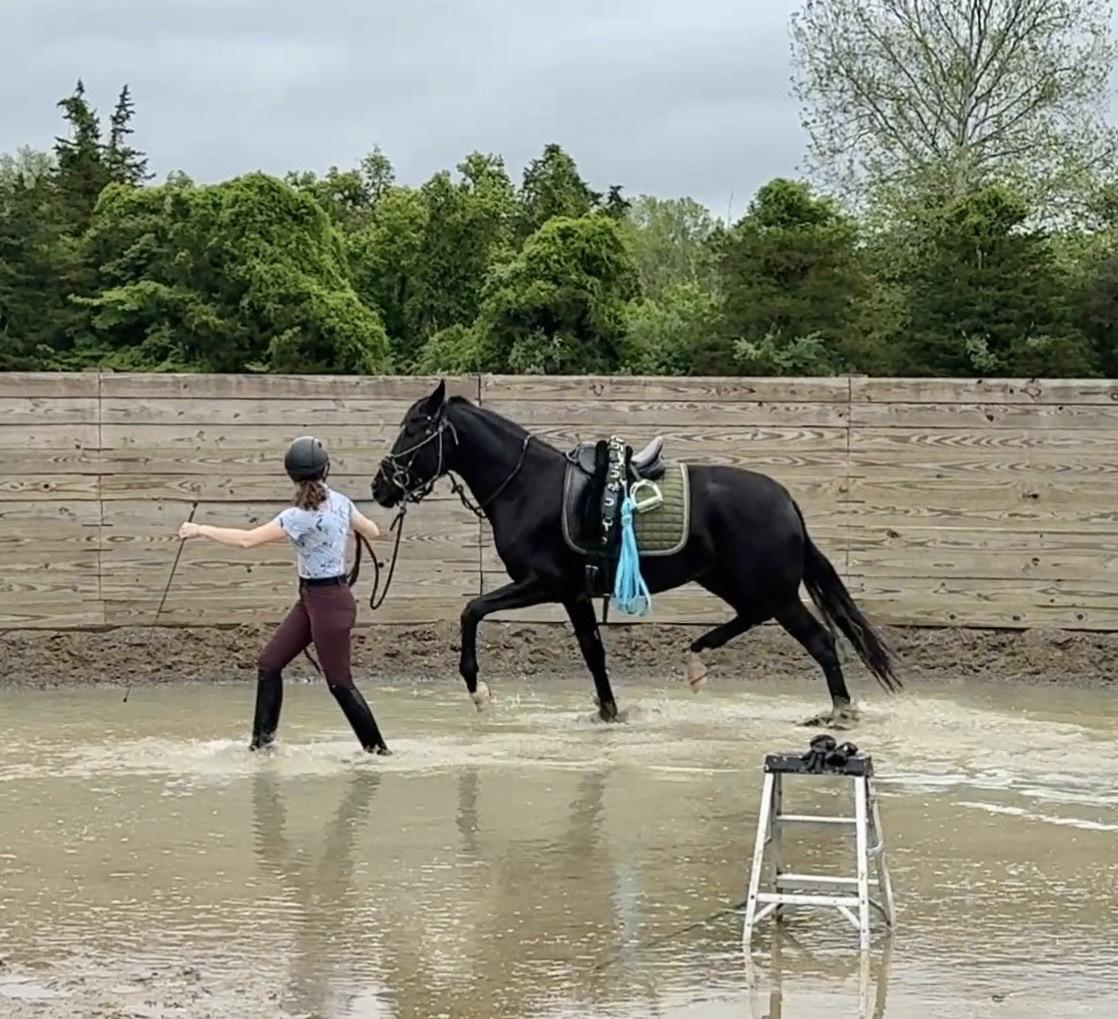
I’ve watched many materiale classes over the years while Olivia rode different horses, but I’m hoping Tiara and I might get into the ring ourselves for a few this year! She is currently in the early stages of being started under saddle, and she is doing well and learning quickly. The learning curve in the beginning is very steep, and every day brings a new lesson for both me and her, with Olivia’s help. Right now she is being ridden 2 to 3 times a week, along with some free lunging and long-lining.
At the moment we are keeping things very consistent each day we work her. We start by free lunging and/or long-lining her in the round pen, then riding in the round pen, and then either going for a walk in the indoor or out in the field. Earlier this year, I had started sitting on her in the indoor while Olivia walked us around on a few “pony rides,” but the round pen has truly made a huge difference in our ability to work with her. It just makes everything so much easier. It provides clear boundaries and walls, the horse can’t go very far if they want to run or leap around, and they don’t have to think too much about steering. Instead, they can focus on learning the basic aids to
go forward, stop, and yield, while following the wall for support and confidence. Tiara has learned very clear voice cues to stop and go, and she’s gotten quite good at changing direction by turning her head toward the wall and turning around. A lot of these concepts can certainly be taught in the indoor as well, but it’s so much easier in a smaller space and on a circle.
At the time of writing this, our biggest focus is developing a more consistent response to the forward leg aid. Turning also becomes much easier once they understand how to go forward! I also don’t have much contact yet because I really want her to learn that the hind leg pushes forward to the bit. When that happens, the softness in the mouth and neck comes naturally. I don’t want to pull her head down and make her tight or confused. Energy from behind creates good contact in the front. Right now, I just keep a steady feel on her mouth and follow wherever her head wants to be, which is usually just up and forward. She doesn’t typically get inverted unless she’s a little nervous. She is already very soft to the contact while lunging and long-lining and sometimes even comes a bit too deep, so it should come naturally with time.
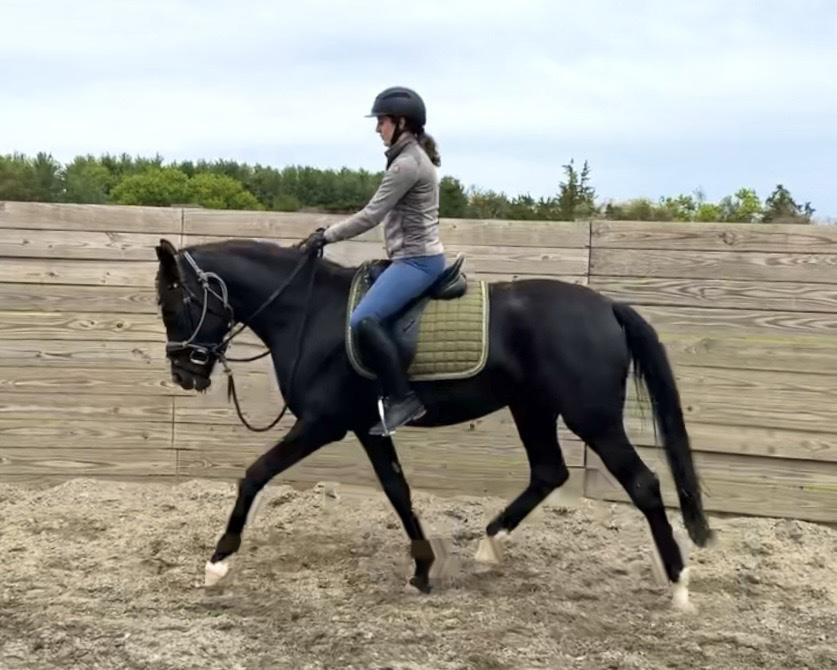
One of the next big steps will also be teaching her the sideways aids. Right now we are mainly focused on forward, but she also needs to learn what the leg means laterally and how to yield through her shoulders and belly to create the early stages of bend. Groundwork is always very helpful for introducing these concepts, and Olivia is very good at that. This will also help to introduce the concept of leg yield. There’s still lots to work on and lots to look forward to. I’m very grateful to Olivia for all of her help, and I’m looking forward to getting Tiara out and about when the time comes. She’s a brave girl and seems to be catching on to what we want. She’s very smart and also sensitive.
Onwards and upwards!
From Our Friends at Lehigh Valley Dressage Association
2023 On the Levels” - Adding to Your Dressage Knowledge Bank
Arena Optional
Arena Optional
USDF Virtual Education:
USDF Virtual Education: Common
Common Mistakes in the Show Ring
By Ellen Broadhurst
Mistakes in the Show Ring
By Ellen Broadhurst
By Ellen Broadhurst
Arena Optional is a monthly column devoted to Adult Amateur unmounted education. Our focus is to explore the (vast!) educational resources offered free to members by the USDF. USDF University is a treasure trove of library materials as well as Virtual Education programs offered both live and on-demand.
This month, we’re going to review the May 14, 2026, USDF Virtual Education program: Common Mistakes in the Show Ring presented by Joan Darnell “S” Judge and L Program Faculty and Jodie Lees “S” Judge and L Education Faculty.
Want to watch for yourself? USDF’s Virtual Programs are available On Demand within 30 days of the live presentation. Check out programs available!
USDF Virtual Education Series
Common Mistakes In the Show Ring
Dressage judges and educators Joan Darnell (“S” Judge, L Program Faculty) and Jodie Lees (“S” Judge, L Education Faculty) recently hosted a virtual session informed by their many, many years spent in the judges box: mistakes they see over and over again.
Their discussion focused not only on riding errors, but also on ring etiquette, preparation, accuracy, and the responsibilities riders have before, during, and after their test. The presenters emphasized that many mistakes occur not because riders are careless, but because experienced trainers sometimes forget that skills and procedures that feel second nature to professionals still need to be taught and explained to students.
Before You Enter the Ring
One theme of the evening was professionalism prior to entering the arena.
Riders are responsible for making sure the scribe knows their number before entering. While riders may mention which test they are riding, that should be the extent of the conversation. Judges are often finishing comments from the previous ride and should not be distracted with casual conversation - the judge is not interested in any personal information.
Timing is also entirely the rider’s responsibility. Riders should know who they follow in the warmup area and be prepared to enter promptly. “On time” means the rider should be prepared to head down centerline (not begin acclimation around the ring) at their scheduled ride time. Allowances are given for shows that run late, of course, but both Darnell and Lees were clear that it is the rider’s responsibility to be aware of time and be prompt.
They also clarified that as soon as the previous rider makes their final halt and salute, the next rider may come around the outside of the ring and continue working until the bell is rung.
If a competition setup does not allow riding around the outside of the arena, show management will provide instructions. In some cases, riders may warm up inside the arena or approach centerline from within the ring.
Understanding the Purpose of the Test
Darnell and Lees stressed repeatedly that riders should not go down centerline “hoping” they can perform the movements. The purpose of the test is to demonstrate the horse’s training confidently and correctly.
Ideally, riders should already be schooling above the level they are competing. Judges emphasized that riders consistently earning scores around 65% or higher are generally better prepared to move up a level.
“We want riders to be successful,” the judges explained. “We enjoy giving high scores. We want to see good partnerships and confident riding.”
Every dressage test includes a stated purpose, and riders should understand what qualities the test is designed to demonstrate.
The Salute Matters
Failure to salute is considered an error of course and results in a deduction.
The judges clarified several common misunderstandings about the salute:
● Riders must clearly use an arm to salute; simply nodding the head is insufficient
● Riders may salute with either hand
● Saluting with the hand holding the whip is discouraged, though not prohibited
● The salute should be simple and visible, but, please, not theatrical
● The halt should be held for approximately three seconds
The presenters encouraged riders not to fuss excessively with the halt. Attempting to repeatedly straighten or square the horse in the ring often makes the situation worse.
“The show ring is not the place to fix things,” they noted. And they clarified to a question from the audience that the rider’s body is what should be centered at X.
Accuracy Counts
Accuracy was one of the strongest themes throughout the presentation.
Riders should demonstrate:
● Correct geometry
● Accurate circles
● Proper use of corners
● Precise placement of transitions
Transitions occur when the rider’s body reaches the designated letter. However, riders must prepare the horse in advance rather than surprising the horse at the marker.
The judges also discussed lateral work, reminding riders that excessive neck bend or overpositioning destroys the correctness of the movement. True lateral work demonstrates suppleness and carrying power, not exaggerated angle.
Another important point: riders should avoid allowing one mistake to affect multiple scores.
For example, if a horse loses balance after a canter circle and picks up the wrong lead, the rider should still attempt the next transition. A late transition is preferable to omitting it entirely.
Understanding the Walks
The discussion included several clarifications regarding free walk, medium walk, and extended walk.
In the free walk, the horse should clearly stretch down and out with freedom through the topline. Riders must allow the horse to stretch while maintaining soft following contact.
In medium walk, the horse should maintain purposeful marching steps while accepting contact. The movement should not resemble a stretch.
Extended walk, introduced at Third Level and above, differs from free walk because the rider maintains clearer contact and connection while still allowing maximum ground cover and reach through the topline.
The judges noted that many riders fail to show enough distinction between these walk movements.
Errors and What To Do
The presenters reviewed several common error situations.
When the Judge Rings the Bell
The presenters reviewed several
When the Judge Rings the Bell
● If riders know where they went off course, they may acknowledge the judge and continue correctly. Otherwise, they should stop and listen while the judge explains how to return to the proper place in the test
● If riders know where they went off course, they may acknowledge the judge and continue correctly. Otherwise, they should stop and listen while the judge explains how to return to the proper place in the test
● Riders should ask questions if instructions are unclear
● Riders should ask questions if instructions are unclear
● If riders know where they went off course, they may acknowledge the judge and continue correctly. Otherwise, they should stop and listen while the judge explains how to return to the proper place in the test
● Riders should ask questions if instructions are unclear
● The judges also explained that sometimes they will assign an error without ringing the bell if stopping the test would unnecessarily disrupt the flow
● The judges also explained that sometimes they will assign an error without ringing the bell if stopping the test would unnecessarily disrupt the flow
● The judges also explained that sometimes they will assign an error without ringing the bell if stopping the test would unnecessarily disrupt the flow
Reader Errors
Reader Errors
Reader Errors
● Even if a reader gives incorrect instructions, riders remain responsible for riding the correct test
● Even if a reader gives incorrect instructions, riders remain responsible for riding the correct test
● Even if a reader gives incorrect instructions, riders remain responsible for riding the correct test
● Readers may only read what is printed on the test sheet and may not repeatedly coach or assist the rider. Excessive assistance can result in elimination for unauthorized assistance
● Readers may only read what is printed on the test sheet and may not repeatedly coach or assist the rider. Excessive assistance can result in elimination for unauthorized assistance
● Readers may only read what is printed on the test sheet and may not repeatedly coach or assist the rider. Excessive assistance can result in elimination for unauthorized assistance
Use of Voice
Use of Voice
Use of Voice
● Use of voice, including clucking, results in point deductions every time it occurs
● Use of voice, including clucking, results in point deductions every time it occurs
● If voice is used during a movement, judges deduct two points from that movement score. On coefficient movements, the deduction effectively becomes one point before the coefficient is applied
● Use of voice, including clucking, results in point deductions every time it occurs
● If voice is used during a movement, judges deduct two points from that movement score. On coefficient movements, the deduction effectively becomes one point before the coefficient is applied
Retirement From the Test
● If voice is used during a movement, judges deduct two points from that movement score. On coefficient movements, the deduction effectively becomes one point before the coefficient is applied
Retirement From the Test
Retirement From the Test
● If a rider needs to retire, permission must be requested from the judge before leaving the arena. Riders who leave without permission may face elimination from the remainder of the competition under USEF rules
● To retire properly, riders should stop and approach the judge’s booth to request permission to leave the ring
● If a rider needs to retire, permission must be requested from the judge before leaving the arena. Riders who leave without permission may face elimination from the remainder of the competition under USEF rules
● If a rider needs to retire, permission must be requested from the judge before leaving the arena. Riders who leave without permission may face elimination from the remainder of the competition under USEF rules
Breed Differences and Fair Judging
● To retire properly, riders should stop and approach the judge’s booth to request permission to leave the ring
● To retire properly, riders should stop and approach the judge’s booth to request permission to leave the ring
Breed Differences and Fair Judging
Breed Differences and Fair Judging
Responding to a question from the audience, the judges emphasized that dressage scoring is not based on breed. All horses are evaluated according to the same standards of balance, connection, suppleness, bend, and ability to carry themselves correctly.
Responding to a question from the audience, the judges emphasized that dressage scoring is not based on breed. All horses are evaluated according to the same standards of balance, connection, suppleness, bend, and ability to carry themselves correctly.
“That’s what makes dressage great,” Darnell noted. “Any horse can do dressage.”
Responding to a question from the audience, the judges emphasized that dressage scoring is not based on breed. All horses are evaluated according to the same standards of balance, connection, suppleness, bend, and ability to carry themselves correctly.
“That’s what makes dressage great,” Darnell noted. “Any horse can do dressage.”
Turnout and Presentation
The presenters concluded with reminders about turnout and overall presentation.
Turnout and Presentation
“That’s what makes dressage great,” Darnell noted. “Any horse can do dressage.”
Judges appreciate riders who present themselves neatly and professionally:
Turnout and Presentation
● Clean boots
The presenters concluded with reminders about turnout and overall presentation. Judges appreciate riders who present themselves neatly and professionally:
The presenters concluded with reminders about turnout and overall presentation.
● Clean boots
Judges appreciate riders who present themselves neatly and professionally:
● Clean boots
● Properly contained hair
● Well-groomed horses
● Respectful attire
While tasteful sparkle and embellishment are welcome, they should enhance the overall picture rather than distract from the horse.
“Little details matter,” Lees said. “When you come in well groomed, it shows respect for the sport, your horse, and the officials.”
They also reminded participants that judges are required to eliminate riders for illegal attire.
Final Takeaway
The evening’s presentation reinforced an important truth about dressage competition: success in the show ring is not only about training the horse. It is also about preparation, professionalism, accuracy, and understanding the purpose behind every movement.
Most importantly, the judges encouraged riders to approach competition with confidence rather than hope, demonstrating the partnership and training they already have at home.
Ellen Broadhurst is an active GMO Board and Committee member with both ESDCTA and LVDA and has a strong commitment to education, volunteerism, and supporting the growth of dressage and specifically the education of Adult Amateurs within her local GMOs and through USDF's resources. Interested in working with her on Arena Optional? Contact: ellen.broadhurst25@gmail.com