COLLECTIVE REMARKS


The Lazy Hazy Days of Summer 2026 are here!
As the days grow longer and the sun warms the pastures, we officially welcome the lazy, hazy days of summer. That magical season where mornings sparkle with dew, afternoons slow to a gentle rhythm and evenings are perfect for golden-hour rides. Whether you are dreaming under a shady tree or brushing off your saddle, summer invites us all to embrace a more relaxed pace – while still keeping our equine partners happy and healthy.
Our horses feel the shift too! Longer turnout times mean more grazing and play, but the heat also bring important considerations:
• Hydration is key: Always ensure fresh, cool water is available, and consider adding electrolytes to feed especially on hot or humid days
• Shade and Fans: Provide ample shelter from the midday sun; many barns are seeing great results with barn fans and misting systems
• Fly Protection: Summer brings those pesky flies – stock up on fly sprays, masks, and sheets to keep your horse comfortable.]
• Hoof and Skin Care: Dry, hard ground can lead to cracks, while humidity increases the risk of rain rot or thrush; regular farrier visits and grooming are your best friends
A gentle reminder: Adjust your riding schedule to avoid the hottest parts of the day. Early morning or twilight hacks often become the most enjoyable (and safest) moments with your horse.
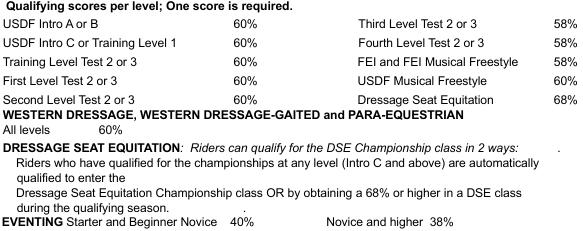
The show season is heating up too! Remember, our ESDCTA Championship Show will take place on October 11 at the Horse Park of New Jersey. So with the show season in full swing, now is the time to qualify by earning 1 score at any ESDCTA recognized show that appears on our online calendar or omnibus. You need to be an ESDCTA member at the time your score is earned.
Whether you are competing or simply enjoying trail rides, summer is an excellent time to set small, fun goals with your horse. Maybe it's improving your canter transitions or mastering a new trail loop.
As we settle into these slower, sweeter days, remember that the best part of summer with horses is simply the joy of it all: the smell of sun-warmed hay, the sound of contented grazing, and the bond that deepens with every shared moment.
Wishing you a safe and happy and hazy summer days filled with memorable rides.
Vice President
Cynthia Vanderlely
P.S. Have a favorite summer riding tip or upcoming event you would like featured? We would love to hear from you!
Board of Trustees
OFFICERS
President Vice President Secretary Treasurer
Ellen Brindle-Clark
Cynthia Vanderley
Ruth McCormick
Holly Cornell
Executive Board
Dressage at Large
Eventing at Large
Dressage Competitions
Eventing Competitions
Marketing
Membership Finance Education Youth Calendar/Omnibus
NJEAB Representative Awards
OFF BOARD COMMITTEE CHAIRS
Grants
Equipment Newsletter Nominating Nominating
Awards Ordering
Show Results
Marley McCourt
Jennifer Duelfer
Jennifer Koch
Janice Pellegrino
Paige Zimmerman
Heidi Lemack
Gary Maholic
Rachael Stillwell
Stephanie Warner
Mia Zimmerman kai glennney
Carolyn Montgomery
Becky Kuc
Ellen Clark
Jessica Clark
Meredith Rogers
Ruth McCormick
Heidi Lemack
Laura Aber
Ashley Mucha
Volunteer Coordinator Jen Koch
president@esdcta.org vicepresident@esdcta.org secretary@esdcta.org treasurer@esdcta
datlargeMAL@esdcta.org eatlargeMAL@esdcta.org dressage@esdcta.org eventing@esdcta.org marketing@esdcta.org membership@esdcta.org fi nance@esdcta.org education@esdcta.org youth@esdcta.org omnibus@esdcta.org
crunner141@comcast.net awards@esdcta.org
grants@esdcta.org horselover8968@gmail com newsletter@esdcta.org nominations@esdcta.org nominations@esdcta.org
Results@esdcta.org youthdressageshows@gmail.com
If you’re reading this, you are probably a member of ESDCTA, but I’m sure you know of someone who rides dressage or events who is not a member. You know all about the wonderful things offered like educational programs, clinics with big name trainers, horse shows, year-end awards, and not least, that sense of being part of a community of likeminded people. The more members ESDCTA has, the better the programs we can offer. Our membership numbers are also important considerations when state and local governments decide on legislature that affects us (like open space), and we advocate for our sports (We helped get better footing at the HPNJ). Please reach out to your equestrian buddies and tell them about all of the benefits of membership and have them sign up. The more the merrier!
Let us know what you would like to help us with in 2026. All skills and interests wanted. Have an idea? We want to hear about it. Remember, this club is what YOU make it. Contact president@esdcta.org if you are interested.
Have a great article that you would like to share?
Please send article to: Meredith Rogers: newsletter@esdcta.org All submissions are due by the 15th of the month. Due to space considerations, the editor reserves the right to edit submitted articles. If necessary, articles will be edited and returned for your review. AND YOU GET VOLUNTEER HOUR FOR EACH STORY!
Please Contact this newsletter if you know any ESDCTA members who have achieved any Milestones. Success at a show, regional/national/international award, new horse, or anything else you want to celebrate.
e-mail: newsletter@esdcta.org
For membership questions including updating physical or e-mail addresses please contact: Heidi Lemack membership@esdcta.org
Deadline: 15th of prior month Email: newsletter@esdcta.org
Please have electronic ads in Adobe PDF or .jpg format You will receive an invoice for ad via email.
Email: treasurer@esdcta.org
By Meredith Rogers
Being members of ESDCTA, horses fill up a large portion of our lives. They provide exercise. They are often the center of our social circle. They serve as our confidants, listening without judgment (except maybe those red mares) as we pour out our deepest, darkest, secrets, and as our therapists by keeping us grounded in the here and now. Horses help us heal physically and mentally by just being. Although we may take for granted how wonderful horses are for our sanity, they also fill more formal roles in therapy as outlined below.
Hippotherapy uses the natural gait and movement of the horse to provide motor and sensory input as a form of physical, occupational, and speech therapy. It is used both for people with physical and mental disorders. The therapeutic use of horseback riding was first mentioned in the works of the Greek philosopher, Hippocrates in 400 BCE, and is where the name comes from. However, it wasn’t until the 1960s when an official protocol was established that it became a formal discipline. Horses are particularly good for physical therapy because the rhythmic motion of the horse stimulates a person’s musculoskeletal system in ways other forms of therapy can’t. Hippotherapy leads to improvements in coordination, muscle tone, postural balance, stiffness, flexibility, endurance, strength, correction of abnormal movement patterns, and improvements in balance, gait, and language skills. In patients with dementia, horse-assisted therapy has been shown to improve well-being, functional ability, social participation, and communication. Hippotherapy differs from therapeutic riding because the former is when the horse is utilized as a tool in treatment while the latter is more about riding as the activity and may be better considered adaptive riding.
With equine-assisted emotional/psychotherapy, the horse’s nonverbal behavior mirrors that of the humans around them, creating a safe space for patients to explore their inner feelings. Horses provide nonjudgmental feedback in real-time and have been shown to help treat post-traumatic stress disorder, substance use disorder, depression, anxiety, and many other conditions. For example, patients gain confidence and increased self-esteem by learning to lead such a large animal as a horse.
Horses are also used to teach life skills, such as teamwork, communication, resilience, and goal-setting. These equine-facilitated learning programs are especially helpful with at-risk youth, but have also been used in adult settings, such as for corporate team building experiences.
Recreational riding programs that are inclusive of riders with different needs, experi-
ences, and backgrounds follow a more traditional riding-school structure, but the purpose is more to foster community than competition. An example would be a program directed at inner city school-aged children that gives students who otherwise would not have the opportunity to be around horses access to all that horses have to give, including grooming and groundwork in addition to riding. These programs provide a supportive environment to engage, learn, and grow.
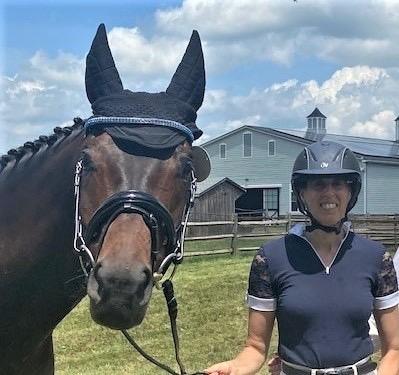
By Meredith Rogers
One day last week Leo and I were both grumpy. I know why I was – the standard reasons of too much work, too many deferred chores, and general stress from life. I wish I knew why Leo was a grouch. He didn’t enjoy my scratching his itchy spot or the massage with the magnetic curry or even the peppermints I stuffed in his mouth (okay, his ears pricked forward for that last one). I tacked him up anyway thinking we would only work on a couple of things. Usually just being at the barn picks up my mood but his attitude during our preride groom didn’t help me out of my funk. I thought maybe a good workout session would help. Nope. He was stiff, especially in right shoulder-in. After going through our standard W/T/C warm-up and a little work on that shoulder-in at walk, I called it a day. He was maybe a little less cranky after the ride, probably knowing he would shortly have his dinner and go out with his friends.
I’ve been doing this horse thing for a while now, and the biggest thing I’ve learned is to listen to your horse. Time and time again I’ve found that if their natural state is happygo-lucky but then one day they’re mentally not quite right, there’s something physical going on. With that in mind, I gave Leo a bute. The next day he was back to his old self on the crossties but I decided to give him the day off anyway. The next day after that he again seemed normal and we had a good ride.
Not being able to speak to us, it’s our responsibility to read our horses. That’s one of the reasons I like to spend time grooming, being the one to bring Leo in from the field, and to feed him his dinner. I’ve gotten to learn what’s normal for him and what’s just a little bit off. Sometimes it feels like intuition or some form of animal communication but I swear I know what he’s thinking. Maybe it’s just wishful thinking.
By Paige Zimmerman
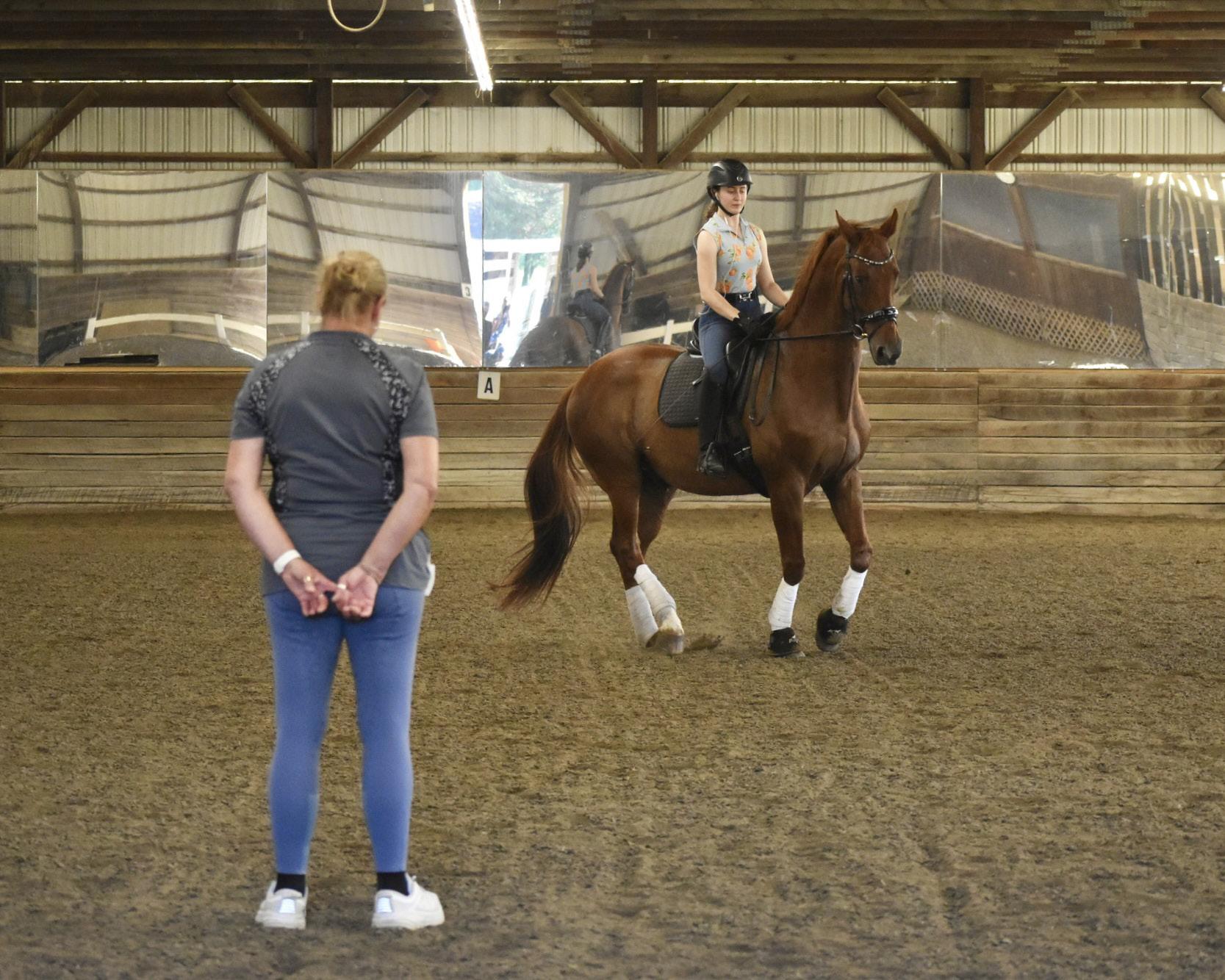
In June, Ducati and I had the pleasure of riding in another clinic with Silke Rembacz. Silke was originally scheduled to come over the winter, but poor weather delayed her trip until this summer. I was very glad to ride with her again, and she had a lot of great advice that I have added to my toolbox. I was also happy to hear that she thought Ducati had changed a lot since she saw him last year. He has changed significantly in both his confidence and his musculature, which seems to continue improving as he gets older.
We first worked in the canter, warming up with some leg yields and then focusing on the flying changes. To improve the throughness in the changes, Silke had me approach them from a leg yield: pushing him off my outside leg from the rail toward the quarterline, and then asking for a change to the outside. This exercise is always good for Ducati and really helps me get him connected to both sides so that he doesn’t get too ‘static’ and tight against my leg. It keeps me tuned in to how he feels on either side.
Silke also had me try the changes on a 20-meter circle, which is not something I have worked on extensively before. She had me doing a flying change with each half of the circle, and then a change with each quarter of the circle. It was very interesting. When we were circling to the right, it was challenging to get the changes in general (to the inside and the outside). However, when we were circling to the left, the changes were much easier and cleaner.
The right-lead flying change is our more difficult direction, and when traveling right, Ducati often falls out through the left shoulder and gets tight on the right side, especially in the changes. Paying close attention to his straightness throughout the circles and being mindful of my geometry made me much straighter in my own position, which helped the changes automatically. The circle also helped keep him looser on both sides, since the added bend of the turns helped prevent him from tightening up. This also kept him much more in front of my leg in the changes.
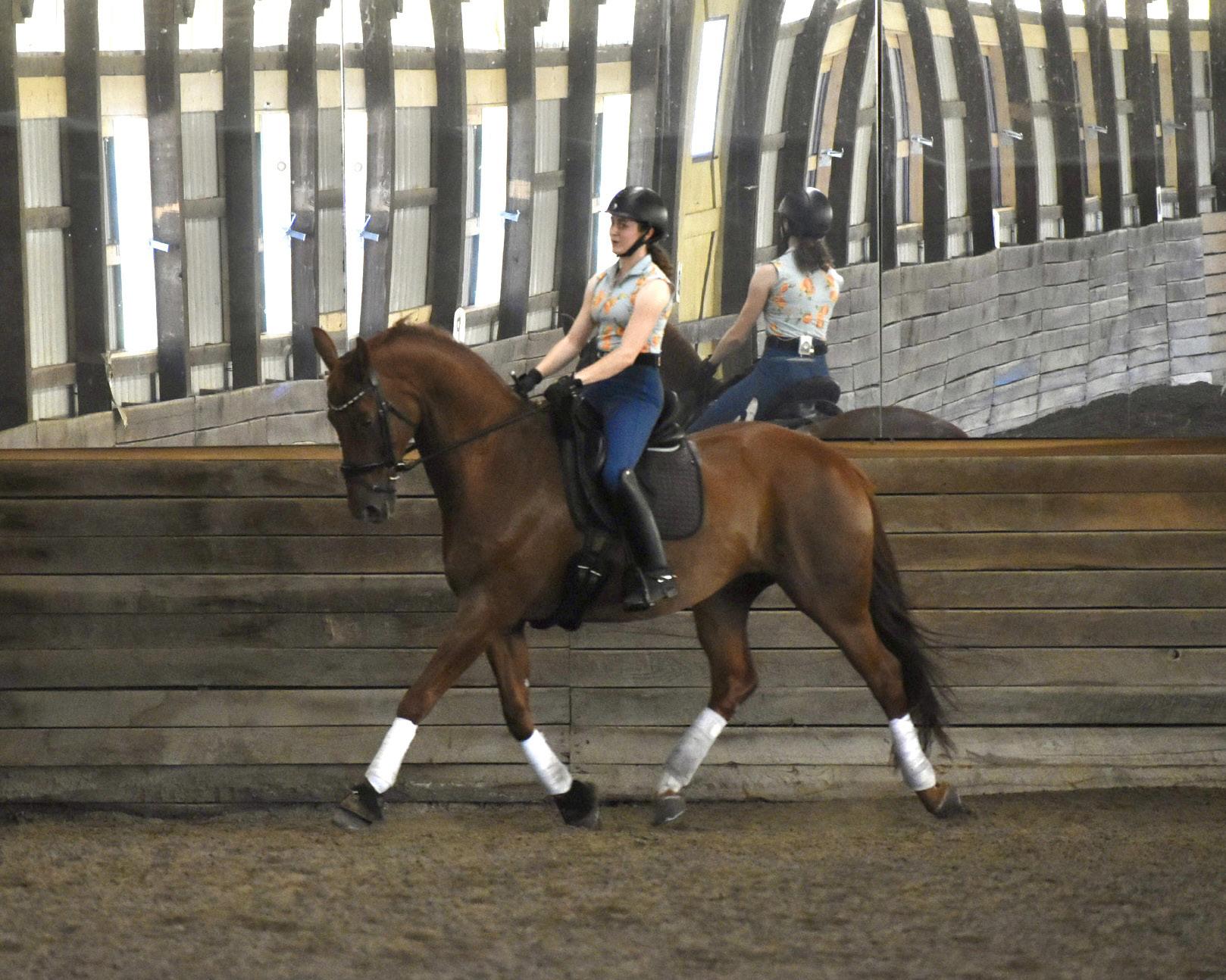
We did touch on the canter pirouettes briefly, but Silke was quite happy with them, so we did not drill them. They are a strength of Ducati’s, and he much prefers them to changes!
In the trot, we began by working on brief forward-and-back transitions, as well as keeping him softer to my right leg by positioning him in a right renver when traveling
left. He began to get excited and hot to trot, but I was able to redirect that energy into a productive, forward trot by maintaining the feel of the right renver. Keeping him bent right and moving into the left (outside) rein was crucial: He could not fall out of the bounds of my outside aids, but he still had to maintain his bend and softness. It is just like in the canter with our changes: he gets tight on either side and becomes crooked, and then we struggle to get them clean. Keeping him straighter and softer is always key to improving the quality of the work.
I also had to make sure I was not pulling on the left rein, since that is a bit of a bad habit of mine. Silke suggested that if I want to make sure I am not being too backward with my left hand, I can make a habit of reaching forward and petting his neck with my left hand. That will help reset my position and keep me from being too restrictive with my hand, even if it is totally subconscious. Getting lighter with the aids is always the goal, without throwing away the contact, of course.
Thank you Silke for coming up to teach us in NJ. We all had a great time! I appreciate the team at Sara Schmitt Dressage for organizing this educational opportunity. Thank you Olivia for the pictures and support, and thank you Brenda for sharing Ducati with me. Additionally, thank you to ESDCTA for the grant I received over the winter, which allowed me to participate in this clinic. I can’t wait to continue with the show season!
IMMEDIATE RELEASE
June 30, 2026
www.nj.gov/agriculture PO Box 330 Trenton, New Jersey 08625-0330 Contact: Bella Walz
P: (609) 913-6559
C: (609) 915-5862
E:isabella.walz@ag.nj.gov
Effective immediately, livestock, dogs, cats, and exotic pets entering New Jersey from affected state must meet new importation requirements
(TRENTON) The New Jersey Department of Agriculture (NJDA), with consultation and agreement from the New Jersey Department of Health (NJDOH), has implemented specific requirements for animals being transported from a New World Screwworm (NWS) affected state into New Jersey, effective immediately. New World screwworm (NWS), Cochliomyia hominivorax, is a species of fly found throughout portions of North, Central, and South America and the Caribbean. NWS is particularly devastating because the fly larvae burrow and feed on living tissue, often causing severe, sometimes fatal damage to animals. NWS can infest any warmblooded animal, including livestock, companion animals, wildlife, birds, and humans. To safeguard animals and protect public health, NJDA and NJDOH have instituted new movement requirements and restrictions for domestic animals that must be met prior to movement into New Jersey. Domestic animals include all livestock, poultry, cats, dogs, and exotic pets.
Since the announcement of an NWS detection in Texas on June 3, the NJDA has been monitoring the case reports and considering potential impacts to New Jersey animal owners. While the risk to New Jersey remains low, the confirmation of NWS in the US and continued new detections in Texas prove that this will be an ongoing issue. Movement of animals from impacted areas is a potential source of NWS introduction into New Jersey. The confirmed cases, in Texas and New Mexico, have involved livestock and canine species. There have been no cases of NWS detected in New Jersey or surrounding states.
“Protecting New Jersey from this dangerous insect is the purpose of the animal movement and restrictions we are putting in place,” said Ed Wengryn New Jersey Secretary of Agriculture. “The larvae feed on the living flesh of infected animals, so it is a risk to livestock, domestic pets, and humans. The goal of the regulations is to ensure animals coming to New Jersey from infected states are not bringing the fly or larvae with them.”
“The risk to New Jerseyans from New World Screwworm is very low. But public health means acting before a threat arrives, not after,” said Dr. Raynard E. Washington, New Jersey’s health commissioner . “We know animal health, environmental health, and human health are deeply interconnected. These new movement requirements are a smart, proactive step to keep people and livestock safe in our state.”
Under the implemented requirements, any domestic animal infested with or suspected to be infested with NWS or originating from a quarantined premises will be prohibited from entering New Jersey. Animals originating from elsewhere in an NWS-affected state must undergo a thorough veterinary examination within five days before transportation into New Jersey. The examination is required and must be verified in a Certificate of Veterinary Inspection. Dogs, cats, exotic pets, and rabbits originating from any place in a US state that contains an infested zone or adjacent surveillance zone must be treated by an accredited veterinarian with a systemic product effective against NWS. All livestock animals originating in or transiting through a US state that contains an infested zone or adjacent surveillance zone must obtain permitted approval from NJDA prior to movement into New Jersey.
The NJDA is authorized to institute and enforce such measures as it deems necessary to control infectious or contagious diseases of animals or poultry. The state has long recognized NWS as a “particular and dangerous menace to animal health in the State.” NJDA is asking animal owners to remain vigilant for this pest. If you suspect NWS in your animal, please alert your veterinarian or the New Jersey Department of Agriculture, Division of Animal Health at 609-671-6400.
The full list of movement requirements may be found at: Animal Health (https://www.nj.gov/agriculture/divisions/ah/).
View the New World Screwworm New Jersey Entry Infographic at: NWS_Import_Infographic.pdf
View Quarantine Order here: Quarantine Order for Preventing New World Screwworm
The New Jersey Department of Agriculture (NJDA), established in 1916, serves New Jersey’s agricultural community and resident s through a wide range of programs across its divisions that ensure the preservation and continuation of the state’s agricultural landsca pe. NJDA works to ensure the safety and quality of New Jersey’s food supply, protect animal and plant health, and promote the overall long -term viability of agriculture. The Department also connects consumers with New Jersey’s farmers and locally grown products while supporting the state’s diverse agricultural industry through initiatives of the Jersey Fresh program.
For more information about the New Jersey Department of Agriculture, follow us on Facebook at www.facebook.com/NJDeptofAgriculture and www.facebook.com/JerseyFreshOfficial; on Instagram @njdeptofagriculture; on X/Twitter @NJDA and @JerseyFreshNJDA; and on LinkedIn at New Jersey Department of Agriculture.
It may be about 3 months away but it’s never too early to dream of all the excitement of Dressage at Devon, and now we have an extra special reason to look forward to this historic show. Kingsview Partners Dressage at Devon has announced that the headliner for the Masterclass on September 24 will be no other than Carl Hester! Mr. Hester is not only one of the greatest equestrians in the world, but he is known to be an engaging and entertaining instructor. You don’t have to be a Grand Prix rider to apply to ride in the Masterclass, just fill out an application here: Carl Hester Masterclass Application (deadline is July 15).
Just last month another carriage horse in NYC spooked and took off, resulting in a human fatality, and bolstering the call to ban all horses in Central Park. Although this incident is not directly related to horse sport, the public paints anything related to horse welfare with a broad brush, and the Olympic Equestrian disciplines are clearly in the cross-hairs. One medium that is used to both support and criticize horse welfare is still photography. The blue tongue images come to mind as a widely disseminated cause of negative perceptions of dressage. A new study wanted to dig deeper into what aspects of photographs of horses competing in dressage, show jumping, and eventing convey positive versus negative insight into horse well-being. A total of 30 competition and behind-the-scenes images captured by an accredited photographer at the 2024 Paris Olympics were included in an online survey sent to equine enthusiasts to judge what people consider core markers of good (eg, relaxed facial expression) and bad (eg, restrictive tack) horse interactions. The results showed that pictures really do speak a thousand words and that people can not only differentiate between positive versus negative attributes of horse welfare in still photography, but they prioritize horse comfort over athleticism when viewing these images. What these means to us is that just enacting new rules and saying how we are doing better is not enough to sway public opinion, we have to show them. To read the whole article see: https://juniperpublishers.com/jpfmts/pdf/JPFMTS.MS.ID.555824.pdf
6/30/26
Second

July 2026