ONLINE READERSHIP: 410,000 monthly unique clicks through Google Analytics
The SingaporeBusinessReview is the highest circulating and best read business magazine in Singapore. Our online readership has an average of 215,000 unique viewers, according to Google Analytics. We won the Business Trade Media of the Year Award at the 2017 MPAS Awards.
Do reach out to us if you would like us to tell your story to our readers via print and online advertising or events.
PUBLISHER & EDITOR-IN-CHIEF Tim Charlton
EDITORIAL MANAGER Tessa Distor
PRINT PRODUCTION
EDITOR Vienna Verzo
LEAD JOURNALIST Vincent Mariel Galang
JOURNALISTS Frances Gagua Jilliane Rae Manuel Sam Bernardo Levi Buenviaje Miguel Dumlao
EDITORIAL RESEARCHER Shiena Viene Sur
GRAPHIC ARTIST Simon Engracial
EDITORIAL ASSISTANT Dylan Afuang
COMMERCIAL MEDIA TEAM Jenelle Samantila Dana Cruz Danielle Goh
Charlton Media Group 101 Cecil St. #17-09 Tong Eng Building Singapore 069533 +65 3158 1386
HONG KONG Room 1006, 10th Floor 299 QRC, 287-299 Queen's Road Central, Sheung Wan, Hong Kong +852 3972 7166 www.charltonmedia.com
MIDDLE EAST
FDRK4467, Compass Building, Al Shohada Road, AL Hamra Industrial Zone-FZ, Ras Al Khaimah, United Arab Emirates
PRINTED BY Times Printers Private Limited 18 Tuas Avenue 5, Singapore 639342 www.timesprinters.com
A member of Times Publishing Limited +65 6383 5290
Can we help?
Editorial Enquiries: If you have a story idea or press release, please email our news editor at sbr@charltonmediamail.com. To send a personal message to the editor, include the word “Tim” in the subject line.
Media Partnerships: Please email sbr@charltonmediamail.com with “Partnership” in the subject line.
Singapore Business Review is published by Charlton Media Group. All editorial materials are covered by copyright and may not be reproduced without consent. Contributions are invited but copies of all work should be kept as Singapore Business Review can accept no responsibility for loss. We will, however, take the gains.
FROM THE EDITOR
Singapore’s startup ecosystem is entering a more disciplined phase. As funding conditions ease, the “growth at all costs” mentality is giving way to sharper focus on unit economics and regional scale. Our cover story on page 28 tracks how founders are pivoting to deep tech, with AI and robotics driving a more selective recovery.
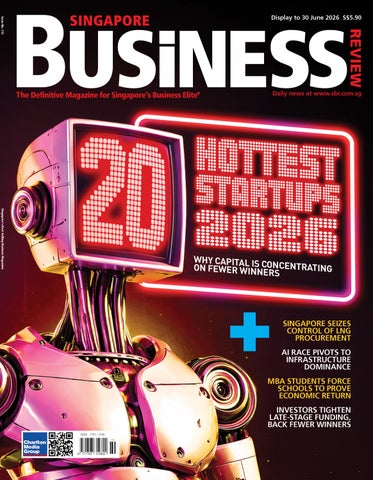
That same shift runs across the issue. On page 8, Singapore centralises LNG procurement to tighten control over pricing and supply. By page 22, the AI race moves beyond adoption to infrastructure—compute, talent, and ecosystems.
Capital markets are testing a return. Page 34 looks at how the SGX is positioning for an IPO pickup, though conviction must show in deals. Meanwhile, page 18 shows late-stage funding concentrating into fewer companies, with fintechs chasing larger rounds under stricter terms.
Even education is under pressure. On page 40, MBA students demand clear outcomes, reflected in our latest MBA list.
Finally, we celebrate the visionaries navigating these complexities at the SBR Management Excellence Awards 2025. See the full gallery of winners on page 50.
Read on and enjoy!
Sold on newsstands in Singapore, Malaysia, Hong Kong, London, and New York. Also out in sbr.com.sg with an online readership of 215,000 monthly unique visitors*.
*Source: Google Analytics
Tim Charlton
Flight | Baggage | Seat | Fare Families
Atlas (atlaslovestravel.com) is a global travel-tech company offering a complete LCC flight API and data analytics solution, unifying fragmented content from 140+ LCCs and driving growth through analytics from 1B+ daily searches across global LCC data.
Built on a foundation of transparency, Atlas provides Travel Sellers with non-aggregated fares and terms and conditions while giving airlines full visibility into fare distribution.
News from sbr.com.sg
Daily news from Singapore
MOST READ
Singapore to slash CDC vouchers in Budget 2026: analysts
Singapore’s national spending for the year is expected to cut back on CDC vouchers as the government shifts its focus to defence, infrastructure and AI.
“CDC vouchers will likely be scaled back from the generous quantum in FY2025 (CDC $1.06b, SG60 $2.2b) and be more targeted,” Maybank said in its report.
MOST READ COMMENTARY
From ownership to access: Unlocking vehicle productivity
BY Johnson Lim
Car ownership has traditionally been known to be costly, but volatile Certificate of Entitlement premiums and a growing list of recurring costs are pushing it beyond what many households can reasonably justify. In such a volatile environment, planning around car ownership has become increasingly difficult.
Top 20 under 40: The young lawyers leading Singapore's biggest deals
Eight women and 12 men have earned a place on Singapore Business Review’s 2025 list of the country’s most influential lawyers under 40. The honourees have played key roles in landmark transactions and disputes, billiondollar mergers and acquisitions, privatisations, and cross-border financings.
Spending millions on bollards whilst accidents keep rising
BY Lai Wei Xiang
Here's something that should bother every developer in Singapore: We've spent millions installing 18,000 safety bollards at bus stops since 2018. We've upgraded 100 signalised junctions with protective barriers by 2025. And traffic accidents causing injuries and fatalities? Up 7.4% in the first nine months of 2025 from 5,368 to 5,765.
to rise
Employee salaries are expected to increase by 4% in 2026, according to a survey by global HR consulting firm Mercer, mirroring the 4.1% growth recorded in 2025. Mercer’s Total Remuneration Survey 2025 found that 97.6% of employers plan to provide salary increases next year, slightly down from 99.2% in 2025.
Why businesses must focus on outvaluing, not just upskilling BY
Rich Chua
For more than a decade, the conversation across Singapore’s corporate landscape has centred on skills. Upskilling, reskilling, and continuous learning have become standard prescriptions for staying competitive in a rapidly evolving economy. Yet many organisations find themselves facing a quiet paradox.
Salaries
4% in 2026, Mercer survey shows
Digital infrastructure of tomorrow, today
GLOBAL DIGITAL INFRASTRUCTURE POWERING THE FUTURE OF
K2 Strategic is a global developer, owner, and operator of hyperscale digital infrastructure assets.
We specialise in delivering the critical physical infrastructure that underpins today’s internet, cloud services, and emerging digital technologies. From advanced data centre environments to renewable energy and connectivity solutions – we are a comprehensive digital infrastructure partner.
DATA CENTRES (PORTS)
DATA CENTRES
State-of-the-art hyperscale campuses across Ireland, Thailand, Malaysia, and Indonesia — engineered to support the evolving needs of global enterprises.
World-class data centre campuses in Ireland, Indonesia, Malaysia, and Thailand — purpose-built to meet the dynamic demands of global hyperscalers.
Extending our reach beyond data centres, we invest in regional connectivity infrastructure to ensure seamless, secure data exchange across international markets.
Driving sustainable innovation through renewable energy solutions that power our data centres in strategic global markets. RENEWABLE ENERGY
Employers urged to prioritise pay for critical roles over broad increases
Companies should focus pay increases on roles that directly drive business results, rather than handing out broad-based raises, as the country prepares for a projected 4% salary rise in 2026.
“Companies should strategically allocate their budgets towards critical talent and key roles that drive business resilience and growth,” Eugene Chong, head of career products for Singapore at Mercer LLC, told Singapore Business Review.
Moderate hiring sentiment
Mercer’s preliminary data released in January showed Singapore’s salary growth is expected to remain stable at 4%, slightly below last year’s 4.1% increase.
The figure reflects efforts by companies to retain talent amidst rising living costs.
Singapore remains Asia’s most expensive city, according to the 2026 Global Cost of Living Index by Numbeo DOO BeogradPalilul, with a score of 87.7, up from 79.1 in 2025, placing it ninth globally.
Kirsty Poltock, country manager for Singapore at Robert Walters Plc, told the magazine that tight labour market is particularly evident for critical skill sets.
“Whilst hiring sentiment has moderated compared to the post-pandemic surge, demand continues to outpace supply in areas such as technology, artificial intelligence (AI), cybersecurity, finance, risk, compliance, and transformationrelated roles,” she said in a separate interview with Singapore Business Review. ManpowerGroup Inc.’s 2026 Global Talent Shortage Survey showed that AI skills have emerged as Singapore’s hardestto-fill capabilities, even as overall talent scarcity eases. Specifically, AI Model & Application Development (26%) and AI Literacy (25%) were the hardest-to-find skills in the city-state.
Poltock expects companies to shift focus from hiring more staff to optimising existing workforces. There is also greater scrutiny around role design, with businesses prioritising hires that deliver clear commercial impact rather than increasing headcount indiscriminately, she said.
“As companies respond to the volatility and agility required in the market, the workforce will see traditional permanent roles matched with an increasing number of contract positions and project-based hiring,” Poltock said, adding that outsourcing and managed services can further support scale whilst controlling costs.
Chong added that performance-based pay should become central.
This shift aligns with Mercer’s data showing a slight dip in the number of employers planning raises, falling to 97.6% for 2026 from 99.2% in 2025, as individual performance becomes a primary differentiator in budget allocation.
The trend points towards navigating cost pressures, which naturally leads to more selective salary increases rather than broadbased adjustments, Poltock said
“Instead of across-the-board raises, we are seeing a stronger emphasis on differentiated compensation strategies,” Poltock said. “Increments are more targeted and aligned to performance, skill scarcity, and business priorities.”
Outlook
Foo See Yang, managing director and strategic business group head of PERSOL Singapore, also said in the company’s Salary Guide 2025/26 that “organisations that embrace skills-based hiring, data-driven insights, and agile work models will be best positioned to attract and retain top talent.”
Industries expected to see the biggest compensation movements include logistics, aerospace, high-tech manufacturing, consumer goods, healthcare, life sciences, chemicals, technology, financial services, and supply chain functions.
Roles tied to digital transformation, cybersecurity, data analytics, regulatory compliance, and risk management remain particularly well-compensated, Poltock said.
PERSOL Singapore said in its Salary Guide 2025/26 that the technology sector is amongst those that will see robust salary growth. It expects an 8% to 12% increase in specialised roles such as AI, cybersecurity, and cloud computing professionals.
The workforce will see traditional permanent roles matched with an increasing number of contract positions and project-based hiring
Singapore's salary growth is expected to remain stable at 4%, slightly below 2025's 4.1% increase
HR & EDUCATION
Leaner menus seen as key after 2,431 F&B outlets shut
Retail food chains should tighten their menus to survive a wave of closures that has swept the sector, according to analysts, as more than 2,400 food and beverage (F&B) outlets shut in the first 10 months of 2025 following a near 20-year high in closures the year before.
“You can remove the items that are low-selling or complicated,”
Anuran Dhar, practice head for foodservice at GlobalData Plc, told Singapore Business Review. “You make a tighter menu that improves your speed, reduces wastage and makes training easier.”
The credit and charge card payments market is projected to grow 9.2% to $116.8b in 2026, driven by wider card acceptance and increased use of contactless payments, according to a report by GlobalData.
The report said the market reached $107b in 2025, a 7.6% increase, due to rising consumer spending.
Credit and charge cards continue to gain market share through rewards programmes, instalment options, and cashback offers. Whilst debit cards remain common for everyday purchases, credit products lead due to value-added benefits.
Singapore recorded 62,551 pointof-sale terminals per million inhabitants in 2025, higher than Malaysia with
From January to October, 2,431 outlets ceased operations. Of these, 63% had been operating for five years or less, according to Deputy Prime Minister and Trade and Industry Minister Gan Kim Yong. Amongst the younger firms, 82% had never recorded a profit.
Simplifying menus
Michael Alexander Kruesi, associate professor at the Singapore Institute of Technology, said simplifying menus helps operators manage slow demand and rising costs. With fewer items, businesses can streamline inventory, reduce
spoilage, and shorten preparation times. Training staff also becomes easier and more consistent.
Kruesi said the closures do not necessarily point to market failure. Many of the businesses were started out of passion and financed through personal loans or family savings, leaving them vulnerable when costs rose or sales slowed.
Rents have been climbing.
Data from the Urban Redevelopment Authority showed retail rents rose 3% in 2025, up from 1% a year earlier. Analysts expect further increases this year as supply remains tight.
Rather than making drastic cuts, Kruesi said operators should detect cost pressures early. This could mean delaying expansion or trimming menus before losses widen.
Dhar said regular monitoring is key in a low-margin business. “It is essential that you are monitoring your business on a weekly basis,” he said, adding that waiting until month-end to review food or labour costs might be too late.
Competition is another challenge. Many outlets sell similar products, forcing them to compete for the same customers.
Customers have a lot of choices, so they will choose the best
“Customers have a lot of choices, so they will choose the best,” Kruesi said. In a competitive environment with thin margins, there is little room for weak performance.
29,093, Hong Kong with 27,992, and Thailand with 13,017.
Banks have introduced incentives to increase card usage. United Overseas Bank offers instalment plans with 0% interest for online purchases at partner merchants, whilst Citibank provides 5% cashback on store and online transactions through its Citi SMRT card.
Government support has also expanded merchant adoption. The Productivity Solutions Grant provides 50% funding for POS installations for small and medium enterprises.
GlobalData forecasts the market to grow at a compound annual growth rate of 7.8% between 2025 and 2029, with total payment value from credit and charge cards expected to reach $144.2b by 2029.
Eight in ten outlets had never recorded a profit, said Trade and Industry Minister Gan Kim Yong
Anuran Dhar
Michael Alexander Kruesi
FOOD & BEVERAGE
SINGAPORE TURNS TO REGIONAL GRIDS FOR CLEAN POWER
Energy opportunities in landconstrained Singapore are shifting away from adding generation capacity towards improving system flexibility, as the city-state works towards importing about 6 gigawatts of low-carbon electricity by 2035.
“With limited domestic resources but strong financial capacity, Singapore’s most attractive opportunities lie in enabling regional supply and system flexibility rather than expanding local generation,”
Alnie Demoral, Asia energy analyst at independent think tank Ember, told SingaporeBusinessReview
Singapore has moved from cautiously exploring solar power to actively shaping Southeast Asia’s cleanenergy ecosystem, she said. As electricity demand rises and the country eases its reliance on gas, momentum has built around crossborder imports of solar, wind and hydropower, alongside large gridinterconnection projects.
That shift has triggered a wave of activity in neighbouring markets, especially Indonesia, where developers are advancing utility-scale solar-plusstorage projects and subsea cables designed to supply a meaningful share of Singapore’s future clean electricity, she said in an exclusive interview.
The Energy Market Authority has issued conditional approvals to 11 projects to import low-carbon power from Australia, Cambodia, Indonesia, Sarawak in Malaysia, and Vietnam.
To support these efforts, Singapore Energy Interconnections Pte. Ltd. was established in April 2025 to develop and operate cross-border transmission infrastructure. For lenders, the vision of a regional power network represents a long-dated but important opportunity.
“The ASEAN Power Grid is certainly a longer-term play from an investment financing point of view,” said Kelvin Wong, global head of energy, renewables and infrastructure at DBS Bank Ltd.
Gov't bets on AI to drive next phase of growth
ECONOMY
The latest budget signals a shift in economic strategy, with the government betting on artificial intelligence (AI) and industry collaboration to drive growth whilst tightening foreign workforce rules.
Prime Minister Lawrence Wong said the government would focus on building industry clusters powered by AI, linking companies across sectors to develop technologies that could compete globally.
“Singapore’s next wave of growth will not be defined by isolated industries, but by interconnected industry clusters,” Johanes Candra, a partner for business incentives advisory at Ernst & Young Solutions LLP (EY), told Singapore Business Review
Companies with related strengths will work together to develop and scale innovations, he said in an interview.
Wong said advanced manufacturing, connectivity and logistics, finance, and healthcare would anchor the government’s AI strategy.
The sectors together contributed more than two percentage points to Singapore’s 5% economic growth in 2025, according to data from the Ministry of Trade and Industry.
The government will also establish a National AI Council headed by Wong to oversee the development and execution of AI missions, which aim to accelerate technology adoption and strengthen Singapore’s position as a global innovation hub.
Lee Bo Han, a partner for R&D and incentive advisory at KPMG in Singapore, said the initiatives could boost productivity by building on the country’s existing industrial strengths.
“The missions are part of a coordinated effort to enhance Singapore’s AI strategy,” he said.
“These initiatives show that the government recognises AI’s huge potential to refresh economic growth.”
Amaresh Mohan, chief risk and compliance officer at Nium Pte. Ltd., said the focus on vital sectors should prompt businesses in other industries to act independently.
“They should start with highconfidence use cases like risk controls, customer operations, finance automation, and compliance monitoring, and make sure governance is strong,” he told the magazine.
Tighter labour policies
The budget also tightens foreign worker rules, including higher minimum salaries for some work pass holders and a higher pay benchmark used to set foreign worker limits.
Analysts said the measures signal a broader shift away from labourdriven growth towards a higherproductivity economy.
Rahul Nambiar, chief executive officer at Botsync Pte. Ltd., said the budget’s focus on AI encourages companies to modernise rather than maintain legacy operating models.
“Whilst the adjustment may create short-term pressure, it strengthens the long-term competitiveness of Singapore’s industrial base,” he said.
But the tighter labour policies could increase operating pressure on manpower-heavy sectors such as construction, manufacturing, logistics, food and beverage, and hospitality, said Barbara Kinle, a partner for personal tax and global mobility services at KPMG.
“Strategic workforce planning will be critical,” she said.
Companies need to identify where foreign expertise delivers the most value whilst strengthening efforts to develop local talent, she added.
Sectors like advanced manufacturing would anchor the government's AI strategy
Johanes Candra
Amaresh Mohan
Lee Bo Han
SINGAPORE’S NEWEST SHIPYARD
PAXOCEAN SG @ 5JS
The 17.26-hectare facility, featuring 3 docks and 1,250m of berths, is designed for operational scale and versatility—capable of supporting a wide range of vessels, including offshore, specialised, and Suezmax-class ships.
iHub5 is a new initiative designed to serve as the nexus for fostering collaborative partnerships to drive deep-tech solutions. iHub5 connects ecosystem stakeholders to leverage domain expertise, engineering capabilities, and operational insights to accelerate business growth and decarbonization.
Located within iHub5, the Centre of Excellence in Engineering R&D advances Kuok Maritime Group’s (KMG) technology interests such as digital twins, carbon capture, electrification, and alternative fuel solutions.
STARTUP FUNDING RISES WITH BIGGER CHEQUES AND FEWER DEALS
Source: Tracxn Technologies Ltd.
STARTUP
AID PLANS EUROPE EXPANSION THROUGH JOINT VENTURES
BUILDING & ENGINEERING
Aid Pte. Ltd. plans to expand into Europe as part of a five-year growth strategy, bringing its fire-rated and sound-control building materials to new markets.
Founder Elijah Yang said the Singapore-based startup is in talks with XB Acoustics GmbH as a potential partner in Stuttgart, Germany. Fabervanderwijk, a possible dealer in the Netherlands, has also approached the firm.
“If things go well, and the dealer wants to promote our products more actively, there is a possibility of setting up a joint venture in Germany to represent Europe,” Yang told Singapore Business Review in an exclusive interview.
Whilst he did not identify, Yang said a venture capital firm has also approached Aid to explore a joint venture in the Benelux region focused on decarbonisation. The partnership will be finalised in April 2026.
Founded in 2024, Aid specialises in wall panels, ceiling systems, and acoustic panels. The company grew out of Yang’s earlier business, Aural Aid, which focused on soundproofing and acoustic solutions for about a decade. The rebrand marked its shift into broader construction materials.
Because of its roots in acoustics, many of Aid’s products are designed to manage sound within buildings. Yang said materials used for walls and ceilings should do more than enhance appearance.
They should perform a job, he told the magazine, citing compliance with fire safety standards and reducing echo or excessive noise in a room.
In architectural acoustics, managing how sound behaves inside a space is critical, especially in offices, auditoriums, and commercial buildings. Aid’s panels are designed to help control reverberation whilst meeting fire safety codes.
Sustainability focus
Sustainability is another focus for the company. According to Yang, environmental standards now influence most of its product development decisions.
“Sustainability is now a huge part of what we do,” he said. That includes sourcing materials responsibly and ensuring products meet emission standards for volatile organic compounds.
Aid is headquartered in Singapore and has offices in Dubai, Chicago, and California. Its products have been used in about 20 countries, including Switzerland, Saudi Arabia, and Costa Rica. Whilst Aid’s $3.15m (US$2.5m) target funding is still a work in progress, Yang said the company continues to bag projects globally.
The company has worked on projects such as SeaWorld Abu Dhabi in the United Arab Emirates, as well as the Pall Mall Wine Club and Changi Airport Auditorium in Singapore. It is now involved in a mixed-use development in Singapore’s central business district that will house offices and retail spaces.
Sogni AI builds community AI network
Sogni AI Pte Ltd. is challenging centralised artificial intelligence (AI) systems by building a global, community-powered network for creative AI.
The platform, Sogni Supernet, lets users contribute computing power from their own devices to run AI models for image and video generation, earning tokens in return. It now includes over 1,000 graphics processing units (GPUs) worldwide, contributed by volunteers on Mac, Windows, and Linux systems.
This setup lets the platform generate far more content simultaneously than typical AI services, CEO Mauvis Ledford told Singapore Business Review.
“Platforms like ChatGPT or MidJourney might give you one or four images at a time,” he said. “We can generate 16, 32, or even 512 images at once because we’re backed by a global network of volunteer GPU compute.”
The platform bundles roughly 100 open-source AI models and provides tools for both image and video creation. Users can generate videos from text, images, or sequences of frames, with recent updates adding 360-degree video and voice-to-video capabilities.
Ledford said Sogni AI was inspired
by the difficulty of using open-source models independently.
“Many models are available for free, but they’re hard to download, compile, and use,” he told the magazine. “If we could bundle these open-source models into a one-click [platform], the whole world could benefit.”
He described the platform as an “AI art studio for creating in your own privacy” and emphasised user control. “We’re not tracking everything you’re doing.”
Sogni AI charges about $0.016 or half a US cent per render, depending on image size and model complexity.
Video costs more due to frame rendering and 4K resolution.
There are no subscription fees; users buy credits converted into tokens that compensate GPU contributors.
Initially bootstrapped with $1.3m (US$1m), the company later raised $2.5m (US$2m) in pre-seed funding in March 2025 and about $317,000 (US$251,000) through token sales.
The platform now has about 85,000 active users.
Level3AI scales enterprise AI in APAC
Level3 AI Pte Ltd. is scaling its enterprise AI agents across its Asia-Pacific markets, aiming to automate customer engagement whilst maintaining what it describes as human-quality service.
Co-founder and CEO Harry Yu said the company plans to deepen its presence through existing partnerships and expand deployments amongst enterprise clients already operating in the region.
“The plan is to build on partnerships in markets where we already operate,” he told SingaporeBusinessReview. He declined to share specific markets but said several projects are under way, ranging from proof-of-concept work to live production trials and parallel system testing.
Founded in 2024 by Yu and Zachary Wang, Level3AI developed an AI agent named Emily to handle customer
engagement tasks such as inquiries, requests, and service workflows. Clients include car-sharing firm GetGo Technologies Pte. Ltd, online marketplace Carousell Pte. Ltd, and Minden International Pte. Ltd, which operates the yuu Rewards loyalty programme. Yu said the company differentiates itself by combining large language models with a rulebased control system.
Mauvis Ledford, CEO at Sogni AI
Elijah Yang, CEO at Aid Pte. Ltd.
MEDIA & MARKETING
Harry Yu, co-founder and CEO at Level3AI
SPACE WATCH
Yubico dedicates 80% of hub to production
The workspace showcases its Scandinavian design with light and greenery.
Yubico has opened a 393-square-metre Singapore hub designed to support its regional operations across Asia-Pacific. Located at Tai Seng Exchange Tower A, the facility serves as the company’s base for programming, customising, packaging, and distributing its YubiKey devices closer to customers.
About 80% of the space is allocated to production and distribution functions. Whilst devices continue to be manufactured in the US and Sweden, the Singapore hub enables Yubico to tailor products to customer requirements and shorten turnaround times in the region, said Geoff Schomburgk, regional vice president
for Asia Pacific & Japan at Yubico.
The office houses around 40 staff and also functions as a collaboration space for sales and engineering teams.
It includes areas for client discussions, alongside practical features such as two phone booths and a meeting room.
Design reflects Yubico’s Scandinavian roots, with an emphasis on natural light and greenery.
The layout is intended to mirror the company’s focus on simplicity and security.
A mural by local studio Mural Lingo integrates Singaporean elements with Yubico’s branding, anchoring the global firm in its local setting.
1 Yubico’s Singapore office plays a pivotal role in the regional customisation and distribution of its cybersecurity solutions in APAC.
2 The 393-squaremetre facility is Yubico’s third global headquarters.
3 The office features a mural by local studio Mural Lingo that blends local icons
4 The space features two phone booths and a meeting room in a layout defined by natural light and greenery.
5 The new hub will programme, customise, package, and distribute devices to regional clients.
6 The office also functions as a collaboration space for sales and engineering teams.
Geoff Schomburgk
with Yubico branding.
SPACE WATCH
TEC opens dual-floor workspace in CBD
The office is supported by reception, IT and hospitality staff, including a barista.
The Executive Centre (TEC) has expanded its presence in Marina Bay with a new workspace at IOI Central Boulevard Towers, marking its 13th location in the city. The site spans Level 32, with a second floor on Level 40 set to open in mid-2026, establishing a dual-floor presence in one of the CBD’s most connected buildings.
The workspace is designed as a premium flexible office targeting multinational clients. It combines private offices, meeting rooms, lounges, and an event space, alongside smaller features such as phone booths and collaborative areas. A dedicated wellness zone with a massage chair adds to the layout.
Service is embedded into the space. A full on-site
2 4 6
1 TEC’s 13th Singapore hub at IOI Central Boulevard Towers offers premium connectivity in Marina Bay.
2 The 20,000 sq ft floor features collaborative lounges and high-tech displays to meet growing MNC demand.
3 Workstations feature Herman Miller ergonomic chairs and height-adjustable desks for maximum comfort.
4 Meeting rooms are equipped with advanced AV systems and supported by a dedicated on-site IT Tech Bar.
5 The hospitality team includes a resident mixologist and barista, serving a selection of over 200 cocktails.
6 All-day F&B services transition from a morning café to an evening bar for both members and the public.
team supports operations, including reception, IT personnel, and hospitality staff.
The workspace also integrates a barista and a resident mixologist, with a café that transitions into a bar serving cocktails, wines, and spirits in the evening.
Ergonomics are prioritised through height-adjustable desks and premium seating whilst technology infrastructure includes advanced telephony, routers, and conferencing systems to support daily operations.
Location is central to the offering, said Yvonne Lim, regional managing director, Southeast Asia at TEC Singapore. Positioned within IOI Central Boulevard Towers, the workspace benefits from direct connectivity to MRT lines and nearby commercial nodes.
Yvonne Lim
Crédit Agricole CIB, Indosuez share HQ
Crédit Agricole Corporate and Investment
Bank (Crédit Agricole CIB) and CA Indosuez (Switzerland) SA, Singapore Branch (Indosuez Wealth Management) have moved into a shared office to foster collaboration between the two firms.
The two companies now occupy adjoining floors at IOI Central Boulevard Towers, linked by an internal staircase.
The 43,400 square foot space features shared amenities in an open plan set-up with collaboration zones and technology-enabled meeting rooms.
The new office was selected to foster greater collaboration, flexibility, and sustainability, according to Antoine Sirgi, senior country officer for Singapore at Crédit Agricole Group, in a press release announcing the inauguration of the office.
“Our new headquarters will enhance stronger collaboration across the Group, further augmenting our growth ambitions in Asia,” Laurent Proutière, chief executive officer of Indosuez Wealth Management for Asia, said during the inauguration of the office.
The activity-based layout replaces assigned seating with flexible, multi-purpose zones, which support
different workstyles and encourage spontaneous collaboration, Crédit Agricole CIB and Indosuez said in a joint statement shared with Singapore Business Review.
Crédit Agricole CIB and Indosuez are both part of the Crédit Agricole Group, the 10th largest banking group worldwide based on total assets, according to data from London-based publication The Banker.
Crédit Agricole CIB is the group’s corporate and investment banking arm, whilst Indosuez is the group’s dedicated wealth management arm.
Employees of both companies will enjoy heightadjustable workstations and spaces.
Digital features include wireless docking, smart lockers, and Cisco Room Kits for conferencing. Employees will also have access to the towers’ wellness amenities such as the sky park, jogging track and childcare facilities.
Beyond physical design, the relocation represents the two companies’ investment in their people and culture.
The investment in new premises demonstrates the firms’ confidence in Singapore’s role as a regional hub for wealth management, said Proutière. Crédit Agricole has operated in Singapore for 120 years.
The companies occupy adjoining floors at IOI Central Boulevard towers
Digital features include Cisco Room Kits for conferencing
The space spans 43,000 sq ft
The activity-based layout replaces assigned seating with multi-purpose zones
Laurent Proutière
Antoine Sirgi
Why are VCs backing fewer startups?
Investors are becoming more selective after the rapid funding cycle earlier in the decade.
DEAL #1: PRINCETON DIGITAL GROUP (SINGAPORE) LED TECH FIRMS' FUNDING ROUNDS LAST YEAR, RAISING $1.7B IN A SERIES C ROUND
Venture capital investors are shifting towards startups with clearer paths to profitability, moving away from speculative early-stage bets.
Investors are becoming more selective after the rapid funding cycle earlier in the decade, focusing on companies with stronger business fundamentals and sustainable growth prospects. Artificial intelligence (AI) is expected to remain a key focus for investors in the coming years, according to analysts.
“The deployment approach now is very much toward companies that have unit economics that can deliver profitability in the relatively short term,” Nick Cocks, a partner at Velocity Ventures Pte. Ltd., told Singapore Business Review in an exclusive interview. “The continual funding of losses is now a bygone era.”
Data from Tracxn Technologies Ltd. showed total funding for tech startups in Singapore edged up 1.59% to $5.85b last year even as deal activity slowed sharply. Funding rounds fell to 201 from 359 a year earlier.
The figures suggest investors are concentrating capital in fewer companies whilst becoming more cautious about their bets. The median deal size rose 40% to about $8.92m last year amongst AI-Native rounds, according to Tracxn.
“This suggests that investors are making fewer bets overall but concentrating capital into a smaller number of startups,” Tracxn founder Neha Singh said in a separate interview with the magazine.
Princeton Digital Group (Singapore) Pte. Limited led tech firms’ funding rounds last year, raising $1.7b
The continual funding of losses is now a bygone era
in a Series C round. It was followed by Digital Edge (Singapore) Holdings Pte. Ltd., which raised $877m from a Series D round.
Completing the top five were Airwallex (Singapore) Pte. Ltd., which raised $427.4m in a Series G round, Supabase Pte. Ltd., which raised $269.4m in a Series D round, and TransferTo Mobile Financial Services Ltd., which raised $194m in a Series D round.
Investors said the change in strategy reflects a more disciplined investment environment after years when capital flowed freely into high-growth startups.
“Gone are the days back in the early 2020s when a lot of investors were chasing more top-line growth,” Zen Liew, investment director for Singapore at Gobi Partners Venture Capital, said in an exclusive interview.
Disciplined deployment
Singapore remained Southeast Asia’s main startup funding hub, accounting for more than 60% of the region’s deal count, said Mike Maté, general partner at Kickstart Ventures, Inc.
“What we saw in Singapore mirrors the region more broadly: capital becoming more selective, not less available,” he told the magazine.
Maté said investors are prioritising startups with demonstrable unit economics and credible paths to profitability, with fintech and green technology leading funding activity.
Artificial intelligence is expected to be a major focus
DEAL #2: DIGITAL EDGE (SINGAPORE) HOLDINGS PTE. LTD. RAISED $877M FROM A SERIES D ROUND
Neha Singh
Nick Cocks
FINANCIAL INSIGHT: VENTURE CAPITAL
for venture investors this year as companies adopt the technology across industries.
Maté said cautious or value-driven investors may start to rethink their stance on AI-native opportunities. These startups can become category leaders so quickly that waiting for traditional profitability to prove their worth may no longer be necessary.
Maté said AI startups could attract funding even before reaching traditional profitability benchmarks because of their potential to scale rapidly.
“Disciplined deployment and compelling technological acceleration… should make 2026 a more interesting vintage than 2025,” he said.
Outlook
Government support is also expected to drive investment. Singapore has launched several initiatives to boost the sector, including a $1b expansion of the Startup SG Equity programme to support emerging and growth-stage technology firms.
Investors are also seeing greater participation from global capital, including institutional investors, family offices, and foreign funds from markets such as South Korea and Japan, Liew said.
Even as venture funding stabilises, industry participants said stronger exit opportunities are needed to sustain investment momentum.
Cocks said the sector must expand exit routes beyond mergers and acquisitions by drawing private equity firms into earlier funding rounds and revitalising the initial public offering (IPO) market.
Data from the Singapore Exchange showed six companies had listed as of March 17, with UI Boustead Real Estate Investment Trust raising about $973.6m in its debut offering. Market watchers expect more than 20 listings this year, compared with 13 IPOs in 2025 that raised more than $2.5b.
Meanwhile, Maté sees more discipline translating into better outcomes in 2026.
“If late-stage activity continues its second half 2025 momentum (transactions more than doubled from first half) and early-stage investors find their footing in AI and climate, amongst others, we could see a measured improvement in total value deployed, even if deal counts stay compressed,” he said.
Disciplined deployment and compelling technological acceleration should make 2026 a more interesting vintage than 2025
Mike Maté
Zen Liew
Boustead Real Estate Investment Trust raised about $973.6m in its debut offering
Reimagining finance talent with purposeful, tech-enabled careers
Singapore’s finance professionals are transforming the future of work with AI, mobility, and purpose converging.
Singapore’s finance profession is standing at a defining moment, with mobility, technology, and purpose reshaping how professionals define success as well as what employers must do to attract and retain them.
According to ACCA’s Global Talent Trends 2025 study, 65% of finance professionals in Singapore expect to change roles within the next two years, a number that serves as a signal of ambition. Professionals seek careers where they can attain growth and relevance, and this is because they no longer view finance purely as a stable career path but as a platform for tech-enabled contributions to business and society.
Mobility, digital fluency gap, and intrapreneurs
Rising mobility amongst Gen Z and Gen Y professionals often sparks concern about retention. But as ACCA Singapore country manager Daniel Leung pointed out in an interview with Singapore Business Review, “Talent mobility doesn’t have to mean attrition.”
Smart employers reframe this as a way to build capability. Moreover, crossborder assignments, project rotations, and secondments across ASEAN broaden professional horizons and, more importantly, strengthen organisational cohesion.
Employees are motivated to stay and
evolve within the organisation when they see growth pathways. In this sense, movement can become a form of loyalty.
Meanwhile, the ACCA Global Talent Trends 2025 study also revealed that fewer than one in three finance professionals say their organisations offer formal AI training. This poses a gap because digital fluency is no longer optional amidst the finance landscape being increasingly data-driven.
To close this gap, Leung underscored the collaboration between employers and educators as the critical factor. Data literacy, digital assurance, and AI competence need to be woven into qualifications and continuing professional development (CPD). Initiatives such as modular, micro-credential learning pathways can make digital skills both attainable and relevant, embedding AI fluency into the everyday competence of finance professionals.
The next generation of accountants is entrepreneurial by instinct
Furthermore, the report shows that the next generation of accountants is already innovating, with entrepreneurial and
intrapreneurial mindsets rising across the finance workforce.
“The next generation of accountants is entrepreneurial by instinct,” Leung said. “Organisations can channel that energy into intrapreneurship by encouraging innovation within finance teams. That means rewarding creative problem-solving, supporting experimentation, and giving professionals the space to contribute ideas that improve systems, not just processes.”
Retention levers
The talent market has been defined by choice; hence, culture has become its ultimate differentiator. Whilst flexible work policies matter, they are no longer enough.
What has emerged as a crucial factor is leaders who communicate purpose clearly and back it with tangible investment in employee well-being. In Singapore’s knowledge-driven economy, these human factors are what sustain high performance.
Moreover, Singapore has long been a testbed for innovative learning models, so initiatives like SkillsFuture have embedded lifelong learning into its national fabric. The next step, Leung stated, is scale and global portability to ensure that skills gained locally hold value regionally and globally.
To attain this, the “portable, stackable learning” comes in. By aligning national initiatives with globally recognised frameworks, Singapore can strengthen its position as a regional talent hub. Through modular pathways that integrate sustainability, digital, and data analytics into qualifications, professionals can build globally relevant skill sets. But above all this, Leung underscored that ethics remains the anchor in technology-enabled finance.
“Ethics is the compass for innovation. As technology automates more decisions, professional accountants must remain the human conscience of finance,” he stated, noting that embedding ethics and professional scepticism throughout education ensures that automation enhances trust.
Collaboration, not competition
Looking ahead, Singapore’s financial ecosystem can strengthen its ASEAN leadership not through competition but collaboration. Deeper partnerships in training, sustainability reporting, and digital capacity-building are key to building a globally relevant finance profession.
“The future of finance in ASEAN will depend on how effectively we collaborate, not compete, to develop people who can operate across borders with both confidence and conscience,” Leung said.
ACCA Singapore country manager Daniel Leung
CEO INTERVIEW
Singapore plans long-term LNG supply deals
Contracts from the US and Qatar will support the nation’s RE shift.
The government plans to secure long-term liquefied natural gas (LNG) supply contracts for its power sector starting early 2026 to support its low-carbon energy goals through 2035.
“We will be going out into the international market to procure long-term LNG,” Singapore GasCo Pte. Ltd. CEO Alan Heng told Singapore Business Review
“We anticipate starting this process in the first quarter of 2026. Once we issue our request for proposals, we will build a portfolio tailored for Singapore.”
Singapore GasCo is a fully government-owned entity established in May 2025. Its primary purpose is to centralise the procurement and supply of natural gas, which accounts for 93.1% as of the first half of 2025, to the power sector.
Puah Kok Keong, chief executive of the Energy Market Authority, has said that Singapore GasCo’s “aim is to secure more diversified sources of natural gas and strengthen [Singapore’s bargaining position.” It will also focus on ensuring gas infrastructure can meet future demand.
Heng said Singapore's renewable energy efforts necessitate increasing the availability of renewable sources like solar and wind.
Given Singapore’s land constraints, however, this green transition will inherently rely on importing clean electricity from neighbouring nations.
During the LNG2026 Qatar’s Spotlight Session on Trading Places: How Buyers are Redefining the LNG Landscape, Heng noted that “buyers and sellers face the same uncertainties — from geopolitics to shipping and supply chain disruptions.”
“We can’t design portfolios for every scenario, but closer collaboration, flexibility and partnership are how we mitigate risk together,” he added.
Tapping neighbours
Singapore is already tapping Indonesia, Vietnam, Cambodia, and Malaysia to import low-carbon power, with a target of 6 gigawatts by 2035. The intermittency of renewable imports, however, makes reliable gas supply critical.
“The role of Singapore GasCo is to help with the energy transition and enable gas-fired generation to support green energy,” Heng told the magazine.
Before, power generators contracted gas independently under the Energy Market Authority’s supervision.
Centralising supply allows Singapore GasCo to aggregate demand, negotiate better deals, and secure flexible contract terms.
“It does not just improve price competitiveness, but it also enables us to secure terms that may be more suited and more flexible to our requirements today and into the future,” the chief executive officer said.
“By doing this, we hope that it will actually enhance the overall stability of supply and ensure that prices are affordable over time,” he continued.
The company plans to diversify liquefied natural gas sources to manage geopolitical and market risks: 35% from the US, 35% from the Middle East—mainly Qatar— and the remaining 30% from other regions.
Singapore also imports 35% to 40% of its gas via pipelines from Indonesia and Malaysia, which will continue to supplement LNG supplies.
“We need to find a way to create sufficient diversity through different geographic regions and take into account not just the dynamics of pricing, but also the potential geopolitical challenges ahead of us,” Heng said in an exclusive interview with the magazine.
Singapore GasCo is working with Southeast Asian neighbours like Thailand and the Philippines to build a shared emergency gas supply network.
“Singapore’s current framework has to transition to the new one,” Heng said. “Existing contracts will be grandfathered, so we need to work with them whilst adding value to the overall generators,” he continued.
Critical function
The role of Singapore GasCo is to help with the energy transition and enable gas-fired generation to support green energy
Aside from diversifying, Heng said the company will also contract downstream with generators and ensure that they get a value proposition that is better than what they can currently get.
“At the same time, we recognise that we play a critical function in the system, and we want to make sure we are able to respond to any emergencies or supply disruptions rapidly and efficiently,” he said.
“So part of our goal will also be to make sure we set ourselves up to deal with these potential supply disruptions and volatility in the market,” he added.
Alan Heng, CEO at Singapore GasCo ENERGY & OFFSHORE
Seamlessly accept all payments
• Local and international card payments.
• QR payments from local banking apps and mobile wallets as well as overseas payment apps from China, India, Indonesia, Malaysia and Thailand.
Enhance operational efficiency
• Manage your entire store from one integrated POS terminal, with an intuitive digital menu you can customise to fit your exact business needs.
• Receive real-time notifications, detailed transaction reports and settlement updates instantly via our online platform.
• Simplify record-keeping with our digital receipt management system.
Transform how you do business
• Convert your NFC-enabled Android device into a secure, cost-effective POS terminal with our SoftPOS solution.
GFTN targets growth-stage fintechs with $200m
The focus will be on firms that have shown commercial traction and scale.
Global Finance & Technology Network Limited (GFTN) plans to deploy a $250m (US$200m) capital fund to back fintech firms that have outgrown early-stage funding but are not yet ready for public markets, targeting what it sees as a persistent gap in growth financing.
The fund will focus on companies seeking capital to expand into new markets or broaden their product offerings, Neil Parekh, deputy chairman at GFTN, a nonprofit established by the Monetary Authority of Singapore in 2024, told Singapore Business Review
“We see an opportunity especially at the growth capital stage, where there’s a dearth of capital,” he said in an exclusive interview with the magazine.
The fund is expected to deploy capital over three years after its first close, which Parekh said is targeted for the first half of the year.
The nonprofit organisation will invest in growth-stage fintech companies globally, with a focus on firms that have shown commercial traction and operational scale.
According to Parekh, capital availability has become uneven across the fintech funding cycle.
Early-stage startups continue to attract backing from family offices and high-net-worth people, whilst latestage fintechs and companies preparing for initial public offerings still see strong investor interest.
Struggling to find capital
Where GFTN sees the biggest challenge is in the middle, he said. These companies have already raised multiple rounds, but they struggle to find capital to support their next phase of growth, he added.
Many of the firms approaching the organisation have been operating for six to eight years and are looking to enter more markets or expand into adjacent business lines, such as payment firms moving into small- and medium-enterprise financing.
Parekh said a growing number have expressed interest in the fund without any formal marketing effort.
“They’ve evidenced the value they add to the fintech ecosystem,” he told the magazine.
The fund was launched in partnership with Japan’s SBI Holdings and SBI Ven Capital Pte. Ltd. GFTN spoke with more than 20 potential partners before selecting SBI, citing its experience managing close to $76b (US$60b) in financial service investments.
“They want to work with a partner like us that can help companies enter new jurisdictions and markets,” he said.
Heightened interest
Interest from potential portfolio companies increased after the fund was announced at the Singapore Fintech Festival, he added. As of December 2025, GFTN was processing documentation to complete the fund’s formal setup.
The launch comes as fintech investment in Southeast Asia remains under pressure. Funding for the sector fell 21% year on year in 2025, according to Traxcn Technologies Ltd.,
They want to work with a partner like us that can help companies enter new jurisdictions and markets
underscoring the challenges faced by companies seeking expansion capital amidst tighter market conditions.
Parekh said the long-term goal is to establish more funds, but that depends on performance.
“If you take money from outside investors, whether they’re institutions or family offices or insurance companies, you have a fiduciary responsibility to generate returns,” he said. “No one will be willing to give us money unless we generate returns on fund No. 1,” he continued.
The deputy chairman added that the fund would remain flexible as market conditions shift. “We have to stay nimble… and adapt as we go along.”
In an earlier interview, GFTN co-Chief Executive Officer James Boey said that they are shifting the focus of their events from scale to impact.
“It's not about scale. It's not about size anymore,” Boey told Singapore Business Review at the Singapore Fintech Festival 2025.
“We are an ecosystem builder. We work towards creating social impact and global impact to the underserved, to the unbanked, especially to the youth, who need support, who need literacy,” the co-CEO continued.
Neil Parekh, deputy chairman at GFTN
Startups pivot to deep tech as funding tightens
Founders must show stronger unit economics and expansion strategies.
The startup economy is poised for modest growth this year as founders pivot toward deep-tech innovations, particularly in artificial intelligence (AI) and robotics.
“We foresee not a broad bull market, but a strong environment for high-quality startups with clear ASEAN (Association of Southeast Asian Nations) expansion pathways,” Mike Maté, a general partner at Kickstart Ventures, Inc., told Singapore Business Review
The cautious outlook follows a strong 2025. Singapore, home to more than 48,000 startups, climbed to fourth place globally from fifth a year earlier, according to StartupBlink Ltd.’s Global Startup Ecosystem Index.
Data from Kickstart Ventures’ January report showed equity funding in Singapore rose 35% to $5.4b (US$4.2b) in 2025, with fintech leading at $1.3b (US$1b).
Of the top 10 equity fundraisers in the state, three were fintech firms, and the rest were a mix of data centre, health tech, general trade, utility, logistics and supply chain, data analytics, and e-commerce.
Some of the top equity raised last
A lot of funds are sitting on investments that are underperforming
year were Princeton Digital Group (Singapore) Pte. Limited, Ultragreen. ai Ltd., TransferTo Mobile Financial Services Ltd., AddVita Pte. Ltd., and Endowus Singapore Pte. Ltd.
Maté noted that whilst the ecosystem’s value remains resilient at $184.7b (US$144b), investors have become more selective.
Founders must now show stronger unit economics, clear regional expansion strategies, or categorydefining products.
Nick Cocks, a partner at Velocity Ventures Pte. Ltd., said the shift reflects a more disciplined funding
environment.
“A lot of funds are sitting on investments that are underperforming,” he said.
“That’s what caused the socalled funding winter over the last 18 months. But we’re starting to see funds deploy more rationally.”
Prepared investors
Whilst fintech led deal activity, health technology had the strongest rebound, signalling renewed investor interest in regulated, high-impact sectors, according to Maté.
Kickstart Ventures reported that health tech raised $413.44m (US$323m) in 2025. Ultragreen. ai reached unicorn status after raising $240.64m (US$188m) in a pre-maiden round that valued the company at $1.664b (US$1.3b).
Herston Elton Powers, founding managing partner at 1982 Ventures Pte. Ltd., said founders are entering the market more prepared and globally focused.
Many are building for multiple markets from the outset rather than expanding later, he told Singapore Business Review
Zen Liew, investment director for Singapore at Gobi Partners Venture Capital, said investors are prioritising sustainable business models over rapid expansion.
“There is a shift towards deeper technology, business-to-business startups, particularly in AI, fintech, infrastructure, and enterprise,” he said in a separate interview.
Sun Sun Lim, vice president for partnerships and engagement at Singapore Management University, said the ecosystem is becoming more science-driven, supported
Source: Kickstart Ventures
Health technology had the strongest rebound in 2025, signalling renewed investor interest
Dealmaking gathers pace in the second half of 2025
by stronger investment in research and development.
“This creates that ecosystem with scientific innovations, with scientific talent,” she told the magazine, adding that there’s a growing appetite for “defensible” technologies that address structural challenges across the region.
Key sectors in 2026 Analysts see AI, sustainability, and health tech as key sectors in 2026.
“AI infrastructure, climate tech, and digital health are the three sectors most likely to see accelerated funding,” Maté said, citing strong adoption and regional scalability.
These sectors are backed by government initiatives like the Smart Nation Agenda and Green Plan 2030, which attract both public and private capital. Beyond these, growth is expected in enterprise solutions, driving digital transformation, urban sustainability, agri-tech, and maritime technology.
Lim said that AI-enabled enterprise solutions are a big growth area as various tools allow people to take on tasks outside of their expertise and allow organisations to fuel their digital transformation.
“Industries that are linked to the hard sciences and infrastructure transformation remain relatively underfunded, and that's got to do with the long arc of development. But ultimately, when these mature, the impact that they will make can actually be very long-term,” she said.
“Technologies in advanced materials, construction, water systems, carbon management, agricultural productivity, these actually do require longer development cycles, and they have more complicated technical validation, but they are very important, because they're helping us to address a lot of critical structural challenges,” she added.
Liew also pointed to growing interest in robotics, advanced materials, and semiconductors, partly driven by firms shifting operations to Southeast Asia amidst US-China trade tensions.
In travel and hospitality, Cocks said robotics could play a bigger role as companies adopt labour-saving technologies in manpower-intensive settings such as hotels and airports.
Here’s what experts said when asked which underfunded industries or technologies they see as having significant potential and why:
EXPERT OPINION
NICK COCKS Partner, VelocityVenturesPte.Ltd.
We see a huge opportunity in both the hotel and the airport industry to introduce robotics. They're both very manpower intensive operations, and I think we'll start to see the increasing use of robotics to do things like clean hotel rooms, load and unload baggage from aeroplanes. We've seen founders working on some of these problems, and I think there are funding gaps there, and as AI starts to evolve and becomes the operating system of some of these robotic solutions, the funding will become easier. But it's a challenging thing to develop a robotic solution, and so the funding required to get to the finish line and commercialise a product is more extensive, the runway
ZEN LIEW Investment Director for Singapore, GobiPartnersVentureCapital
Deep tech and advanced manufacturing do have the potential to move forward in 2026. I think building strong capabilities in robotics, semiconductor, and advanced materials. If you look at these sectors, traditionally, they are underfunded. A couple of years back, they were a bit too early; the participation from venture capitals was relatively limited compared to the software sector, SaaS. So I think this is one of the key sectors that we do expect to see more venture capital participating in this sector.
SUN SUN LIM VP for Partnerships & Engagements, SingaporeManagementUniversity
Industries that are linked to the hard sciences and infrastructure transformation still remain underfunded, and that's got to do with the long arc of development. But ultimately, when these mature, the impact that they will make can be very long-term. So we need to have more investors coming in with that long view, with patient capital. Tech in advanced materials, construction, water systems, carbon management, and agricultural productivity require longer development cycles, and they have more complicated technical validation, but nevertheless, they are very important because they're helping us to address a lot of critical structural challenges.
MIKE MATÉ General Partner, KickstartVentures,Inc.
For Singapore specifically, and without considering the broader artificial intelligence trend, several high-potential sectors remain genuinely undercapitalised. Agri-tech and food security tech are one. Singapore imports a large portion of its food, yet startup investment in food systems remains limited relative to the strategic risk — and one could argue it is at the post-peak recalibration from flying high in the early 2020s – but governance concerns with major startups also have a hand in that. Maritime and port technology is another: Singapore is the world's second-busiest port, yet deep-tech innovation in logistics and maritime AI is still nascent compared to fintech.
HERSTON ELTON POWERS
Founding Managing Partner, 1982VenturesPte.Ltd.
Everyone is funding artificial intelligence applications. Almost nobody is funding the infrastructure that makes AI actually work in this region. The models everyone is building on were trained on English-language, Western data. They work poorly in Bahasa, Thai, Tagalog, and Vietnamese. Every AI application built on top of them carries that blind spot. There is a massive opportunity to fund the infrastructure needed to fix these issues. Look at local language models, regionally-trained datasets, energy-efficient hardware, AI-native tooling and AI cloud services throughout the region.
Founders: Alexander Linton, Founder & CEO
Funding: $100,000 (Self-funded)
Start of operations: December 2025
Founded by National University of Singapore EMBA candidate and veteran investor Alexander Linton, RUMAVI is a premier content-driven advisory and curated marketplace for Southeast Asian property. Leveraging Linton’s $50m+ personal investment track record and his background as a chartered accountant, the platform bridges the “experience gap” for international buyers and relocating families. RUMAVI’s achievement lies in its rigorous, boots-on-the-ground research and development vetting, providing the transparency and data-driven security essential for navigating complex regional markets. By simplifying the relocation landscape, the startup empowers investors to confidently access high-growth opportunities across Singapore and the broader Asian region.
Founders: Bhavana Ravindran
Funding: Undisclosed
Start of operations: August 2024
Co-founded by financial veteran Bhavana Ravindran, Earlybird is Asia’s first AI-native finance operations platform, purpose-built to eliminate the "month-end scramble" for modern commerce. Backed by Antler, Tenity, and Google for Startups, the platform uses autonomous AI agents to ingest payouts and invoices, cutting reconciliation time by 90%. By replacing reactive bookkeeping with a real-time “Close Engine” Earlybird delivers audit-ready financials and CFO-level insights—such as 90-day cash flow modelling— helping lean teams scale without increasing headcount. By integrating seamlessly with existing ERPs and banking stacks, the startup ensures that high-growth businesses maintain absolute fiscal control through automated discrepancy detection and intelligent categorisation, ultimately transforming the finance function.
Founders: Yao Ming Tay (Co-Founder and CEO) & Ian Lee (CoFounder and CTO)
Funding: Seed
Start of operations: November 2024
Videotto is an AI-native video infrastructure startup founded by 18-year-old prodigies Tay Yao Ming and Ian Lee. Backed by East Ventures for its ability to “level the playing field” the platform automates the conversion of long-form content—such as podcasts and livestreams—into viral-ready clips with professional-grade captions and dynamic layouts. A major 2025/2026 achievement is its award-winning “Close-Loop” engine, which identifies highlights and orchestrates multi-platform distribution in minutes— eliminating manual bottlenecks and empowering creators to scale data-driven content strategies globally. By learning from individual user preferences, Videotto’s four-person strike team is effectively democratising high-quality video production.
Founders: Gabriel Lim
Funding: $5m (Seed)
Start of operations: May 2024
Blue Whale Energy is a energy-tech pioneer building Singapore’s first battery-powered virtual power plant. Backed by Wavemaker Partners and Forge Ventures, the startup is a participant in the EMA Regulatory Sandbox, where it uses proprietary orchestration software to aggregate distributed batteries. A core achievement is its strategic partnership with US-based Unigrid to deploy integrated solar-plus-storage solutions, utilising safe and cost-effective sodiumion technology. By turning underused commercial and industrial rooftops into dispatchable grid assets, Blue Whale increases solar ROI whilst enhancing national grid reliability. The platform effectively democratises energy market participation, allowing businesses to monetise stored energy and contribute to Singapore’s 2030 solar targets through a resilient, decentralised power network.
1. Rumavi
2. Videotto
3. Earlybird AI Pte. Ltd
4. Blue Whale Energy
Founders: Anand Roy & Shaad Sufi
Funding: $600,000 (Seed)
Start of operations: May 2024
Wubble.ai is the world’s first B2B ethical AI music and audio platform, revolutionising how businesses generate customised, royalty-free soundscapes in seconds. A standout in the L’Oréal Big Bang Beauty Tech Innovation Program with a 2025 “Special Mention,” Wubble.ai counts global giants like Disney, Starbucks, and HP amongst its clientele. The platform empowers brands to produce studio-quality marketing audio and retail soundtracks at a fraction of traditional costs, supporting over 60 genres and 17 languages through text, image, or video prompts. Backed by Antler and HP’s Garage 2.0 initiative, its “ethical-first” approach—training models exclusively on royalty-free data—ensures a transparent, sustainable future for commercial audio engagement whilst protecting the rights of the global creative community.
Founders: Kim Dusun & Joseph Chua
Funding: $8.9m (Pre-A Series)
Start of operations: December 2023
MediSun, a water infrastructure company, is building next-generation decentralised systems that convert saline water and brine into freshwater, energy, and critical minerals. Its modular infrastructure platform enables rapid deployment of resilient water production systems across water-stressed regions and industrial economies. By leveraging its proprietary WEGen Reverse Electrodialysis (RED) technology, the startup converts high-salinity brine into “blue energy” (osmotic power) whilst extracting critical minerals like magnesium carbonate. With recent strategic expansion into Saudi Arabia and partnerships with Greentech, HSL Constructor, Equator Renewables Asia, EEIC, Khalifa University, KAUST and WTEYA, MediSun is scaling a net-zero future where waste brine becomes a sustainable source of clean water and renewable power.
Founders: Darien Poh
Funding: $14m (Seed)
Start of operations: 2024
Synthesys (formerly Equitize) is a Singapore-based fintech leader providing modular infrastructure that connects traditional financial institutions to the tokenised capital market. Founded in 2023 by CEO Darien Poh, the startup recently secured $14m (US$11m) in funding to scale its global liquidity network. Its platform automates cross-jurisdictional compliance and replaces siloed legacy systems with a unified API, enabling banks, fintechs, traditional brokers and digital marketplaces to access tokenised securities issued by different global asset managers. By leveraging blockchain for real-time settlement and automated reconciliation, Synthesys is bridging the gap between institutional finance and the $58t global capital market. The company aims to expand its Network APIs to over a 100 partners by the end of the year.
Founders: Lee Shen Ming (CEO), Boonsom Uranukul (CTO), & Min Hao Wong (Co-Founder)
Funding: $3.9m (Pre-Seed)
Start of operations: December 2023
Terra Oleo is a biotechnology pioneer decarbonising the $70b palm and cocoa industries through precision fermentation. Co-founded by CEO Shen Ming Lee, whose family roots in the palm oil industry drive its mission, the startup recently emerged from stealth with $3.9m (US$3.1m) in funding.
A major 2026 achievement is its selection for Bill Gates’ Breakthrough Energy Fellows programme, recognising its potential to eliminate 900 million tonnes of CO₂ annually. By upcycling agro-industrial waste into “application-ready” specialty oleochemicals, Terra Oleo delivers sustainable ingredients with an 86% lower carbon footprint and 90% less land use than traditional plantations.
5. Wubble.Ai
6. Synthesys
7. MediSun
8. Terra Oleo
Founders: Pritam Dutta
Funding: $7.5m (Pre-Series A)
Start of operations: June 2023
Founded in 2023 by fintech veteran Pritam Dutta, Zoth is a Singapore-based, privacy-first stablecoin neobank bridging the gap between Traditional Finance and the emerging Agentic Economy. The startup has rapidly scaled its “StableFi” operating system, managing over $75m in institutional-grade yield products and onboarding 1.8 million retail wallets. Following a $7.5m Pre-Series A raise backed by Taisu Ventures and Blockchain Founders Fund, Zoth recently expanded its footprint through the strategic acquisition of Sony-backed Neemo Finance. By unifying cross-chain yield and payments via partnerships with Chainlink and Standard Chartered’s Olea, Zoth provides the essential financial infrastructure for individuals, enterprises, and AI agents to transact on stablecoin rails with unprecedented transparency and institutional-grade security.
Founders: Kieran Donovan, Julian Corbett, Timothy Ma, & Jeff Wu
Funding: $70.7m (Series A)
Start of operations: April 2023
Led by CEO Kieran Donovan, k-ID is a Singapore based technology company building infrastructure that helps online platforms deliver age appropriate experiences for kids and teens. Through a single integration, k-ID supports privacy preserving age assurance, parental consent, and compliance with local regulatory requirements across more than 200 markets. Founded in 2023, the company has raised over $70m to date and was named a World Economic Forum Technology Pioneer. Its products are used by global platforms and game developers to simplify youth safety and compliance, reduce operational complexity, and lower friction for families whilst preserving user privacy and supporting trusted digital access.
Founders: Brian Dow, CEO
Funding: Series A
Start of operations: May 2023
Led by Co-Founder and CEO Brian Dow alongside a team of breakthrough energy hardware veterans, Amperesand is a deep-tech pioneer transforming grid infrastructure with nextgeneration solid-state transformer (SST) systems. Originating from Nanyang Technological University, the startup recently secured an oversubscribed $102m (US$80m) Series A co-led by Walden Catalyst and Temasek. By replacing bulky legacy hardware with ultra-compact, silicon-carbide technology, Amperesand is accelerating the deployment of AI data centers and critical industrial power systems globally. This infusion of capital enables the firm to scale its advanced manufacturing capabilities and commercialise its software-defined power products, ensuring that critical energy projects can keep pace with modern electrical demands.
Founders: Mahir Hamid
Funding: $40.75m (Seed)
Start of operations: March 2023
Cinch is a pioneer in the circular economy, offering an AI-driven Device-as-a-Service (DaaS) platform that democratises technology access across Singapore and Malaysia. Backed by 1982 Ventures, Monk’s Hill Ventures, and Z Venture Capital, Cinch raised $36.82m (US$28.8m) in 2024 to scale its sustainable "Green Fintech" model and proprietary subscription operating system. A flagship achievement is its official partnership with Samsung, enabling circular subscriptions that reduce e-waste and carbon emissions by 70% whilst slashing enterprise hardware costs. Recently recognised on the “Forbes Asia 100 to Watch” list, the startup is transforming how SMEs and enterprises manage IT lifecycles by replacing traditional ownership with flexible, asset-light subscriptions that prioritise resource longevity and financial inclusion.
9. ZOTH
10. Amperesand
11. k-ID
12. Cinch
Founders: Salim Dhanani, Simon Vans-Colina, & Dmitry Bocharov
Funding: $55.5m (Series A)
Start of operations: March 2023
Pave Bank is a fully licensed commercial bank bridging traditional finance and digital assets for institutional clients. Backed by Accel, Tether, and Wintermute, the bank followed its seed round with a $49m (US$39m) funding surge in late 2025, whilst maintaining a digital banking licence from Georgia. Its standout achievement is PaveNet, an always-on programmable network enabling instant multi-asset settlement and unified treasury management, effectively merging regulated banking with blockchain-speed efficiency. Now boasting over 50 employees, the Singapore-based firm has achieved early profitability by utilising AI-driven operations. Under Dhanani’s leadership, the bank is aggressively expanding its regulatory footprint across the UK and UAE, positioning itself as the primary regulated gateway for the emerging on-chain financial economy.
Founders: Hai Ho, Co-Founder & CEO; & Nam Nguyen, Cofounder & CTO
Funding: $3.5m (US$2.8m, Series A1)
Start of operations: February 2023
Energy-tech pioneer Alternō is decarbonising heavy industry with its patented sand-based thermal storage platform. Since its 2023 inception, the startup has secured multiple rounds of funding led by Antler, UntroD Capital Asia, ADB, SEEAA, The Radical Fund, Impact Square, Touchstone Partners, and 144 Ventures. Its breakthrough achievement is the commercialisation of Alternō Heat and Alternō E, providing long-duration, non-flammable energy storage that converts intermittent renewables into continuous, zero-emission heat and power for industrial and AI applications. By enabling high-growth sectors like agro-processing to slash energy costs by 50%, Alternō is effectively future-proofing regional supply chains against carbon taxes.
Founders: Mrat Yussubaliyev, Mark Keong
Funding: $1.2m (Seed)
Start of operations: March 2023
Co-founded by Mrat Yussubaliyev and Mark Keong, ZOLO is a pioneering AI-powered business-to-business system transforming the order-to-cash cycle for Southeast Asia’s food supply chain. Backed by Antler, Gharage, and Tenity, ZOLO AI turns fragmented WhatsApp, email, e-commerce, and website orders into structured ERP records in seconds—cutting manual work, reducing errors, and unlocking insights that drive repeat sales. ZOLO Pay completes the loop, where suppliers get paid on Day 1 whilst customers enjoy flexible credit terms, improving liquidity and reinforcing trust within the industry. By automating tedious administrative tasks and solving cashflow frictions in the industry, ZOLO empowers food distributors and wholesalers to scale faster and smarter across Singapore and the region.
Founders: Tan Yew Heng Terrence
Funding: $3.2m (Seed)
Start of operations: February 2023
Academic Labs is a blockchain-based EdTech pioneer democratising global education through a decentralised “Create-to-Earn” model. By allowing educators to directly monetise content via Publisher NFTs, the platform removes traditional institutional barriers. A key 2026 achievement is its integration of AI-driven adaptive learning pathways and a transparent, tokenised reward system powered by the proprietary AAX Chain. Following a $3.2m funding round and a listing on Bitpanda, the platform has fostered a self-sustaining ecosystem where high-quality knowledge sharing is incentivised and accessible to millions of learners regardless of geographical constraints. This Web3native approach ensures that intellectual property is securely managed whilst providing students with verifiable, gamified credentials that represent a new standard in decentralised, lifelong learning.
13. Pave Bank
14. ZOLO
15. Alternō
16. AcademicLabs
Founders: Jerry Liao
Funding: Undisclosed
Start of operations: 2023
Established by Jerry Liao, Shiok Burger is a fast-growing “Oriental Burger” brand fusing Southeast Asian flavours with fast food. Backed by ACV Capital, its achievement lies in rapid 12-month expansion to 13 Singapore outlets and reaching profitability with a 50% customer repurchase rate. The brand distinguishes itself by replacing traditional buns with crispy, Chinese-style “pancake” buns—similar to rou jia mo—to house signature fillings like Mala Chicken and Black Pepper Wagyu. Following a 2025 Pre-Series A round, the company is scaling its halal-certified central kitchen to support over locations, whilst spearheading regional expansion into Indonesia and Malaysia. This capital injection also fuels comprehensive digital system upgrades and the development of framework.
Founders: Alfan Hendro & Darmawan Shi
Funding: Seed
Start of operations: 2023
RevScaler scales enterprise solutions via an AI-first framework. Recently recognised as one of Singapore’s “20 Hottest Startups of 2025” by Singapore Business Review, the firm has solidified its position as a dominant AI-powered command centre for modern brands. After doubling ARR and achieving 2025 profitability through predictive revenue orchestration, the firm is expanding into agentic AI. Following the acquisition of Kabana, the platform now offers a comprehensive “Ecommerce Intelligence Layer” that aggregates SKU-level data across major marketplaces like Shopee, Lazada, and TikTok Shop. These autonomous agents execute complex, goal-oriented growth workflows, evolving SaaS into an active revenue driver. RevScaler's achievement lies in redefining capital-efficient scaling for Southeast Asia’s digital economy.
Founders: Dhruv Sawhney
Funding: $21.2m (Series A)
Start of operations: 2023
Jointly backed by Temasek, Wavemaker Impact, Breakthrough Energy Ventures, and GenZero, Rize is building a modernised infrastructure for Southeast Asia’s rice farming. Led by CEO Dhruv Sawhney, its integrated platform combines AI-driven agronomy with affordable inputs to boost farmer incomes by up to 30% whilst slashing methane emissions and water usage through techniques like Alternate Wetting and Drying (AWD). A standout achievement is its end-to-end supply chain resilience, transforming the world’s most essential crop into a sustainable, data-backed asset class for global markets. Following a successful $17m (US$14m) Series A round, the startup has expanded its “boots-on-the-ground” presence across Indonesia and Vietnam. Rize has deployed a growing team of over 100 agronomists.
Founder: Manminder Dhillon, Founder & CEO
Funding: Seed
Founding Year: 2025
Founded by PR veteran Manminder Kaur Dhillon, Supernewsroom.AI is an award-winning PR-tech platform helping brands secure visibility in AI-driven discovery. The startup recently launched SuPR.AI, an agentic PR assistant that integrates with ChatGPT to convert raw ideas into media-ready stories. By leveraging a global marketplace of more than 800 high-authority news outlets, the platform bypasses traditional “keyword stuffing” in favour of authoritative citations—the primary signal trusted by AI engines like Gemini and Perplexity. Headquartered in Singapore, the firm has empowered over 4,000 brands to automate distribution, track real-time sentiment, and achieve generative engine optimisation through institutional-grade credibility.
17. Shiok Burger
18. Rize
19. RevScaler
20. Supernewsroom
MBA PROGRAMMES SURVEY
MBA students chase practical skills for career outcomes
Students prioritise real-world skills and career outcomes.
MBA applicants are increasingly prioritising practical experience and career outcomes as employers shift focus from narrow specialists to leaders who are capable of operating across functions.
Enrolment across eight MBA providers in 2025 inched up 0.05% to 4,002 students from a year earlier, according to the latest survey by Singapore Business Review.
Schools said students are becoming more selective, focusing on whether a programme can translate into faster career progression and measurable returns.
INSEAD Business School enrolled the largest group, with 976 students in its single MBA programme, followed by PSB Academy with 830 students across four programmes.
Amity Global Institute had 655 students across two programmes, Kaplan Higher Education Academy 391 across four, James Cook University Singapore 329 in one, SP Jain School of Global Management 301 across two, TMC Academy
245 across four, and Singapore Management University 275 in its single MBA offering.
Business schools said applicants are paying closer attention to how programmes align with employer demand, particularly as companies seek managers who can handle technological disruption and evolving business models.
Rashmi Udaykumar, CEO and head of the Singapore campus of SP Jain, said programmes offering strong industry exposure and analytics training are gaining interest.
“Applicants are more outcome-focused, more career progression-focused, and seek faster career acceleration,” she told Singapore Business Review in an exclusive interview.
Dr Susie Khoo, nonexecutive chairwoman at Kaplan, said prospective students are evaluating whether an MBA would produce tangible returns.
“The evaluation criteria for what constitutes a good MBA have
sharpened significantly,” she told the magazine in a separate “If I spend this much, will it give me a return on investment?”
Applicants are also interested in emerging fields such as artificial intelligence (AI), sustainability, innovation, digital transformation, and business analytics, Khoo said.
Mark Stabile, dean of degree programmes and professor of economics at INSEAD, said students want programmes that prepare them to lead organisations facing rapid technological change.
They want leaders who can operate across borders, exercise sound judgement under uncertainty, and engage with the opportunities and risks presented by AI and fast-moving technologies, he told Singapore Business Review.
Evolving expectations
Economic conditions are shaping student priorities. Singapore’s economy grew 5% in 2025, easing from 5.3% in 2024 but exceeding the Ministry of Trade and Industry’s 4% forecast.
The labour market remained stable, although retrenchments rose to 14,400 from 13,020, largely in transportation, storage, and financial services.
“The job market is very dynamic. We hear often there is a mismatch between what employers are looking for and what employees think employers are looking for, and that's because the expectations keep evolving,” Khoo said.
Employers are increasingly seeking leaders who understand AI, data analytics, and digital tools, even if they are not technical specialists.
Schools said companies want managers who can integrate these technologies into strategy, finance, and operations, adjusting to automation and digital transformation. Cross-functional skills and the ability to handle complexity have become key indicators of leadership potential.
Singapore’s policy environment reinforces the trend. Stabile noted that government investment in AI – most recently reflected in the 2026 Budget alongside the longstanding SkillsFuture framework – has fostered a culture where continuous professional
INSEAD Business School saw the biggest enrollment with 976 students in its single MBA programme
HR & EDUCATION
Rashmi Udaykumar
Dr Susie Khoo
Mark Stabile
development is both expected and supported.
Cross-border competence
In January, Josephine Teo, minister for Digital Development and Information, announced an additional investment of over $1b until 2030 under the National AI Research and Development Plan.
This will support the government’s AI goals, strengthening the state’s position as a research hub by scaling up ongoing research efforts and tackling important AI research challenges.
Business schools are responding with expanded programmes and flexible formats.
INSEAD and SP Jain emphasise studying across global campuses to build adaptability, cross-border competence, and industry exposure.
“When they move from one country to another, there's an agility, adaptability and this, you know, cross-border competence that they gain,” Udaykumar said.INSEAD has also unveiled its Master in Finance,
MBA PROGRAMMES SURVEY
a course for senior executives, and a three-day programme on AI, disruption strategy, and leadership development.
Kaplan is increasing flexible learning arrangements and integrating industry practitioners into classroom instruction.
Udaykumar said demand for agility and a global mindset would remain central to MBA education.
“The MBA of the future will
Applicants are more outcomefocused, more career progressionfocused, and seek faster career acceleration
be skill-integrated, experiential, technology-enabled,” she said.
Success comes from combining academic rigour with measurable career impact, she said.
In the near term, Khoo expects demand to remain stable, although MBA programmes face growing competition from specialised master’s degrees in fields such as data analytics, digital transformation, and emerging technologies.
MBA programmes face growing competition from specialised master's degrees in fields like data analytics
MBA PROGRAMMES SURVEY
MBA PROVIDERS SURVEY
m
n
Mathew drives real-time cash visibility at DBS
Treasurers need better cash visibility as payments accelerate.
For all the changes sweeping global finance—from instant payments to artificial intelligence—the core job of corporate cash management has remained the same: making sure companies have money where and when they need it.
That task has become harder as payments move faster and companies operate across more markets, said Tesy Mathew, managing director and group head of cash product management at DBS Bank Ltd.
What has changed is the speed and complexity of global finance. Many companies now operate across multiple countries, with payments moving in real time and trade flows shifting rapidly. That leaves corporate treasurers under pressure to track liquidity and avoid sudden funding gaps.
“We have many corporate clients who are not just based in one location, but across multiple locations,” Mathew told Singapore Business Review. “Treasurers need liquidity and visibility. They don’t want any surprises when it comes to cash.”
“Making sure cash is available when it is required, where it is required, at the right time. That is what customers are expecting,” Mathew said in an exclusive interview.
Her team works with companies to monitor cash positions across regions and ensure they can move funds quickly between markets when needed.
The challenge, she said, is growing as payment systems multiply and businesses adopt digital tools.
As group head of cash product management at DBS, Mathew oversees teams that design and develop solutions for businesses to manage their payments, collections, liquidity and cash positions. The role requires balancing customer needs, regulatory rules and emerging technologies.
“It’s really a 360-degree view of everything,” she told the magazine, noting that one has to understand what clients need today, what they will need tomorrow, what regulators expect, and what technology is coming.
Next stage
Amongst the developments banks are studying most closely is tokenisation—the process of representing financial assets digitally on blockchain-based systems.
DBS has introduced tokenised deposits, which allows companies to move funds instantly across different markets whilst keeping tighter control of their liquidity, she said.
Real-time and embedded payments are also expected to spread across more international corridors.
Whilst many banks already support instant payments in certain countries, Mathew said the next stage would be linking more of these systems across borders.
“At the moment, most banks cover only certain locations,” she said. “But we do see this becoming more pervasive across corridors.”
Faster payments and expanding trade routes also introduce fresh risks. Currency volatility remains a major concern for companies operating globally, particularly during periods of geopolitical tension.
“How do you help customers when some things are not in their control—for example what happens overnight in the
Treasurers need liquidity and visibility. They don't want any surprises when it comes to cash
US?” Mathew asked, referring to sudden moves in global markets that could affect exchange rates and funding costs.
From teller to group cash head
Mathew’s own career in banking began by chance. Originally from India, she moved to Singapore in 1998 to study at the National University of Singapore.
Towards the tail end of her studies in 2002, she worked as a bank teller for three months at the Jurong branch of Post Office Savings Bank (POSB), which DBS acquired in 1998.
“It wasn’t really planned, but because the economy was in such a [bad] state, I thought getting an internship would help, and it really did.” At the time, Singapore’s economy was just emerging from its worst recession since its independence, contracting 2% in 2001 from a 10% growth a year earlier.
After graduating, she joined DBS’s consumer banking division before moving into transaction banking, where she has spent much of her career.
One of her early assignments involved Singapore’s cheque truncation system, which allows cheque images to be processed electronically. The technology reduced the need to physically transport cheques between banks. More than two decades later, Singapore is preparing to phase out physical cheques entirely by 2027.
The banking industry has also changed in other ways, particularly in how it supports working parents and women in leadership roles.
When she had her children, maternity leave was three months, Mathew told the magazine.
Today, there are flexible work arrangements that include letting new parents fully work from home for up to six months, the managing director added.
Tesy Mathew, managing director and global head of cash management at DBS Bank
Last-mile delivery ditches growth for efficiency
These pressures are structural rather than temporary.
Last-mile delivery operators are prioritising efficiency over expansion as rising labour, fuel, and facility costs collide with growing customer expectations, forcing a rethink of operational strategies.
Easyvan (SG) Pte. Ltd., which operates Lalamove in Singapore, reported that 43% of small and medium enterprise (SME) clients cited rising logistics costs as a top concern, whilst over half flagged higher delivery demands, according to an internal survey of 1,000 Singapore SMEs.
“The main challenge will be handling higher costs whilst meeting higher customer demands, especially in e-commerce,” Alex Lin, managing director at Lalamove Singapore, told Singapore Business Review.
“These pressures are now viewed as structural rather than temporary,” he said in an exclusive interview.
Labour remains the biggest and most persistent cost driver, Lin said. Facility costs are also high due to
Singapore’s limited land availability, leaving operators little room to absorb inefficiencies.
Lin said that, compared to a year ago, businesses now interpret higher operating costs as structural constraints, shifting planning assumptions for 2026 towards sustained cost intensity rather than temporary spikes.
He added that labour-related expenses remain the strongest and most persistent upward pressure across SMEs, whilst rental and facilities costs stay elevated due to land scarcity and sustained urban demand.
Intensifying pressure
Idle assets, excess capacity, and poor routing now directly eat into margins.
Richard Schubert, group chief operating officer at Cartrack Holdings Ltd., said fuel and labour costs dominate last-mile economics, with warehouse location and storage methods becoming increasingly consequential.
“Where and how you're storing your goods are critical,” he said in a separate interview.
Margins are tightest at the final stage of delivery. “The last mile remains highly labour-intensive, energy-intensive, and exposed to urban complexity,” Ezanne Soh, a senior manager for Southeast Asia at Geotab, Inc., told the magazine.
Inefficiencies that were once tolerable are now costly, and she predicts pressure will intensify this year as inflation converges with rising service expectations.
Peak demand days, not averages, now define performance. Lin noted that sudden surges and overlapping festive periods, including Christmas, Chinese New Year, and Ramadan, test logistics networks.
Further complications
Operators are moving from reactive scaling to deliberate capacity control, preparing year-round for spikes two to three times normal levels.
Talent scarcity further complicates operations. Finding drivers is becoming increasingly difficult, Schubert said, noting that operational visibility, including real-time driver dashboards, is key to preventing small disruptions from cascading.
Technology investments face higher scrutiny. Lin described artificial intelligence (AI) as a supporting tool rather than a substitute for operations.
“AI is an important enabler for Lalamove, but not the sole driver of performance,” he said.
“For us, the biggest gains come from applying AI practically to support daily execution,” the managing director continued.
Soh warned that standalone AI tools risk underperformance unless fully integrated into operations.
“Bringing every asset into one open platform creates a single source of truth,” she continued.
Schubert said financial accountability is the ultimate measure of technology’s impact.
“You can’t optimise what you can’t measure,” he said, adding that cost per delivery is the ultimate test.
For senior leaders setting priorities early in the year, Soh has this advice: “I’d urge them to consolidate their operations into a single operational brain.”
Four in ten SME clients cited rising logistics as a top concern
TRANSPORT & LOGISTICS
Ezanne Soh
Richard Schubert
Alex Lin
SMARTER PATROL,
Introducing Matrix: The Next Evolution in Outdoor Security.
Matrix is our most advanced outdoor security robot yet With enhanced autonomy, upgraded sensors, and next-gen AI, it delivers unmatched perimeter intelligence in any environment.
Designed to thrive in rugged terrain and harsh conditions, it patrols proactively, detects threats in real time, and integrates seamlessly into your existing security infrastructure Whether you’re protecting critical assets or expanding your security reach, Matrix is always on guard smarter, stronger, and more resilient than ever.
SCAN TO VIEW
INDUSTRY INSIGHT: MARKETS & INVESTING
SGX reforms set stage for over 20 IPOs
2025 logged 13 listings raising over $2.5b, Deloitte said.
MARKETS & INVESTING
The stock market may host more than 20 initial public offerings (IPO) this year, a rebound that would mark a decisive pickup in deal activity as regulatory reforms and state-backed funding begin to lift the bourse.
The higher tally would build on 2025’s modest pipeline, with bankers citing a lower profit threshold and the Monetary Authority of Singapore’s (MAS) equity market development programme as key drivers in attracting more established and growth-oriented companies.
“The base expectation is many more IPOs compared with this year,” Jason Saw, group head of investment banking at CGS International Securities Pte. Ltd., told Singapore Business Review by telephone.
Deepening the capital pool
Recent Singapore Exchange Ltd. (SGX) reforms have made the market more attractive. The mainboard profit requirement was lowered to $10m from $30m, widening access for smaller but profitable firms.
Separately, MAS has allotted billions of dollars to fund managers tasked with participating in new listings and supporting liquidity.
Together, the measures aim to deepen the capital pool, improve aftermarket trading, and position Singapore as a more competitive venue for regional listings.
“Over the next two years, Singapore is likely to see a broader pipeline of quality listings, deeper liquidity, and greater sectoral diversity,” Stephen Bates, a partner and head of deal advisory at KPMG in Singapore said in a separate exclusive interview. Investor confidence, particularly amongst institutional players, is also improving. More companies are considering listing locally, highlighting the SGX’s growing appeal, he said.
Singapore had 13 IPOs in 2025 that raised more than $2.5b (US$2b), according to Deloitte & Touche LLP.
Retail money is flowing back to the city because investors think the market will go up, said Saw, who’s been tracking investor activity in the
city-state for the past decade.
“In the past, when investors bought something on SGX, even though it was undervalued, they were not sure if they could make a gain in only three or five years,” he said. “Today, there's a lot more confidence,” he continued.
New listings are likely to come from sectors with strong credit records, such as real estate investment trusts (REIT) and business trusts, as well as small and medium enterprises seeking public capital, he added.
The move by Singapore’s central bank to allocate $3.95b to nine fund managers in July and December 2025 is expected to further stimulate IPO activity. These fund managers must participate in listings and provide additional capital, increasing market depth.
“By offering greater flexibility and speed through a shorter time-tomarket and reduced compliance burdens, Singapore can become more competitive for high-growth sectors such as tech, biotech, and sustainability-focused firms,” Bates told the magazine.
The changes could shift
regional listing dynamics. Before, companies that met SGX’s $30m profit rule often considered Hong Kong or NASDAQ listings to tap larger investor pools.
Now, Singapore may retain more domestic and regional issuers, supporting both market depth and sector diversification.
Recent tech-related IPOs signal the shift is under way, with the potential to expand beyond traditional REIT and finance listings, Bates said.
Singapore-listed stocks saw higher trading activity at the start of 2026, with over 100 counters averaging $1m or more in daily trading value in January, according to SGX data. This points to stronger interest across a wider group of companies on the exchange.
Counters such as AEM, InnoTek, CSE Global, UMS, and iFAST attracted higher levels of institutional buying during the month, the data showed. Meanwhile, stocks that crossed the million dollar daily trading mark include Bukit Sembawang, InnoTek, GuocoLand, Raffles Education, Sunpower, and iX Biopharma.
The mainboard profit requirement was lowered to $10m from $30m, widening access for smaller but profitable firms
Stephen Bates
Jason Saw
No Limits.
Eliminating artificial workflow barriers inherited through decades of WMS expansion and shedding systemic limitations to unlock radical advancements in productivity in the DC.
LEGAL BRIEFING
MAS targets more IPOs via Global Listing Board
A clearer pathway for dual listings could boost the city-state’s appeal.
MARKETS & INVESTING
Singapore is betting that cutting red tape — not cutting taxes — will draw billion-dollar companies back to its stock market.
A proposal by the Monetary Authority of Singapore (MAS) to simplify dual listings with the US would let eligible firms use a single prospectus and align offering timelines for simultaneous listings on Singapore Exchange Ltd. (SGX) and Nasdaq.
Gary Wan, co-head for capital markets at law firm Drew & Napier LLC, said reducing duplication could broaden issuers’ investor reach and funding flexibility. “Increased issuer diversity may also enhance market dynamism and improve the attractiveness of Singapore as a listing destination,” he told Singapore Business Review in an exclusive interview.
The changes, slated to take effect with the launch of the Global Listing Board around mid-year, target companies with a market capitalisation of at least $2b.
If it works, the framework could reposition Singapore as a viable co-listing venue for large, growth-stage companies that might otherwise bypass the city in favour of a sole US listing.
At present, issuers must comply separately with Singaporean and US security rules.
That typically requires reconciling two disclosure standards and navigating two regulatory review processes—an exercise lawyers describe as costly and time-consuming.
Singapore’s central bank also seeks to align initial public offering (IPO) timetables across both markets and permit certain offering practices consistent with US norms.
Gail Ong, head of equity capital markets at WongPartnership LLP, said aligning regulatory reviews is crucial. Without it, companies would still have to deal with two regulators at the same time.
“It would not be advisable to have two very different prospectuses—one for the US and one for Singapore—
as investors would not have access to the same level of information,” she said in a separate interview.
Divergent disclosures could undermine investor confidence and deter issuers from pursuing concurrent listings, she told the magazine.
Other reforms
For Singapore, the move addresses a broader challenge: a thinning IPO pipeline and intensifying competition from other financial hubs. Singapore hosted 13 IPOs in 2025 from only four a year earlier, raising over $2.5b (US$2b), according to Deloitte & Touche LLP.
By offering a clearer pathway for dual listings, policymakers are seeking to strengthen the city-state’s appeal as a secondary capital-raising venue rather than compete head-to-head with New York.
MAS has also proposed reforms beyond the Global Listing Board, including earlier engagement with retail investors in IPOs and shifting prospectus registration responsibility for sponsored depositary receipts to issuers. Wan said the measures could help set fairer prices and boost accountability, raising disclosure standards.
Similar mutual-recognition or streamlined disclosure regimes exist elsewhere, including between the US and Canada, within the European Union, and across Australia and New Zealand. Studies of the trans-Tasman framework have pointed to lower compliance costs and faster approvals, though comprehensive data on long-term market impact remains limited.
It would not be advisable to have two very different prospectuses as investors would not have access to the same level of information
One key distinction: Global Listing Board issuers will fall primarily under the oversight of the US Securities and Exchange Commission and Nasdaq, rather than Singapore regulators. Ong told the magazine that investors should understand that governance and enforcement standards would largely follow US rules.
“Once that fundamental premise is well understood, the tangible advantages for a company and the overall market would be a more streamlined and efficient process and therefore more interest in pursuing a Singapore listing via the Global Listing Board,” Ong said.
MAS also seeks to align IPO timetables across Singapore and US
Gary Wan
Gail Ong
Singapore IPO market performance
A global AI-driven procurement service partner
We transform indirect (non-strategic) procurement cost into strategic company value
SBR Management Excellence Awards 2025 honours standout business leadership
The Singapore Business Review Management Excellence Awards 2025 took centre stage, shining a spotlight on Singapore’s most exceptional business leaders and recognising those who demonstrate transformative leadership and deliver meaningful results.
The awards ceremony celebrates executives, teams, and initiatives that achieve business success whilst leading with purpose and fostering a nurturing, engaging workplace. Winners were recognised across a range of categories, including Executive of the Year, Innovator of the Year, Team of the Year, Diversity & Inclusion Initiative of the Year, Employee Engagement of the Year, and Health
SINGAPORE BUSINESS REVIEW MANAGEMENT EXCELLENCE AWARDS 2025 WINNERS
Executive of the Year
• Banking - Gautam Duggal, Standard Chartered Bank
Held on 20 November 2025 at the Marina Bay Sands Expo & Convention Center in Singapore, the prestigious Awards Dinner brought together distinguished companies, industry leaders, and innovators for an evening of celebration.
The esteemed panel of judges this year included Tea Wei Li, Partner, Risk, Advisory, KPMG in Singapore; Veron Wong, Ernst & Young Advisory Pte. Ltd., Roger Loo, Executive Director, Management Consulting, BDO LLP; and Henry Tan, Group CEO & Chief Innovation Officer, CLA Global TS Holdings Pte. Ltd.
Congratulations to all the winners!
• Financial Technology - StarHub Enterprise Digital Services and Business Operations Excellence Team, StarHub Ltd.
• Healthcare - Kent Ridge Office of Innovation, National University Hospital (Singapore) Pte Ltd
• Healthcare - Kent Ridge Office of Resources, National University Hospital (Singapore) Pte Ltd
• Hospitality & Leisure - Novotel Singapore on Stevens | Mercure Singapore on Stevens
Health & Wellness Initiative of the Year
• Security - Certis
Avanade Asia Pte Ltd
Certis
Cisco Cognizant
CWT Pte. Limited
DayOne Data Centers
ESET
IHH Healthcare Berhad
EVENT: SBR MANAGEMENT EXCELLENCE AWARDS
Kent Ridge Office of Innovation, National University Hospital (S) Pte Ltd
Kent Ridge Office of Resources, National University Hospital (Singapore) Pte Ltd
Lee Kong Chian School of Medicine
Logitech Singapore Pte Ltd
Maybank Securities Singapore
Millennium Hotels & Resorts
Momentus Hotels & Resorts
NielsenIQ (Singapore) Pte Ltd
NTUC LearningHub
Standard Chartered (Executive of the Year - Banking)
Standard Chartered (Team of the Year - Banking)
STRIDES Engineering Pte Ltd
StarHub
TrustFinance
LKCMedicine: A school where organisational excellence is our DNA
From strategic rebranding and campus-wide digital upgrades to sustainability milestones and holistic staff wellbeing initiatives, the School’s achievements reflect a culture of excellence.
The Lee Kong Chian School of Medicine (LKCMedicine) was recognised with two prestigious accolades at the Singapore Business Review Management Excellence Awards 2025, winning Team of the Year - Education and Employee Engagement of the Year - Education. This double win underscores the importance of organisational excellence, and together they tell a compelling, singular story of an institution powered by purpose, resilience, and a deep commitment to its people and community.
Driving transformation with purpose
The Team of the Year - Education award recognises the Corporate Services Division’s integrated and future-ready approach to institutional transformation, spanning branding, technology, community engagement, and sustainability.
One of the division’s flagship undertakings was the corporate rebranding exercise, a comprehensive refresh of LKCMedicine’s brand identity and positioning. More than
a visual update, the exercise clarified the school’s narrative and values, aligning internal culture with external perception. The rebranding strengthened stakeholder engagement, enhanced brand coherence across touchpoints, and positioned the school confidently within Singapore’s competitive higher education and healthcare landscape.
In parallel, the division led a campus-wide technology refresh to future-proof learning, research, and administrative operations. New digital infrastructure and smart classroom solutions were implemented to support hybrid learning, ensuring continuity and flexibility in medical education. Beyond teaching and learning, the technology upgrades enhanced the delivery of administrative and research support, enabling staff to work more efficiently whilst improving the overall student and faculty experience.
The team’s commitment to outreach
and public engagement was exemplified through the Art & Science of Medicine Festival 2024. Designed to demystify the medical profession, the annual festival brought medicine out of the campus and into Singapore’s heartlands.
Through exhibitions, talks, and handson experiences, the initiative bridges the gap between medical education and the community, reshaping public perceptions of medical schools such as LKCMedicine as accessible, human-centred institutions rather than distant academic ventures.
Sustainability was another cornerstone of the division’s achievements. The team spearheaded initiatives to enhance LKCMedicine’s environmental stewardship, embedding sustainability into campus operations and long-term planning.
These efforts culminated in the school achieving the Green Mark Platinum
LKCMedicine at the Singapore Business Review Management Excellence Awards 2025
Building Certification, the highest tier under Singapore’s green building standards. The milestone reflects not only environmental responsibility but also disciplined governance, data-driven decision-making, and strong interdepartmental collaboration.
Putting people first
Complementing its operational excellence, LKCMedicine was also awarded Employee Engagement of the Year – Education, recognising its holistic and empathetic approach to staff wellbeing through the LKCMedicine Cares initiative.
Developed in response to the growing demands and emotional pressures faced by colleagues in healthcare and education environments, LKCMedicine Cares focuses on fostering emotional resilience, personal growth, and mental health support across the organisation.
The initiative reflects the school’s belief that institutional success is deeply intertwined with the wellbeing of its people. Under the programme, colleagues have access to a wide range of activities, including fitness classes, wellness talks, and personal development workshops. These initiatives encourage healthy lifestyles, stress management, and open conversations around mental health—normalising self-care in a traditionally high-pressure sector.
Beyond individual wellbeing, LKCMedicine Cares also nurtures a strong sense of community and social responsibility. Staffled fundraisers for charitable causes have enabled colleagues to come together in support of the wider community, reinforcing shared purpose and organisational pride.
Importantly, employee engagement at LKCMedicine is not treated as a one-off programme but as an ongoing cultural commitment. Feedback mechanisms, leadership support, and continuous refinement ensure that initiatives remain relevant, inclusive, and impactful.
Excellence through integration
LKCMedicine’s double awards at the SBR Management Excellence Awards 2025 bring forth an institution where strategic excellence and human-centred leadership work in harmony. From branding to technology, from sustainability to staff wellbeing, every initiative is aligned to a shared purpose: to build a stronger, futureready medical school.
“These achievements are the result of our collective mindset to push boundaries and set new standards. Organisational excellence is built daily—in how we care, collaborate, and challenge ourselves to grow. Our culture is our greatest strength, and it is what propels us forward
together,” said LKCMedicine Chief Operating Officer Dr Serene Ng.
As LKCMedicine continues its mission to shape the future of medical education in Singapore, its achievements at the SBR Management Excellence Awards 2025 reaffirm a core belief: excellence isn’t an outcome—it is a culture.
A culture lived daily. A culture shaped by empowered people. A culture built to last.
About the awards
The Singapore Business Review Management Excellence Awards is an esteemed awards program dedicated to recognising the most exceptional business leaders in Singapore.
The prestigious event celebrates the remarkable achievements of leaders, innovators, teams, and initiatives that drive growth and make a positive impact on both the business operations and its workforce.
The most recent awards programme was held on 20 November 2025 at the Marina Bay Sands Expo & Convention Center in Singapore. Judges included Tea Wei Li, Partner, Risk, Advisory, KPMG in Singapore; Veron Wong, Ernst & Young Advisory Pte. Ltd., Roger Loo, Executive Director, Management Consulting, BDO LLP; and Henry Tan, Group CEO & Chief Innovation Officer, CLA Global TS Holdings Pte. Ltd.
Chinese New Year celebration at LKCMedicine
Rebuilding the engine of Singapore’s public healthcare
Care delivery is becoming more specialised, expectations are rising, and hospitals must continue to remain accessible, safe, and affordable.
Many organisations respond by layering new programmes onto existing structures.
National University Hospital (NUH) chose a different path: it redesigned how the hospital works. That decision gave rise to the Kent Ridge Office of Resources (KROR) — and in 2025, it earned NUH the Employee Engagement of the Year – Healthcare award.
Leadership intent to organisational design NUH’s leadership recognised that delivering excellent care could no longer be pursued separately from how manpower, technology, and resources are organised.
The question was no longer how individual functions could improve in isolation, but how NUH could redesign the way it works so that every role, process, and investment reinforce care.
By bringing together finance, operations,
KROR enables decisions to be made with a systemwide view
clinicians, HR, and IT into a single, coordinated structure, KROR enables decisions to be made with a system-wide view.
At the SBR Management Excellence Awards 2025, NUH’s Chief Financial Officer Shane Lee reflected that this shared approach strengthened procurement discipline, shortened reporting cycles and improved data accuracy — giving teams the confidence to act on insight rather than intuition.
Within its first year, KROR contributed close to SG$26m in cost containment, demonstrating how strategy, when embedded into organisational design, can deliver tangible outcomes without compromising care.
Why engagement was the breakthrough KROR’s leadership recognised that systems cannot be redesigned effectively without the
trust and participation of the people who work within them.
Engagement was therefore embedded into how work was rethought. Doctors, nurses, allied health professionals, and administrators were actively involved in redesigning manpower deployment, clinical workflows, digital adoption, and vendor strategies.
Instead of being handed solutions, teams were invited to shape how things should work in practice. This ownership translated into sustained behavioural change and measurable outcomes.
Digital that gives time back to care
The impact of this approach is visible in NUH’s digital initiatives. Through the Great Epic Transformation, clinicians received role-specific training and workflow redesign, delivering a 20% improvement in documentation efficiency. Mobile Electronic Medical Records (EMR) and speech-to-text tools now generate more than 100 hours of clinical transcription each week, reducing delays and strengthening data quality.
Patients benefit as well. The active adoption of the patient portal, MyChart, reduced post-cataract follow-up calls by 30%, whilst remote rehabilitation assessments allow therapists to focus more time on patients who require in-person care.
In practical terms, engagement translates into healthcare workers spending more time on care and less on administrative burden.
Turning procurement into capability
Through its Vendor and Contract Management (VCM) function, the hospital shifted from transactional purchasing to structured contract planning and value design. Vendors are engaged earlier, requirements are aligned more deliberately, and agreements increasingly incorporate outcome-based elements.
MRI systems were upgraded rather than replaced, contracts were optimised to unlock vendor efficiencies, and avoidable cost drivers were removed. A Contract Management Playbook now embeds these practices into staff capability development.
Scaling learning across the system
Through Communities of Practice across the National University Health System (NUHS), teams share staffing models, contracting strategies, and operational playbooks. These exchanges allow institutions to adapt proven ideas within their own contexts.
This collaborative approach has contributed to more than SG$10m in cost containment across the NUHS cluster, whilst strengthening professional networks and shared learning.
Learn how NUH Kent Ridge Office of Resources turned engagement into a strategic advantage.
NUH’s Chief Financial Officer Shane Lee delivers his acceptance speech at the SBR Management Excellence Awards 2025
KROR group photo
NUH Kent Ridge Office of Innovation: Advancing the next generation of health tech
Moving from prototype to clinical adoption in Singapore’s healthcare system requires more than good ideas—it demands real-world validation, clinician trust, and regulatory readiness.
For technology solution providers looking to enter, validate, or scale within Singapore’s healthcare system, one of the biggest challenges is not ideation—it is adoption. Moving from a promising prototype to real-world clinical deployment requires rigorous workflow validation, clinician trust, regulatory readiness, as well as proof of impact at scale.
This is where the National University Hospital’s (NUH) Kent Ridge Office of Innovation (KROI) plays a critical role. As a strategic innovation office, KROI provides a structured environment for piloting, validating, and co-developing solutions in real clinical settings, supporting the transition from testbed to broader implementation.
A living testbed for real-world clinical validation
Unlike traditional sandbox environments, KROI operates within hospital workflows, collaborating closely with clinicians, operations teams, and health IT stakeholders. This enables technologies to be evaluated under real-world conditions—where factors such as patient safety, interoperability, and workflow efficiency are critical.
For medical device and health tech companies, such validation is increasingly essential. Clinical workflow testing, usability assessment, and safety evaluation form a critical foundation for product registration, regulatory submissions, and market readiness. KROI’s structured approach reduces risk early in the development
lifecycle, ensuring solutions are clinically relevant, operationally feasible, and aligned with healthcare standards.
Innovation
in action: From in-house development to national scale
KROI’s innovation approach is grounded in practicality. One example is MedBot, an inhouse developed solution designed to address frontline operational needs. Starting as a locally built innovation, MedBot has since been refined, validated, and implemented. Beyond MedBot, KROI has enabled the adoption of AI applications and workflow automation tools, demonstrating how insights developed internally and external technologies can converge to deliver measurable outcomes.
These initiatives have delivered meaningful time savings across both clinical and administrative functions,with the support of continuous data collection as well as user feedback.
The focus remains on addressing real clinical and operational challenges – enhancing productivity, improving patient experience, and strengthening care quality.
A gateway to scaling across Singapore
Singapore’s public healthcare system is highly integrated, and scaling innovations requires alignment with national priorities, interoperability standards, and crossinstitutional workflows.
KROI acts as a bridge between pilot deployments and system-wide adoption. Working closely with national health
KROI provides a structured environment for piloting, validating, and co-developing solutions in real-world clinical settings
technology agencies and stakeholders, KROI supports successfully validated solutions to be replicated beyond NUH. Solutions proven within KROI’s ecosystem are better positioned for broader deployment across healthcare institutions.
This makes KROI a key enabler of healthcare innovation - supporting safe experimentation, structured evaluation, and the translation of pilots into scalable models.
Supporting Singapore’s healthcare and AI strategy
KROI’s work aligns closely with Singapore’s broader healthcare transformation agenda, including the adoption of AI, automation, and digital solutions to improve efficiency and care outcomes amid rising demand and workforce challenges.
Through clinician-led co-design, rigorous validation, and structured implementation, KROI contributes to the national shift toward smarter, more sustainable healthcare delivery. Solutions developed or refined within this environment are thus inherently aligned with national healthcare objectives.
Driving innovation for the future of healthcare
As healthcare challenges grow in complexity, KROI remains committed to advancing innovations that deliver tangible improvements to patient care, staff productivity, and system resilience. By supporting real-world testing, iterative refinement, and evidence-based evaluation, KROI continues to strengthen Singapore’s healthcare innovation landscape and enable the development of impactful, scalable health technologies.
NUH’s Kent Ridge Office of Innovation clinched two awards: Team of the Year-Healthcare and Innovator of the Year-Healthcare.
The company demonstrated excellence through new technology projects such as Project iSafe and strong team collaboration.
STRIDES Engineering Pte Ltd received two major honours at the Singapore Business Review Management Excellence Awards 2025, winning in the categories of Innovator of the Year - Transportation and Team of the YearTransportation. The recognition reflects the company’s advancements in applying artificial intelligence to transport safety and its performance in driving business growth within Singapore’s mobility sector.
Advancing commuter safety through AI and video analytics
STRIDES Engineering Pte Ltd received the Innovator of the Year - Transportation award for Project iSafe, an artificial intelligence and video analytics system that improves commuter safety on the Bukit Panjang Light Rail Transit (BPLRT). The system uses AI to detect hazards in real time, such as track intrusions, unsafe platform behaviour, and loitering within stay-clear zones.
When such activity occurs, the system triggers immediate alerts to Operations Control Centre (OCC) staff, who can respond rapidly to prevent accidents.
The project was completed in three months, half of its original schedule, through collaboration amongst AI engineers, UX designers, operations staff, and safety specialists. The system was deployed across 13 BPLRT stations,
supported by 104 CCTV cameras. Since its introduction, iSafe has recorded multiple unsafe behaviours and intrusions, with zero fatalities or injuries from such incidents.
When launching iSafe in 2023, Dr Amy Khor, the then Senior Minister of State for the Ministry of Sustainability and the Environment and the Ministry of Transport, commended the team’s work on the project, saying, “The teams worked very hard to move the project forward, and I am glad that iSafe was completed two months ahead of schedule. With this system in place, operational staff at the Operations Control Centre now have both visual and audio alerts in the event of track intrusions. I commend SMRT for their initiative in developing iSafe.”
Driving sustainable growth through collaboration and innovation
STRIDES Engineering Pte Ltd also received the Team of the Year - Transportation award for its business performance and teamwork in a competitive industry.
As the commercial business arm of SMRT Corporation, the company achieved nearly threefold revenue growth since 2020, exceeding its targets every year. Growth
was driven by its mix of operations and maintenance projects, expansion into AIbased systems such as Project iSafe and AI Road Inspection, and new ventures in green energy through 720kWh electric vehicle charger deployments in Singapore.
“We represent a successful model of how transport operators can leverage their know-how to build new and successful businesses,” STRIDES Engineering stated.
The Singapore Business Review Management Excellence Awards honours visionary executives, innovators, and highperforming teams, as well as initiatives that champion diversity, inclusion, employee engagement, and workplace well-being.
STRIDES Engineering is a business arm of SMRT. brings strong expertise in rail-related advanced technologies, digital solutions, and services to meet the evolving needs of urban transport. Its comprehensive offerings include innovative engineering capabilities, operation & maintenance services, and consultancy, alongside turnkey solutions for transit infrastructure projects. Additionally, STRIDES Engineering is committed to technical and knowledge development for workers, ensuring sustainable and efficient urban mobility systems.
We represent a successful model of how transport operators can leverage their know-how to build new and
successful businesses
STRIDES Engineering Pte Ltd at the SBR Management Excellence Awards 2025
Moments Worth Staying In For.
Comfort comes with a sense of ease, where small moments, and everyday pleasures feel naturally elevated.
Millennium Hotels and Resorts makes staying in feel just as good as going out.
Three rewarding tiers. Endless reasons to enjoy more with
SCAN TO JOIN
One team, one goal: CWT connecting world trade
The company unites logistics, trading, finance, and engineering to deliver growth through collaboration and innovation.
Since 1970, CWT has evolved from a Singapore-based logistics operator into a global enterprise uniting logistics, commodity marketing, financial services, and engineering capabilities. What has remained constant is the belief that collaboration across diverse strengths unlocks the most sustainable growth. Guided by the Group’s leadership team under Executive Chairman and Group CEO Michael Wang, CWT continues to sharpen its focus on integration, resilience, and customer-driven innovation — embodying the spirit of One Team. One Goal. that informs every business segment and partnership.
At its core, CWT is united by a simple mission: “Connecting World Trade.” This purpose brings together more than 6,000 employees globally with a shared commitment to enabling customers to operate efficiently and adaptively across complex markets. Its integrated business model places logistics at the heart of operations, with complementary divisions enhancing customer value and reinforcing group-wide synergy.
Building a strong foundation in logistics CWT’s logistics network remains the backbone of its operations. With state-ofthe-art warehousing, freight forwarding, and transport management, the Group enables businesses to move goods efficiently, track shipments in real time, and anticipate operational challenges. Strategic facility placement and advanced visibility systems allow customers to optimise delivery cycles, manage inventory, and maintain continuity, even in dynamic markets.
Logistics insights also inform decisions in commodity marketing, financial brokerage, and engineering, creating a seamless flow of information and capabilities that amplify the impact of every service CWT offers.
Connecting markets and supply chains
Within this ecosystem, MRI Trading AG, CWT’s commodity marketing arm, bridges global markets and supply chains. Specialising in base metal concentrates and energy products, MRI combines market intelligence with logistics expertise, helping producers, refiners, and industrial consumers manage supply continuity, pricing exposure, and delivery risk.
By aligning trading operations with physical movement, MRI ensures reliability and efficiency across commodity flows. Customers benefit from integrated solutions that combine market insight with logistics execution, whilst investors gain exposure to a diversified and strategically connected revenue stream.
Across every segment and region, collaboration and shared purpose ensure that CWT delivers on its mission: Connecting World Trade
Bringing financial insight to trade
Financial brokerage complements these operations through CWT’s financial services subsidiary Straits Financial Group, a global derivatives broker serving institutional and retail clients. Straits delivers market access, trade execution, and advisory services, enabling customers to hedge price exposure and align financial strategies with operational objectives.
Within CWT Group, Straits Financial strengthens the link between physical and financial trade.
Its expertise allows customers to manage risk whilst ensuring logistical and commercial decisions are coordinated, creating integrated value across the Group.
Ensuring reliability behind the scenes
Supporting CWT’s operational backbone is its engineering division, Indeco Engineers, a specialist in facilities and vehicle fleet maintenance. Indeco ensures that critical infrastructure and equipment operate safely and efficiently, delivering mechanical, electrical, civil, and fleet services to external clients. Its expertise complements CWT’s logistics and trading operations, demonstrating the Group’s broader capability to provide integrated, reliable solutions.
Cultivating collaboration and shared value
CWT’s strength lies not in individual segments but in their synergy. Collaboration enables solutions that integrate depth with reach, from moving goods and managing market exposure to maintaining critical infrastructure. Recent financial performance demonstrates the resilience of this model, with growth and profitability underpinned by coordinated execution.
The Group also recognises its responsibility beyond business. Environmental, social, and governance (ESG) considerations are embedded across operations, from energyefficient logistics facilities and optimised transportation routes to digitised processes that reduce carbon footprints. CWT actively gives back to communities, supporting initiatives such as Hair for Hope, the Children’s Cancer Foundation’s flagship campaign, and Children for Children.
Across the organisation, a culture of alignment, transparency, and shared accountability encourages teams to think beyond silos, share insights, and work collectively towards sustainable growth.
Driving shared success
It is this unity — the convergence of expertise, insight, purpose, and responsibility — that defines CWT. By connecting world trade through integrated growth and mindful stewardship, CWT continues to create value, resilience, and shared success for customers, investors, and communities worldwide.
Michael Wang, CWT Executive Chairman and Group CEO
Mega Logistics Hub: CWT’s flagship integrated warehouse and container depot facility in Singapore
Liquidity crucial to stock market reform
JAMES LEONG CEO Grasshopper
Public markets are the foundation of a healthy capital-markets ecosystem. They provide price discovery, liquidity, and crucially, the exit pathways that allow private capital to recycle into new opportunities. When public markets weaken, the effects cascade through the entire chain: private equity struggles to exit, venture capital slows deployment, and institutional investors face diminished returns.
We’ve seen this dynamic play out in Southeast Asian capital markets.
Following the Market Review Group’s final recommendations announced in November, Singapore’s policymakers have recognised this reality. The proposals span supply, demand and connectivity, supported by a shift towards a more disclosure-based regulatory regime and strengthened investor recourse.
These are welcome and necessary reforms.
Yet revitalising Singapore’s equity markets also requires something that no policy paper can fully deliver on its own: deep, reliable liquidity and the confidence that investors can enter and exit positions at fair prices.
A central component of the review is the $5b Equity Market Development Programme (EQDP), with $3.95b already allocated across nine asset managers, and more appointments in 2026. The programme is intended to catalyse greater participation in Singapore equities by developing the domestic fund management industry and channelling more institutional capital into the market.
It sits alongside adjustments to the Global Investor Programme to steer eligible family-office capital towards SGX-listed equities, tax incentives for meaningful allocations to SGX equities and enhancements to the research ecosystem through GEMS. These measures collectively strengthen demand at a time when institutional participation has thinned, and retail activity has shifted offshore.
But demand alone cannot resolve one issue; liquidity will.
Deep, continuous liquidity is what gives investors confidence that they can transact efficiently and that prices reflect genuine supply and demand rather than episodic flows.
In larger markets, liquidity is supported by global capital and high turnover. In smaller equity markets like Singapore, the role of professional market makers becomes especially important.
Market making is often misunderstood and sometimes conflated with manipulative behaviour. In reality, legitimate market makers are essential infrastructure and market making goes back to the days of trading in coffee houses. By providing continuous two-way quotes and narrowing spreads, market makers enable smoother execution and contribute to better price formation.
This is why the Market Review Group’s emphasis on incentives to enhance market making, modernise post-trade custody arrangements and reduce board lot sizes is so important. The real test will be whether incentives and market structure changes translate into consistently tighter spreads and higher turnover beyond the index heavyweights. These steps will make participation easier and execution more efficient, particularly for retail investors.
International comparisons highlight what Singapore must avoid. In the United States, a proliferation of exchanges and alternative trading systems has created a market so fragmented that even experienced investors struggle to track where prices are formed.
Retail participants are confronted with complex products, such as zero-day options, that research shows most do not fully understand and often lose money on.
The pursuit of access has produced a system where complexity favours those with scale and sophisticated technology.
Singapore has deliberately charted a different course. Our markets are comparatively simpler, more transparent and more protective of retail investors. But too much caution can also limit participation and innovation. If the range of products, liquidity or execution quality feels constrained, investors will naturally look to larger venues that offer more opportunities, even if those venues carry greater risks.
This is the balance Singapore must now navigate.
The Market Review Group’s recommendations acknowledge that supply-side reforms, such as streamlining listing processes and strengthening incentives for quality companies, must be complemented by demand-side measures like EQDP and improvements in research, governance and institutional participation.
At the same time, connectivity and trading infrastructure must evolve to support a modern market.
Dual-listing pathways, including proposals to enable an SGXNasdaq framework and streamline prospectus and listing timelines alongside improved market-making incentives and efficient posttrade systems, are all part of creating an environment where investors, issuers and intermediaries can operate with greater confidence.
Liquidity and trust are the glue that hold these efforts together. A disclosure-based regulatory regime only works when investors believe the market is fair and prices are robust.
Incentives for market making only work when firms can operate within a clear, supportive regulatory framework.
Retail participation only grows when individuals feel that the market is accessible and not overwhelmed by opaque complexity.
Singapore is well-positioned to strike this middle path. Revitalising SGX is not about recreating older eras of high turnover but about building a market structure suited to the next decade of Asian growth.
The goal is an ecosystem where high-quality companies view Singapore as a viable listing venue, where fund managers see SGX as a meaningful part of their portfolios and where liquidity allows investors of all sizes to participate with confidence.
Public markets still matter. They remain the common ground where capital is priced, opportunity is shared, and long-term growth becomes accessible. With the right balance of innovation, protection and liquidity, Singapore can build an equity market that reflects not just the ambitions of our economy but also supports the resilience and competitiveness required for the future.
Why Singapore schools need AI policies now: A chemistry teacher’s warning
KELVIN ANG Founder and Principal Tutor The Chemistry Practice
Last year, a student showed me an artificial intelligence (AI)generated answer to a 2024 A-Level Chemistry question asking why calcium fluoride remains insoluble despite a negative Gibbs free energy solution. ChatGPT delivered a long, technically accurate explanation about kinetics and lattice energy. It sounded impressive. It was also wrong for the exam.
The expected answer was simply that the activation energy is too high. The student had everything except the one idea that mattered.
The AI answered it, they copied it, and they never questioned whether it made sense. This isn’t a one-off situation. If we don’t set clear rules around this soon, we’ll stop measuring what students actually know.
We’re operating without a playbook
Right now, most schools are winging it. Some teachers ban AI completely. Others let students use it freely. Many cross their fingers and hope kids will figure out “responsible use” on their own, whatever that means. This isn’t working, and it’s creating real problems.
When students hand in work, and we can’t tell how much of it is theirs, we’ve lost our ability to spot who’s struggling and who needs help. Academic integrity becomes impossible to enforce when nobody’s clear on what counts as cheating versus legitimate help.
And weirdly, students in the same school are getting wildly different educations depending on whether their teacher is pro-AI or anti-AI.
More importantly, students lose the struggle that makes learning stick. Wrestling with why thermodynamics and kinetics don’t always align is the mental work that builds understanding. When AI delivers an answer fully formed, that process disappears, and with it, authentic learning.
What good AI policies actually look like
From what I’m seeing on the ground, schools need to split AI use into three clear buckets: things you absolutely can’t use it for, things you can use it for with oversight, and things where it actually helps.
For the no-go zone, I would include any assessed work and homework intended to build core skills. In chemistry, that means drawing mechanisms, doing calculations, explaining concepts, the fundamental stuff. These are not pointless exercises. They’re how students develop the intuition they will need later when AI gives them garbage, and they need to spot it.
Students who let AI do all their mechanics practice never build that gut feeling for what looks right. And you can’t just download that intuition later. You have to earn it through repetition and mistakes. The supervised category could include things like reviewing concepts after you have learned them, double-checking your work, or generating extra practice questions. However, and this is critical, “supervised” has to mean something.
Teachers need to actually check whether students understand the AI-generated material or if they are copying it mindlessly. That means we need to train teachers to recognise AI-generated content and probe for a fundamental understanding, which most of us honestly are not equipped to do yet.
The encouraged uses should be tasks where AI genuinely adds value: looking up scientific papers, visualising complex molecules, and exploring hypothetical scenarios. The catch is timing.
These only work after students have built enough foundational knowledge to evaluate the AI’s output.
How to actually make the policy work
Writing a policy is the easy part. Getting it to work in practice? That is where things get messy, and administrators need to plan for some predictable headaches.
First, forget about relying on AI detectors. They’re unreliable, they flag innocent work and miss obvious AI content. Plus, students adapt fast. They learn to tweak AI outputs until they pass detection.
We can’t technology our way out of this. Instead, we need to redesign how we assess, such as by doing more in-class work, more oral exams, and more questions that ask students to explain their reasoning step by step.
Second, teachers are all over the map on this. Some see AI as the end of education as we know it. Others think students need to use it constantly to prepare for the real world.
Professional development needs to help everyone understand both the real limitations of AI and its legitimate uses.
Teachers need practical training in creating assignments that AI can’t easily complete and in using AI as a teaching tool when it makes sense.
Third, parents complicate things. Many bought ChatGPT subscriptions specifically for homework help. When we tell them their kids can’t use it, we need a better explanation than “because we said so.” We have to help parents understand that real understanding comes from effort, not from having answers handed to you. It’s the difference between watching someone do pushups and doing them yourself.
They’ll use it at work anyway
I hear this argument a lot from administrators that students will use AI in their careers, so we should let them use it freely now. But this gets it backwards. Using AI effectively at work requires knowing when to trust it and when to question it. It requires enough expertise to catch its mistakes. It requires the ability to function when the AI breaks or encounters something new. You can’t develop any of that if you never learned the fundamentals in the first place.
Take chemistry careers. Yes, routine calculations and data processing will be automated. But what companies actually need are chemists who can troubleshoot weird lab results, make judgment calls on safety issues, and solve problems that don’t have obvious answers. Those skills develop through the kind of deep thinking that AI shortcuts prevent.
Future chemistry graduates will likely be hybrid professionals, comfortable with both lab work and computational tools. But that only works if they first learn to think like chemists.
If you spend your whole education letting AI explain mechanisms for you, you never develop the intuition that comes from drawing hundreds of wrong arrows and learning why they’re wrong.
The Future Workplace Is Human-Centric. And
nally,
measurable.
Work today is no longer de ned by desks lled or rooms booked. It is shaped by how people collaborate, how technology supports them, and how outcomes are understood.
Logitech’s AI-driven collaboration solutions help organizations create workplaces that perform better and feel more human.
Enhanced Meeting Experiences
AI removes common meeting frustrations, creating conversations that feel natural and inclusive.
Supercharged Productivity
With fewer distractions, meetings stay focused and decisions happen faster.
Inclusivity at the Core
Intelligent framing and thoughtful design help everyone participate fully.
Optimized IT Resource Allocation
Design your ideal video conferencing room with our Room Con gurator.
Centralized management and real-time insights simplify operations, with clear visibility into usage, performance, and e ciency.
Adaptable Anywhere
Collaboration stays consistent across o ces, hybrid spaces, and remote environments. www.logitech.com